
Crypto World
Hawaii Crypto ATM Ban to Take Effect on Oct. 1



Cointelegraph is committed to providing independent, high-quality journalism across the crypto, blockchain, AI, and fintech industries.
All news, reviews, and analyses are produced with full journalistic independence and integrity. For more details on our standards and processes, please read our Editorial Policy.



The deal would add NEOS’ $30 billion ETF business, including Bitcoin- and Ether-linked income funds, to Goldman Sachs Asset Management.


BitGo Chief Financial Officer Edward Reginelli will resign effective Sept. 15, the digital-asset infrastructure company disclosed on Aug. 12. In the same announcement, BitGo reported a $19.0 million second-quarter net loss, reversing a $38.3 million profit a year earlier even as revenue climbed… Read the full story at The Defiant
Crypto World
Boltz Founders Exit as Unnamed Bitcoin Group Agrees to Take Over Suspended Swap Service


Boltz’s original founders have stepped down, and an unnamed group of “veteran Bitcoiners” has agreed to take over the suspended Bitcoin swap service, the company said Wednesday. The incoming operators will provide capital and engineering resources, while work to find and fix vulnerabilities is… Read the full story at The Defiant
Crypto World
Bitget Institutional Launches $300 Million Project Archimedes to Back Quant Firms and Asset Managers


Bitget, the world’s largest Universal Exchange (UEX), has launched Project Archimedes, a $300 million institutional capital program for quantitative trading firms, asset managers and market makers.
With the vision of backing minds that move markets, Project Archimedes will support firms at different stages of growth through two programs:
- Capital Provider Program ($100 million): Allocated to accelerate emerging and growing quantitative firms running market-neutral strategies. Bitget will provide capital, with returns shared under an agreed structure and risk framework.
- Interest-Free Lending Program ($200 million): Available to established institutions with mature strategies and existing trading scale. Eligible firms can access interest-free capital by meeting defined trading volume or position requirements, reducing funding costs while increasing the capital available to their strategies.
Institutional trading is entering a period where access to capital, execution quality and risk control increasingly determine which strategies can scale. Arbitrage returns across established crypto markets have tightened as competition has increased, leading quantitative firms to explore market structures such as basis spreads, funding-rate differences and tokenized assets.
“Strong strategies often reach a point where talent is no longer the constraint but capital might,” said Gracy Chen, CEO at Bitget. “Project Archimedes gives capable teams the acceleration it needs to scale, while aligning capital, risk and execution around sustainable performance. Our goal is to boost over fifty projects in the next six months with this capital.”
The program takes its name from Archimedes’ principle that the right fulcrum can move the world. For institutional trading firms, capital provides that fulcrum, while product structure and infrastructure determine how effectively it can be used.
Tokenized US stocks offer one example. Arbitrage opportunities can arise from differences in basis and funding rates across spot and derivative markets. These strategies typically require firms to maintain positions on both sides of a trade, which can tie up margin across separate accounts.
Under Bitget’s Unified Account, eligible rToken spot positions can serve as collateral for derivatives trading without requiring transfers between accounts. This structure allows institutions to maintain tokenized stock exposure while deploying related contract strategies through the same account, improving the use of available capital. Weekend collateral valuation follows the underlying stock’s Friday closing price, providing a fixed reference while traditional US markets are closed.
Project Archimedes will focus initially on market-neutral strategies with established operating histories and measurable risk controls. Participating institutions will undergo strategy assessment, due diligence and drawdown reviews.
The program is structured as a long-term capital cooperation framework with rolling admissions and phased deployment. Bitget Institutional plans to disclose program developments over time, including participation figures, deployed capital and strategy distribution. Product specifications, market-structure research and institutional case studies will provide further insight into how participating firms use capital and trading infrastructure.
Project Archimedes also supports Bitget Institutional’s broader role as a capital partner with market insight, connecting firms with liquidity, unified trading infrastructure and an international institutional network. Through capital allocation and interest-free lending, the program aims to help emerging teams establish stronger foundations and enable mature institutions to convert proven strategies into greater trading scale.
About Bitget
Bitget is the world’s largest Universal Exchange (UEX), serving over 125 million users and offering access to over 2M crypto tokens, 500+ tokenized stocks, ETFs, commodities, FX, and precious metals such as gold. The ecosystem is committed to helping users trade smarter with its AI agent, which co-pilots trade execution. Bitget is driving crypto adoption through strategic partnerships such as MotoGP™. Aligned with its global impact strategy, Bitget has joined hands with UNICEF to support blockchain education for 1.1 million people by 2027. Bitget currently leads in the tokenized TradFi market, providing the industry’s lowest fees and highest liquidity across 150 regions worldwide.
For more information, visit: Website | X | Telegram | LinkedIn | Discord
Risk Warning: Digital asset prices are subject to fluctuation and may experience significant volatility. Investors are advised to only allocate funds they can afford to lose. The value of any investment may be impacted, and there is a possibility that financial objectives may not be met, nor the principal investment recovered. Independent financial advice should always be sought, and personal financial experience and standing carefully considered. Past performance is not a reliable indicator of future results. Bitget accepts no liability for any potential losses incurred. Nothing contained herein should be construed as financial advice. For further information, please refer to our Terms of Use.
The post Bitget Institutional Launches $300 Million Project Archimedes to Back Quant Firms and Asset Managers appeared first on BeInCrypto.

Bitcoin’s bounce off Tuesday’s low near $63,200 is coming mostly from leveraged futures positioning, not real spot buying, according to CryptoQuant data cited by the analytics account XWIN Japan.
That’s the same setup that preceded April 2026’s failed rally, which is why some analysts are treating the current recovery as fragile until spot demand actually shows up.
Futures Are Leading, Spot Is Lagging
XWIN Japan laid out the numbers plainly: 30-day perpetual futures demand has turned positive again, while on-chain spot demand remains negative. Traders, in other words, are adding leveraged exposure before real spot buying has caught up.
The account pointed to April 2026 as the precedent, when Bitcoin ran from roughly $66,000 to $79,000 on rising futures demand while spot stayed weak, and the rally eventually faded once that leverage unwound.
One difference this time is that US spot Bitcoin ETF inflows have started recovering too. As XWIN Japan put it, “the key question is not simply whether Bitcoin is rising.”
Ki Young Ju, CEO of CryptoQuant, had made a near-identical call earlier in the day: open interest is climbing while on-chain spot demand stays negative, and “a sustainable rally needs both spot and future demand.”
He’d said almost the same thing on April 27, noting that Bitcoin was futures-driven even with ETF inflows and Michael Saylor’s Strategy purchases in play, and that bear markets historically only end once spot and futures demand recover together.
Bitcoin was trading near $64,000 at the time of writing, having oscillated within a 24-hour range of roughly $63,200 to $64,400 per CoinGecko data.
Price Under Pressure, and a Familiar Setup
It’s been a choppy stretch for the asset as it first got turned back at $65,000 earlier this month after the CLARITY Act stalled in the Senate, then rallied a few hundred bucks above that same level on a weak US jobs report last Friday before getting rejected there again on Monday. It slipped as low as the aforementioned $63,200 on Tuesday, a nine-day low, before clawing back some ground.
Zoom out, and the picture softens further: BTC is up only 1.4% across 30 days and still down 46% from a year ago. Its market cap sits near $1.28 trillion, with dominance over the rest of the crypto market just over 57%.
Other traders are watching the same tension play out technically. Glassnode data shows 54.6% of Bitcoin’s supply still sitting in profit even as the price has stuck in the $63,500 to $65,000 band, with the firm treating $65,000 as the level that would need to break before anyone calls a bottom confirmed.
A weekly chart shared separately by trader Titan adds another wrinkle: the same moving-average crossover that preceded Bitcoin’s three prior cycle bottoms, in 2015, 2019, and 2022, has just printed again, with price sitting in the same zone the chart flags as a potential bottoming range.
That lines up with XWIN Japan’s framing regardless: the rebound holds together only if spot buying, ETF flows, and futures demand all turn up together, and if open interest keeps climbing without spot behind it, the setup looks like April all over again.
The post Bitcoin Rebound Faces Risk as Futures Demand Outpaces Spot Buying: Analysts appeared first on CryptoPotato.

Market analyst Jamie Coutts said x402 daily settlement volume is down 93% year-to-date as a late-2025 testing wave died out.
The decline contrasts with growing infrastructure for AI agents, leaving the protocol’s actual payment activity well behind the expectations surrounding the agentic economy.
x402 Activity Remains Far Below Late-2025 Levels
Coutts posted the assessment on August 12, pointing to a Helios Analytics chart tracking x402 settlement volume from October 2025 through July 2026. The data shows heavy activity during the final quarter of 2025, with several daily peaks approaching or passing $800,000 and $1 million.
That activity did not last. Settlement volume fell steeply after December and remained subdued through most of 2026. The chart puts the seven-day average at around $41,800, while the latest provisional daily figure is roughly $28,400.
The wider figure tells a similar story. x402 volume is down 55% over three months and 93% year-to-date. Yet the one-year figure is still 358 times higher, largely because activity was starting from a very low base.
Coutts described the numbers as a “reality check” for claims that the agentic economy is already here. Still, he does not see the current slowdown as permanent. He expects agent activity to begin rising alongside greater use of agent harnesses in the fourth quarter.
His argument rests partly on a recent development involving Cloudflare. On July 1, the company launched its Monetization Gateway, which lets customers charge for pages, APIs, datasets and MCP tools. The service uses x402 for stablecoin settlement and handles usage measurement and settlement at the edge.
Coutts said the system expands Cloudflare’s earlier Pay Per Crawl model. That service focused on charging AI bots, while the new gateway can charge any caller, including people and AI agents.
Infrastructure Is Growing While Usage Catches Up
The muted settlement data comes despite a series of developments aimed at machine-to-machine payments. On July 14, Ripple joined the newly launched x402 Foundation, hosted by the Linux Foundation, as a premier member alongside other crypto firms overseeing the Coinbase-built protocol.
Markus Infranger, senior vice president of RippleX, said “open standards like x402 help lay the foundation for trusted, interoperable machine-to-machine payments.” Ripple said its XRP Ledger already supports x402, meaning agents could transact using XRP or its RLUSD stablecoin, something it had previewed a month earlier with an AI Starter Kit for building autonomous payment apps on the XRPL, built with t54.
A16z had flagged x402 by name back in December 2025, predicting AI agents would need payments that move at internet speed and calling programmable settlement tools a way to make value transfer “a native network function rather than a separate operational layer.” Almost eight months later, Coutts’ chart shows the anticipated activity has mostly gone quiet.
The post x402 Volume Plunges 93% YTD as Agentic AI Economy Hype Fades appeared first on CryptoPotato.


Circle renewed its push for cirBTC as neutral institutional collateral in an Aug. 12 post, but the product is not a new launch. It has been live on Ethereum since June 8 and had only about 40 tokens outstanding at the time of review, compared with more than 116,000 WBTC and 97,000 cbBTC. cirBTC… Read the full story at The Defiant
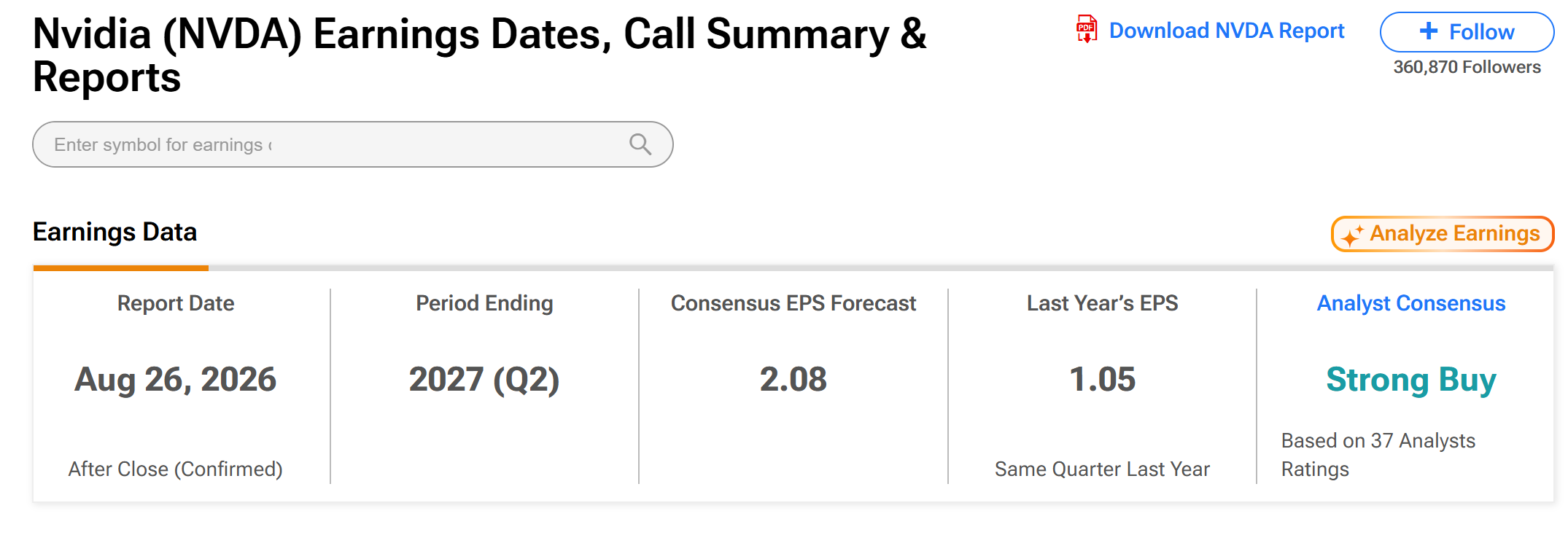
Nvidia reports Q2 earnings on August 26, and Wall Street already knows the headline number. Analysts expect about $92 billion in revenue and earnings per share of $2.08, double the year-ago figure.
The report is due in 14 days. Nvidia guided to $91 billion, so a beat is close to assumed. What to expect beyond that is where analysts split.
What Wall Street Expects From Nvidia Q2 Earnings
The call begins at 5 p.m. ET. It covers the quarter that ended July 26. Nvidia set the bar itself in May. It grew to $91 billion, give or take 2%, with gross margin near 75%. Those figures come from the company’s own outlook.
The year-ago quarter makes the math easy. Nvidia earned $1.05 per share on $46.7 billion in revenue. Hitting $92 billion would nearly double the top line.
One caveat on the earnings figure. TipRanks puts consensus at $2.08 from 37 analysts. Zacks, tracked by Nasdaq, shows $2.01 from 11. The gap is small, but it decides what counts as a beat.

Analysts are almost uniformly positive. Of the 37 tracked, 36 rate the stock a Buy and one a Hold. The average target sits near $310, with estimates from $250 to $500.
Crypto traders have their own reason to watch. Nvidia’s November 2025 report lifted Bitcoin above $91,000. AI sentiment now moves both markets.
Nvidia Has Beaten Its Own Guidance for Three Straight Quarters
The beat is expected because it keeps happening. The size of it barely changes.
- Nvidia guided to $54 billion for the October 2025 quarter and delivered $57 billion.
- It guided to $65 billion for January and delivered $68.1 billion.
- They also guided to $78 billion for April and delivered $81.6 billion.
That is a beat of $3 billion, $3.1 billion, then $3.6 billion. Every figure comes from Nvidia’s own quarterly releases.
Bank of America expects $94 billion to $95 billion this time. That is a beat of $3 billion to $4 billion. It sits exactly inside the pattern.
So the surprise would be a small beat, not a large one.
The Growth Rate is the Part Nobody Highlights
Here the picture shifts. Revenue growth from one quarter to the next has run near 20% three times in a row.
Nvidia’s $91 billion revenue guide implies growth of just 11.5%. Even Bank of America’s $95 billion works out to 16%. Both are the slowest pace in more than a year.
The year-on-year number still looks enormous at roughly 97%. That is because the comparison base is small, not because momentum is building.
While none of this means demand is fading, it does explain why a headline beat may not move the stock much.
The Guidance Number to Expect is $108 Billion
Bank of America analyst Vivek Arya models third-quarter guidance of $107 billion to $108 billion. Analysts currently carry roughly $104 billion. Arya keeps a Buy rating and a $350 target.
Goldman Sachs analyst James Schneider holds a Buy rating with a $285 target. He expects meaningful upside to guidance. He also warns that the bar is high after a 12% two-week run.
Goldman’s 2026 and 2027 estimates are 6% and 19% above consensus, respectively. Traders can weigh that against the current Nvidia stock price forecast.
The options market has voted too. Contracts expiring on August 28 imply a 6.75% move, or a range near $209 to $239. The stock traded around $224 on Wednesday after closing at $217.50 the day before.

What Could Go Wrong Between Vera Rubin and Memory Costs
Nvidia moved its Vera Rubin platform into full production on May 31. Shipments start in the fall.
“Agentic AI is a new kind of workload. One prompt can launch a thousand-step journey of reasoning, retrieval, tool use and response generation. Vera Rubin was built for this moment,” Jensen Huang, Nvidia founder and chief executive, in the company’s announcement.
- Memory is the cost problem.
It now accounts for 40% to 50% of the cost to build a system. That share used to be 15% to 20%.
Bank of America still sees margins holding near 73% to 74%. On Rubin racks, the memory hit is about 60 basis points. Larger pod systems could take 500.
- Then there is the funding question.
Nvidia has put roughly $70 billion into partners, including $30 billion in OpenAI and $10 billion in Anthropic. Critics say that props up its own order book.
Bank of America calls it 15% of the free cash flow it expects across 2026 and 2027. Skeptics are unmoved. The worry feeds the AI bubble debate.
Suppliers point the other way. Supermicro’s record AI backlog showed demand that has not cooled.
What to Watch on August 26
The setup is unusual. Nvidia could beat by $4 billion and still disappoint, because attention has moved to the October quarter.
Investors also want proof that the demand is external. That doubt grew once Nvidia began financing its own customers.
Expect the guidance slide to matter more than the beat. Whether $108 billion appears there may set the tone for months.
The post Nvidia Q2 Earnings in 14 Days: What to Expect from NVDA Stock? appeared first on BeInCrypto.


A new U.S. survey has found that 79% of prediction-market users lost money during the past year, while 51% used borrowed funds to place bets.
Summary
- 79% of users reported losses, including 27% who lost more than $500.
- Among users who borrowed money, 88% reported losses, compared with 69% of non-borrowers.
- 53% joined for income-related reasons, nearly twice the share motivated by entertainment or curiosity.
- The online survey covered 1,000 U.S. adults, with results based on raw, unweighted responses.
Prediction market losses rise among borrowers
BadCredit.org surveyed 1,000 U.S. adults and found that 15% had used a platform such as Kalshi, Polymarket, or PredictIt, placing the consumer findings against a period of rapid trading growth and continued regulatory debate.
Among self-reported users, 79% said they had lost money on prediction markets in the past year. More than one-quarter, or 27%, reported losses above $500, including 9% who lost over $1,000. Only 21% said they had not lost money during the period.
Losses were more common among people who financed their positions with debt. According to the study, 51% of users had funded bets through a credit card, personal loan, or another form of borrowing. Of that group, 88% reported losing money, compared with 69% of users who did not borrow.
Consumer finance expert Erica Sandberg warned that debt adds repayment costs to an already uncertain outcome. Borrowers may owe interest after losing the original amount, increasing the total cost beyond the value placed on the contract.
“Although tempting, borrowing money to place a bet is a universally bad idea,” Sandberg said.
Credit cards and personal loans are meant to finance purchases that borrowers can repay, she added, rather than speculative contracts whose value depends on the result of a future event. Sandberg advised participants to use only cash they can afford to lose without affecting bills or creating debt.
The study measured whether respondents experienced losses during the previous year, but it did not publish platform-level account records or calculate net returns from verified transaction histories. Its results therefore represent participants’ own reports rather than audited trading data.
Income needs are drawing users to prediction markets
Financial motives ranked above entertainment when respondents explained why they began using prediction markets. The survey found that 44% wanted to earn extra income, while another 9% were struggling financially and needed an additional source of money.
Combined, 53% entered for an income-related reason. Entertainment or curiosity attracted 27%, social-media content influenced 10%, and recommendations from friends or relatives brought in 7%. Another 3% said conventional investing felt inaccessible.
Across all surveyed adults, 30% believed prediction markets could realistically improve their financial situation. Men expressed that belief more often than women, at 37% versus 25%.
Usage also showed a gender difference. According to the survey, 24% of men had tried a prediction-market platform, compared with 9% of women. BadCredit.org did not provide account-level data to determine whether bet sizes, contract choices, or returns differed by gender.
The income findings come as prediction markets offer contracts tied to elections, economic releases, cryptocurrency prices, sports, and other events. Participants generally buy contracts priced between $0 and $1, with the value moving according to the market’s estimated probability before settlement.
Separate transaction research has also found that profits can be concentrated among a small number of accounts. In April, crypto.news covered an academic study of 1.72 million Polymarket accounts and about $13.76 billion in volume from 2023 through 2025.
Researchers from London Business School and Yale classified 3.14% of the accounts as skilled winners. Skilled traders and market makers, who together represented less than 3.5% of accounts, captured more than 30% of gains, while 67% of accounts categorized as unlucky or unskilled losers absorbed the platform’s total losses.
Prediction market volume has reached record levels
Consumer losses have drawn attention during a sharp rise in platform activity. Kalshi, Polymarket, and Polymarket US generated a combined $50.59 billion in July trading volume, according to recent market data published on Aug. 3.
The monthly total increased 7.8% from a revised $46.95 billion in June. Kalshi accounted for $37.7 billion, or about 74.5% of the combined figure, while Polymarket US grew 54% to $5 billion.
Polymarket’s international venue recorded $7.9 billion, down 26% from June. Combined activity across its U.S. and international operations reached $12.9 billion.
The figures represent taker notional volume, not customer deposits, platform revenue, or trader losses. Because one contract can change hands several times before settlement, the same capital may contribute to volume repeatedly.
World Cup contracts supplied a large share of summer activity. Chainalysis estimated that about 400,000 wallets generated $5.7 billion during the five-week tournament and that World Cup markets accounted for roughly 63% of prediction-market activity over that period.
Open interest across Kalshi and the two Polymarket venues fell from around $2 billion near the start of July to about $1.2 billion by month-end as tournament positions closed or settled. The decline occurred even as monthly turnover reached a record.
US regulators are examining customer protection
Prediction markets in the United States sit between federal derivatives oversight and state gambling rules. Kalshi operates as a Commodity Futures Trading Commission-designated contract market, while QCX, which operates Polymarket US, also appears on the CFTC’s list of designated markets.
Federal registration has not ended disputes over sports contracts. Several states maintain that products tied to games resemble conventional wagers and require local gambling licenses, while the platforms argue that the Commodity Exchange Act places their event contracts under federal supervision.
In July, the U.S. House Agriculture Committee scheduled a hearing focused on customer protection and market integrity as gaming groups pressed Congress to restrict sports-based contracts. As reported at the time, representatives of the American Gaming Association and Indian Gaming Association argued that some prediction products perform the same economic function as sports bets.
CFTC officials have also told regulated platforms to avoid presenting contracts through American-style gambling odds, which use formats such as +150 or -200. The agency reminded operators that event contracts remain subject to derivatives laws and that marketing, listings, and solicitations cannot use deceptive practices.
State litigation continues alongside federal scrutiny. Courts in different jurisdictions have reached conflicting early decisions on whether commodities law prevents states from applying gambling rules, leaving access and product availability dependent partly on where a user lives.
BadCredit.org conducted its survey through an online panel and used raw, unweighted responses. Questions about borrowing, losses, and motivations went only to respondents who said they had used a prediction market. The organization calculated a margin of error of about ±3.1 percentage points for the full sample and approximately ±8 percentage points for findings drawn from the user subgroup.


The Intercept and the Freedom of the Press Foundation filed a Truth API lawsuit against President Donald Trump on Wednesday. The case asks a federal judge to decide whether the president can sell early access to his own official statements.
The complaint, filed in the Southern District of New York, says presidential posts are government information. If that holds, no paying customer can own a bigger share of them than any other American.
A $100,000 Paywall on the President’s Posts
Truth Social’s parent, Trump Media & Technology Group, switched on the Truth API on August 1. The product feeds posts from the platform’s top accounts to paying clients within milliseconds. Trump’s account is the main draw.
Markets often move when he posts. Subscribers, mostly high-frequency trading firms, pay $60,000 to $100,000 a month for that head start. More than 10 firms have signed up, and the feed has already earned over $1 million.
That figure matters. Trump Media booked a $238.1 million net loss in the second quarter on revenue of just $1.7 million. At more than $1 million a month, the feed could soon out-earn the rest of the business.
Trump is the company’s largest shareholder through a trust. According to the complaint, his stake was once worth $4 billion and has since sunk to around $1 billion.
Inside the Truth API Lawsuit
The plaintiffs, backed by the watchdog group Citizens for Responsibility and Ethics in Washington (CREW), lean on two constitutional guarantees.
Under the First Amendment, they argue, journalists and the public hold an equal right to official information. Selling a head start breaks that right.
Follow us on X to get the latest news as it happens
The Fifth Amendment claim targets the price itself. Charging “unreasonable sums” for equal access undermines equal protection, the complaint says. It calls the product an “out-and-out plan of extortion.”
“Every American is entitled to equal access to the president’s public statements. Individuals who pay $100,000 to the president’s personal company do not have any greater entitlement to those public statements,” CREW chief counsel Nikhel Sus made that argument in the filing announcement.
The suit reaches into the White House itself. It also names Trump aide Natalie Harp, Deputy Chief of Staff Daniel Scavino, and the Executive Office of the President. None of the defendants had responded publicly by publication.
Regulators Have Killed This Model Before
Washington saw this coming. On July 28, Senators Adam Schiff and Elizabeth Warren demanded an SEC investigation, writing to Chair Paul Atkins days before the feed launched. Their letter listed stocks Trump had promoted on Truth Social this year, including Citigroup, Palantir, and Coinbase.
History offers Trump Media a warning. In 2013, Thomson Reuters sold select clients a two-second head start on consumer sentiment data for $6,025 a month.
New York’s attorney general pushed back, and the program died. A year later, Business Wire cut its direct feeds to high-speed traders under similar pressure.
Those sellers were private data vendors, and they charged a fraction of Truth API’s price. This time, the product is the sitting president’s own voice, and the seller is his own company.
A judge, rather than a regulator, may now decide whether official speech can carry a price tag.
The post Who Owns the President’s Tweets? A Federal Lawsuit Wants an Answer appeared first on BeInCrypto.

Four-run third fuels Twins past Orioles

Google’s new Tensor G6 brings performance, efficiency, and post-quantum security to the Pixel 11 series

The eclipse snapped by YOU: Daily Mail readers’ photos are revealed


-

 Fashion5 days ago
Weekend Open Thread: Mattifying Sunscreen
-

 Fashion5 days ago
Frugal Friday’s Workwear Report: Cap-Sleeve Pointelle Crewneck Sweater
-

 News Videos4 days ago
Can Astrology Help Find Gold and Silver Trends? A Financial Astrology Guide
-

 Sports7 days ago
Jordan Coyle & Cordiamo take Laya Arena Stakes at RDS
-
 Business7 days ago
US stocks: Dow closes at record on Mideast optimism; SpaceX, AMD drag Nasdaq
-

 Politics6 days ago
Reform UK And Greens Sink To Lowest Favourability Ratings To Date
-

 Business7 days ago
Supply chain issues impact Ingredion
-

 Tech5 days ago
Rinn Pharma & Biopharma to join NordicPharmaTrain network
-

 Business4 days ago
How to Start a Cleaning Business: A Step-by-Step Guide
-

 Business3 days ago
Datadog: Best Of Breed For Multiple Reasons
-

 Business4 days ago
BDC Weekly Review: Private BDC Q2 Numbers Are Strong
-
 NewsBeat23 hours ago
Communication cards help banking customers access services or report scams
-
Sports7 days ago
Spider-Man: Brand New Day ending explained: Is Peter Parker alive?
-

 Tech6 days ago
Price Hikes May Be Coming for PC Motherboards Next
-

 Business6 days ago
Brightwater secures funding for WA-first dementia projects
-
 Crypto World7 days ago
Galaxy Digital Stock Slides 14% as Crypto Prices Hit Earnings
-
 Business2 days ago
Oil Price Today (August 11): Crude oil rises to $88 after Trump’s compensation demand dents Hormuz opening. Here’s why
-

 Politics7 days ago
The Not-So Talented Mr Arday
-

 Business6 days ago
SpaceX Shares Plunge 13.6% After First Public Earnings as AI Capex Surge and Lockup Spark Selloff
-

 Tech7 days ago
How to Use Your Phone as a Webcam on PC and Mac (2026)
You must be logged in to post a comment Login