When you buy a new iPhone, you expect it to last. However, all rechargeable batteries are consumable components that chemically degrade over time. As a battery degrades, it can hold less charge, which ultimately affects your device’s daily use. Apple provides built-in tools that help you monitor cycle count — the number of full discharges and recharges it has undergone — and overall battery health. Understanding these metrics is essential for knowing if the batter is working as expected, when it might be time for a replacement or for better understanding the condition of a used iPhone before you buy it.
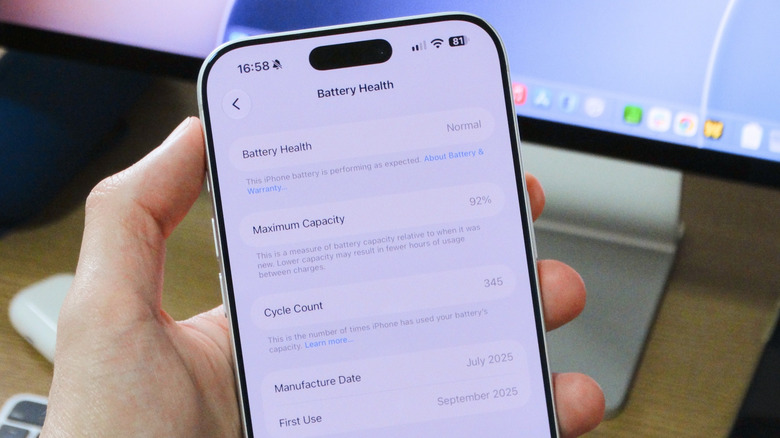
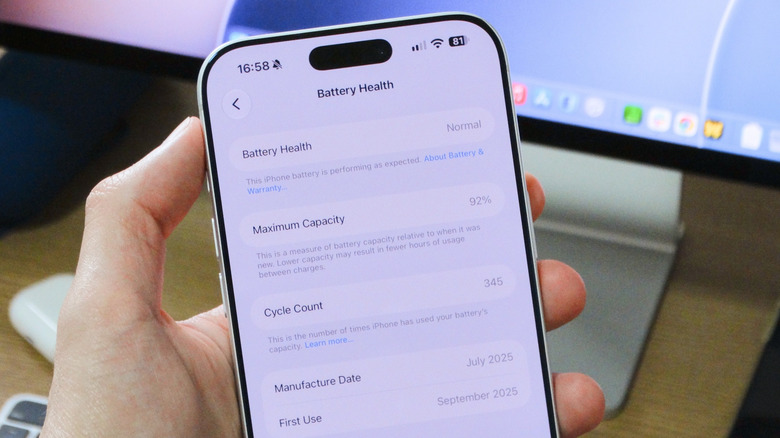
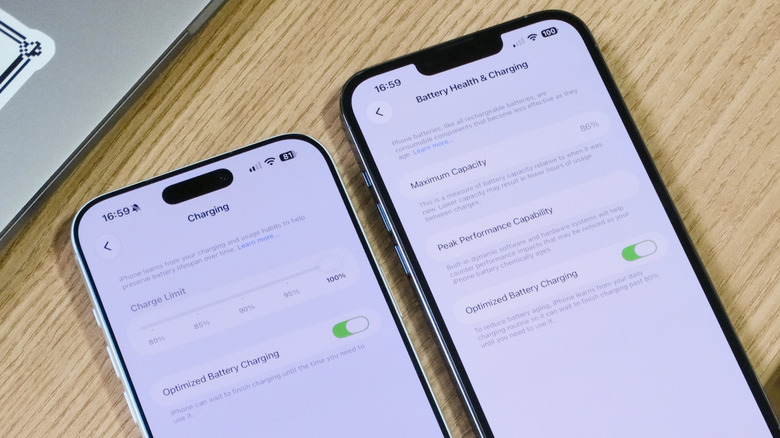
Checking your iPhone’s battery health is a pretty simple process. To get started, open the Settings app on your iPhone, tap Battery and look for the Battery Health section. On some older models, such as the iPhone 13, this section is called Battery Health & Charging. This screen will show you an estimate of your iPhone’s battery capacity relative to when it was new, along with other useful information.
Advertisement
What the health numbers actually mean
Filipe Espósito for Engadget
The Maximum Capacity percentage gives you a better idea of the overall condition of your iPhone’s battery. According to Apple, a typical battery is designed to retain up to 80 percent of its capacity when operating under normal conditions. For the iPhone 15 and later models, this estimate is based on 1,000 full charge cycles. For older models, the estimate is that the battery will last up to 500 cycles before degrading significantly. When the battery health drops below 80 percent, your iPhone may still work, but you’ll likely notice a significant decrease in battery life.
In some cases, iOS may even enable additional performance management features to prevent the iPhone from shutting down unexpectedly due to a severely degraded battery. In that case, you’ll see a warning below the Peak Performance Capability section. If you don’t see anything, it likely means your iPhone hasn’t had any battery issues and is still running at full performance.
To help preserve your iPhone’s battery health, you can enable the Optimized Battery Charging option in the battery settings. When enabled, this feature learns your daily routine and when you typically charge your iPhone, so that it temporarily pauses charging at 80 percent and only completes the charge to 100 percent around the time you need to use your iPhone again. On the iPhone 15 and later, you can also set a maximum charge limit for your device, which also helps preserve battery health for longer.
Advertisement
How to check your cycle count and why it matters
If you have an iPhone 15 or newer, Apple provides an easy way to check the cycle count directly in the Settings app. Go to Battery > Battery Health, and scroll down to find your cycle count. If you’re using an older model, Apple doesn’t provide battery cycle statistics natively. This means you’ll have to rely on third-party alternatives, such as the popular Mac app coconutBattery, to check your iPhone’s battery cycle count.
Knowing your device’s battery cycle count can be helpful for understanding its long-term lifespan, as well as how heavily you’ve been using your device. iPhone 15 models and later are rated to retain good battery health for up to 1,000 full charge cycles before experiencing battery issues, while older models are rated for up to 500 cycles. For reference, 1,000 cycles works out to two or three years’ use in under real-world conditions.
Keep in mind that one cycle represents expending 100 percent of your battery’s current capacity, though not necessarily all at once. For example, if you used 50 percent of your battery, recharged your device and then used another 50 percent afterward, that counts as one complete charge cycle.
Advertisement
Reaching these numbers doesn’t mean your iPhone’s battery will automatically fail, but it does mean its capacity will typically be lower, so you may notice shorter battery life. If your iPhone’s battery health is below 80 percent or if it has reached 1,000 charge cycles, you should consider replacing the battery to keep your phone running smoothly. To do so, your best option is to contact Apple Support to arrange for a replacement.
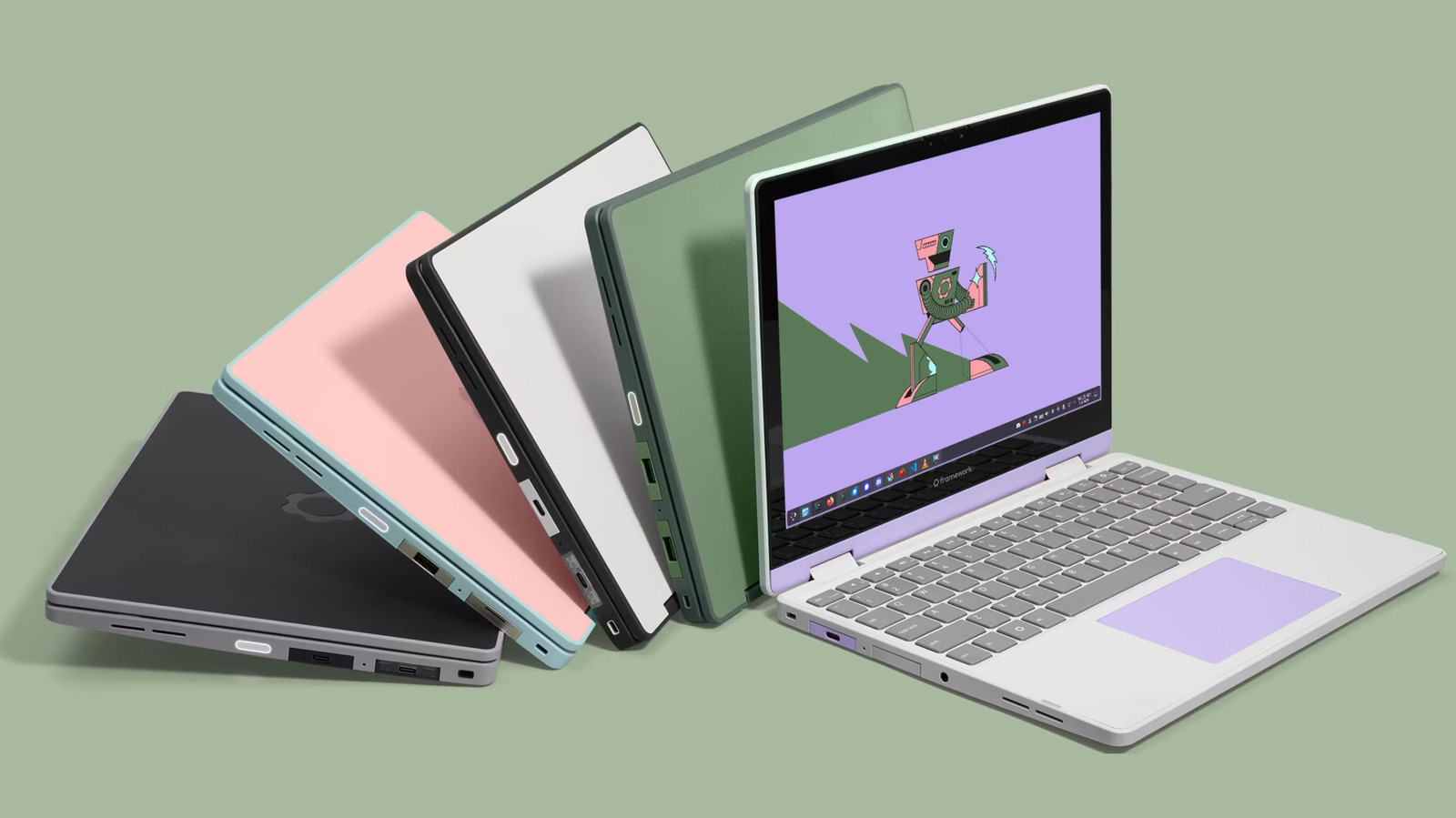
Framework leaned on efficiency improvements the Intel Core Ultra Series 3 brought to its Framework Laptop 13 Pro, and the company says the entry-level, non-Ultra chips bring similar benefits to the Framework Laptop 12. Pre-built versions of the new laptop features either a Core 3, Core 5 or Core 7 chip, with 8GB of RAM, 16GB of RAM or 32GB of RAM, respectively. Framework says the Laptop 12 has improved battery life as a result of its new chip, and specifically notes the Core 5 model demonstrated 70 percent better battery life while streaming Netflix when compared to the Core i5 version of the original Laptop 12. Starting at 8GB of memory isn’t ideal, but it’s possibly a reflection of the RAMaggedon issues all computer makers are dealing with. Speaking of, you can equip the Laptop 12 with up to 48GB of RAM if you’re happy paying $659 for that upgrade.
Advertisement
Using the latest Intel chip brings along other perks, too, like support for Thunderbolt 4 on two of the Laptop 12’s four hot-swappable Expansion Cards, and faster DDR5 RAM. The 12.2-inch display hasn’t been improved, but the Laptop 12 can be configured to include a backlit keyboard and a fingerprint reader. You’ll have the most flexibility via Framework’s DIY option, but the pre-built Core 5 and Core 7 models running Linux feature both upgrades by default.
Like the Laptop 13 Pro, the Laptop 12 is yet another of Framework’s computers that can come pre-installed with Linux. The company says over 80 percent of original Laptop 12 owners are running Linux, so it’s decided to offer the new model pre-installed with Fedora, with Windows 11 available as a $100 upgrade. Framework says the new Laptop 12 hardware has also been seeded to other Linux distros so support will be ready when the laptop ships.
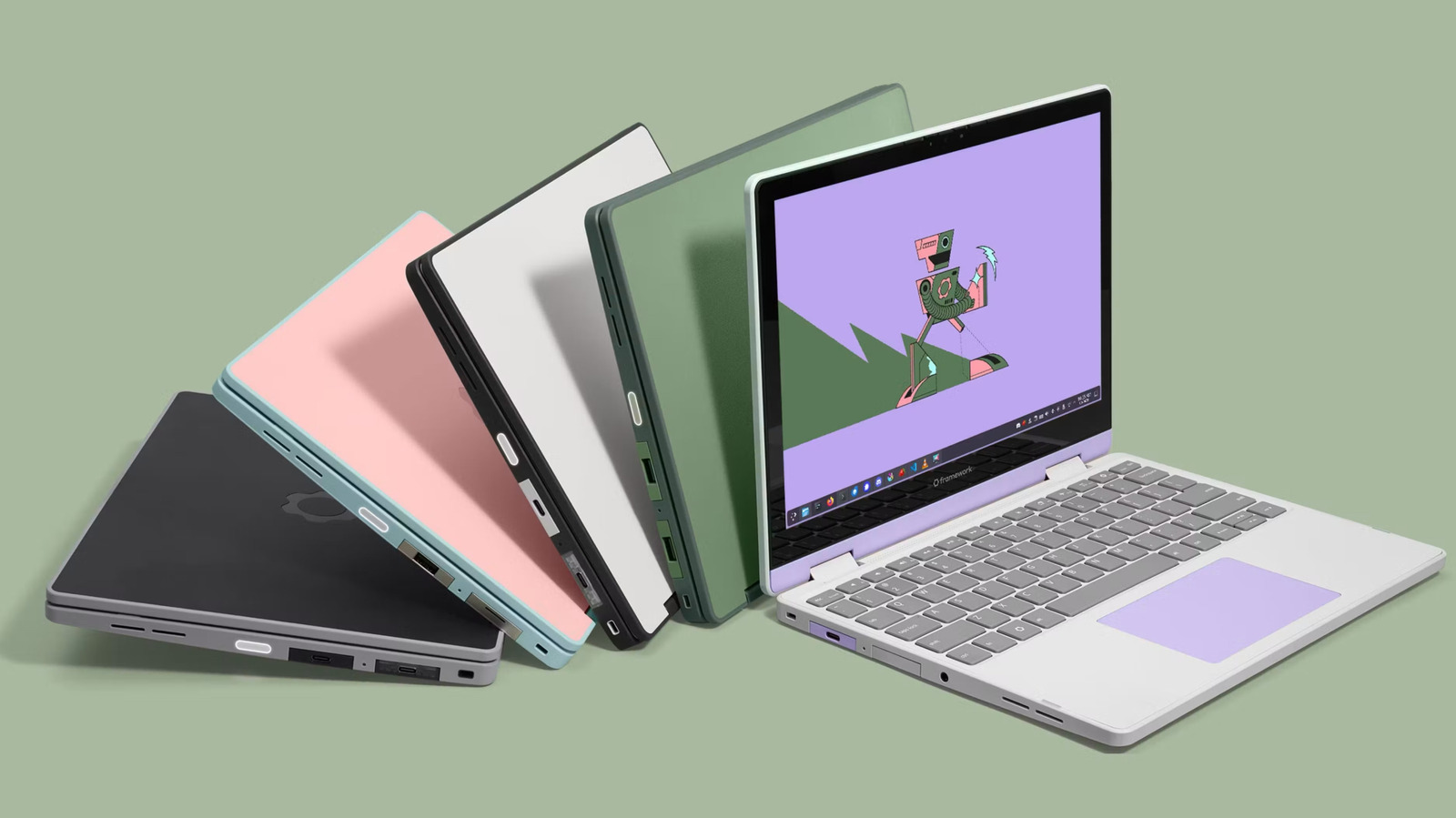
The Framework Laptop 12 starts at $699 for a pre-built Linux configuration in green or $549 for a DIY version in black, gray, light purple, pink, or green. Framework is collecting pre-orders now and plans to start shipping the new laptop in October.
The big picture: Several major US automotive and heavy equipment manufacturers are reportedly modifying their business models to capitalize on the exploding demand for power equipment in AI data centers. Caterpillar, Cummins, Eaton, and Ford are among the major US industrial companies benefiting from the AI boom.
Caterpillar is the world’s largest construction equipment manufacturer, ahead of rivals Komatsu, Volvo CE, Hitachi, and JCB. However, its engine and turbine sales surpassed its construction equipment revenue for the first time last year, as AI data centers turn to jet engines and diesel generators for power.
According to CEO Joe Creed, the company began “modernizing and investing” last year to meet burgeoning demand from data centers. A major part of that investment went toward expanding capacity at its factory in Lafayette, Indiana. The expansion is expected to cost around $275 million and create 100 new jobs.
Earlier this year, Caterpillar won contracts from Nscale to supply G3516 natural gas generators for the proposed 2,250-acre Monarch Compute Campus in Mason County, West Virginia. The facility will provide 1.35GW of power for a Microsoft data center featuring a large-scale deployment of Nvidia’s Vera Rubin NVL72 GPUs.
Advertisement
The Mason County facility is expected to reach a total power capacity of up to 8GW by 2031, potentially becoming “one of the largest dedicated AI compute installations in the world.” The plant will be built in phases, with the first phase expected to come online by 2028 with a capacity of 2GW.
Cummins is also reaping the rewards of the AI boom, with demand for its diesel, natural gas, and hydrotreated vegetable oil generator sets reaching record highs. According to CEO Jennifer Rumsey, the company’s Power Systems segment earned record profits in Q1 2026, fueled by “continued strong demand for data center backup power.”
The company is now expanding its product portfolio to include larger generators that can be used as the primary power source for data centers. The new generators will use 130-liter engines powered by natural gas and produce 4MW of electricity.
Ford is also looking to data centers to supplement its automotive revenue. The company reportedly plans to supply its excess EV batteries to AI data centers and other large factories amid declining demand for electric cars.
Advertisement
Eaton, an Ohio-based manufacturer of circuit breakers, switchgear, and other electrical equipment, has also expanded its data center business. The segment accounted for 21% of the company’s revenue in the last fiscal year, up from 14% in 2023.
Rehlko, Johnson Controls, and a host of other major US heavy equipment manufacturers are also capitalizing on the AI data center boom. The trend has partly contributed to US manufacturing output rising in July to its highest monthly level since the Covid-fueled growth of 2021 – 22.
For as long as anyone can remember, Github has been the de facto code host preferred by a majority of developers. However, in recent times, the platform has struggled with widely reported outages and performance degradation and, as it drops the ball, Cursor is waiting to pick it up.
The AI startup, which is now officially a part of SpaceXAI, launched Origin this week — a new code hosting platform designed to do all of the things that developers typically use Github for: collaboratively work on codebases, browse and edit them, handle pull-requests (edits made by others asking to be added to the main codebase) and store them in repositories.
This seems like a natural next step for Cursor, whose primary focus up until this point has been selling automated web development services through its AI Code Editor. Cursor has also said that “agent native” features will soon be available for Origin, although hasn’t shared many details yet. The company also says it is building a wider “app ecosystem” to support broader coding efforts within Origin.
Interestingly enough, using Origin doesn’t require a user to stop using Github. Indeed, Origin is designed to allow developers to work alongside Github and pass code back and forth between the two in an interoperable manner.
Advertisement
“Your GitHub repos can sit alongside the ones Cursor hosts,” Cursor says in its blog. “Connect GitHub to Cursor, pick your org, and you’ll see the repos you can sync. Select one and Cursor pulls it in.”
The launch of Origin coincides with ongoing frustration over a perceived dip in Github’s services. Indeed, on the same day that Cursor launched its new platform, Github suffered a quite lengthy worldwide outage. For over six hours, the site’s functions were reportedly degraded, with a nearly 20 percent error rate worldwide.
This isn’t the first time in recent times when this has happened either. Earlier this year, after a rash of outages, Github announced new actions to sate unhappy coders as its availability problems seemed to escalate. More broadly, the platform has suffered 257 outages over the past year, a recent analysis by LeadDev states. Such persistent issues have led to “a visible exodus of high-profile users” writes LeadDev’s reporter Charles Humble.
Still, if Cursor wants to compete with Github, it will have its work cut out for it. According to Github’s own metrics, some 180 million developers use its platform as of last October. The platform, which was founded in 2007 and was acquired by Microsoft in 2012, continues to be the largest source code hosts in the world.
Advertisement
When you purchase through links in our articles, we may earn a small commission. This doesn’t affect our editorial independence.
Comcast is activating Wi-Fi motion sensing on millions of compatible Xfinity gateways, allowing the routers to detect movement by measuring disruptions in signals between the gateway and connected devices. The free feature, part of Xfinity Shield, can send activity alerts through the Xfinity app and offers Home, Away, and nighttime monitoring modes without requiring separate motion sensors. The Verge reports: Wi-Fi motion sensing is a technology that has been around for a while, but it’s only recently that it’s become accurate and reliable enough to catch on. Linksys launched a similar service in 2021, but discontinued it a few years later. Lighting company Wiz launched a line of Wi-Fi-sensing smart bulbs in 2023, and more recently Philips Hue deployed a similar radio-frequency sensing technology in its products (using Zigbee rather than Wi-Fi). Comcast’s motion sensing pairs with new modes in the Xfinity app — Home Watch, Away Watch, and Dark Watch (a night/sleep mode) — allowing you to turn sensing on or off based on your activities.
The first death came in July 2022, when Spotify stopped manufacturing its first hardware product only five months after putting it on general sale in the U.S. The second arrived on December 9, 2024, when Spotify remotely made the remaining devices non-operational and advised owners to recycle them. Refunds were eventually offered to eligible purchasers.
Apparently nobody informed the corpse.
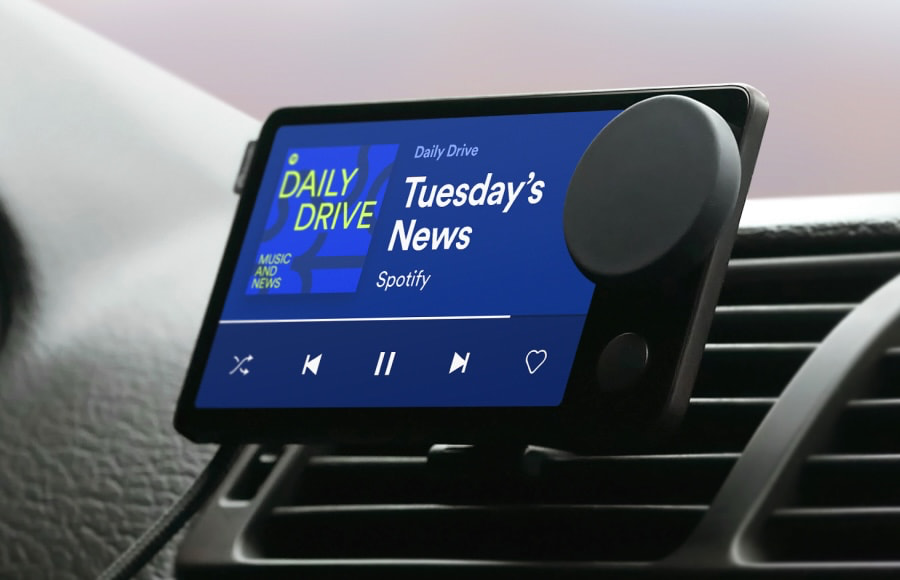
A new free, open-source firmware called Mira 1.0 has brought Car Thing back to life without Spotify’s original Car Thing software or companion infrastructure. Flash Mira onto the device, tether it to a phone over Bluetooth or a computer over USB for internet access, sign into Spotify and the little dashboard screen becomes useful again.
Advertisement
There is something wonderfully awkward about volunteers accomplishing that after Spotify told customers to find an electronics recycling bin.
What Was Car Thing Again?
Spotify originally developed Car Thing for drivers whose vehicles lacked modern infotainment systems such as Apple CarPlay or Android Auto.
The four-inch touchscreen connected to a smartphone and offered Spotify playback using touch controls, a large physical dial, preset buttons and “Hey Spotify” voice commands. It still needed a phone for data and originally required Spotify Premium, so Car Thing was essentially a very attractive $89.99 Spotify remote for your dashboard.
And yes, Spotify actually sold them.
Advertisement
What Spotify has never publicly disclosed is how many. Reports at the time claimed roughly 2 million people had joined the waitlist, but that clearly did not translate into two million purchases. Spotify stopped production in July 2022 and recorded a €31 million charge associated with the decision.
Two million people apparently wanted to know what Car Thing was. Considerably fewer appear to have wanted one badly enough to hand Spotify $90.
What Does Mira 1.0 Actually Do?
Quite a lot.
Advertisement. Scroll to continue reading.
Advertisement
Mira restores playback controls and the physical volume knob, four preset buttons, album artwork and lyrics, podcast support with synchronized transcripts and device selection. It also adds its own “Hey Mira” voice control for playing music, changing volume, skipping tracks and managing queues. Multiple Bluetooth phones can be paired with the device.
Mira itself requires no companion app, additional account or paid subscription. It does, however, work only with Spotify, requires a Spotify sign-in and needs an internet connection supplied through Bluetooth or USB tethering.
This is not a one-click firmware update for your father-in-law. Installation requires a computer, USB-C cable and flashing the replacement firmware, which wipes the original software. The developers also acknowledge occasional problems waking from sleep and Bluetooth not always reconnecting automatically.
Why Is This Unique?
Because Mira changes the Car Thing story from failed gadget to an uncomfortable lesson about who controls hardware after you buy it.
Advertisement
Spotify did not merely stop making Car Thing or end technical support. It made functioning hardware stop functioning. Owners were initially told to reset the devices and dispose of them through appropriate e-waste channels. No refund of any kind was provided to customers who stupidly took the plunge.
Mira demonstrates that those screens, knobs, buttons and processors were still perfectly capable of doing something useful. What disappeared was Spotify’s willingness to support them. That should concern anyone buying hardware whose basic functionality depends on a manufacturer’s servers remaining interested in its continued existence.
Who Is This For?
Mira is primarily for existing Car Thing owners, tinkerers and anyone who kept one in a drawer rather than following Spotify’s recycling advice.
It also gives the device a reason to exist beyond the car. Car Thing can serve as a desktop Spotify controller with physical controls, album art, lyrics and voice commands without requiring the main Spotify application to dominate another screen.
Advertisement
What Mira does not do is turn Car Thing into CarPlay, Android Auto or a general-purpose infotainment system. There is no Apple Music or TIDAL support, navigation remains somebody else’s problem, and this still requires more fiddling than mounting your phone on the dashboard.
The Bottom Line
Spotify deserves exactly zero victory lap here. This is the company that announced lossless audio in 2021 and did not actually begin delivering it until September 2025, years after Apple Music, Amazon Music and others had moved on. More recently, its approach to AI and music has looked less like a philosophy than a moving target: stronger rules against impersonation and AI spam in 2025, AI-powered covers and remixes with Universal in 2026, and now new labels designed to keep AI personas out of recommendations. Spotify certainly knows how to change lanes; signaling first would be nice occasionally.
Car Thing belongs in the same conversation because Spotify sold customers a piece of hardware, lost interest in it, and ultimately rendered it useless through a software shutdown. The embarrassing part is that the hardware itself did not suddenly become obsolete. A group of software developers looked at the same discarded screen, knobs and buttons and saw something Spotify apparently did not: a perfectly usable product that did not need to become electronic waste just because the corporate strategy changed.
So the people worth celebrating here are the software geeks behind Mira, not Spotify. They have given Car Thing what amounts to a third life and, in the process, made Spotify’s decision to kill it look even worse. Companies love talking about sustainability, ownership and putting users first. Sometimes the most convincing rebuttal is a few developers with GitHub accounts refusing to accept that a working piece of hardware belongs in the trash.
Although we personally have yet to see anyone brandishing an old digital point-and-shoot camera, we hear they’re back in vogue. Why, though? People are nostalgic for that image quality. While he certainly could have simply picked up a vintage model somewhere for a likely inflated price, [Arnov Sharma] decided to build his own version and call it the PolyShot.
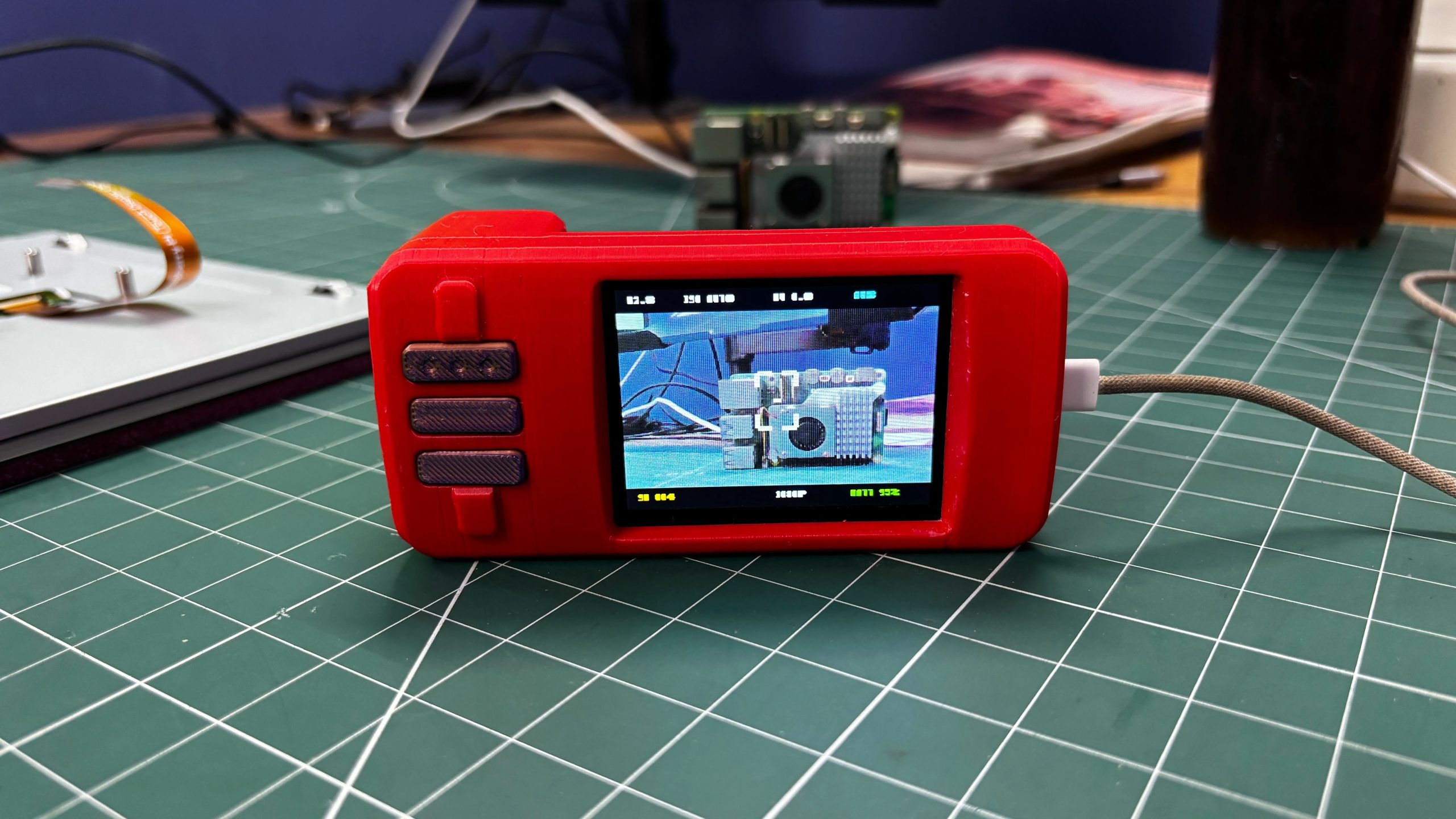
The core of this project is the Unihiker K10 dev board, which uses an ESP32-S3, a whopping 2 megapixel camera, and a micro SD card to capture photos and display them back on the screen. The tricky part, if you can call it that, is the custom PCB. It’s a simple board with just three buttons: shutter, gallery, and next image. We do like that the position of the battery compartment creates a nice grip.
The biggest difference here is that there is a few-second delay between pressing the shutter button and actually capturing the image, which you can see in the short videos below. So if you’re trying to get a shot of a skink or something equally speedy, we wish you good luck.
Advertisement
In a future iteration, [Arnov] wants to address the issue of image quality, because this project ended up evolving into a more traditional digital camera. He would also improve the battery life, for which the current expectancy is around three hours on a charge. Ultimately, [Arnov] wants to ditch the Unihiker and design everything from the ground up, using an ESP32-S3 module.
If you are a regular reader, then the odds are you have taken apart an electronic gadget, either for a fix, or simply because your curiosity got the better of you. Once inside, it’s all but impossible to help yourself from doing at least a little reverse engineering. That’s what happened when [PRBS23] took a look inside a Gravity 800 Grill for a simple wire fix. But one thing led to the next, and now open source firmware for the grill is freely available!Control board schematic.
The thermistor along with the physical inputs are connected to a 16 pin chip, interfacing with the MCU over a 9600 baud UART connection. [PRBS23] cannot determine an ADC chip meeting these specifications, so the most likely answer is a cheap MCU programmed to act as a simple analog fronted.
The neatly labeled programming header is used to quite easily dump the firmware with the espflash utility. Analyzing this dump reveals a rather strange ADC correction function used by the original firmware. The necessity and overall utility of this function remains unclear, as it only corrects by a maximum of two or three degrees Fahrenheit.
Most of the other features ended up being at least somewhat easier. The CS1621 segmented display driver is reasonably well documented with datasheets making its implementation far easier. Likewise, the other odds and ends were implemented in a far more normal manner compared to the thermistors.
Yet if you’ve ever stumbled into a local TikTok livestream, the reality often looks very different.
Instead of thousands of viewers piling into a show, many sellers find themselves talking to a few dozen people waiting for the next voucher code before scrolling away.
The format has become almost routine across Southeast Asia. In 2023, nearly five in 10 consumers watched livestream sales at least once a week, and 63% of viewers went on to make a purchase.
In Singapore, that figure was just 40%. Still, a handful of local brands have managed to make livestreaming work.
The brands that have made it work
The three brands Vulcan Post spoke to—Tasty Toastys, Tap Space, and Emporal Co.—operate in completely different categories.
Advertisement
One sells bread-themed plushies, another sells MRT-inspired collectibles, and the third sells candles and haircare.
Yet they’ve all found growth through livestreaming.
1. Make the livestream itself entertaining
Tasty Toastys offers bread-themed merchandise such as plushies, tote bags, blind boxes, travel neck pillows, and insulated bottles./ Image Credit: Tasty Toastys
For Tasty Toastys, livestreams became less about pitching products and more about giving fans something fun to watch.
Founder Chanel Lee discovered that her bread-character collectibles naturally created “watchable” moments—whether it was unboxing plushies, showing new designs, or letting fans react together in real time.
That communal experience helped the brand grow beyond local consignment shelves into 12 Toys “R” Us outlets and even a dedicated US TikTok Shop.
Advertisement
If the product creates anticipation on screen, viewers stay longer.
2. Consistency pays off
Tap Space’s store at Burlington Square./ Image Credit: Tap Space
Transport-collectible brand Tap Space arguably had one of the toughest starting points. Founder Danial Sim launched with zero followers and a marketing budget of just S$50.
His solution wasn’t clever growth hacks—it was consistency.
Every night after dinner, he livestreamed himself showing the MRT station keychains he’d made.
Those sessions gradually brought in a few hundred followers each day, eventually snowballing into a business capable of selling 1,500 products in a single day at a Takashimaya pop-up before selling out by day three.
Advertisement
Consistency compounds, even when early audiences are small.
3. Putting a face behind the brand
Emporal Co. has expanded its product range beyond hand-poured candles into skincare, haircare, and scented products like sachets and perfumes./ Image Credit: Emporal Co.
The sisters behind skincare and candle brand Emporal Co., Grace and Lena Lim, spent two months making zero sales.
Then, one TikTok video went viral.
Instead of relying solely on that lucky break, they kept posting daily content featuring themselves and their products, turning followers into customers who later showed up in real life. Grace has even been recognised in public by people who’ve supported the brand for years, with one customer stopping her to ask for a selfie.
Today, the business generates six-figure annual sales, has sold over 17,000 bottles of leave-in hair conditioner in two years, and attracted around 400–450 people to a warehouse sale built largely through TikTok.
Advertisement
Their biggest advantage was familiarity.
A different playbook for live commerce
None of these brands relies on the tactics commonly associated with livestream commerce elsewhere.
Instead of aggressive countdown timers or endless discounts, they lean on three key pilars: Consistency, a strong visual hook, and a founder whose personality is the product.
Image Credit: Tasty Toastys/ Tap Space/ Emporal Co.
That matters because Singapore’s structural reality is very different from its neighbours’.
The single most important reason live commerce exploded across Asia is one Singapore simply doesn’t have: large populations living far from physical retail.
Livestreaming doesn’t just entertain these consumers, but brings the market to them.And in a way, residents in rural areas have become micro-retailers in their own homes. Farmers and artisans in rural China now sell directly to urban consumers through live broadcasts, bypassing the physical retail infrastructure they never had.
Image Credit: MIT
Unlike Indonesia or Vietnam, where millions of consumers live far from physical retail, Singapore has one of ASEAN’s highest concentrations of shopping malls. Most people can reach a mall within minutes.
Whereas in Singapore, the city-state has the highest retail space per capita in ASEAN, at 1.08 square metres per person — nearly double Bangkok’s 0.8 sqm and significantly above Kuala Lumpur’s 0.71 sqm. Total retail space on the island stands at 6.1 million square metres, making Singapore one of the most mall-dense cities in the world.
The urgency that drives impulse purchases on a livestream—”I can’t get this anywhere near me”—simply doesn’t apply in Singapore.
Advertisement
And vouchers, which dominate many local TikTok streams, don’t necessarily solve that problem. They can give viewers a reason to tune in briefly, redeem a code, and leave.
The brands succeeding in Singapore have therefore had to solve a different problem: not how to make people buy, but how to make them want to stay.
Trust is also a barrier
Trust is the foundation of live commerce. You’re buying from a person you’ve watched for 20 minutes, often without seeing the product in person first. And many viewers who find trust in a livestreamer will often return for more.
In markets where livestreaming took off early, before bad actors moved in, that trust was established before it could be eroded. However, Singapore got the livestream scams before the culture could concretise.
Advertisement
TikTok-related scam cases in Singapore rose nearly 38% in 2025, according to the Singapore Police Force’s Annual Scam and Cybercrime Brief, making it the only major platform where scam cases increased, even as Facebook, Instagram, WhatsApp, Telegram, and Carousell all saw declines.
On the bureaucratic level, TikTok itself rejected 1.4 million seller applications and removed 700,000 sellers for policy violations in H1 2025 alone, which tells you both how aggressive TikTok enforcement has become and how serious the underlying problem of scams really is.
When shoppers become wary of livestream sellers, every legitimate creator has to work harder to earn credibility.
Singapore’s version of live commerce may look smaller, but more personal
As Singapore’s live commerce ecosystem develops, some businesses are looking overseas for answers.
But importing the mechanics of a more mature market doesn’t necessarily mean importing its success.
The biggest takeaway from the brands that have made livestreaming work here is that Singapore may need its own version of live commerce.
The winning formula isn’t necessarily bigger audiences, more frequent streams, or deeper discounts. It’s giving a relatively small audience a reason to keep coming back.
Advertisement
Read other articles we’ve written on Singaporean businesses here.
Featured Image Credit: Tasty Toastys/ Emporal Co./ Tap Space
Comcast is promoting WiFi-based motion detection as a part of its new Xfinity Shield home protection platform, allowing routers and wireless devices to detect people moving through a home without cameras or motion sensors.
This feature was announced as part of a new Xfinity Shield product offering on Tuesday, a new application suite that combines cybersecurity, physical home monitoring, and family safety features through Xfinity WiFi and the Xfinity app.
Part of this new offering is WiFi Shield, which is included at no additional cost for Xfinity Internet customers with compatible gateways. It combines Xfinity’s CyberSecure network protection, Family Settings, and WiFi Motion, with Home Watch, Away Watch, and Dark Watch modes used to control when notifications are generated.
Comcast is also launching Shield Select for $15 per month, which adds an indoor camera, door/window sensor, cloud video storage, and 24/7 urgent response functionality.
However, while Comcast is now making WiFi Motion a major part of its WiFi Shield security offering, the motion detection feature isn’t new.
Advertisement
A Reddit post from August 21, 2024, shows an Xfinity customer receiving an email introducing WiFi Motion.
This email describes the same functionality as today’s announcement, stating that the feature detects disruptions to WiFi signals between the gateway and devices on the network and generates notifications in the Xfinity app.
“It works too. It detects motion to the point of raising your hand to change the channel with the remote control. Detects my cat walking across the living room,” reads another user using the feature in 2024.
WiFi NOW also reported in February that Comcast had offered WiFi Motion “for a long time” and was ramping up its marketing, including advertising it during Olympic hockey broadcasts.
Advertisement
Turning WiFi signals into motion sensors
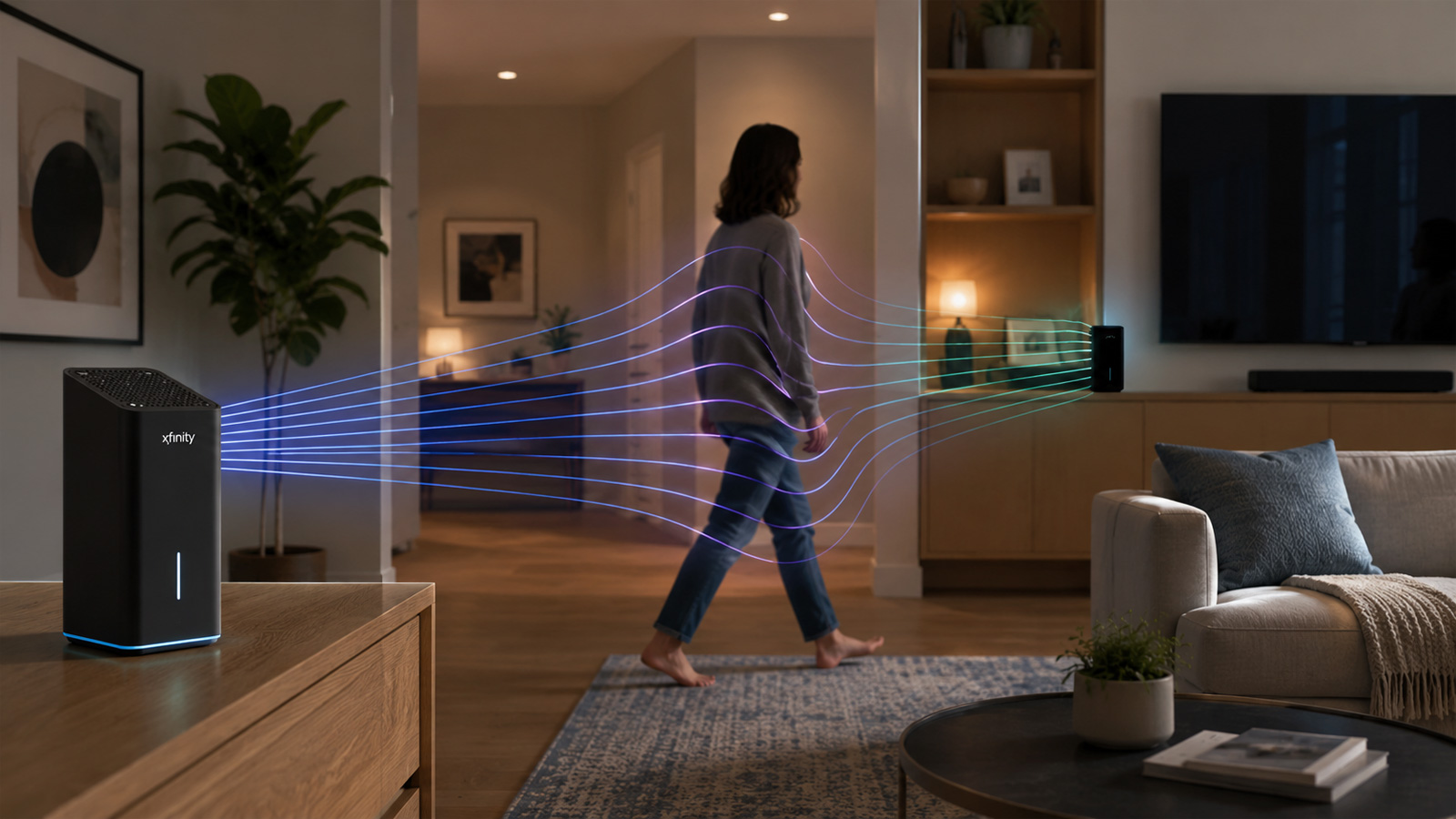
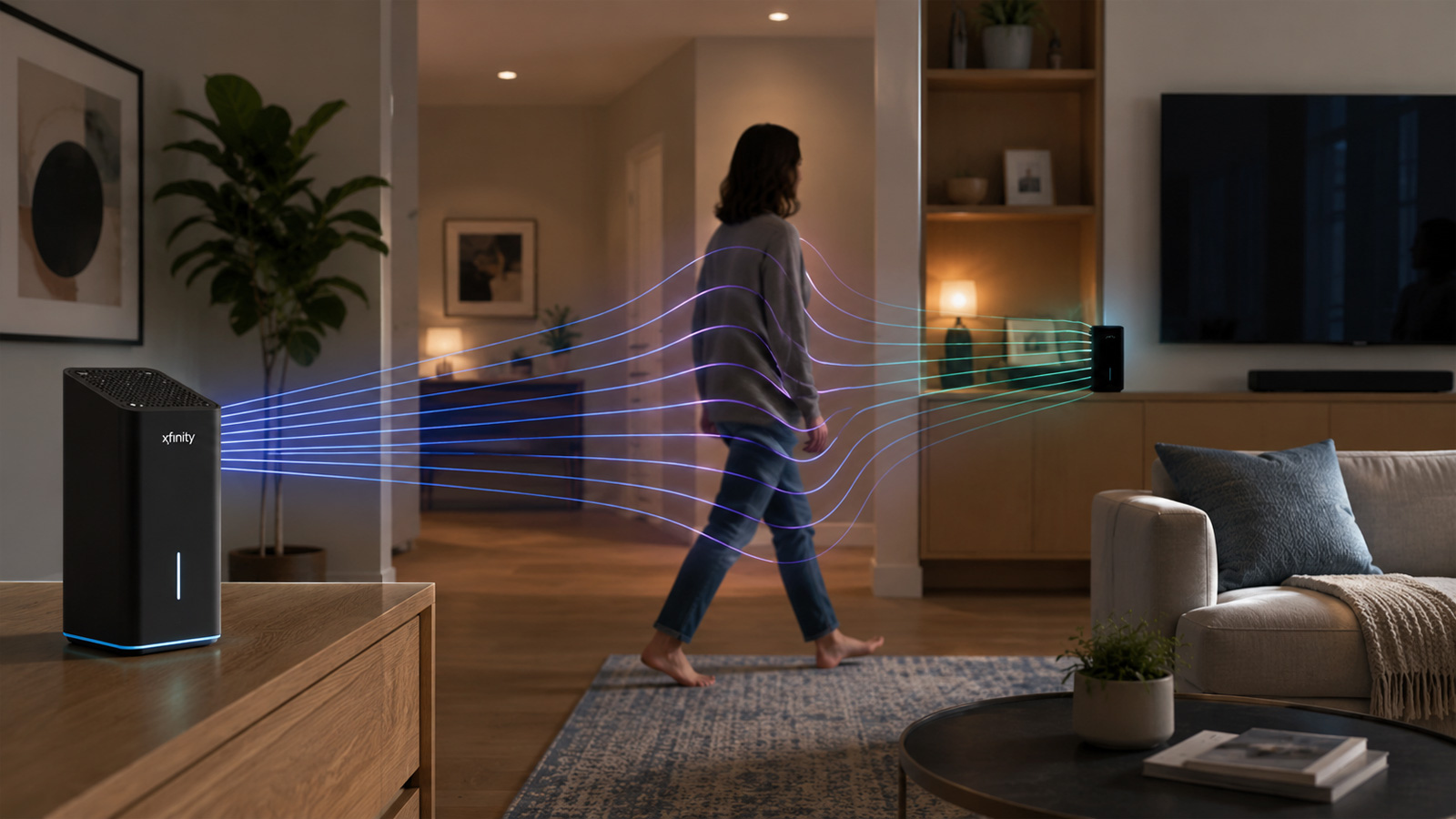
WiFi Motion works by turning the radio links between an Xfinity Gateway and stationary WiFi devices into virtual motion sensors.
According to support documents, customers select stationary WiFi devices, such as smart speakers or thermostats, positioned around the home. When someone moves through the area between the gateway or extender and one of those devices, their body changes how the WiFi radio signals travel.
Comcast says the system detects these changes in the home’s radio frequency signals and uses them to determine that movement has occurred. Customers will then receive notifications through the Xfinity app without installing a camera or motion detector.
Xfinity says the system does not identify who is moving or determine their exact location, and WiFi Motion is opt-in and disabled by default.
Advertisement
“It is designed to detect motion, not identify specific people, and does not track the exact location of movement. Notifications indicate when movement is detected between a connected device and the Xfinity Gateway,” explains an Xfinity support document.
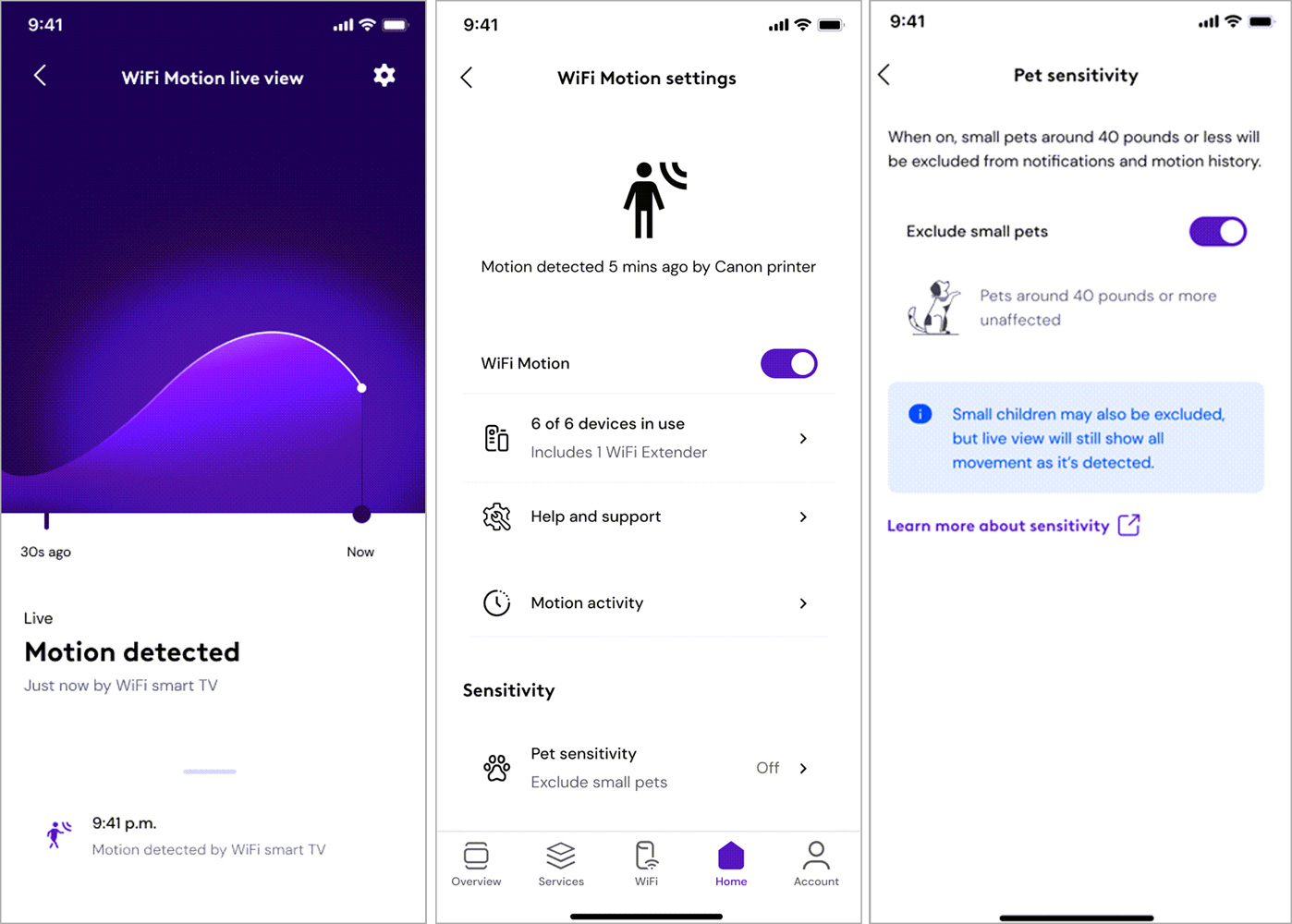
However, the technology can be sensitive, with Comcast providing different motion sensitivity levels to filter out movement from small pets weighing around 40 pounds or less.
The company warns that the system has no visual information and therefore may not always distinguish a small pet from a similarly sized child.
Various Wifi Motion screens in the Xfinity app Source: Xfinity
Comcast also advises customers in apartments and other buildings with shared walls to lower the sensitivity if movement outside the sensing zone causes unwanted detections.
A Comcast patent application provides a glimpse into how this type of system can work.
It describes using stationary network devices for motion detection and analyzing changes in characteristics such as the wireless signals to determine when an object or person has moved through a space.
The patent explains that WiFi signals can travel along multiple paths as they reflect or scatter off walls, people, and other objects. Movement changes those paths and the resulting wireless signal, allowing software to detect that something in the environment has moved.
Comcast’s patent cites several earlier Cognitive Systems patents related to WiFi motion detection, including technology for detecting motion from repeated wireless transmissions and motion detection in mesh networks.
Advertisement
Using WiFi as an invisible motion sensor raises questions about what happens to the data generated when people move around their houses.
As first spotted by TechCrunch, Comcast’s WiFi Motion documentation says the company may disclose information generated by the feature to third parties “without further notice to you” in connection with a law enforcement investigation or proceeding, a dispute involving Comcast, or pursuant to a court order or subpoena.
Comcast separately states that it does not monitor the motion or notifications generated by WiFi Motion.
The company’s documentation does not explain what WiFi Motion information Comcast retains, how long it keeps it, or what it could provide in response to a legal demand.
Advertisement
BleepingComputer contacted Comcast with questions about the generated data and will update the article if we receive any additional information.
Overall prevention scores can hide what happens after initial access. Once attackers are using valid credentials, prevention drops sharply.
The Blue Report 2026 measures defenses technique by technique across 338 million simulations run in customer production environments.
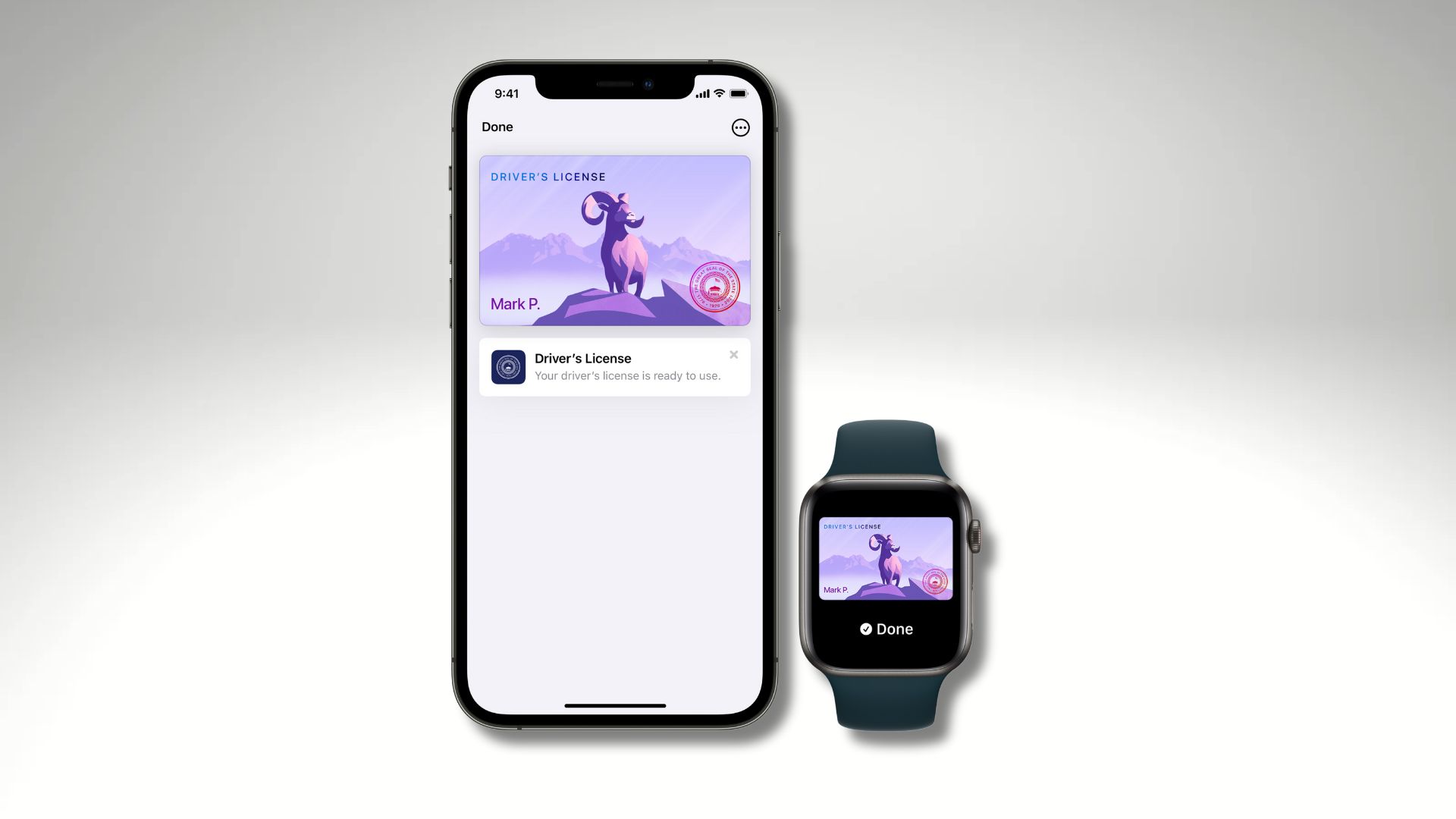
Apple is expanding one of the most useful features in Apple Wallet, with digital driver’s licences and state IDs set to arrive in four more US states.
According to evidence found in Apple’s code, Wallet IDs are coming to Oklahoma, Utah and Virginia. Meanwhile, North Carolina has separately confirmed plans to support Apple Wallet IDs in early 2027. That would take the number of US states offering the feature to 18.
The expansion gives more iPhone and Apple Watch users the option to store a compatible driver’s licence or state ID digitally. However, there are still important limitations around where these IDs can be used.
North Carolina is the only one of the four with a clearer launch window. The state’s DMV says it plans to introduce its own NC Wallet mobile ID programme in December. Support for Apple Wallet, Google Wallet and Samsung Wallet is expected to follow in early 2027.
Advertisement
The other three states – Oklahoma, Utah and Virginia – were identified through code spotted by MacRumors. However, there is currently no availability timeframe for their Apple Wallet implementations.
Advertisement
Apple first introduced digital IDs in Wallet in 2022, and the feature has gradually expanded across the US. The current supported locations include Arizona, Maryland, Colorado, Georgia, Ohio, Hawaii, California, Iowa, New Mexico, Montana, North Dakota, West Virginia, Illinois and Arkansas. Additionally, Puerto Rico is also supported.
Apple Wallet IDs can also be used at participating TSA checkpoints. Apple says they are accepted at more than 250 airports for domestic travel. Nonetheless, travellers should check TSA signage before relying on the feature.
Advertisement
Once a driver’s licence or state ID has been added, users can present it at supported identity readers using an iPhone or Apple Watch.
The process is designed to reveal only the information requested by the TSA or participating business. After tapping the device on the reader, the user reviews the requested information. The user then authorises its release using Face ID or Touch ID. That means there’s no need to unlock the iPhone, show the screen to someone or hand over the device.
There is, however, a significant caveat: Apple Wallet IDs aren’t generally accepted by law enforcement. This means users still need to carry a physical driver’s licence for situations such as traffic stops. Acceptance among businesses is also relatively limited.
North Carolina’s DMV similarly warns that retailers, restaurants and other businesses may not immediately be equipped to accept mobile IDs.
Advertisement
Advertisement
For now, then, Apple Wallet IDs are best viewed as a convenient alternative where supported rather than a complete replacement for a physical driver’s licence. However, the addition of four more states should make the feature considerably more useful for iPhone owners across the US.





















































You must be logged in to post a comment Login