Huntingdonshire District Council approved the four homes at the vacant site despite fears about development in the countryside
Four homes have been approved at a former kennels and cattery despite fears they could “open a floodgate” of development in the countryside.
Advertisement
Plans for five houses at the site off Fenstanton Road near Hilton had been rejected in 2022 for being out of character for the countryside and being in an unsustainable location where residents would need to drive to access services. But the latest plans for four detached four-bedroom bungalows were recommended for approval by Huntingdonshire District Council’s planning officers.
A design and access statement from Twenty Nine Architecture and Planning said the new plan “significantly reduced” the scale of the homes to a “modest single-storey form” more in line with the existing buildings on the site. The former Fields View Kennels and Cattery, which shut in 2020, would be demolished to make way for the homes.
Hilton Parish Council still objected to the new plans and Cllr Peter Balicki spoke on its behalf to the council’s development management committee on Monday, August 17. He said that the last proposal was originally for seven homes before being revised down to six, and finally five.
He said the parish council objected to these from “concern” that if homes were approved on the former agricultural site it would “open a floodgate of applications”.
Advertisement
He said: “It just seems that you can turn the barrel of the kaleidoscope as many times as you like until it falls into place. Now that we’ve gone from seven failed, six failed, five failed – we’ll let permission be given for four”.
James Aldridge, of nearby Alpha Farms, said he was concerned that future residents of the homes could complain about his poultry farm – despite it being there first.
He said: “Our farm is already here and is a working farm – there will naturally be noise, smells, dust, farm vehicles and muck movements. If people move into these houses and then complain about these normal farming activities, could that lead to the council putting restrictions on our farm? We want to know that our farm can continue to operate normally in the future.”
Advertisement
The council’s planning officer said national planning policy states that existing sites “should not have unreasonable restrictions” placed on them as a result of new developments being approved nearby.
An odour assessment also took place, which was not done for the previous application, and officers said they didn’t think odour or noise would negatively impact future residents.
Cllr Alan Hunt, of St Neots Eatons, raised concerns that two parking spaces per home would not be enough and visitors would be forced to park on the road which could lead to a “real highway safety risk”.
The Liberal Democrat councillor said: “From our visit to the site there was nowhere on the side of the road that I felt was actually safe for that kind of parking. It’s a rural road, it’s a 60mph limit and the visibility is not brilliant.”
Advertisement
Cllr Jon Neish said that even though cycle parking would be provided at the homes, they’ll still be largely car dependent as they would be “in the middle of nowhere”.
The Conservative councillor said: “I wouldn’t want to cycle down there – I was lucky I was on a motorbike at the time, so it was two wheels, but it had an engine. I just think it’s a little bit awkward myself and I’ve not been convinced that it actually is the right use for this.”
Cllr Tom Sanderson said that, since the highway authority didn’t object to the plans, it would be “very difficult” for them to refuse based on parking or road safety concerns.
The Liberal Democrat councillor said: “If this went to appeal, the fact is we are in tilted balance – that dreaded phrase. I think if this were to be rejected, it would be very difficult to justify doing so at appeal.”
Advertisement
The application was passed by a single vote with five voting in favour, four against and four abstaining.
John Scheerhout Crime reporter and Áine Fox Press Association Social Affairs Correspondent
22:47, 18 Aug 2026
Andy Burnham has pledged to work to “get everyone in for Christmas” as he continues to build on his vow to end rough sleeping.
The Prime Minister is attempting a repeat of efforts during the coronavirus pandemic when the Everyone In scheme resulted in thousands of rough sleepers across England being taken in off the streets.
The latest annual national statistics, published by the Government in February, estimated there were 4,793 people sleeping rough on a single night in autumn 2025 in England.
Advertisement
Click here to get the biggest stories straight to your inbox in our Daily Newsletter
This was a new record high and the fourth annual increase in a row. At that stage 43% of all people sleeping rough were in London and the South East.
Newer data for London published last month showed a 10% year-on-year drop in the number of rough sleepers in the capital, prompting a charity boss to insist ending rough sleeping in London and beyond is “within reach”.
Some 3,959 people slept rough in the capital between April and June this year, research from the Combined Homelessness and Information Network (Chain) showed, down from 4,392 in the same period in 2025.
Advertisement
This week, the Government has committed to “offer everyone a route off the streets this Christmas”, although there is no defined duration as to how long local authorities might be expected to take people in for, and it is understood to be accepted that not every rough sleeper might take up the offer.
Mr Burnham has also said he will host what is being described as a first-of-its-kind national summit this autumn to “bring together leaders from across society – from business, finance, charities, health, faith communities and more – to ask what role each of them can play in ending rough sleeping”.
The Prime Minister, who pledged as his “first instruction” on day one in No 10 “to end rough sleeping in our country”, suggested people living on the streets has begun to become accepted over the years.
Advertisement
He said: “No-one should have to bed down in a doorway or outside a station. But we’ve seen it for so long that it feels like Westminster has started to accept it.
“I won’t accept it. That’s why my first instruction as Prime Minister was to end rough sleeping. And it’s why today we’re getting started with a national drive to get everyone in for Christmas.
“We did it in the pandemic, we can do it again. But it needs all of us.
Government will put the money in, but I’m asking leaders in communities and sectors across society to play their part locally too.
Advertisement
“Let’s get people out the cold. And let’s bring back hope.”
Mr Burnham has announced an additional £102 million, from uncommitted budgets within the Ministry of Housing, Communities and Local Government (MHCLG), to go towards immediate routes for people off the street this winter, including an £8.4 million boost to the Ending Homelessness in Communities Fund, in recognition of the work of charities, faith groups and community organisations in this area.
The £102 million will go alongside the £340 million announced last month in funding for new support to get long-term rough sleepers into settled accommodation.
MHCLG said areas facing the greatest pressures with regard to homelessness will get the largest share of support and that mayors will be expected to work alongside councils to “play a leading role in driving local action to end rough sleeping” including deciding what help is needed and where.
Advertisement
Guidance to help with the drive will “make clear the need to ensure adequate and accessible provision” for female rough sleepers who the department said are often underrepresented in official statistics and can be at greater risk of violence, abuse and exploitation.
Local areas will be encouraged to “consider single-sex accommodation with specialist, intensive and trauma-informed support, for victims of domestic abuse and sexual violence”, the department said.
Housing Secretary Angela Rayner said: “When the Prime Minister pledged to end rough sleeping, we said we’d move urgently from words to action. Today we’re delivering on that promise.
Advertisement
“This funding will help thousands of people leave the streets behind, move into secure homes and get the support they need to rebuild their lives.
“Working alongside councils, mayors and charities, we’re backing local areas to tackle rough sleeping at its roots, giving people the security, dignity and opportunity they deserve, and restoring hope to those who have been let down for far too long.”
Ms Rayner has previously declined to put a target deadline on the Government’s pledge to end rough sleeping, when asked about Mr Burnham’s commitment that his Government would work to “finally end long-term rough sleeping across the UK at the earliest opportunity”.
Homelessness charities welcomed the announcement as a “strong start” that puts the country on a path to end rough sleeping, while opposition critics said it lacked detail and substance.
Advertisement
Shelter chief executive Sarah Elliott said: “The Prime Minister’s pledge to get everyone sleeping rough off the streets by Christmas is a game-changing move and exactly the kind of bold leadership needed to end the housing emergency.”
She added: “Tackling the most visible form of homelessness is a strong start, but the almost 178,000 children hidden away in grim temporary accommodation also need somewhere to call home.
“The Prime Minister must apply the same unwavering ambition to delivering the council housing revolution he promised.”
Lord John Bird, the crossbench peer and co-founder of the Big Issue, said: “Covid proved that when we decide rough sleeping is unacceptable, we can act and get people in off the streets. This Christmas commitment is a welcome return to that spirit.
Advertisement
“But it’s important that people are not just brought in from the cold for a few weeks, only to be sent back out again.
“To that end, I’m encouraged to see the Prime Minister is allocating millions in tried-and-tested localised solutions that offer wraparound support for long-term rough sleepers.”
Crisis chief executive Matt Downie said: “Today’s announcement represents a clear statement that in the 21st century, we will not tolerate a situation where people are having to bed down on our streets.
Advertisement
“It puts us on the path to an historic milestone: the end of rough sleeping in England.”
He added: “Where access to a home isn’t possible straight away, providing good quality accommodation with a clear plan to support people into settled housing is a vital first step.”
Shadow housing secretary Sir James Cleverly said: “Andy Burnham promised to end rough sleeping in Manchester, and failed because he didn’t do the hard work necessary.
“Now he is pledging to end it nationally without any plan for delivery. And as with many of his other commitments, there is very little detail on how this one will be paid for.”
Advertisement
Sir James added: “Labour must come clean on what other programmes they are cutting to pay for this project.
“Otherwise, struggling families will fear that yet more Labour tax rises are on the horizon.”
Deputy Reform UK leader Richard Tice dismissed the pledge as “yet another vague announcement with no substances which uses our most vulnerable for political point-scoring”.
“We’ll believe it when we see it. Andy Burnham’s record on homelessness has left a lot to be desired,” he said.
Advertisement
“As mayor of Greater Manchester, he promised to eradicate rough sleeping. In actual fact, homelessness in the city-region increased every year since 2021.”
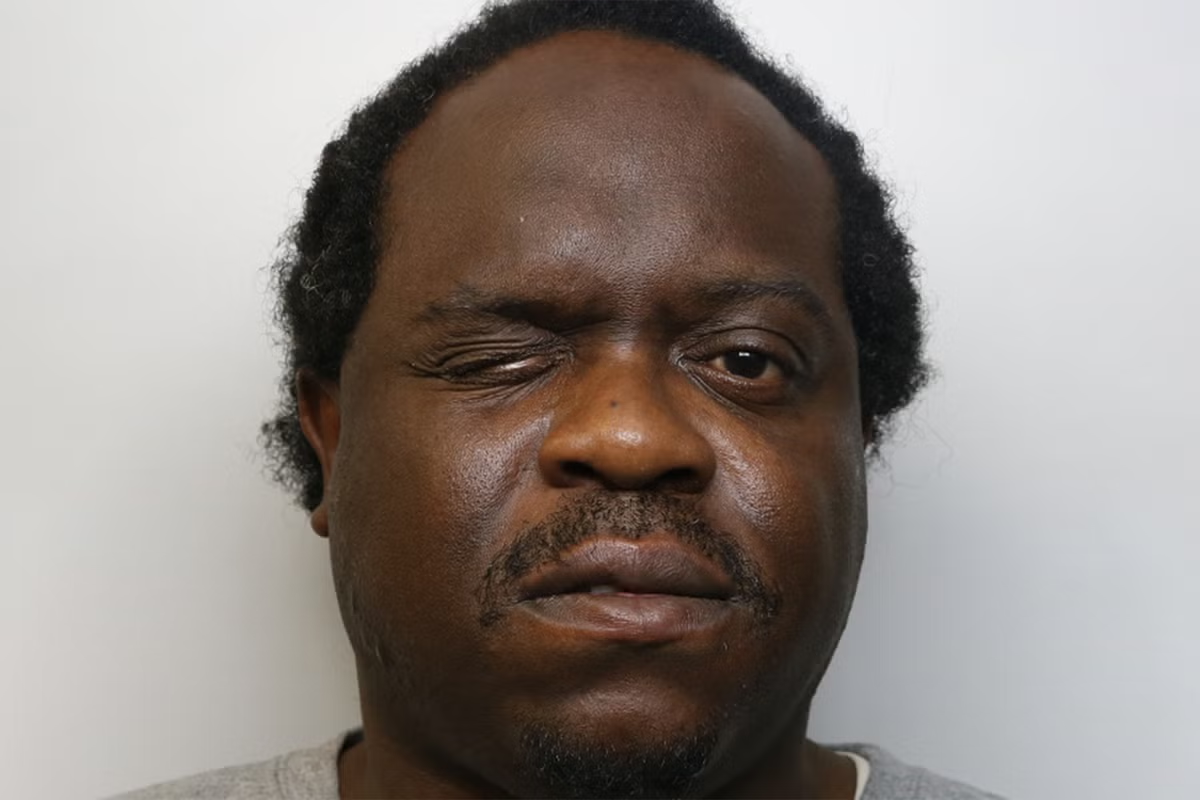
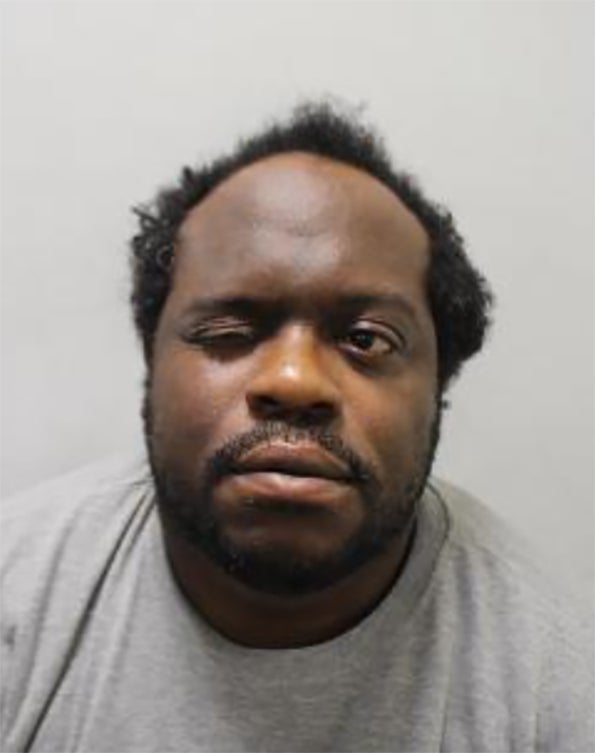
The police watchdog has launched an investigation into two British Transport Police (BTP) detectives after a serial sex offender was left free to murder two women and rape a third.
A probe has now been launched into the conduct of two BTP detectives over “alleged failures to progress or supervise an investigation” into two reported sexual assaults by Levy on the London Underground in October 2024, the Independent Office for Police Conduct (IOPC) said on Tuesday.
It comes after the IOPC previously said an investigation into alleged failures of two Metropolitan Police officers in their management of Levy following his prison release on licence in February 2023 was “ongoing”.
Simon Levy’s crime spree spanned from 2018 to 2025 and included myriad sex attacks on women in public spaces and two murders (Metropolitan Police)
A spokesperson for the watchdog said of the investigation into the BTP officers: “Levy was arrested in November 2024 regarding these incidents but was bailed to return to custody in January, with his bail further extended twice until May 2025 to allow for the investigation to be completed.
“During this period, Levy committed multiple further sexual assaults on trains, and other serious offences including murder and rape.
“We received a voluntary conduct referral from BTP on August 12 and decided an independent investigation was required.”
Advertisement
“The families of murder victims Carmenza Valencia-Trujillo and Sheryl Wilkins, and the woman who survived the rape attack, have been notified of our investigation,” the spokesperson added.
The BTP said: “It’s in the public interest for independent and objective scrutiny to be applied, and we will fully co-operate with the IOPC’s independent investigation.”
Levy, 40, was jailed for the rest of his life earlier this month after being convicted of killing grandmother Carmenza Valencia-Trujillo, 53, in March 2025 and mother-of-four Sheryl Wilkins, 39, in August that year.
He suffocated both women in sexually motivated attacks, with Ms Valencia-Trujillo found in a largely abandoned block of flats on the Aylesbury estate in south-east London, and Ms Wilkins behind a car park wall near Tottenham High Road, north London.
Advertisement
Levy was convicted of killing grandmother Carmenza Valencia-Trujillo mother-of-four Sheryl Wilkins (Metropolitan Police)
When he turned killer, Levy had already subjected a third woman to a brutal rape in January 2025 in the same car park where Ms Wilkins’s body was later found.
The surviving victim had told police where her attacker lived.
Levy committed the murders after having been jailed in 2021 for groping two women in the summer of 2018, one at Notting Hill Carnival and the other at a party in Camden.
He sexually assaulted a prison guard while behind bars in 2022 but was still released the following year, going on to sexually assault a woman on the Tube in October 2023 and allegedly rape another in May 2024, for which he was recalled to prison and released again in August that year.
Levy was arrested by BTP in November 2024 for sexual assaults on the Tube, but delays in organising an identification parade until the following April left him free to carry out the rape and first murder.
Advertisement
Following Ms Valencia-Trujillo’s death, Levy was released on bail at two magistrates’ court hearings in May and June 2025.
The Crown Prosecution Service admitted it had not opposed bail at the first hearing, and the prosecutor had not given the court all the relevant information for consideration at the second hearing.
There were another three crown court hearings that he failed to attend for various reasons, yet no arrest warrant was requested.
Less than two weeks after a hearing on August 11, he murdered Ms Wilkins.
Advertisement
The murders of Ms Valencia-Trujillo and Ms Wilkins over eight months in 2025 were interspersed with sexual assaults on six women on the Tube and Overground.
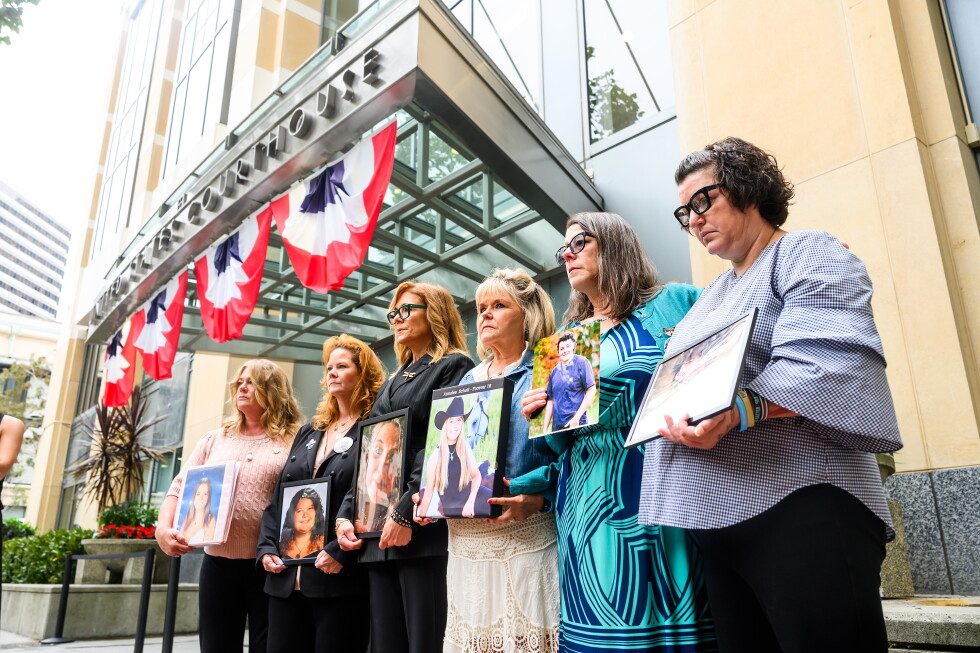
As opening statements kicked off Tuesday in a trial for Meta Platforms, advocates and parents of social media victims gathered outside the federal courthouse in Oakland, California, with a banner that stretched several feet across.
Written on it in black ink were the names of children and young adults who have died from social media related harms, including deaths by suicide after bouts of cyberbullying or sextortion. Giovanni, an 11-year-old, Bubba, a 13-year-old, and Englyn, a 14-year-old, were among the nearly 600 names. Parents said the names were “just the tip of the iceberg.”
“Behind us, justice is going to be served,″ said Lennon Torres, an advocate with the organization Heat Initiative. “The courtroom doors are open, and it is time that the public see what the executives at Meta have known all along: that their products are designed to addict and to harm children.″
Many of the gathered parents have attended previous trials, congressional hearings and other events related to online child safety. But they say this trial, in which the attorneys general from four states are seeking billions of dollars in damages for social media harms to children, marks a significant moment.
Advertisement
They see it as the culmination of years of work and public pressure on social media firms to do more to protect kids online. Social media companies are increasingly facing lawsuits over harms to young users, and Meta already has lost two pivotal cases over harms to children and teens this year, both of which it is appealing.
The trial represents a “groundswell of public perception changing against these companies,” said Amy Neville, whose 14-year-old son Alexander Neville died from fentanyl poisoning after being deceived by a drug dealer operating on Snapchat. Neville, like many other parents who have lost their children in similar ways, has dedicated her life to educating and spreading awareness of the dangers of social media.
“If we can keep holding them accountable over and over, something has to give, and I don’t want us to stop doing this until they’ve made their products safe by design,” she said.
Lawsuit focuses on broad claims
This lawsuit is not focused on any individual person, case or specific harm tied to social media, but rather broader claims that Meta made decisions in designing Instagram and Facebook that put young users at risk. The states also claim Meta knew the platforms to be dangerous and lied about how dangerous they were.
Advertisement
Meta has rejected the allegations and said the trial will show the work it has done to make its platforms safer.
The trial’s outcome could have significant consequences for Meta’s bottom line and how its platforms are designed and operated. But many parents are eager for evidence from the trial, namely internal Meta documents, to be brought to light.
John DeMay, whose son Jordan died by suicide at age 17 after being subject to a sextortion scheme on Instagram, is one of those parents who will be closely watching the trial and the evidence that emerges.
“As this information starts to unfold and unfold and unfold, the American people, the American mothers and the American fathers who are not seeing this stuff every day can see it and go, ‘Oh my God, this is really what’s happening,’ ” he said.
Advertisement
Some of the parents present outside of the courtroom were residents of the four states that are the plaintiffs in this trial — California, Colorado, Kentucky and New Jersey — and they thanked their attorneys general for the work on the case.
Lori Schott of Colorado said Attorney General Phil Weiser has viewed the content that populated her daughter Annalee’s social media feeds and read her journals after her death by suicide. Annalee, who was 18 when she died, wrote in her journals about feeling ugly and comparing herself to other girls’ social media profiles.
Parents call for accountability
In a message to Meta, its CEO Mark Zuckerberg and the head of Instagram Adam Mosseri, Schott said outside of court that they have built one of the most powerful companies in the world, “but power does not excuse harm.”
“Profits does not erase the responsibility of Big Tech and no company — no matter how wealthy, no matter how influential, no matter how untouchable it feels it is — should get to stand above the truth, the law and our children,” Schott continued.
Advertisement
Many parent advocates seemed to carry optimism with them on Tuesday. Erin Popolo, whose daughter Emily Murillo died by suicide after being subject to intense cyberbullying, was hopeful the trial’s outcome could lead to meaningful change on social media.
“I think that we’re going to make history here,” she said.
___
Associated Press journalist Terry Chea contributed to this report.
Duff drew on her shared experience with Panettiere, who similarly started acting in her youth, and said: “I remember staying up late, chatting and gossiping, and connecting because we were part of such a small sliver of people who actually understood the strange lot in life we were navigating…
From April 2025 to March 2026, 32% of all victims of domestic abuse crimes in NI were male
A new campaign has been launched by the PSNI to raise awareness of domestic abuse against men.
Advertisement
The campaign, titled ‘Every Victim Matters’, in partnership with the Men’s Advisory Project, aims to challenge misconceptions, highlight the different forms abuse can take, and encourage men experiencing abuse to seek support.
From April 2025 to March 2026, the PSNI recorded 5,817 domestic abuse crimes perpetrated against male victims across Northern Ireland. 32% of all victims of domestic abuse crimes recorded in that time frame were male. These crimes had a sanction outcome rate of around 19%.
Speaking at the launch, Detective Superintendent Kerry Brennan said: “Officers have stood in living rooms where the silence says more than any statement ever could.
“Men sitting there, shoulders hunched, eyes fixed on the floor—not because they’ve done something wrong, but because they’ve been made to feel they don’t deserve to be heard.
Advertisement
“Domestic abuse doesn’t wear one face, and it certainly doesn’t check your gender before it destroys your confidence, your safety, and your sense of self.
“As officers, our job is to protect without prejudice. Abuse is abuse. It’s not a lesser crime because the victim is male, and it’s not something to be minimised or joked about.
“Every victim deserves dignity, support, and to know that the law stands firmly on their side. When we fail to recognise that, we don’t just fail individuals—we reinforce the very stigma that keeps people trapped.
“So I say this clearly: if you are a man experiencing domestic abuse, you are not weak, and you are not alone. Speaking up is not a failure of strength—it’s the first act of reclaiming it. Your voice matters just as much as anyone else’s. We will listen, and we will act.”
Advertisement
The campaign highlights issues including coercive control, emotional abuse, and controlling behaviours, which are often less visible but equally harmful.
Every year, the Men’s Advisory Project supports more than 1,000 men and boys affected by domestic abuse across Northern Ireland.
Rhonda Lusty, CEO, said: “We very much welcome this campaign from the Police Service of Northern Ireland and its clear message that male domestic abuse is real, it is serious, and men who come forward will be listened to.
Advertisement
“We know how difficult that first disclosure can be. Many of the men who come through our doors have lived with abuse, coercive control, fear and isolation for a very long time before they tell anyone what is happening to them.
“Domestic abuse can happen to any man, at any age and from any background. It can happen within an intimate relationship or within a family.
“It is not always physical and it is not somehow less serious because the person experiencing it is male. The consequences can be life-changing and, tragically, they can be life-ending.
“Our message to any man experiencing abuse is very simple: what is happening to you matters. You can speak to the police and you can speak to us. The Men’s Advisory Project are specialists, and we are here for you and your needs.”
Advertisement
Justice Minister Naomi Long has funded the campaign and is showing her support publicly, saying: “The reality is that anyone can become a victim of domestic abuse and that’s why this campaign is so important.
“I am delighted to be able to support this campaign which will help to increase awareness that men are affected by intimate partner abuse, and that they should never feel ashamed or unable to seek help.
“Support is available; speaking up is the first step in the road to recovery.”
The public is encouraged to look out for signs that someone they know may be experiencing abuse and to reach out. For more information, visit: www.psni.police.uk/every-victim-matters
A jury will decide whether or not Meta designed its apps to “hook the users, hold them for as long as they can, harvest their data and hide the truth from the public”
Meta, the parent company of Instagram and Facebook, has been accused of contributing to the youth mental health crisis by knowingly and deliberately designing features that addict children to its platforms.
Advertisement
California, Colorado, Kentucky and New Jersey are seeking billions of dollars in damages as well as fundamental changes to how Meta runs its platforms. The states claim Meta gathers data from children aged 13 without the consent of their parents, a major breach of US federal law if proven accurate.
The lawsuit also argues that Meta routinely collects data on children under 13 without their parents’ consent, in violation of federal law. The company strongly denies the allegations.
The trial started in a California federal court on Tuesday, August 18. A jury will decide whether or not the tech giant designed its apps to “hook the users, hold them for as long as they can, harvest their data and hide the truth from the public,” as Megan O’Neill, a deputy attorney general for the California Department of Justice, put it in her opening statement.
Here’s everything you need to know about the opening day of the trial…
Advertisement
What allegations does Meta face?
The lawsuit alleges Meta illegally collected and used data of children aged under 13 who were using its social media platforms. It also claimed the company made decisions in designing its platforms that drove excessive use “and put young users at risk, and lied to users, their families, and the public about the safety of its platforms.”
The US Attorney Generals allege Meta violated federal and state laws, including the Children’s Online Privacy Protection Act (COPPA) as well as the New Jersey Consumer Protection Act. COPPA, introduced in 1998, many years before Meta’s founding, requires websites, apps as well as other online services to gain verified parental consent before collecting data from children aged under 13.
The lawsuit, originally filed in 2023, also claims “harmful” features on Instagram and Facebook drove excessive use by children and teenagers that caused them to be distracted at school and disrupted their ability to sleep at night, “all the while misleading users, their families, and the public about the existence and severity of these risks.”
Advertisement
The opening statements
O’Neill told the court: “You’re going to hear that Meta knew a lot about kids’ brains.” This includes how they are constantly seeking rewards, how they are sensitive to social feedback and “how they are still developing their ability to control impulses the way adults do.”
Meta, she said, researched these vulnerabilities and talked about how it could change Instagram to respond to them. She said: “‘The young ones are the best ones’ is a title of a Meta study we are going to show you.”
Meta, O’Neill said, also knew that kids under 13 were using its products even though they were banned from it, and “failed to take the simplest most obvious steps to keep them off.”
Advertisement
Meta executive Arturo Béjar gives evidence
Former Meta executive Arturo Béjar, who worked as an engineering director at Facebook from 2009 to 2015, was the first witness to be called.
Béjar said that, contrary to Meta’s statements, the company’s research on safety issues was not being used to improve products. For example, regarding eating disorder content, Meta’s engineers “had very good ideas on how to make it better” so that users, especially young ones, would not be exposed to it.
“But once it was reviewed, it got whittled down to a little pebble that didn’t make a difference,” he said.
Meta attorney highlights company work on safety
Meta lawyer Paul Schmidt said he will focus on the work Meta does to make its platforms safer and share information with the public.
He said: “Much of this lawsuit is about the government attorneys and their witnesses saying in trying to improve, we’d do it a little differently. In talking about how to improve, we disagree with how you talk about it. It’s meaningful, and the evidence will be meaningful, these efforts Meta has taken to improve.”
The proceedings
The proceedings are expected to last six weeks. The trial is expected to hear testimony from Meta CEO Mark Zuckerberg and other executives as well as former employees.
U.S. District Judge Yvonne Gonzalez Rogers in Oakland is overseeing the trial.
Advertisement
If Meta loses the trial, the court would have wide discretion over the size of any financial penalty. Meta has said if it loses, the case could result in damages amounting to $1.4 trillion, but legal experts believe that would be unlikely.
Significant smoke is affecting the area and it is unsafe for trains to pass, the agency added.
A statement on the National Rail website said: “A fire on a property between London Bridge / Canada Water and New Cross / New Cross Gate means all lines are blocked.
Advertisement
“As a result, trains between these stations may be cancelled, severely delayed by up to 100 minutes or revised.”
The fire is at a waste facility on Landmann Way in Deptford, near to train lines which run to London Bridge Station. The cause of the blaze is not yet known.
Smoke and flames from a blaze on Landmann Way, in Deptford as seen from Millwall (PA)
In a statement, London Fire Brigade said: “Fifteen fire engines and around 100 firefighters are responding to a fire on Landman Way, Deptford.
“The fire involves around 50 tonnes of household waste stored at a waste facility. This will be a protracted incident, with firefighting operations expected to be taking place through the night.”
Speaking from the scene, station commander Duncan Rees said: “Crews are working hard in difficult conditions to bring the fire under control. One of the Brigade’s 32m ladders and a 64m ladder are both being used as a water towers to tackle the flames from above
Advertisement
“A large amount of smoke is being produced by the incident. Local residents should keep doors and windows closed where possible.”
The brigade took the first of over 160 calls reporting the incident at 7.59pm, and crews from East Greenwich, Old Kent Road, Deptford and surrounding fire stations have been sent to the scene.
People have been asked to avoid the area and keep their doors and windows closed where possible because of the large amount of smoke.
The UK Health Security Agency (UKHSA) confirmed 207 cases between August 11 last year and August 1 this year, with 199 in England, six in Scotland, one in Wales, and one in Northern Ireland.
The outbreak “may be linked to eggs imported from outside of the UK.”
However, the Food Standards Agency (FSA) said there is “no evidence that UK-produced eggs are affected”.
It said that investigations had identified links to imported eggs “mainly used by food service and catering establishments such as restaurants or cafes, as a potential source”.
Advertisement
More than a third of people affected (38%) in the outbreak were admitted to hospital, with two people developing potentially life-threatening blood stream infections.
The highest numbers have been recorded in London (47) and Yorkshire and Humber (38).
The cases span a wide age range, from babies to people as old as 90.
What causes salmonella?
Hannah Charles, lead epidemiologist for gastrointestinal infections at UKHSA, said: “Salmonellosis is often caused by eating or handling contaminated food and can be spread rarely from person-to-person.
Advertisement
“Salmonella generally causes a mild illness, although vulnerable groups with weakened immune systems may experience more severe illness.
“Symptoms of a salmonella infection include diarrhoea, stomach cramps and sometimes vomiting and fever.
“Anyone who is concerned about symptoms should contact their GP or out of hours service in the first instance.
“There are simple steps to prevent the spread of salmonella: wash your hands thoroughly after using the bathroom and before preparing and handling food, cook food thoroughly, and if you have any symptoms, avoid handling food for others where possible.”
Advertisement
Hannah adds: “We’re working with Food Standards Agency and other public health agencies to investigate a salmonella outbreak that may be linked to eggs imported from outside of the UK.”
“Number of confirmed cases is likely to be just the tip of the iceberg”
Jacquelyn McCormick, head of incidents at the Food Standards Agency, said: “We are working closely with the UK Health Security Agency and other partners to investigate an outbreak of Salmonella Enteritidis.
“The exact cause has not yet been identified, however investigations so far have identified links to eggs imported from outside the UK, mainly used by food service and catering establishments such as restaurants or cafes, as a potential source.
“There is no evidence that UK-produced eggs are affected.
Advertisement
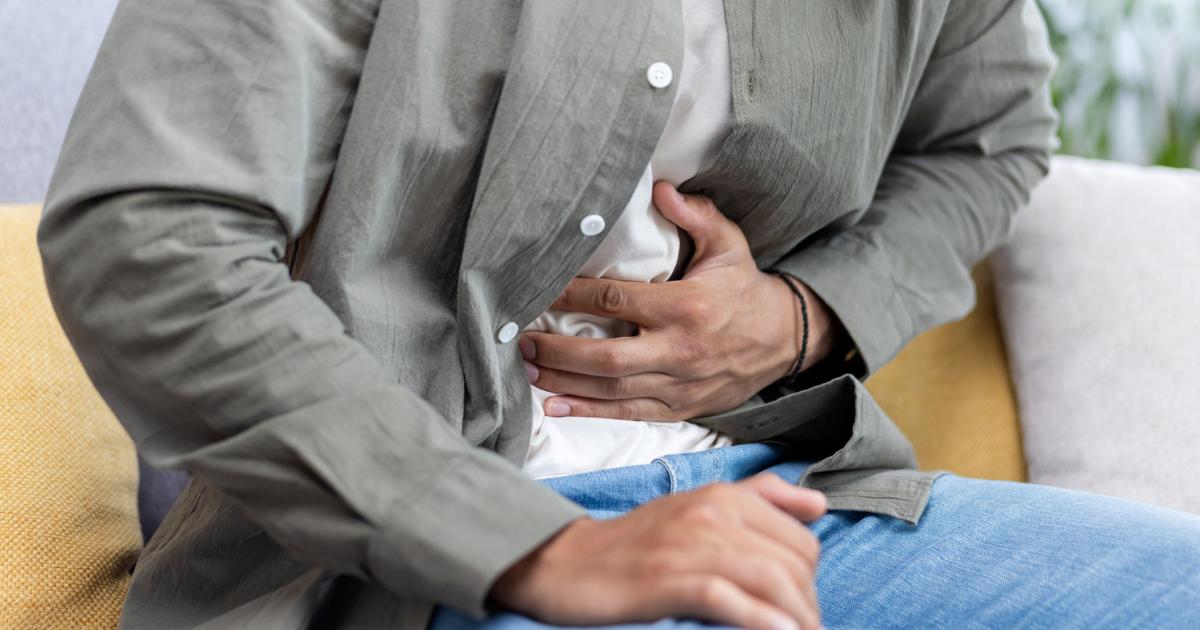
Salmonella has affected more than 200 people in the UK in the last year (Image: Getty)
“While investigations continue, our advice around eating eggs remains the same.
“Eggs which are thoroughly cooked and handled hygienically should not present a food safety risk.
“Infants, young children, pregnant people and older adults should only eat runny or raw eggs if they have a British Lion mark or are produced under the Laid in Britain egg assurance scheme.
“This advice does not apply to those who are severely immunocompromised and require medically supervised diets.
Advertisement
“We continue to advise people who are handling eggs, eggshells or egg packaging to always wash their hands thoroughly with warm water and soap and dry them properly afterwards.”
Dr Damien Tully, associate professor at the Medical Research Council/Uganda Virus Research Institute and London School of Hygiene and Tropical Medicine Uganda Research Unit, said: “This is a sizeable outbreak, but the number of confirmed cases is likely to be just the tip of the iceberg.
Recommended reading:
“Many salmonella infections cause relatively short-lived gastrointestinal illness and people may recover without ever being tested, meaning the true number of infections associated with an outbreak can be considerably higher than the number identified through laboratory surveillance.”
Advertisement
Dr Tully added: “For most healthy people, salmonella causes an unpleasant but self-limiting illness, although it can occasionally cause serious disease, particularly in young children, older adults and people with weakened immune systems.
“Good food hygiene remains important: wash your hands before preparing or eating food, avoid cross-contamination in the kitchen, and make sure foods such as eggs, poultry and meat are cooked thoroughly.”
What are your tips for soothing a stomach ache? Let us know in the comments below.
“This report shows what a common sense approach looks like. Unlike Labour, who are wedded to the old failing plans; or Reform, who still don’t believe climate change is happening, the Conservatives will protect our environment, protect our energy security and make energy cheaper. Our plan means using our own oil and gas in the North Sea, removing unnecessary costs from energy bills, and backing cheap, reliable, abundant energy for homes and businesses.”
The death of Professor Jason Arday has left many of us with a profound sense of sadness. For Black academics in particular, his loss feels deeply personal. Jason represented possibility – a reminder of what could be achieved despite the barriers that continue to shape Black people’s experiences in education.
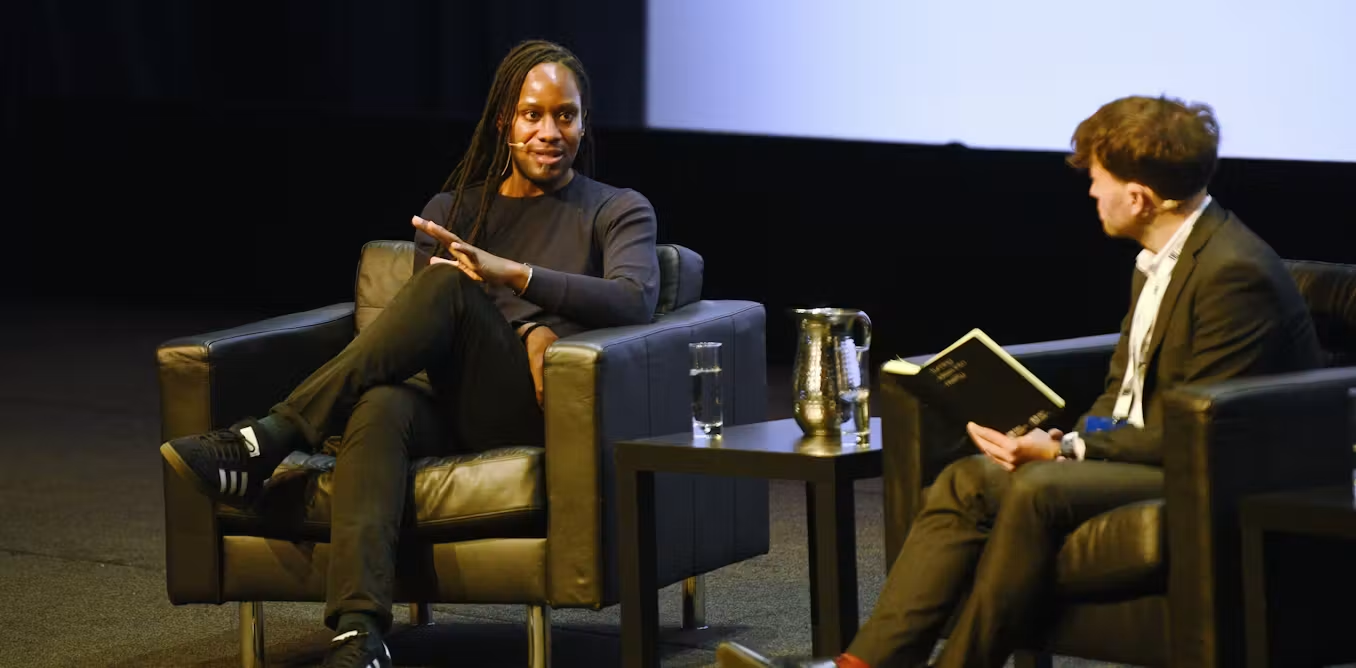
I had the privilege of knowing Jason and welcoming him to speak to scholars on the Accomplished Study Programme in Research Excellence (Aspire), which was set up to address the underrepresentation of Black students progressing into doctoral education.
Jason had been facing accusations of plagiarism and resigned from his position at the University of Cambridge. He was found dead on August 14 2026.
His passing has made me reflect on an uncomfortable question: do Black academics really belong in UK higher education? Of course, we should belong. The more difficult question is whether our institutions consistently make us feel that we do.
Advertisement
This question has shaped much of my work through the Aspire programme. Across three cohorts, Aspire has supported 59 Black and mixed-Black scholars. Fifteen progressed into fully-funded PhDs at universities across the UK.
Those numbers matter. But our research suggests that the most important impact of such programs cannot be captured through numbers alone.
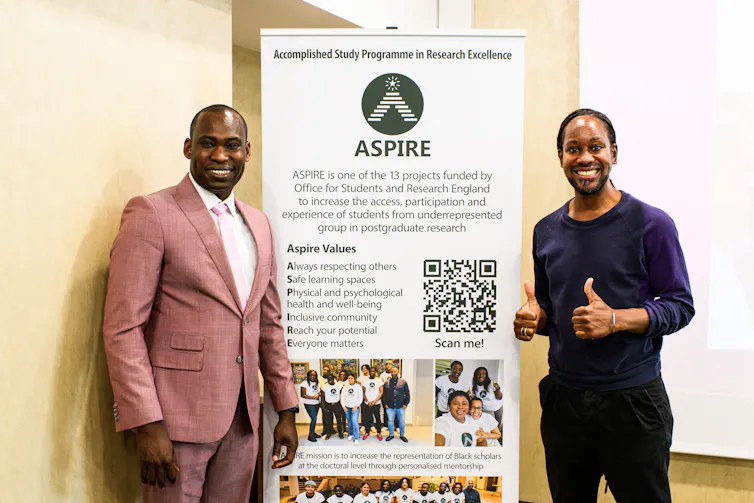
Jason Arday (left) and Ifedapo Francis Awolowo at an Aspire event in 2024. Aspire/Key Reflections, Author provided (no reuse)
Despite years of commitments to equality, diversity and inclusion (EDI), Black academics remain significantly underrepresented at the highest levels of higher education. Only around 1% of professors in the UK are Black.
Behind that statistic are people navigating systems in which they may rarely encounter someone who looks like them in positions of seniority.
Advertisement
Scholars were transformed not simply by learning how to write research proposals, navigate PhD applications or identify funding. What mattered enormously was the building of relationships.
They encountered mentors who believed in them. They met Black academics who made becoming a researcher seem possible. They entered spaces where conversations about race did not have to be avoided. They became part of a community in which their ambitions were taken seriously.
For some, the journey towards a PhD began with something much simpler than research training: someone telling them that they belonged there.
Sometimes, exclusion is being the only Black person in the room. Sometimes it is not knowing the unwritten rules. Sometimes it is constantly having to prove that you deserve to occupy the space you have already earned.
Advertisement
And sometimes it is quietly wondering: is this place really for someone like me?
Supporting Black scholars is not an act of charity. Universities are intellectually richer when knowledge is produced by people with different histories, experiences and perspectives. Different questions are asked and assumptions are challenged. Students encounter new possibilities for who can become a professor, researcher or intellectual leader.
This is why the current moment should not lead universities to become less committed to EDI. It should make us more intentional about it.
EDI cannot simply be something written into strategies, displayed on websites or celebrated during particular months. It must be something people experience. And one of the simplest tests of meaningful inclusion is whether people genuinely feel they belong.
My work draws on ubuntu, the African philosophy often captured as “I am because we are”, alongside omoluabi, a Yoruba philosophy concerned with character, integrity and our responsibilities towards others. Both challenge the idea that academic success is purely an individual achievement. None of us flourishes alone.
Most academics can remember somebody who opened a door, encouraged them after a rejection, advocated for them, or simply believed in them before they fully believed in themselves.
That is why racial equity must move beyond access towards belonging and duty of care.
One message consistently ran through Jason’s work and his interactions with others: kindness and love matters. Behind our titles, publications, grants and achievements are human beings who need community, encouragement and care.
Advertisement
There is a difference between being invited into a university and feeling wanted there; between being represented and being valued; between surviving academia and flourishing within it.
Universities therefore need to ask difficult questions. Who mentors Black scholars? Who advocates for them? Who notices when they are struggling? Where can they speak honestly about their experiences? Who reminds them that they do not have to navigate academia alone?
This is not the time to retreat
These questions are becoming more urgent at precisely the moment when EDI initiatives are facing increased scrutiny and universities face enormous financial pressures. There is a danger that universities will respond to this situation by retreating from EDI initiatives.
If mentoring changes trajectories, fund it. If communities create belonging, sustain them. If targeted interventions enable talented Black scholars to enter doctoral education, invest in them.
Advertisement
Otherwise, EDI risks becoming performative – something institutions are comfortable talking about but less willing to resource.
Picture taken at the ASPIRE showcase event in 2024. ASPIRE/Key Reflections, Author provided (no reuse)
The question should never really have been: do Black academics belong in higher education? We do. The question for universities is: what are we doing to make sure they know that they do?
Jason’s work feels especially important now. Kindness may sound too soft for conversations about structural racism. I believe the opposite. There is something profoundly powerful about creating institutions in which people genuinely care whether others flourish.
At a time when some Black academics are looking towards the future with uncertainty and wondering where they truly belong, retreating from racial equity cannot be our response.
We must instead build universities where Black scholars do not merely enter and survive, but are supported, valued and able to flourish.
















































You must be logged in to post a comment Login