
Crypto World
How to earn $5,000 in passive income daily through ASDeFi



Disclosure: This article does not represent investment advice. The content and materials featured on this page are for educational purposes only.
Bitcoin’s move above $71,000 is renewing investor interest, while ASDeFi Cloud Mining offers a way to participate in mining without owning or managing ASIC hardware.
Summary
- Bitcoin breaks $71,000 as market momentum grows, prompting investors to explore cloud mining for passive income opportunities.
- BTC hits a nearly three-month high above $71,000, while investors seek alternatives to simply holding and trading Bitcoin.
- The surge highlights renewed momentum as ASDeFi offers investors a way to participate through cloud mining.
On August 20, the price of Bitcoin once again broke through the $71,000 mark, hitting a new high in nearly three months. The recent market rally has not only been driven by improved sentiment in the cryptocurrency market, but also by the U.S. Treasury’s expansion of its long-term Treasury bond buybacks and the liquidation of a large number of short positions, which have further amplified the market’s upward momentum.
For investors who have been following Bitcoin over the long term, the price breaking through $71,000 signifies that the asset’s value is once again drawing market attention, but it also raises another question:
Following Bitcoin’s rise, investors are turning their attention to opportunities beyond holding
The traditional approach to investing in Bitcoin is simple: buy BTC and wait for the price to rise. While this approach can yield solid returns during a bull market, investors often face long waiting periods during market volatility.
Furthermore, after BTC rises rapidly, new investors must consider whether the current price is already too high. As a result, some investors are seeking more ways to participate in the Bitcoin ecosystem. From trading and ETFs to custody, computing power, and crypto infrastructure, Bitcoin investment is no longer limited to simply “buying and selling.”
Bitcoin mining is becoming more specialized
In the past, individual investors could participate in mining simply by purchasing mining rigs. However, as competition in the network has intensified, costs such as mining rig procurement, electricity, cooling, space, network infrastructure, and equipment maintenance have become significant barriers to entry.
For the average investor, the challenge lies not only in understanding Bitcoin but also in managing the infrastructure required for mining. Therefore, ASDeFi Cloud Mining offers an alternative way to participate: by centrally managing computing power, equipment, and daily operations through the platform, users can participate in Bitcoin mining without having to purchase and deploy ASIC miners at home.
What is ASDeFi cloud mining?
Founded in 2020 and headquartered in the United Kingdom, ASDeFi primarily provides AI cloud computing power and cryptocurrency mining services. Through centralized management of computing power and automated operations, the platform allows users to participate in cryptocurrency mining via a web browser or mobile app without having to purchase mining equipment or deal with issues such as electricity, cooling, and maintenance. This model offers a way to participate in the Bitcoin ecosystem without relying on short-term price predictions.
How should the claim of “$5,000 in passive income per day” be interpreted?
“$5,000 per day” is a relatively high yield target and does not mean that ordinary investors will automatically earn this amount after signing up. Actual returns typically depend on factors such as hashrate, investment amount, contract terms, and the price of BTC.
Therefore, a more reasonable way to understand this is that ASDeFi can serve as a tool for some investors to explore ways to generate returns on cryptocurrency assets. Before participating, investors should familiarize themselves with the contract term, investment amount, yield calculation method, and withdrawal rules, and invest according to their own financial circumstances.
How to get started with ASDeFi Cloud Mining?
1. Register for a cloud mining account
Once registration is complete, users receive a free $15 bonus to purchase hashrate contracts, which will generate $0.60 in daily contract earnings.
2. Complete account information
Log in to the account dashboard and link a cryptocurrency wallet address to receive contract earnings.
3. Understanding computing power contracts
Go to the contracts page to view the amounts, terms, and earnings rules for different computing power contracts, and select the one that best fits your budget.
4. Start the service and view earnings
After completing the relevant configurations, the platform will run the computing power service according to the contract terms. Users can view their account earnings data and manage their earnings via the web or mobile app.
Current examples of computing power contract earnings:
| Contract | Purchase Amount | Term | Daily Return | Total Return |
| Daily Check-in Contract | $15 | 1 day | $0.60 | $15.60 |
| New User Experience Contract | $100 | 2 days | $4.00 | $108.00 |
| Basic Hashrate Contract No. A2317 | $500 | 5 days | $6.50 | $532.50 |
| Basic Hashrate Contract No. A2312 | $3,500 | 15 days | $54.25 | $4,313.75 |
| Stable Hashrate Contract No. S3189 | $10,000 | 25 days | $190.00 | $14,750.00 |
| Stable Hashrate Contract No. S3170 | $23,000 | 30 days | $425.50 | $35,765.00 |
What does BTC breaking through $71,000 mean?
BTC’s recent break above $71,000 is not only a significant price milestone but also reflects a shift in market sentiment following a prolonged correction. Massive liquidations of short positions have further fueled the rally, but this does not guarantee that BTC will continue to rise. Future prices may still be influenced by factors such as interest rates, U.S. dollar liquidity, ETF capital flows, regulatory policies, and global market risk appetite.
Conclusion
BTC has broken through the $71,000 mark, once again highlighting its prominence in the global cryptocurrency market. The recent price surge has been driven by factors such as improved liquidity, a rebound in market sentiment, and short-covering; however, this rapid rise also indicates that market volatility remains high.
For investors holding BTC long-term, in addition to monitoring price movements, it may be beneficial to explore cryptocurrency infrastructure such as cloud mining. Through centralized management of computing power resources and automated operations, ASDeFi offers an option for users who wish to participate in the cryptocurrency computing power ecosystem.
For more information, visit the official website and download the app.
Disclosure: This content is provided by a third party. Neither crypto.news nor the author of this article endorses any product mentioned on this page. Users should conduct their own research before taking any action related to the company.


In this video, Gary Thomson explores the key September central bank meetings and whether policy divergence could impact major FX pairs.
👉 Key topics covered:
✔️ ECB Decision — 10 September — Markets are pricing a high probability of a 25-basis-point hike. Will the ECB signal that further tightening is still possible?
✔️ Fed Decision — 16 September — Although markets lean towards a hold, renewed inflation pressure could bring a hike back into focus.
✔️ BoE Decision — 17 September — UK inflation remains elevated, but slowing wage growth and a softer labour market could keep the Bank Rate unchanged.
✔️ BoJ Decision — 18 September — Markets are increasingly considering a 25-basis-point hike. Could tighter Japanese policy provide lasting support for the yen?
✔️ FX Divergence in Focus — EUR/USD, GBP/USD, EUR/GBP, USD/JPY, EUR/JPY could all react as markets reassess the expected paths of interest rates.
With four major central bank decisions in just eight days, it may be the changes in expectations — not only the decisions themselves — that drive the FX moves.
💬 Don’t forget to like, comment, and subscribe for more market insights every week.
Watch it now and stay updated with FXOpen.
This article represents the opinion of the Companies operating under the FXOpen brand only. It is not to be construed as an offer, solicitation, or recommendation with respect to products and services provided by the Companies operating under the FXOpen brand, nor is it to be considered financial advice.

Bitcoin (BTC) climbed above $75,000 on Friday, continuing its strongest rally in months. The flagship cryptocurrency is on track to record its best week in over two years as improving regulatory sentiment, lower bond yields, and a $3 billion short squeeze push prices higher.
The flagship cryptocurrency surged over 7% on Wednesday and another 5.36% on Thursday, decisively crossing $70,000 and closing at $73,011. The price is up 3.42% during the ongoing (Friday) session at $75,411.
Short Squeeze and Macroeconomic Headwinds Power Bitcoin Rally
The flagship cryptocurrency is up almost 8% over the past 24 hours and nearly 20% over the week, and remains on course for its highest weekly gain in over two years. The broader cryptocurrency market has also pushed higher, with Ethereum (ETH) up nearly 5%, Ripple (XRP) up 17%, and Solana (SOL) up over 5%. 24-hour trading volume has risen to $137.28 billion, while the overall cryptocurrency market cap rose 6.79% to $2.53 trillion. The most telling sign of shifting market sentiment is the Fear and Greed Index, which jumped to 69, firmly in “greed” territory.
The rally began on Wednesday (August 19), when the US Treasury announced it would double the buyback operations for the 10- to 20-year and 20- to 30-year nominal coupon operations from $2 billion to $4 billion per operation. The announcement came after 30-year bond yields hit 5.337%, the highest since 2007. Yield dropped to 5.192% following the announcement. The effect of these buybacks on the markets is almost immediate, improving liquidity conditions across the market. Rachel Lucas, an analyst at BTC Markets, stated,
“The real driver was the US Treasury doubling long-dated bond buybacks, which pulled long yields lower and lifted risk appetite broadly. Nothing has rewritten Bitcoin’s long-term case, but nothing’s rewritten its volatility either.”
President Trump’s renewed calls to Congress to advance the CLARITY Act, following a meeting with top crypto industry executives, also buoyed market expectations of a favorable regulatory environment in the US.
Spot Bitcoin ETFs Could Dictate Momentum
Meanwhile, some analysts believe ETF and spot demand will play a major role in dictating whether the breakout holds. Nicolai Søndergaard, senior research analyst at Nansen, stated that while forced short covering fueled Bitcoin’s rally, rising institutional demand and better liquidity conditions had already put the market on an upward trajectory. Søndergaard highlighted stable open interest to show that the rally was being driven by more than just traders adding fresh leverage.
“Bitcoin’s move above $70,000 reflects a combination of forced short covering, renewed institutional demand and a more supportive liquidity backdrop.”
Meanwhile, spot Bitcoin ETFs added over $600 million on Thursday, the highest since May, and marking their fourth consecutive day of inflows. Bitcoin ETFs have registered $1.61 billion in inflows so far this week, with the figure expected to climb higher on Friday as institutional investors buy strongly. Søndergaard believes spot trading and ETF inflows will determine whether BTC can build support above $70,000 and push higher once forced buying reduces. BTC’s price action has pushed it above the 20-week and 200-day moving averages and the estimated short-term holder cost basis, putting buyers in profit.
Nick Ruck, LVRG Research Director, believes the US Treasury’s announcement to double bond buybacks has improved institutional investor sentiment, helping to reverse months of substantial outflows.
However, he cautioned that only progress on the CLARITY Act, a clear course of action on interest rates, and broader access to crypto through retirement accounts could help establish a positive institutional trend.
“Sustained inflows are unlikely without additional confirmation. Until those catalysts develop, inflows will likely remain temporary rather than structural.”
Bitcoin Momentum Stretched
However, momentum is stretched, with the one-hour RSI around 78 and the four-hour RSI above 85. Positive funding rates also indicate that leveraged long positions were picking up. If BTC holds above $70,000, it could extend its rally higher, while a drop to around $69,000 could indicate a retest rather than a reversal.
White House Pushes for Crypto Legislation
President Trump met with top crypto executives from Coinbase, Ripple, Gemini, Chainlink Labs, Kraken, among others. Following the meeting, Trump urged Congress to approve the CLARITY Act, establish clear market rules, and divide market oversight between the Securities and Exchange Commission (SEC) and the Commodity Futures Trading Commission (CFTC). Bitget Wallet Research Analyst Lacie Zhang believes the Trump administration must show lower borrowing costs, progress in high-growth industries, and a robust financial market before the November midterms.
The SEC’s Regulation Crypto Assets also provided a policy catalyst, offering crypto companies and startups exemptions under specific circumstances. However, Zhang warned that failure to advance the CLARITY Act, conflict of interest controversies, and waning regulatory momentum could sour investor sentiment.
Disclaimer: This article is provided for informational purposes only. It is not offered or intended to be used as legal, tax, investment, financial, or other advice.
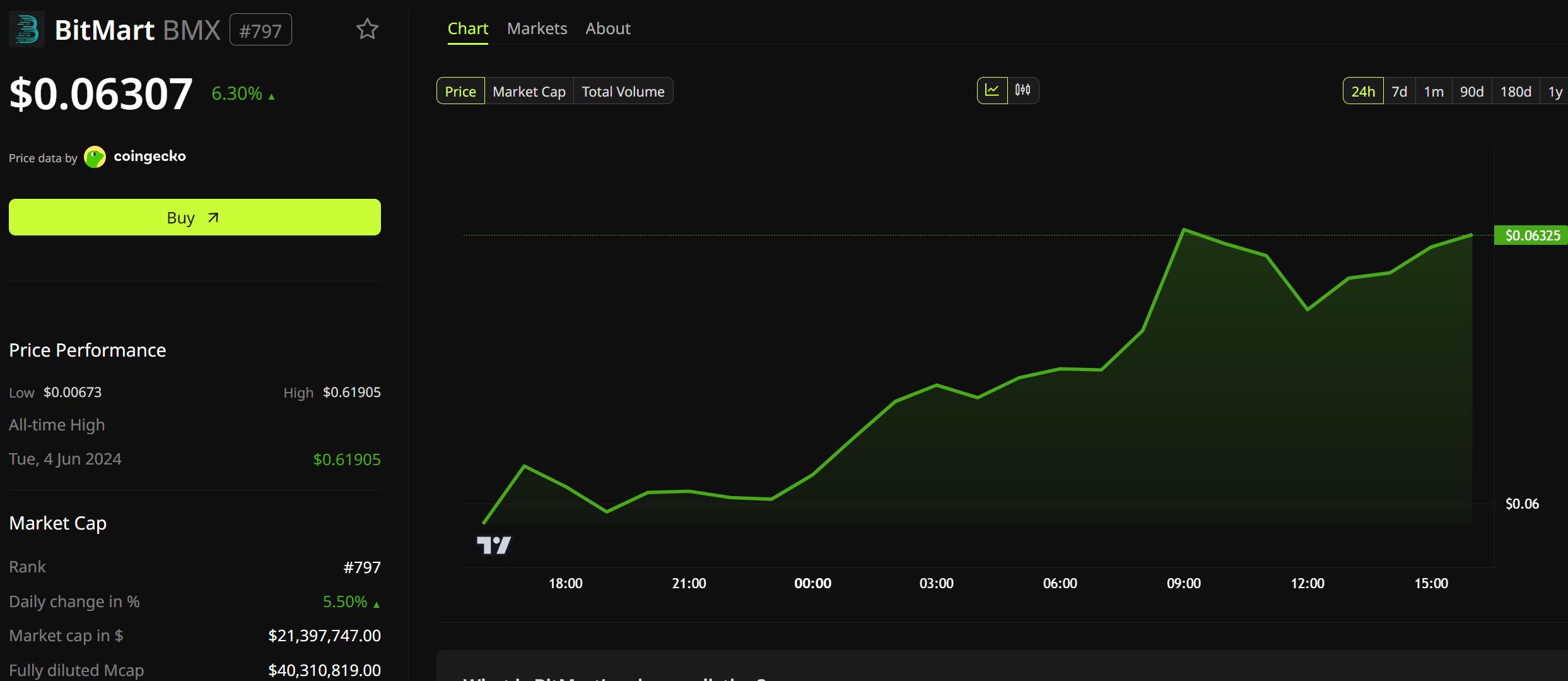
BitMart says it may reopen parts of its exchange, weeks after telling users it was closing for good.
The reversal landed on Friday. That is five days before the August 26 deadline that was set to stop all trading on the platform.
A Shutdown That Was Meant to Be Permanent
BitMart published its exit plan on July 26. New sign-ups, deposits, and new orders stopped the same morning. The schedule was firm. All trading was due to end on August 26. The platform itself would go dark on January 31, 2027.
The exchange blamed no crisis. Its notice pointed to operating conditions, the market, and future strategy. There was no mention of missing money.
Traders did not read it that way. BitMart Token (BMX) crashed 46% overnight to about $0.11. The token now trades near $0.0626, up 6% on the day following a surprising announcement.

One Word in the New Notice Changes the Story
Friday’s update reads like good news at first glance. BitMart says it is building a restructuring plan instead of a full wind-down.
Then comes the detail. Any phased restart would run “alongside distributions to creditors.”
That word matters. Creditors are people owed money. Exchanges that simply pause for market reasons do not pay out creditors.
BitMart has also hired White & Case as restructuring counsel. The firm is one of the largest insolvency practices in the world. Companies bring in that kind of help when a balance sheet needs fixing, not when a market recovers.
Follow us on X to get the latest news as it happens
Analysts Had Called the Closures a Healthy Reset
The July shutdowns drew a strangely upbeat response. Several analysts read them as the market clearing out weak venues.
Moonrock Capital founder Simon Dedic argued the model behind many exchanges had run out of road.
Crypto Banter chief executive Ran Neuner added that bottoms form when the fittest survive. Both readings assumed the exits were final.
That is the assumption Friday broke. One of the exchanges analysts called a bottom on is now working out how to trade again.
BitMEX Is Still Walking Away
BitMEX has not blinked. The derivatives venue still plans to close on September 23 after a strategic review, ending an 11-year run.
It has already returned staked BMEX balances. Verified accounts that leave funds sitting there now pay a monthly charge, which pushes users out rather than back in.
Both exchanges announced their exits three days apart. Both used near identical language about strategy. Only one is looking for a way back.
Why Users Are Not Celebrating
The July notice promised that withdrawal service would stay open. Many users say it did not.
Ethereum withdrawals spiked to a 2026 high as people rushed for the door. By mid-August, traders were reporting blocked withdrawals and former staff said wages went unpaid.
Founder Sheldon Xia denied the withdrawal claims as fabricated and threatened a police report. He gave no reserve figures and no repayment date. Investigator ZachXBT told him to return the money instead of posting statements.

There is history here. Hackers drained roughly $196 million from two BitMart hot wallets in December 2021. Security firm Peckshield first flagged the breach.
BitMart pledged to repay the victims. Weeks later, users said the money had not arrived.
The CEO Was Already Gone
One more fact complicates the comeback. Nenter Chow was named BitMart’s global chief executive in April 2025, when Xia stepped back to group president.
Chow says he was fired on July 24, two days before the shutdown notice went out.
“Since 24 July I have had no role in the management or decision-making of the company and have not been consulted on any operational matters,” he explained.
So the decision to close was taken without the sitting CEO. The decision to possibly reopen came from the same group, four weeks later.
Nothing is settled. BitMart calls the plan potential and has promised a roadmap by September 9.
The test is simple. If that roadmap carries wallet addresses, reserve totals, and a payment date, the restart is real. If it carries another paragraph of intentions, users still have until August 26 to get out.
The post BitMart Reverses Shutdown Decision, What Changed? appeared first on BeInCrypto.


Standard Chartered’s Geoff Kendrick said Bitcoin could move toward its $126,000 all-time high after Oct. 6 as spot Bitcoin ETF inflows recover.
Circle says Arc is on track for a Sept. 16 public mainnet launch that would open its production blockchain to users and applications while keeping block production within a permissioned validator set. In a separate post on X, Circle reported more than half a billion testnet transactions, nearly 3… Read the full story at The Defiant

Coinkite has rolled out a major security firmware upgrade for its Coldcard hardware wallets, aiming to harden seed phrase generation against a class of failures that can leave private keys more guessable than they should be. The company says the updates—Coldcard firmware 5.6.1 for Mk4 and Mk5 and 1.5.1Q for the Coldcard Q—change how new wallet seeds are created by requiring user-supplied entropy and combining it with multiple onboard sources of randomness.
The move comes as confirmed losses from the Coldcard exploit continue to be tallied. According to an Aug. 14 report by Galaxy Research, confirmed theft reached 1,778 BTC (about $112 million). Galaxy’s reporting also places the incident among the year’s largest crypto hacks, with DefiLlama’s aggregated data ranking it as the third-largest exploit of 2026.
Key takeaways
- Coinkite’s firmware updates require new seed phrases to include user-supplied entropy collected through interactive user actions.
- Coinkite says the collected entropy is mixed with device randomness from secure elements and the hardware RNG to reduce the impact of any single randomness failure.
- Users are instructed to upgrade immediately, but must also replace existing seed phrases before migrating funds, because old seeds are still considered vulnerable.
- The update adds additional protections around USB data handling and transaction signing by re-verifying transactions immediately before signing.
- As the ecosystem responds to “weak seed” risks, Coinspect has launched a free tool intended to detect addresses generated from known weak seed phrase datasets.
User entropy becomes a required ingredient for new seeds
The most significant change in Coinkite’s release is in the mechanics of seed phrase generation. The firmware requires that newly generated seeds incorporate user-supplied entropy through at least 65 keypresses with deliberately unpredictable timing, plus one of two additional interaction-based inputs: 50 rolls of a six-sided die or 128 coin flips. The company pairs this user input with randomness sourced from multiple hardware components, including secure elements and the wallet’s hardware random-number generator (RNG).
Coinkite’s stated goal is straightforward: even if one entropy source fails or behaves unexpectedly, the seed creation process should still produce private keys that remain hard to predict. That “defense in depth” matters for users because seed phrases are the single critical root of control in Bitcoin self-custody—if their generation is weakened, an attacker may be able to brute-force likely keys rather than needing to break cryptography.
Importantly, Coinkite stresses that upgrading the firmware does not automatically immunize existing wallets. The company told users that previously generated seed phrases remain vulnerable after the update and must be replaced with new seeds before any funds are migrated. In practice, this means the security benefit applies to future seed creation, not past ones.
Seed protection continues after a prior fix
The Thursday release follows a broader security review and extends protections that were already introduced in a July 31 firmware update. Coinkite previously said that update addressed the seed-generation failure for wallets created after that point. The new 5.6.1 and 1.5.1Q releases build on that foundation by strengthening how entropy is gathered and validated, and by adding safeguards beyond seed generation alone.
Coinkite also characterizes the new approach as closing a theoretical gap involving a compromised computer USB port. Rather than assuming the external host is trustworthy—or assuming that checks performed earlier in a workflow are sufficient—the firmware is designed to re-verify transactions immediately before signing. This reduces the chance that altered transaction data could survive earlier checks and make it onto the signing path.
Additional enhancements include hardware RNG checks and a boot-time test intended to confirm that the wallet is using the intended hardware randomness path. Coinkite further restricts how USB transfers occur by limiting downloads to the device’s most recent output and requiring an encrypted session.
Finally, certain Bitcoin signature hash modes that can allow transaction outputs to be modified are now blocked by default, tightening the rules around which transaction forms the device will sign.
Coldcard losses remain material while upgrades roll out
Even as Coinkite issues new defenses, the fallout from the Coldcard exploit continues to be quantified. Galaxy Research’s Aug. 14 report, cited in the coverage of this firmware update, put confirmed losses at 1,778 BTC (about $112 million). The same reporting context notes the incident’s scale relative to other 2026 hacks, using DefiLlama’s aggregated exploit rankings.
For users, the critical implication is that remediation must be more than “patch and hope.” The requirement to generate new seed phrases underscores that the security model is tied to how a wallet was originally initialized. In other words, if a wallet was created under weaker randomness assumptions, the safest path is typically to replace the root of control rather than rely on later software fixes.
Given the confirmed-loss magnitude, these upgrades also carry practical urgency for anyone who used affected wallets and has not yet assessed whether their seed phrase was produced under the vulnerable conditions. The firmware update provides a clearer security story for new wallet initialization, but it does not undo exposure retroactively.
Software tools emerge to identify weak-seed exposure
Alongside firmware changes, the security ecosystem is increasingly focused on detection. Coinspect announced Unlukey, described as a free public tool for identifying wallet addresses generated from weak seed phrases. In a Friday post on X, Coinspect said the initial version aims to reproduce known weak seed generation behavior and then check whether public addresses fall into an affected dataset.
This kind of tooling matters because it moves the conversation from “what might be vulnerable” to “is this specific wallet address likely connected to weak-seed generation.” While such tools cannot replace operational security measures—such as upgrading, re-seeding, and moving funds—their role is to help users triage and focus on wallets most likely to be impacted.
The broader context for weak-seed risks includes claims from TRM Labs, which stated that a firmware bug from March 2021 weakened seed randomness on some Coldcard wallets. TRM Labs said this reduced key strength from 128 bits to 40 bits, making affected keys “brute-forceable without physical access.” Those figures are particularly relevant because they illustrate how far a randomness failure can go beyond a small quality-of-randomness issue—potentially changing the feasibility of an attacker’s search.
For builders and traders alike, the evolving response highlights a pattern seen across major wallet incidents: security upgrades address the technical causes going forward, while independent detection tools attempt to quantify exposure in the wild. Investors should watch how these tools perform in practice—especially whether they gain broader validation and whether they help more users act quickly and correctly.
Next, users running older Coldcard firmware should confirm they are using the latest releases and follow Coinkite’s guidance on re-seeding before moving funds, while the wider community will likely keep evaluating how detection tools like Unlukey map to real-world exposure. The remaining uncertainty is how comprehensively the weak-seed issue affected wallets in circulation—and whether further forensic work will refine estimates as additional data comes in.


Binance’s employees were cleared and released after providing statements to UAE authorities about third-party fund flows through a company client account, a spokesperson told Cointelegraph.
Crypto World
Stock Market Rally Buckles; Moderna, Gold, Bitcoin Surge While Walmart Tumbles: Weekly Review

The stock market had a bad week, with the key indexes all falling below their 21-day moving averages on Thursday while the Nasdaq composite closed below its Aug. 4 follow-through day low, a bearish signal that its rally will ultimately fail. A Treasury Department move to buy some long-dated bonds didn’t have much lasting impact on yields, which are around…
Copyright ©2026 Investor’s Business Daily, LLC. All rights reserved. 87990cbe856818d5eddac44c7b1cdeb8
Coinkite has released a major security upgrade for its Coldcard hardware wallets aimed at strengthening seed-phrase generation by forcing users to contribute unpredictable entropy. The change is designed to ensure private keys remain hard to predict even if one of the device’s randomness sources underperforms.
In a Thursday blog post, Coinkite announced firmware 5.6.1 for the Coldcard Mk4 and Mk5, and 1.5.1Q for the Coldcard Q. The company said affected users must upgrade immediately and—critically—replace any existing seed phrases before moving funds.
Key takeaways
- Coinkite’s new firmware changes how Coldcard generates seed phrases by mixing user-supplied entropy with multiple device randomness sources.
- For newly generated wallets, the firmware requires user input via at least 65 keypresses with unpredictable timing (or equivalent die/coin-rolling actions).
- Even after upgrading, previously generated seed phrases remain vulnerable and must be replaced with new seeds before migrating funds, Coinkite says.
- The update also adds safeguards around USB handling, transaction verification timing, hardware RNG checks, and boot-time integrity testing.
- Separately, Coinspect launched Unlukey, a free tool intended to help detect wallet addresses potentially linked to weak-seed generation.
Seed phrases now rely on more user unpredictability
At the center of Coinkite’s update is a shift in seed generation. According to the company, newly generated seeds must incorporate user-supplied entropy through interactive actions, including at least 65 keypresses with intentionally unpredictable timing. Coinkite also describes alternative entropy contribution methods: 50 rolls of a six-sided die or 128 coin flips.
That input is then combined with randomness from several parts of the device, including secure elements and the wallet’s hardware random-number generator (RNG). Coinkite frames the redesign as defense-in-depth: by requiring user entropy and mixing it with internal sources, the resulting private keys should remain unpredictable even if one device entropy source fails or is otherwise compromised.
Importantly, Coinkite’s guidance is not limited to upgrading. The company warns that existing seed phrases do not become safe just because the firmware is updated; users must generate new seeds and replace the wallet’s backing recovery phrase before migrating funds.
Coinkite adds transaction and USB safeguards
The new firmware follows an earlier July 31 update that Coinkite says already corrected the seed-generation failure for newly created wallets. In its Thursday announcement, Coinkite describes the latest release as the result of additional security review over the subsequent weeks, expanding protections beyond seed generation.
One element targets how transactions are processed when a Coldcard is connected to a potentially compromised computer. Coinkite says the firmware re-verifies transactions immediately before signing—an approach intended to counter a theoretical attack involving a compromised USB port. In other words, the device aims to confirm that what it signs is still what it expects, right up to the moment it produces a signature.
Coinkite also describes new hardware RNG checks and a boot-time test designed to confirm the wallet is using the intended hardware pathway. Beyond randomness integrity, the update restricts USB downloads to the device’s most recent output and requires an encrypted session, reducing opportunities for manipulated data to be fed to the wallet during the workflow.
Finally, the firmware blocks certain Bitcoin signature hash modes by default—specifically those that could allow transaction outputs to remain modifiable under the affected conditions Coinkite references.
Impact from the Coldcard exploit remains significant
While Coinkite focuses on preventing additional exposure, the ongoing consequences of the Coldcard exploit continue to shape the security landscape. Galaxy Research reported that confirmed losses associated with the exploit reached 1,778 Bitcoin, worth about $112 million, in an Aug. 14 report. Galaxy’s assessment is linked to a broader figure compilation, and DefiLlama data aggregated in the same context ranks the Coldcard hack as the third-largest cryptocurrency exploit of 2026.
These figures underline why seed-generation hardening and secure transaction flows matter to users: even hardware-wallet protections can be undermined if randomness used for key material is weak or if signing operations can be influenced through connectivity or timing issues.
Weak-seed detection tools enter the ecosystem
Alongside firmware fixes, at least one blockchain security firm is working on software approaches to identify potential victims of weak seed generation. Coinspect revealed Unlukey, a free public tool for identifying wallet addresses that may have been generated from weak seed phrases.
In a Friday X post, Coinspect said the first iteration of Unlukey focuses on reproducing known weak seed generation patterns and checking whether public addresses appear in the affected dataset. While this does not automatically prove that any given address belongs to an exposed wallet, the tool is positioned as a way to narrow down exposure for individuals and analysts who are investigating risks related to the Coldcard incident.
Context on the underlying weakness comes from TRM Labs, which said in an analysis that a firmware bug from March 2021 weakened seed randomness on some Coldcard wallets. TRM Labs reported that the issue reduced key strength from 128 bits to 40 bits, making keys “brute-forceable without physical access.”
Coinspect’s decision to build an address-level detection method suggests the broader industry takeaway from the Coldcard episode: even when hardware vendors issue patches, secondary tooling can help the ecosystem identify which wallet outputs and addresses may be most at risk based on how seed generation was implemented in the past.
Readers should watch how users apply Coinkite’s guidance—especially the requirement to replace existing seed phrases before moving funds—and whether address-detection tools like Unlukey continue to expand coverage as more information about weak-seed generation patterns is validated.


A federal judge in San Francisco on Thursday kept TRON founder Justin Sun's individual claims against World Liberty Financial in a public courtroom, declining the Trump family crypto venture's request to route the whole dispute into private arbitration. The forum decides how much of the dispute… Read the full story at The Defiant

Harry Potter Star Jessie Cave Opens Up On OF Move

I Hired a Hood Translator For Financial Audit

The call’s coming from inside the house





-

 Fashion7 days ago
Weekend Open Thread: Ann Taylor
-

 Sports7 days ago
Birmingham 2026: Day 6 Timetable for Irish Athletes
-
 NewsBeat6 days ago
Myanmar says over 300,000 Rohingya refugees verified for repatriation as exodus enters ninth year
-

 Business3 days ago
SMA Solar Technology AG (SMTGY) Q2 2026 Earnings Call Transcript
-

 Politics6 days ago
SEQ Code: The Three Letter Boarding Pass Code That Could Give You The Worst Seat
-

 Crypto World7 days ago
Pi Network Protocol 27 endgame: last upgrade before what?
-

 Tech3 days ago
Qwen3.8-27B runs frontier-class coding agents and reasoning locally, no cloud API required
-

 Crypto World4 days ago
OCC Greenlights Trump Family Crypto Firm for Trust Charter
-
 Tech6 days ago
Every fusion startup that has raised over $100M
-
 Entertainment6 days ago
Marvel Studios Reveals New X-Men Cast Including Adam Driver and Sadie Sink
-

 Fashion7 days ago
Weekly News Update, 8.14.26 – Corporette.com
-
 Business6 days ago
Monarch Mutual Fund set to enter MF space with maiden overnight fund; files draft with Sebi
-

 Business6 days ago
Facebook Down Now? Users Report Login And Loading Problems As Outage Trackers Monitor Ongoing Issues
-

 Business6 days ago
Cristiano Ronaldo’s Secret Wedding Deepens As Presenter Claims Family Learned ’30 Seconds’ Before
-

 News Videos1 day ago
Don’t Leave Your Financial Future To Chance | August 19, 2026
-

 Crypto World5 days ago
Data of 54K Wallet Users Leaked, Clarity Odds Just 10%: Hodler’s Digest, Aug. 16
-

 Fashion7 days ago
Cart Confidential Vol. 44 – Julia Berolzheimer
-

 Crypto World4 days ago
NAVI Prime launches institutional lending framework on Sui
-

 Politics5 days ago
Britain is facing a housing disaster
-

 Business6 days ago
New Avengers Doomsday Trailer Drops at D23 Showing Robert Downey Jr as Doctor Doom
You must be logged in to post a comment Login