Connect with us

Business

Intuitive Surgical’s Stock Price Is Too High Even For Great Business (NASDAQ:ISRG)

Published

on

Intuitive Surgical's Stock Price Is Too High Even For Great Business (NASDAQ:ISRG)

This article was written by

My analysis is focused on high-quality companies, that can outperform the market over the long-run due to a competitive advantage (economic moat) and high levels of defensibility. Focused on European and North American companies, but without constraints regarding market capitalization (from large cap to small cap companies).My academic background is in sociology and I hold a Master’s Degree in Sociology (with main emphasis on organizational and economic sociology) and a Bachelor’s Degree in Sociology and History.

Analyst’s Disclosure: I/we have no stock, option or similar derivative position in any of the companies mentioned, and no plans to initiate any such positions within the next 72 hours. I wrote this article myself, and it expresses my own opinions. I am not receiving compensation for it (other than from Seeking Alpha). I have no business relationship with any company whose stock is mentioned in this article.

Seeking Alpha’s Disclosure: Past performance is no guarantee of future results. No recommendation or advice is being given as to whether any investment is suitable for a particular investor. Any views or opinions expressed above may not reflect those of Seeking Alpha as a whole. Seeking Alpha is not a licensed securities dealer, broker or US investment adviser or investment bank. Our analysts are third party authors that include both professional investors and individual investors who may not be licensed or certified by any institute or regulatory body.

Advertisement
Continue Reading
Click to comment

You must be logged in to post a comment Login

Leave a Reply

Business

RailTel shares rise 4% after securing Rs 165 crore order from Western Coalfields

Published

on

RailTel shares rise 4% after securing Rs 165 crore order from Western Coalfields
RailTel Corporation of India shares gained nearly 4% in Friday’s session after the company secured a Rs 164.78 crore work order from Western Coalfields Limited (WCL), extending its strong order-winning streak in August.

The stock climbed as much as 3.92% to Rs 291.75 during the session, as investors reacted to the latest contract and the company’s growing order pipeline.

According to RailTel’s regulatory filing, the latest order involves setting up an MPLS VPN network for Western Coalfields Limited on a rental basis for 60 months. The contract, awarded by WCL, is worth Rs 164.79 crore including taxes, with execution scheduled to be completed by September 20, 2031.

RailTel received the work order on August 19, 2026. The company also clarified that neither its promoter or promoter group nor its group companies have any interest in WCL. The contract does not qualify as a related-party transaction.

Advertisement

RailTel’s August order rush

The latest win takes RailTel’s major order announcements in August to five, with a combined value of around Rs 551.44 crore, underscoring continued demand for the company’s telecom, networking and digital infrastructure capabilities.

The company’s recent orders include:

Western Coalfields Limited, Rs 164.79 crore: MPLS VPN network on a rental basis for 60 months, announced on August 19.
Employees’ Provident Fund Organisation (EPFO), Rs 166.80 crore: A one-year extension of the Infra-as-a-Service (IaaS) work order, along with additional components. The order was received on August 17 and is scheduled for execution by February 9, 2027.Deendayal Port Authority, Rs 63 crore: Design, supply, installation, testing and commissioning of an Integrated Gate Automation System (IGAS) at Kandla, along with five years of operation and maintenance. The order was received on August 12 and is scheduled for completion by August 16, 2031.

Department of Posts, Rs 119.19 crore: Provisioning and management of cloud services for Postal Life Insurance (PLI). The order was received on August 10.

Advertisement

North Western Railway, Rs 37.67 crore: Provision of 4×48-fibre Optical Fibre Cable for the Indigenous Train Collision Avoidance System (TCAS) across the Ajmer division, covering 568.24 route kilometres. The project is scheduled for completion by August 6, 2027.

Why RailTel shares are in focus

The latest contract adds to RailTel’s expanding order book and reinforces its presence across key public-sector and infrastructure segments, including coal, railways, ports, postal services and social-security infrastructure.

With five sizeable orders announced in just the first three weeks of August, investors are increasingly focusing on whether RailTel’s strong order inflow can translate into sustained revenue growth and execution momentum.

The latest Western Coalfields win therefore adds another significant leg to RailTel’s August order momentum, keeping the stock firmly on investors’ radar.

Advertisement

On the technical front, RailTel Corporation’s 14-day RSI stands at 40.5, indicating that the stock is in neutral territory. An RSI below 30 is generally considered oversold, while a reading above 70 signals overbought conditions. Meanwhile, the stock is trading below five of its eight key simple moving averages (SMAs), pointing to a relatively bearish technical setup.

(Disclaimer: Recommendations, suggestions, views and opinions given by the experts are their own. These do not represent the views of The Economic Times.)

Continue Reading

Business

FPIs turn bullish on financials, autos and IT in first half of August

Published

on

FPIs turn bullish on financials, autos and IT in first half of August
Mumbai: Overseas investors remained net buyers across sectors in the first half of August, marking the fourth consecutive fortnight of inflows and the strongest run of purchases for a two-week period since early February, NSDL data showed.

Financial services attracted the highest foreign buying during the period, followed by automobiles & auto components’ stocks, consumer services, healthcare and information technology companies. In contrast, telecom, capital goods, power and realty witnessed the highest outflows.

Of the 24 sectors tracked, 14 got flows, while nine saw outflows.

“Although the Nifty has pulled back nearly 500 points from its recent highs due to rising bond yields, broader markets have demonstrated notable resilience, remaining largely flat. This performance signals a strategic shift among FIIs: rather than allocating capital to large-cap heavyweights, they appear to be favouring mid-cap names within key sectors,” said Pankaj Pandey, head of fundamental research, ICICI Direct.

Advertisement

Foreign investors continue to buy, financials top the listET Bureau

Money trail ₹16,621 cr foreign money flowed into stocks during Aug 1-15, with financials taking ₹6,535 cr; analysts see sector as undervalued with a 3 to 5-year growth visibility

Foreign investors net bought shares worth ₹16,621 crore across sectors during August 1-15, after investing more than ₹20,200 crore in July, according to NSDL data.


Despite remaining net sellers of financial services stocks in July, the tide turned for the sector this time around, with buying seen for ₹6,535 crore.
IT stocks also saw buying for the third straight fortnight.”Financial services is one of the sectors which has very clear growth visibility over the next 3-5 years and is significantly undervalued. It can be a pick for the long term oriented FPIs,” said Vikas Gupta, CEO at OmniScience Capital. “IT seems more like a tactical trading bet given the huge uncertainty in terms of manpower, revenues and earnings predictably from a 5 year perspective.”

Read more: Jefferies favours two-wheeler stocks over four-wheeler stocks as earnings gap widens

Gupta said that assuming that FPIs continue allocating to India, this is probably an initial positive trickle indicative of a turnaround phase in sentiment towards India and non-AI allocations.

Advertisement

Pandey said that FPI investments drove the Auto index to fresh all-time highs despite muted performance from major OEMs like Maruti and M&M, and positive inflows in IT hint that the worst of the downturn may be behind it.

Continue Reading

Business

Residents fear ‘development by stealth’ after council gives go-ahead to ‘industrial park’

Published

on

Business Live

Crown Estate plans ‘flexible commercial use’ for Wiltshire units

Moorhouse Farmhouse at Netherstreet, near Bromham.

Moorhouse Farmhouse at Netherstreet, near Bromham(Image: Local Democracy Reporting Service)

Residents in a Wiltshire hamlet fear they have fallen foul of “development by stealth” after Wiltshire planners granted permission for an “industrial park” on a farm.

Advertisement

The Crown Estate – a public corporation that manages assets held on behalf of the Crown – applied for planning permission last year to convert two barns on Moorhouse Farm, Netherstreet near Bromham, for what it described as “flexible commercial use.”

Concerned by the potential for increased traffic and noise, and the impact on the North Wessex Downs Area of Outstanding Natural Beauty a mile to the east, residents rallied to oppose the application with the backing of Bromham Parish Council.

A public meeting was attended by around 100 residents, with 29 letters of objection being written to the council.

The Crown Estate told locals that it wanted to convert a total of five barns on the farm – the tenancy of which was relinquished when the third-generation farmer retired.

Advertisement

Their plans also include the renovation of the old farmhouse, and the provision of 35 parking spaces around the former farmyard.

Members of the Action Group even wrote to the King about their concerns, and were relieved when Cllr Laura Mayes, the ward councillor for Bromham, ‘called in’ the application – meaning the decision would be made by councillors in a public forum.

But the councillor was told that as the site has been given approval via the Prior Approval process, there are no planning grounds for the application to be heard at a planning committee.

Instead, the decision was made by planning officers who gave permission in June for the conversion of two of five barns on the farm for ‘storage and distribution’ purposes.

Advertisement

Residents say they only found out in recent weeks that planning permission had been granted.

“There has been no public scrutiny and no public vote,” said action group member Mike White, a former town councillor and chairman of the planning committee on the former North Wilts District Council.

Stephen Durant, a fellow member of the action group, said residents had conducted their own traffic survey which showed twice as many cars driving through the hamlet as the official report suggested.

“Our traffic survey has never been acknowledged, and Wiltshire Council refuses to do its own traffic survey,” he said.

Advertisement

A survey by traffic consultants for The Crown Estate found the road to be four metres wide, and sometimes as narrow as 3.7 metres. The average HGV is 2.6 metres wide.

The applicants were told to create two passing places on the mile-long road as part of the planning approval.

“We want the development to be used by small rural businesses,” said Mr White. “Something in keeping with its rural setting.”

A spokesperson for The Crown Estate said: “We have received approval under permitted development rights for the change of use of two agricultural barns at Moorhouse Farm to flexible commercial use. We are currently reviewing future options for the remaining buildings on the site. The former farmhouse is being refurbished and will remain in residential use as a single dwelling. We expect the works to the farmhouse to be completed later this year.”

Advertisement
Continue Reading

Business

Couples share their biggest money disagreements

Published

on

A man and a woman stand together in a sunny plaza. He wears a grey T-shirt and sunglasses. She wears a black T-shirt, necklace and headband

Candles, haircuts, a Tesla… this week we’re asking couples in London: “What’s the biggest money disagreement in your relationship?”

Continue Reading

Business

Nektar Therapeutics chief R&D officer Zalevsky sells $13,388 in shares

Published

on


Nektar Therapeutics chief R&D officer Zalevsky sells $13,388 in shares

Continue Reading

Business

Manchester construction consultancy opens Bristol office

Published

on

Business Live

The team is based within Runway East on Queen Square

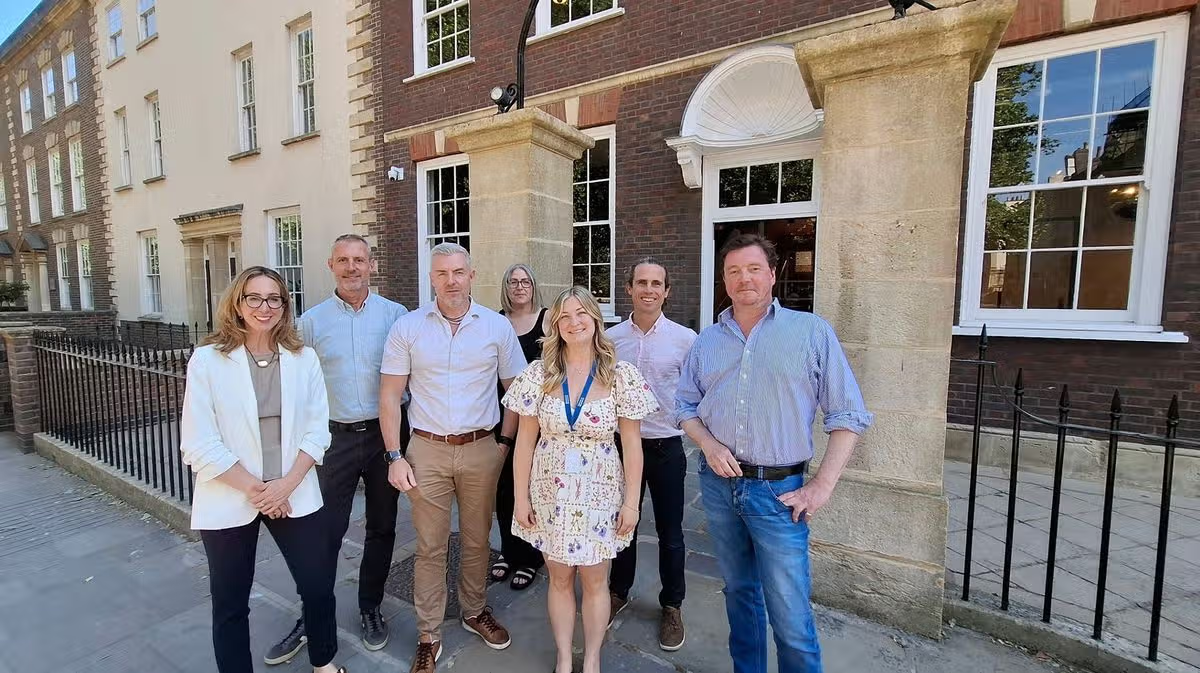
Left to right: Claire Robertson, Divisional Director; Jon Edden, Associate Project Manager; Mark Simpson, Director and Associate Partner; Anne-Louise Wells, Executive Assistant; Annabelle Kennett, Project Manager; Simon Joe Portal, Associate Director Sustainability & Climate Solutions; Torcail Forsyth, Principal Building Safety Act Consultant.

Left to right: Claire Robertson, Divisional Director; Jon Edden, Associate Project Manager; Mark Simpson, Director and Associate Partner; Anne-Louise Wells, Executive Assistant; Annabelle Kennett, Project Manager; Simon Joe Portal, Associate Director Sustainability & Climate Solutions; Torcail Forsyth, Principal Building Safety Act Consultant.(Image: Drees & Sommer UK)

A Manchester-headquartered construction, real estate and infrastructure consultancy has opened an office in Bristol. Drees & Sommer UK said its new South West base would “reinforce” its presence in the region and was in response to a growing investment and development pipeline.

The new office is based within Runway East on Queen Square and will provides a permanent base for the firm’s expanding Bristol team, the company said.

Claire Robertson, a divisional director for the consultancy’s industrial sector services, is heading up the Bristol office.

“Bristol and the South West represent one of the UK’s most dynamic and economically diverse regional powerhouses,” Drees & Sommer UK said in a statement.

Advertisement

“The area combines deep heritage in advanced manufacturing, aerospace, and defence with rapidly growing strengths in battery technology, life sciences, digital and clean technology sectors.

“Sustained inward investment and strong population growth are also driving a buoyant residential and mixed-use development market, all creating significant demand for the specialist consultancy services Drees & Sommer UK provides.”

Drees & Sommer UK is part of Drees & Sommer – a partner-managed, global consulting company with more than 6,500 staff across 80 offices worldwide. It’s UK arm has a number of sites including in London, Birmingham, Liverpool and Belfast.

Mark Simpson, director and associate partner at Drees & Sommer, said: “Bristol and the wider South West continue to attract investment, talent and development activity across a range of sectors, making it a natural location for Drees & Sommer UK to establish a permanent base.

Advertisement

“This move strengthens our ability to support clients locally, deepen existing relationships and build new partnerships across the area.”

The Bristol office will deliver consultancy services, including project management, cost management, technical due diligence, health and safety, sustainability consulting, building surveying and digital/BIM advisory.

Ms Robertson added: “This move to Queen Square is much more than a change of address. It reflects our confidence in Bristol as a centre of innovation, engineering excellence and long-term growth.

“As investment across the South West continues to create opportunities across the industry, being close to our clients and partners has never been more important. We’re excited to put down lasting roots in a location that matches our ambitions and those of our clients. We look forward to expanding our team with new hires in the near future too.”

Advertisement
Continue Reading

Business

Greenock: The town whose council wants migrants to move in

Published

on

A coastal cityscape with a tall clock tower in the foreground, surrounded by historic and modern buildings. Behind it, a large white cruise ship is docked beside red industrial cranes. Beyond the harbour, green hills and mountains rise under a partly cloudy blue sky.

Rummage through Greenock’s industrial history and you will find a distinct heritage – in the 19th Century its status as a global hub for refining sugar earned it the nickname “Sugaropolis”. Thousands of ships were also built in the coastal town over a near 300-year period.

More recently, the computer manufacturer IBM employed more than 5,000 people at its campus near Greenock. But the site closed completely in 2016.

Indeed, in the past four years, a further 1,500 jobs have vanished. Amazon, EE and a string of other companies have gone elsewhere. Just this week, the local shipyard announced it was cutting about a quarter of its workforce. Meanwhile, supporters of Greenock Morton, the local football team, have set up a fighting fund to try to stave off financial collapse at the club.

The town has been left bereft – little wonder Scotland’s First Minister John Swinney is due to visit this month, to hear the problems first-hand.

Advertisement

While health and social care roles employ many of the Africans, job opportunities for those born locally, and refugees, can be hard to find.

“When the work disappears, people disappear,” says Muriel, one of dozens of elderly residents gathered at Lyle Gateway Community Cafe, a stone’s throw from the High Street.

Continue Reading

Business

ASX 200 Closes Lower as Weakness in BHP and CSL Offsets Guzman y Gomez’s 14% Earnings Surge to Close Week

Published

on

Australia Housing Market 2026: Two-Speed Boom Persists as Prices Hit

SYDNEY — The S&P/ASX 200 closed down 28.6 points, or 0.32%, at 9,055.2 on Friday, ending a volatile trading week on a soft note as weakness in mining and healthcare heavyweights outweighed a standout earnings-driven rally in fast-food chain Guzman y Gomez.

The benchmark had opened Friday’s session on a strong footing, defying futures market predictions by climbing 0.33% at the open to 9,083.8 points, according to ABC News’ live market coverage. However, the index gradually gave back those early gains as the session progressed, ultimately finishing in negative territory for the day.

Guzman y Gomez emerged as the clear standout of Friday’s session, with shares holding a roughly 14% jump following the company’s latest earnings result. According to market coverage from TS2.Tech, the fast-casual restaurant chain traded at $27.34 during the session, having already changed hands at roughly 1.54 times its recent average daily trading volume. The company’s shares rallied even as it reported a loss tied to the closure of its U.S. business, with investors instead rewarding what analysts described as strong domestic operating momentum and continued shareholder returns.

Offsetting Guzman y Gomez’s gains, several of the index’s largest constituents weighed heavily on the broader market. BHP, CSL and WiseTech Global all traded lower during the session, with only partial offsetting support from gains in Woodside Energy, Rio Tinto and Commonwealth Bank of Australia, according to TS2.Tech’s market commentary. WiseTech shares were trading at $41.98 by mid-morning, while Rio Tinto changed hands at $174.36 and Commonwealth Bank traded at $157.24.

Advertisement

The S&P/ASX 200 Tech Index extended a broader stretch of weakness Friday, falling for the fourth time in five sessions after closing at a fresh seven-month high the previous Friday, according to Market Index’s live coverage of the day’s trading. Data center operator DigiCo tumbled after issuing weaker-than-expected fiscal 2027 guidance, while buy now, pay later company Zip Co gave back a portion of the roughly 18% gain it had posted in the prior session following its own earnings result.

Friday’s session also featured continued fallout from Thursday’s reporting-season results. Telix Pharmaceuticals shares were on watch after Bell Potter downgraded the radiopharmaceutical company to hold from buy, trimming expectations ahead of a closely watched regulatory decision. “The pivotal moment is in a few days time for Pixclara with this event alone to dominate short term share price performance. We expect approval but without great conviction. FY26 earnings adjustments are modest. We retain our PT $19.00 and downgrade to Hold following the recent share price increase,” Bell Potter said in its note.

Energy stocks continued to trend higher throughout the week, buoyed by rising oil prices, which climbed for a fifth consecutive session amid ongoing instability tied to the conflict between the United States and Iran. Gold miners Evolution Mining and Newmont Corporation were also positioned for a strong finish to the week after gold futures rose 0.65% overnight to $4,574.80 an ounce, a move analysts attributed to easing expectations for further interest rate hikes.

Poultry producer Inghams Group offered a cautious outlook alongside its full-year results, with chief executive Ed Alexander acknowledging a difficult year for the business. “The headline for financial year 2026 is that earnings were below the prior year and below the expectations that we had entering the year,” Alexander said, though he pointed to sequential improvement, with earnings before interest, tax, depreciation and amortization rising from $80 million in the first half to $106.6 million in the second half. Looking ahead, Alexander outlined the cost pressures facing the company in fiscal 2027. “You take your FY26 number, you add give or take AUD 130 million of cost inflation driven by a combination of feed, Middle East,” he said, describing a cost bridge that also factored in softening wholesale prices for the coming year.

Advertisement

Property group Charter Hall delivered fiscal 2026 operating earnings broadly in line with analyst consensus, supported by record equity inflows, though its fiscal 2027 guidance, which assumes no performance fees, landed somewhat short of where the market had been positioned heading into the result, according to Market Index’s live blog.

The broader macroeconomic backdrop continued to weigh on sentiment throughout the week. The Reserve Bank of Australia’s cash rate currently sits at 4.35% following three separate rate increases so far in 2026, with the central bank continuing to flag the possibility of further tightening should inflation risks materialize. Globally, strong U.S. jobless claims data and a robust Philadelphia Fed manufacturing survey reading lifted Treasury yields earlier in the week, while July’s Federal Reserve meeting minutes indicated another U.S. rate increase remained under consideration. Adding to the cautious tone, continued disruption to shipping traffic through the Strait of Hormuz, alongside U.S. threats directed at countries perceived as supporting Iran, kept oil-related inflation risk elevated across global markets.

On the currency front, the Australian dollar climbed Friday as traders pulled back from the U.S. dollar, according to ABC News, adding a further dimension to a session already shaped by a wide range of domestic earnings results and international macroeconomic developments.

Despite Friday’s pullback, the ASX 200 has climbed 2.66% over the past month, according to Trading Economics, even as the index remains roughly flat, up just 0.09%, compared with the same period a year earlier. With Friday marking the close of one of the busiest weeks of the current corporate reporting season, investors are likely to spend the coming days digesting the full scope of this week’s earnings results, from Guzman y Gomez’s standout rally to the more subdued performances from index heavyweights BHP, CSL and WiseTech, while continuing to monitor the Reserve Bank’s rate path and the ongoing geopolitical risk emanating from the Middle East.

Advertisement
Continue Reading

Business

Perenti divests BTP Group for $100m

Published

on

Perenti divests BTP Group for $100m

Mining services contractor Perenti has filed documents to divest BTP Group, and will recognise a $64 million non-cash loss within its FY26 financials.

Continue Reading

Business

Decision Making in Critical Thinking for Effective HR Management in 2026

Published

on

Decision Making in Critical Thinking for Effective HR Management in 2026

Critical thinking transforms HR from intuition-based actions to evidence-driven strategies, potentially reducing problem-solving bias by 51%.

By applying structured models like RED, Recognize assumptions, Evaluate arguments, and Draw conclusions, professionals ensure objective hiring and ethical conflict resolution. This analytical approach balances data-driven AI insights with essential human judgment to foster long-term organizational growth and employee trust.

Relying on gut instinct in human resources can lead to inconsistent hiring and biased evaluations that undermine organizational trust. While many professionals follow established policies, the real challenge lies in dissecting the underlying facts before making high-stakes choices. Effective decision making in critical thinking allows us to move beyond superficial impressions to identify the root causes of workplace issues.

Today, we will see how structured analysis and logical frameworks transform HR from a reactive administrative function into a strategic business partner. Let’s start with the practical methods to sharpen your judgment and ensure every decision is backed by solid evidence.

What Is Decision Making in Critical Thinking?

Critical thinking shifts HR from gut instinct to evidence-based logic, reducing bias by 51% in problem-solving. Using structured models ensures objective hiring and strategic growth, balancing human judgment with data-driven AI insights.

Advertisement

This shift from intuition to evidence is the foundation of modern HR management consulting.

The Shift From Intuition to Evidence

Relying solely on instinct can lead to inconsistent hiring decisions and performance evaluations. Personal impressions and emotional reactions may introduce bias, whereas objective, evidence-based assessments provide a more reliable foundation for evaluating candidates and employees.

HR professionals should verify relevant information before making important decisions. Taking the time to validate performance data, feedback, and supporting evidence helps reduce errors in judgment and promotes fair, consistent outcomes. Developing strong critical thinking skills is essential for making balanced and well-informed HR decisions.

As a result, modern HR practices place less emphasis on instinct and more on structured evaluation processes. Using consistent criteria, standardized assessments, and objective data helps organizations make better decisions while supporting fairness, transparency, and long-term business success.

Advertisement

Real-World Decision Making in Critical Thinking Examples

Using a structured evaluation rubric instead of relying on subjective impressions helps HR managers make more consistent and objective hiring and promotion decisions. Standardized criteria ensure that every candidate is assessed fairly based on their qualifications, skills, and performance, reducing the influence of personal bias throughout the selection process.

A transparent and unbiased approach also strengthens trust across the organization. When employees understand how decisions are made and believe they are being evaluated fairly, they are more likely to have confidence in the process and remain engaged in their work.

Over time, consistent and objective decision-making can contribute to higher employee retention, stronger performance, and a more positive workplace culture built on fairness, accountability, and trust.

Why Critical Thinking Leads to Effective Decision Making in HR Management

Moving from theory to practice, applying logic directly solves the most friction-heavy parts of human resources.

Advertisement

Solving Complex Employee Relations Issues

A logical, evidence-based approach is essential for resolving workplace grievances effectively. Rather than focusing only on the visible symptoms of a conflict, HR professionals should investigate the underlying causes to better understand the situation and identify an appropriate resolution.

Maintaining objectivity throughout the process helps ensure that every case is handled fairly and consistently. Using established policies, internal benchmarks, and standardized procedures, supported by regular HR compliance training, enables organizations to apply the same standards across all employee concerns.

By prioritizing facts over assumptions or personal opinions, organizations can reduce the influence of office politics and create a more stable, professional workplace where employees have confidence in the fairness of HR processes.

Strengthening Strategic Decision Making in HR

Logical, data-driven evaluation plays an important role in supporting long-term business growth. Strategic HR decision-making goes beyond filling immediate vacancies by considering the skills, capabilities, and workforce needs the organization is likely to have in the years ahead. This forward-looking approach helps identify future talent gaps before they become business challenges.

Advertisement

Effective workforce planning adds significant value by using data to forecast trends such as employee turnover, hiring demand, and evolving skill requirements. Combined with a well-defined HR location strategy, these insights help organizations build a workforce that supports sustainable growth across multiple markets.

As a result, HR becomes a strategic business partner rather than simply an administrative function. By aligning workforce planning with business objectives, HR can help drive organizational performance, support expansion, and contribute directly to long-term success.

  • Analyze facts to avoid emotional bias
  • Consider diverse perspectives for equity
  • Use data driven decision making in human resources
  • Anticipate consequences of policy changes

Data Driven Decision Making in Human Resources and Critical Thinking

While strategy sets the path, the actual numbers require a sharp mind to interpret them correctly.

Moving Past Surface-Level Analytics

Numbers often mask underlying realities. Data driven decision making in human resources requires identifying hidden patterns. Confirmation bias frequently leads us to favor metrics that support our existing beliefs.

We must investigate where every metric originates. Is the data truly representative of the workforce?

Advertisement
  • Halo effect
  • Recency bias
  • Affinity bias

Integrating Human Judgment with AI Tools

Automation offers impressive speed but lacks genuine empathy. Human experience must filter machine outputs to ensure fairness. It is vital to maintain AI recruitment compliance while evaluating automated suggestions.

Algorithms can perpetuate old systemic inequalities. Relying solely on software is risky. Critical thinking skills for HR professionals remain the final safeguard against algorithmic errors.

Feature AI Role Human Role
Screening Data sorting Nuance check
Interviewing Pattern recognition Empathy
Final Offer Market benchmarking Strategic negotiation
Cultural Fit Keyword matching Subjective judgment

Practical Critical Thinking Skills for HR Professionals

Mastery of these tools is useless without a repeatable framework for daily operations.

The RED Model for Structured Analysis

The RED model provides a clear path. First, we must recognize assumptions to identify hidden biases. Then, evaluate arguments with a cold eye. Finally, draw logical conclusions based on evidence.

Evidence evaluation requires gathering diverse facts. We should collect data from multiple departments to ensure accuracy. This rigor helps when choosing between PEO and staff leasing for your organization.

Advertisement

Apply the model consistently. Use it for every major policy change. It prevents expensive management errors.

Building a Culture of Critical Thinking in the Workplace

Encourage teams to question existing standards. We should not accept the phrase “we have always done it this way.” Reward employees who find flaws in old processes. Critical thinking skills for HR professionals must be practiced daily.

Identify effective training methods for your staff. Use workshops focused on logical problem solving. These sessions often integrate well into broader leadership development programs for managers.

To sustain this environment, we recommend implementing these simple habits:

Advertisement
  • Weekly brainstorming sessions
  • “Devil’s Advocate” roles in meetings
  • Open-door feedback loops

Conclusion

Getting up to speed with decision making in critical thinking allows HR professionals to replace intuition with evidence-based logic, reducing bias and improving talent retention. By applying structured models like RED, you can transform complex workplace challenges into strategic growth opportunities. Act now to build a fair, data-driven future where every choice strengthens your organization’s success.

Frequently Asked Questions (FAQ)

How does critical thinking improve the quality of HR decision-making?

Critical thinking allows HR professionals to move beyond gut instinct and emotional reactions. By focusing on objective analysis and evidence-based logic, we can reduce bias in problem-solving and ensure that choices regarding hiring, promotions, and conflict resolution are grounded in facts rather than personal feelings or past experiences.

What is the RED model and how is it applied in a human resources context?

The RED model is a structured framework designed to guide HR professionals through complex challenges using three essential steps: Recognize assumptions, Evaluate arguments, and Draw conclusions. It begins by identifying unproven beliefs or biases that might influence a situation, ensuring that we gather all necessary information before proceeding.

Can you provide examples of critical thinking in everyday HR tasks?

In recruitment, critical thinking involves using standardized rubrics and behavioral assessments instead of relying on a “vibe” or first impression. This ensures the most qualified candidate is selected based on merit and cultural fit, effectively removing personal favoritism from the selection process.

How can HR teams effectively balance data-driven insights with human judgment?

While AI and data analytics provide speed and identify patterns, they often lack empathy and can perpetuate historical biases. Critical thinking is required to question the context of the data and the sources of specific metrics to ensure they are not misleading or discriminatory.

Advertisement

What are the best ways to foster a culture of critical thinking within an organization?

Building this culture starts with encouraging teams to question the status quo and move away from the “we’ve always done it this way” mentality. HR can lead by example, rewarding employees who identify flaws in existing processes and creating safe spaces for divergent thinking and open-door feedback loops.

Advertisement
Continue Reading

Trending

Copyright © 2025