Connect with us

NewsBeat

Tottenham: Roberto De Zerbi admits it was a risk starting Lucas Bergvall in Brentford defeat

Published

on

Tottenham: Roberto De Zerbi admits it was a risk starting Lucas Bergvall in Brentford defeat

He told reporters: “Yeah, I was surprised, I was suffering for this defeat, but we are working. If you analyze last season, the defensive line, [Pedro] Porro, [Kevin] Danso, Micky van de Ven and [Destiny] Udogie. And today, Archie Gray, Jean Paul van Hecke, [Marcos] Senesi and [Andy] Robertson, four new players.

Source link

Continue Reading
Click to comment

You must be logged in to post a comment Login

Leave a Reply

NewsBeat

I endulged in a sweet extravaganza at this Cambridge brunch spot

Published

on

Cambridgeshire Live

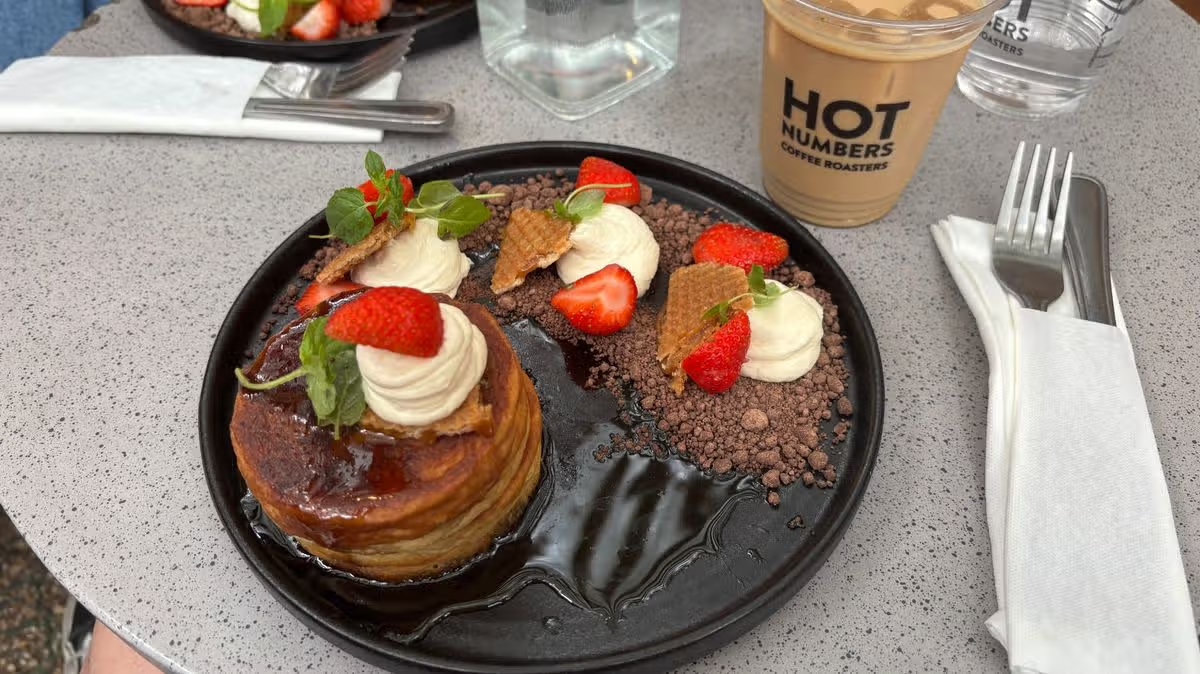
The pancakes were great value at £12.50

See inside Hot Numbers in Cambridge

I’ve been to Cambridge for work many times, but I’ve never been as a tourist. So when I took a trip to the city with the intention of being a tourist for the day, I made it my mission to tick off as many items on my ‘Cambridge bucket list’ as I could.

One of thos activities involved indulging in some sweet and sticky pancakes from Hot Numbers. I had a big day planned – including my first punting trip, having a drink in Byron’s Bear and taking a stroll next to the River Cam. But I began my day by fuelling up with some good food.

There are two Hot Numbers branches in Cambridge, one on Trumpington Street and the other on Gwydir Street. We visited the one in Trumpington Street. I was told that Hot Numbers offers some of the ‘finest specialty coffee’ in Cambridge. We arrived and the whole place was practically filled – it’s a good thing we’d book a table.

We got seated in a cosy corner of the outside area. There was a lot on offer on the menu, with both sweet and savoury options, and as expected, a large range of coffees. I went for the stroopwaffle and strawberry pancakes which came with stroopwafel, fresh strawberries, dark chocolate soil, cinnamon syrup and vanilla mascarpone cream.

Advertisement

For my drink, I chose an iced coffee with honey. I’d usually go for vanilla, but in the absence of this flavouring, the honey satisfied my sweet tooth. And I have to say the coffee lived up to the hype. It was refreshing and not too strong – just the way I like it.

The pancakes arrived and they looked too pretty to eat. The chocolate soil was scattered neatly across my plate, with the pancakes stacked on top of each other. They were daubed in syrup and the fresh strawberries brightened up my plate. I tried some of the stroopwaffle first, which was soft, delightfully sticky, and sweet.

Advertisement

I cut into the pancakes next, and immediately I could see how fluffy they were. Strawberries, chocolate and syrup are elite pancake toppings in my rankings, so I knew I wasn’t going to be disappointed. Altogether it was a sweet extravaganza and I didn’t want it to end. For £12.50, I felt satisfied, and rather full.

I’m all too aware of how high the food prices can be in Cambridge, but for a city centre sweet treat, I felt like I really got my money’s worth. If you find yourself craving something sweet next time you’re in the city, Hot Numbers may make a good pit stop.

All of our food reviews are paid for by the writer. The establishments do not know we will be reviewing their food, allowing us to make fair judgements on each place.

Source link

Advertisement
Continue Reading

NewsBeat

‘Overloaded’ UK mobile network is so poor one in five struggle to make calls

Published

on

Britain's overloaded mobile network regularly leaves one in five users unable to make calls (stock image)

Advertisement

Britain’s overloaded mobile network regularly leaves one in five users unable to make calls, The Mail on Sunday can reveal.

Ofcom, the regulator, claims 96 per cent of the population has good 4G coverage, allowing them to stream videos or play games online.

But damning data involving more than 25,000 tests on phone signals found the country was riddled with blackspots that condemn millions to poor signal or no service at all.

Buffering Britain, the app behind the audit, said the findings suggested up to two in five mobile phone users could not play video clips on websites or social media, and up to one in five in some regions struggled to make a phone call. The consumer group Which? claims Britain’s mobile coverage is worse than in all 27 EU member countries and every other member of the G7 group of major economies.

Advertisement

Data usage is growing by a fifth annually in the UK, but phone operators complain that new masts are often blocked by planning officers because of local complaints.

Buffering Britain’s findings match early results from another national audit that is mapping the phone network using trackers attached to council refuse lorries and trains.

Data from Dorset shows only 63.5 per cent of the county has ‘good’ 4G coverage from at least one operator, even though Ofcom claims a figure of 99.9 per cent.

According to the Dorset survey, just 82.2 per cent of the county road network has even ‘basic’ coverage from at least one mobile network operator. This means it is hard or impossible to make mobile calls across almost a fifth of the region.

Advertisement

Join the discussion

Should phone companies or councils be blamed for Britain’s poor mobile coverage and connectivity?

Britain’s overloaded mobile network regularly leaves one in five users unable to make calls (stock image)

Advertisement

Streetwave, the Government-backed data group behind the project, has found similar gaps between Ofcom’s claims and the reality for customers in 130 counties and metropolitan boroughs.

Advertisement

Buffering Britain’s audit is based on tests conducted through its phone app, with thousands signing up since it was launched last month. It said: ‘Britain has worse mobile connectivity than Kazakhstan. It’s an embarrassment.’

Streetwave said: ‘The results from Dorset highlight a significant gap between official claims – based on models and data supplied by the industry itself – and the connectivity consumers actually experience.’

Last month, former security minister Tom Tugendhat wrote in this newspaper that the phone signal in London was worse than in Kabul a decade ago, and phones were now ‘useless in vast areas of Britain’.

The trade body Mobile UK said: ‘Operators are pouring billions into network upgrades, but rollouts are stalled by sluggish planning regimes and regulatory inertia.’

Advertisement

Advertisement

Source link

Continue Reading

NewsBeat

I was going to join Real Madrid over Man United – but one conversation changed my mind

Published

on

Manchester Evening News

A former Manchester United captain was persuaded to reject Real Madrid in favour of a move to Old Trafford

Antonio Valencia revealed the impact Steve Bruce played in his decision to turn down Real Madrid for Manchester United.

Advertisement

The former United star, 41, spent 10 years at Old Trafford and served as the captain in his last year at the club. Valencia was only three years into his professional career when moving to England in 2006 to join Wigan Athletic on loan from Villarreal.

His deal with the English club was made permanent in 2008, and he subsequently drew interest across Europe the following summer, with United and Madrid among his suitors. The ex-winger opened up about the difficulty of moving across the world but admitted that Wigan remains close to his heart.

“It was very difficult for me when I first signed for Wigan and moved to England, because there was so much I didn’t know,” Antonio Valencia exclusively told Ladbrokes. “The language, the culture, the food… all of it was new to me, so it was difficult on that side of things.

“I came over from Spain, and didn’t really know how long I’d be in England, to be honest with you, but I’m so grateful to Wigan for playing such a big part in my career. They still hold a special place in my heart, because they gave me the opportunity to go and play for Manchester United.

“So, of course, I still look out for them, and it looks like they’ve added some decent names to their squad this summer. They finished 16th last season, and I’m hopeful they can build on that this season, and can aim for a play-off position, because I’d love to see them back in the higher divisions again.”

Valencia was managed by United icon Steve Bruce in his time at Wigan and revealed that a phone call with his former manager swayed him to accept Sir Alex Ferguson’s offer. Valencia explained: “It’s not just that Wigan gave me the opportunity to play for Manchester United, but the club – and in particular, Steve Bruce – played a key role in me signing for United.

Advertisement

“First of all, I couldn’t believe it when I found out United were interested in me… it was wonderful news for me and my family. But I also had interest from another big Premier League club, and also from Real Madrid.

Essential 26/27 Sky Sports Bundle for the new season

This article contains affiliate links, we will receive a commission on any sales we generate from it. Learn more
Content Image

£51

£35

Sky

Advertisement

Get the deal here

Sky’s Essential TV and Sky Sports bundle includes at least 215 live Premier League clashes across the 2026/27 season, with more than 1,500 games from the EFL and beyond, plus F1, golf and darts.

This introductory offer saves £384 compared to the standard price, with every package also providing 100 regular channels alongside free Netflix and discovery+ subscriptions.

“I came very close to making the move to Real Madrid, but I’m someone who likes to listen, and it was Steve Bruce who told me to sign for Manchester United, so that’s what I did, and it’s the best decision I could have made.”

Valencia enjoyed a trophy-laden career at United as he won six major honours, including two Premier League titles in his first four years at the club.

Advertisement

Source link

Continue Reading

NewsBeat

This European country has slashed the number of asylum applications by a third, so why can’t we? The man whose policies dramatically cut them reveals how he did it… and how we could too

Published

on

Britain's migrant crisis - that has seen the introduction of so-called mega dinghies carrying 230 people to our shores - is being exacerbated by our weak approach to asylum applications

Britain needs to make itself much less appealing to asylum seekers if it wants to control soaring numbers coming here illegally.

That’s the verdict of the Danish politician whose hardline policies drove a significant reduction in the number of migrants coming to the Scandinavian country to try to gain residency status as a refugee.

Denmark is governed by the centre-left Social Democratic party – whose values are similar to those of new Prime Minister Andy Burnham‘s Labour – which has been following a tough policy aimed at ‘zero asylum seekers’ for several years.

When measured in relation to per capita population, Denmark and the UK until recently had quite comparable numbers: as recently as 2023, Denmark had an average of 57 per 100,000 while in Britain it was 55.

Advertisement

But since then the two nations’ experiences have dramatically diverged: Britain’s number has almost tripled and now amounts to 145 claims per 100,000 citizens while Denmark’s number has fallen by a third to just 40 claims.

And when the Mail visited previously troubled areas of the capital Copenhagen this week we saw the positive social results of the change – more of which later.

But Denmark’s statistical turnaround alone is one that new PM Andy Burnham would love to achieve – having pledged to tackle the small boats crisis.

Indeed we know that the Labour government has looked to the Denmark model for inspiration: Rasmus Stoklund, until recently Denmark’s immigration and integration minister, was invited to host Shabana Mahmood to share his insights earlier this year.

Advertisement

Britain’s migrant crisis – that has seen the introduction of so-called mega dinghies carrying 230 people to our shores – is being exacerbated by our weak approach to asylum applications

The UK needs to make itself 'less appealing to migrants' - seen here waving to a smuggler's boat in an attempt to cross the English Channel, on the beach of Gravelines, in northern France

The UK needs to make itself ‘less appealing to migrants’ – seen here waving to a smuggler’s boat in an attempt to cross the English Channel, on the beach of Gravelines, in northern France

Rasmus Stoklund, Denmark's former immigration and integration minister, has been integral in the country's number of applications dropping by a third to just 40 per 100,000 people

Rasmus Stoklund, Denmark’s former immigration and integration minister, has been integral in the country’s number of applications dropping by a third to just 40 per 100,000 people

Advertisement

That meeting came when the British Home Secretary visited Denmark on a fact-finding tour and held high-level discussions with Mr Stoklund and his team, with the Danish MP saying he hoped the talks had been ‘fruitful and useful’.

Mr Stoklund said he was unable to share details of his discussions with Ms Mahmood – ‘Far be it for me to advise the UK government on policy’ – beyond saying he hoped they had been ‘fruitful and useful’.

But he was happy to tell the Daily Mail how he turned Denmark around.

He told us: ‘What we have done is to make clear that asylum seekers without a valid reason are not welcome in Denmark.

Advertisement

‘We 1787462964 have very strict criteria and everything is checked and checked again and decisions made very quickly – and many of them are rejected and the claimants sent back to where they came from.

‘We are sending a signal to human smugglers and migrants considering trying to get into Denmark that it is not that easy anymore, and we have strict rules and regulations that will be used and will probably get you sent back.

‘During the last ten years we have taken a number of initiatives that have kept the numbers down, and the focus has been on securing and controlling our borders and who gets in.

‘People who apply for asylum have their applications processed very quickly and thoroughly and a lot of them are rejected straight away because they don’t have any real reason to claim it – they come from safe countries.

Advertisement

‘They are [therefore] rejected and they are deported, they are not told please leave and then go back into society, they are put in centres and then returned home.

‘On average we have around 50 people a week put on planes from Denmark who have no right to stay in the country.

‘We send people back to Afghanistan and Syria as often as possible and we are able to control the numbers well. We have repatriation schemes where people volunteer to go back, and many have taken this opportunity.’

Denmark’s attempt to turn the tide on migration goes back to 2019 when the left-leaning government first indicated an ambition to protect Danishness – and acted on the pledge.

Advertisement

The country famously banned the burka, the garment fully covering the face and body worn by devout Islamic women.

Advertisement

And new rules came in compelling all newcomers and their children to learn Danish or lose asylum seeker benefits.

Mr Stoklund went on: ‘It is tough but it has worked – we have made ourselves less attractive and less inviting and that’s how we have dealt with the issue, it’s as simple as that.’

Mr Stoklund is adamant that it’s not in his remit to tell the UK what to do – but when pressed on where we are going wrong he does have thoughts in that direction.

Mr Stoklund explained: ‘Britain needs to focus on what is good for Britain

Advertisement

‘What I can tell you is that here in Denmark we try to make it as unappealing as possible to come here because of the demands and restrictions.

‘If you have no viable legal reason to arrive then you will be sent back, it’s as simple as that, the asylum process is very thorough, and you need to have detailed documentation.

‘If you cannot provide this then your claim will be rejected but if you are fortunate enough to be granted asylum then you will be expected to work and give back to society, and if you turn to crime then you will also most likely be deported.

Denmark Prime Minister Mette Fredericksen, met Sir Keir Starmer in Downing Street last year to discuss her approach to immigration

Denmark Prime Minister Mette Fredericksen, met Sir Keir Starmer in Downing Street last year to discuss her approach to immigration

‘Your right to benefits is also very low and with these incentives the aim is to show that Denmark is not an attractive place to come to and maybe that’s where the UK is going wrong but it’s not for me to tell the government there what to do. 

‘We also have very strict regulations for people who want to come here and join family members who may be in Denmark already – it’s not as simple as just turning up, they have to fulfil their obligations.

Advertisement

‘It’s not just possible for them to arrive and move in.’

This compares to a much less strict regime here: in a case that emerged just last month a single refugee from Afghanistan was astonishingly able to successfully argue that 22 family members should be allowed to enter the UK to join him.

Mr Stoklund went on: ‘These family claimants are put in centres, and their claims are examined and if they meet the requirements then fine but it’s a very hard process and Denmark is good at investigating thoroughly the backgrounds of all migrants.

‘To be honest the likelihood is that any application will be rejected and that’s the incentive we use, to make people realise that it’s just not worth coming here because you will more than likely be sent back.

Advertisement

‘Of course, we are a small country with a low population which makes the numbers easier for Denmark to handle but the structures we have in place undoubtedly help keep the figures down.

‘But we expect people who come here to contribute and if they don’t then they are sent back, that’s if they get in in the first place.’

Mr Stoklund, who held the migration job until this June, even argued – unsuccessfully – that his country should ignore judgments from the European Court of Human Rights, a policy that both the Conservative and Reform parties here have adopted.

And his successor in the role, Morten Bødskov, is keeping up the hardline approach: just this week he floated plans to ban the Islamic call to prayer being used in Denmark, claiming parts of the country felt like ‘a suburb of Islamabad’.

Advertisement
Denmark has cut asylum claims by 90 per cent with policies like banning the burkha, the garment fully covering the face and body worn by devout Islamic women

Denmark has cut asylum claims by 90 per cent with policies like banning the burkha, the garment fully covering the face and body worn by devout Islamic women

Denmark and the UK until recently had comparable migrant numbers: In 2023, the Danes had an average of 57 per 100,000 while in Britain it was 55

Denmark and the UK until recently had comparable migrant numbers: In 2023, the Danes had an average of 57 per 100,000 while in Britain it was 55

Meanwhile when the Mail toured Copenhagen – and visited the three districts most affected by migration – we saw the context that caused the Danish government to take drastic action.

All three have seen crime and rental costs go up – while social cohesion, according to many, has gone down.

Advertisement

In Ishøj, an outer suburb of Copenhagen, where native Danes are expected to be outnumbered imminently by those with ancestry from overseas (the current ratio is 51 per cent/49 per cent), there is widespread relief that the numbers are falling.

Local mayor Merete Amdisen, a Social Democrat, said earlier this year that the area had no capacity to take any more new immigrants.

Mark, a pensioner and long-term resident, said: ‘An enormous number of immigrants have arrived, and older Danish people like me are worried about our country and what the future holds.

‘There has been an increase in serious crime and now it is practically children who are carrying knives and guns and being recruited by gangs.

Advertisement

‘So we welcome something finally being done.’

Mr Stoklund was invited to host Home Secretary Shabana Mahmood to share his insights into migration and how Denmark has achieved a reduction in asylum claims earlier this year

Mr Stoklund was invited to host Home Secretary Shabana Mahmood to share his insights into migration and how Denmark has achieved a reduction in asylum claims earlier this year

In the Rødovre district, Mayor Britt Jensen, also a Social Democrat, had said she will not accept any more Ukrainian refugees and they will have to build temporary accommodation units in car parks if the numbers coming don’t decrease.

She said: ‘The main problem is that we don’t have space. We don’t have any housing available. We are in the process of renting out commercial properties and converting them into housing. And then we have to build pavilions in all our available parking spaces.’

Advertisement

In Brøndby, Mayor Maja Højgaard, again a Social Democrat, says that the municipality’s already large proportion of people with a foreign background means that there is no room for more Ukrainian refugees. Today, immigrants and descendants make up 42 per cent of the municipality’s inhabitants.

She said: ‘It is no use putting the people who need help the most in the place where there are already the vast majority of other local residents who also need help’

A local there, a middle-aged man, said: ‘Rental costs here have sky rocketed in recent years so much so that many people cannot afford somewhere to live. It has now become profitable for landlords to relocate original inhabitants, renovate the apartments and then double the rent.’

More positive was resident Anna who said: ‘I like having a diverse population. There is a lot we can learn from the newcomers. So, I’m not afraid. Crime gets far too much attention and creates a gloomy atmosphere.’

Advertisement

But a neighbour said: ‘We used to get told all about the positive aspects of migration and how we would have a positive, multicultural Denmark but now the talk is all of parallel societies with conflicting interests.’

Mr Stoklund addressed his point in his final comment. 

He said: ‘We realised a long time ago that we wouldn’t be able to maintain a high level of social cohesion and trust in our society if we accepted migrants from countries who would end up being unemployed or turn to crime.’

Source link

Advertisement
Continue Reading

NewsBeat

The rise of gang boss Jamie Daniel from council housing estate hood to top of criminal tree

Published

on

Daily Record

He was the boy from Glasgow’s tough Possilpark that rose to the top of the criminal tree from humble beginnings. Jamie Daniel has been described in the past as the head of Scotland’s richest crime family.

He has even been compared to Harold Shand, the fictional London crime boss in the British gangster epic The Long Good Friday played by the late Bob Hoskins. As a young man Daniel was said to be into shoplifting, loan-sharking, stealing car wheels and scrap metal.

One of his big earners in his early days was melting down aluminium beer barrels stolen from outside pubs. In 1983, at the age of 25, he was jailed for four years in England for heroin smuggling.

Undeterred Daniel was said to have gone on to built an international criminal empire stolen cars, firearms and major drug smuggling and forged links with gangs in London, Manchester and Liverpool. His underworld dominance remained secret until January 2003 when our sister paper the Sunday Mail named him for the first time as the leading criminal figure in Scotland ahead of people like Tam “The Licensee” McGraw and Glasgow’s McGovern brothers.

Advertisement

At the time his criminal empire was said to be worth £16 million a year. By this time his family had embarked on a feud with the Lyons family who were based in the neighbouring Milton housing estate over control of the city’s drugs trade.

Over the years he earned the reputation as someone not to be crossed. Two doormen who had attacked a family member at a Glasgow nightclub later were then said to have had their cars blown up.

Advertisement

And in 2000, he was linked to the murder of drug dealer Frank McPhie, a career criminal who was shot in the head by a sniper outside his home in Maryhill, Glasgow. McPhie was said to have attacked a member of Jamie’s family weeks earlier.

The murder to this day remains unsolved.

Daniel spent most of his criminal career successfully staying away from the long arm of the law. However his temper let him down in 2010 when he became involved in a road rage incident with a young student driver near his luxury home in Glasgow’s Jordanhill

Advertisement

Daniel chased after him, tried to reach into his car and grab him and battered the car with a metal pole. At Glasgow Sheriff Court Daniel admitted breach of the peace, as well as two charges of assaulting a fellow prisoner while on remand in Barlinnie prison He was jailed for a year and served six months.

In 2016 he died after a four year battle with cancer. On the day of his funeral ‘In the Ghetto’ by Elvis Presley was played over the sound system in Clydebank Crematorium as 600 mourners filed into the chapel building.

The 30-minute non-religious service was conducted by civil celebrant who described as a scrap metal dealer who enjoyed bungee jumping, hunting, jet skiing, playing pool and supporting Rangers. The celebrant made no reference to Daniel’s criminal past but said he was a loving family man loyal to his friends who had fathered 10 children and had 10 grandchildren.

She added: “He was someone who liked to be in control and was usually two steps ahead of everyone else. You either loved him or hated him. But Jamie liked it that way.”

In August a 2019 Channel Five TV documentary said Daniel had been one of country’s most feared criminals. It had been due for broadcast the previous year.

Advertisement

However it was postponed because of the trial of six members of the Lyons crime gang accused of attempting to murder Jamie Daniel’s nephew Steven “Bonzo” Daniel.

In the programme former Detective Inspector David Moran said of the late crime boss: “He had the reputation of being one or two steps ahead of the police and pretty much untouchable”. In July we told how a top London crime gang called in Daniel to sort out a Glasgow drug dealer who owed them £200,000 from a cannabis deal.

The very mention of his name was enough for the errant dealer to pay up that night having earlier been summoned to a Chinese restaurant in Glasgow where Daniel had been eating. A London enforcer Psycho Nick – also known as Nick the Greek – had been sent to Glasgow to get the money and called in Daniel for assistance.

Advertisement

He was taken for dinner to the Chinese restaurant where Jamie Daniel phoned the man – known as Brave Alan -over the drugs debt. Later that night Brave Alan arrived at Daniel’s home in Glasgow’s posh Jordanhill carrying a rucksack containing the money and handed it to Nick.

He then told Daniel: “When I heard your voice on the phone, Jamie I thought I was dead.”

The story was related to the Daily Record by Andrew Pritchard once compared to Pablo Escobar, the Colombian drug lord. Over a period of almost 30 years Londoner Pritchard smuggled millions of pounds’ worth of drugs into the UK hidden inside everything from coconuts and coffins, to crates of fruit and vegetables.

Pritchard went straight after his release from prison in 2019 and has now brought out a book about his life of crime titled ‘Empire of Dirt’. He says the Brave Alan incident forged a friendship between Psycho Nick and Jamie Daniel that lasted up until his death.

Pritchard added: “Jamie was a big guy in Glasgow. He was a very serious man but you knew what strength he had.

“Jamie Daniel came in through our network. One of the local firms in London was connected to him. When they had an issue up in Scotland he was their man to go to.”

Get more Daily Record exclusives by signing up for free to Google’s preferred sources. Click HERE

Advertisement

Source link

Continue Reading

NewsBeat

Child left feeling ‘scared’ after report of man allegedly ‘hitting woman’

Published

on

Cambridgeshire Live

Officers spoke to one of the children present who described feeling ‘scared’

A child was left “feeling scared” after a report of a man allegedly “hitting a woman”. Earlier this week, a member of the public called Cambridgeshire Police and reported seeing a man hitting a woman while she was holding a child.

Advertisement

Officers attended and the woman described the incident as “just an argument”, according to Cambridgeshire Police. But officers continued to investigate.

A spokesperson for the force said: “As part of their enquiries, they spoke to one of the children present, who described hearing shouting and said it had left them feeling scared.”

An assault investigation has now been launched and a man was arrested. He has since been released on bail with strict conditions while enquiries continue, the force confirmed.

The spokesperson for the force added: “Children can be deeply impacted by what they see, hear and experience domestic abuse. If you witness behaviour that doesn’t seem right, trust your instincts and report it. Your actions could help safeguard both an adult and a child from harm. For support on domestic abuse https://orlo.uk/S3dJA.”

Advertisement

Source link

Continue Reading

NewsBeat

Horoscope today: Your daily guide for Sunday, August 23, 2026

Published

on

Horoscope today: Your daily guide for Sunday, April 5, 2026

Aries (March 21st – April 20th)

Today asks you to step back from the usual rush, Aries. Pausing doesn’t mean you’re weak; it shows foresight. Observing others quietly gives you the edge, and small adjustments today help you avoid bigger conflicts tomorrow. The sharpest eyes often see the hidden path.

Taurus (April 21st – May 21st)

Advertisement

Your generosity is noticed, Taurus, but don’t let it be taken for granted. A minor misunderstanding could appear if you give too quickly without clarity. Today is about boundaries wrapped in kindness. Clear expectations prevent future friction. Even the softest touch can move mountains.

Gemini (May 22nd – June 21st)

Your curiosity sparks learning, Gemini, but today it’s about listening as much as speaking. A casual remark could hold the key to an opportunity you hadn’t expected. Awareness of timing and tone brings the upper hand. Little things often shape big outcomes.

Cancer (June 22nd – July 23rd)

Advertisement

Someone close revealed a hidden side, Cancer. Your ability to respond with calm insight transforms tension into understanding. Minor gestures of care now cement trust that lasts. Those you cut ties with, you cut for good now.

Leo (July 24th – August 23rd)

You’ll be tempted to dominate a conversation, Leo, but influence comes from listening as well as speaking. Small acknowledgements now make others more willing to support your plans. Your presence alone inspires, but your thoughtfulness seals success. Soft words often carry the greatest power.

Virgo (August 24th – September 23rd)

Advertisement

A detail you’d usually overlook holds the key today, Virgo. Focusing on what’s subtle, rather than obvious, prevents errors and shows your skills. What seems minor now has a long-term impact on work or home. Dreams have meaning regarding family at this time.

Libra (September 24th – October 23rd)

A social situation asks you to judge carefully, Libra. Harmony isn’t about agreeing with everyone, but understanding what’s needed to move forward. Small interventions now prevent bigger disagreements later. Balance is found when you measure both heart and mind.

Scorpio (October 24th – November 22nd)

Advertisement

You notice what others miss, Scorpio, and your intuition guides you today. A choice could appear trivial, yet its consequences ripple further than expected. Trust what you feel, even if it seems unseen. Shadows often reveal what light can’t.

Sagittarius (November 23rd – December 21st)

Adventure calls in subtle ways, Sagittarius. A new path or idea emerges, but only if you observe before acting. Today is about preparation hidden in spontaneity. Enthusiasm is best channelled with care, as small sparks ignite long-term results. Curious steps yield surprising rewards.

Capricorn (December 22nd – January 20th)

Advertisement

You feel responsibility pulling in all directions, Capricorn, but clarity comes from choosing what truly matters. Delegating doesn’t mean losing control, it means creating space for priorities to flourish. The slowest path can bring the surest results.

Aquarius (January 21st – February 19th)

Family and social matters require a more careful touch, Aquarius. Listening closely reveals what is unspoken but important. Small gestures today carry more influence than grand ones tomorrow. Your insight builds trust quietly, like water shaping stone.

Pisces (February 20th – March 20th)

Advertisement

Your creativity flows, Pisces, but grounding today ensures it’s productive. Even modest actions toward a dream now yield results that grow over time. A practical step may feel small, yet it shapes a larger future. Building with care transforms imagination into reality.

Aries 0904 470 1141 (65p per minute)*

Taurus 0904 470 1142 (65p per minute)*

Gemini 0904 470 1143 (65p per minute)*

Advertisement

Cancer 0904 470 1144 (65p per minute)*

Leo 0904 470 1145 (65p per minute)*

Virgo 0904 470 1146 (65p per minute)*

Libra 0904 470 1147 (65p per minute)*

Advertisement

Scorpio 0904 470 1148 (65p per minute)*

Sagittarius 0904 470 1149 (65p per minute)*

Capricorn 0904 470 1150 (65p per minute)*

Aquarius 0904 470 1151 (65p per minute)*

Advertisement

Pisces 0904 470 1152 (65p per minute)*

*Astro line horoscopes are updated every Thursday. Calls cost 65p per minute plus your telephone company’s network access charge and will last approximately five minutes. You must be over 18 and have the bill payer’s permission. Service provided by Spoke. Customer service: 0333 202 3390

Source link

Advertisement
Continue Reading

NewsBeat

2026 heatwaves compared to famous 1976 summer ‘and it’s not even over yet’

Published

on

Cambridgeshire Live

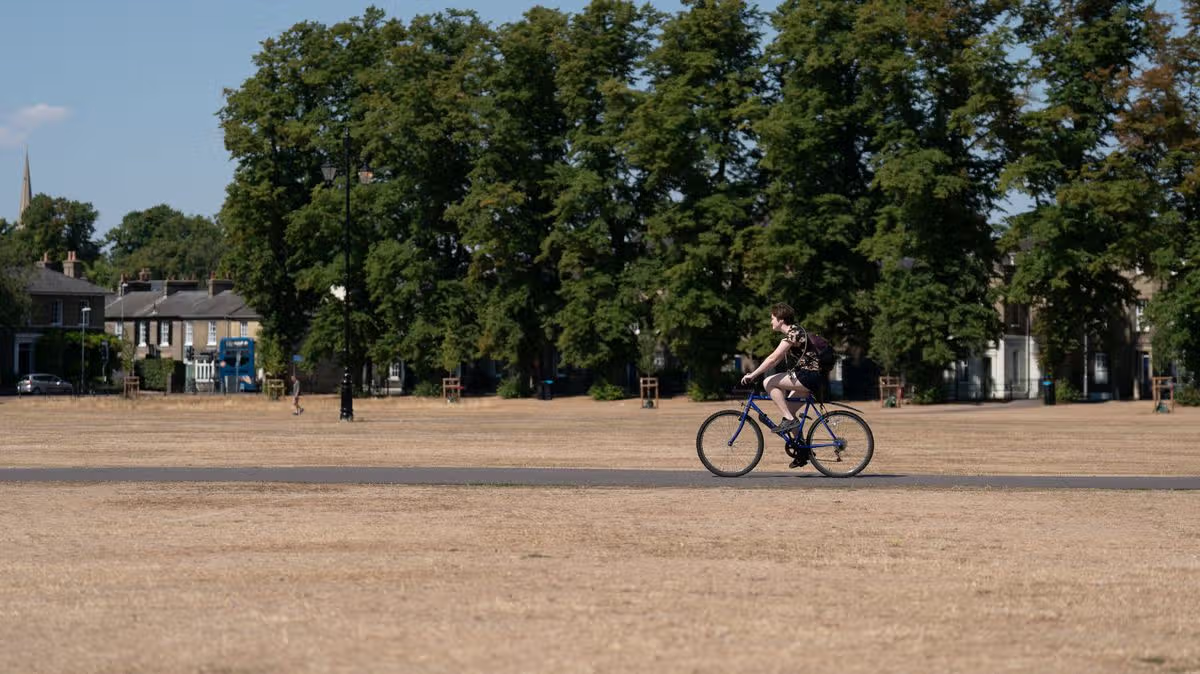
Cambridgeshire Live readers have been looking back on the long, hot summer of 1976 as the UK faces the hottest summer on record in 2026

Cambridgeshire Live readers have been reminiscing about the scorching summer of 1976, now half a century ago. While Cambridgeshire and the remainder of the UK is experiencing the hottest summer on record, a look back 50 years reveals the county endured one of its most sweltering summers then, too.

Residents in 1976 also faced a drought, just as we are experiencing this year. During 1976, temperatures throughout June, July, and August remained consistently in the high 20s and low 30s.

Advertisement

There was no rainfall for 16 months, making it the driest spell in over 250 years at that time. Village ponds started to dry up and firefighters were deployed to replenish them.

In Cambridgeshire, Grafham Water dried up enough to reveal trees that had been underwater since it was filled during the 1960s. Several of Cambridge’s beloved green spaces also required watering to stop them from becoming parched.

The summer of 1976, with its drought and heat, has much in common with the hot summer we are experiencing this year. In 2026, there has been an increase in field fires across Cambridgeshire due to dry grass, and hosepipe bans have been introduced. Temperatures have also exceeded 30C on many days, with the county hit by its fifth heatwave this year.

One reader, Skipper asks: “So – why do we need net zero? 76 for me was a great year. Every weekend was another day in a hot and sunny paradise.”

Advertisement

Henryfrog believes: “2026 easily had 76 beaten, and it’s not even over yet. We’ve also had 4 other record breakers just in the last 10 years. That’s rapid acceleration of climate change in action, and humans are to blame.”

Calumen Nomen replies: “By that logic, humans must have been ‘to blame’ for last year’s carp summer, then, too? Or is that an ‘inconvenient truth’?”

Banallbikes says: “It’s hot because it’s summer, it happens every year.”

Liveincrete asks: “How many so called wild fires was there in 1976 in comparison to this year?”

Advertisement

Over on our Facebook page, Patrick D. L comments: “The difference was that ’76 was an isolated, extremely hot, dry summer. Now, we have a lot of extremely hot, dry summers.”

Bridget D replies: “It wasn’t isolated. 1975 was very hot and dry, too.”

Graham E says: “I remember the summer of 76 in the UK and to say ”Now, we have a lot of extremely hot, dry summers.” is stretching the truth to say the least because we’ve had the odd 3 or 4 days to a week but definitely not summers like that, i.e., several weeks of it.”

Colin A says: “Mother nature, nature can be a great leveller, so I wonder what we will be talking about in twelve months’ time.”

Advertisement

Adrian W writes: “Rather subdued hazy skies with somnolent heat, and I preferred the ‘75 summer after the early June cold patch; beautiful blue skies for fruit-picking after A Levels.”

Do you think that the legendary summer of 1976 can be compared to the extreme weather we are currently enduring? Comment below or HERE to have your say.

Source link

Advertisement
Continue Reading

NewsBeat

Organised criminals targeting Scots shoppers in elaborate gift card rigging scam

Published

on

Daily Record

Gangs are ‘draining’ thousands of pounds in hard-earned cash from customers in the lucrative £8bn gift card and voucher market.

Organised crime gangs are secretly rigging gift cards to “drain” thousands of pounds in hard-earned cash from Scots shoppers in a new high-tech scam.

Gift cards remain one of the most popular ways to give at Christmas, birthdays and anniversaries, with the UK gift card and voucher market worth around £8billion a year.

With thousands of Scots expected to buy gift cards in the run-up to Christmas, they are being urged to check them carefully and report anything suspicious to store staff.

Advertisement

Police Scotland have now warned that prepaid gift cards are being tampered with in a sophisticated online scam known as “gift card draining”.

They say the three-stage scam sees gangs steal and tamper with gift cards before returning them to shop shelves. When an unsuspecting shopper buys and activates the card, the cruel fraudsters are lurking online to siphon off the cash.

Many victims may be unaware they have been conned until weeks or even months later, when the recipient tries to use the gift card only to discover the money has already been drained. By that time both the fraudsters and their cash are long gone.

Advertisement

A Police Scotland spokesperson said: “While we are aware of gift card draining, offences of this nature are currently not reported in significant numbers within Scotland, however, we would urge retailers and customers to always remain vigilant.

“Store staff can help prevent such offences by displaying gift cards close to tills and other areas where it is less easy for criminals to steal them without being detected.

“For the public, we would ask that you inspect any gift card prior to purchase and if there is any evidence of tampering do not buy it – instead report it to staff within the premises.

“Any incidents of gift card thefts should be reported to police immediately.”

Advertisement

It comes after Police Scotland’s Retail Crime Task Force (RCTF) recently helped smash a crime gang accused of rigging gift cards before putting them back on shop shelves.

The scam was uncovered during a joint operation in May and June involving RCTF and a national retailer being targeted by crooks running a gift card sting across Scotland and England.

They say it led to two arrests with officers seizing more than 800 gift vouchers and £12,000 in cash.

Shoppers are advised to check packaging for signs of tampering, choose cards from secure or staffed locations where possible and always keep their receipt.

Advertisement

Data shows shoplifting has surged to an all-time high and now accounts for over 45% of all crimes of dishonesty in Scotland.

According to Police Scotland, more than 53,000 retail crimes were recorded in the year to March – up almost 20% on the previous 12 months.

Shop workers are increasingly finding themselves on the frontline of the shoplifting crisis, facing the brunt of brazen and sometimes violent offenders targeting stores and leaving staff exposed to abuse and intimidation.

Police estimates up to February 28 show the scale of the epidemic, with 5089 shoplifting charges or detections recorded, alongside 1122 arrests and 601 charges relating to offences against retail workers.

Advertisement

Get more Daily Record exclusives by signing up for free to Google’s preferred sources. Click HERE

Source link

Continue Reading

NewsBeat

Ferguson Marine unions tell John Swinney to ‘delivers contracts, not more promises’

Published

on

Daily Record

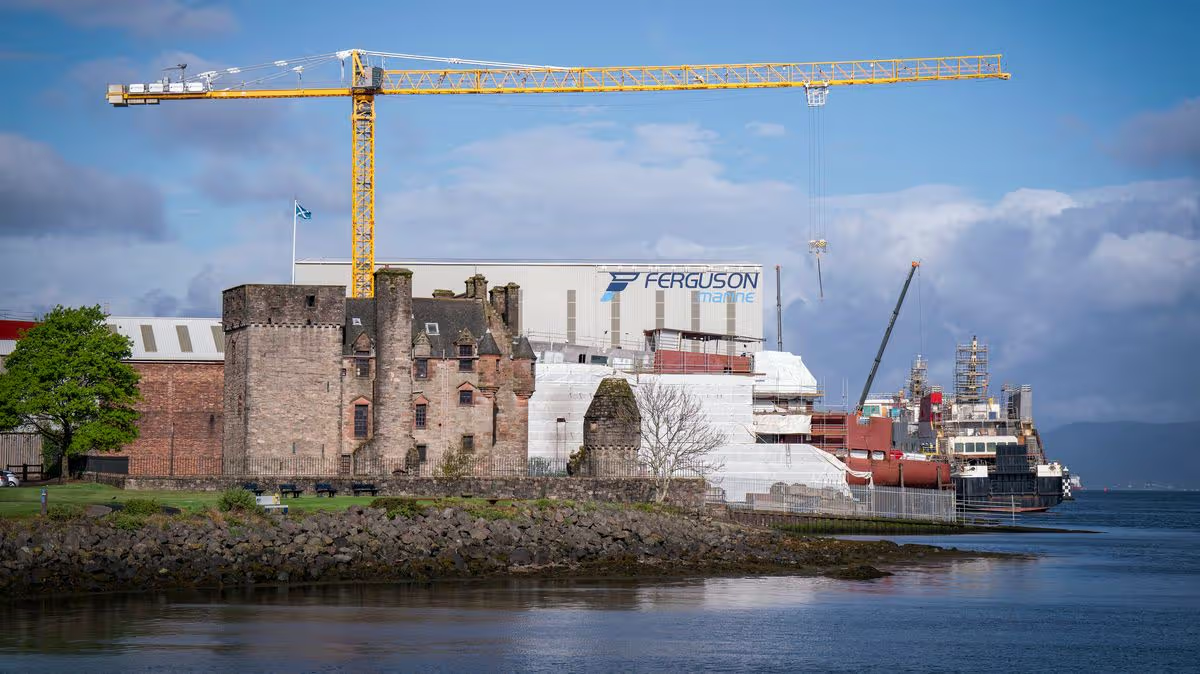
The demand comes days after bosses at the Ferguson Marine, in Port Glasgow, announced plans to axe almost a quarter of its workforce while waiting for the Scottish Government to sign off promised contracts.

Unions at a struggling shipyard have pleaded with John Swinney to deliver contracts, not more promises.

Advertisement

The demand comes days after bosses at the Ferguson Marine, in Port Glasgow, announced plans to axe almost a quarter of its workforce while waiting for the Scottish Government to sign off promised contracts.

The direct award of two CalMac ferries and two maritime research and protection vessels was announced before the Holyrood election in May.

But Transport Secretary Stephen Flynn is now refusing to predict when the work will be approved.

Advertisement

The First Minister is facing mounting pressure to act after the shipyard, which was taken into state control by the SNP Government in 2019 and has been plagued by repeated delays, cost overruns and turmoil in its leadership, said it was set to cut 70 of its 283 workers.

The announcement came amid growing frustration over delays to contracts promised by ministers.

The Scottish government last night refused to confirm if and when the First Minister would visit the shipyard.

GMB Scotland, the biggest union at the yard, warned only urgent action can stop jobs, skills and morale draining from the last commercial yard on the Clyde, where a third of the current CalMac fleet was built.

Advertisement

Louise Gilmour, GMB Scotland secretary, said: “If Mr Swinney is visiting Fergusons, he should arrive with signed contracts not more warm words.

“This yard was once Scotland’s ferry factory and could be again but it needs ships to build today not more promises of support tomorrow.

“Why is Scotland buying ferries from around the world when we own a yard where some of our country’s most skilled and experienced shipbuilders are being encouraged to walk out the gate?

“The Scottish Government promised four contracts just weeks before the election but, months later, the silence is deafening.

Advertisement

“The lack of ministerial drive, leadership and ambition for a shipyard that has such strategic industrial potential is beyond grim.

“The workers are blameless for the mess made by ministers, managers and those in charge of our ferry service and deserve the chance to turn the page.”

Ferguson Marine was rescued from administration by the Scottish Government in 2019 and has since been at the centre of the long-running scandal surrounding two dual-fuel CalMac ferries.

Advertisement

The vessels, the Glen Sannox and Glen Rosa, are years late and are expected to cost taxpayers around £500million – almost five times the original £97million contract price.

Now critics have accused ministers of penalising workers for what they claim is SNP mismanagement.

Scottish Labour Economy spokesperson Daniel Johnson said “The workers at Fergusons deserve more than warm words and photo ops from the SNP.

“It would be an insult for John Swinney to show up at the yard without any reassurances for the workers.

Advertisement

“We need to see a real plan to deliver the work promised to this yard, protect jobs, and secure a bright future for Scottish shipbuilding.”

Meanwhile Transport Minister Stephen Flynn has also been told to ‘get a grip’ over the latest SNP transport fiasco.

Scottish Labour’s Daniel Johnson added: “SNP chaos has undermined countless Scottish infrastructure projects and put jobs at risk.

“Stephen Flynn must stop making excuses and ensure that workers aren’t punished for the SNP government’s failures.

Advertisement

“The SNP’s incompetence has damaged Scottish shipbuilding and left skilled workers to pick up the pieces.

“The SNP must get a grip of the spiralling costs in its projects and act with the urgency needed to secure jobs at Ferguson Marine.”

Scottish Liberal Democrat transport spokesperson Willie Rennie MSP said: “These workers have been let down by the SNP over and over again.

Advertisement

“The yard needs a pipeline of work to flourish but that has not been forthcoming.

“Meanwhile, there can be little doubt that the chaos around its ownership and management have made it a less appealing prospect for those wanting to build commercial ships.

“All of this can be traced back to the SNP yet despite so many transport ministers coming and going no one has ever taken responsibility.

“It has been a case study in how not to do a government intervention.”Transport spokesman Tim Eagle added: “Workers are paying the price for years of disastrous SNP mismanagement at their nationalised yard.

Advertisement

“Ministers promised that jobs would be protected but their failures have deeply damaged the longstanding reputation of Ferguson Marine.

“Stephen Flynn needs to get a grip of this situation. More taxpayers’ money shouldn’t be squandered while this yard and its workers are still left without any future work.

“The money blown by SNP ministers while trying to deliver two new lifeline ferries has been symbolic of a government that have no regard for taxpayers’ money and it is astounding no minister has ever taken responsibility.”

The Scottish Government has consistently said it hopes eventually to return Ferguson Marine to the private sector.

But the publicly-owned yard has struggled to secure orders in recent years, raising concerns over its long-term viability.

Staff have been invited to apply for voluntary redundancy, with bosses insisting the move is necessary to protect the yard’s future.

The Scottish Government has a long-standing policy of opposing compulsory redundancies in the public sector, and Swinney has said he wants that approach applied at Ferguson Marine.

Advertisement

In March, before the Holyrood election, the Scottish Government announced plans to directly award the yard contracts to build four future vessels.

The orders – two small CalMac ferries, a fisheries research ship and a marine protection vessel – were described by ministers as providing a “bridge to the future” for Ferguson Marine.

Speaking last week, Swinney said: “The Government’s given that commitment for that work to go to Ferguson Marine and, while I regret the redundancies that are being taken forward, it’s vital that the yard is sustainable and the contracts from the Scottish Government will assist in that process.”

Following the announcement of the job cuts, Ferguson Marine chief executive Graeme Thomson said completing the Glen Rosa was the yard’s “immediate focus”.

Advertisement

He said the shipyard was confident it would achieve the necessary number of redundancies through the voluntary process.

The row is the latest in a string of Scottish Government controversies and infrastructure schemes hit by spiralling costs and delays.

We revealed last week that two new prisons are set to cost taxpayers around £1million per cell as construction costs soar.

Advertisement

The replacement HMP Barlinnie in Glasgow was estimated last year at £1billion – almost ten times the original £100million price tag put forward in 2014.

Sources told the Sunday Mail that the final cost of the delayed 1,344-cell facility, scheduled for completion in 2028, could rise even further.

The 200-cell HMP Highland in Inverness, due to open in spring 2027, is now expected to cost £209million – up from an initial estimate of £52million a decade ago.

Meanwhile the £3billion-plus A9 Perth-Inverness dualling project has missed its original 2025 completion date, with the deadline pushed back to 2035.

Advertisement

Ministers have also faced fury after being forced to reject plans for a new Monklands Hospital when the projected price rocketed to £2.1billion.

The Scottish Parliament building in Edinburgh was originally estimated to cost between £10million and £40million in 1997 but ultimately cost taxpayers £431million.

Source link

Advertisement
Continue Reading

Trending

Copyright © 2025