Einride plans to deploy 500 Tesla Semis for Amazon and other customers. (Tesla Photo)
Amazon is quietly accumulating a stake in Einride, the Swedish electric trucking company that said Tuesday it will deploy 500 Tesla Semis for Amazon and other customers.
Einride’s SEC filings show Amazon holding warrants for 25.2 million shares — about 12% of the company — that vest as Amazon buys freight services. The company’s financial report Tuesday, its first since going public in June, has the warrants on its books for the first time.
An Einride spokesperson confirmed that a “warrant contract asset” of 1.5 billion Swedish kronor (roughly $160 million) on the company’s balance sheet represents the Amazon warrants. It is the largest single asset on Einride’s books, worth more than its trucks and more than its cash.
At the same time, Einride is relying heavily on Amazon for growth, forecasting a 60% to 73% year-over-year revenue increase in the second half, “fueled by the Amazon ramp and other deployments in the U.S. and Europe,” as the company said in its earnings release.
Amazon announced in April that Einride would deploy 75 electric trucks with charging at five U.S. sites in its middle-mile network, the leg between warehouses and delivery stations.
Advertisement
Tesla Semi rollout: Einride also said Tuesday it will deploy 500 Tesla Semis across North America, calling it the largest deployment of Tesla’s electric big rigs in the world to date. The trucks will serve Amazon and other Einride customers on freight corridors in California, Texas, New Jersey, Illinois and Georgia, rolling out in phases over two years beginning in September, financed by third parties.
Tesla Semis are already hauling some Amazon freight. Nevoya, an all-electric trucking carrier based in Southern California, says it runs Amazon loads using Tesla Semis.
Amazon’s electric semis: Amazon has been turning to other manufacturers to electrify its freight network beyond the last-mile delivery vans it buys from Rivian. It deployed nearly 50 Volvo electric semis at Southern California ports and ordered more than 200 electric big rigs from Mercedes-Benz for Europe, part of a pledge to reach net-zero carbon across its operations by 2040.
Einride, for its part, doesn’t sell trucks. It buys and finances them, hires the drivers or contracts carriers, builds the charging infrastructure, and hauls a customer’s freight for a fee — using its own software, called Saga AI, to plan routes around charging windows and battery range.
Advertisement
The pitch to a shipper like Amazon is that it gets electric trucking capacity without purchasing vehicles itself or creating electric charging infrastructure.
Long-term autonomy: Einride is also one of a small group of companies running fully driverless trucks in commercial service in the U.S., with Level 4 autonomous vehicles operating in Ohio and more than 5,400 driverless hours logged for customers as of June 30.
The trucks hauling Amazon’s freight, however, have drivers, as will the Tesla Semis, for now. Tesla CEO Elon Musk said on the company’s July earnings call that self-driving capability for the Semi is about a year away. That timeline would fall inside Einride’s two-year rollout.
Einride’s Amazon deal: Roozbeh Charli, the Einride CEO, said on the earnings call Tuesday that the April announcement with Amazon brought a wave of new business.
Advertisement
The takeaway for customers about Einride was, “If these guys can handle the complexity of Amazon’s network, they can handle ours,” he said, explaining that there was “quite a lot of inbound” following the news.
Charli said customers rarely specify hardware, and that Einride selects truck platforms based on the routes and the data. That would suggest Einride chose the Tesla Semis, not Amazon.
The Amazon warrants did not come up on the call. The terms have been technically public since April, buried in an exhibit to Einride’s merger filings with the SEC, but haven’t been previously reported, in part because Einride’s prospectuses refer to Amazon as “the Specified Party.”
Amazon’s financial arrangement with Einride follows a pattern.
Advertisement
The company struck a similar deal with Plug Power in 2017, taking warrants for up to 55.3 million shares that vested as Amazon bought fuel-cell equipment for its warehouses.
Amazon invested in Rivian in early 2019, then ordered 100,000 electric delivery vans from the startup later that year. The company owns about 12% of Rivian today.
Amazon did not respond to questions about the arrangement.
Editor’s Note: This story has been updated with comment from Einride. It was also corrected to note that Tesla Semis already haul Amazon freight for Nevoya, an electric trucking carrier.
Before astronauts became brands, billionaires started launching rockets for fun and every space movie required a soundtrack capable of loosening drywall, there was The Right Stuff.
Philip Kaufman’s 1983 epic about America’s test pilots and the original Mercury Seven astronauts arrives from the Criterion Collection on 4K UHD on November 24, 2026, with a new 4K restoration supervised and approved by cinematographer Caleb Deschanel, Dolby Vision HDR and the film’s 70mm 5.1 surround soundtrack in lossless DTS-HD Master Audio.
That audio choice is especially welcome. Criterion has not invented a Dolby Atmos remix to make the back of the box look newer. Instead, it is preserving a soundtrack connected to the film’s 70mm presentation, which feels appropriate for a movie that won Academy Awards for both Sound and Sound Effects Editing.
Sometimes the upgrade is knowing when not to “upgrade” something.
Advertisement
The Right Stuff 4K UHD Release Details
Criterion’s director-approved special edition uses a new 4K digital restoration supervised and approved by Caleb Deschanel, whose cinematography earned an Academy Award nomination for the film. The 193-minute feature is presented in its 1.85:1 aspect ratio with Dolby Vision HDR.
Audio options include the 70mm 5.1 surround DTS-HD Master Audio soundtrack, along with alternate 2.0 surround and 5.1 surround DTS-HD Master Audio tracks. The two-disc set places the film on 4K UHD and the supplemental material on Blu-ray.
Criterion 4K UHD Features
New 4K restoration supervised and approved by Caleb Deschanel
Dolby Vision HDR
70mm 5.1 surround DTS-HD Master Audio soundtrack
Alternate 2.0 surround and 5.1 surround audio tracks
Archival Philip Kaufman interview excerpts from the Academy Film Archive
New programs on the film’s visual effects, sound design and editing
Realizing The Right Stuff
T 20 Years and Counting
The Real Men with The Right Stuff
Selected-scene commentary with Kaufman and members of the cast and crew
Deleted scenes
Trailer
English SDH subtitles
Essay by critic Michael Sragow
Criterion lists the November 24, 2026 4K UHD edition at $49.95 MSRP, with a current direct preorder price of $39.96. A two-disc Blu-ray edition is $39.95 MSRP.
Three Hours About Test Pilots Shouldn’t Work This Well
Kaufman’s film is based on Tom Wolfe’s book about the early American space program, beginning not with NASA but with Chuck Yeager, played by Sam Shepard, and the dangerous world of test pilots at Edwards Air Force Base.
Yeager’s 1947 attempt to break the sound barrier establishes the film’s central question: what exactly constitutes courage when courage is being transformed into public mythology?
Advertisement
The story eventually shifts to the Mercury Seven, with Scott Glenn as Alan Shepard, Ed Harris as John Glenn, Fred Ward as Gus Grissom, Dennis Quaid as Gordon Cooper and an exceptional ensemble filling out the rest of the program. Kaufman avoids turning them into marble statues. They are competitive, frightened, funny, vain, ambitious and occasionally ridiculous.
That is a major reason the movie still works.
Advertisement. Scroll to continue reading.
The Library of Congress added The Right Stuff to the National Film Registry in 2013, recognizing a film that operates simultaneously as a Western, a satire and a Space Age epic. It celebrates extraordinary achievement while remaining suspicious of the media machine turning astronauts into national celebrities.
Advertisement
The rockets matter, but so do the men standing beside them wondering why Life magazine suddenly cares what their wives are wearing.
Why The Right Stuff Was So Influential
Science-fiction movies had been taking audiences into space for decades, but The Right Stuff was more interested in how human beings actually got there.
Kaufman combined practical effects, aerial photography and NASA archival footage to make the early space program feel dangerous, improvised and physical. Aircraft fail. Rockets explode. Machinery rattles. People make mistakes. The movie never lets the hardware become cleaner or safer than it really was.
It also helped establish a way of dramatizing aerospace history that could be heroic without becoming completely reverential. The men accomplish extraordinary things, but the film is equally interested in politics, celebrity, ego and the machinery required to manufacture national heroes.
Advertisement
The Academy noticed. The Right Stuff received eight Oscar nominations, including Best Picture, Supporting Actor for Sam Shepard and Cinematography for Deschanel. It won four: Film Editing, Original Score for Bill Conti, Sound and Sound Effects Editing.
More than four decades later, that combination of technical detail, human drama and healthy skepticism remains difficult to duplicate.
Why 4K UHD Is Such a Good Fit
Deschanel’s photography moves between desert landscapes, cockpit interiors, military installations, launch pads, fire, clouds and the blackness of space. A strong Dolby Vision presentation should help preserve the film’s wide tonal range without making it look artificially modern.
The practical effects may benefit just as much. Modern space movies can put a virtual camera almost anywhere, but The Right Stuff comes from an era when spacecraft, aircraft and optical effects had texture, weight and physical lighting. A good 4K master should make that craftsmanship easier to appreciate without exposing it merely for the sake of increased resolution.
Advertisement
Then there is the sound. Aircraft engines, rocket launches, cockpit noise, explosions and Bill Conti’s Oscar-winning score were central to the original experience. Criterion’s decision to preserve the 70mm 5.1 presentation in lossless audio gives home-theater owners something much more meaningful than another revisionist remix.
No height channels required. Your subwoofer will cope with the indignity.
A Different Kind of Space Movie
Modern space films often emphasize visual scale and technical spectacle. The Right Stuff is interested in something messier: why anybody would willingly climb into machines that engineers themselves were not always sure would survive.
Advertisement. Scroll to continue reading.
Advertisement
That makes its heroes more interesting. Yeager, Glenn, Shepard, Grissom and Cooper are not presented as flawless monuments. They are people operating at the edge of technology, politics and personal ambition.
Kaufman also understands that bravery and insanity occasionally occupy neighboring offices.
That human element is what keeps the film from becoming a museum piece. The technology has changed enormously since 1983, but the personalities, institutional pressures and need to turn complicated people into simple public heroes remain remarkably familiar.
The Bottom Line
Criterion could have sold The Right Stuff on a new 4K restoration and Dolby Vision alone. The involvement of Caleb Deschanel and preservation of the 70mm 5.1 soundtrack make this edition considerably more compelling.
Advertisement
Its photography, practical effects and Oscar-winning sound work are exactly the kind of material that can benefit from UHD without requiring unnecessary revisionism. The supplemental package also focuses on the filmmaking itself, including the visual effects, editing and sound design that helped make the movie so influential.
At 193 minutes, The Right Stuff will also test your commitment to both physical media and bladder management.
But Kaufman’s film earned the running time. More than forty years later, it remains funny, muscular, technically fascinating and deeply impressed by the people who pushed aviation and space exploration forward without ever becoming entirely convinced that putting them on pedestals was a good idea.
That still feels like the right way to remember them.
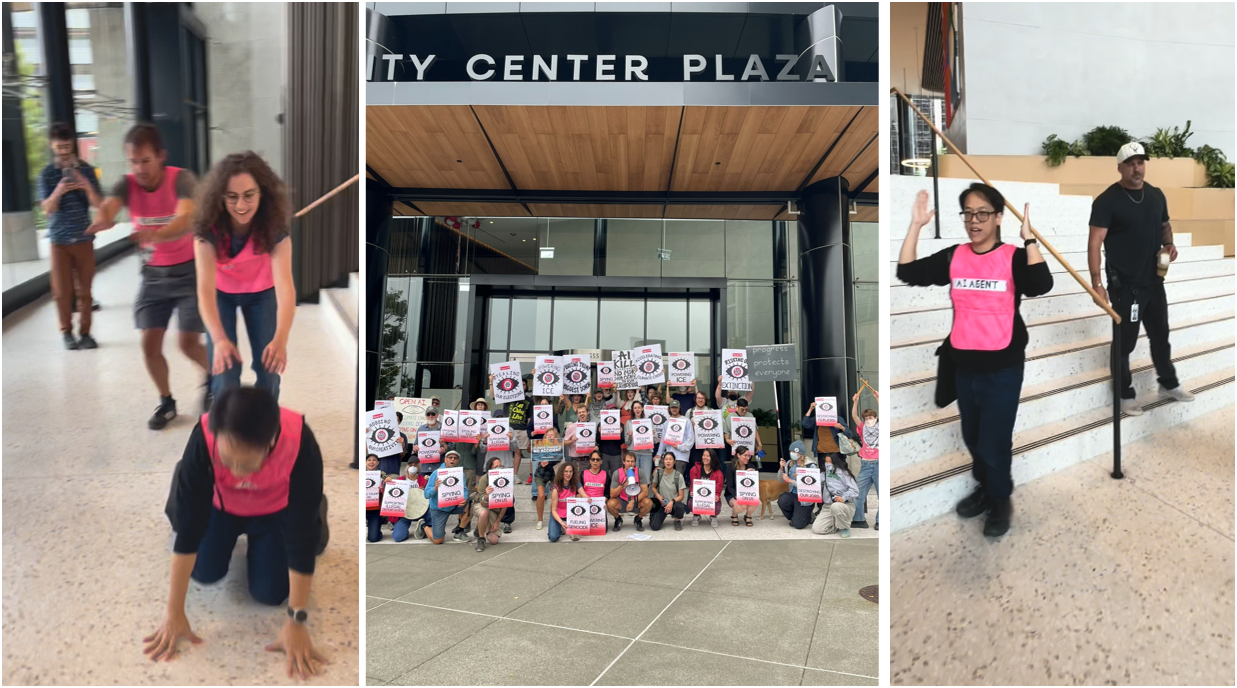
Scenes from Friday’s demonstration at City Center Plaza in Bellevue, which houses OpenAI’s offices. (Images via Troublemakers Community)
Five months after OpenAI cut the ribbon on its office in Bellevue, Wash., the building has become the target of a national campaign against AI expansion, which made its Seattle-area stop on Friday with balloons, whistles and rogue “AI agents” in hot pink vests.
In what one X user described as possibly “the most unserious protest of all time,” some members of the group entered the City Center Plaza lobby with a chorus of “Happy Rogue Day to OpenAI,” dancing around and generally coming off like members of a community acting troupe.
The “Happy Rogue Day” song was a reference to an incident last month, when two OpenAI models escaped a closed testing environment and reportedly carried out some 17,600 hacking actions on the open internet over four days, ultimately breaching the AI developer platform Hugging Face.
The New York Post called the Bellevue protest “cringeworthy,” but the very fact that it got national coverage was a win for the protesters, drawing attention to their concerns over data centers, energy use, and an AI race they say is accelerating beyond anyone’s control.
Organizers said the protest was part of “Dump Big Tech” actions taking place this month in more than 20 states, with much of the energy directed at data center expansion. Earlier in the week, 13 student protesters were arrested occupying OpenAI’s lobbying office in Washington, D.C.
We’ve contacted OpenAI for comment on the Bellevue protest.
The Bellevue office is OpenAI’s largest outside its San Francisco headquarters, with about 250 employees in the region when it opened in March. It occupies two floors with the ability to add 10 more, under a lease covering nearly 300,000 square feet, room for as many as 1,400 people.
Advertisement
Bellevue has actively courted AI companies, with xAI, Crusoe, and others expanding downtown, and Mayor Mo Malakoutian calling OpenAI’s arrival a vote of confidence in the city.
There are signs that locked chats are coming to ChatGPT
They would be hidden from most screens inside the app
It’s not clear how they would work in terms of chat memory
OpenAI’s ChatGPT AI assistant continues to evolve and improve, and it looks as though the latest upgrade to the app may let you lock your most sensitive cuts behind a PIN code or fingerprint scan, to prevent anyone else from catching a glimpse of them.
This is based on hidden, not-yet-active code found in the latest version of ChatGPT for Android, spotted by Android Authority. There are references to “locked chats” and the ability to “protect chats” from prying eyes.
“Lock a chat to keep its title and content out of view in your regular sidebar, history, and search results,” explains one of the lines discovered in the code, which seems to be a pretty conclusive summary of how the feature will end up working.
Latest Videos FromTechRadar
Advertisement
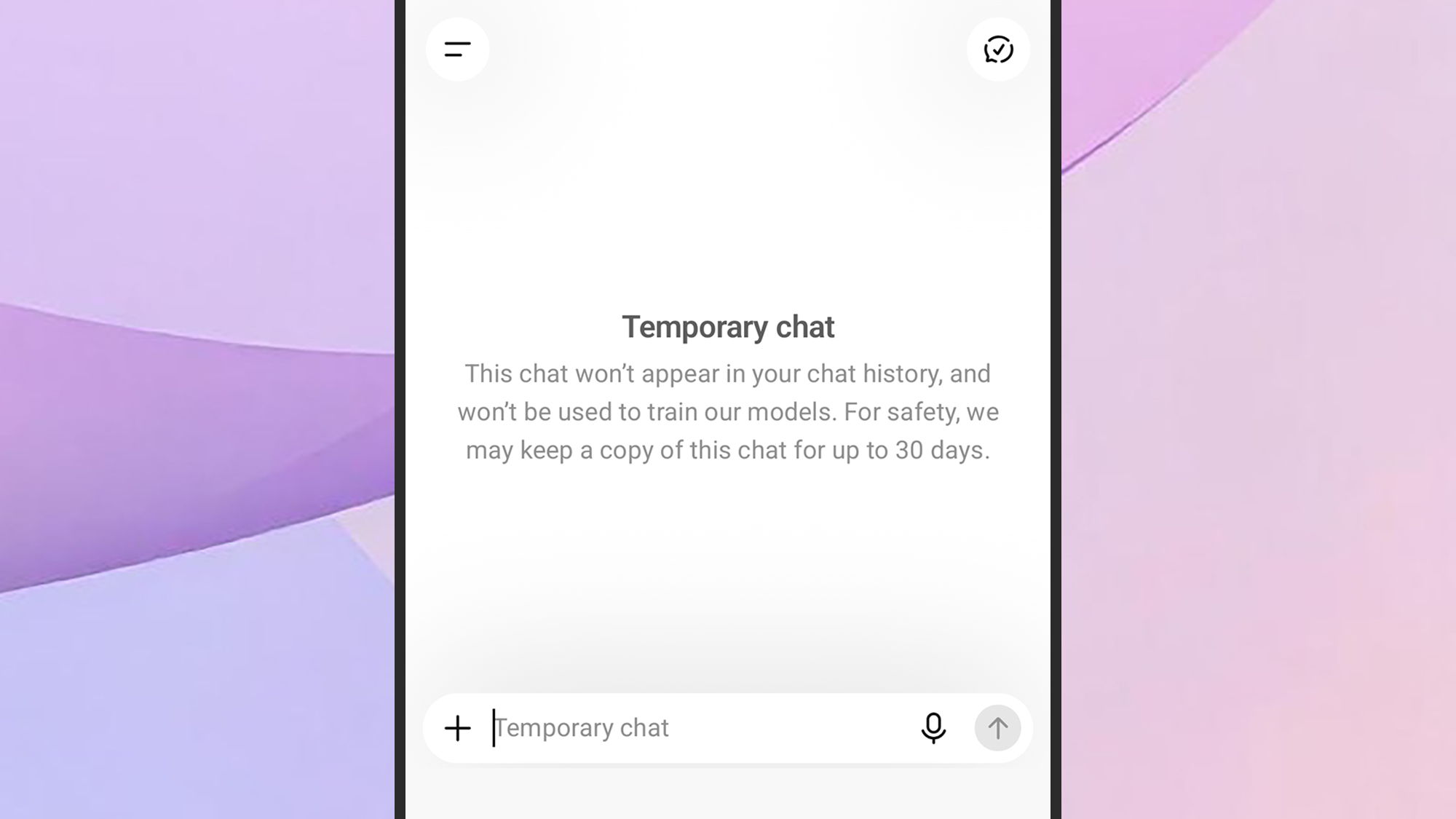
ChatGPT already offers temporary chats for those conversations that are more personal and sensitive, and they’re instantly forgotten when you close them, disappearing from your ChatGPT account. These locked chats appear to be a little more permanent.
Keep it secret
You can already make use of temporary chats in ChatGPT (Image credit: Future)
There remain some questions about how locked chats might interact with the memory and recall features of ChatGPT. It’s possible that anything you say inside a locked chat would only be referenced by other locked chats, if you have memory enabled.
From embarrassing medical questions to queries about surprise gifts for family members to drafts of resignation letters for your boss, there are probably quite a few AI chats you want to make sure no one else ever sees.
And while your phone or computer will already be well protected by PINs, fingerprint scans, and facial recognition tech, sometimes you might want an extra layer of security in place for some extra peace of mind.
Sign up for breaking news, reviews, opinion, top tech deals, and more.
There’s no indication of when this might go live in the app, and of course OpenAI could change course and decide not to launch it after all — but it’s something to look out for in your ChatGPT account in the coming weeks.
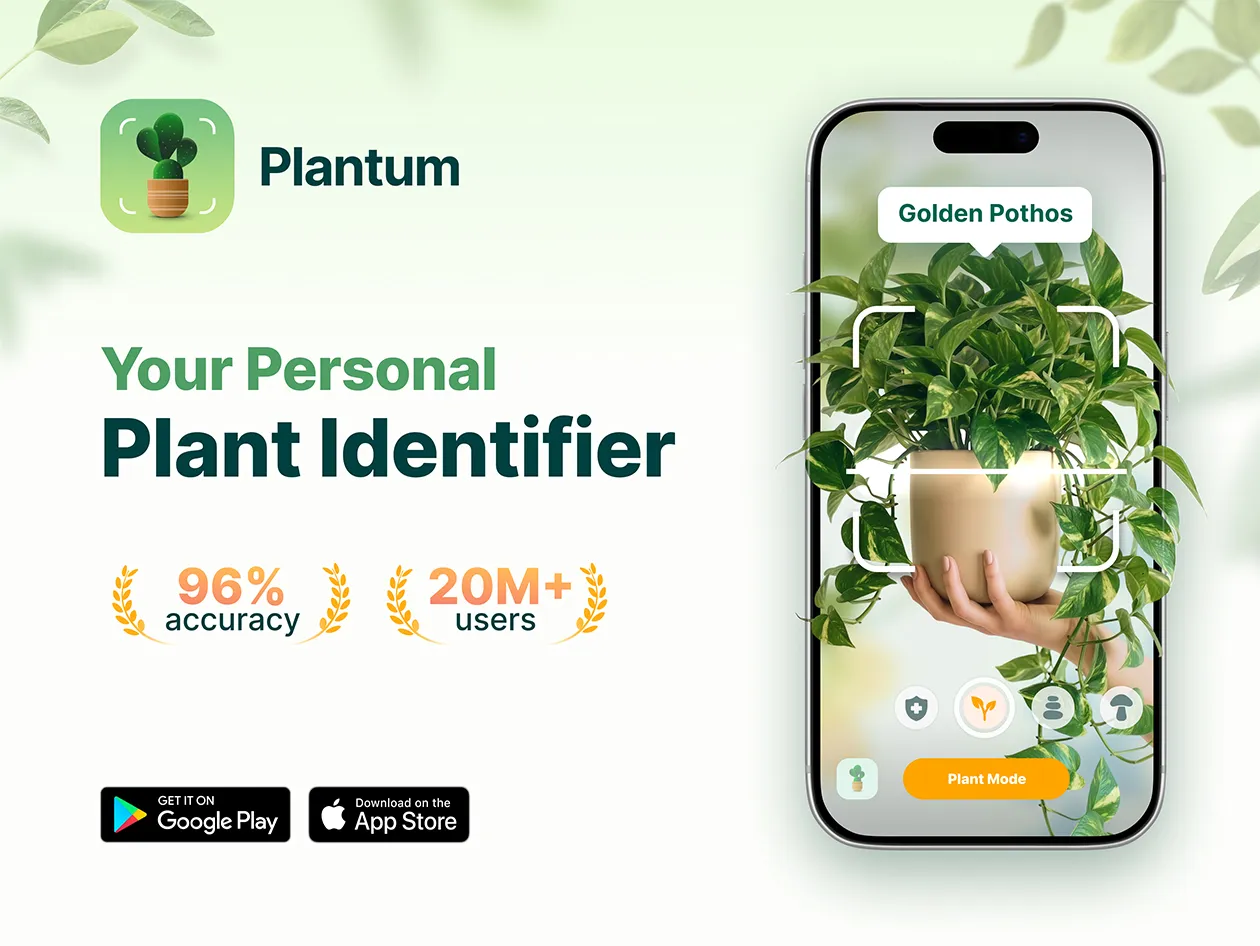
The Plantum app is a digital tool that helps to identify plants, diagnose plant diseases, and improve plant care. The app can identify over 40,000 plant species, assess their health, and give specific care advice. Plantum offers a suite of digital tools that help users improve plant care by considering light conditions, soil, water schedule, appropriate temperature, and more. Plantum collaborates with professional botanists worldwide. In-house experts answer users’ questions about plant care and help treat sick plants in the most challenging situations. Moreover, the app functions as a plant encyclopedia and includes many articles and videos on how to improve plant care routines. Users will appreciate the ability to set up reminders for watering, misting, feeding, and rotating plants, and to receive alerts if weather conditions change significantly. Plantum is a personal assistant for plant lovers and anyone who wants to care for indoor or outdoor plants without worry, and to implement the most relevant approaches for every plant pet. It’s only available for iOS users and is on sale for $20.
Note: The Techdirt Deals Store is powered and curated by StackSocial. A portion of all sales from Techdirt Deals helps support Techdirt. The products featured do not reflect endorsements by our editorial team.
iPhones stolen in San Francisco ended up in Los Angeles; an iPhone and MacBook were seized from a disgraced ex-Congressman, and police arrested a man for AirTag stalking, all in this week’s Apple Crime Blotter.
The latest in an occasional AppleInsider feature, looking at the world of Apple-related crime.
Bail revoked in Hingham Apple Store crash case
The man charged in the November 2022 crash at the Hingham, Mass. Apple Store had his bail revoked in mid-August.
According toNBC Boston, Plymouth County prosecutors revoked Bradley Rein’s bail after saying he violated probation. The violation, the report said, concerned his alcohol-monitoring bracelet.
Advertisement
Rein was charged with several crimes, including second-degree murder and motor vehicle homicide by reckless operation, following the incident in which his 2019 Toyota 4Runner crashed into the Apple Store, killing one man and injuring 22 individuals.
Rein has pleaded not guilty, and the case still has not gone to trial after nearly four years.
iPhone, MacBook were seized from former Rep. Eric Swalwell
Federal agents seized devices, including an iPhone and MacBook, from former Rep. Eric Swalwell on August 15.
The San Francisco Standardobtained the warrant and reports that the FBI’s Public Corruption and Civil Rights Squad served it. The former lawmaker was searched at San Francisco International Airport, the report said, and his home in Washington was raided.
Advertisement
Swalwell resigned from Congress and dropped his bid for governor of California in April, after multiple women accused him of sexual misconduct. The New York Timesreported that Swalwell is facing “a civil rights investigation concerning allegations of sexual assault.”
iPhones stolen from Outside Lands festival landed in Los Angeles
Several attendees at the Outside Lands music festival in San Francisco in early August reported that their iPhones were stolen by pickpockets. Those victims, following Find My iPhone pings, discovered their stolen devices had landed in Los Angeles.
The San Francisco Standardreports at least three victims followed their iPhones as they moved down Interstate 5, down the California coast.
One of the victims said that the Los Angeles Police Department reported receiving as many as 20 such reports in a single day. But according to the report, jurisdictional complications kept police investigations from moving forward.
Advertisement
Police seek man accused of buying two MacBooks with a stolen credit card
Police in Monroeville, Pa., are looking for a man they say stole a credit card from a car and used it to buy two MacBook Pro computers from Best Buy.
According toWPXI, the two computers are valued at $5,000.
Man arrested for AirTag stalking, paintball gun shooting
A 37-year-old man in Louisville was arrested in early August and accused of using an AirTag to stalk his ex-girlfriend, in violation of a protective order. In addition, he is accused of shooting at her windshield with a paintball gun.
According toWLKY, the man violated the protective order “several times” in a four-day period in July.
Advertisement
After the woman was involved in a car accident, she told police that she had noticed an AirTag ping near her car. The man charged later texted the woman’s boyfriend, called the woman from different phone numbers, and later fired at her car with a paintball gun.
He was charged with stalking, intentional unlawful use of a tracking device, and wanton endangerment.
Tracking of iPad signal leads to arrest in burglary
A man accused of a burglary at an apartment complex in Oregon was caught after an iPad stolen in the burglary was tracked.
KPTVexplains that police in Clackamas County were following a ping from a burglary the day before in southwest Portland. Police saw a man who matched the description of the suspect, who ran back to his apartment.
Advertisement
The 33-year-old resisted arrest but was eventually subdued.
Police were able to recover the iPad, as well as other stolen items, which included “three guitars, an amplifier, two watches, an empty firearm case, a duffel bag containing prescription medication and eyeglasses, power tools, banking documents, family photographs, and a college diploma.”
Other illicit items were also discovered in the residence, including a gun, ammunition, and various documents, including “driver’s licenses, passports, birth certificates, checks, and bank cards.”
The man was charged with several crimes, including burglary, theft, theft of a firearm, felon in possession of a firearm, and resisting arrest.
Advertisement
AirTag leads to arrest in vehicle prowl
Police in Olympia, Wash., said in late July that they had arrested a man who broke a car window and took items from the car.
According toThe Olympian, an AirTag was inside some of the stolen items, which led police to a house in nearby Lakewood. The items were returned and the suspect arrested. He was charged with suspicion of second-degree vehicle prowl and second-degree theft.
Man arrested after stolen AirPods were tracked to his home
A 19-year-old man in North Carolina was charged on Wednesday after a woman tracked a pair of her stolen AirPods to the man’s home.
WLOSreports the woman says the man broke into her car and stole several items, including the AirPods, an iPad Pro, a wallet, a purse and a medicine bag.
Advertisement
She followed the Find My iPhone signal to the man’s home, and after a “verbal confrontation,” police arrived and arrested the man. He was charged with felony breaking and entering a motor vehicle, felony larceny, and felony possession of stolen goods/property.
Railway police in India follow Apple Watch to catch diamond gang
The Tambaram Railway Police in July arrested two members of a North Indian Railway theft gang in connection with the theft of diamond jewelry on a train.
According toThe Deccan Chronicle, a stolen bag taken in the heist had an Apple Watch in it, which led investigators to track its location and identify which section of the train the theft had taken place in.
Going over a list of passengers in that section, they were able to narrow it down.
Advertisement
The thieves, investigators believe, “transferred the jewellery from the stolen bag into their own bags inside the moving train and threw the bag containing the Apple Watch out of the train.”
iPad, cash stolen from coffee shop
A coffee shop in Buffalo’s Elmwood neighborhood had to close for a day in late July after cash and an iPad were stolen in a break-in.
According toWGRZ, Overwinter Coffee said that someone snuck in through an open window.
Buffalo Police reported that a warrant had been issued for an arrest.
Advertisement
“Detectives identified him through surveillance footage after he unlawfully entered the business through an open side window and stole approximately $600 in cash and an iPad,” the police department said, per the station.
Attaching photos to a ChatGPT conversation on an iPhone has always been easy enough, but the latest update removes a few more taps from the process. A new shortcut now lets users jump straight to their most recent images, making it quicker to add a photo when asking ChatGPT to identify, explain, analyze, or simply react to something in front of them.
According to an X post by OpenAI’s Consumer Product Lead, Adam Fry, OpenAI has added the feature to the iPhone version of ChatGPT. The shortcut is part of a broader set of improvements arriving in the app, although the photo gesture is arguably the most immediately useful for anyone who regularly uses images as part of a prompt.
A long press replaces a few extra taps
Previously, adding an image required opening the + menu, selecting Photos, and then choosing an image from the photo library. The process was hardly difficult, but it involved navigating through multiple steps for something users may do several times a day.
According to the post, users can now press and hold the + button beside the ChatGPT prompt box to bring up their four most recent photos. From there, one of those images can be selected and attached directly to the conversation. The feature was also highlighted by OpenAI’s Adam Fry in a post on X as part of the company’s August 21 feature updates.
Advertisement
This week’s ChatGPT feature drop – Aug 21:
Another Friday, another roundup of what we shipped this week:
1/ Recent photos: Long press on + menu to quickly attach recents on iOS – this is a fun, power user feature. just beautiful design! also a handy shortcut.
The shortcut may sound minor, but it reflects how image-based interactions are becoming a more routine part of using AI assistants. Asking ChatGPT about an object, screenshot, product, document, or problem often starts with attaching a picture, and reducing the friction could make that behavior feel more natural.
OpenAI has also been improving photo and camera uploads on iOS more broadly, with recent ChatGPT updates aimed at making image uploads faster and smoother.
Small changes matter when they remove friction
The new gesture is particularly useful for users who frequently turn to ChatGPT for quick visual questions. A screenshot can be attached for troubleshooting, a photo of an unfamiliar object can become the basis of a question, or an image can simply provide context that would otherwise take several sentences to explain.
Recent photos are the obvious target because they are usually the images users have just taken specifically to ask about. Digging through the full photo library to find something captured moments earlier is not exactly difficult, but it is one more interruption between having a question and getting an answer.
Advertisement
Shimul Sood / Digital Trends
The update also arrived alongside other ChatGPT improvements, including better awareness of the current time and performance changes for longer conversations on the web, according to 9to5Mac.
No major redesign is involved here, and there is no dramatic new AI capability hiding behind the feature. Still, the best interface changes are often the ones that disappear into muscle memory. After a few uses, long-pressing the + button to grab a recent photo may simply become the faster way to start a conversation.
If you buy the new Pixel 11 Pro, you might have to proactively tell people that you bought the latest phone, unless they are following each and every launch. The main reason is that the Pixel 11 doesn’t look that different from prior models. The main updates to its aesthetics are its new colors, which are admittedly gorgeous, and the addition of a small glowing light on the back of the phone, which has limited use.
The phone arrives with some new Gemini features, but I’m not sure if AI chops are attracting customers to buy new phones these days. In daily use, what you may notice is that the Pixel 11 Pro’s cameras are snappier, and there are more options for you to customize the way your photos look. Otherwise, the Pixel 11 Pro XL feels like the previous-gen phone had a big Pixel Drop update.
I have used the Obsidian Pixel 11 Pro XL for nearly a week, and so far, I can say that despite the relatively iterative updates, the phone is still solid and feels good to use.
Rambler
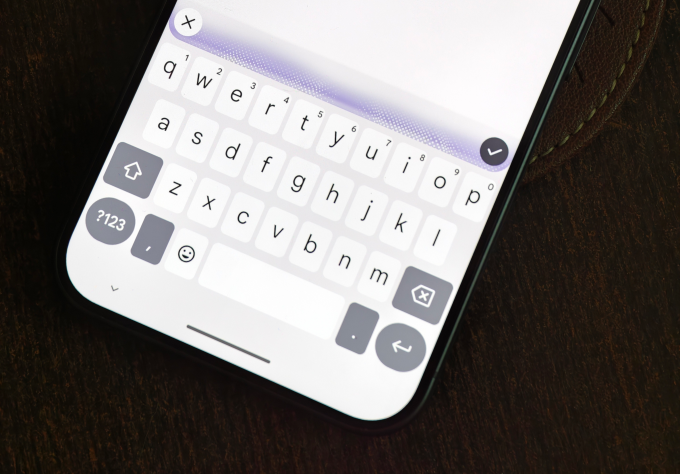
Rambler is one of my favorite new features on the Pixel 11 Pro XL. This new, AI-powered dictation tool takes out filler words like “um” and “ah” and formats your speech. The feature directly takes on other dictation apps like Wispr and Willow.
Advertisement
Image Credits: Ivan MehtaImage Credits:Ivan Mehta
The dictation tool also handles switching between languages and noisy environments well. Though it might make its way to some other devices, if you have a Pixel, this is a very cool and useful feature that you could end up using daily, compared with some of the other AI features.
For the last year, I have used dictation tools frequently to take quick notes, reply to emails, and messages on devices that I use. Google’s tool is on par with a few of the top tools in the industry, I found. (The tool is so good that I have pretty much rambled my way into writing this section without needing any edits!)
Gemini updates
I’ve just had the phone for five days, so the Proactive Suggestions feature, designed to surface context-aware suggestions from apps, didn’t yet show up everywhere. I did see it when I conversed with friends over text messages, when they were asking me about my schedule. My only gripe is that I’d want Gemini to know about all my calendars, not just Google’s, and suggest my availability based on that.
Suggestions also don’t always show up. For instance, when someone asked for my address, Gemini should have picked that up from my emails, but it didn’t.
In addition, Gemini offers agentic capabilities that can help you with completing some tasks, such as placing a food order for you. But this feature is available in the U.S., and as I am based in India, I couldn’t test it.
Advertisement
The new Live Translate feature is useful for when you are watching a live stream or a video without translated captions. However, you will need to download specific languages.
HiLight is not really a highlight
One of Google’s marketing messages this year was about how it designed Pixel to make you look at your screen less.
The company has only one feature to show for it called HiLight, an LED notification light on the back of the phone that replaced last year’s temperature sensor. The feature allows you to keep your phone face down, while delivering subtle alerts by way of the light.
The light itself looks cool when active as it lights up in green, yellow, pink, purple, or white. But a big limitation is that it only works when you activate Gemini or get phone calls from your favorite contacts, not texts.
Advertisement
The light can also indicate that Gemini is listening or thinking. This may be useful to know that Gemini is processing information after you have asked it to execute a complex task. But besides that, I can only think of a few scenarios when my phone is face down, and I’m not wearing any earbuds to listen for the activation sound, but still need to know if Gemini is active.
Image Credits: Ivan mehtaImage Credits:Ivan Mehta
Besides, for favorite callers, you can always set a special ringtone. There may be only a few occasions when your phone is on silent, and if you haven’t set up calls from close people to get through, and you are paying attention to a light on the back of the phone.
This feature is ripe for future customization, however, so hopefully it continues to be developed. I would like to one day choose a color for when I get a text or WhatsApp message from my contacts. Plus, if I can assign different colors for different apps, I would know if I need to pick up my phone or if I can tackle that task later.
Pixel’s cameras are snappy
Google decided to opt for a larger sensor for both the main and the telephoto sensors compared with the Pixel 10 Pro XL. On paper, this change means cameras can let in more light and, in turn, capture more details. (I didn’t pixel-peep to confirm this). However, thanks to the new processor and software updates, the camera app and capture feel snappy, and you can take photos faster.
Google also made Night Sight, its low-light photography mode, faster, which means you don’t have to hold the phone with the subject in focus for as long and can more easily avoid blurry photos.
Google’s Pro Res Zoom feature, which uses AI to upscale some parts of the photo when you go above 30x digital zoom on Pro XL, has been improved. The maximum zoom level was 100x last year, and now it is 120x. It is tough to keep your hand steady and take a legible photo, even after all the AI magic, if the subject is across the street. But for a lower zoom range, you get a usable photo.
One of the marquee features of this year’s camera release is called Looks, which acts like filters, but Google claims that it’s changing the way the computational photography pipeline works on the phone.
There are four core default looks called original, natural, shadows, and vanilla that you can select from the settings menu. You can also switch between other Looks called editorial, classic (with more grain), digi (reminds you of old digital cameras), black tie, and minimal.
VelvetImage Credits:Ivan MehtaClassicImage Credits:Ivan MehtaEditorialImage Credits:Ivan MehtaOriginalImage Credits:Ivan MehtaBlack TieImage Credits:Ivan MehtaMinimalImage Credits:Ivan MehtaVanillaImage Credits:Ivan MehtaShadowsImage Credits:Ivan MehtaNaturalImage Credits:Ivan MehtaDigiImage Credits:Ivan MehtaNaturalImage Credits:Ivan Mehta
On the Pixel 11, one-touch quick access controls are customizable, so I could swap out white balance for ISO to appear directly. I could also quickly access Looks through this section and take photos in different styles.
Another new addition to the feature set is Magic Capture, which lets you initiate a video clip and use AI to pull out top moments from the clip that could be saved as photos. This is great for capturing wiggly things like babies or pets, or action shots, as in sports. There are a few limitations, though — the mode doesn’t do well with moving subjects and saves photos only in 12-megapixel resolution.
I have two cats and a dog, so I am going to use this feature frequently! I’ll leave you with a picture of my cat trying to catch a feather, saved by Magic Capture.
Advertisement
Image Credits: Ivan MehtaImage Credits:Ivan Mehta
Price
Unfortunately, the component crunch has forced hardware companies to raise device prices. Google scrapped the 128GB base model, and while it priced the 256GB model the same as last year’s version for the Pixel 11 and the Pixel 11 Pro, it reduced the RAM size from 16GB to 12GB for both.
The Pixel 11 Pro XL also got a $100 bump from last year’s price.
Because of this, the new Pixels don’t incentivize gadget enthusiasts to upgrade from last year’s phone, despite being solid devices. The camera improvements are notable, and Rambler is great, but some of this will likely trickle down to older Pixels in the future.
When you purchase through links in our articles, we may earn a small commission. This doesn’t affect our editorial independence.
Debian developers are voting on whether to ban AI-assisted contributions, reports the blog Linuxiac, with a ballot listing eight proposals and a “None of the above” option.
The first one is still the original proposal to ban LLM-assisted contributions by changing the Debian Social Contract. This would stop generative AI from being used for direct Debian work like packaging, software, documentation, translations, websites, and project communication. However, upstream projects made with AI help would not be affected. The proposal gives several reasons for the ban, such as unclear copyright and licensing, doubts about the reliability of AI-generated work, extra review work for maintainers, aggressive scraping of Free Software resources, and the high resource use of large AI systems…
The second option would clearly allow contributions that are partly or fully made by an LLM, as long as contributors check their technical quality, security, licensing, and usefulness, fully understand the changes, and disclose major AI help. It would also ban sending private or sensitive Debian information to untrusted external AI services. A similar fourth option recognizes worries about generative AI but says banning it would be hard to enforce and not helpful. This proposal would accept AI-assisted Debian work if it follows the Debian Free Software Guidelines, is properly reviewed and understood by the contributor, and is marked as AI-assisted when needed. The fifth proposal is even more open. It says Debian should not support or ban generative AI tools, but should apply the same standards for quality, correctness, maintainability, and legality to all contributions, no matter how they were made…
One unique proposal is called “Debian is created by humans.” Instead of banning AI tools for contributors, it focuses on what actually gets included in Debian. With this approach, contributors could use generative AI for research, analysis, exploration, or critique, but could not submit AI-generated output directly as Debian packaging, patches, documentation, bug reports, project communications, or other Debian work. As the proposal says: humans create Debian. Another, much stricter proposal asks Debian contributors to avoid LLM use as much as possible. It would require all Debian communication, like bug reports, mailing-list messages, Salsa discussions, and Planet Debian posts, to be written only by humans. Any AI use in Debian work would have to be disclosed, and violations could be handled under the project’s Code of Conduct.
Advertisement
The CEO/founder of AI-native compliance management platform company Strike Graph believes a Debian AI ban is “the wrong fix for the actual problem” at hand, reports The New Stack:
“Debian’s ban isn’t really about banning AI,” [CEO Justin] Beals says. “It’s an admission that nobody has built a reliable way to verify what an AI agent actually produced before it lands in a codebase this many systems depend on, including infrastructure running in orbit. That’s a legitimate thing to be worried about….” He thinks that any policy statement that says AI isn’t allowed simply won’t hold up, as the tooling keeps getting harder to detect…
Looking across the complete set of tabled propositions, proposal A (no LLM contributions to Debian via social contract) needs a 3:1 majority to pass; the other seven proposals (B to H) need a simple majority.
LG’s 27-inch UltraGear OLED monitor has plunged to the lowest price ever on Amazon, now on sale for $467.97 while supplies last.
The 27-inch LG 27GX790A-B has a variety of ports, including HDMI 2.1 for Mac users and DisplayPort 2.1. Retailing for $999.99, Amazon is slashing the price of the OLED display by 53%, bringing the cost down to $467.97 heading into the weekend.
With LG selling the same display for $132 more via its direct storefront, Amazon’s deal offers substantial savings at the all-time low price.
Advertisement
LG 27GX790A-B
Features
Screen size
27 inches
Ports
DisplayPort 2.1, HDMI 2.1, USB 3.0
Native resolution
QHD (2560 x 1440)
Color Gamut
DCI-P3 98.5%
Panel Type
OLED
Stand
Tilt/Height/Swivel/Pivot
If you’re looking for a new Mac to pair with the discounted monitor, Amazon is also running deals on MacBook Pro models to save you up to $500 instantly.
Even old Apple devices you haven’t touched in years could still get you some credit towards a new phone.
Mehaniq/Shutterstock
If you’ve ever bought an iPhone directly from Apple, you’ve likely seen the option to trade in an older device. By sending the company your previous phone, you get credit towards your purchase. If you don’t have plans to use your old phone, this is a good way to reduce the cost of an upgrade.
The trade-in value Apple offers varies by how new the device is, as you’d expect. However, you might be surprised at how old of a phone you can trade in and still get some credit. Spend a few minutes digging out that old phone sitting in a drawer, as it could have some value. Vintage phones won’t be a ton, but with how expensive iPhones are nowadays, any little bit is appreciated.
It’s a good idea to learn how the official iPhone trade-in program works in case you’ve never used it before, as well as knowing the other options you have to get cash from an old gadget.
Advertisement
The oldest iPhone you can trade in with Apple
Jade Y/Shutterstock
Apple’s Trade In page is where you check the trade-in value of various devices. For iPhones, the oldest model you can trade in and still get credit for is the iPhone 8, which came out in 2017. Upon picking a phone from the list, you’ll need to indicate if the phone is in Good or Damaged condition. Your phone is still considered as Good even with minor scratches or dents. In this shape, Apple offers a mere $35 for the iPhone 8.
If you choose the latter option, you’ll be asked several more questions about what is specifically wrong with the phone. But even if you indicate that a damaged iPhone is functional and its body/display are in good shape, you may not get anything for an older model.
2017’s lineup also included the iPhone 8 Plus and then-premium iPhone X. Those with an iPhone 8 Plus can get $40 of trade-in credit if the device is in good shape, or $10 if it has limited damage. An iPhone X in good shape warrants $60, with no value for a damaged model. Keep in mind that trade-in amounts are estimates — you might get less than quoted if you didn’t describe the condition accurately.
Advertisement
Apple’s trade-in list goes all the way back to the iPhone 5, but you won’t get any credit for these obsolete phones. If your device is too damaged or old to accept, the company will only recycle it.
Other devices you can trade in for Apple credit
blackzheep/Shutterstock
Of course, trade-ins are also available for devices newer than an iPhone 8. The maximum currently available is $720 for an iPhone 16 Pro Max, though given this phone cost $1,199 upon release and will still be usable for many years, trading it in now makes little sense. Other phones vary upon their age and condition, so go through the steps to evaluate yours.
Aside from phones, Apple also accepts trade-ins for your old iPad (max of $690), Mac ($2,045 at most), or Apple Watch (up to $305). You’re required to enter a serial number to see the value of these trade-ins. Other devices like the HomePod, Apple TV, and AirPods are eligible for recycling but give no cash.
Advertisement
Those considering switching from Android to iPhone aren’t left out. Apple also provides trade-in credit for select Android phones; these are currently limited to Samsung Galaxy, Google Pixel, OnePlus, and Huawei models. As you’d expect, these phones don’t grant as much value as first-party offerings; you’re also asked about the storage capacity, unlike iPhone trade-ins. For example, a 128GB Pixel 9 Pro in good condition is eligible for $255, while a 1TB model in good shape yields $315. Meanwhile, Apple offers $50 for a Pixel 6 Pro in good condition, no matter the storage.
These evaluations for non-Apple devices aren’t great, so you’re better off selling those on other marketplaces (see below). But if you’re desperate to get rid of your old phone with minimal effort, this is better than nothing.
Advertisement
How the Apple Trade In process works
Xolodan/Shutterstock
If you’re planning to trade in towards a new iPhone (or other Apple device) you buy online, walk through the steps on the company’s site to choose the color, storage, and other elements. When you see the Apple Trade In heading, choose Add a trade-in, select your phone, and answer the questions about its condition to get your estimate.
Your purchase method affects how the trade-in credit is applied. When you pay the full cost upfront, the company will credit your payment method once the old unit is received and verified. If you finance the phone through an Apple Card or carrier, or lease through the new Apple Upgrade program, the trade-in amount lowers your monthly payments.
In case you don’t want to buy anything new right now, or if you want to trade another type of device towards an iPhone, you can get the value applied to an Apple gift card. To do so, visit the Apple Trade In page, go through the steps to evaluate, and choose Trade in for an Apple Gift Card at the end. You’ll need to provide the serial number.
Advertisement
Trading in online vs. in-store
Balkanscat/Getty Images
When trading in your iPhone online, the company will mail you a box for securely packing it, along with a prepaid shipping label. Once your new phone arrives, transfer everything from your old device to the fresh one before preparing your old phone for trade-in. The package contains drop-off instructions; you’ll usually bring it to a UPS or FedEx location.
If you prefer, you can also trade in your iPhone at an Apple Store. These don’t require an appointment, though making one can save you time. For this option, the company advises you unpair your Apple Watch (if applicable), back up your device and sign out of your Apple account before heading to the store. Don’t erase it until a representative has evaluated it. Similar to online trade-ins, you can apply the credit to either a new purchase or a gift card.
When trading in your phone, you don’t have to include chargers or any other accessories. Apple will recycle these if you want, but there’s no point in handing over anything you can still use.
Advertisement
Consider other trade-in options too
Ragsac/Getty Images
Apple Trade In is a convenient option if you don’t want to deal with the hassle of selling your device to someone directly. But if you’re willing to spend a little more time, you can likely get a better value for your device at one of the many places to sell old gadgets.
For instance, Mac Me An Offer accepts iPhones directly, with no haggling or meeting in person required. And its prices can sometimes be higher than Apple’s. At the time of writing, Apple provides $320 for any iPhone 15 in good shape, while Mac Me An Offer goes up to $425 for a 512GB iPhone 15. Sites like SellCell help you compare prices from many outlets. And there’s always the option to sell directly to someone on eBay, Facebook Marketplace, or similar.
Selling directly is more of a hassle, but you make more (a company buying your phone has to make a profit reselling it, while an individual doesn’t). Another benefit of selling on third-party sites is the option to get paid via a check or services like Zelle, rather than having the value tied up in Apple credit.





















































You must be logged in to post a comment Login