Even old Apple devices you haven’t touched in years could still get you some credit towards a new phone.
Mehaniq/Shutterstock
If you’ve ever bought an iPhone directly from Apple, you’ve likely seen the option to trade in an older device. By sending the company your previous phone, you get credit towards your purchase. If you don’t have plans to use your old phone, this is a good way to reduce the cost of an upgrade.
The trade-in value Apple offers varies by how new the device is, as you’d expect. However, you might be surprised at how old of a phone you can trade in and still get some credit. Spend a few minutes digging out that old phone sitting in a drawer, as it could have some value. Vintage phones won’t be a ton, but with how expensive iPhones are nowadays, any little bit is appreciated.
It’s a good idea to learn how the official iPhone trade-in program works in case you’ve never used it before, as well as knowing the other options you have to get cash from an old gadget.
Advertisement
The oldest iPhone you can trade in with Apple
Jade Y/Shutterstock
Apple’s Trade In page is where you check the trade-in value of various devices. For iPhones, the oldest model you can trade in and still get credit for is the iPhone 8, which came out in 2017. Upon picking a phone from the list, you’ll need to indicate if the phone is in Good or Damaged condition. Your phone is still considered as Good even with minor scratches or dents. In this shape, Apple offers a mere $35 for the iPhone 8.
If you choose the latter option, you’ll be asked several more questions about what is specifically wrong with the phone. But even if you indicate that a damaged iPhone is functional and its body/display are in good shape, you may not get anything for an older model.
2017’s lineup also included the iPhone 8 Plus and then-premium iPhone X. Those with an iPhone 8 Plus can get $40 of trade-in credit if the device is in good shape, or $10 if it has limited damage. An iPhone X in good shape warrants $60, with no value for a damaged model. Keep in mind that trade-in amounts are estimates — you might get less than quoted if you didn’t describe the condition accurately.
Advertisement
Apple’s trade-in list goes all the way back to the iPhone 5, but you won’t get any credit for these obsolete phones. If your device is too damaged or old to accept, the company will only recycle it.
Other devices you can trade in for Apple credit
blackzheep/Shutterstock
Of course, trade-ins are also available for devices newer than an iPhone 8. The maximum currently available is $720 for an iPhone 16 Pro Max, though given this phone cost $1,199 upon release and will still be usable for many years, trading it in now makes little sense. Other phones vary upon their age and condition, so go through the steps to evaluate yours.
Aside from phones, Apple also accepts trade-ins for your old iPad (max of $690), Mac ($2,045 at most), or Apple Watch (up to $305). You’re required to enter a serial number to see the value of these trade-ins. Other devices like the HomePod, Apple TV, and AirPods are eligible for recycling but give no cash.
Advertisement
Those considering switching from Android to iPhone aren’t left out. Apple also provides trade-in credit for select Android phones; these are currently limited to Samsung Galaxy, Google Pixel, OnePlus, and Huawei models. As you’d expect, these phones don’t grant as much value as first-party offerings; you’re also asked about the storage capacity, unlike iPhone trade-ins. For example, a 128GB Pixel 9 Pro in good condition is eligible for $255, while a 1TB model in good shape yields $315. Meanwhile, Apple offers $50 for a Pixel 6 Pro in good condition, no matter the storage.
These evaluations for non-Apple devices aren’t great, so you’re better off selling those on other marketplaces (see below). But if you’re desperate to get rid of your old phone with minimal effort, this is better than nothing.
Advertisement
How the Apple Trade In process works
Xolodan/Shutterstock
If you’re planning to trade in towards a new iPhone (or other Apple device) you buy online, walk through the steps on the company’s site to choose the color, storage, and other elements. When you see the Apple Trade In heading, choose Add a trade-in, select your phone, and answer the questions about its condition to get your estimate.
Your purchase method affects how the trade-in credit is applied. When you pay the full cost upfront, the company will credit your payment method once the old unit is received and verified. If you finance the phone through an Apple Card or carrier, or lease through the new Apple Upgrade program, the trade-in amount lowers your monthly payments.
In case you don’t want to buy anything new right now, or if you want to trade another type of device towards an iPhone, you can get the value applied to an Apple gift card. To do so, visit the Apple Trade In page, go through the steps to evaluate, and choose Trade in for an Apple Gift Card at the end. You’ll need to provide the serial number.
Advertisement
Trading in online vs. in-store
Balkanscat/Getty Images
When trading in your iPhone online, the company will mail you a box for securely packing it, along with a prepaid shipping label. Once your new phone arrives, transfer everything from your old device to the fresh one before preparing your old phone for trade-in. The package contains drop-off instructions; you’ll usually bring it to a UPS or FedEx location.
If you prefer, you can also trade in your iPhone at an Apple Store. These don’t require an appointment, though making one can save you time. For this option, the company advises you unpair your Apple Watch (if applicable), back up your device and sign out of your Apple account before heading to the store. Don’t erase it until a representative has evaluated it. Similar to online trade-ins, you can apply the credit to either a new purchase or a gift card.
When trading in your phone, you don’t have to include chargers or any other accessories. Apple will recycle these if you want, but there’s no point in handing over anything you can still use.
Advertisement
Consider other trade-in options too
Ragsac/Getty Images
Apple Trade In is a convenient option if you don’t want to deal with the hassle of selling your device to someone directly. But if you’re willing to spend a little more time, you can likely get a better value for your device at one of the many places to sell old gadgets.
For instance, Mac Me An Offer accepts iPhones directly, with no haggling or meeting in person required. And its prices can sometimes be higher than Apple’s. At the time of writing, Apple provides $320 for any iPhone 15 in good shape, while Mac Me An Offer goes up to $425 for a 512GB iPhone 15. Sites like SellCell help you compare prices from many outlets. And there’s always the option to sell directly to someone on eBay, Facebook Marketplace, or similar.
Selling directly is more of a hassle, but you make more (a company buying your phone has to make a profit reselling it, while an individual doesn’t). Another benefit of selling on third-party sites is the option to get paid via a check or services like Zelle, rather than having the value tied up in Apple credit.
Debian developers are voting on whether to ban AI-assisted contributions, reports the blog Linuxiac, with a ballot listing eight proposals and a “None of the above” option.
The first one is still the original proposal to ban LLM-assisted contributions by changing the Debian Social Contract. This would stop generative AI from being used for direct Debian work like packaging, software, documentation, translations, websites, and project communication. However, upstream projects made with AI help would not be affected. The proposal gives several reasons for the ban, such as unclear copyright and licensing, doubts about the reliability of AI-generated work, extra review work for maintainers, aggressive scraping of Free Software resources, and the high resource use of large AI systems…
The second option would clearly allow contributions that are partly or fully made by an LLM, as long as contributors check their technical quality, security, licensing, and usefulness, fully understand the changes, and disclose major AI help. It would also ban sending private or sensitive Debian information to untrusted external AI services. A similar fourth option recognizes worries about generative AI but says banning it would be hard to enforce and not helpful. This proposal would accept AI-assisted Debian work if it follows the Debian Free Software Guidelines, is properly reviewed and understood by the contributor, and is marked as AI-assisted when needed. The fifth proposal is even more open. It says Debian should not support or ban generative AI tools, but should apply the same standards for quality, correctness, maintainability, and legality to all contributions, no matter how they were made…
One unique proposal is called “Debian is created by humans.” Instead of banning AI tools for contributors, it focuses on what actually gets included in Debian. With this approach, contributors could use generative AI for research, analysis, exploration, or critique, but could not submit AI-generated output directly as Debian packaging, patches, documentation, bug reports, project communications, or other Debian work. As the proposal says: humans create Debian. Another, much stricter proposal asks Debian contributors to avoid LLM use as much as possible. It would require all Debian communication, like bug reports, mailing-list messages, Salsa discussions, and Planet Debian posts, to be written only by humans. Any AI use in Debian work would have to be disclosed, and violations could be handled under the project’s Code of Conduct.
Advertisement
The CEO/founder of AI-native compliance management platform company Strike Graph believes a Debian AI ban is “the wrong fix for the actual problem” at hand, reports The New Stack:
“Debian’s ban isn’t really about banning AI,” [CEO Justin] Beals says. “It’s an admission that nobody has built a reliable way to verify what an AI agent actually produced before it lands in a codebase this many systems depend on, including infrastructure running in orbit. That’s a legitimate thing to be worried about….” He thinks that any policy statement that says AI isn’t allowed simply won’t hold up, as the tooling keeps getting harder to detect…
Looking across the complete set of tabled propositions, proposal A (no LLM contributions to Debian via social contract) needs a 3:1 majority to pass; the other seven proposals (B to H) need a simple majority.
LG’s 27-inch UltraGear OLED monitor has plunged to the lowest price ever on Amazon, now on sale for $467.97 while supplies last.
The 27-inch LG 27GX790A-B has a variety of ports, including HDMI 2.1 for Mac users and DisplayPort 2.1. Retailing for $999.99, Amazon is slashing the price of the OLED display by 53%, bringing the cost down to $467.97 heading into the weekend.
With LG selling the same display for $132 more via its direct storefront, Amazon’s deal offers substantial savings at the all-time low price.
Advertisement
LG 27GX790A-B
Features
Screen size
27 inches
Ports
DisplayPort 2.1, HDMI 2.1, USB 3.0
Native resolution
QHD (2560 x 1440)
Color Gamut
DCI-P3 98.5%
Panel Type
OLED
Stand
Tilt/Height/Swivel/Pivot
If you’re looking for a new Mac to pair with the discounted monitor, Amazon is also running deals on MacBook Pro models to save you up to $500 instantly.
There’s no denying that TV screens are getting bigger. While 65 inches is still the current most popular screen size in the United States in 2026, demand for TVs 75 inches and larger has been accelerating, and TVs as large as 98 inches, 100 inches or even 115 inches are becoming more common.
But, as screen sizes have increased, soundbars have stayed more or less the same size. The most popular soundbars from Samsung, Sonos, LG, Bose and Sony generally measure in between 48 inches and 52 inches wide, while a standard 65-inch TV measures around 57 inches wide. This size difference leads not only to a visual mismatch but an audio mismatch as well. A 48-inch soundbar has a tough time keeping up with the on-screen action when the TV itself may span 85 inches wide for a 98-inch TV to over 100 inches wide for a 115-inch TV. For this situation, Sony has released the Sony BRAVIA Theater Trio.
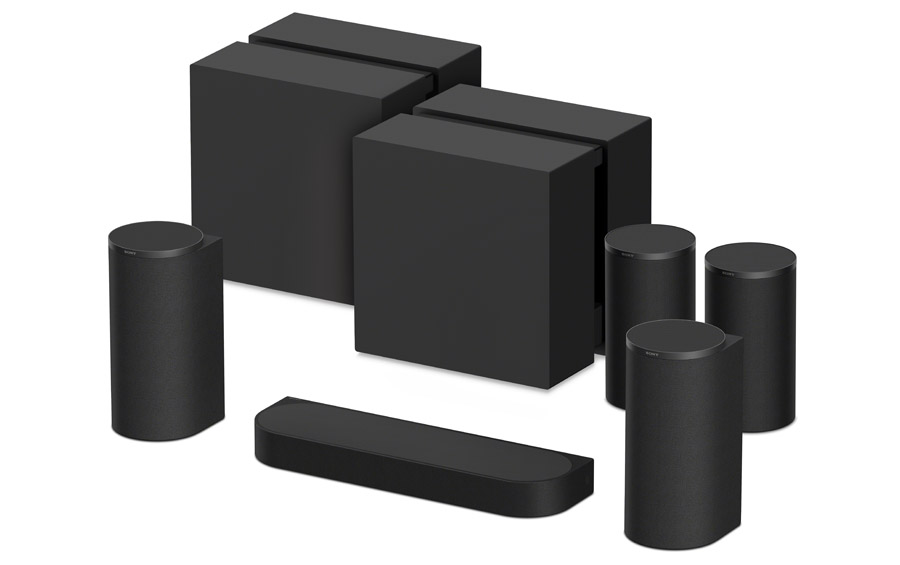
The front three speakers make up the Sony BRAVIA Theater Trio. Behind it are two of the company’s Theater Sub 9 subwoofers and the Theater Rear 9 surround speakers.
What Is It?
The BRAVIA Theater Trio is a powered 3-speaker system that is about as easy to install as a soundbar, but with separate left and right speakers that can go beyond the TV screen in order to create a rich wide soundstage as well as a dedicated center channel speaker for crisp clear dialog. While the Trio can be purchased and installed on its own, you can also add a pair of rear speakers for more immersive surround sound as well as one or two powered subwoofers for deep extended bass response.
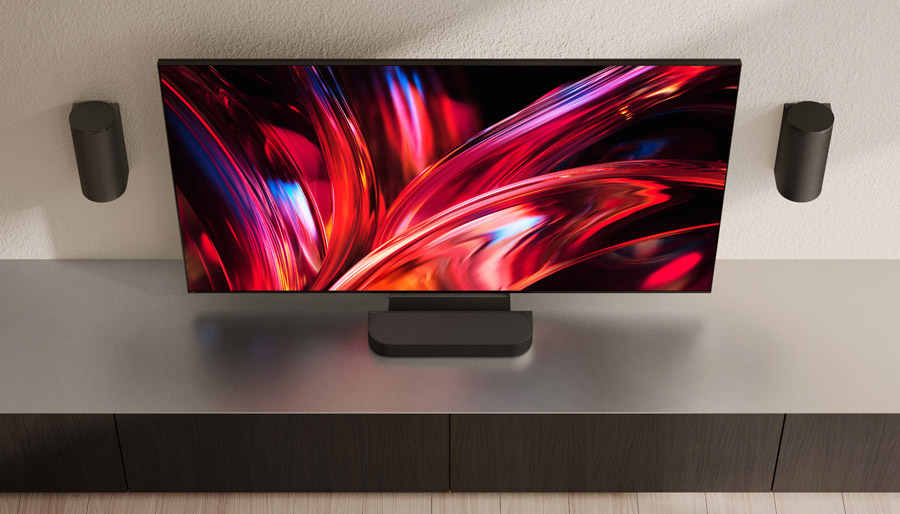
The Trio’s independent left and right speakers can be placed on either side of even the largest TV or projection screen for a wide and immersive soundfield.
We are reviewing the BRAVIA Theater Trio with its BRAVIA Rear 9 surround speakers and one BRAVIA Sub 9 powered subwoofer. On its own, the Trio can decode Dolby Atmos and DTS:X surround, but with the addition of rear speakers and a powered sub, it also becomes “IMAX Enhanced Certified.” This will come in handy if you like to watch IMAX Enhanced movie titles on Disney+ or on the Sony Pictures Core streaming app on Sony TVs as it means the system can apply the IMAX-specific EQ curve and sound settings for a more theatrical sound.
The Trio system is classified as “3.0.2-channel” – three front channels, no sub or LFE speaker and two up-firing height speakers, built into the front left and right speakers. It features 9 active speaker drivers, powered by 360 watts of amplification. The center speaker bar, which also includes the inputs, is a 2-way system, with two X-Balanced woofers and one soft-dome tweeter. The front left and right speakers are also two-way designs, each featuring one woofer, one tweeter, and one angled up-firing driver to reflect overhead sound off the ceiling.
The Trio’s center speaker includes a central tweeter flanked by dual X-balanced elongated woofers.
The center speaker has feet for placement on a credenza or TV stand as well as an included pair of wall-mount brackets. The left and right speakers each include a standard keyhole mount and an M5 threaded insert for attachment to a bracket or stand. You can also mount the center channel directly below your TV using a compatible Sony or Sanus TV mounting bracket. One nice thing about this design, compared to a soundbar, is that the reflective height drivers in the front left and right speakers will not be blocked by your TV, as they would be on a soundbar if you were to mount the bar to the TV itself or to the wall beneath a TV.
You can use the Trio with any of Sony’s current rear speaker kits, but we chose the current top of the line BRAVIA Theater Rear 9 (SA-RS9) as it’s the best visual and sonic match to the Trio, and they includes their own built-in up-firing drivers for enhanced height effects. The Rear 9 surround speaker resembles the Trio’s left and right speakers in its cylindrical design. It also includes a similar driver configuration with woofer, tweeter and angled up-firing full-range driver for height effects.
Advertisement
The cylindrical Rear 9 surround speakers match the look of the TRIO’s front left and right speakers. They come with a rotating bracket and include up-firing full range drivers for height effects.
The Rear 9 can be wall-mounted directly, by using their integrated keyhole mounts, but we’d recommend using the included wall-mount brackets instead as these will allow you to rotate the speakers toward the listening position for best surround and height effects. You can also place the Rear 9 speakers on a speaker stand or compatible wall mount using the M5 threaded insert on the back of each speaker or you can use a platform type stand, or just put them on a shelf or table in the back of your room. Be sure not to block the top-firing drivers on the rear speakers as that will kill your height effects.
There are multiple wireless subwoofer options for the Trio system, including the previous generation SA-SW5 and SA-SW3 and the new Sub 7, Sub 8 and Sub 9. Of these, the Sub 9 (aka SA-SW9) is the largest and most powerful with dual opposing force-balanced 8-inch aluminum drivers and 600 watts of peak amplification. This design cancels out mechanical vibrations to deliver tight, yet extended bass. We paired the Trio with a single Sub 9 and found that this offered more than enough bass in our fairly small (15 foot by 16 foot) listening room.
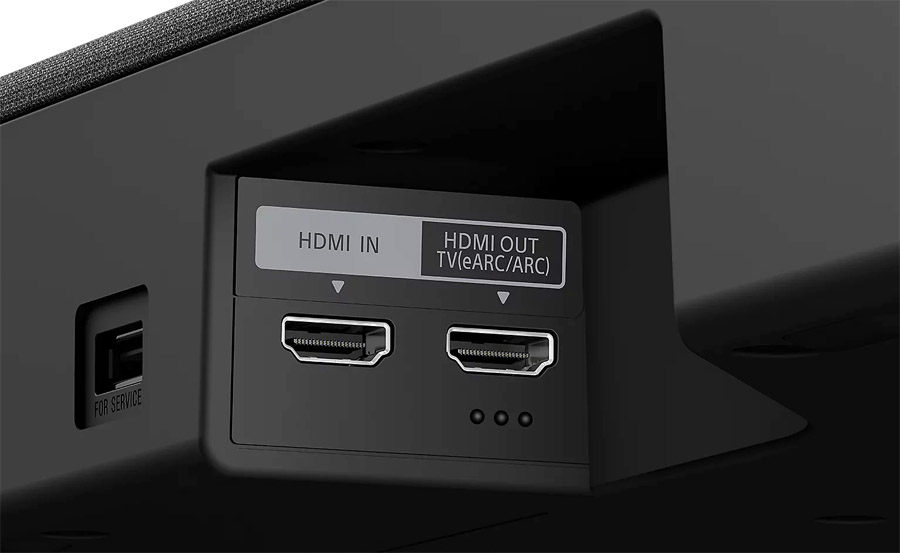
The BRAVIA Theater Trio includes an HDMI port with support for ARC (Audio Return Channel) and eARC (extended Audio Return Channel). This is a bi-directional port which allows the bar to decode sound from anything connected to the TV, or from the TV’s on-board streaming apps or built-in tuner. The Trio also includes a second HDMI port in case you want to connect a source directly to the bar. This is handy if your TV doesn’t support DTS sound and you want to connect a Blu-ray Disc Player directly to the soundbar. The Trio system will pass that source’s video signal to the TV over the HDMI eARC port.
The Trio also supports wireless connectivity, both Bluetooth 6.0 and WiFi 6.0. For Bluetooth, it functions as both a Bluetooth receiver (for streaming music from devices like phones or tablets) and a transmitter (for listening to TV audio with Bluetooth headphones). The Trio supports LDAC, AAC, and SBC codecs. For WiFi, the Trio supports Apple AirPlay 2, Spotify Connect and firmware updates.
Advertisement. Scroll to continue reading.
Advertisement
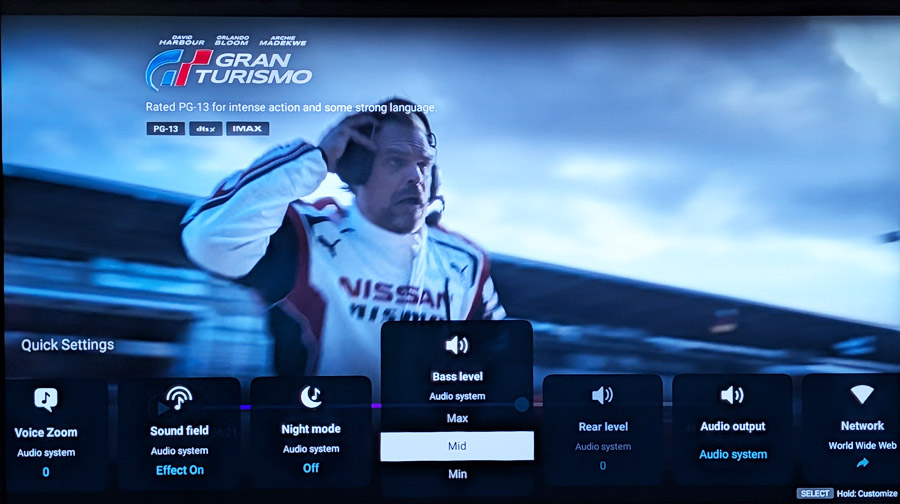
The Trio comes with a remote control and can also be controlled with the BRAVIA Connect app. With HDMI-CEC on board, you can control the volume on the system with any compatible TV remote. If you connect it to a recent Sony TV, you can access detailed settings via the TV’s Quick Settings menu and you can take advantage of Sony’s AI-driven Voice Zoom 3 feature to boost dialog without impacting the rest of the sound. The Trio includes Sony 360 Spatial Sound Mapping (360SSM), which can optimize sound for your room, compensating for less-than-ideal speaker placement.
If you pair the TRIO with a Sony TV, you can control most aspects of the sound from the TV’s Quick Settings menu.
Unlike most of Sony’s soundbars and the BRAVIA Theater Quad, the Trio does not support Sony’s Acoustic Center Sync feature to use the TV speaker as a center channel. Apparently Sony is confident enough in the sound quality of the Trio’s center channel speaker that it doesn’t think the S-Center feature is necessary. Having experimented with Acoustic Center Sync in the past, we’d tend to agree. TV speakers rarely match the timbre of separate speakers and soundbars, and this can lead to tonal inconsistency within the front soundstage.
What About the Quad?
Those familiar with Sony’s home theater speaker solutions know about the BRAVIA Theater Quad. This is a stylish 4-speaker system designed to have two speakers flank the TV and two more be placed toward the back of the room for surround sound. Like the Trio, you can add a subwoofer to the Quad, but only one (there is no support for a second subwoofer).
The Sony BRAVIA Theater Quad features four low profile square speakers and a separate control unit for connectivity.
The major difference between the Quad and the Trio is that the Trio features a dedicated center channel speaker, for rock solid dialog, while the Quad handles center channel duties via a phantom center channel – a virtual speaker that is created between the main left and right speaker thanks to Sony’s 360 Spatial Sound Mapping processing. The Quad also comes with rear channel speakers in the box while the Trio does not. The Quad also allows you to use your Sony TV as a center speaker, using Sony’s “Acoustic Center Sync” feature, but results with this method may vary as the tonality of TV speakers rarely matches the sound of the Quad speakers themselves.
The Set-Up
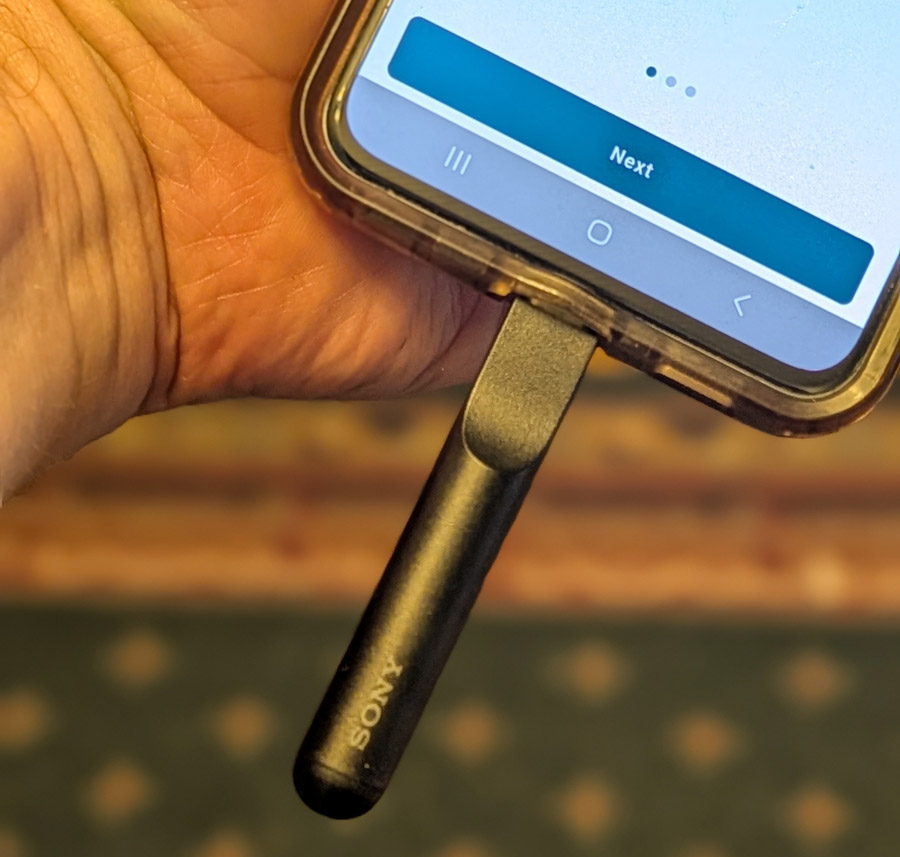
Rather than relying on the mic built into your Android or Apple phone, Sony has included a high quality calibration microphone with a USB-C connector with the Trio. This can be plugged directly into most recent Android and Apple phones and tablets and will be automatically identified. To use it for calibration, and to complete the rest of the set-up, you’ll need to install Sony’s BRAVIA Connect app for Android or iOS.
A new calibration microphone comes with the BRAVIA Theater Trio to optimize the system’s sound for your listening space.
Sony recommends plugging in and positioning the Trio speakers and whatever optional add-on speakers you have purchased first, then installing or launching the BRAVIA Connect app to complete the set-up. This means connecting the BRAVIA Trio’s center channel speaker from its HDMI/eARC port to your TV’s HDMI/eARC port using the included HDMI cable or any high quality ultra high-speed HDMI cable, plugging the center channel into power, as well as plugging the front left and right speakers, rear speakers and subwoofer(s) into power sources.
For placement, make sure the center channel is just below the TV, the front left and right speakers are to the left and right of the TV (preferably equidistant), the rear speakers are mounted behind the listening position (again, equidistant from the main listening seat, if possible) and the subwoofer is placed in a suitable location (more on that later). Be sure to note the markings on the left and right speakers (both for front and rear) so you put these speakers on the correct sides. I was happy to see that the system comes with rubber feet for the center speaker which can elevate it a bit to sit flat, even if your TV has feet that protrude from near the center. I keep a few sorbothane pucks around when reviewing soundbars for just this reason.
Advertisement
If the subwoofer is too close to a wall or corner, it may get a little boomy, so some experimentation with placement may be required. We put ours along the front wall, close to a corner, but with around 12 inches of space from both the side and front wall and this produced good results in our room: solid bass extension without boominess.
Once everything is plugged in, you can install or load the BRAVIA Connect app, make sure your phone is connected to your home network, add the Trio as a new device and proceed with the installation. We used the Trio with a Sony BRAVIA 9 II True RGB TV, which allowed us to take advantage Voice Zoom 3 for dialog enhancement. It also allowed us to access most of the soundbar’s settings from the TV’s Quick Settings bar.
Connections
One thing that bugs me about some soundbar-based systems is the inclusion of just one HDMI port. This requires you to use your TV or projector as the switching device, which isn’t always ideal. Fortunately the BRAVIA Theater Trio includes a dedicated HDMI input, in addition to the HDMI ARC/eARC port for connection to the TV. This is handy if you need to connect a separate streaming stick, disc player or gaming console. In my case, in order to listen to Dolby Atmos Music, I needed to connect an Amazon Fire Stick to get Dolby Atmos from Amazon Music Unlimited. The Amazon Music app built into the TV (like most TVs) does not support Dolby Atmos output.
The TRIO includes two HDMI ports, one for connection to your TV or projector using HDMI ARC/eARC, and another for connecting a separate source device.
Unfortunately the little recess at the bottom of the Trio center speaker where the input ports are located is too tight to fit a streaming stick, so I needed to use an HDMI cable extender to attach the Fire TV stick. Those two HDMI ports are all you get for wired connections. There is no analog input, fiberoptic digital or ethernet port for wired networking. There is a USB-A port on the back for software updates, but this doesn’t support playback of digital music or video files. There is both Bluetooth and WiFi connectivity available so the lack of additional wired connections isn’t a major omission.
Pro Tip: If you have a Sony TV, (or other TV that supports Google Cast) you may be able to cast Dolby Atmos music tracks from your phone’s Amazon Music app using Google Cast. We found that this worked well using a Google Pixel 10 Pro phone casting Dolby Atmos tracks from Amazon Music to a BRAVIA 9 II TV. The TV then sent the Dolby Atmos stream to the TRIO system for decoding. YMMV, of course as some Google Cast implementations only support two-channel casting.
Advertisement
Advertisement. Scroll to continue reading.
Super Calibration-istic Expealadocious
Unlike the Samsung HW-Q990H soundbar system, which we recently reviewed, the Sony system does offer a dedicated calibration procedure. This uses the included USB-C microphone to measure sound from the primary listening position and adjust levels and EQ to compensate for any room or speaker placement anomalies. This process worked for us without incident. Once I plugged the microphone into my Pixel 10 Pro, the app recognized it and allowed me to go through the calibration procedure. This calibration process works in conjunction with Sony’s 360 Spatial Sound Mapping to generate phantom channels around the room for more effective immersion and a more seamless dome of sound.
Listening Notes
To get a sense of what the BRAVIA Theater Trio system could do on its own, I initially plugged in just the included three speakers. I performed the calibration and put on a few scenes from movies and music to run the system through its paces. The Trio system provided a huge improvement in soundstage depth and width, thanks to its independent left and right speakers. Also, front height effects came through clearly thanks to the up-firing drivers and the flat reflective 9 foot ceilings in my listening space.
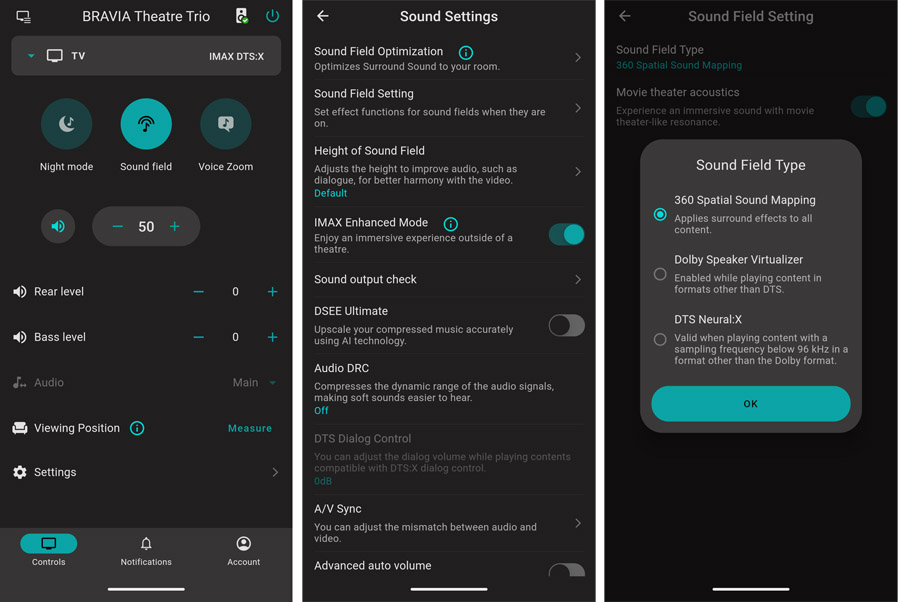
For processing modes, 360 SSM is engaged by default, though you can switch that to DTS Neural:X or Dolby Speaker Virtualizer. On both surround sound tracks and 2-channel material, 360 SSM sounded best to me, with nice dynamics and spatiality. You can also enable a “Movie Theater Acoustics” option in the app, which brings an additional layer of punch to the sound.
Advertisement
In the opening of the first episode of Andor, rain falls softly from above as the main character enters the city. Through the Trio system on its own, that rain sound came from above, but only in the front part of the room. As Andor enters a night club/brothel, dialog was clear, despite the throbbing music in the background. As he leaves the city, the encounter with corporate security guards included some body thuds and blaster shots with decent impact, though not a lot of bass.
Moving on to the sandworm attack of the spice crawler in Dune, as the sound cuts out in a swirl of wind, and the music, swirling sand and Bene Gesserit voices coalesce, the sound maintained reasonable cohesion, though the line “The Kwizzatz Hadderach awakes” wasn’t quite as articulate as on some systems we’ve tested. Switching over to the Gran Turismo movie on Sony Pictures Core, the Trio system presented all the racing action well, with decent dynamic range and impact, including (spoiler alert!), the accident at the Nurburgring track, but again, bass was a bit lacking.
On music tracks in Dolby Atmos, the soundstage is clearly defined. Male and female vocals are captured nicely. Freya Ridings lead vocal on “Lost Without You” is as haunting and delicate as I’ve heard on some of the best soundbar systems. And Bryan Ferry’s dulcet tones are smooth and articulate on the Roxy Music classic “Avalon” (now in Dolby Atmos on Amazon Music). Elton John’s “Rocket Man” is a fun track in Dolby Atmos as the chorus expands in space to take over the entire room. On the Trio, this impact was somewhat lessened as it provides no sound in the rear of the room, neither real nor virtualized.
With just the three speakers, there was no sense of immersive surround from the sides or rear of the room, and bass response was not particularly strong. There is a bass control on the remote and this does boost the bass, but it also makes it a bit “tubby.” There isn’t much, if any, energy below 120 Hz so on things like EDM music tracks and action movies, you will likely notice the bass is lacking. I was eager to add the sub and rear speakers, so I did just that.
Advertisement
Send in the Reinforcements
Adding the speakers and subwoofer through the app was simple enough. I had to plug them into power and hit the pair button on the bottom of each speaker. Then the system added the speakers. The app then informed me that an update was available so I had to wait a few minutes for that to complete. Once the update was complete, I ran through the calibration one more time and dove back into listening.
With the sub and rear speakers attached, the Trio sounded like an entirely different system. Dynamics were greatly improved, bass response was firm and extended and the sort of “bandshell” of sound expanded into a complete dome encompassing the area above and behind the listening position. The rain in Andor fell from directly overhead, and the worm attack in Dune became much more involving, with the “Kwizzatz Hadderach Awakes” line much more clearly audible and articulate.
IMAX Enhanced – It’s Not Just Marketing
Moving over to IMAX Enhanced content on Disney+ and Sony Pictures Core, the Trio switched over automatically to IMAX Enhanced audio mode on these DTS-X soundtracks. This made movies like Gran Turismo (on Sony Pictures Core) and most of the Marvel Cinematic Universe titles on Disney+ come alive with theatrical impact. Powerful deep bass and extended dynamic range were most noticeable. Watching Gran Turismo in IMAX Enhanced mode made me feel like I was in the stands (I kept my eyes peeled for flying cars). And Marvel titles like Guardians of the Galaxy, Volume II brought a taste of that IMAX Theatrical experience home.
The Sony BRAVIA Connect app allows you to adjust volume, speaker levels, sound settings and Sound Field type for the Trio from your phone or tablet.
The industrial/EDM soundtrack on Tron: Ares, composed by Nine Inch Nails members Trent Reznor and Atticus Ross, is well suited to the film’s DTS:X/IMAX Enhanced soundtrack on Disney+. The throbbing pulsing score and songs will certainly wake you up in the morning like a triple shot of espresso for your ears. I did have to keep the volume level much lower on this movie than others, lest risk hearing damage. At some points in the film, I feel like it could have benefited from a dialog boost to cut through the music and effects, but the Voice Zoom feature didn’t appear to work on the DTS:X soundtrack. I assume the Sony TV can’t do the DTS:X Profile 2 to Profile 1 transcoding and also manage the voice boost independently. Voice Zoom did work as expected on PCM and Dolby Atmos content and did a nice job of boosting just the dialog without detracting from the rest of the soundtrack.
If you do listen to DTS:X/IMAX Enhanced soundtracks, make sure your listening space is well sound-proofed or plan to hear from your neighbors or family members complaining to KEEP IT DOWN!
Advertisement
Advertisement. Scroll to continue reading.
The song “Alive” by Kx5 in Dolby Atmos is a great track to test low bass and spatial imaging.
Switching back over to Dolby Atmos music tracks, “Alive” by KX5/deadmau5 became more impactful after adding the sub and rear speakers. The bass drop is much more substantial with the subwoofer in the mix. Around four minutes into the song as a synth snare roll encircles the room, the sound maintained its tonality and traveled fairly seamlessly all around the listening space, though there were small gaps in the extreme left and right of the room as the Trio does not include side firing speakers to fill in that space. Elton John’s “Rocket Man” was also much more enjoyable as the chorus kicked in and backup voices and instruments expanded to fill the entire listening space, drawing me right inside the music.
On mellower fare like “Prodigal Daughter” by Aoife O’Donovan, delicate finger picking is easily audible and harmony vocals were ethereal and detached from the main mix, as intended. Bass notes were better defined and extended than they were prior to adding the sub. I should mention that you can listen to standard 2-channel stereo music from just the front left and right speakers, by disabling the “Sound Field” on the remote or in the app. But I felt most two channel material sounded better with Sony’s 360 Spatial Sound Mapping engaged. It fills in the space nicely without adding too much in the way of artificial-sounding processing.
Ergonomically Speaking
Overall the Trio system is easy to operate, particularly when matched with a Sony TV. The remote is well laid out and includes all the essentials: input switching, voice boost, Sound Field engagement, night mode activation, volume, mute and bass level adjustment. When connected to a Sony TV, you can also adjust settings in the TV’s Quick Settings menu.
Remote control for the Sony BRAVIA Theater Trio
There is no clear visual indicator on the unit itself to see what mode you’re in, whether Voice Zoom is engaged, etc. You’ll need to check all that in the BRAVIA Control app or in the TV’s Quick Settings menu. There is an LED light indicating that it has received a command from the app or remote, but that’s about it. Personally I prefer a small text screen on the unit itself – like we see on the Samsung HW-Q900H and Klipsch Flexus Core 300 soundbars – to indicate what’s happening.
The Bottom Line
When it comes to improving TV sound, Sony gives its customers plenty of choices, with soundbars of all shapes and sizes and integrated surround sound systems like the BRAVIA Theater System 6, BRAVIA Theater Quad and now the BRAVIA Theater Trio. While the Trio system is expensive, particularly when you add the rear speakers and powered subwoofer, it does what standard soundbars can’t by creating a wide and immersive soundstage, suitable for even the largest TV or projection screen. If you’re upgrading to a large TV like Sony’s own BRAVIA 7 II or BRAVIA 9 II True RGB TV in a 65-inch or larger size, and you want a fairly simple plug-n-play wireless system, the BRAVIA Theater Trio offers an excellent integrated solution that can match the large screen size with even larger sound.
Advertisement
Ironically, the aesthetic mismatch (big TV/small soundbar) is actually accentuated here, due to the center channel “bar” which is significantly smaller than most standalone soundbars but a bit deeper than most, which can make it protrude like a little bump when mounted beneath a TV. But the sonic benefit of having a dedicated center speaker may be worth that cosmetic idiosyncracy. The dedicated center channel speaker helps to lock dialog on screen and creates a stable foundation for multi-channel surround sound. When used with a Sony TV, Voice Zoom 3 offers excellent dialog intelligibility without sacrificing other important sonic elements which draw the viewer into the on-screen action.
However, we do have to consider the cost. At $2,199 (MSRP) for just the three speakers, and an additional $749 for the Rear 9 rear speakers and $899 for the Sub 9 subwoofer, prospective buyers may consider buying a component system (receiver and speakers), which would offer higher performance and greater flexibility at a potentially lower cost.
Pros:
Excellent dialog articulation and localization
Soundstage width expands as wide as you want to place the speakers
Support for Dolby Atmos, DTS:X and IMAX Enhanced
Great dynamic range
No shortage of low bass output, if you add a subwoofer
Better than a soundbar for larger TVs
Cons:
Ironically, the center channel speaker looks small with any TV (it’s much smaller than most soundbars)
Optional subwoofer and rear speakers are required for truly immersive sound
Expensive, particularly with subwoofer and rear speakers added
Not as well defined or articulate with 2-channel or 5.1-channel material
No support for Sony 360 Reality Audio or Eclipsa Audio decoding
The Lake Washington Ship Canal, the working waterway connecting Lake Union to Puget Sound, where shipyards, fishing boats and houseboats share the shoreline with the region’s new wave of tech startups. (GeekWire Photo / Kevin Lisota)
Opinion: A year ago, GeekWire ran a headline that posed an uncomfortable question to the local startup community: “Seattle is a global AI hub — but where are the superstar startups?”
The answer, we believe, was hiding in plain sight.
Walk a half-mile today along the banks of Lake Union or through the industrial blocks of Kent, and you will pass a unicorn that didn’t exist a half decade back.
The superstar startups are here. They just don’t look like the superstars that came before. Instead of pure software, this new generation is building intelligent machines, physical products like rockets, power plants, and off-road vehicles that operate in the real world.
Some call this deep tech. We call it Seattle’s Third Act.
Advertisement
As Seattle-based venture capitalists, we have watched this shift up close, conversation by conversation, founder by founder, dollar by dollar. Out of those data points came a framework, one that we think holds the city’s past, present and future in three acts:
Act I: Maritime and aerospace. These industries taught the city how to build complex hardware and left behind the infrastructure to sustain it, from shipyards to airplane hangars.
Act II: Software and cloud computing. The industry that made the city an economic powerhouse and drew a quarter of the country’s AI engineers to Seattle.
Act III: Intelligent machines. The child of its two predecessors and what’s taking shape today: software-enabled hardware, conceived by the region’s world-class talent and built atop its unique physical infrastructure.
Across the national press and social feeds, the perception of Seattle in 2026 is not a positive one. Downtown office towers sit mostly empty while sweeping layoffs cut tens of thousands from the workforce. Policymakers passed tax legislation, hampering Big Tech and startups alike. And Starbucks, the hometown company, is leaving the hometown.
Despite the city’s sinking reputation as a place to do business, Seattle’s Third Act companies are continuing to double down on the region. Few places on earth hold all three of the ingredients these companies need: legacy industrial infrastructure, world-class AI talent, and deep manufacturing know-how.
Of course, those strengths carry a cost. High taxes and rising overhead mean any company that can grow without the full set has reason to leave — and many already have.
Pure software firms, free to operate from anywhere, drift toward cheaper hubs or the density of the Bay Area. Pure manufacturers, drawing little from the local engineering pool, get priced out by the overhead.
Advertisement
But for companies in robotics, energy, space, and defense, the calculus runs the other way. These are industries that demand all three of the region’s strengths at once, and so the tradeoffs are worth making.
Third Act companies grow in person, by recruiting and managing the best software and hardware talent under one roof. They also need things pure software never did: high-bay space with cranes and roll-up doors, freight and runway access through Sea-Tac and Paine Field, thousands of acres to run a vehicle hard, and protected ports that open to the high seas.
Don’t believe us? Just take a look at some of Seattle’s hottest startups right now:
Advertisement
Endurance Energy, the subsea geothermal startup, works out of a converted fishery on Lake Union, giving its team direct access to the water where they’ll test their first-of-its-kind power plant.
Overland AI, which builds autonomous off-road vehicles, keeps its headquarters in Fremont, manufactures in South Seattle, and tests across a hundred square miles of open terrain in central Washington.
Stoke Space, the reusable-rocket unicorn, co-locates its factory and headquarters in Kent while proving hardware at a 75-acre range in Moses Lake.
Perhaps the strongest vindication for Seattle’s Third Act appeal is the companies and leaders choosing to move here. Emergency response drone-maker Brinc relocated its headquarters from Las Vegas. Orbital data center startup Starcloud left El Segundo after its CEO, Philip Johnston, said “everyone we want to hire is in Redmond.”
Seattle has also cultivated a world-class nuclear ecosystem to match. Fusion pioneers Helion, Zap, and Avalanche have raised nearly $2 billion combined, while TerraPower has broken ground on a $4 billion next-generation fission reactor. Meanwhile, Zeno Power is opening a new factory to produce nuclear batteries.
The foundation for the Third Act is set, but having the raw ingredients is not the same as winning the future.
Taking the next step will require a greater appetite for risk. Young builders have to choose the uncertainty of an early-stage startup over the golden handcuffs of Big Tech. Investors have to write early checks for capital-intensive hardware that may take years to pay off. Founders have to build the culture Silicon Valley made second nature long ago, where resources are pooled, introductions traded, and learnings shared.
The rest falls to our elected officials. Third Act companies build in the physical world, and leaders who want to anchor the region’s economy for a generation have to clear the path. A founder shaping metal and code should spend their days on hard engineering, not on permitting lines, red tape, and taxes that chase ambition to friendlier states.
Advertisement
It seems that every week brings another round of grim economic headlines. This constant drumbeat does little to alter Seattle’s trajectory and a great deal to wear down the people who live here. Maybe what we need most is the promise of an ambitious new chapter worth building toward, rather than a decline to defend against.
The question GeekWire asked a year ago has an answer and an address — or, rather, several of them: a converted fishery on Lake Union, a factory floor in Kent, a proving ground in Monroe, a hundred square miles of central Washington scrubland with a driverless vehicle running hard across it.
Seattle’s superstar startups have been hiding in plain sight. Now, the rest of us have to mobilize behind them: investors writing the early checks, policymakers clearing the way, and founders willing to take the leap and build the next one here.
Today’s Man City vs Bournemouth live streams pit two coaches with big shoes to fill against each other on the opening weekend of the Premier League 2026/27 season.
City boss Enzo Maresca has the unenviable task of following Pep Guardiola, who stepped down at the end of last season after winning 20 trophies in 10 years. The new era didn’t get off to the best of starts, with the Italian presiding over a crumbling 3-0 defeat by Premier League champions Arsenal in last Sunday’s Community Shield. It puts Maresca under a little bit more pressure for this league opener against Bournemouth, who finished a record sixth last term. Midfielder Elliot Anderson should make his home debut after a £116m move from Nottingham Forest in the summer.
There is also a new face in the Bournemouth dugout, as Marco Rose takes charge of his first competitive game since replacing Andoni Iraola. The Basque boss departed the south coast as arguably the greatest manager in Cherries history after their highest Premier League finish and first-ever European qualification, so if Rose even gets close to emulating his predecessor’s flowers he’ll have done an excellent job. Bournemouth’s summer recruits include a trio of 22-year-olds, all of whom have never played in England: center-back Antonio Silva from Benfica, striker Alvaro Rodriguez from Elche and right-back Juanlu Sanchez, who joins from Sevilla.
Advertisement
Read on for our dedicated guide on how to stream Man City vs Bournemouth in the Premier League, live and from anywhere in the world.
Can I watch Man City vs Bournemouth for free?
Yes! Fans in Brazil can watch Man City vs Bournemouth for free on CazéTV’s YouTube channel. CazéTV will have live coverage of one Premier League match per gameweek during the 2026/27 season.
There is also a way for viewers in the US to watch at no cost.
Advertisement
US coverage is live on USA Network, which can be accessed via YouTube TV, Hulu Live TV and DirecTV and all have free trials of varying lengths for new customers.
Not in Brazil or the US? Use NordVPN to access your USA Network stream – more details below.
Use a VPN to watch Man City vs Bournemouth from anywhere
A VPN is a handy piece of software that can make your device appear as if it’s back in your home country, thereby letting you unlock your usual streaming service. The best VPN right now? We recommend NordVPN – it does everything and comes with a 75% discount.
Advertisement
It’s really straightforward to use a VPN to watch Man City vs Bournemouth.
1. Install the VPN of your choice. As we’ve said, NordVPN is our favorite.
2. Choose the location you wish to connect to in the VPN app. For example, if you want to watch the Sky Sports stream, select ‘United Kingdom’ from the listed countries.
Advertisement
3. Sit back and enjoy the action. Head to Sky Sports and tune into Man City vs Bournemouth.
How to watch Man City vs Bournemouth live streams in the US
Man City vs Bournemouth will be shown on USA Network in the US.
USA Network is part of NBC Universal, which holds the Premier League broadcast rights in the US.
Advertisement
As we’ve mentioned above, YouTube TV, Hulu Live TV and DirecTV all carry USA Network and have free-trial options, while Sling Blue has USA Network and NBC.
Outside the US for this EPL clash? Use NordVPN to unlock your stream of Man City vs Bournemouth.
How to watch Man City vs Bournemouth live streams in the UK
Fans in the UK can watch Man City vs Bournemouth on Sky Sports.
Advertisement
The game will be live on Sky Sports Main Event and is one of at least 215 Premier League matches broadcast live across Sky Sports this season.
Plans start from £35 a month on a long-term TV contract, while existing customers on a 24-month Sky TV contract can add Sky Sports from £22 a month.
Not in the UK right now? Use NordVPN to watch Man City vs Bournemouth on Sky Sports.
Advertisement
How to watch Man City vs Bournemouth live streams in Canada
Fubo is the Premier League’s broadcast partner in Canada and has live coverage of Man City vs Bournemouth.
Prices start from CA$31.49 per month for Fubo’s Sports Monthly package. However, the best option right now is the Quarterly Package which costs just CA$27.99 CA$14.99 for each of the first three months. You can also watch Fubo’s content if you have a selected DAZN subscription in Canada.
Traveling away from Canada? Use NordVPN to access your Premier League live streams from anywhere in the world.
Advertisement
How to watch Man City vs Bournemouth live streams in Australia
Man City vs Bournemouth will be broadcast on Stan Sport in Australia.
Stan Sport will once again show all 380 Premier League games live this season, and in even better news, it’s even cheaper after they introduced a new Basic tier at AU$9.99. You’ll also need the AU$20 Sport add-on, but you get every Premier League fixture, plus the Champions League, FA Cup, and more, all for AU$29.99 a month.
Missing the game because you’re outside Australia?Use a VPN to login to your Stan Sport account.
Advertisement
Man City vs Bournemouth: Tickets
Want to watch Man City live this season? Seat Unique has you covered…
What is the Man City vs Bournemouth start time?
Man City vs Bournemouth kicks off at 6am PT / 9am ET / 2pm BST / 11pm AEST on Sunday, August 23.
We test and review VPN services in the context of legal recreational uses. For example: 1. Accessing a service from another country (subject to the terms and conditions of that service). 2. Protecting your online security and strengthening your online privacy when abroad. We do not support or condone the illegal or malicious use of VPN services. Consuming pirated content that is paid-for is neither endorsed nor approved by Future Publishing.
A proposed class action filed in San Francisco alleges Oura’s sleep staging is generated by AI estimates rather than measurement, and names Finnish parent Oura Health Oy as a defendant. Oura says it stands behind its science and accuracy claims.
The number Oura puts on its own product pages is now the subject of a lawsuit. A proposed class action filed in the Northern District of California alleges the company’s sleep tracking cannot support its accuracy claims, and names both Oura Inc. and its Finnish parent Oura Health Oy as defendants.
The disputed line is specific. Oura has advertised “95% Sleep Staging Accuracy compared to clinical sleep lab,” which the complaint argues a finger-worn device cannot substantiate.
The physical argument is the core of it. A polysomnography sleep study measures brain activity, eye movement and muscle tone through electrodes, none of which a ring has.
Advertisement
The filing’s language is not restrained. It describes Oura’s sleep stages as “AI-generated guesses” with roughly “a coin flip’s chance” of being right.
It leans on published research for that. The complaint cites a study of 45 patients that found overall sleep stage classification accuracy of 53.18%, with REM sleep overestimated by an average of 31.56 minutes.
Oura rejects the characterisation. “We stand behind our science, research, and accuracy claims,” a spokesperson said, adding that its sleep staging has been compared favourably against polysomnography in multiple studies.
The case carries seven counts, including fraud by misrepresentation and breaches of California’s Unfair Competition Law and False Advertising Law. Alongside damages, it asks for a corrective advertising injunction requiring prominent disclaimers.
Advertisement
The timing is the uncomfortable part. Oura filed confidentially for a US initial public offering in May, after reaching an $11bn valuation that made it Europe’s most valuable consumer health hardware company.
Europe has an interest here beyond ownership. The same 95% figure is marketed to European buyers, where the Unfair Commercial Practices Directive prohibits misleading claims about a product’s main characteristics and about “the results and material features of tests or checks carried out on the product.”
Until recently that mattered less in practice. Since June 2023 the Representative Actions Directive has let designated consumer bodies bring collective redress actions across the EU, and unfair commercial practices sit in its annex.
Oura knows the machinery from the other side, having sued a rival over its own patents. Whether any European consumer organisation picks this up will say more about the new redress regime than about the ring.
Grand Theft Auto 6 is still months away from release, but one leaker who appears to have a build of the game has been posting snippets online over the past week. Take-Two Interactive, the parent company of publisher Rockstar Games, has gone to court to get to the bottom of who this leaker could be.
The stakes are high for Take-Two, as GTA 6 has been so eagerly awaited and is expected to sell so well that the rest of the games industry has stayed away from its November release date by cramming their launches into the months before, or waiting until February 2027 at the earliest. Official GTA 6 trailers get millions of views, and are so popular that Netflix scored exclusive access to the next teaser ahead of its public release. Take-Two has been extremely careful in how it’s dripped info about the game, which is why it’s pursuing legal action against a prominent leaker.
Take-Two filed a petition with the US District Court in the Southern District of New York on Thursday, asking the court to issue a subpoena to Microsoft and Discord for information about suspected GTA 6 leakers, as reported earlier by Kotaku and shown in filings reported on by The Verge. The company wants data from Discord servers and from a repository hosted on GitHub, which is owned by Microsoft, in order to identify the individuals posting the copyrighted content that allegedly infringes the Digital Millennium Copyright Act.
“The copyrighted material includes but is not limited to audiovisual content, artwork, images, dialogue or other creative elements,” the filing alleges. “Take-Two, through its counsel of record, has submitted a sworn declaration confirming that the purpose for which the DMCA subpoena is sought is to obtain the identity of an alleged infringer or infringers, and that such information will only be used for the purpose of protecting Take-Two’s rights.”
Advertisement
In the court filing, Take-Two lists the account names of multiple Discord users that it’s seeking info on, which includes a bevy of data that could identify them: original message logs, IP access logs, email addresses, phone numbers, connected accounts, linked services such as Google and Xbox, backend metadata and telemetry, and device identifiers, among much else. As for Microsoft, Take-Two only requests details from the GitHub repository that GTA 6 was posted on, which is a page dedicated to info about the game leaks, as well as attempts to identify the leakers. The filing doesn’t specify whether it wants information about that repository’s users.
Both filings call for a subpoena to be issued and for the requested information to be produced by Sept. 4. This is not a court order, but rather a request to the court clerk to issue the DMCA subpoena.
A Discord spokesperson said in an emailed statement on Friday that the company “will review and comply with valid subpoenas” when received.
Microsoft didn’t immediately respond to a request for comment.
Advertisement
The GTA 6 leaks began in mid-August when a short gameplay clip was posted on social media by a group calling itself CyberLeek. According to the GitHub repository, nine gameplay videos have been posted on various video-sharing sites. The clips are only a minute or two of footage of one of the GTA 6 protagonists, Jason, driving around town, stealing cars and conducting other activities. Some of the videos show cutscenes and tutorials from the game, but they don’t appear to be in any logical order.
A clip posted online Wednesday had the message, “No physical discs? Then more leeks!” IGN reported, implying that Rockstar would need to reverse its decision to make GTA 6 a digital-only game. Rockstar confirmed there wouldn’t be a physical disc for the game when it revealed the preorder details and pricing back in June. Retail stores will have a physical edition for sale; however, that version just contains a code for the game, not a disc. Rockstar has yet to comment on the threat.
GTA 6 will be released on Nov. 19 for the PS5 and Xbox Series X and S consoles. The Standard Edition will cost $80, while the Ultimate Edition will cost $100.
Oscar Gonzalez
Contributing writer
Advertisement
Oscar Gonzalez is a Texas native who covered video games, conspiracy theories, misinformation and cryptocurrency.
See full bio
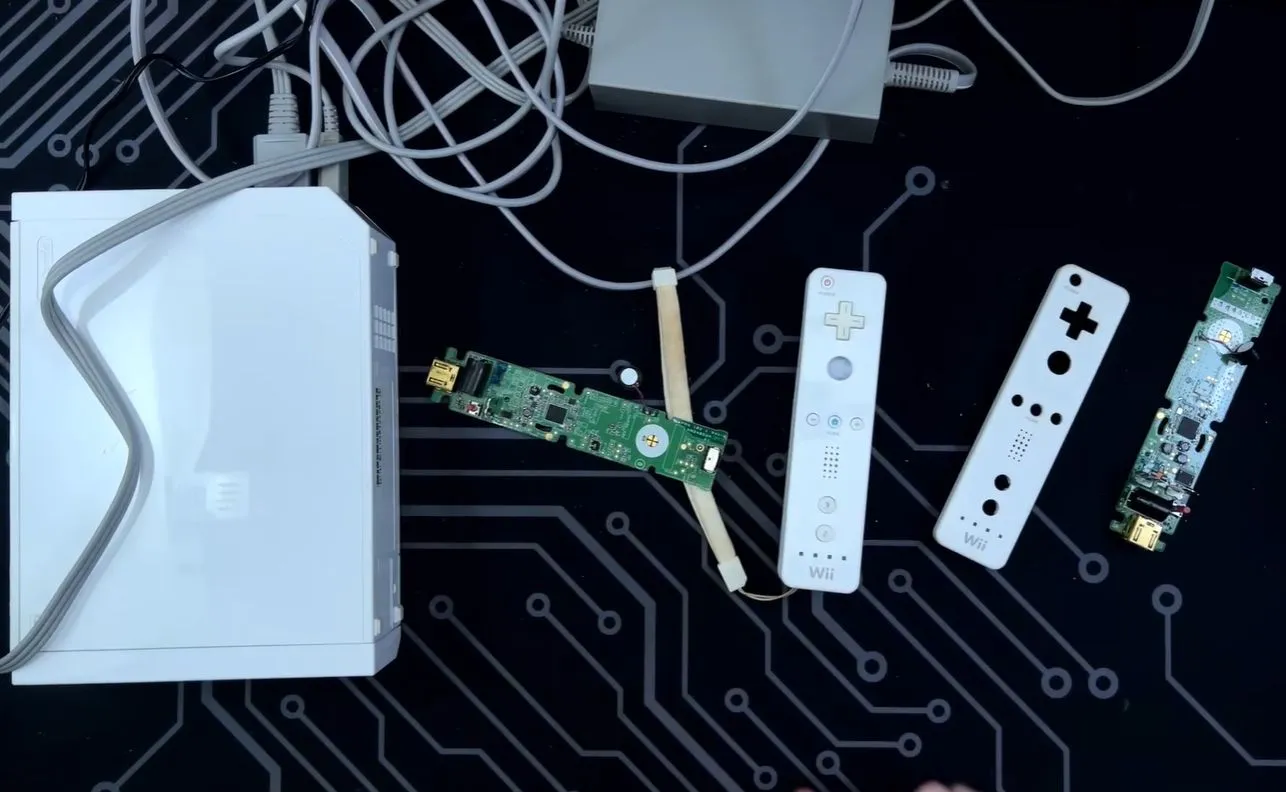
A time-honored tradition in the electronics repair business is to make many into one, specifically a stack of broken devices into one that works. So too with a triplet of heavily corroded and bug-infested WiiMote controllers that [eWastelander] dug out of a box of e-waste. After suffering abuse like leaving in leaky alkaline cells, bugs and general corrosion the task was to see whether at least one working WiiMote could be assembled from these three. (Video, embedded below.)
Adding to the fun was that the PCBs in these WiiMotes spanned at least two hardware revisions, and on one board the battery corrosion had caused an IC to fall off. After an initial assessment, neutralizing the battery acid and a deep clean of all the disassembled parts, it was time to give it a shot at reassembly into something resembling a Wii controller you could use and even want to touch without washing your hands afterwards.
Ultimately at least one working WiiMote was put together, with still an open question whether the remaining two units in much worse conditions could be revived in some way. An interesting idea here is to use the WiiMote shells for a custom OpenMote board, which replaces the guts with an ESP32-S3-based system for more general non-Wii things around the house.
With the 2026-27 season kicking off this weekend, Premier League football teams are facing a new set of rules. But these ones aren’t enforced on the pitch, they’re being enforced by the Premier League board.
As the Premier League has adapted to a new era of fan engagement and interaction, teams are holding huge amounts of personal data, including names, email addresses, credentials, and even financial information. These place them at greater risk of data leaks and make them a primary target for cyber attacks.
In order to ensure teams take the necessary steps to protect both their data and the data of their fans, the board can impose fines of up to £100,000 for teams that don’t meet the requirements across backups, incident response, risk management, security assurance and much more.
Advertisement
Latest Videos FromTechRadar
What do the new rules mean for Premier League teams?
The teams previously had to align with a non-prescriptive security baseline issued in 2024, but the new rules place requirements on teams with deadlines for their implementation.
If these deadlines are not met, the teams can be subject to the aforementioned fine, or referred to an independent commission.
Advertisement
The teams will be required to meet the first set of requirements by April 30, 2027, with further requirements to be met in April 2028 and April 2029. The teams will also have to assess their own compliance by January 10 each year, with a final assessment and evidence submitted to the Premier League board by April 30.
The board can also request additional detail and evidence where needed to track a team’s progress in adhering to the new rules. If a team does not meet requirements during the interim stage it must submit a plan on how it aims to become compliant within 28 days.
Sign up to the TechRadar Pro newsletter to get all the top news, opinion, features and guidance your business needs to succeed!
Advertisement
Expert perspectives on Premier League cybersecurity rules
Muhammad Yahya Patel, vCISO and cybersecurity advisor for EMEA, Huntress:
The Premier League introducing mandatory cybersecurity standards is the right move, but the detail is where the questions start. £100,000 sounds significant until you remember that top Premier League clubs generate revenues north of £600 million annually.
The phased timeline, April 2027, 2028, 2029, is pragmatic but slow given the threat environment. Waiting until 2029 for full compliance gives attackers three more seasons to find the weakest link.
£100,000 sounds significant until you remember that top Premier League clubs generate revenues north of £600 million annually.
That said, the direction is unambiguously right. Moving from a non-prescriptive roadmap to formal requirements with deadlines and evidence submissions is a meaningful structural shift.
Backups, incident response, risk management, and recovery testing are exactly the right foundations. The Premier League doing this proactively rather than reactively before a major breach forces the issue deserves genuine credit.
Most governing bodies wait for the headline incident. This one didn’t. The real test is enforcement appetite. Rules without credible consequences change nothing.
Jamie Akhtar, CEO and Co-founder, CyberSmart:
This is an important shift for the Premier League. Cyber security is moving from being viewed primarily as an IT responsibility to becoming an enforceable element of club governance.
Football clubs hold significant volumes of sensitive supporter, employee and player data, while also relying on systems for ticketing, payments, stadium access and match-day operations. Making areas such as backups, incident response, risk management and security assurance mandatory reflects the reality that a serious cyber incident can quickly become an operational, financial and reputational crisis.
For clubs, compliance should not become an annual box-ticking exercise.
For clubs, compliance should not become an annual box-ticking exercise. They need clear board-level ownership of cyber risk, an accurate inventory of critical systems and data, tested and segregated backups, rehearsed incident-response and recovery plans, strong identity and access controls, and effective oversight of third-party suppliers.
Advertisement
Just as importantly, clubs should continuously collect evidence that these controls are operating effectively. The organisations that treat the new requirements as a minimum baseline for resilience, rather than simply a regulatory hurdle, will be in the strongest position when an attack inevitably tests those controls.
Anna Collard, SVP of Content Strategy and CISO Advisor, KnowBe4:
Good to see the Premier League treating cybersecurity as a governance issue rather than an IT afterthought. Mandatory rules with real financial consequences (fines of up to £100,000) send the right signal: boards are expected to own this risk, not just delegate it.
As I’ve said before, sport is uniquely exposed because it runs on the very emotions social engineers exploit: passion, urgency, loyalty and trust.
But fines only address one side of the equation. As I’ve said before, sport is uniquely exposed because it runs on the very emotions social engineers exploit: passion, urgency, loyalty and trust.
A rushed transfer payment, a fan chasing tickets, an official acting on a “verified” WhatsApp message from someone posing as a coach or chairperson, these are moments of heightened emotion and time pressure, exactly when human judgment degrades. That’s not a firewall problem.
It’s worth remembering that one of the most costly incidents in this sector involved a Premier League club being spear-phished during a £1 million transfer negotiation. That wasn’t a technical breach, but a person deceived at a moment of pressure.
Advertisement
Rules with teeth are a welcome start. But real resilience means pairing compliance with genuine behavioural readiness, for example helping people recognise urgency as a red flag, not a reason to skip verification.
Cian Heasley, Principal Consultant, Acumen Cyber:
I think it’s a positive step forward. Football clubs are attractive targets because they hold large volumes of sensitive data, process significant financial transactions and rely on operational systems where disruption can have very real consequences. Moving from advisory guidance to enforceable standards creates much-needed accountability, and the financial incentive will inevitably help drive action.
Requiring clubs to have a clear plan, aligned to defined standards and delivered within a set timeframe, also gives them something measurable to work towards. The key will be making sure those standards provide clear structure rather than leaving too much open to interpretation.
The key will be making sure those standards provide clear structure rather than leaving too much open to interpretation.
The focus on backups, incident response and recovery is particularly important. Preventing every incident simply isn’t realistic, so clubs need to prove they can recover quickly when something does happen. If clubs are working towards common standards, there is also a real opportunity to share lessons around what works, where implementation falls short and how security can continue to improve across the league.
In November ‘24, Italian club Bologna FC confirmed a ransomware attack claimed by the RansomHub group, which exfiltrated sensitive data. After the club declined to meet the ransom demand, the ransomware gang published the full dataset on the dark web. The leaked material reportedly included player and sponsor information, and the attackers went as far as invoking GDPR exposure to pressure the club into paying, a tactic that turns a club’s own regulatory obligations into leverage.
Advertisement
More recently, Dutch club Ajax was named among the organisations affected by the CEVA Logistics breach, where customer data was exposed through a shared shipping vendor rather than a direct compromise, underlining that supply-chain exposure is also as material a risk as any attack on a club’s own estate.
Taken together, these incidents show why these rules were needed then, though they are pitched as proactive, they must also be driven by these football-related breaches.
The £100,000 ceiling is modest against the true cost of a serious incident and the amounts of money tied up in football clubs, so the value lies less in the sanction and more in compelling clubs to build tested backups, incident response and recovery capability before they are needed. The Bologna case in particular demonstrates that ransomware leaks can be damaging, which makes resilience and data minimisation far more important than any assumption that a club can negotiate its way out of trouble.
How do I submit my own perspective on emerging news?
If you have an expert perspective you would like to share on an emerging story or particular topic, please get in contact here: benedict.collins@futurenet.com
GRMNT pulled his grandfather’s old road bike out of storage and found a Bianchi built with real Tange steel tubing. Years of grime covered the frame, yet the metal underneath still held the clean lines and solid construction of a proper 1980s road machine. He cleaned it thoroughly, then set out to give the bike an electric boost that left almost no visible trace of the change.
A used Bafang mid-drive motor turned up unexpectedly for €10. The device had clearly had a tough life because water had gotten inside, the magnets had taken a hammering and one of them had broken, and a blind bearing would not move. When GRMNT attempted to withdraw the bearing, they damaged the housing. But GRMNT doesn’t give up easily, and he sets to work mending the damage, replacing worn bearings, recovering the magnet, and restarting the engine. Once placed in the bottom bracket, the drive sat low, centered, and ready to engage whenever necessary, as long as you were spinning the stock chainring at a fair speed.
【Excellent Motor Performance】This electric bike is equipped with a high-performance 750W motor(1500W peak power) with 2 to 3 speed settings…
【Upgraded Removable Battery】 Powered by a 48V 15Ah removable battery, the ebike can be fully charged in just 6-7 hours and can ride up to 60 miles…
【Comfortable Riding Experience】 This fat tire electric bike is equipped with front and rear suspension system, which absorbs most of the bumps and…
A batch of recycled Samsung 50E batteries, repurposed from somewhere, supplied power. Ten of the cells were joined and spot welded together with nickel strips and protected by a BMS system. There was an issue with the wiring early on, but it was detected before the pack had completed any significant work. Anyway, once everything was in order, the finished battery was placed in a bespoke leather case designed and hand sewed by GRMNT from some exquisite Italian calf skin. The pack sat on the frame as if it had always been there, and the entire configuration appeared to be factory-installed. The case was secured with a simple clasp, and everything was kept understated.
As one might expect, the entire setup remained relatively quiet. The majority of the traditional suspects, including the throttle, factory display, and all visible wiring, were removed or disconnected. Instead, the motor was operated by a single simple button, and riders looking over the handlebars saw nothing but a completely normal bike. Battery level information was provided via a different type of display entirely. A small microcontroller monitored the pack voltage and utilized it to trigger a solenoid located within the handlebars. Every time the battery reduced another quarter of its capacity, the solenoid would click over and produce a clear, tactile sound, similar to an old-fashioned instrument. When the battery was first connected, the system flashed a short series of clicks to notify the rider that everything was working. There were no flashy screens or numbers, just a solid, old-school vibe.
During the drive, everything worked perfectly. A fifty-kilometer loop through the hills surrounding Iași, Romania served as a great test, with plenty of ups and downs to push the system to its limits. On a particularly painful twenty-six-degree incline, the motor kicked in, making what would have been a difficult slog appear nearly effortless. On the flats, however, the bike glided along pleasantly at 35 km/h using only human power. The frame and motor were unaffected by the dirt paths and rocky ground, but the original brakes reminded us that some of the base parts needed some TLC before they were up to pace. However, by the end of the ride, the battery had a beautiful round forty-plus percent charge. [Source]







































































You must be logged in to post a comment Login