
Crypto World
Ray Dalio says investors should own ‘a bit of Bitcoin’ as U.S. debt risks rise



The Bridgewater founder says recent Treasury-market stress fits his long-running debt-crisis framework, though he still prefers gold as the bigger hedge.

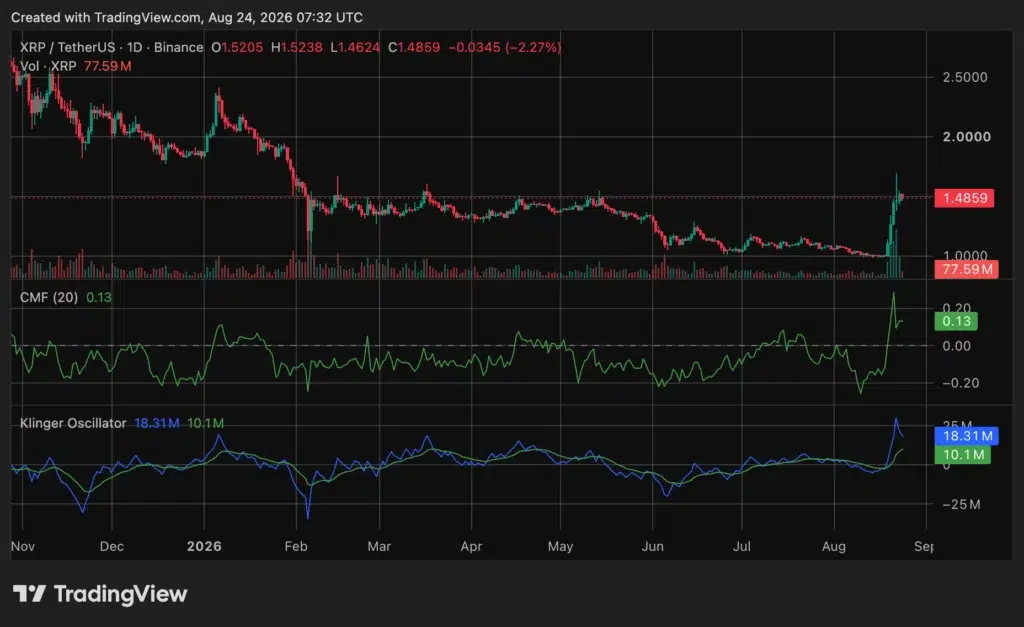
XRP price traded near $1.47 on Aug. 24 after gaining 47.5% in seven days, putting the payments focused cryptocurrency on course for its strongest weekly performance since November 2024.
Summary
- XRP price traded near $1.47 on August 24, gaining 47.5% across seven days after breaking higher.
- Treasury doubled planned long bond buybacks to at least $4 billion per operation starting September.
- Marketwide short liquidations exceeded $1.2 billion during one 24-hour period, accelerating the broader cryptocurrency rally.
- Binance XRP leverage reached its highest level since early 2026, increasing two sided liquidation risks.
- XRP price remains nearly 60% below its July 2025 record high despite its sharp weekly recovery.
The token rose 1.2% over the previous 24 hours and traded between $1.44 and $1.54, according to crypto.news data. Daily trading volume stood at approximately $4.72 billion, while market capitalization reached $92.3 billion.
The crypto briefly moved above $1.50 before giving back part of the advance. The token remains about 59.6% below its July 2025 record of $3.65, showing that the rally has recovered only part of the previous bear market decline.
Treasury buybacks helped XRP and risk assets rally
The advance began after the U.S. Treasury announced larger liquidity support buybacks for long dated government debt.
Treasury will raise the maximum amount purchased in individual operations from $2 billion to at least $4 billion. The change covers nominal securities in the 10 to 20 year and 20 to 30 year maturity ranges beginning Sept. 9.
The larger operations will remain in effect through Nov. 4, according to the official statement.
Long term Treasury yields initially fell following the announcement, while the U.S. dollar weakened and risk assets advanced. Lower yields can increase the relative appeal of assets that do not provide fixed income, including cryptocurrencies.
Some traders interpreted the move as a possible step toward “yield curve control.” However, Treasury described the operations as liquidity support for parts of the bond market receiving large volumes of eligible offers.
Yield curve control would generally involve a central bank targeting specific interest rates through potentially unlimited purchases. Treasury’s scheduled and capped operations do not meet that definition. Any claim that the announcement confirms future monetary easing remains speculative.
Marketwide short liquidations accelerated the move
The rally coincided with a large reduction in bearish derivatives positions. CoinGlass data cited during the initial breakout showed approximately $1.2 billion in cryptocurrency shorts liquidated within one 24 hour period.
Those liquidations covered the wider cryptocurrency market rather than XRP alone. Available data does not support the claim that nearly $2 billion of XRP short positions were liquidated during the week.
A short liquidation occurs when an exchange forcibly closes a bearish leveraged position because the market has moved too far against it. The resulting purchases can push prices higher, forcing further liquidations and creating a short squeeze.
The crypto also received support from spot demand. As previously reported, large holders accumulated approximately 380 million tokens during the week as XRP Ledger transactions exceeding $1 million increased sharply.
The accumulation data does not identify the owners or their intentions. Large transfers can represent purchases, internal wallet movements, custody changes or exchange activity.
Rising XRP leverage raises reversal risk
The estimated leverage ratio for XRP derivatives on Binance has climbed to its highest level since early 2026, according to CryptoQuant figures.
An increasing ratio means open interest is growing relative to the exchange’s XRP reserves. It does not reveal whether traders are predominantly bullish or bearish, but it indicates that more market exposure depends on borrowed capital.
High leverage can extend a rally when rising prices force short sellers to close. It can also deepen a correction when long positions are liquidated. The token could therefore experience larger movements in either direction while leverage remains elevated.
Meanwhile, the daily chart supports the stronger momentum. XRP’s price breakout was accompanied by volume of 77.59 million tokens, while the Chaikin Money Flow remained positive at 0.13. The Klinger Oscillator stood at 18.31 million, above its 10.1 million signal line, indicating continued buying pressure despite short term profit taking.
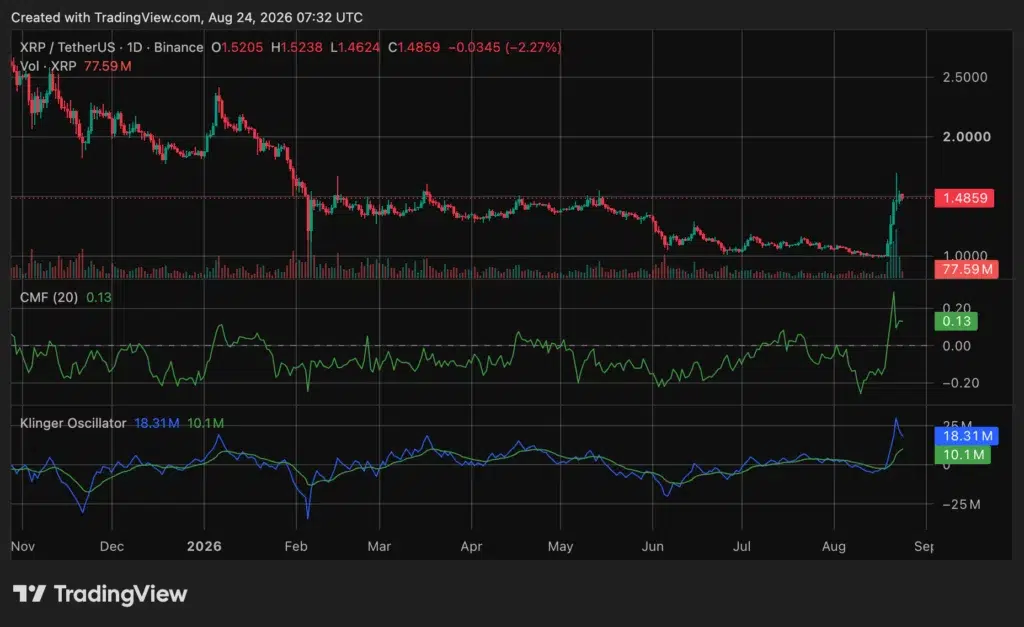
Crypto analyst EGRAG Crypto said XRP price remains inside a broader range until it closes above his identified resistance zone. His forecast that the token could eventually reach $6 to $7 assumes another large expansion based on earlier market cycles.
The target is speculative and is not supported by a confirmed breakout. Historical percentage gains do not establish that a similar move will occur again.
XRP price must hold its breakout structure
The immediate resistance area sits between the recent $1.54 high and the next psychological level around $1.60. A sustained close above that region would confirm that buyers remain active after the initial short squeeze.
The first nearby support is around $1.44, the lower end of the latest daily range. A deeper decline toward $1.30 would return the crypto price to the area traded during the earlier stage of the breakout.
XRP’s price 35.2% monthly gain supports the improved medium term structure. However, its 51.5% decline over the past year and continued distance from the record high show that a broader recovery has not been completed.
The U.S. policy outlook also remains relevant. In related coverage, uncertainty surrounding the CLARITY Act continued to weigh on XRP before the latest marketwide rally.
Traders will now watch whether spot demand continues after liquidations subside. The Sept. 9 start of the larger Treasury buybacks, movements in long term yields and changes in Binance leverage will provide the next tests for the XRP price rally.
XRP gained more than 50% in five trading days, its strongest weekly performance in 21 months, as a Treasury buyback expansion, a White House crypto summit, and aggressive whale accumulation converged on the same narrow window.
Summary
- XRP surged from approximately $1.00 on Aug. 18 to a high of $1.6963 on Aug. 22, 2026, a gain of roughly 56% that marks its biggest weekly move since November 2024.
- The U.S. Treasury doubled long-term bond buyback operations from $2 billion to at least $4 billion per session, triggering a rapid drop in benchmark yields and pushing capital into risk assets across crypto markets.
- Ripple CEO Brad Garlinghouse attended a White House crypto policy summit on Aug. 19 alongside SEC Chairman Paul Atkins, advancing the CLARITY Act that would classify XRP as a digital commodity under CFTC oversight.
- Whale addresses holding between 1 million and 10 million XRP accumulated approximately 380 million tokens in one week, pushing tracked holdings from 16.05 billion to 16.36 billion XRP while exchange outflows exceeded 240 million tokens since summer began.
- Spot XRP ETFs attracted $39.78 million in net inflows for the week ending Aug. 22, bringing cumulative inflows since their November 2025 launch to $1.55 billion across seven approved funds.
XRP closed the week of Aug. 18 as the best-performing asset among the top ten cryptocurrencies by market capitalization, beating Bitcoin by more than 40 percentage points and Ethereum by more than 45. The move was not a single-catalyst spike. It was a compressed sequence of macro, regulatory, and on-chain events that landed in the same five-day window, each one reinforcing the next. Understanding why each catalyst mattered, and why their convergence produced a move of this magnitude, requires looking at the specific mechanics of how they interacted.
The rally also marks the first sustained price advance since the SEC settlement that correlates with improving on-chain metrics rather than pure speculation. For seven months before this week, XRP traded between $0.90 and $1.10 while Ripple’s corporate fundamentals strengthened in the background. The disconnect between token price and business development had become one of the most discussed topics in crypto markets. That gap narrowed sharply over five days.
The Treasury buyback that unlocked the rally
The catalyst that set everything in motion arrived on Aug. 19, when Treasury Secretary Scott Bessent announced an expansion of long-term government bond buyback operations. The size of each buyback would double from $2 billion to at least $4 billion per operation, starting Sept. 9. The announcement came after the 30-year Treasury yield spiked to its highest level since 2007, a move that had been pressuring risk assets across every market for weeks.
Buying back bonds pulls supply off the market, pushing bond prices up and yields down. The 30-year yield fell to 5.19% within hours. Traders described the dynamic as informal yield curve control, since the buybacks effectively cap how high long-end yields can climb without the Federal Reserve having to intervene directly.
The effect on crypto was immediate. Bitcoin jumped from $62,000 to $69,000 within 48 hours, its biggest weekly gain in two years. But the impact on XRP was disproportionate. More than $3 billion in crypto short positions were liquidated during the surge, and XRP’s lower market capitalization relative to Bitcoin made it more sensitive to the rotation. Leveraged short sellers who had been betting on a continued grind below $1 were forced to cover, and the resulting squeeze amplified the underlying move.
Lower yields make bonds less attractive relative to riskier assets, which frees capital to rotate into high-beta positions. XRP, with its pending regulatory catalysts and recent technical weakness, became the primary beneficiary of that rotation among large-cap altcoins.
The White House summit and the CLARITY Act
On the same day the Treasury buyback was announced, a separate catalyst emerged from Washington. The White House hosted a crypto policy summit attended by Ripple CEO Brad Garlinghouse, SEC Chairman Paul Atkins, and members of Congress who had co-sponsored the CLARITY Act. President Trump publicly urged Congress to pass the legislation, which would classify XRP and similar tokens as digital commodities under CFTC oversight rather than securities under the SEC.
The CLARITY Act represents the most significant potential shift in U.S. crypto regulation since the Ripple settlement itself. If passed, it would give XRP the same regulatory classification as Bitcoin and Ethereum, removing the last remaining ambiguity about its legal status. The crypto.news analysis of the three conditions for XRP’s recovery identified regulatory clarity as the single most important factor, with 65% of institutional allocators surveyed saying they need this classification before increasing crypto exposure.
The bill faces a Senate procedural vote on Sept. 15. Polymarket prediction contracts currently give it approximately 16% odds of passing, reflecting the difficulty of moving any legislation through Congress in the current political environment. But the market responded to the optics of the summit itself, not the probability of passage. Brad Garlinghouse standing alongside the SEC chairman and the president, discussing a bill that would formalize XRP’s commodity status, sent a signal about the direction of policy that no probability model fully captures.
XRP price jumped roughly 30% in two days following the summit, breaking a year-long downtrend in the process. The move took the token from $1.00 to $1.31 before the additional catalysts pushed it higher.
Whale accumulation and the exchange drain
The on-chain data tells a story that started before the price moved. According to crypto.news reporting on whale accumulation, addresses holding between 1 million and 10 million XRP accumulated approximately 380 million tokens over the week of Aug. 18. Total whale holdings rose from roughly 16.05 billion to 16.36 billion XRP, the highest level since the SEC settlement.
The accumulation was not limited to a single cluster of wallets. Whale transactions on the XRP Ledger surged 280% in 24 hours, with 38 large-value transfers exceeding $1 million recorded in a single trading day. The baseline for large-value XRP transactions in July and early August had averaged roughly 10 to 12 per day, making the spike to 38 a clear departure from normal activity.
More telling than the buying itself was the absence of selling. Whale transfers to Binance fell to their lowest level since 2021 during the same period, suggesting that large holders were accumulating and holding rather than flipping for short-term profit. More than 240 million XRP tokens left exchanges since summer began, reducing the available supply on order books and tightening the market.
The wallets involved in the accumulation include a mix of known institutional custodians and unidentified addresses. Analyst Ali Martinez noted that the accumulation pattern resembles the pre-rally positioning seen before XRP’s January 2026 high of $3.40, when whale addresses added similar quantities before the token rallied from $2.00 to its peak.
Ripple’s own escrow activity adds context. In August 2026, Ripple unlocked 1 billion XRP from escrow, valued at approximately $1.08 billion under its monthly program. Despite this regular supply injection, whale accumulation outpaced the new supply reaching the market, a dynamic that had not occurred since early 2025.
Spot ETF inflows and institutional re-engagement
The seven U.S. spot XRP ETFs approved since November 2025 had a complicated first year. After a strong launch that saw them accumulate $1.3 billion in assets within two months, inflows collapsed through the summer. Weekly ETF inflows fell 93% to just $1.01 million for the week ending Aug. 8, down from $14.86 million the prior week. JPMorgan had predicted up to $8 billion in year-one inflows. The reality was $1.5 billion across eight months.
The week of Aug. 18 reversed that trajectory. Spot XRP ETFs attracted $39.78 million in net inflows, the strongest weekly pace since May. Bitwise Asset Management, Franklin Templeton, and Grayscale Investments led the buying. Cumulative inflows since launch reached $1.55 billion, with the funds now holding approximately 1.50% of total XRP supply.
The crypto.news coverage of ETF inflows crossing $1.55 billion noted that the timing aligned with a shift in macro sentiment following the Treasury buyback announcement. Institutional buyers who had paused allocations during the yield spike returned as soon as yields dropped, suggesting that the problem with XRP ETFs was never demand for the asset itself but the competing returns available in fixed income.
The ETF structure also matters for price mechanics. Unlike over-the-counter XRP purchases, ETF inflows require the fund to buy XRP on the open market or through authorized participants, creating direct buying pressure on the spot price. When $39 million in weekly inflows meets a market where 240 million tokens have already left exchanges, the price impact is amplified beyond what the dollar figure alone would suggest.
How this rally compares to every post-settlement XRP move
XRP has produced four distinct rallies since the SEC settlement was finalized in May 2025. Each one differed in catalyst, duration, peak gain, and retracement depth. Mapping them reveals a pattern that this week’s move both follows and breaks.
Rally one: the settlement itself (May 2025). XRP jumped 42% in three days after the SEC formally withdrew its appeal and Ripple paid the reduced $50 million penalty. The catalyst was purely legal. On-chain accumulation was minimal because the news broke with no advance warning. The retracement was fast: XRP gave back 60% of the gain within two weeks as traders took profit on the news.
Rally two: the ETF approval wave (November 2025). Seven spot XRP ETFs received regulatory clearance, and XRP surged 85% over three weeks. This was the longest sustained move of the cycle, driven by genuine institutional inflows that totaled $483 million in December alone. The retracement was slower but deeper. XRP fell 65% from its January 2026 high of $3.40 to the $1.00 level it occupied before this week’s move.
Rally three: the Ripple Prime announcement (June 2026). Ripple announced conditional approval for a national trust bank charter and raised at a $50 billion valuation. XRP gained 28% in five days. The retracement was almost complete within ten trading sessions, as the market concluded that corporate milestones were not translating into token demand.
Rally four: this week (August 2026). XRP gained 56% in five days, making it the second-largest post-settlement move by magnitude. What distinguishes it from the previous three is the convergence of multiple catalyst types. The settlement rally was legal only. The ETF rally was institutional only. The Ripple Prime rally was corporate only. This week combined macro (Treasury buyback), political (White House summit), on-chain (whale accumulation), and institutional (ETF inflows) catalysts simultaneously.
The convergence matters because it creates feedback loops that single-catalyst rallies cannot sustain. Macro-driven yield drops pull capital into crypto broadly. Political catalysts direct that capital specifically toward XRP. Whale accumulation reduces available supply. ETF inflows create structured buying pressure. Each factor reinforces the others, making the rally more durable than moves driven by a single headline.
Whether this convergence produces a genuinely different outcome from the previous three rallies, all of which eventually retraced, is the central question for XRP holders heading into September.
The overbought signal and what it has meant before
The Relative Strength Index on XRP’s daily chart reached 85.4 on Aug. 22, its most overbought reading since July 2025. The last time the RSI crossed 85, XRP retraced 18% within ten trading days. In three of the four previous instances where XRP’s RSI exceeded 80 since the SEC settlement, the token lost at least 15% of its value within two weeks.
The technical picture is further complicated by the death cross that formed earlier in August. The crypto.news analysis of the death cross erasure explained that while XRP’s daily candle closed above both the 50-day and 200-day exponential moving averages for the first time since the bearish crossover, the 50-day EMA remains below the 200-day line. A confirming golden cross has not yet formed.
The distinction matters because three previous breakouts above both moving averages failed to produce a golden cross, each time resulting in a return below the 200-day EMA within five trading days. The current move needs to hold for at least another week before the moving average crossover would confirm a genuine trend change.
A weekend flash crash on Aug. 22 added to the uncertainty. Approximately $500 million in XRP long positions were liquidated in minutes when the price dropped sharply from $1.69 to $1.43 before recovering to the $1.46 to $1.51 range where it traded into Saturday. The event showed how quickly leveraged positions can unwind even in the middle of a strong rally, and it reduced open interest enough to partially reset the overbought condition.
Ripple’s corporate momentum and the token disconnect
The irony of XRP’s 2026 performance is that Ripple the company has never been stronger. The SEC case ended with XRP retaining full trading rights in the United States. Seven U.S. spot ETFs launched and now hold nearly a billion dollars in XRP. Ripple secured conditional approval for a national trust bank charter. The company raised at a $50 billion valuation. It spent roughly $4 billion on acquisitions. Most recently, Ripple Prime raised $275 million through a private placement of senior unsecured notes with a BBB rating from KBRA, an 8.25% coupon, and a 2031 maturity date.
Yet XRP the token spent the first seven months of 2026 trading between $0.90 and $1.10 while all of this happened. The crypto.news XRP price prediction page noted the base case of $1.80 to $3.20 by 2030, a range that assumed slow and steady appreciation from the $1.00 level. This week’s move has compressed months of expected appreciation into days.
The token’s disconnect from Ripple’s fundamentals is partly structural. XRP’s supply dynamics differ from tokens like Bitcoin or Ethereum. Ripple holds billions of XRP in escrow and releases them monthly, creating a persistent supply overhang that weighs on price even when demand increases. The monthly escrow release of 1 billion XRP in August alone exceeded the total whale accumulation for the entire week. The net effect on circulating supply depends on how much Ripple returns to escrow, a figure the company reports quarterly but not in real time. In previous months, Ripple has returned between 800 million and 900 million tokens to escrow, meaning the net new supply reaching the market each month is typically between 100 million and 200 million tokens. Even at the lower end of that range, the monthly supply addition partially offsets the accumulation pressure from whale buyers.
Ripple Prime’s integration with EDX Markets and Hyperliquid to expand institutional access to spot, perpetual futures, and decentralized liquidity creates new demand channels that did not exist during the first three post-settlement rallies. Whether these channels can absorb enough supply to offset the escrow releases is one of the structural questions that will determine whether this rally holds.
The CLARITY Act as a binary event
The Senate procedural vote on the CLARITY Act scheduled for Sept. 15 creates a binary event risk for XRP that has no parallel in the token’s history. If the bill passes cloture and eventually becomes law, XRP would receive the same commodity classification as Bitcoin and Ethereum, removing the final barrier to full institutional adoption. If it fails, the market would need to reprice the probability of regulatory clarity arriving through legislation versus the current patchwork of court rulings and agency guidance.
The bill’s passage is far from certain. Polymarket gives it approximately 16% odds, and the Senate procedural calendar is crowded. But the White House summit on Aug. 19 moved the conversation from theoretical to operational. The presence of the SEC chairman at a meeting dedicated to advancing the bill suggests coordination between the executive branch and the regulatory agencies that would implement it.
For XRP specifically, the CLARITY Act would resolve the last remaining ambiguity from the Ripple settlement. While courts ruled that XRP traded on secondary markets did not constitute a securities transaction, certain institutional sales remained subject to securities law considerations. The CLARITY Act would eliminate that distinction entirely, making XRP legally identical to Bitcoin for regulatory purposes.
The market appears to be pricing in a higher probability of passage than the prediction markets suggest, or at least pricing in the optionality that the political environment has shifted enough to make some form of regulatory clarity likely within the next 12 months, whether through this specific bill or an alternative path.
https://twitter.com/cryptodotnews/article/2061436021380661610
What to watch
The 200-day EMA retest. A daily close below the 200-day exponential moving average within five trading days would repeat the pattern of three previous failed breakouts and signal that the rally was a short squeeze artifact.
Weekly ETF flow data for the week ending Aug. 29. If inflows sustain or accelerate from the $39.78 million recorded this week, it would confirm that institutional demand is genuine and not a one-week reaction to macro headlines.
The Sept. 15 CLARITY Act cloture vote. The vote itself is binary, but the political dynamics in the weeks leading up to it will shape expectations. Watch for co-sponsor additions or withdrawals as a leading indicator.
Exchange reserve levels. If the drawdown of 240 million tokens from exchanges since summer continues or accelerates, it would tighten supply further and support the price. A reversal, with tokens flowing back to exchanges, would suggest whale profit-taking.
The 30-year Treasury yield. The yield fell to 5.19% after the buyback announcement. If it climbs back above 5.50%, the macro tailwind that triggered the rally would weaken, and the rotation into risk assets could reverse.
Why did XRP surge 50% in one week?
XRP gained approximately 56% between Aug. 18 and Aug. 22, 2026, driven by a convergence of four factors: the U.S. Treasury doubling bond buyback operations, a White House crypto summit advancing the CLARITY Act, whale accumulation of 380 million tokens in a single week, and $39.78 million in spot ETF inflows. The combination created feedback loops that amplified the move beyond what any single catalyst could produce.
What was the Treasury buyback and why did it affect XRP?
Treasury Secretary Scott Bessent announced that long-term bond buyback operations would double from $2 billion to at least $4 billion per session starting Sept. 9. The buybacks pulled supply off the bond market, pushing yields down and freeing capital to rotate into risk assets including crypto. The 30-year yield fell to 5.19% within hours, triggering more than $3 billion in crypto short liquidations.
How much XRP did whales accumulate during the rally?
Addresses holding between 1 million and 10 million XRP accumulated approximately 380 million tokens over the week of Aug. 18, according to on-chain tracking data. Total whale holdings rose from 16.05 billion to 16.36 billion XRP. Additionally, whale transactions exceeding $1 million surged 280% in 24 hours, with 38 large-value transfers recorded in a single trading day.
Is the XRP rally sustainable given the overbought RSI?
The Relative Strength Index reached 85.4 on Aug. 22, the most overbought reading since July 2025. In three of four previous instances where XRP’s RSI exceeded 80 since the SEC settlement, the token retraced at least 15% within two weeks. However, the convergence of multiple catalyst types in this rally makes direct comparison to single-catalyst moves incomplete.
What is the current status of XRP spot ETFs?
Seven U.S. spot XRP ETFs have been trading since November 2025, with issuers including Bitwise, Franklin Templeton, Grayscale, 21Shares, Canary Capital, and Volatility Shares. Cumulative net inflows have reached $1.55 billion, with the funds holding approximately 1.50% of total XRP supply. The week ending Aug. 22 saw $39.78 million in inflows, the strongest weekly pace since May.
What is the CLARITY Act and when is the vote?
The CLARITY Act is proposed legislation that would classify XRP and similar tokens as digital commodities under CFTC oversight. A Senate procedural vote is scheduled for Sept. 15, 2026. Polymarket prediction contracts give it approximately 16% odds of passing. If enacted, it would give XRP the same regulatory classification as Bitcoin and Ethereum.
How does this rally compare to previous XRP moves since the SEC settlement?
This is the second-largest post-settlement rally by magnitude (56%) and the first to combine macro, political, on-chain, and institutional catalysts simultaneously. The settlement rally (May 2025) was legal only, the ETF wave (November 2025) was institutional only, and the Ripple Prime rally (June 2026) was corporate only. Each previous rally eventually retraced between 60% and 100% of its gains.
What is XRP’s current price and market capitalization?
As of Aug. 23, 2026, XRP trades near $1.46 to $1.51, with a total market capitalization of approximately $91.5 billion. It ranks among the top five cryptocurrencies by market cap. The 24-hour trading volume stands at approximately $9.3 billion, reflecting the elevated activity from the weekly surge.
Disclaimer: This article is for informational purposes only and does not constitute investment advice. Cryptocurrency markets are highly volatile, and past performance does not indicate future results. Always conduct your own research before making investment decisions. Published Aug. 23, 2026.


Banks and financial regulators from Europe, the Middle East and Asia joined a cross regional pilot testing post quantum security for digital asset wallets and blockchain transfers on Aug. 24.
Summary
- Two banks will test quantum resistant wallets and transfers on a specialized NEAR testnet environment.
- Regulators from Abu Dhabi, Bhutan and Malta will initially observe the pilot’s first phase activities.
- The protocol combines multiparty computation with NIST standardized ML-DSA-65 signatures for secure digital asset transfers.
- Organizers plan a white paper covering test results before eventually releasing the underlying protocol publicly.
- No cryptographically relevant quantum computer currently exists that can break deployed blockchain signatures at scale.
The Responsible Fintech Institute convened the project with digital asset custody infrastructure provider Safeheron as its technology partner, according to the official announcement.
Bison Bank and DK Bank will test wallet creation and onchain transfers in a shared application environment. Abu Dhabi Global Market, Bhutan’s Gelephu Financial Services Office and the Malta Financial Services Authority will initially participate as observers.
The pilot does not mean that quantum computers can presently compromise the participating banks or the NEAR network. It is a preparedness exercise intended to test how financial institutions could adopt new signature standards before sufficiently powerful quantum computers become available.
Banks will test ML-DSA-65 signatures on NEAR
Safeheron developed a multiparty computation protocol supporting ML-DSA-65, one of the parameter sets contained in the U.S. National Institute of Standards and Technology’s FIPS 204 standard.
NIST finalized the standard in August 2024. The agency says ML-DSA is believed to remain secure against an adversary possessing a large scale quantum computer. However, the standard’s security depends on correct implementation and continued cryptographic review.
Multiparty computation allows several parties or devices to participate in signing a transaction without reconstructing a complete private key in one location. The pilot combines that custody model with post quantum signatures intended to resist future attacks.
Testing will cover wallet generation and transfers on a quantum resistant NEAR testnet. The organizers have not identified the assets involved, transaction volumes, testing schedule or performance measures.
The exercise does not involve the public NEAR mainnet or customer funds. Results from a controlled testnet also cannot by themselves establish that the system is ready for live institutional use.
Regulators will examine governance after observing tests
Regulators will observe the technical work during the first phase rather than execute transfers themselves. Their participation levels will vary depending on each institution’s mandate and jurisdiction.
A later governance workstream will examine operational resilience, oversight and cross border interoperability. The initiative could help participants assess how post quantum wallet infrastructure fits existing custody, cybersecurity and risk management requirements.
“No single bank, vendor, or regulator solves this alone,” Responsible Fintech Institute Chairman Chia Hock Lai said. He described the project as an effort to produce a shared security and compliance reference.
Safeheron said it eventually intends to release the protocol as open source software, allowing independent researchers to examine the implementation. The organizers also plan to publish a white paper covering the research, protocol design and test findings.
Neither the white paper nor the software release has a confirmed publication date. Until both become available, outside researchers cannot independently assess the protocol’s implementation, performance or security assumptions.
Financial authorities are preparing for quantum migration
The Bank for International Settlements warned in a July 2025 roadmap that migration to post quantum systems cannot be treated as a simple algorithm replacement.
Banks must identify where existing cryptography is used, assess third party dependencies and prepare systems that can switch between cryptographic methods. The BIS recommended coordinated planning, layered defenses, hybrid systems and phased migration.
Hong Kong is already measuring progress. As previously reported, its banking sector scored 2.3 out of 10 for quantum preparedness, while 32% of surveyed banks had not begun preparing. The Hong Kong Monetary Authority wants the sector fully prepared by 2030.
Blockchain developers are also testing network level changes. In related coverage, the Algorand Foundation set a 2027 target for broad quantum resilience covering accounts, wallets, validator tools and consensus.
Bitcoin developers have proposed new transaction formats designed to protect future funds from quantum attacks. However, moving existing holdings into quantum resistant outputs would require broad coordination across users, wallets, exchanges and custodians.
The bank pilot’s next milestones are the completion of wallet and transfer testing, the governance review, publication of the white paper and release of the underlying code. Those materials will show whether the system can offer practical performance alongside its intended security properties.
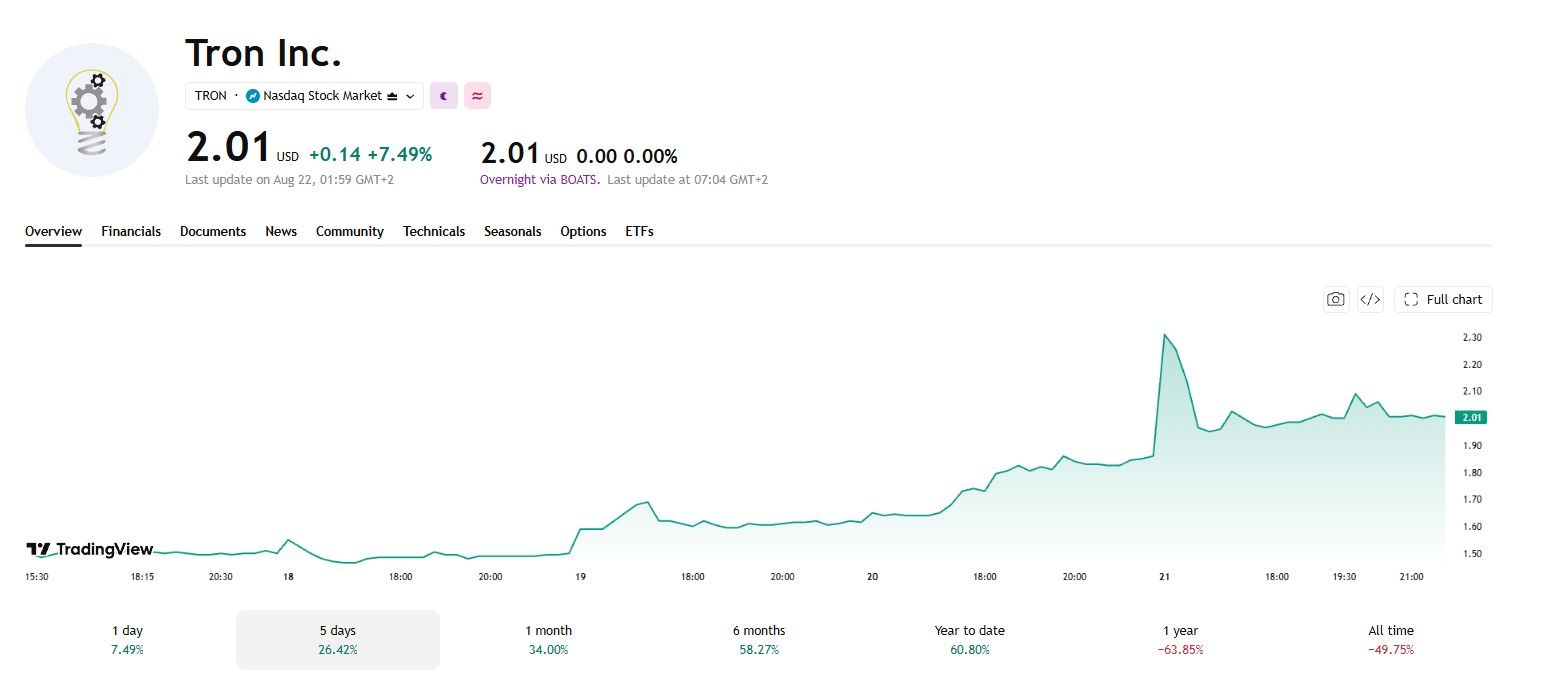
Tron Inc. added 145,002 TRX to its corporate treasury on Monday, pushing total holdings past 711.2 million tokens. Shares of the Nasdaq-listed company closed their latest session 7.49% higher at $2.01.
Meanwhile, the underlying TRON blockchain crossed 400 million total accounts. Founder Justin Sun marked both developments on X.
Why the Tron Treasury Playbook Is Working
Tron Inc. buys TRX almost every trading day, and the rhythm echoes Strategy’s long Bitcoin accumulation run. The company reached the Nasdaq through a mid-2025 reverse merger with toy maker SRM Entertainment. Since then, management has treated the treasury as its central investor story.
Monday’s purchase landed at an average price of $0.3448 per token. At current prices, the full stack carries a value near $245 million. Back in March, the same MicroStrategy model comparison covered a balance of just 686 million tokens.
The setup gives shareholders exposure to TRX without any wallet or exchange account. In return, they accept the equity risk that comes with a small-cap listing. Rival treasury vehicles have posted heavy paper losses this year whenever their chosen token slipped.
Investors have rewarded that consistency so far. The stock climbed 26.42% across five sessions and 34% over the past month. Year to date it trades 60.80% higher, with a 58.27% gain across six months. That 2026 run has recovered most of last year’s decline, and the trend still points up.

Sun keeps pressing the company to buy more. In April, he called for faster TRX treasury expansion as holdings crossed 693 million tokens. His response on Monday ran to two words.
400 Million Accounts Shift the Story
TRONSCAN data confirmed the account threshold. Sun then amplified the figure with a short post of his own.
Growth has arrived steadily rather than suddenly. In July, daily signups hit a one-month high of 230,862 new accounts. June delivered record active addresses alongside a broadly healthy on-chain picture.
Much of that traffic comes from stablecoin transfers. TRON carries a large share of global Tether (USDT) settlement, especially across emerging markets where fees matter most. Account totals therefore track payment demand more closely than speculative trading.
The token itself has lagged the equity, however. TRX trades near $0.344, up 0.45% on the day, with a market value of $32.65 billion and eighth place among all crypto assets.
That gap defines the trade. Tron Inc. shares react to treasury headlines far more than TRX does, a pattern visible across other digital asset treasury companies this year. It remains to be seen how the daily purchase program will affect the price relationship between the stock and the underlying token in the long term.
The post Tron Inc. Treasury Tops 711 Million TRX as Stock Jumps 7.49% appeared first on BeInCrypto.


The Bank of Russia has opened a new domestic testing route for individuals seeking qualified investor status, a change that could let more Russians access higher cryptocurrency purchase limits under the country’s new regulated market framework.
Summary
- Russia will allow investors to gain qualified status by passing an approved financial knowledge test.
- The new qualification route takes effect on Aug. 31 and accepts certificates from approved Russian institutions.
- Qualified retail investors can access crypto purchase limits ten times higher than those for non-qualified investors.
The Bank of Russia said individuals will be able to qualify by passing a special financial-market knowledge test and presenting an approved Russian certificate, with the new rules taking effect on Aug. 31.
Under the updated requirements, successful applicants can use a Qualifin Certificate issued by the National Finance Association or a MOEX Investor Certificate from the Moscow Exchange. The regulator will also accept a Financial Analyst Certificate from the NFA and an Investment Adviser Certificate from the National Association of Securities Market Participants.
Possession of any one of the approved certificates will be enough for a broker or management company to recognize an individual as a qualified investor, the central bank said.
Bank of Russia qualified investor rules add a knowledge-based route
Previously, investors relying on educational credentials had to present international certifications covering fields such as financial analysis, investment consulting, asset management or risk management. The Bank of Russia cited the CFA designation as one example of the credentials accepted under the earlier system.
The domestic test adds another route without removing the existing qualification criteria. According to the regulator, individuals can still receive qualified status based on income over the previous two years, minimum asset holdings, relevant securities-market work experience, independent investing experience, a relevant degree or a permitted combination of criteria.
Deputy Governor Mikhail Mamuta said the test would make access to qualified investor status “more accessible and deliberate,” allowing people to qualify through demonstrated knowledge instead of relying only on large account balances or high income.
Mamuta said increasing the number of qualified investors on paper was not the regulator’s objective. “The actual level of their knowledge is much more important than this number,” he said.
The central bank wants investors to understand the risks attached to complex financial instruments before entering the market, Mamuta added.
Qualified investor status carries higher crypto purchase limits
The timing puts the qualification change alongside Russia’s newly adopted crypto framework, which separates cryptocurrency access according to investor status.
A July 21 crypto.news report said Russia’s State Duma had passed crypto market rules covering regulated exchanges, brokers, custodians and other intermediaries, while placing the Bank of Russia in charge of market supervision.
Under the framework, non-qualified investors can purchase up to 300,000 rubles, roughly $3,800, in approved cryptocurrencies each year through a single regulated intermediary. Qualified retail investors receive a limit ten times higher, allowing annual purchases of up to 3 million rubles under the rules described during the bill’s passage.
Before the final votes, lawmakers had retained the 300,000-ruble retail ceiling while changing other parts of the legislation. A revised crypto bill approved by a State Duma committee in July removed a proposed requirement for holders to disclose their cryptocurrency wallet addresses.
The revised version instead focused reporting requirements on information including balances and transaction volumes. It also allowed crypto to be used to purchase Russian securities and digital financial assets, while certain large transfers abroad or to third parties could be delayed for up to two days, according to the July report.
Earlier proposals had already tied retail participation to knowledge requirements. During the bill’s first reading in April, lawmakers backed a system requiring non-qualified investors to use licensed intermediaries and restricting them to cryptocurrencies deemed sufficiently liquid by the central bank.
The first-reading framework also treated cryptocurrency as property while maintaining Russia’s ban on using digital assets for domestic payments. Companies were permitted to use crypto for cross-border transactions, with the legislation creating a separate legal route for foreign trade.
Russian banks prepare for regulated crypto access
Major Russian lenders have started preparing services around the regulated market as the legal framework moves toward implementation.
Sberbank plans to launch crypto trading infrastructure and a digital depository by Dec. 1, according to a July report on its planned crypto launch. The planned system would cover trading, custody, settlement and depository services for eligible clients.
The same report said Russia’s new crypto framework was scheduled to begin on Sept. 1, while market participants would have until July 1, 2027, to meet licensing requirements. Non-qualified investors would remain subject to the 300,000-ruble annual purchase ceiling and a mandatory knowledge test before buying approved crypto assets.
Alfa-Bank has also tested cryptocurrency trading inside its Alfa-Investments brokerage app with a limited group of qualified investors. The bank has said a larger rollout depends on the Bank of Russia completing the required regulatory acts, while its plans include a digital depository and crypto-to-ruble exchange gateways.
Alfa-Bank expects a full retail launch closer to the fourth quarter of 2026 if the regulatory timetable permits, while Dmitry Vitman, chief operating officer of its corporate and investment business, said substantial liquidity in Russia’s regulated crypto market may not emerge before late 2027.

Zelensky discussed the defense budget deficit during a summit with Nordic and Baltic leaders in Kyiv on Sunday, where the leaders of Denmark, Estonia, Finland, Iceland, Latvia, Lithuania, Norway, Sweden agreed to continue to provide military and financial support.
U.K. Prime Minister Andy Burnham is set to visit Ukraine Monday, in his first international visit.
“Russia should be in no doubt of our resolve. We will not back down until there is a just and lasting peace,” Burnham said in a statement Monday.
Successive polls have shown a lack of public interest in holding elections during the war. The latest, conducted by the Kyiv International Institute of Sociology from July 20 to Aug. 3, shows that 57% of Ukrainians believe elections should be held after fighting has ended, down from 69% in March. Experts have previously said that the invasion, which Russian President Vladimir Putin launched in 2022, nixed the possibility of holding safe and secure elections in Ukraine.

Pakistan’s crypto regulatory authority, the Pakistan’s Virtual Assets Regulatory Authority (PVARA), has opened a licensing portal and started enforcing a framework for exchanges and other virtual asset service providers (VASPs). The move turns Pakistan’s virtual-asset regime from a largely legislative exercise into an operational compliance system—creating a clear deadline for firms already serving users in the country.
Under PVARA’s stated rules, businesses providing virtual asset services on or before March 5 must apply for a no-objection certificate (NOC) by Sept. 5. PVARA warns that operating after the deadline without filing an application will be treated as an offense, according to a Saturday press release reported by the Associated Press of Pakistan. PVARA also said the licensing window is designed to establish standards for consumer protection, governance, compliance, and market integrity.
Key takeaways
- PVARA has opened its licensing portal, shifting Pakistan’s virtual-asset policy into enforcement mode.
- Existing VASPs serving before March 5 must seek an NOC by Sept. 5 or face regulatory action.
- The framework sets requirements that include segregation of customer holdings and restrictions on lending or pledging them without written consent.
- Firms may pursue licensing via a regulatory sandbox or an NOC pathway tied to incorporation plans in Pakistan.
- Pakistan’s approach builds on earlier legal steps, including the Virtual Assets Act and bank-account rules for licensed providers.
From framework to enforcement: the licensing deadline
For market participants, the most immediate change is timeline clarity. PVARA’s licensing website outlines the operational expectations for VASPs already active in Pakistan. Companies that have been providing virtual asset services on or before March 5 are required to submit an application for an NOC by Sept. 5. If they continue operating without applying, PVARA says it will treat that as an offense.
While this does not necessarily mean all noncompliant businesses will be shut down instantly, it does set up a compliance gate that operators must clear. For traders and users, licensing timelines can influence platform availability, withdrawal processing, and counterparty risk. For businesses, the deadline effectively turns “watch-and-wait” posture into a project with legal, technical, and governance deadlines attached.
Scope of covered services and “two-route” licensing
PVARA’s framework is broad. It covers core parts of the virtual-asset industry, including exchanges, custody, broker-dealer services, lending, derivatives, asset management, token issuance, and mining-related services. That breadth matters because it signals that Pakistan’s regulatory intent is not limited to a single type of business model; it aims to govern multiple layers of the value chain from issuance to market infrastructure.
The authority also described two paths to licensing. Firms can apply for an NOC prior to incorporating locally, or they can enter a regulatory sandbox to test products under PVARA supervision before pursuing a full license. According to PVARA, these routes are designed to accommodate companies at different stages of market entry—those that are preparing to establish a local entity and those that want to pilot products while working through compliance expectations.
This two-route model is especially relevant for companies exploring new offerings like derivatives or lending, where consumer protection, operational resilience, and risk controls typically require more extensive systems work than a basic exchange front-end.
Operational and compliance requirements for licensed providers
PVARA’s notified requirements emphasize custody discipline and broader institutional controls. Among the explicit obligations mentioned in the framework are rules requiring licensed providers to keep customer holdings separate from their own assets. PVARA also states that firms cannot lend or pledge customer holdings without written consent, a clause designed to reduce the risk of customer funds being used for the provider’s own balance sheet activities.
Beyond asset-handling, PVARA’s framework points to governance and conduct expectations, along with detailed operational and security requirements. The rules reference cybersecurity, operational resilience, and anti-money laundering and counter-terrorism financing controls. In practical terms, these categories are often where regulators assess whether a platform can sustain continuity, protect user data and assets, and meet compliance obligations consistently—not just at launch, but as ongoing operational processes.
The compliance emphasis is consistent with what PVARA described when it previously issued NOCs to certain firms, allowing them to set up local subsidiaries and prepare for full licensing applications. In other words, the licensing portal appears to formalize a staged approach: preliminary permission to move toward local incorporation and detailed readiness, followed by the deeper compliance requirements that accompany full authorization.
How Pakistan’s legal groundwork enabled the licensing rollout
PVARA’s licensing process builds on earlier steps that set the regulator’s authority and operational structure. Pakistan’s parliament passed the Virtual Assets Act in March, establishing PVARA as the statutory regulator for the sector. After that, the State Bank of Pakistan allowed banks to provide accounts to licensed VASPs, including arrangements such as segregated client-money accounts. Those banking rules are important because they can reduce settlement and custodial friction while also strengthening accountability for how customer funds are handled.
PVARA’s enforcement rollout also followed public consultation, with consultations held from June 11 to July 2. The authority said the final framework provides two licensing pathways—reflecting feedback incorporated into the end product rather than a purely top-down rulemaking.
Notably, the move comes after PVARA had already issued NOCs to some firms. According to coverage earlier in the year, NOCs were issued to Binance and HTX in December 2025, permitting them to establish local subsidiaries and prepare applications for full licensing. With the regulations now notified and the licensing portal open, those preliminary steps can progress into more complete authorization planning under PVARA’s detailed requirements.
For compliance teams, this is where projects become concrete: companies with NOCs still need to align their custody setup, governance, cybersecurity posture, and AML/CFT systems with the framework’s expectations—and do so inside the enforcement timelines now linked to the Sept. 5 NOC application deadline for existing providers.
What to watch next
With PVARA now accepting applications through its licensing portal, the next critical signals will be how quickly NOC applications are processed and whether PVARA’s sandbox pathway launches smoothly for new product testing. Market participants and users should also watch for any enforcement actions tied to the Sept. 5 deadline, since those outcomes will define how strictly the regulator draws the line between compliant, transitioning, and noncompliant operations.
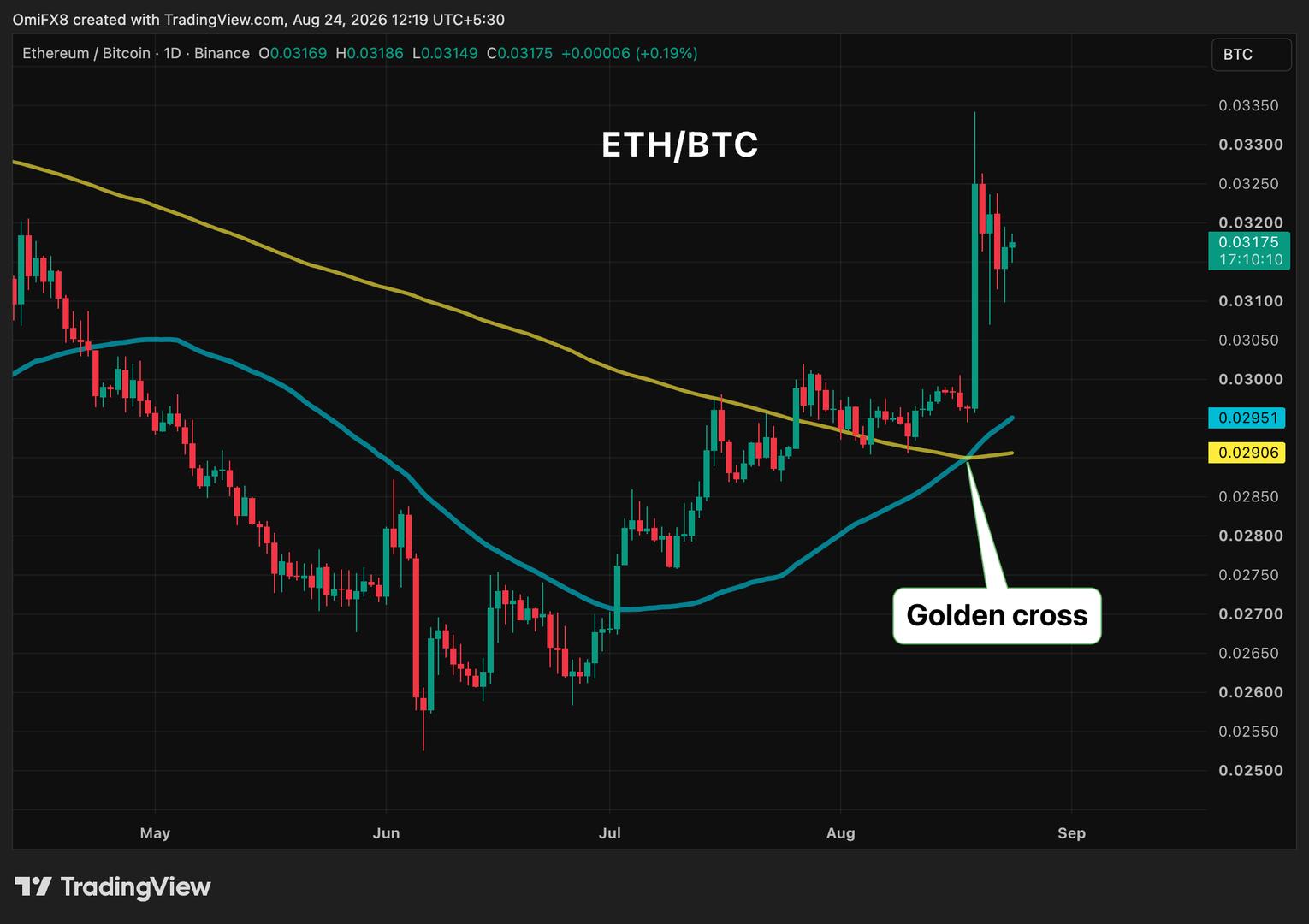
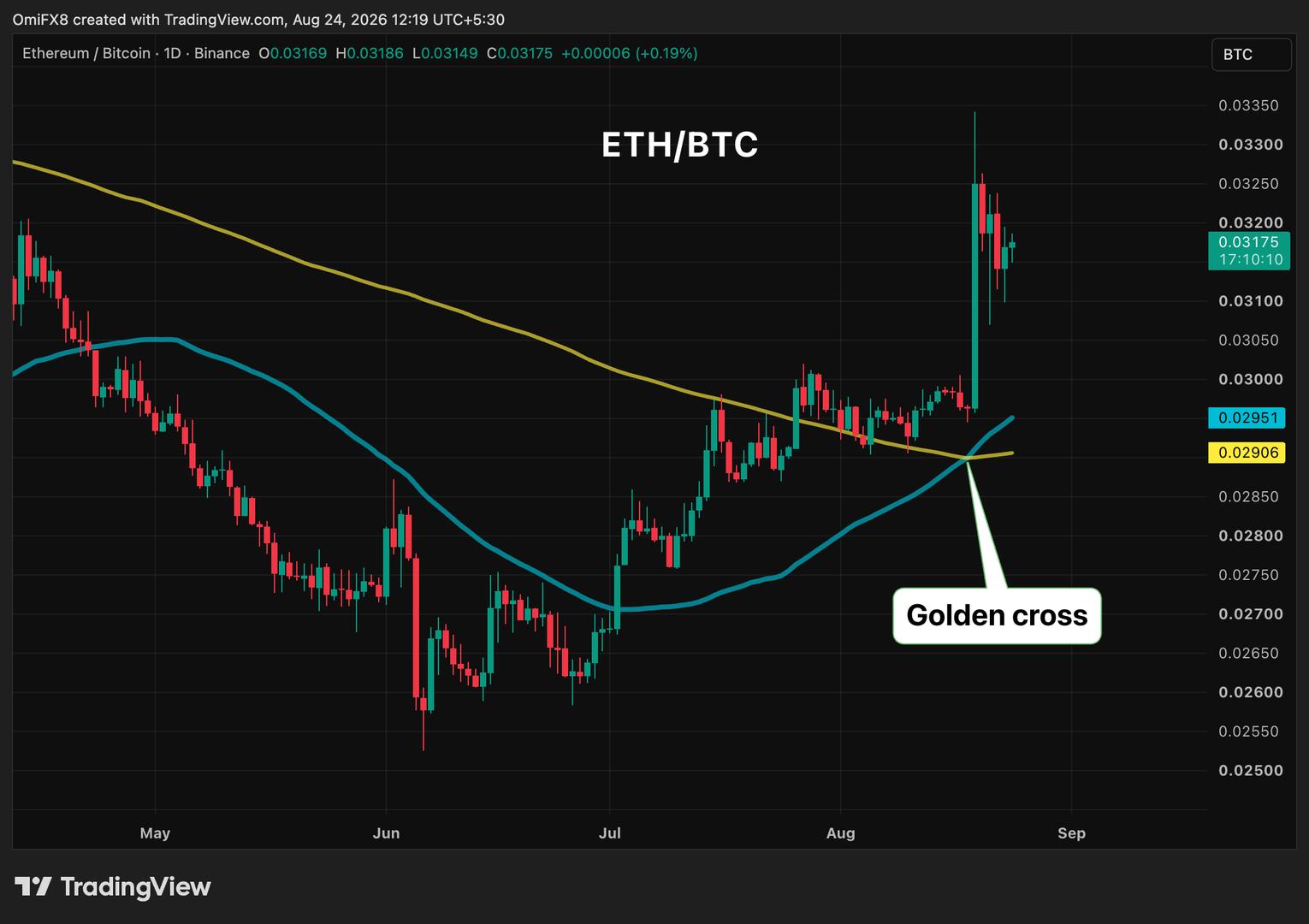
The ETH/BTC ratio has recently formed a bullish golden cross, suggesting ether could extend its outperformance against bitcoin.


Stablecoin neobank Fasset raised $68 million in a Series C funding round led by Japan’s SBI Group, reaching a private valuation of $1 billion on Aug. 24.
Summary
- Fasset raised $68 million in a Series C round led by Japan’s SBI Group Monday.
- The financing valued Fasset at $1 billion and lifted its 2026 fundraising to $119 million.
- Fasset says annualized transaction volume exceeds $40 billion across customers operating in 125 countries worldwide.
- Chief executive Mohammad Raafi Hossain said revenue grew sixfold while profitability continued for twelve months.
- Fasset’s Own Network connects financial institutions across more than 100 banking corridors using stablecoin settlement.
The financing follows the company’s $51 million Series B round in May. Fasset has now raised $119 million during 2026 as it expands stablecoin payment, banking and settlement services across emerging markets.
Early investor Speedinvest and other strategic investors participated in the latest round, according to the report. Speedinvest’s updated portfolio also identifies the financing as a $68 million Series C led by SBI.
The $1 billion valuation was established through the private funding transaction. It is not a public market valuation, and Fasset did not disclose the equity stake sold, the round’s full investor list or other financial terms.
Fasset funding reaches $119 million in 2026
Fasset previously raised $51 million to expand regulated banking services in May. SBI, Investcorp, Arz Portföy and strategic family offices participated in that round.
The company said at the time that it processed more than $32 billion in annualized transaction volume. Fasset now puts that figure above $40 billion, indicating that the annualized pace has increased by at least $8 billion since May.
Fasset co-founder and CEO Mohammad Raafi Hossain said revenue has grown approximately sixfold from the previous year. He also said the company has remained profitable for 12 consecutive months.
Those figures are management claims. Fasset did not disclose its revenue, profit or audited financial statements, preventing an independent assessment of its margins or the earnings supporting its valuation.
Revenue currently comes from institutional and retail services, including stablecoin payments and settlement. Hossain said cards and bank accounts are beginning to provide additional income, although Fasset did not provide a breakdown by product.
Stablecoins operate behind Fasset’s banking products
Fasset allows consumers and businesses to hold, send, spend and invest across currencies and assets. Stablecoins can provide the settlement rail even when customers interact with traditional bank accounts, cards or local currencies.
“Customers interact with stablecoins at many different points on our platform,” Hossain said. “They might be moving between a bank account, a payment product, a currency or another asset, while stablecoins provide the settlement rail underneath.”
The company operates Own Network, an AI enabled Ethereum layer 2 built using Arbitrum technology. Fasset says the network connects banks, telecommunications companies, payment firms, liquidity providers and other institutions across more than 100 banking corridors.
Own Network uses artificial intelligence to select payment routes, currencies, liquidity sources and settlement methods based on cost, speed and availability. The company plans to direct part of the new capital toward expanding those routing systems.
Fasset holds regulatory approvals in markets including the UAE, Indonesia, Malaysia, the European Union, Türkiye and Pakistan. Its services and available products vary by jurisdiction.
SBI brings Japanese payments and regulatory reach
The investment deepens a relationship established before the Series C. Fasset and SBI Remit previously combined their infrastructure for international stablecoin payments covering remittances, business payments and treasury settlement.
SBI Remit said in June that its network supported cash payouts at approximately 350,000 locations across more than 200 countries and territories. Hossain now puts its reach at about 470,000 locations, suggesting the network has expanded, although SBI has not published a matching updated figure.
Fasset expects to work with other businesses in SBI’s portfolio. The Japanese group’s digital asset interests include Ripple, Circle, blockchain company R3 and crypto liquidity provider B2C2.
“Together, we want to connect more corridors and financial rails across Japan, Asia and other emerging markets,” Hossain said.
The companies have not named the first new products, countries or deployment dates associated with the investment. Any expansion will depend on local licensing, banking partnerships and customer access requirements.
What comes next for Fasset
Fasset plans to use the capital to expand Own Network, develop its AI routing systems and connect additional financial institutions. Cards, bank accounts, lending and trade finance could also become larger parts of its revenue mix.
The company must still show whether rapid transaction growth produces durable earnings. Stablecoin payment providers face competition from banks, card networks and other fintech companies, while the cost of converting between stablecoins and local currencies can reduce expected savings.
A recent Bank of Italy test found that conversion and access fees pushed some stablecoin remittance costs toward 9%. Fasset’s ability to secure local banking corridors and liquidity will therefore be central to its effort to lower costs.
The next verifiable updates should include specific SBI linked products, additional corridor launches and new regulatory approvals. More detailed financial disclosures would also provide clearer evidence supporting Fasset’s $1 billion valuation and profitability claims.


Bitcoin has posted its largest dollar-denominated weekly gain on record, adding $14,264 to close at $77,387 as Strive CEO Matt Cole predicts the next Bitcoin cycle could be its strongest yet.
Summary
- Bitcoin gained a record $14,264 last week to close at $77,387, up 22.7%.
- Strive CEO Matt Cole expects the next Bitcoin cycle to be the strongest yet as BTC breaks out against both the dollar and gold.
- U.S. spot Bitcoin ETFs recorded $1.92 billion in weekly net inflows, their highest since October 2025.
- Cole expects dollar weakness and rising demand for scarce assets to support Bitcoin over the next 12 to 18 months.
Bitcoin has gained roughly 22.7% over seven days, according to crypto.news price data, with the rally accelerating after the U.S. Treasury Department expanded its government bond buyback program and spot Bitcoin exchange-traded funds recorded their strongest weekly inflows since October 2025.
Cole, chairman and CEO of Bitcoin treasury company Strive, said Bitcoin’s recent performance against both the U.S. dollar and gold has strengthened his view that the cryptocurrency is entering a new cycle backed by macro conditions it has not experienced before.
“Bitcoin priced in gold is reinforcing my view that the next Bitcoin cycle will be the strongest we have ever seen,” Cole wrote in an X post.
His forecast follows a sharp change in market sentiment. The Crypto Fear & Greed Index climbed to 78, putting it close to the “extreme greed” category and at its highest level since December 2024.
Bitcoin ETF inflows add to renewed demand
Institutional demand returned alongside the price recovery, with U.S. spot Bitcoin ETFs recording $1.92 billion in total net inflows during the trading week ended Aug. 21, according to SoSoValue data.
The weekly total was the highest since October 2025, when Bitcoin was still trading around the peak of its previous bull cycle.
Bitcoin’s latest move began after Treasury Secretary Scott Bessent announced on Aug. 19 that the Treasury would increase the maximum size of its liquidity-support bond buybacks for longer-dated securities from $2 billion to at least $4 billion per operation.
The expanded program, covering parts of the 10-to-30-year maturity range, is scheduled to begin in September. Long-term Treasury yields initially fell following the announcement, while the dollar weakened and Bitcoin, gold and equities moved higher.
For Cole, dollar weakness forms one part of his longer-term Bitcoin forecast. He expects the U.S. dollar to enter a sustained period of weakness and argues that Bitcoin has never operated through such a macro environment.
A second factor comes from what he described as a “growing hunt for scarcity in an AI-driven world of abundance.”
As artificial intelligence makes intelligence, software and other capabilities cheaper and easier to reproduce, Cole expects investors to place a higher premium on assets whose supply cannot be easily expanded. He placed Bitcoin alongside gold and silver within that category.
“Capital will increasingly place a premium on forms of scarcity that cannot be manufactured away,” Cole said.
Bitcoin-gold breakout strengthens Cole’s cycle call
Bitcoin’s performance against gold forms another part of Cole’s argument. The Bitcoin-to-gold ratio has risen to 16.73 ounces of gold per Bitcoin, its highest level since May, according to Longtermtrends data cited by The Block.
Cole said the ratio has previously provided an earlier signal of changes in Bitcoin’s market cycle than its dollar price.
Bitcoin peaked against gold in December 2024, almost a year before its dollar-denominated peak in October 2025, according to his analysis. While BTC continued setting new highs against the dollar during that period, its relative performance against gold had already weakened.
A similar sequence occurred around the latest lows. Cole said Bitcoin bottomed against gold in February 2026, about five months before BTC reached its dollar-denominated bottom in July.
“What makes this week particularly interesting is that Bitcoin has now broken out against both the dollar and gold. The breakout has been explosive,” he said.
Cole expects relative performance to play an important role in deciding where new capital enters the scarcity trade. If Bitcoin continues outperforming gold while investment into scarce assets increases, he believes BTC could take a larger portion of those flows.
“When Bitcoin is the fastest horse, it will attract a disproportionate share of that capital,” he added.
Bitcoin’s store-of-value role has also remained part of institutional research despite weaker conditions earlier this year. In June, Bernstein said Bitcoin had attracted roughly $12 billion in combined ETF and corporate treasury inflows during 2026, even as spot ETF investors had withdrawn a net $2.6 billion at the time.
Bernstein attributed much of that demand to corporate treasury buyers and said institutional ownership continued to support Bitcoin’s long-term store-of-value case.
Strive has kept adding Bitcoin during the downturn
Cole’s bullish forecast comes after Strive continued accumulating Bitcoin while prices were under pressure earlier this year.
As crypto.news previously reported in June, Strive purchased 2,500 BTC between May 23 and June 1 for approximately $185.2 million, paying an average of about $74,092 per coin.
The purchase lifted its holdings to 19,000 BTC at the time, while cash and cash equivalents increased to $137.3 million from $93.3 million. The company also reported no short-term or long-term debt.
Later that month, Strive added another 759 BTC for roughly $50 million, raising its holdings to 19,864 BTC. The coins were purchased between June 15 and June 21 at an average price of approximately $65,850, including fees and expenses.
Cole said in his latest post that Strive continued buying Bitcoin during the bear market, including purchases made almost every week during the months before the latest breakout.
The company has structured its balance sheet around what it calls Bitcoin amplification, seeking to increase Bitcoin exposure per share while avoiding debt, margin requirements and financing arrangements that could trigger forced liquidations.
Earlier in June, Strive expanded its fundraising plans by $4.2 billion through proposed increases to its ASST and SATA at-the-market programs, with $2.1 billion allocated to each program for additional capital capacity.
Cole said the company considers being too conservative a potential risk if Bitcoin performs as expected, arguing that waiting for future business cash flows to purchase BTC could result in acquiring fewer coins at higher prices.
Cole expects dips to attract aggressive buying
Despite his longer-term forecast, Cole acknowledged that Bitcoin could retrace after its rapid weekly advance.
“A meaningful retracement from here would not surprise me, but it may not happen at all,” he said.
If a pullback develops, Cole expects buyers to enter aggressively and said his conviction that Bitcoin’s bear market has ended remains “very strong.”
His outlook covers the next 12 to 18 months while extending the underlying scarcity thesis over several years. Cole expects a weaker dollar, continued monetary debasement and demand for assets with fixed or difficult-to-expand supplies to direct more capital toward scarce monetary assets.
Strive’s CEO said Bitcoin’s combination of absolute scarcity, global liquidity, portability and around-the-clock settlement gives it characteristics that differ from gold, which has thousands of years of monetary history.
“That setup has me more bullish on Bitcoin today than I have ever been,” Cole said.

Alan Ritchson’s $700M Blockbuster Is Officially Leaving Streaming Competition in the Dust

M60 LIVE as huge delays after all motorway traffic stopped amid crash

KOSPI Plunges 3% as Samsung Shares Crash 8% Following Underwhelming Shareholder Return Plan Investors Wanted





-

 Fashion3 days ago
Weekend Open Thread: Madewell – Corporette.com
-

 Crypto World2 days ago
anatomy of crypto’s biggest liquidation event since 2021
-

 Business6 days ago
SMA Solar Technology AG (SMTGY) Q2 2026 Earnings Call Transcript
-

 Tech6 days ago
Qwen3.8-27B runs frontier-class coding agents and reasoning locally, no cloud API required
-

 Business2 days ago
Musk’s Tesla, SpaceX Confirm $16.8 Billion ‘Terafab’ Chip Plant as World’s Largest Building in Texas
-

 Crypto World6 days ago
OCC Greenlights Trump Family Crypto Firm for Trust Charter
-

 Politics2 days ago
6 months on, Irish renters crushed by effects of government housing bill
-
 NewsBeat2 days ago
The ‘Lucky Dip Gang’ causing carnage for clicks: After five thugs were killed speeding in the wrong direction on a motorway, GUY ADAMS investigates a sick new trend… and why police aren’t even allowed to pursue them
-

 Crypto World6 days ago
NAVI Prime launches institutional lending framework on Sui
-

 Tech5 days ago
GLM-5.3 hits the API at $1.4/$4.4 per million tokens
-

 News Videos4 days ago
Don’t Leave Your Financial Future To Chance | August 19, 2026
-
Tech6 days ago
5 Of The Most Reliable Car Brands To Consider If You’re Buying A Used SUV
-
 Crypto World6 days ago
Dow’s 3-Year Winning Run Isn’t a Crash Signal, Still 49% Odds of Double-Digit Gains
-

 Business6 days ago
Stock Market Today: Tech Futures Slide As Treasury Yields Jump; Nvidia, Micron, Sandisk Sell Off
-

 Tech7 days ago
Straight Up the Cliff, Yunnan’s New Fuyao Ladder Turns a Three-Hour Climb Into a 50-Second Ride for Students
-

 Tech6 days ago
Keychron K8 Ultra 8K review: a great value keyboard with comfort issues
-
 Tech6 days ago
Nvidia discloses $21B stake in SpaceX
-
Business6 days ago
Fabrinet (FN) Q4 2026 Earnings Call Transcript
-

 Business4 days ago
Five Below: Kids Discount Retailer Reaps Rich Rewards
-

 Business5 days ago
Marvell Shares Jump 7% as Google Chip Deal Confirms Custom AI Silicon Partnership, Analysts
You must be logged in to post a comment Login