
Crypto World
Phantom ends Sui support on Sept. 24

Phantom will end support for the Sui network on Sept. 24, 2026, removing the ability to view, send, swap or interact with Sui assets through its wallet interface.
Summary
- Phantom will stop supporting Sui on September 24, removing balances, transactions, swaps and application access.
- Sui assets will remain onchain and accessible through compatible wallets using existing recovery credentials afterward.
- Phantom waived its fee for native SUI swaps into wrapped SUI on Solana until transition.
- Network and exchange charges still apply to those cross chain swaps before September 24 deadline.
- Users keeping Sui can import their credentials into Slush before or after Phantom support ends.
The transition comes less than 20 months after Phantom introduced native Sui support in January 2025. Phantom has not publicly explained why it is withdrawing the integration.
Users will not lose their assets when support ends, according to Phantom’s official notice. SUI and other tokens remain recorded on the Sui blockchain and controlled by the corresponding recovery phrase or private key.
Phantom will remove every Sui wallet function
After Sept. 24, Phantom will stop displaying Sui balances and remove Sui from its supported network list. Users will also lose access to Sui transactions, swaps and decentralized applications through Phantom.
Connections previously established between Phantom and Sui applications will stop working. Users who move to another compatible wallet must reconnect those applications through the replacement wallet.
The withdrawal reverses an expansion announced in early 2025, when Phantom added native access to Sui assets and applications. Sui was the first blockchain based on the Move programming language supported by Phantom.
At launch, the integration allowed users to manage SUI and other network tokens, perform swaps and connect with applications including Suilend, Bluefin, Navi and Aftermath.
Phantom has not reported a security breach or network failure connected with the withdrawal. Its support notice describes the decision as a product transition and does not provide a technical or commercial reason.
Sui users have two migration options
Users who want to remain inside Phantom can swap their Sui assets into tokens on supported networks before the deadline. Available alternatives include SOL, ETH and USDC.
Phantom has temporarily waived its own fee for cross chain swaps from native SUI into wrapped SUI on Solana. The waiver remains effective through Sept. 24. Network and exchange fees will still apply.
Wrapped SUI is not native SUI. It is a Solana based token representing SUI transferred through cross chain infrastructure. Holders should verify the receiving network and token contract before approving a transaction.
Users who want to retain native Sui assets can import their Phantom recovery phrase into a compatible wallet. Phantom recommends Slush, the wallet associated with the Sui ecosystem.
The same Sui address and assets should appear after the wallet is restored with the correct credentials. Users with additional recovery phrases or separately imported private keys must transfer each set individually.
Migration can take place before or after Sept. 24 because there is no deadline for accessing the underlying assets. However, completing the process early allows users to confirm their balances and wallet access before Phantom removes the network interface.
Migration scams present the immediate security risk
Phantom warned that it will never contact users first, request a recovery phrase or offer to move assets on their behalf. Anyone providing unsolicited migration assistance should be treated as a potential scammer.
The warning is relevant because wallet transitions often create opportunities for phishing campaigns. Scammers can imitate support accounts, distribute fake wallet applications or direct users to websites that capture recovery phrases.
As previously reported, attackers used fraudulent update prompts to steal Phantom recovery phrases. The prompts were designed to resemble legitimate wallet messages and gave attackers full control when users entered their credentials.
Users should obtain the replacement wallet through its official website and confirm the domain independently. Recovery phrases should never be entered into websites, support chats or forms sent through social media.
Importing a recovery phrase into another application grants that software access to the same wallet. Users should therefore verify the application carefully and store the phrase offline after completing the process.
What happens on Sept. 24
Phantom will remove Sui balances, transaction tools and application connections when the transition takes effect. The change will not transfer, delete or convert assets automatically.
Users who take no action can restore access later by importing the correct credentials into a compatible Sui wallet. Phantom has not announced any plan to resume support after the transition.
The main deadline applies to in-app functionality and Phantom’s swap fee waiver, not asset ownership. Holders who want to swap inside Phantom or verify their migration should complete those steps before Sept. 24.



U.S. President Donald Trump said on Aug. 19 that his administration had discussed accumulating more Bitcoin or other cryptocurrencies but had not reached a decision.
Summary
- Trump said officials discussed additional Bitcoin accumulation but confirmed no government purchase decision or timetable.
- The existing Strategic Bitcoin Reserve holds assets obtained primarily through completed federal forfeiture proceedings cases.
- Treasury and Commerce may develop budget neutral Bitcoin acquisition strategies imposing no additional taxpayer costs.
- Trump said he would consider recommendations from SEC Chair Paul Atkins and other administration advisers.
- Federal policy bars purchasing additional non Bitcoin stockpile assets without further executive or legislative action.
Trump responded to a question during a White House gathering attended by technology executives, cryptocurrency industry leaders and federal regulators. He said he would likely rely on Securities and Exchange Commission Chair Paul Atkins and the broader policy team for recommendations.
“Well, it’s been talked about,” Trump said during the event. “I think I’d probably rely on Paul and the whole group for that.”
The president added that he would listen if the group submitted recommendations. He did not announce purchases, name a funding mechanism or provide a timetable for expanding federal cryptocurrency holdings.
Trump did not announce new U.S. Bitcoin purchases
Trump’s comments left open the possibility of further Bitcoin accumulation but did not change existing federal policy. The administration would still need to identify a lawful, budget neutral method before buying additional Bitcoin outside asset forfeiture proceedings.
Trump also claimed cryptocurrency had “taken a lot of pressure off the dollar” and had been “very, very good” for it. He did not provide data or explain the economic mechanism supporting that assessment. The statement therefore represents the president’s view rather than an independently established conclusion.
The comments came during a broader White House event focused on digital asset legislation, market regulation and U.S. technology competitiveness. Trump urged Congress to pass the CLARITY Act and said the administration wanted the country to remain ahead of China in cryptocurrency and other emerging technologies.
SEC Chair Paul Atkins attended alongside Commodity Futures Trading Commission Chair Michael Selig. Executives from Coinbase, Ripple, Robinhood, Kraken and other financial technology companies also participated.
Existing order permits budget neutral accumulation
Trump established the Strategic Bitcoin Reserve through a March 6, 2025 executive order. The reserve was designed to hold Bitcoin finally forfeited through criminal or civil proceedings.
Bitcoin transferred into the reserve cannot be sold and must remain a federal reserve asset, subject to limited legal exceptions. Agencies were also directed to provide Treasury with a full accounting of government controlled digital assets.
The order authorized the Treasury and Commerce secretaries to develop strategies for acquiring additional Bitcoin. Any strategy must remain budget neutral and cannot impose incremental costs on U.S. taxpayers.
As previously reported, Treasury’s existing authority does not include ordering banks to buy Bitcoin. Treasury Secretary Scott Bessent previously told Congress that the government would retain Bitcoin obtained through seizures while considering permitted budget neutral options.
Potential approaches discussed by outside advocates include converting other federal assets or using revenue generated from government holdings. The administration has not formally adopted those proposals.
Other cryptocurrencies face stricter acquisition limits
The March order created a separate U.S. Digital Asset Stockpile for cryptocurrencies other than Bitcoin. Like the Bitcoin reserve, the stockpile initially consists of assets obtained through completed forfeiture cases.
However, federal agencies cannot purchase additional non Bitcoin assets for the stockpile without further executive or legislative action. Treasury may determine whether to retain or sell those holdings under applicable law.
The distinction means Trump’s reference to “Bitcoin or other cryptocurrencies” does not itself authorize purchases. Expanding the non Bitcoin stockpile would require a separate policy decision and potentially congressional approval.
In related coverage, the reserve was initially expected to contain only legally forfeited holdings, since some government controlled cryptocurrency remains subject to victim restitution or unresolved legal proceedings.
What happens next for the Bitcoin reserve
The next development would likely come from Treasury, Commerce, the SEC or the administration’s digital asset working group. A concrete plan would need to specify the amount of Bitcoin, acquisition method, legal authority and safeguards for federal custody.
Atkins could advise the administration on securities regulation and market structure. However, the SEC does not ordinarily manage Treasury reserve assets or conduct federal Bitcoin purchases. Treasury and Commerce hold the explicit acquisition mandate under Trump’s order.
No new executive order, Treasury acquisition notice or congressional authorization accompanied Trump’s remarks. Until one of those actions occurs, the U.S. government’s accumulation policy remains centered on forfeited Bitcoin and possible budget neutral strategies still under consideration.
Arthur Hayes has bought 1.9 million Ether.fi (ETHFI) tokens worth $1.17 million, returning to a position he walked away from earlier this year.
The BitMEX co-founder paid $0.62 per token. Onchain trackers put that entry well above the level where he last sold the same asset.
Arthur Hayes Chases ETHFI’s 25% Weekly Rally
Hayes sold 265,461 ETHFI at $0.44 in April, collecting roughly $118,000 and booking a loss. His new entry sits about 41% higher per token.
Follow us on X to get the latest news as it happens
Onchain analytics account Lookonchain surfaced the purchase roughly four hours after it settled, flagging it as another case of selling low and buying high.
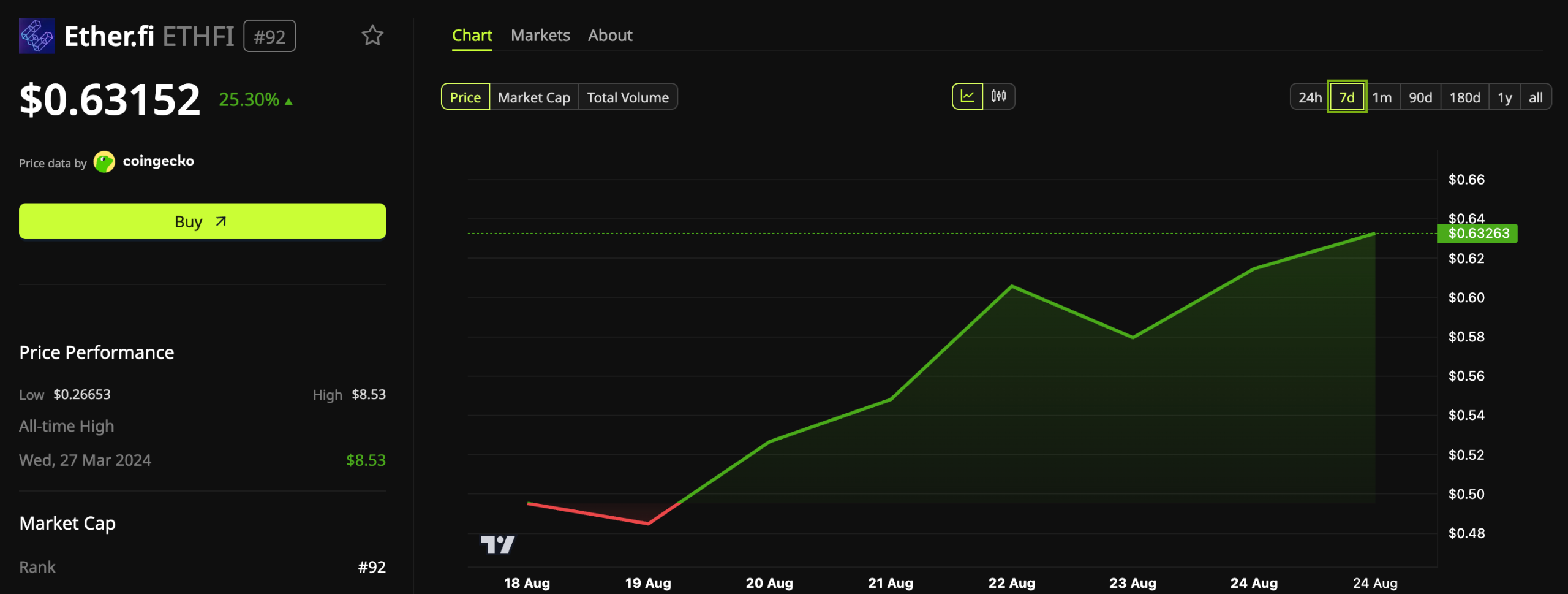
ETHFI has climbed 25.3% over the past week amid a broader market rally. This beats Bitcoin’s (BTC) 21.4% gain, although Ethereum’s (ETH) 27.8% advance still leads. However, the token sits about 93% below its March 2024 record of $8.53.
ETHFI trades at $0.631 at press time, up 11.1% over 24 hours, according to BeInCrypto data. Market cap stands at $649.7 million, ranking the token 92nd.

The pattern of selling low and buying high is not new. BeInCrypto reviewed three wallets attributed to Hayes. Those wallets lost $2.47 million across 124 recorded trades between December 2023 and August 2026.
ETHFI accounted for $474,000 of those losses. Ethena (ENA) was the only profitable position, up $3.23 million.
For now, the ETHFI position sits marginally above water. Whether this trade breaks the pattern depends less on the entry than on whether Hayes holds through the next drawdown.
Subscribe to our YouTube channel to watch leaders and journalists provide expert insights
The post ETHFI Rallies 25% in a Week, and Arthur Hayes Pays Up to Get Back In appeared first on BeInCrypto.


Cointelegraph is committed to providing independent, high-quality journalism across the crypto, blockchain, AI, and fintech industries.
All news, reviews, and analyses are produced with full journalistic independence and integrity. For more details on our standards and processes, please read our Editorial Policy.
Strive CEO Matt Cole says the Bitcoin (BTC) bear market has ended, citing the asset’s breakout against both the US dollar and gold in the same week.
Cole argues that the BTC/gold ratio has turned before the dollar price at recent inflection points. He now expects the next cycle to be the strongest Bitcoin has produced.
Why the BTC/Gold Ratio Turned First
Bitcoin peaked against gold in December 2024, according to Cole. Its dollar price held up far longer, topping in October 2025.
The sequence reversed at the low. Cole dated the BTC/gold bottom to February 2026 and the dollar bottom to July, roughly five months later.
That dynamic, in Cole’s telling, helps explain why sentiment turned so negative. Bitcoin set dollar records while losing ground to gold throughout the rally. He argues a mild nominal drawdown still feels brutal when the preceding bull market never delivered relative leadership.
Price action has since flipped. Bitcoin climbed roughly 21% between Wednesday and Friday last week, briefly surging above $79,000. However, the move has been widely attributed to the Treasury’s decision to buy back longer-dated bonds.
Cole sees another development as particularly significant: Bitcoin has now broken higher against both the dollar and gold.
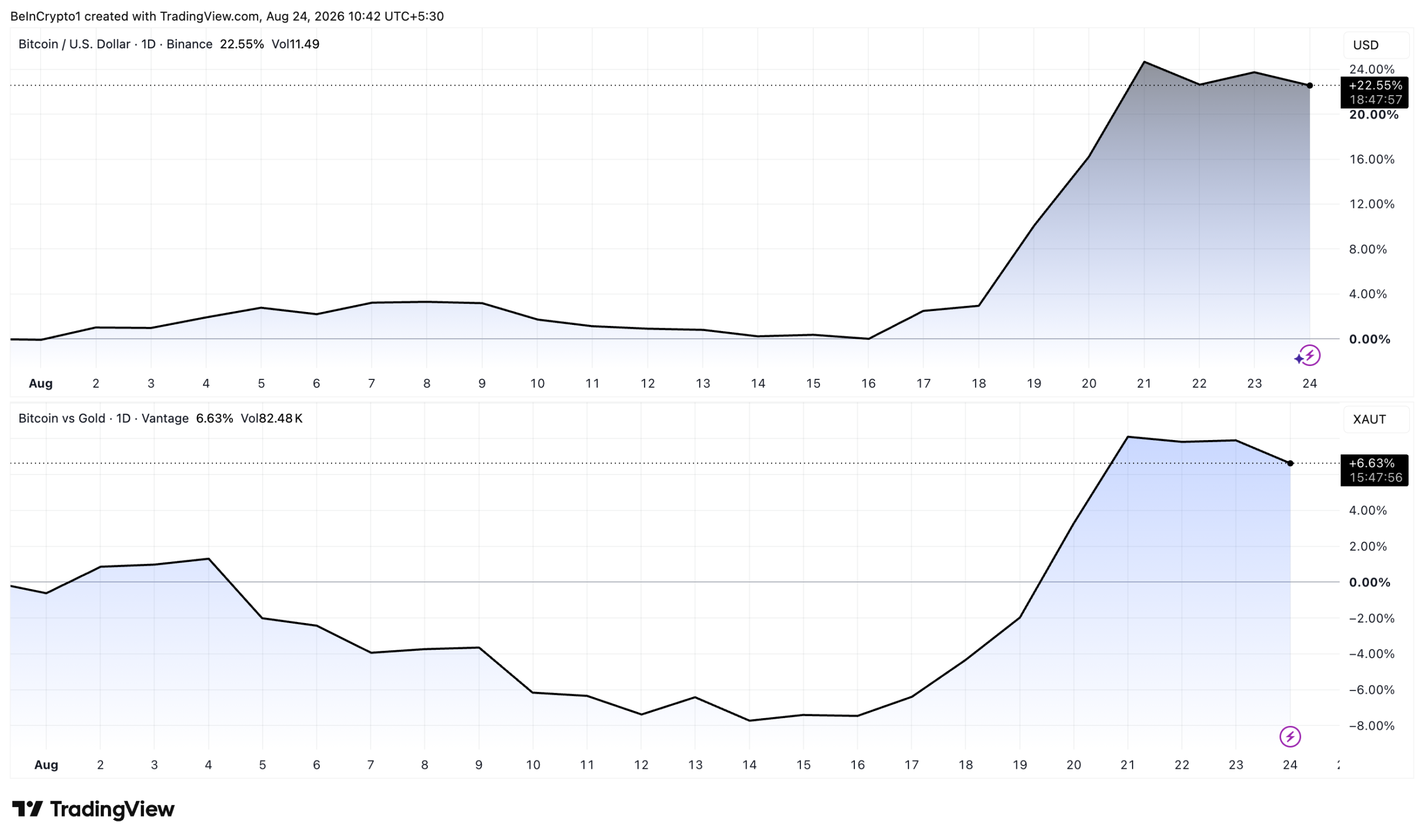
The move has been sharp. Market data show Bitcoin is up more than 22% against the US dollar this month, while it has gained 6.6% against gold.
Follow us on X to get the latest news as it happens

The executive acknowledged that Bitcoin could still pull back after the rapid advance, but said he would expect strong buying if a meaningful correction occurs.
“My conviction is very strong that the Bitcoin bear market is over. If BTC/gold was again the earlier signal, seeing both relationships now turn higher together gives me more confidence in the next 12 to 18 months and in the much larger opportunity that could unfold over the years ahead,” he added.
Cole’s conviction is backed by one of the largest corporate Bitcoin positions on the market. Strive held 20,246 BTC, ranking seventh among public company holders.
The position also shows why the call matters to him. Strive’s average cost sits at $94,345 per Bitcoin, roughly 22% above current levels. The company has an unrealized loss of roughly $350 million on the trade despite last week’s rally.
Subscribe to our YouTube channel to watch leaders and journalists provide expert insights
The post Strive CEO Says Bitcoin’s Bear Market Is Over After Double Breakout appeared first on BeInCrypto.

Pakistan’s crypto regulator has formally moved from rulemaking to enforcement by opening its licensing portal for virtual asset service providers (VASPs). The Pakistan’s Virtual Assets Regulatory Authority (PVARA) notified regulations for crypto exchanges and a broader set of virtual-asset activities, setting a deadline for firms already operating in the country to apply for a no-objection certificate (NOC).
Under PVARA’s licensing website guidance, companies providing virtual asset services on or before March 5 must submit their NOC applications by Sept. 5; otherwise, continuing operations without an application will be treated as an offense. The regulator says the window is now “officially open,” laying out standards intended to bring consumer protection, governance, and compliance into the open for regulated market participants.
Key takeaways
- PVARA has opened its licensing portal after notifying the regulations that define how crypto services will be authorized in Pakistan.
- Existing operators have until Sept. 5 to apply for an NOC; operating past the deadline without applying can trigger enforcement.
- The framework covers a wide range of VASP activities, including exchanges, custody, broker-dealer services, lending, derivatives, asset management, token issuance, and mining-related services.
- Licensed providers must segregate customer holdings and face restrictions on lending or pledging those assets without written consent.
- Firms can pursue either a sandbox pathway for product testing or an NOC pathway as they prepare for full licensing.
A licensing regime built for enforcement
PVARA’s move is significant because it converts a regulatory framework into an action-oriented process with clear compliance steps for market participants. In a Saturday press release attributed to the Associated Press of Pakistan, PVARA said operating after the relevant deadline without submitting an application will be considered an offense.
In a separate statement on LinkedIn, PVARA described the launch as creating a “clear pathway” for businesses to enter Pakistan’s regulated virtual asset market. The regulator linked the licensing effort to defined expectations around consumer protection, governance, compliance, and market integrity—areas that typically become central when regulators shift from consultations and policy drafting to supervision and licensing decisions.
Which services fall under PVARA’s framework
The notification outlines a broad scope of activities that VASPs must address in their licensing pathway. According to PVARA’s described framework, it includes services such as exchanges and custody, broker-dealer activities, lending and derivatives, asset management, token issuance, and mining-related services.
PVARA also lays out options for how companies can engage with the regulator before they become fully licensed. The regulator states that providers may seek an NOC prior to incorporating locally, or they can enter a regulatory sandbox to test products under PVARA supervision before applying for full authorization.
That two-track design matters for companies trying to scale operations while navigating compliance requirements. The sandbox approach can reduce time-to-learning for new products, while the NOC pathway offers a structured route for firms preparing to establish a Pakistan-based presence.
Operating rules: segregation, cybersecurity, and AML/CTF controls
PVARA says licensed providers will have to meet specific operational and custody-related requirements. One of the most immediate implications for exchanges and custodial platforms is the requirement to keep customer holdings separate from their own assets.
The framework further restricts how those customer holdings can be used. PVARA states that providers cannot lend or pledge customer assets without written consent, a rule designed to reduce the risk of conflicts between customer interests and a platform’s own balance-sheet needs.
Beyond custody, the regulator’s framework also specifies governance and conduct expectations, cybersecurity requirements, operational resilience measures, and anti-money laundering and counter-terrorism financing controls. For operators, these obligations will likely determine not only whether a license is granted, but also how systems are architected—especially around risk monitoring, incident response, and compliance reporting.
From consultation to notified rules—and what it changes now
The licensing push follows a public consultation that ran from June 11 to July 2. PVARA said the final framework provides two routes to licensing: a sandbox for product testing and an NOC pathway for companies preparing to incorporate in Pakistan.
In practice, this turns previously described standards into enforceable requirements with dates attached. Companies that were waiting for the notified regulations to start applying will now need to treat licensing as a near-term priority, particularly because the NOC application deadline is tied to whether a provider was already offering services in the country on or before March 5.
Notably, PVARA has indicated it already issued NOCs to some firms. The regulatory groundwork includes preliminary approvals that allow certain exchanges to establish local subsidiaries and prepare full license applications—progress that now can move faster now that the rules have been formally notified through the portal process. PVARA’s earlier NOC issuances have included Binance and HTX, as previously reported by Cointelegraph.
How Pakistan’s broader crypto framework is taking shape
PVARA’s ability to run a licensing process stems from Pakistan’s legislative shift earlier this year. Cointelegraph previously reported that Pakistan’s parliament passed the Virtual Assets Act in March, establishing PVARA as the statutory regulator for the sector.
Regulatory coordination has also extended to banking access. Cointelegraph has reported that the State Bank of Pakistan allowed banks to provide accounts to licensed VASPs, including segregated client-money accounts. Combined with PVARA’s new requirements around separation of customer holdings, that creates a clearer compliance stack for licensed providers—addressing both operational custody rules and the banking plumbing required for regulated services.
Still, with licensing enforcement now starting in earnest, companies and users should watch how quickly applications are processed and what additional conditions—if any—are imposed as full licenses are granted. The regulations establish the baseline, but the practical effects will depend on PVARA’s implementation, including how sandbox participants are supervised and how quickly NOCs translate into full licensing.
For market participants, the next phase will likely center on whether existing VASPs can meet the Sept. 5 NOC deadline and how rigorously PVARA assesses custody separation, cybersecurity readiness, and AML/CTF controls. That timeline—and the regulator’s approach to granting first full authorizations—could determine how rapidly Pakistan’s regulated crypto market expands.
Nvidia reports earnings Wednesday, and Fed Chair Kevin Warsh speaks at Jackson Hole Friday. Equity strategists expect little market reaction to either event, but crypto analysts disagree on Bitcoin’s next move.
On CNBC’s Halftime Report, Gilman Hill Asset Management CEO Jenny Harrington argued neither event would move stocks. She said earnings growth, not Nvidia’s print or Fed rhetoric, drives this year’s rally.
The Case for a Crypto Reaction Already Underway
Bitcoin does not need Friday’s speech, or Wednesday’s Nvidia print, to gauge where liquidity stands, according to some analysts. The Treasury already expanded its bond buybacks last week, pulling long-end yields lower and pushing crypto sharply higher.

Bernstein senior analyst Gautam Chhugani called that reaction a historical pattern, not a one-off event.
Bitcoin historically has had a positive reaction to liquidity expansion.
Gautam Chhugani, senior analyst, Bernstein
BitMEX co-founder Arthur Hayes made a similar case last week. He told investors that avoiding risk assets after the Treasury’s move would be a mistake. If liquidity drives this rally, Warsh’s tone on Friday may matter less than what the Treasury already did.
Why Others See More Room for Bitcoin to Move
Not every desk agrees the reaction has run its course. In a note before this week’s rally, QCP Capital described the setup as balanced rather than directional. The firm said Bitcoin’s range remained tested, but not broken.
TD Securities Chief U.S. Macro Strategist Oscar Munoz sees the picture differently. He argues Warsh’s limited communication since May has hurt the Fed’s credibility. That skepticism gives Friday’s speech real room to move markets.
Crypto also carries a variable stocks do not share. Warsh divested a personal portfolio of blockchain holdings before his confirmation. He also appointed a Bitcoin investor to co-lead a Fed task force. Any comment on digital asset policy could move crypto independent of the rate debate.
The equity case for shrugging off Nvidia and the Fed rests on earnings math investors have already locked in. Crypto lacks that anchor. That gap is why the priced-in argument travels less cleanly between the two markets.
The post This Week’s Big Events Are Priced In for Stocks: Will Bitcoin Agree? appeared first on BeInCrypto.
Bessent’s bond-buyback plan fails to curb Treasury yields. Here’s what it means for bitcoin and gold


Pakistan’s Virtual Assets Regulatory Authority (PVARA) has opened its licensing portal after notifying regulations governing crypto exchanges and other virtual asset service providers (VASPs) operating in the country.
Companies providing virtual asset services on or before March 5 must submit an application for a no-objection certificate (NOC) by Sept. 5 or cease operations, according to the PVARA licensing website. Operating after the deadline without submitting an application will constitute an offense, PVARA said in a Saturday press release published by the Associated Press of Pakistan.
“The licensing window is officially open, creating a clear pathway for businesses to enter Pakistan’s regulated virtual asset market, with defined standards for consumer protection, governance, compliance and market integrity,” PVARA said on LinkedIn.
The launch moves Pakistan’s crypto framework from legislation into enforcement, requiring domestic and overseas VASPs to enter the formal licensing process or stop serving the market.
New regulations clear path to full crypto licenses
The framework covers activities including exchanges, custody, broker-dealer services, lending, derivatives, asset management, token issuance and mining-related services. VASPs can pursue an NOC before incorporating locally or enter a regulatory sandbox to test products under PVARA supervision before seeking a full license.
According to the press release, licensed providers will be required to keep customer holdings separate from their own assets and cannot lend or pledge them without written consent. The framework also requires covering governance, market conduct, cybersecurity, operational resilience and anti-money laundering and counter-terrorism financing controls.
The rollout followed a public consultation held between June 11 and July 2. PVARA said the final framework provides two routes to licensing. This includes a sandbox pathway for firms testing new products and an NOC pathway for companies preparing to incorporate in Pakistan.
Related: Pakistan crypto chief seeks dialogue after scholar rules against crypto payments
PVARA has already issued NOCs to some firms, including Binance and HTX in December 2025. The preliminary approvals allow the exchanges to establish local subsidiaries and prepare full license applications, a process that can now advance following the notification of the regulations.
Pakistan’s parliament passed the Virtual Assets Act in March, establishing PVARA as the statutory regulator for the sector. The State Bank of Pakistan subsequently allowed banks to provide accounts to licensed VASPs, including segregated client-money accounts.
Magazine: MiCA cracks down on USDT in Europe… but no one else cares

After one bitcoin’s most volatile and impressive weeks, the cryptocurrency market has turned its attention to important US macro news to be announced in the next five days.
The analysts at the Kobeissi Letter highlighted several such events scheduled next, but three stand out for the crypto industry: the July PCE inflation report, revised second-quarter GDP data, and the Federal Reserve Chair Kevin Warsh’s highly anticipated appearance at Jackson Hole for the first time.
All Eyes on Wednesday
Monday is expected to be a quiet day, with nothing major scheduled. The data coming on Tuesday will probably not impact crypto, as it’s the August CB consumer confidence data and the July new home sales data. However, it all changes on Wednesday, which will be the busiest day of the week.
The Bureau of Economic Analysis will release July’s Personal Consumption Expenditures (PCE) Price Index and core PCE at 8:30 ET, which remains particularly important as it continues to be the Fed’s preferred measure for assessing underlying inflationary pressures.
Economists cited by Kiplinger expect core PCE to rise slightly month over month and 3.2% annually. Such a reading would leave underlying inflation higher than the Fed’s 2% objective, despite relatively encouraging CPI and PPI figures from earlier this month.
As usual, hotter-than-expected readings could strengthen expectations that US interest rates will remain elevated or even rise again, potentially pushing Treasury yields and the dollar higher. In contrast, softer reading would likely have the opposite effect by reducing pressure on the Fed to tighten monetary policy further.
The other big event on Wednesday will be the release of the second estimate of US GDP for Q2. The advance reading showed annualized growth of just 1.5%, down significantly from 2.1% during Q1.
Key Events This Week:
1. August CB Consumer Confidence data – Tuesday
2. July New Home Sales data – Tuesday
3. July PCE Inflation data – Wednesday
4. US Q2 2026 GDP data – Wednesday
5. Nvidia, $NVDA, Reports Earnings – Wednesday
6. August MI Consumer Sentiment data – Friday…
— The Kobeissi Letter (@KobeissiLetter) August 23, 2026
Warsh Goes to Jackson Hole
The other major development will take place on Friday when Fed Chair Kevin Warsh delivers his first keynote address after his appointment at the annual Jackson Hole Economic Policy Symposium. This speech will come at a particularly sensitive moment since the central bank left its benchmark rate unchanged at 3.50%-3.75% during its July meeting, but three policymakers voted for a hike.
Longer-term treasury yields have surged, with the 10-year recently around 4.73% and the 30-year above 5.2%. Investors will continue to look for clues about how Warsh and the Fed view persistent inflation and whether another rate hike remains on the table.
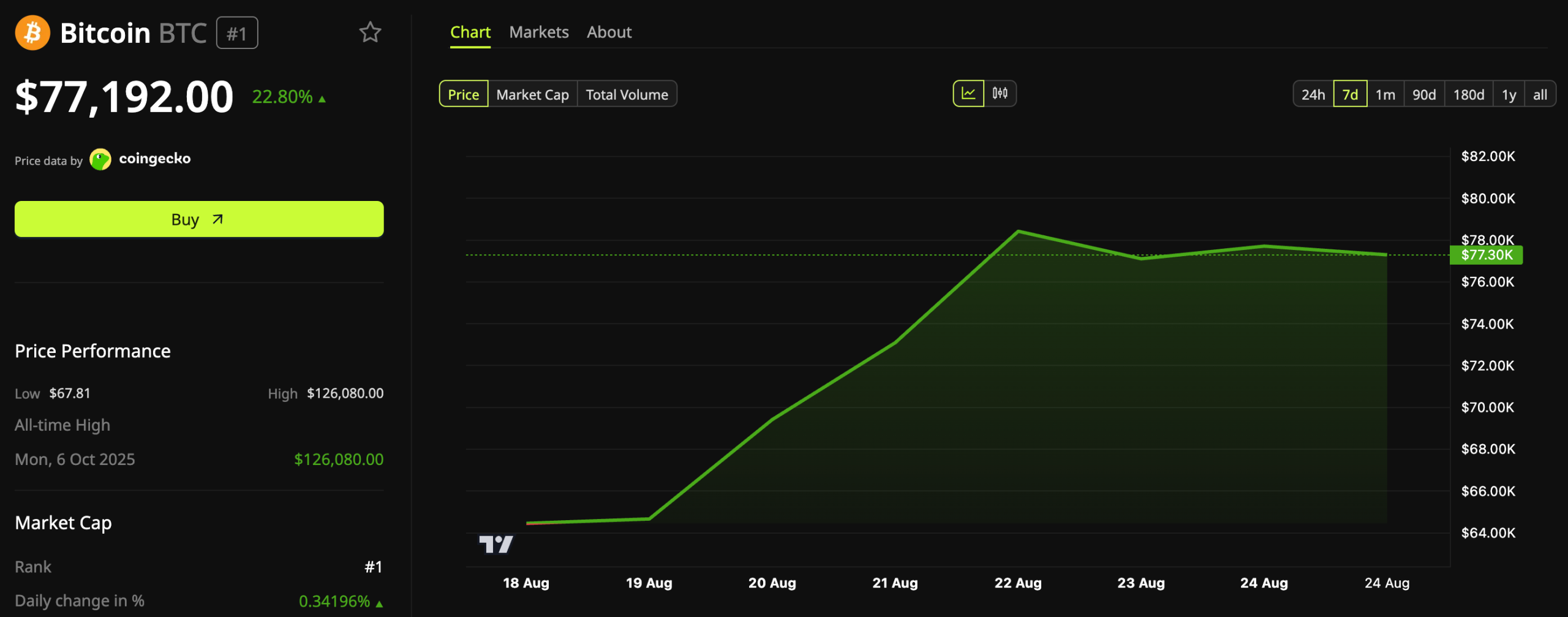
His stance, especially if it’s clear, will likely impact BTC, which rose from $64,000 to almost $80,000 at the end of last week, but it has stalled at around $77,000 since then.
The post Bitcoin’s Rally Faces a Crucial Week: These 3 Macro Events Could Decide the Next Move appeared first on CryptoPotato.


The Bridgewater founder says recent Treasury-market stress fits his long-running debt-crisis framework, though he still prefers gold as the bigger hedge.

Opinion: Farm repairs face digital future

President Trump says U.S. Bitcoin purchases remain under review

Ligue 1: Ferran Torres saves Paris Saint-Germain against Rennes – Sports





-

 Fashion3 days ago
Weekend Open Thread: Madewell – Corporette.com
-

 Crypto World2 days ago
anatomy of crypto’s biggest liquidation event since 2021
-

 Business6 days ago
SMA Solar Technology AG (SMTGY) Q2 2026 Earnings Call Transcript
-

 Tech6 days ago
Qwen3.8-27B runs frontier-class coding agents and reasoning locally, no cloud API required
-

 Business2 days ago
Musk’s Tesla, SpaceX Confirm $16.8 Billion ‘Terafab’ Chip Plant as World’s Largest Building in Texas
-

 Crypto World6 days ago
OCC Greenlights Trump Family Crypto Firm for Trust Charter
-

 Politics2 days ago
6 months on, Irish renters crushed by effects of government housing bill
-
 NewsBeat2 days ago
The ‘Lucky Dip Gang’ causing carnage for clicks: After five thugs were killed speeding in the wrong direction on a motorway, GUY ADAMS investigates a sick new trend… and why police aren’t even allowed to pursue them
-

 Crypto World6 days ago
NAVI Prime launches institutional lending framework on Sui
-

 News Videos4 days ago
Don’t Leave Your Financial Future To Chance | August 19, 2026
-

 Tech5 days ago
GLM-5.3 hits the API at $1.4/$4.4 per million tokens
-
 Crypto World6 days ago
Dow’s 3-Year Winning Run Isn’t a Crash Signal, Still 49% Odds of Double-Digit Gains
-

 Tech7 days ago
Straight Up the Cliff, Yunnan’s New Fuyao Ladder Turns a Three-Hour Climb Into a 50-Second Ride for Students
-
Tech6 days ago
5 Of The Most Reliable Car Brands To Consider If You’re Buying A Used SUV
-

 Business6 days ago
Stock Market Today: Tech Futures Slide As Treasury Yields Jump; Nvidia, Micron, Sandisk Sell Off
-
Business6 days ago
Fabrinet (FN) Q4 2026 Earnings Call Transcript
-

 Tech6 days ago
Keychron K8 Ultra 8K review: a great value keyboard with comfort issues
-

 Business4 days ago
Five Below: Kids Discount Retailer Reaps Rich Rewards
-
 Tech6 days ago
Nvidia discloses $21B stake in SpaceX
-

 Business5 days ago
Marvell Shares Jump 7% as Google Chip Deal Confirms Custom AI Silicon Partnership, Analysts
You must be logged in to post a comment Login