
Politics
Elring Haaland Debuts New Buzzcut Haircut And Fans Can’t Cope

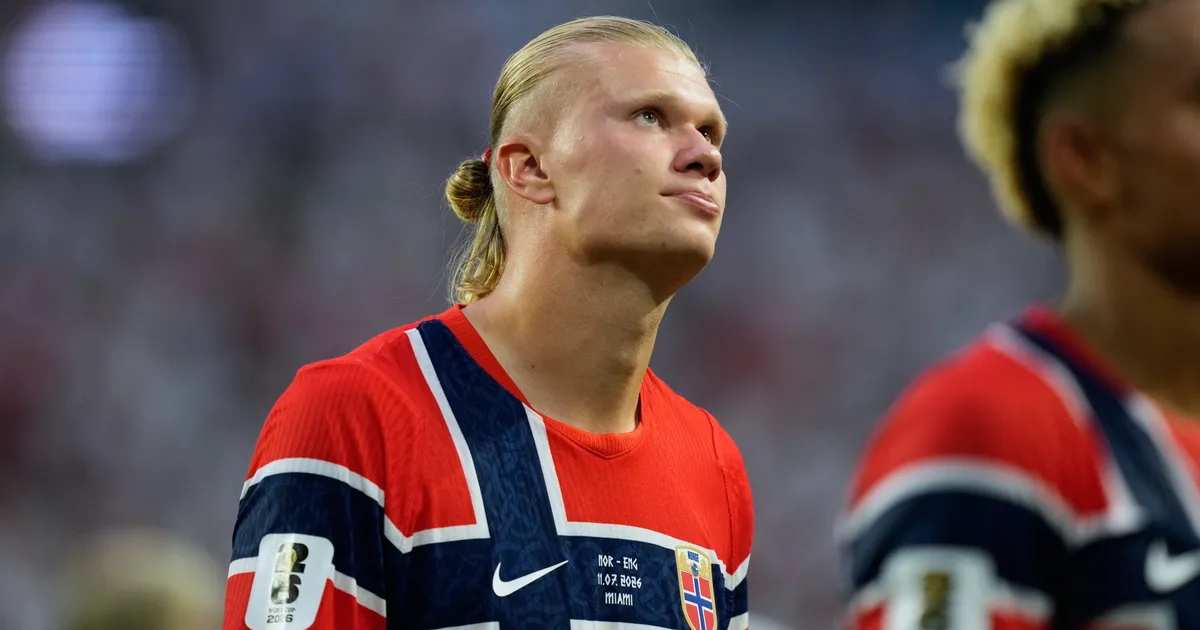
Over the weekend, there was something of a celebrity hair-mergency that we’re just about ready to talk about.
In recent history, Norway’s Erling Haaland has become one of the most talked-about footballers in the world thanks to his skills on the pitch (as seen in the World Cup earlier in the summer) his cheeky sense of humour and, of course, his iconic blond locks.
Ahead of his return to the pitch for Manchester City over the weekend, the Scandinavian striker decided to switch things up, and revealed on his Instagram that he’d buzzed off his infamous do.
He showed off the results of his new look on Instagram on Sunday, teasing his followers: “New season, new trim.”
“Short hair don’t care,” he added, first showing off a 90s boyband-esque curtains look, before unveiling the full buzz.
Suffice to say, the new look got plenty of attention on social media, with many admitting that Haaland’s new look was going to take them a minute to get used to…
Even his fellow footballers were left voicing their shock, with Jude Bellingham commenting a stunned: “No way.”
In a follow-up YouTube video, Haaland teased: “This beautiful blond hair, it’s time to let it go. I was thinking about doing this straight after the World Cup, but I was so busy, so I didn’t do it.
“The season starts now, so it’s time to get a fresh start and everything. The only thing is, Zlatan [Ibrahimović the Swedish player] told me, ‘never cut your hair, because your strength is in your hair’. So I’m a bit nervous.”
Fortunately, it wasn’t too much of a bad omen for Manchester City, who beat Bournemouth 2-1 while playing at home on Sunday afternoon…
Check out Erling Haaland’s hair update video in full – including his girlfriend Isabel Johansen’s reaction – below:




4 min read
It is welcome news that Andy Burnham has made it clear that assisted suicide should not be introduced while the situation with social and palliative care in this country is so dire.
Hospice and palliative care face a severe funding problem. A National Audit Office report published at the end of last year found that nearly two-thirds of England’s independent hospices ran a financial deficit in 2023/24, with expenditures exceeding income by £78m. The hospice care provider, Marie Curie, revealed this year that around 170,000 people die annually in England with unaddressed symptoms, and unmet palliative care needs are expected to rise by 23 per cent in the next 25 years unless drastic measures are taken to fix the deficiencies.
Such a context is not one in which assisted suicide should be legalised. Individuals with unmet palliative care needs would not be given genuine choice at the end of their lives. Sufficient treatment would often not be an option, but a hastened death would be. Indeed, as health secretary, Wes Streeting warned that funding for palliative and end-of-life care would have to be reduced so funding could be diverted to set up assisted suicide services.
Lauren Edwards, the MP sponsoring the latest iteration of the assisted suicide bill, responded to the Prime Minister’s statement by making the claim that you don’t have to choose between fixing palliative care or having assisted suicide – it would be possible to have both. This has become a common refrain from supporters, but there cannot be a genuine choice if funding for care is so inadequate that some terminally ill people may feel forced into a premature death because their basic needs are not being met. The argument just doesn’t hold water.
Not only would there likely be less funding to fix palliative care if assisted suicide were to be introduced, which would bring its own costs, but the reforms needed to solve the deeply entrenched funding problems in the care sector are not a quick fix; they will take time.
The assisted suicide legislation includes an implementation period of a maximum of four years that would begin immediately after receiving Royal Assent and becoming law. This would mean that, after four years, assisted suicide would automatically be introduced regardless of the state of palliative care services at that time. I have every hope that the PM achieves his goal of fixing the funding issues in the care sector, but setting a hard limit of only a few years – less than the lifespan of one parliament – to fully address this monumental problem would be an irresponsible hostage to fortune.
Experts also agree that it is simply not feasible to attempt to do both at the same time. Professor Katherine Sleeman, Chair in Palliative Care at King’s College, London, has said that introducing assisted suicide when care services are so fragmented presents a “huge risk” that people may decide to end their lives “simply because of lack of high-quality care”. Professor Mumtaz Patel, President of the Royal College of Physicians, said something similar to the House of Lords Select Committee that considered the last assisted suicide bill: that people would certainly choose to end their lives “because of the lack of provision around good palliative care”. That, surely, is not what anyone wants.
Fixing palliative care is of enduring national importance, and it is welcome that the PM, along with both supporters and opponents of the assisted suicide legislation, recognises it as such. MPs must unite to implement the reforms needed to address these funding issues.
And yet, it seems irrefutable to me that care services cannot be fixed concurrently with the legalisation of assisted suicide, and that assisted suicide could not be introduced safely. Care services remain in a poor state. The obvious solution, as the PM has recognised, is to defer any talk of assisted suicide until we have fixed the issues with palliative care. Anything else would be irresponsible.
Mary Glindon is Labour MP for Newcastle upon Tyne East and Wallsend
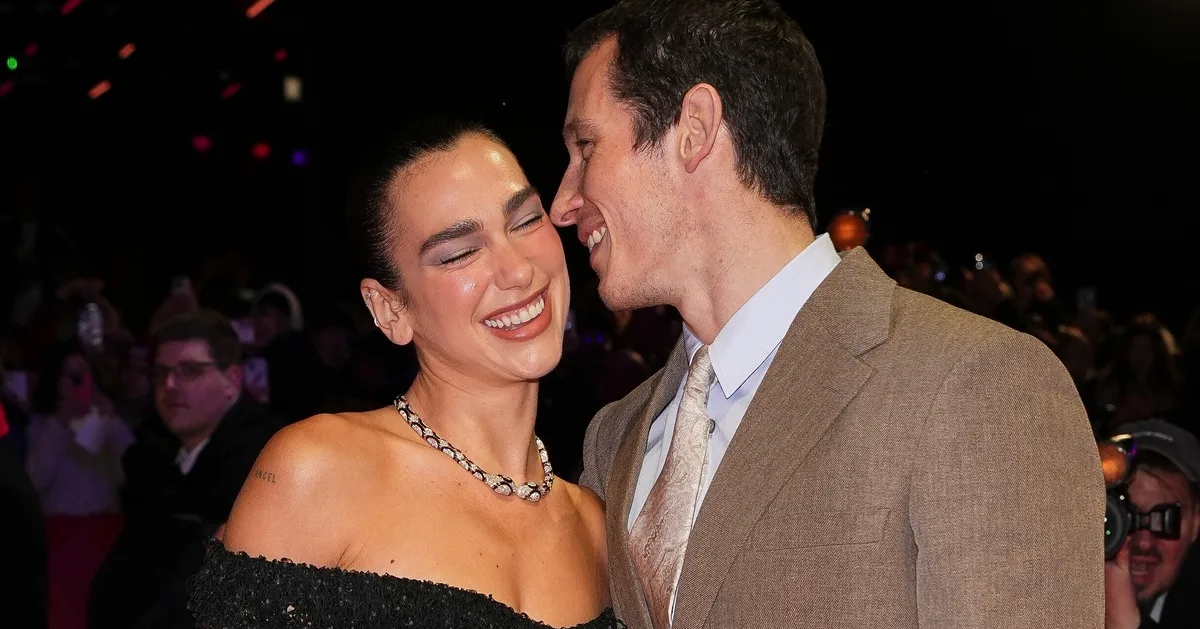
Dua Lipa is opening up about her wedding day.
Earlier in the summer, the Training Season singer married British actor Callum Turner at an intimate ceremony in London, before jetting off to Palermo for a more lavish celebration.
Speaking to Vogue Italia, Dua recalled that hers and Callum’s reception was “such a beautiful celebration”.
The Grammy winner also opened up about how friends of hers and Callum’s had given them “lots of advice” about how best to maximise, but there were “two suggestions that we really took on board”.
“One was to show up at our wedding like we were guests ourselves, which meant we had the best time and we weren’t stressed at all,” she said.
“The other was for Callum and me to keep checking in with each other so we didn’t lose each other in the crowd. As a result, we spent loads of time together and created so many amazing memories.”
Elsewhere in the interview, she spoke about how her attitude to romance has changed over the years – and how this has affected her songwriting.
“[Writing] about having a broken heart is very common,” she explained. “When I was younger, I found much more inspiration in the search for and the longing for [true love] because heartbreak is such a loud emotion.
“But now I want to discover what happens after you find love. I’m interested in the everyday complexities of a relationship, in its quieter moments, in the small things.”
Dua and Callum began dating in January 2024, making their red carpet debut as a couple at the following year’s Met Gala, around a month before confirming their engagement.
Shortly afterwards, she told British Vogue that the engagement was “very exciting”, revealing how Callum had designed her engagement ring for her, and that she was “obsessed” with it.
“It’s nice to know the person that you’re going to spend the rest of your life with knows you very well,” she enthused.
Read Dua Lipa’s latest interview in full in Vogue Italia.


Israel’s occupation regime has issued an order to kill Palestinian children if they dare to fly kites in Gaza.
The order comes after a manufactured panic following four kites that broke loose over several days and landed in Israeli neighbourhoods close to Gaza. The occupation military admitted the kites posed no threat at all, but this has not stopped ‘defence’ minister Israel Katz from announcing that anyone flying kites will be targeted for ‘forceful‘ military action. Katz also threatened to escalate Israel’s wider assassination campaign and forced displacements across Gaza if the kites continue to fly:
A balloon is like a kite, and a kite is like a drone, whether it carries explosives or not.
Respite denied by Israel
Kite-flying is one of the few recreations that have been within reach for Palestinian children to provide a few moments respite from the horrors of Israel’s genocide. Now it is likely, like so many other things in Gaza, to get them killed by the coloniser.
Zionists’ targeting of children has been identified by the United Nations and others as a core part of its Gaza genocide.
Featured image via the Canary
By Skwawkbox

What a year 2026 has been. We’ve had heatwave after blistering heatwave, leading to drought in parts of the UK – and resulting hosepipe bans are expected to last until the end of the year, according to a Thames Water boss.
That’s spelled chaos for gardeners.
The Royal Horticultural Society found that while some species, like wild carrots and lavender, thrived in the parched conditions, others like hydrangeas suffered enormously.
And a peek at Reddit’s r/GardeningUK proves that ordinary growers are starting to reconsider what they plant, too.
Writing to the group, site user u/oldschoolie asked their fellow green-fingered forum members: “What will you be giving up on because it died or needed too much coddling in the drought this year?”
Here are some of the most-upvoted responses:
1) “Anything that died in the drought! If it survived, it can stay”
Credit: u/Normal-Height-8577
BTW, the Royal Horticultural Society offers similar advice. Its principal horticultural advisor, Leigh Hunt, said: “As temperatures become more extreme don’t replace like for like – if a plant is struggling in your garden you can plant something better suited to the space.”
2) “Hydrangeas”
“I’ve been nursing a bunch of them for the last four years… and tried many spots, but every summer [they] become pretty sorry looking. [They] take too much effort to get back to [a good condition] before they get ‘summered’ again.”
Credit: u/Glittering-Mentat-4
Hydrangeas seem to be among the most susceptible plants in a heatwave.
3) “Lupins”
“Urgh. Even with the drought, they still got slug-decimated, and have just sat there looking crap and scraggly since.”
Redditor u/A_Pure_Motive agreed, writing: “Same here, looked fabulous for about a month, if that, and have looked awful since the hot weather hit and also been subject to multiple aphid attacks. Saved all the seeds, hoping to plant more for next year, and now I’m thinking meh…”
4) “50% of the lawn”
“I want some grass, but the rest will be pollinator-friendly plants which don’t need much water.”
Wildflowers, clover, and thyme can “reduce or eliminate the need for watering and improve biodiversity,” explained the RHS. Gardens that follow a mixed grass and wildflower pattern are sometimes called tapestry lawns.
5) “Pots and planters. All of them”
We’ve written before at HuffPost UK about how important it is to place potted plants in dark, shady spots when it’s hot out. Their thinner soil dries out much faster than soil in the ground – this is especially true for dark plastic and unsealed terracotta pots.
In general, container plants suffer more in the heat.
6) “Courgettes”
“They always end up with powdery mildew and look awful. Output has been dwindling in recent years, especially bad this year.”
And u/destria seemed to have a similar experience, writing: “It’s been my worst year for courgettes too. Such a low yield. I’m usually drowning in them, but this year, even with five plants, we’ve only been getting maybe three to four decent courgettes each week. I don’t even like courgettes that much…”
7) “Sweet peas”
“They’ve done very poor[ly] the last two years,” u/insrtitherenow, who‘s also given up on celery, said.
For their part, u/Panda1953 reckoned, “Neither sweet peas [nor] tomatoes have been a success this summer. Won’t bother next summer.”
If you’re looking to overhaul your back garden ahead of what seem to be very likely future heatwaves, we’ve written a handy guide on where to start.

If you’ve tuned into any political news in the last few days, you’ll have heard the official Labour buzzword of the week: pivot.
Prime minister Andy Burnham is apparently swivelling the party left so sharply you’d think he’d just spotted a late bus leaving the station and is sprinting to catch it. He’s promising “a state that isn’t afraid to intervene”, “putting British industry first”, and “fairness for working people”.
I’m sure we have heard this somewhere before…
Pundits are already cooing about a return to roots — like Labour’s forgotten roots were just hiding down the back of the leader’s sofa all this time.
But look past the nicely turned phrases and the perfectly pressed shirt, and this isn’t a revolution. It’s just the same old menu, but with a fancier description on the blackboard.
Let’s give credit where it’s due, if we must.
Burnham: grateful for small mercies?
On paper, it all sounds great. Who wouldn’t cheer for backing our steel mills instead of letting bosses ship jobs abroad to save a few quid? Who’d argue with telling big corporations they can’t hoover up record profits while paying staff so little they qualify for food banks?
It’s the sort of stuff that gets shared a thousand times on Facebook by people who haven’t voted since 2005, nodding along like “at last, someone gets it”.
Then you read the small print — or rather, notice the complete absence of small print on the stuff that actually matters — and it’s like biting into an M&S Gourmet Nut Wellington and finding it’s mostly carrot peel and stewed nettles.
Leaked briefings still talk about “streamlining welfare” — which in Westminster language means something like making life even more miserable for people who’ve already got it tough.
There have been no promises to end sanctions that cut off cash for weeks because someone missed a job centre slot while they were in hospital, or their bus was cancelled — which, let’s be honest, happens most weeks anyway.
And Universal Credit’s infamous six-week wait? Still there, lingering like a bad smell in a bathroomless HMO.
Panic setting in already
On the big stuff? Total silence. Burnham’s said zilch about bringing energy companies into public ownership — the only plan that’d actually stop bills going up faster than a queue at Greggs on a Saturday morning. Nada on closing tax loopholes that let giants like Amazon pay less than your average market stallholder. Nothing about scrapping Trident, even though we could fund every school repair in the country three times over for what that ludicrous white elephant costs.
And it turns out that standing up for ordinary people stops dead the moment it might upset a wealthy donor or a newspaper editor.
This isn’t a pivot. Is it? It’s a panic.
And we’ve seen this act before. Labour won power claiming they’d fix the housing crisis, sort out social care, and the usual nonsense about making work pay.
What has changed? Rents are higher than the roof on my nan’s old council high rise, there are no rent controls in sight, and no-fault evictions are still the greedy landlords’ favourite party trick.
Now we hear 30,000 NHS jobs could go — at the exact same time private firms are trousering millions in outsourcing contracts.
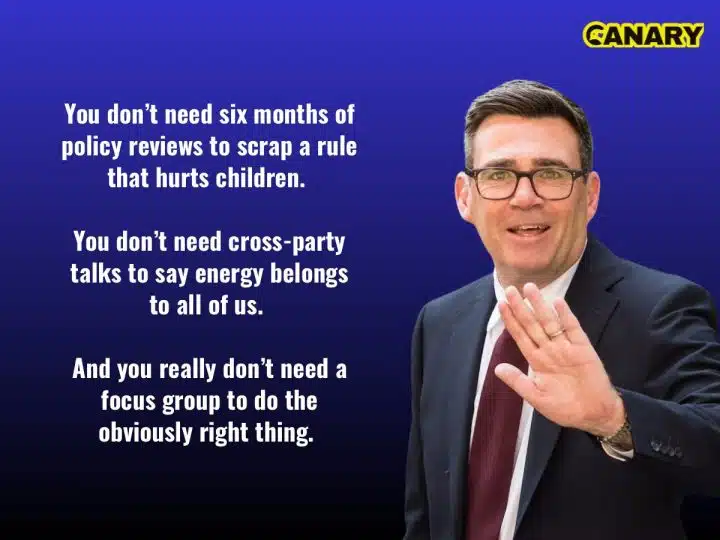
Some will say “give Burnham a chance, he’s only just started, bless him”. Fair enough — but you don’t need six months of policy reviews to scrap a rule that hurts children, right?
You don’t need cross-party talks to arrive at the conclusion that energy belongs to all of us, do you?
And do you really need a focus group to tell you to do the obviously right thing?
Burnham: choosing not to choose
These aren’t tricky administrative puzzles — they’re choices. And right now, Burnham’s choosing not to choose.
Out here in Swindon, in towns across the south west and the north, we don’t care about Westminster wordplay. We care about the neighbour working two zero-hours jobs who still can’t afford to put the heating on.
We care that utter monsters such as Nigel Farage can spout any old rubbish and get called “bold”, while anyone asking for actual change gets dismissed as “unrealistic”.
Burnham might think a few rousing lines will win us back. He might reckon we’re too busy counting pennies for the weekly shop to check if he’s actually delivering. But he’s wrong. We’re not daft. We know the difference between someone who’s turning the ship around, and someone who’s just polishing the brass portholes while it slowly drifts onto the rocks.
We don’t want speeches. We want action. We want a party that’s not scared to pick a side — our side, not the boardroom’s — no fine print, and no last-minute U-turns like the ones that haunted the last Prime Minister, whatever his name was.
Actions speak louder than carefully rehearsed buzzwords — and right now, Burnham’s actions are whispering while his speeches are little more than shouting. This isn’t a bold new journey, it’s just more of the same old drift, with a louder PA system.
At the end of the day, most voters aren’t fooled by sound bites, spin, or fancy pivots. We can all spot a con when we see one. If it looks like the same old Tory-lite soup, tastes like the same old Tory-lite soup, and costs the same old price in our pockets — it really doesn’t matter what label you stick on the tin.
Featured image via the Canary


Since 2025, Reform UK has been incredibly successful at winning local elections. What it’s struggled with is holding on to its new councillors. The below clip from ex-Reformer Robbie Lammas gives you an idea of why that is:
'They're not a professional political party… it's mafia-esque.' — LBC (@LBC) August 23, 2026
@RobbieLammas explains why representing Reform UK as a councillor was 'the biggest mistake of his life'. pic.twitter.com/UYqxI0pI0e
Defector to Reform
Unlike many of his now-ex-colleagues, Lammas didn’t win on a Reform ticket. Instead, he defected from the Conservatives in late 2025. He wasn’t the only one to do so either, with many big names like Suella Braverman and Robert Jenrick following the same path. The difference between them and Lammas is he wasn’t willing to put up with the nonsense.
In the above clip, Lammas says:
Reform is a bit like the person who sells you DVDs in a pub in Clacton, okay? They promise you things that you want. They offer you a price… and you’re quite happy to do the deal, but when you get home and it’s rubbish quality, you really resent it…
Lammas also said:
It was the biggest mistake of my life. They’re completely unprofessional in every way, shape, or form. And that is the reason why Kemi is saying what she’s saying.
Lammas is referring to the following comments from Kemi Badenoch:
Kemi Badenoch, the leader of the Conservative Party, has described the prospect of a coalition government with Reform UK as “monstrous”.
Again ruling out the prospect of a deal between the two parties, she said any agreement would “put off” as many voters as it would attract — The Telegraph (@Telegraph) August 23, 2026
 … pic.twitter.com/1P1ea4xHFN
Both Reform UK and the Conservative Party have defined themselves by how they differ from one another. As such, Badenoch is correct to think a merger could do just as much damage as good. We actually have some proof of this too, because Reform’s polling has worsened since it began accepting ex-Tories. This is worth bearing in mind, because despite what Lammas is publicly saying, one of his underlying concerns could be that unlike when he first defected, Reform is no longer the obvious next party of government.
Not normal
Lammas continued:
They’re not a normal alternative conservative outfit which you can do deals with. They’re not even a professional political party. They are a power unto themselves. They run themselves more like some corrupt, strange, mafia-esque situation. They don’t make up policy properly. There’s no professionalism. So there is no talent to do a deal with.
Lammas isn’t the first ex-Reformer to make such claims. As we reported, several councillors have claimed that Reform HQ stopped them acting in the local interest. As Durham councillor Nick Brown said:
When we took control [of Durham Council], I believed the messages from Nigel Farage that we would make big changes for people living locally.
But really, whenever we had a local issue, we were told to follow the party line. Not to rock the boat, bring press attention on the council. We all turned into Nigel’s yes-men – ordered to be on best behaviour to help him get to power.
In fighting
Lammas finished by talking about infighting:
There’ll be nothing to gain for the Conservative Party in doing any kind of deal with them, and it turns out they absolutely hated Conservatives when you got to the inside. And then i saw the infighting. It made everything that I experienced in the Tory party look like playground politics.
You’ve got the different camps warring with each other constantly. I described it… unlike a family – like the Conservative Party – Reform is like a HMO, where you have strangers living in the same building, despising each other.
As we’ve reported, Reform politicians are currently denying that the national party is a hotbed of infighting.
By my reckoning in the past week senior Reform figures have claimed journalists from the Spectator, the Daily Mail, the Mail on Sunday, the Sun, the Times and the I Paper have all independently invented broadly the same stories about internal infighting within the party…
— (((Dan Hodges))) (@DPJHodges) August 22, 2026
According to Lammas, this infighting seems to exist at every level of the party. Which probably isn’t good, is it? Not if you have hopes of Reform successfully running the country.
Unstable Reform
Reform UK has what may be an unsolvable problem. The party’s driving engine is the politics of division, and as a result it attracts divisive politicians. This works when they’re in lockstep, but frequently they won’t be, because they’re not the sort of people who think about the greater good; they’re the sort of people who simply want to get their own way.
Featured image via Belinda Jiao / Gareth Fuller
By Willem Moore

British actor Hayley Atwell has admitted she’s less than pleased with how things turned out for her Marvel character the last time we saw her on our screens.
Hayley has portrayed Peggy Carter in a number of MCU projects, beginning in 2011’s Captain America: The First Avenger, before landing her own TV spin-off.
She then played an alternate version of the character, dubbed Captain Carter, in Doctor Strange In The Multiverse Of Madness in 2022, where she was seemingly killed off by Elizabeth Olsen’s Scarlet Witch in battle using her own shield.
Speaking at the For the Love Of Fantasy & Sci-Fi event over the weekend, Hayley admitted she was a bit gutted to discover Captain Carter’s fate.
“If I’m really like brutally honest, I was so disappointed with how they positioned her and what happened to her in that scene,” she lamented. “It’s so small, and she gets frisbeed to death.”
She even claimed that “on set” she “tried” to make suggestions to improve the scene, but was ultimately told: “Sure… but no.”
“I felt that was like a bum steer and a complete disservice to the character,” Hayley concluded.
Later this year, Hayley will make a return to the MCU in the next Avengers movie Doomsday, which will serve as a sequel to 2019’s Endgame.
That film ended with Chris Evans’ Captain America travelling back in time to the 1940s to live out his days with Hayley’s Peggy Carter, with Marvel boss Kevin Feige making it clear that this new movie will pick up where Endgame left off.
Doomsday will feature a number of favourites from the superhero world, not to mention seeing the likes of Sir Ian McKellen, Sir Patrick Stewart and Alan Cumming reprise their roles from the X-Men movies for the first time in the MCU.
Meanwhile, Robert Downey Jr – previously known to MCU fans for his portrayal of Iron Man – is set to take on the role of the villainous Dr Doom.
Politics
Stephen Goss: How a music festival hosted in Belfast might just signal a shift in Northern Irish politics
Dr Stephen Goss is a freelance historian, lectures in history and politics in London, and is a Conservative councillor in Reading.
The big story from Northern Ireland this month is the truly remarkable success of Belfast hosting Fleadh Cheoil na hÉireann this year. ‘The Fleadh’, as it is known, is an annual music festival which has been running for 75 years. A different village, town, or city on the island of Ireland is selected to host the festivities which celebrate and promote traditional Irish music and dance. In a similar way to the Edinburgh Fringe now overshadowing the Edinburgh International Festival, the ‘craic agus ceol’ surrounding the Fleadh has eclipsed the formal competitions at its heart.
This was its first visit to Belfast. The organisers expected 800,000 people; instead, footfall of over 1.6 million visitors has been recorded over the eight days. To put this perspective, the population of Northern Ireland is approximately 1.9 million.
Yet, the statistics scarcely convey the atmosphere.
Serendipitously I was home in Belfast while the Fleadh was taking place. Streets were cleaned and pedestrianised, businesses entered into the spirit of the event, and music and drinking spilled out from pubs and venues into the public realm. A city usually divided and dysfunctional showed it could be relaxed and welcoming. A triumph for Belfast, its economy and tourism, it sets the stage for what will hopefully be an even greater success when the Fleadh returns to the city next August.
However, such is the nature of Northern Irish politics, the event could not escape attempts to force it into Northern Ireland’s familiar zero-sum narrative. I have written previously about nationalist contrived outrage, and it raised its ugly head again on this occasion. Some nationalist and republican commentators seemed invested in unionist rejection. Jude Collins predicted there would be ‘distressingly few Protestants/unionists availing themselves of the chance to hear the best in Irish music, dance and culture’. There is too much bigotry, dismissiveness, and sectarianism in this assessment from the Belfast republican press for me to summarise here. The general assumption was that unionists and loyalists would boycott, protest, or at best ignore the Fleadh. Any that held their nose and engaged with it were to be considered doing so for purely cynical, political reasons.
While Jim Allister and the Traditional Unionist Voice raised concerns over the cost and disruption caused by the event (and objections to a Post Office selling Irish tricolours), unionism in fact embraced the Fleadh. Speaker of the Northern Ireland Assembly, Edwin Poots MLA (briefly DUP Leader; the DUP’s Liz Truss), stated at an event in Stormont to welcome performers to the Fleadh in Belfast:
‘Musical traditions flow through the veins of the community across Northern Ireland… This is an opportunity to celebrate all the different traditions that have been passed from one generation to the next and to share them with new audiences, and for Belfast to open its doors and demonstrate the warmth of its welcome’.
The Deputy First Minister, DUP MLA Emma Little-Pengelly spoke from the main stage of the Fleadh. She said: ‘Respecting another’s culture never diminishes our own… Confidence in who we are gives us the freedom to celebrate the richness of others…. Culture need not divide us’. She spoke of a ‘cultural heritage that belongs to no single tradition. A cultural future that certainly does not’.
Those were not merely gracious words delivered from a platform. Loyalist marching bands were not left at the festival’s edge, either literally or figuratively. The Belfast Bands Forum was represented on the organising committee and presented an Ulster Bands Showcase at the Titanic Slipways. Flute and accordion bands, Lambeg drummers, pipe bands, and Highland dancers all took part. The strongest rebuttal to the caricatures came from the welcome these musicians received. The Shankill Road Defenders were applauded not only at the City Hall, but Band member Dr. Gordon Ramsey described the reception as ‘extraordinary’. He said they had received substantially more support than criticism from within their own community.
This was not loyalism holding its nose, nor unionism cynically trying to appropriate somebody else’s celebration; it was confident participation. As Belfast Bands Forum chairman Darren Leighton observed:
‘One of the most important things for us has been challenging some of the stereotypes around the marching band community… we simply put our musicians and our culture on the stage and allowed people to experience it for themselves… Our musicians stepped outside their comfort zones this week, performed in front of new audiences and were welcomed everywhere they went’.
Despite the assumptions of many, unionism was far from outraged at the Fleadh and its success. However, this month has seen indignation within unionism. With the DUP in turmoil over who knew what and said nothing about the now convicted Jeffrey Donaldson, for the first time in decades, the Ulster Unionists have overtaken the DUP in the polls.
Therefore, it seemed like typical Ulster Unionist self-sabotage when last week the party leader fell out with his Health Minister. Leader Jon Burrows publicly declared that emergency general surgery must remain at Causeway Hospital, placing himself directly at odds with former leader (twice) Mike Nesbitt. Although Nesbitt had not yet taken a final decision, he accused Burrows of imposing a new ‘red line’ and objected to discovering his leader’s position from the media.
This comes after another former leader of the Ulster Unionists, Doug Beattie, resigned from the party in May. So, was the outrage of both Party Leader and Health Minister typical – or contrived? Although located in East Londonderry, Causeway Hospital also serves communities within Burrows’s own North Antrim constituency. Burrows was co-opted as North Antrim MLA only last August. He has yet to face the electorate. Defending a hospital serving communities across his north-coast hinterland allows him to demonstrate ahead of next May’s Assembly election that he is more than a drop-in. It presents him as a decisive leader, willing to challenge the health bureaucracy on behalf of patients, and a representative who will do whatever it takes to defend the interests of his constituents.
The appointment of Lagan Valley MLA Robbie Butler as Nesbitt’s successor may be more strategically significant still. Butler was the alternative for party leader earlier this year. Giving him Northern Ireland’s most prominent ministerial portfolio provides a platform from which to build a much larger public profile. Butler has yet to be drawn on the decision he will make regarding the Causeway Hospital.
DUP turmoil allowed Alliance’s Sorcha Eastwood to snatch Lagan Valley from unionism at the 2024 general election. The same poll that puts the Ulster Unionists ahead of the DUP has Alliance at a five-year low of ten per cent. With the Ulster Unionists now polling ahead of both parties, Butler has an opportunity to establish himself as the principal challenger to Eastwood.
The Fleadh demonstrated how Northern Ireland’s familiar assumptions should not be taken as certainties. Loyalists were expected to sulk outside; instead, they marched onto the stage and were warmly applauded. If Burrows is returned at next May’s Assembly election with his own mandate, and Butler emerges as the strongest challenger for Donaldson’s former Westminster fortress of Lagan Valley, what looked like the first shots of another Ulster Unionist civil war may instead prove to have been the opening salvo of its long overdue electoral recovery.

Former Race Across The World competitor Jo Gardiner has died at the age of 61.
In a statement released on Monday morning, Jo’s family announced that she had died “following a long and courageous battle with cancer”.
“She lived fully, fiercely and never did anything by halves,” they said (as reported by Metro). “She was blessed with countless friends, drawn to her extraordinary magnetism. Somehow, each one felt as though they were among her very best.
“To us, she was more than all of these things. She was our family, our joy, our safe place and our absolute treasure.”
Jo’s family ended by making a call for privacy, adding: “We also ask everyone who knew and loved Jo to do exactly what she would have wanted: tell the funny stories, raise a glass, have an adventure, laugh loudly and live life to the full.
“She was one of a kind. There will never be another her.”
Jo and her son Sam took part in the second season of Race Across The World, which took the competing teams from Mexico City to Ushuaia, Argentina.

The pair finished in fourth place overall, after having to drop out during the penultimate leg after running out of money.
Last year, Sam died suddenly at the age of 24, following a car accident.
“On behalf of the Studio Lambert production team, the BBC and the whole Race Across The World cast, we offer our deepest and heartfelt sympathies to Jo’s son Charlie, and her wider family and friends,” a Race Across The World rep said on Monday.
“Following the tragic death of Jo’s son Sam last year, we paid tribute to how integral Sam and Jo had been to series two. Millions of people remembered their transformative journey across Latin America in 2020 and we hold that memory in our hearts as we fondly recall Jo’s passion for life, her kindness, her strength, and above all her utter devotion to Sam and her family.
“At the time of filming, Sam described his mum as amazing – and that is how we will always remember her. Jo became the matriarch of the Race Across The World cast family, she leaves a lasting legacy in the many lives that she touched, both through the series and beyond. It was a privilege to share her story and she will be deeply missed.”

Billie Piper has spoken out about Doctor Who’s uncertain future.
Last year, Billie was involved in a Doctor Who cliffhanger that stopped fans in their tracks, when Ncuti Gatwa’s Time Lord regenerated in the season finale into a figure played by the former pop star.
Immediately afterwards, fans debated whether this meant that she was playing a new character who would be the Sixteenth Doctor, or it was all a plot twist involving Rose Tyler, the entity “Bad Wolf” or another of Rose’s characters, the being known as “The Moment”.
However, it seems fans could be in for a long wait for answers.
Showrunner Russell T Davies announced back in June that a planned Christmas special for 2026 had been axed, and that he was stepping away from Doctor Who entirely, with the show’s future now being up in the air as it is now “out to competitive tender this year”, meaning different production companies can bid to take over at the helm.
Over the weekend, Billie made an appearance at the Love Of Fantasy & Sci-Fi event in London, where she addressed her future with the Doctor Who franchise during a fan Q&A.
“I am not the next Doctor, I am Rose Tyler in hiatus,” she said. “Sorry, that’s a really cryptic answer, but because I’m not currently filming Doctor Who as The Doctor, I can’t lie and say otherwise.”
“Phew, I’m sweating! I hate this,” she admitted.
Addressing Doctor Who fans, Billie added: “You’ve all got to be very patient, it’ll be worth it when it comes. And I think that we need to celebrate the fact that the show has been on the air for [21] years in its new incarnation. It’s been around for a very long time, and it’s massively successful and it’s impacted many people’s lives in a positive way.
“It’s had a bit of a rough time lately, and I think everyone just needs to chill out and wait for what comes from having space… and time.”
In July of last year, she said of her most recent Doctor Who appearance: “All I can say is I was approached very last-minute, and I can’t talk about in what capacity, but I found it very emotional to film and I think it’s a really great ending.”
“I found it quite moving, and it was really fun to film because it had such a sort of ‘cloak and dagger’ feeling about getting it made,” Billie continued.
“So, yeah, I have to lie a lot about anything to do with Doctor Who, it seems.”

Splurge Monday’s Workwear Report: Floral-Printed Wool Polo Sweater

The House Opinion Article | We can’t have assisted dying in a care crisis

Suspect in Oregon Quintuple Murder Found Dead in Washington a Day After Bodies Discovered on Rural Property

Weekend Open Thread – Corporette.com

Weekend Open Thread: Brooks Brothers

London Mayor Sadiq Khan handed a peerage by Keir Starmer alongside 15 other Labour figures… just days before the PM leaves No10

THIS JAKE CLAVER XRP PREDICTION IS WRONG! – NEIGHBORS WILL THINK YOU’RE A DRUG DEALER WHEN XRP MOONS

Buying Bitcoin & XRP Right Now Could Be The Move The Rich Know Something You Don’t

How to Finance Your Assisted Living Facility in Florida | ALF Owner Guidance
-

 Fashion3 days ago
Weekend Open Thread: Madewell – Corporette.com
-

 Business6 days ago
SMA Solar Technology AG (SMTGY) Q2 2026 Earnings Call Transcript
-

 Crypto World2 days ago
anatomy of crypto’s biggest liquidation event since 2021
-

 Business2 days ago
Musk’s Tesla, SpaceX Confirm $16.8 Billion ‘Terafab’ Chip Plant as World’s Largest Building in Texas
-

 Tech6 days ago
Qwen3.8-27B runs frontier-class coding agents and reasoning locally, no cloud API required
-

 Crypto World7 days ago
OCC Greenlights Trump Family Crypto Firm for Trust Charter
-

 Politics2 days ago
6 months on, Irish renters crushed by effects of government housing bill
-
 NewsBeat2 days ago
The ‘Lucky Dip Gang’ causing carnage for clicks: After five thugs were killed speeding in the wrong direction on a motorway, GUY ADAMS investigates a sick new trend… and why police aren’t even allowed to pursue them
-

 Crypto World7 days ago
NAVI Prime launches institutional lending framework on Sui
-

 News Videos4 days ago
Don’t Leave Your Financial Future To Chance | August 19, 2026
-

 Tech5 days ago
GLM-5.3 hits the API at $1.4/$4.4 per million tokens
-
Tech6 days ago
5 Of The Most Reliable Car Brands To Consider If You’re Buying A Used SUV
-
 Crypto World7 days ago
Dow’s 3-Year Winning Run Isn’t a Crash Signal, Still 49% Odds of Double-Digit Gains
-

 Business6 days ago
Stock Market Today: Tech Futures Slide As Treasury Yields Jump; Nvidia, Micron, Sandisk Sell Off
-

 Tech7 days ago
Straight Up the Cliff, Yunnan’s New Fuyao Ladder Turns a Three-Hour Climb Into a 50-Second Ride for Students
-

 Tech6 days ago
Keychron K8 Ultra 8K review: a great value keyboard with comfort issues
-
 Tech7 days ago
Nvidia discloses $21B stake in SpaceX
-
Business6 days ago
Fabrinet (FN) Q4 2026 Earnings Call Transcript
-

 Business4 days ago
Five Below: Kids Discount Retailer Reaps Rich Rewards
-

 Business5 days ago
Marvell Shares Jump 7% as Google Chip Deal Confirms Custom AI Silicon Partnership, Analysts
You must be logged in to post a comment Login