
Crypto World
USDC growth could restart; sets $140 Circle target

Circle is catching the attention of Wall Street analysts again, with Bernstein arguing that USDC is entering a fresh growth phase that could lift the company’s performance over the next year. In a research note published Monday, the firm said USDC is showing signs of what it called “digital dollar reflation,” after supply jumped by roughly $2 billion in seven days—an apparent turnaround from a six-month period of stagnant or declining growth.
Bernstein maintained an Outperform rating on Circle and set a $140 price target, implying around 60% upside from current levels. The stock has reportedly risen about 40% over the past month, underscoring how quickly market sentiment can shift around stablecoin issuance and adoption.
Key takeaways
- Bernstein cited USDC supply increasing by roughly $2 billion in seven days, reversing a prior stretch of flat or falling growth.
- The firm expects a potential “next phase” for stablecoins to be driven by market momentum, U.S. regulatory clarity, and tokenized capital markets.
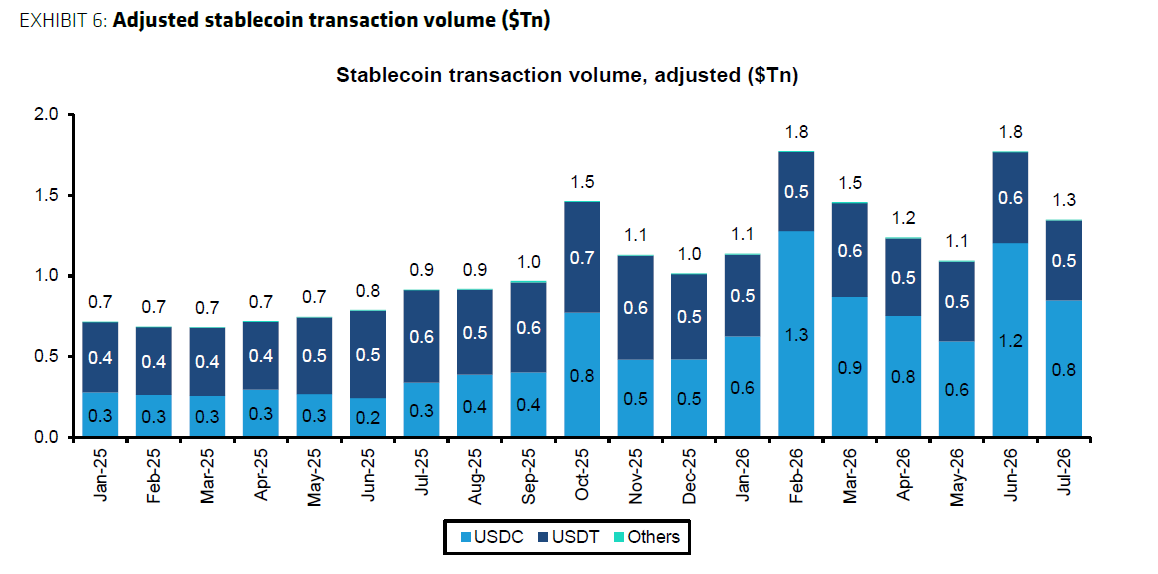
- Bernstein said USDC’s share of adjusted stablecoin transaction volume rose from about 40% in 2025 to more than 60% so far in 2026, overtaking USDt by that measure.
- Analysts highlighted early signals of stablecoin payments being used by artificial intelligence agents.
Why Bernstein thinks USDC momentum matters
Stablecoin growth is often measured in multiple ways—issuance, liquidity, and real-world transaction usage. Bernstein’s central argument focuses on issuance acceleration: a $2 billion increase in USDC supply over just one week suggests demand for dollar-denominated on-chain settlement is picking up again. The note frames this as “digital dollar reflation,” implying that the on-chain dollar supply is expanding in a way that may support broader ecosystem activity.
For investors, the implication is straightforward: renewed stablecoin issuance can translate into more business for Circle, particularly if new supply is associated with greater on-chain usage and related enterprise adoption. Bernstein also points to a broader set of catalysts beyond one-week supply growth—elements that, if they materialize, could help make the rebound more durable rather than episodic.
Drivers: regulation, tokenized markets, and payments
Bernstein outlined several potential contributors to a stablecoin “growth cycle.” First, it pointed to renewed momentum in crypto markets, which can raise risk appetite and increase the volume of on-chain activity where stablecoins serve as settlement rails. Second, it highlighted the possibility of greater regulatory clarity in the United States—an area that has long been a variable for stablecoin issuers, exchanges, and payment integrators trying to scale compliant services.
Third, Bernstein linked stablecoin expansion to tokenized capital markets—an umbrella term for the use of tokenized instruments and on-chain infrastructure for financial services. If more of these workflows use stablecoins as a unit of account or settlement asset, transaction volume could increase meaningfully. Finally, Bernstein pointed to growing stablecoin adoption for payments, suggesting that stablecoins are moving beyond trading and into everyday transfer use cases.
The analysts also referenced “early signs” of stablecoin use in payments made by artificial intelligence agents. While still emerging, the idea matters because AI-driven workflows could introduce new automation patterns for transfers—potentially increasing the frequency and diversity of stablecoin payment demand over time.
USDC’s transaction share rises while USDt slips in that metric
Although USDC is still the second-largest dollar-backed stablecoin by market capitalization—behind Tether’s USDt—Bernstein argued that USDC is gaining ground in actual transaction activity. According to the firm, USDC’s share of adjusted stablecoin transaction volume rose from roughly 40% in 2025 to more than 60% so far in 2026. On that basis, USDC has reportedly overtaken USDt.
This distinction is important because it separates “size” from “usage.” A stablecoin can lag in total market cap yet still lead in transaction throughput if it becomes the preferred settlement asset for certain applications or platforms. For Circle, a rise in transaction share can signal improvements in distribution, integrations, and user behavior—even if headline supply growth is the first datapoint drawing attention.
Circle stock performance and fundamentals since IPO
Bernstein’s bullish view arrives during a period of noticeable stock volatility for Circle. The company went public in June 2025, pricing its shares at $31 and raising about $1.1 billion in its initial public offering. After a strong early period, the shares slid back toward their IPO level by November 2025 as broader crypto market weakness weighed on publicly traded companies exposed to the sector.
Despite that volatility, Circle has continued to report improving results on an annual comparison basis. In its most recent quarter, the company reported $701 million in revenue and $48 million in net income, both up from a year earlier. The persistence of year-over-year improvement can matter for how equity markets interpret a stablecoin growth rebound—especially when traders are trying to balance short-term issuance trends against longer-term profitability.
As stablecoin demand patterns evolve, investors may focus not only on supply but also on which networks and use cases drive transaction volume. Bernstein’s emphasis on USDC overtaking USDt on adjusted transaction share suggests that, at least for now, usage dynamics are shifting in Circle’s favor.
What to watch next is whether the “digital dollar reflation” signals translate into sustained growth beyond a one-week supply jump—particularly as policy clarity and payment and tokenization adoption progress. If USDC continues to lead transaction share while issuance remains steady, Bernstein’s thesis could gain more traction; if not, the current rebound may prove temporary.

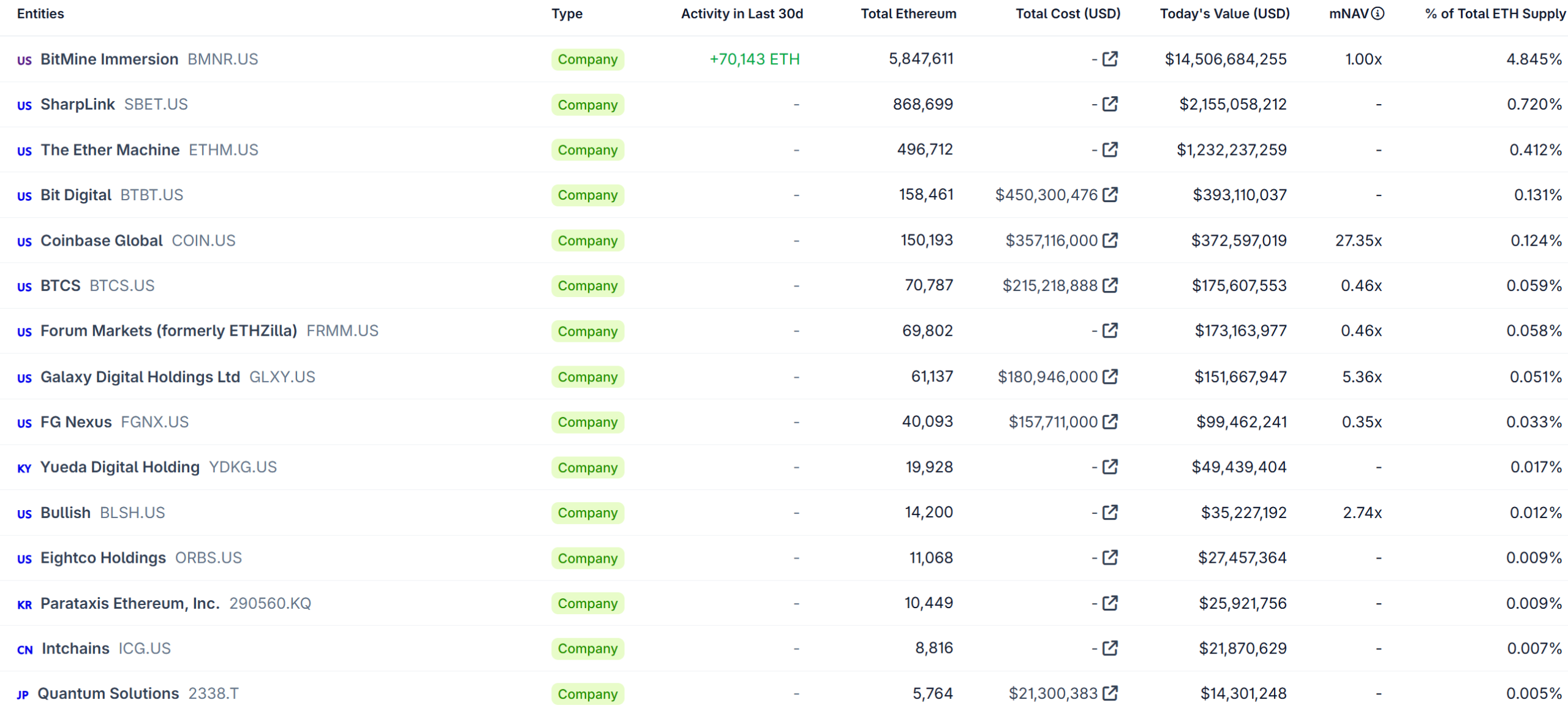
BitMine Immersion Technologies owns 5,847,611 ether. That is 4.79% of every ether in existence, and a tighter grip on Ethereum than Michael Saylor has ever held on Bitcoin.
Chairman Tom Lee told the Bankless podcast the company could reach its 5% goal before the end of 2026. The math is harder than it looks.
BitMine Built Its Ethereum Stack in 14 Months
Saylor’s firm, MicroStrategy, took six years to gather 840,447 Bitcoin. That comes to 4.19% of the coins in circulation.
BitMine passed that share of ether in 14 months. It made its first purchase on June 30, 2025, and has bought every week since. Sixty weeks, no gaps.

Lee credits a plain balance sheet. BitMine paid for the stack with common stock, not loans or convertible notes. Several rival treasuries leaned on those tools and did not survive the downturn.
Ether traded near $2,480 on Monday, up 1% on the day. It rose about 30% last week, its best week since May 2025. BitMine used the rally for its largest weekly ETH purchase since early July.
“It’s about $350 million worth of ETH that we need to acquire to reach 5%… we could reach it by the end of the year,” Tom Lee, chairman of BitMine Immersion Technologies, speaking on Bankless.
Follow us on X to get the latest news as it happens
The 5% Finish Line Keeps Moving
Here is the catch. Ether supply is not fixed, and right now it is growing. The network has added 85,893 ether over the past 30 days.
Total supply now sits at 121.98 million. That is about 1.3 million higher than the figure BitMine’s own disclosures use.

That gap matters because a true 5% means 6.1 million ether. BitMine is about 251,000 tokens short, worth roughly $620 million at Monday’s price. Lee’s $350 million estimate was made before ether’s rally.
What Comes After 5%
Lee rules out selling. BitMine has staked most of its ether, and those 5.07 million tokens generate about $330 million a year. That alone is roughly 12% of all staked ether on the network.
The yield covers the dividend on BMNP. That is a 9.5% preferred stock BitMine sold in June at $80, against a $100 liquidation value. Lee calls it a cheap three-year call option on ether.
The company is also turning into an Ethereum operator. Its validator arm MAVAN, short for Made in America Validator Network, launched in March.
BitMine then helped anchor three groups spun out of the Ethereum Foundation, alongside SharpLink and Ethereum co-founder Joe Lubin.
Lee ties the long-term case to tokenization and artificial intelligence rather than stablecoins. On that Wall Street adoption thesis, he named a number.
“I think Ethereum could easily be over 10,000 in that time frame.”
No listed rival is close. SharpLink, the next largest ether treasury, holds 888,938 tokens, about one-seventh of BitMine’s pile. The real contest is not with them. It is with a supply schedule that keeps printing.
The post BitMine Is About to Own 5% of Ethereum, Tom Lee Reveals What Comes Next appeared first on BeInCrypto.
Crypto World
We Told Microsoft Copilot AI to Be Brutally Realistic About XRP Predicts, This Was Its Target
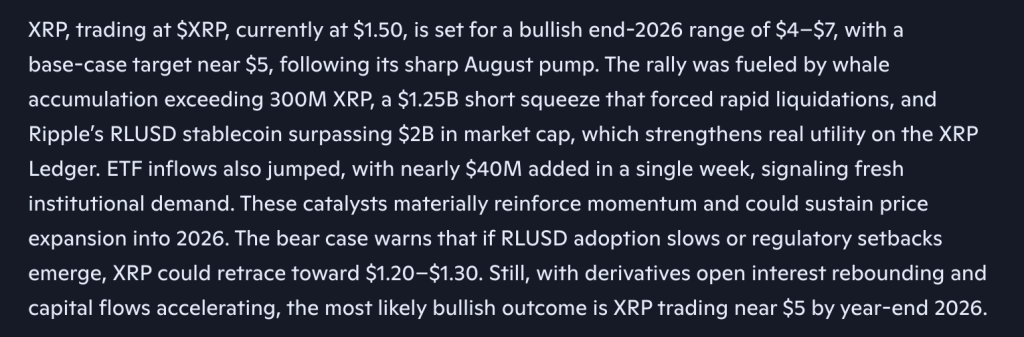
A rally of a few days has repriced an entire year of drift. The latest Microsoft Copilot AI price prediction leans into that, and the model predicts Ripple (XRP) reaching $4 to $7 by the end of 2026, with a base case near $5.
XRP price trades at $1.50 as that call gets made. The August pump is what changed the math.
Whales moved first. Accumulation exceeded 300 million XRP, tightening available supply before the move even registered on most screens.
Then the leverage broke. A $1.25 billion short squeeze forced rapid liquidations and turned a quiet bid into a vertical repricing.
Underneath the speculation, there is real usage. Ripple’s RLUSD stablecoin has surpassed $2 billion in market cap, which strengthens genuine utility on the XRP Ledger.

Institutions are showing up too. ETF inflows jumped by nearly $40 million in a single week, a clear signal of fresh demand rather than retail churn.
Copilot reads these catalysts as materially reinforcing momentum. Together, they could sustain price expansion well into 2026.
The bear case has two triggers. If RLUSD adoption slows or regulatory setbacks emerge, XRP retraces toward $1.20-$1.30.
Neither is guaranteed. With derivatives open interest rebounding and capital flows accelerating, Copilot still frames $5 by year-end 2026 as the most likely bullish outcome.

Make Your Prediction Count With $25 For Free on Kalshi
XRP Price Prediction: Microsoft Copilot AI Predicts the Pump Becomes a Trend
Context makes this breakout look larger than it is. XRP traded above $3.40 last September and spent the following eleven months bleeding value in stages.
February 2026 was the capitulation, with the price flushing to $1.13. What followed was a six-month range roughly between $1.30 and $1.60, then a June breakdown that parked XRP flat at $1.00.
That $1.00 shelf held through July and most of August. Last week it snapped, with price spiking to $1.68 before pulling back.
Now comes the digestion phase. XRP closed at $1.50054, up $0.03841 for a gain of 2.63%, with a session range from $1.43474 to $1.55082.
Resistance sits at $1.55082 first, then the $1.68 spike high, then the old $1.80 shelf. Support runs through $1.43474 and $1.30, with $1.00 as the structural base.
RSI reads 86.45 against a signal line at 51.64. That gap of nearly 35 points is the widest reading on this entire chart.
Nothing about that is sustainable at face value. Buyers are in full control, but the indicator has outrun its own average by a distance that usually demands rest.
Where XRP rests decides everything. Consolidate above $1.43, and the path toward $5 stays credible into next year.
Never Miss a Swing Again: Use AI Copy Trading Bots From CryptoHopper
XRP Has Already Made the First Move. Kalshi Lets Traders Position for What Decides the Second.
A short squeeze can ignite a rally, but it cannot decide whether XRP reaches $5. That depends on what happens next: stablecoin adoption, ETF flows, regulatory developments, and whether fresh demand continues to absorb supply.
Kalshi gives traders another way to express those views before XRP itself prices them in.
(Source: Kalshi XRP)
The platform lets users trade directly on real-world outcomes across crypto, regulation, politics, economic data, Fed decisions, and other events that can move markets. Instead of taking another position in XRP after a vertical rally, traders can isolate the catalyst they believe matters most and trade the outcome itself.
That becomes especially relevant with RSI already above 86. XRP may need time to cool, but the events shaping the longer-term thesis will keep moving while price consolidates.
Eligible new users who join Kalshi through CryptoNews can also receive $25 through our referral link.
The post We Told Microsoft Copilot AI to Be Brutally Realistic About XRP Predicts, This Was Its Target appeared first on Cryptonews.
Strive purchased 1,110 Bitcoin for about $81.5 million last week, bringing its total holdings to 21,356 BTC. According to a Monday filing with the US Securities and Exchange Commission, the company paid an average of $73,409 per Bitcoin (BTC), including fees and expenses, for purchases made between Aug. 17 and Aug. 21.
Strive’s cash and cash equivalents rose by $17.1 million to $171.9 million over the period, while its Class A shares outstanding increased by 3.65 million to 79.89 million. Bitcoin was trading near $79,000 on Monday, about 8% above the average price Strive paid for its latest purchase.
The purchase lifted Strive to the seventh-largest publicly traded corporate BTC holder, behind Bullish and ahead of SpaceX, according to BitcoinTreasuries.NET data. Its Nasdaq-traded ASST shares were up more than 11% in Monday morning trading, poised to extend their roughly 36% year-to-date gains, according to Yahoo Finance data.
“The upside is not simply Bitcoin going higher. It is Bitcoin becoming the fastest horse inside an expanding scarcity trade while $ASST is structured to amplify that outcome as much as we can responsibly support,” CEO Matt Cole said in a post on X ahead of Monday’s market open.
Strive operates a Bitcoin treasury strategy alongside an asset management business that manages nearly $3 billion across exchange-traded funds and a direct-indexing platform, according to the company.
It also held 505,000 shares of Strategy’s STRC preferred stock valued at $48.6 million as of Aug. 21.
Related: Bitmine extends 14-month ETH buying pace as Ether breaks above $2.5K
Strive’s SATA returns to $100 par
SATA closed at $100.01 on Friday, returning to management’s targeted $99-to-$101 trading range after falling as low as $83.30 in late June. Strive narrowed the range from $95-$105 to $99-$101 in March and said it would not issue SATA through at-the-market or follow-on offerings below $100.
Strive launched SATA in November 2025, initially selling 2 million shares at $80 each for $160 million in gross proceeds. The variable-rate perpetual preferred stock has a stated amount and initial liquidation preference of $100 per share.
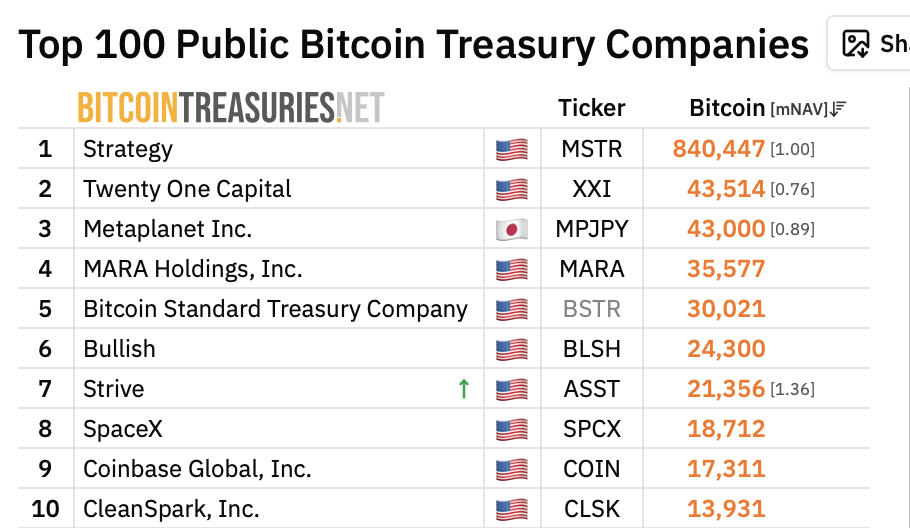
Top 10 publicly traded companies by Bitcoin holdings. Source: BitcoinTreasuries.NET
Unlike Strive’s common stock, SATA is designed as an income product, with a variable dividend rate intended to help keep the shares trading near $100. Strive raised the annualized dividend rate to 13% in April and switched from monthly to daily dividend payments beginning June 16.
SATA is similar to STRC, the variable-rate perpetual preferred stock issued by Strategy, the world’s largest corporate Bitcoin holder. STRC was trading near $97 on Monday, below Strategy’s $100 target, while Strategy reported no Bitcoin purchases for the week ended Aug. 23.
Magazine: Bitget CEO isn’t buying the Bitcoin rally — She’s waiting for $50K
Coinbase’s tokenized US stocks went live on Base Monday, alongside a Chainlink integration providing price data to support their use across decentralized finance applications.
Chainlink Data Feeds will provide continuous pricing for Coinbase’s tokenized stocks, including Nvidia, Apple, Meta and Alphabet. The data allows DeFi protocols to integrate the assets into lending markets, decentralized exchanges and structured products, including as collateral for borrowing.
According to Chainlink’s documentation, the feeds value each token using the underlying stock price and a Coinbase-supplied multiplier that accounts for dividends and corporate actions.
The stocks are issued as B20 tokens natively on Base, Coinbase’s layer-2 blockchain, and are available to non-US users in eligible jurisdictions. Each token represents a direct claim on an underlying share held with regulated broker and custodian Alpaca under an Abu Dhabi Global Market-supervised structure, according to Base. The tokens can be held in self-custody wallets and traded around the clock.
Base said the stocks can be integrated with existing DeFi infrastructure, including using tokenized Nvidia shares as collateral for loans on Aave or supplying tokenized Apple shares to decentralized exchanges. More Coinbase tokenized stocks are expected to launch on Base in the coming weeks.
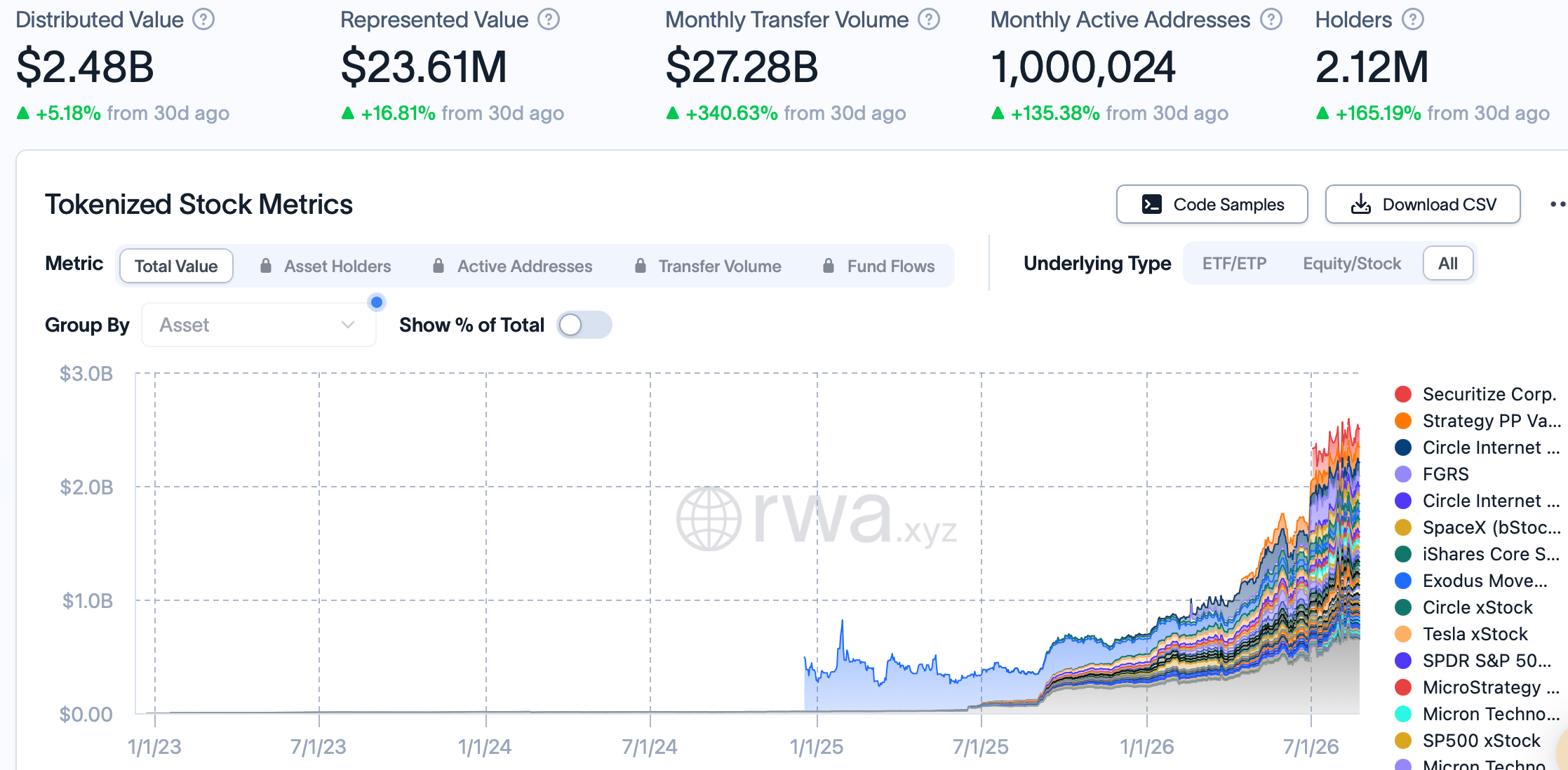
The news comes as the broader market for tokenized equities continues to grow. The total value of tokenized stocks has reached about $2.48 billion, up 5.2% over the past 30 days, according to RWA.xyz data. Monthly transfer volume has climbed to $27.28 billion, while the number of holders has surpassed 2.1 million.
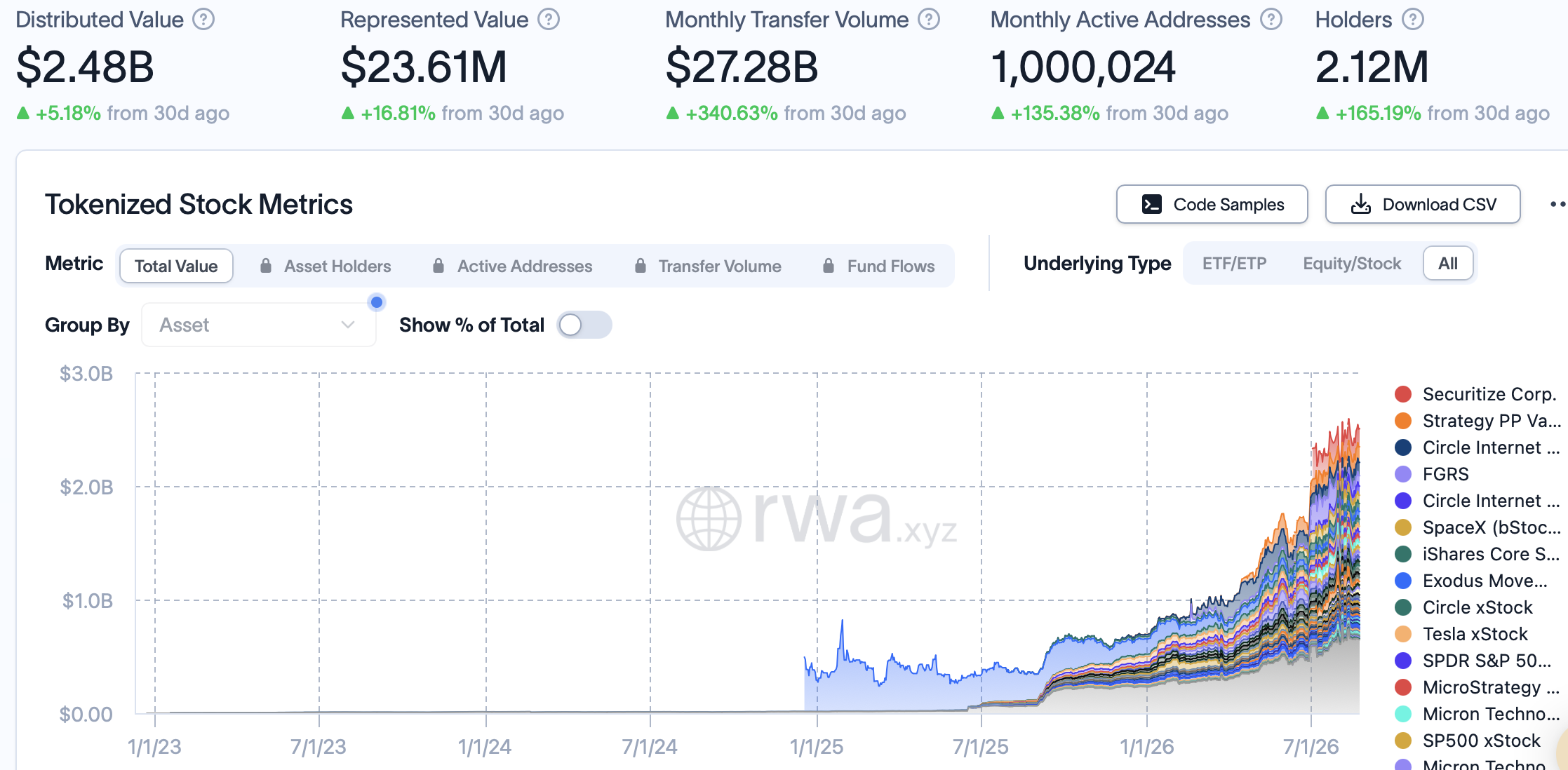
Tokenized stocks. Source: RWA.xyz
Magazine: Bitget CEO isn’t buying the Bitcoin rally — She’s waiting for $50K
Analysts at Bernstein are bullish on stablecoin issuer Circle, arguing that a new growth cycle for its USDC stablecoin could provide a significant boost for the company over the next 12 months.
In a research note published Monday, Bernstein said USDC (USDC) is showing signs of what it called “digital dollar reflation” after its supply increased by roughly $2 billion in seven days, reversing a six-month stretch of stagnant or declining growth. The firm maintained an Outperform rating on Circle (CRCL) and a $140 price target, implying roughly 60% upside from current levels. Circle shares have risen roughly 40% over the past month.
Bernstein said the next phase of stablecoin growth could be driven by several factors, including renewed momentum in crypto markets, greater regulatory clarity in the United States, tokenized capital markets and growing adoption of stablecoins for payments. The analysts also pointed to early signs of stablecoin use in payments made by artificial intelligence agents.
Although USDC remains the second-largest dollar-backed stablecoin by market capitalization, well behind Tether’s USDt (USDT), it has gained significant ground in transaction activity. Bernstein said USDC’s share of adjusted stablecoin transaction volume rose from roughly 40% in 2025 to more than 60% so far in 2026, overtaking USDt by that measure.
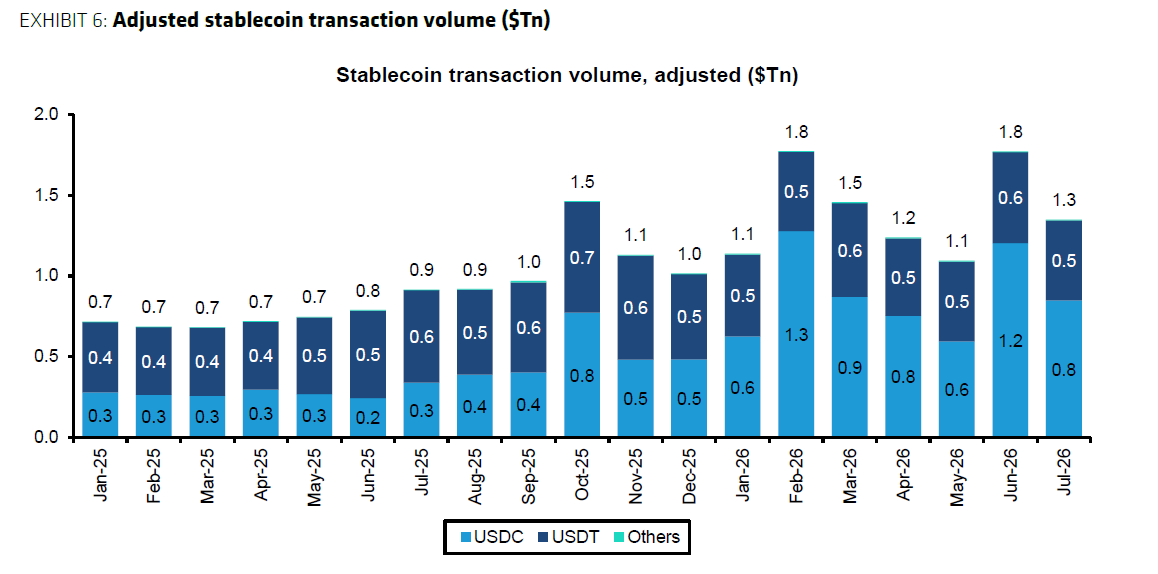
Stablecoin transaction volume has grown significantly this year. Source: Bernstein
Related: MiCA is coming for DeFi vaults, but regulation will be difficult
Circle’s volatile path since its IPO
Circle shares have experienced significant swings since the company went public in June 2025. The stablecoin issuer priced its shares at $31 and raised roughly $1.1 billion in its initial public offering. After surging in the months following its debut, the stock had fallen back toward its IPO price by November 2025 as a broader crypto market downturn weighed on publicly traded companies with exposure to the sector.
In its most recent quarter, Circle reported $701 million in revenue and $48 million in net income, both up from a year earlier.
Related: Western Union brings stablecoin remittances to Visa network with Stablecard

“America has been carrying Canada for decades, but no longer!” Trump said in his post. “The U.S.A. will always be far bigger, richer, and stronger than Canada. Without the United States, Canada couldn’t survive — It’s where they get all of their money and, because of their current bad leadership, primarily Governor Carney, and his Flunky, Ford, they will not be allowed to keep taking advantage of the United States — Their key to survival.”
Trump referred to Ontario Premier Doug Ford, who has been a vocal critic of the tariffs that the Trump Administration has imposed or threatened to impose on Canadian goods. In addition to calling Ford Carney’s “Flunky,” Trump said the Premier was “the less charismatic, intelligent, and overall unimpressive brother of the late, great, Rob Ford,” a former mayor of Ontario’s capital, Toronto.
Tensions between the allied countries have escalated in recent days. Trump claimed earlier last week that, “subject to the finalization of documents,” the two nations had reached a deal, but trade negotiations between the two broke down on Friday, and both sides have pointed the finger at the other.

Six out of 13 firefighter deaths have involved entrapments, the report shows. An average of 17 firefighter fatalities occur each year from wildfires.
Hotter, drier, and windier conditions
Wildfire trackers often use the “30-30-30” rule to identify conditions that can lead to extreme wildfires. The rule refers to when the temperature is at least 30 degrees Celsius (86 Fahrenheit), humidity is at 30% or lower, and wind speeds are at 30 kilometers per hour or more (roughly 19 miles per hour). When combined, these hot, dry, and windy conditions can produce extremely large and destructive fires, as they have this year.
Reno has experienced an average daily high temperature of 92.8 degrees Fahrenheit (33.7 Celsius), 27% humidity, and 18 miles per hour (29 kilometers per hour) daily maximum wind speed over the last 10 days, including the week before the “Hawk” fires began on Saturday and the three days since as the blaze continues.

Bitget CEO Gracy Chen says she does not view Bitcoin’s recent surge toward the $79,000 area as proof the bear market is finished. In an interview on Trade Secrets, Chen argued that downside could still be ahead and indicated she is prepared to keep a large portion of her own portfolio in stablecoins while waiting for a better entry level.
Chen said she would personally look to buy Bitcoin again if the market drops by more than $25,000 from current levels—pinning that “buyback” zone around $50,000. She also cautioned that she does not have special insight into Bitcoin’s next move, while acknowledging that traders can still debate where the year ends.
Key takeaways
- Bitget CEO Gracy Chen is keeping a significant share of her portfolio in stablecoins while monitoring for a possible deeper pullback.
- Chen’s personal Bitcoin re-entry level centers around roughly $50,000, rather than assuming the rally marks a lasting floor.
- She does not expect her timing to be perfect and explicitly avoids committing to a specific month for a $50,000 move.
- Chen says most of her portfolio is Bitcoin and the S&P 500, with small allocations to assets like Ethereum and Solana.
- On altcoins, she appears selective—citing Hyperliquid as the one she is currently more bullish on, conditional on regulatory access in the US.
Why Chen isn’t treating $79,000 as the end of the decline
Bitcoin’s climb over the past week has pushed it to levels near $79,000, but Chen’s reaction is cautious. She framed the rally as something that could still be followed by volatility and a meaningful retracement, rather than an automatic signal that the long downturn is over.
In the same interview, Chen described her approach as pragmatic: she is not trying to predict the exact path of an asset known for sharp reversals. Instead, she is watching for a specific kind of opportunity—a pullback she believes could be large enough to justify adding back exposure.
Chen told Trade Secrets that while she is keeping her expectations open, her personal “sort of price” target for a buyback sits around $50,000. She put it in practical terms, saying she could act if Bitcoin falls by more than $25,000 from where it is now.
Importantly, Chen also avoided presenting her view as a broader forecast. She said she lacks any proprietary edge in timing Bitcoin’s unpredictable market and compared herself to an exchange operator rather than an analyst “good at analyzing Bitcoin price,” emphasizing her role in providing a trading venue.
Other traders still see more downside before the next leg
Chen’s caution is not an outlier in crypto circles. The interview surfaced multiple perspectives suggesting that even with Bitcoin up strongly over a short period, deeper drops remain plausible.
Earlier this month, Transform Ventures founder Michael Terpin told Trade Secrets that “we still have more pain to go,” arguing Bitcoin could eventually fall far from its October 2025 all-time high of $126,100. Terpin’s scenario—described in the interview as a potential 66% decline—would imply a move into the “40s.”
Before this week’s rally, veteran trader Peter Brandt similarly pointed to a potential “bottom on Oct. 4,” according to prior coverage cited within the interview.
While these figures differ in magnitude and timing, the common theme is that traders are separating “short-term strength” from “cycle confirmation.” Chen’s stablecoin posture reflects the same idea: wait for price to reach a level that better matches her risk-reward, even if momentum has already improved.
Chen’s Bitcoin plan: no exact date, but an expectation for volatility
Although Chen anchored a buyback area around $50,000, she was careful not to attach a firm timetable to it. She said her own prediction is not meant to be treated as a precise catalyst or schedule.
Chen explained that she does not have a specific month in mind, offering only a range of possibilities—suggesting “later this year might be a good estimate,” but also saying “maybe next year” is possible.
Her stance matters for readers because it highlights a difference between conviction and commitment. Chen’s view is directionally cautious, but she is not claiming certainty on timing—an approach that aligns with how many traders manage uncertainty in a market that can swing quickly.
Portfolio preferences: Bitcoin focus, minimal altcoin exposure
Beyond price levels, Chen’s comments also shed light on how she approaches risk across the broader market. She said that most of her portfolio is split between Bitcoin and the S&P 500, while noting she does not actively trade much because of her responsibilities running a major exchange.
Chen estimated that less than 1% of her portfolio is allocated to Ethereum and Solana combined, reinforcing the idea that her current exposure is relatively concentrated rather than broadly diversified across many major tokens.
She is also openly selective about altcoins. While running a platform that lists many different assets, Chen said she is “not particularly” enamored with altcoins and singled out one asset as currently more compelling: Hyperliquid. She said she is bullish on Hyperliquid (and referenced the HYPE token’s strong move) in the context of a more crypto-friendly regulatory posture toward the network.
The interview further connected Chen’s enthusiasm to a US regulatory development. She stated that if the CFTC finds a way to allow Hyperliquid to enter the US market properly, it would be a major factor in her optimism. The article notes that President Trump indicated this week that CFTC chair Mike Selig was working on allowing Hyperliquid to officially trade in regulated US markets.
Chen also voiced skepticism toward memecoins, saying she believes the market will not repeat a “memecoin season” like in prior cycles because too many retail investors have been burned. Her remark included the idea that “retails are not stupid,” framing her view as a response to investor experience rather than a claim about any one token’s fundamentals.
On the $1M narrative and Bitcoin’s diminishing cycle returns
In addition to short-term trade levels, Chen addressed a longer-running topic on Trade Secrets: whether Bitcoin can realistically reach $1 million by 2030. She said she does not believe it will happen.
Chen referenced Bitcoin’s shrinking returns across its four-year cycles as a central reason. According to her explanation, the ratio between the all-time high in one cycle and the all-time low in that same cycle has been decreasing over time—implying that future cycle rebounds may not scale in the same way as earlier periods.
Her perspective comes alongside broader debate mentioned in the interview, including bullish calls from figures such as Brian Armstrong and Cathie Wood, but Chen’s argument is anchored in a repeated pattern she believes has emerged from past cycles.
For readers, the main takeaway is that even as Bitcoin regains momentum, market participants are still split between “cycle bottom confirmed” and “rally before deeper retracement.” Watch whether Bitcoin can hold above key levels that traders treat as near-term support; just as importantly, pay attention to whether exchanges and regulated access narratives—such as those involving Hyperliquid—continue to shape where liquidity flows across the ecosystem.
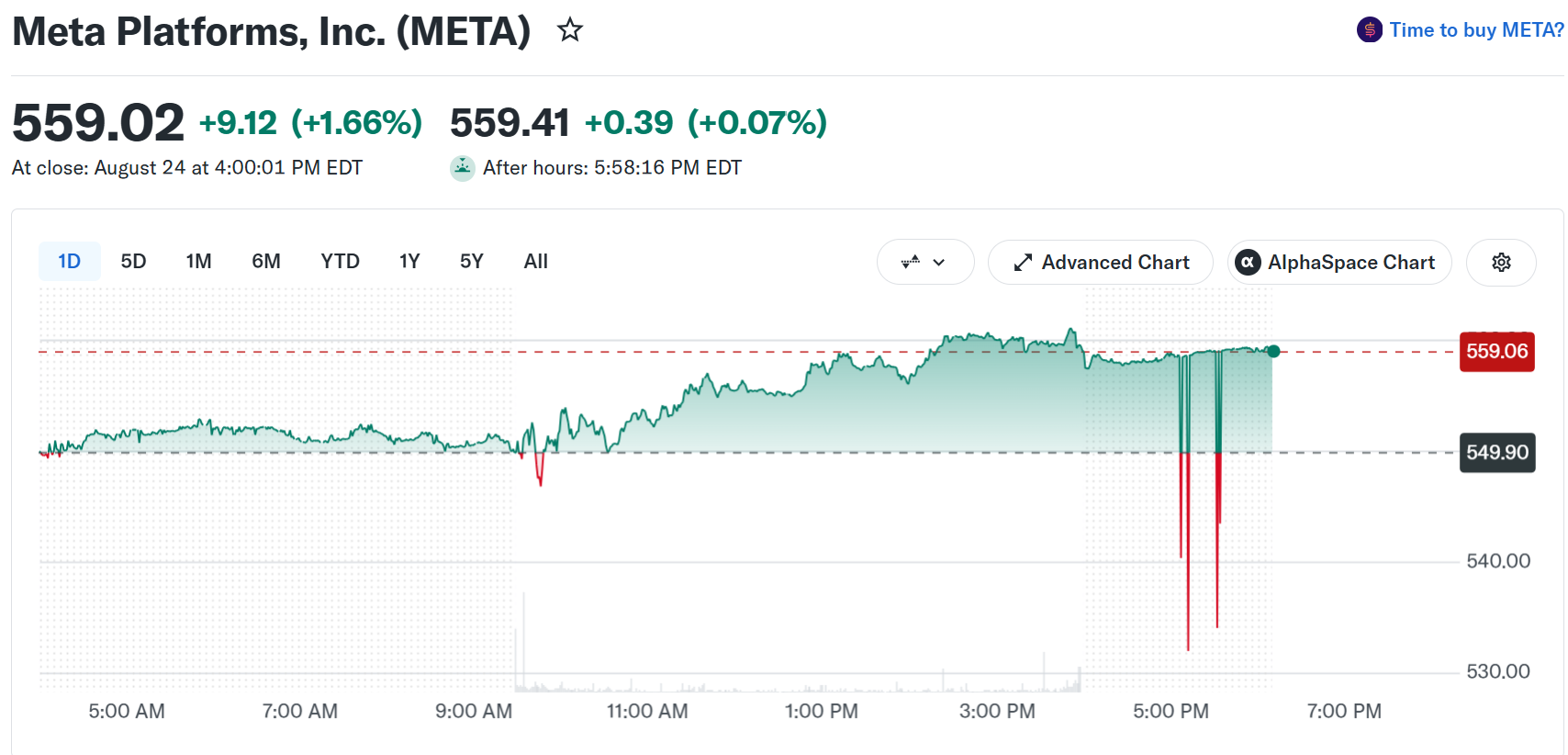
Jim Cramer told investors not to sell Meta Platforms (META) over the youth-safety trial in Oakland, California. He argued the legal pressure is temporary and the shares reward patience.
Meta stock trial risk has weighed on the shares all year. They closed Monday at $559.02, up 1.66%, valuing Meta near $1.42 trillion.

What the Meta Stock Trial Risk Actually Covers
Opening arguments in the case, brought by 29 state attorneys general, began on August 18. The states accuse Meta of designing Facebook and Instagram to be habit-forming for minors, then downplaying the danger.
Judge Yvonne Gonzalez Rogers will decide the outcome, because the jury is advisory only. She has already discarded claims tied to infinite scroll and autoplay.
Meta leans on Section 230, the federal law shielding platforms from liability over user posts. The states attack design, not content.
The $1.4 Trillion Figure Is a Ceiling, Not a Demand
No state has asked for $1.4 trillion. The number is a theoretical maximum, alleged violations multiplied by the fines written into state law.
Meta surfaced the calculation in a July 7 filing and asked the court to reject it. The states’ filings remain sealed, and they have never named a figure.
California Attorney General Rob Bonta accused Meta of promoting the number to make the case look unreasonable. Asked for a fair penalty, he pointed to revenue.
“They generated revenue of $200 billion last year, so, you know, maybe that amount would be appropriate. Maybe more. Maybe less,” Rob Bonta, quoted by NPR on Aug. 18.
New Mexico’s separate case ended in $942 million of penalties, a fraction of the number greeting the landmark youth-safety trial.
Cramer and Wall Street Split on Meta Stock
Cramer made his case on X six days ago, blaming the venue, not the merits.
“Meta trial in the worst possible district for corporate defendants, hence why the stock is being hammered. But the case, while strong enough, might not survive a supreme court review,” Jim Cramer, host of CNBC’s “Mad Money,” in a post.
Bank of America kept its Buy rating and $810 price target, implying roughly 45% upside on 16 times estimated 2027 earnings.
Mizuho is warier, comparing the case to the Big Tobacco fights of the 1990s. Forced product changes would bruise sentiment faster than any fine.
The Inverse Cramer Trade Has a Losing Record
Fading Cramer is a standing market joke, and BeInCrypto covered the latest inverse Cramer episode days ago.
The record does not reward it. Tuttle Capital’s Inverse Cramer Tracker ETF (SJIM) ran from March 2023 to February 2024, losing 15% while the S&P 500 gained 25%.
Quiver Quantitative still tracks the trade, showing a 42.57% win rate and a 17.63% loss over the past year.
Selling Meta because Cramer said hold is therefore a weak thesis. Of 43 analysts tracked by TipRanks, 38 still rate the stock a Buy and none a Sell.
The consensus reads Strong Buy, with an average 12-month target of $752.38. That sits 34.59% above Monday’s close.
Targets run from $580 to $1,000, so even the lowest sits above where Meta trades today.

The stronger bear case sits with Mizuho and the remedies, not with the messenger. Meta’s bill for AI server hardware will test it long before the courtroom does.
The post Jim Cramer Cites Overblown Meta Stock Trial Risk: Is This A Sell Signal? appeared first on BeInCrypto.
The meme coin niche has been one of the biggest beneficiaries of the latest market pump, with Shiba Inu (SHIB) standing out as a prime example.
The price of the self-proclaimed Dogecoin killer has climbed to a three-month peak, and some industry participants believe there is still plenty of room for further growth. However, certain factors suggest the rally may not be as sustainable as the bulls would hope.
Parabolic Jump Incoming?
As of press time, SHIB trades at around $0.000005455 (per CoinGecko), marking a substantial 22% increase on a weekly scale. Its market capitalization has surpassed $3.2 billion, solidifying the token’s position as the second-largest meme coin.
According to Crypto Patel, the latest revival is nothing compared to what might be coming next. The analyst noted that SHIB has completed a 95% macro correction over the years and is now trading within a historical accumulation zone, where the weekly structure is repeating the fractals that preceded previous price explosions. That said, they claimed the coin could be gearing up for a 2,200% rally.
The analyst’s bullish scenario includes a weekly close above $0.000006697, which, combined with a successful retest and rising volume, might trigger the next HTF expansion. At the same time, a weekly close below $0.0000035 would invalidate the current accumulation thesis.
Crypto With Gopal presented an even more optimistic prediction. He opined that SHIB has printed a textbook falling wedge formation and is consolidating inside a long-termsedcending structure, with sellers losing momentum as price compresses near the lower boundary. The analyst assumed that a clean break above the upper trendline could fuel a major rally to as high as $0.00025, or a nearly 5,000% increase from the current levels.
“Bulls are waiting for confirmation – major breakout could be next,” he added.
It is important to note that some popular market observers touched on SHIB prior to the latest market revival. Last week, David Gokhshtein claimed that people writing off DOGE, SHIB, and PEPE “are going to be in a rude awakening.” For their part, Whale News Daily suggested that Shiba Inu’s ignition will be “epic” and that it will start a proper altseason.
The Concerning Signals
Despite the positive performance, certain elements suggest that SHIB may not be completely out of the woods. Data show that Shiba Inu’s burn rate has declined by more than 91% over the past month, meaning the asset’s supply remains enormous after the team and community have scorched only a negligible amount of coins.

Next on the list is Shibarium’s waning activity. Daily transactions processed on the layer-2 scaling solution are in the mere thousands, signaling weak user engagement and potentially undermining investor confidence.

The post Top Shiba Inu Price Predictions as SHIB Soars 22% in a Week appeared first on CryptoPotato.

Why some US restaurants are banning tips

BitMine Is About to Own 5% of Ethereum, Tom Lee Reveals What Comes Next

A 6’2″ Corner with a Vikings Connection Sits in a Tricky Spot. Does a Trade Make Sense?





-

 Fashion3 days ago
Weekend Open Thread: Madewell – Corporette.com
-

 Business2 days ago
Musk’s Tesla, SpaceX Confirm $16.8 Billion ‘Terafab’ Chip Plant as World’s Largest Building in Texas
-

 Crypto World3 days ago
anatomy of crypto’s biggest liquidation event since 2021
-

 Business6 days ago
SMA Solar Technology AG (SMTGY) Q2 2026 Earnings Call Transcript
-

 Tech7 days ago
Qwen3.8-27B runs frontier-class coding agents and reasoning locally, no cloud API required
-

 Politics3 days ago
6 months on, Irish renters crushed by effects of government housing bill
-
 NewsBeat3 days ago
The ‘Lucky Dip Gang’ causing carnage for clicks: After five thugs were killed speeding in the wrong direction on a motorway, GUY ADAMS investigates a sick new trend… and why police aren’t even allowed to pursue them
-

 Tech6 days ago
GLM-5.3 hits the API at $1.4/$4.4 per million tokens
-

 News Videos5 days ago
Don’t Leave Your Financial Future To Chance | August 19, 2026
-
Tech7 days ago
5 Of The Most Reliable Car Brands To Consider If You’re Buying A Used SUV
-

 Business2 days ago
Mystery AI Model ‘Ox Alpha’ Draws Developers With Free Access as Chinese Lab Origins Remain Debated
-

 Tech7 days ago
Keychron K8 Ultra 8K review: a great value keyboard with comfort issues
-

 Business6 days ago
Stock Market Today: Tech Futures Slide As Treasury Yields Jump; Nvidia, Micron, Sandisk Sell Off
-

 Business5 days ago
Marvell Shares Jump 7% as Google Chip Deal Confirms Custom AI Silicon Partnership, Analysts
-

 Business4 days ago
Five Below: Kids Discount Retailer Reaps Rich Rewards
-
Business7 days ago
Fabrinet (FN) Q4 2026 Earnings Call Transcript
-

 Fashion7 days ago
The Dressier Side of Shorts
-

 Tech6 days ago
Ken Okuyama’s Kode89 Supercar Features Three Pedals and a Choice of V12s
-

 Politics6 days ago
The House Opinion Article | Security means more than military spending
-

 Business7 days ago
Nasdaq Ticks Higher as Wall Street Awaits Retail Earnings and Weighs Fed’s Next Move at Jackson Hole Meeting
You must be logged in to post a comment Login