

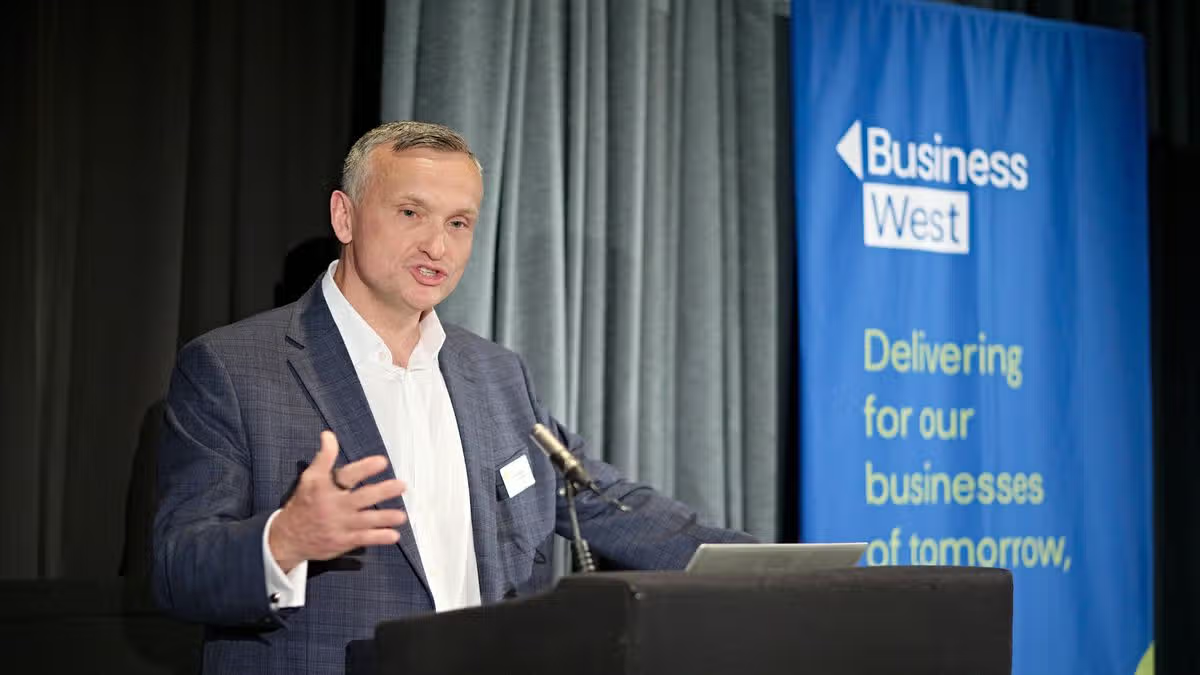
“I am keen to engage, listen and learn,” says Douglas Ure as he sips his coffee. The new chief executive of Business West – the historic West Country business support organisation and chamber of commerce – is sitting opposite me in a booth at Engine Shed, the innovation hub near Bristol Temple Meads.
He has travelled to meet me in Bristol from Somerset, where he now lives after spending more than a decade in South East Asia where he was working for US insurance giant Marsh, including a two-year stint in Jakarta as its chief executive. It’s the first interview he has given since taking the helm of Business West in January.
Ure has a warm demeanour and eight months into the role it is apparent he is making every effort to understand the needs of businesses across the region and, perhaps more importantly, his own organisation. The role he has taken on is a big one – it was held for three decades by former boss Phil Smith who retired in the spring – something Ure is “massively mindful” of.
He tells me he “didn’t really have a vision” on joining Business West, but there is no doubt he has a clear strategy for the organisation. He also credits his commercial background at Marsh – a global insurance broker and risk management firm – with landing him the role.
“That is probably one of the reasons Business West brought me in; it was that commercial background I have,” he says. “I don’t see us dramatically shifting our purpose [but] there are opportunities.”
Aside from growing membership, which has been flatlining in recent years, one of Ure’s main priorities is to start bringing more money into Business West, which employs around 150 people and is currently headquartered at Leigh Court on the outskirts of Bristol, although it operates across the South West including in Devon and Cornwall.
As a not-for-profit, Business West reinvests any money it raises into the business, but Ure is keen to ramp up revenue generation. At present, the organisation relies heavily on public sector contracts but Ure would like to pursue consulting work too.
“We want to be an active player in those [government] contracts but is there an opportunity to pivot into a more commercial consulting opportunity? The idea would be providing support for a fee to businesses – less than a large consulting business as we are not looking to make the same level of profit, but we do want to make sure we have money coming in.”
Another major focus will be examining Business West’s real estate footprint. Leigh Court, a grade II listed country house in Abbots Leigh that is currently the organisation’s HQ, was put up for sale for £5.5m last year. Ure refuses to be drawn on who is buying the building as the sale process is still ongoing, but admits once any deal is complete that Business West will become a leaseholder – in the short-to-medium term at least.

The Leigh Court estate in Abbots Leigh near Bristol(Image: Johnny Palmer – autonomous investments)
“The offices will transfer to the buyer and we will continue with our space there. Our members are predominantly Bristol and Bath based so we would want to be around [that area].”
But Ure says he wants to make a decision on where Business West’s staff are based in future – and how they collaborate – in the next 12 months, adding: “We would perhaps have 50 desks somewhere, mainly for our international trade team.”
Currently, around 90 per cent of Business West’s 150 staff have a hybrid-working pattern, without any official requirement to be in an office.
“When I first joined I did think we probably needed to be a bit more disciplined and structured around what we needed to do around our own people,” he says.
Ure admits that staff working on government contacts in Cornwall being based in an office in Bristol “makes zero sense”, but says he has a “genuine concern” about collaboration and sharing work with younger employees or helping new staff learn about the business and how it operates.
“I get quite a lot of value from sitting up in the office with the West of England Combined Authority (Weca) as that is where we hear from policy and the communications team, and you hear conversations they are having.
“I think, like most businesses, practices have evolved. [Business West] hasn’t taken a firm line about days in the office. There are different practices for different teams.”
‘It is easier to get things done in the North’
When asked about Andy Burnham’s plan to devolve more power to English regions such as the West Country, Ure believes it is “a good thing”. But could combining the Weca region with Devon and Cornwall to create a major South West powerhouse ever work?
“Combining all the geographies and regions across the South West definitely won’t happen. There is a benefit of having local communities, local councils, local authorities making decisions that benefit the economic area of their immediate vicinity,” he says.
On the economy, he refuses to be “too pessimistic”, but admits the current landscape is a challenge for many firms, with mounting concerns around inflation and the impact the geopolitical situation is having on international trade, exports and energy.
“There is definitely uncertainty but there is also resilience and optimism. A lot of businesses are quite bullish about their own growth opportunities with many feeling they will do better this year and next year than previously,” he says. “In the West, the cost of tax on businesses is high. The government is not flush with cash but if you overtax businesses you can strain growth and businesses are paying a lot more money on tax and so will have less to invest.”
Ure would like to see Burnham’s government offering tax credits or breaks for businesses to make it easier for companies moving into the region or for international firms coming in.
“It takes too long to get applications for planning sorted out. Organisations looking to build have to go through a lot of red tape although some local authorities are better than others.
“Some of our members tell us it is easier to get things done in the North of England than in the West of England. That is down to planning at a local authority level [but] it is also down to politics and if you are managing decision making across different political parties then that can slow things down.”
‘Bristol Airport is an important transport hub’

Bristol Airport’s Public Transport Interchange(Image: Bristol Airport)
One way to boost the West of England’s economy, according to Ure, is through its transport hubs such as Bristol Airport. Business West has long been a champion of the airport’s controversial expansion plans, and supports the latest application for the hub to increase capacity from 12 million passengers a year to 15 million.
“Bristol Airport is an important transport hub for the West of England,” says Ure. “I think it is important these organisations do things in a sustainable way and Bristol Airport has spent a lot of resources in making the airport as environmentally sustainable as it can be.
“Transport to and from the airport is obviously an issue, although improvements have been made, but making sure we have got a good economic hub and the ability to have more trade through the airport is important.”
He says he “appreciates the concerns” in the local community, though.
“Some of our employees are based around the airport and they are concerned about increased passenger numbers as they live there and it has a direct impact on people living around the area. But economically I think it is definitely the right thing to do.”
Ure believes the West’s wider transport infrastructure issues are also holding the region back, adding that connecting people from their homes to their work is “super important”.
“There is nothing more draining than sitting in traffic or having a really long commute,” he says. “There is some indication things are moving in the right direction, with the rail link from Portishead to Bristol, for example. But there is a long way to go and it requires massive investment and that is the challenge.
“We don’t have that much money in the West to invest the billions needed to make that right. Although there are some quick wins that are happening around buses and the expansion of the rail network that will help.”
‘AI is super important’
It’s not just transport and taxes posing a problem for businesses in the West it seems. Artificial Intelligence (AI) is already changing the business landscape and in the next few years Ure, for one, believes its use will become “super important” to small firms in particular.
“It is difficult to overemphasise what an impact AI is going to have,” he says. “There are efficiencies businesses can get by using AI – internally or in the supply chain. We face the same challenges as other businesses in some ways [and] we recognise there is a need for us to deploy and utilise AI.
“It is super important. We want to get our exec team and heads of department all well versed in the different AI tools and agents that are there to help them do their job better and then cascade that down. We are starting at the top.”
And looking to the top, how does Ure describe his own leadership style?
“I am quite democratic in that I am keen to engage, listen, learn and take input from colleagues and the exec team. I have spent a lot of time with the team to understand their priorities and get more input on the purpose of the organisation and what we do well and what we could do more of, and how we put that into our strategy.”
That strategy, he reiterates, is improving Business West’s financial strength. He has given himself 12 months to reach a place where the organisation “has room to move financially” and invest in more projects.
“Are you counting the 12 months from January, or from our meeting?” he laughs. “Let’s talk in 12 months from now and see how I’ve done.”






















































You must be logged in to post a comment Login