
Crypto World
Fed Chair Kevin Warsh Kept Quiet for 3 Months. Jackson Hole Might Change That.



80% of economists surveyed by CNBC want Federal Reserve Chairman Kevin Warsh to explain his economic thinking when he delivers his first Jackson Hole keynote on Friday.
The poll of 31 economists, strategists, and investors also shows deep division over how far he should go. Respondents split 48% to 48% on whether Warsh should address the rate outlook at all.
Warsh Silence Divides Wall Street
Warsh has said little about the economy or his policy outlook since taking office in May. This marks a departure from how earlier chairs handled the job. He has said this lets him get a cleaner view of market pricing, unfiltered by Fed guidance.
Most of the panel expects the silence to hold. The largest bloc, 45%, thinks Warsh says nothing about rates on Friday, against 32% who see a somewhat hawkish tone and 19% who expect neutrality.
Constance Hunter, chief economist at Economist Enterprise, argued that the strategy has pushed communication onto other officials and speeches.
“He has abdicated his role in communicating about the reaction function,” Hunter said.
Warsh’s premise has drawn support. Some 65% back the idea that the Fed should say less and lean harder on market signals about rates.
Views on the broader overhaul are less settled, with the panel split 40% to 40% on whether a Federal Open Market Committee (FOMC) majority supports his inflation-framework reform.
Follow us on X to get the latest news as it happens
Bessent Bond Push Faces Doubt
Meanwhile, Treasury Secretary Scott Bessent announced an increase in purchases of long-dated bonds last week. Some 77% of respondents expect the move to lower Treasury yields to fail.
The 10-year Treasury yield stood at 4.66% at press time. Survey respondents see the benchmark holding between 4.60% and 4.70% through next year.
Asked why yields climbed, the average respondent assigned 37% of the move to rising global debt supply and 28% to higher expected inflation. Fed rate expectations accounted for 21%, and a better growth outlook for 19%.
The rate path itself remains contested. Over the next year, 53% forecast hikes, 30% see cuts, and 16% expect no change. At the same time, fed funds futures price 40% odds of a September hike and 70% by December.
Inflation is projected to cool to 2.6% next year from 3.4% in 2026. For part of the panel, that decline occurs only because the Fed tightens first, leaving risk assets exposed on Friday.
Subscribe to our YouTube channel to watch leaders and journalists provide expert insights
The post Fed Chair Kevin Warsh Kept Quiet for 3 Months. Jackson Hole Might Change That. appeared first on BeInCrypto.



A cluster of 12 wallets deposited 36 million USDC into Hyperliquid during the 24 hours ending Aug. 27 and used about $24 million to purchase HYPE, according to on-chain analyst EmberCN.
Summary
- Suspected linked wallets deposited 36 million USDC into Hyperliquid through twelve addresses within one day.
- Twenty-four million USDC reportedly purchased 282,090 HYPE at an average price near $81.50 per token.
- EmberCN estimated the cluster held and staked 4.679 million HYPE worth approximately $381 million overall.
- No public a16z statement, filing or signed wallet proof confirms ownership of the reported addresses.
- Earlier analysts produced different cluster totals, showing attribution methods can materially alter calculated holdings considerably.
The wallets acquired 282,090 HYPE at an estimated average price of $81.50. EmberCN described the cluster as “suspected” of being connected to Andreessen Horowitz, or a16z, but the venture capital firm has not confirmed that attribution.
Public blockchain records can verify individual transfers, purchases and staking transactions. They cannot establish the legal owner of an address without additional evidence linking the wallet to a person or company.
HYPE wallets still hold $12 million in USDC
The cluster had converted approximately two-thirds of its newly deposited USDC into HYPE when EmberCN published the analysis. About $12 million remained available within the reported group of wallets.
The addresses appeared to divide purchases across multiple accounts rather than execute one large market order. Such activity can reduce the visibility and price movement associated with a single transaction, although the wallets’ exact execution strategy was not confirmed.
Three addresses cited by the analyst show Hyperliquid transaction histories that readers can inspect through Hypurrscan: one, two and three.
However, EmberCN did not publish a complete ownership proof covering all 12 addresses. Calculations can also change as wallets trade, transfer, stake or delegate tokens.
Reported HYPE position reaches $381 million
EmberCN estimated that the cluster’s accumulated and staked position had reached 4.679 million HYPE. At the market price used in the post, the holdings were worth approximately $381 million.
The analyst calculated an average acquisition cost near $65.60 and an unrealized profit of about $74.4 million. These remain estimates because the calculation depends on which addresses, deposits and internal transfers are included.
The same entity reportedly bought about $24 million in HYPE during June at an average price of $68.70. The latest purchase was made at a higher average price of $81.50.
HYPE traded near $81.40 on Aug. 27. The available evidence does not establish that the wallet activity caused any specific price movement.
A16z ownership remains unconfirmed
No public a16z portfolio announcement, regulatory filing or signed wallet message identifies the addresses as company-controlled. A16z has also not issued a statement claiming the HYPE purchases or staking position.
The wallets are therefore “suspected” to be associated with a16z, not confirmed institutional holdings.
On-chain analysts typically connect addresses through common funding sources, synchronized transactions, exchange withdrawals and interactions between wallets. These methods can identify coordinated activity but do not always reveal the entity directing it.
Earlier estimates also differed from EmberCN’s latest total. As crypto.news reported, wallets described as a16z-linked were previously estimated to hold 9.18 million HYPE.
Another analysis later claimed that suspected a16z wallets accumulated 6.906 million HYPE during 2026. The differing figures may reflect separate address clusters, transfers, sales or attribution methods.
Remaining USDC could signal further purchases
The clearest item to monitor is the roughly $12 million in USDC that had not been converted when EmberCN published the update. Further HYPE purchases would appear in the wallets’ public transaction records.
Transfers from staking accounts to exchanges or market makers could instead indicate repositioning or possible sales. Staking alone does not prove how long the entity intends to hold the tokens.
Confirmation from a16z, a signed wallet message or independently documented custody records would be needed to establish ownership. Until then, the $381 million position should be described as an analyst-attributed wallet cluster.


Tokenized deposits could make bank funding less stable and raise credit costs for US households and businesses, according to an analysis by two economists at the Federal Reserve Bank of Dallas.
Economists Rosie Levy and Srini Ramaswamy said instant settlement could allow depositors seeking higher yields to switch banks more quickly. They said programmable deposit tokens and agentic artificial intelligence could automate the transfers, shortening the time that deposits remain at individual banks and making them more sensitive to interest rates.
The economists estimated that if deposits became 10% more sensitive to interest rates, banks’ capacity to hold long-term loans and other assets could fall by about $700 billion. In a separate scenario, deposits remaining at banks for 10% less time could reduce that capacity by about $580 billion. Both figures are expressed in 10-year equivalents and do not represent direct reductions in lending.
The calculations are scenarios rather than forecasts and do not represent dollar-for-dollar reductions in bank lending. They come as US banks build shared blockchain networks designed to move tokenized deposits around the clock while keeping customer funds within the regulated banking system.
Banks develop networks for tokenized deposits
On Tuesday, 39 US state banking associations formed the BankChain Alliance to develop a nationwide network supporting tokenized deposits, stablecoins and automated settlement. The Clearing House is developing a separate network backed by JPMorgan Chase, Bank of America, Citi, BNY and Wells Fargo.
Banks have also begun connecting tokenized-deposit systems across institutions. On Aug. 20, Standard Chartered and HSBC completed a live cross-border transaction through Swift’s blockchain ledger, which linked the banks’ separate systems and recorded their resulting obligations before settlement through existing payment infrastructure.
Related: US regulator mulls guidance for tokenized deposit insurance, stablecoins
Levy and Ramaswamy said banks could respond to more volatile deposits by holding larger portfolios of highly liquid assets, including reserves and US Treasurys. They said banks could also rely more heavily on term debt to maintain their lending portfolios, although funding loans through wholesale debt would likely increase credit costs for consumers and businesses.
The authors cited Brazil’s Pix instant-payment system as a potential comparison, while noting that it is not identical to tokenized deposits. A 2025 study found that heavier Pix use increased banks’ holdings of liquid assets and reduced credit intermediation.
Magazine: SEC’s proposed crypto rules probably won’t spark new ICO boom
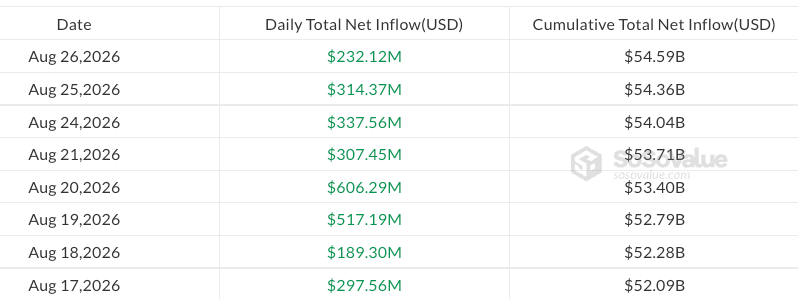
US-listed spot Bitcoin exchange-traded funds (ETFs) drew $232.1 million in net inflows on Wednesday, slowing from the previous day while extending their inflow streak to eight trading days.
The latest inflow was down about 26% from Tuesday’s $314.4 million and marked the smallest daily total since Aug. 18, according to SoSoValue data.
The eight-session streak has attracted about $2.8 billion, cutting year-to-date net outflows to about $2.03 billion. Cumulative net inflows rose to $54.6 billion, while total net assets reached $98.6 billion.
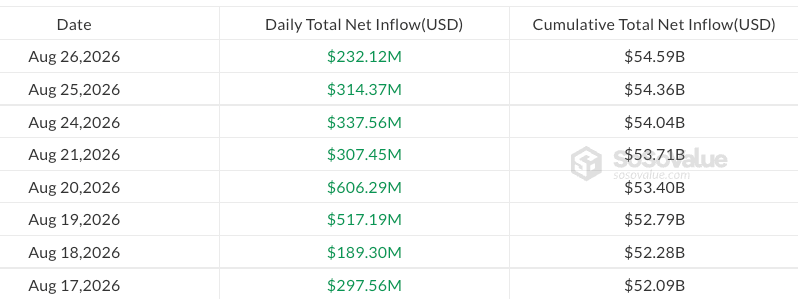
Daily inflows in US spot Bitcoin ETFs since Aug. 17. Source: SoSoValue
The slowdown came as Bitcoin stalled after briefly climbing above $80,000 on Tuesday. Bitcoin traded at about $78,759 at publishing time, down 0.3% over the past 24 hours, according to CoinGecko.
Despite Bitcoin’s stalled price action, crypto market sentiment strengthened on Thursday. The Crypto Fear & Greed Index rose to 71 from 65 a day earlier, remaining in “Greed” territory, according to Alternative.me.
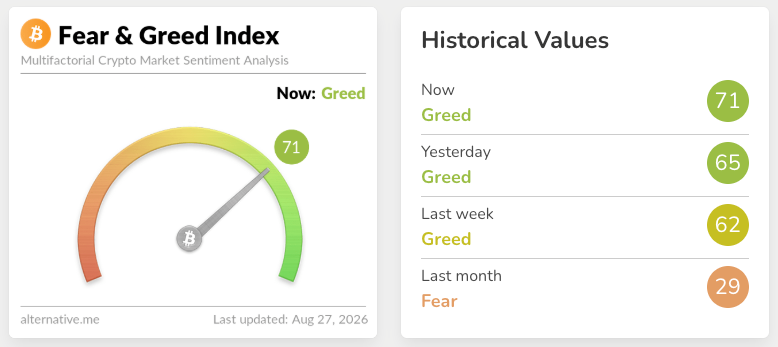
The Crypto Fear & Greed Index. Source: Alternative.me
Among altcoin funds, US spot Ether ETFs also recorded an eighth consecutive day of inflows on Wednesday, attracting $192.4 million.
US-listed spot XRP ETFs attracted $28.1 million on Wednesday, their biggest daily inflow since Jan. 5, according to SoSoValue. Cumulative net inflows reached $1.62 billion.
Related: Supply absorption ‘key question’ as Bitcoin fails to reclaim $80K: Analysis
The SHRINCS proposal would let bitcoin transactions use larger, quantum-resistant approvals while preserving more network capacity than existing post-quantum signature designs.
The SEC approved a privacy coin ETF the same month it proposed tighter rules for every other digital asset. That contradiction tells you more about what regulators actually fear than any speech or rulemaking ever could.
Summary
The last time a privacy coin dominated headlines, exchanges were delisting them. Binance dropped Monero in February 2024. OKX followed months later. The message from compliance departments was clear: assets designed to obscure transaction details were incompatible with global anti money laundering frameworks, and no amount of technical nuance would change that.
Eighteen months later, Grayscale rang the opening bell on NYSE Arca for ZCSH, the first exchange traded fund in the United States to offer direct spot exposure to Zcash. The product holds approximately $304 million in ZEC, custodied by Coinbase, and carries a 2.50% management fee with all proceeds directed toward Zcash ecosystem development. It is not a futures wrapper or a synthetic tracker. It is a fund that buys and holds privacy coins on behalf of investors who can now access them through a standard brokerage account.
That inversion from pariah to ETF did not happen by accident, and the mechanics behind it reveal something important about where regulators are actually drawing the line on financial privacy.
How the conversion worked
ZCSH is not a new fund. Grayscale established the Zcash Trust in October 2017, making it one of the oldest single asset crypto vehicles in the United States. For years it traded on OTC markets at persistent discounts to net asset value, sometimes exceeding 40%, because shareholders had no redemption mechanism to arbitrage the gap.
The conversion to an ETF changes that structure entirely. Authorized participants can now create and redeem shares directly against the underlying ZEC, which forces the market price to track net asset value within tight bands. The discount that defined the trust for years collapsed in the weeks before listing as arbitrageurs front ran the conversion.
Coinbase Custody International holds the underlying ZEC in cold storage. The fund’s prospectus specifies that only transparent (unshielded) Zcash addresses are used for custody, meaning the coins sitting inside the ETF are fully auditable on the public blockchain. This is a critical design choice: Grayscale gets to offer exposure to a privacy coin while ensuring the fund itself operates with the transparency that securities regulators require.
Why the SEC let it through
The regulatory path for ZCSH was not straightforward, but it was less contested than most observers expected. Two factors mattered.
First, the SEC completed a formal review of the Grayscale Zcash Trust in January 2026 and took no enforcement action. That review, which began in late 2024, examined whether ZEC qualified as a security under the Howey test. The conclusion was not a formal safe harbor or blessing, but the absence of action created enough regulatory clearance for Grayscale to proceed with the NYSE Arca listing.
Second, Zcash’s architecture differs from Monero’s in a way that regulators find meaningful. Zcash offers opt in privacy: users choose between transparent transactions that are fully visible on the public ledger and shielded transactions that use zero knowledge proofs to encrypt sender, receiver, and amount data. Monero, by contrast, applies privacy by default to every transaction using ring signatures, stealth addresses, and RingCT. There is no transparent mode.
That distinction matters because it allows compliance frameworks to function. An exchange listing ZEC can enforce know your customer rules on deposit and withdrawal addresses because those addresses can be transparent. The same exchange listing Monero cannot verify the origin of funds with the same confidence because the protocol obscures that information by design.
The SEC held a Zcash roundtable in 2025, the kind of structured engagement that Monero has never received. Whether that difference reflects a principled regulatory distinction or simply the politics of which assets have well funded advocacy organizations is an open question, but the outcome is clear: Zcash got an ETF, and Monero remains delisted from Coinbase, Robinhood, and most major Western exchanges.
The shielded adoption curve
The most important number in the Zcash ecosystem is not the ETF’s assets under management. It is the percentage of transactions using shielded pools.
As of July 2026, shielded transactions account for approximately 90% of all Zcash network activity. That figure was under 20% as recently as 2024. The shift happened for two reasons: wallet infrastructure improved, and community norms changed.
Zodl, the most popular Zcash mobile wallet, adopted shielded by default as a design decision in late 2025. Users no longer need to opt in to privacy. They need to opt out. That single UX change flipped the ratio. When the default is private, most users stay private.
The shielded supply pool now holds roughly 4.2 million ZEC, representing about 30% of the circulating supply. That pool has grown steadily even during periods of price decline, suggesting that the users moving coins into shielded addresses are doing so for functional reasons rather than speculative ones.
This creates an interesting tension with the ETF. The fund holds ZEC in transparent addresses for regulatory compliance, but the network those coins run on is increasingly opaque. Roughly 90% of non custodial Zcash activity is now invisible to chain analytics firms. The ETF offers a window into a room where most of the lights are off.
The privacy coin paradox
The timing of ZCSH’s launch is worth examining in context. The SEC proposed Regulation Crypto Assets on August 11, 2026, a framework that would impose new registration and disclosure requirements on virtually every digital asset offering in the United States. Two weeks later, the same agency’s inaction allowed a privacy coin ETF to begin trading.
Those two moves are not contradictory in the way they appear. The SEC’s framework targets issuers and intermediaries, not the assets themselves. A privacy coin is not inherently a security any more than a transparent coin is. What matters under existing securities law is how the asset is offered, sold, and promoted. Grayscale’s trust structure, with its registered prospectus, audited financials, and regulated custodian, satisfies those requirements regardless of what the underlying asset does at the protocol level.
But the optics matter. At least 10 countries, including Japan, South Korea, the UAE, and Australia, have banned or severely restricted privacy coins on exchanges. The European Union’s Markets in Crypto Assets regulation, which took full effect in late 2025, requires exchanges to implement enhanced due diligence for assets with privacy features. Several major European exchanges delisted ZEC preemptively.
The United States just moved in the opposite direction. The world’s largest asset manager by crypto AUM listed a privacy coin on the New York Stock Exchange. That signal will be difficult for other jurisdictions to ignore, and it may force a reexamination of blanket privacy coin bans that were enacted before opt in privacy architectures like Zcash’s were well understood.
What Monero’s absence reveals
The gap between Zcash and Monero’s regulatory trajectories is now the widest it has ever been. ZEC trades on Coinbase, Robinhood, and as of this week, NYSE Arca through an ETF. Monero is available on decentralized exchanges, peer to peer platforms, and a shrinking list of offshore centralized venues.
That divergence is not primarily about technology. Both protocols provide strong transaction privacy. The difference is political and structural. Zcash has the Electric Coin Company and the Zcash Foundation, funded organizations that engage with regulators, publish compliance guidance, and maintain relationships with exchanges. Monero’s development is decentralized and pseudonymous by design, which aligns with its philosophical commitment to privacy but leaves no entity to sit across the table from a regulator.
The market has priced this difference aggressively. ZEC’s market capitalization overtook Monero’s earlier in 2026, a reversal that would have seemed implausible two years ago when Monero was the undisputed leader in the privacy coin category. The ETF listing is likely to widen that gap further, as institutional capital flows to the asset that can be held in a brokerage account rather than the one that requires self custody and offshore exchanges.
Whether that outcome represents a victory for financial privacy or its domestication depends on which version of privacy you value. Zcash offers privacy you can choose. Monero offers privacy you cannot avoid. The market, and the regulators, have made their preference clear.
There is a third possibility that neither camp has fully reckoned with: the ETF itself could become the primary way institutions gain exposure to privacy technology without ever touching a private transaction. If most ZEC demand flows through ZCSH and stays in transparent custody addresses, the network could bifurcate into an institutional layer that is fully visible and a retail layer that is fully shielded, with minimal interaction between the two. That bifurcation would be unprecedented in crypto markets and would raise new questions about what “privacy coin” means when the largest holders operate in the open.
The price mechanics behind the 66% rally
ZEC’s surge from roughly $500 to above $850 in the week surrounding the ZCSH listing was not a simple “buy the news” event. The move had three distinct phases, each driven by different market participants.
The first phase began on August 18 when Grayscale filed its final amended registration statement with the SEC. Traders who had been tracking the regulatory timeline recognized that the filing removed the last procedural obstacle to listing. ZEC climbed from $510 to $640 over three days on spot buying concentrated on Coinbase and Kraken, the two US exchanges with the deepest ZEC order books.
The second phase was the trust discount collapse. The Grayscale Zcash Trust had traded at a discount to NAV for most of its existence, sometimes exceeding 40%. As the conversion date approached, arbitrageurs bought trust shares at the discount and simultaneously shorted ZEC to lock in the spread. When the conversion went live and redemptions became possible, those short positions needed to be covered, creating a squeeze that pushed ZEC from $640 to $780 between August 22 and August 24.
The third phase was the listing day itself. ZCSH began trading on NYSE Arca on August 25 and ZEC touched $855, its highest price since January 2018. Volume on centralized exchanges exceeded $1.2 billion in 24 hours, roughly five times the average daily volume for the preceding month. The move attracted momentum traders and triggered liquidations on leveraged short positions across multiple derivatives venues.
The rally left ZEC with a market capitalization above $14 billion, making it the largest privacy coin by a wide margin and placing it in the top 25 digital assets by market cap. Whether that valuation is sustainable depends on whether the ETF generates sustained inflows or whether the listing was a one time catalyst that front loaded months of demand into a single week.
The post quantum question
One factor that has received less attention than it deserves is Zcash’s roadmap for post quantum cryptography. The zero knowledge proofs currently used by Zcash (Halo 2, based on the PLONK proving system) rely on elliptic curve assumptions that a sufficiently powerful quantum computer could break. The same vulnerability applies to Bitcoin, Ethereum, and every other blockchain using elliptic curve cryptography, but for a privacy coin the stakes are higher: breaking the cryptographic assumptions does not just allow theft of funds but also retroactive deanonymization of every shielded transaction ever recorded.
The Zcash development team has been working on lattice based proving systems that would resist quantum attacks, with a preliminary specification published in Q2 2026. No timeline for deployment has been committed, but the research is further along than comparable efforts on other chains. For institutional investors considering a long duration allocation through ZCSH, the credibility of that post quantum migration path is material to the investment thesis.
The irony is that a quantum threat would affect transparent blockchains far sooner in practice, since those chains expose public keys directly. Zcash’s shielded pool, by hiding public keys behind zero knowledge proofs, actually provides a degree of quantum resistance that transparent chains lack, even before a formal post quantum upgrade.
The AI privacy thesis
Grayscale published a research report on August 20, 2026, titled “Zcash: Financial Privacy in the Age of AI,” arguing that the proliferation of artificial intelligence systems capable of analyzing public blockchain data creates a new demand driver for transaction privacy.
The argument is straightforward: as AI models become better at clustering addresses, identifying users, and inferring spending patterns from transparent blockchains, the privacy guarantees of unshielded transactions degrade. A transaction that was effectively private in 2020 because no one was analyzing it may be fully deanonymized in 2026 by automated systems scraping public chain data at scale.
Zcash’s zero knowledge proofs offer mathematical privacy, not merely practical obscurity. A shielded transaction is not private because no one is looking. It is private because the cryptographic proof reveals nothing about the sender, receiver, or amount, regardless of how much computational power is directed at it.
That distinction becomes more valuable as surveillance capabilities improve, and Grayscale is positioning ZCSH as a hedge against a future where transparent blockchains offer no meaningful financial privacy at all. The thesis is speculative, but the directional logic is sound: demand for privacy tends to increase when the tools for surveillance improve.
The report also highlights a less obvious dynamic: AI agents executing transactions on behalf of users will generate vastly more on chain data than human users ever did. An AI managing a portfolio, paying invoices, or rebalancing yield positions may execute hundreds of transactions per day, each one adding to a public record that can be analyzed, clustered, and attributed. The privacy implications of AI driven financial activity on transparent chains have not been widely discussed, but Grayscale’s framing positions Zcash as infrastructure for a world where most on chain activity is automated and the volume of analyzable data grows by orders of magnitude.
Chainalysis, Elliptic, and other blockchain analytics firms have not publicly commented on how their models perform against Zcash’s shielded pool. The absence of commentary is itself informative: if the shielded transactions were trivially deanonymizable, the analytics firms would say so, as doing so would reassure their exchange and law enforcement clients. The silence suggests the privacy guarantees are holding under real world conditions, which strengthens both the investment thesis and the regulatory tension.
Fee structure and ecosystem funding
The 2.50% annual management fee on ZCSH is notably higher than the fees charged by Bitcoin and Ethereum ETFs, which have compressed below 0.25% through competitive pressure. Grayscale’s Bitcoin ETF (GBTC) charges 1.50% and has lost market share to cheaper alternatives from BlackRock and Fidelity.
ZCSH faces no such competition. It is the only Zcash ETF in the United States, and no competitor has filed to launch one. That monopoly position allows Grayscale to maintain the higher fee, but it also means the fund has committed to directing all management fee revenue toward Zcash ecosystem development and marketing.
At current AUM of roughly $304 million, that fee generates approximately $7.6 million annually for the Zcash ecosystem. For a project whose development funding has historically depended on a block reward allocation that has been contentious within the community, a stable external revenue stream tied to ETF assets is a meaningful structural change.
The question is whether the fee will suppress demand. Institutional allocators building diversified crypto portfolios may balk at paying 2.50% for Zcash exposure when they can access Bitcoin for 0.20%. The counterargument is that ZEC’s uncorrelated privacy narrative and smaller market capitalization offer a different risk return profile that justifies the premium.
What to watch
Disclaimer: This article is for informational purposes only and does not constitute investment advice. Cryptocurrency investments carry significant risk. Always conduct your own research before making investment decisions. Published August 27, 2026.

A recent update from the XRP Ledger Foundation welcomed the TradFi giant, which has a long history with Ripple, to a hackathon taking place just ahead of the major conference, Ripple Swell.
Meanwhile, 21Shares’s XRP ETF has changed how it prices the underlying token amid renewed inflows into all such funds.
Mastercard Joins
The XRP Ledger Foundation said it was “thrilled” to welcome the global technology behemoth in the payments industry as a sponsor of the XRP Ledger Hackathon, scheduled for late October. It’s a 36-hour pre-event to the Ripple Swell 2026 conference, which runs from October 27 to October 29, while the hackathon is open on October 24-25.
“With a decade of proven robustness and architecture, the XRP network is ideally suited for payment use cases. Register, build, and connect with industry leaders like Mastercard. It’s your time to shine,” said the team.
This announcement comes just a few months after Mastercard expanded its relationship with the broader Ripple ecosystem, as well as other crypto giants. As reported in March, the TradFi firm enlisted several industry companies, such as Binance, Gemini, PayPal, Paxos, Circle, and Ripple, in a new partnership program aiming at connecting blockchain with its own vast global payments infrastructure.
In June, Mastercard took it a step further, expanding the blockchain integration with new support assets like Ripple’s own stablecoin, RLUSD, and Circle’s USDC.
ETF Changes to TOXR
An SEC filing showed that 21Shares has switched the pricing of the underlying assets for its XRP ETF (TOXR), moving from the CME Group to the new FTSE XRP Index, effective today.
The other notable change to their financial vehicle means the sponsor will be paid once every three months instead of every week. More importantly, the sponsor will be paid in XRP.
21Shares XRP ETF ($TOXR) just switched how it prices XRP moving from CME to the new FTSE XRP Index starting Aug 27.
They also changed how the sponsor gets paid now once every 3 months instead of every week, and paid in $XRP. https://t.co/I1dHswlJ9t pic.twitter.com/U6oHwAVlzi
— 𝗕𝗮𝗻𝗸XRP (@BankXRP) August 26, 2026
Meanwhile, the spot XRP ETFs have extended their impressive streak of net inflows, attracting $13.82 million on Monday, $24 million on Tuesday, and just over $28 million on Wednesday.
TOXR, however, remains the only XRP ETF in the red, with cumulative net flows of -$20.06 million. In contrast, Bitwise’s XRP ETF remains the largest of the bunch, currently holding $575 million in cumulative net inflows.
The post 2 Major Ripple (XRP) Updates: Mastercard Gets Involved, ETF Changes Announced appeared first on CryptoPotato.


Mirae Asset Group has set an initial target of building its digital asset business to 150 trillion won ($108 billion) and turning it profitable in 2027, using newly acquired crypto exchange Digital X as a central part of its “Mirae Asset 3.0” strategy.
Summary
- Mirae Asset is targeting 150 trillion won ($108 billion) for its digital asset business.
- Digital X will serve as a core part of the group’s Mirae Asset 3.0 strategy.
- The group plans to expand across crypto, stablecoins, RWAs and tokenized securities.
- Mirae Asset is targeting profitability for the digital asset business in 2027.
Digital X said Mirae Asset Group Chairman and Global Strategy Officer Park Hyeon-joo outlined the plan on Aug. 26 during an event for Digital X employees at the Four Seasons Hotel in Seoul, where the group presented its long-term strategy following the exchange’s recent change in ownership.
Park said Mirae Asset plans to build the digital asset unit around four main areas: cryptocurrencies, stablecoins, real-world assets, or RWAs, and security token offerings. The group also intends to digitize physical assets including gold, silver, and electricity as it develops products tied to blockchain-based finance.
“We will make Digital X a key pillar of Mirae Asset 3.0,” Park said. “Based on the group’s 1,500 trillion won in client assets, our first target is to grow the digital asset sector to 150 trillion won and achieve profitability in 2027.”
Digital X becomes the core of Mirae Asset’s digital asset plan
The strategy gives Digital X a defined role less than two months after Mirae Asset completed its takeover of Korbit and renamed the South Korean cryptocurrency exchange.
As crypto.news previously reported, Mirae Asset Consulting completed the acquisition of a 97.15% stake before the exchange began operating under the Digital X name. Park informed employees in July that Korbit had formally joined the group and would form part of the Mirae Asset 3.0 strategy.
Mirae Asset Consulting initially held 92.06% of the exchange and later bought the remaining 5.42% stake needed to bring its ownership to 97.15%. The transaction followed approval from South Korea’s Fair Trade Commission and was described in local reports as the country’s first acquisition of a crypto exchange by an affiliate of a traditional financial group.
Korbit’s existing trading, deposit, withdrawal and account services continued after the ownership change, while customer cash and virtual assets remained segregated from company assets under South Korea’s Virtual Asset User Protection Act.
At the Aug. 26 meeting, organized to welcome Digital X employees into the group and introduce Mirae Asset 3.0, Park moved beyond the initial acquisition plan by assigning numerical targets to the business.
Alongside the 150 trillion won asset target, the group plans to develop financial products and services that can operate through blockchain networks while using principal investment to support its digital asset operations.
Mirae Asset described the planned model as an “on-chain finance” ecosystem, covering both digital-native assets and tokenized versions of assets that have historically traded through conventional financial infrastructure.
Mirae Asset plans RWA, stablecoin and STO products
Under the strategy presented by Park, Digital X will work across crypto trading and products while Mirae Asset develops stablecoin, RWA and tokenized securities businesses using its existing financial operations and client base.
Real-world asset projects could include the digitization of gold and silver as well as electricity, according to the company. Mirae Asset did not disclose specific token structures, blockchain networks, launch dates or transaction sizes for the planned products.
The group’s tokenized securities plans are being developed as South Korea prepares a legal framework for blockchain-issued securities.
The Financial Services Commission said in May that detailed rules would be prepared for the country’s tokenized securities framework, ahead of amendments to the Capital Markets Act and Electronic Securities Act taking effect on Feb. 4, 2027.
Those changes are expected to recognize distributed ledger systems within regulated securities infrastructure, while the FSC has been studying the treatment of tokenized stocks, bonds and money market funds along with investor protection requirements.
Infrastructure is also being prepared for the market. Samsung SDS won a contract to build a production-ready token securities platform for the Korea Securities Depository, with completion scheduled around the time the new legal rules take effect in 2027.
Other financial groups have moved into the same area. Shinhan Asset Management and Shinhan Investment & Securities signed agreements with the Canton Foundation in June to study Korean tokenized assets, regulatory requirements and access to international markets through the Canton Network infrastructure.
The agreements included work on policy discussions and technical development, while Shinhan Financial Group said other affiliates could later participate in projects involving tokenized assets and digital finance.
Stablecoin plans are developing alongside new crypto rules
Stablecoins form another part of Park’s four-part strategy, although South Korea has yet to finalize the rules that will govern domestic issuance.
A policy report published in July by Hashed Open Research and the Solana Policy Institute proposed introducing interim licensing guidance while lawmakers continue negotiations over the country’s Digital Asset Basic Act.
The proposed stablecoin licensing framework would cover issuance and circulation, exchange conduct, disclosure requirements, internal controls and operational resilience. Lawmakers and regulators have also been discussing the role of banks and non-bank firms in issuing won-denominated stablecoins.
South Korea’s existing Virtual Asset User Protection Act primarily regulates custody, unfair trading and safeguards for customer assets, leaving stablecoin issuance and other market-structure provisions for a second stage of legislation.
The Financial Services Commission said in July that it planned to work with the ruling Democratic Party on consolidating 10 pending digital asset proposals into a government-backed bill. Areas under discussion include stablecoins, exchange operations, disclosure rules, internal controls and system resilience.
The Bank of Korea has separately argued that won-backed stablecoins should initially be issued through bank-led consortiums and has supported a statutory policy body involving financial regulators and other government agencies.
No final legislative structure for stablecoin issuance has been adopted, leaving Mirae Asset’s planned stablecoin products subject to rules still being negotiated by South Korean authorities.
Mirae Asset wants more finance to move on-chain
Beyond individual product categories, Mirae Asset plans to use Digital X to develop an on-chain financial ecosystem that combines blockchain-based products with the group’s existing investment operations.
Park said the company would identify new financial products and services using digital assets while supporting selected businesses through principal investment. Digital X had previously said it would maintain compliance systems covering anti-money laundering, know-your-customer checks, information security and fraud detection as it expands under Mirae Asset ownership.
During the employee event, Park also told staff to prepare for changes in financial markets without limiting themselves to established business models.
“You need to have the insight to look ahead and prepare for new changes in advance,” Park said, adding that employees should “continuously find new possibilities” instead of remaining within fixed frameworks.
The Aug. 26 event also served as the formal introduction of Digital X employees to Mirae Asset Group’s organizational culture and long-term business strategy following the completion of the Korbit acquisition.
Alibaba reported its first-quarter results on 20 August, revealing a mixed picture for investors. Revenue increased by 9%, driven by accelerating growth in its cloud computing and AI businesses, but net profit fell by nearly three-quarters as capital expenditure on AI infrastructure surged.
Management said it expects these investments to reach break-even within the next three years. Meanwhile, free cash flow turned negative as spending on computing capacity continued to rise. To finance the further development of its full-stack AI ecosystem, Alibaba also completed a new share offering on the Hong Kong Stock Exchange this week, raising approximately $10.2 billion. Investors responded cautiously to the combination of weaker earnings and equity dilution.
Technical Analysis of Alibaba
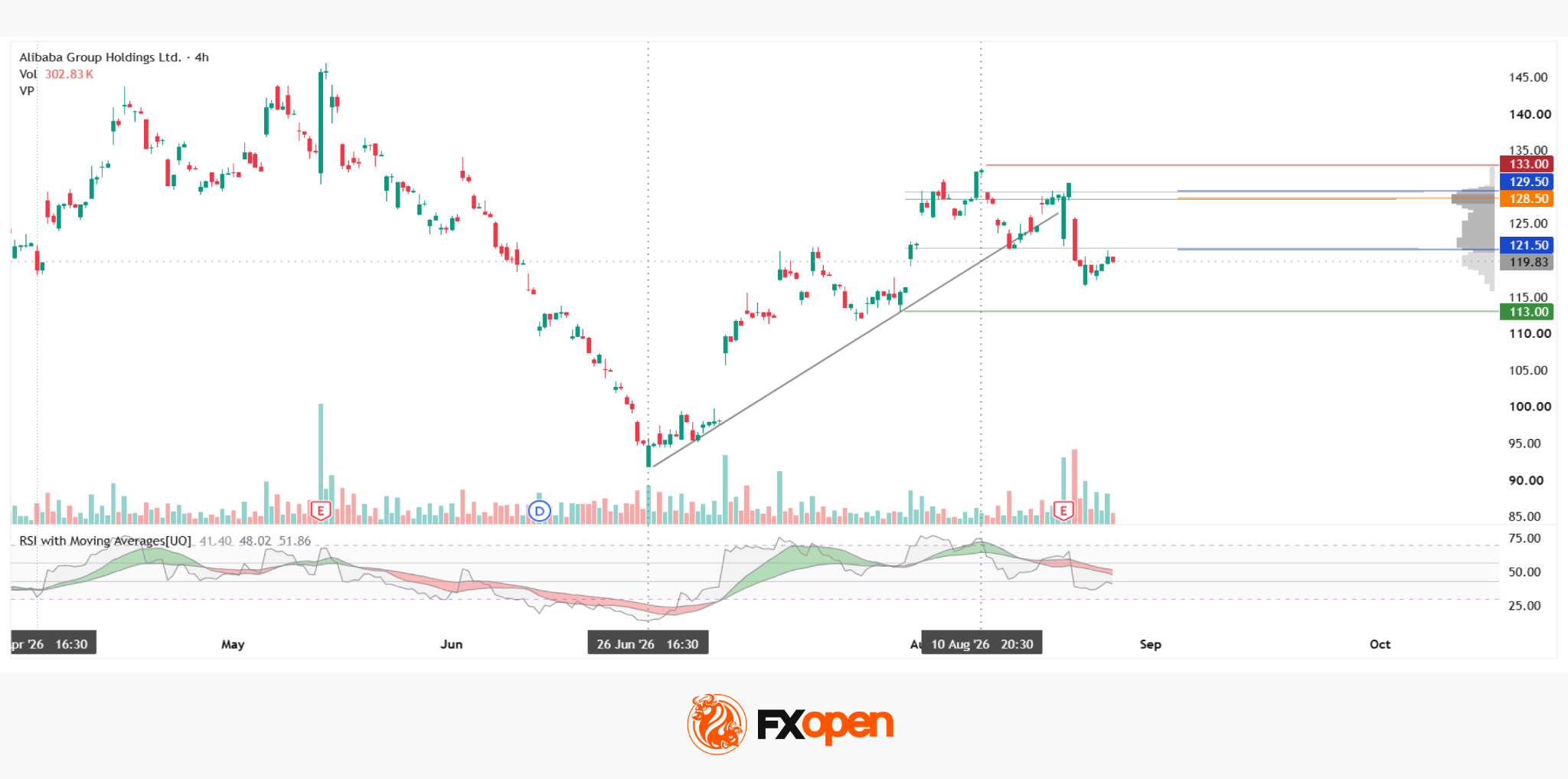
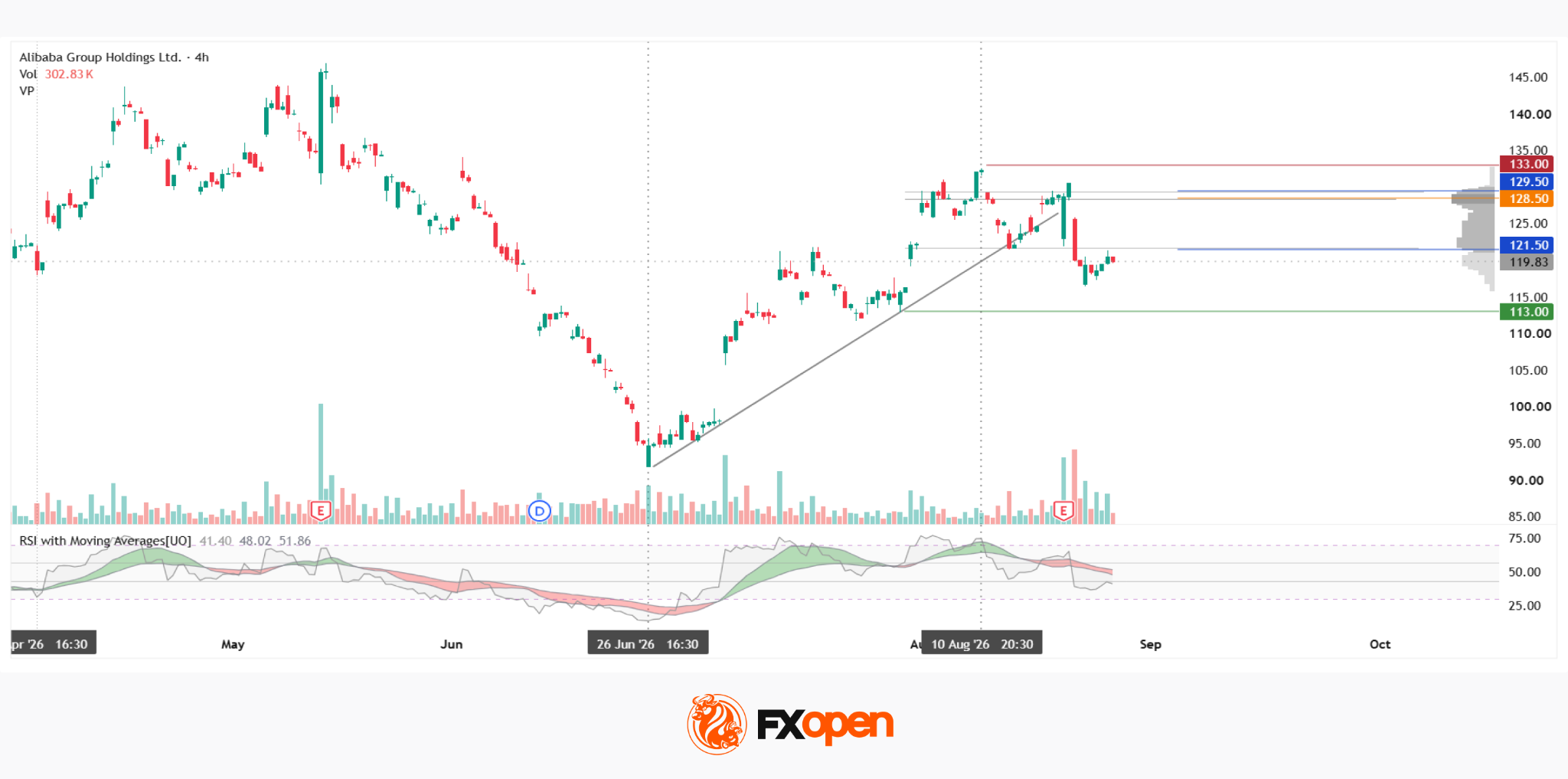
The four-hour chart shows a clear short-term uptrend that began in late July, with the share price climbing from around $92.00 to the $133.00 resistance area.
The stock is now attempting to break below its ascending trendline after buyers failed to maintain momentum following the test of the recent highs. On 21 August, the price moved beneath the lower boundary of the current market profile at $121.50 on exceptionally high trading volume. If sellers extend the decline, the next significant support lies near $113.00.
Should the move prove to be a false breakout, attention will shift to a cluster of key resistance levels within the market profile. The Point of Control (POC) at $128.50 and the upper profile boundary at $129.50 sit very close together, creating a potentially strong resistance zone. Above this area, the major resistance remains at $133.00.
The RSI + MAs indicator currently stands at 41, 48 and 51. RSI has slipped below the neutral zone, while both moving averages remain near the middle of their range, suggesting that bearish momentum has yet to receive full confirmation.
Key Takeaways
Alibaba’s disappointing profit performance and sizeable share issuance have weighed on sentiment following its failed attempt to establish itself above $130.00. The stock’s next move is likely to depend on whether investors continue to focus on near-term earnings pressure or place greater value on the company’s long-term AI growth strategy.
Buy and sell stocks of the world’s biggest publicly-listed companies with CFDs on FXOpen’s trading platform. Open your FXOpen account now or learn more about trading share CFDs with FXOpen.
This article represents the opinion of the Companies operating under the FXOpen brand only. It is not to be construed as an offer, solicitation, or recommendation with respect to products and services provided by the Companies operating under the FXOpen brand, nor is it to be considered financial advice.
The euro and pound have pulled back from their recent highs as the US dollar regained ground following a batch of stronger-than-expected economic data. The Personal Consumption Expenditures (PCE) price index accelerated to 3.7% year-on-year, compared with expectations of 3.6%, while the quarterly core PCE reading came in at 3.6%, above the forecast of 3.4%.
The dollar also received support from stronger consumer activity. Personal spending increased by 0.2%, versus expectations of 0.1%, while personal income rose by 0.4%, double the forecast of 0.2%. At the same time, revised US GDP growth for the second quarter came in at 1.5%, matching market expectations.
Taken together, the figures point to continued resilience in the US economy and reduce the likelihood of the Federal Reserve shifting rapidly towards a more accommodative monetary-policy stance.
Market attention is now turning to fresh US data and the Jackson Hole symposium. Initial jobless claims are expected to come in at 208,000, up slightly from 206,000 a week earlier, while the trade deficit is forecast to narrow modestly to $100.8 billion from $101.4 billion previously.
Following the latest strong US figures, investors will also be paying close attention to comments from Fed officials on inflation and the outlook for interest rates. Resilient economic data combined with hawkish signals from Jackson Hole could provide further support for the dollar, while signs of a cooling labour market or a more cautious Fed tone could put renewed pressure on the US currency.
EUR/USD
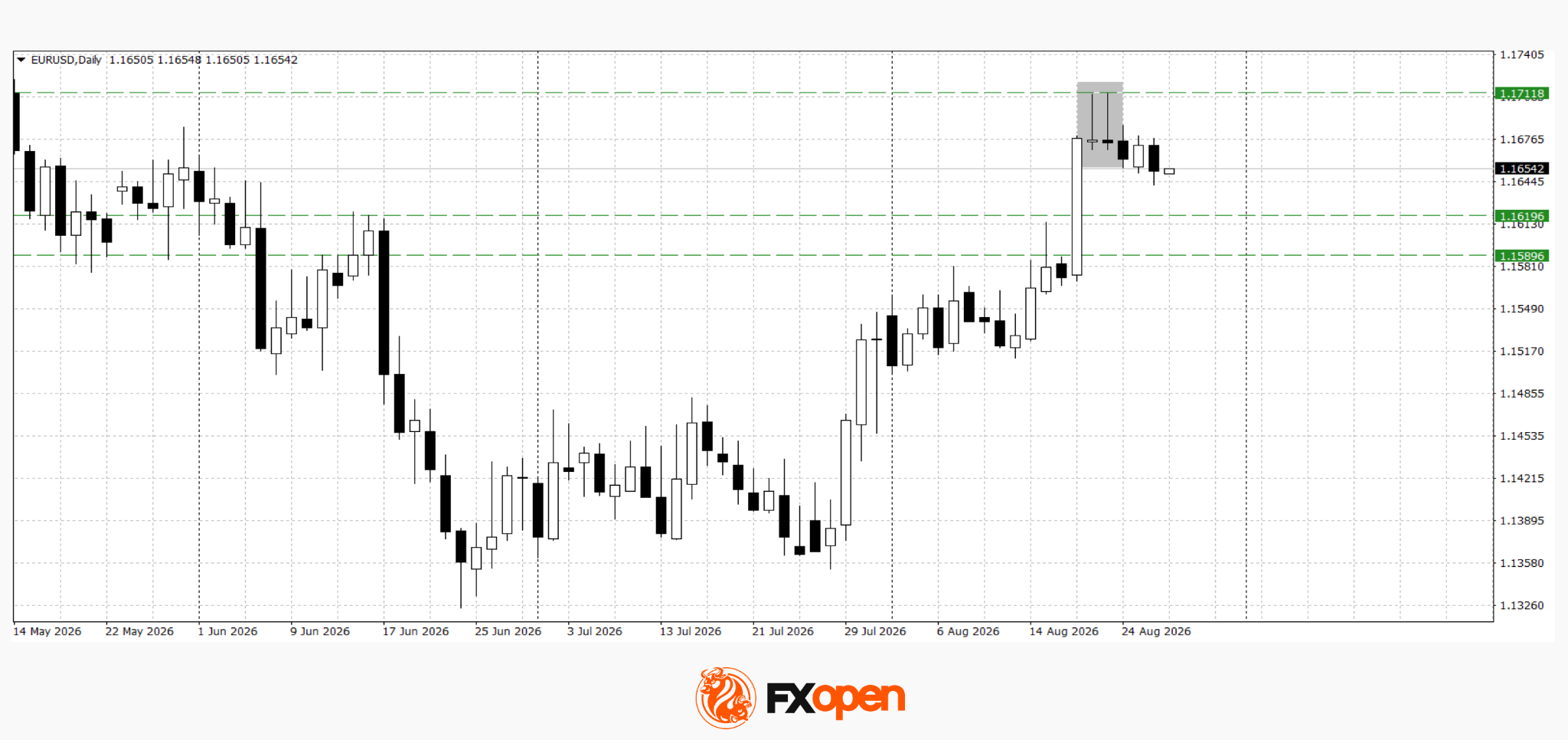
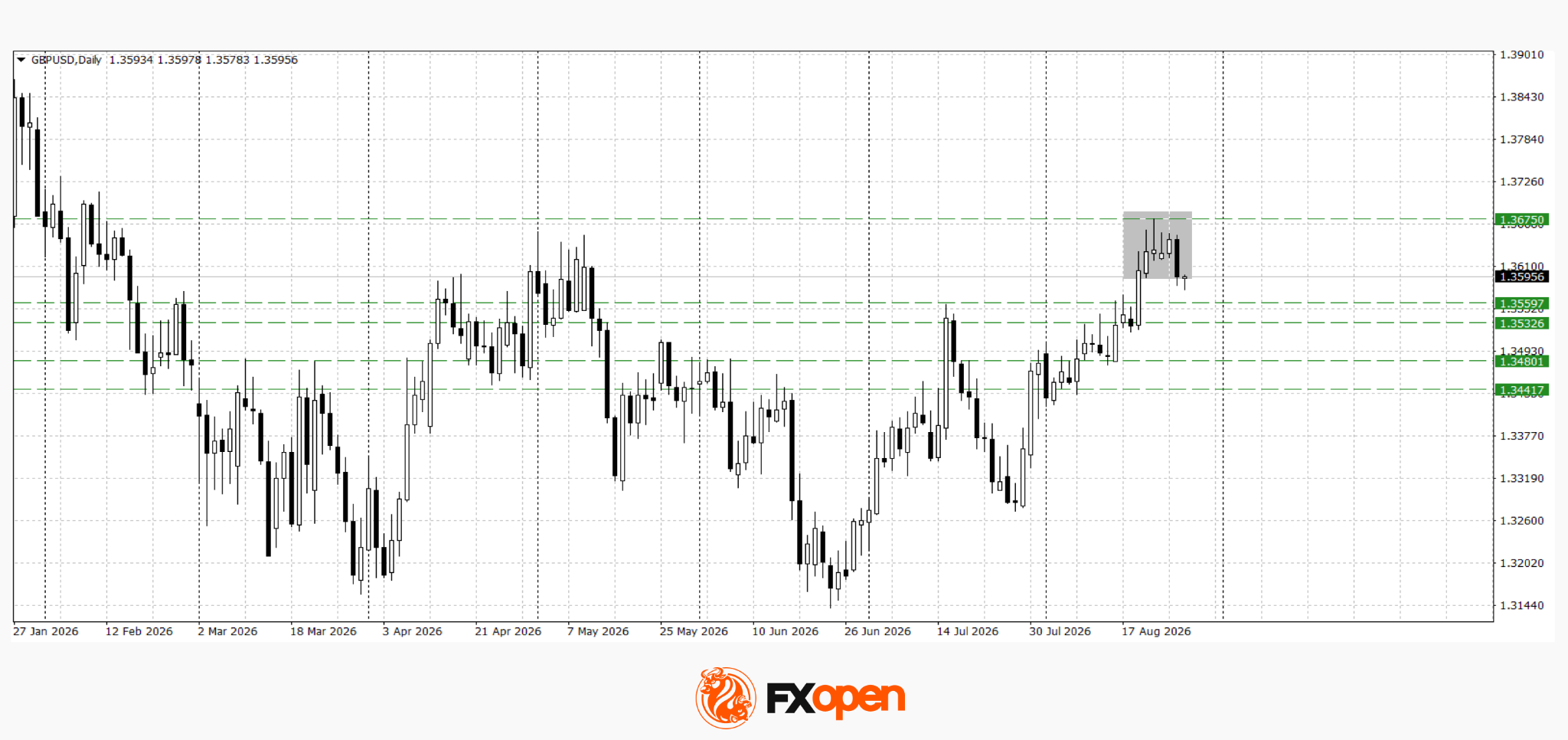
EUR/USD has made several unsuccessful attempts to establish itself above 1.1700, resulting in the formation of a doji pattern. From a technical perspective, this could signal a corrective decline towards the 1.1620–1.1580 area.
The bearish scenario would be invalidated by a firm move and close above 1.1700.
Key events for EUR/USD:
- today at 09:00 (GMT+3): Germany’s GfK Consumer Confidence;
- today at 13:00 (GMT+3): total number of unemployed people in France;
- today at 15:00 (GMT+3): Jackson Hole Symposium.
GBP/USD
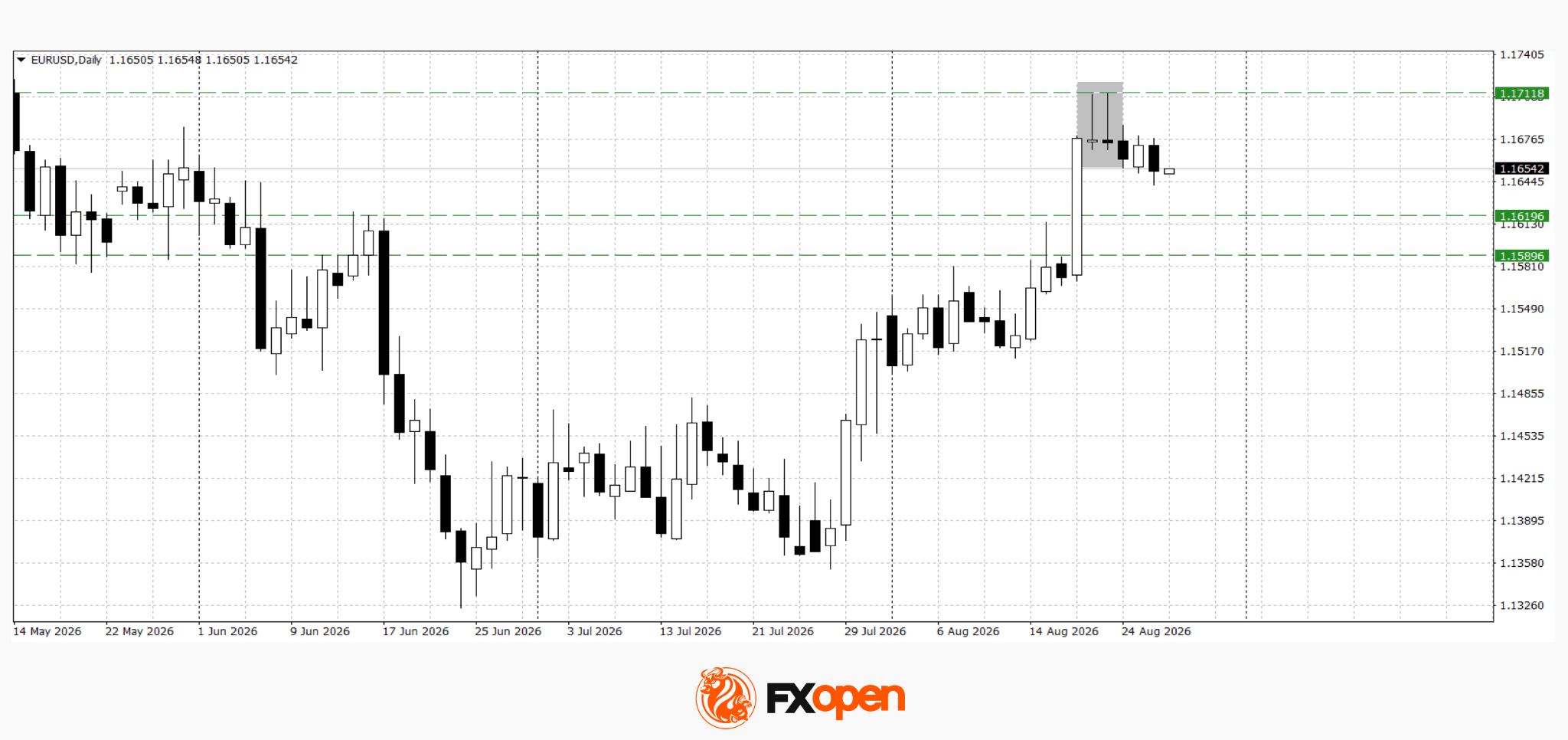
GBP/USD is showing signs of a potential reversal, with a “tower” pattern taking shape. If the formation is confirmed, the pair could decline towards 1.3530–1.3560.
A sustained break below this zone could trigger a deeper correction towards 1.3440–1.3480. Conversely, renewed dollar weakness could allow GBP/USD to recover above 1.3600.
Key events for GBP/USD:
- today at 15:30 (GMT+3): US initial jobless claims;
- today at 23:30 (GMT+3): US Federal Reserve balance sheet;
- tomorrow at 16:45 (GMT+3): Chicago PMI.
EUR/USD and GBP/USD have retreated from their recent highs after stronger US economic data allowed the dollar to recover some of its recent losses.
Whether the current correction develops further will depend on incoming economic data from the US and euro area, as well as signals from Federal Reserve officials. Resilient economic figures and a hawkish tone from Jackson Hole could support a further dollar recovery, while signs of a weakening labour market or more cautious Fed commentary could once again put pressure on the US currency.
Trade over 50 forex markets 24 hours a day with FXOpen. Take advantage of low commissions, deep liquidity, and spreads from 0.0 pips (additional fees may apply). Open your FXOpen account now or learn more about trading forex with FXOpen.
This article represents the opinion of the Companies operating under the FXOpen brand only. It is not to be construed as an offer, solicitation, or recommendation with respect to products and services provided by the Companies operating under the FXOpen brand, nor is it to be considered financial advice.
Mastercard will sponsor a 36-hour XRP Ledger hackathon scheduled for Oct. 24–25 in New York, XRPL Commons announced on Aug. 26.
Summary
- Mastercard sponsors 36-hour XRP Ledger hackathon in New York on October 24–25, XRPL Commons confirmed.
- Four event tracks cover protocol development, agentic finance, lending and projects adding XRPL functionality directly.
- Mastercard separately plans regulated stablecoin settlement supporting RLUSD across XRPL and seven additional blockchain networks.
- Ripple, Mastercard, WebBank and Gemini are exploring RLUSD settlement for Gemini credit card transactions together.
- Sponsorship confirms event participation, not a new Mastercard product or commercial deployment on XRPL itself.
The event will bring developers together to build and launch applications before Ripple’s Swell conference. Mastercard’s sponsorship confirms its involvement in the developer event but does not represent a new payment product or XRPL deployment.
Mastercard joins four-track XRP Ledger event
The XRP Ledger Hackathon will cover four tracks: protocol innovation, agentic finance, lending and borrowing, and an open category for other projects.
The protocol track will focus on core network development, amendments, client implementations and developer tools. The agentic finance track will examine applications in which software agents can initiate or manage financial activity.
Lending participants can build around the proposed XRP Ledger Lending Protocol and related features. Existing projects can also enter by adding XRP Ledger functionality rather than developing a new product entirely.
XRPL Commons lists the event on its official calendar. Its sponsorship announcement did not disclose Mastercard’s financial contribution, judging role or technical involvement.
Sponsorship does not confirm a Mastercard product
Mastercard has not announced that it will launch an application created during the hackathon. XRPL Commons also has not said participating teams will gain access to Mastercard’s payment network or commercial partnerships.
Claims that the sponsorship confirms broader XRP adoption would therefore go beyond available evidence. Developer sponsorship can support research and product experimentation without resulting in a live integration.
No verified XRP market reaction can be attributed specifically to the announcement. The token’s wider price movement occurred alongside changes across the broader cryptocurrency market.
Mastercard’s role nevertheless places a large payments company inside an event focused on financial applications. The company has already worked with Ripple and other firms on stablecoin settlement and tokenized assets.
Mastercard already plans RLUSD settlement support
Mastercard announced in June that it would expand its settlement network to support regulated stablecoins, including Ripple USD, Circle’s USDC, SoFiUSD and several Paxos-issued tokens.
Its official release named the XRP Ledger among eight supported blockchain networks. The others were Arbitrum, Base, Canton, Ethereum, Polygon, Solana and Tempo.
Mastercard said the expansion would provide issuers and acquirers with “more choice in how and when they settle transactions.”
The planned rollout includes intraday, weekend and holiday settlement. However, availability will depend on participating institutions, supported markets and the completion of Mastercard’s staged expansion.
Support for RLUSD does not mean every Mastercard payment will use Ripple’s stablecoin or the XRP Ledger. The program offers blockchain settlement as one option alongside existing fiat processes.
Ripple collaboration began with Gemini card settlement
Ripple announced in November 2025 that it was working with Mastercard, WebBank and Gemini to explore settling fiat card transactions using RLUSD on the XRP Ledger.
WebBank issues the Gemini Credit Card, while Mastercard provides the payment network. The companies said the project would examine RLUSD as the settlement asset between Mastercard and WebBank.
The companies described the initiative as an “exploration,” meaning a full commercial rollout was not guaranteed by the announcement.
Gemini separately offers an XRP-branded Mastercard that pays eligible rewards in XRP. That card product and the RLUSD settlement project involve different functions: one concerns customer rewards, while the other concerns institutional settlement.
In related coverage, Ripple’s institutional settlement activity has largely used RLUSD rather than XRP as the cash component. This distinction matters because activity on the XRP Ledger does not automatically create comparable demand for XRP.
The next confirmed milestone is the October hackathon itself. XRPL Commons is expected to provide registration details, judging criteria and sponsor roles before the event. Any commercial Mastercard integration would require a separate announcement from the companies involved.

Meta Just Paid Nearly $17 Billion To Make Sure It Gets To Write The Kid Safety Rules For Every Other Social Media Platform

Powerful Prayer to Restore the Wasted Years of Financial Struggle | God Will Restore Everything

Locals ‘kept in the dark’ over controversial Huntingdon car park homes proposal





-

 Fashion6 days ago
Weekend Open Thread: Madewell – Corporette.com
-

 Crypto World1 day ago
SpaceX stock could rise 75% to $240, JPMorgan says
-

 Business5 days ago
Musk’s Tesla, SpaceX Confirm $16.8 Billion ‘Terafab’ Chip Plant as World’s Largest Building in Texas
-

 Crypto World5 days ago
anatomy of crypto’s biggest liquidation event since 2021
-

 Crypto World2 days ago
A $30 Billion AI Fund Implodes, Now the SEC Is Investigating Wall Street’s Role
-

 Politics5 days ago
6 months on, Irish renters crushed by effects of government housing bill
-

 Crypto World1 day ago
Did Trump Just Move SpaceX Stock With One Truth Social Post?
-
 NewsBeat5 days ago
The ‘Lucky Dip Gang’ causing carnage for clicks: After five thugs were killed speeding in the wrong direction on a motorway, GUY ADAMS investigates a sick new trend… and why police aren’t even allowed to pursue them
-

 Business4 days ago
Mystery AI Model ‘Ox Alpha’ Draws Developers With Free Access as Chinese Lab Origins Remain Debated
-

 Business3 days ago
Moderna CEO warns China is pouring state money into mRNA technology
-

 Business7 days ago
Five Below: Kids Discount Retailer Reaps Rich Rewards
-

 Business2 days ago
NVIDIA Stock Drops Nearly 2 Percent to $210 on Seventh Losing Day Ahead of Critical AI Earnings
-
 Crypto World5 days ago
Nvidia Stock Suffers Longest Losing Streak Since 2022: Will Q2 Earnings End It?
-

 Sports4 days ago
Deshaun Watson fires back at Browns fans after being booed: ‘It’s a disrespectful thing’
-

 Business6 days ago
UK firms in critical financial distress rise 9% to 53,756
-
 Crypto World4 days ago
Google Gemini AI Predicts Ethereum Could Become the Trade Retail Misses in 2026
-

 Tech5 days ago
Unitree’s New Superman Robot Claims to Outjump and Outrun Every Human, Usain Bolt Included
-

 Crypto World7 days ago
Optimism-funded team's deciding vote shifts $49 million in OP tokens away from users
-

 Business7 days ago
PayPal and Venmo now accepted for tuition at several universities
-

 Tech6 days ago
Faster chip in a familiar form factor
You must be logged in to post a comment Login