Connect with us

NewsBeat

The modern book burners: The tech giants buying thousands of second-hand books – so they can tear off their spines, scan their precious contents… then destroy them

Published

on

Pictured: Compass Books in Dartmouth, Devon, whose books have been pillaged by Silicon Valley tech firms to train AI

The geology of western Peru. Cornish pioneers in South Africa. The defunct Eastern Counties Railway. Cheeses of the world. The jewellery of Hong Kong.

When Compass Books in Dartmouth, Devon, received an order earlier this summer for second-hand volumes on these subjects and many more, seller Lucy Hingston was delighted – if a little baffled.

And when she discovered that the buyer appeared to be a shipping company based at Heathrow airport, her suspicions increased.

Soon the 49-year-old was speaking to other second-hand dealers around the country – and discovered that Compass Books wasn’t alone.

Advertisement

There is now a growing realisation that Britain’s second-hand bookshops are being pillaged – not by voracious collectors of prized first editions but by Silicon Valley tech firms for a far more insidious purpose.

Today, the Daily Mail explains how millions of second-hand books are being bought in bulk and sent to warehouses across America, where the pages are sliced from the spine before being fed into industrial scanners, harvested for their text, and later destroyed.

This process, known as ‘destructive scanning’, is the latest method of gathering the vast reams of data being used by Big Tech to train its AI chatbots.

‘It’s a moral dilemma,’ says Lucy. ‘They’re my books, my babies. I feel like we’ve been eaten by the AI monster. It’s difficult.

Advertisement

‘I want the sale, but not to somebody who will b****r up everybody’s books.’

Pictured: Compass Books in Dartmouth, Devon, whose books have been pillaged by Silicon Valley tech firms to train AI 

Pictured: A warehouse used by Anthropic to store books. Today, the Daily Mail explains how millions of second–hand books are being bought in bulk and sent to warehouses across America

Pictured: A warehouse used by Anthropic to store books. Today, the Daily Mail explains how millions of second-hand books are being bought in bulk and sent to warehouses across America

Advertisement

Aside from the obvious concerns over copyright – of which more later – there are fears tech firms could be destroying rare books – even the last remaining editions of some historical tomes. As Lucy herself admitted, some of the books purchased from her store are ‘collectable and valuable’.

‘Bulk-buying books just to rip them apart to scan is shocking, but it’s just the tip of the iceberg when it comes to the brazen theft of copyright materials by the tech giants,’ says Dan Conway, CEO of the Publishers Association.

He adds: ‘They’re not just destroying books. Through their shameless actions – including the illegal use of content from books and journals without payment or permission – they are harming our world-leading creative industries and the livelihoods of authors, illustrators and journalists. This behaviour needs to stop.’

Last year, the Daily Mail launched a campaign, Make It Fair – backed by numerous celebrities and entrepreneurs including Sir Elton John, X Factor impresario Simon Cowell and Universal Music boss Sir Lucian Grainge – to stop Big Tech from stealing Britain’s creative genius.

Advertisement

This latest twist in the drive to satisfy AI’s insatiable hunger for content proves the imperative to resist is greater than ever. But with so many books already available online, why are tech firms turning to niche, second-hand bookstores and obscure volumes to train their AI models?

Court documents released earlier this year revealed that Anthropic – the AI giant behind the popular chatbot Claude – had been engaged in ‘destructive scanning’ since early 2024 as part of a secret initiative known as ‘Project Panama’.

‘We don’t want it to be known that we are working on this,’ declared one employee in an internal memo.

Court documents showed the firm ‘spent many millions of dollars to purchase millions of print books’ and then ‘stripped the books from their bindings, cut their pages to size, and scanned the books into digital form – discarding the paper originals’.

Advertisement

Join the discussion

Should tech giants be allowed to destroy old books just to feed their AI algorithms?

The books are bought by the AI companies and then destroyed after they are finished with them

The books are bought by the AI companies and then destroyed after they are finished with them 

Lucy Hingston (right) with comedian Susan Calman. When Ms Hingston received her order for a large volume she was delighted but became suspicious very quickly

Lucy Hingston (right) with comedian Susan Calman. When Ms Hingston received her order for a large volume she was delighted but became suspicious very quickly 

Advertisement

AI ‘large language models’ – such as Claude and OpenAI’s ChatGPT – are ‘trained’ on vast amounts of text, audio, pictures and film footage. Type a ‘prompt’ into the chatbot, such as ‘tell me about the geology of western Peru’, and the response, and the rest of the conversation with the bot, will be based on the incomprehensibly huge bank of material it has previously absorbed.

This will include, for practical purposes, more or less everything available on the searchable internet, but also enormous amounts of pre-internet-era material that has already been digitised.

Now the companies are turning to books that have not previously been uploaded to the internet to widen their databases further.

Previously, Anthropic had trained Claude on more than seven million digitised books without paying a penny to the authors or publishers.

Advertisement

The company did so by sourcing the books from ‘pirate’ websites on which copyrighted material is illegally shared.

Five million books were taken from one of these sites alone.

Earlier this month a federal judge in San Francisco approved Anthropic’s $1.5billion (£1.1billion) out-of-court settlement following a class-action lawsuit filed by three affected authors in California in 2024. It was the documents from this case that revealed the firm had since pivoted to buying physical books.

Doing so avoids copyright infringement issues or illegality because under American law’s ‘first sale doctrine’, established by the Supreme Court as long ago as 1908, the buyer of a physical product can do whatever they want with it, including throwing it away.

Advertisement
Most book–lovers would find the practice of destroying huge numbers of physical volumes stomach–churning. Scenes of grinning young Nazis burning towering pyres of 'un–German' books in university cities across the Third Reich in 1933 are seared in the public memory

Most book-lovers would find the practice of destroying huge numbers of physical volumes stomach-churning. Scenes of grinning young Nazis burning towering pyres of ‘un-German’ books in university cities across the Third Reich in 1933 are seared in the public memory

In other words, if Anthropic buys a physical book, it is legally – though not, many would argue, ethically – entitled to use it to ‘train’ Claude by scanning and destroying the physical copy.

This also means that any future user of Claude will be able to use the information contained in the now-destroyed book more or less for free.

Most book-lovers would find the practice of destroying huge numbers of physical volumes stomach-churning. Scenes of grinning young Nazis burning towering pyres of ‘un-German’ books in university cities across the Third Reich in 1933 are seared in the public memory: a ‘cultural genocide’ that continues to horrify us.

Advertisement

Of course, the AI companies would argue they are doing something different: rather than destroying books to censor the material they contain, as the Nazis did, they are destroying them in order to disseminate their contents more widely.

Nevertheless, the thought of those once-loved, out-of-print volumes being shredded for the financial benefit of faceless tech giants is deeply dystopian.

As the recent court documents explained, Anthropic has been seeking to train its AI models on ‘good’ writing in order to create better chatbots for its customers.

But rather than hire writers to create high-quality sample writing, the firm reasoned that it would be cheaper to purchase existing books.

Advertisement

Hence the Silicon Valley giants buying millions of books from around the world, including Britain, to train their chatbots without paying anything more than the low cost of the second-hand volumes. And Anthropic is not the only one at it. An investigation by 404Media found that an Amazon warehouse outside Las Vegas known as VGT3 was also being used to scan incalculable numbers of second-hand volumes.

‘I work at VGT3 here in Vegas, and all we do is scan books,’ revealed one anonymous Amazon whistleblower on an online forum.

AI 'large language models' – such as Claude and OpenAI's ChatGPT – are 'trained' on vast amounts of text, audio, pictures and film footage

AI ‘large language models’ – such as Claude and OpenAI’s ChatGPT – are ‘trained’ on vast amounts of text, audio, pictures and film footage

Second-hand books on sale in London. The Daily Mail has established that tech firms are especially targeting second–hand dealers, where the price per copy can be in pennies or a few pounds at most

Second-hand books on sale in London. The Daily Mail has established that tech firms are especially targeting second-hand dealers, where the price per copy can be in pennies or a few pounds at most

Advertisement

‘Some are assigned to cut books, and others go to receive where they get books and scan the bar codes.’

Leaving aside the question of whether or not books should be scanned at all, the practice of cutting off the spines of books and destroying them afterwards has caused uproar.

So much so that even Elon Musk took to X last month to assure supporters: ‘I’ve asked the SpaceXAI team to preserve any rare books in a library and scan them the hard way [physically turning the pages] vs just cutting off the spine and scanning.’

It is, of course, possible to scan books in such a way that the text and binding are preserved – assuming the practice of feeding this information into the insatiable AI models is a worthy pursuit at all. But cutting the pages out first is ‘significantly faster’ and guarantees ‘shadow-free scans’, according to specialist scanner eRecordsUSA.

Advertisement

So which books do tech firms want most, and which bookshops are being targeted?

The Daily Mail has established that tech firms are especially targeting second-hand dealers, where the price per copy can be in pennies or a few pounds at most.

However, only shops with online catalogues appear to have been approached.

Intriguingly, the firms appear to be interested only in books published before 2022, the year in which generative AI achieved mainstream popularity following the launch of ChatGPT.

Advertisement

Books published before that period are highly likely to be free from AI-written text – whereas many authors of more recent books are, whether they admit it or not, using AI, while many books available for purchase online are entirely AI-written.

Training AI models on text written by AI can lead to what experts call ‘model collapse’.

Shelves of books in Camden Market. The thought of those once–loved, out–of–print volumes being shredded for the financial benefit of faceless tech giants is deeply dystopian

Shelves of books in Camden Market. The thought of those once-loved, out-of-print volumes being shredded for the financial benefit of faceless tech giants is deeply dystopian

‘It’s the AI equivalent of a feedback loop gone wrong,’ explains Yarin Gal, Associate Professor of Computer Learning at Oxford University. ‘The more models feed on their own output, the further they drift from reality. Model collapse threatens to create an AI echo chamber.’

Advertisement

In other words, chatbots need to be trained on high-quality, human-written text. That means books published before the arrival of AI are guaranteed to be an effective ‘dataset’.

Which brings us back to the boom in second-hand book sales across Britain. Finn Windle, 30, works at The Minster Gate Bookshop in York. ‘We had an unusual batch order in May, quite a lot of books, and none of them were related subjects,’ he says.

‘It was quite confusing. There was local history, geology, a real mix of things, academic books and books for the general reader. Generally, non-fiction.

‘The purchaser was in the USA: Zoom Books. They’ve only ordered twice. Other people had had orders from them, so they seemed legitimate. But thankfully it’s gone quiet since.

Advertisement

‘If we knew destructive scanning is what they were doing, we wouldn’t have authorised the order. We’re not pleased about it – it’s awful.

‘Some of these titles aren’t even in print any more and there are no other copies available.’

Other booksellers as far afield as Germany, New Zealand and Australia have reported receiving orders from Zoom Books. The company has since denied being involved in destructive scanning. However, this does not rule out Zoom Books being the middleman responsible for collecting books for an AI giant.

It’s a similar story in Felixstowe, Suffolk, where Helen Bott, 64, runs Treasure Chest Books. ‘It started in early May,’ she says. ‘First, we got an order from Zoom Books in America. We got two or three orders for five or six books, and then a week later there were massive orders for 340 books, all to this place in America called Zoom Books. We’d never heard of it. I specialise in transport and railway books and the sheer randomness of the orders was noticeable. Fifty per cent were on railways, then Latin, or school history, or shipping companies.

Advertisement

‘We noticed these were all non-fiction. It felt like they were looking for unusual books: a history of a village in Devon, for example. You don’t want to see books destroyed. But I’m conflicted about it. From a business point of view, it’s good. But destroying books, that is the last thing we want to see.’

Meryl Halls, managing director of the Booksellers Association, agrees. ‘The potential scenario of tech companies bulk-ordering second-hand books to train their large language models is a concerning development,’ she says. ‘If true, it is another example of the lengths some AI companies may go to in order to access copyright-protected material without transparency or compensation.’

However, not everyone shares her concerns. ‘We have been joking and hoping that that would happen to us!’ says Patrick Kelly of Book Mongers in Brixton, south London. ‘We could use the business. My suspicion is that you need a catalogue of your inventory [for the AI companies to buy from you] – something we don’t have. To be honest, I don’t understand why the shops affected are complaining.’

And this attitude gets to the heart of the dilemma. For booksellers operating on tight margins, selling hundreds of books to AI firms makes sense. But, as every book-lover knows, Faustian pacts don’t end well.

Advertisement

A spokesperson for Anthropic told the Daily Mail: ‘Claude is trained on a mix of publicly available web data, commercially acquired datasets, and data we generate ourselves.

‘Sourcing books is a widely used approach for training large language models across the AI industry. None of our data acquisition programs buy and destroy rare or antiquarian books.’

A spokesperson for Amazon added: ‘Amazon purchases books through commercial channels to help develop and improve the products and services our customers use.’

Another infamous mass destructions of books was the ‘Bonfire of the Vanities’ in Renaissance Florence, when the friar Savonarola presided over the burning of books deemed immoral.

Advertisement

A new wholesale destruction of books appears to be underway again, some of which will never be printed again.

This time, however, the motivation is purely to enrich technology companies already enjoying wealth far beyond Savonarola’s dreams.


Source link

Advertisement
Continue Reading
Click to comment

You must be logged in to post a comment Login

Leave a Reply

NewsBeat

Locals say new business park with HGV area would be ‘unacceptable burden’

Published

on

Cambridgeshire Live

The applicant has sought permission for a site near the A14

Plans for a huge new “employment park” next to a major Cambridgeshire park have faced backlash, with one person claiming it would be an “unacceptable burden”. Lolworth Developments Limited (LDL) is seeking permission to deliver a huge employment floorspace accommodating a mix of logistics, mid-technology, and research uses for new and existing companies to invest, expand, and occupy.

Advertisement

The employment park would deliver around 240,000 square metres of floor space on land next to Junction 25 of the A14 between Bar Hill and Northstowe. The development, called ‘Cambridge 25’, would provide around 2,900 new jobs and training opportunities near existing and planned future homes.

If approved, a nature park would be created for future employees and visitors. It would deliver more structural landscaping and tree planting, community facilities, better walking and cycling connections, and large HGV areas with parking bays.

Additionally, it would deliver “high-quality” and “sustainable” employment premises for new and existing companies to invest, expand and occupy. The applicant said: “There is a current deficit in the supply of land for future employment uses and a specific shortfall in industrial and logistics floorspace.”

Once in operation, the development activity is predicted to generate around £117.1m in Gross Value Added (GVA) annually, equal to 0.7 per cent of Greater Cambridge’s total GVA in 2031. GVA is the value that producers have added to the goods and services they have bought.

Advertisement

A planning document said: “There is an urgent need for the provision of land which can accommodate high quality I&L premises (industrial and logistics), including those towards the larger size ranges. There is a critical undersupply of land and premises to meet the needs of the I&L sector and this is particularly severe in relation to large units.”

Since its submission in July, the plans have received some backlash. One person objected to the Cambridge 25 development due to its “unacceptable scale and impact on Oakington and the surrounding countryside”.

The objector wrote: “My main concerns are the loss of 103 hectares of greenfield habitat, visual and landscape harm, 24/7 noise and light pollution, and significant flood-risk concerns. I am deeply concerned that up to 350,000 litres of treated effluent per day could be discharged into Oakington Brook, a watercourse that can become very low or dry in summer, creating serious risks to local ecology and residents.

“I’m also concerned about the additional HGV traffic on the ‘local’ A14 bypass road and other small roads, which are unsuitable for such volumes of heavy vehicles. The ‘jug handle’ for travel towards Bar Hill roundabout will cause massive problems, especially as this area will also face increasing pressure from the ongoing development of Northstowe, making the cumulative impact on congestion, road safety and local communities even more concerning.”

Advertisement

They fear the development would “fundamentally urbanise this rural setting and place an unacceptable burden on local infrastructure”.

Bar Hill Parish Council also lodged an objection to the plans. A spokesperson for the council said the development would lead to “significant increases in traffic on the A1307 and B1050 as well as the A14”.

The objection said: “The pathway is used by pedestrians, cyclists and horse riders whose safety will be impacted by the large numbers of HGVs crossing the path into the site. The number of junctions could cause confusion for drivers.

“The increase in vehicles at junction 25 of the A14 may lead to drivers going along the A1307 to use junction 24 of the A14 at Swavesey or go through Dry Drayton to avoid the congestion. The increase in traffic increases the likelihood of any incident on any of the roads near the junction 25 roundabout blocking access to Bar Hill due to the village only having one road in and out.”

Advertisement

The parish council also urged the development to accommodate all HGVs when they arrive and provide suitable welfare facilities for the drivers, including overnight. The spokesperson said: “On road parking of HGVs in local villages including Bar Hill is a regular problem as Swavesey services are unable to cope with the current number of HGVs on the road system.”

The Environment Agency objected to the proposed development as submitted because it “involves the use of a non-mains foul drainage system in circumstances where it may be feasible for the development to be connected to a public sewer but inadequate justification has been provided for the use of a non-mains system”. The public body recommended that the application, as it stands, be refused on this basis.

Another person said the facility could potentially serve thousands of workers. As a result, they raised an objection because it could “create a huge amount of sewage, with possible dire consequences for the local environment, wildlife and residents”.

Source link

Advertisement
Continue Reading

NewsBeat

North Yorkshire’s HECK! launches chicken Cumberland sausage

Published

on

North Yorkshire's HECK! launches chicken Cumberland sausage

HECK! has launched new Chicken Cumberland Sausages, aimed at people looking for a high-protein and leaner alternative to pork sausages.

The new Chicken Cumberland Sausages, which will be available nationwide at Morrisons and Tesco stores from mid-September, are made with lean chicken and a blend of bold black pepper, fragrant sage and warming spice notes.

RECOMMENDED READING:

Advertisement

Weighing 340g and priced at £3.50, the sausages are designed to be a versatile addition to various meals, from mash and sausage sandwiches to stir-fries and tray bakes.

The new product is part of HECK!’s expanding range of lean sausages, burgers, seasoned mince, and sausage rashers.

These products are aimed at people wanting to boost their protein intake without compromising on flavour.

All items in the HECK! chicken range are gluten-free and naturally lower in fat.

Advertisement

Source link

Continue Reading

NewsBeat

Man United latest: Luke Shaw told time has ‘gone’ as Arsenal interest in Marcus Rashford emerges

Published

on

Manchester Evening News

Manchester United transfer news as the club attempts to complete some more business before Tuesday’s deadline

Manchester United’s mixed transfer window is coming to an end, with one area in particular still needing attention.

Advertisement

United have made successful additions in midfield, with Carlos Baleba following Andrey Santos and Youri Tielemans through the door. Nevertheless, there will be disappointment if United fail to strengthen on the left side of defence.

Another option to Luke Shaw is required, with the long-serving left-back entering the final 12 months of his contract. Lewis Hall is a longstanding target but Newcastle have no intention of selling.

Regarding potential departures, talk surrounding Marcus Rashford’s future persists after he turned down a switch to Fenerbahce. Ahead of United’s opening home fixture of the campaign against Ipswich Town, here’s a summary of the latest transfer developments.

Rashford interest

Despite his reintegration into the first-team setup, Rashford could still move on soon. The latest link involves Arsenal, who need a replacement for Saudi-bound Gabriel Martinelli.

According to the Independent, the Premier League champions are considering whether to table a loan offer for the enigmatic forward. Whether United would approve a third loan spell for Rashford remains uncertain, though they could at least anticipate the Gunners covering the majority of his £325,000 per week wages.

A more pressing target for the Gunners is Atletico Madrid’s unsettled striker, Julian Alvarez, whose desired switch to Barcelona has been blocked.

Advertisement

Returning to Rashford, there has been unexpected speculation that Barcelona haven’t dismissed the possibility of re-signing him, despite declining the option to make his move permanent following last season’s loan. According to TeamTalk, Barca remain in contact with Rashford’s camp.

‘Time’s up for Shaw’

Patrice Evra has urged United to bring in a replacement for Shaw. While holding considerable respect for his fellow left-back, the Frenchman believes the moment has arrived to replace the 30-year-old, whose Old Trafford career has been plagued by injury.

Speaking on his Kick stream, Evra criticised Shaw’s display at Hull last weekend. He said: “What I’m really disappointed about is all the back passes in that game. Luke Shaw, I love you, but it’s going to be a tough season for him.

“Why? He’s been at the club for years, he’s had a lot of injuries that killed his football career. When I talk with him, he’s still traumatised by [the injuries], he wouldn’t go 100 per cent into every challenge.

“I have to tell the truth. Man United fans want to hear my opinion, and I think [Shaw’s] time has gone. Don’t get me wrong, he might have a great game next game, but I don’t care. If Luke Shaw can give me a 35-game season, then that’s a good season.

“I don’t care if he has 10 good games and three bad ones, if he doesn’t play at least 35 games in a row, Man United fans will go crazy. He’s lucky because he’s English. I love Luke Shaw, but I love Man United even more. That’s why I’m saying they need another left-back.”

Essential 26/27 Sky Sports Bundle for the new season

Advertisement
This article contains affiliate links, we will receive a commission on any sales we generate from it. Learn more
Content Image

£51

£35

Sky

Get the deal here

Sky’s Essential TV and Sky Sports bundle includes at least 215 live Premier League clashes across the 2026/27 season, with more than 1,500 games from the EFL and beyond, plus F1, golf and darts.

This introductory offer saves £384 compared to the standard price, with every package also providing 100 regular channels alongside free Netflix and discovery+ subscriptions.

Advertisement

Source link

Continue Reading

NewsBeat

How a ‘psychic’ horse named Clever Hans changed the way we do science

Published

on

How a ‘psychic’ horse named Clever Hans changed the way we do science

Do you sometimes wish that you had telepathic or other supernormal powers?

Around a hundred years ago, some of the greatest minds in philosophy thought there were people who had such abilities. In fact, they even suggested that perhaps horses and dogs could have them too.

At the turn of the 20th century, many great scientists, psychologists and philosophers became fascinated by the possibility of “psychic phenomena” like telepathy, clairvoyance or ghosts. Many of them, like J.J. Thomson, the 1906 winner of the Nobel prize in physics, performed experiments to test mediums. Others, like the philosopher C.D. Broad, attended seances and thought about the possibility of precognition – the ability to foresee future events.

These weren’t just marginal charlatans. Many of them had an impact on philosophy and science in the 20th century. Many of the concepts philosophers of time still argue over today trace back to C.D. Broad, such as the growing block theory, which says that the past is real, the present is real, but the future does not yet exist.

Advertisement

Most of their focus was on the psychic abilities of humans. However, some of these “psychic researchers” went even further and began wondering about the possibility of telepathy in animals.

The philosopher Friedrich Canning Scott Schiller (1864-1937), who spent most of his career at the University of Oxford, was an active member of the Society for Psychical Research (SPR). He was one of the founders of pragmatism, the philosophical view that the truth of a theory can be judged based on whether it works in practice.

Schiller engaged in heated discussions about the psychic abilities of animals. His article on “psychical research” for the Encyclopedia Britannica has a section about “equine mathematicians” – horses with supposedly paranormal mathematical abilities that they demonstrated by tapping out solutions to equations with their hooves.

In 1914, Schiller wrote an article for the SPR about Rolf, “the thinking dog of Mannheim” (in south-west Germany). Rolf was credited with the ability to tap out answers to mathematical problems with his paw. And, with the help of a spelling code for letters and syllables, Schiller even claimed that the dog managed to produce entire sentences.

Advertisement

On one occasion, Schiller alleged that the dog professed its Catholic faith to a priest.

The case of Rolf (and other “thinking dogs” who suddenly started cropping up elsewhere) caused a dilemma for psychical researchers. Some thought this proved that animals have hidden intellectual powers just like humans. Others, like the Russian scientist Vladimir Bechtereev, suggested that the whole thing can be explained by telepathy.

Bechtereev went on to make major discoveries about memory and brain structure. In his view, the dog’s owner telepathically communicated all the information to him.

Schiller believed that his theory of pragmatism could help settle these disputes. He thought there was no point discussing these things in the abstract. What matters is whether either of the theories can be shown to have practical consequences for how the animal behaves. If Rolf was really so skilled at arithmetic, why does he not use mathematics in everyday life? And if he is a confessed Catholic, why does he not go to church?

Advertisement
The alleged
Francis Wickware

Joseph Banks Rhine (1895-1980) and his wife Louisa (1890-1983) are widely considered to be the founders of the controversial field of parapsychology. They published the influential volume Extra-Sensory Perception (1934) and founded the Parapsychology Laboratory at Duke University, which has since been shuttered. Their approach of using a large number of tests with multiple subjects has been closely connected with modern statistics.

In 1929, the Rhines published an article about the horse Lady Wonder. This horse was seemingly able to make predictions, work out answers to mathematical problems, and tell time, all of this by touching lettered and numbered blocks with her nose.

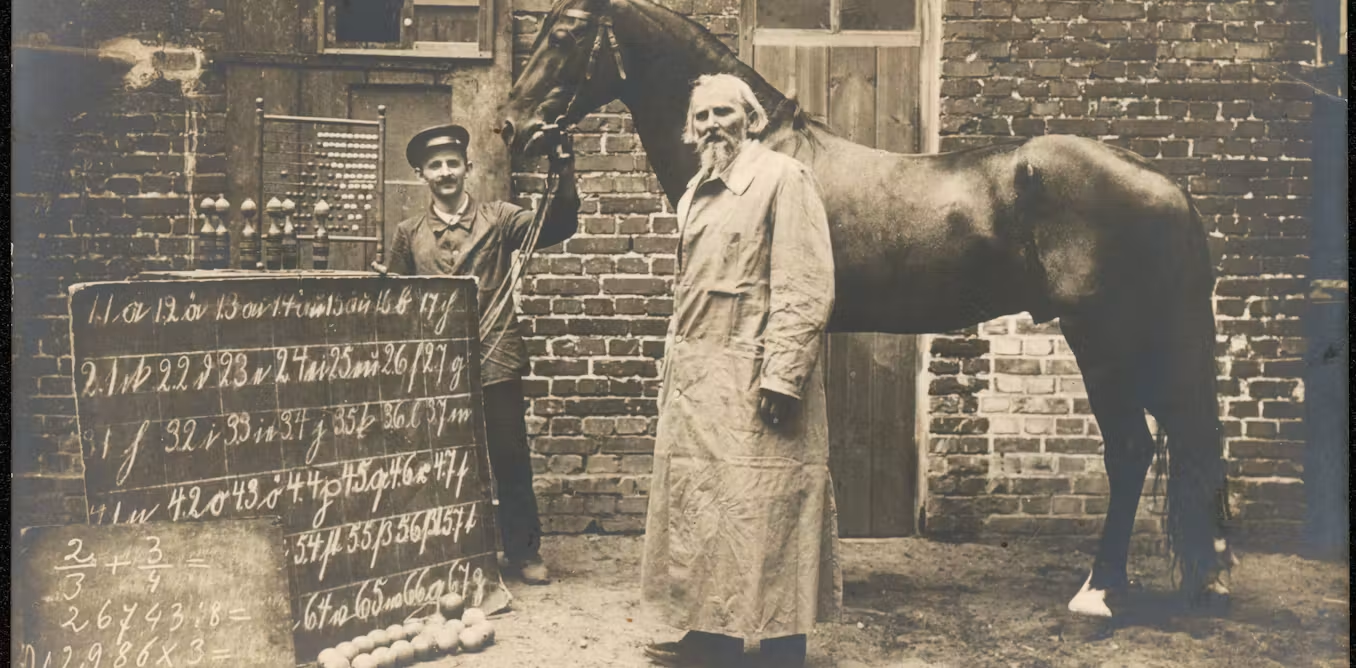
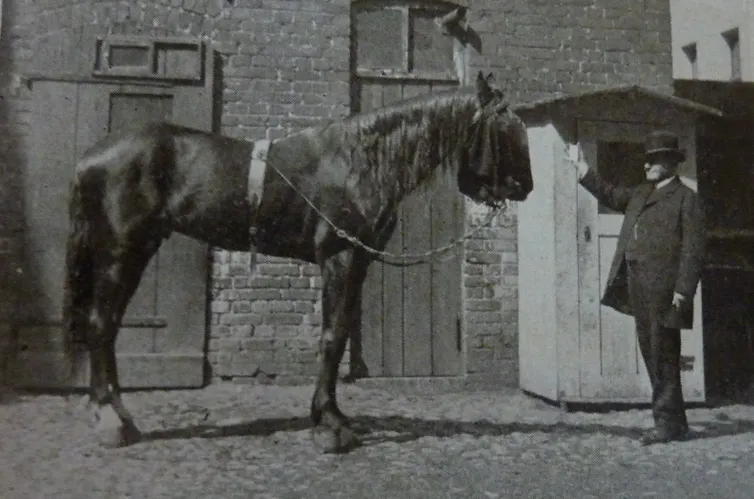
The most famous of these mathematically gifted horses was Clever Hans. Just like Lady Wonder in the US, Hans attracted huge crowds to his native Germany, who were eager to witness his arithmetic abilities. This included psychical researchers curious to see whether Hans had supernormal powers, as well as Carl Stumpf (1848-1936), one of the fathers of modern psychology.

It was Stump’s research assistant Oskar Pfungst who eventually got to the root of Hans’s miraculous powers. Pfungst observed that Hans could only provide the correct answer when his owner, standing nearby, knew the answer to the question asked – and only when Hans could see him.

Advertisement
Large horse looks at man holding up a card
Clever Hans and his owner Wilhelm von Osten.
Karl Krall

This led Pfungst to conclude that Hans was simply responding to involuntary signals from his owner, signals that his owner did not even realise he was providing. Pfungst thereby discovered the so-called Clever Hans effect. This describes situations where the bad set up of an experiment causes the experimenter to unintentionally influence the subjects they are studying.

Pfungst’s explanation got rid of the need to appeal to supernormal abilities and partially contributed to the gradual disappearance of psychical research from universities. Like many other psychic phenomena, modern psychology could explain what was going on.

Although it turned out that these horses and dogs had no such mathematical powers, the studies conducted by psychical researchers helped uncover new knowledge. One surprising example is the development of randomisation in experiments.

Randomisation means deciding the order or allocation of things in an experiment by chance, rather than allowing the researcher or participant to choose. It is now a basic part of good experimental design because it helps prevent expectations from influencing the results. Surprisingly, attempts to test telepathy helped drive its development. Researchers realised that if people knew what answer was expected, even tiny unconscious cues could affect the outcome.

The case of Clever Hans and other “telepathic” animals shows just how turbulent this period of time was for modern science and philosophy. The telephone suddenly made it possible to contact someone on the other side of the world, and the X-ray allowed you to see inside the body. So perhaps it’s not that surprising that some of the greatest minds began to investigate telepathy in animals.

Advertisement

Source link

Continue Reading

NewsBeat

‘Travellers’ rip up wildlife haven with diggers and heavy machinery as they wage Bank Holiday ‘land grab’ while council offices are closed

Published

on

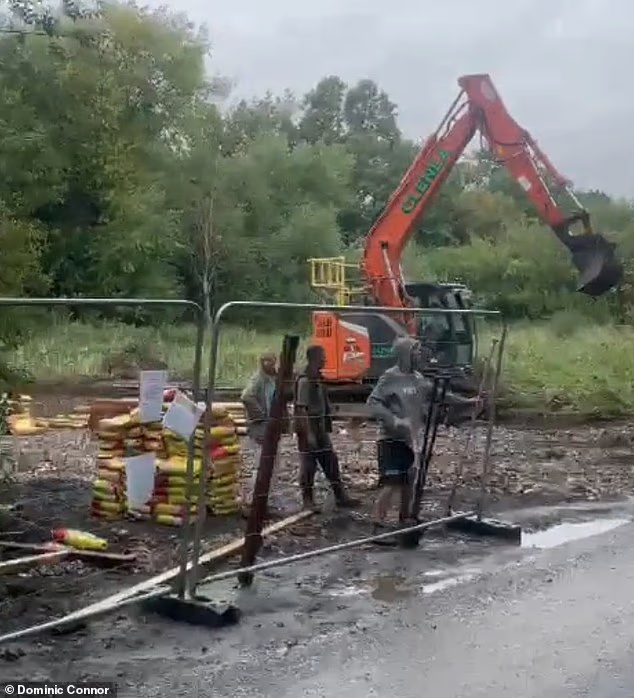
In videos posted on social media, birds can be heard chirping as work involving heavy machinery is carried out on greenbelt land

Another Bank Holiday ‘land grab’ has left residents devastated after diggers bulldozed a wildlife haven for a suspected traveller site.

Sawbridgeworth, East Hertfordshire was the latest area to be targeted by developers who arrived on Friday morning with huge lorries, fences going up and roads being blocked. 

In videos posted on social media, birds can be heard chirping as work involving heavy machinery is carried out on greenbelt land. It has devastated residents who fear travellers have taken over and destroyed the precious wetland habitat and floodplain.

The council has issued a Temporary Stop Notice which requires builders to halt further work on the site, but residents claim unauthorised work has carried on regardless.

Advertisement

One neighbour, in her 50s who wishes to be anonymous, has lived in the area all her life and told the Daily Mail she feels ‘powerless’ and ‘devastated’.

She said: ‘I believe they are travellers building a traveller site. Some people don’t want them anywhere and I think they should go through all the steps that everyone else has to when it comes to planning and building. 

‘They definitely don’t have permission – the order was ignored and they’ve continued to bring in diggers and all sorts of machines.’ 

The resident added that she and her neighbours are mostly saddened by the destroyed habitats of the protected wildlife, including bats, newts and nesting birds.

Advertisement

In videos posted on social media, birds can be heard chirping as work involving heavy machinery is carried out on greenbelt land

Another Bank Holiday 'land grab' has left residents devastated after diggers bulldozed a wildlife haven for a suspected travellers site

Another Bank Holiday ‘land grab’ has left residents devastated after diggers bulldozed a wildlife haven for a suspected travellers site

Left: Last month a muntjac was pictured enjoying the land. Right: The current state of the site

Left: Last month a muntjac was pictured enjoying the land. Right: The current state of the site 

Advertisement

She said: ‘The reserve has been around for as long as life and within a day it was destroyed. It’s a total destruction of nature, it’s absolutely disgusting. 

‘There’s a lady who lives right across the road from it and she’s in tears. We’re completely appalled by the destruction; it’s devastating to be so powerless in the situation.

‘It’s the bank holiday and no one has the chance to stop it before it’s too late, so they’ve got four days to destroy habitats’. 

It follows a trend that has seen travellers purchase land, often in leafy parts of the Home Counties, before unauthorised sites are set up.

Advertisement

They fear it could be the latest example of a ‘land grab’ – a trend that has seen travellers swoop in to lay pitches over Bank Holiday weekends, when council offices are closed. 

Planning permission is then sought retrospectively, with travellers often granted the permanent right to stay because there is an ‘unmet need for pitches’. 

One concerned neighbour expressed dismay over the irreversible damage to the wildlife and the inaction from authorities over the long weekend.

She said: ‘Heavy machinery and diggers began bulldozing a beautiful wetland beside our village lock. The area is an important habitat for birds and other wildlife, and it is now being rapidly churned up and covered with large quantities of hardcore.

Advertisement

‘East Herts Council has issued a Temporary Stop Notice. However, despite that notice, machinery and vehicles are continuing to operate on the site and further material is being brought in.

The council has issued a Temporary Stop Notice which requires builders to halt further work on the site, but residents claim unauthorised work has carried on regardless

The council has issued a Temporary Stop Notice which requires builders to halt further work on the site, but residents claim unauthorised work has carried on regardless

One resident said that she and her neighbours are mostly saddened by the destroyed habitats of the protected wildlife, including bats, newts and nesting birds

One resident said that she and her neighbours are mostly saddened by the destroyed habitats of the protected wildlife, including bats, newts and nesting birds

Neighbours have organised a peaceful protest to be held at the lot on Sunday morning to convey their frustration which they hope will remove the workers quicker

Neighbours have organised a peaceful protest to be held at the lot on Sunday morning to convey their frustration which they hope will remove the workers quicker

Advertisement

‘The police are currently in attendance, but there appear to be only two officers dealing with the situation. Meanwhile, the destruction is continuing in real time.

‘We are extremely concerned that by the time the relevant authorities are able to take effective action, this precious wetland and its wildlife habitat will have been irreversibly damaged.

‘This is not simply a planning dispute. It is an environmental emergency happening right now, with heavy machinery actively destroying a wildlife habitat.’

Neighbours have organised a peaceful protest to be held at the lot on Sunday morning to convey their frustration which they hope will remove the workers quicker.

Advertisement

Another resident also told the Mail: ‘Many many residents are distraught, dismayed and feel very let down by the laws relating to this kind of destruction of wildlife habitats beside a lovely picturesque lock in a pretty historic small town.’

East Herts council said in a statement on Saturday morning: ‘Council officers have attended the site and we have issued a temporary stop notice, requiring any further unauthorised activity covered by the notice to cease immediately. 

‘Our planning enforcement team will continue to closely monitor the site and investigate the works that have taken place. We will also work with Herts police to monitor the situation. 

‘We will consider what further enforcement action may be necessary and appropriate, and will provide a further update when we are able to do so.’ 

Advertisement
Sheering Mill Lane, Sawbridgeworth, Hertfordshire: Map view of the suspected travellers site

Sheering Mill Lane, Sawbridgeworth, Hertfordshire: Map view of the suspected travellers site

Last week, travellers who held an entire village to ransom for £600,000 in a land grab scam have applied to officially house caravans the site after their 'blackmail attempt' backfired

Last week, travellers who held an entire village to ransom for £600,000 in a land grab scam have applied to officially house caravans the site after their ‘blackmail attempt’ backfired

Cllr Angus Parsad-Wyatt, the mayor of Sawbridgeworth said: ‘East Herts issued the temporary stop notice this morning. This has been ignored, so the council is working on an emergency application for an injunction to prevent occupation of the site. 

‘Legal and enforcement officers at the council are gathering the necessary information and hope that a temporary injunction can be issued today.’ 

Advertisement

A police spokesman told the Indie: ‘Hertfordshire Constabulary is aware of a dispute over the use of land in Sheering Mill Lane, Sawbridgeworth. We are liaising with our partners at East Herts District Council.’ 

East Herts council and Hertfordshire Constabulary Police have been contacted by the Daily Mail

It’s the latest ‘bank holiday land grab’ to occur after construction works suddenly got underway on a greenbelt plot of land in Irby, Merseyside.

Three caravans, two diggers, two cars and a van have been seen on the land, which is located just yards from residents’ homes.

Advertisement

No planning application has been submitted for works to be completed on the site, according to the Wirral Council planning portal.

A number of locals believe it is travellers who have bought the land and are conducting the illegal works.

Last week, travellers who held an entire village to ransom for £600,000 in a land grab scam have applied to officially house caravans on the site after their ‘blackmail attempt’ backfired.

The family bought the greenfield site, which is the size of a tennis court, just outside the Buckinghamshire village of Dinton in February – and immediately drove three caravans and a mobile home onto the plot.

Advertisement

In a carefully orchestrated operation, diggers and lorries moved onto a quarter-of-an-acre plot off to lay hardstanding rubble and position caravans in the designated conservation area.

Horrified villagers, who protested against what they call an illegal land grab, say they were approached by two men who said that if they wanted them to leave the area, they could buy back the land for more than £600,000 – forty times the £15,000 they are believed to have paid for it.

Now, after the 800 people living in Dinton refused to bend to the travellers’ demands, the family’s patriarch Jimmy Doran has officially applied to the council to turn it into a permanent residence.

Source link

Advertisement
Continue Reading

NewsBeat

New video reveals the moment hikers witnessed collapse of giant glacier in the Himalayas – triggering the Nepal and Tibet flash floods and mudslides

Published

on

Dramatic new footage has revealed the moment hikers witnessed a giant glacier collapse in the Himalayas

Dramatic new footage has revealed the moment hikers witnessed a giant glacier collapse in the Himalayas, triggering the catastrophic flash floods and mudslides that devastated parts of Nepal and Tibet. 

The video, filmed by a Chinese tour guide in Tibet, shows huge chunks of ice breaking away from a ridge on Langtang Lirung peak, on the Nepali side of the border.

Hikers reported hearing a huge crack before ice, rock and debris plunged into the valley below, sending an enormous cloud of dust billowing into the air.

The glacier collapse triggered a landslide which formed a lake in the valley below, before a torrent of water and debris surged through the mountain river system towards the Gyirong border crossing. 

Advertisement

A second video shows debris racing down the mountainside immediately in the aftermath of the collapse, marking the beginning of the disaster that would devastate communities downstream.

The footage, obtained and verified by The New York Times, provides one of the clearest views yet of the August 26 glacier collapse.

Dramatic new footage has revealed the moment hikers witnessed a giant glacier collapse in the Himalayas

Advertisement
The video, filmed by a Chinese tour guide in Tibet, shows huge chunks of ice breaking away from a ridge on Langtang Lirung peak, on the Nepali side of the border

The video, filmed by a Chinese tour guide in Tibet, shows huge chunks of ice breaking away from a ridge on Langtang Lirung peak, on the Nepali side of the border

Hikers reported hearing a huge crack before ice, rock and debris plunged into the valley below, sending an enormous cloud of dust billowing into the air

Hikers reported hearing a huge crack before ice, rock and debris plunged into the valley below, sending an enormous cloud of dust billowing into the air

The death toll from the disaster has now risen to 676, with nearly 3,000 people still missing across Nepal and Tibet.

This includes more than 500 foreign tourists, 33 of whom are known to be British. Many foreign nationals are feared to have been in the vicinity of Rasuwagadhi, taking holy pilgrimages or embarking on trekking expeditions.

Advertisement

Search and rescue operations resumed on Saturday after being temporarily suspended because of rain and fog, with helicopters returning to the worst-hit areas as weather conditions improved.

A UK rapid deployment team arrived in Nepal on Saturday to support British nationals and their families.

Authorities are also monitoring two lakes upstream of the flood zone, with officials warning that the risk of further flooding will remain until both have fully drained.

Satellite images taken since the ‘tsunami from the sky’ swept through remote areas of the country and neighbouring Tibet depict entire settlements simply disappearing. 

Advertisement

Rasuwagadhi border crossing, located at one end of Friendship Bridge on the border between Nepal and Tibet, was finally reached by a team of rescuers on Friday and was found to have been annihilated. 

Last night, fresh satellite images brought home the scale of the damage, showing entire settlements have completely vanished, washed away by the raging torrent of mud and water which descended along the Trishuli River on Wednesday.

The Gyirong region crossing, a crucial landmark for pilgrims seeking access to the Langtang valley and tourists out trekking, saw some of the first, and most distressing, footage of the flood to be captured.

CCTV footage saw people fleeing before the water and mud completely engulfed the large building.

Advertisement
Rasuwagadhi border crossing, located at one end of Friendship Bridge on the border between Nepal and Tibet, is pictured in April 2024

Rasuwagadhi border crossing, located at one end of Friendship Bridge on the border between Nepal and Tibet, is pictured in April 2024

A man takes pictures in front of damaged buildings after flash floods and a mudslide, in Trishuli

A man takes pictures in front of damaged buildings after flash floods and a mudslide, in Trishuli

Scores of men in orange hi-vis jackets and hard hats fled in terror as they watched the mass of water rush at them

Scores of men in orange hi-vis jackets and hard hats fled in terror as they watched the mass of water rush at them

Nepalese Army personnel rescue a survivor from a hydropower tunnel in Rasuwa district on Friday

Nepalese Army personnel rescue a survivor from a hydropower tunnel in Rasuwa district on Friday

Advertisement

The crossing has now gone, along with its large rear car park, Friendship Bridge and all associated buildings – just the river and surrounding greenery remain, as if it was never there.

A Chinese rescue team was the first to reach the obliterated landscape at the crossing yesterday, and said they found ‘nothing but ruins’.

State media reported that the Chinese team of 21 rescuers and a search-and-rescue dog arrived at Rasuwagadhi yesterday.

‘There was no road … it was all virgin forest and sheer cliffs,’ rescue worker Zou Mingqi said. At the complex, ‘as far as the eye could ⁠see, there was nothing but ruins’.

Advertisement

The team had to use ropes to cross forests and valleys to reach the area, thought to be among the worst affected.

The crossing is one site where many of the missing tourists are feared to have been. British care agency boss Leena Bector, 53, from Slough, Berkshire, was last heard from just an hour away from the site.

Other images show bridges crossing the Trishuli river wiped out, along with the small settlements and industries on either side.

Some depict the village of Syapru Besi, with prior photos suggesting a vibrant, sprawling community nestled around a fork in the river.

Advertisement

Images taken after the flood had rampaged through the area show much of the village washed away.

Just a fraction of the houses were spared, mostly those nestled further away from the river along a narrow road rising into the mountains.

A bed of mud and silt can be seen left behind, showing how far beyond its usual banks the torrent flowed.

A bridge, which appears to be located just to the south of the village, has also completely been destroyed.

Advertisement

And construction sites, camping areas and footbridges have all similarly been affected. Some of those set back from the river have survived, but the landscape around them has not, with huge areas of trees and forest disappearing compared to images taken previously.

Source link

Continue Reading

NewsBeat

‘I went to Norfolk’s most popular beach near Cambridge – I can sum it up in two words’

Published

on

Cambridgeshire Live

Just two hours from Cambridge, along the Norfolk coast, is one of the world’s best beaches, offering miles of pristine golden sand, backed by rolling dunes and an enchanting forest

One Norfolk beach has frequently been hailed as the best in the world, so I visited to see what it was all about – and I have two words.

Advertisement

In a bid to savour the last of the summer days and make the most of the August bank holiday, a trip to the beach might just be the perfect remedy. There are ample beaches within easy reach of Cambridgeshire, with Norfolk providing some of the most beautiful stretches of coastline, so it couldn’t be easier to spend a day out at the beach.

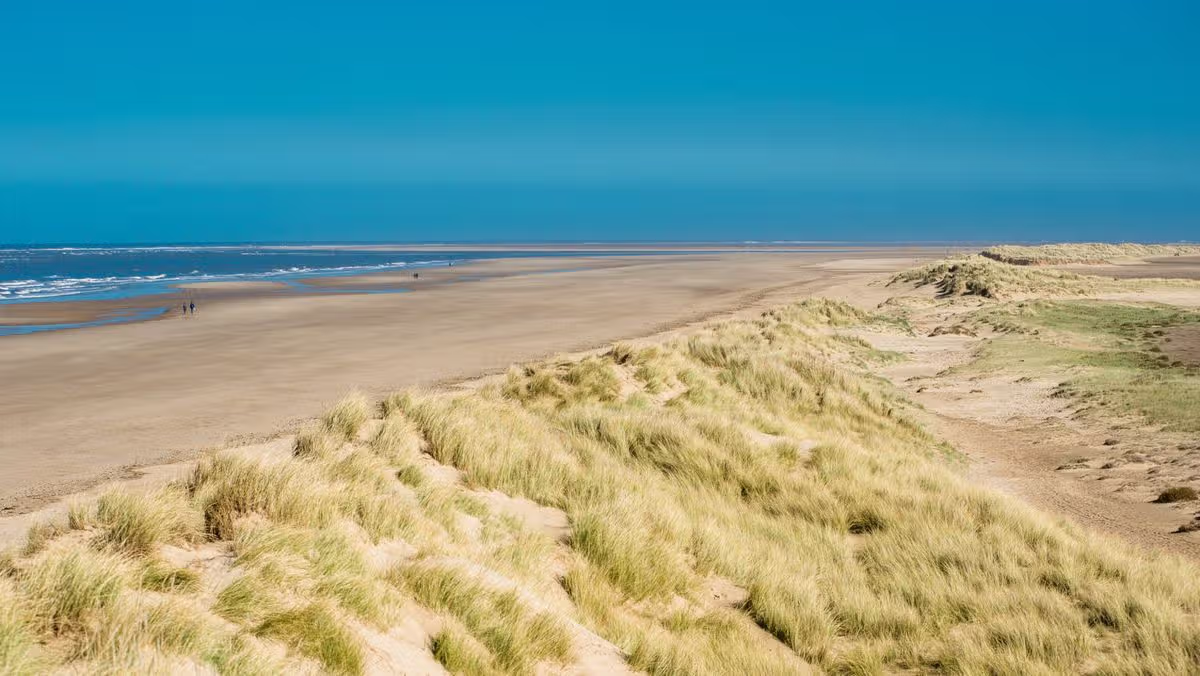
And it’s no surprise that Holkham is one of the most popular beaches to visit in Norfolk, thanks to its pristine golden-sand shore backed by rolling sand dunes and an enchanting forest. It’s even been globally acknowledged as The Times previously named it as one of the best beaches in the world, noting it’s “wide-open, jaw-dropping, windswept romance of this five-kilometre-long blonde hits you square on.”

And it certainly does that. From the moment I stepped onto the soft golden sand, after walking through the majestic sand dunes, it felt as though I had been transported to the other side of the world. The beach stretches for endless miles, out towards the sea and all the way along to Wells-next-the-Sea beach on the east, and Burnham Overy Staithe Beach to the west, for sensational coastal vistas.

Advertisement

I’ve never seen such a sprawling sand beach that remains beautifully untouched, with its scenes completely mesmerising. As I wandered along the sand, following the footprints of fellow beachgoers, I passed by families paddling in the shallows of the waters, dogs running freely off the leads, and horse riders cantering along the dedicated Bridleway – there’s that much space along the shore!

There’s nothing quite like it, and on certain days, you can see the leftover sand ripples from where the tide crept up, which only adds to its striking landscapes, in addition to the undulating dunes and perfectly imprinted footprints. If I could, I’d visit Holkham every day of the year, purely to soak up the serene setting that’s unlike any other beach; it really is breathtakingly beautiful.

I took my time strolling along the sun-kissed shore, passing dramatic sand dunes before reaching the Burnham Overy Staithe salt marsh and venturing further into its pretty harbour village for a stop off at The Hero pub for a refreshing pint and a bowl of chips. On the way back to Holkham, I found myself in other captivating scenes as I ambled over rolling hills before reaching the ancient woodland, with towering trees and an easy-to-follow footpath that’s adjacent to the stunning shore.

Advertisement

Holkham beach is even loved by members of the Royal Family, with the Prince and Princess of Wales, frequently visiting the unspoilt shore with their three children, Prince George, Princess Charlotte and Prince Louis, during the school holidays. Holkham beach is perfectly positioned just over 30 minutes from the family’s country home, Anmer Hall, which sits within the Sandringham Estate – the private residency of King Charles III and Queen Camilla, who are also reported to have visited Holkham many times.

The Norfolk beach has also been used as a backdrop for photos for the Wales family, with Princess Kate capturing snaps of her beloved family, marking various occasions and milestones. And it’s easy to see why it’s got the royal stamp of approval and has been named as one of the best beaches in the world, with its unspoilt scenes offering a slice of paradise, less than two hours from Cambridge.

Advertisement

Do you have a travel story to share? Email webtravel@reachplc.com

Source link

Continue Reading

NewsBeat

Newspaper headlines: ‘We’ve not given up’ and ‘The X Backtop’

Published

on

The headline on the front page of the Independent reads: 'We've not given up': Anguish of families as flood toll climbs.

The Sunday Telegraph, external says John Healey is mulling a windfall tax on banks and oil companies in the Budget. Treasury officials are said to be looking at ways of plugging a £4.7bn black hole without raising direct taxes on individuals.

The paper suggests banks and oil companies are seen as “low-hanging fruit”. BP is said to have more than doubled its profits between April and June because of higher oil prices driven by the Iran war. In its editorial, the paper warns against the windfall tax move, saying it will harm growth by denting investor confidence.

According to the Mail on Sunday, Russia is poised to target Britain with a cyber attack on a drone or missile factory. A key advisor to President Vladimir Putin, the former deputy foreign minister Andrei Fedorov, tells the paper the highest levels of the Russian government are considering such a strike. A drone factory owned by the British Ukrainian firm, Ukrspecsystems, is said to be a target. Its location, near RAF Mildenhall in Suffolk, was made public in April.

The Sunday Times, external reports that Andy Burnham has given what it calls a lucrative pay rise to train drivers on the Avanti West Coast London to Manchester line. The deal with union leaders was said to have been made to avoid strikes on a flagship service, and one of the busiest lines in Europe. The paper suggests industrial action would have proved embarrassing for cabinet ministers travelling to the prime minister’s new political hub, Number 10 North, in Manchester.

Advertisement

According to both the Sunday Telegraph and the Sunday People, new studies suggest statins can reduce the risk of dementia, as well as lowering cholesterol and the risk of heart attacks. The Telegraph reports that the largest study by Denmark’s Copenhagen University Hospital found that the daily pills reduced the chances of dementia by up to 15%. The paper says the research means statins could benefit around six million of almost 10 million people aged 70 and over in the UK who are not currently taking them.

The Sunday Mirror, external reports that Peter Homa, the ex-boss of Nottingham NHS Trust, where a review found that 520 mothers or babies suffered potentially avoidable death or harm, is now CEO of a firm giving maternity training to the health service. Grieving families tell the paper they are “concerned” by the news. Homa was approached for comment.

The Sun on Sunday, external suggests the X Factor could return, seven years after it left our screens. ITV chiefs are said to be “in talks” about revamping the programme for a younger generation. The show’s creator and former head judge Simon Cowell is said to be likely to return in some capacity.

And several papers carry pictures of Sir David Beckham and his wife Victoria watching their son Cruz perform at the Reading Festival with his band the Breakers. “Beckstage at Reading” says the Sunday Mirror, external. “Band it Like Beckham” is the Sunday Times caption.

Advertisement

Source link

Continue Reading

NewsBeat

Trump posts AI video of ‘Lake America’ being protected by an army of bequiffed ‘Donald Ducks’

Published

on

Trump posts AI video of ‘Lake America’ being protected by an army of bequiffed ‘Donald Ducks’

President Donald Trump on Saturday posted an apparently AI-generated video depicting an army of buff, bequiffed and heavily-armed “Donald Ducks” patrolling the shores of “Lake America.”

Hours later, while he was at his Virginia golf course, the president posted another AI-generated video, this time showing himself knocking over a “Welcome to Lake Ontario” sign and installing a “Welcome to Lake America” one in its place. He then dances to the Village People’s “YMCA.”

The posts followed Trump’s executive order renaming Lake Ontario “Lake America” amid a bitter tariff war with Canada, a longtime U.S. ally and trading partner.

Set to the theme song from Hawaii Five-O, a 34-second clip shows a squadron of Canada geese marching near the Great Lake. The birds have human arms, carry assault rifles and sport the president’s signature blond pouf of hair.

Advertisement

The geese then fire their weapons into the air as fireworks erupt over the skyline of a nearby city — which appears to resemble Toronto.

President Donald Trump posted an apparently AI-generated video of 'Lake America' being patrolled by an army of buff and bequiffed 'Donald Ducks'
President Donald Trump posted an apparently AI-generated video of ‘Lake America’ being patrolled by an army of buff and bequiffed ‘Donald Ducks’ (@RealDonaldTrump, Truth Social)

Earlier this week, Trump announced that the U.S. was giving “serious consideration” to rebranding Lake Ontario, which straddles the U.S.-Canada border. He also posted a TikTok video showing himself using a Sharpie to mark up a map of the lake.

“We’re gonna make a little change; we’re gonna call it something different than Lake Ontario,” the 80-year-old president said in the clip.

Trump posted another AI-generated video that shows the president knocking over a sign for Lake Ontario then dancing to the Village People
Trump posted another AI-generated video that shows the president knocking over a sign for Lake Ontario then dancing to the Village People (@RealDonaldTrump, Truth Social)

Any doubt that the effort was simply trolling evaporated Thursday, when Trump signed an executive order directing federal agencies to refer to Lake Ontario as “Lake America” in all official documents and records. The move echoed his similar effort last year to rebrand the Gulf of Mexico as the “Gulf of America.”

Although the president can direct how the federal government refers to geographic features, he cannot compel foreign nations, private entities or even U.S. states to follow his lead.

Canadian Prime Minister Mark Carney responded to the missive in a Thursday post on X.

Advertisement

“The name Lake Ontario comes from the Wendat word Ontari’io, which, appropriately, means ‘the lake is beautiful, the lake is big,’” he wrote. “The name is more than 400 years old, predating both the Confederation of Canada and the Declaration of Independence of the United States of America.”

“We know that America is changing. Their trading relationships, their foreign policies, their national monuments, their hydronyms,” he added. “Canadians also know that naming reality means calling it Lake Ontario – then, now and always.”

Trump signed an executive order directing federal agencies to refer to Lake Ontario as ‘Lake America’ in all official documents and records
Trump signed an executive order directing federal agencies to refer to Lake Ontario as ‘Lake America’ in all official documents and records (Getty Images)

Relations between the U.S. and Canada have deteriorated since Trump took office, including as a result of his repeated suggestion that Canada should become the “51st state.” Tensions escalated further this week over trade.

On August 22, the U.S. imposed 50 percent tariffs on about $20 billion worth of Canadian exports after last-minute talks between Ottawa and Washington broke down. The Trump administration has accused Canada of discriminating against U.S. businesses.

Carney, who has denied Trump’s accusations, likened the levies to an act of war. He retaliated with tariffs of up to 50 percent on a range of U.S. goods.

Advertisement

The trade war has also spilled into a war of words. This week, Trump singled out Ontario Premier Doug Ford in a Truth Social post, describing him as a blustering “flunky” who needs to “fall in line.”

At a news conference, Ford responded by calling Trump a “dictator,” a “bully” and the “king of bankruptcies.” He also told Trump to “kiss my a**.”

Source link

Advertisement
Continue Reading

NewsBeat

Marty Gleeson: Dog Ear at Edinburgh Fringe 2026 review – Commit to the bit, this is art

Published

on

Marty Gleeson: Dog Ear at Edinburgh Fringe 2026 review - Commit to the bit, this is art

And so with this show, everything is very deliberate and performed with conviction. There is no “oh I need some stronger material there” or “haha I never know how that bit’s going to go”. That’s not to say every part of this show fully lands with the audience, by any means. But it’s the show as it was intended. To see a performer commit to the bit, to the extent she does in particular when playing out a funeral scene (and if you’re trying to guess how, you’re wrong) may be unrivalled at this year’s festival. It pays off with what may be its most brilliant extended joke. No spoilers.

Source link

Continue Reading

Trending

Copyright © 2025