
Crypto World
Microsoft, Palantir Lead Five Stocks Near Buy Points In Hot Sector


Technology stocks are back, as Magnificent Seven member Microsoft (MSFT) extends a breakout. Palantir Technologies (PLTR), Workday (WDAY), JFrog (JFROG) and Shopify (SHOP) are other software stocks near buy points, too. After back-to-back losses, the S&P 500 Technology sector is up about 6% so far this month. The software segment is outperforming, with iShares Expanded Tech-Software Sector ETF (IGV) up…
Copyright ©2026 Investor’s Business Daily, LLC. All rights reserved. 87990cbe856818d5eddac44c7b1cdeb8


How The Anthropic And OpenAI IPOs Could Shake Up The AI Brawl
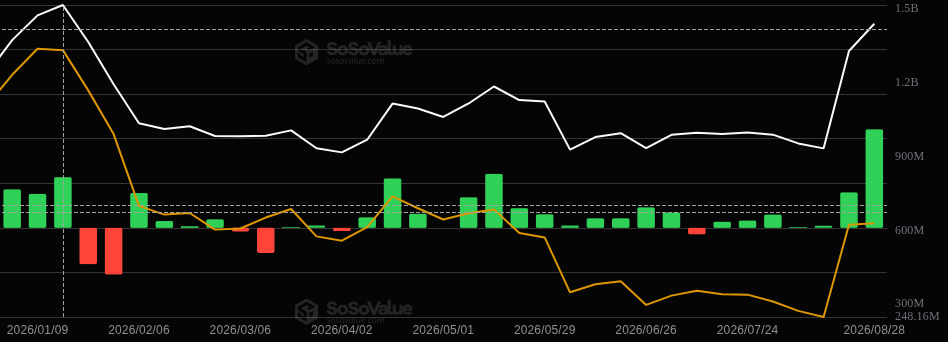
Spot XRP ETFs pulled in $110.49 million in net inflows for the week ending August 28, their strongest weekly haul of 2026 by a wide margin.
That surge pushed cumulative net inflows to $1.66 billion, with total net assets climbing to $1.44 billion across all funds.

XRP ETFs Smash Their Weekly Inflow Record This Year
Most of 2026 told a quieter story. Negative weeks hit in late January, mid-March, and briefly in July, followed by a near-dead stretch of inflows through early August, right before this week’s breakout.
The $110.49 million pulled in this week is the year’s best, though it still trails the all-time high of $243.95 million set during the week in late November 2025.
Measured against 2026 alone, this week more than doubled the previous top mark, a $60.5 million week back in mid-May, according to SoSoValue data. Trading activity spiked alongside it, with $363.03 million changing hands, the busiest week since these funds launched.
While XRP ETFs posted a $26.20 million net inflow that day, Bitcoin funds saw $201.81 million in net outflows, and Ethereum funds saw $102.18 million in net outflows, highlighting XRP’s steadier institutional demand even as Bitcoin faced heavy selling pressure.
Follow us on X to get the latest news as it happens.

XRP Price Pulled Back From $1.70 Resistance
The inflow surge did not track XRP’s own price this week. The token traded near $1.38 as of August 29, according to CoinGecko data, down 2.3% over 24 hours and 7.8% over the past week, after briefly testing resistance near $1.70 earlier in the period before pulling back sharply.
That divergence stands out. Institutional inflows accelerated even as the token itself corrected lower, suggesting funds may be accumulating into weakness rather than simply chasing price strength.

Total net assets across the ETF group nearly tripled in a single week, jumping from roughly $933 million to $1.44 billion, reflecting the surge in fresh capital despite the price pullback.
Whether this pace of inflows continues remains an open question. The ETFs already showed this year that strong weeks can be followed by long stretches of muted demand, and XRP itself remains in a clear corrective phase after its sharp run toward $1.66, now trading roughly 8% below that level.
Subscribe to our YouTube channel to watch leaders and journalists provide expert insights.
The post XRP ETFs Hit a New 2026 Record at $1.6 Billion appeared first on BeInCrypto.

Copper and gold prices are rising, helping mining stocks return to and dominate the IBD 50. Many of these industry players are in or near buy zones. Gold prices recently got a boost after the U.S. Treasury announced increased bond buybacks. This move reduces bond yields and weakens the dollar, making the metal more attractive and cheaper for foreign buyers.…
Copyright ©2026 Investor’s Business Daily, LLC. All rights reserved. 87990cbe856818d5eddac44c7b1cdeb8
Ethereum’s explosive rally has stalled around a major resistance area, with price action now turning increasingly choppy near $2.5K. The broader recovery remains intact, but weakening short-term structure and a more hawkish macro backdrop raise the probability of consolidation or a corrective pullback before another sustained advance.
Ethereum Price Analysis: The Daily Chart
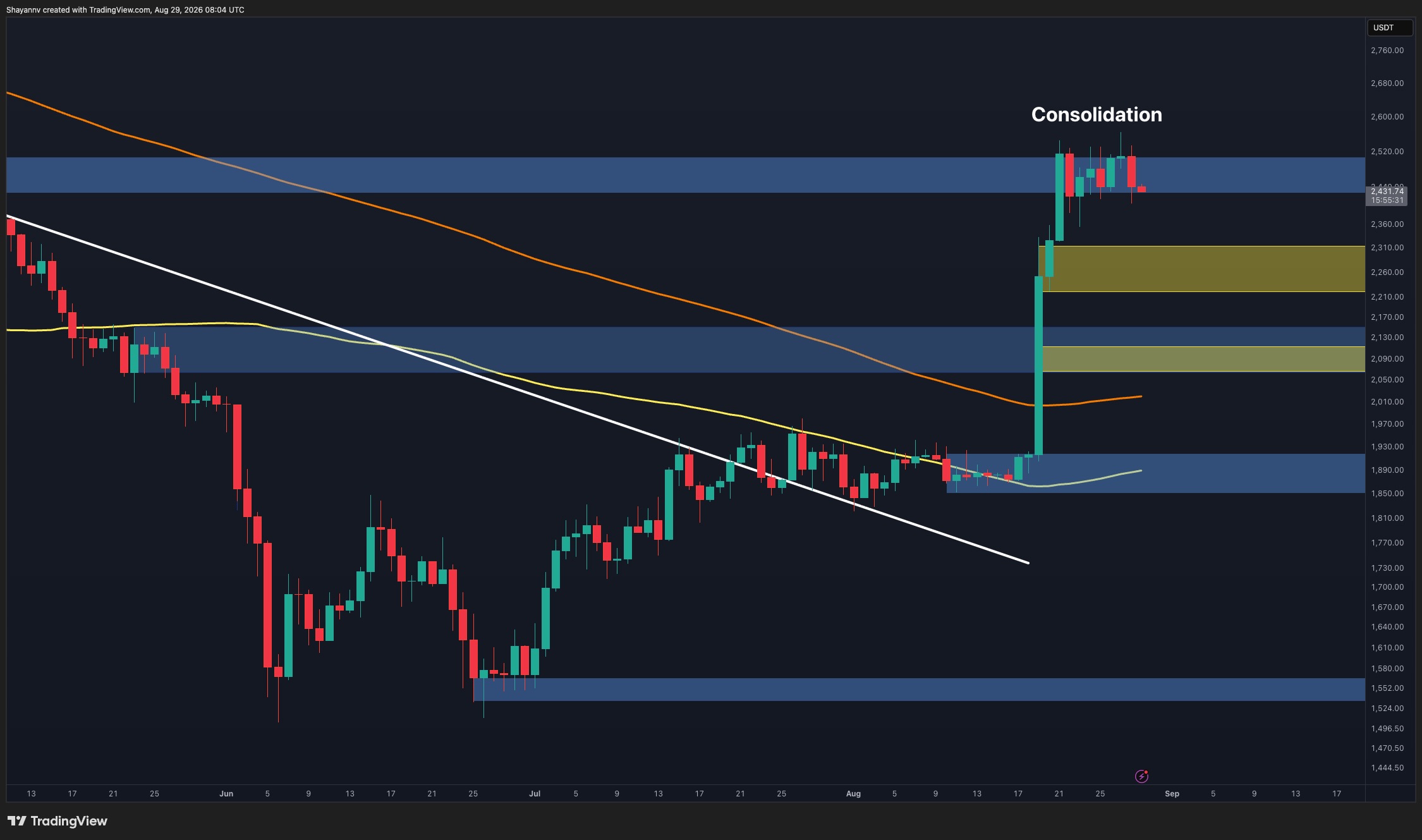
Ethereum is consolidating after its powerful breakout from the $1.85K-$1.92K base. The price has now reached the major $2.4K-$2.52K supply zone, where buyers have so far struggled to generate another impulsive continuation. The repeated rejection around this region suggests that supply is becoming increasingly relevant following the near-vertical advance.
As a result, choppy consolidation appears likely in the short term, while a corrective move should not be ruled out. The first notable support sits around the $2.21K-$2.31K zone. Below it, the $2.06K-$2.14K area represents the next important support region and could become relevant if selling pressure accelerates.
The macro environment is also adding pressure. Federal Reserve Chair Kevin Warsh’s latest Jackson Hole remarks emphasized that inflation remains too elevated and suggested that rates may need to remain restrictive or potentially move higher if inflation fails to make sufficient progress toward the Fed’s 2% objective.
Markets interpreted the comments as hawkish, with expectations for another rate increase rising after the speech. This backdrop appears to be weighing on risk sentiment and could make an immediate Ethereum breakout more difficult.
ETH/USDT 4-Hour Chart
The short-term picture is showing clearer signs of exhaustion. Ethereum has repeatedly tested the upper portion of the $2.4K-$2.52K resistance zone, producing three successive peaks around the same broad area.
This price action creates the potential for a three-drive pattern. Such a structure typically signals that the preceding directional move is losing momentum and can precede either a sideways range or a temporary reversal. More importantly, Ethereum has now slipped below the ascending trendline connecting the recent higher lows, adding weight to the possibility that the immediate bullish impulse is weakening.
The first downside area to monitor remains the $2.21K-$2.31K pullback zone. A correction into this region would still be compatible with the broader bullish structure and could allow the market to establish a healthier base. If that support fails, the second pullback zone around $2.07K-$2.11K becomes the next significant target.
Alternatively, holding the current $2.4K area and reclaiming the rising trendline would reduce the immediate bearish pressure. A convincing breakout through the $2.52K region would also invalidate the developing reversal setup and favor continuation of the broader bullish trend.

Sentiment Analysis
Ethereum’s Spot Average Order Size chart provides additional context for the current indecision. The metric distinguishes periods dominated by larger whale-sized spot orders from more ordinary market activity.
Most recent observations appear to be classified as normal orders, with no notable concentration of large whale transactions at the latest readings. This suggests that neither exceptionally strong whale demand nor aggressive whale supply is currently dominating the spot market.
The absence of substantial large-player participation fits the technical consolidation scenario. With limited evidence of strong directional conviction and relatively subdued participation, Ethereum may remain vulnerable to volatile swings within a range rather than immediately establishing another sustained trend. A meaningful return of large whale orders could therefore provide a more useful signal that stronger demand or supply is entering the market.

The post Where Will ETH Find Support After the $2.5K Rejection? (Ethereum Price Analysis) appeared first on CryptoPotato.

A Solana token marketed through a Trump-linked brand appears to have collapsed shortly after launch, igniting fresh questions about who controlled the project and what happened to the liquidity once trading began. The episode centers on a token called “Trump Digital GOLD” and the Real Trump Coins brand, which publicly promoted the launch before deleting related posts.
According to blockchain analytics firm Lookonchain, the token’s supply was heavily concentrated in a small number of wallets controlled by the developer, with early buyers later selling into the market. The sharp drop in value—paired with the rapid sell activity—has led analysts to describe the launch as highly suspicious and potentially a “rug” style event.
Key takeaways
- Lookonchain says the GOLD token’s developer held about 82.45% of the total supply at launch, raising immediate red flags for traders.
- Lookonchain reports that a group of 15 newly created wallets acquired large amounts of GOLD and then sold all tokens shortly afterward.
- DEX Screener data cited by Lookonchain shows GOLD’s market capitalization fell from roughly $50 million to $500,000 within hours.
- Real Trump Coins promoted the token on X before deleting related posts, fueling speculation the account or promotion may have been compromised.
How the GOLD launch unraveled so quickly
GOLD first came onto the radar early Saturday when the Real Trump Coins X account announced the token launch and directed users to buy via RealTrumpCoins.com. The post appeared with the Real Trump Coins account connected to—at least by follow—Trump’s official presence on X, lending the promotion extra attention.
Lookonchain flagged the activity shortly afterward, pointing to unusual on-chain behavior. In its analysis, the firm said the developer controlled 600 million GOLD tokens and that 15 newly created wallets collectively spent $18,657 to purchase about 224.5 million GOLD.
Lookonchain also emphasized that the team’s wallet concentration was extreme, stating that the group controlled 82.45% of the total supply. That type of distribution pattern can be a major risk factor because it increases the likelihood that early insiders can influence price through coordinated selling.
Further on-chain tracking from Lookonchain later claimed those 15 wallets sold all 224.5 million GOLD for 3,178 SOL, which it estimated at roughly $330,000. The report describes that selloff as occurring after the initial purchases were made.
As a result, GOLD’s price appears to have deteriorated rapidly. Lookonchain cited DEX Screener to describe a collapse in market value, with market capitalization dropping from around $50 million to about $500,000 by the time of publication. Lookonchain characterized the outcome in its own commentary, estimating profits for the wallets at approximately $312,000—about 17 times their initial investment.
Ongoing website promotion after X posts vanished
While traders were watching the on-chain data, the promotional footprint of the brand itself became another point of controversy. Lookonchain reported that Real Trump Coins’ related X posts were deleted on Saturday, after Trump-linked brand activity initially circulated.
Despite the social-media deletions, the Real Trump Coins website continued promoting “GOLD” at the time of publication. The page advertised a 4% trading fee and claimed that 99% of trading fees would be used to buy back the token, positioning the plan as a method to push GOLD toward a top-10 market capitalization ranking.
This mismatch—social promotion disappearing while the website remained—helped fuel speculation among community members and analysts about what exactly happened behind the scenes, including whether the X account was compromised or whether the token’s development team had acted against the interests suggested by the website’s marketing.
What is Real Trump Coins?
Real Trump Coins is a brand that Donald Trump publicly promoted in September 2024, according to coverage linked by the article via TrumpTruth.org. At the time, Trump described RealTrumpCoins.com as the exclusive place to buy his silver medallions.
The Real Trump Coins website also states that the products are not manufactured, distributed, or sold by the Trump Organization. That detail matters for readers because it frames the brand as separate from the Trump Organization’s direct operational control—an important distinction when investors assess perceived affiliation and responsibility.
In the hours after the GOLD launch, multiple observers took to X with competing theories. Some claimed the Real Trump Coins X account was hacked, while others characterized the GOLD token launch itself as a scam based on its trading and supply dynamics. The broader conversation included allegations from community accounts about an external hacking actor, though such claims weren’t verified in the reports cited.
Why the episode matters for Trump-linked crypto narratives
Beyond the specific token, the GOLD incident adds to a wider pattern of scrutiny around crypto ventures associated with political figures. The article ties this environment to how the U.S. is debating crypto oversight, including whether tokens are treated under securities or commodity frameworks.
According to the account described in the source text, Trump urged lawmakers on Aug. 19 to pass a “fair version” of the proposed CLARITY Act, aimed at creating a clearer regulatory structure for digital assets. The same context highlights that Trump and his family have backed or launched multiple crypto-related efforts, including the Official Trump (TRUMP) memecoin and World Liberty Financial, while the White House has denied impropriety.
For market participants, these developments are relevant because brand-driven promotions can attract users who assume the marketing implies legitimacy. When a token launch exhibits insider control and rapid sell behavior, it can undermine trust not only in the individual project but also in how political or widely known brands are perceived in the crypto space.
Readers should watch whether GOLD’s token contracts and liquidity evolve in a way that clarifies control and intent—especially any changes to wallet distributions, trading activity, or official follow-ups from the Real Trump Coins team. Until then, the combination of concentrated supply control and abrupt market collapse remains the strongest signal that traders should treat similar “branded” launches on Solana with exceptional caution.


When you strip out what was never mobile, correct for who’s holding what and why, add back what works off-contract, the utilization of tokenized assets looks close to 20%, argues Katana’s Matthew Fisher.


A regional UK police force has seized 20.21 Bitcoin and other assets valued at more than $1.4 million after tracing the funds to darknet marketplaces active between 2016 and 2019.
Summary
- Police recovered 20.21 BTC, other cryptoassets, and bank funds valued at £1.03 million.
- Investigators traced the holdings to unnamed darknet markets that operated from 2016 to 2019.
- A court forfeited the assets under the Proceeds of Crime Act earlier in 2026.
- The recovery is the force’s largest since new crypto freezing powers took effect in April 2024.
UK police recover 20.21 Bitcoin and other assets
Avon and Somerset Police said on Aug. 27 that its Financial Investigation Unit had recovered 20.21 BTC, other digital assets, and money held in a bank account.
The assets had a combined value of £1,032,487.86, or more than $1.4 million, when the police force valued them. Officials did not disclose the amount held in other cryptocurrencies or the bank account, nor did they identify the tokens involved.
Earlier in 2026, a court approved the forfeiture after accepting that the holdings represented proceeds from unlawful conduct. Police pursued the assets under the Proceeds of Crime Act, which allows authorities to recover property obtained through criminal activity.
The unnamed person at the center of the investigation had previously been convicted of money laundering and has since died, according to the statement. Officials did not disclose when the earlier conviction occurred, the offenses connected to it, or whether anyone else was investigated.
At Bitcoin’s current price of about $77,570, the 20.21 BTC alone would be worth approximately $1.57 million. The difference from the police valuation may come from the date on which officials calculated the total, as Bitcoin’s market price has changed since the assets were forfeited. The force did not provide a valuation date or state whether any of the Bitcoin had been converted into pounds.
Blockchain records exposed the darknet funds
Working with the force’s cyber team, financial investigators used specialist tracing methods to follow the assets to several darknet marketplaces operating from 2016 through 2019.
Police did not name the platforms but said law enforcement agencies have since closed all of them. According to the force, the marketplaces facilitated offenses ranging from drug distribution to human trafficking.
The period includes several major darknet enforcement operations. The U.S. Department of Justice closed the AlphaBay market in July 2017 after an international investigation involving authorities in the United States, Thailand, the Netherlands, Lithuania, Canada, the United Kingdom, and France.
Dutch police had secretly taken control of Hansa before closing it alongside AlphaBay. Europol said investigators operated Hansa for about one month, allowing them to collect information about vendors and customers who moved to the platform after the AlphaBay takedown.
Dream Market, another large platform from the period covered by the Avon and Somerset investigation, stopped operating in 2019. The police statement did not say whether the recovered Bitcoin passed through AlphaBay, Hansa, Dream Market, or other marketplaces.
Although darknet services can hide the people behind transactions, public blockchain records retain the movement of Bitcoin between addresses. Investigators can combine that transaction history with exchange records, seized devices, and other financial evidence to identify links between wallets and suspected criminal activity.
Detective Constable Anthony Davis of the Financial Investigation Unit said some people believe cryptocurrency can provide anonymity, conceal wealth, and keep assets outside the reach of police. In practice, he said, the blockchain stores a “permanent record of transactions” that can become “an invaluable source of evidence.”
Davis added that specialist financial investigation skills had become increasingly important for locating and recovering criminal assets held in cryptocurrencies.
UK crypto freezing powers support asset recovery
The operation is Avon and Somerset Police’s largest cryptocurrency seizure since crypto wallet freezing orders became available in April 2024.
The UK government introduced the new powers through changes to the Proceeds of Crime Act. Police can freeze cryptoassets when they have reasonable grounds to suspect a connection to illegal activity, even when authorities have not made an arrest.
Before the amendments, officers could face limits when trying to take control of digital assets during an investigation. The current rules allow authorities to transfer seized tokens into law enforcement-controlled wallets and recover items that could provide access to the funds, including written passwords and storage devices.
Officers may also destroy a cryptoasset when returning it to circulation would not serve the public interest. When the measures took effect, the UK Home Office identified privacy-focused cryptocurrencies as one type of asset that could require such treatment.
A freezing order does not itself establish that an asset is criminal property. In the Avon and Somerset case, the holdings were forfeited only after a court became satisfied that they came from unlawful conduct.
Money recovered under the Proceeds of Crime Act can be directed to policing and community programs. Avon and Somerset Police said the funds may support education, training, early intervention and crime-prevention work.
U.S. cases also rely on blockchain tracing
The British recovery follows several American cases in which investigators used transaction records to locate crypto connected to darknet services.
In January, crypto.news previously reported that the U.S. Department of Justice completed a $400 million forfeiture involving assets seized from Helix operator Larry Dean Harmon. The DOJ said Helix processed more than 354,000 BTC between 2014 and 2017 and helped customers conceal funds associated with darknet markets.
A federal court granted the U.S. government legal ownership of the Helix assets after Harmon pleaded guilty in 2021 to operating an unlicensed money-transmitting business and violating the Bank Secrecy Act. He received a three-year prison sentence in 2024.
In June, U.S. prosecutors charged two alleged operators of the AudiA6 laundering service, which authorities accused of handling more than $389 million in cryptocurrency. Blockchain analysis cited by prosecutors identified about 10,333 BTC deposited into wallets controlled by the service since 2021, including 393.39 BTC sent directly from known darknet markets, ransomware groups, and other illicit sources.
The UK has also handled much larger Bitcoin recoveries. In September 2025, Chinese national Zhimin Qian pleaded guilty after authorities recovered digital wallets containing 61,000 BTC connected to an investment fraud that targeted more than 128,000 people in China. Police discovered the wallets during a 2018 raid after receiving information about the transfer of criminal assets, according to earlier case coverage.
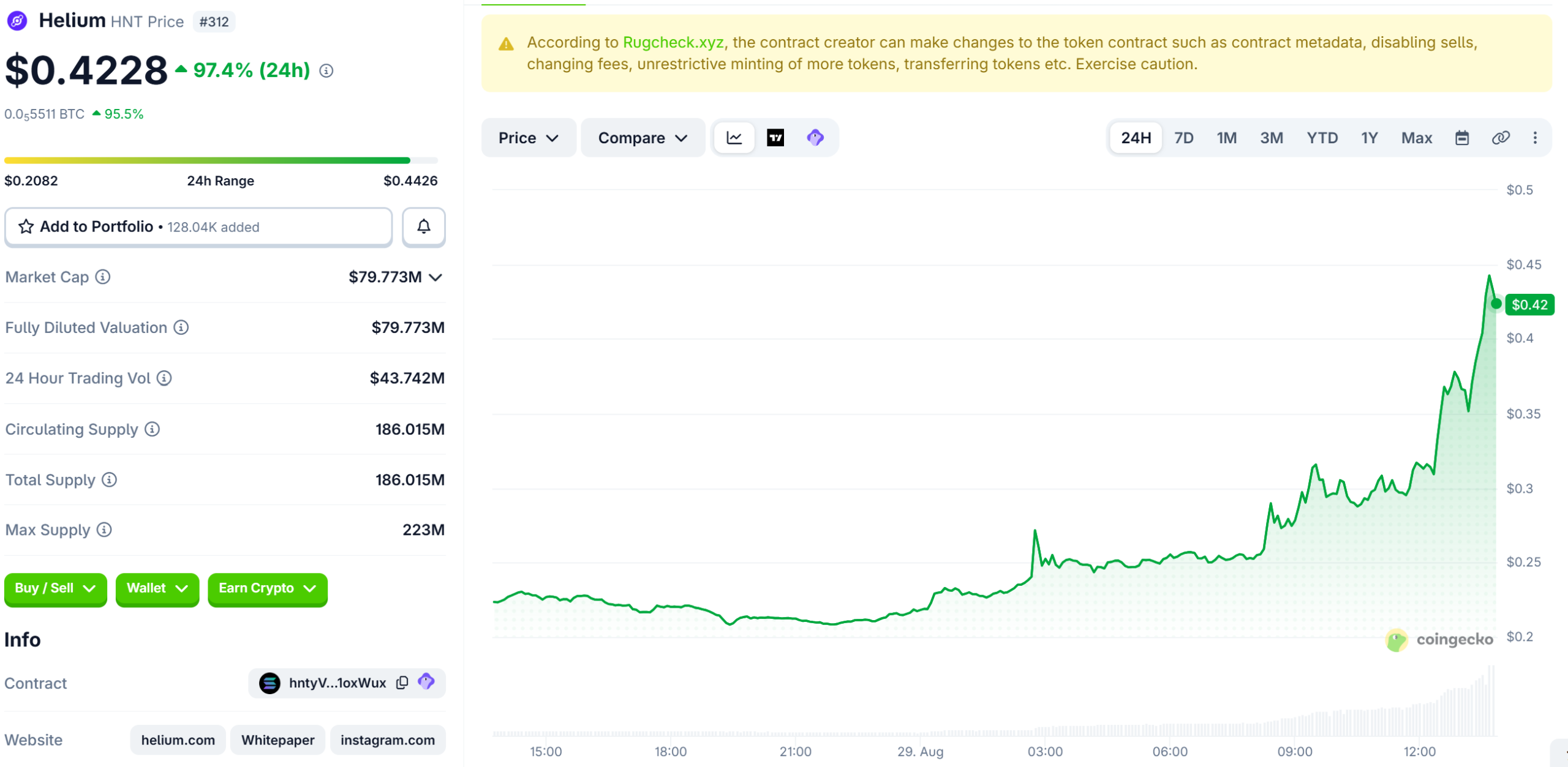
Helium (HNT) jumped almost 100% on Saturday. Behind the surge is a Texas town that stopped waiting for cell towers and switched on Wi-Fi it already owned.
Celina sits north of Dallas. It added 12,710 residents in a year and grew 24.6%, the fastest of any US city with more than 20,000 residents.
How Helium Turned Wi-Fi Into Cell Service
Helium announced the deployment on Friday. It covers the Celina Public Library, the Ralph O’Dell Senior Center, and some downtown shops.
The city built nothing new, since it already had Wi-Fi. Helium added a layer that lets phones treat those hotspots as cell coverage.
Phones sign in using credentials already stored on the SIM card. No app or password. Most people never notice the handoff.
The idea is not new either. AT&T signed on to the same Helium system in April 2025. That deal is what makes the automatic connection work.
“Helium let us turn Wi-Fi we already own into coverage our residents’ phones use automatically, without spending a dollar on new towers,” said Amy Alexander, director of information technology for the City of Celina.
Follow us on X to get the latest news as it happens
Why Helium Jumped Nearly 100%
The news broke Friday, yet HNT ran overnight and added roughly $37 million in market value. Those Celina sites carry about 100 GB a day. That is one library, one senior center, and a few shops.
So traders bought the idea, not the income. HNT gained 97.4% over 30 days, and almost all of it arrived in the final 24 hours.
Turnover says the same thing because close to $44 million changed hands in a day, more than half the token’s $79 million market value.

However, with HNT trading near $0.42, it remains down 85.6% over 12 months and far below its 2021 Helium price peak of $54.88.
The post Helium Token Skyrockets 100% After Texas Town Turns Wi-Fi Into Cell Coverage appeared first on BeInCrypto.
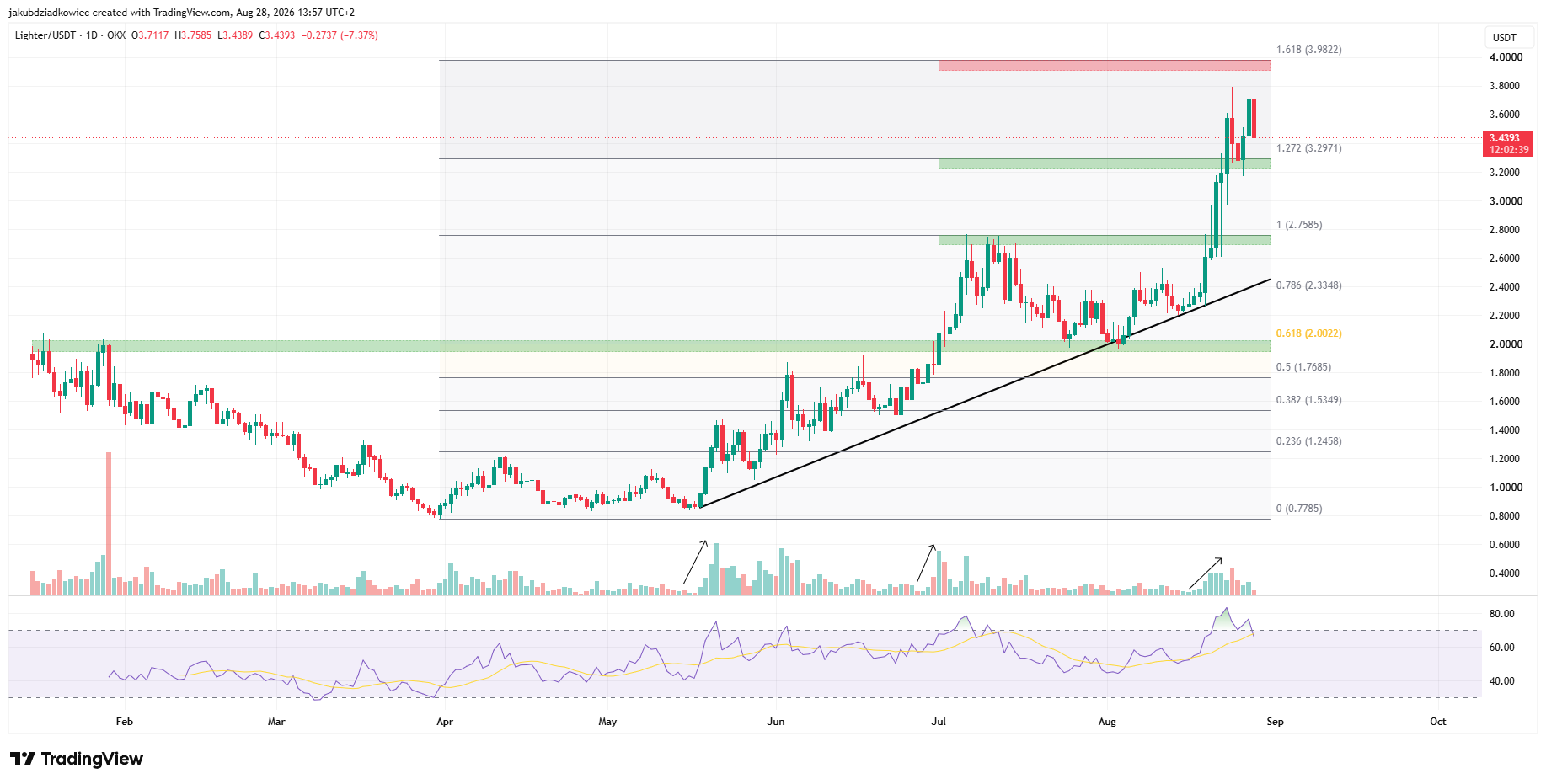
Three altcoins to watch this weekend share the same setup. Lighter (LIT), Zcash (ZEC), and Rain (RAIN) have each broken above multi-month highs and tagged their first Fibonacci extension target.
Each chart now asks the same question. The broken highs have flipped into support, while the 1.618 Fibonacci extension sits overhead as the next objective into the weekend.
Altcoin
Current Price
Next Resistance
Target if Cleared
Support if Price Falls
Lighter (LIT)
~$3.39
$3.79
$3.98
$3.30, then $2.76
Zcash (ZEC)
~$807
$903
$1,099
$749.65, then $628.63
Rain (RAIN)
~$0.01766
$0.01948
$0.02214
$0.01624, then $0.01420
Lighter Extends Its Breakout Toward $3.98
Lighter trades near $3.46 with a market capitalization of $865 million. The token has gained about 25% over the past week and roughly 57% over the past month.
The daily chart shows a clean breakout on Aug. 21 above $2.76, a level LIT had not traded through since January. That move followed a July tokenomics overhaul that introduced permanent supply reduction.
Price then cleared the 1.272 Fibonacci extension at $3.30 and now works toward the 1.618 extension at $3.98. That target sits about 15% above spot.

On a pullback, the broken $2.76 level becomes the first support. An ascending trendline drawn from the mid-May low is converging with the same price level, strengthening the zone.
Below it, the long-term 0.618 retracement at $2.00 remains the deeper floor.
Volume expanded higher on each leg, including the August advance that followed the first revenue-funded burn. RSI has cooled from an overbought reading near 85 to just under 70 without printing a bearish divergence.
Zcash Stalls Under $900
Zcash trades near $806 with a $13.6 billion market cap. ZEC has climbed roughly 75% in 30 days, extending a rally that began earlier this year.
The privacy coin broke above $749.65 and pushed into the 1.272 extension at $903.47 before sellers stepped in. Price has since settled back near $800, holding well above the breakout level.
The 1.618 extension at $1,099.14 marks the next upside objective, roughly 37% above current prices. ZEC still trades far below its record of $3,191.93, set in October 2016.

Support is stacked. The old $749.65 high sits first, followed by the 0.786 retracement at $628.63, which currently aligns with the 20-day moving average.
Bollinger Bands have expanded sharply, indicating a period of volatility rather than a range. Volume ticked higher on the breakout leg, and RSI holds near 70 with no bearish divergence. A newly listed Grayscale product tracking ZEC provides a fundamental backdrop for the move.
Rain Prints a Record High With Volume Behind It
Rain trades near $0.01763 with a $12.35 billion market cap. Market data places its record high at $0.019464, reached on Aug. 25.
The RAIN chart offers the cleanest structure of the three altcoins discussed here. Price built a tight accumulation base through early and mid-August, roughly between $0.0121 and $0.0130.
That base formed directly on the 0.618 retracement at $0.01259, and volume rose steadily inside the range before any breakout occurred. Accumulation therefore preceded the move rather than chasing it.

The Aug. 26 candle cleared $0.01624 and wicked into the 1.272 extension at $0.01884. The 1.618 extension at $0.02214 now stands about 27% higher.
Support levels sit at the broken $0.01624 high, then $0.01420, then the accumulation shelf at $0.01259. RSI trades above 70 with no bearish divergence, which suggests momentum remains intact.
One structural risk deserves attention. Circulating supply stands near 709 billion tokens against a maximum of 1.15 trillion, so further unlocks could weigh on price.
The post Top 3 Altcoins to Watch This Weekend After Record High Price Jump appeared first on BeInCrypto.
Crypto World
UAE “Spy Sheikh” Behind Trump Crypto Bank: 49% Ownership, $500M and Questions MAGA Can’t Avoid

Sheikh Tahnoon bin Zayed al Nahyan and co-investors are behind an entity that owns 49% of the holding company created for the planned Trump crypto World Liberty Financial’s US banking venture, according to people familiar with the matter, as cited by The Wall Street Journal.
The stake makes Tahnoon-linked investors the largest shareholders in the holding company behind a bank being prepared by the Trump family’s cryptocurrency venture.
The reported ownership arrangement follows a $500M investment in World Liberty Financial that Tahnoon backed last year in exchange for a 49% stake in the company, the Journal previously reported. The new venture expands the business relationship between the Trump-backed crypto company and a foreign government official.
Trump Crypto Bank Breakdown: Why the Initiative Matters Now
The Office of the Comptroller of the Currency earlier this month granted preliminary conditional approval for World Liberty Financial to launch a federally chartered national trust bank, according to the Journal’s Aug. 27 report. The proposed bank would issue, redeem and safeguard USD1, the dollar-backed stablecoin World Liberty launched last year.
The preliminary approval places the proposed bank at the center of World Liberty Financial’s stablecoin business. It also focuses on the ownership of the holding company created for the venture, in which Tahnoon and his co-investors are reported to hold the largest stake.
Make Your Prediction Count With $25 For Free on Kalshi
The Ownership Question
— Mario Nawfal (@MarioNawfal) August 28, 2026
 The “spy sheikh” is now a major backer of the Trump family’s new crypto bank.
Sheikh Tahnoon bin Zayed, UAE national security adviser and brother of the country’s president, sits behind a 49% stake in the holding company for World Liberty’s planned U.S. bank. A Trump-family… pic.twitter.com/wV4laIAK6f
The 49% holding-company stake follows the earlier 49% stake in World Liberty Financial itself. The Journal reported that Tahnoon-linked investors are behind the entity holding the largest stake in the holding company for the banking venture.
Tahnoon is the United Arab Emirates’ national security adviser and the brother of the country’s president. The Journal reported that he oversees an empire funded by his personal fortune and state money worth more than $1.3 trillion.
The report identifies the size of the stake and the investors behind it, but it does not detail the banking venture’s board composition, governance rights, or any veto arrangements associated with the ownership position. Those details would be important to assessing how the holding-company ownership is reflected in the venture’s operations.
Don’t Miss Out on Our $1,000 USDT Airdrop on ByBit
What the Reporting Establishes
The reporting establishes a significant financial relationship between World Liberty Financial and investors linked to a senior UAE official. It does not establish that Tahnoon personally directs the planned bank’s day-to-day management or sets its U.S. regulatory strategy.
Tahnoon has sometimes been referred to in coverage as the spy Sheikh. The Journal’s reporting on this banking venture identifies his role as the UAE’s national security adviser and describes the ownership stake, but does not connect the nickname to operational control of World Liberty Financial’s planned bank.
How USD1 Fits Into the Proposed Trump Crypto Bank

USD1 is World Liberty Financial’s dollar-backed stablecoin, launched last year. Under the OCC’s preliminary conditional approval, the federally chartered national trust bank would issue, redeem, and safeguard the token.
The report describes the proposed Trump crypto bank’s role in USD1 but does not provide further detail about the venture’s governance structure or how the holding company’s ownership would relate to specific banking functions. The preliminary approval is therefore a key development for the planned bank, while important operational details remain outside the reporting provided.
Never Miss a Swing Again: Use AI Copy Trading Bots From CryptoHopper
The post UAE “Spy Sheikh” Behind Trump Crypto Bank: 49% Ownership, $500M and Questions MAGA Can’t Avoid appeared first on Cryptonews.

Watch Tottenham vs Newcastle: Live Streams, Team News & TV Channels

Bitcoin Erased 3 Months of Pain in Just 72 HOURS

SBAR: 85% In A Money Market ETF, But That’s Not Where The 12% Yield Comes From (NYSEARCA:SBAR)





-

 Crypto World4 days ago
SpaceX stock could rise 75% to $240, JPMorgan says
-

 Crypto World2 days ago
Bitcoin’s 22% rally now needs real demand to outlast Treasury liquidity boost
-

 Business7 days ago
Musk’s Tesla, SpaceX Confirm $16.8 Billion ‘Terafab’ Chip Plant as World’s Largest Building in Texas
-

 Fashion20 hours ago
Weekend Open Thread: Maeve – Corporette.com
-

 Crypto World5 days ago
A $30 Billion AI Fund Implodes, Now the SEC Is Investigating Wall Street’s Role
-

 Crypto World3 days ago
Warsh Jackson Hole keynote puts financial innovation first
-

 Business2 days ago
Salesforce Stock Soars 19% as Blowout Earnings and Agentforce AI Growth Silence Software Skeptics
-

 Crypto World3 days ago
Did Trump Just Move SpaceX Stock With One Truth Social Post?
-

 Business6 days ago
Mystery AI Model ‘Ox Alpha’ Draws Developers With Free Access as Chinese Lab Origins Remain Debated
-

 Business3 days ago
Walmart takes aim at younger shoppers with new fashion brand
-
 NewsBeat3 days ago
Lindsay Clancy jury braces for closing arguments as judge tells court: ‘You’ve heard all the evidence’ – Live updates
-

 Business5 days ago
Moderna CEO warns China is pouring state money into mRNA technology
-

 Crypto World3 days ago
Elon Musk Grok Bot Promise: We Will Make You Whole if AI Loses Your Money
-

 Business5 days ago
NVIDIA Stock Drops Nearly 2 Percent to $210 on Seventh Losing Day Ahead of Critical AI Earnings
-

 Crypto World2 days ago
NVIDIA revenue hits $96.2B as AI demand doubles
-

 Business21 hours ago
iPhone 18 Pro Pre-Orders Could Shift to Saturday as Apple Reportedly Avoids September 11 Anniversary
-

 Business4 days ago
Thailand’s Eastern Economic Corridor Capital City (EECiti): Key Developments and Investment Opportunities
-
 Crypto World5 days ago
$92 Billion Nvidia Earnings Could Make or Break the AI Trade
-

 Business6 days ago
Where Will Kevin Durant Play in 2027? Rockets Hold Player Option Key to His Future With Houston via Deal
-

 Sports6 days ago
Deshaun Watson fires back at Browns fans after being booed: ‘It’s a disrespectful thing’
You must be logged in to post a comment Login