
Crypto World
Solana sets Sept. 9 date for Transaction V1



Solana Foundation Vice President of Technology Jacob Creech outlined several upcoming Solana upgrades on Aug. 30. Transaction V1 is scheduled for Sept. 9, while the first stage of a network rent reduction is expected during the week beginning Aug. 31.
Summary
- Solana plans to activate Transaction V1 on September 9, increasing transaction size to 4,096 bytes.
- The first rent reduction stage begins next week, starting a five-step path toward 90% savings.
- Solana already cut target slots to 350 milliseconds, with 300, 250 and 200 planned later.
- Alpenglow remains targeted for October, with Solana aiming for approximately 150-millisecond finality after mainnet activation.
- Legacy and version-zero transactions remain compatible because developers must opt into the larger V1 format.
Creech also said developers plan to shorten slot times further and target October for Alpenglow. However, these changes follow separate activation processes. Transaction V1 will not automatically reduce slot times or activate Alpenglow.
Transaction V1 raises Solana’s limit to 4,096 bytes
Transaction V1 will raise Solana’s maximum serialized transaction size from 1,232 bytes to 4,096 bytes. The increase is about 3.3 times the existing limit, according to Solana’s official upgrade roadmap.
The larger format could support transactions containing zero-knowledge proofs, complex multisignature instructions and other data-heavy operations. The associated SIMD-0296 proposal also identifies BLS signatures and cross-chain operations as possible uses.
Developers must opt into the V1 format. Existing legacy and version-zero transactions will remain valid. Transaction V1 will not support address lookup tables, meaning applications must decide which format suits each transaction.
The change also requires wallets, application programming interfaces and other infrastructure to handle larger data payloads. The proposal acknowledges possible bandwidth and network fragmentation risks, which makes coordinated testing important before wider adoption.
Solana rent reduction begins with one of five steps
The first rent reduction does not deliver the full 90% target immediately. Solana plans five stages that would eventually lower the rent calculation from 6,960 lamports per byte to 696 lamports per byte.
Solana uses rent-exempt balances to limit uncontrolled state growth. Applications lock SOL when creating accounts that store data. That SOL is generally recoverable when the account closes, meaning rent functions more like a refundable deposit than a recurring network fee.
Lower requirements would reduce the amount of SOL that developers must lock when creating token accounts, program accounts and other onchain state. This could lower entry costs for applications that manage many user accounts.
Agave 4.2 included the necessary code, but Solana placed the changes behind independent feature gates. As crypto.news previously reported, validators can activate the rent, transaction-size and slot-time upgrades separately after testing.
Faster Solana slots follow a separate schedule
Solana has already reduced its target slot time to 350 milliseconds, down from the previous 400-millisecond target. The network plans additional stages at 300, 250 and eventually 200 milliseconds.
Creech did not provide dates for those remaining stages. Each reduction requires a separate feature activation. Network developers can therefore monitor validator performance before proceeding to the next target.
Shorter slots can improve transaction confirmation speed and increase the frequency at which validators produce blocks. They also place greater timing and networking demands on validators. Solana plans to adjust resource limits proportionally during the rollout.
Transaction V1 and reduced slot times are related to Solana’s broader performance roadmap, but they remain technically distinct. Reports describing Sept. 9 as the date for both changes would overstate Creech’s announcement.
Alpenglow remains an October target
Alpenglow is Solana’s proposed consensus redesign. Solana says it aims to reduce transaction finality to approximately 150 milliseconds, compared with the longer confirmation process used by the current consensus system.
The official roadmap lists Alpenglow as “in development,” while Agave 4.3 is expected in October. Creech’s post supports October as the current target, but neither statement confirms a guaranteed mainnet activation date.
Before then, Solana is expected to begin the first rent-reduction stage and activate Transaction V1 on Sept. 9. Further slot reductions will depend on separate validator activations. Alpenglow must also complete testing and secure the required network support.
No verified market movement was directly attributed to Creech’s announcement at publication time.

Tim Cook leaves the Apple chief executive job on Tuesday, September 1. He never put a single Bitcoin on the company’s balance sheet. John Ternus takes over and has never said in public whether he agrees.
Cook answered the Bitcoin question once, in 2021, and never moved off it. Five years later, the numbers suggest he was not wrong to say no.
What Tim Cook Actually Said About Bitcoin
Apple sat on $146.5 billion in cash and marketable securities as of June 27, its own filing shows. A pile that size keeps the question alive.
Cook was asked about it at a New York Times DealBook event in November 2021. He said he owned crypto himself. Then he shut the door on Apple doing the same.
“I wouldn’t go invest in crypto, not because I wouldn’t invest my own money, but because I don’t think people buy Apple stock to get exposure to crypto,” he explained.
He never said how much he holds, and did not reveal the assets either, declining to give details.
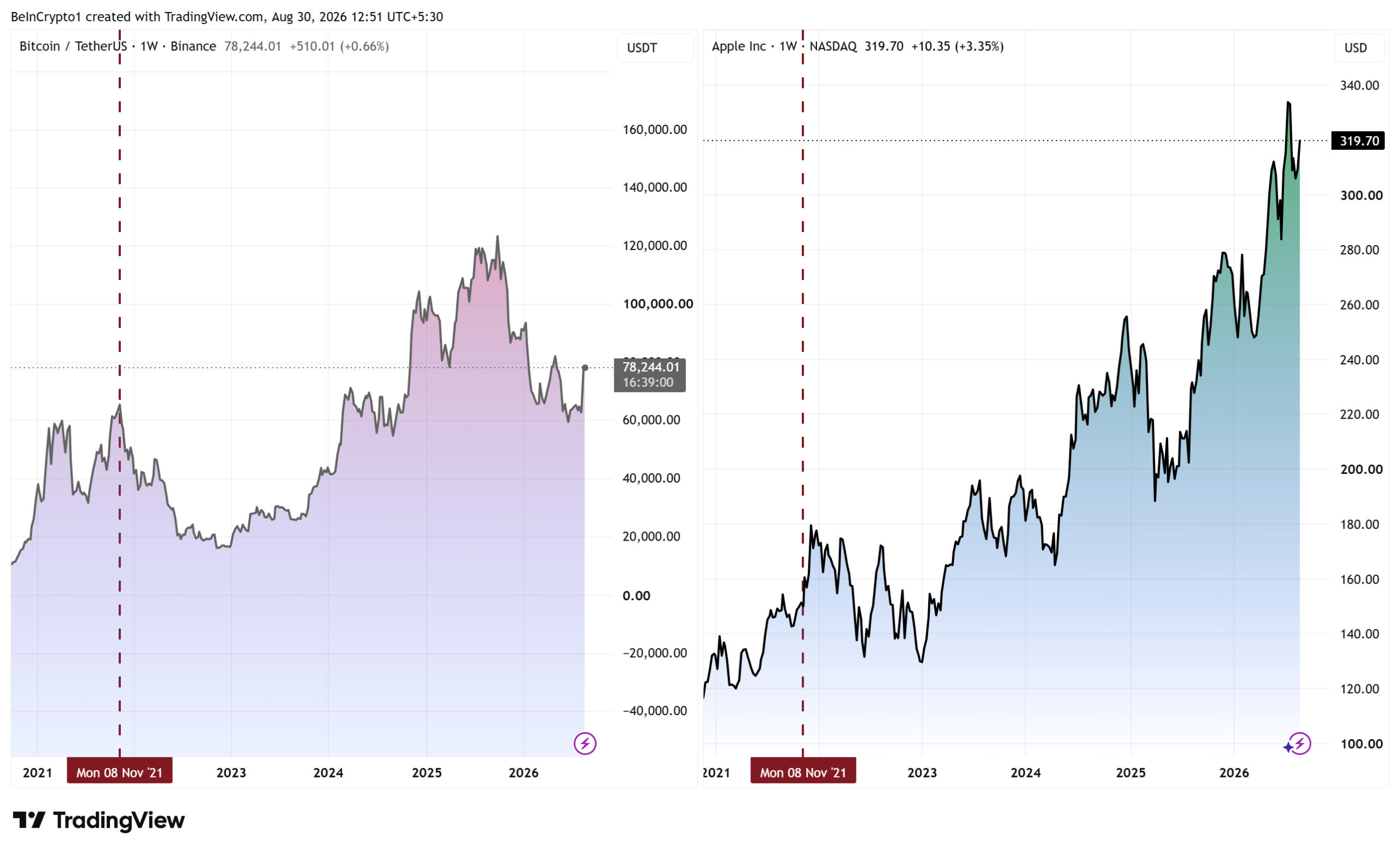
The scoreboard since then favors him, as Bitcoin set a record near $68,991 the next day. The pioneer crypto traded near $77,244 on Sunday, about 12% higher. Apple shares closed 2021 at $175.35 and ended Friday at $319.70, roughly 82% higher.

Why Stablecoins Matter More Than a Treasury Bet
Ternus is a hardware engineer. Apple’s incoming chief executive spent 25 years on devices, not finance. Cook stays on as executive chairman with a policy brief.
So the live decision sits in payments, not treasury. Services brought Apple $30.7 billion last quarter. Apple Pay moves card transactions, not tokens.
Reports in 2025 tied Apple to early talks about using stablecoins to cut settlement costs. Nothing shipped, and Apple has never confirmed it.
That would be plumbing, not a keynote. It would still reach further than any treasury buy, because Apple already gates crypto apps through App Store rules.
Cook answered the question early and stuck to it. Ternus has not been asked yet.
The post Tim Cook Owns Crypto But Apple Never Bought Bitcoin: Will This Change? appeared first on BeInCrypto.
Ripple pledged $300,000 on Aug. 29 to support emergency relief following catastrophic floods across Nepal and China’s Tibet region.
Summary
- Ripple pledged $300,000 to World Central Kitchen and Mercy Corps for Nepal-Tibet flood relief operations.
- World Central Kitchen’s local restaurant partners are distributing meals across Nepal’s Rasuwa and Nuwakot districts.
- Mercy Corps is coordinating emergency water and sanitation support after operating in Nepal since 2005.
- Authorities reported 750 deaths and over 3,000 missing across Nepal and Tibet by Sunday morning.
- The glacier collapse damaged roads, bridges and hydropower facilities while isolating communities from emergency assistance.
The San Francisco-based blockchain company will divide its support between World Central Kitchen and Mercy Corps. The organizations are providing meals, clean water and sanitation support to affected communities.
Ripple donation supports two established aid partners
Ripple said World Central Kitchen is distributing meals in the hardest-hit areas. Mercy Corps is coordinating water, sanitation and other humanitarian work with local authorities and partner organizations.
Both organizations had worked with Ripple before the disaster. Ripple has supported World Central Kitchen since 2020 and has partnered with Mercy Corps on projects using blockchain technology for humanitarian finance.
World Central Kitchen said its local restaurant partners were already serving meals in Nepal’s Rasuwa and Nuwakot districts. Members of its relief team were also traveling to the area to expand the response.
Mercy Corps has operated in Nepal since 2005. Its previous work has included earthquake, flood and landslide responses alongside disaster-preparedness and early-warning programs.
Nepal and Tibet face rising casualties
Authorities reported that the death toll had reached 750 by Sunday morning, while more than 3,000 people remained missing across Nepal and Tibet, according to a Reuters update.
Nepal recorded 734 deaths and 2,498 missing people. Officials in Tibet’s Gyirong County reported 16 deaths and 546 missing. Those figures may change as rescue workers reach isolated locations.
The Red Cross estimated that more than 90,000 people were affected. Roads, bridges, power infrastructure and entire settlements were damaged or destroyed, restricting access to food, water and emergency services.
Hundreds of workers were also believed to be trapped inside damaged hydropower tunnels. Nepal requested international assistance for tunnel rescues, forensic identification, DNA testing and storage of recovered bodies.
A glacier collapse triggered the flooding
Scientists linked the disaster to a glacier collapse that released ice, rock, mud and debris into the mountain river system on Aug. 26. The resulting torrent moved through communities on both sides of the Nepal-China border.
World Central Kitchen said an ice-rock avalanche temporarily blocked the Lhende Khola River before releasing a sudden surge downstream. The flood destroyed villages and infrastructure along the Bhotekoshi and Trishuli river corridors.
Rescue operations have faced repeated interruptions because of rain, rising water and lakes formed behind landslide debris. Drones later identified another natural dam and a new pool of water downstream from the original lake.
Chinese state media attributed the collapse to glacier instability linked to long-term warming. Scientists continue to study the event, and the exact contribution of climate change requires further assessment.
Ripple has used aid partnerships beyond donations
Ripple previously provided cash and XRP to World Central Kitchen for responses to hurricanes and other disasters. The company reported more than $200 million in charitable donations between 2018 and the end of 2024.
Its Mercy Corps partnership has also tested blockchain-based aid distribution. As Ripple used RLUSD for drought-relief payments in Kenya, smart contracts were designed to release assistance when satellite data detected defined drought conditions.
Ripple did not say that XRP, RLUSD or another cryptocurrency would be used for the Nepal and Tibet donation. Its announcement described a $300,000 contribution without identifying the payment method.
World Central Kitchen and Mercy Corps continue to accept public contributions through their official websites. Neither organization has announced when its emergency response will end.
A free coding trophy just turned into roughly $20,000 after a US high school student sold his Telegram Gift NFT for 15,000 Grams. Pavel Durov held the sale up as startup money.
The price cleared about 40 times what Telegram guaranteed the average prize was worth. Durov posted the result on his channel and urged other winners to go build something.
How a Free Prize Became $20,000
Jonathan He won gold at the 2026 International Olympiad in Informatics (IOI). Durov ranked him seventh in the world.
Instead of the usual medal or cheque, the prize was an Algorithm Cup, a digital collectible that lives on TON, the blockchain behind Gram. Winners can sell theirs to anyone.
Jonathan He competes for Team USA and interns as an engineer at trading firm Liquid. He sat fifth after Day 1 on 246 points out of 300, co-founder Franklyn Wang said.
Telegram promised the 235 medalists a combined $117,000 in Algorithm Cups. That averages close to $500 a cup. One of them sold for 40 times that.
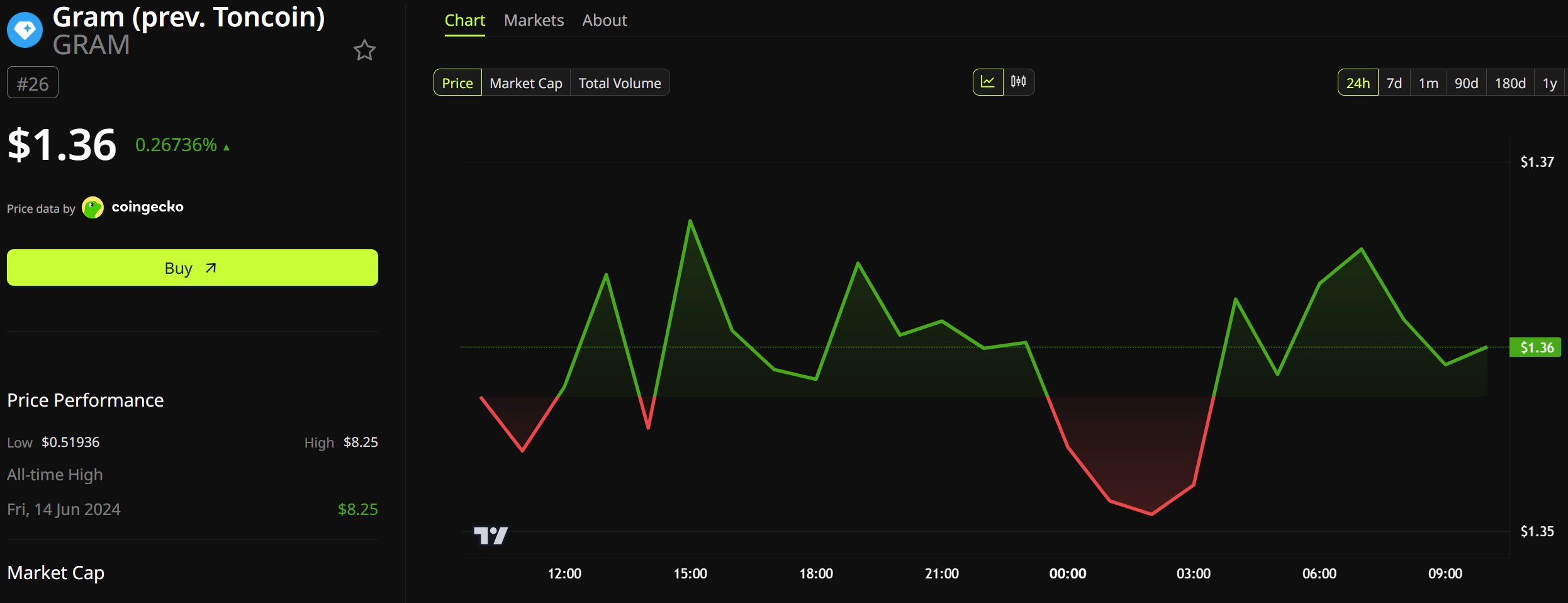
Gram (GRAM), the token rebranded from Toncoin in June, traded near $1.36 on Sunday. That puts 15,000 Grams at about $20,400.

Durov Calls It Seed Money
Pavel Durov highlighted the sale in a Sunday post on Telegram, calling on other winners to put their Grams to similar use.
“…20 years ago, $20K was enough for me to launch my first company. Within months, it had reached 1M users and raised $12M at a $60M valuation,” he wrote.
That company was VKontakte. Durov left the Russian social network in 2014, then built Telegram, the company that handed out this year’s cups.
He now buys these collectibles himself. In June, he paid 7,500 Grams for a Plush Pepe NFT, his third such purchase since December 2025. The teenager’s cup fetched twice as many Grams.
Gram has lost 56% of its value over the past year. A Telegram collectible still cleared $20,000. The buyer and the marketplace remain undisclosed.
The post Telegram Gift NFT Sells for $20,000 as Pavel Durov Backs Young Coders appeared first on BeInCrypto.
The spot Bitcoin exchange-traded funds recorded another highly impressive week, attracting over $900 million, but Friday changed the landscape after Kevin Warsh’s hawkish speech at Jackson Hole.
Meanwhile, the funds tracking the largest altcoin continue to see only green, and their actual inflows are quite close to those of their BTC counterparts.
BTC ETFs Gain Over $900M Weekly
CryptoPotato reported the significant change in investor behavior when it comes to the spot Bitcoin ETFs as they poured in nearly $2 billion, the highest since the October 2025 crash. This came after the US Treasury Department’s pivot in its monetary policy, which resulted in a substantial uptick in the entire crypto market.
The trend extended during the new business week as BTC’s price challenged the $80,000 resistance on a couple of occasions. Investors inserted $337.56 million on Monday, another $314.37 million on Tuesday, $232.12 million on Wednesday, and $242.24 million on Thursday. Thus, the BTC ETFs saw nine consecutive days of net inflows only.
However, the streak was snapped on Friday, perhaps due to the hawkish stance taken by the new Federal Reserve Chairman, Kevin Warsh. Net outflows dominated, with $201.81 million leaving the funds.
Nevertheless, the week still ended well in the green, with $924.48 million in net inflows. The funds have attracted almost $3 billion in the past two weeks alone. The cumulative total net inflows have risen from under $52.8 billion on August 14 to $54.63 billion on August 28.

ETH ETFs Keep Seeing Green
Unlike the spot Bitcoin ETFs, which ended Friday in the red, the Ethereum counterparts attracted just over $102 million on that day, which extended their impressive streak. The funds have not seen a single red day since August 11. Overall, the week ended with more than $824 million in net inflows.
Thursday was the most notable day, with $234.51 million entering the ETFs. Another $192.35 million went in on Wednesday, $179.80 million on Thursday, and $115.57 million on Friday. The cumulative total net inflows are up from $11.44 billion on August 11 to nearly $13 billion on August 28.
The underlying asset’s price rocketed from $1,900 to over $2,500 within the same timeframe, where it was ultimately stopped and now sits inches below it.

The post Over $900M Pours Into Bitcoin ETFs While Ethereum Funds Extend Impressive Streak appeared first on CryptoPotato.


Ripple has hired London Metal Exchange treasury executive Joseph Thompson for its trading and markets team, according to an Aug. 28 report.
Summary
- Ripple appointed Joseph Thompson to the trading and markets team, focusing on tokenization strategy and delivery.
- Thompson leaves LME on August 31 after nearly ten years working at the metals exchange.
- He previously held liquidity, funding and risk positions at Deutsche Bank, ICAP and LCH respectively.
- Ripple recently launched Delta One swaps covering U.S. equities, indices and digital assets for institutions.
- The appointment itself does not confirm any new commodity tokenization product or XRP-related market launch.
Thompson will leave the LME on Aug. 31 after nearly a decade at the exchange. His work at Ripple will focus on tokenization strategy and delivery. Ripple has not disclosed his exact title, starting date or reporting structure.
Ripple gains experience from a major commodities exchange
Thompson currently serves as senior vice president and head of treasury at the LME. His professional profile lists experience managing treasury operations at the exchange, which provides futures and options markets for industrial metals.
Earlier LME documents identified Thompson as head of investment and liquidity and collateral risk management. Those responsibilities included areas relevant to clearing operations, such as liquidity, eligible collateral and financial risk.
Before joining the LME, Thompson held liquidity management and funding responsibilities within Deutsche Bank’s group treasury division. He also worked in liquidity risk at ICAP and in collateral and liquidity management risk at London Clearing House.
Moreover, Thompson has more than 15 years of financial-services experience and holds certification from the Association of Corporate Treasurers. His background gives Ripple experience spanning exchanges, clearing, collateral and institutional liquidity.
Ripple is building its tokenization infrastructure
Ripple has expanded beyond cross-border payments into custody, stablecoins, treasury technology, tokenized assets and institutional trading. Its tokenization business supports the issuance and management of funds, bonds, securities and other real-world assets.
The company recently invested in ZILO and Licuido. As the two investments added token issuance and collateral tools, Ripple said it was building regulated transfer agency, trading and collateral mobility into its capital-markets infrastructure.
Thompson’s experience at a commodities exchange may assist that strategy. However, Ripple has not announced a commodity tokenization product connected to the appointment. It has also not said that Thompson will develop products tied directly to metals traded on the LME.
The hire therefore confirms a personnel addition to Ripple’s tokenization operations, not an agreement between Ripple and the LME. It also does not establish that any future tokenized asset will use XRP.
Ripple Prime expands into traditional markets
The appointment follows Ripple Prime’s launch of a Delta One business for institutional investors. The service allows clients to execute total return swaps linked to U.S.-listed equities, equity indices and digital assets.
Ripple says the offering provides hedge funds and asset managers with access through a single counterparty. Clients can also cross-margin exposure across foreign exchange, derivatives, fixed income, equities and digital assets.
Ripple Prime came from the company’s $1.25 billion acquisition of Hidden Road, which closed in October 2025. The brokerage now clears more than $3 trillion in annual trades for over 300 institutional clients, according to Ripple.
As Ripple Prime expanded its institutional clearing connections, the business also joined a DTCC working group focused on tokenized securities. Its participation does not place XRP inside the DTCC’s clearing system.
What happens after Thompson leaves the LME
Thompson is expected to leave the LME on Aug. 31 before beginning his work at Ripple. Neither company has announced who will replace him as the exchange’s head of treasury.
Ripple has not published a timetable for projects involving Thompson. Further disclosures will be needed to establish which tokenization products, markets or institutional clients fall under his responsibilities.
The appointment comes as Ripple connects tokenized-asset infrastructure with trading, financing, clearing and collateral services. Thompson’s experience fits that direction, but the commercial outcome remains uncertain until Ripple identifies specific products.


Bitcoin’s realized capitalization increased by more than $4.6 billion during the week ending Aug. 30, according to CryptoQuant contributor Darkfost. The increase accompanied BTC’s sharp recovery from around $63,000 earlier in August to above $80,000.
Summary
- Bitcoin’s realized capitalization increased by more than $4.6 billion during the latest seven-day measurement period.
- The 30-day average growth rate remained only 0.4%, leaving the developing liquidity shift unconfirmed overall.
- Bitcoin traded near $78,024 after retreating from its three-month high above $81,200 earlier this week.
- U.S. spot Bitcoin ETFs attracted $2.57 billion across seven consecutive positive sessions through August 25.
- Realized capitalization can also rise when loss-taking investors move coins into lower-cost newly created UTXOs.
Darkfost described the increase as the strongest short-term realized-cap movement since the current bear market began. However, the analyst warned that the 30-day average growth rate remained just 0.4%, meaning the data does not yet confirm a sustained liquidity expansion.
Bitcoin realized cap points to returning activity
Realized capitalization values each Bitcoin at the price recorded when it last moved onchain. This differs from standard market capitalization, which values the entire circulating supply at the latest market price.
When older coins move at higher prices, realized cap generally increases. Analysts often interpret that change as capital entering the market because coins are transferring to buyers with higher cost bases.
The latest $4.6 billion increase followed an extended period of declining or weak realized-cap growth. Darkfost said the reversal suggests incoming liquidity helped support Bitcoin’s recent price advance.
The analyst nevertheless stopped short of identifying the move as a confirmed market regime change. “This move still needs confirmation,” Darkfost said, pointing to the modest 30-day growth rate.
The $4.6B increase does not represent only new money
Realized-cap growth is not a direct measurement of cash deposited into cryptocurrency exchanges. Changes can also occur when existing investors transfer coins or sell them at prices different from their previous recorded cost bases.
Darkfost noted that some investors who bought Bitcoin at higher prices may have capitulated during the recent downturn. Their sales created new unspent transaction outputs, or UTXOs, carrying lower realized prices.
That process can affect the metric without representing entirely new capital. A rising realized cap therefore supports the liquidity argument but does not prove that the complete $4.6 billion came from first-time or external buyers.
Price behavior offered some supporting evidence for demand. Bitcoin recorded a historic weekly dollar increase of $14,775 during the week ending Aug. 23, according to a Galaxy Research report. The 23.5% advance was its largest weekly dollar gain on record, though short liquidations and momentum trading also contributed.
ETF demand supported Bitcoin’s recovery
U.S. spot Bitcoin ETFs recorded seven consecutive sessions of net inflows through Aug. 25. The funds attracted approximately $2.57 billion over that period, providing an independently measured source of spot-market demand.
BlackRock’s IBIT contributed $284.4 million of the $314.3 million recorded on Aug. 25. As Bitcoin ETF inflows supported demand during the price recovery, Bitfinex analysts argued that the rally was not driven solely by leveraged speculation.
Bitcoin also benefited from a weaker U.S. dollar and renewed concerns about fiscal policy. The U.S. Treasury expanded purchases of longer-dated government debt, encouraging investors to consider scarce assets under the so-called debasement trade.
BTC climbed above $81,200 on Aug. 25, its highest price since mid-May, before surrendering part of the advance. Bitcoin traded near $78,024 on Aug. 30, up about 0.6% over 24 hours but still below the resistance area around $81,000.
Bitcoin’s liquidity rebound still needs confirmation
The realized-cap pattern resembles periods observed during Bitcoin’s previous bear market, according to Darkfost. Historical resemblance alone does not establish that Bitcoin has reached the same stage of its market cycle.
CryptoQuant CEO Ki Young Ju previously argued that realized capitalization had grown by $467 billion over two years without producing comparable price appreciation. As realized-cap growth became less efficient at lifting Bitcoin, Ju said increasingly large inflows may be required to produce another parabolic advance.
The next confirmation would be continued positive realized-cap growth over several weeks rather than one strong observation. A rising 30-day rate would offer broader evidence that new cost bases are being established consistently.
Traders will also monitor U.S. ETF flows and Bitcoin’s attempt to reclaim the $81,000 area. Renewed realized-cap contraction, ETF outflows or another rejection at resistance would weaken the liquidity-recovery interpretation.
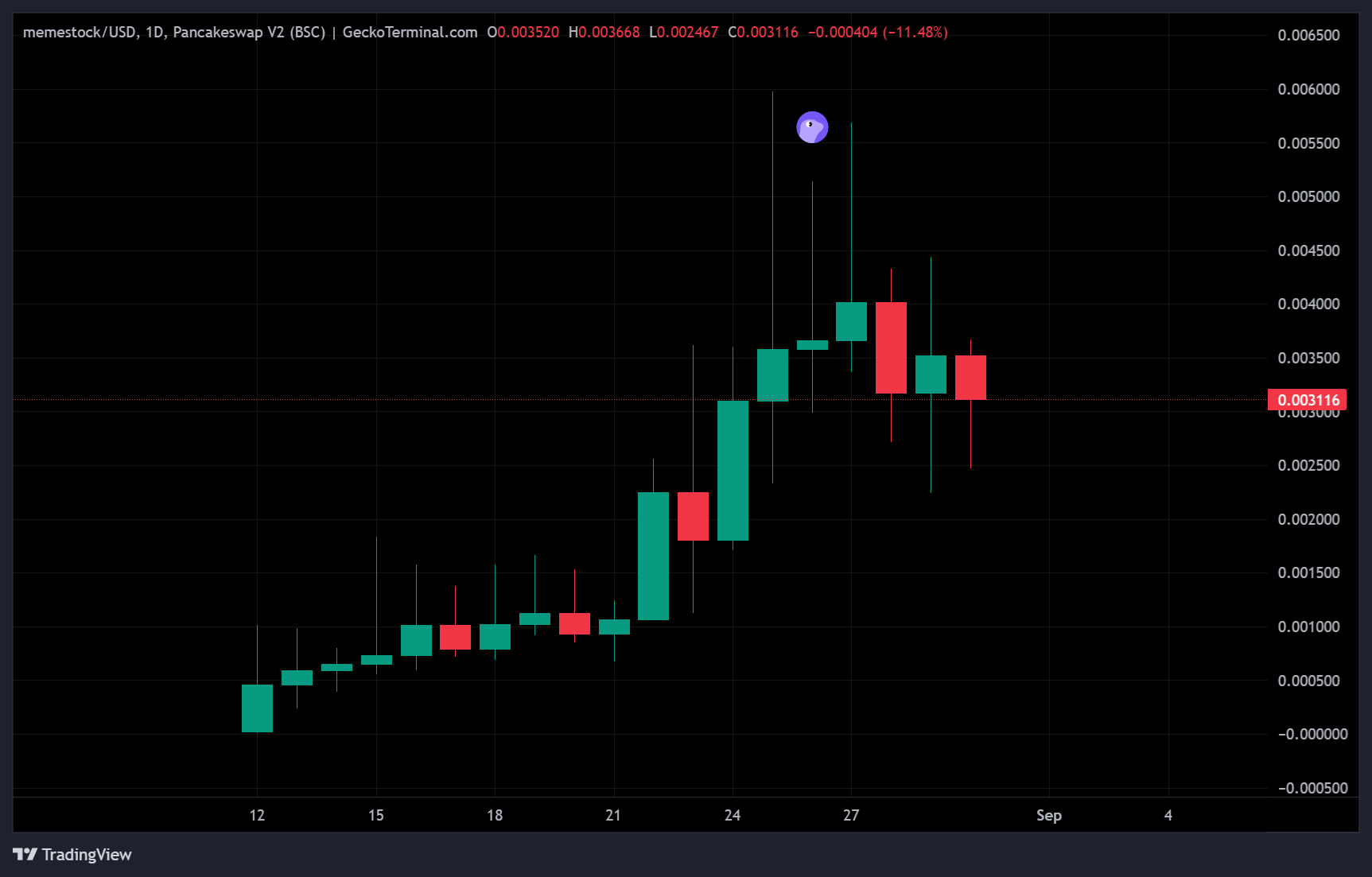
Crypto traders want a token that can move a real share price. The closest thing yet is on BNB Chain, where meme coins now trade directly against tokenized GameStop.
Binance says every tokenized share it issues is backed by a real one held at a custodian.
GameStop’s Tokenized Share Became a Meme Coin
A token called memestock trades against GMEB, Binance’s tokenized GameStop, in a PancakeSwap pool created on August 12. The pool holds more than $200,000 and turned over $543,000 in a day.

There are others, with at least 10 meme coins now using GMEB as their quote asset, among them stockmemes, LONGCZ and BURN. Together, those pools moved about $2.2 million in 24 hours.
GMEB arrived through bStocks, the tokenized stock lineup Binance launched in June and has expanded in batches since.
Binance describes each bStock as fully backed by a real US share held at a regulated custodian. BTech Holdings Limited issues them, and Nest Trading Limited arranges conversions at one token per share.
The Numbers Are Nowhere Near Wall Street
Every tokenized GameStop share on the chain adds up to 292,353 tokens worth $5.3 million. GameStop closed Friday worth $8.02 billion.

So the onchain version is roughly 0.07% of the company. The meme coin attached to it is worth about $3.7 million.
Robinhood Chain shows the same gap, albeit in a sharper form. Its biggest meme coin experiment, Artificial Inu, is valued near $98.6 million and trades against a tokenized Nvidia supply worth just $9.3 million. Nvidia itself is a $5.25 trillion company.
The plumbing also runs one way, with Binance offering bStocks out of Abu Dhabi and stating that they are not sold to US persons.
Only eligible users can convert between tokens and shares, so onchain enthusiasm does not automatically reach a New York order book.
“the real question is, when are we going to get a memecoin paired to a penny stock and then onchain activity leads to that stock going up 100-200%?” crypto trader Schoen posed.
Traders rule GameStop out as far too big, calling for a company valued between $50 million and $250 million. No company that small has been tokenized and paired yet, which leaves the experiment fully specified and still unrun.
The post Crypto’s Next Meme Coin War? Traders Want Tokens That Can Move Real Stocks appeared first on BeInCrypto.


OCEAN co-founder Luke Dashjr left the Bitcoin mining pool on Aug. 29 after reaching a mutual separation agreement with its parent company, Mummolin Inc. He resigned as chairman, chief technology officer and director.
Summary
- OCEAN co-founder Luke Dashjr resigned as chairman, chief technology officer and director by mutual agreement.
- Mummolin repurchased all Dashjr’s equity, ending his ownership interest in the Bitcoin mining pool entirely.
- Dashjr will establish CONVOY to continue promoting decentralized Bitcoin mining; launch details remain undisclosed today.
- OCEAN said it will continue operating its transparent, non-custodial pool for Bitcoin miners without Dashjr.
- The parties cited differing visions after recent protocol developments but identified no specific technical disagreement.
Mummolin also repurchased all of Dashjr’s equity, according to a joint statement. Neither party disclosed the value of the repurchase or Dashjr’s former ownership percentage.
OCEAN and Dashjr cite different mining visions
OCEAN and Dashjr attributed the separation to “different visions for the future of Bitcoin mining following the recent protocol developments.” The statement did not identify the developments or explain the areas of disagreement.
The wording therefore does not confirm whether a single Bitcoin protocol proposal caused the split. Dashjr has participated in public debates about transaction policies, mining decentralization and alternative Bitcoin software. Connecting the departure to any particular dispute would require further confirmation from the parties.
Dashjr had already stepped back from his OCEAN responsibilities earlier in August. His permanent departure now removes him from the company’s leadership and ownership structure.
The company did not announce a replacement chairman or chief technology officer. It also provided no details about how Dashjr’s former technical responsibilities will be distributed.
Luke Dashjr will pursue Bitcoin mining through CONVOY
Dashjr plans to create a new venture called CONVOY. The joint statement said the project would continue his mission of decentralizing Bitcoin mining.
No official website, technical documentation or launch schedule was available at publication time. The statement did not explain whether CONVOY will operate a mining pool, develop mining software or pursue another infrastructure model.
Dashjr previously founded Eligius, an early Bitcoin mining pool, before helping launch OCEAN in 2023. OCEAN was designed to give miners greater visibility into block templates and deliver block rewards directly to miners through a non-custodial system.
The new venture suggests Dashjr intends to pursue those decentralization goals independently. However, claims about CONVOY’s architecture, mining policies or commercial model remain unverified until the project publishes further information.
OCEAN will keep its non-custodial pool operating
OCEAN said it will continue serving miners through its transparent, non-custodial mining pool. Its model sends mining rewards directly to participating miners instead of holding payouts in a pool-controlled account.
The company operates through Bitcoin Ocean LLC, a subsidiary of Wyoming-based Mummolin. It raised $6.2 million to develop decentralized mining infrastructure in a 2023 seed round led by Jack Dorsey and other investors.
OCEAN later introduced DATUM, a protocol intended to let individual miners construct their own block templates while still participating in pooled mining. The approach seeks to reduce the control large pool operators exercise over transaction selection.
In April 2025, Tether committed mining hashrate to OCEAN, including capacity from its operations in Africa and other regions. OCEAN has not announced any change to that arrangement following Dashjr’s departure.
What happens next for OCEAN and CONVOY
OCEAN must clarify its leadership structure and technical roadmap after losing its co-founder, chairman and chief technology officer. The company has not announced deadlines for those decisions.
Miners can continue using the pool, according to the joint statement. There was no reported service suspension, custody event or change to its payout system linked to the separation.
CONVOY’s next step will be publishing details about its team, technology and intended services. No launch date or funding information has been confirmed.
The equity repurchase completes Dashjr’s corporate separation from OCEAN. Still, the limited announcement leaves the underlying technical disagreement unresolved. No verified market reaction was directly attributable to the news.

I contacted Curry and asked him what he thought about the value and opportunities for kindness in what feels like an incredibly hostile world. “Humans are naturally kind, under the right circumstances,” he tells me.
Indeed, according to research across diverse cultural and economic settings, from the U.S. and Canada to Uganda, India, and South Africa, the well-being rewards one experiences from helping others appears deep-rooted in human nature.
Jonathan Passmore, a psychologist and coach in the U.K., has developed a positive psychology coaching technique called CAKE, which stands for consistent acts of kindness and empathy. I asked him how engaging in CAKE can help teach someone how to spread kindness. “The list of possible actions is limitless,” he says. “I advocate for folks to initially commit to a one-week plan—choosing to engage in one act of kindness per day.” On Monday, for example, you can greet the barista at your local coffee shop by name, and wish them a pleasant day, he offers. On Tuesday, “you could write a handwritten card to a colleague and thank them for something they have done.” Do this for a week, and “one often gets hooked and begins to hold an empathic stance towards most they meet.”


Vietnam has not issued its first crypto exchange license, but five companies have passed an initial assessment under the country’s five-year digital asset market pilot.
Summary
- Vietnam has not licensed any crypto exchange, although five applicants passed an initial assessment stage.
- Applicants need 10 trillion dong in charter capital and Level 4 information-system security certification before licensing.
- Decree 284 takes effect September 1, establishing penalties for crypto-market violations during Vietnam’s pilot program.
- Domestic traders face no immediate offshore-platform fines because a separate six-month transition period applies first.
- Vietnam’s six-month transition starts only when the Ministry of Finance licenses its first service provider.
To Tran Hoa, deputy standing head of the Digital Asset Trading Market Board under Vietnam’s State Securities Commission, disclosed the progress at the Vietnam RWA Summit 2026, according to an Aug. 30 Vietnam News Agency report.
The authorities did not name the five applicants or confirm when final licensing decisions will be issued. Passing the initial assessment does not authorize any company to operate an exchange.
Vietnam crypto exchange applicants face a $383 million threshold
Vietnam’s Resolution No. 05/2025/NQ-CP requires each exchange applicant to have at least 10 trillion Vietnamese dong, approximately $383 million, in contributed charter capital. Contributions must be made in Vietnamese dong.
At least 65% of that capital must come from institutional shareholders. More than 35% must be contributed by at least two qualifying organizations, including commercial banks, securities companies, fund managers, insurers or technology companies.
Applicants must also obtain an appraisal showing that their technology meets Level 4 information-system security standards. The Ministry of Public Security handles the required security assessment before an exchange can begin operating.
Other licensing requirements cover management qualifications, custody, transaction monitoring, internal controls, conflict management and customer complaints. Applicants must also maintain systems for anti-money laundering and investor-identity verification.
The 10 trillion dong requirement is charter capital, not an additional investment fee paid to the government. Vietnam has not said whether all five preliminary applicants have already secured the full amount.
New crypto penalties take effect September 1
Decree No. 284/2026/ND-CP takes effect on Sept. 1 and will remain applicable while Resolution 05 governs the crypto market pilot. The decree establishes penalties for unlicensed services, improper issuance, weak customer checks and anti-money laundering failures.
Organizations providing crypto services or advertising an exchange without a license face fines of between 180 million and 200 million dong. Authorities can also order the removal of websites, software and trading systems involved in violations.
Licensed service providers face fines for failing to separate customer assets, monitor transactions or protect account information. Failure to verify customers can attract organizational fines ranging from 50 million to 70 million dong.
The decree generally states organizational fine levels. Individuals committing the same violation ordinarily face half the stated amount. The maximum penalty is 200 million dong for an organization and 100 million dong for an individual.
Domestic traders do not face immediate platform fines
Article 9 sets an organizational fine of 30 million to 50 million dong for domestic investors trading outside a Ministry of Finance-licensed provider. The general half-rate provision indicates an individual could face between 15 million and 25 million dong.
However, that penalty does not automatically begin on Sept. 1. Article 7 of Resolution 05 states that domestic investors become subject to the licensed-platform requirement six months after the first crypto asset service provider receives approval.
Because Vietnam has not licensed any provider, the six-month transition clock has not started. Domestic investors therefore will not be fined from Sept. 1 solely for continuing to use an overseas or otherwise unlicensed platform, according to experts cited by VNA.
Other violations covered by Decree 284 can still become enforceable on Sept. 1. These include operating or advertising an unauthorized platform, improper token issuance and certain failures involving customer data or anti-money laundering controls.
The first license will start Vietnam’s six-month countdown
Vietnam introduced the pilot through Resolution 05 on Sept. 9, 2025. As crypto.news previously reported, the five-year regulated crypto market pilot created rules for issuance, custody, trading and licensed service providers.
The framework initially permits locally issued crypto assets to be offered only to foreign investors. Eligible tokens must be backed by real-world assets and cannot represent securities or fiat currencies under the pilot.
Vietnam previously indicated that only a limited number of exchanges would receive licenses. The report that five companies passed the first assessment does not confirm that each will ultimately receive approval.
The next event is the Ministry of Finance’s first license. That decision will start the six-month period after which domestic investors must route covered crypto trading through licensed Vietnamese providers.
No licensing deadline has been announced. Investors will need to watch official Ministry of Finance and State Securities Commission notices rather than treating preliminary assessments as operating authorization.

UK networks are not ready for AI traffic, say mobile operators

Here Are The 4 Tiers of Wealth (Do You Agree?)

Late arrivals, tech problems and lyric mistakes – yet Raye is Reading’s biggest joy





-

 Crypto World5 days ago
SpaceX stock could rise 75% to $240, JPMorgan says
-

 Fashion2 days ago
Weekend Open Thread: Maeve – Corporette.com
-

 Crypto World3 days ago
Bitcoin’s 22% rally now needs real demand to outlast Treasury liquidity boost
-

 Crypto World4 days ago
Warsh Jackson Hole keynote puts financial innovation first
-

 Crypto World5 days ago
A $30 Billion AI Fund Implodes, Now the SEC Is Investigating Wall Street’s Role
-

 Business2 days ago
Salesforce Stock Soars 19% as Blowout Earnings and Agentforce AI Growth Silence Software Skeptics
-

 Crypto World4 days ago
Did Trump Just Move SpaceX Stock With One Truth Social Post?
-

 Business4 days ago
Walmart takes aim at younger shoppers with new fashion brand
-
 NewsBeat4 days ago
Lindsay Clancy jury braces for closing arguments as judge tells court: ‘You’ve heard all the evidence’ – Live updates
-

 Crypto World4 days ago
Elon Musk Grok Bot Promise: We Will Make You Whole if AI Loses Your Money
-

 Crypto World1 day ago
Bitcoin price tests $82K resistance as Brandt stays long
-

 Business3 days ago
Apple Confirms September 9 Keynote and Reveals Its Full Pre-Order Schedule
-

 Business6 days ago
Moderna CEO warns China is pouring state money into mRNA technology
-

 Crypto World3 days ago
NVIDIA revenue hits $96.2B as AI demand doubles
-

 Business4 days ago
Thailand’s Eastern Economic Corridor Capital City (EECiti): Key Developments and Investment Opportunities
-

 Business2 days ago
iPhone 18 Pro Pre-Orders Could Shift to Saturday as Apple Reportedly Avoids September 11 Anniversary
-

 Business6 days ago
NVIDIA Stock Drops Nearly 2 Percent to $210 on Seventh Losing Day Ahead of Critical AI Earnings
-
 Crypto World6 days ago
$92 Billion Nvidia Earnings Could Make or Break the AI Trade
-

 NewsBeat4 days ago
Trump’s trade truce with China faces test with Iran effort
-

 Crypto World2 days ago
Truflation calls for Fed rate cut after PCE forecast
You must be logged in to post a comment Login