
Crypto World
SLB Stock Surpasses Buy Point On AI Data Center Deal


SLB (SLB), one of the largest providers of oilfield support services, is expanding its data center services business after acquiring a provider of cooling systems. The stock climbed above a new buy point Monday morning. In a deal valued at $4.1 billion, SLB is acquiring Kelvion from funds managed by investment firm Apollo (APO). Kelvion is a global provider of…
Copyright ©2026 Investor’s Business Daily, LLC. All rights reserved. 87990cbe856818d5eddac44c7b1cdeb8

Crypto World
Ripple Price Analysis: XRP Hits Critical Decision Point as Key Support Comes Under Pressure
Ripple’s XRP is undergoing a corrective phase after its explosive breakout from the $1 region. While the broader structure has improved substantially, fading momentum below the $1.45-$1.55 resistance zone suggests the market may need a deeper pullback or additional consolidation before attempting another sustained advance.
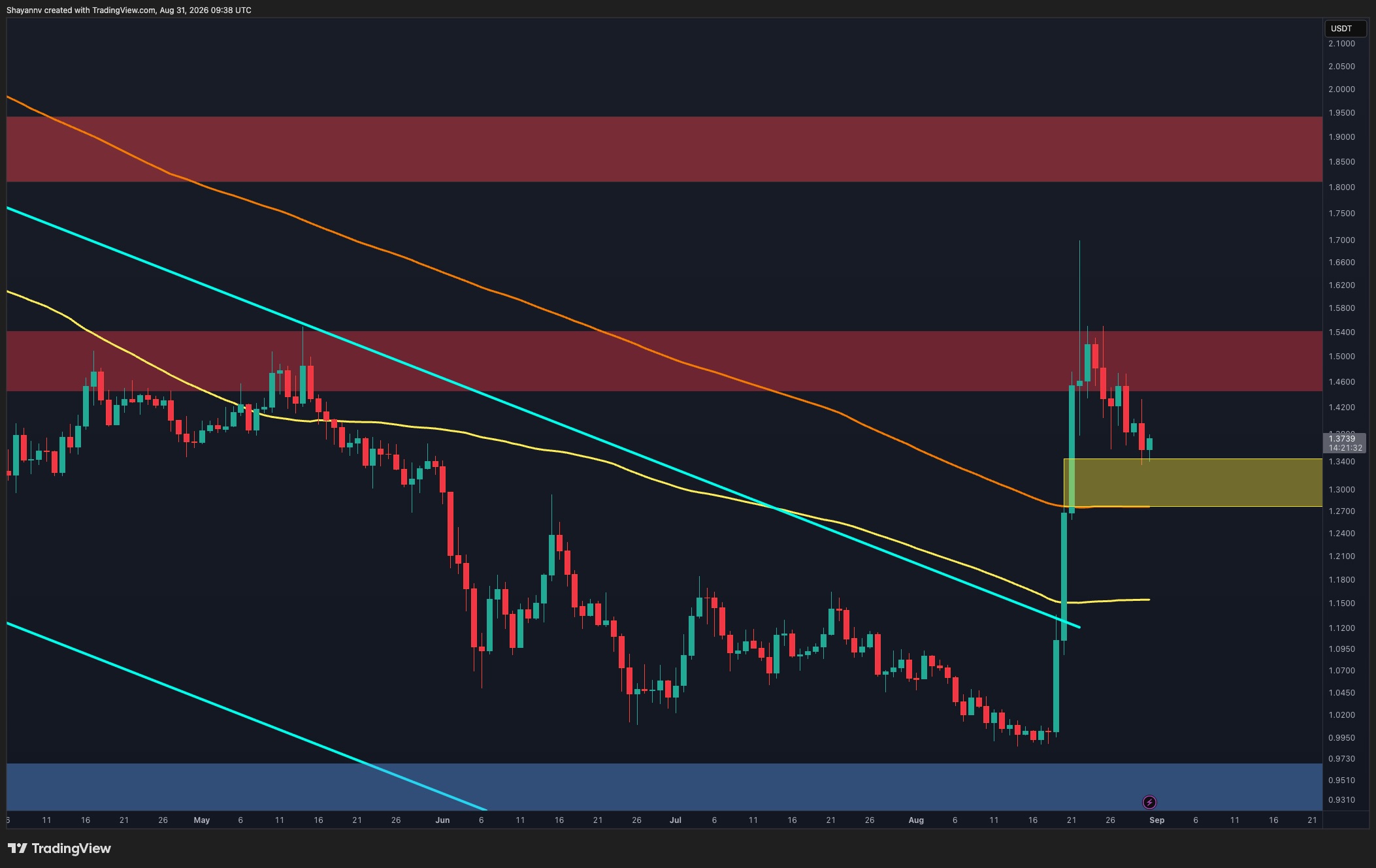
XRP Price Analysis: The Daily Chart
On the daily timeframe, XRP’s breakout represented a major structural shift, with the price escaping the prolonged descending channel and surging through both moving averages. However, the rally encountered substantial selling pressure inside the $1.45-$1.55 resistance zone, while the long upper wick toward $1.70 highlights the rejection of higher prices.
The token has since retraced toward $1.37, with the sequence of lower highs and lower lows following the rejection indicating that short-term momentum has turned corrective.
The first important support is the $1.27-$1.34 zone. This area also overlaps with the higher moving average shown on the chart, strengthening its technical significance. A successful reaction from this region could allow XRP to stabilize before another attempt at the $1.45-$1.55 resistance zone.
However, a daily breakdown below $1.27 would weaken the post-breakout structure and increase the probability of a deeper correction. In that case, the lower moving average around $1.15 could become relevant before the broader $0.93-$0.97 demand zone comes back into consideration.
XRP/USDT 4-Hour Chart
The 4-hour chart shows XRP consolidating after the initial rally from approximately $0.99 to $1.70. The subsequent rejection from the $1.43-$1.55 supply zone has gradually pushed the price back toward the 0.5 Fibonacci retracement at $1.34.
This makes the $1.33-$1.34 area an important near-term decision point. The asset has already tested this level and produced a modest reaction, but buyers have yet to generate a convincing recovery. Holding above it could lead to continued sideways consolidation and potentially another attempt at the $1.43-$1.55 resistance zone.
If the $1.34 level fails, however, the correction could extend toward the next Fibonacci levels. The 0.618 retracement at $1.26 sits inside the first notable pullback zone, while the 0.702 level near $1.20 provides another support reference. A more substantial correction would bring the 0.786 retracement at $1.14 and the broader $1.09-$1.14 support zone into focus.
For now, the short-term structure remains corrective below $1.43-$1.55. A sustained reclaim of this resistance zone would be needed to shift momentum decisively back toward the bulls and reopen the possibility of challenging the $1.70 high.

The post Ripple Price Analysis: XRP Hits Critical Decision Point as Key Support Comes Under Pressure appeared first on CryptoPotato.

Bitcoin traded at $78,500 as the Japanese yen breached 160 per dollar in Tokyo trading, while a U.S. strike on Iran’s Larak Island added to market uncertainty. All these follow Friday’s broad dollar advance and hawkish remarks from Warsh at Jackson Hole, which lifted expectations for a Federal Reserve rate hike.

It is reported that bond investors were pricing a Fed positioned to hike and that the repricing had pulled institutional money out of bitcoin ETFs across May and June. The yen itself has long been used as a funding currency for investments in U.S. stocks and Treasury notes.
U.S. Treasury Secretary Scott Bessent said Sunday that recent moves in the Japanese yen had been contained and did not warrant a joint U.S.-Japan intervention like the one seen last month. Reuters likewise reported that Bessent described the moves as contained.
Bessent had warned Friday that a disorderly yen market could feed through to higher U.S. interest rates. That link places Tokyo’s currency market alongside Wall Street’s rate expectations and crypto-market positioning.
Trade Bitcoin on Bybit and Get a Chance to Win Our $1,000 USDT Airdrop
What the Iran Strike Adds to the Macro Test
The U.S. strike on Iran’s Larak Island added another macro risk alongside yen weakness and higher rate expectations. Oil moving higher and stocks moving lower after the U.S. action, while bitcoin showed a comparatively muted response.

Reuters reported that U.S. forces struck Iran’s Larak Island on Sunday and that oil rose as Gulf tensions flared. The market response highlighted energy as an immediate channel for pricing the escalation.
The $78,000 Bitcoin Consolidation Question
Bitcoin’s daily loss remained under 1% as the yen breached its closely watched threshold and Gulf tensions flared. The dollar strength that pushed the yen past its intervention line as the same force capping crypto, leaving bitcoin near $78,000 amid competing market pressures.
The wider crypto market showed mixed performance. Solana and Dogecoin fell roughly 3% on the day, while Ether, BNB, Zcash, and Tron were within 2% of flat. On a weekly basis, Solana was up about 8% while Dogecoin was down by 10%.
Monday was the final trading session of August. The month’s closing ETF total would show whether an eight-day bitcoin ETF inflow run survived the change in rate expectations or ended with it.
Reuters reported that investors were turning to upcoming U.S. data, including the nonfarm payrolls report and consumer inflation figures, which could shape expectations ahead of the September Fed meeting. CoinDesk identified August’s closing ETF flow total as the more immediate crypto-market indicator.
The dollar’s direction, the yen’s movement near intervention-sensitive levels, and the path of rate expectations remain key variables for risk assets, including bitcoin.
Discover: The Best Crypto to Diversify Your Portfolio
The post Bitcoin Faces a Three-Way Macro Test Near $78,000 appeared first on Cryptonews.

For investors looking for an actionable trade, a bullish spread on global payments giant Mastercard (MA) stock is worth considering. The stock broke out of a long-term cup-with-handle pattern, clearing a 583.71 buy point on Aug. 24. It currently sits near the lower end of its buy zone on a daily chart. Investors who anticipate further bullish momentum in Mastercard…
Copyright ©2026 Investor’s Business Daily, LLC. All rights reserved. 87990cbe856818d5eddac44c7b1cdeb8

In a stock picker’s market, investors look for stocks that outperform their peers. Research tools at Investor’s Business Daily leapfrog this process, and among them is a screen for stocks whose relative performance is not just better than others but is at new highs. Shipping stocks have been getting a boost amid the oil supply shock. Also, software provider JFrog…
Copyright ©2026 Investor’s Business Daily, LLC. All rights reserved. 87990cbe856818d5eddac44c7b1cdeb8
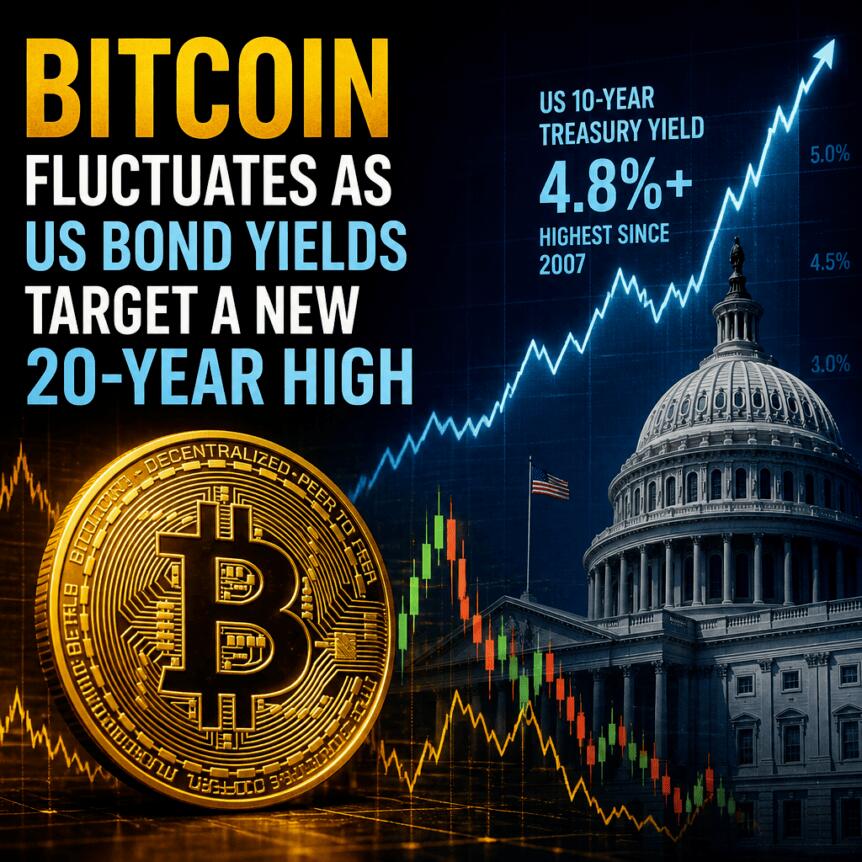
Bitcoin traded around the $78,000 area at the open of Wall Street on Monday as US bond yields pushed back toward multi-year highs. The move tied back to fresh comments from US Treasury Secretary Scott Bessent, who signaled the Treasury was considering further action at the long end of the curve, even as yields continued climbing.
BTC/USD’s intraday swings stayed relatively contained at first, but crypto traders were clearly watching the same macro driver again: higher yields tend to tighten financial conditions and can reduce appetite for risk assets—including digital tokens—especially when investors start pricing sustained strength in the long end of US rates.
Key takeaways
- Bitcoin rebounded during the US session after Scott Bessent told CNBC he had not yet purchased long-dated bonds, while implying further intervention was possible.
- US 10-year yields were back near their highest levels since January 2025 (4.76% cited), and the 30-year yield approached levels not seen since January 2007.
- Despite BTC holding the 50-week EMA near $77,269, traders flagged an emerging bearish divergence on the daily RSI ahead of the August monthly close.
- Market participants are balancing Treasury debt-buyback announcements against skepticism that policy changes can reliably steer bond pricing.
Bessent’s CNBC interview brings a quick BTC bounce
According to TradingView data referenced in the report, BTC/USD traded in a tight range early in the session, up roughly 1% on the day after a dip around the start of US trading. The rebound came alongside comments from Bessent in an interview with CNBC, where he emphasized that he had not yet taken steps to directly support the long end of the yield curve—specifically the 10-year and 30-year segments.
“I haven’t bought anything yet,” Bessent said on CNBC, adding that he was “fine” with yields rebounding following the latest Treasury messaging. The exchange mattered for traders because even hints about intervention in long-duration Treasuries can change expectations for real yields and the broader discount rate applied to future assets.
Earlier this month, the Treasury announced it would at least double the size of its debt buyback transactions to $4 billion from September. The report notes that yields fell after that announcement, but Monday’s trading showed the follow-through was limited: the 10-year yield was cited at 4.76%, returning to its highest levels since January 2025.
On the long end, the 30-year yield reached 5.269% on Monday—just six basis points short of its highest level since January 2007. In other words, while the Treasury talked, rates kept pressing higher, reinforcing the idea that the bond market’s interpretation of policy remains cautious and reactive.
Bond investors question whether policy is actually steering yields
One of the sharper reactions cited came from The Kobeissi Letter, which argued that “the bond market appears to be completely ignoring the US Treasury.” The post, shared on X, framed the issue as a mismatch between official actions and what investors are pricing into the yield curve—particularly as the 30-year rate moves close to long-unobserved territory.
The report also referenced earlier skepticism from Ray Dalio regarding the likelihood that the Treasury can control bond behavior under the new program. Dalio, in a post earlier covered by Cointelegraph, reportedly pointed to both Bitcoin and gold as potential hedges if investors conclude that debt markets cannot be stabilized through policy measures.
While Dalio’s remarks were not market guidance in the strict sense, they reflect a broader debate that matters to crypto: when yields rise and investors worry about long-term debt dynamics, some participants look for alternative stores of value outside traditional fixed income.
Stocks slip as geopolitical headlines feed risk caution
Bitcoin’s macro sensitivity showed up again in cross-asset price action. The report states that US equities traded lower, with both the S&P 500 and Nasdaq Composite around 0.4% down at the time. It attributed the pressure to market concerns tied to new US-Iran strikes, which filtered into investor sentiment during the session.
For crypto traders, this combination—rising yields alongside softer equity sentiment—often means fewer tailwinds. Even when BTC finds support on technical levels, broader risk conditions can cap upside until the macro picture stabilizes.
Technical watch: 50-week support holds, but daily RSI divergence warns
On the chart, the report highlighted Bitcoin’s ability to hold a key long-term reference point. Ahead of the August monthly candle close, BTC/USD maintained its 50-week exponential moving average (EMA) at $77,269, described as support. Cointelegraph previously framed this area as a “line in the sand” for bulls.
At the same time, momentum signals looked less convincing. The trader and analyst Rekt Capital warned of a “hidden bearish divergence” forming on daily time frames between price action and the relative strength index (RSI). The report notes that while RSI signals on the weekly chart have been bullish, the daily readings suggested waning momentum.
Rekt Capital cautioned followers that if the daily RSI continues to print lower highs, it could “contribute to mounting weakness here,” according to the X post cited in the report. On Monday, daily RSI was reported at 70.7—still within the “overbought” band, but potentially relevant because divergence often appears when an asset begins to struggle to sustain strength despite elevated momentum readings.
In practical terms for traders, the tension is clear: Bitcoin is holding a major trend indicator (the 50-week EMA), yet a shorter-term momentum warning suggests any late-month weakness could deepen if price can’t reclaim upside traction.
What to watch into the August monthly close
With the August monthly candle approaching, investors will likely focus on whether Bitcoin can hold the 50-week EMA around $77,269 while daily RSI divergence plays out. At the same time, the next developments in the bond market—especially around long-end yields near recent highs—will remain a crucial variable, since the day’s BTC movement was closely linked to Treasury messaging that did not immediately halt the rise in rates.
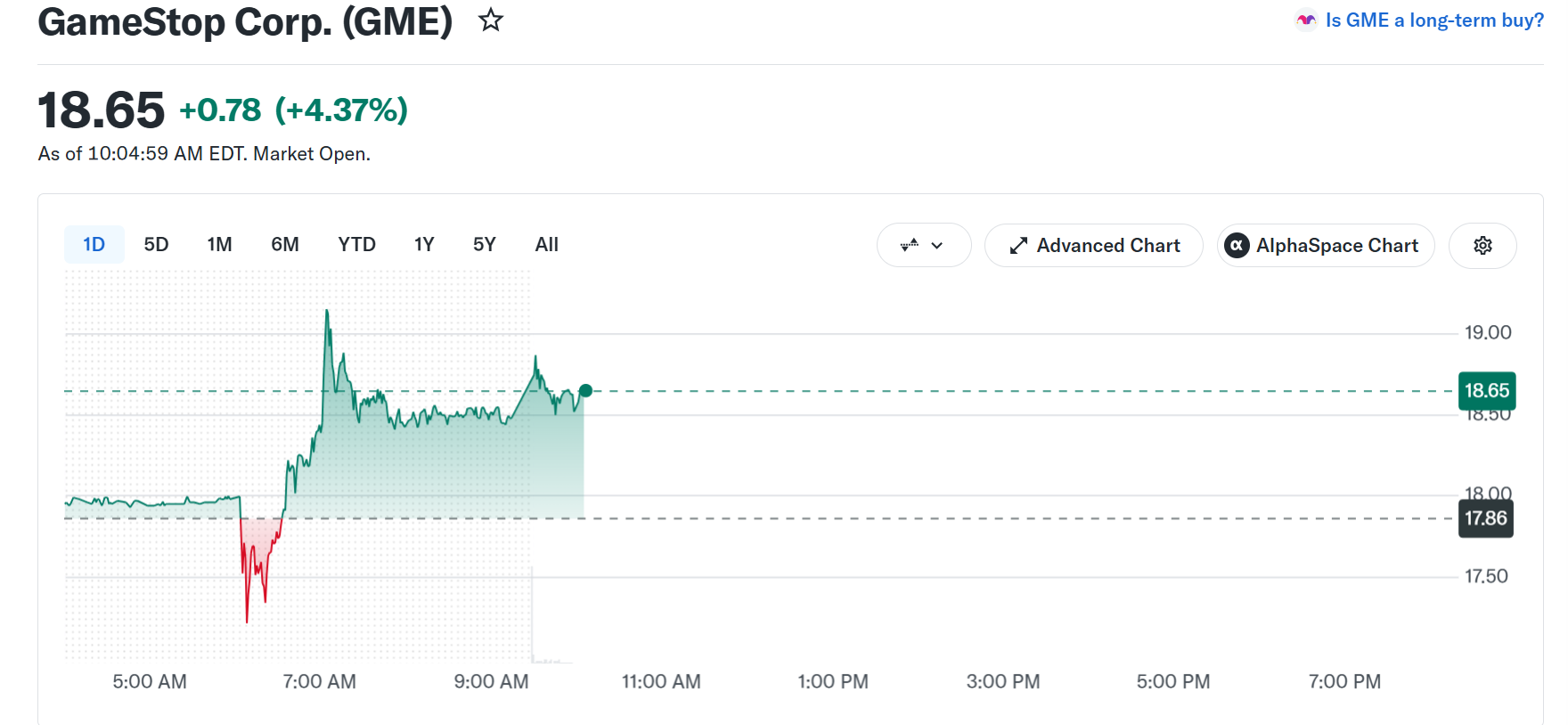
GameStop stock climbed about 4% on Monday. The company paid $358.4 million in cash to stop a share count that could have continued to grow.
The payment freezes the deal at roughly 55.5 million new shares. That equals about 12% of GameStop’s 448.7 million shares outstanding.

Why GameStop Stock Rallied After the Dilution Fix
On August 3, GameStop agreed to swap $1.4 billion of zero-coupon convertible debt for stock. The company would hand over shares and pay nothing.
The catch sat in the pricing, as the share count depended on an average of GME’s price over 35 trading days. A cheaper stock meant more shares.
Traders spotted the loop at once, and GME fell 12.25% that day to $19.06, down from $21.72 on July 31.
GameStop has now killed the rest of that window. Noteholders take 73% of the deal in shares and 27% in cash. No further shares can be issued.
The Warning Buried in the Filing
Monday’s amendment added a clause the August 3 release did not carry.
“GameStop expects that participating noteholders may purchase or sell shares of Common Stock or enter into or unwind derivative transactions to adjust their positions, including purchases of Common Stock to close out short positions,” read an excerpt in the filing.
Those last five words matter because convertible investors usually short the stock to hedge. A frozen share count and a cash payout can leave those hedges mis-sized.
GameStop also pulled the closing date forward by 20 days, to about September 3. That compresses the window for any unwinding.
What the Fix Does Not Solve
The exchange retires only a third of the debt. Roughly $2.8 billion of the original $4.2 billion convertible stack stays on the books.
The cash came from a shrinking pile, too. Holdings fell to about $5.06 billion from $8.694 billion, mostly because GameStop converted its proposed eBay takeover bid into 43.4 million eBay shares.
The quarter itself read better. Sales slipped to between $780 million and $800 million from $972.2 million. Yet operating margin jumped to roughly 20% from 6.8%, even after a $75 million loss on GameStop’s Bitcoin holdings and other digital assets.
At $18.65, GME still trades 14% below its July 31 close. The dilution clock has stopped. The rest of the risk has not.
The post GameStop Stock Climbs After a $358 Million Fix. Will It Last? appeared first on BeInCrypto.

Coinbase CEO Brian Armstrong has accused “entrenched incumbents” of lobbying against the CLARITY Act, arguing that established financial players are trying to stop crypto companies from competing in US financial services.
His comments frame the fight over the bill as a contest between traditional firms protecting their position and crypto businesses seeking clearer rules.
Armstrong Puts Competition at Center of CLARITY Fight
Armstrong said the Trump administration came to power after millions of Americans felt “disenfranchised” by the previous administration’s approach to crypto.
He pointed to Donald Trump’s 2024 campaign promise to remove former SEC Chair Gary Gensler, recalling the reaction when Trump said at a Bitcoin conference that he would fire Gensler “on day one.”
He then ran through what he sees as progress since Trump took office: an executive order calling for clearer crypto rules, the appointment of SEC Chair Paul Atkins and CFTC Chair Mike Selig, and passage of the GENIUS Act for stablecoins. The CLARITY Act, Armstrong said, is the next piece.
“Make no mistake, there are people out there actively fighting against this,” Armstrong said. “There are entrenched incumbents who don’t want competition from crypto companies that would provide better financial services.”
He went further, alleging that some of those firms are “actively lobbying against it, trying to kill it.” The Coinbase chief also singled out Senator Elizabeth Warren, saying she is among those seeking to stop the legislation. His argument comes as the bill approaches a September 15 Senate vote on a motion to proceed.
As CryptoPotato reported previously, Armstrong had earlier said on August 21 that regulatory clarity was coming either through Congress or through action by the SEC and CFTC. He pointed to September 15 and 16 as possible dates for that development.
The Senate needs 60 votes for cloture, while Republicans hold 53 seats. That means if all of them support the measure, it would still leave them needing at least seven additional votes from Democrats or independents.
Furthermore, the bill still faces disputes over ethics rules, anti-money laundering provisions, and whether crypto companies can offer rewards on customer stablecoin holdings.
Banks Remain a Point of Tension
The banking industry’s concerns over stablecoin rewards sit close to Armstrong’s competition argument. The provision has drawn resistance from traditional lenders, who say such products could pull deposits away from banks.
That dispute helps explain why the CLARITY debate is about more than deciding which regulator handles crypto. The legislation would establish federal rules for digital assets, including how tokens are classified and where SEC and CFTC responsibilities begin and end.
With all that going on, Armstrong’s message is direct: the bill should pass because consumers and crypto firms need clearer rules, while established financial companies should not be able to block competitors through lobbying.
“It’s time to get the Clarity Act, which will protect consumers, over the finish line,” he wrote on X. “There’s something in it for everyone: banks, law enforcement, crypto companies, and most importantly the American people.”
The post Brian Armstrong: ‘Incumbents’ Are Trying to Kill Crypto Competition appeared first on CryptoPotato.


BeInCrypto is attending TOKEN2049 Singapore as an official media partner, and this year we are bringing The NewsDesk to the main venue. Our team will be at Marina Bay Sands for both days of the conference, October 7-8, interviewing executives and industry leaders from across digital assets and finance.
About TOKEN2049 Singapore 2026
TOKEN2049 Singapore is expected to bring together more than 25,000 attendees, 7,000 companies, 300 speakers and 500 exhibitors across 160+ countries, with more than 60% of attendees holding C-level positions.
Alongside the broader Singapore programme, 1,000 side events will be featured throughout the week. Other major gatherings taking place in Singapore that week include Digital Asset Summit Asia, Sui Basecamp, the Network State Conference, the Milken Institute Asia Summit, and the Forbes Global CEO Conference, all against the backdrop of the Formula 1 Singapore Grand Prix.
This year’s agenda features tracks on institutional capital integration, with traditional financial leaders such as Nasdaq’s Adena Friedman and Franklin Templeton’s Jenny Johnson discussing capital flows and regulatory developments. At the same time, industry leaders including Binance CEO Richard Teng, Hyperliquid Labs CEO Jeff Yan, and Polymarket founder Shayne Coplan will explore exchange liquidity, on-chain derivatives, and decentralised prediction markets.
The speaker’s lineup also features other financial heavyweights such as Joseph Lubin, Co-founder of Consensys, Vlad Tenev, CEO of Robinhood, and Amy Oldenburg from Morgan Stanley, among others.
BeInCrypto NewsDesk at TOKEN2049 Singapore
Our NewsDesk will be located at the main venue in Marina Bay Sands where our journalists will be speaking to industry leaders and covering all the latest announcements and product launches as it happens.
Follow BeInCrypto for coverage across both days, and check token2049.com for the full speaker lineup and agenda as more of the programme is announced.
BeInCrypto is part of the BeInNews Group, an independent media group covering the convergence of finance and digital assets. We help professionals act with confidence in a complex and fast-changing industry through our newsroom, research reports, events, expert councils and multimedia studio.
The post BeInCrypto Partners with TOKEN2049 Singapore 2026 appeared first on BeInCrypto.

The Bitcoin price is getting ready for another critical test near the $80,000 level, although there seems to be a confusing environment on the charts. The technical picture looks a bit weak in the short term, while on-chain metrics remain stable. That keeps the trading range for BTC quite narrow, from $77,000 to $80,000.
Key Takeaway
- Bitcoin is heading toward an important resistance point at $80,000; a breakout here can take the price closer to $88,000-$90,000.
- Near-term momentum looks weak as BTC trades close to key support levels at $77,000-$78,000.
- There are no major developments on the chain front, with active addresses holding steady close to 680,000 and transactions ranging from 550,000 to 600,000 per day.
- Below $77,329 could add more pressure to the bearish side, while failure to hold above $70,000-$71,000 may worsen the outlook.
Bitcoin Price Faces Resistance Near $80,000
Bitcoin recently rejected at the 50-week moving average, according to crypto analyst Ted Pillows. But Bitcoin managed to close above its 50-week exponential moving average (EMA), meaning the overall technical setup is not in breakdown territory just yet.
In his analysis, Pillows indicated that regaining control of the 50-week moving average might pave the way for Bitcoin toward $88,000-$90,000, while giving up the 50-week EMA may cause the price of Bitcoin to fall toward $74,000.
The weekly chart puts the 50-week simple moving average (SMA) around $80,326.65, while the 50-week EMA sits near $77,329.10. That makes the current area particularly important. Bitcoin is trading between the two averages, with the 50-week EMA acting as nearby support and the 50-week SMA sitting just above $80,000 as resistance.
There is also a larger support zone below the market. The Bull Market Support Band is currently around $70,102-$71,052. A drop toward this area would mean a deeper pullback, while a weekly close below $70,102 would be a more serious warning for the broader bullish structure.
Daily Chart Shows Bitcoin Losing Some Momentum
The daily chart tells a similar story, with Bitcoin stuck between short-term support and key resistance levels. BTC is currently trading at $78,287, while the 9-day EMA is at $77,330. As long as it continues to trade above this moving average, short-term support holds up. The situation could change quickly if BTC closes below the 9-day EMA, which could put $75,000 back in focus, followed by the $70,000 area if selling pressure continues.
For the bulls, however, $80,000 remains the level to watch. Bitcoin’s daily Relative Strength Index (RSI) is around 70.34, putting momentum close to the traditional overbought zone. The RSI is still below its upper band near 75.95, though, so there is room for momentum to increase if Bitcoin manages to break higher. A move above the upper RSI band alongside a clean break above $80,000 would strengthen the bullish case.
The 4-hour chart is less encouraging in the short term. Bitcoin is trading below its 9-period EMA at $78,143, and the RSI is at 46.81. Also, the RSI is trading below its signal line at 48.72, implying bearish momentum in the short term.
However, the first level that needs to be watched is $77,900. Should the price find support at $77,900, there would be hope of pushing toward $80,000 once again. Breaking down from $77,900 would make a move toward $75,000 and $72,000 possible. Retaking $78,143 on the other side would improve the near-term picture.
Bitcoin On-Chain Activity Remains Steady
While the charts are showing some short-term weakness, Bitcoin’s network activity tells a different story. The analysis puts Bitcoin’s market capitalization at around $1.61 trillion, with BTC trading near $78,000. Despite recent consolidation, market capitalization has remained relatively stable.
That suggests Bitcoin’s overall valuation has not experienced a major breakdown while the price has moved sideways. Active addresses are also holding up relatively well. The provided Glassnode data shows around 680,000 active addresses, with activity generally fluctuating between approximately 640,000 and 680,000.
This is worth watching because a sharp and sustained decline in active addresses could point to weakening network participation. So far, however, there has not been a major drop of that kind.
Transaction activity also remains fairly healthy. Daily transactions generally sit between 550,000 and 600,000, although there have been periods where activity jumped toward 750,000-$900,000. In other words, Bitcoin’s price may be struggling to push higher, but the network itself is still seeing meaningful activity.
Bitcoin Price Outlook: $70,000 And $80,000 Are The Key Levels
Put everything together, and Bitcoin is essentially stuck between two major zones. On the other hand, bulls should aim for $80,000, and once a break above that level is seen, eyes will be on the next targets of $84,000, $87,000, and ultimately $90,000. Breaking above the 50-week moving average on a weekly chart at $80,326 again will send a positive signal to the market.
On the downside, the critical levels start with the 50-week EMA at $77,329. A breach of this level will add more downward pressure, with $75,000 becoming relevant. Beneath that is the range of $70,000-$71,000, which becomes increasingly more crucial. A close beneath $70,102 will weaken the overall bullish setup, putting Bitcoin back into the support zone of $63,400-$61,800.
For now, Bitcoin is caught in a tug-of-war. Short-term technical indicators are showing signs of weakness, but on-chain activity remains relatively stable. This means the upcoming move is very significant. Breaking out above $80,000 would help rekindle bullish sentiment toward the $90,000 area, whereas breaking down below the support levels would weaken the bullish setup significantly.
Disclaimer
This analysis is based on market trends and does not guarantee future results. It should not be treated as financial advice. Cryptocurrency investments involve risk, so always do your own research (DYOR) before investing.
[contact-field label=”Name” type=”name” required=”true”/][contact-field label=”Email” type=”email” required=”true”/][contact-field label=”Website” type=”url”/][contact-field label=”Message” type=”textarea”/][/contact-form>
Bitcoin gained about 26% in a month. Federal Reserve Chairman Kevin Warsh just told the world’s finance chiefs why that run may be ending.
Cheap money is over, he argues. Growth is picking up, and cash is chasing new projects. That pushes interest rates up, not down.
Warsh Says the Easy Money is Gone
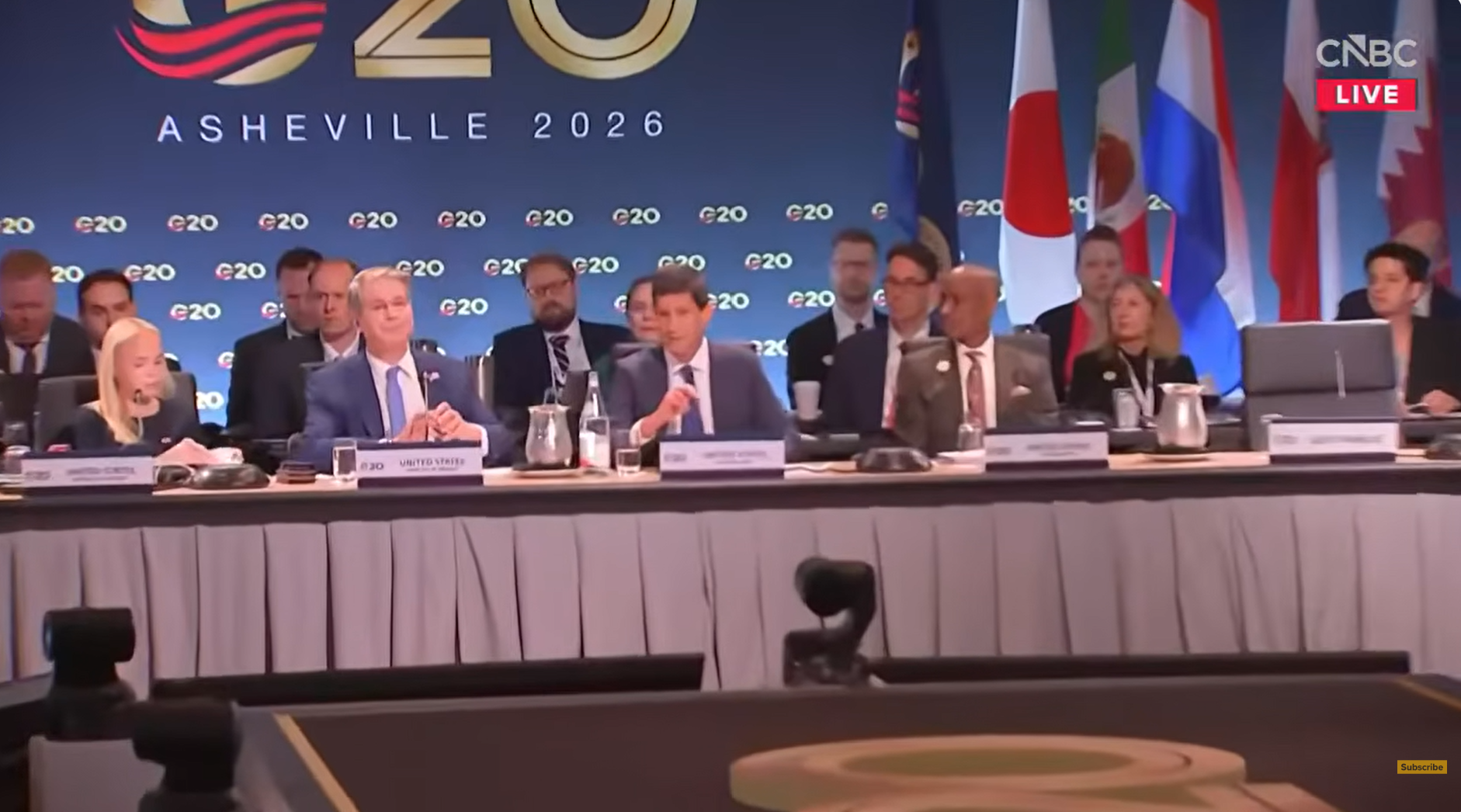
Warsh has run the Fed for 100 days. He spoke on Monday at the Group of 20 (G20) meeting in Asheville, North Carolina. It gathers finance ministers and central bankers.
For years, economists blamed too much idle cash and too few good projects. That kept borrowing cheap. Warsh says that world is finished. He made the same case at Jackson Hole on Friday.
“It wasn’t so long ago … when economists and policymakers were speaking of secular stagnation and a global saving glut,” said Warsh.
Money is now pouring into artificial intelligence, he said. He cannot call today’s conditions tight. Inflation still runs at 3.7% a year.
Bessent Says He Cannot Fight It
Treasury Secretary Scott Bessent sat beside him on Monday in Asheville. On August 19, Bessent doubled the size of Treasury’s bond buybacks to at least $4 billion each. A buyback means the government buys back its own long-term debt.
Critics said the real goal was to push borrowing costs down. Bessent denies it.

“I don’t think I can change the equilibrium price. My job is to slow things down … and make sure that the market doesn’t get disorderly,” he said on Monday’s panel.
However, the market is not listening, with the 30-year Treasury yield reaching about 5.26% the same day, to mark a 19-year high. The 10-year yield also surged to 4.76%.

Stanley Druckenmiller has seen this film before. He ran the 1992 bet that broke the Bank of England. Britain was defending a price it could not hold. Bessent worked at Soros Fund Management then. Druckenmiller says he is repeating the mistake.
Bessent addressed the row directly on Monday. He said he has spoken with Druckenmiller since the op-ed ran, and suggested the timing cost his former mentor money in the market.
Why Bitcoin Holders Should Care
Investors bought hard assets in August because they expected the dollar to keep losing value. Warsh describes the opposite world. Stronger growth lifts interest rates. Savers then get paid to wait. Bitcoin pays nothing.
Both gold and Bitcoin retreated after his Jackson Hole speech. The bigger risk is Warsh, not Bessent, as a risky September market pattern sits ahead too.
The post Bitcoin Gained 26% in August, But Fed’s Kevin Warsh Says It Could Be Over appeared first on BeInCrypto.

#shorts #nepal #nepa #money

The Lord Of The Rings voted Classic FM listeners’ favourite film score

Microsoft Azure Down? Outage Reports Surge, Capping a Fourth Microsoft Service Disruption This Monday Alone





-

 Crypto World6 days ago
SpaceX stock could rise 75% to $240, JPMorgan says
-

 Fashion3 days ago
Weekend Open Thread: Maeve – Corporette.com
-

 Crypto World4 days ago
Bitcoin’s 22% rally now needs real demand to outlast Treasury liquidity boost
-

 Crypto World5 days ago
Warsh Jackson Hole keynote puts financial innovation first
-

 Crypto World7 days ago
A $30 Billion AI Fund Implodes, Now the SEC Is Investigating Wall Street’s Role
-

 Business4 days ago
Salesforce Stock Soars 19% as Blowout Earnings and Agentforce AI Growth Silence Software Skeptics
-

 Crypto World6 days ago
Did Trump Just Move SpaceX Stock With One Truth Social Post?
-

 Crypto World5 days ago
Elon Musk Grok Bot Promise: We Will Make You Whole if AI Loses Your Money
-

 Business4 days ago
Apple Confirms September 9 Keynote and Reveals Its Full Pre-Order Schedule
-

 Business5 days ago
Walmart takes aim at younger shoppers with new fashion brand
-
 NewsBeat5 days ago
Lindsay Clancy jury braces for closing arguments as judge tells court: ‘You’ve heard all the evidence’ – Live updates
-

 Business3 days ago
Onto Innovation Stock: AI’s Next Bottleneck Is Yield (NYSE:ONTO)
-

 Crypto World3 days ago
Bitcoin price tests $82K resistance as Brandt stays long
-

 Business6 days ago
Thailand’s Eastern Economic Corridor Capital City (EECiti): Key Developments and Investment Opportunities
-

 Crypto World5 days ago
NVIDIA revenue hits $96.2B as AI demand doubles
-

 Business7 days ago
NVIDIA Stock Drops Nearly 2 Percent to $210 on Seventh Losing Day Ahead of Critical AI Earnings
-

 Business3 days ago
iPhone 18 Pro Pre-Orders Could Shift to Saturday as Apple Reportedly Avoids September 11 Anniversary
-

 NewsBeat6 days ago
Trump’s trade truce with China faces test with Iran effort
-
 Crypto World5 days ago
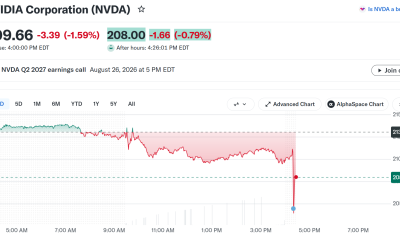
Nvidia Q2 Earnings Reveal $96.2 Billion Beat, So Why Is NVDA Falling?
-

 Tech5 days ago
Claude Cowork gets its own browser that doesn’t touch your tabs, bookmarks, or saved passwords
You must be logged in to post a comment Login