They called it the ‘moron premium’. It was September 23, 2022, and Liz Truss‘s nascent government had announced £45billion of tax cuts – funded entirely by borrowing, rather than corresponding cuts to public spending.
The markets went haywire. The notorious ‘bond vigilantes’ who trade global government debt were appalled at her fiscal irresponsibility. They dumped British bonds, known as gilts, en masse.
In response, the interest rate or ‘yield’ on those ten-year bonds exploded: from 3.03 per cent to 4.42 per cent. This made it agonisingly more expensive for Truss and her equally inept chancellor Kwasi Kwarteng to borrow.
The Treasury’s bill to service public debt, along with the government’s cost of doing business at all, soared.
This was the moron premium in action. Truss, of course, resigned soon after her infamous ‘mini budget‘, her 49-day tenure making her the shortest-serving prime minister in British history – famously outlasted by an iceberg lettuce.
That was only four years ago. It’s hardly ancient history. But Andy Burnham appears to have ignored those lessons completely.
Less than a year ago, our new Prime Minister airily opined: ‘We have got to get beyond this thing of being in hock to the bond market.’
The only way of achieving this, of course, is for a government to live within its means and not borrow more than they can afford from those markets, but that is not the Labour way.
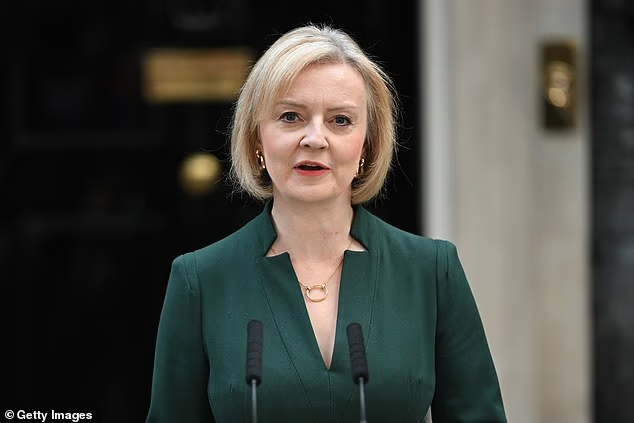
Liz Truss announced £45billion of tax cuts – funded entirely by borrowing – which was dubbed the ‘moron premium’
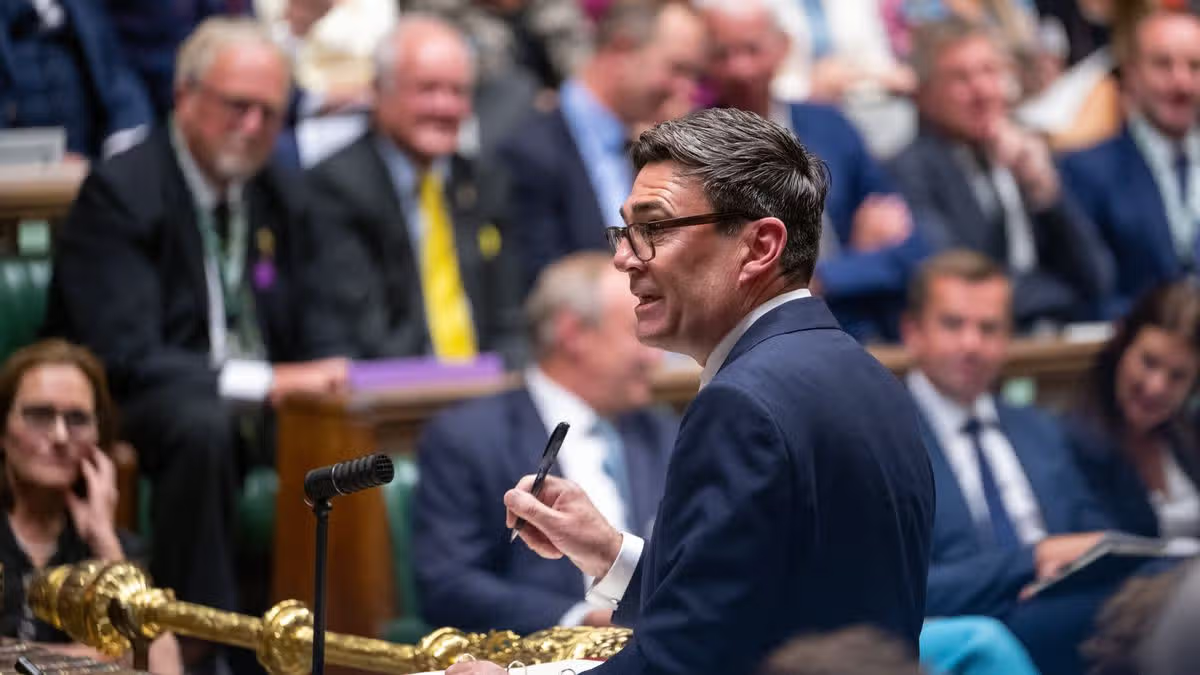
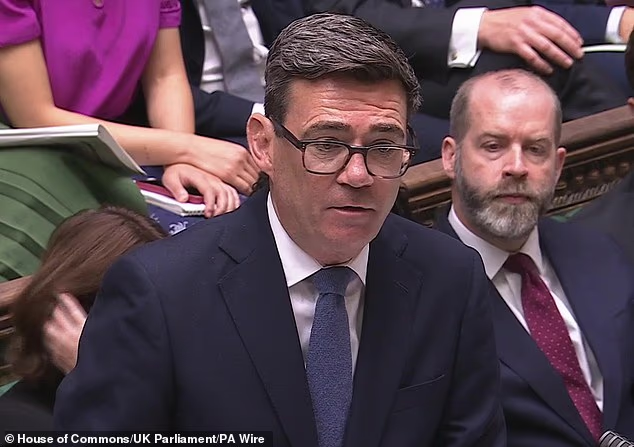
On Tuesday, Burnham gave a speech to Parliament that sent further tremors through the City and sparked a new ‘moron premium’.
Outlining his dream of going back to the future, to a bright socialist utopia in which Margaret Thatcher’s pioneering reforms would be reversed, the welfare system would continue to balloon without ‘crude cuts’ and ‘relentless’ efforts would be made to renationalise utilities such as water and energy – all sent bond yields soaring once again.
Yesterday, the yield on the crucial ten-year bond climbed to 5.29 per cent, the highest since the onset of the Great Financial Crisis in July 2008, and in excess of the rates seen under Truss, which Labour has claimed amounted to ‘crashing the economy‘.
The yield on 30-year gilts, meanwhile, reached a peak of 5.92 per cent: a rate not seen since 1998, when Burnham was occupying himself as an ‘administrator for the Football Task Force’.
This new Labour moron premium only seems set to get worse.
What is particularly infuriating is that it doesn’t have to be this way. Yes, rising bond yields currently afflict all major economies. But Britain’s are by far the highest among the G7 richest nations: far ahead of the runner-up, America, at 4.79 per cent and leaving France trailing in comparison on 4.22 per cent.
The shock of the Iran war has undoubtedly made life more expensive for the world’s governments. But that is no reason to compound the problem with policies that could have been designed to make it worse.
The dogmatic Burnham manifestly fails to understand the simple fact that, far from being responsible for the nation’s economic woes today, Thatcherism ushered in an era of prosperity, imperfect though that was.
Prime Minister Andy Burnham and Chancellor John Healey during a visit to Sheffield earlier this year
Smaller-state Thatcherism slammed the door on precisely the sort of red-blooded socialism that wrecked the economy in the 1970s, forcing the then Chancellor Denis Healey to go cap in hand to the International Monetary Fund (IMF) for a bailout.
Burnham was then in short trousers, but I saw it as a young economics reporter at the time – it was a national humiliation that remains seared on my memory.
And though he loves to castigate it, Brexit, too, has freed Britain from the statist bureaucracy of Brussels.
Although undoubtedly we can and should be doing more to harness its advantages, leaving the EU has helped to unleash a boom in the export of home-grown financial and professional services to the rest of the world.
We rarely hear any of this from doom-laden Labour politicians, obsessed with what they incessantly call the ‘cost of living crisis‘. But Britain’s income from exported services has soared by 21 per cent since the pandemic to £545 billion last year.
Burnham could be capitalising on all this but, instead, he’s wedded to the foolish, well-tested delusion that growth and prosperity can be delivered in a country where an addiction to benefits, untrammelled trade union power and an unreformed NHS suck the lifeblood out of enterprise.
The PM’s endless cascade of easy, feel-good gestures, from a £2 cap on bus fares to an assault on vaping and betting shops on our derelict high streets, is simply cover for his failure to tackle more important issues.
Foremost among these: our nation sits on a £3trillion debt mountain and faces an interest-rate bill of £135billion this financial year – vastly more than the defence budget (£62 billion) and close to our spend on education (£122 billion). I should hardly need to say it, but such borrowing costs are utterly unsustainable and can only end in political and economic disaster.
Events in the bond markets may seem remote, but they filter down into all our lives. Higher bond yields mean more expensive mortgages, fewer houses being built, more expensive borrowing for businesses and individuals, fewer jobs, reduced output and slashed investment.
Most seriously of all, the Labour moron premium is eating away at Chancellor John Healey’s precious ‘headroom’: the spare capacity he has in next month’s Budget to cope with unexpected contingencies, following Rachel Reeves’s growth-crushing £75billion stream of tax rises.
City experts suggest that the Burnham Bond Crisis has already wiped out as much as £14billion of that headroom, leaving precious little scope for hitting the crucial Nato target of spending 3 per cent of our GDP on defence.
Early indications are that instead of tackling Britain’s bloated welfare bill and the exploding cost of state pensions – and generous public sector pensions in particular – Healey will target wealth, housing and banking for new taxation at his first budget.
How dispiriting. In July, the Office for Budget Responsibility noted that even a simple and entirely reasonable change, such as indexing welfare-payment increases to inflation rather than average earnings, could produce billions in savings.
IMF officials warn privately that Britain is moving towards ‘peak’ taxation, the point at which raising taxes becomes counterproductive because citizens and businesses will simply avoid paying: if necessary, by fleeing overseas.
Burnham may boast a refreshingly cheerful demeanour after his lugubrious and robotic predecessor. But his refusal to acknowledge the oncoming fiscal cyclone means that Britain looks as vulnerable now as at any time since the 1976 sterling crisis.
I suspect this will be the second Chancellor named Healey I will witness plunging Britain into a terrible financial crisis.
Failing to tackle the ‘moron premium’ is no longer an option. History shows that in any fiscal crisis, governments are overwhelmed by the power of markets and swept from office.
Unless Burnham and Healey wake up to the danger, mark my words: they will be removed from power as speedily as they arrived.


















































You must be logged in to post a comment Login