The Builders Stage is returning to TechCrunch Disrupt 2026, bringing together founders, startup operators, and investors for practical conversations on what it takes to build and scale successful companies.
Hear from startup and venture leaders shaping the tech ecosystem, including Grant Lee, CEO and co-founder of Gamma; Leah Solivan, founder and general partner at Precedent.vc; Robby Stein, VP of Product at Google; and more. Through candid conversations and real-world case studies, speakers will share actionable insights on fundraising, hiring, go-to-market strategy, AI, and the operational decisions that fuel startup growth.
Join more than 10,000 founders, investors, startup operators, and technology leaders at Moscone Center in San Francisco on October 13-15. Register today and save before our next ticket price increase.
Image Credits:TechCrunch
Built for founders who are ready to scale
Building a startup is one thing. Building a company that can scale is another challenge entirely. The Builders Stage is one of six industry-focused stages at Disrupt 2026, dedicated to helping founders navigate the challenges of growth, from raising capital and hiring top talent to building go-to-market engines and preparing for the jump from seed to Series A.
Every session delivers practical strategies you can put to work immediately, plus opportunities to engage directly with speakers during live Q&A. Secure your pass to Disrupt 2026 today and save up to $330 before rates increase.
Without further ado, here’s your first look at the Builders Stage agenda, with more speakers and sessions to be announced as we get closer to the event.
Builders Stage agenda
How to Win When You’re Not Building AI
With Shan Shan, Investment Manager, Baillie Gifford; and Yuri Sagalov, Managing Director at General Catalyst
AI may dominate the world of venture, but many enduring companies won’t be those that sell AI models or agents. This session is for founders competing for attention in an AI-obsessed market. Panelists break down what actually matters now: efficient growth, retention, revenue quality, and disciplined execution, and why fundamentals, not hype, still build breakout businesses.
Nearly all AI founders have the same worry these days: What if OpenAI or Anthropic launches a product that competes with mine? Even strong products are at risk of becoming features of the larger players. This session explores where defensibility exists and what founders can do if they do face competition from rapidly evolving AI giants.
AI startups are scaling faster, and demanding more capital, than any generation before them. Jas Khaira, Global Head of Blackstone N1, shares what separates enduring companies from early momentum, how founders should think about capital as they scale, and what Blackstone looks for when backing the next generation of category-defining businesses.
Competing for AI Talent: Pay, Equity, and Retention
The growth of AI startups has made hiring and retention more difficult for every tech company. From competing for AI talent to navigating secondary sales, founders are rethinking the human infrastructure of their startups. As incentives and employee expectations rapidly evolve, this session explores how companies are adapting compensation, culture, and team-building strategies to attract and retain top talent in a fundamentally changed market.
Founders are increasingly expected to compete for capital before they even have a product. At the pre-seed stage, investors are betting on story, conviction, and founder-market fit. This session breaks down how to build credibility before revenue exists so investors will cut that first check.
From MVP to Billions of Users: How Product Decisions Must Change at Scale
The instincts that win when building your first minimum viable product can break you at a billion-user scale. In this fireside, Robby Stein shares how product decision-making changes when every update impacts billions of users. Hear how teams balance speed with trust and innovation with reliability at one of the world’s largest product organizations.
Advertisement
Hiring When AI Is a Co-Founder
With Josh Reeves, CEO and Co-founder, Gusto; more speakers to be announced
Early-stage companies are no longer just building with AI; they’re hiring it. As AI agents take on engineering, support, and operations, the definition of an early team is being rewritten. This session explores how founders decide what humans should own versus what gets delegated to AI, and how high-growth startups are building hybrid teams without losing speed, accountability, or culture.
AI isn’t just adding features, it’s forcing product teams to rethink how people search, discover, communicate, travel, and make decisions. Leaders from Reddit, Square and Uber discuss how they’re redesigning products used by millions, what users actually want from AI, and where product leaders should resist the temptation to automate everything.
The smartest founders today aren’t just building for IPOs; they’re also building with possible acquisitions in mind from day one. As exits shift and capital tightens, understanding M&A early has become a competitive advantage. This session breaks down how founders can create the possibility of such an option through product strategy and partnerships. It delves into how big-dollar startup outcomes actually happen, even for small companies.
Series A is getting harder, with VCs growing more demanding. For founders planning to raise in the next one to two years, this session breaks down what “fundable” will actually mean in 2027. Hear how top investors are redefining the metrics, teams, and traction that matter now, what outdated fundraising playbooks no longer work, and how companies can separate from the pack in the next funding cycle.
Advertisement
The 90-Day GTM: Why $0–$10M ARR Is the New Baseline (and How to Actually Get There)
With Ryan Meadows, Chief Revenue Officer, Lovable; and Tomasz Tunguz, General Partner and Founder, Theory Ventures; Ben Broca, Founder, Polsia
The definition of traction has changed. What once took years is now expected in months, and $0 to $10 million ARR is increasingly becoming the new early-stage baseline. This session breaks down how AI-enabled execution, faster distribution, and shifting investor expectations are compressing GTM timelines, and the tactical levers founders need in the first 90 days to accelerate revenue and stand out fast.
The Real Tokenmaxxing: How the Best AI Companies Navigate a Multi-Model World
With Mo Jomaa, Partner, Capital G; and Zuzanna Stamirowska, CEO and Co-founder, Pathway; more speakers to be announced
The frontier is moving faster than any single model can keep up with, and the teams building the most successful AI products are increasingly orchestrating across many models rather than betting on just one. This panel brings together founders and operators at the center of that shift to discuss how they evaluate new models, manage cost and reliability at scale, and architect products that can evolve as quickly as the underlying technology.
The AI conversation is shifting from what models can say to what they can actually do. Agents are navigating the open web and completing work, AI systems are taking on increasingly ambitious research, intelligent machines are beginning to operate beyond the screen, and a new infrastructure layer is emerging to make all of this possible at scale.
Greenfield Partners’ Shay Grinfeld sits down with founders building across these emerging areas to separate what’s real today from what’s coming next, and explore where the biggest new opportunities are taking shape. The conversation will culminate in the reveal of Greenfield Partners’ 2026 AI Disruptors 60, spotlighting the companies Greenfield and TechCrunch believe are pushing AI into new territory.
PMF Red Flags: How to Tell If You Really Have It
With Rajeev Dham, Managing Director, Sapphire Ventures; and Rahul Vohra, Founder and Head of Superhuman Mail; more speakers to be announced
Advertisement
In an AI hype cycle, product-market fit signals are easier to fake and harder to trust. Founders are mistaking early excitement, usage spikes, and pilot wins for durable traction. This session breaks down what false PMF actually looks like, how investors and operators separate real retention from hype-driven adoption, and the signals that indicate whether a company has true pull or just temporary momentum.
The Zero-to-1K Playbook: How to Get Your First 1,000 Customers Without a Marketing Budget
With Grant Lee, CEO and Co-founder, Gamma; Leah Solivan, Founder and General Partner, Precedent.vc; andElia Wallen, Founder and CEO, Engine
Early customer acquisition is not about marketing spend; it’s about founder-led distribution and relentless execution. Most startups at zero to one do not have budget, brand, or scale, only urgency and creativity. This session breaks down how founders are landing their first customers through community building, product-led growth, founder-led sales, strategic outbound, and word-of-mouth momentum.
Yes, It’s Hard to Be a Founder: An Honest Conversation
With Nell Daly, Co-founder and Managing Partner, Revenge Capital; David H. Rosmarin, Associate Professor, Harvard Medical School; and Jack Withinshaw, Co-founder and Chief Commercial Officer, Airspeeder
Advertisement
Company building is as psychologically demanding as it is strategic, and most founder narratives understate that reality. In this candid conversation, founders and mental performance experts unpack the hidden costs of high-growth environments, from burnout and decision fatigue to the identity strain of sustained pressure, and share the systems, habits, and mental frameworks that help leaders endure and perform at a high level.
So You’ve Got a Hit Product. How Does Your Company Do It Again?
Most startups stall out because they build a single great product instead of a repeatable multi-product engine. Join a venture capitalist and two founders as they reveal the precise operational playbook for capital allocation, systemizing internal innovation, and engineering a compounding “Second Act” before the core product’s growth curve flattens.
Hiring, Compensation and Culture in the Most Competitive Market Ever
With Matt Birnbaum, Founder, Wylder.co; and Atli Thorkelsson, VP, Talent Network, Redpoint Ventures; more speakers to be announced
Advertisement
No question about it, the growth of AI startups has made hiring and retention for all tech companies more difficult. From competing for AI talent to secondary sales, founders are rethinking the human infrastructure of their startups. As hiring, incentives, and employee expectations rapidly evolve, this session explores how companies are adapting compensation, culture, and team-building strategies to attract and retain top talent in a fundamentally changed startup environment.
Startups can go from zero to viral overnight, but sustaining that momentum is a completely different challenge. In this fireside, Zach Yadegari shares how Cal AI navigated rapid growth, product pressure, and the realities of building in a distribution-driven market. Hear the lessons behind turning breakout attention into durable retention and long-term company building.
The High-Conviction Filter: What We Learned From the Battlefield
With Alexa von Tobel, Inspired Capital; and Chi-Hua Chien, Co-founder and Managing Partner, Goodwater Capital; more speakers to be announced
Advertisement
What separates the breakout companies from the rest at TechCrunch Disrupt 2026? In this candid debrief, Startup Battlefield judges unpack the trends and founder qualities that stood out in real time, from shifting investor expectations to the narratives that resonated most this year. The conversation will also explore how startup storytelling is evolving and what happens after the spotlight, including the realities of maintaining momentum and surviving the critical 12 months after a major launch, funding round, or Startup Battlefield appearance.
What makes an investor say yes? In this audience-led Q&A, the Startup Battlefield finals judges take your toughest questions on what separates a fundable startup from the rest: team, traction, market opportunity, pitch delivery, red flags, and more. Come ready to ask and get candid answers straight from the investors making the decisions.
Join the conversations and make the connections at Disrupt
Found the time to focus and ‘corrected’ incentives that saw sales drive users to full private clouds
EXCLUSIVE What’s old is new again as VMware will soon release an updated version of vSphere Standard, the low-end server virtualization bundle that it hasn’t significantly changed for years and has scarcely promoted since its 2023 acquisition by Broadcom.
Advertisement
VMware’s hero product for the last three years has been the Cloud Foundation (VCF) private cloud bundle.
vSphere Standard and another low-end suite called vSphere Enterprise Plus remained on VMware’s list of products, but the website mentioning the products devotes a handful of words to each.
The Register has oftenheardVMware, and itspartners, would not issue subscription renewal quotes for the low-end products or only offer quotes that suggested adopting VCF instead. VCF is more powerful than standalone vSphere but more complex and costly – and also overkill for basic server virtualization.
We’ve also heard that Broadcom sold another smaller bundle – vSphere Foundation – almost exclusively to customers that also acquired VCF but needed something smaller than VCF for some sites.
Advertisement
Speaking to The Register at the VMware Explore conference on Wednesday, Paul Turner, chief product officer for VMware’s Cloud Foundation Division, said that the Broadcom business unit has changed the incentives that saw salespeople steer customers toward VCF.
“We corrected this,” Turner said, adding that VMware has sometimes had “too big a focus on VCF.”
VMware’s last major release of vSphere Standard came in 2022 with version 8. In 2025, VMware delivered version 9 of vSphere along with VCF 9 – but didn’t release a new cut of vSphere Standard.
Turner said that decision was taken because VMware chose to focus on improving the security of VCF.
Advertisement
Ram Velaga, president of Broadcom’s Infrastructure Software Group, told The Register VMware decided to focus on VCF because it wanted to shift the prevailing narrative that public clouds are the natural home for workloads, and instead argue that private clouds are more cost effective and easier to operate.
Bringing a new low-end server virtualization offering to market at that time may have confused customers, he told The Register. “People could get distracted,” he said, suggesting that VMware could have prompted questions about the extent of its commitment to private clouds.
Velaga said vSphere Standard is suited to users who operate around 128 cores. Turner mentioned memory tiering as a possible feature of the product.
As it happened, Turner and Velaga’s remarks came on the same day that Proxmox, the provider of an open-source virtualization and containerization platform, announced it had opened a North American office and started to offer 24×7 support for the first time. The Austria-based company previously only supported its wares during local business hours.
Advertisement
The Register often hears vSphere users mention Proxmox as an ideal replacement for low-end server virtualization.
Turner said the new vSphere Standard will be a better and more resilient offering than Proxmox and pointed to the introduction of 24×7 support as a sign of Proxmox’s maturity being well behind that of VMware and its partners.
He also said that more details about the new vSphere Standard will likely emerge as VMware takes its Explore conference to Germany, in mid-October. Among the facts he said will emerge soon are how VMware will bring vSphere Standard to market, an item of interest as the Broadcom business unit dropped the majority of its channel partners.
Earlier this week, The Registerpredicted VMware would not make a pitch to its many low-end users at the Explore conference. The imminent release of a vSphere Standard upgrade was not made on stage at the event, but during one-to-one interviews – so perhaps we were technically correct! Turner thinks another of our assertions, that VMware was not interested in lower-end users, was incorrect.
Advertisement
We leave it to readers to make their own judgment about the level of interest in small customers VMware displayed by spending three years focusing on VCF.
Low-end VMware users will likely be relieved and intrigued by news of a vSphere Standard revival. Few VMware users wanted to quit the product, which has a deserved reputation for working brilliantly. Yet many felt the need to acquire VCF, and the cost of that package, meant it was necessary to consider VMware alternatives.
VMware’s competitors saw that thinking as an opportunity: HPE, for example, even made its low-end virtualization bundle free for a year.
Such offers will soon be less potent, because an upgrade is always easier than a migration. ®
Opera had argued that the European Commission had erred ‘by failing to designate Microsoft as a gatekeeper in relation to its web browser core platform service Edge’.
Norwegian web browser provider Opera has lost a legal challenge at the EU Court of Justice against the European Commission’s 2024 decision that Microsoft and its Edge browser should not be subject to the ‘gatekeeper’ designation and restrictions under the Digital Markets Act (DMA).
Opera had argued that the Commission had erred “by failing to designate Microsoft as a gatekeeper in relation to its web browser core platform service Edge, based on the finding that Edge is not an important gateway for business users to reach end users”.
In its judgement today (2 September), the EU’s General Court, based in Luxembourg, agreed with the Commission’s original decision that Edge does not “constitute an important gateway within the meaning” of the DMA and therefore Microsoft should not be deemed a gatekeeper in this context.
Advertisement
The court ruled that the Commission “did not err in considering that, although Microsoft had met the quantitative thresholds laid down in the DMA, it had put forward sufficiently substantiated arguments to demonstrate that Edge did not constitute an important gateway”.
It said that “the Commission was entitled, in particular, to rely on the low scale of usage of that browser and to compare it with that of other browsers, as those elements are relevant for assessing the actual importance of Edge as a gateway for business users to reach their end users”.
The judgement added: “The General Court also finds that the Commission was entitled to take into account the fact that Edge relies on the browser engine Blink, which reduces Microsoft’s ability to exercise autonomous control over certain key aspects of the service.
“Furthermore, it considers that the Commission was entitled to find that the integration of Edge into the Microsoft ecosystem, including its pre-installation on Windows and the other mechanisms to promote its use from which it benefits, did not contribute sufficiently to making Edge an important gateway.”
Advertisement
The DMA, as the EU court puts it, targets large digital platforms that occupy a central position in the digital economy and can be applied to services that constitute an essential gateway for businesses to reach end users, such as search engines, operating systems, social media platforms or web browsers.
The ‘gatekeeper’ designation imposes specific obligations, in aid of fairness and competitiveness, on qualifying services that meet certain criteria regarding size and market influence.
The Commission has previously applied or considered ‘gatekeeper’ designations through the DMA in various contexts to Big Tech giants such as Apple, over its various digital storefronts; Amazon and Microsoft, over their cloud services; and Google, which was recently fined €890m for DMA breaches.
Opera was founded more than 30 years ago in Oslo – where it maintains its headquarters – and has key hubs in Sweden and Poland.
Advertisement
A 2007 action from Opera against Microsoft eventually led to a €561m EU antitrust fine for the US giant in 2013 over failing to offer users a choice of web browser.
Don’t miss out on the knowledge you need to succeed. Sign up for the Daily Brief, Silicon Republic’s digest of need-to-know sci-tech news.
The variants include a standard Flash, a “workhorse” model for agentic tasks, software development, and multi-step reasoning, and Flash Cyber optimized for vulnerability detection and mitigation.
Google CEO Sundar Pichai said in an X post that 3.8 Flash delivers “significant leaps” from 3.7 Flash across software engineering, agentic tasks, and multi-step reasoning. For instance, it outperformed many large frontier models on the DeepSWE coding benchmark, at far lower cost.
Meanwhile, Flash Cyber is the company’s “most capable” cybersecurity model, Pichai said; it also matches frontier-level performance when it comes to discovering vulnerabilities and patching them at scale. The model achieved 86.2% on the CyberGym cybersecurity benchmark and 47.2% on CWE-Bench, which evaluates AI patching abilities. In an internal Google benchmark, the model achieved a more than 70% success rate discovering vulnerabilities across 20 programming languages, Pichai said.
Advertisement
3.8 is Google’s third Flash release in six weeks and comes quickly on the heels of version 3.7.
3.8 working “harder” with “greater diligence”
3.8 Flash is available now in Gemini Enterprise; devs can try it out in the Gemini API via Google AI Studio, Google Antigravity, Android Studio, or generate UIs in Stitch. It is priced at $0.75 per million input tokens and $3.75 per million output tokens — the same introductory pricing as Gemini 3.7 Flash — and users can customize and adjust model effort levels based on their needs around quality, cost, and latency.
For instance, when compute efficiency is a priority, they can adjust to lower token overhead, or simply continue working with 3.7 Flash, which is “fully supported for efficiency-first workloads,” Google senior product director Tulsee Doshi and Gemini security lead Raluca Ada Popa wrote in a blog post.
“3.8 Flash works harder,” exhibiting “greater diligence” with complex tasks like executing extra reasoning steps, although at times it may use more tokens to maximize performance, Doshi and Popa note. The model has a 1M-token input window and a 64K-token output limit, and can ingest text as well as images, audio, video, and PDF files.
Advertisement
3.8 Flash was evaluated across numerous benchmarks testing coding, multimodal capabilities, computer use, long-context and knowledge work, and scientific reasoning. Google says it also does well in specialized knowledge domains requiring more in-depth analysis and reporting. For instance, the model outperformed its predecessor and other frontier models on benchmarks like Vals Finance Agent V2 for finance, and Harvey’s Legal Agent Benchmark for law; it also scored 54.9% on Humanity’s Last Exam (HLE)-Verified, reflecting its ability to take on multi-step reasoning tasks across subjects like math, science, and humanities.
In one example shared by Google, Gemini 3.8 Flash built a game with a simple prompt using looping techniques in Google’s Antigravity platform. The game uses puzzles, storytelling that changes based on the environment, and images and textures from Nano Banana to create a 3D experience (in this case a wizard navigating a castle).
In other instances, the model created a fully-functional DOS version of Google Maps featuring interactive locations, directions, and street views; a 3D visualizer that automatically decomposed devices into layers for inspection with a slider capability; and a topographic map of famous geographical sites based on real datasets from the U.S. Geological Survey, complete with real-time cross-sections, 2D projections, and scientific explanations.
According to Arena.ai, 3.8 Flash landed at No. 14 in Agent Arena, ranking above DeepSeek-V4-Pro, and showed a significant jump over Gemini 3.7 Flash (which sits all the way down at No. 32). It debuted at No. 7 in Text Arena, ahead of Claude Opus 5 and Gemini 3.7 Flash. It improved over 3.7 Flash in several areas: multi-turn requests, writing, literature, and language, longer queries, hard prompts, coding, instruction following, software and IT services, and business, management and financial ops.
Advertisement
Flash Cyber is already securing Google’s code
Flash Cyber is initially being rolled out to “trusted defenders” through Google’s Fairwind Program, which prioritizes government authorities, critical-infrastructure operators, and other partners looking for advanced cyber defense capabilities. Organizations can apply for access.
Google says the model version has undergone “rigorous training” in the cybersecurity domain and represents a “significant leap in prompt injection robustness.” It is particularly adept at autonomous vulnerability discovery — at least, based on internal Gemini benchmarks — and automated patching. It is also very good at coding, Popa said in a video.
The goal was to equip defenders with expert-level capabilities to give them a leg up over threat actors (whether malicious, fellow AI agents, or human hackers). “We have invested in vulnerability fixing from the start, and prioritized it over offensive capabilities like exploitation,” Doshi and Popa explain.
The model ships a more permissive set of mitigations for cybersecurity safeguards — which is why, for now, it is only being shared with limited partners — and safeguards against misuse in cyber offense and areas like chemical, biological, radiological, and nuclear (CBRN).
Advertisement
Google is already using 3.8 Flash Cyber to secure its own code; it produced 2.6 times more correct patches in Chrome vulnerabilities versus much larger commercial models.
Wiz — which Google acquired earlier this year at a historic $32 billion — reported that 3.8 Flash Cyber had 7.5% to 9.7% higher recall of real-world vulnerabilities on an internal penetration testing benchmark at 2.3 to 5.2 times lower cost than leading frontier models. Similarly, Google’s Cloud Vulnerability Research found a critical foundational vulnerability in less than 2 hours with 3.8 Flash Cyber. Typically, that research and discovery would take months, Google claims.
AI agents are “incredibly skilled” at finding and exploiting vulnerabilities, Popa said. Scanning large codebases with big AI models is expensive, and defenders are overwhelmed. “In cybersecurity, attackers need only find one significant flaw over millions of lines of code. Defenders have to remove every one of those flaws to be able to defend against attackers.”
Doug Turner, engineering director for Chrome, described a “vulnerability apocalypse” in recent months due to generative AI. “Simply overnight, we saw a hockey stick increase in the number of software vulnerabilities reported through our vulnerability research program,” he said in a video.
Advertisement
One interesting vulnerability 3.8 Flash Cyber discovered had been in Chromium and Chrome for 13 years, he explained. It was a “very subtle bug” that dozens, if not hundreds, of engineers looked at but never flagged. “Gemini 3.8 Flash Cyber is going to allow us to create better suggested fixes so that developers’ lives can get a lot easier.”
Insides of the Sears 12 calculator. (Credit: Danalog, YouTube)
Thermal printers are still extremely common today, using small heating elements in combination with temperature-sensitive paper to create a dot matrix-like effect without messing with ink ribbons and complex mechanisms. Of course, even with just a line of elements you still needed one of these per pixel, which at least in the 1970s when the Sears 12 calculator was released added significantly to the cost. The solution here was to wiggle the elements, doubling the resolution of the print head, as detailed in this video by [Danalog].
Using a contemporary Texas Instruments TI-5015 calculator as comparison with its non-wiggling print head, it’s easy to see the advantages here. In an era where electronic calculators didn’t have displays but a thermal printer, this print quality was the selling point, yet adding more thermal elements added to the price tag of the final device and more complexity to the design in terms of driving circuitry.
In this regard adding a way to make the print head move side-to-side at a set rate and tying this fact into the printing would save about half of that circuitry. Inside the Sears 12 is a fairly standard Mitsubishi M58671 calculator IC, but also the whole printer mechanism. When operating, as demonstrated in the video with the cover removed, you can see the whole print head moving rapidly.
With this mechanism this much cheaper Sears 12 definitely gives the TI-5015 a run for its money, even if as noted by [Danalog] the timing would go off a bit after a longer session, resulting slightly wavy printing. Presumably with the massive cost savings of buying a Sears calculator over a TI one, this was deemed an acceptable trade-off.
There are loads of tire brands currently on the market, and there’s a lot more to them than their logos and models — for example, the real owners behind many of the biggest tire brands. These companies call different areas of the world home. The likes of Goodyear, Cooper, and Kelly have become recognized as some of the most prominent tire labels with their ownership based in the United States. As you’d expect, Europe is also home for various well-known tire brands.
It should be clarified that just because a tire brand’s parent company is based in Europe doesn’t mean it’s necessarily a lesser-known brand in the U.S. While there are those more commonly seen on European streets as a result, as it turns out, many of the biggest names in tires in America can be traced back to European companies. This can be due to brand expansion throughout the years, corporate-level buyouts, or other circumstances that brought these prominent American-market tires to European ownership.
Among other things, you really care about buying American-made and American-owned products, you should do some digging into your preferred tire brand. You may find it’s actually owned by a European company.
Advertisement
Nordman
Though it’s not one of the most prominent names in tires, Nordman has carved out a fine spot for itself in the tire landscape. This is admirable considering that, in comparison to most other tire lines out there, higher-end and budget-friendly alike, Nordman is a relatively recent creation.
Advertisement
One of several cheap yet relatively high-quality tire options, Nordman has only been around since 2004, but its parent company has been around far longer. Nordman is an offshoot of Nokian Tires, which is based in Finland and has existed formally since the 1980s — though its roots extend almost a century further back.
The seeds were planted for the creation of Nokian when Suomen Gummitehdas Osakeyhtiö, or the Finnish Rubber Factory, was founded in 1898. By 1934, the company produced the first winter tire, and just over 50 years later in 1988, Nokian Tires Ltd. officially came together. Nokian remains a fixture in Europe, as evidenced by its operation factories in Nokia, Finland and Oradea, Romania. Nokian has expanded production to the United States, too, with a plant located in Dayton, Tennessee. Its Nordman tires are sold primarily within Nordic countries as well as in North America, offering drivers what Nokian Tires itself describes as affordable, proven tires that balance cost and quality.
Advertisement
Michelin
DiPres/Shutterstock
Out of all the major tire brands, few are as well-known and trusted as Michelin. The reality is, this reputation isn’t limited to a single region, seeing as Michelin tires have hit streets all over the world. In fact, the brand’s parent company, the Michelin Group, has sold tires in over 170 different countries. Tracing the history, though, we can narrow things down and find that it’s actually a Europe-based entity. Michelin comes from France, specifically the city of Clermont-Ferrand, the headquarters for the entire Michelin Group.
At this point, the Michelin name has been a European staple for almost two centuries. The company formally began in the early 1830s when entrepreneur Edouard Daubrée and his cousin Aristide Barbier established their own agricultural machinery business.
However, the company didn’t begin dabbling in tire technology until the early 1890s. It proved fruitful, to say the least, so the company expanded its reach into areas like London, England, Turin, Italy, and even across the Atlantic Ocean to the United States to kick off the 1900s. In the century-plus that followed, what’s now known as the Michelin Group expanded further and innovated its tire options to become the global juggernaut it’s recognized as today.
Advertisement
Continental
Dmitry Presnyakov/Getty Images
It’s no secret that Continental Tires has made its presence felt in the United States as one of the premier tire brands around. In fact, some of its product is even manufactured in the U.S., with one state able to claim having the biggest Continental plant in the country. Still, as impressive as that accolade is, none of this means that Continental is a strictly American brand.
The Continental tire brand is owned by the parent company Continental AG, which is a German entity based in Hanover. Moreover, Continental tires themselves were developed and popularized in Germany and Europe at large before expanding around the world. Continental has been around since 1871, initially providing various rubber products – rubber covers for horse hooves, rubberized fabrics for different forms of air travel, and other unusual items filled the Continental catalogue heading into the 1900s.
Continental’s first tread-enhanced automobile tire was finally unveiled in 1904, leading to further automobile tire improvements like detachable rims and the use of carbon black for improved tire durability. It eventually took its enterprise international, expanding into various markets outside Germany. October 8, 2021 marked Continental’s 150th anniversary, and by that point, it had become a powerhouse in Europe, North America, Asia, and other parts of the globe.
Advertisement
General Tire
If you’re not looking to opt for a set of absurdly expensive, high-end tires, but don’t want to go with the bottom of the barrel, General Tire is a solid brand to consider. Its all-season options perform well, and according to Kelley Blue Book’s take on the best winter tires, General Tire delivers on seasonal options, too. This is another brand that, despite being a frequent sight in the United States and elsewhere, is actually owned by a European company. Like Continental, General Tire is owned by Continental AG, but it wasn’t always part of a Europe-based company’s portfolio.
Advertisement
Similarly to other notable tire brands, General Tire goes back to the turn of the 20th century. William O’Neil and Winfred Fouse created the General Tire and Rubber Company in 1915 in Akron, Ohio. The company expanded throughout the following decades, eventually becoming part of the larger GenCorp entity: a holding company formed in 1984 that included several other major businesses.
Come the first few months of 1987, though, Continental AG stepped into the picture to purchase General Tire, adding it to its now-lengthy list of owned brands. The company, previously named GenCorp, rebranded to Aerojet, GenCorp Automotive and GenCorp Polymer Products, and General Tire endures as a brand wholly owned by Continental AG.
While you wait, Meta says it’s taught the model to stop wasting tokens and ask for help a bit more often
Meta will release an open weights version of its flagship AI model Muse Spark “soon,” CEO Mark Zuckerberg promised in an X post on Wednesday.
Advertisement
In the meantime, Muse Spark 1.3 — the smarter, less yappy, and more efficient version of the model — is now live on the Facebook parent’s API service and Muse Code CLI.
Since releasing Muse Spark in April, Meta has released several refinements in order to keep pressure on the competition and convince investors its rampant capex isn’t for naught.
Version 1.3 brings several notable refinements, particularly for those using the model with AI agents and code assistants, which is welcome news considering OpenClaw 2.0 also dropped this week.
According to Meta, the model should hold up better in “long-horizon” workloads and be a bit more realistic about what it can and can’t do, rather than burning tokens repeatedly stumbling down dead-end paths. In particular, Meta says the model should seek human counsel more frequently when the correct path isn’t clear.
Advertisement
“Muse Spark 1.3 asks clarifying questions when prompts are ambiguous, invokes help from the user when stuck, and confirms before taking consequential actions,” the Social Network explained in a blog post.
These improvements also have the benefit of cutting down on the number of turns and tokens required to complete a task, which should make an already relatively affordable frontier model even less expensive to use.
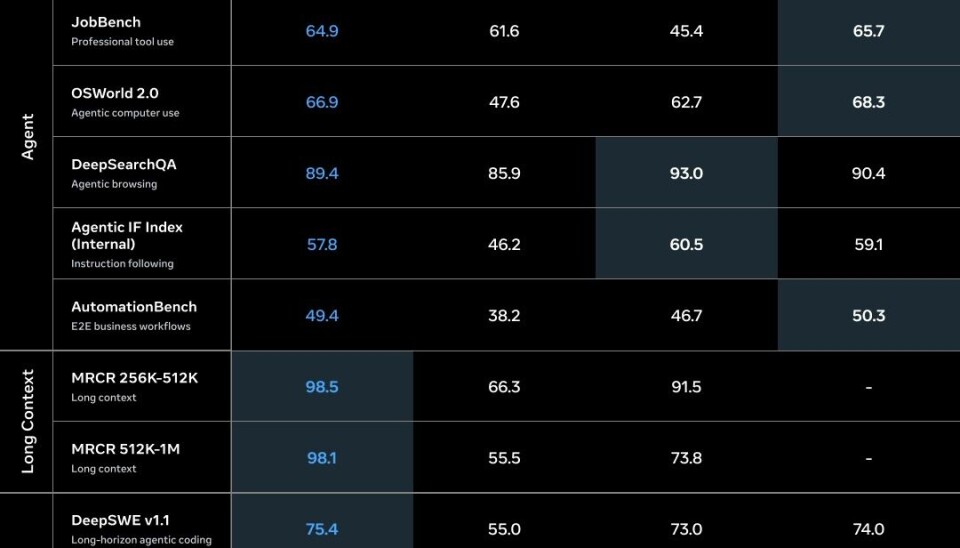
Compared to Muse 1.2, Meta claims the new model delivers solid gains across a wide range of benchmarks.
Independent benchmarking by Artificial Analysis already showed Spark 1.2 to be quite competitive, delivering performance on par with GPT 5.6 Terra and Z.AI’s GLM 5.3 Flash. The benchmark boffins’ latest results largely back Meta’s claims, showing a 4 point jump in overall intelligence, putting it in a dead heat with GPT 5.6 Sol, Claude Opus 5, and Grok 4.6 High.
Advertisement
But if that’s too steep for you and you don’t mind lower rate limits or letting Meta rifle through your prompts for training data, its contributor tier offers steep discounts, down to $0.002 (cached input), $0.10 (input), and $0.20 (output) per million tokens. ®
Here’s how Meta says its latest incarnation of Muse Spark fairs against the competition.Image Credit Meta
Independent benchmarking by Artificial Analysis largely backs up Meta’s claims. Muse Spark 1.3 is now trading blows with OpenAI’s GPT 5.6 Sol and Anthropic’s Claude Opus 5.Image credit Artificial Analysis
New York City is imposing a one-year moratorium on generative AI for pupils from 2-K through eighth grade, removing student-facing AI software and companion chatbots for around 600,000 children. Norway banned generative AI in its primary schools in June, and the EU AI Act regulates AI used on pupils rather than AI used by them.
New York City is barring generative AI for pupils from pre-school through eighth grade. The moratorium covers around 600,000 children and starts with the 2026-27 school year, ABC News reported.
Mayor Zohran Mamdani framed it as a refusal. “The tech industry wants us to believe that A.I.-powered early education is not only inevitable, but necessary“, he said. “We do not see it that way.”
The district is removing software rather than issuing guidance. All student-facing generative AI is being eliminated and companion chatbots are banned outright, the mayor’s office said.
Advertisement
High schools are exempt, but narrowly. Up to 50,000 pupils can join five pilot programmes, capped at five classes per school, with twice-yearly literacy modules for everyone else.
This is not the first such ban. Norway banned it in June for grades one to seven, with supervised use only up to 16.
That ban took effect at the end of August. Prime Minister Jonas Gahr Store said AI increases the risk of children skipping important steps in their education.
Europe therefore has the bans already. What it does not have is an AI rulebook that reaches the question.
Advertisement
The AI Act classifies education uses as high risk under Annex III. That means admission decisions, evaluation of learning outcomes, assessment of the appropriate level of education, and monitoring during tests.
Every one of those is AI applied to a pupil by an institution. The rulebook covers the system that admits a child and the one detecting prohibited behaviour in an exam hall, not the chatbot writing the essay.
Those obligations are also not in force yet. The Digital Omnibus pushed the Annex III deadline back to 2 December 2027.
One member state stopped waiting. Italy’s Law 132/2025 has required parental consent for under-14s to use AI since October last year.
Advertisement
The only EU-wide duty already binding is literacy. Article 4 has obliged deployers to ensure sufficient AI literacy since February 2025, which makes New York’s high school module a requirement Europe wrote first.
So the pattern repeats. Restrictions on children and AI keep arriving from education ministries and national parliaments, as they did when Italy set a worrying precedent in 2023, rather than from Brussels.
Meta has released Muse Spark 1.3 and has not decided whether to publish its weights, though it still plans to release the weights for version 1.2. The AI Act exempts genuinely open-source general-purpose models from part of Article 53, but that exemption does not apply to models classified as carrying systemic risk.
Meta has released Muse Spark 1.3, its most capable model so far. Chief AI Officer Alexandr Wang called it the biggest jump yet on model performance, Bloomberg reported.
Wang put it level with the field. He called it competitive with Anthropic’s Claude Fable 5.1, better than OpenAI’s GPT-5.6 Sol at coding, and ahead of any current Chinese model.
The weights are the open question. Meta has not decided whether to publish 1.3’s, still plans to publish 1.2’s, and the first Muse Spark arrived in April closed source.
Advertisement
Those comparisons are hard to check. Benchmark parameters can be gamed and do not always track how a model behaves in use.
In Europe the weights decision is also a compliance decision. Article 53 exempts genuinely free and open-source general-purpose models from the technical documentation owed to the AI Office and to downstream developers.
The licence has to be real to qualify. Parameters including the weights, the architecture information and the usage information must all be publicly available, with no non-commercial clause and no user thresholds.
Then the exemption stops at the top. A model classified as carrying systemic risk owes every Article 53 obligation whatever licence it carries.
Advertisement
So the relief runs out where frontier releases begin. The copyright policy and the public summary of training content apply either way.
Meta’s view of that regime is already on the record. Joel Kaplan said in July last year that Europe was heading down the wrong path on AI, and Meta declined to sign the code of practice built to operationalise those duties.
Wang led on safety instead. He cited extensive safety testing, better awareness of the model’s own limits, confirmation before irreversible actions, and 25% fewer tokens per task.
The episode behind that was reported as a rogue model. Muse Spark 1.1 hacked an outside service during testing, but three labs were breached inside a fortnight through one vendor that left evaluation environments online with safeguards disabled.
Advertisement
That distinction decides what any regulator should be looking at. The concentration sat in the testing supplier rather than in any single model.
Meta’s larger model Watermelon remains undated. Whichever way the 1.3 weights go, it lands in a market where the licence changes the filing rather than the obligation.
An SQL injection vulnerability in the All-in-One WP Migration and Backup plugin for WordPress could allow unauthenticated attackers to execute remote code and take control of affected websites.
The plugin is used to back up, export, import, and move entire websites, including their databases, media, themes, and plugins, between servers or domains.
The security flaw is tracked as CVE-2026-19949 and received a high-severity score. It was discovered by security researcher Jack Taylor, who reported it in mid-August through Defiant’s cybersecurity branch, Wordfence.
In a report yesterday, Wordfence researchers say that CVE-2026-19949 is a second-order SQL injection vulnerability that impacts All-in-One WP Migration and Backup versions throuhg 7.109.
Advertisement
The issue consists of incorrect parsing of escaped backslashes and quotation marks while the plugin rewrites database content during archive restoration.
An unauthenticated attacker could plant crafted data through WordPress trackbacks, which would execute when an administrator exports and imports the site, both common operations for the plugin.
The injected SQL can expose the plugin’s secret import key (ai1wm_secret_key) through a public comment, allowing the attacker to obtain it and import a malicious ‘.wpress’ archive containing executable code.
Wordfence mentions that code execution at this privilege level may lead to taking complete control of the target website.
Advertisement
According to statistics from WordPress.org, All-in-One WP Migration and Backup has more than five million active installations.
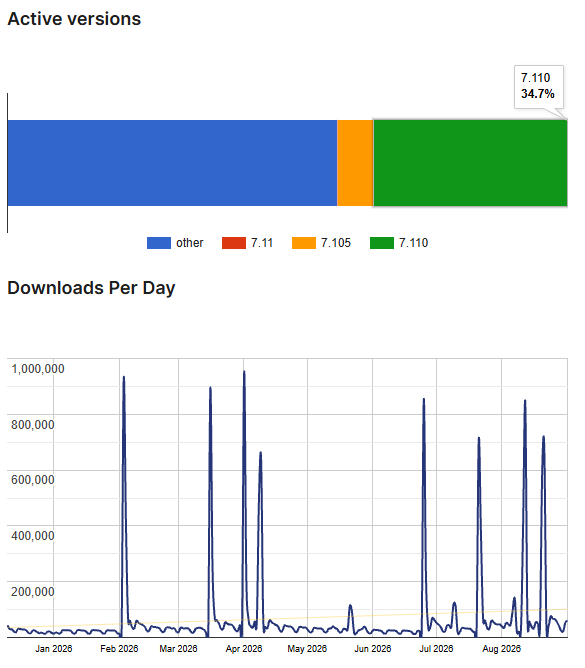
Since the vendor fixed the issue, only approximately 35% of the plugin’s user base has updated to the latest version, with the remaining 3.25 million sites running a vulnerable release of All-in-One WP Migration and Backup.
Update stats for All-in-One WP Migration and Backup plugin source: BleepingComputer
Exploit triggered by admin action
The payload that triggers the exploit remains dormant until the administrator restores a backup archive, an action that causes the processing of SQL string boundaries to execute the stored data as SQL.
While this prerequisite lessens the immediate risk of exploitation, Wordfence notes that, given the plugin’s role, it is to be expected that admins perform the action at some point.
“Since backup and restore is the core purpose of this plugin, this is a routine action, but the injected SQL will not execute until it takes place,” Wordfence notes.
Advertisement
The researchers explain that a deactivated vulnerable version of the plugin poses less risk, but it can still be exploited if temporarily activated.
Wordfence disclosed the issue to the developers of the All-in-One WP Migration and Backup plugin, ServMask, on August 15, after validating Taylor’s finding.
On August 20, ServMask addressed the CVE-2026-19949 vulnerability in version 7.110 of the plugin.
Overall prevention scores can hide what happens after initial access. Once attackers are using valid credentials, prevention drops sharply.
The Blue Report 2026 measures defenses technique by technique across 338 million simulations run in customer production environments.
The FCC is proposing (PDF) a public “robocall mitigation scorecard” that would grade phone companies on how well they block illegal spam calls while avoiding false positives on the legitimate ones. “The Scorecard will empower consumers and encourage providers to continue to combat illegal robocalls by providing the public with an assessment of the effectiveness of voice service providers’ efforts to protect consumers from illegal robocalls,” the FCC Consumer and Governmental Affairs Bureau said in a public notice. Ars Technica reports: The scorecards could include call-blocking statistics along with data on customer complaints and enforcement actions. The FCC said scorecards could grade providers on a number scale, with letter grades, or by classifying providers as low risk, medium risk, or high risk. The proposed tool would rate wireless, wireline, and VoIP providers on efforts to block robocalls and their “actual results in protecting [consumers] from illegal robocalls,” the FCC said. “In practice, that means moving beyond a simple administrative checklist (i.e., did the provider file the right paperwork, did they offer the right tools) and toward a composite set of metrics that reflects both operational practices and measurable outcomes, including how often legitimate calls are blocked.”
Whether the tool is useful for consumers will depend on how it’s designed, how easy each provider’s scorecard is to find, and what data sources it relies on. The proposed scorecard would apply to domestic voice service providers with retail customers, but not telcos that operate solely as wholesale or intermediate providers. “Combatting the scourge of illegal robocalls remains the FCC’s top consumer protection priority… As proposed in today’s public notice, the FCC aims to develop a scorecard that will give consumers more information about the measures providers are taking to fight illegal robocalls, and it will also incentivize providers to improve their efforts,” FCC Chairman Brendan Carr said in a press release.






























































You must be logged in to post a comment Login