
Crypto World
Ondo urges US regulators to allow stock perpetuals



Ondo Finance has asked US regulators to bring perpetual futures tied to individual stocks onshore after its offshore platform recorded $8 billion in cumulative trading volume within roughly six weeks.
Summary
- Ondo says existing US security futures rules can cover perpetual contracts tied to individual stocks.
- Its Panama-based affiliate had processed $8 billion in cumulative volume by Aug. 14.
- Recurring funding payments keep the contracts close to the prices of their underlying shares.
- The SEC and CFTC are reviewing rules for onchain derivatives and tokenized securities.
Ondo Finance, in three Aug. 24 comment letters to the Securities and Exchange Commission and Commodity Futures Trading Commission, said the agencies could accommodate stock perpetual futures through the existing security futures framework.
The company’s proposal covers product classification, margin requirements and the use of onchain market data. Instead of asking Congress or federal agencies to create a separate regulatory category, Ondo wants the SEC and CFTC to apply rules already used for futures tied to individual securities.
According to its product-classification letter, the lack of a fixed expiration date does not prevent a perpetual contract from qualifying as a security futures product.
“Nothing in the statutory definition of a security futures product requires a fixed expiration date,” Ondo said.
Ondo says funding payments can replace expiration
Traditional futures expire on a set date, when the contract settles against the value of its underlying asset. Perpetual futures have no scheduled expiry and use recurring funding payments to keep their market prices close to the assets they track.
When a perpetual trades above its reference price, traders holding long positions generally pay traders holding short positions. Payments move in the opposite direction when the contract trades below the reference price, creating an incentive for both prices to converge.
Ondo told regulators that the funding mechanism performs a function similar to expiration in a dated futures contract. Under its interpretation, the economic structure of the product matters more than whether the contract ends on a predetermined date.
The filing also addresses updated margin systems and blockchain-based pricing data. Ondo argued that regulators could account for such features within current law, although the SEC and CFTC would still need to decide how individual products satisfy listing, trading, and investor-protection requirements.
A similar request reached both agencies on Aug. 24, when the Hyperliquid Policy Center proposed treating equity perpetuals with futures-like characteristics as security futures. The group said Hyperliquid’s HIP-3 markets had processed more than $480 billion in cumulative notional volume during their first 10 months.
Under that proposal, regulators would first examine how a contract is structured and traded before considering the asset it tracks. A futures-style contract tied to an individual stock would then fall under the security futures system jointly administered by the SEC and CFTC.
Security futures combine features of securities and futures law. A CFTC-regulated designated contract market can list them after notice-registering with the SEC, while a national securities exchange can use a parallel registration route with the CFTC.
Offshore stock perpetuals have processed $8B
Through a Panama-based affiliate, Ondo already offers stablecoin-settled perpetual futures referencing individual US-listed stocks to eligible users outside the United States.
The platform had generated $8 billion in cumulative trading volume by Aug. 14, according to the company’s SEC submission. Ondo said the total was reached about six weeks after the product launched.
Many referenced shares principally trade on US exchanges, even though American users cannot access the offshore contracts. The arrangement allows eligible non-US traders to gain price exposure to individual stocks while settling their positions with stablecoins instead of using a conventional brokerage account.
“Bringing that activity back to the U.S. should not be an open question; it’s something both agencies should actively pursue,” the company said.
Ondo’s request would not automatically authorize every stock perpetual. Exchanges, brokers, and clearing organizations would still need to comply with the registration, listing, margin, and customer-protection requirements that apply to security futures.
The proposal could nonetheless give US investors a regulated route to products that are already available through offshore venues. American access would depend on the agencies accepting Ondo’s classification and determining how current security futures standards apply to perpetual contracts.
Former SEC counsel Ashley Ebersole recently told crypto.news that creating a US regulatory pathway for onchain perpetuals could take 10 to 12 months if the agencies pursue rulemaking, public comments and implementation. Ebersole said the process could move faster if regulators rely heavily on existing authority or exemptions.
Ondo expands its tokenized securities business
Alongside its derivatives proposal, Ondo operates one of the largest tokenized real-world asset businesses. RWA.xyz ranked the company fourth among RWA managers, with approximately $2.6 billion in distributed asset value as of Wednesday.
Ondo Stocks listed more than 440 tokenized stocks and exchange-traded funds across Ethereum, BNB Chain and Solana as of Aug. 13. The platform reported around $1.02 billion in asset value at the time, according to earlier Ondo coverage.
The company says each tokenized security is backed by the related stock, ETF, or cash held with US-registered broker-dealers. An independent verification agent checks the asset backing, while a security agent holds an interest in the collateral.
Ondo’s disclosures state that buyers receive economic exposure to price movements and reinvested dividends after applicable tax withholding. Holders do not own the referenced stock or ETF directly and do not receive the same rights as registered shareholders.
Late in July, Ondo secured FINRA authorization connected to its US tokenized-equity operations. The company said at the time that its tokenized products had exceeded $2.5 billion in total value locked, while Ondo Stocks had processed more than $7 billion in cumulative volume.
Such tokenized products differ from the perpetual futures covered by the latest letters. Stock tokens provide an indirect economic interest backed by securities or cash, while perpetuals are derivative contracts designed to track the price of a referenced share without transferring ownership.
SEC and CFTC coordination could shape access
Ondo submitted its letters while federal agencies were reconsidering how securities and derivatives rules should apply to blockchain-based markets.
In March, the SEC and CFTC signed a memorandum of understanding to coordinate work in areas where their authority overlaps. The agreement created a formal process for sharing information, developing policy, and resolving questions involving products that may fall under both securities and commodities law.
Security futures require such coordination because the SEC oversees securities markets and the CFTC regulates US futures and derivatives venues. A perpetual tied to an individual stock could therefore require approval or supervision from both agencies.
Political attention has also turned toward bringing offshore perpetual markets into the country. President Donald Trump said in August that CFTC Chair Michael Selig was working to bring Hyperliquid to the United States in a “fully compliant and legal fashion.”
Neither the CFTC nor Hyperliquid has publicly explained how access would operate. Hyperliquid is best known for onchain perpetual futures, while its HYPE token climbed more than 20% after Trump’s comments and gained nearly 49% over the following month to trade around $81 on Wednesday, according to CoinGecko.
Regulators are separately examining the infrastructure needed to support tokenized securities. On Tuesday, the SEC proposed updating transfer-agent rules covering registration, recordkeeping, transfer processing, cybersecurity, and the protection of securities and customer funds.
Most existing transfer-agent requirements date from the late 1970s and early 1980s, when paper certificates and manual ownership records remained common. Under the proposed rules, onchain transfer agents would need controls protecting digital records from unauthorized changes, deletion, and operational failures.
The SEC said the amendments would remain technology-neutral and would not require companies to use blockchain systems. Public comments will remain open for 60 days after the proposal appears in the Federal Register, after which SEC staff may revise the text before commissioners consider a final rule.




The idea sprouted from Honnold’s desire to offset his own travel emissions. But he knew that in order to gain traction and funding, his sustainability efforts would need wider impact. “Nobody cares about the environment unless their basic needs are met,” he says. “So if you’re trying to protect the environment in a broad sense without protecting or improving the lives of human populations, you’re facing an uphill battle.”
Today, at least 600 million people live without access to electricity. Solar power could hugely improve their lives, with the added benefit of reducing the global reliance on fossil fuels. HF focuses on solar projects that sit at the intersection of climate, equity, and human impact, with grant recipients typically receiving between $50,000 and $150,000. More than 1,200 organizations applied in 2026—a far cry from Honnold’s early days of researching and funding projects on his own. Recent recipients include the Cambodian Center for Human Rights, which will install solar lighting and power to protect against illegal fishing and mangrove destruction; Integrated Health Outreach in Antigua and Barbuda, which will power a female-led beekeeping and honey-processing facility; and the Hopi Utilities Corporation in Arizona, which will install solar panels and battery storage on tribal land to power groundwater pumps.
One oft-cited recipient of an HF grant is Kara Solar, which provides solar-powered boats to the Achuar people in Ecuador and Peru. The partnership, which began in 2020, has helped facilitate commerce, health care, and education in the region, while also reducing reliance on gasoline. Kara Solar recently received a large grant from a global foundation, which built on earlier success: In 2024, thanks in part to HF’s support, it created a for-profit manufacturing company to produce electric motors for its boats.
“That’s the ultimate success for a project if it takes off beyond the philanthropic money,” Honnold says. “And then the real success will be in 20 years if everyone’s riding an electric boat.”
Honnold believes the transition away from fossil fuels is inevitable. And while the foundation doesn’t fund policy work, he says some projects have exposed the need for solar incentives in states with policies that limited rooftop solar. “I personally like funding projects in states that are really regressive, anti-solar states,” he says. “Because it’s like a big middle finger to the man. I think there’s a little of the anti-authority, rock climbing streak.”
Coinbase has launched 23 perpetual and dated crypto futures for eligible Canadian investors, with leverage of up to 10 times on supported contracts.
Summary
- Coinbase has opened 23 crypto futures markets to eligible sophisticated and institutional investors in Canada.
- The contracts cover Bitcoin, Ethereum, Solana, and 20 other digital assets.
- Traders can use nano-sized contracts and leverage of up to 10 times.
- Commodity and index futures linked to gold, silver, oil, and COIN50 are also available.
Coinbase said eligible Canadian clients can access the new contracts through Coinbase Financial Markets, its futures commission merchant registered with the U.S. Commodity Futures Trading Commission.
The selection includes perpetual futures, which do not have fixed expiry dates, and dated futures that settle at a specified time. Supported markets include Bitcoin, Ethereum, and Solana, along with 20 other digital assets.
By allowing both long and short positions, the contracts give eligible investors a way to trade in either direction without buying or selling the underlying cryptocurrencies. Investors can also use the products to hedge price exposure held elsewhere in their portfolios.
Access remains limited to sophisticated and institutional investors who meet Canadian eligibility rules. Coinbase is providing the contracts under an international exemption rather than opening them to Canadian retail customers.
Coinbase crypto futures offer up to 10x leverage
Coinbase has structured the contracts in nano sizes, lowering the amount of capital needed to open a position compared with standard futures. Traders can use leverage of up to 10 times, depending on the contract and applicable margin requirements.
With 10x leverage, a trader can control a position worth 10 times the capital posted as margin. Leverage also increases the effect of an adverse price move, and a position may be liquidated if the account no longer meets its required margin level.
Coinbase has introduced temporary pricing of 0.02% per trade plus $0.11 for each contract. The company did not state how long the introductory rate would remain available or disclose the standard pricing that would apply after the offer ends.
Perpetual contracts use recurring funding payments to keep their prices close to the underlying spot market. Dated futures instead expire according to a fixed schedule, allowing traders to choose a contract that matches a defined time horizon.
The Canadian offering carries less leverage than Coinbase’s recent rollout for professional clients in Britain. In August, the exchange introduced UK derivatives covering more than 170 assets, with up to 50x leverage on perpetuals and 20x on dated futures.
As crypto.news previously reported, the British service also includes crypto options and contracts tied to commodities, equities, and foreign exchange. Access is restricted to clients who meet professional-investor requirements under the exchange’s UK authorization.
Canadian investors gain commodity and index futures
Alongside the 23 crypto futures, Coinbase has added five commodity contracts linked to markets including gold, silver, and oil. Eligible investors can also trade index products such as COIN50, which tracks a basket of major digital assets.
The combined selection allows customers to manage several types of market exposure through one account. Rather than taking ownership of an asset, a futures trader enters a contract whose value moves with the referenced cryptocurrency, commodity, or index.
According to the Bank of Canada, about one-third of publicly listed Canadian non-financial companies use derivatives to hedge risks affecting their earnings. Corporate hedging commonly covers changes in commodity prices, interest rates and foreign exchange rates, although Coinbase’s new service targets investors who satisfy the platform’s derivatives eligibility requirements.
Coinbase said crypto derivatives generate about 4.4 times the worldwide volume recorded in spot markets. Despite that trading activity, the company said Canadian investors have had fewer regulated ways to access the products.
In the United States, Coinbase Financial Markets operates under a different regulatory route. The entity is registered with the CFTC as a futures commission merchant and belongs to the National Futures Association, placing its U.S. activity within federal derivatives rules.
Coinbase received CFTC clearance in May to connect eligible American customers with specified perpetual contracts treated as foreign futures under defined conditions. In June, the company said the structure would give U.S. clients regulated access to global perpetual liquidity through Deribit, the derivatives exchange it acquired for $2.9 billion.
The U.S. perpetual approval gave American traders a separate path to products that had largely remained on offshore platforms. Coinbase CEO Brian Armstrong said at the time that the company had spent years working toward the regulatory clearance.
Coinbase expands its derivatives infrastructure
Coinbase has been consolidating more of its institutional derivatives business around Deribit. The exchange agreed to acquire the platform in 2025, adding a major crypto options venue to its existing futures operations.
During the second quarter of 2026, Coinbase recorded $1.03 trillion in crypto derivatives trading volume, little changed from the preceding quarter. The company also said its derivatives market share reached a record and increased for a third consecutive quarter.
In August, Coinbase scheduled a Sept. 9 migration of institutional accounts from Coinbase International Exchange to Deribit. Participating clients were instructed to establish Deribit access, replace application programming interface connections, and close outstanding margin loans before the transfer.
The Deribit account migration is intended to place international perpetuals, dated futures, and options within the same institutional system. Coinbase said country restrictions and individual eligibility would continue to determine which products each client could access.
Coinbase adds more services in Canada
Coinbase Canada has operated as a restricted dealer since April 2024 and is seeking dealer registration with the Canadian Investment Regulatory Organization. The status would place its Canadian business under CIRO oversight while the company adds more regulated financial products.
Canadian clients are also receiving additional crypto services through Coinbase’s infrastructure partnerships. Webull Canada recently selected Coinbase Crypto-as-a-Service to add cryptocurrency trading and custody to its investment platform.
Under the expanded Webull partnership, Coinbase provides the underlying trading and custody infrastructure while Webull keeps the service within its existing application. The arrangement gives Webull Canada customers access to supported cryptocurrencies without requiring them to move to a separate exchange account.
Outside Canada, Coinbase began rolling out almost 4,000 U.S. stocks to eligible UK customers in August. The service supports fractional investments starting at £1, funding through pounds or USDC, and trading for 24 hours on five days each week.
Coinbase routes the UK equity orders through Coinbase Capital Markets Corporation for execution by Apex, while Apex Clearing holds the underlying shares. Fractional-share orders remain limited to regular U.S. trading hours even though eligible whole-share orders can be placed during extended sessions.








Disclosure: This content is provided by a third party. Neither crypto.news nor the author of this article endorses any product mentioned on this page. Users should conduct their own research before taking any action related to the company.
Cryptocurrency mining, the process of using computer hardware to verify transactions on a blockchain network, experienced a major surge in popularity between 2011 and 2018. During this period, cryptocurrency prices climbed to record highs, encouraging miners to invest in expensive hardware and infrastructure to mine digital assets and earn rewards.
Summary
- SHRMiner offers cloud mining contracts, daily reward tracking, and cryptocurrency withdrawals.
- CGMiner provides open-source mining software but requires command-line knowledge.
- StormGain and MinerGate offer accessible tools for users without dedicated mining hardware.
- Zionodes lets users remotely manage mining equipment through a real-time dashboard.
In recent years, however, the landscape has changed. Rising energy costs and the significant upfront investment required for mining have made it increasingly difficult for individual and small-scale miners to remain profitable.
If you want to use your spare time to earn Bitcoin with your smartphone, several apps offer convenient ways to participate in mining. That said, mobile mining typically generates relatively low returns and can put additional strain on your device. Here are some of the top apps to consider for Bitcoin mining in 2026.
Best apps to earn free Bitcoin in 2026
1. SHRMiner — A Bitcoin mining app worth watching
Founded in 2018, SHRMiner has grown into one of the leading cloud mining service providers, allowing users to rent computing power from professional ASIC mining hardware to participate in Bitcoin mining. The company focuses on ease of use, security, and transparency.
Key features and benefits
Easy to use and accessible: SHRMiner provides a straightforward dashboard, simple contract selection, daily reward tracking, and withdrawal monitoring, making it easy for users to manage their mining activities.
Flexible contract options: The platform offers different plans and contract levels designed to accommodate both beginners and experienced users, with flexible options based on investment amount and contract duration.
Security and transparency: The platform states that it uses cold wallets, encryption, and real-time monitoring to help protect user funds and mining operations.
Reputation and reviews: SHRMiner has been featured in cryptocurrency media coverage and press releases, where it has been presented as a reliable option for users interested in cryptocurrency mining.
How to get started with SHRMiner
Getting started with SHRMiner is simple and straightforward:
Create a free account — Visit the official SHRMiner platform and create a free account using your email address. New users can currently receive a $15 bonus, along with a $0.60 daily mining reward. [Click here to register instantly.]
Choose a mining contract — Select a short-term or long-term plan based on your budget and expected returns.
Fund your account — Deposit funds into your account and purchase a mining contract to participate in Bitcoin mining.
Start earning — Once the contract is activated, mining rewards will begin automatically.
Withdraw anytime — SHRMiner supports flexible daily withdrawals to your cryptocurrency wallet.
With an intuitive interface and convenient mining experience, SHRMiner has become one of the platforms worth watching in the 2026 cloud mining market. Users can simply register, log in, select a plan, and begin participating in mining.
2. CGMiner
CGMiner is a popular Bitcoin mining application that also supports mining other cryptocurrencies, including Litecoin and Dogecoin. Launched in 2011, CGMiner is known for its versatility and open-source design, making it a popular choice for users looking to scale their mining operations.
However, CGMiner uses a command-line interface, which means it has a steeper learning curve than many other mining applications. Users control the mining software through keyboard commands, so having a comfortable and ergonomic computer keyboard can make extended use more convenient.
CGMiner is compatible with multiple operating systems, including Linux, Mac, and Windows, giving it a broad user base. If you’re comparing it with platforms such as RollerCoin, the latter may be a more accessible option for beginners.
3. StormGain
StormGain is a user-friendly Bitcoin mining application that provides a convenient dashboard for monitoring asset prices and market movements. The platform also includes charting tools that allow users to track trends and price changes.
With StormGain, users can participate in digital currency mining without investing in expensive mining hardware. The service offers native applications for Android and iOS, as well as a web-based version, making it accessible across different devices.
Whether you’re new to cryptocurrency or already have mining experience, StormGain provides a convenient way to participate in Bitcoin and other cryptocurrency-related activities.
4. MinerGate
Founded in 2014, MinerGate is an open mining pool designed to improve mining efficiency while helping reduce associated costs. Its user interface and overall experience have received attention for providing a relatively straightforward mining environment.
The software is designed to be easy to install and allows users to quickly get started with cryptocurrency mining. MinerGate also provides tools for managing and monitoring cryptocurrency mining activities.
One of MinerGate’s notable features is its ability to use both CPU and GPU resources to mine multiple cryptocurrencies. This provides users with a more flexible and comprehensive approach to cryptocurrency mining.
Overall, MinerGate offers a user-friendly mining solution that can appeal to both beginners and more experienced cryptocurrency users.
5. Zionodes
Zionodes is one of the more user-friendly Bitcoin mining platforms available today. After registering an account, users can get started with mining operations relatively quickly. One of its most useful features is a dynamic dashboard that allows users to monitor earnings and mining activity in real time.
Zionodes uses a remote mining model, meaning users can own their own mining hardware while managing how it is used remotely. This gives customers greater control and ownership over their mining operations compared with traditional cloud mining service models.
With an easy-to-use interface and an emphasis on transparency, Zionodes has positioned itself as one of the more accessible and user-friendly options for Bitcoin mining.
Final thoughts
Overall, these five Bitcoin mining apps and platforms offer different ways to participate in the cryptocurrency mining market in 2026. From SHRMiner’s cloud mining model and MinerGate’s flexible mining options to Zionodes’ remote mining approach, each platform offers a different experience for cryptocurrency users.
Whether you’re a beginner exploring Bitcoin mining for the first time or an experienced miner looking for a more convenient option, these platforms can provide accessible ways to participate without having to build and operate a traditional mining setup yourself.
For cryptocurrency enthusiasts looking to make use of their spare time and explore alternative ways to earn Bitcoin, these apps and platforms are worth considering in 2026.
Disclosure: This content is provided by a third party. Neither crypto.news nor the author of this article endorses any product mentioned on this page. Users should conduct their own research before taking any action related to the company.
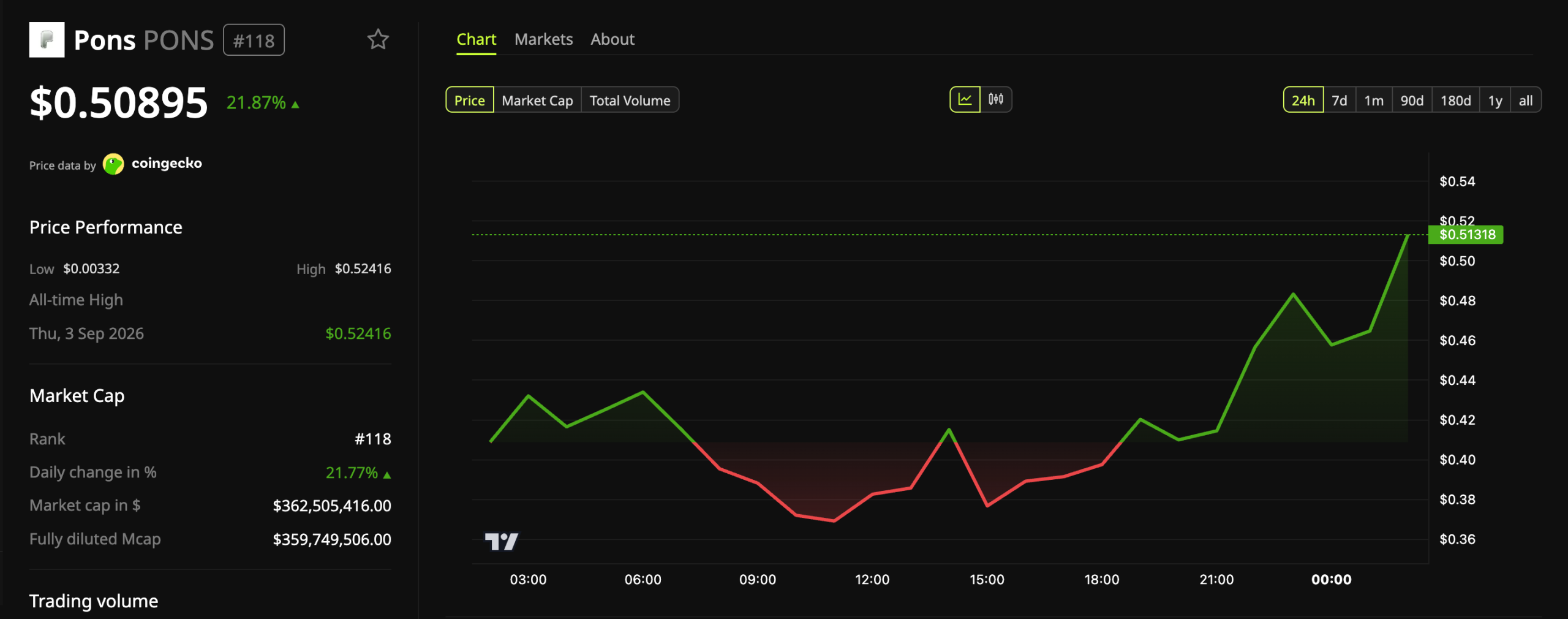
Pons (PONS) reached a record $0.52 on Thursday, after Binance Alpha opened trading in the token. PONS last traded near $0.50, up 21.87% over 24 hours.
The move lifted the Robinhood Chain launchpad token to a market value near $362 million. PONS now ranks 118th by market capitalization.

Follow us on X to get the latest news as it happens
Binance Alpha Listing Lands in a Softer Market
Binance Wallet said on September 2 that PONS and another meme coin, FLORK, were added to Binance Alpha. PONS trades on Alpha 1.0 only, through market and limit orders.
The double-digit advance stands against a weaker backdrop. The total crypto market capitalization dropped over 2% to $2.26 trillion. Bitcoin (BTC) and Ethereum (ETH) both traded lower.
FLORK drew speculative money as well. According to Wu Blockchain, the meme coin climbed about 293% and added more than 80% after entering Binance Alpha. Its market value briefly reached roughly $17.5 million.
Pons Ranks Among Robinhood Chain’s Busiest Tokens
Trading activity backs the price move. PONS logged 95,969 trades from 8,014 wallets over the past day, according to a Dune dashboard tracking Robinhood Chain.
That activity produced $64.94 million in daily turnover. Therefore, PONS ranked among the three most-traded assets on the network over the period.
Lifetime figures are larger. The token has cleared $702.12 million in cumulative volume across more than 2.1 million trades and 66,422 unique traders. BeInCrypto previously reported that the launchpad cleared $4.54 billion in volume on Robinhood Chain.
PONS now trades about 3% below its peak. Whether the listing bid holds may depend on how long it holds the trader’s attention.
Subscribe to our YouTube channel to watch leaders and journalists provide expert insights
The post Binance Alpha Debut Lifts PONS to a Fresh All-Time High appeared first on BeInCrypto.


Bitcoin has held between $76,500 and $79,500 for five trading days as its $76,350 active-investor cost basis has absorbed selling after a 24.9% August gain.
Summary
- Bitcoin’s True Market Mean stands at $76,350, just below the current trading range.
- Long-term holder SOPR has stayed near breakeven for nine sessions, indicating limited profit-taking.
- September options place downside protection between $68,000 and $75,000, while calls favor a move above $80,000.
- Strategy bought 4,603 BTC for $369.7 million as spot Bitcoin ETF demand cooled.
Bitfinex analysts said in a Sept. 2 Alpha report that Bitcoin’s position above the True Market Mean reduces the risk of a deep pullback, even though September has produced an average loss of 2.95% since 2013.
The True Market Mean, which measures the average cost basis of active Bitcoin investors, stood at $76,350 when the report was published. Bitcoin had remained inside a 3% range between $76,500 and $79,500 since Federal Reserve Chair Kevin Warsh delivered a hawkish message at Jackson Hole on Aug. 28.
Selling has appeared around the upper end of the range, but buyers have prevented Bitcoin from closing decisively below the on-chain cost basis. Bitfinex described $76,350 as a market pivot rather than a fixed price that buyers must defend to the dollar.
August closed with Bitcoin up 24.9% from its $62,922 monthly open, recording its first positive August since 2021 and its largest monthly gain since November 2024. As crypto.news reported in its coverage of Bitcoin’s best August since 2017, the rally left $80,000 as the main resistance level entering September.
Bitcoin momentum favors limited pullbacks
During the week ended Aug. 23, Bitcoin added $14,833, the largest weekly dollar gain in its history, according to Bitfinex. The increase exceeded the previous record, set in November 2024, by $3,275 and produced a weekly return of 23.6%, the strongest percentage gain since March 2023.
Historical data cited in the report showed that Bitcoin has recorded 17 weekly gains above 15% since 2020. The price was higher 30 days later in 14 of those cases, with a median return of 8.4%.
Based on that record, the analysts said corrections are likely to remain “short lived and limited in scale” while Bitcoin stays above the former $68,000 range ceiling. The level also sits close to the area where traders have concentrated downside options protection.
Bitcoin’s strength has continued despite pressure from two U.S.-linked risks. Warsh’s comments raised expectations for another interest-rate increase, while renewed conflict between the United States and Iran pushed Brent crude toward $95 per barrel.
Warsh said inflation had not improved fast enough to assure policymakers that it was returning to the Fed’s 2% goal. In an earlier report on his Jackson Hole speech, prediction-market traders placed the probability of a 2026 rate increase at 68% after Bitcoin slipped below $80,000.
Higher U.S. rates can lift Treasury yields and the dollar, raising the cost of holding non-yielding assets. Bitfinex nevertheless found that Bitcoin’s price structure had remained intact during the five sessions following the speech.
Sellers are exiting Bitcoin close to breakeven
On-chain spending data indicate that investors who bought Bitcoin around current prices are providing much of the available supply.
The long-term holder Spent Output Profit Ratio, or SOPR, moved between 0.88 and 1.19 over nine consecutive sessions and stood at 0.98 in the report. A reading of 1 means the average coin is being spent at the same price at which its holder acquired it.
Bitfinex linked the pattern to buyers from February and March who held through the subsequent decline and began selling when Bitcoin returned to their entry prices. For five sessions, bids absorbed that supply without allowing the price to break below the True Market Mean.
Two sustained changes would weaken that reading, according to the analysts. SOPR falling below 0.9 while Bitcoin declines would indicate that holders are accepting losses to exit. A move above 1.1 would show that investors with larger unrealized gains are selling into strength.
Supply concentration around the current range helps explain why BTC price has moved sideways. When Bitcoin closed at $80,256 on Aug. 27, 72.1% of circulating supply was in profit. By the time the price closed at $77,468, the share had fallen to 67.7%.
Bitfinex calculated that roughly 880,000 BTC carried a cost basis inside the $2,800 gap between the two closes. Each move across the area pushes a large block of coins between profit and loss, changing the incentive to sell.
The short-term holder cost basis, meanwhile, stood at $69,980 and was climbing by about $300 per day. Bitfinex identified the level as possible support during a deeper correction, below an initial target near $73,500.
Strategy purchases offset weaker Bitcoin ETF flows
Corporate demand returned while Bitcoin was meeting passive sellers above $77,000. Strategy purchased 4,603 BTC for $369.7 million between Aug. 24 and Aug. 30, paying an average price of $80,318 per coin.
The transaction was Strategy’s first Bitcoin purchase in 10 weeks and increased its holdings to 845,050 BTC, acquired for an average of $75,412. At-the-market equity sales financed the deal, according to the company’s filing.
Strategy’s average price for the purchase has been above every Bitcoin daily close since May 14. The company therefore bought inside the same area where the market had struggled to sustain prices above $79,000.
Demand for U.S. spot Bitcoin exchange-traded funds became less consistent over the same period. A nine-session inflow run totaling $3.04 billion ended with $201.9 million in redemptions on Aug. 28, the day of Warsh’s speech.
Inflows returned with $216.7 million on the following Monday, including $205.9 million directed to BlackRock’s IBIT. Sept. 1 then produced a $236.5 million outflow, driven mainly by IBIT, according to the figures cited by Bitfinex.
A separate analyst assessment identified sustained ETF buying as one requirement for extending the rally. The same report noted that spot products recorded $606 million of inflows on Aug. 20 as Bitcoin moved above $76,000.
While Bitcoin fund demand cooled, U.S. spot Ether ETFs attracted $815.7 million during the previous week and extended their inflow run to 13 sessions through Sept. 1. Bitfinex said Strategy’s renewed buying had helped counter the slowdown in Bitcoin ETF demand.
Stablecoin supply also stopped expanding after rising by $1.25 billion before Warsh’s remarks. Aggregate market capitalization peaked at $309.4 billion on Aug. 28 and later stood at $303.83 billion, according to the report.
Bitfinex interpreted the change as capital waiting at the market’s entry point rather than leaving crypto through a sustained wave of stablecoin redemptions. Stablecoins often serve as settlement assets for traders, making changes in their total supply a gauge of capital available for deployment.
Bitcoin options favor upside without heavy leverage
Options traders have purchased protection around scheduled U.S. economic releases, but the positioning does not show an across-the-board bet on a Bitcoin decline.
Average implied volatility stood at 37.2 for a sixth consecutive session between 37 and 38, placing it in the 18th percentile of daily closes recorded during the previous year. Options had been cheaper on fewer than one in five trading days, while the 2026 low was 33.8.
Implied volatility also remained below the trailing 30-day realized volatility of about 41%. Bitfinex said the pricing indicated that traders expected the current compression to continue even though Bitcoin had moved 21% within three sessions in August.
The Sept. 11 at-the-money straddle cost $3,208, requiring a 4.13% move to reach breakeven. Unlike the options expiring on Sept. 4, the contract covers the U.S. payroll report, the Producer Price Index release, and seven standard trading sessions.
Across the eight U.S. payroll releases held in 2026, Bitcoin moved by an average of 1.9% on release day. Four produced moves below 1%, while the other four generated changes ranging from 2.4% to 4.4%, according to Bitfinex.
Downside protection for the payroll-to-Consumer Price Index window was concentrated between $68,000 and $75,000. The Sept. 11 expiry carried one put for every call, compared with an overall options-market put-to-call ratio of 0.56.
Call open interest was largest at $80,000, while put open interest was concentrated at $75,500. Perpetual-futures leverage remained 10% below its August peak, which Bitfinex interpreted as traders retaining upside exposure without rebuilding a large pool of positions vulnerable to forced liquidation.
Under the report’s base case, Bitcoin would remain between $76,657 and $81,300 through the Sept. 4–11 U.S. data window. Two daily closes above $82,818, accompanied by SOPR above 1 and positive ETF flows on both days, would open a path toward the next cost-basis reference near $85,200.
Two closes below $76,657 would instead activate Bitfinex’s retracement scenario, placing the three-to-six-month holder cost basis near $73,500 first and the short-term holder cost basis at $69,980 second.

Wyoming is upgrading how it verifies reserves behind its state-issued Frontier Stable Token (FRNT), moving from scheduled attestations toward near-real-time onchain proof. The Wyoming Stable Token Commission said it has expanded its integration with Chainlink to publish verified reserve and token-supply data using Chainlink Proof of Reserve.
The change is designed to help market participants track backing more quickly between formal disclosure periods. According to the commission, the system combines independent reserve examinations conducted by The Network Firm with Chainlink’s infrastructure, with data made available onchain on a near-real-time basis.
Key takeaways
- Wyoming’s Stable Token Commission says it adopted Chainlink Proof of Reserve to publish verified FRNT reserve and supply data onchain.
- Wyoming already provides daily reserve attestations for FRNT; the new setup targets more timely visibility into changes in backing between reporting cycles.
- The commission is also working toward Chainlink’s “Secure Mint” approach, intended to require verified reserves to cover token supply before additional FRNT can be minted.
- FRNT was migrated exclusively to Chainlink’s Cross-Chain Interoperability Protocol (CCIP) roughly two weeks earlier, after moving from LayerZero.
From scheduled attestations to near-real-time verification
FRNT is a Wyoming state-issued stablecoin backed by US dollars and short-term US Treasurys. Until now, Wyoming’s disclosures included daily reserve attestations, reflecting a regular cadence for reserve verification.
The commission’s new announcement centers on Chainlink Proof of Reserve, which is intended to bring the verification process closer to real time by publishing verified reserve status and outstanding token supply directly onchain. The commission said the mechanism blends independent examinations by The Network Firm with Chainlink’s data and verification infrastructure.
The distinction matters because stablecoin backing can change quickly in normal operations, and the gap between reporting periods is often where investors focus their risk assessment. The commission noted that its existing framework includes monthly disclosures required under the GENIUS Act, including reserve composition and outstanding stablecoin supply. With near-real-time onchain data, the upgrade aims to reduce uncertainty during the intervals between those scheduled reports.
What Wyoming’s disclosure framework requires—and what changes
Wyoming already operates within a disclosure structure that includes daily reserve attestations and additional requirements under federal-facing or state-facing frameworks. The commission referenced the GENIUS Act’s monthly requirements for reserve composition and outstanding stablecoin supply.
Under the expanded Chainlink integration, the commission’s stated goal is not to remove those formal obligations, but to layer faster visibility on top of them. Put simply: monthly disclosures remain the baseline for full reporting, while near-real-time onchain proof is intended to help observers see movements in backing sooner.
The commission also signaled an additional step on the horizon: adopting Chainlink’s Secure Mint feature. The idea, as described by the commission, is to align minting with reserve verification by enforcing that verified reserves must equal or exceed FRNT’s total supply before new tokens can be minted.
If implemented as outlined, that would strengthen the operational linkage between backing and issuance by adding a programmable constraint around minting eligibility. While the commission did not provide a timeline for adoption in this update, the direction suggests an effort to move from “after-the-fact” confirmation toward “verification-gated” issuance.
FRNT’s broader Chainlink rollout through CCIP
The reserve-verification upgrade arrives soon after another major Chainlink-related development for FRNT. About two weeks earlier, Wyoming said it fully migrated FRNT from LayerZero to Chainlink’s Cross-Chain Interoperability Protocol (CCIP), making CCIP the token’s exclusive cross-chain infrastructure.
Bringing reserve verification and cross-chain infrastructure under the same ecosystem strengthens consistency in how data about the token is managed across functions. Even though reserve proof and cross-chain messaging are different technical domains, both depend on reliable, verifiable information flows for users who interact with FRNT across chains.
FRNT launched in January and is backed by US dollars and short-term US Treasurys. The commission said interest income generated from the token’s reserve deposits goes to Wyoming’s School Foundation Program, tying the stablecoin’s reserve management to a state-designated funding channel.
Chainlink’s expanding role across tokenization and stablecoin infrastructure
Chainlink’s growing involvement with institutional and tokenized-finance use cases has been a recurring theme over the past year, and FRNT is another example of how its verification and data services are being positioned for regulated or quasi-regulated environments.
Recent integrations highlighted by Cointelegraph include Chainlink becoming the pricing-data provider for Coinbase’s B20 tokenized equities on Base after their August launch. Those price feeds are designed to cover equities such as Apple, Nvidia, Meta, and Alphabet—supporting DeFi use cases including lending, trading, and collateral valuation.
In June, Chainlink also joined banking groups in Project Pangea, a cross-regional effort exploring regulated euro- and won-denominated stablecoins for atomic foreign exchange settlement. Separately, Chainlink’s technology has also been discussed in connection with the Depository Trust and Clearing Corporation (DTCC) and a planned 24/7 platform for managing tokenized collateral.
Cointelegraph also noted that Fidelity International launched a tokenized liquidity fund using Chainlink and Sygnum infrastructure, with JPMorgan providing daily net asset value data for pricing.
While these developments span different domains, they share a common emphasis: reliable data feeds and verifiable workflows that can be integrated into financial processes where timing and auditability matter.
Market observers have also tracked the performance of Chainlink’s native token (LINK). CoinGecko data cited in the source indicates LINK has gained more than 34% over the past month, trading around $11.07 on Wednesday.
For FRNT holders and other stakeholders, the key point to watch is how quickly Wyoming moves from publishing near-real-time proof into enforceable minting constraints. The commission’s work toward Chainlink Secure Mint could further tighten the relationship between verified reserves and token issuance, but readers will want to monitor whether and when those controls go live, and how the onchain proof behaves during reserve transitions between formal reporting periods.

Google’s AI Mode shows the same products at higher prices than regular Search, study finds

Stocks, Bonds, and Financial Freedom: A Beginner’s Guide to Investing Wisely

EU and Nato vow to step up pressure on Russia after ‘new escalation’ in Leipzig





-

 Fashion5 days ago
Weekend Open Thread: Maeve – Corporette.com
-

 Crypto World6 days ago
Bitcoin’s 22% rally now needs real demand to outlast Treasury liquidity boost
-

 Business6 days ago
Apple Confirms September 9 Keynote and Reveals Its Full Pre-Order Schedule
-

 Business6 days ago
Salesforce Stock Soars 19% as Blowout Earnings and Agentforce AI Growth Silence Software Skeptics
-

 Business5 days ago
Onto Innovation Stock: AI’s Next Bottleneck Is Yield (NYSE:ONTO)
-

 Crypto World5 days ago
Bitcoin price tests $82K resistance as Brandt stays long
-
 Tech4 days ago
Hugging Face built a $4.5 billion empire on free AI models. Now Nvidia is buying it for $12.9 billion
-

 Business5 days ago
iPhone 18 Pro Pre-Orders Could Shift to Saturday as Apple Reportedly Avoids September 11 Anniversary
-

 Crypto World6 days ago
Truflation calls for Fed rate cut after PCE forecast
-

 News Videos4 days ago
Charlie Munger on Robinhood: No one should believe that Robinhood’s trades are free
-

 Tech5 days ago
PaperCut releases second emergency patch for exploited flaws
-
 Business7 days ago
AI Assistant Startup Instinct Rockets to $2.5 Billion Valuation in Weeks Amid Investor Feeding Frenzy
-

 Tech6 days ago
The fix for the AI agent that hijacked a company’s DNS: it can propose the change, but it can’t approve it
-
 Entertainment6 days ago
‘Adults’ Creators Break Down Season 2’s Most Shocking Moments and Tease a Potential Season 3
-

 Tech4 days ago
Tamagotchi Ring Takes the 30-Year Digital Pet and Places it on Your Finger
-

 Tech4 days ago
As the influencer economy drives retail sales, Seattle startup raises $22M to play matchmaker
-
 NewsBeat4 days ago
Trump posts AI video of ‘Lake America’ being protected by an army of bequiffed ‘Donald Ducks’
-
 Entertainment3 days ago
Taylor Swift Reportedly ‘Frustrated’ With Travis Kelce After ‘Short’ Honeymoon
-
 Entertainment5 days ago
Kendall Jenner’s Circle Concerned About Jacob Elordi Romance
-
 Business1 day ago
Oil Price Today (September 2): Crude oil nears $97 as war tensions escalate. Will it hit $100 again?
You must be logged in to post a comment Login