
Crypto World
Opt-in privacy is failing crypto


Disclosure: The views and opinions expressed here belong solely to the author and do not represent the views and opinions of crypto.news’ editorial.
Privacy has been a recurring narrative in crypto for years. Just weeks after Bitcoin (BTC) launched, Hal Finney pointed out the problem in only his second tweet about it, but the concept didn’t gain wider traction until Monero (XMR) arrived in 2014. Since then, privacy has repeatedly re-emerged as a core promise of decentralised money, especially during moments of regulatory pressure or heightened concerns around financial surveillance.
Summary
- Opt-in privacy fractures networks: When users must “turn on” privacy, anonymity sets shrink and private transactions become more conspicuous — not less.
- Design, not demand, is the problem: Zcash’s advanced cryptography exists, yet most transactions remain transparent. Narrative momentum hasn’t translated into usage.
- Privacy must be the default to work: Like security, financial privacy only strengthens when everyone shares it — automatic, universal, and baked into the protocol.
Analysts are positive that crypto’s future will continue to be defined by the privacy narrative. Investor Balaji Srinivasan argued privacy will define the industry’s following eight years; meanwhile, a16z crypto said privacy will be the industry’s most important “moat” in 2026. Indeed, privacy coins have rallied at the end of 2025 and continue to fluctuate into the start of the new year. At their peak, the sector reached a combined market capitalisation surpassing $40 billion, before falling back to roughly $17 billion.
Zcash (ZEC) was a key driver of that resurgence, rising by more than 1,300% from late September 2025 to its all-time high and remaining up over 600% at current prices, briefly overtaking Monero by total market volume. Yet despite renewed interest and price momentum, actual privacy usage remains strikingly low. Zcash’s shielded pool continues to hold just above 30% of the circulating supply, while roughly two-thirds of transactions remain fully visible on-chain.
This disconnect exposes a deeper issue. If interest in privacy is rising, why are users not migrating into the very privacy layers designed for that purpose? The answer could just be structural: opt-in privacy is failing crypto.
Opt-in privacy was a design compromise
In 2013, the pseudonym Nicolas van Saberhagen published the CryptoNote v2 paper, which explicitly framed transaction privacy not as a “nice to have,” but as a core requirement of electronic cash. This paper argued that Bitcoin’s transparency made it pseudo-anonymous at best, and outlined two properties a truly private payment system should satisfy: untraceability and unlinkability. Andrey Sabelnikov, now co-founder of Zano, worked alongside Nicolas to bring this vision to life, implementing the protocol he had designed. From the start, CryptoNote made privacy the default, baked into every transaction rather than offered as an afterthought.
But as the industry evolved, many projects lost sight of this principle. Rather than pushing the boundaries of privacy-preserving technology, they took the path of least resistance, prioritizing compatibility, performance, and mainstream appeal over user protection. Privacy-preserving cryptography was still expensive and unfamiliar, so newer designs retreated to opt-in models.
This compromise had serious consequences. Privacy became a feature to be toggled on rather than a baseline guarantee. Users who chose the private option effectively marked themselves as having something to hide, while the default transparent experience left the majority exposed. This trade-off may have seemed pragmatic at the time, but it fundamentally betrayed the original vision that CryptoNote had established: that true electronic cash must protect user privacy by design and wasn’t something to bolt on later; it had to be designed into the core transaction model itself.
The biggest network carrying the original default-privacy philosophy is Monero. Launched in 2014, it adopted the CryptoNote protocol, preserving the principles that Nicolas and Andrey had already established. Instead of asking users to choose between public and private modes, the design assumes that financial transactions should be private by default, and that privacy improves when everyone shares the same protections.
Through this philosophy, privacy does not just become a feature, but a network effect. A privacy system is only as strong as the crowd it can hide in. When privacy is optional, the network fractures into transparent and private activity. The private pool becomes smaller, the anonymity set shrinks, and the privacy model weakens in practice, regardless of how sophisticated the cryptography may be.
The Zcash paradox
Zcash illustrates the central contradiction facing much of today’s privacy ecosystem. On paper, it offers some of the most advanced privacy technology in crypto, including zero-knowledge proofs that can fully shield transaction details. In practice, however, the majority of network activity remains transparent.
Despite renewed market interest and strong price performance, Zcash’s shielded pool continues to hold just above 30% of the circulating supply, while roughly two-thirds of transactions remain fully visible on-chain. The technology exists. The privacy guarantees are real. Yet most users do not use them.
This gap is not a failure of cryptography, nor a lack of demand for privacy. It is the predictable outcome of opt-in design. When privacy is presented as a separate mode, something users must consciously enable, it introduces friction, uncertainty, and behavioural drop-off. Many users default to transparent transactions simply because they are easier, faster, or more familiar. Others may be unaware of the distinction altogether.
The consequence is a fragmented network. Public and private transactions coexist, but they do not reinforce one another. Instead, the private pool remains small, limiting the size of the anonymity set and weakening privacy guarantees for those who do opt in. Ironically, using privacy in an opt-in system can make a user more conspicuous rather than less.
Privacy can only work when it is the default
Privacy is not a behaviour users reliably opt into. It functions as a collective property. The more participants who share the same privacy guarantees, the stronger those guarantees become. When privacy is optional, networks fracture into public and private activity, shrinking anonymity sets and weakening protection for those who do opt in. In practice, optional privacy often makes users more conspicuous, not less.
The repeated cycles of privacy coin interest show that demand is not the problem; design is. Systems that rely on users to actively choose privacy struggle to translate narrative momentum into real adoption. If privacy is to become crypto’s defining moat, it must be treated as foundational infrastructure, not a feature toggle. Financial privacy works best when it is automatic, universal, and secure by default.


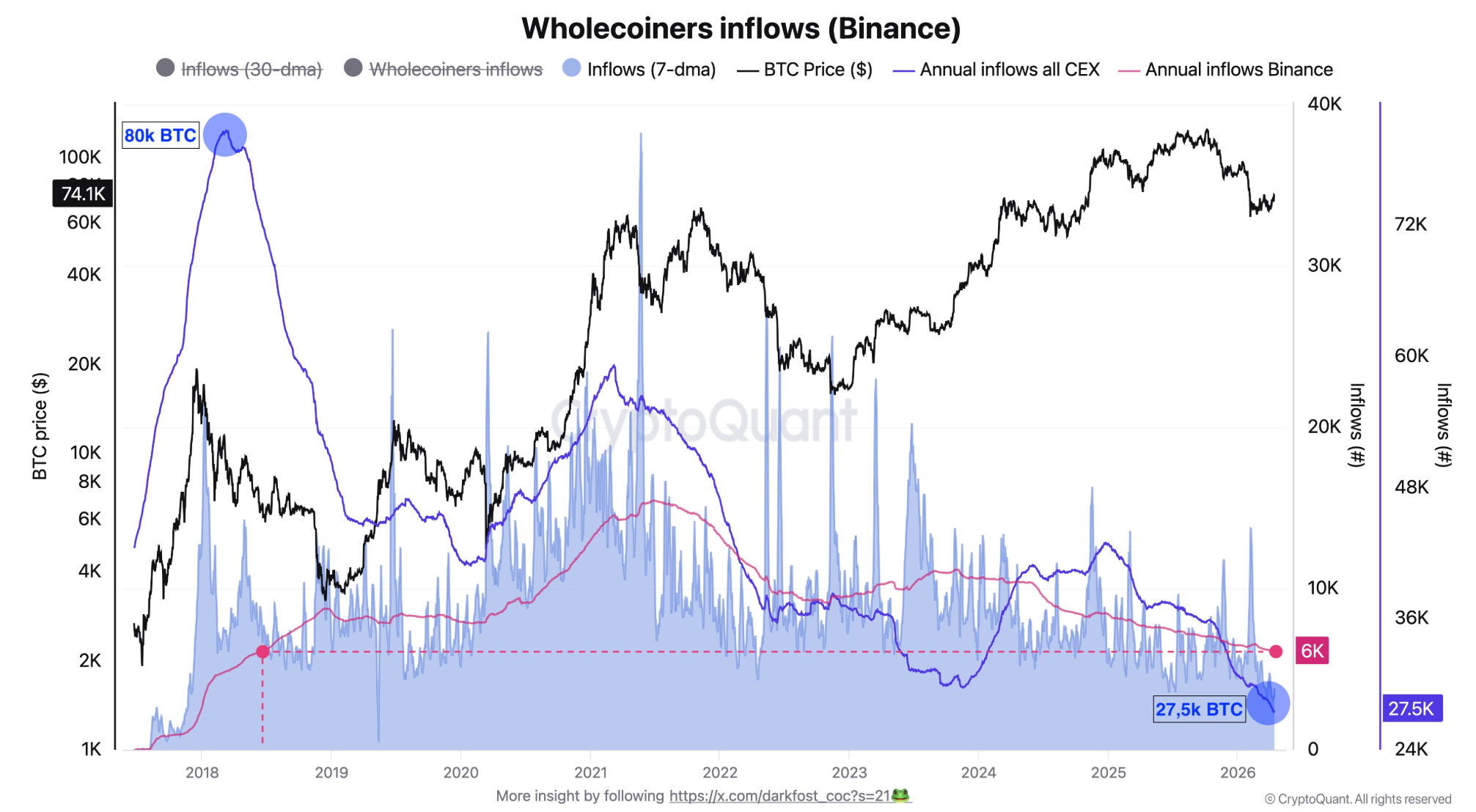
Bitcoin (BTC) wholecoiner exchange flows have collapsed to levels not seen since 2018, signaling a structural shift in how large holders interact with the market.
The decline coincides with Donald Trump’s latest signal of diplomatic coordination with Chinese President Xi Jinping over the Strait of Hormuz, adding a geopolitical tailwind to an already tightening supply picture.
Wholecoiner Flows Hit Multi-Year Lows
Transactions of at least one full BTC sent to exchanges have fallen sharply. On the Binance exchange, the monthly average now sits around 6,000 BTC, far below the 15,400 BTC recorded in 2021.
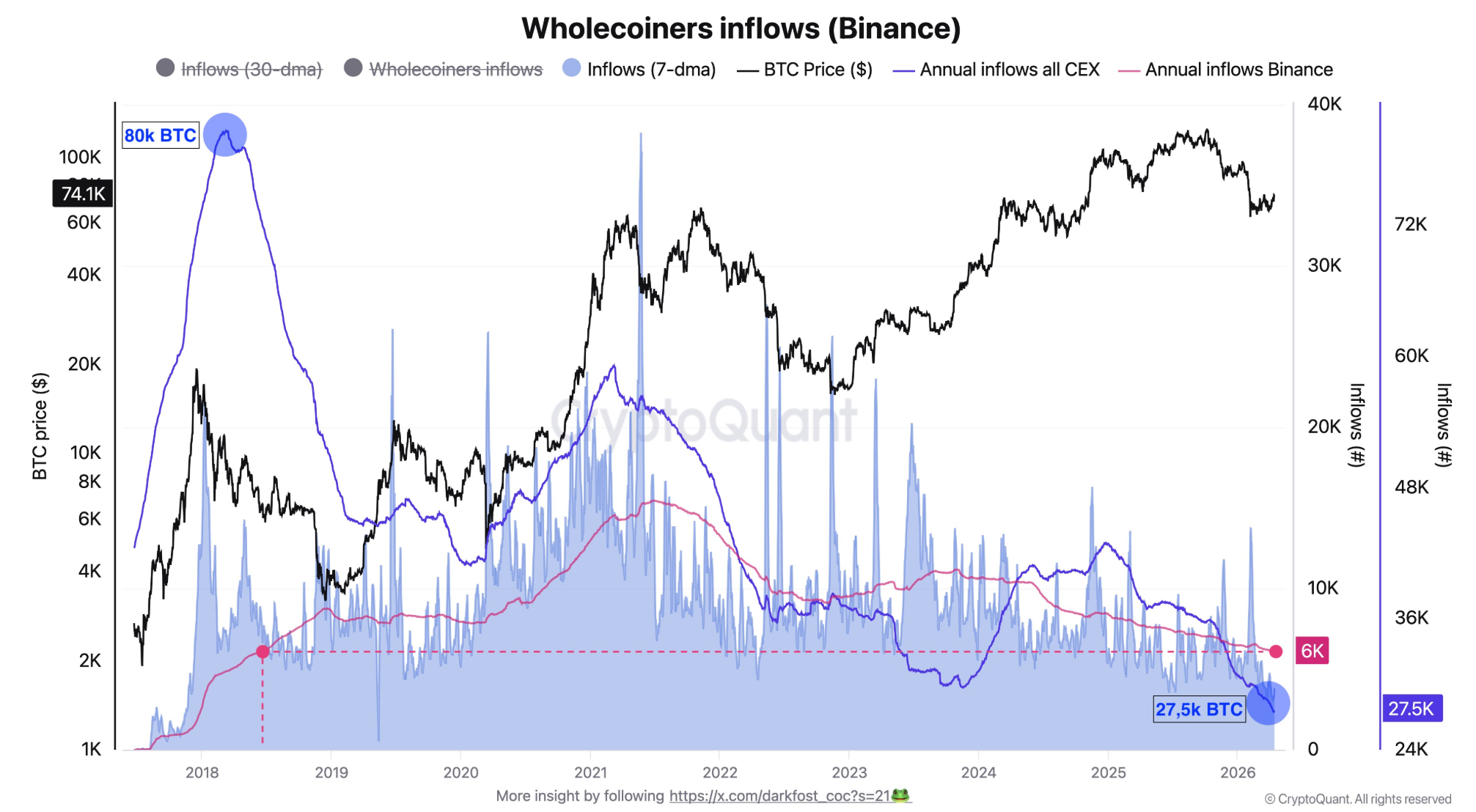
At a global level, the picture is more pronounced. Total transfers of at least one BTC to exchanges have dropped to roughly 27,500 BTC, compared to 80,000 BTC at the 2018 peak.
Several factors explain the trend. Rising prices have made holding a full bitcoin increasingly difficult, reducing the pool of wholecoiners over time.
The expansion of trading platforms and the introduction of spot Bitcoin ETFs in 2024 now allow investors to gain exposure without directly holding BTC.
A growing share of holders also appears to favor long-term strategies, further reducing exchange activity.
“This decline in active wholecoiners on exchanges reflects both reduced selling pressure and a gradual transformation of market structure, with a growing share of supply becoming increasingly illiquid over time,” Darkfost wrote.
Short-Term Holders Take Profits While Shorts Pile In
While long-term holders pull back, short-term holders (STHs) have moved aggressively in the opposite direction.
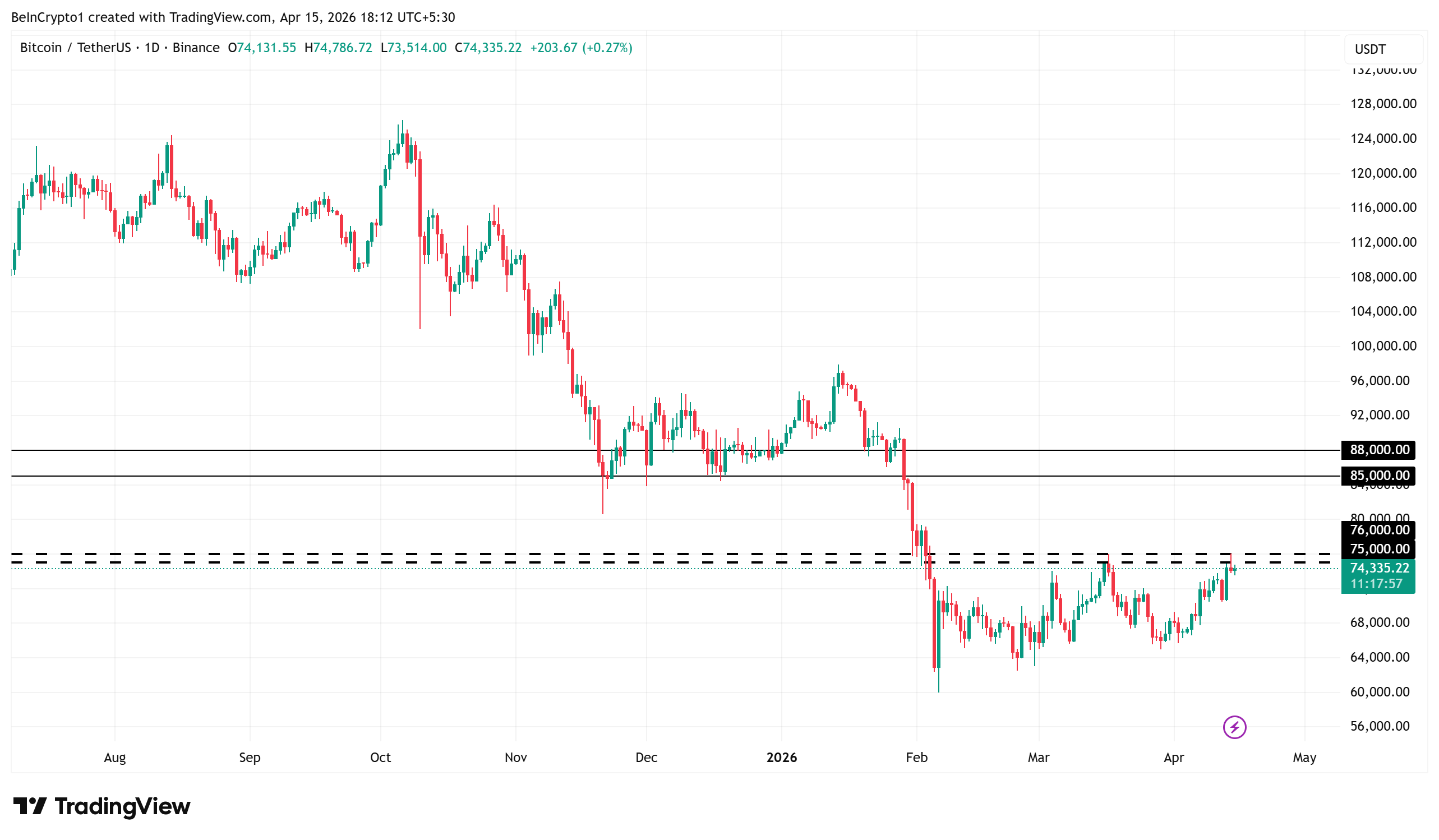
When BTC tested the $75,000 level, STHs sent more than 65,000 BTC to exchanges within 24 hours, with 61,000 of those transfers locked in profit.
Analyst Michaël van de Poppe noted that the derivatives market is setting up for a potential squeeze. Funding rates have turned negative while open interest has climbed, meaning traders are overleveraged short as BTC tests resistance for the third time.
“…as long as BTC remains above $72K, I wouldn’t be worried, and I’d rather be looking for longs vs. shorts,” the analyst wrote.
He identified $85,000 to $88,000 as the next resistance zone if $75,000 breaks.
Separately, on-chain researcher Axel Adler Jr. flagged that Bitcoin’s Bull-Bear Index has flipped above zero, clearing the bear zone.
However, he cautioned that network profit and loss sentiment remains underwater, framing the current move as a recovery rather than a new bull regime.
The post Bitcoin Wholecoiner Exchange Flows Drop to 2018 Levels, Tightening Supply appeared first on BeInCrypto.
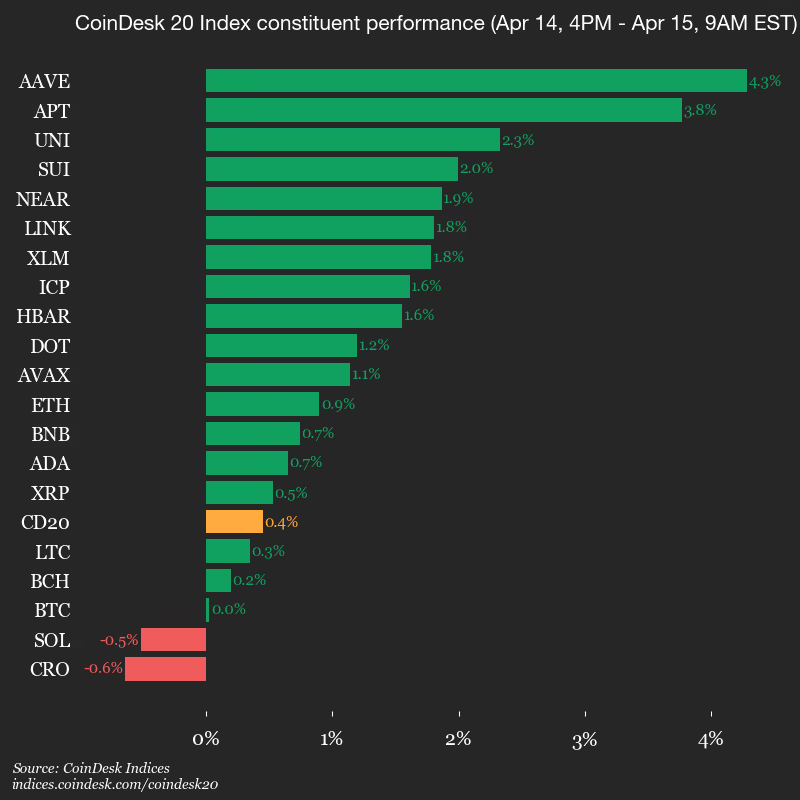
CoinDesk Indices presents its daily market update, highlighting the performance of leaders and laggards in the CoinDesk 20 Index.
The CoinDesk 20 is currently trading at 2058.34, up 0.4% (+9.17) since 4 p.m. ET on Tuesday.
Eighteen of 20 assets are trading higher.

Leaders: AAVE (+4.3%) and APT (+3.8%).
Laggards: CRO (-0.6%) and SOL (-0.5%).
The CoinDesk 20 is a broad-based index traded on multiple platforms in several regions globally.

Key Highlights
- Trading platform eToro has entered an agreement to purchase crypto wallet company Zengo for approximately $70 million
- Zengo leverages multi-party computation (MPC) security, eliminating seed phrase requirements
- The acquisition is designed to integrate self-custody features and decentralized trading capabilities into eToro’s ecosystem
- ETOR shares have declined more than 1% so far this year and approximately 48% over the trailing twelve months
- Citizens analyst Devin Ryan reduced his target price to $85 while maintaining a bullish outlook with ~145% potential upside
eToro (ETOR) revealed on Wednesday that it has reached an agreement to purchase Zengo, a crypto wallet service provider, in a transaction valued at approximately $70 million according to industry reports. The company’s shares experienced a modest uptick following the announcement.
Established in 2018, Zengo has amassed over 2 million users worldwide. The platform provides a non-custodial wallet solution, empowering users to maintain direct control over their digital assets without intermediary involvement.
Zengo’s architecture employs multi-party computation (MPC) technology for asset security, eliminating the traditional seed phrase requirement. This approach addresses a persistent challenge in self-custody solutions: the vulnerability associated with lost or compromised recovery keys.
The acquisition brings established functionality including token swapping capabilities, staking services, and fiat currency onramps that Zengo currently provides. The wallet infrastructure will operate independently from eToro’s regulated offerings, enabling users to engage directly with third-party decentralized protocols.
Speaking on the strategic timing, eToro CEO and co-founder Yoni Assia stated, “As we often say, crypto downtimes are the time to build and this acquisition reflects that long-term approach.”
According to company statements, the purchase will enable eToro to better serve emerging cryptocurrency applications — particularly tokenized real-world assets, decentralized prediction markets, and perpetual futures contracts. The platform intends to weave Zengo’s underlying technology into its core infrastructure moving forward.
“[The acquisition] will strengthen our ability to support evolving digital asset use cases, including tokenized assets and emerging decentralized trading models,” eToro announced in an official statement.
The Zengo deal follows closely on the heels of eToro’s launch of its proprietary app marketplace, unveiled just one day earlier. This marketplace provides a centralized hub for investors and third-party developers to create and access trading tools, analytics platforms, and other functionality within eToro’s environment. ETOR shares jumped more than 4% following that app store reveal.
ETOR Stock Faces Headwinds Despite Strategic Moves
Notwithstanding recent strategic initiatives, the stock has struggled significantly. ETOR has shed over 1% since the beginning of the year and tumbled roughly 48% over the past twelve-month period.
Last week, Devin Ryan from Citizens adjusted his price target downward to $85 from a higher previous level, though this still represents approximately 145% appreciation potential from current trading levels. Ryan noted that “navigating volatility remains the central challenge” facing capital markets and fintech businesses, adding that cryptocurrency market sentiment “remains impaired” in the near term.
These headwinds were evident in eToro’s fourth-quarter financial performance. Revenue from digital assets plummeted 38% during the quarter that concluded on December 31. However, the company still managed to generate a quarterly profit of $69 million, representing approximately 16% growth compared to the same period a year earlier.
Analyst Sentiment and Price Projections
Among Wall Street analysts, the consensus rating for ETOR stands at Moderate Buy, reflecting seven Buy recommendations and three Hold ratings issued over the last three months.
The average analyst price target currently sits at $52.80, suggesting roughly 52% upside potential from present price levels.
The Zengo transaction remains subject to standard closing requirements and regulatory conditions. While eToro has not publicly verified the $70 million purchase price, Bloomberg reported the figure based on information from a source familiar with the transaction terms.

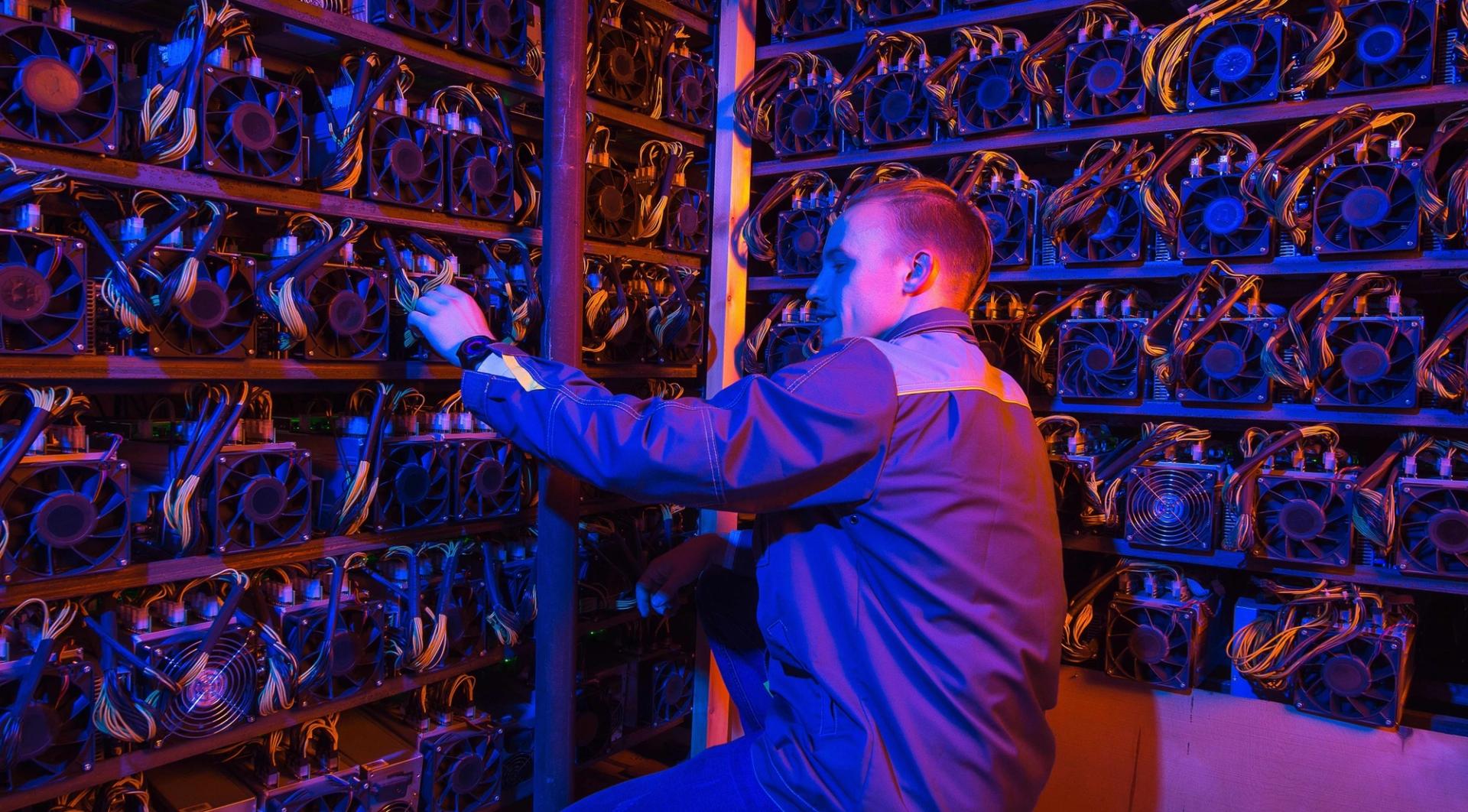
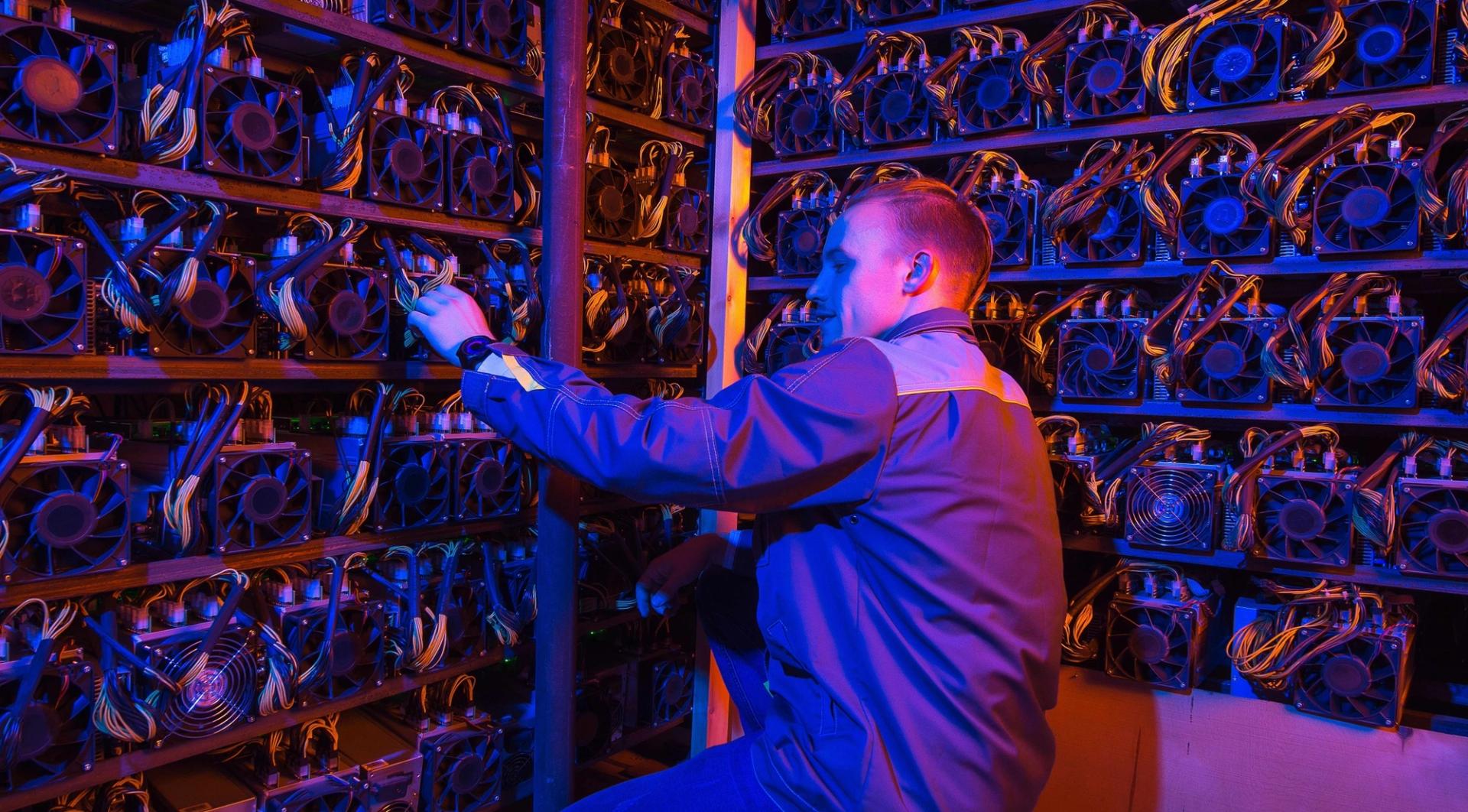
TeraWulf (WULF), a US data center operator focused on bitcoin mining and AI computing, saw its shares drop early Wednesday, after the company announced a $900 million capital raise.
The firm priced 47.4 million shares at $19 each. WULF is down 5.8% to $19.73 in early trading. The underwriter greenshoe option is for an additional 7 million shares.
Alongside other AI infrastructure names, WULF has been on a scorching run, rising more than 50% since late March.
The proceeds are earmarked for funding the construction of a major data center campus in Hawesville, Kentucky, alongside repaying outstanding bridge financing and supporting future expansion.
Preliminary Q1 results
Alongside the offering, TeraWulf released preliminary first-quarter 2026 results. The company expects revenue between $30 million and $35 million. The balance sheet showed $3.1 billion in cash and $5.8 billion in total debt.
Management highlighted a growing shift toward contracted HPC hosting revenues, which now account for over half of total revenue, positioning the business for more stable, long-term cash flows.
Compass Point analyst Michael Donovan, who has a Buy rating and a $28 price target on WULF, pointed to the shift in mix toward HPC as a positive inflection point for the business, with contracted hosting revenue overtaking bitcoin mining for the first time. He also views the capital raise as a necessary step to unlock the next phase of growth. While acknowledging the dilution, he said the added funding improves visibility into the buildout of the Kentucky site, which he expects to be developed in phases based on customer demand. He added that demand for TeraWulf’s power and hosting capacity remains strong.
Looking ahead, Donovan expects the company’s revenue profile to change meaningfully as HPC scales. He forecasts that contracted hosting will become the dominant driver of revenue over the next two years, reducing reliance on bitcoin price swings and supporting a more predictable earnings stream.
The shift reflects a broader trend across the industry, as bitcoin miners increasingly pivot toward AI and high-performance computing infrastructure to diversify revenue streams and improve margins.

A European Commission adviser said the European Union’s landmark MiCA crypto regime is likely to evolve as digital asset markets develop beyond the conditions the law was originally designed to address.
Speaking at the Paris Blockchain Week (PBW) 2026, Peter Kerstens, an adviser on technological innovation, digital transformation and cybersecurity at the European Commission’s financial services department, said the Commission will review the Markets in Crypto-Assets Regulation (MiCA) and launch a public consultation to assess whether the rules are working for market participants and supporting business development.
The remarks suggest EU policymakers are already thinking about how MiCA may need to evolve as the crypto market matures. Kerstens said he could not predict the future, but added that EU financial legislation typically evolves in stages, suggesting it would be “rather unusual” if there were not a “MiCA 2” over time.
MiCA already contains a built-in review clause. The regulation requires the Commission to report on its application by June 30, 2027, and allows it to accompany that review with legislative proposals if needed, according to the Official Journal of the European Union.

MiCA review signals next phase of EU crypto rules
Kerstens said the review is not a response to a broken framework, but part of an effort to ensure rules keep pace with a changing market structure. He said MiCA was designed at a time when crypto markets were dominated by a few large assets and many smaller tokens.
He said that the ecosystem has since matured, requiring policymakers to reassess whether the framework fits in current conditions.
Related: EU central bank backs plan for crypto supervision under EU markets watchdog
He also emphasized the role of industry feedback, saying that the Commission would begin with a public consultation with “no taboos.” Kerstens invited market participants to identify where rules should be expanded, adjusted or left unchanged.
He warned that if regulation does not evolve alongside innovation, markets may develop around existing rules, creating legal uncertainty.
Kerstens’ comments come as aspects of MiCA and related frameworks are being tested in practice. On March 24, stablecoin issuer Circle urged the European Commission to adjust parts of its proposed Market Integration Package, including lowering thresholds that limit the use of euro-denominated stablecoins in settlement and expanding access for crypto-asset service providers.
At the same time, policymakers are debating how MiCA should be implemented. On April 3, officials weighed whether to shift supervision of major crypto firms to the European Securities and Markets Authority (ESMA) amid concerns over inconsistent enforcement.
Magazine: Singapore isn’t a ‘crypto hub’ — it’s something better: StraitsX CEO
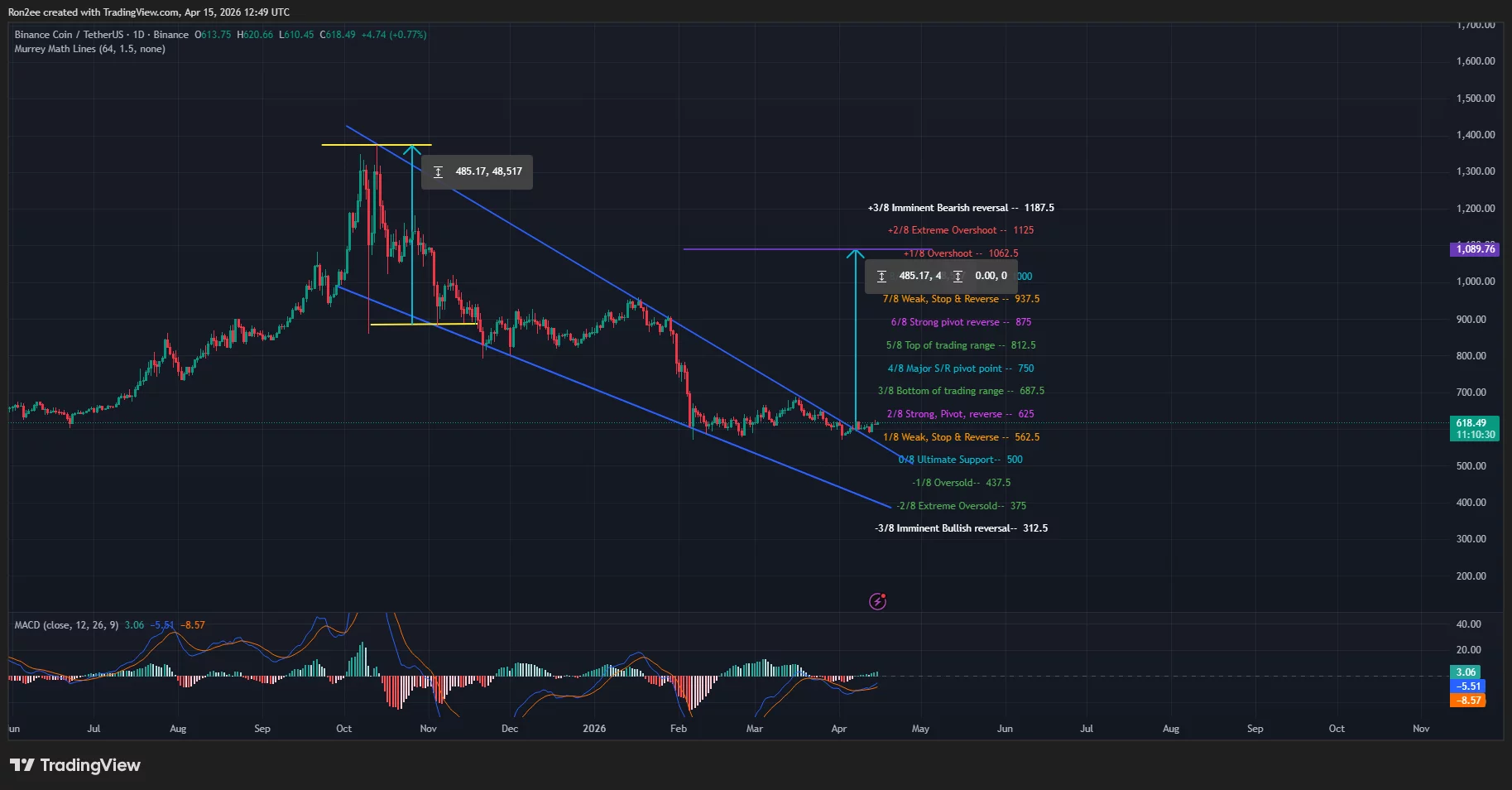
BNB price has broken out of a falling wedge pattern, which positions it for significant upside over the coming weeks.
Summary
- BNB price broke out of a falling wedge pattern, signaling a potential trend reversal, with price hovering near $620 after a 30% drop from its January high.
- Technical indicators, including a bullish MACD crossover, point to strengthening momentum, with a potential upside target near $1,089 if the breakout holds.
- Upcoming catalysts such as a $1.22 billion token burn, potential spot ETF filings, and Binance ecosystem activity could support further recovery.
According to data from crypto.news, BNB (BNB) price was hovering around $620 last check on Wednesday, April 15. The token has fallen nearly 9% over the past month and over 30% from its year-to-date high of $949 reached on Jan. 15.
BNB’s price retreat was primarily triggered by a structural inversion in market liquidity, where Bitcoin’s dominance surged to 58.5% and drained capital from top-tier altcoins. This sell-off was intensified by a series of high-leverage long liquidations exceeding $2 billion in early February after BNB breached the critical $700 and $650 support zones, triggering mass stop-loss orders.
While the token’s price still remains relatively suppressed compared to earlier this year, a look at the technical charts reveals a highly optimistic setup for a trend reversal.
On the daily chart, BNB price has broken out of a falling wedge pattern formed of two descending and converging trendlines. When an asset breaks out from such a formation, it often signals a powerful move toward the upside as selling pressure exhausts.
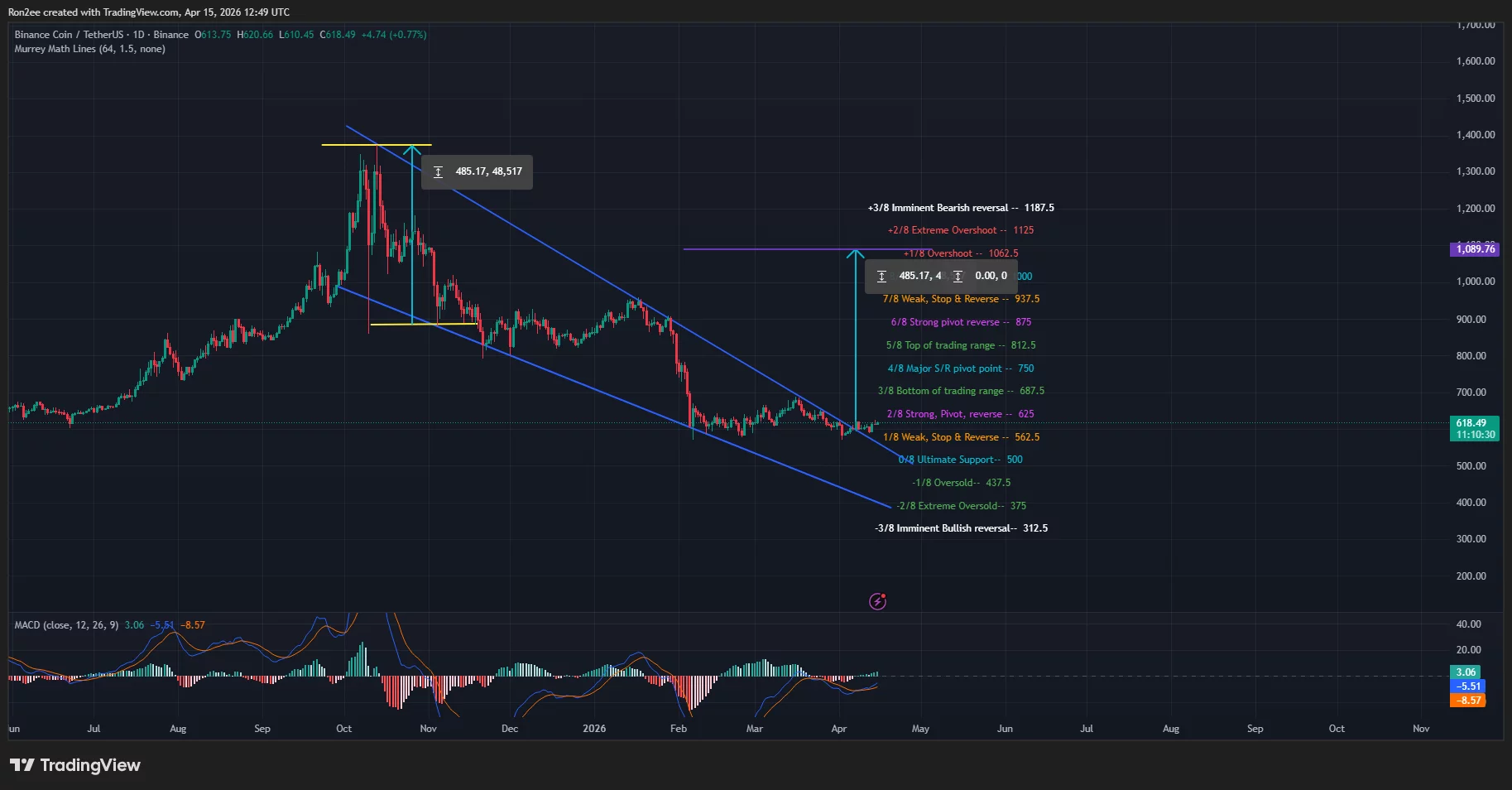
As such, the breakout from the pattern suggests a potential rally to as high as $1,089, a level calculated by adding the height of the falling wedge pattern formed to the breakout point of the upper trendline.
The token is currently trading towards the strong pivot reverse of the Murrey Math line at $625. A break above this specific threshold would likely accelerate the buying momentum and clear the path for a retest of previous psychological resistance zones.
Furthermore, the MACD lines have formed a bullish crossover, which means the short term momentum is beginning to outweigh the long term selling trend and typically indicates that a sustained price increase is underway.
BNB token has multiple catalysts in the background that could support a potential recovery in the coming weeks.
First, the BNB ecosystem is expected to announce its next quarterly burn soon. As per reports, nearly 1.36 million BNB worth around $1.22 billion would be permanently removed from circulation and hence create a supply shock that historically leads to price appreciation.
Second, institutional investors such as VanEck and Grayscale are currently pursuing spot BNB ETF applications. If the SEC shows any progress on the approval of these filings, it could unlock massive institutional capital inflows and provide a major stamp of legitimacy for the asset.
Third, high-profile listings on Binance, the world’s largest exchange, such as Genius, which was listed on April 13, continue to drive engagement and demand within the ecosystem by encouraging users to hold and use BNB for participation in various launchpools and trading activities.
Disclosure: This article does not represent investment advice. The content and materials featured on this page are for educational purposes only.


Disclosure: This article does not represent investment advice. The content and materials featured on this page are for educational purposes only.
AI trading bots gain momentum as investors seek consistency in fast-moving crypto and stock markets.
Summary
- AI trading bots surge in 2026 as investors seek consistency in fast-moving stock and crypto markets
- AriseAlpha stands out with fully automated AI trading and pre-built strategies for beginners
- Demand grows for AI trading systems that reduce manual effort and improve execution consistency
Whether it’s the stock market or cryptocurrency, one thing remains the same: Markets move fast.
Price volatility, breaking news, and shifting sentiment create endless opportunities, but they also make decision-making increasingly difficult. Many beginners don’t lack ideas; they struggle to execute them consistently.
That’s exactly why AI trading bots have gained so much attention.
These systems aren’t designed to magically predict the market. Instead, they help users stay consistent in complex conditions. As a result, more investors are actively searching for the best AI stocks and crypto trading bots to automate their participation in the market.
In this context, this guide introduces 8 AI trading tools and, based on real-world usage, helps traders understand their differences and how to choose the right platform.
In practice, some platforms have evolved beyond simple tools into full systems. For example, platforms like AriseAlpha simplify the process, allowing users to enter automated trading with minimal setup and ongoing effort.
What are AI trading bots and how do they work?
AI trading bots are automated systems powered by algorithms and data analysis.
They execute trades based on predefined strategies, such as:
- Buying or selling based on trend signals
- Running grid or dollar-cost averaging strategies in volatile markets
- Adjusting positions automatically based on market conditions
Unlike manual trading, these systems are not influenced by emotions. They rely on data and logic, reducing impulsive decisions and improving execution consistency.
Most importantly, AI trading bots can run continuously, allowing users to stay active in the market without constant monitoring.
Top 8 AI crypto and stock trading bots
1. AriseAlpha — Free AI trading bot for effortless automation
Among all platforms tested, AriseAlpha stands out because it functions more like a complete system rather than just a tool.
Most platforms require users to configure strategies and make ongoing adjustments. AriseAlpha simplifies this by allowing users to activate a pre-built AI system that runs automatically.
Key Features
- Fully automated AI quantitative trading system
- Supports both stocks and cryptocurrencies
- Pre-built strategies with minimal setup required
- Continuous operation with ongoing optimization
Why it stands out
For beginners, the biggest challenge isn’t choosing a strategy — it’s maintaining consistency.
AriseAlpha reduces this barrier by automating execution, allowing users to focus on monitoring rather than constant manual intervention. This is one of the reasons it is often considered among the best AI stocks and crypto trading bots available today.
2. Cryptohopper
A well-rounded platform that supports strategy customization and copy trading.
Suitable for users who want to gradually deepen their understanding of AI trading.
3. TradeSanta
Known for its simplicity and ease of use.
A solid option for beginners looking to get started quickly.
4. 3Commas
Offers a wide range of trading strategies, including grid and DCA bots.
Better suited for users who want more control over their trading setup.
5. Pionex
Provides built-in trading bots with a low entry barrier.
Ideal for beginners exploring automated trading for the first time.
6. Coinrule
Allows users to build trading strategies using simple rules without coding.
Suitable for users who want flexibility without technical complexity.
7. HaasOnline
Offers advanced automation tools and deeper customization.
Best suited for users with more experience or technical interest.
8. Botcrypto
Features a visual, drag-and-drop interface for strategy building.
Designed for complete beginners.
How to choose the right AI trading platform
With so many options available, beginners should focus on a few key factors:
Automation level
Does it significantly reduce manual effort?
Ease of use
Is it beginner-friendly
Stability
Can it run consistently over time?
Strategy flexibility
Can it adapt to the user’s needs?
For most users, choosing a simple and reliable platform is more important than having advanced features.
FAQ
Which are the best AI stocks and crypto trading bots for beginners?
Platforms with high automation and ease of use, such as AriseAlpha, are generally better suited for beginners starting with AI trading.
Do AI trading bots really work?
They can improve execution consistency and efficiency, but their performance depends on strategy and market conditions.
Do I need trading experience to use AI bots?
Not necessarily. Many platforms are designed for beginners and offer simplified workflows.
Can AI trading bots guarantee profits?
No. They are tools for execution, not guarantees of profit.
Final thoughts
AI trading bots are reshaping how people enter financial markets, making it easier for beginners to participate without extensive experience.
The key is not choosing the platform with the most features, but that it can actually be used consistently. Based on real-world testing, platforms that prioritize automation and simplicity tend to deliver better long-term usability.
Systems like AriseAlpha reduce complexity and allow users to transition into automated trading more smoothly, aligning with what many investors look for in the best AI stocks and crypto trading bots.
In fast-moving markets, consistent execution often matters more than complex strategies.
Disclosure: This content is provided by a third party. Neither crypto.news nor the author of this article endorses any product mentioned on this page. Users should conduct their own research before taking any action related to the company.
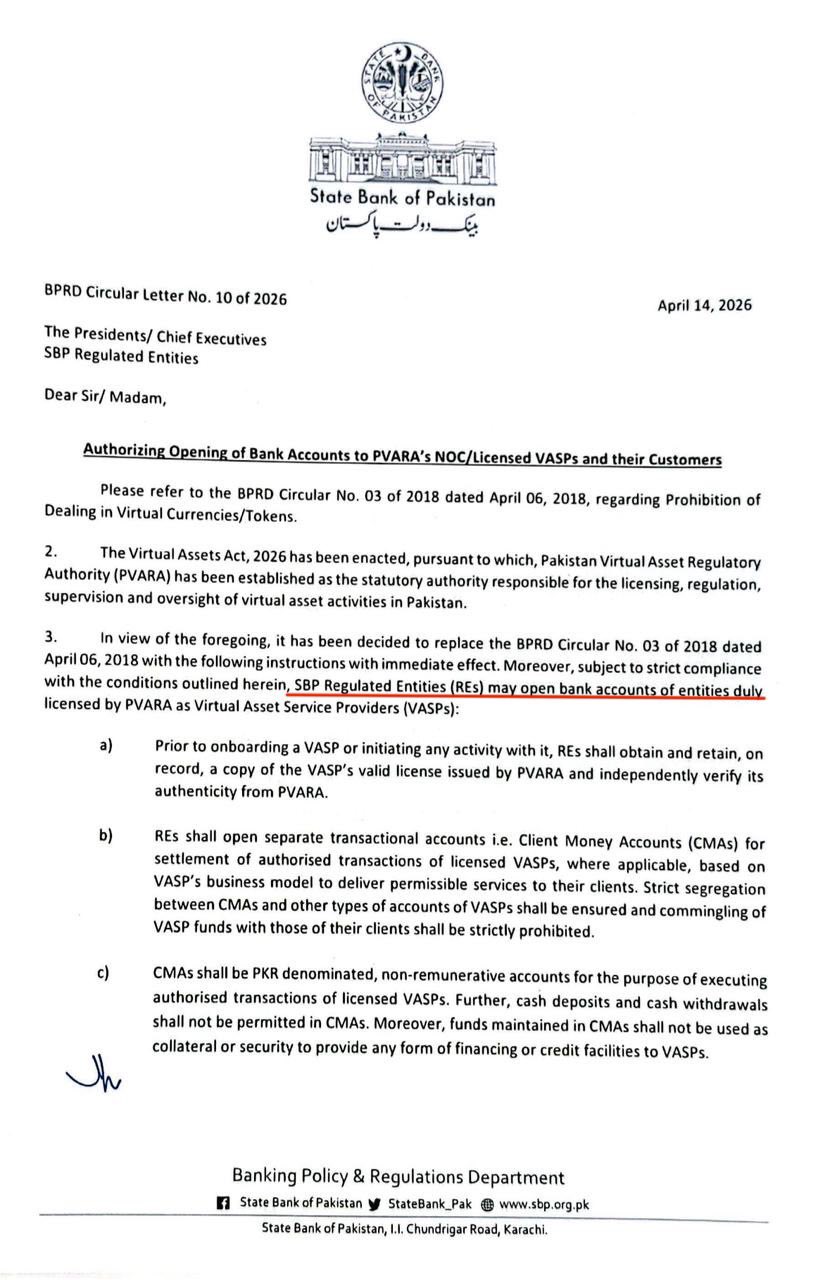
Pakistan’s central bank has allowed banks to open accounts for licensed virtual asset service providers (VASPs) and their customers, replacing an eight-year-old prohibition on dealing in virtual currencies.
In a circular dated April 14, the State Bank of Pakistan (SBP) said regulated entities may open bank accounts for entities licensed by the Pakistan Virtual Assets Regulatory Authority (PVARA), the statutory body responsible for licensing, regulation and oversight of virtual asset activities in the country.
The move follows Pakistan’s passage of the Virtual Assets Act 2026 in March and marks a shift toward a more formal regulatory framework for digital assets after years of restrictions following an outright ban in 2018.
Authorities have recently signaled a more structured approach to the sector, including holding discussions with major exchanges such as Binance and HTX in December 2025, as part of efforts to attract regulated trading platforms.
In parallel, Pakistan has also explored blockchain-based financial infrastructure through engagements with affiliates of World Liberty Financial, including discussions around the use of stablecoins for cross-border payments.
Banking access opens under strict regulatory framework
Under the new framework, regulated entities shall not invest, trade or hold virtual assets using their own funds or customer deposits, the circular states, emphasizing that banks’ role is limited to providing banking services to licensed firms.

The SBP added that banks remain responsible for complying with all applicable central bank regulations, including foreign exchange rules, and that any arrangement with a VASP does not absolve them of those obligations.
Banks are required to open separate transactional accounts denominated in Pakistan rupees, described as Client Money Accounts (CMAs), for settlement of authorized transactions of licensed VASPs, with strict segregation between CMAs and other VASP accounts and a prohibition on commingling VASP funds with client assets.
Related: Pakistan may be a crypto leader in 5 years at current pace: CZ
In addition to existing customer due diligence rules under SBP’s anti-money laundering (AML) and counter financing terrorism (CFT) rules, regulated entities must conduct full due diligence on each VASP, amend their customer risk profiling models to capture VASP-related risks, and risk-rate VASPs accordingly.
Banks are directed to monitor their relationships with VASPs on an ongoing basis and report any suspicious transactions to Pakistan’s Financial Monitoring Unit.
Magazine: Singapore isn’t a ‘crypto hub’ — it’s something better: StraitsX CEO
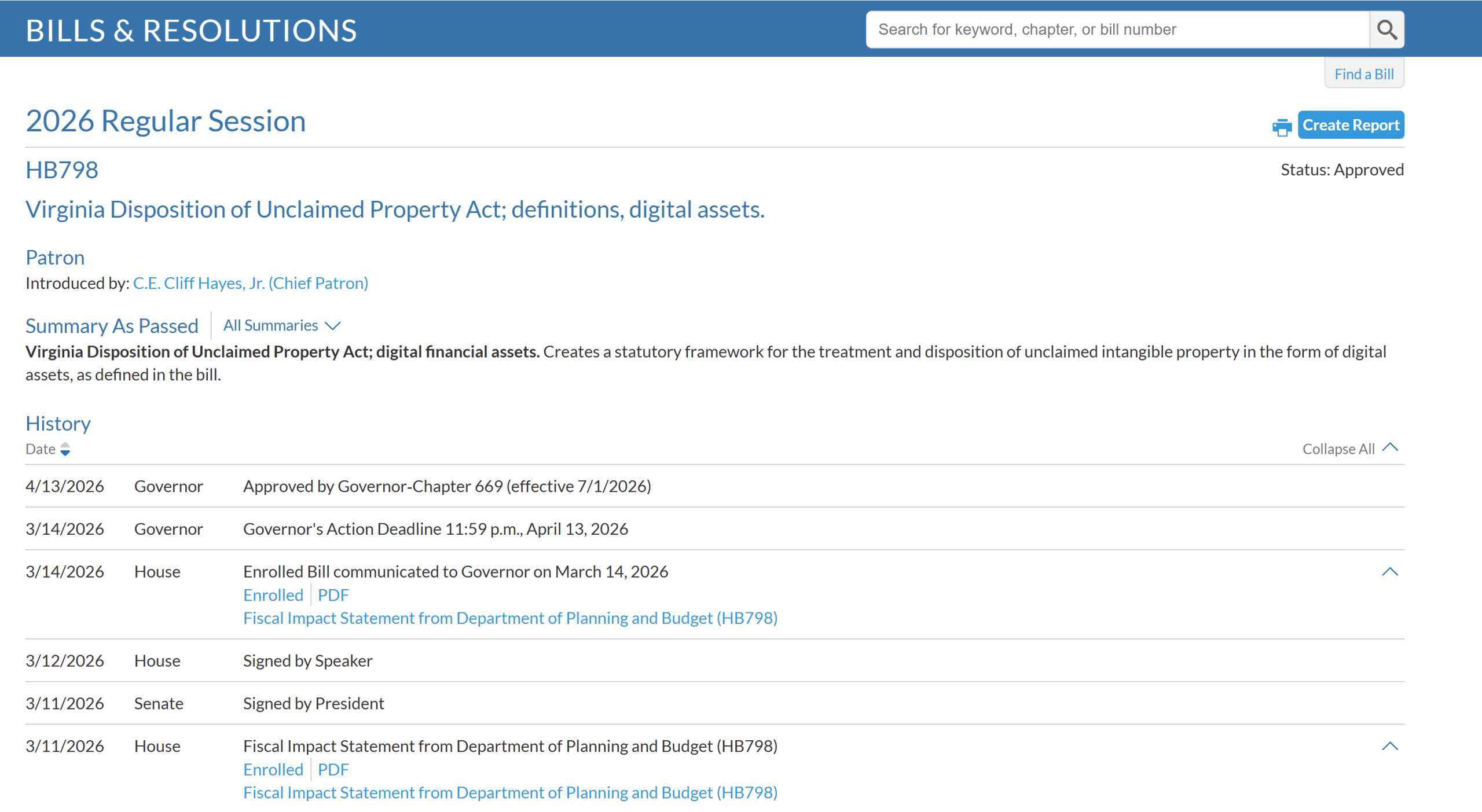
Virginia signed a law bringing digital assets into unclaimed property rules, requiring in-kind transfer and limiting how quickly the state can sell them.
The US state of Virginia has approved changes to its unclaimed property framework, bringing digital assets under state custody rules while limiting how soon those assets can be sold.
On Monday, Governor Abigail Spanberger signed House Bill 798 into law. The measure amends the state’s Disposition of Unclaimed Property Act, requiring custodians of unclaimed crypto to transfer those assets in-kind, meaning in their original form, rather than liquidating them into cash.
The law also imposes a minimum one-year holding period before any sale. “The administrator may subsequently direct such holder of unclaimed digital assets to liquidate the reported but unremitted digital assets not less than one year following the filing of a report,” the bill reads.
By holding crypto in-kind, the state reduces the risk of forced sales at unfavorable prices or during downturns, offering potential upside for owners who later reclaim their assets.
With the measure, Virginia joins a growing group of states that have included digital assets within unclaimed property laws. In May last year, Katie Hobbs signed a law allowing Arizona to take ownership of unclaimed crypto after three years and place it into a state-managed reserve fund. California has also passed a bill bringing crypto under the state’s unclaimed property laws.

Related: Alabama becomes second US state to grant DAOs legal status under DUNA
Virginia sets five-year clock for abandoned crypto accounts
The bill further clarifies when crypto accounts are deemed abandoned, setting a five-year inactivity period unless the owner shows signs of engagement, such as logging in or conducting transactions.
“Some good news out of Virginia,” Paul Grewal, chief legal officer of Coinbase, wrote on X, adding that the law “updates the state’s unclaimed property statute to cover digital assets and ensures they are escheated in-kind.”
Related: West Virginia lawmaker introduces bill to allow state crypto investments
Virginia Blockchain Council previously called the bill “an important step,” claiming that it “helps modernize Virginia’s financial laws and signals the Commonwealth’s continued engagement with emerging technologies.”
Magazine: How crypto laws changed in 2025 — and how they’ll change in 2026


- Hedera (HBAR) price is hovering near a fragile $0.08 support cluster.
- Losing $0.08 could open a move toward $0.07842 or lower.
- Upside only improves if the $0.0942 resistance is reclaimed.
Hedera’s price has been drifting lower again, and the latest price action is starting to circle a level that traders are watching very closely.
At around $0.0856, the token is down about 1.5% over the past 24 hours, with intraday trading ranging between $0.0846 and $0.0875.
On the surface, it looks like a normal pullback in a weak market.
But underneath, the structure is tightening around a critical zone that could decide whether the next move is stable consolidation or a deeper slide toward February’s lows near $0.072.

Notably, the broader trend hasn’t been friendly to altcoins in general.
Over the past week, Hedera has lost more than 6%, and the monthly decline is now above 12%.
Even longer-term momentum remains negative, with the asset still significantly lower compared to where it traded a year ago.
What makes the current situation more sensitive is that this weakness is happening without any strong internal catalyst.
There has been no major ecosystem shock or technical breakdown tied to the project itself.
Instead, the pressure is coming from a wider rotation out of altcoins and into safer assets, leaving tokens like HBAR more exposed to downside moves.
Pressure builds around a fragile support zone
Right now, the most important area on the chart sits just below the current price.
Short-term support has been forming around $0.0838, while another closely watched structural level sits at $0.08067.
These two zones are effectively acting as a support cluster. If they hold, price action could continue to move sideways as traders wait for new catalysts.
But the problem is that this cluster has already been tested indirectly through repeated dips and weak bounces.
Each retest weakens confidence. If selling pressure increases again, there is very little structural support until lower levels come into play.
Below this region, historical price data points to a more significant breakdown zone near $0.0703.
That would represent a much deeper correction, but markets rarely move in straight lines.
Before that level becomes relevant, traders are focused on a nearer and more psychologically important target: the February low at approximately $0.07270.
If price loses the $0.08 region decisively, the path toward that February floor opens quickly.
In thin or sentiment-driven markets, these levels tend to act like magnets.
Upside potential is still there, but it needs confirmation
Despite the current pressure, the structure is not entirely broken. There is still a clear resistance ladder above the market that could come into play if sentiment shifts.
The first key level sits at $0.0942. A move back above this zone would signal that buyers are regaining control in the short term.
Above that, the next resistance zones are located around $0.1051 and then $0.1174, marking progressively stronger recovery thresholds.
However, the market is not in a position where upside levels are immediately relevant.
Before any recovery attempt can take shape, the price needs to stabilise and reclaim lost ground. At the moment, that has not happened.
Instead, each rally attempt has been smaller than the previous one, which is often a sign of weakening demand.
HBAR price outlook
The near-term outlook now hinges on one simple condition: whether $0.08 holds or breaks.
If buyers defend this area again, Hedera could continue ranging between the mid-$0.08s and low-$0.09s while waiting for a stronger catalyst. In that case, price action would likely remain choppy but contained.
If $0.08 fails, however, the structure shifts quickly, and market projections place the next visible target as the February low at $0.07796, and below that, the broader support zone near $0.0727 comes into view.
The speed of any drop would depend on how quickly liquidity disappears below current levels.
But there is still one wildcard in the background: upcoming Hedera Hashgraph ecosystem developments and broader market sentiment shifts.
These events can temporarily interrupt bearish momentum, but so far, they have not been strong enough to reverse the current trend.

Blue Jackets coach Rick Bowness blasts team after sixth straight playoff miss

Drought could be making antibiotic resistance worse, scientists say

GOOG Dips 0.5% as Alphabet Awaits Q1 Earnings Amid AI Spending and Iran Relief Rally


-

 Politics5 days ago
US brings back mandatory military draft registration
-
 Sports5 days ago
Man United discover Nico Schlotterbeck transfer fee as defender reaches Dortmund agreement
-

 Fashion5 days ago
Weekend Open Thread: Veronica Beard
-

 Politics5 days ago
Malcolm In The Middle OG Turned Down ‘Buckets Of Money’ To Appear In Reboot
-

 Politics3 days ago
World Cup exit makes Italy enter crisis mode
-

 Crypto World6 days ago
Canary Capital Files SEC Registration for PEPE ETF
-

 Business5 days ago
Tesla Model Y Tops China Auto Sales in March 2026 With 39,827 Registrations, Beating Cheaper EVs and Gas Cars
-

 Crypto World2 days ago
The SEC Conditionalises DeFi Platforms to Be Avoided for Broker Registration
-

 Crypto World2 days ago
SEC Signals Exemption for Crypto Interfaces From Broker Registration
-

 Crypto World7 days ago
Bitcoin recovers as US and Iran Agree a Ceasefire Deal
-

 News Videos6 hours ago
Secure crypto trading starts with an FIU-registered
-
 NewsBeat3 days ago
Pep Guardiola and Gary Neville agree over Arsenal title problem that benefits Man City
-

 Business5 days ago
OpenAI Halts Stargate UK Data Centre Project Over Energy Costs and Copyright Row
-

 Business4 days ago
Ireland Fuel Protests Enter Day 5 as Blockades Spark Shortages and Government Prepares Support Package
-

 Politics5 days ago
LBC Presenter Mocks Trump Over Iran War Failures
-

 Crypto World5 days ago
Federal judge blocks Arizona from bringing criminal charges against Kalshi
-
 NewsBeat3 days ago
JD Vance announces ‘no agreement’ with Iran over nuclear weapons fear
-

 Tech6 days ago
A version of Windows 10 released a decade ago is now eligible for additional security patches
-

 NewsBeat1 day ago
Trump and Pope Leo: Behind their disagreement over Iran war
-

 Crypto World1 day ago
SEC Proposes Certain Crypto Interfaces Don’t Need to Register as Brokers
You must be logged in to post a comment Login