
Business
Heathrow and Gatwick among airports hit by air traffic control problems

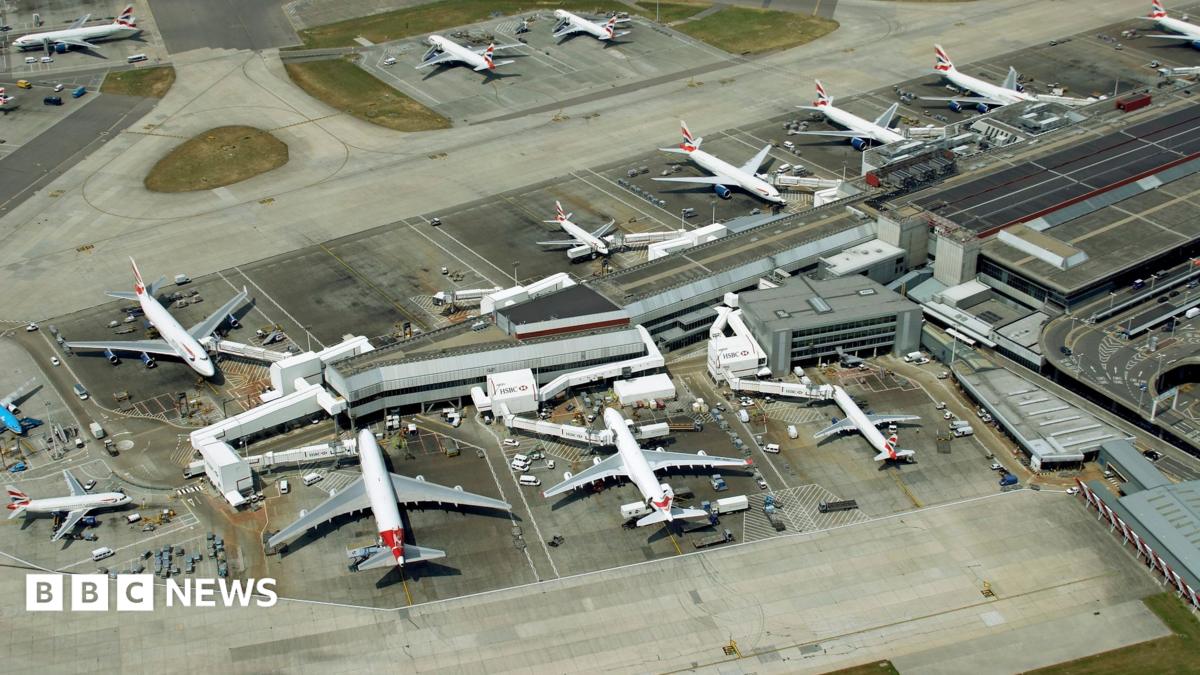
Hundreds of flights into and out of the UK have been cancelled following a technical problem affecting the air traffic control provider Nats.
At least 625 flights in or out of the country have been cancelled, according to tracking website FlightRadar24. EasyJet has made 200 cancellations and British Airways has made more than 100.
Nats said on Tuesday evening that its flight systems were starting to recover.
With few aircraft able to take off, it is understood landings are being restricted, leading to some flights being prevented from departing from overseas airports.
At Heathrow, one of the busiest airports in Europe, departures were initially paused around lunchtime. Traffic then resumed, before facing further disruption in the afternoon.
It is understood that the airport ran out of space for incoming flights during the afternoon because planes had not been departing.
Thirteen Heathrow-bound flights were diverted to other airports in the UK and Europe.
Passengers have been advised to contact their airlines to check the status of their flights.
British Airways said in a statement that it was anticipating knock-on effects.
“We were forced to cancel or divert more than 100 flights on Tuesday afternoon,” a spokesperson said.
“We’re doing everything we can to keep our customers updated and make arrangements for them to continue their journeys.
“We ask customers whose flights have been cancelled not to travel to the airport and to bear with us if they’re trying to get in touch, as our call centres are incredibly busy at the moment.”
Airports across the UK said they were experiencing cancellations and delays and advised people to check their flight details before travelling.
According to FlightRadar, the worst affected airports are Heathrow, Gatwick, Manchester and Birmingham. The site said approximately 4% of UK flights have been cancelled or delayed as a result of the issue.
Ryanair said affected passengers would be notified.


Artificial intelligence has crossed an important threshold in British business. It’s no longer something companies are merely discussing, testing in innovation teams or watching from a safe distance. People are using it, and they’re using it a lot.
The latest UK Business Data Survey found that 41 per cent of businesses handling digital data now use AI for at least one purpose. Among large companies, that figure rises to 82 per cent. Separate research from the Office for National Statistics suggests adoption may be moving even faster among workers themselves, with 55 per cent of employees reporting that they use AI for work or education.
Those numbers definitely sound impressive. But they also raise a more difficult question for British business. If we’re adopting AI this quickly, when do we start seeing the transformation we’ve been promised?
For investors, business leaders and policymakers, that question matters much more than the number of people who’ve opened an account with ChatGPT or had Copilot rewrite an email. Britain doesn’t have an AI awareness problem anymore. Increasingly, it has an AI integration problem.
Using AI isn’t the same as changing a business
The government’s own data makes the distinction quite stark. Among businesses already using AI, only 21 per cent say their AI tools are integrated into existing business systems.
When you look at what companies are actually doing with the technology and the picture becomes clearer. The most common reported use of AI is researching information, cited by 28 per cent of businesses handling digital data. Another 21 per cent use it to summarise information or draft reports and correspondence.
These are obviously useful applications. I use AI tools myself and can see the value they offer in removing some of the friction from everyday work. But we need to be careful about describing every efficiency gain as some sort of ‘transformation’.
As an investor, I’m much more interested in what happens when AI moves deeper into a company. Is it changing how customers are served or how products are developed? Can it shorten a process that previously took days or more to hours? Is proprietary company data being used more smartly? Can management make better decisions because information that once sat in different systems can now be understood together?
These are harder changes to make. They’re also where the economic value is likely to become much more significant.
Only 5 per cent of AI-using businesses in the UK Business Data Survey reported using automated decision-making systems. Just 6 per cent said they use data to develop, train or improve AI or automated decision-making systems. Much of British business, in other words, is still near the beginning of this process.
Workers are moving faster than their companies
The gap between individual and corporate adoption is particularly interesting. ONS research found that 55 per cent of employees were using AI for work or education, while 35 per cent of businesses with ten or more employees reported using at least one AI technology.
There’s something encouraging about that. Technologies often spread because people discover that they solve a real problem, rather than because somebody at head office tells them to use one. But it creates challenges too, particularly when individual experimentation moves ahead of the systems and rules surrounding it.
The UK Business Data Survey points to that governance challenge. Its detailed findings show that only 5 per cent of businesses using AI have a formal written policy governing its use or development. Among large businesses, however, the figure rises to 56 per cent.
That’s a remarkable difference. It suggests that the emerging AI divide in Britain isn’t simply between companies that use the technology and those that don’t. There’s also a divide between businesses with the resources to integrate and govern it properly and those that are largely figuring things out as they go.
The answer shouldn’t be for smaller businesses to slow down with layers of bureaucracy. They don’t need an AI committee for the sake of having one. But they do need to understand what information employees are putting into external systems, where decisions remain subject to human judgement, and which uses of AI carry genuine commercial, legal or reputational risk.
Good governance should make adoption easier, not harder.
Productivity is appearing before revenue
There are already signs that AI is delivering economic benefits. Research published by the Department for Science, Innovation and Technology earlier this year found that 56 per cent of businesses currently using AI reported increased employee productivity.
But there’s another number that deserves at least as much attention. Some 77 per cent of businesses using AI said they hadn’t yet seen any change in revenue. Only 12 per cent reported an increase.
I don’t find this particularly surprising. Productivity gains should appear before many of the larger commercial benefits. A member of staff saving an hour on a task has value, but it doesn’t automatically create a new customer, a better product or a new source of revenue.
The next stage is turning those accumulated efficiencies into something more substantial. Businesses need to ask what they can now do that they couldn’t do before, rather than simply how they can do existing tasks slightly faster.
This distinction will become increasingly important for investors too. Asking a management team whether it “uses AI” is already becoming a fairly meaningless question. Before long, almost every company will be able to answer “yes”.
I’d rather know where AI sits inside the business, which processes have changed because of it, what measurable improvement has followed and whether competitors could easily reproduce the same advantage. Those questions tell us much more about whether AI is creating lasting value.
Britain doesn’t need to build everything
The debate about Britain’s position in artificial intelligence often gravitates towards comparisons with the United States and China, which is understandable. Frontier models, computing infrastructure, chips and research capability matter enormously, and the UK should remain ambitious about its role in all of them.
But Britain doesn’t have to dominate every single layer of the AI economy to benefit from it. Nor should its success be measured solely by whether the next global foundation model is built here or not.
The country already has considerable strengths in financial services, life sciences, professional services, advanced research, creative industries and technology. It also has millions of smaller businesses whose productivity matters enormously to the wider economy. For many of those companies, the opportunity isn’t to become an “AI company”. It’s to become a better company because of AI.
This may sound like a small distinction, but economically it could be the more important one. The productivity benefits of a technology don’t come only from the companies that invent it. They spread when businesses in other sectors reorganise around what the technology makes possible.
The latest numbers suggest Britain has become rather good at experimenting with AI. The challenge now is to move beyond experimentation and embed it into the far less glamorous machinery of business, from operations and customer relationships to product development, finance, logistics and decision-making.
If it can do that, the most important British AI story may not be the creation of one spectacular company. It may be thousands of existing companies becoming more productive, more competitive and better able to grow. That’s a harder transformation to capture in a headline, but it’s the one that could matter most.

Nicole Junkermann
Business
Broadcom Shares Rise 2.9% As Analyst Sets Jaw-Dropping $600 Price Target After Earnings Amid AI Boom

PALO ALTO, Calif. — Shares of Broadcom Inc. climbed $10.31, or 2.88%, to $368.20 as of 10:48 a.m. ET Tuesday, extending a recovery following the company’s fiscal third-quarter earnings report last week, as Wall Street continues digesting a striking new price target from one of the semiconductor sector’s most closely watched analysts.
Broadcom reported earnings on Sept. 2, delivering results that beat Wall Street expectations across most key metrics even as the stock initially dropped following the report. Semiconductor revenue more than tripled to $16.7 billion, exceeding the $15.2 billion average analyst estimate compiled by StreetAccount, while the company’s infrastructure software business generated $8.75 billion, slightly below the $8.82 billion consensus estimate.
Despite the overall beat, two factors weighed on investor sentiment immediately following the report. Broadcom’s fourth-quarter revenue guidance of approximately $34.8 billion came in slightly below the $35.03 billion Wall Street had projected, and the broader semiconductor sector was already experiencing a period of profit-taking following an extended rally, according to reporting from TheStreet.
Despite that initial pullback, Cantor Fitzgerald analyst C.J. Muse responded to the results by significantly raising his price target on the stock, lifting it to $600 from $525 while maintaining an Overweight rating, according to Investing.com. That target sits roughly 68% above where Broadcom shares were trading at the time of the upgrade, a notably wide margin for a company already valued at approximately $1.75 trillion. Muse, who covers the technology sector and has logged 321 individual stock ratings with roughly a 71% success rate according to tracked performance data, argued that the broader market has treated Broadcom with excessive caution given the size and visibility of the company’s order backlog.
Broadcom CEO Hock Tan offered additional detail on the company’s growth trajectory during the earnings conference call, highlighting expanding partnerships tied to the company’s custom AI chip business. Tan said Broadcom expects to accelerate shipments of Google’s Ironwood tensor processing units to Anthropic, along with TPU 8i chips destined for Google itself, telling analysts the company will deliver tens of billions of dollars worth of processors to Google annually over the next several years.
According to Tan, Broadcom is targeting deployment of 5 gigawatts of TPU 8i chips for Anthropic in 2027, with visibility toward delivering an additional 10 gigawatts beyond that initial commitment. Tan also said OpenAI is preparing to tape out its second-generation custom chip developed in partnership with Broadcom, known as Jalapeno, with the two companies already working on plans for a third version. Broadcom is targeting a 1.3 gigawatt deployment of Jalapeno chips in 2027, with a longer-term line of sight toward more than 5 gigawatts across that chip family.
During the same quarter, Broadcom also touted its custom Jalapeno chip partnership with OpenAI more broadly, while separately noting that Apple had agreed to increase its spending with Broadcom specifically tied to U.S.-based chip production.
Broadcom’s own forward guidance points to a dramatic acceleration in AI-related chip revenue over the coming years. According to figures cited by Yahoo Finance, the company’s recent forecasts project AI chip revenue reaching $115 billion in fiscal 2027 and climbing further to $230 billion by fiscal 2028, underscoring the scale of growth the company anticipates as major technology companies continue investing heavily in custom AI infrastructure.
Despite that bullish long-term outlook, Broadcom shares have lagged the broader market for much of 2026. As of last Wednesday’s close, ahead of the earnings report, Broadcom shares had gained approximately 6% for the year, compared with a roughly 12% gain for the broader S&P 500 index over the same period, according to CNBC’s reporting on the earnings results. That relative underperformance stands in contrast to the stock’s dramatic longer-term run, having climbed more than sixfold since the end of 2022, a surge that coincided with the emergence of ChatGPT and the broader wave of generative AI investment that has since reshaped the semiconductor industry.
Broadcom’s stock has continued showing considerable volatility even in the days immediately following its earnings report. According to Nasdaq data, Broadcom shares dropped roughly 9.7% over a recent three-month stretch, underperforming the broader Zacks Computer and Technology sector’s 0.9% return over the same period, even as the stock has continued attracting bullish analyst commentary in the aftermath of last week’s results. The stock’s 52-week range spans from a low of $289.96 to a high of $495.00, illustrating the significant price swings the shares have experienced over the past year amid shifting sentiment toward AI-related chip stocks more broadly.
Broadcom has separately announced a quarterly cash dividend of $0.65 per share, with an ex-dividend date of Sept. 21, continuing the company’s practice of returning capital to shareholders even as it invests heavily in expanding its AI chip manufacturing capacity and partnerships.
Competition within the AI chip sector has continued intensifying, with Broadcom facing increasing pressure from rivals including Nvidia and Marvell Technology as all three companies race to capture a larger share of the rapidly growing market for AI infrastructure hardware. Some analysts, including those at Goldman Sachs, have weighed in directly comparing Broadcom against Marvell following each company’s respective earnings reports, while other coverage has directly compared Broadcom’s custom, application-specific chip approach against Nvidia’s more flexible, broadly applicable hardware architecture, framing the two companies’ differing strategies as a key point of ongoing debate among investors evaluating which approach offers the stronger long-term investment case within the AI infrastructure buildout.
With Tuesday’s gain extending Broadcom’s recovery from its initial post-earnings dip, investors will likely continue weighing the tension between the company’s aggressive multiyear AI revenue projections and the more cautious near-term guidance that initially pressured the stock following last week’s results. Muse’s substantially raised price target, alongside Broadcom’s continued expansion of custom chip partnerships with major AI developers including Google, OpenAI and Anthropic, suggests Wall Street sentiment toward the stock’s longer-term trajectory remains largely constructive, even as the shares continue navigating a volatile trading environment shaped by broader shifts in investor appetite for AI-linked semiconductor names throughout 2026.

Western Australian aged care providers have criticised the federal government’s move over the national funding price, claiming it could put project investments at risk.

Jefferies raises Tarsus Pharmaceuticals price target on guidance
Business
Trump Demands Bombardier Build Jets in America or Lose U.S. Sales as Ottawa’s Tariffs Take Effect

WASHINGTON — President Donald Trump said Canadian planemaker Bombardier should stop selling jets in the United States unless it builds them there, a threat issued hours before Ottawa’s retaliatory tariffs on American goods took effect and without an accompanying executive order or tariff schedule.
“NO MORE SELLING BOMBARDIER IN THE UNITED STATES!” Trump wrote on Truth Social on Monday. “Their products aren’t good enough! Over 50% of their revenue comes from the United States — They live off American Buyers, American Companies, American Airports, and American Service — All while Canada blocks our GREAT American Banks, and Companies, throughout the U.S.A.” He added: “If they want our Market, they must build here, and stop treating America like a ‘piggybank.’” The post closed with a string of slogans: “BUY AMERICAN. FLY ON AMERICAN AIRLINES. ENJOY AMERICAN LIQUOR AND BEVERAGES. SAIL ON LAKE AMERICA. AMERICA FIRST!“
The White House did not immediately describe how a sales ban would work. Civil aircraft already flying in the United States are certified by the Federal Aviation Administration on safety grounds, not by presidential social-media posts. No new duty on Bombardier airframes was published with the message. The gap between the all-caps line and a legal instrument is the first fact of the story.
The second is timing. Canada’s counter-tariffs — 15% to 50% on hundreds of U.S. products, framed in Ottawa as a dollar-for-dollar answer to earlier U.S. levies — were set for 12:01 a.m. Tuesday. Prime Minister Mark Carney told CBC News there were no last-minute calls scheduled with Trump and no deal to announce. Talks had collapsed late last month. Trump’s Bombardier post landed in that vacuum.
Bombardier answered without naming the president. “Bombardier values its great partnership with American companies and its U.S. employees,” the Montreal company said. “Our plan is to continue to invest in our people, our customers and the communities in which we operate across the country.” It said it employs workers in more than 20 states, with sites in Kansas, Texas, Arizona, Florida, Connecticut, Illinois, Delaware, California, Washington, D.C., and New Jersey. Wings for its Global-series business jets are built in Red Oak, Texas. Flight-control parts come from the Los Angeles area. The firm said about 2,800 American businesses in 47 states sit in its supply chain and that it spends more than $2.5 billion a year with those partners. A new facility in Fort Wayne, Indiana, is planned later this year. About 55% of Bombardier’s $9.6 billion in 2025 revenue came from the United States, according to the company.
That U.S. footprint produced the first Republican pushback. Sen. Jerry Moran of Kansas, where Bombardier keeps its American headquarters and builds special-mission aircraft, said he contacted the administration. “The presence of Bombardier in Wichita supports a local workforce of more than a thousand employees, who contribute their talent and expertise to our nation’s defense and aerospace capabilities,” Moran wrote. He said he wanted the president aware of workers at the plant and in the Kansas supply chain.
Quebec’s economy minister, Christopher Skeete Fréchette, took the opposite tack from Ottawa’s silence in the first hours. “I will not respond to provocation with provocation,” he wrote. “Quebec will not allow anyone to dictate where our companies must produce in order to access a market.”
Trump has aimed at the same company before. On Jan. 29 he wrote that because Canada had “wrongfully, illegally and steadfastly refused to certify the Gulfstream 500, 600, 700 and 800 Jets,” the United States was “hereby decertifying their Bombardier Global Expresses, and all Aircraft made in Canada” and would impose a 50% tariff on Canadian-built aircraft if the Gulfstream files were not cleared. Neither the blanket decertification nor the 50% aircraft tariff materialized in that form. Canada certified several Gulfstream models in February. A White House official told Reuters in January that Trump was not talking about stripping certificates from jets already in service.
The history is longer. In Trump’s first term the Commerce Department imposed a nearly 300% duty on new Bombardier C Series airliners after Boeing alleged Canadian subsidies. The U.S. International Trade Commission unanimously rejected the tariff in 2018. Boeing did not appeal. Airbus later took a stake in the program, now the A220, and Bombardier left commercial aviation to concentrate on business jets — Globals, Challengers — whose customers are corporations and wealthy owners concentrated in the U.S. market Trump now says they must earn by moving final assembly.
Gulfstream, a General Dynamics unit based in Savannah, Georgia, is the American rival in that cabin. Certification delays in Canada were real; they were also temporary. U.S. banks and companies operate in Canada, contrary to the broadest reading of Trump’s “blocks” line. The narrower, documented fight is over who signs off on which business jet, how fast, and whether that process is safety review or industrial policy.
Enforcement options, if the administration wants more than a post, run through familiar tools: tariffs under trade statutes, procurement rules for government and contractor fleets, or pressure on FAA bilateral processes that other countries would treat as politicizing airworthiness. Each has costs. A duty on completed Canadian jets would hit U.S. buyers who already order Globals with Texas-built wings. A ban on new deliveries would strand a service network at American airports that Bombardier says it staffs. Kansas and Texas workers are not an abstraction in that ledger.
For Canada the company is a national champion that no longer makes airliners but still anchors Montreal aerospace. For Trump it is a symbol in a wider argument that access to U.S. customers should require U.S. factories. He has applied that template to autos, steel and pharmaceuticals. Business jets are a smaller trade flow with a louder customer class. Owners who write checks for a Global 8000 also donate and vote in the states where Bombardier already pays people.
The midterm calendar sits behind the industrial one. Moran’s note is a reminder that “build here” collides with “jobs already here” when the plant is in Wichita. Carney’s tariffs are a reminder that Ottawa will answer sector by sector. Trump’s January threat faded when Canada moved the Gulfstream files. Monday’s threat arrived with no order attached.
What exists on the record is the post, the company statement, the Kansas senator, the Quebec minister, and a tariff war that started at midnight. Bombardier already builds wings in Texas and special-mission aircraft in Kansas. Trump says that is not enough. Until an agency publishes a rule, American buyers can still take delivery of a Canadian-branded jet that rolled through American shops — and Canadian customs can still collect on U.S. goods that crossed the same border the other way.


VAUGHN, ONT. — Canadian sprinkle producer Spectra Confectionery Ltd. has opened a new facility in Mississauga, Ont.
The facility expands the company’s capabilities by 40% while creating a stronger foundation for innovation, customer service and continued expansion into the US market, Spectra said.
Spectra has grown to become the largest Canadian manufacturer of toppings for baked foods, snack foods and ice creams since its founding in 1996. The toppings are naturally colored, sugar free and uniquely shaped. Spectra also works closely with bakeries and snack producers across the United States.

It remains unclear whether the Perth Scorchers will be involved in Cricket Australia’s opt-in Big Bash League privatisation model, announced on Tuesday.

Private capital often avoids infrastructure and development projects in Asia and the Pacific not because of poor project quality but due to weak financial reporting and auditing systems. Drawing on an Asian Development Bank essay, the piece argues that investors require trustworthy financial data to assess risk, and without reliable accounting standards and independent audits, they demand higher returns or avoid investment entirely.
Weak financial trust causes banks to lend against physical collateral rather than business performance, excluding smaller viable firms. This creates a gap between countries adopting international accounting standards legally and implementing them meaningfully. The piece concludes that credible financial reporting serves broader public functions beyond attracting investment, including tax collection and government accountability, and that such trust must be earned gradually rather than legislated.
Every development strategist in Asia and the Pacific knows the arithmetic. Public budgets cannot cover the region’s infrastructure and social needs, so private capital must fill the gap.
What gets less attention is why that capital so often stays on the sidelines even when the need is obvious, and the projects are sound.
A recent essay from the Asian Development Bank, written by financial management officer Deewas Khadka, makes the case plainly. Investors do not fund a project because it is important. They fund it because they trust the numbers behind it.
When that trust is absent, even a technically excellent power plant, road or water system can struggle to find backers.
Why the “boring” part of finance matters most
Before capital moves, three conditions usually need to be satisfied: a project must be bankable, its risks must be identifiable, and the environment around it must be dependable.
It is the third condition that gets waved through as a formality, and it is the one Khadka argues deserves the closest scrutiny.
Reliable financial reporting and independent audits are what allow investors to believe that the people managing a project can account for its resources and report results honestly.
This is easy to dismiss as a back-office concern. It is not. Accounting standards define what must be disclosed.
Audits test whether that disclosure can be believed. Strip either one out, and investors are left pricing uncertainty instead of risk, which almost always means demanding higher returns or simply walking away.
The hidden cost of weak financial trust
The clearest evidence of this problem shows up in ordinary lending behavior. In many developing markets, banks still lend against land and buildings rather than against a company’s actual financial performance, because collateral feels safer than a balance sheet.
That habit quietly excludes smaller businesses that lack property to pledge but have viable, revenue-generating operations.
These are often the firms most responsible for local employment and innovation, and they are also the ones locked out by a system that does not trust financial statements enough to lend against them.
The gap between law and practice compounds the problem. Many countries have adopted international accounting standards in legislation.
Far fewer have made those standards work in practice. Audits in some markets have become a compliance ritual rather than genuine independent scrutiny, and financial statements fall short of what they claim to represent.
Reform on paper does not automatically produce trust in the field, and businesses that need financing the most often see the least benefit from it.
Five fixes worth taking seriously
Khadka’s essay outlines a practical agenda for governments willing to treat this as a priority rather than a technicality:
Reporting obligations should scale with risk, so large companies and banks face full requirements while smaller firms face proportionate ones, preserving scrutiny without burying small business in paperwork.
Financial information should be genuinely accessible. A report filed away and never seen again helps no one. Central filing systems and digital, open reporting make information usable by lenders, regulators and tax authorities alike.
The accounting and auditing profession should be funded and staffed like infrastructure, because universities, professional qualifications and continuing education are what make standards function rather than merely exist on paper.
Reform needs a clear owner. Too many countries support better reporting in principle while responsibility for delivering it is scattered across agencies with no single body accountable for results.
And countries should diagnose their own weaknesses honestly, using tools such as the World Bank’s Report on the Observance of Standards and Codes to identify where trust is strong and where it is not, then build a plan with real deadlines and accountability behind it.
A public good, not just an investor courtesy
The value of credible financial reporting extends well beyond any single deal. Reliable accounting records help tax authorities collect revenue they are owed.
They give journalists, lawmakers and citizens the ability to follow public money. They give regulators the evidence they need to catch abuse before it spreads.
A country that neglects its reporting and audit systems is not only less attractive to foreign capital. It is also weakening the domestic institutions that accountability depends on.
Trust cannot be legislated, only earned
The uncomfortable conclusion is that none of this can be manufactured by decree. Trust is built slowly, through years of consistent reporting and institutions that behave the way they claim to. There is no ribbon cutting for a more rigorous audit regime, which is precisely why governments tend to underinvest in it.
But the logic Khadka lays out is hard to argue with. Development needs will keep growing faster than public budgets.
Private capital will not arrive simply because a project deserves it. It arrives when risk can be measured, and institutions can be believed.
For governments across the region serious about closing their financing gap, credible financial reporting is not a technical afterthought to development strategy. It is the foundation the rest of the strategy stands on.

At Touchstone Investments, we recognize that not all mutual fund companies are created equal. Our commitment to being Distinctively Active means the employment of a fully integrated and rigorous process for identifying and partnering with asset managers who sub-advise our mutual funds and advocating a robust approach to portfolio construction that either uses standalone active strategies or serves as a complement to passive strategies. That is the power of Distinctively Active.
Touchstone Funds are offered nationally through intermediaries including broker-dealers, financial planners, registered investment advisors and institutions by Touchstone Securities, Inc. For more information please call 800.638.8194 or visit www.touchstoneinvestments.com
Specialties
Touchstone Investments helps investors achieve their financial goals by providing access to a distinctive selection of institutional asset managers who are known and respected for proficiency in their specific area of expertise.
Touchstone Securities Inc. is a registered broker-dealer and member FINRA and SIPC Note: This account is not managed or monitored by Touchstone Investments, and any messages sent via Seeking Alpha will not receive a response. For inquiries or communication, please use Touchstone Investments’s official channels.

Host Maria Bartiromo poses as New York City mayoral candidate Andrew Cuomo visits “Mornings With Maria” at Fox Business Network Studios on October 29, 2025 in New York City.
Roy Rochlin | Getty Images Entertainment | Getty Images
Maria Bartiromo is disputing reports that she was terminated from her longtime gig as a host of various segments for cable TV networks Fox News and Fox Business.
“The irresponsible reports that have been published stating that Maria Bartiromo was fired or is no longer an employee of Fox are absolutely and unequivocally false,” her attorney said in a Friday statement. “Make no mistake, we have the receipts and witnesses and they will come out whether through the courthouse or otherwise. Those reporting her firing or the incredulous facts supporting that fiction have exhibited a complete and utter reckless disregard for the truth.”
Fox News, in response to Bartiromo’s comments Friday, said its brief statement from a day earlier “speaks for itself.”
On Thursday, Fox Corp.’s Fox News Media announced Bartiromo had parted ways with its networks.
“We thank Maria for her work over the last 12 ½ years and wish her all the best on her next chapter,” Fox News said in Thursday’s statement, without providing reasoning or cause for her departure.
Various media outlets have since reported that Bartiromo was fired for violating company policy.
A former CNBC anchor, Bartiromo led the daily show “Mornings with Maria,” as well as the Friday program “Maria Bartiromo’s Wall Street,” on Fox Business Network. She also led Fox News’ “Sunday Morning Futures.” The conservative network Fox News is the top-rated cable TV news channel in the U.S.
Bartiromo was one of the Fox News anchors named in the Dominion Voting Systems defamation case in which the company accused Fox of making false on-air allegations that Dominion had helped rig the 2020 presidential election when Donald Trump lost to Joe Biden.
While Bartiromo was scheduled to testify as a witness if the lawsuit went to trial, Fox agreed to pay $787.5 million to settle the lawsuit in 2023. Fox faces a similar ongoing defamation lawsuit with Smartmatic USA, in which Bartiromo is also a defendant.

ALEX JONES: XRP WILL VANISH OVERNIGHT, THEY WILL CONFISCATE IT?

Britain is using AI. So why isn’t it getting more productive?

Crypto.com keeps rewriting terms for CRO holders


-
 Tech7 hours ago
Memory prices are slowing because buyers ran out of money
-

 NewsBeat5 hours ago
England up in reading, maths and science rankings as Scotland and Wales dip
-

 Business9 hours ago
Egyptian TV Presenter Sarah Khalifa, 11 Others Sentenced To Death In Major Drug Trafficking Case In Cairo
-
 Tech9 hours ago
Strong Password Policy and Password Manager Guide
-
 NewsBeat4 hours ago
Tehran’s assertive rhetoric signals a new and dangerous phase in conflict
-

 Business6 hours ago
US-Canada tariffs: Canada braces for prolonged trade war as counter-tariffs on US take effect
-

 Tech4 hours ago
Google’s revived nuclear power plant gets $1.9B loan from US government
-

 Crypto World9 hours ago
Visa expands stablecoin card network to 160 programs
-

 Crypto World8 hours ago
Arm Stock: Arm Extends Reach To Physical AI
-
 Fashion5 hours ago
New tops for women from EGO
-

 Crypto World9 hours ago
Stablecoins could save South Korean merchants up to $3.8 billion a year, budget office says
-

 Business9 hours ago
model backs CBD drinks brand
-
 Entertainment9 hours ago
The 10 Most Influential Books of the 20th Century, Ranked
-

 Crypto World9 hours ago
How Democrats Plan to Investigate Trump’s Ballroom
-

 Sports9 hours ago
Rob Baxter: Exeter boss says England should pick English-based players
-
Business9 hours ago
Goldman Sachs maintains neutral stance amid market shifts
-

 Entertainment5 hours ago
Fat Joe Prompts Debate Claiming He’s Black, Marc Lamont Reacts
-

 Entertainment4 hours ago
Aritzia-Inspired Fashion Finds for Fall at Amazon, From $7
-

 Politics4 hours ago
The Ultimate September Reset Guide: How To Refresh Your Mind And Life This Autumn
-

 Business4 hours ago
Corning Stock Climbs On Multibillion-Dollar Verizon Network Deal
You must be logged in to post a comment Login