Connect with us

Tech

ICE’s Vetting Standards Are So Low It Can’t Even Be Bothered To Verify The Identities Of New Hires

Published

on

from the get-you-a-gun-and-a-glove-no-experience-necessary dept

A whistleblower report delivered to the DHS Office of the Inspector General makes it clear ICE is willing to hire pretty much anyone who applies for the job. Keeping up appearances (and by “appearances,” I mean constantly pushing for 1,500-3,000 arrests per day) is tough when you don’t have the warm bodies to do all the kidnapping, so ICE has been on a hiring spree pretty much since day one of Trump’s second term in office.

Not only has ICE lowered its hiring standards, but it’s offering $50,000 signing bonuses to whoever can somehow survive its comfy chair of an on-boarding gauntlet. Consequently, ICE has not only been cannibalizing multiple local law enforcement agencies, but it’s handing out free money to exactly the sort of people you’d expect to respond to an ICE “Help Wanted” ad.

In other words, its people who think actor Dean Cain’s PSA for ICE jobs is just the sort of thing that puts lead in the pencils. Lots of other rejects have signed up as well: people who have already retired from law enforcement (because age no longer matters), as well as several others who definitely are attracted to the 99% power/1% accountability split of cop work, but probably aren’t capable of surviving even the minimal vetting that goes on at local cop shops.

Then there are the people who just want to hurt migrants, even if they’re way more likely to injure themselves while performing literally any physical effort. Finally, there are the disgraced cops who now have an employment option that fully embraces their bigotry.

Advertisement

And yet somehow some ICE applicants have failed to surpass the most minimal requirements any federal law enforcement agency offers (the FBI’s recent embrace of bestiality notwithstanding), which means ICE still needs more officers. And that means the standards that have been lowered several times already continue to drop.

In the wake of a hiring surge last summer, an official in charge of evaluating new recruits to U.S. Immigration and Customs Enforcement issued a dire warning.

[…]

Citing an “unprecedented lowering of standards,” the career ICE official said that “systemic breakdowns” had allowed applicants to receive job offers before they had passed basic fingerprint, identity or credit checks in a preliminary vetting process.

For an administration that clearly desires a “papers please” standard to be applied across the United States and directs the actions of the agency now expected to handle most of this “papers please” work, it’s almost hilarious to discover ICE applicants are getting job offers before their identities have been verified. That means it might be easier for an undocumented migrant to secure a job at ICE than one at the local food jobber.

Advertisement

This is happening while Trump and his MAGA cohorts are demanding everyone produce proof of citizenship before being allowed to vote. Meanwhile, ICE doesn’t even know if the person it’s trying to hire is actually the person the applicant says they are.

This isn’t just some rando speaking off the record. The New York Times has secured a copy of the whistleblower report submitted to the DHS Inspector General and spoken to the whistleblower directly:

The whistle-blower, a 17-year ICE veteran who spoke to The New York Times on the condition of anonymity because of the sensitive nature of his claims, said the agency had cut corners in its rush to fill the ranks.

“We chose as an agency to be more convenient rather than thorough,” he said, describing the agency’s decision to reduce scrutiny of recruits in order to expedite hires. “By doing so, there was a potential to put lives at risk and to jeopardize national security.”

When you lower your hiring standards and skip steps to expedite on-boarding, it always makes things worse. Sure, a lot of this happened all over as pretty much any place that employed anyone tried to bounce back from the COVID pandemic. But it’s one thing to throw money at under-qualified candidates when all you’re trying to do is fill fast food orders. It’s quite another to discard these standards when civil rights, national security, and actual human lives are on the line.

Advertisement

A process that fully verified an applicant’s identity was discarded because it apparently took too long. ICE officials decided waiting 7 to 10 days to perform a background check was no longer tenable. By stripping out all of the difficult bits, the vetting process apparently became almost instant, with those doing the vetting told to make “judgment calls” on applicants despite having almost no verifiable information on hand.

The preliminary vetting process, which took seven to 10 days, was upended last summer. The vetters were told to make determinations on recruits without having the full security form, fingerprints or any polygraph testing, according to the former unit chief and a former federal official familiar with the process who was granted anonymity to speak freely about it.

That meant new hires were heading to training without having their identities, criminal histories and other basic information checked and verified, the unit chief said.

Note the “last summer” mentioned in the first paragraph. This isn’t a recent development. While it’s been known for awhile that ICE was lowering its standards (and cutting an entire month out of its 10-week training program), the impression delivered by the administration and ICE officials was that standards were slowly lowered over several months beginning sometime last fall. The reality is far, far worse: the decision to bring ICE recruits on board before fully vetting them actually began almost immediately — only a few months into Trump’s second term.

These are the people who have been violating rights regularly, up to and including beatings and killings, for months now. And these are the people who will soon be randomly stun-gloving US citizens and residents at their discretion, thanks to ICE’s contract with Compliant Technologies. All the while, ICE officials will continue to claim these officers have been fully trained to use the weapons they’re armed with as well as advised on the general contours of the Constitution.

Advertisement

But none of that is true because it cannot possibly be true. ICE doesn’t even really know if some of the people working for it are actually the people they claimed to be. And since it can’t even be bothered to perform that essential task, there’s no reason to believe they’ve received the minimum training to do their jobs competently, much less handle all the weaponry they’ve been inordinately blessed with.

Filed Under: dhs, ice, lowering standards, markwayne mullin, mass deportation, trump administration

Source link

Advertisement
Continue Reading
Click to comment

You must be logged in to post a comment Login

Leave a Reply

Tech

Sonos Ace Ultra vs Sonos Ace: Should you go for Ultra?

Published

on

Sonos has recently launched its latest pair of headphones, with the Sonos Ace Ultra.

Considering we awarded the Sonos Ace with a four-star rating, how does the Sonos Ace Ultra look set to compare? Is it worth upgrading to the newer pair of headphones?

Ahead of our Sonos Ace Ultra review, we’ve compared its specs to the original Sonos Ace and noted the key differences between the two headphones here. 

Once you’re finished here, make sure you visit our round-up of the best headphones and best noise cancelling headphones too.

Advertisement

Price and Availability

At the time of writing, the Sonos Ace Ultra is available for pre-order and will launch officially at the end of September. Unsurprisingly, as the headphones are positioned as Sonos’ most premium pair, the Ace Ultra has a higher starting price of £399.

Advertisement

SQUIRREL_PLAYLIST_10208747

As the Sonos Ace is over two years old, having launched as the brand’s first pair of over-ear headphones back in 2024, it’s not impossible to pick up the cans with a hefty discount – especially during sales events like Prime Day or Black Friday. Having said that, the headphones still have a pretty high RRP of £349.

Advertisement

SQUIRREL_PLAYLIST_10208748

Sonos promises the Ace Ultra has 2x the ANC ability than the Ace

Both the Sonos Ace and Sonos Ace Ultra are fitted with active noise cancelling (ANC) which blocks out external sounds like traffic and chatter in real-time for a more immersive listening experience. In addition, both headphones also sport an Aware mode which lets in ambient sound – perfect for when you want to stay in-tune with your surroundings. 

We concluded that the Sonos Ace’s ANC performance was generally strong and able to suppress most public transport sounds and wind noise well. While it isn’t quite as adept at handling flights, especially when compared to the Sony WH-1000XM5, the Ace is still an admirable pair of noise-cancelling headphones. 

Sonos Ace earcups detailSonos Ace earcups detail
Sonos Ace. Image Credit (Trusted Reviews)

Advertisement

So where does that leave the Ace Ultra? According to Sonos, the Ace Ultra should see improved ANC compared to its predecessor, thanks to the headphones’ drivers that produce “noise-cancelling frequencies faster and more effectively”. In addition, the Ace Ultra sports an all-new 10-mic array, two more than the Ace, that’s able to detect and cancel out sounds like underground train cars or airplane cabins. 

Advertisement

We’ll have to wait until we review the Ace Ultra to see how well they really perform, but the headphones undoubtedly sound promising.

Sonos Ace Ultra has an Adaptive EQ

To help ensure the best possible sound quality while you’re on the move, the Sonos Ace Ultra introduces Adaptive EQ. Sonos explains Adaptive EQ measures the seal and fit of each ear cup and adjusts the sound accordingly “so what you hear sounds balanced and natural as you move”. 

Sonos Ace UltraSonos Ace Ultra
Sonos Ace Ultra. Image Credit (Sonos)

That’s not to say we struggled with the Sonos Ace while wearing them out and about. In fact, AV Editor Kob Monney reported no issues with the Ace’s design and concluded the clamping force to be strong enough to keep the headphones secure, yet light enough to not be an irritant too. 

Sonos Ace Ultra has custom 3- and 8-band EQ

While the Sonos Ace has a customisable 2-band EQ, the Ace Ultra sports a customisable 3- and 8-band EQ instead, allowing you to further tailor the sound to your preference. 

Advertisement

Advertisement

Regardless, both Sonos headphones are supported by the Sonos app, which allows you to access the customisable EQs plus adjust the noise cancelling settings, enable Audio Swap (which allows you to switch sound from your headphones to a compatible Sonos soundbar) and set up Head Tracking too.

Sonos Ace control app customisationSonos Ace control app customisation
Sonos Ace controls on app. Image Credit (Trusted Reviews)

Sonos Ace Ultra promises a longer battery life 

With a promise of up to a whopping 35 hours of battery life with ANC on, the Sonos Ace Ultra looks set to be a brilliant pair of travel headphones. However, if you do forget to top up your headphones then a super quick three-minute charge results in three hours of ANC-enabled playback while the headphones’ power saver mode cleverly switches off features to double battery life too.

Even so, it’s still worth noting that the Sonos Ace offers a solid 30 hours of life between charges, so the headphones are certainly no slouch. 

Early Verdict

Judging by its specs, the Sonos Ace Ultra looks set to be a promising pair of headphones for those who want strong ANC, the ability to customise sound and a longer battery life than the Ace. Having said that, the Sonos Ace remains a brilliant pair of headphones that will likely see a price drop now the Ace Ultra has been announced. 

Advertisement

Advertisement

One area where we found the Sonos Ace to be merely adequate was with call quality. While the headphones offer good voice pick up in quiet areas, they can struggle to compete with noisy areas. With that in mind, we hope the Sonos Ace Ultra’s 10 mic-array improves call quality.

We’ll be sure to update this versus once we get our hands on the Sonos Ace Ultra.

Source link

Advertisement
Continue Reading

Tech

Lucky enthusiast found $12,000 worth of RAM sitting in his garage

Published

on

TL;DR: An Australian tech enthusiast claims to have unexpectedly found dozens of DDR4 memory modules in their garage. Believed to be worth more than $12,000 at current market prices, the DIMMs were reportedly part of an old work server that their previous employer allowed them to keep after it was decommissioned in favor of newer hardware.

According to Redditor VastOption875, the old server, which had been collecting dust in their garage, contained 30 64GB DDR4-2666 memory modules, totaling nearly 2TB.

Given that individual 64GB DDR4 modules sell for around $400 on sites such as Newegg and Amazon, the stash could be worth around $12,000 at current prices, assuming the claims are genuine. The Redditor did not reveal the full specifications of the DDR4 modules, but dual-rank ECC server memory typically commands a premium over non-ECC consumer memory, meaning the modules could be worth more than $400 each on the open market.

While the massive price gap between DDR4 and DDR5 means DDR4 offers better value at current prices, ECC modules are only compatible with servers and high-end workstations powered by Intel Xeon and AMD Epyc processors, which could somewhat reduce their appeal.

Advertisement

It is worth noting that this is not the first time someone has stumbled upon DDR4 RAM in an unexpected place. Earlier this year, another Redditor claimed to have discovered 64GB of Corsair Vengeance RGB Pro DDR4 memory while dumpster diving at their local landfill. Rather than selling it for a profit, the Redditor decided to keep the memory and use it to upgrade their existing gaming rig.

Found 10k worth of ram sitting in my garage
by u/VastOption8705 in LinusTechTips

With DDR5 prices going through the roof, even the largest tech companies have started using DDR4 modules to cut costs. In July, Meta confirmed it was reusing DDR4 RAM from decommissioned servers in its new DDR5-only machines, using a custom CXL ASIC to help circumvent the compatibility issues and latency penalties typically associated with mixing memory generations.

With both consumers and enterprises moving to DDR4, hardware manufacturers are ramping up production of DDR4 memory and compatible motherboards. While most memory manufacturers have confirmed the dramatic growth in the DDR4 market, one unnamed semiconductor maker was more specific, claiming that DDR4 sales grew by a double-digit percentage in Q2 2026.

Advertisement

Source link

Continue Reading

Tech

First Look at Paraborgs, Cyborg Roaches That Crawl Into Rubble and Fire Lifesaving Needles

Published

on

Paraborg Paramedic Cyborg Cockroaches
Photo credit: The University of Queensland
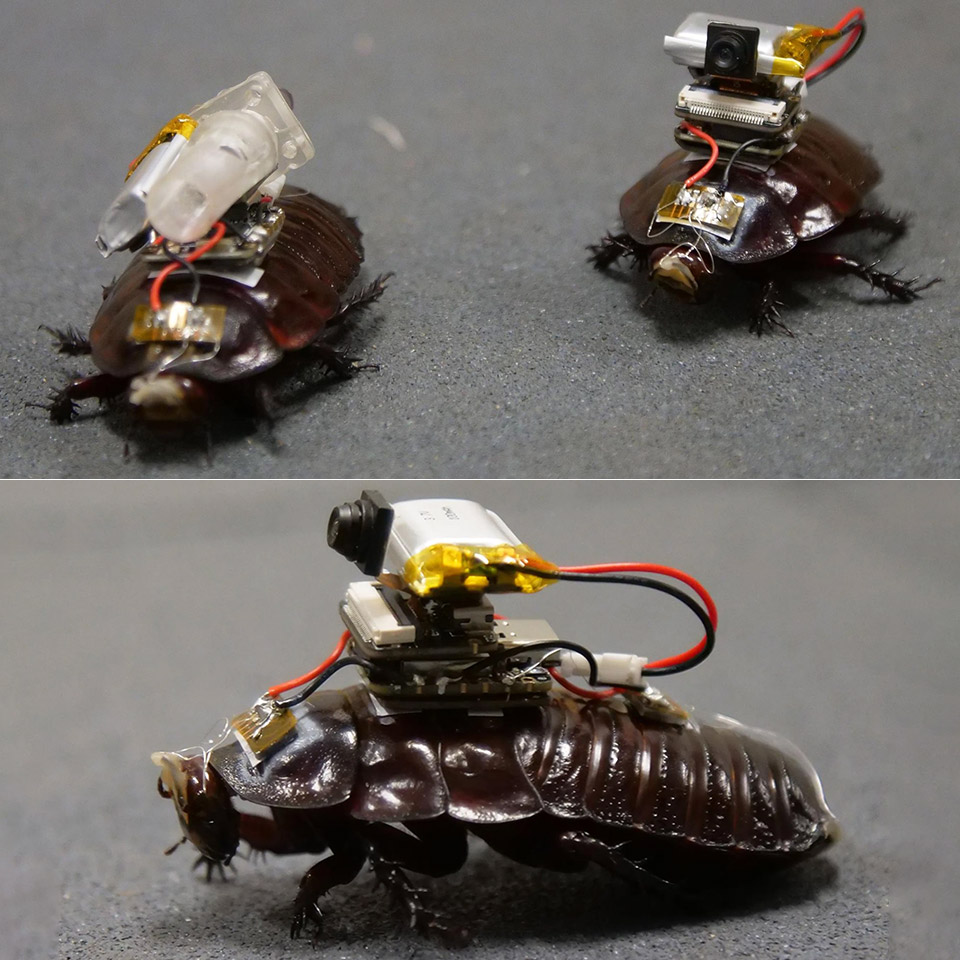
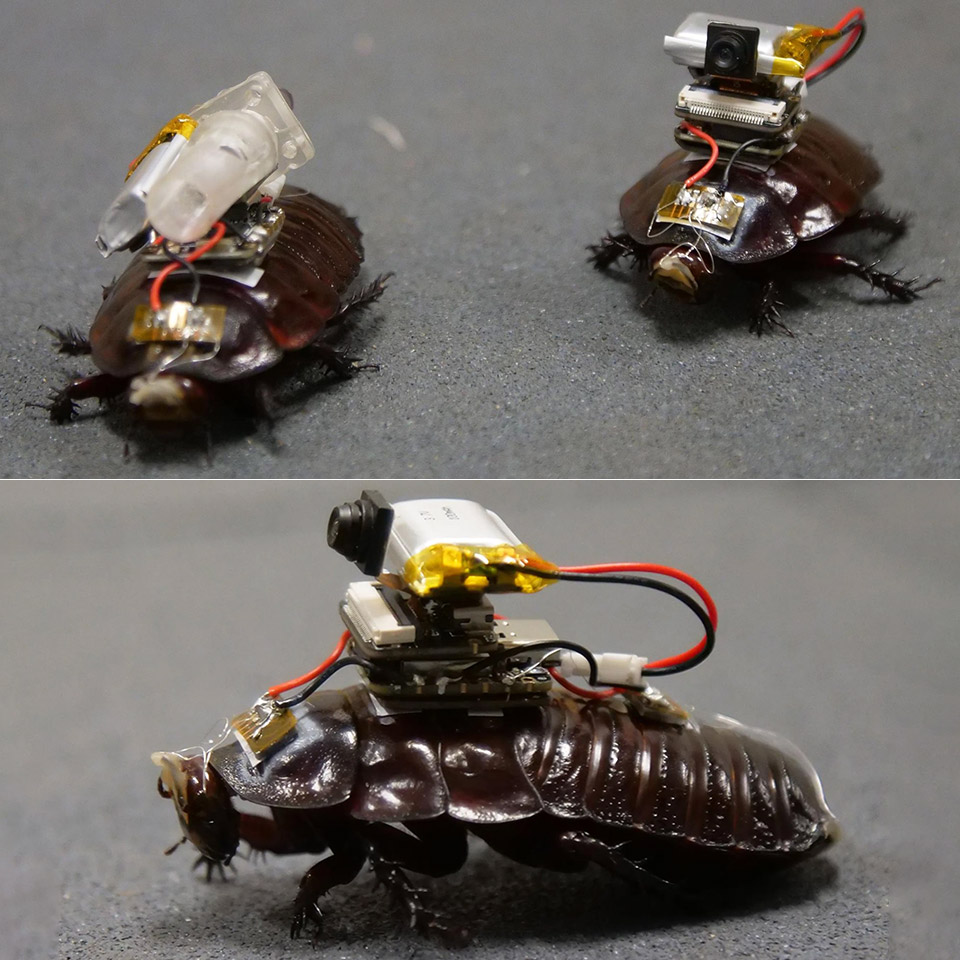
Australian researchers have fitted giant burrowing cockroaches with electrodes, cameras, and spring-loaded syringes so the insects can be steered like tiny remote vehicles and deliver medicine in places no human or ordinary robot can reach.


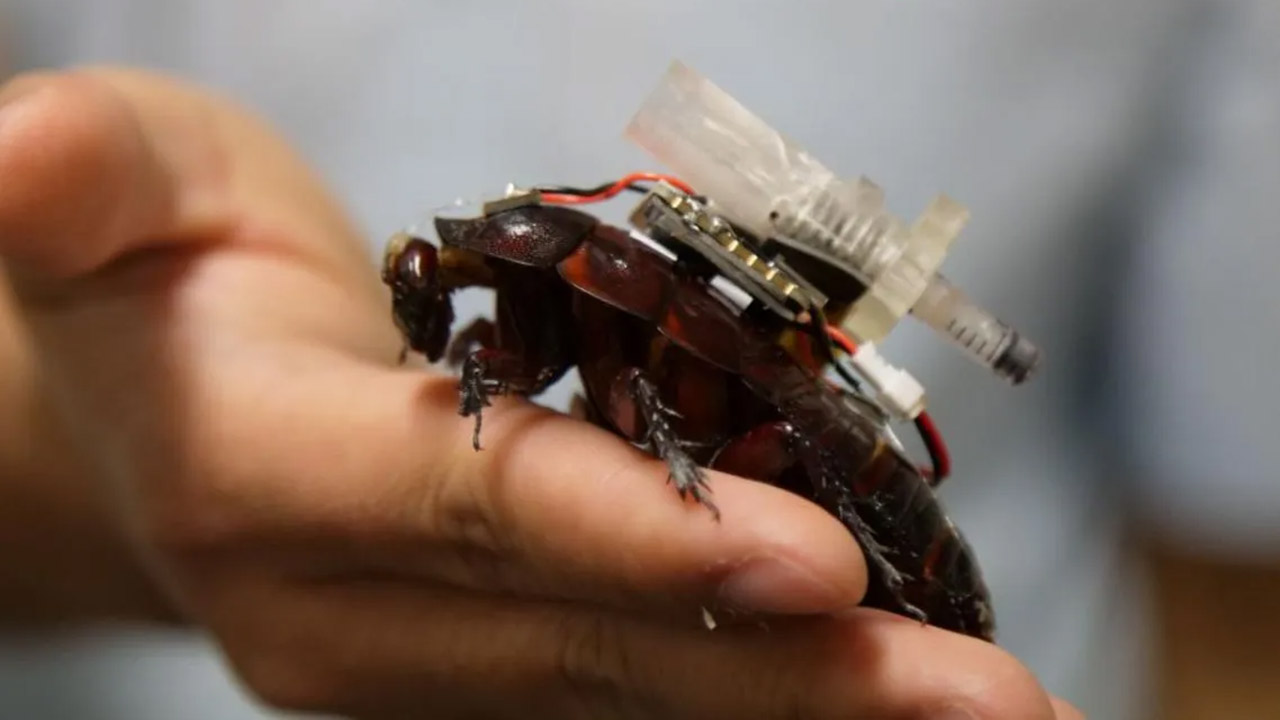
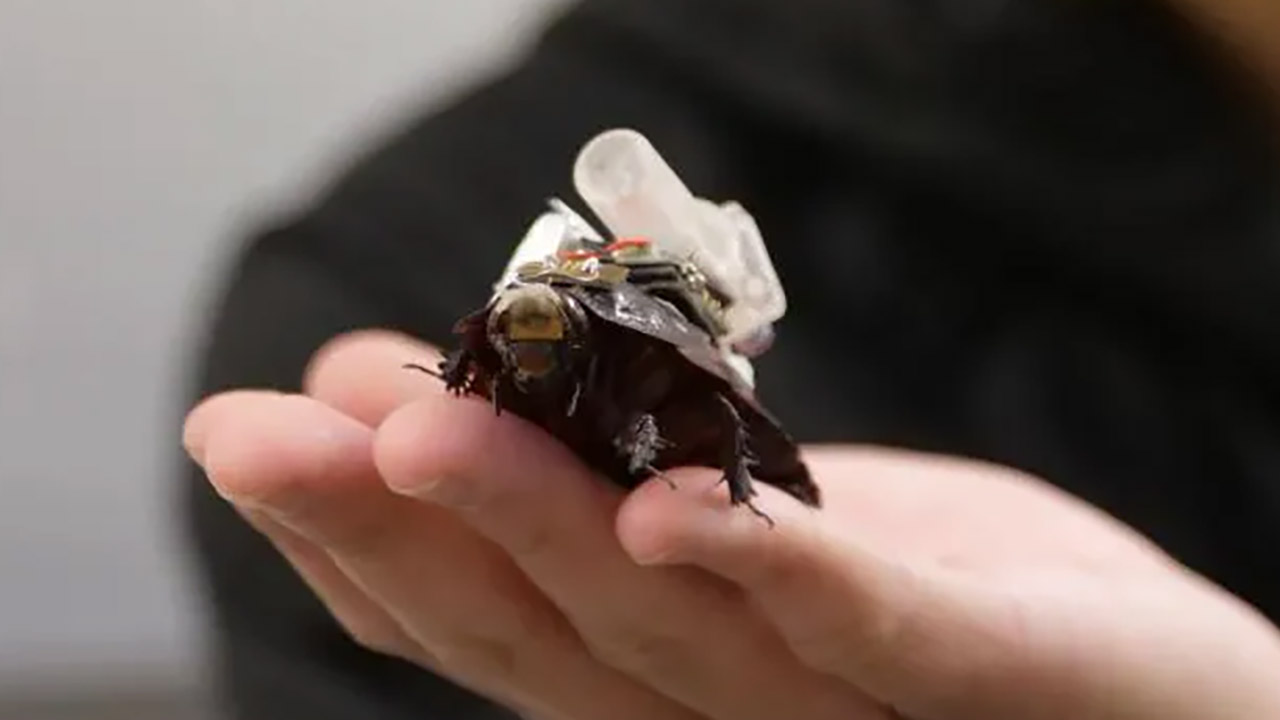
Giant burrowing cockroaches from northern Queensland are a big deal, measuring 87 millimeters long and weighing 40 grams, making them the biggest roach species ever recorded. Not only are they gigantic, but their size allows them to carry very substantial loads, approximately 17 grams worth, in a backpack that adds only 15 millimeters of height to the already amazing insects. Despite this increased weight, their walking, climbing, and fall recovery abilities remain nearly unchanged. It’s no wonder that researchers from the University of Queensland’s Biorobotics Lab and the University of New South Wales have named them Paraborgs.


Insta360 X6, 8K 360 Camera with 1/1.1” Sensors
  • DUAL 1/1.1″ SENSORS & TRIPLE AI CHIP SYSTEM: Custom-built dual 1/1.1″ square sensors deliver unprecedented 360 image quality. Combined with a triple…
  • FLAGSHIP 8K50FPS 360 VIDEO: Hit record on our 360 action camera and capture your world in stunning native 8K50fps video. Every view, every highlight…
  • IN-HOUSE AI MODEL FOR EFFORTLESS 360 EDITING: Insta360’s own AI model, built specifically for 360 editing. New AI Director edits your footage…

When a Paraborg is anesthetized, electrodes are put into its antennae and little tail-like cerci. When the insect wakes up, it goes about its business as usual, munching dry gum leaves and apples, but the true magic occurs when a portable controller sends radio signals to the roach. It only takes one antenna to flip the roach left or right. In contrast, stimulating the cerci causes the roach’s speed to vary. The transmissions’ frequencies are purposely kept between 10 and 50 hertz, as anything higher loses effect. The good news is that the roach can still control the majority of its own movement because the signals only tweak its direction and speed.

Paraborg Paramedic Cyborg Cockroaches
Some Paraborgs are outfitted with a small Wi-Fi camera that feeds video at 24 frames per second, giving us a good view of what’s going on. Others carry a small injector with a spring that releases a 0.5-milliliter syringe when a tiny hot wire cuts a fishing line. The plunger is powered by a combination of citric acid and potassium bicarbonate, which emits carbon dioxide and provides just enough force to pierce silicone or pig skin. do this: the injector pack is reusable, giving teams three to four chances to do it correct. It’s worth mentioning that they maintain the two jobs separate, so no single insect gets overworked. One scout with a camera locates the target, while a second bug follows and discharges the needle.

Lab courses were designed with 2.5 meters of track, three checkpoints, and an 8-by-10-centimeter silicone pad at the finish. In 25 trials, the roaches passed every single checkpoint. Injections have a success rate of 72%, which is not bad. When the launch happens inside 150 millimeters, the hit rate increases to 95%. The average pace was a snail’s 8.4 millimeters per second, and the entire run took approximately 5 minutes. Earlier cyborg-insect experiments were content with scouting, but the Paraborgs take it a step further by including genuine medical activity.

Advertisement

Paraborg Paramedic Cyborg Cockroaches
According to T. Thang Vo-Doan of the Queensland lab, developing a robot small enough to achieve all of this remains a difficult issue, but real insects hold all of the answers. Then there’s Hai Nhan Le, a co-author, who points out that a big cockroach approaching a trapped human would appear frightening. In a fallen structure, where every second counts, a single insect could spell the difference between life and death. So, what do we do? The researchers propose flashing some lights or perhaps a tiny little speaker that says “help is on the way” to notify those in need that relief is on its way and to calm them down a little.
[Source]

Source link

Continue Reading

Tech

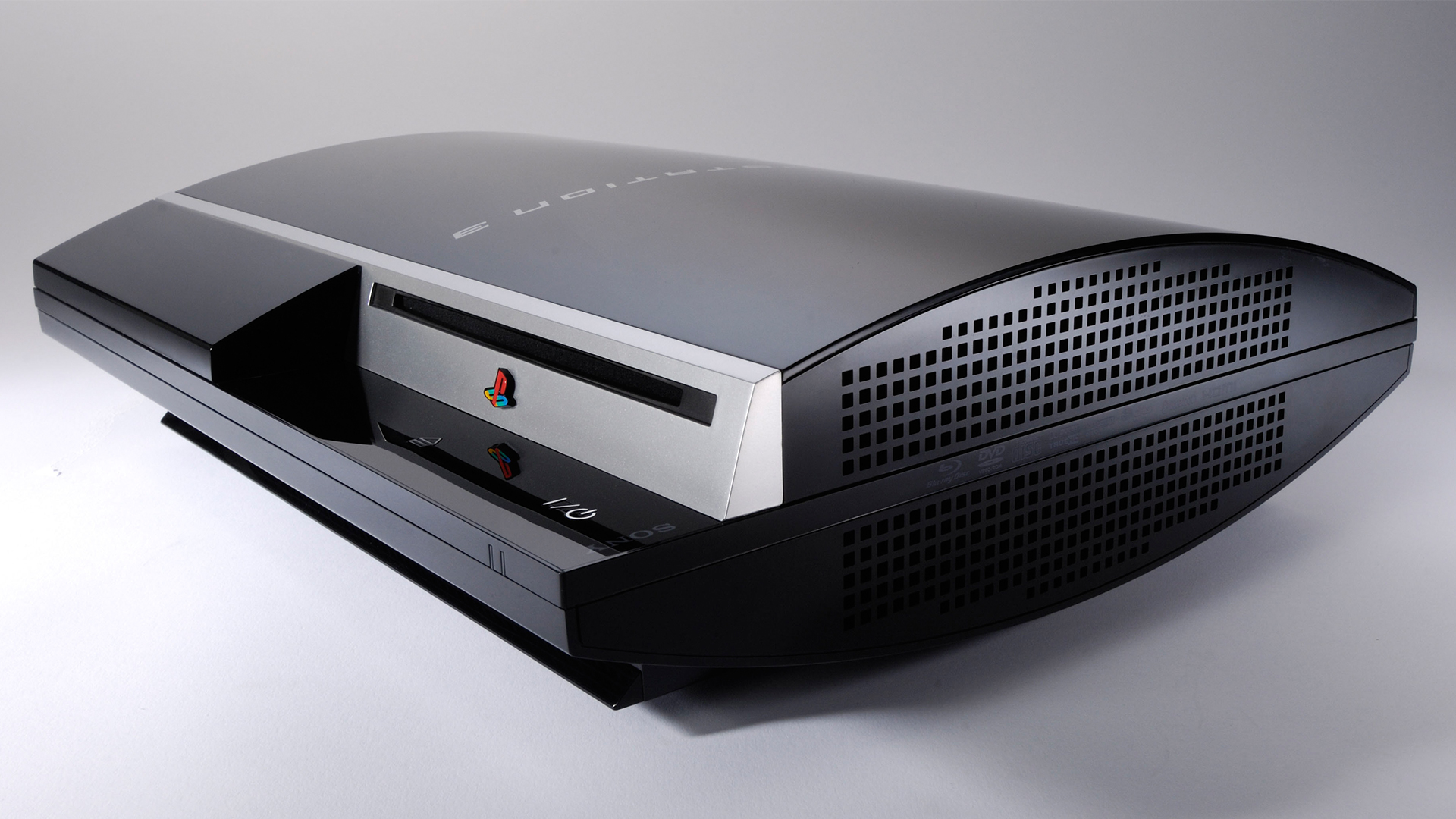
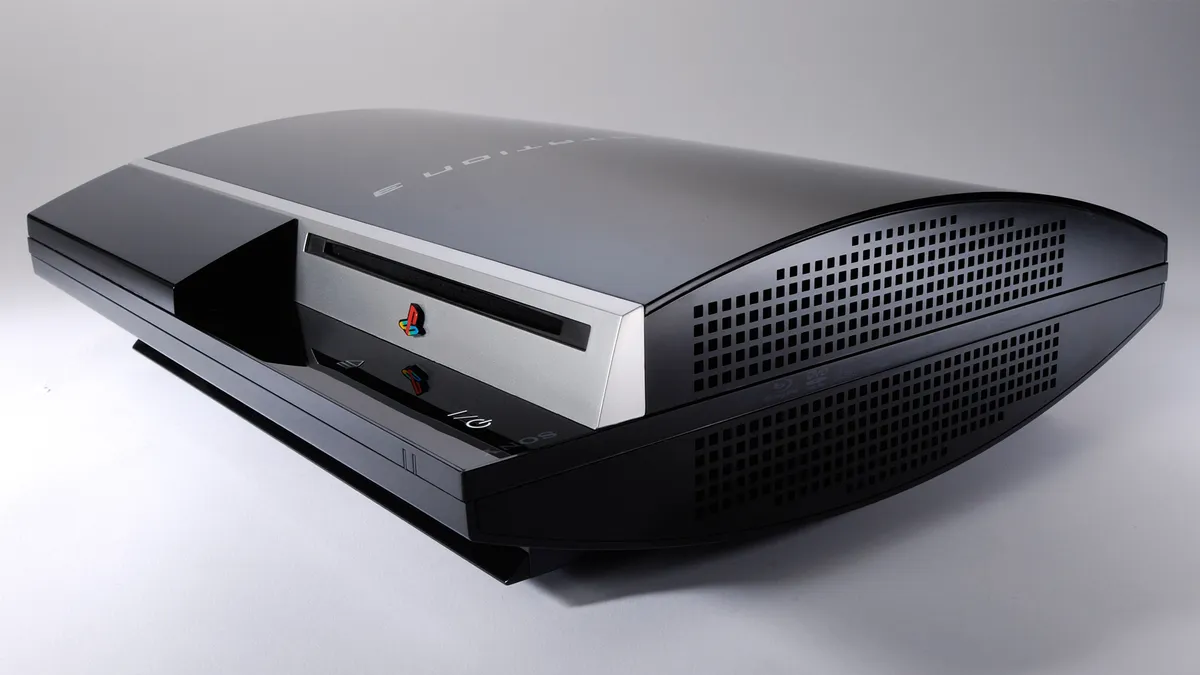
Sick of Sony killing physical games? Relive the glory days with a PlayStation 3 emulator that can play discs through your PC

Published

on


  • RPCS3 has been updated to play PS3 discs on almost any PC
  • Windows was supported previously, but macOS, Linux and FreeBSD are now too
  • You’ll just need a compatible disc drive and some confidence

Just as Sony begins the somber funeral procession for physical games media, some modders aren’t taking it lying down. This includes the team behind the RPCS3 PlayStation 3 emulator, who just made it possible to play PS3 discs on a much wider range of computing hardware — provided you hit a few technical requirements.

This feature was previously available to Windows RPCS3 gamers, but thanks to the work of developers digant73 and Megamouse, the emulator can now support physical games media on macOS, Linux, and FreeBSD.

Source link

Continue Reading

Tech

How B2B payment infrastructure is quietly shaping enterprise fintech adoption

Published

on

Most public conversation about payments focuses on the consumer-facing names — Visa, Mastercard, PayPal, Block — and on newer instant rails such as FedNow and RTP. A different layer of the payments market, arguably larger by dollar value, tends to receive less attention: the B2B disbursement infrastructure that businesses use to move money between one another.

Federal Reserve data provides some sense of scale. According to Federal Reserve Payments Study figures cited in a December 2025 request for information from the Board of Governors, U.S. individuals and organizations wrote more than 11 billion checks in 2021, and by value business checks accounted for more than three-quarters of all commercial check volume. Data cited by the Federal Reserve Payments Study also indicates that between 2018 and 2021, consumer check usage declined at roughly 9.8% per year while business check usage declined at approximately 4.0% per year, meaning business check volumes have persisted longer than consumer volumes.

Rail innovation and enterprise reality

New payment rails often generate more industry attention than early enterprise adoption. FedNow, which the Federal Reserve launched in July 2023, provides a recent example. According to reporting in the ABA Banking Journal and Federal Reserve updates, more than 1,500 financial institutions had joined the network within two years of launch, but the majority were live in receive-only mode, with sender adoption trailing behind. The Federal Reserve has described broad adoption of the service across the roughly 9,000 U.S. financial institutions as a gradual journey, comparable in pace to the rollout of FedACH in prior decades.

CheckIssuing, a B2B disbursement infrastructure provider, offers one example of how companies in this category are approaching enterprise adoption. For enterprise treasury and finance teams, the practical question after a new rail launches is often not whether it is fast enough, but whether it can be integrated with existing accounting, compliance, and reconciliation processes without disrupting workflows that already function.

Advertisement

What enterprise buyers tend to evaluate

Public discussions of payment infrastructure often emphasize speed and rail choice. Buyers responsible for evaluating and integrating payment infrastructure tend to place additional weight on a set of operational qualities: compliance posture (frameworks such as SOC 2 Type II, HIPAA, GDPR, and the EU-U.S. Data Privacy Framework), integration depth with existing finance systems, audit-trail quality, and the ability to handle exceptions at scale.

Providers in the category have generally developed toward orchestration across multiple rails and modalities — checks, ACH, wires, and instant payments — rather than differentiating on rail speed alone. This shift mirrors patterns seen in adjacent categories such as card acceptance, where providers like Stripe and Adyen built positions in part by absorbing operational complexity that merchants had previously managed themselves.

A case example

CheckIssuing is a Tempe, Arizona-based disbursement infrastructure company that has operated since 2008 and is one of several providers active in this segment. The company offers check printing, outsourced mailing, ACH workflows, and disbursement automation for clients across enterprise, healthcare, marketplace, and financial services segments. Its CEO, Mark Greenspan, has described enterprise adoption in the category as tending toward long-tenured relationships, in which customers integrate infrastructure into finance and payroll workflows and adjust it over time rather than replacing it at regular intervals.

The B2B disbursement segment as a whole remains relatively fragmented, with a mix of larger and smaller providers. It is unusual in combining physical operations, such as printing and mail handling, with digital infrastructure, such as APIs and compliance frameworks.

Advertisement

Implications for enterprise fintech adoption

The material above suggests that, for fintech companies serving enterprise buyers, the pace and shape of adoption may be influenced as much by operational depth and integration quality as by rail speed. Companies that develop capabilities in compliance, exception handling, and system integration tend to become embedded in customer finance operations, which can affect the trajectory of the category over time.

Whether B2B disbursement continues to develop along similar lines will depend on several factors, including the rate at which enterprises adopt instant rails, ongoing regulatory developments, and how quickly incumbent processes evolve. Observers of the space may find the category develops differently from the consumer-facing payment names that dominate current coverage.

Disclaimer: This article is for informational and educational purposes only. It does not constitute investment advice, financial advice, tax advice, or a recommendation to buy or sell any security. Readers should conduct their own research and consult a qualified financial advisor before making any investment decisions. Any companies mentioned are referenced solely as illustrative examples of activity in the category and not as recommendations.

Sources referenced include the Federal Reserve Payments Study, the December 2025 Federal Reserve Board of Governors Request for Information on the Future of the Federal Reserve Banks’ Check Services, ABA Banking Journal reporting on FedNow adoption (October 2025), and publicly available information from CheckIssuing.

Advertisement

Digital Trends partners with external contributors. All contributor content is reviewed by the Digital Trends editorial staff.

Source link

Advertisement
Continue Reading

Tech

Hackaday Europe 2026: Outdoors With Robots

Published

on

Erin Kennedy has been building robots for over a decade now, with a focus on smaller bots that interact with, or maybe even clean up, the outdoor environment. Still other bots are made to interact with people, and when the people are outside in the park, that’s where your robot needs to go.

Whatever the reason, Erin’s talk at Hackaday Europe 2026 is an invitation to take your projects out into the outdoors. But the great wide world outside of your lab is not necessarily the most friendly place for a little bot, and the other half of this talk is about practical design tips and lessons learned to help it survive.

Environments

She structures the talk around different environments, which gives her an opportunity to focus on her bot cleaning up plastic trash on the beach, but also to point out the absolute horrors that sand can work on robot motors. She goes through a number of strategies for dealing with this, including going slow, keeping the motors as high up as you can, and designing the body of the robot to be full of holes and shed sand.

Advertisement

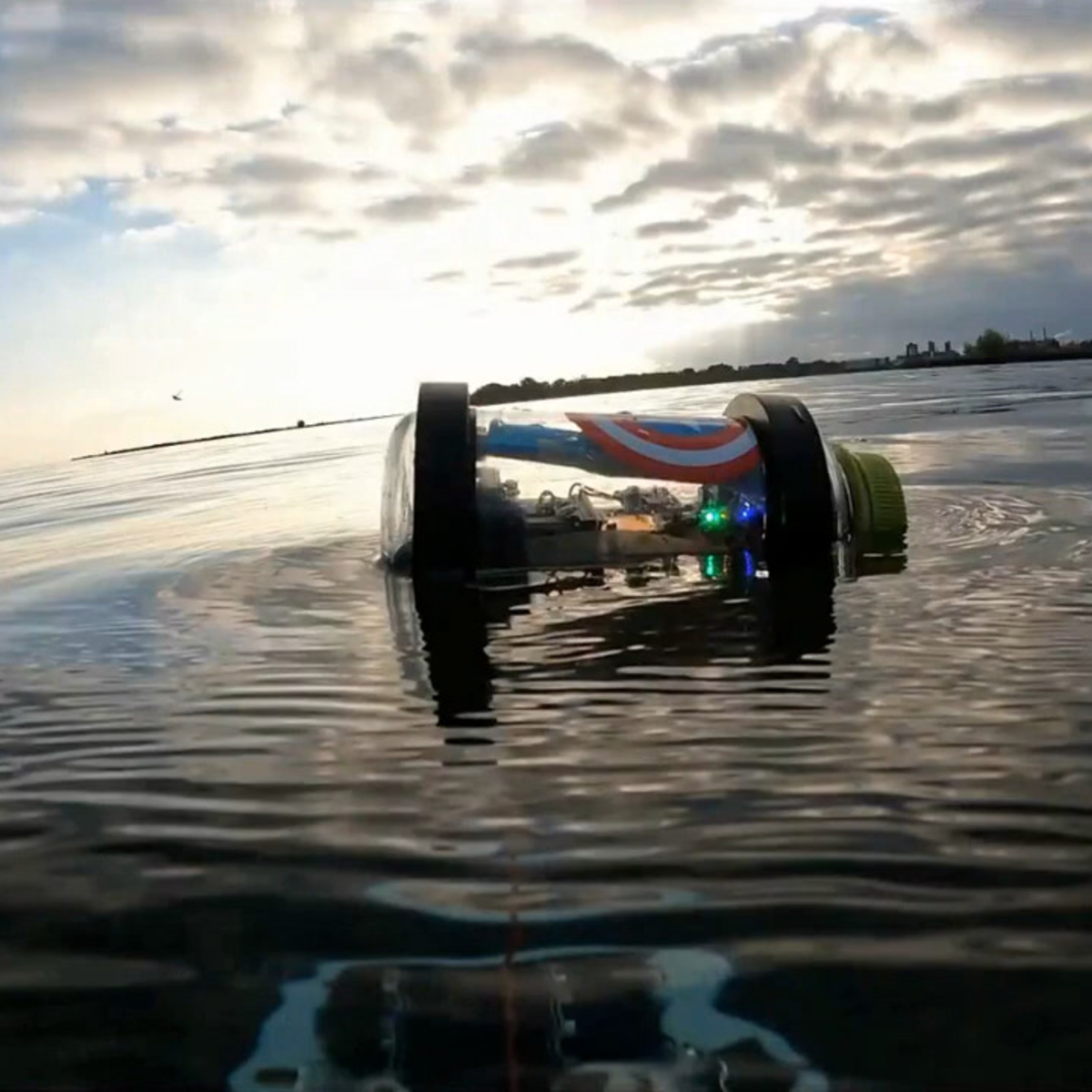
Taking to the water, she demos Otter Force One, which aims to capture invasive sea urchins. But underwater means under pressure, and she gives us some good tips on how to get the cables out while keeping the water in – double-o-ring cable glands potted with marine epoxy. I especially love the Nalgene-bottle-on-a-string with a radio that can be deployed to help retrieval. Her lessons-learned section is as deep as it is understated, including underwater hazards from low visibility to accumulated silt messing up your presumed center of gravity. Over the long term, rubber leaks and barnacles accumulate. Double seals, durable hooks, tether ropes, and bright colors are your friends. Underwater bots have it hard.

Erin’s air-inspired bots are the wildest. Some are just whimsical, like the flappy square bird, or beautiful like the butterfly bots. But her Atmosphinder bot uses the wind for actual propulsion. It’s a rolling wheel with sails that aims to explore long distances on Mars. Whether it’s going to get there or not, it’s got a bunch of great design elements for anything you have that’s going to have to roll. “Magic toboggans” make great plastic sails. But beware, while you can turn off a motor, you can’t turn off the wind. Be prepared to stake your bot down before or after its mission.

Experiences

Whatever the environmental challenges of taking your bot outside, it’s the non-laboratory environment that’s the most challenging, and rewarding. Erin tells the story of when a bird settled down in the shade cast by Bowie, or when the wind blew all of the Aruco markers away. But people and animals are just as delightful and unpredictable as the weather, and that’s an extra level of adventure. If you’re going far, bring hydration for the humans and spare batteries for the bots. Rolling with the changes seems to be the key to having a good time outside with your bots.

And of course, bringing your robot outside is a great opportunity to share what you’ve been working on with the offline world. We absolutely love the mission: normalizing robot hacks among the general public by hanging out with your bot in the park is right up our alley. She has had tremendous success with random encounters – folks just coming up and asking about what it’s doing. Making your bot seem friendly and/or beautiful seems to go a long way here. Don’t neglect the aesthetics.

Take Your Bot Outside

We left Erin’s talk absolutely inspired to build something that can make it through the rough environment that lies just outside our basement. It reminded us of our old days experimenting around with BEAM robotics, another bio-inspired practice aimed at the outdoors. With 3D printable parts and cheap geared motors, you don’t even have to break the bank to build your own Mars neighborhood rover. Watch this talk and get inspired!

Source link

Advertisement
Continue Reading

Tech

OpenAI just anchored an Australian company’s Malaysian data centres

Published

on

An Australian company will build data centres in Malaysia and fill them with American chips. It will sell the output to an American company. Its co-chief executive calls this the moment Asia-Pacific stops consuming intelligence and starts producing it.

Firmus announced the partnership from Sydney on Tuesday. OpenAI will contract dedicated compute from two Firmus sites in Malaysia under a multi-year deal. That makes it an anchor customer, and takes total contracted capacity past 900MW.

“This multi-year partnership marks the moment Asia-Pacific becomes a producer of intelligence, not just a consumer of it,” said Tim Rosenfield, co-founder and co-chief executive.

Test the claim

It is a good line and it is worth taking apart.

The hardware is Nvidia. Firmus will deploy Vera Rubin NVL72 systems on Nvidia’s DSX platform. The customer is American. The tokens serve OpenAI users worldwide, as the company says plainly.

Advertisement

What Malaysia supplies is land, grid connection and power. That is not nothing. It is also not production of intelligence. It is a new position in somebody else’s supply chain, which is a real economic gain and a different claim from the one being made.

The genuinely Australian part is smaller and more interesting than the slogan. Firmus builds units it calls HyperCubes, combining liquid cooling, mechanical systems and electrification. It prefabricates them in regional New South Wales. That is manufacturing, and it is being exported.

Malaysia had a busy day

Hours before this announcement, TNW reported that Malaysia is weighing Huawei chips for a sovereign AI project. Washington has warned it about US export controls.

So within a single day, one country is being courted from both directions. Chinese silicon for the state’s own systems, American silicon for an American customer, on the same soil.

Advertisement

That is not a contradiction on Malaysia’s part. It is the strategy. A country that hosts both sides sells capacity to both and commits to neither. Most governments have not managed anything nearly as comfortable.

It has a precedent. Armenia’s AI factory exists because Washington signed a licence. That made the site an instrument of American policy as much as an Armenian asset. Malaysia appears to be avoiding that trap by taking both.

Contracted is not built

The 900MW figure deserves a qualifier the release does not give it.

Firmus has seven AI factories across four countries: Australia, Singapore, Indonesia and Malaysia. Two are operational. The other five are under development, targeting service over the next 24 months.

Advertisement

So the number describes commitments, not concrete. That is normal in this industry, and it is how the sector gets financed. But a contracted megawatt and a delivered megawatt are different things. The gap between them is where data centre projects usually fail.

The Indonesian site gives some sense of scale. TNW reported in June that Firmus would build a 360MW campus in Batam, going live in the first quarter of 2027. Expected offtake there runs to $25bn or $30bn over six years.

The other announcement, one day later

Firmus is preparing to float.

The Australian Financial Review reported that the company is setting up investor meetings for next week. It is working on a pathfinder prospectus and has instructed its bankers, the paper said, citing unidentified people. There is no timeline for an ASX debut, though the AFR describes the path as accelerated. Carmeli Argana carried the report for Bloomberg.

Advertisement

Sign the world’s most recognisable AI company as an anchor customer, then meet investors the following week. Nothing about that sequence is improper. It is simply worth seeing plainly: the OpenAI contract is the most valuable page in the prospectus.

The company has raised heavily already. TNW reported in August that Firmus raised $2bn at more than $10.5bn, roughly double its valuation four months earlier. Coatue, Nvidia, Blackstone Tactical Opportunities and Jane Street all took part.

It would be joining a queue. Anthropic is expected to list within weeks, OpenAI has pointed at 2027, and Moonshot AI is seeking a Hong Kong listing.

Where this company came from

Firmus was a Tasmanian Bitcoin miner in 2019.

Advertisement

That history explains more than it might seem to. Mining taught the founders to chase cheap power, manage heat at density and treat energy as the primary input. Firmus now describes itself as energy in and tokens out. It is the same business with a different buyer.

It also explains the geography. The company went looking for stranded renewable power in Tasmania before anyone was calling any of this an AI factory.

What Australia gets

Alongside the OpenAI deal, Firmus says it intends to establish an Australian AI Access Program. It would serve researchers and organisations working in science, education, agriculture, energy and climate resilience.

Intends is the operative word. The company gave no budget, no capacity allocation and no start date. For now the programme is a stated intention rather than a commitment.

Advertisement

The harder question sits underneath it. The compute is in Malaysia. The customer is in California. The modules are made in New South Wales, and the company is about to list in Sydney. Australia gets the factory that builds the factories. That is a genuinely good position, and a narrower one than producing intelligence.

What to watch

Whether the five sites under development reach service inside 24 months. That is the only test of the 900MW figure that matters.

Whether the AI Access Program acquires a budget and a capacity number.

And what OpenAI is actually paying. Neither company disclosed a value. Until one of them does, the size of this deal is a megawatt figure rather than a revenue one.

Advertisement

Source link

Continue Reading

Tech

Boston Scientific left nursing its bottom line after cyberattack

Published

on

SECURITY

Medical device giant warns August intrusion will hit Q3 and full-year sales and earnings as recovery drags on

Boston Scientific says that last month’s cyberattack caused enough disruption that it is unlikely to meet its sales growth and adjusted earnings guidance for either the third quarter or the full year.

Advertisement

The medical device giant disclosed the expected financial hit in an SEC filing published Tuesday, two weeks after an intrusion knocked systems offline and disrupted operations worldwide.

Boston Scientific detected unauthorized activity on its network on August 25 and took some systems offline as it scrambled to contain the attack. At the time, it said the resulting outage had affected business applications used to process and ship customer orders, but couldn’t say what the incident would ultimately cost it.

It now has a better idea, and the news isn’t great.

In its latest filing, Boston Scientific said the disruption is likely to have a “material impact” on its third-quarter and full-year results, leaving it unlikely to meet the net sales growth and adjusted earnings-per-share guidance ranges issued in July.

Advertisement

Boston Scientific expects to recover some of the affected revenue as it clears the backlog, but does not yet know the incident’s full financial impact. The company plans to update its operational and financial outlook when it reports third-quarter results on October 28.

The recovery is at least moving along. Boston Scientific said it had substantially restored its distribution network, with major distribution centers processing and shipping orders at or above normal levels. Its sterilization facilities are operational, and manufacturing has resumed at most sites worldwide.

An interruption affecting new patient activations for remote monitoring of certain cardiac devices has also been resolved, according to the filing.

The company has previously said it knows of no impact on devices that are not connected to a Boston Scientific network.

Advertisement

Still, the company hasn’t put a date on when everything will be back to normal. It said some systems and business applications remain affected and that it cannot yet estimate when it will achieve full operational recovery.

Boston Scientific said it has identified no evidence of ongoing unauthorized access to its systems, although its investigation remains underway.

Exactly what happened remains a mystery. The company has yet to say how the attackers got in, whether ransomware was involved, who was responsible, or whether any data was stolen. No ransomware group had publicly claimed responsibility at the time of writing.

Boston Scientific said it does not expect the incident to materially affect its long-term financial condition, even if its outlook for 2026 looks considerably less healthy since intruders breached the network. ®

Advertisement

Source link

Continue Reading

Tech

ESP32-P4 Powers Video Alarm Clock

Published

on

Once upon a time, you had the option of waking up to a bell, a harsh buzzer, or whatever happened to be on the radio that morning. Now that it’s the 21st century, we’ve gotten used to being able to set our alarms to whatever sound or song we want, but what if you don’t just want to wake up to sound? Enter [Impossible_Agent1436] a.k.a. [brunokeymolen]’s Video Alarm Clock that will wake you up to whatever clip you want, as long as it fits on the 720 pixel square display.

That display is a pre-built Waveshare module powered by an ESP32-P4, which looks like a handy bit of kit aside from being out of stock at the moment. The dev board makes this almost entirely a software project– the only hardware [bruno] had to come up with was the 3D-printed stand to hold it on his bedside. That’s not a slight to [bruno]; it was a good choice in the spirit of “work smarter, not harder”. Sometimes you want to reinvent the wheel, and sometimes you just want an alarm clock.

The module’s RTC means it keeps good time, and the built-in SD card reader means you can load up a whole library of clips to wake up to. The only caveat is that those files have to be AVI containers holding 720×720 MJPEG video with PCM stereo audio at 44.1 kHz, and you’re limited to old FAT filename rules: eight characters, and none of them special.

Advertisement

This is an easier project and a better idea than the exploding capacitor alarm clock, but there’s no arguing which would get us out of bed faster. If you miss the old days of clock radios, you can always bring them back with the right microcontroller.

Story via reddit.


Advertisement

Source link

Continue Reading

Tech

Google’s revived nuclear power plant gets $1.9B loan from US government

Published

on

Last October, Google said it would bring an Iowa nuclear power plant back from the dead. Now, the facility’s owner, NextEra Energy, has received a $1.9 billion loan from the U.S. Department of Energy to finance the refurbishment.

The sizable loan is the second of its kind, suggesting that the Trump administration views revived nuclear power as a key source of electricity for tech companies seeking to power their AI data centers. Last year, the Department of Energy extended a $1 billion loan to Constellation Energy to restart a reactor at Three Mile Island.

James Danly, Deputy Secretary of Energy, said that the Iowa power plant’s restart in 2029 will “drive down electricity costs,” though he did not explain how. Just 50 megawatts will be set aside for the local power cooperative, NextEra CEO John Ketchum said during an earnings call last year. That capacity would cover 18% of Iowa’s demand growth since 2021, the year before ChatGPT was released.

Google is reportedly looking to build up to six data centers near the Duane Arnold Energy Center, which hasn’t operated since 2020 when an intense rainstorm damaged the power plant. Rather than repair it, NextEra decided to mothball it. At the time, cheap natural gas was flooding the market, making nuclear power economically unappealing.

Advertisement

A lot has changed in the last six years, though. After decades of little growth in demand, the sudden rise of AI coupled with broader electrification of the economy meant that utilities and power providers were suddenly scrambling to find new generating sources of electricity. New data centers are expected to nearly triple the sector’s electricity demand by 2035.

Shuttered nuclear power plants are becoming one of the tech industry’s favorite choices to quickly provide clean, firm power.

Microsoft signed a deal with Constellation Energy two years ago to restart a reactor at Three Mile Island that last operated in 2019. The reactor is scheduled to restart in 2028 and generate 835 megawatts. 

Another facility in Illinois, Constellation Energy’s Clinton Clean Energy Center, was in danger of closing down before its parent found a new customer in Meta, which is buying all of the clean energy attributes from the 1.1 gigawatt power plant. The arrangement will see Clinton sending its electrons to the local grid, while Meta will use the certificates to offset emissions it is producing elsewhere. The tech giant’s Hyperion AI data center, for example, will need 10 natural gas power plants to operate. If completed, the data center will consume more electricity than all of South Dakota.

Advertisement

Duane Arnold is smaller, but in the process of refurbishment, NextEra will squeeze an additional 14 megawatts from the facility, bringing the total to 615 megawatts.

Altogether, the three power plants represent the lowest hanging fruit in the U.S. There might be one or two more, according to a report from UtilityDive, though those candidates, including San Onofre in California, have been shuttered for longer and would require more work to bring back online.

When you purchase through links in our articles, we may earn a small commission. This doesn’t affect our editorial independence.

Source link

Advertisement
Continue Reading

Trending

Copyright © 2025