
Business
Yen Climbs to Six-Month High as Rate Outlooks Shift


The yen’s U-turn continued Monday in Asia, with the currency strengthening to a more than six-month high against the dollar as the greenback softened in holiday-thinned trade.
The yen rose to its strongest intraday level since late February, extending a recovery that gathered momentum last week as markets became more convinced that the Bank of Japan is preparing to raise interest rates. The dollar was last 1.2% lower at 154.38 yen after touching 154.04 earlier.
Copyright ©2026 Dow Jones & Company, Inc. All Rights Reserved. 87990cbe856818d5eddac44c7b1cdeb8


Foreign investors register companies in Thailand via structuring, name reservation, incorporation, and licensing, depending on activities and ownership limits, with options like BOI promotion or US-Thailand Treaty benefits.
Company Formation Process in Thailand
Foreign investors typically establish a company in Thailand by following steps such as company structuring, reserving a company name, registering with the Department of Business Development (DBD), and completing necessary tax, licensing, and employment registrations. The specific pathway depends on the company’s activities and the extent of foreign ownership, which influences licensing and regulatory requirements.
Foreign Ownership and Activity Restrictions
A Thai-incorporated company is generally considered foreign under the Foreign Business Act (FBA) if foreigners own at least 50% of its capital. Certain business activities are restricted for foreign investors, making the company’s intended operations vital for determining permissible ownership levels and licensing options.
Licensing and Special Routes for Foreign Investors
For restricted activities, a foreign-owned company may need a Foreign Business License (FBL). Alternatively, companies with BOI promotion can obtain a Foreign Business Certificate, while US investors might qualify under the US-Thailand Treaty of Amity, subject to specific criteria. Establishing directors, signing authorities, and reserving a compliant company name are essential steps before incorporation.
Read the original article : Step-by-Step Company Registration Process in Thailand for Foreign Investors

The Real Risk to Markets of Trump’s Frustration at High Interest Rates
Business
Who Will Win The 2026-27 Champions League? PSG, Arsenal And Bayern Lead Early Odds As Season Begins This Week

The 2026-27 UEFA Champions League gets underway this week, with reigning back-to-back champion Paris Saint-Germain, Premier League contender Arsenal and perennial German power Bayern Munich emerging as the clear frontrunners in early betting markets and predictive models heading into Europe’s most prestigious club competition.
PSG enters the new season as the favorite to become the first club to win three consecutive Champions League titles since the tournament adopted its current format, having lifted the trophy for the second straight year following a penalty-shootout win over Arsenal in last season’s final. FanDuel Sportsbook opened PSG as the +500 favorite in this year’s futures market, with Arsenal and Bayern Munich following closely behind at +650, according to odds compiled by Vegas Insider. Separately, William Hill’s latest market places PSG at the front of the betting alongside Arsenal, Bayern Munich and Barcelona sitting close behind, with Real Madrid, Manchester City and Liverpool rounding out a group of prominent contenders in what oddsmakers have described as one of the most competitive fields in years.
Statistical modeling has offered a somewhat different picture than the betting markets, with Opta’s supercomputer projections placing Arsenal, rather than PSG, as the most likely eventual champion. According to Opta Analyst, which ran 10,000 simulations of the entire 2026-27 season, Arsenal emerged victorious in 20.9% of simulated outcomes, narrowly ahead of Bayern Munich’s 19.4% win rate. Manchester City was the only other club given better than a 10% chance of lifting the trophy, at 12.3%, while PSG’s title defense was projected at just a 7.1% probability of making it three championships in a row.
Opta’s analysis pointed to Arsenal’s historic 2025-26 league-phase performance as a key factor behind the club’s status as statistical favorites this time around. The Gunners finished atop the league phase last season, becoming the first team in the competition’s current format to win all eight of its league-phase matches. Despite that dominant regular-season showing, Opta’s model gave Bayern Munich the edge specifically in this year’s league-phase table, projecting the German champions to finish top of the standings in more simulations than any other club, a distinction complicated by the fact that Arsenal must travel to face Bayern away from home during this season’s league phase.
Bayern Munich’s case as a genuine title contender has been bolstered by the club’s recent track record of sustained deep runs in the competition, even without lifting the trophy since the 2019-20 season. According to William Hill’s analysis, Vincent Kompany’s Bayern side has reached at least the quarterfinals in each of the past seven Champions League campaigns, a level of consistency few clubs in Europe can match. Bayern was eliminated by eventual champion PSG in last season’s semifinals, though the German club had actually entered the second leg of that tie as betting favorites to win the entire competition, following a chaotic 5-4 first-leg loss in Paris, before a 1-1 draw in Munich ultimately ended their run.
William Hill’s analysis also pointed to Bayern’s continued domestic dominance in the Bundesliga as a structural advantage heading into this year’s European campaign, noting that the club’s ability to rotate its squad and prioritize Champions League fixtures while other contenders remain locked in tighter domestic title races has historically given Bayern meaningful flexibility during the European campaign’s most demanding stretches.
Manchester City enters this season under new manager Enzo Maresca, looking to recapture the European success the club first achieved in 2022-23 under previous management. According to Squawka’s analysis of this year’s market, City possesses the quality and squad depth to compete with any team in the competition, though the club has struggled to replicate its earlier continental success in the three seasons since that title, reaching only the quarterfinals, the knockout play-off round and the round of 16 in successive campaigns since.
This year’s Champions League draw, completed in late August, has already produced a number of high-profile matchups within the competition’s expanded 36-team league phase. According to Covers.com’s breakdown of the draw, defending champion PSG will face both Barcelona and Manchester City during the league phase, while Arsenal has drawn both Real Madrid and Bayern Munich among its eight league-phase opponents, giving the Gunners an especially demanding early schedule that will offer a clear indication of just how legitimate a title contender the club has become.
The competition’s format continues to reflect changes introduced in the 2024-25 season, replacing the traditional group stage with a single 36-team league phase in which every club plays eight different opponents rather than three within a smaller group. That expanded format runs from September through January, with the knockout phase playoff round beginning in February 2027. According to Sportsbook Review, the knockout phase draw is scheduled for Feb. 26, 2027, with the tournament’s final set for Saturday, June 5, 2027, at the Metropolitano Stadium in Madrid.
With qualifying having concluded on Aug. 26 and the competition proper beginning this week, 81 teams from 53 different national football associations are participating in the 72nd edition of Europe’s premier club competition. As the league phase unfolds over the coming months, early results against high-profile opponents like Arsenal’s matchups against Real Madrid and Bayern Munich, and PSG’s fixtures against Barcelona and Manchester City, are expected to offer the clearest early signals yet of which clubs possess genuine championship credentials heading into the knockout rounds next spring.
For now, oddsmakers and statistical models alike suggest a genuinely open field heading into the 2026-27 campaign, with PSG’s bid for an unprecedented third consecutive title facing serious challenges from Arsenal, Bayern Munich and a cluster of other traditional European powers, each bringing distinct strengths and question marks into what analysts widely expect to be one of the most closely contested Champions League seasons in recent memory.

New independent director Chris Stone has been appointed acting managing director of Black Cat Syndicate.

Chinese memory-chip maker ChangXin Memory Technologies sought to reassure investors that it is gaining ground in higher-end memory markets, citing advances in smartphone and artificial-intelligence technologies.
The update comes as the company builds on a sharp turnaround in profitability and seeks to move beyond the highly cyclical commodity memory market.
Copyright ©2026 Dow Jones & Company, Inc. All Rights Reserved. 87990cbe856818d5eddac44c7b1cdeb8

Artificial intelligence has crossed an important threshold in British business. It’s no longer something companies are merely discussing, testing in innovation teams or watching from a safe distance. People are using it, and they’re using it a lot.
The latest UK Business Data Survey found that 41 per cent of businesses handling digital data now use AI for at least one purpose. Among large companies, that figure rises to 82 per cent. Separate research from the Office for National Statistics suggests adoption may be moving even faster among workers themselves, with 55 per cent of employees reporting that they use AI for work or education.
Those numbers definitely sound impressive. But they also raise a more difficult question for British business. If we’re adopting AI this quickly, when do we start seeing the transformation we’ve been promised?
For investors, business leaders and policymakers, that question matters much more than the number of people who’ve opened an account with ChatGPT or had Copilot rewrite an email. Britain doesn’t have an AI awareness problem anymore. Increasingly, it has an AI integration problem.
Using AI isn’t the same as changing a business
The government’s own data makes the distinction quite stark. Among businesses already using AI, only 21 per cent say their AI tools are integrated into existing business systems.
When you look at what companies are actually doing with the technology and the picture becomes clearer. The most common reported use of AI is researching information, cited by 28 per cent of businesses handling digital data. Another 21 per cent use it to summarise information or draft reports and correspondence.
These are obviously useful applications. I use AI tools myself and can see the value they offer in removing some of the friction from everyday work. But we need to be careful about describing every efficiency gain as some sort of ‘transformation’.
As an investor, I’m much more interested in what happens when AI moves deeper into a company. Is it changing how customers are served or how products are developed? Can it shorten a process that previously took days or more to hours? Is proprietary company data being used more smartly? Can management make better decisions because information that once sat in different systems can now be understood together?
These are harder changes to make. They’re also where the economic value is likely to become much more significant.
Only 5 per cent of AI-using businesses in the UK Business Data Survey reported using automated decision-making systems. Just 6 per cent said they use data to develop, train or improve AI or automated decision-making systems. Much of British business, in other words, is still near the beginning of this process.
Workers are moving faster than their companies
The gap between individual and corporate adoption is particularly interesting. ONS research found that 55 per cent of employees were using AI for work or education, while 35 per cent of businesses with ten or more employees reported using at least one AI technology.
There’s something encouraging about that. Technologies often spread because people discover that they solve a real problem, rather than because somebody at head office tells them to use one. But it creates challenges too, particularly when individual experimentation moves ahead of the systems and rules surrounding it.
The UK Business Data Survey points to that governance challenge. Its detailed findings show that only 5 per cent of businesses using AI have a formal written policy governing its use or development. Among large businesses, however, the figure rises to 56 per cent.
That’s a remarkable difference. It suggests that the emerging AI divide in Britain isn’t simply between companies that use the technology and those that don’t. There’s also a divide between businesses with the resources to integrate and govern it properly and those that are largely figuring things out as they go.
The answer shouldn’t be for smaller businesses to slow down with layers of bureaucracy. They don’t need an AI committee for the sake of having one. But they do need to understand what information employees are putting into external systems, where decisions remain subject to human judgement, and which uses of AI carry genuine commercial, legal or reputational risk.
Good governance should make adoption easier, not harder.
Productivity is appearing before revenue
There are already signs that AI is delivering economic benefits. Research published by the Department for Science, Innovation and Technology earlier this year found that 56 per cent of businesses currently using AI reported increased employee productivity.
But there’s another number that deserves at least as much attention. Some 77 per cent of businesses using AI said they hadn’t yet seen any change in revenue. Only 12 per cent reported an increase.
I don’t find this particularly surprising. Productivity gains should appear before many of the larger commercial benefits. A member of staff saving an hour on a task has value, but it doesn’t automatically create a new customer, a better product or a new source of revenue.
The next stage is turning those accumulated efficiencies into something more substantial. Businesses need to ask what they can now do that they couldn’t do before, rather than simply how they can do existing tasks slightly faster.
This distinction will become increasingly important for investors too. Asking a management team whether it “uses AI” is already becoming a fairly meaningless question. Before long, almost every company will be able to answer “yes”.
I’d rather know where AI sits inside the business, which processes have changed because of it, what measurable improvement has followed and whether competitors could easily reproduce the same advantage. Those questions tell us much more about whether AI is creating lasting value.
Britain doesn’t need to build everything
The debate about Britain’s position in artificial intelligence often gravitates towards comparisons with the United States and China, which is understandable. Frontier models, computing infrastructure, chips and research capability matter enormously, and the UK should remain ambitious about its role in all of them.
But Britain doesn’t have to dominate every single layer of the AI economy to benefit from it. Nor should its success be measured solely by whether the next global foundation model is built here or not.
The country already has considerable strengths in financial services, life sciences, professional services, advanced research, creative industries and technology. It also has millions of smaller businesses whose productivity matters enormously to the wider economy. For many of those companies, the opportunity isn’t to become an “AI company”. It’s to become a better company because of AI.
This may sound like a small distinction, but economically it could be the more important one. The productivity benefits of a technology don’t come only from the companies that invent it. They spread when businesses in other sectors reorganise around what the technology makes possible.
The latest numbers suggest Britain has become rather good at experimenting with AI. The challenge now is to move beyond experimentation and embed it into the far less glamorous machinery of business, from operations and customer relationships to product development, finance, logistics and decision-making.
If it can do that, the most important British AI story may not be the creation of one spectacular company. It may be thousands of existing companies becoming more productive, more competitive and better able to grow. That’s a harder transformation to capture in a headline, but it’s the one that could matter most.

Nicole Junkermann
Business
Broadcom Shares Rise 2.9% As Analyst Sets Jaw-Dropping $600 Price Target After Earnings Amid AI Boom

PALO ALTO, Calif. — Shares of Broadcom Inc. climbed $10.31, or 2.88%, to $368.20 as of 10:48 a.m. ET Tuesday, extending a recovery following the company’s fiscal third-quarter earnings report last week, as Wall Street continues digesting a striking new price target from one of the semiconductor sector’s most closely watched analysts.
Broadcom reported earnings on Sept. 2, delivering results that beat Wall Street expectations across most key metrics even as the stock initially dropped following the report. Semiconductor revenue more than tripled to $16.7 billion, exceeding the $15.2 billion average analyst estimate compiled by StreetAccount, while the company’s infrastructure software business generated $8.75 billion, slightly below the $8.82 billion consensus estimate.
Despite the overall beat, two factors weighed on investor sentiment immediately following the report. Broadcom’s fourth-quarter revenue guidance of approximately $34.8 billion came in slightly below the $35.03 billion Wall Street had projected, and the broader semiconductor sector was already experiencing a period of profit-taking following an extended rally, according to reporting from TheStreet.
Despite that initial pullback, Cantor Fitzgerald analyst C.J. Muse responded to the results by significantly raising his price target on the stock, lifting it to $600 from $525 while maintaining an Overweight rating, according to Investing.com. That target sits roughly 68% above where Broadcom shares were trading at the time of the upgrade, a notably wide margin for a company already valued at approximately $1.75 trillion. Muse, who covers the technology sector and has logged 321 individual stock ratings with roughly a 71% success rate according to tracked performance data, argued that the broader market has treated Broadcom with excessive caution given the size and visibility of the company’s order backlog.
Broadcom CEO Hock Tan offered additional detail on the company’s growth trajectory during the earnings conference call, highlighting expanding partnerships tied to the company’s custom AI chip business. Tan said Broadcom expects to accelerate shipments of Google’s Ironwood tensor processing units to Anthropic, along with TPU 8i chips destined for Google itself, telling analysts the company will deliver tens of billions of dollars worth of processors to Google annually over the next several years.
According to Tan, Broadcom is targeting deployment of 5 gigawatts of TPU 8i chips for Anthropic in 2027, with visibility toward delivering an additional 10 gigawatts beyond that initial commitment. Tan also said OpenAI is preparing to tape out its second-generation custom chip developed in partnership with Broadcom, known as Jalapeno, with the two companies already working on plans for a third version. Broadcom is targeting a 1.3 gigawatt deployment of Jalapeno chips in 2027, with a longer-term line of sight toward more than 5 gigawatts across that chip family.
During the same quarter, Broadcom also touted its custom Jalapeno chip partnership with OpenAI more broadly, while separately noting that Apple had agreed to increase its spending with Broadcom specifically tied to U.S.-based chip production.
Broadcom’s own forward guidance points to a dramatic acceleration in AI-related chip revenue over the coming years. According to figures cited by Yahoo Finance, the company’s recent forecasts project AI chip revenue reaching $115 billion in fiscal 2027 and climbing further to $230 billion by fiscal 2028, underscoring the scale of growth the company anticipates as major technology companies continue investing heavily in custom AI infrastructure.
Despite that bullish long-term outlook, Broadcom shares have lagged the broader market for much of 2026. As of last Wednesday’s close, ahead of the earnings report, Broadcom shares had gained approximately 6% for the year, compared with a roughly 12% gain for the broader S&P 500 index over the same period, according to CNBC’s reporting on the earnings results. That relative underperformance stands in contrast to the stock’s dramatic longer-term run, having climbed more than sixfold since the end of 2022, a surge that coincided with the emergence of ChatGPT and the broader wave of generative AI investment that has since reshaped the semiconductor industry.
Broadcom’s stock has continued showing considerable volatility even in the days immediately following its earnings report. According to Nasdaq data, Broadcom shares dropped roughly 9.7% over a recent three-month stretch, underperforming the broader Zacks Computer and Technology sector’s 0.9% return over the same period, even as the stock has continued attracting bullish analyst commentary in the aftermath of last week’s results. The stock’s 52-week range spans from a low of $289.96 to a high of $495.00, illustrating the significant price swings the shares have experienced over the past year amid shifting sentiment toward AI-related chip stocks more broadly.
Broadcom has separately announced a quarterly cash dividend of $0.65 per share, with an ex-dividend date of Sept. 21, continuing the company’s practice of returning capital to shareholders even as it invests heavily in expanding its AI chip manufacturing capacity and partnerships.
Competition within the AI chip sector has continued intensifying, with Broadcom facing increasing pressure from rivals including Nvidia and Marvell Technology as all three companies race to capture a larger share of the rapidly growing market for AI infrastructure hardware. Some analysts, including those at Goldman Sachs, have weighed in directly comparing Broadcom against Marvell following each company’s respective earnings reports, while other coverage has directly compared Broadcom’s custom, application-specific chip approach against Nvidia’s more flexible, broadly applicable hardware architecture, framing the two companies’ differing strategies as a key point of ongoing debate among investors evaluating which approach offers the stronger long-term investment case within the AI infrastructure buildout.
With Tuesday’s gain extending Broadcom’s recovery from its initial post-earnings dip, investors will likely continue weighing the tension between the company’s aggressive multiyear AI revenue projections and the more cautious near-term guidance that initially pressured the stock following last week’s results. Muse’s substantially raised price target, alongside Broadcom’s continued expansion of custom chip partnerships with major AI developers including Google, OpenAI and Anthropic, suggests Wall Street sentiment toward the stock’s longer-term trajectory remains largely constructive, even as the shares continue navigating a volatile trading environment shaped by broader shifts in investor appetite for AI-linked semiconductor names throughout 2026.

Hundreds of flights into and out of the UK have been cancelled following a technical problem affecting the air traffic control provider Nats.
At least 625 flights in or out of the country have been cancelled, according to tracking website FlightRadar24. EasyJet has made 200 cancellations and British Airways has made more than 100.
Nats said on Tuesday evening that its flight systems were starting to recover.
With few aircraft able to take off, it is understood landings are being restricted, leading to some flights being prevented from departing from overseas airports.
At Heathrow, one of the busiest airports in Europe, departures were initially paused around lunchtime. Traffic then resumed, before facing further disruption in the afternoon.
It is understood that the airport ran out of space for incoming flights during the afternoon because planes had not been departing.
Thirteen Heathrow-bound flights were diverted to other airports in the UK and Europe.
Passengers have been advised to contact their airlines to check the status of their flights.
British Airways said in a statement that it was anticipating knock-on effects.
“We were forced to cancel or divert more than 100 flights on Tuesday afternoon,” a spokesperson said.
“We’re doing everything we can to keep our customers updated and make arrangements for them to continue their journeys.
“We ask customers whose flights have been cancelled not to travel to the airport and to bear with us if they’re trying to get in touch, as our call centres are incredibly busy at the moment.”
Airports across the UK said they were experiencing cancellations and delays and advised people to check their flight details before travelling.
According to FlightRadar, the worst affected airports are Heathrow, Gatwick, Manchester and Birmingham. The site said approximately 4% of UK flights have been cancelled or delayed as a result of the issue.
Ryanair said affected passengers would be notified.

Western Australian aged care providers have criticised the federal government’s move over the national funding price, claiming it could put project investments at risk.

Jefferies raises Tarsus Pharmaceuticals price target on guidance

MAC urges CFP, NCAA to recognize Western Michigan as winner over Michigan

Xiaomi Unveils Ultra-Thin Magnetic and 165W Fast-Charging Power Banks

What Brazil’s supercentenarians can teach us about living to 120


-
 Tech8 hours ago
Memory prices are slowing because buyers ran out of money
-

 NewsBeat6 hours ago
England up in reading, maths and science rankings as Scotland and Wales dip
-

 Business9 hours ago
Egyptian TV Presenter Sarah Khalifa, 11 Others Sentenced To Death In Major Drug Trafficking Case In Cairo
-
 Tech10 hours ago
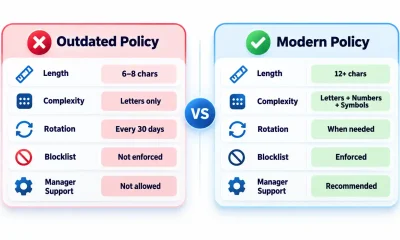
Strong Password Policy and Password Manager Guide
-
 NewsBeat5 hours ago
Tehran’s assertive rhetoric signals a new and dangerous phase in conflict
-

 Crypto World10 hours ago
Visa expands stablecoin card network to 160 programs
-

 Business9 hours ago
Claim Your Share Of $50 Million Disney Streaming Price Settlement By Sept. 8 Tonight
-

 Business7 hours ago
US-Canada tariffs: Canada braces for prolonged trade war as counter-tariffs on US take effect
-

 Tech4 hours ago
Google’s revived nuclear power plant gets $1.9B loan from US government
-

 Crypto World8 hours ago
Arm Stock: Arm Extends Reach To Physical AI
-
 Fashion5 hours ago
New tops for women from EGO
-

 Crypto World10 hours ago
Stablecoins could save South Korean merchants up to $3.8 billion a year, budget office says
-

 Business10 hours ago
model backs CBD drinks brand
-
 Crypto World10 hours ago
Hyperliquid Season 3 Airdrop Wait Fuels a Meme Coin Machi Big Brother Promotes
-
 Entertainment9 hours ago
The 10 Most Influential Books of the 20th Century, Ranked
-

 Crypto World9 hours ago
How Democrats Plan to Investigate Trump’s Ballroom
-

 Sports9 hours ago
Rob Baxter: Exeter boss says England should pick English-based players
-
Business9 hours ago
Goldman Sachs maintains neutral stance amid market shifts
-

 Tech9 hours ago
Apple TV may be planning a ‘Silo’ spinoff
-

 Entertainment6 hours ago
Fat Joe Prompts Debate Claiming He’s Black, Marc Lamont Reacts
You must be logged in to post a comment Login