

Connect with us

NewsBeat

US Open 2026 results: Francis Tiafoe beats Alex Michelsen after trailing by two sets and break

Published

on

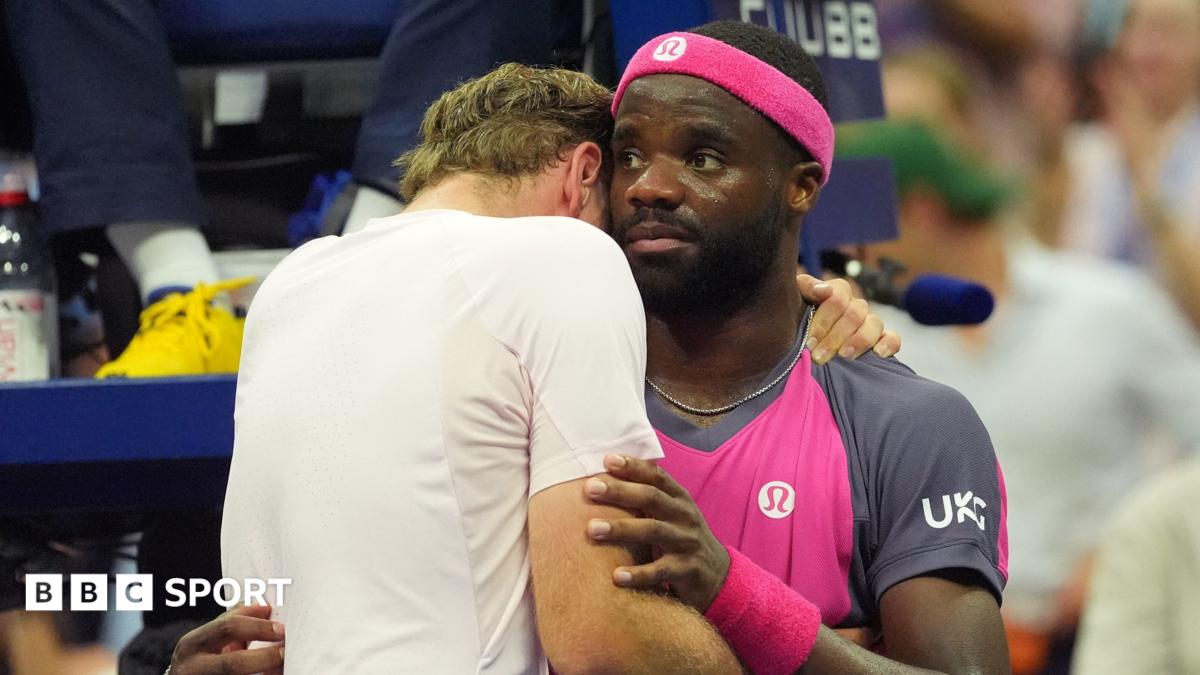
Frances Tiafoe consoles Alex Michelsen

Tiafoe is hoping to reach the final at Flushing Meadows for the first time, following semi-final defeats by Alcaraz in 2022 and Taylor Fritz in 2024.

But it was a straight-set third-round loss to Jan-Lennard Struff in last year’s tournament which brought about a change in coach – and mentality.

“This time last year he was losing matches because of his fitness, now here we are four hours and 40 minutes into a match and he’s raining down the fastest serve of the match,” former Grand Slam doubles champion Ryan Harrison told Sky Sports.

“This is why he put the hard work in at the gym when nobody’s watching. At the end of last year when he was having to hear all the chatter about his commitment, things he wasn’t doing well – at 28 years old it’s so hard to make a change like that, and his willingness to go through the process.

Advertisement

“For him to go through all that work, to fight to put himself in this position its great to see.”

While it has taken until now for Tiafoe’s renewed work-ethic to bear fruit in a major, he is unequivocal when asked how he compares to the player that reached the last four previously in New York.

“I’m just a different person in general,” he said.

“Those two runs were great, something I will cherish forever, but I’m not that person who I was when I made one in 2022 and when I made one in 2024. I’m not that person.

Advertisement

“I think I’ve been so routine-oriented all year, just continuously on a routine. Ideally you want to make every day feel the same.”

Source link

Continue Reading
Click to comment

You must be logged in to post a comment Login

Leave a Reply

NewsBeat

How studying astronauts could help tackle ageing on Earth

Published

on

How studying astronauts could help tackle ageing on Earth

Astronauts who undergo long-duration spaceflight aboard the International Space Station often return with health problems that resemble some age-related conditions in people on Earth.

Remarkably, some of this decline reverses within months of their return but others persist. This raises an intriguing question: what can be learned from these rapid changes and could they help prevent or reverse aspects of age-related decline on Earth?

That question has turned space into a laboratory for ageing research. Spaceflight reproduces many features of ageing. Astronauts also experience unusual conditions, including very low gravity, increased radiation and disrupted sleep. Even so, changes that usually develop over decades on Earth can appear within weeks or months in space, giving scientists an opportunity to observe some ageing-related processes in fast-forward.

A 2026 study, which tracked four astronauts during the nine-day Axiom-2 mission, examined chemical markers attached to DNA that can be used to estimate biological age. This is an estimate of how old the body appears to be based on molecular changes, rather than the number of years a person has lived.

Advertisement

The astronauts’ estimated biological age increased during the mission and began to fall after they returned to Earth. This does not mean that they physically aged by years in a matter of days. With only four participants, the study cannot provide firm conclusions, but it shows how rapidly the body can respond to the conditions of spaceflight.

Why would leaving gravity behind affect the body in ways that resemble ageing? On Earth, muscles, bones, and the cardiovascular system and other organs are adapted to function under the constant pull of gravity. That continual mechanical load helps keep these systems healthy, although their function often declines later in life. In space, many of those demands disappear.

When muscles age in fast-forward

Skeletal muscle provides one of the clearest examples. Astronauts lose muscle mass and strength at a startling rate in very low gravity, even while exercising for around two hours a day to attempt to limit the effects.

Some of the biological processes involved may overlap with those associated with sarcopenia, the age-related loss of muscle strength and mass that increases the risk of frailty, falls and loss of independence.

Advertisement

Scientists are still working out how closely muscle loss in space resembles sarcopenia, because similar effects can arise through different biological processes. The crucial difference is timescale. That compression is exactly what drew our team to space.

Through our UK Space Agency-funded MicroAge mission, we sent lab-grown human muscle constructs to the International Space Station.

These miniature muscles, roughly the size of a grain of rice, were engineered from human muscle stem cells. Using lab-grown tissue, rather than relying solely on the limited number of astronauts available for study, allowed us to compare muscle adaptations in very low gravity with those seen during ageing on Earth. It also allowed us to carry out early tests of possible ways to protect muscle. If some of the same mechanisms are involved in both settings, space could provide a useful opportunity to study years of biological change over the course of months for a single mission.

Our follow-up mission, MicroAge II, will explore the biology of this decline in greater detail. It focuses on mitochondria, the structures inside cells that produce most of the energy those cells need. Problems with mitochondria are recognised as one process involved in muscle ageing on Earth.

Advertisement

MicroAge II will investigate whether similar changes to their structure and function also contribute to rapid muscle loss in space. Why does any of this have significance beyond the space station?

Loss of muscle mass and function is one of the most consequential aspects of growing older. It underlies frailty, falls and the loss of independence that many people fear, yet effective treatments remain limited. Testing potential interventions in populations that age over decades is inevitably slow. Space research will hopefully help scientists identify relevant biological processes and test early ideas more rapidly.

Experiments in space cannot replace final clinical studies involving older people, however. Any treatment suggested by this work would still require extensive testing on Earth to establish whether it is safe and effective but would identify potential drug candidates far more quickly.

Advertisement

Source link

Continue Reading

NewsBeat

Flight chaos after tech failure is expected to last for DAYS after more than 1,000 jets were grounded: Calls for air traffic boss to quit grow as he is set to meet Transport Secretary this morning

Published

on

National Air Traffic Service chief Martin Rolfe faced calls to resign on Tuesday after a technical issue sent the country's airports into turmoil

The CEO of the UK’s air traffic control service faced calls to resign last night after a technical issue sent the country’s airports into turmoil. 

More than 1,000 departures and arrivals were cancelled on Tuesday after the National Air Traffic Services (NATS) reported an issue with its ‘flight processing system’. 

It sparked chaos at a dozen major airports – including Heathrow, Gatwick, Manchester and Birmingham – as scores of planes were grounded and holidaymakers left stranded. 

Pictures showed huge queues spilling out of terminals across the country as passengers scrambled to find alternative routes. 

Advertisement

One instance saw holidaymakers flying from Heathrow to New York stranded on the runway for as long as nine hours.  

British Airways, meanwhile, revealed it was forced to cancel or divert more than 100 flights on Tuesday in a decision which impacted ‘tens of thousands of customers’. 

Disruption is now expected to last for days as airlines try to find alternative routes home for customers, pilots and cabin crew members stuck in hotels abroad. The precise cause of the disruption is, however, yet to have been made clear. 

The ordeal prompted calls for NATS chief Martin Rolfe, who is paid £ 1.5 million a year, to resign after a string of similar issues in previous years cost airlines millions. 

Advertisement

National Air Traffic Service chief Martin Rolfe faced calls to resign on Tuesday after a technical issue sent the country’s airports into turmoil

Thousands of passengers were left stranded at Heathrow after having their flights delayed or cancelled

Thousands of passengers were left stranded at Heathrow after having their flights delayed or cancelled

Images showed queues spilling out of terminals across the country after the chaos unfolded yesterday afternoon

Images showed queues spilling out of terminals across the country after the chaos unfolded yesterday afternoon

Advertisement

Ryanair COO Neal McMahon said more than 65,000 of the company’s passengers had been affected before dubbing Mr Rolfe an ‘overpaid failure’. 

He fumed: ‘The UK Government, the CAA and the NATS Board must stop making excuses for repeated NATS failures and appoint a new leader capable of running the UK ATC system without repeated failures. It’s time for overpaid failure Martin Rolfe to go.’ 

Wizz Air later joined the Irish airline in its criticism of NATS, saying it was ‘extremely disappointed’ that yet another technical issue had plunged the country’s airports into turmoil. 

‘A critical national infrastructure provider should not repeatedly bring the aviation system to a standstill,’ the airline’s social media page posted. ‘NATS is simply not fit for purpose in its current form.’ 

Advertisement

It came before Shadow Transport Minister Greg Smith also took aim at the service, which is 49 per cent Government-owned. 

He said: ‘Yet again passengers are stuck on the tarmac wondering why Britain cannot keep its own skies open. The Government and NATS must explain what has happened and how they will make sure resilience is improved.’

Mr Rolfe will meet with Transport Secretary Heidi Alexander on Wednesday morning, hours after he appeared on Sky News to apologise for NATS’ latest blunder.

Only last year, more than 150 flights were cancelled when a malfunction left air traffic controllers at a centre in Swanwick, Hampshire, with only a patchy view of the airspace. 

Advertisement

And in August 2023, a NATS technical glitch saw more than 700,000 passengers have their flights delayed or cancelled.

Mr Rolfe apologised for the inconvenience that NATS caused thousands of passengers yesterday during an appearance on Sky News, describing the ordeal as ‘unfortunate’. 

‘I am the CEO of a piece of critical infrastructure,’ he said. ‘So it is my job to take responsibility for that.

A woman is seen rummaging through her suitcase after dozens of flights out of Stansted Airport were cancelled

A woman is seen rummaging through her suitcase after dozens of flights out of Stansted Airport were cancelled

Advertisement
British Airways planes are seen grounded at Heathrow on Tuesday afternoon following the technical issue

British Airways planes are seen grounded at Heathrow on Tuesday afternoon following the technical issue

Join the discussion

Should the air traffic control boss lose his job over repeated flight chaos affecting thousands?

‘What I absolutely take responsibility for is keeping people safe and delivering the best service we possibly can on a day like today. 

Advertisement

‘You will understand my focus is entirely about how we actually resolve the issue, get things back to normal, help our airlines, our airport customers and the travelling public.’ 

He added that the service does ‘not yet have an idea’ of what caused the disruption. 

It was estimated that 352 flights to and from Heathrow were delayed yesterday out of its daily average of about 1,300, while 281 Gatwick flights were delayed out of an 850 daily average. This was 249 out of 650 for Manchester, and 101 out of 300 for Birmingham.

In its latest statement issued on Tuesday night, NATS admitted that ‘it will take time’ to recover from the disruption its blunder caused. 

Advertisement

It continued: ‘Work is continuing to assist airlines and airports recover from today’s disruption.

‘This has been a very complex recovery and has created difficulties for the whole aviation network, from which it will take time to recover. 

‘We apologise again for the disruption caused. Passengers should check with their airline on the status of their flight tonight or tomorrow.’

Source link

Advertisement
Continue Reading

NewsBeat

Help us test binoculars with the RSPB and birding experts

Published

on

Help us test binoculars with the RSPB and birding experts

At Telegraph Recommended, we test hundreds of products each year, and we rely on our community members to help verify our experts’ findings.

We currently have an upcoming opportunity for Telegraph readers to help test the latest binoculars for birdwatching with the Royal Society for the Protection of Birds (RSPB).

Selected readers will be invited to RSPB’s The Lodge nature reserve in Sandy, Bedfordshire, where Jamie Wyver, editor of the RSPB magazine, and Tim Jones, otherwise known as ‘Begin Birding’ on Instagram, will host two binocular testing mornings.

Advertisement

Taking place on September 23 and 24, Jamie and Tim will lead each group on a morning ramble across the heathland, offering the chance to spot local bird species, including Nuthatches, Great Spotted Woodpeckers and Jays.

Source link

Advertisement
Continue Reading

NewsBeat

Telegraph Fantasy Football: most selected players

Published

on

Telegraph Fantasy Football: most selected players

Calum’s main sporting passions are horse racing, football and, notably, golf, in which he trained to be a PGA professional. He oversees the running of Telegraph Media Group’s betting section and has been involved in the sports and betting industry for nearly 15 years, working with household names such as AC Milan, Aston Villa, Mercedes Formula E and World Rugby.

Source link

Advertisement
Continue Reading

NewsBeat

Do you drink your coffee ‘extra hot’? It could be putting you at risk of deadly oesophageal cancer, major study finds

Published

on

Drinking 'extra hot' tea and coffee could significantly increase your risk of deadly oesophageal cancer , a major study suggests

Drinking ‘extra hot’ tea and coffee could significantly increase the risk of developing deadly oesophageal cancer, a major study suggests.

Scientists found people who regularly consumed drinks at above 65C were three times more likely to develop the disease than those who drank them at slightly cooler temperatures.

Meanwhile, consuming more than six hot drinks a day was linked to a 71 per cent higher risk of the cancer compared with drinking none – regardless of temperature.

The team, from the University of Oxford, specifically linked the beverages, consumed by millions of Britons every day, to oesophageal squamous cell carcinoma – one of the most aggressive forms of the disease which accounts for more than 3,000 new cases each year in the UK.

Advertisement

Studies suggest that around a fifth of oesophageal cancer patients are still alive five years after diagnosis, in part because the disease is often discovered at a late stage.

The researchers estimated that around 14 per cent of cases diagnosed in Britain each year could be prevented if people allowed hot drinks to cool before consuming them.

Experts said the findings add to a growing body of evidence suggesting that regularly drinking very hot beverages may contribute to the development of oesophageal cancer. 

It’s believed the heat from the beverages damages the cells at the top of the food pipe, where the cancer is found.

Advertisement

Drinking ‘extra hot’ tea and coffee could significantly increase your risk of deadly oesophageal cancer , a major study suggests

‘While the risk of being diagnosed with this cancer remains relatively low in the UK, this research does add to the evidence that drinking very hot drinks could increase the risk of oesophageal squamous cell carcinoma,’ said Fiona Osgun, head of health information at Cancer Research UK, which funded the study.

‘There is however a simple step people can take – let a cuppa cool down a little before taking a sip.’

Advertisement

The Oxford University scientists analysed data from almost 980,000 UK adults who were followed for more than a decade.

Participants reported how hot they preferred their drinks – ‘warm’, ‘hot’ or ‘very hot’ – and how many they consumed each day.

The researchers then compared this with cancer diagnoses, taking into account other risk factors such as smoking, alcohol and obesity.

During the study, 2,348 people developed oesophageal cancer, including 1,045 cases of SCC.

Advertisement

Those who preferred ‘hot’ drinks were 1.7 times more likely to develop SCC than those who drank them ‘warm’, while the risk was more than three times higher among those who preferred them ‘very hot’.

No increased risk was seen for adenocarcinoma, the other main type of oesophageal cancer.

Importantly, the scientists did not measure the actual temperature of participants’ drinks.

But previous research has typically described drinks at around 70C as very hot, while the International Agency for Research on Cancer considers beverages above 65C ‘probably carcinogenic’.

Researchers said allowing drinks to cool could therefore help prevent some cases of the disease.

Advertisement

Dr Keren Papier, lead researcher at Oxford Population Health, said: ‘What was less clear was whether this also applied to the temperatures at which hot drinks are usually consumed in Western populations.

‘This is now the largest study to look at that question in a UK population. More research is now needed to identify the exact drink temperatures linked to this increased risk.’

Around 9,500 people are diagnosed with oesophageal cancer each year in the UK and 7,900 die from the disease.

It is often diagnosed late because early symptoms can be mistaken for problems such as indigestion.

Advertisement

Smoking, obesity and alcohol are also major risk factors.

Ms Osgun said the ‘most important’ ways to reduce the risk remained ‘not smoking and cutting down on alcohol’.

Professor Muy-Teck Teh, an expert in molecular oral oncology at Queen Mary University of London, who was not involved in the study, also urged caution over the findings.

He said people’s perception of how hot a drink is can vary and stressed the study showed a link – but could not prove hot drinks directly cause cancer.

Advertisement

Source link

Continue Reading

NewsBeat

‘About time!’ – Cardiff City star makes his point as Rubin Colwill update given

Published

on

Wales Online

Joel Colwill’s first Championship start brought a goal and praise from Brian Barry-Murphy, who also provided an update on Rubin Colwill

Brian Barry-Murphy joked that Joel Colwill had told him “about time” after the Cardiff City youngster marked his first Championship start with a goal against Stoke City.

Advertisement

Colwill produced a superb header to rescue a point for the Bluebirds in Tuesday night’s 1-1 draw at Cardiff City Stadium, having been handed his first league start of the season.

The 21-year-old had a relatively quiet first half but came alive after the break, getting into dangerous positions and eventually beating Stoke goalkeeper Viktor Johansson with an excellent header to level the contest.

And Barry-Murphy revealed Colwill was quick to make sure his manager knew exactly what the goal meant to him.

“It was about time, he told me!” Barry-Murphy said with a smile. “He showed me.

Advertisement

“But it was a great finish and very important for us that he carries a big goal through, and you saw he got close to another goal.

“His movement in the box in the second half particularly was very good.

“We planned that, playing very close to Yousef with Jack Moylan, and we felt as if we could get a lot of joy against Stoke in that position.

“He played a little bit too deep in the first half, but in the second half he was very close to Yousef and a lot of our best moments in the box he was kind of on the premises, which is a big part of his role for the team.”

Advertisement

There was no place in the squad for Rubin Colwill, meanwhile, with the Wales international continuing to manage an ankle problem.

Barry-Murphy confirmed Colwill had been unable to train on Monday and was not considered fit enough to risk from the bench.

“Rubin’s ankle wasn’t OK yesterday, he didn’t train yesterday,” he said.

“There was talk of putting him on the bench, but I wasn’t sure if he was to come on he’d be fully fit.

Advertisement

“That was also kind of the case on Saturday and I didn’t want to risk it because of what he’s been through with the ankle.

“So I’ll try and give him some more time to train, hopefully on maybe Thursday, maybe Friday, and then be available for Saturday.”

The draw extended Cardiff’s winless Championship run to six games, but Barry-Murphy was encouraged by the response after a difficult spell which included defeats by QPR and Portsmouth.

Advertisement

The Bluebirds dominated large periods of the game, creating numerous opportunities, but had to settle for a point after falling behind to Ben Johnson’s first-half goal.

Barry-Murphy admitted the lack of a victory remains a concern, but believes the performance showed the mentality within his squad.

“We want to win. We’re aware we haven’t won this season, we’re aware in many of the games we’ve played really well, created chances and haven’t taken them,” he said.

“So we just have to keep improving and, like I said, the goals will come if we keep getting in the same situations.

Advertisement

“We just need to be a bit more ruthless in terms of how we don’t give the opponents a head start.”

He was particularly pleased with how his players responded after going behind.

“The way the players responded was incredible, really, and in the second half it felt as if it was only a matter of time,” Barry-Murphy said.

Advertisement

“I was pretty sure we would get the winner, but we just couldn’t find a finish.

“We have to remain calm. We have an incredible support and that support is very powerful.

“The players are in a great place, really focused, really together. The dressing room is a very tight place where there’s a great sense of unity and that’s the most important thing for me at the moment.”

Source link

Advertisement
Continue Reading

NewsBeat

How Kate Middleton’s family began in Durham pit villages

Published

on

How Kate Middleton's family began in Durham pit villages

Instead, generations of Catherine’s maternal ancestors lived and worked in the coalfield communities in the North East, carving out lives in the shadow of the pithead and helping to power Britain’s industrial rise.

Kate’s family tree traces her mother’s side to the mining villages of Hetton-Le-Hole and nearby Low Moorsley, where the Harrison family worked underground for more than a century.

According to genealogical records, the family’s mining connection began with James Harrison, who entered the County Durham coal industry in 1819.

Two years later, he moved to Low Moorsley after news emerged of a new pit opening in the area.

Advertisement

He and his wife Jane settled in a miner’s cottage and became part of a community built around the rapidly expanding coalfield.

(Image: DURHAM COUNTY COUNCIL)

Coal mining would become the family’s way of life for generations.

The Harrisons remained in the North East coalfield for around 120 years, with fathers, sons and grandsons following one another into the pits that fuelled Britain’s factories, railways and homes.

The Princess’s maternal great-grandfather, Thomas Harrison, was born into that mining tradition.

Advertisement

He was the son of a miner from the Hetton-Le-Hole area – which was previously part of County Durham before becoming part of Sunderland in the 1970s – and grew up in colliery housing before choosing a different path.

Seeking safer and cleaner employment, he left County Durham and moved south to London in the early 20th century, where he worked as a carpenter.

That move would ultimately set the family on a dramatically different course.

Thomas’s daughter Dorothy Harrison went on to marry Ronald Goldsmith.

Advertisement

Their daughter, Carole Goldsmith, later founded the successful Party Pieces business and became Carole Middleton after marrying Michael Middleton.

Carole and Michael’s eldest child is Catherine, now Princess of Wales and future Queen Consort.

The story represents a remarkable journey through British social history, from the coal seams of east Durham to the heart of the Royal Family.

Local historians have previously described Kate’s ancestry as evidence of the social mobility that transformed Britain during the 20th century.

Advertisement

Source link

Continue Reading

NewsBeat

How to fold down a pop-up tent in 60 seconds

Published

on

How to fold down a pop-up tent in 60 seconds

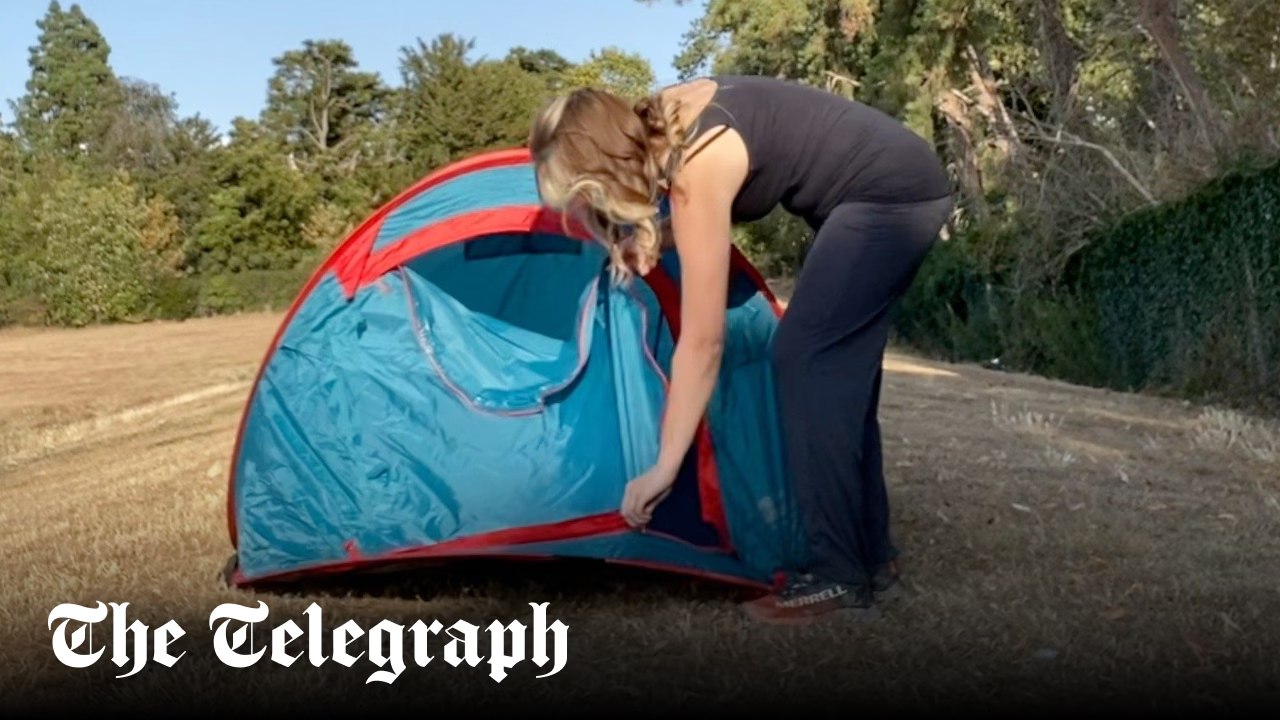
A pop-up tent can be pitched in seconds and, theoretically, taken down in less, making them perfect for music festivals, casual camping or even waiting in the queue at Wimbledon overnight.

Their problem is that they’re not actually as easy to put away as they should be. Angle it right, and the tent folds away as easily as it popped up. Approach without a plan, and you’ll find yourself wrangling with a seemingly live tent that refuses to fold back into its circular bag.

Here’s my step-by-step guide on how to put away a pop-up tent in less than 60 seconds, to help you avoid that problem. Watch the video to see exactly how I do it. 

Advertisement

1. Unzip the doors

This is to let any air escape. Otherwise, you’ll find it balloons out as you try to fold it.

2. Gather the poles

Find the highest arch on both sides, then pull them together into the middle.

Source link

Advertisement
Continue Reading

NewsBeat

Flights at Leeds Bradford Airport are disrupted by problem

Published

on

Flights at Leeds Bradford Airport are disrupted by problem

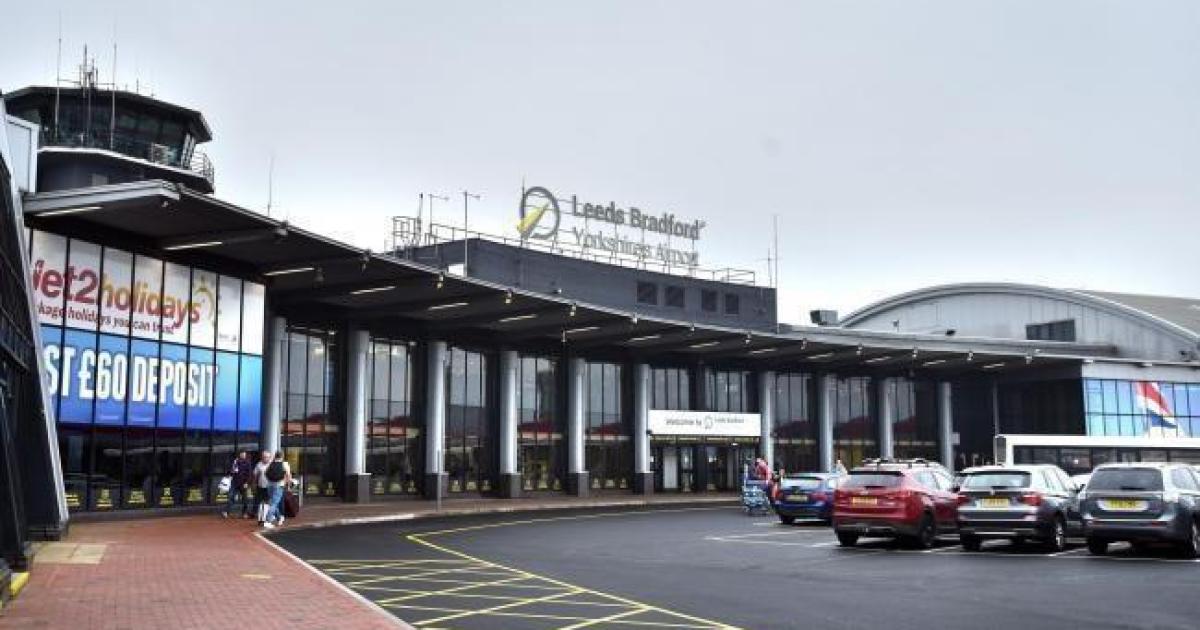
Leeds Bradford is one of 15 airports hit by the problem, which has caused cancellations and delays to flights leaving the UK.

A Leeds Bradford Airport spokesperson said: “The air traffic control service, NATS, is experiencing a technical issue which is impacting flights at airports across the UK, including at LBA.”

“Passengers are advised to check with their airline for the latest flight information.”

Advertisement

“LBA is working alongside its airline partners to ensure customers are on the move before close of day.”

NATS said it was investigating a technical issue linked to its flight processing system, which serves 15 UK airports.

NATS later said it had applied a fix and its flight system was beginning to recover.

NATS said: “Our engineers are on site and working urgently to resume normal operations as quickly as possible.”

Advertisement

“We recognise the ongoing disruption to travel, for which we sincerely apologise.”

“Flights are still departing and airspace is open, but recovery will take some time. We will provide further updates as soon as possible.”

“Passengers should check the status of their flight with their airline.”

Flightradar24 said 425 flights to and from UK airports had been cancelled by 5pm.

Advertisement

The issue also affected airports including Heathrow, Gatwick, Manchester, Birmingham, London City, London Southend, Aberdeen, Glasgow, Southampton and Belfast.

Birmingham Airport said the problem was affecting southern UK airspace and “impacting a significant number of departing flights across the country”.

Heathrow initially said arriving flights were unaffected, but later reported that the issue was “impacting arriving and departing flights across UK airports”.

Manchester Airports Group said flights from Manchester, Stansted and East Midlands had been affected.

Advertisement

Flightradar24 said about 4 per cent of UK flights had been cancelled or delayed because of the problem.

It said Heathrow, Gatwick, Manchester and Birmingham were the worst-hit airports.

NATS said flights were still departing and airspace remained open, but warned that recovery would take time.

Passengers using Leeds Bradford Airport were told to check with their airline before travelling.

Advertisement

EasyJet said some flights were “unable to operate” and delays were affecting services across Europe; affected customers would be offered a free transfer or refund, with meals and hotel accommodation where needed.

Transport Secretary Heidi Alexander said engineers were fixing the problem and apologised to passengers.

The incident follows previous NATS failures, including a radar problem last July and a technical glitch in August 2023.

Advertisement

Source link

Continue Reading

NewsBeat

Clancy jurors reveal the evidence that convinced them mom was not guilty of murder before lone holdout forced mistrial

Published

on

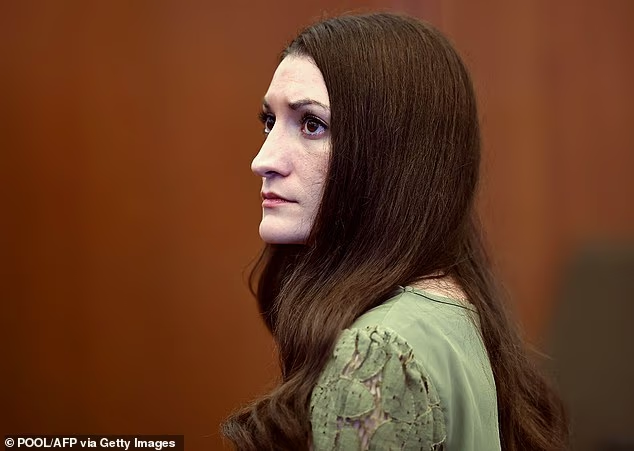
Lindsay Clancy, 36, faces a retrial after a jury of nine women and three men were unable to agree on whether she was guilty of the murders or manslaughter

Three women who served as jurors in the Lindsay Clancy trial have opened up about their decision to find the mother-of-three not guilty of murder before one holdout juror forced a mistrial.

Clancy, 36, had admitted to strangling her children with exercise bands, but argued in court that she was overmedicated while suffering from postpartum depression and that the cocktail of drugs she was prescribed brought on a psychosis.

‘We weren’t trying to figure out if she murdered the children, she did and she’s admitting to that. We’re trying to figure out: Did she know right from wrong at that time?’ jury foreperson Roni Carlson recounted to NBC Boston.

‘And with everybody saying she loved her children so much and everything proved she loved her children, from her journals to her mother-in-law, everything proved that she loved her children,’ Carlson continued. ‘So she had to have snapped.’

Advertisement

Based on that evidence, 11 of the 12 jurors were ready to find Clancy not guilty of murder by reason of insanity.

But a lone holdout on the jury refused to acquit the former labor and delivery nurse, prompting Judge William Sullivan to declare a mistrial in the case.

The three female jurors who spoke to NBC Boston now claim that the unidentified juror ‘would not interact with us and try to understand.’ 

‘He had reasonable doubt. He admitted he had reasonable doubt,’ Carlson said.

Advertisement

‘I started filling out the forms, I was so excited. There were three forms I had to fill out, and then he said “but I’m still not going to say she’s not guilty.”‘ 

Lindsay Clancy, 36, faces a retrial after a jury of nine women and three men were unable to agree on whether she was guilty of the murders or manslaughter

Jury foreperson Roni Carlson told NBC Boston on Tuesday she was persuaded to find the mother-of-three not guilty by reason of insanity after hearing witnesses and journal entries describe how much she loved her children

Jury foreperson Roni Carlson told NBC Boston on Tuesday she was persuaded to find the mother-of-three not guilty by reason of insanity after hearing witnesses and journal entries describe how much she loved her children

Advertisement
Roni and two other female jurors opened up to NBC Boston about their frustrations with one juror who refused to acquit

Roni and two other female jurors opened up to NBC Boston about their frustrations with one juror who refused to acquit 

The jury of nine women and three men ultimately spent more than 37 hours deliberating five-and-a-half weeks worth of evidence, as they deliberated whether Clancy was guilty of the murders or manslaughter of Cora, five, Dawson, three and eight-month-old Callan in January 2023.

As the one juror then refused to side with the others late Thursday and early Friday, defense attorney Kevin Reddington sought an emergency order to try and force jurors to enter one final round of deliberations.

But the motion failed, and Judge Sullivan declared a mistrial at Plymouth Superior Court on Friday afternoon.

Advertisement

As a result, Clancy could face a retrial in the case. 

In a desperate attempt to prevent that from happening, Reddington on Tuesday 
pleaded with President Donald Trump to consider pardoning Clancy, describing her as a good person.

‘Mr President, I hope that you would consider this young lady, the type of person she is, what she’s been through, and consider a pardon,’ the lawyer said on Good Morning America.

He went on to describe Clancy as being ‘intelligent’ and ‘hardworking,’ while describing the strong bond he has with Clancy. 

Advertisement

‘I do feel a very strong bond with Lindsay because of the type of person she is. She’s such a wonderful, wonderful person,’ the lawyer said as he acknowledged he didn’t know much about postpartum depression before taking on Clancy’s trial. 

Clancy argued in court that she was overmedicated while suffering from postpartum depression and that the cocktail of drugs she was prescribed brought on a psychosis

Clancy argued in court that she was overmedicated while suffering from postpartum depression and that the cocktail of drugs she was prescribed brought on a psychosis

Clancy was charged with murder after strangling her three children, Cora, five, Dawson, three, and eight-month-old Callan in 2023

Clancy was charged with murder after strangling her three children, Cora, five, Dawson, three, and eight-month-old Callan in 2023

George Stephanopoulos questioned the lawyer about his remarks at the end of the trial in which Reddington said he ‘crushed’ the prosecution, asking if he regretted them.

Advertisement

‘I don’t regret saying it at all,’ Reddington responded. ‘I think that the defense was very strong and I think it went in very well.

‘I think I perhaps could have been a little more circumspect dealing with [prosecutor] Tim Cruz, and instead of saying I crushed him, I could I have said I did a good job.’ 

Reddington then said that he was open to reaching a deal with Cruz, the District Attorney, so that Clancy did not need to go through another trial.

‘I’m willing to listen to Tim [Cruz]. I’ve known Tim for 30 years. I hope, however, after this trial, that he would revisit that issue and we could work something out that will be acceptable for both sides,’ he added.

Advertisement

Source link

Continue Reading

Trending

Copyright © 2025