
Crypto World
The U.S. Is Having One of Its Most Active Wildfire Seasons. Here’s How the Costs Are Adding Up



The United States is on pace to see one of its most active wildfire seasons on record. According to a new AccuWeather report, large fires were active in at least 13 states as of Sept. 9, while more than 8.4 million acres had burned nationwide this year—about 1.3 million acres above the full-year annual average over the previous decade.
The extraordinarily active season is testing a recently overhauled federal wildfire-response system while placing mounting financial pressure on governments, taxpayers, insurers, and individual households.
How the U.S. changed its wildfire response after the Los Angeles fires
The Los Angeles fires in January 2025 were high-profile incidents that drew widespread attention to the nation’s risk. They were notable as sudden, highly concentrated, urban conflagration events—and they stand in contrast to the 2026 wildfire season, which has garnered less attention with the incidents geographically dispersed across the U.S.
However, almost twice as much land has burned so far in 2026 as had burned at the same point in 2025, according to AccuWeather.
The Palisades and Eaton fires in L.A. showcased just how costly massive wildfires are in terms of infrastructure damage, loss of life, and economic impact. Collectively, the fires burned about 37,500 acres and destroyed nearly 17,000 structures, killing at least 31 people. Munich Re estimated total damage at $53 billion, including $40 billion in insured losses—“by far the largest insured loss on record from a wildfire event,” according to the United Nations.
Read More: What Happens When the World Is on Fire
In response, President Donald Trump signed an executive order on June 12, 2025, calling for the consolidation of wildfire response resources within the Interior and Agriculture departments within 90 days. The U.S. Wildland Fire Service was formed as a result.
The order also directed agencies to review rules that might impede wildfire response, develop performance metrics, release relevant historical satellite data, and evaluate the sale of excess military aircraft for wildfire response. Those provisions carried deadlines ranging from 120 to 210 days.
Since then, the Administration has overhauled how the federal government fights fires. One of the largest shifts involves focusing on wildfire suppression. Since April, Interior Secretary Doug Burgum has directed crews to presume a full-suppression strategy for every wildfire under the management of the Interior Department. While managers are instructed to select tactics according to on-the-ground conditions, the presumptive approach is suppression.
The move has drawn criticism as states compete for limited firefighting resources, and as federal forecasters expect above-normal significant-fire potential in parts of the West through September.
The financial toll of wildfires has dramatically escalated in recent years as fire seasons grow longer and fires become more severe.
Why wildfire costs are rising for federal and state governments
The National Multi-Agency Coordination Group (NMAC), composed of representatives from the federal and state agencies, establishes national preparedness levels ranging from 1 to 5. The country remained at Level 5 from July 18 through Sept. 4, meaning national resources were heavily committed and some regions had to take emergency measures to sustain operations. The level was lowered to 3 on Sept. 9.
During the Level 5 period, the National Multi-Agency Coordinating Group warned of “high competition” for firefighting resources nationally. It said the system lacked sufficient incident-management resources to meet every request, prompting concerns among lawmakers about whether resources could be exhausted before the season ended.
On Friday, five Democratic Senators—Alex Padilla and Adam Schiff of California, Michael Bennet and John Hickenlooper of Colorado, and Ron Wyden of Oregon—released a letter to Burgum and Agriculture Secretary Brooke Rollins, expressing “serious concerns” about the departments’ preparedness and ability to adequately respond to the ongoing wildfire season.
The letter says the U.S. Forest Service and U.S. Wildland Fire Service had more than $6 billion in fire-suppression budget authority for fiscal year 2026 and had spent more than 70% by Aug. 31.
“Any wildfire that represents a threat to life, property, infrastructure or the environment should be extinguished as quickly as possible,” federal officials with the Wildland Fire Service said in a statement to the Associated Press in July when the policy was instituted. “Our experienced fire managers retain the authority to select the safest and most effective tactics based on conditions on the ground.”
Some experts argue, however, that full suppression is part of the issue that makes wildfires so large and expensive in the first place.
“These Western ecosystems are adapted to fire; they need fire, and they’ve burned for thousands of years. Roughly 150 years ago, we started suppressing fires, and in large swaths of the Western forests, that led to an accumulation of fuels,” Winslow Hansen, ecologist with the Cary Institute of Ecosystem Studies, tells TIME. Fuel can refer to any vegetation, twigs, branches, or organic soils that may be prone to catching fire—especially in the hot, dry conditions that are more prevalent nationwide due to climate change, he explains.
The combination leads to more fuel and drier fuel for fires, Hansen says, and “that leads to more intense fires, larger fires, and even faster fires.”
Federal suppression spending captures only one portion of wildfires’ broader economic toll. A Department of the Interior review estimated that wildfires impose between $87 billion and $424 billion in annual costs, measured in 2022 dollars, including property and health damages and other economic losses. The department cautioned, however, that significant gaps in the available data make the total difficult to calculate.
Separately, a 2018 Headwaters Economics review of existing research and five wildfire case studies estimated that suppression represented approximately 9% of the fires’ full community costs.
State governments are shouldering part of that broader economic burden. While no comprehensive national tally tracks their wildfire spending in real time, data within affected states illuminates the strain.
In Oregon, wildfires had burned 2.5 million acres and cost the state $236.2 million as of late August. Last week, the state approved nearly $123 million in additional funding and authorized $150 million in short-term Treasury borrowing to cover expenses while awaiting federal reimbursements. Officials project that the season’s total cost could reach $350 million, surpassing the state record of $318 million set in 2024.
In Utah, where more than 559,000 acres had burned as of Sept. 3, state wildfire costs had reached approximately $44.9 million and could approach $50 million. Federal costs associated with fires in Utah were estimated at approximately $216 million. Jamie Barnes, commissioner of the Utah Department of Natural Resources, said it could be a “record breaking” season by cost.
How rising wildfire costs affect Americans
While local, state, and federal governments are responsible for wildfire preparedness and suppression, these activities are funded primarily by taxpayers. For example, the four largest fires that plagued Colorado this year could cost taxpayers $266 million, according to a Colorado Drought Task Force meeting in July.
And the government does not bear the full burden of the fires; Americans shoulder it through property damage, skyrocketing insurance costs, supply chain disruptions, and lost business revenue.
A study released in August analyzed data covering approximately 100,000 people and 50,000 homes inside wildfire burn areas. It found that occupants of destroyed homes experienced reduced earnings for three years after a fire, with cumulative losses equal to 26% of their pre-fire annual income. Within fire zones, lower-income households were more likely to lose their homes.
Wildfires also impose costs that are harder to quantify. A July study from the University of Southern California found that Los Angeles County residents who lived in evacuation zones during the 2025 fires reported elevated anxiety and depression nearly a year later, with the greatest effects among people already facing social and economic hardship.
These costs do not affect only people in communities directly touched by wildfires. In California, average homeowners-insurance premiums rose 84% between the end of 2020 and March 2026, according to Stanford researchers, who attributed the increase to a combination of wildfire risk, inflation and the state’s regulatory framework.
According to the 2026 Wildfire Risk Report by Cotality, a major real estate data and analytics company, more than 2.5 million properties across the 10 of the most exposed states face a moderate or greater risk of wildfire damage, with a combined reconstruction cost value approaching $1.4 trillion. The risk is concentrated in California, Colorado, and Texas. The report estimates that there are some 1.28 million at-risk properties in California alone.
No single figure can capture what the 2026 wildfire season will ultimately cost. The bills will emerge in different forms—from government spending and rebuilding expenses to higher insurance premiums and lost household income. The financial consequences typically persist long after the fires are contained.

Crypto World
$10,000 in Tesla When It Joined the S&P 500 Would Be About $15,700 Today. An Index Fund Would Have Done Better.

On Friday, Dec. 18, 2020, shares of electric-car maker Tesla (NASDAQ:TSLA) rose almost 6% to close at a record $695. More than 200 million shares changed hands that session (more than $131 billion of stock), making it one of the busiest trading days in the company’s history.
The buying wasn’t optional for everyone. S&P Dow Jones Indices had scheduled Tesla to join the S&P 500 (SNPINDEX:^GSPC) at its full weight before the market opened the following Monday. And the addition was based on that Friday’s closing prices. In other words, every fund tracking the index effectively paid $695.
Missed Nvidia in 2009? This Rare Signal Is Flashing Again. In 2009, a “Double Down” signal flashed for a little-known chipmaker called Nvidia. For the first time in years, that same “Total Conviction” signal is flashing for a company 1/100th the size of Nvidia. Continue »
Nearly six years later, that $10,000 would have become about $15,700. The same money in an S&P 500 index fund would have grown to about $20,500 before dividends.

Image source: The Motley Fool.
Nearly six years later
Tesla has split its stock once since then (three for one, in August 2022), which turns that $695 closing price into $231.67 per today’s share. A $10,000 purchase works out to about 43 of today’s shares.
As of this writing, the stock trades at about $364, up 57% from the split-adjusted purchase price. But stretched across almost six years, 57% comes to about 8% a year.
The ride was better at times. The stock traded as high as $498.83 within the past year, a level that would have put the stake above $21,000. It hasn’t held it.
The S&P 500, meanwhile, ended that Friday just above 3,700 and now sits close to 7,600 — up about 105%, or about 13% a year. And dividends would widen the index’s lead from there.
Tesla, for all the attention it gets, has trailed the very index it joined.
The reason isn’t that the company failed to grow.
Did Tesla deliver?
The purchase valued Tesla at more than $658 billion, the largest addition in the S&P 500’s history at the time.
In 2020, the company generated about $31.5 billion of revenue and $721 million of net income, its first profitable year. It produced and delivered about half a million vehicles. Against a price tag of more than $658 billion, the market was paying more than 900 times the year’s earnings.
Much of the growth that price demanded did show up. Tesla’s trailing-12-month revenue now tops $100 billion, more than triple 2020’s total. Notably, the company delivered more than 480,000 vehicles in this year’s second quarter alone, up 25% from a year earlier — nearly as many as it delivered in all of 2020. Its energy storage business, tiny back then, deployed 13.5 gigawatt-hours in the quarter, a 41% jump from a year earlier. And net income over the past four quarters was about $3.8 billion, more than five times what the company earned in 2020, though well below the $12.6 billion it earned in 2022.
UniCredit is exploring an expansion into digital assets that would add crypto custody and brokerage, and has started selecting a technology provider to hold the assets and handle client transactions, Bloomberg reported, citing people familiar with the matter.
As per the report, the discussions are early, and no final decision has been made. Areas under consideration include custody and brokerage, tokenized investment products and fixed-income securities, and stablecoin applications for clients. UniCredit has not disclosed which providers it is weighing, how much it might spend, or when it would choose one.
Any crypto services would fall under the EU’s Markets in Crypto-Assets regulation, whose grace period ended on July 1. MiCA requires crypto-asset service providers to hold a license and lets authorized firms passport custody and trading across the 30-country European Economic Area.
Building on Earlier Crypto Moves
Selecting an outside technology provider is the path other large banks have taken into crypto custody. Deutsche Bank tapped Swiss firm Taurus for digital asset custody and tokenization after what the vendor called a detailed selection and due diligence process.
UniCredit has already put crypto products in front of clients. The bank opened a five-year, dollar-denominated certificate linked to BlackRock’s iShares Bitcoin Trust (IBIT) to professional clients in July 2025, with full capital protection at maturity, a cap of 85% on returns and a $25,000 minimum. It was the first product of its kind in Italy.
In December 2025, UniCredit and state lender Cassa Depositi e Prestiti structured Italy’s first tokenized minibond on a public blockchain, a €5 million issue for E4 Computer Engineering recorded on Polygon.
UniCredit also belongs to Qivalis, an Amsterdam consortium that has grown to 37 European banks across 15 countries and plans to launch a MiCA-compliant euro stablecoin on Ethereum in the second half of 2026. The token would be backed one-for-one by euro deposits, subject to approval from the Dutch central bank.
Banks Push Into Digital Assets
Other large lenders have already started selling crypto to clients. BBVA began offering Bitcoin (BTC) trading and custody to private banking clients in Switzerland, and Israel’s Bank Leumi lined up Galaxy to run trading and custody for a 2027 launch covering Bitcoin, Ethereum (ETH) and Solana (SOL).
UniCredit is also expanding in digital markets beyond crypto. On September 8, it bought a minority stake in VC Trade, a Frankfurt platform that digitizes bond and loan deals. The platform sits in debt markets, separate from the crypto plans, and has handled more than €90 billion across over 600 transactions.
The post UniCredit Weighs Crypto Custody and Brokerage, Hunts for a Technology Provider appeared first on CryptoPotato.


The company is closing its Copenhagen IT site while maintaining Bratislava and opening a new hub in Vietnam to reduce costs.


“Given everything happening with safety, right now would be an ill-advised moment to go public,” OpenAI CEO Sam Altman told Fortune.

Anthropic is reportedly in discussions with Nvidia about a potential $10 billion investment that could help shape what Reuters called a potential “mega IPO” for the AI company. According to Reuters, citing people familiar with the matter, the talks are still fluid and the figures being discussed could materially reshape the size—and potential valuation—of any public debut.
Reuters also reports that Anthropic is seeking to raise as much as $100 billion in the offering, which could value the company at around $2 trillion. The individuals described the negotiations as confidential and asked not to be identified, and Reuters said Anthropic declined to comment while Nvidia had not yet responded to a request for comment.
Key takeaways
- Reuters reports Anthropic is discussing a possible $10 billion Nvidia investment tied to a potentially massive IPO.
- The offering size under discussion could reach up to $100 billion, implying an around $2 trillion valuation target.
- Talks remain ongoing and could change, with neither Anthropic nor Nvidia providing comment.
- The rumored move fits a broader strategy in which chip makers seek influence not just over compute, but also AI platforms and customers.
Why a potential Nvidia-Anthropic deal matters
If the reported discussions result in participation by Nvidia—potentially as an early strategic backer—it would strengthen more than just Anthropic’s funding prospects. Strategic investors often have outsized influence in how companies position their technology and partnerships, especially in fast-moving AI supply chains where chips, infrastructure, model ecosystems, and developer tools can be just as important as model performance.
For Nvidia, a relationship with Anthropic at a scale that could support a record-setting public offering would be consistent with its push to stay tightly embedded in the AI stack. Reuters’ account suggests Nvidia could benefit by reinforcing ties with a major customer while also taking a more prominent role around the timing and structure of an IPO.
Link to Anthropic’s infrastructure footprint
Earlier coverage from Cointelegraph highlighted Anthropic’s increasing demand for AI compute capacity. On Aug. 11, Cointelegraph reported that Bitcoin miner Riot Platforms had secured a 20-year agreement to supply 191 megawatts of capacity from its Rockdale, Texas campus to a “leading frontier AI” company.
Cointelegraph stated that the customer was Anthropic and that the deal was valued at about $9 billion, citing a Bloomberg report that also referenced people familiar with the matter. While such capacity agreements don’t automatically translate into IPO readiness, they can signal the scale of near-term compute requirements—an issue that matters to investors assessing how quickly an AI company can sustain growth in training and inference.
Nvidia’s software leverage and the Hugging Face acquisition
The Nvidia angle in this story also connects to its broader strategy beyond chips. Earlier in August, Cointelegraph reported that Nvidia had agreed to acquire Hugging Face for $12.9 billion, extending its reach into the AI software and developer tooling ecosystem.
Hugging Face, as described in Cointelegraph’s earlier reporting and in remarks by Nvidia CEO Jensen Huang, serves more than 18 million developers and hosts over three million models. Huang said Nvidia to acquire Hugging Face would bring control of a major platform for AI models as AI companies increasingly compete across chips, software, and the developer tools used to build and deploy models.
In that context, the Reuters report—if confirmed—would underline a two-pronged approach: Nvidia aims to maintain leverage at the infrastructure level and also deepen its influence over the software layers where models are published, accessed, and integrated into applications.
What to watch next
Because Reuters characterizes the negotiations as ongoing and potentially changeable, investors and industry participants should watch for follow-on reporting that clarifies whether Nvidia is expected to participate formally, how the offering size would be structured, and whether either company provides updated statements as talks progress. The broader implication—however it plays out—remains clear: AI capital formation and strategic partnerships are increasingly shaped by control of both compute and the platforms developers rely on.

A software engineer at Coinbase has wired a digital copy of a fruit fly’s brain into a Bitcoin trading account. The open-source project is called Stonkfly.
It shows the simulated brain a price chart and rewards profitable trades with a burst of virtual dopamine. The fly never sees a single price number.
How a Simulated Fly Brain Places a Trade
Alex Wormuth published the code on GitHub alongside a public dashboard. The model runs 166,700 neurons and roughly 25.6 million connections between them.
Those figures come from a connectome, a published wiring map of an adult male fruit fly’s nervous system. Neuroscientists spent years building it. Wormuth pointed it at a candlestick chart instead.
Stonkfly draws that chart as a small image and splits it across the fly’s two simulated eyes. Light-sensing cells read the raw pixel colors. The brain then settles on buy, sell, or hold.
Profit fires 15 reward neurons. A loss fires two that register something unpleasant. Trading fees count as losses. The fly cannot borrow or bet on a falling price, which puts it ahead of many AI bots trading stocks.
The Creator Says It Proves Nothing
According to the Coinbase engineer, the experiment does not show everything.

“Synaptic changes do not establish that it learns to trade profitably,” Alex Wormuth said.
The program runs on paper money by default, starting with $100. Live mode caps each order at $10, and limits attempts to 24 per day. The public dashboard still showed zero completed trades on Saturday.
That caution lands differently in a falling market. Bitcoin (BTC) traded near $77,286 on Saturday, up 0.6% on the day but far below its peak.

The real question is not whether the fly makes money. It is whether a mapped brain rewires itself for a reward evolution never gave it.
The post Coinbase Engineer Turns a Virtual Fly Brain Into a Crypto Trader appeared first on BeInCrypto.

XRP is changing hands in the low-$1.30s, sitting near a level our price analysis has circled for weeks. That’s not a coincidence. Three catalysts, a critical demand zone, a looming regulatory decision, and shifting whale behavior are converging as the month moves forward, and the outcome could shape XRP’s trajectory into Q4.
Price feeds across major exchanges show XRP clustering around the low-to-mid-$1.30s, with CoinMarketCap’s tracking showing similar underperformance against the wider crypto market during the latest risk-off move.
The drop follows an August rally that took XRP from around $1 to the high-$1.60 range. That run is now cooling into a descending triangle, with the mid-to-high-$1.30s described as one of the market’s most significant demand zones, where billions of XRP previously changed hands.
Macro conditions aren’t helping. Crypto markets are digesting Fed policy signals, and that pressure is bleeding into altcoin price action across the board. XRP’s next move likely hinges on whether buyers defend the low-to-mid-$1.30s or allow that support to crack.
Trade XRP on Bybit and Get a Chance to Win Our $1,000 USDT Airdrop
XRP Price Analysis: Break $1.45 This Weekend?
XRP is trading in the low-$1.30s, just below its recent seven-day range in the low-to-high $1.30s. That points to a sideways-to-mildly bearish structure heading into the final stretch of September. Volume has concentrated around the mid-$1.30s, reinforcing that area as an important line in the sand.
Support sits in layers. The first floor is around the low-$1.30s, near the 20-day EMA, while the next major zone sits around $1.25–$1.30 near the 50-day EMA. Resistance builds quickly above the current range.

The first hurdle sits around the mid-$1.30s to low-$1.40s, followed by heavier supply around $1.45–$1.55. Beyond that, the $1.55–$1.70 region becomes the next major test.
The bullish scenario would see XRP reclaim the low-$1.40s, potentially opening a path toward the $1.60 area and eventually the high-$1.80s if the triangle pattern breaks higher. The base case is continued chop between roughly $1.30 and $1.40 while traders wait for a fresh catalyst. A break below the low-$1.30s would weaken the recovery thesis and put the mid-$1.20s back in focus.
RSI remains relatively neutral, while expanding Bollinger Bands suggest volatility could be building rather than fading. Traders watching the CLARITY Act vote timeline should treat it as a potential swing factor for the next major move.
Earn $50 and Enter $300K Prize Draw on EdgeX
Bitcoin Hyper Targets Early Mover Upside as XRP Tests Key Levels
XRP holders sitting through this chop have earned the right to ask a blunt question: Is $1.35 support really going to hold, or is this just the market buying time before another leg down?
Whale accumulation patterns and retail positioning offer some reassurance, but at XRP’s market cap, even a clean breakout caps upside in the modest double digits, not the asymmetric moves early-stage capital is chasing. That’s pushing some traders toward earlier-stage infrastructure plays with more room to run.
Easy now. Let Hyper handle this one.
pic.twitter.com/MTV0jygc1L
— Bitcoin Hyper (@BTC_Hyper2) September 10, 2026
Bitcoin Hyper ($HYPER) is one of the more notable examples, a Bitcoin Layer 2 project integrating the Solana Virtual Machine, positioning itself as the first Bitcoin L2 with SVM-based execution faster than Solana’s own network.
Currently priced at $0.013686, the presale has raised more than $33 million to date, with staking rewards offering a high 35% APY only for early participants. Standout features include a decentralized canonical bridge for native BTC transfers and low-latency transaction processing designed to bring programmability to an ecosystem historically limited to simple transfers.
Research Bitcoin Hyper directly before the presale window closes.
Discover: The Best Token Presales
The post XRP Price Analysis: 3 Major Catalysts Set to Shape September appeared first on Cryptonews.

The Securities and Exchange Board of India (SEBI) and the Reserve Bank of India (RBI) have launched a pilot infrastructure for issuing, holding, trading, and settling corporate bonds as digital tokens.
Called Demat 2.0, the model is being integrated directly into the nation’s existing regulated securities market, unlike many tokenization experiments built on standalone blockchain platforms.
$116M Tokenized and Counting
India’s approach allows corporate bonds to be created natively on a distributed ledger maintained by market infrastructure institutions, with ownership records held by the country’s statutory depositories. As written on Demat 2.0’s explanatory page, the system is connected to the RBI’s wholesale digital rupee through its Unified Market Interface. This allows the securities and cash legs of a transaction to settle at the same time.
This so-called atomic delivery-versus-payment model eliminates the period previously needed when one party has transferred an asset while still waiting for the other side to complete the payment. The statement also noted that three companies have already issued tokenized bonds worth a total of ₹1,025 crore (or $116 million).
REC Limited led the charge, becoming the first issuer on September 7, raising ₹500 crore from 18 investors. Larsen & Toubro followed suit with the same amount from four investors, while IIFL raised ₹25 crore from a single investor on September 9.
SEBI said issuers can receive funds on the same day as bidding, compared with the traditional two-to-three-day process. Secondary-market investors could get their proceeds immediately as well.
Smart contracts can also automate coupon and redemption payments directly into investors’ CBDC wallets. Separately, investors can use their existing demat accounts rather than create an entirely different blockchain wallet infrastructure.
Beyond Bonds?
The statement noted that tokenized bonds remain legally identical to conventional ones as existing rules covering credit ratings, disclosures, debenture trustees, and investor protection continue to apply. Given the evident growth of the real-world asset (RWA) industry, India’s authorities said the rollout of their local system will come in three stages.
The current phase is focused on institutional corporate bond issuance. The second will introduce secondary-market trading and expand access to retail investors, while the last one could bring additional regulated entities onto the network and explore tokenization of other financial instruments.
The infrastructure remains private and permissioned, with nodes initially operated by depositories and stock exchanges. This is important because India’s initiative is not an attempt to move its securities markets onto public blockchains; rather, it aims to combine DLT-based ownership, smart contracts, and central-bank money within its existing financial system.
The post India’s Demat 2.0 Could Change Bond Tokenization: Here’s How It Works appeared first on CryptoPotato.
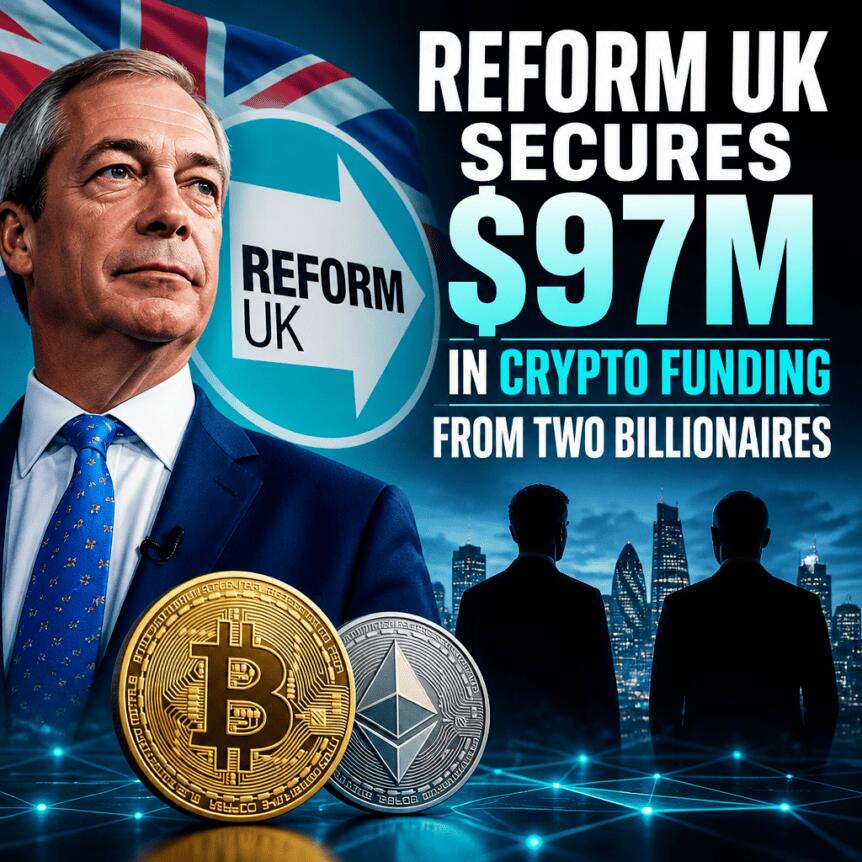
Nigel Farage’s Reform UK has received a total of £72 million (about $97 million) from two crypto-linked billionaires, after Christopher Harborne matched a record donation initially announced by Ben Delo. The pair’s contributions are described as the largest ever given to a British political party, according to reporting cited in the original coverage.
Harborne announced on Saturday that he would donate £36 million, following Delo’s earlier announcement. Reuters reported Farage’s response, noting that Reform welcomed the donations as a way to ensure the party can compete in the upcoming political fight.
Key takeaways
- Reform UK received £72 million total, combining contributions of £36 million each from Ben Delo and Christopher Harborne.
- Harborne matched Delo’s donation after Delo announced his package the day earlier.
- The funding is framed by Reform as enabling a “level playing field” for the next general election campaign.
- The donations come amid ongoing political scrutiny in the UK over crypto-linked financial influence, following an earlier Farage scandal.
- Delo’s background includes a US legal resolution tied to BitMEX-related charges and a later presidential pardon, per earlier Cointelegraph reporting.
Why the donations are drawing attention
The scale of the donations is itself notable: the combined £72 million is presented in the original report as the largest ever made to a British political party, underscoring how quickly Reform has become a focal point for debates over money in UK politics.
Harborne said he was motivated to match Delo’s donation and, according to a quote carried by The Telegraph in the underlying report, he expected no direct personal outcome—describing it as support for a party “ready for government.” Delo, a co-founder of the BitMEX cryptocurrency exchange, said he wanted to help ensure a “fair fight” at the polls.
In remarks attributed to The Telegraph, the funding timeline was also used to manage risk around potential legal or administrative interruption. Delo described the donation as effectively £1 million per month until a general election expected in 2029, but said he paid the entire amount up front so it could not be blocked, rather than drip-feeding funds over time.
Reform’s “level playing field” argument
Farage welcomed both donations, stating that the money would allow Reform to contest the next general election on “a level playing field,” Reuters reported. That framing is important for understanding how Reform is positioning the contributions: rather than describing them as advantage-making capital, the party’s leadership is presenting the donations as a mechanism to counterbalance the resources of other parties.
However, the political context is not purely about campaign budgeting. The original coverage points to heightened scrutiny from UK lawmakers after Reform became associated with crypto-linked figures and large transfers during a period that has already seen contested discussion about whether digital-asset money should be treated differently under UK campaign finance rules.
Scrutiny after the earlier crypto funding controversy
Last month, Cointelegraph reported that Farage was under investigation after receiving millions of dollars in donations and gifts connected to the crypto industry. The underlying reporting cited Christopher Harborne and George Cottrell among the figures tied to the controversy, while noting that Farage denied wrongdoing.
Cointelegraph also reported that Farage resigned as a Member of Parliament in July amid the crypto scandal. The resignation triggered a by-election that Farage won with 63% of the vote, according to the original piece, ahead of a satirical candidate known as Count Binface.
Beyond individual allegations, the donations have intensified broader concerns among lawmakers about the potential influence of digital assets on UK political decision-making. In the underlying report, it was noted that Labour MPs were reportedly considering making a crypto-donation moratorium—announced in March pending legislation—permanent, in response to what Farage characterized as “gifts” from Harborne and Cottrell.
Taken together, the new donations place Reform’s campaign financing squarely inside an active policy debate: whether limits on crypto-related political giving are necessary, and how any such limits might be enforced in practice as crypto industry figures continue to engage with UK electoral politics.
Delo’s US legal history and pardon
The wider scrutiny around the donation also intersects with the personal legal history of one of the donors. Earlier Cointelegraph reporting stated that Delo was one of three BitMEX co-founders who pleaded guilty in the US to federal charges tied to violations of the Bank Secrecy Act.
That reporting added that Delo agreed to pay a $10 million fine in 2022 but did not serve prison time. It further noted that Delo, alongside Arthur Hayes and Samuel Reed, later received a presidential pardon from then-President Donald Trump in March 2025.
While the donation news is focused on UK politics, this US dimension is relevant for readers trying to understand why crypto-linked political contributions are polarizing: the donations are not only raising questions about UK campaign finance oversight, but also resurfacing attention to the donors’ broader regulatory and legal track records.
Looking ahead, investors, voters, and political watchers will likely focus on two practical questions: whether UK authorities or lawmakers introduce additional restrictions on crypto-related political donations, and how Reform responds to ongoing inquiries as the party prepares for the next general election. The larger issue behind the headline figure is how—or whether—crypto money will be treated as ordinary political funding as the debate over fairness and influence continues to escalate.
Teucrium has pushed back the launch of its short XRP ETF (exchange-traded fund) for the 19th time. A filing dated September 11 moves the earliest possible start to October 11, 2026.
The fund is built to pay investors when XRP falls. Its mirror image, which pays when XRP rises, has been trading since April 2025.
19 XRP Short ETF Filings and Not One Launch
Public records held by the US Securities and Exchange Commission show the same three-page document arriving roughly every month since April 4, 2025. Each one does a single job. It moves the date.
The newest filing carries no explanation beyond the new date. Strategy, fees, and risk warnings all stay untouched.
Even that date is not a launch date. It marks the first day the fund is permitted to start trading, and permission is not the same as arrival.
The first postponement landed four days before the 2x long XRP fund began trading on the New York Stock Exchange. Teucrium sold the upside version and shelved the downside one.
No regulator blocked this. The company chose each delay itself.
Why the Bet Against XRP Never Reached the Market
The product aims to move twice as much as XRP does each day, in the opposite direction. It would never sell any XRP. Instead, it would use contracts with trading firms that pay out when the price drops.
Teucrium has never explained the holdup in any filing.
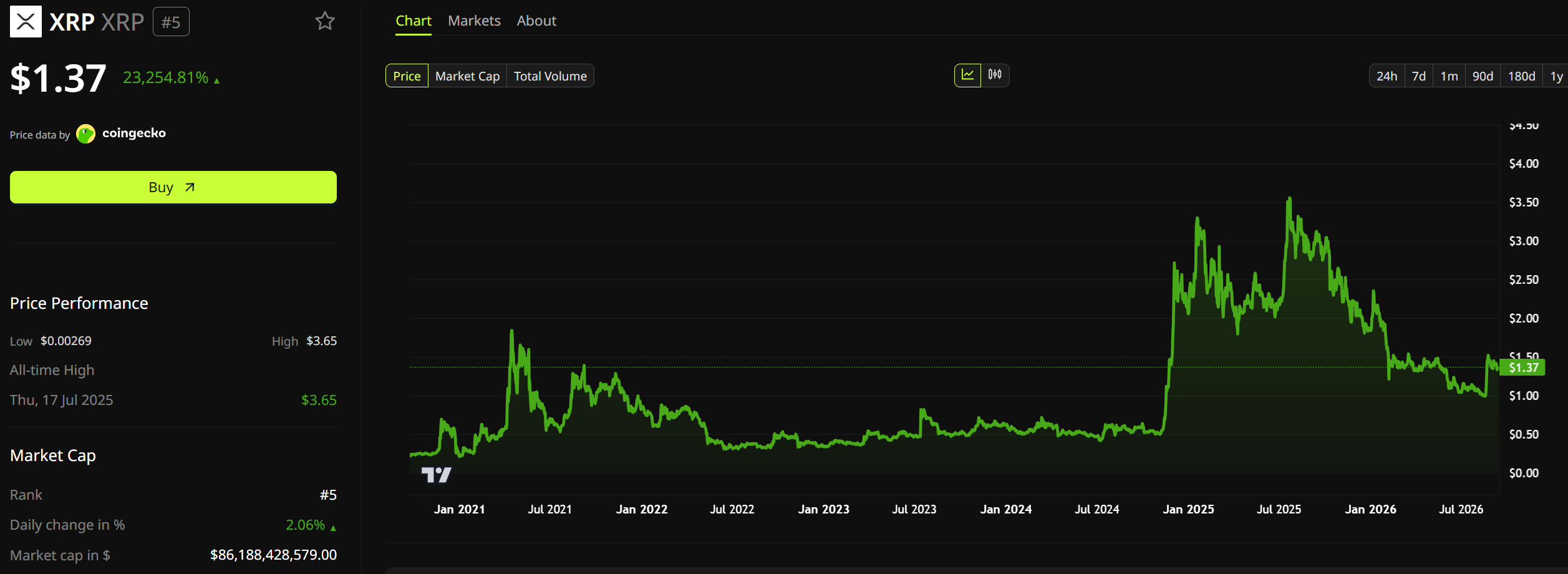
Meanwhile, the thing the fund was designed for happened without it. XRP peaked at $3.65 in July 2025 and now trades near $1.37, suggesting a drawdown of over 60%. Anyone wanting a listed way to bet against that slide had none.

Ordinary funds that simply hold XRP did arrive, and money kept flowing in. Over their past 20 trading days those funds took in $190.5 million, with withdrawals on a single day.
Buyers stayed put through the decline. Cumulative inflows since launch now stand at $1.70 billion. What nobody could buy was the other side of the trade.

October 11 marks the 20th deadline for this fund. After 19 postponements, the sharper question is what changes if it ever does launch.
The post The ETF Built to Bet Against XRP Price Has a New Launch Date appeared first on BeInCrypto.

Major fire at historic mill used in Peaky Blinders and Downton Abbey filming

IBEX Limited 2026 Q4 – Results – Earnings Call Presentation (NASDAQ:IBEX) 2026-09-12

Nicole Kidman’s ‘Striking’ New Appearance Has Experts Talking

Memory prices are slowing because buyers ran out of money

Micron Stock Climbs Above $1,031 as AI Memory Crunch and a $50 Billion Outlook Fuel the Rally

AMD Stock Climbs After Management Lifts 2027 Data Center Outlook Toward $70 Billion in AI Sales


-
Tech4 days ago
Memory prices are slowing because buyers ran out of money
-
 Business3 days ago
Micron Stock Climbs Above $1,031 as AI Memory Crunch and a $50 Billion Outlook Fuel the Rally
-
 Business3 days ago
AMD Stock Climbs After Management Lifts 2027 Data Center Outlook Toward $70 Billion in AI Sales
-

 Crypto World4 days ago
Bitcoin price risks $76K drop as $78K support weakens
-

 Crypto World4 days ago
Robinhood Stock: How To Take Advantage With Reduced Risk
-

 Crypto World4 days ago
Ethereum price stalls below $2,500 as ADX drops to 11
-

 Fashion1 day ago
Weekend Open Thread – Corporette.com
-

 NewsBeat4 days ago
England up in reading, maths and science rankings as Scotland and Wales dip
-

 Crypto World2 days ago
2 Chip Stocks Broke Out This Week. Neither Was Nvidia
-

 Crypto World2 days ago
OKX launches 10x OpenAI, Anthropic X-Perps in Europe
-

 Crypto World2 days ago
XAG/USD: Silver’s Short-Term Rally Meets Its Moment of Truth
-

 Crypto World2 days ago
Diesel Tops $6 a Gallon for the First Time as 28 States Set Records
-
 Crypto World4 days ago
Intel Stock Jumps 9% on Chip Price Hike Report, US Stake Gains $36 Billion
-

 NewsBeat4 days ago
What went right this week: an ‘historic’ fall in violent crime, plus more
-

 Crypto World3 days ago
Bitcoin price risks $70K if $78K neckline breaks
-
 Business4 days ago
Meta debuts long-awaited personal AI agent, Muse
-
Crypto World2 days ago
Ethereum Price Analysis: Consolidation at $2.5K Tests Momentum as On-Chain Activity Surges
-
 Crypto World4 days ago
Bitcoin price holds near $79K as cycle drawdowns narrow
-

 Crypto World4 days ago
Pump Fun and Kraken delete Hunter Biden $LAPTOP promotion
-

 Entertainment3 days ago
Case Sees Major Update As Jury Deliberations Begin
You must be logged in to post a comment Login