
Crypto World
Kevin O'Leary's New Investment Is Not Bitcoin or Stocks



Kevin O’Leary’s next investment target is neither Bitcoin (BTC) nor stocks. The Shark Tank host wants about 5% of his portfolio in rare sports cards, and his group just paid $11 million for one.
The card carries pieces of Shohei Ohtani’s game-worn jersey, and only one exists. A Florida teenager found it in a Boca Raton shop. O’Leary announced the purchase on CNBC last Tuesday.
Why Kevin O’Leary’s Investment Case Starts With the Money Supply
O’Leary defends the cards the way Bitcoin holders defend Bitcoin. US M2 money supply hit $23.22 trillion in July, and he wants assets no central bank can print more of.
He buys through Secure Collectibles alongside collector Shyne and entrepreneur Paul Warshaw. The group labels its holdings the WonderShyne Index and has spent roughly $100 million so far.
That reasoning borrows directly from the debasement-trade narrative that has shaped Bitcoin demand all year.
What the Index Does Not Show
O’Leary picks the cards and also writes the entry rules. He says the index holds no losers, which is easy to claim when the curator decides what qualifies.
The gains remain on paper. Card Ladder marks his $12.93 million Michael Jordan and Kobe Bryant card at nearly $17.05 million, yet he has said he will never sell it.
A one-of-a-kind card has exactly one bidder on the day it matters. His crypto book is thinner but far easier to exit.
BeInCrypto reported in September 2025 that he had cut down to three crypto positions, a read that held up when he confirmed in April that Bitcoin and Ether (ETH) cover 90% of that exposure.
Whether outsiders will ever be able to buy into the index remains unanswered. O’Leary has hinted at public access and confirmed nothing.
The post Kevin O'Leary's New Investment Is Not Bitcoin or Stocks appeared first on BeInCrypto.



In 1988, a secretary at Dell could get rich on the company stock. In 2026, the stock is up roughly 350%, and almost all of that money lands on one man.
That man is Michael Dell. This week he passed Jeff Bezos to become the world’s third richest person, worth $276.5 billion by Forbes’ count.
Nvidia Builds the Brains. Dell Builds the Boxes.
Nvidia makes the chips that run artificial intelligence (AI). Dell bolts those chips into metal racks and ships them.
Nvidia is the far better business. It earned $96.2 billion last quarter and kept 75 cents of every dollar. Dell reported $47 billion and kept 21 cents, even as its AI server sales doubled.
Yet Nvidia founder Jensen Huang is worth $189.1 billion. He is $87 billion poorer than the man who builds the boxes.
The reason is simple. Huang owns about 3% of Nvidia. Michael Dell owns about 40% of Dell. Investors have spent months hunting the winners beyond Nvidia. They were looking at the wrong number.
The Deal That Locked Everyone Else Out
He owns that much because he bought his company back.
In February 2013, Dell moved to take the company private. Silver Lake helped him pay for it. That October, public shareholders got $13.88 a share and were shown the door.
Two days after he announced that plan, Texas Monthly ran a story about what Dell stock used to do. It counted roughly 2,700 employee millionaires in Austin. Locals called them Dellionaires. Secretaries became rich.
This rally works differently. The gains pile up in one place.
Some analysts still doubt the boom pays. BeInCrypto raised the margin question before the earnings that started this run.
“It becomes a problem if it becomes that we’re really not adding to the bottom line at all,” Fortune reported, citing James Fish, senior analyst at Piper Sandler.
Dell now leads Bezos by about $3 billion. Monday can flip that. It cannot flip who owns the company.
The post Nvidia Gets the AI Hype. Dell Gets the Billionaire Fortune appeared first on BeInCrypto.

XRP price is trading lower, caught between a bullish institutional prediction and a chart that refuses to commit either way. A Schwab money fund filing just listed four XRP ETFs as eligible repo collateral. That detail matters more than the latest daily candle, and there’s a wrinkle here that most traders are glossing over.
The filing reportedly names Grayscale, Canary, Franklin, and Bitwise XRP ETF line items, with their combined collateral value running into the millions against billions in repo exposure at the fund level. One report framed this as validation of XRP’s institutional plumbing.
Repo markets sit at the heart of Wall Street liquidity, making eligibility as collateral a different kind of institutional acceptance than simple ETF inflows.
Layer in the recent XRPL ledger upgrade and the upcoming CLARITY Act vote, and the setup looks like a token with several catalysts stacked together. The question now is whether price action can absorb those developments, or whether traders have already priced in too much of the good news.
Earn $50 and Enter $300K Prize Draw on EdgeX
XRP Price Prediction: Can Ripple Hit $1.70 Next Week?
XRP’s intraday range has been volatile, swinging through the low-$1.30s to the mid-$1.40s. That tells you liquidity is thinner than the headlines suggest. The $1.30–$1.40 zone is the demand area technicians are watching, with stronger support around the low-$1.30s. Resistance sits around $1.50–$1.55, followed by the $1.60–$1.70 region.
Bull case: a clean break above the mid-$1.50s opens a path toward the $1.65–$1.70 area, followed by $1.80–$1.90 and potentially the low-$2 range if the repo narrative and CLARITY vote both land favorably. Whale accumulation data suggests larger wallets aren’t fading the move yet.

Base case: continued chop inside the roughly $1.30–$1.55 range while traders wait for confirmation from recent network developments and the upcoming regulatory vote.
Bear case: a sustained loss of the mid-$1.30s risks a slide toward the $1.20–$1.25 area, weakening the near-term bullish structure. Supply-concentration data adds context on how much of the move is retail-driven versus whale-supported. Watching volume around the low-$1.30s remains the practical move here.
Discover: The Best Token Presales
LiquidChain Targets Early Mover Upside as XRP Tests Key Levels
Here’s the uncomfortable math for anyone chasing XRP off this repo headline: at a market cap already in the tens of billions, even a full breakout to $2 is just less than 100% move from current levels. Solid, but not life-changing.
Capital rotating out of large-cap consolidation zones is increasingly looking toward earlier-stage infrastructure plays where the upside math works differently.
The Order rests. The architecture never sleeps. — LiquidChain (@getliquidchain) September 9, 2026
 ⟁https://t.co/vqvBcdSQYC pic.twitter.com/bNof4XHJ58
LiquidChain ($LIQUID) is positioning itself as the connective tissue between Bitcoin, Ethereum, and Solana liquidity. Liquid is a Layer 3 execution environment where developers deploy once and reach all three ecosystems rather than fragmenting builds across chains.
The presale is priced at $0.014954 with $965K raised so far. Core features include a Unified Liquidity Layer, Single-Step Execution, and Verifiable Settlement. An architecture aimed squarely at the cross-chain fragmentation problem that’s plagued DeFi since multi-chain became the default.
Research LiquidChain before the next raise milestone.
Trade XRP on Bybit and Get a Chance to Win Our $1,000 USDT Airdrop
The post XRP Price Prediction: Schwab Opens Wall Street Repo Market to ETFs appeared first on Cryptonews.
I dunno, flip a coin.
Crypto World
What Happens to XRP if the CLARITY Act Vote Fails on September 15? AI Maps the Downside

Although the upcoming vote on the Digital Asset Market Clarity Act is not a final passage vote, it still holds significance for the broader crypto market as senators will decide whether to advance debate on the legislation. Cloture requires 60 votes, meaning that even if all Republicans support it, they would still need assistance from some Democrats or independents.
XRP could be among the most intertwined crypto assets with the bill, which is why a potential failure could weigh on its price quite considerably. As such, we asked ChatGPT about its take on the matter and what could happen to the cross-border token.
Why CLARITY Matters for XRP
The bill aims to create a comprehensive federal crypto market structure, including clearer responsibilities for the two main watchdogs – the SEC and the CFTC, and rules for exchanges, brokers, dealers, and digital commodities. This is particularly relevant for the cross-border token following Ripple’s years-long regulatory battle with the SEC.
After the conclusion of the lawsuit that began in late 2020, the regulator identified XRP as a digital commodity. As such, the legislation would make the broader regulatory framework more durable by codifying it into federal law, since history has shown that the SEC’s allegiance shifts quickly with each new administration.
Overall, even though a failure on the CLARITY Act’s vote next week would remove a potential bullish catalyst, it wouldn’t erase all of XRP’s regulatory progress experienced in the past year and a half.
But Still – Will XRP Tumble?
From a technical standpoint, XRP is currently near $1.40, above the key support at $1.34-$1.35, but it hasn’t reclaimed the crucial resistance at $1.40. If cloture fails but BTC and the broader crypto market remain stable, ChatGPT envisioned a 7% to 10% initial reaction for Ripple’s token, which would materialize with a dip to $1.20-$1.25.
A more aggressive selloff could drive the asset south toward $1.10, especially if markets interpret the result as evidence that comprehensive US crypto legislation could be delayed well after the midterms.
The dark horse comes a day later, when the Federal Reserve will conclude its September 15-16 FOMC meeting. A failed CLARITY Act vote followed by a hawkish Fed decision could turn an XRP-specific regulatory disappointment into a broader crypto selloff. In that scenario, the AI platform predicted a more painful decline toward $1.00.
On the plus side, ChatGPT said a lack of progress on the CLARITY Act alone wouldn’t be as strong a catalyst to drive XRP below $1.00.
The post What Happens to XRP if the CLARITY Act Vote Fails on September 15? AI Maps the Downside appeared first on CryptoPotato.
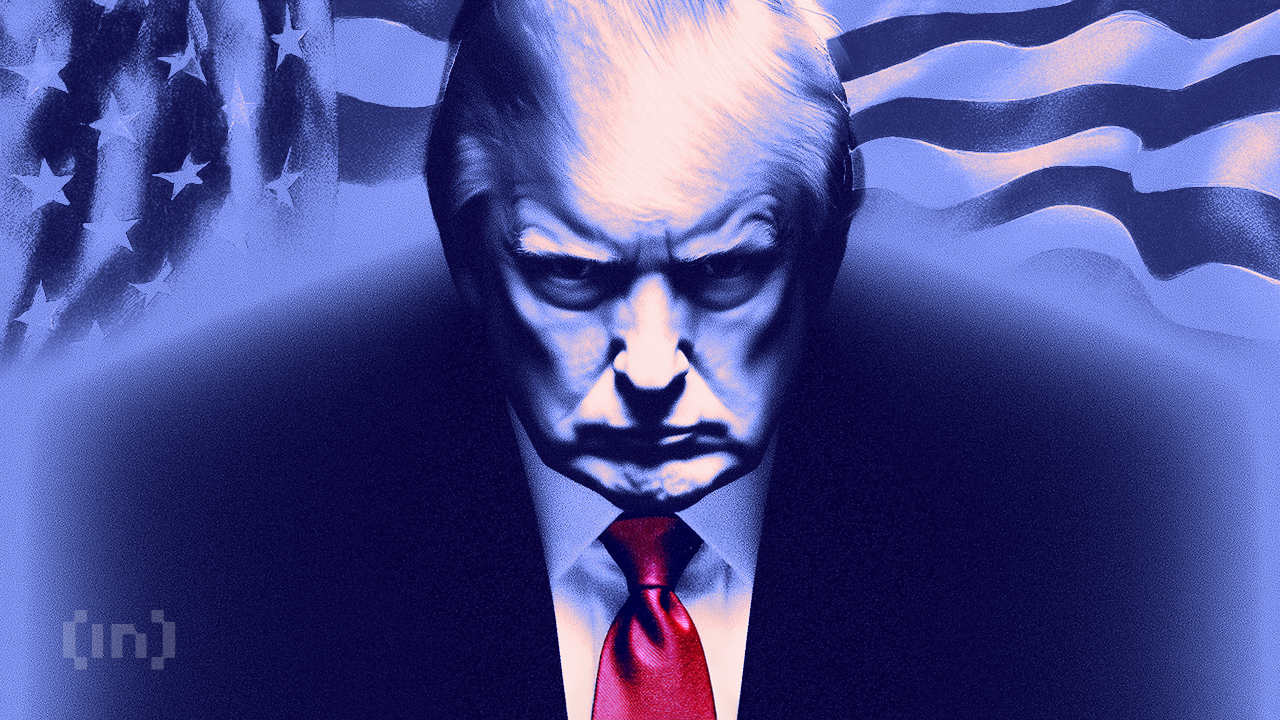

President Donald Trump rejected calls from leading artificial intelligence (AI) executives to slow model development, arguing on Sunday that any pause would hand China the lead in a race the United States must win.
House Speaker Mike Johnson and former White House AI adviser David Sacks made versions of the same argument. An AI safety debate turned into a contest over China.
Congress Hands AI Safety to the Developers
Johnson told CNN’s State of the Union that Congress has already set guardrails. The burden sits with the labs.
“…there is an obvious corporate responsibility that the people who are creating these models have to ensure that their products are safe.”
He spoke a day after Anthropic, OpenAI and xAI urged an AI slowdown. No federal rule obliges any of them to follow through.
Sacks told the three chief executives to stop asking permission. He argued their caution is also commercial, since a damaging cyberattack would expose them to liability claims.
The China Argument Broke on Sunday
According to David Sacks China would never sign anything.
“China is very unlikely to join a global agreement, as you know, and that has to be taken into account as well,” he said.
Meanwhile, China’s President Xi Jinping has called for a “consensus-based global AI governance framework” at the BRICS summit in New Delhi. He also pledged a BRICS AI open source community.
BRICS is an 11 nation bloc led by China, India and Russia.
Meanwhile, Senator Bernie Sanders has demanded a full pause and wants a treaty with Xi. Trump meets him at the White House on September 24, with AI on the agenda.
Amodei Is Not the Dove Washington Describes
Anthropic chief Dario Amodei told CBS News the toughest dilemma in his plan is what happens if China does not follow.
“The more long-term thing would be working together to put a speed limit on the rate of of AI progress…I think that’s going to be very difficult because the incentives to pull ahead and the military advantage that you get from that are so large. And honestly, I don’t know if it’s possible,” Amodei explained.
His essay asks Washington to block advanced chip sales to China and break up smuggling networks. He wrote that a Chinese lead would pose grave danger.
Step three of that plan needs governments to negotiate with authoritarian states. That is the step Congress spent Sunday declining.
Stanford’s 2026 AI Index measured the American lead over the best Chinese model at 2.7% in March. Chinese labs have also been accused of copying American AI models.
Eleven days before Trump sits down with Xi, the only people able to slow AI down are the ones competing to build it fastest.
The post AI Safety Burden Falls on Chief Executives as Trump Prioritizes China Race appeared first on BeInCrypto.
Tesla will reveal its long delayed second generation Roadster on October 1 in Waco, Texas, pairing a “Go for launch” teaser image with a countdown clock and a demonstration built around SpaceX thruster hardware.
The event lands weeks after a different Tesla product launch cost shareholders money. That gap between spectacle and disclosure is what investors have to price.
Nine Years, One Rocket Company
Tesla has set dates like this before. Musk once picked April 1 for the Roadster demo, then told shareholders he chose April Fools’ Day so he could always claim it was a gag.
That date passed. So did the ones after it.
The new plan involves cold gas thrusters, small nozzles that fire compressed gas, borrowed from SpaceX rocket parts. Teslarati reports the car may briefly leave the ground with nobody inside. Musk says it could hit 60 mph in 1.1 seconds.
However, not everyone buys the physics. Mate Rimac, founder of the rival hypercar maker Rimac Automobili, has pushed back on numbers like that.
“…you need something like 30.000 Nm on the wheels to accelerate below 1 sec 0-100 km/h.”
Tesla first showed this car in 2017 and promised deliveries by 2020. Nine years later, nobody has one.
What the Stock Did 10 Days Ago
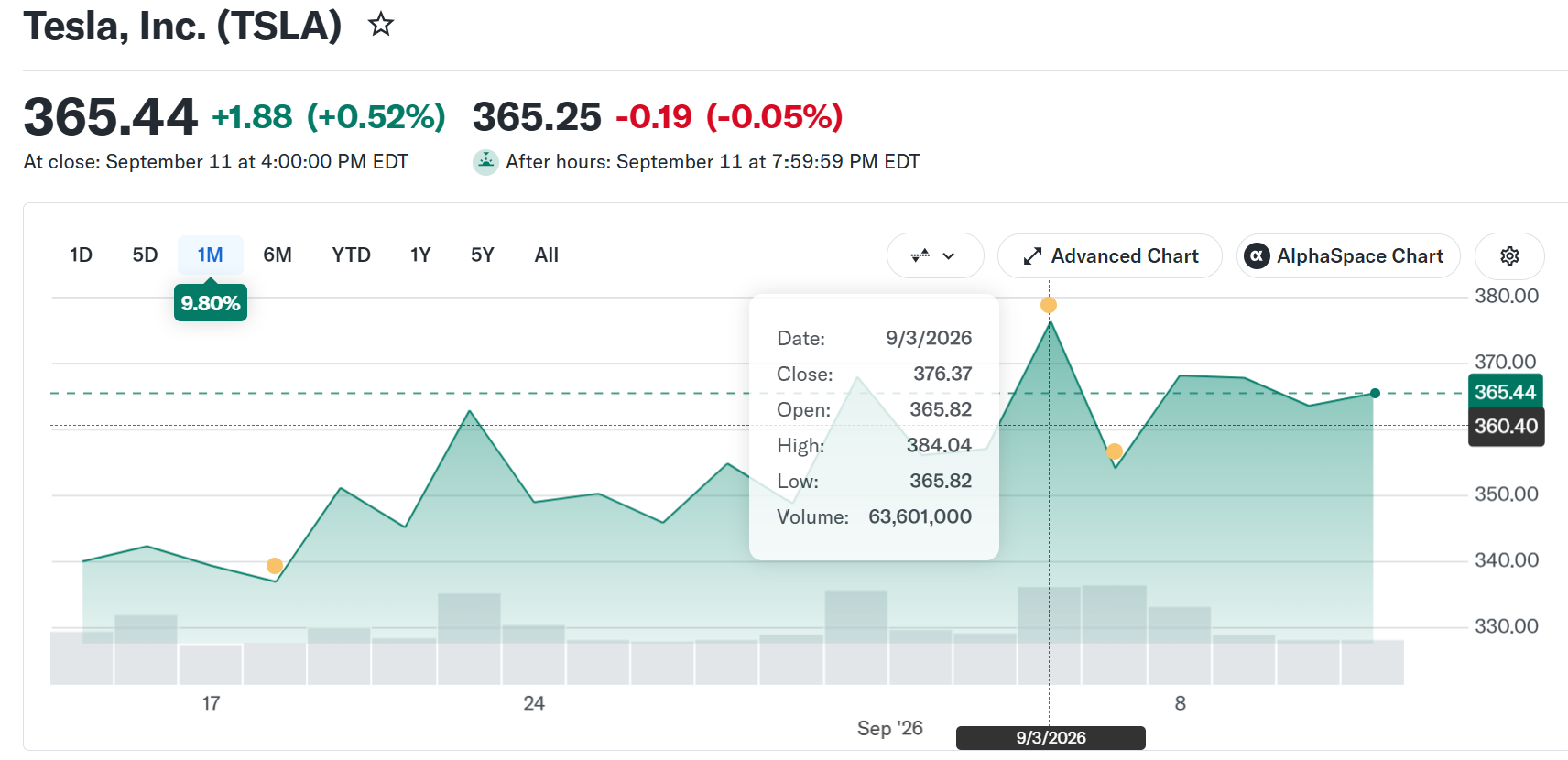
Wall Street already ran this exact test. Tesla launched the Cybercab on September 3 at a closed Austin robotaxi event. No livestream. No public remarks from Musk. No fleet numbers.
Shares fell 5.92% to $354.08 that day, according to Yahoo Finance.

They clawed back to $365.44 by September 11. The average analyst target sits at $377.08, barely 3% above that. Tesla is priced on robots and software, themes that ran through its second quarter earnings, not on a car that hovers.

The difference is simple. A hover is a video. A build date is a business, and October 1 decides which one Tesla brought.
The post New Tesla Roadster Uses SpaceX Tech. Will It Impact the Stock Price? appeared first on BeInCrypto.
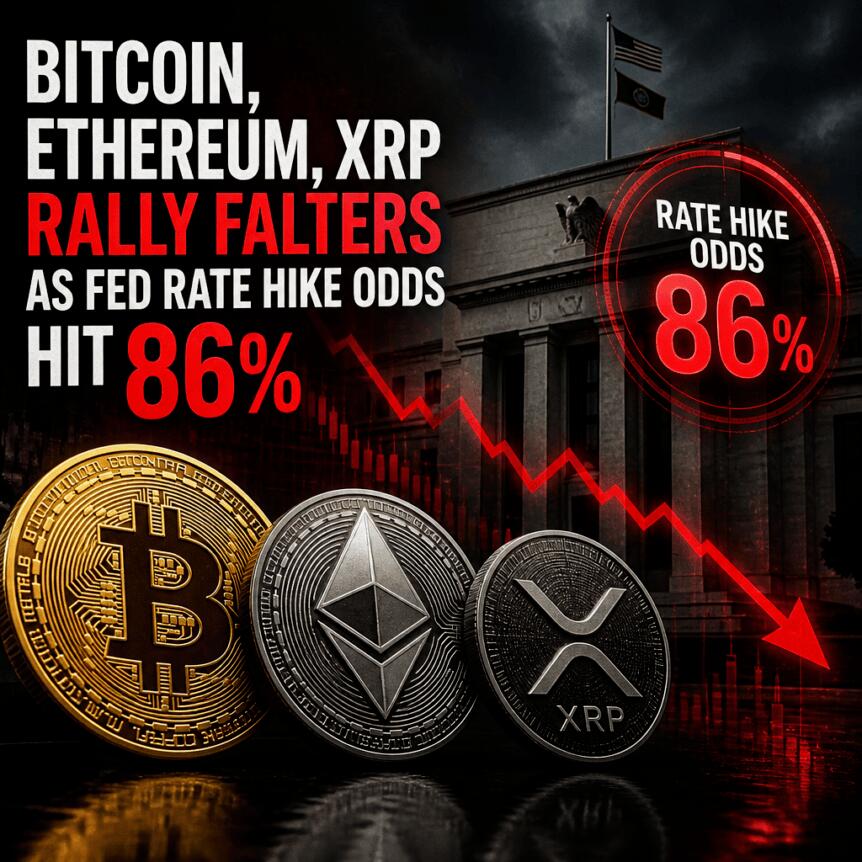
A looming Fed rate hike threatens the fragile rally across Bitcoin, Ethereum and XRP. Traders raised the odds of a Fed rate hike at the September 16 meeting to 86.5%, according to the CME FedWatch tool. The shift follows fresh inflation data and puts pressure on the broader crypto market this week.
Bitcoin Faces Fed Rate Hike Pressure Before FOMC Meeting
The probability of a Fed rate hike jumped from near 70% before the August inflation report. U.S. CPI inflation rose 3.4% year-over-year in August, fueling the shift. A hike would mark the first increase in three years and signal a tighter policy stance.
Fed policymakers do not fully share this outlook, based on a recent Bloomberg survey of officials. Fewer than 13% of 48 respondents expect a rate increase at the September meeting. Most economists also see no change at the December 2027 decision either.
Bitcoin‘s chart structure still points toward higher levels despite the Fed rate hike concerns. Analyst Michaël van de Poppe expects a period of consolidation before the next upward push. He projects a move toward the $90,000 to $92,000 resistance zone, and bull markets typically avoid sharp pullbacks.
Ethereum Approaches $3,000 Despite Fed Rate Hike Concerns
Ethereum trades near $2,535 and faces resistance between $2,547 and $2,550. Analyst Ted Pillows notes the asset has returned to this key resistance level. A break above this zone could open the path toward higher price targets.
The next major resistance sits just above $2,800, according to Pillows’ analysis. Support levels rest near $2,215 and $1,965 if the price pulls back. A weekly close above $2,550 would clear the way for further gains.
Such a close could push Ethereum toward the $3,000 mark, Pillows suggests. The Fed rate hike decision could still disrupt this trajectory in the near term. Broader risk sentiment remains tied to the outcome of the September Fed meeting.
XRP Tests Key Support Amid Fed Rate Hike Uncertainty
XRP faces a more difficult setup than Bitcoin and Ethereum right now. The token dropped nearly 20% over three weeks, falling from $1.70 to $1.35. Analyst Ali Martinez tracks this decline through on-chain and whale activity data.
Whales sold or redistributed about 90 million XRP tokens over the past week. Daily active addresses fell 90.18%, dropping from 388,492 to 38,163. This decline points to a sharp pullback in network activity and engagement.
The $1.35 level stands as a decisive support zone for XRP, per Martinez. Roughly 2.29 billion tokens already changed hands at this price point. A recovery above $1.38 could send XRP back toward $1.60 and $1.68.
The Fed rate hike remains the dominant factor shaping crypto price action this week. Borrowing costs directly affect risk appetite across digital assets and equities alike. Traders will watch the September 16 announcement for further direction on Bitcoin, Ethereum and XRP.
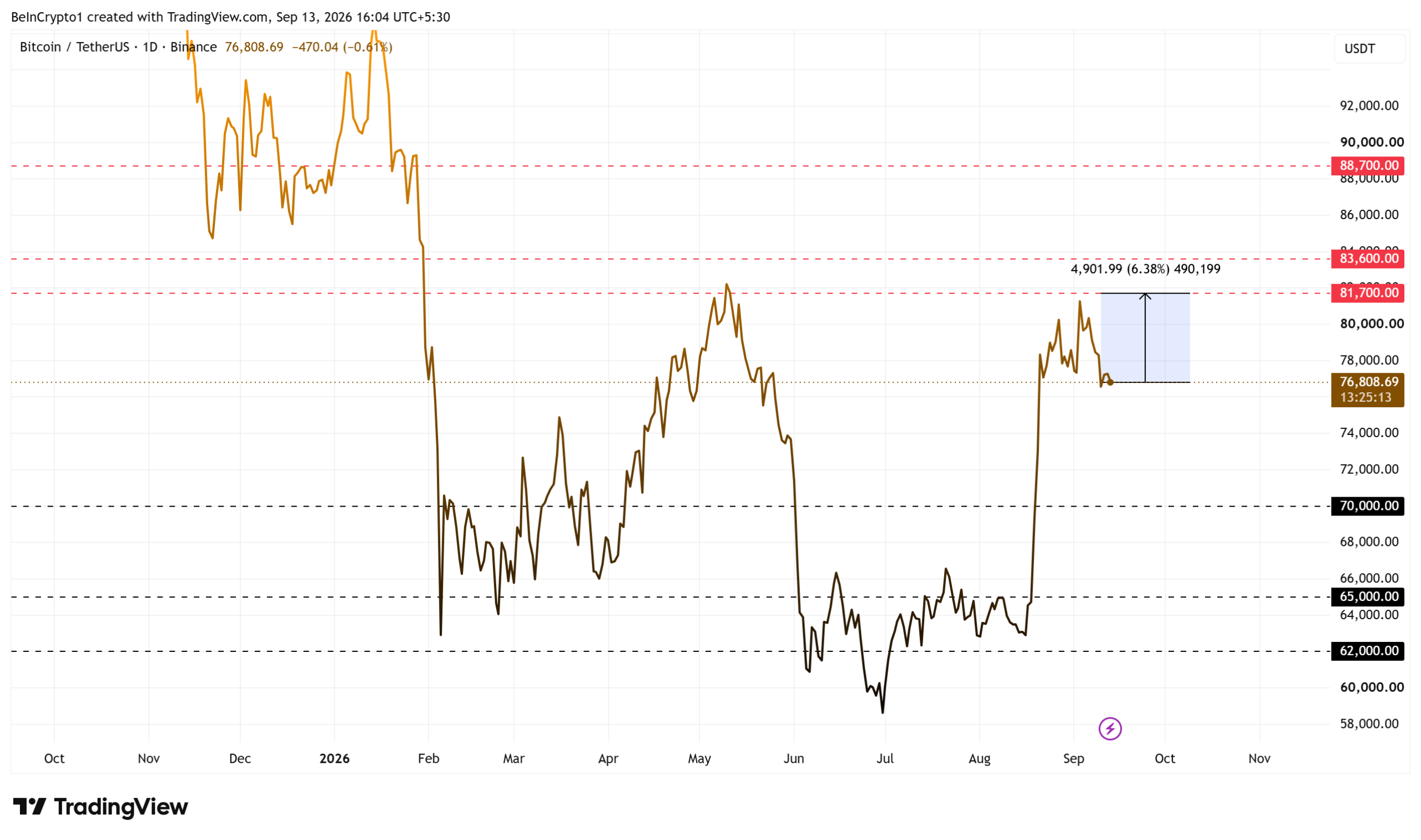
Bitcoin whales sold into the two-week rally while US institutions stayed away, leaving the price about $4,900 short on Sunday of the level CryptoQuant treats as proof of a new bull market.
Bitcoin (BTC) trades near $76,808, down 0.2% in 24 hours. CryptoQuant puts that line at $81,700, the average closing price of the past year.

Bitcoin Whales Sent Coins to Exchanges as Retail Bought
A CryptoQuant Quicktake put the Exchange Whale Ratio at 0.93, a level the firm flags as an alert. The gauge tracks how much of the coin arriving at exchanges comes from the largest wallets, and exchanges are where coins are sold.
That reading covers one hour, so it marks a moment rather than a trend.
Retail went the other way. The Fear and Greed Index registered 66, well inside greed, and a taker buy/sell ratio of 1.12 showed traders paying up for leveraged bets.

Institutions did not join them. A negative Coinbase Premium meant Bitcoin traded more cheaply on the main US exchange than offshore, a sign American funds were not behind the move.
“With Price Momentum already exhausted at level 20 and the FEI Score locked in a zone of absolute noise (99.53%), the stage is set for a Long Squeeze,” said CryptoQuant analyst GugaOnChain.
A long squeeze forces traders who borrowed to bet on gains to sell, pushing prices down further.
A Supply Wall Stands Between Bitcoin and a Bull Market
Meanwhile, CryptoQuant’s September 11 report places the nearest resistance between $77,100 and $80,200. A second group sold there too. Long-term holders, wallets that held their coins for months, released as much as 539,000 BTC within that band this year.

That is two separate groups selling into one zone, one over hours and one across 2026.
“The upper band marks where trader profit-taking has historically emerged,” CryptoQuant analyst Moreno said.
BeInCrypto reported in August on CryptoQuant’s bull market condition, a weekly close above $81,700. Bitcoin has approached it this month without delivering one.
Further ceilings follow at $83,600 and $88,700. Should Bitcoin’s price fall back, support sits at $70,000 and again between $62,000 and $65,000, where holders bought roughly 476,000 BTC this year.
The levels are the easy part. The harder question is who buys a breakout when both groups of large holders are selling and US funds sit it out.
The post Analysts Think Bitcoin is Less Than $5,000 Away From a Bull Market appeared first on BeInCrypto.


lockchains don’t need quantum computers to be quantum-safe, argues Optimum co-founder and MIT professor Muriel Médard. Classic math already gives us the tools.
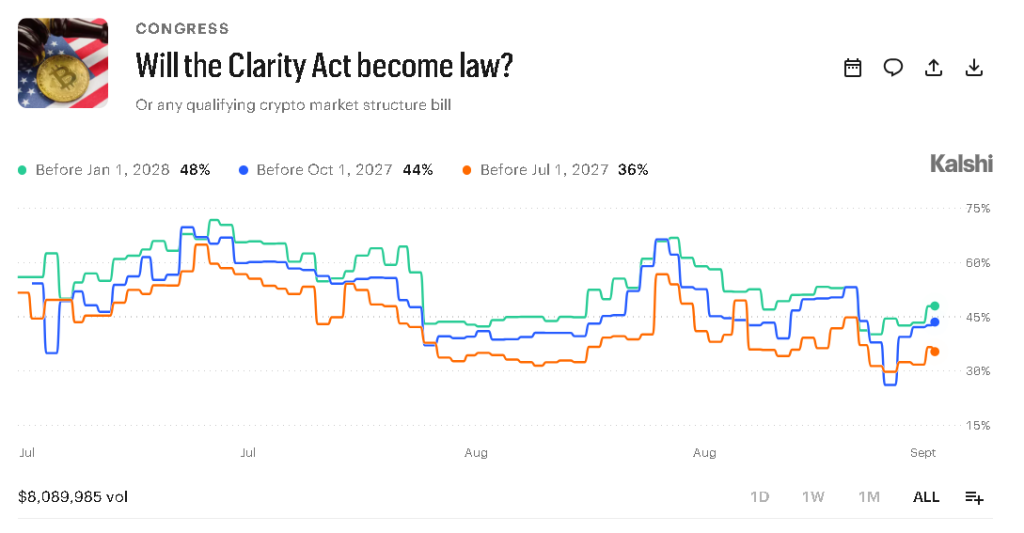
CLARITY Act odds on Kalshi for the bill to become law in 2026 stood at 25% on September 13, down from 82% in February. At the same time, a separate Kalshi market put the probability of a U.S. Senate vote before October 1 at 94%.
The difference reflects two distinct questions: whether the Senate will take up the measure and whether the bill will complete the full legislative process and be signed into law, with a full-blown crypto bull market hinging on its passage.
The Senate is due to consider the measure on September 15. The Kalshi concerns whether H.R. 3633, formerly known as the CLARITY Act, will be passed by both chambers of Congress and signed into law by December 31, 2026. A vote on the motion to proceed is an earlier procedural stage, rather than final enactment.

Make Your CLARITY Act Prediction Count With $25 For Free on Kalshi
CLARITY Act Odds: A Vote Is Not the Same as a Law
More than $8M has been wagered on Kalshi’s contract covering the bill’s enactment. The market’s implied probability fell from 82% in February to 16% on September 7.
Views on the Senate threshold differ. Coinbase CEO Brian Armstrong said in a CNBC interview that he was rather optimistic about obtaining 60 votes and characterized the negotiations as having delivered most of what both sides wanted.
Other estimates cited in the source report were more cautious. Ian Katz of Capital Alpha Partners lowered his estimate of the bill’s chances of passage from about 40% to 25%.
Galaxy Digital’s estimate in August was 10%. These assessments, like the prediction-market prices, address the prospects for legislation that must move beyond a procedural Senate vote.
Make Your CLARITY Act Prediction Count With $25 For Free on Kalshi
Why 53 Republican Seats Isn’t Enough
In other CLARITY Act odds news, September 15 is expected to center on a motion to proceed, a step that authorizes debate on the bill rather than passing it outright. Supporters need 60 favorable votes. Republicans hold 53 Senate seats, so at least seven Democrats would need to join them to overcome cloture.
The CLARITY Act passed the House of Representatives in July 2025 by a 294-134 vote. The bill is intended to establish a federal framework for the U.S. crypto market.
Under the proposal described in the source report, the CFTC would receive exclusive authority over spot markets for digital commodities, while the SEC would retain oversight of certain securities offerings and crypto exchange activities.
Three areas of disagreement remain. Several Democrats, including Kirsten Gillibrand, are seeking a binding ban on public officials holding crypto assets. Traditional banks have resisted compromise over stablecoin rewards.
Lawmakers also remain divided over protections for decentralized finance protocols and non-custodial software developers, with concerns that some language could create regulatory loopholes.
Earn $50 and Enter $300K Prize Draw on EdgeX
What Happens After September 15
— Coin Bureau (@coinbureau) September 6, 2026
 HUGE: Anonymous traders have bet over $1 MILLION that crypto's biggest regulatory bill will FAIL, days before its make-or-break vote.
The CLARITY Act faces a Senate vote on September 15, but only to start debate, not to pass.
It needs 60 votes to proceed, yet Republicans hold… pic.twitter.com/g13s8TapC8
If the motion to proceed receives the necessary votes, the legislation would move into formal debate. The outstanding disagreements over ethics, stablecoin rewards, and protections for DeFi and non-custodial developers would still need to be addressed. If cloture does not clear, the bill would not advance through that procedural step.
The legislative route is not the only avenue for crypto policy. The SEC and CFTC are already pursuing work on crypto regulation without waiting for Congress.
Under Paul Atkins, the SEC has abandoned certain enforcement actions and outlined a taxonomy of crypto assets, according to the source report. The CFTC is working on issues involving leveraged exchanges and DeFi.
Regulatory action can provide a framework outside legislation, but agency rules can also be changed by a future administration. The September 15 proceeding, therefore, remains important as a gauge of whether the CLARITY Act can begin Senate debate, while the prediction markets highlight the separate question of whether it can become law in 2026.
Discover: The Best Crypto to Diversify Your Portfolio
The post CLARITY Act Odds Slashed to 60-Vote Senate Test Comes Into View appeared first on Cryptonews.

10 Movies You Need to Watch on Prime Video in September 2026

Beginners Guide to Trading Crypto & Memecoins in 2026 (Free Course)
How Donald Trump’s war in Iran is failing the legitimacy test in the eyes of US voters

Memory prices are slowing because buyers ran out of money

Micron Stock Climbs Above $1,031 as AI Memory Crunch and a $50 Billion Outlook Fuel the Rally

AMD Stock Climbs After Management Lifts 2027 Data Center Outlook Toward $70 Billion in AI Sales


-
Tech5 days ago
Memory prices are slowing because buyers ran out of money
-
 Business4 days ago
Micron Stock Climbs Above $1,031 as AI Memory Crunch and a $50 Billion Outlook Fuel the Rally
-
 Business4 days ago
AMD Stock Climbs After Management Lifts 2027 Data Center Outlook Toward $70 Billion in AI Sales
-

 Crypto World5 days ago
Bitcoin price risks $76K drop as $78K support weakens
-

 Crypto World5 days ago
Robinhood Stock: How To Take Advantage With Reduced Risk
-

 Fashion2 days ago
Weekend Open Thread – Corporette.com
-

 Tech8 hours ago
The Latest Weird Thing to Play Doom Is the Mapped-Out Brain of a Fruit Fly
-

 Crypto World5 days ago
Ethereum price stalls below $2,500 as ADX drops to 11
-

 Crypto World2 days ago
XAG/USD: Silver’s Short-Term Rally Meets Its Moment of Truth
-

 Crypto World3 days ago
2 Chip Stocks Broke Out This Week. Neither Was Nvidia
-

 NewsBeat5 days ago
England up in reading, maths and science rankings as Scotland and Wales dip
-

 Crypto World3 days ago
OKX launches 10x OpenAI, Anthropic X-Perps in Europe
-

 Business3 days ago
10 Most-Streamed Songs On Spotify In 2026 So Far, Led By Ella Langley’s Dominant Run On The Charts This Year
-

 Crypto World2 days ago
Diesel Tops $6 a Gallon for the First Time as 28 States Set Records
-

 Tech3 days ago
Battery life is the only iPhone 18 Pro and iPhone Duo upgrade I care about. Apple didn’t disappoint
-
 Crypto World5 days ago
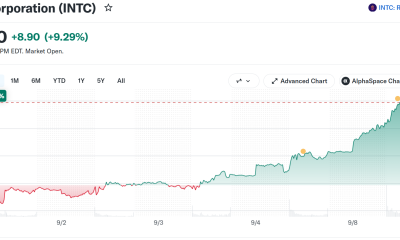
Intel Stock Jumps 9% on Chip Price Hike Report, US Stake Gains $36 Billion
-

 Crypto World4 days ago
Bitcoin price risks $70K if $78K neckline breaks
-

 NewsBeat5 days ago
What went right this week: an ‘historic’ fall in violent crime, plus more
-

 Tech4 days ago
Apple Watch Ultra 4 vs Watch Ultra 3: Should you really spend another $799?
-
Crypto World3 days ago
Ethereum Price Analysis: Consolidation at $2.5K Tests Momentum as On-Chain Activity Surges
You must be logged in to post a comment Login