
Crypto World
BE Stock: Bloom Energy Surges On ‘Meaningful’ Data Center Catalyst


Bloom Energy (BE), an AI energy infrastructure play, has gained important validation for the use of fuel cells to power data centers, an analyst said. BE stock popped near a buy point on Wednesday. Analysts at RBC Capital said in a research note on Tuesday that Bloom Energy is enjoying “another meaningful proof point” with its fuel cells set to…
Copyright ©2026 Investor’s Business Daily, LLC. All rights reserved. 87990cbe856818d5eddac44c7b1cdeb8

Crypto World
DOGE Initiative Resulted in Federal Employees Getting Paid Billions to Not Work, New Government Report Finds


The federal government spent an estimated $9.5 billion paying employees to not work last year, with most of the cost tied to a Department of Government Efficiency (DOGE) initiative to shrink the federal workforce, according to a new report from the Government Accountability Office.
The report, published Tuesday, found that the use of paid administrative leave increased 435% from 2023 to 2025, while associated salary costs rose sixfold. GAO estimated that $6.7 billion—around 70% of the 2025 total—was associated with the Administration’s deferred resignation program. The congressional watchdog analyzed payroll data from 76 agencies representing around 95% of the civilian federal workforce.
In January 2025, the Trump Administration offered roughly 2 million federal workers the option to resign while continuing to receive full pay and benefits through Sept. 30. The government-wide offer was meant to encourage voluntary departures under an arrangement known as deferred resignation. The Office of Personnel Management directed agencies to place employees who accepted the offer on paid administrative leave until their departure. Some agencies later conducted additional deferred resignation programs.
According to federal workforce data, 139,963 federal employees left the government through deferred resignation programs.
The initiative was part of the Trump Administration’s broader campaign under DOGE to cut what it saw as wasteful federal spending. Tech billionaire Elon Musk, who became the public face of DOGE before leaving the Administration in May 2025, initially promised to save the federal government $2 trillion, before lowering the target to $1 trillion. DOGE’s website ultimately claimed $215 billion in estimated savings. That figure has not been independently confirmed. In a separate review of $110 billion in claimed savings, GAO found that some estimates were incorrect or unsupported. (DOGE officially shut down in July, after OPM absorbed most of its functions in November.)
Federal data showed a net decline of 271,363 civilian federal employees—around 12% of the federal workforce—between President Donald Trump’s inauguration and July this year.
Those reductions were not uniform across agencies. Between December 2024 and January 2026, the largest decline was at USAID, where the workforce fell 95%, according to a separate GAO analysis. Staffing declined 46% at the Education Department, 37% at the General Services Administration, 34% at OPM, 33% at the National Science Foundation, and 31% at the Department of Housing and Urban Development. The Department of Homeland Security, by contrast, reduced its workforce by less than 1%.
Some agencies later had to replace workers they paid to leave. The Partnership for Public Service identified 20,557 hires by June 2026 in the same types of roles as employees who left through deferred resignation.
OPM Director Scott Kupor defended the program’s economics in a letter responding to the GAO report. Kupor said OPM expects the workforce reductions to save $20 billion per year, while the $6.7 billion was a one-time cost.
“This distinction is crucial: The savings recur every year, while the administrative leave costs with the DRP were incurred once,” Kupor said.
The Trump Administration has pursued other efforts to reduce the federal government. Trump imposed a government-wide civilian hiring freeze on his first day in office and subsequently directed agencies to hire no more than one person for every four departures, except for positions of national security, immigration enforcement, and other priorities. Agencies were also directed to review whether probationary employees should be retained, prepare plans for large scale layoffs, and consider eliminating positions and functions not required by law.
The government has faced extensive litigation over its workforce cuts. In September 2025, a federal judge ruled that OPM had exceeded its authority by directing agencies to fire thousands of probationary workers, although the judge did not order their reinstatement. Separately, the Supreme Court stayed a lower court injunction in July 2025, allowing agencies to move forward with layoffs while litigation continued. Litigation has since shifted to challenges to individual agency layoff plans.
Earlier this month, U.S. District Judge Susan Illston ruled that a DHS plan to cut staffing at the Federal Emergency Management Agency (FEMA) by 50% was unlawful.
During the October 2025 government shutdown, the Trump Administration took the unprecedented step of threatening permanent cuts, using the funding lapse to accelerate its government downsizing campaign. Federal agencies issued layoff notices to around 4,100 employees and the Administration warned that more than 10,000 jobs could be eliminated. Congress ultimately nullified those layoffs by statute when the shutdown ended in November, and required agencies reinstate employees and provide back pay.
On Tuesday, Sen. Patty Murray (D, Wash.), the top Democrat on the Appropriations Committee, accused the Administration of wasting money while weakening public services.
“Trump spent billions to push out experienced and badly needed experts across government,” Murray said. “This was the most expensive way imaginable to make government worse.”


Bankrupt crypto lender Celsius Network’s estate has sued BitMEX over forced liquidations during the March 2020 Covid crash, seeking the return of 6,360 BTC now worth roughly $495 million.
The complaint was filed Sept. 12 in the U.S. Bankruptcy Court for the Southern District of New York by Blockchain Recovery Investment Consortium, the litigation administrator appointed in the Celsius bankruptcy. Defendants include HDR Global Trading, ABS Global Trading, Shine Effort, 100x Holdings and HDR Global Services — entities spanning Bermuda, the Cayman Islands, England, Hong Kong, the Seychelles and the U.S.
Celsius says it lost 1,325.84 BTC in a single liquidation on March 12, 2020, and is pursuing claims assigned to it by investment fund JST, which lost 5,034.33 BTC the following day. Both held positions that profited only if bitcoin held or rose. The complaint alleges BitMEX controlled both the system deciding when customers were liquidated and the insurance fund that grew from those liquidations.
“BitMEX intentionally designed its platform and liquidation procedures to cause liquidations of collateral and defraud its own customers,” the filing says.
The mayors I’ve met are can-do optimists, free of the cynicism and vitriol that has poisoned much of American politics. Many were political outsiders who felt called to serve. Haris Doukas was a mechanical engineering professor before being elected mayor of Athens, Greece. Patrick Payton, the now-former mayor of Midland, Texas, was a pastor. Each signed up for a relatively unglamorous job that’s part CEO, part building inspector, part mediator—and, on a bad week—part first responder and grief counselor.
In my experience, mayors tend to be deeply committed to their fellow human beings and their livelihoods. Henriette Reker was stabbed in the neck the day before being elected mayor of Cologne, Germany, while still in a coma. Her would-be assassin opposed Germany’s “influx of refugees,” and yet when Russia invaded Ukraine in 2022, a fully recovered Reker didn’t hesitate to welcome more than 100,000 Ukrainians fleeing the war.

Anchorage Digital Bank, the first federally chartered crypto bank in the United States, has expanded its custody offering to include Etherlink-issued assets on the Tezos ecosystem. The update adds custody support for Etherlink’s native tokenized uranium exposure through xU3O8, alongside additional Etherlink tokens such as wrapped Tezos (WXTZ), liquid staking token stXTZ, and major stablecoins.
In an announcement shared with Cointelegraph, Anchorage said its institutional clients can now hold these assets in segregated custody accounts at the federally chartered bank, enabling regulated custody for tokens that settle via an Etherlink network that runs on the Ethereum Virtual Machine (EVM) while relying on Tezos for settlement.
Key takeaways
- Anchorage Digital Bank added custody support for Etherlink assets, including xU3O8, a token backed by physical uranium exposure.
- The custody integration is designed for institutional clients using segregated accounts at the federally chartered bank.
- Supported assets include WXTZ, stXTZ, wrapped Ether (WETH), and stablecoins USDT, USDC, and USDSM.
- Anchorage claims tokenization can reduce transfer and settlement time from weeks to minutes compared with traditional uranium intermediaries.
- xU3O8 custody support is not new—Hex Trust previously integrated Etherlink for xU3O8 custody in August 2025.
Anchorage moves Etherlink custody into segregated bank accounts
The integration targets the institutional custody workflow Anchorage is built around: custody in segregated accounts at a federally chartered institution. According to Anchorage’s announcement, this means clients can hold assets issued on Etherlink—an EVM-compatible layer-2 network—within a regulated custody framework.
Etherlink’s positioning matters for investors because it allows assets to be issued and transacted on an Ethereum-compatible environment while settlement occurs on Tezos. For institutions, that combination can make it easier to support tokenized products that may otherwise require multiple operational layers across different networks.
Anchorage did not frame the move as a broader expansion beyond Etherlink tokens, but the specific selection of assets suggests a focus on both liquidity utilities and “core” market infrastructure tokens: wrapped assets (WXTZ and WETH), liquid staking (stXTZ), and stablecoins (USDT, USDC, and USDSM) alongside xU3O8.
What xU3O8 is, and why tokenized uranium is attracting custody attention
xU3O8 is designed to represent ownership exposure to physical uranium without requiring investors to directly handle or store the underlying commodity. Anchorage’s announcement describes a traditional uranium investment process as involving “specialist intermediaries,” longer settlement periods, and higher minimum investment sizes.
The custody bank argues that tokenization changes the mechanics: it enables transfers and settlement “in minutes rather than weeks,” pointing to faster movement of exposure compared with earlier commodity trading and delivery workflows.
CoinMarketCap data cited in the original announcement places xU3O8’s market capitalization just above $9 million at current price levels. That relatively small market size underscores that uranium exposure via tokens remains a niche product—one that may be more dependent on institutional access and operational support than on mass retail adoption.
The full list of newly supported Etherlink assets
Alongside xU3O8, Anchorage’s Etherlink custody expansion includes the following assets, as reported in the announcement shared with Cointelegraph:
- Wrapped XTZ (WXTZ)
- Liquid staking token stXTZ
- Wrapped Ether (WETH)
- Stablecoins: USDT, USDC, and USDSM
For institutional custody users, the mix is notable. Wrapped and liquid staking tokens can be used for portfolio rebalancing and yield-oriented strategies, while stablecoins are often needed for collateral, treasury management, and operational liquidity. Adding them to the same custody rail as xU3O8 suggests Anchorage is aligning the uranium exposure workflow with the practical day-to-day requirements of professional asset managers and funds.
Custody competition on Etherlink: Hex Trust added xU3O8 earlier
Anchorage’s decision to support xU3O8 is part of a broader trend: other institutional custodians have already moved in the same direction on Etherlink. Earlier, digital asset custodian Hex Trust integrated Etherlink in August 2025 to offer custody for xU3O8 and other Etherlink-issued assets, as noted in earlier coverage by Cointelegraph: Hex Trust integrated Etherlink to offer custody for tokenized uranium.
That earlier integration helps explain why investors watching tokenized real-world assets (RWAs) may see this as incremental but meaningful: multiple custodians are building operational capabilities around the same product rails and the same tokenized commodity exposure. Anchorage’s entry, however, is distinguished by its positioning as a federally chartered crypto bank, which may matter to institutions comparing custody providers’ regulatory status and account structures.
Still, questions remain for market participants. xU3O8’s comparatively small market capitalization suggests limited liquidity relative to mainstream token categories, and the long-term demand for commodity-linked tokens will likely depend on how easily institutions can expand from custody access into consistent trading and portfolio allocation.
As more custodians integrate Etherlink-based assets, traders and institutional allocators should watch whether liquidity for tokens like xU3O8 deepens and whether additional uranium- and commodity-linked products follow onto the same custody infrastructure—especially within regulated, segregated custody accounts.

There are neuroimaging studies to back up that finding, she continues. “When you read fiction, particularly stories that are rich in social content, it activates areas in the brain that we know are involved in social cognition, areas that always come up when you’re doing studies of theory of mind or understanding things from other people’s point of view,” she says.
Surveys indicate a link to stress reduction as well. “With reducing stress, it seems to happen really quickly,” Sahakian says. “If you get engrossed in a book, then your mind and your attention are really focused on reading and the content, which means it takes your attention away from other things. You don’t start ruminating about problems that you have…you forget all of that. So it’s a little bit like mindfulness in that regard, because the attention is so focused.”
The benefits of reading in older age
Some of the research Sahakian finds most exciting focuses on older people’s reading habits. She refers to one study in Taiwan that followed people over age 64 for 14 years. “People who just read once a week had a significantly reduced risk of cognitive decline over that 14-year period, and importantly, it didn’t relate to educational levels,” she says. “What is so good about reading is that you get these benefits regardless of socio-economic background or educational level. It will improve your brain. It will improve your cognition. It will improve your well-being,” she says.
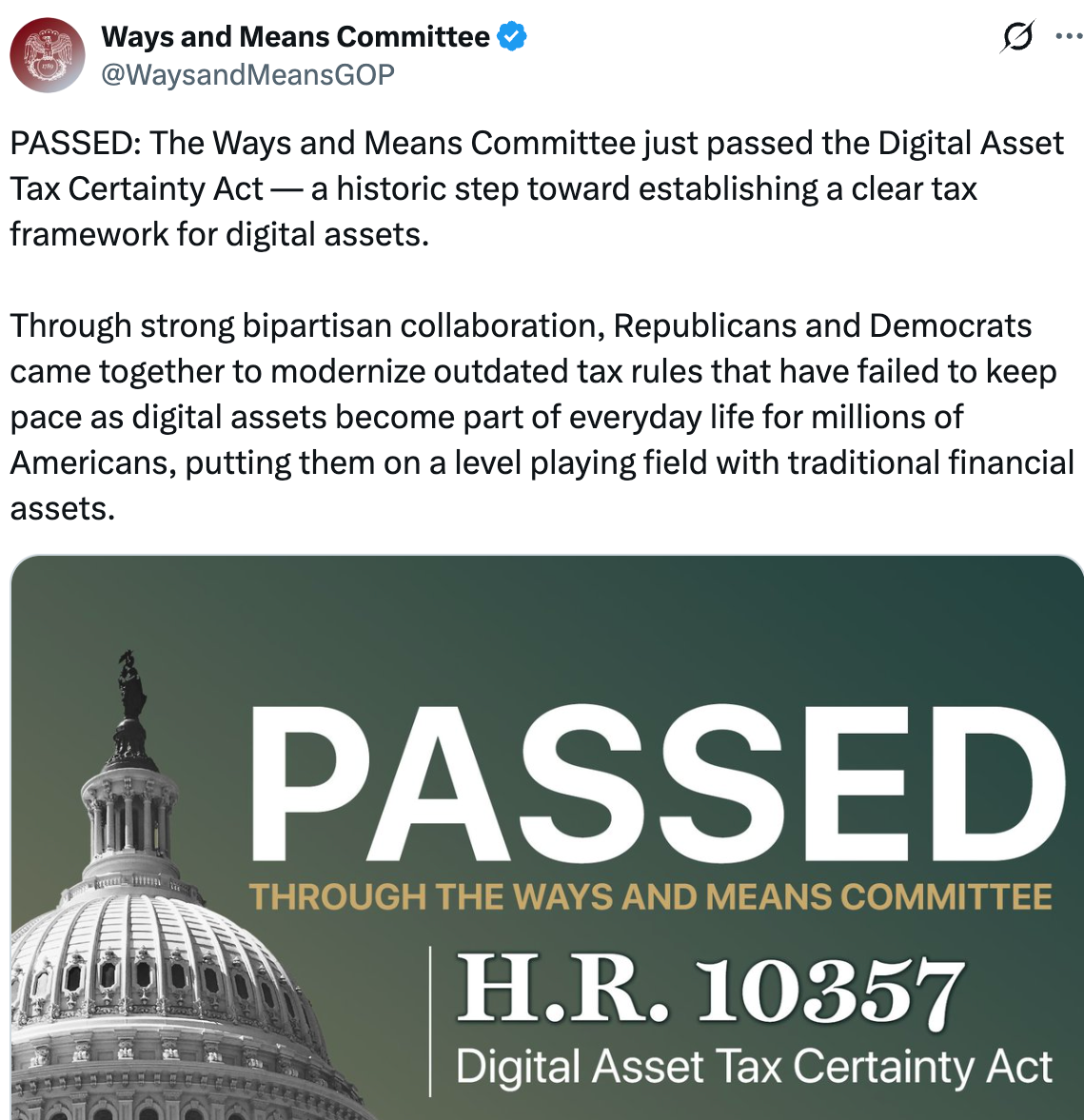
The US House Ways and Means Committee passed the Digital Asset Tax Certainty Act with bipartisan support on Wednesday, advancing legislation aimed at reshaping the federal tax treatment of digital assets.
The bill advanced in a 38-5 vote and covers stablecoins, mining and staking, digital asset lending, transaction fees and other crypto-related activity.
Among its provisions, the bill would establish special tax treatment for qualifying dollar-pegged stablecoins and certain crypto lending agreements, extend wash-sale rules to widely traded digital assets and establish new rules for mining and staking income.
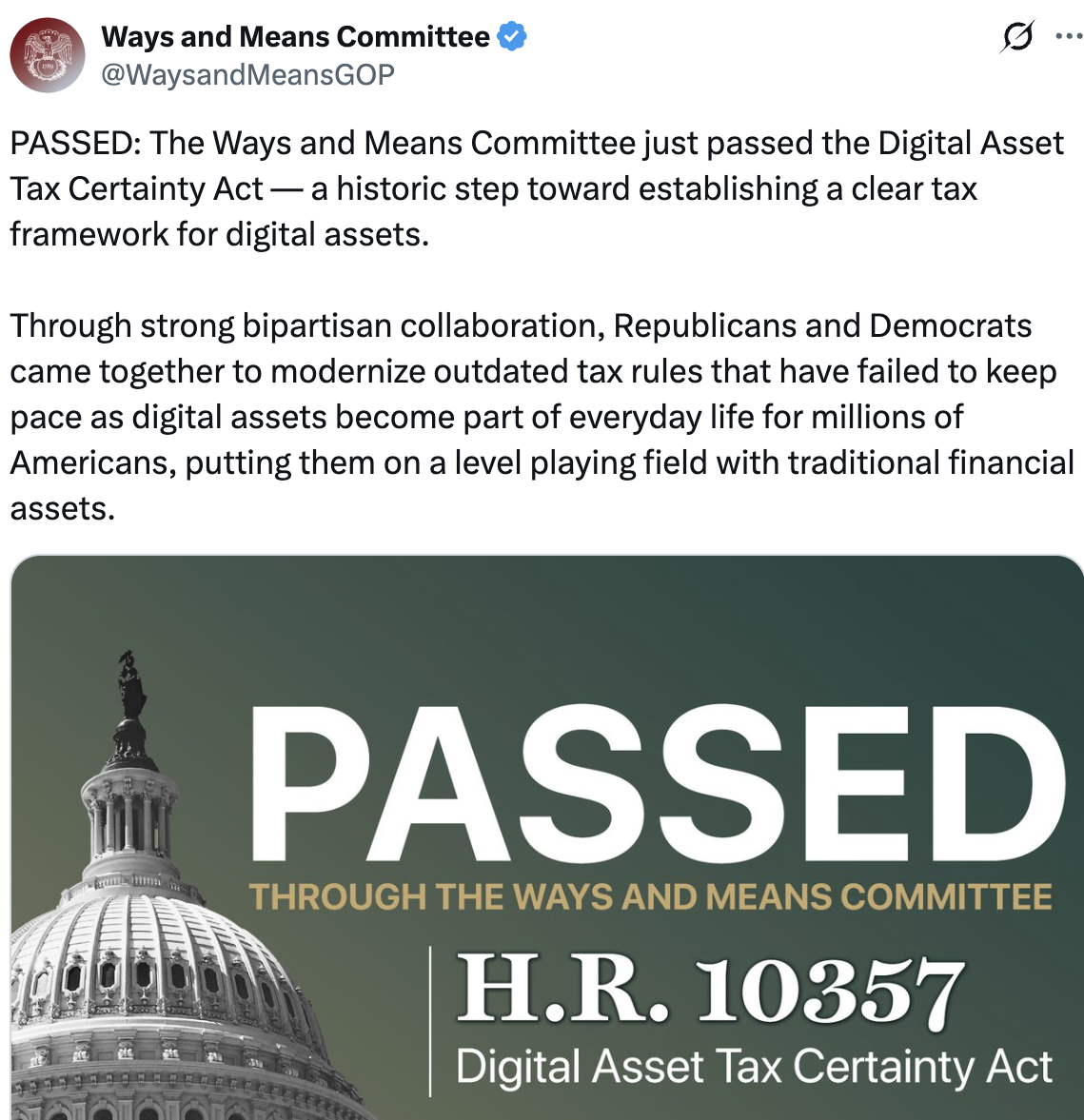
Source: Ways and Means Committee
The legislation would also create a de minimis exemption for certain crypto transaction fees, allowing taxpayers to avoid recognizing gains or losses when digital assets are used to pay qualifying network or transaction fees of $10 or less.
The committee’s approval sends the bill to the full House of Representatives for consideration.
Related: Coinbase faces greater fallout from CLARITY Act setback: Saxo
CLARITY Act failure shifts focus to regulators
The committee vote comes a day after the Senate failed to advance the CLARITY Act, a broader market structure bill that would establish a federal regulatory framework for digital assets and clarify the respective roles of the Securities and Exchange Commission and Commodity Futures Trading Commission.
The cloture motion failed 49–50 on Tuesday, falling short of the 60 votes needed to advance the legislation to debate on the Senate floor.
Senator Cynthia Lummis, chair of the Senate Banking Subcommittee on Digital Assets and a lead sponsor of the legislation, blamed Democrats for the bill’s failure following the vote.
“For over a year, they presented demands and the second we met them, they made new demands and moved the goal posts,” Lummis said in a post on X, adding that Democrats had voted against proposed consumer protections and restrictions on politicians’ personal crypto investments.
With the bill’s failure to advance in the Senate, SEC Chair Paul Atkins signaled Wednesday that the agency would continue moving forward on crypto regulation under its existing authority.
“With or without legislation, we will act decisively within the SEC’s statutory authority to deliver certainty for American investors and for the entrepreneurs shaping our technological future,” Atkins said in a post on X, adding: “Stay tuned.”
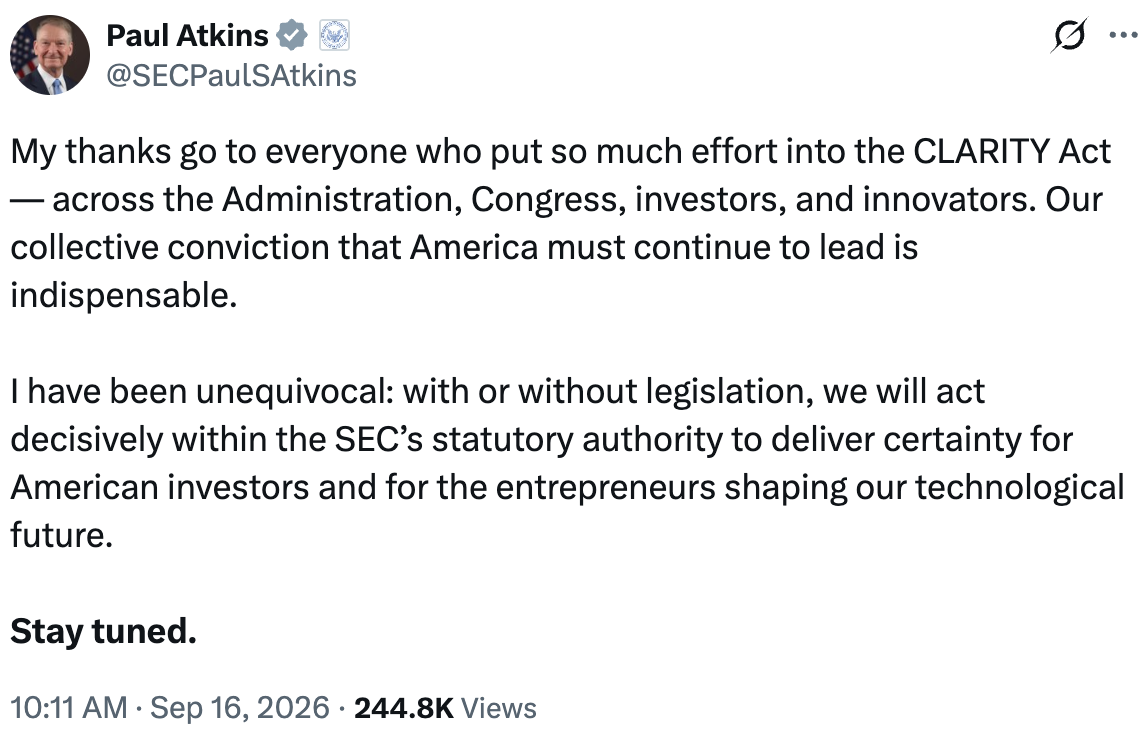
Source: Paul Atkins
CFTC Chair Michael Selig echoed Atkins, saying the agency would move ahead using its existing statutory authority despite the Senate vote.
“The CFTC is locked in and ready to ship its rules for the new frontier of finance,” Selig said in a Wednesday post on X, adding that Americans “deserve regulatory clarity, legal certainty, and consumer protections in crypto asset markets.”
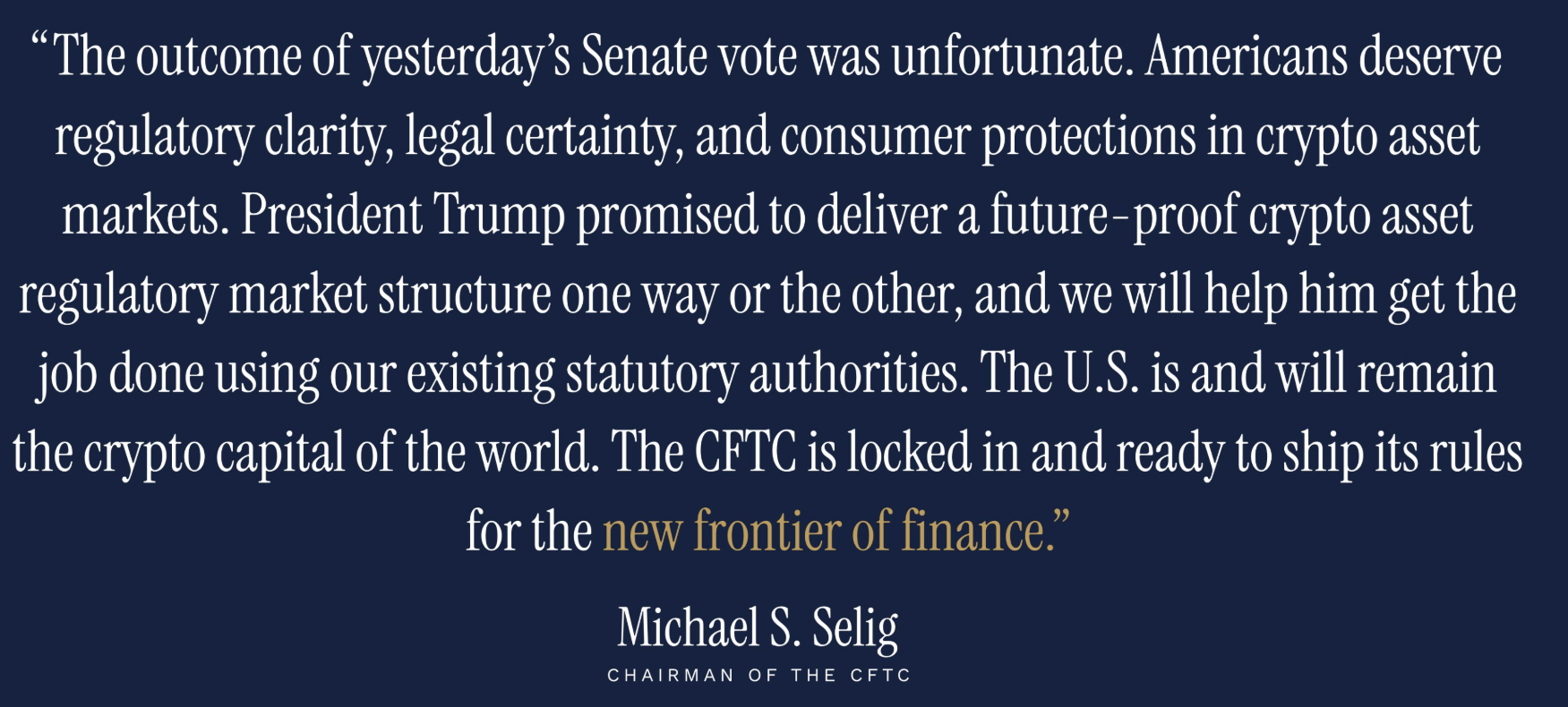
Source: Mike Selig
Magazine: Revolut ID thefts highlight KYC’s dangers: Here’s how to fix it
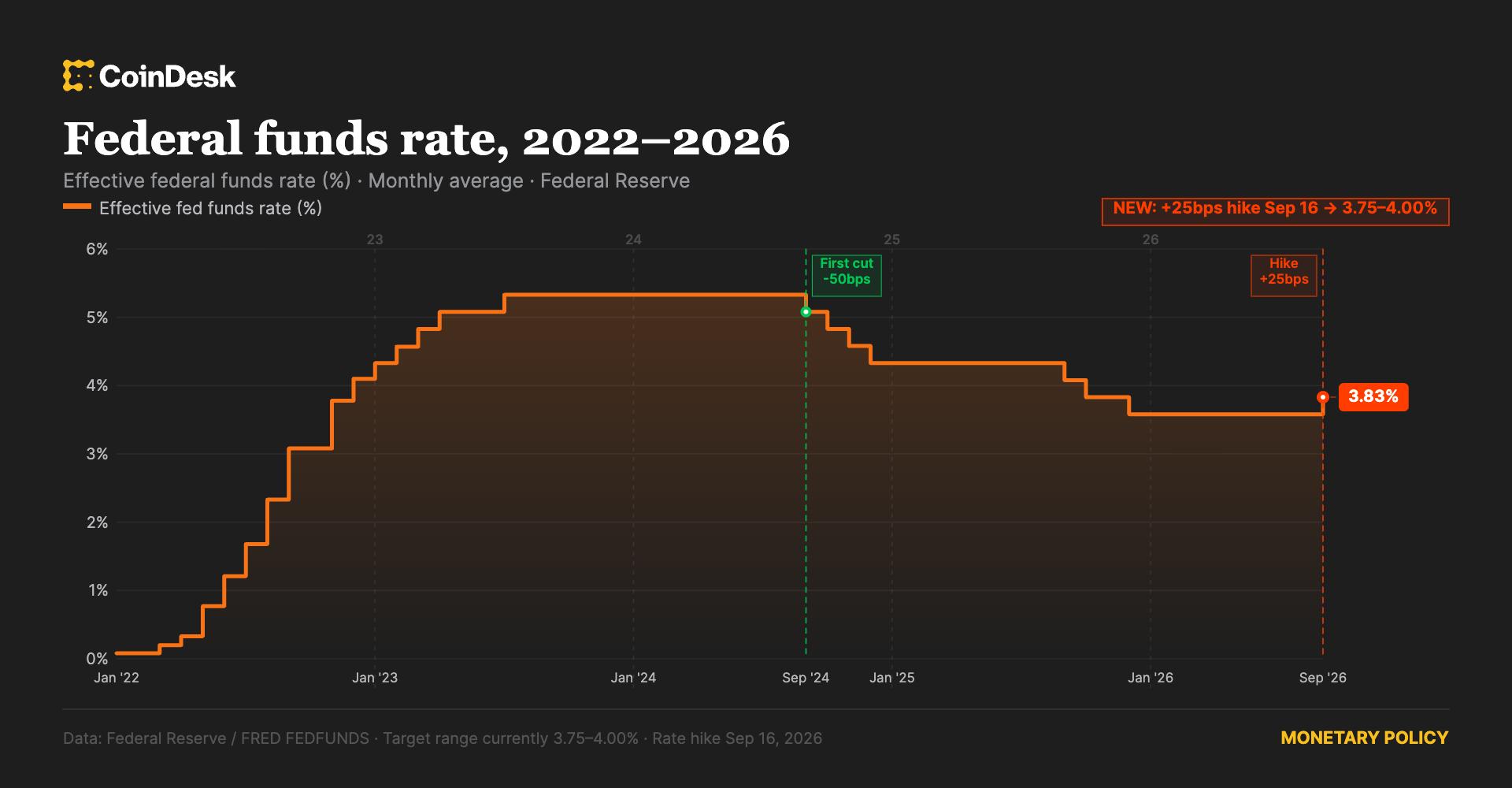
The U.S. Federal Reserve tightened monetary policy for the first time in more than three years on Wednesday.
In a nearly-universally anticipated move, the central bank lifted its benchmark fed funds rate range by 25 basis points to 3.75%-4%.
The vote to hike rates was unanimous, and the “dots” signal an expectation for one more rate hike in 2026.
“Economic activity is expanding at a solid pace,” said the FOMC in its policy statement. “While uncertainty remains elevated owing, in part, to geopolitical developments, domestic spending has been resilient … Inflation remains elevated. Today’s policy action will support a timelier return to the Committee’s 2 percent goal. The Committee will deliver price stability.”
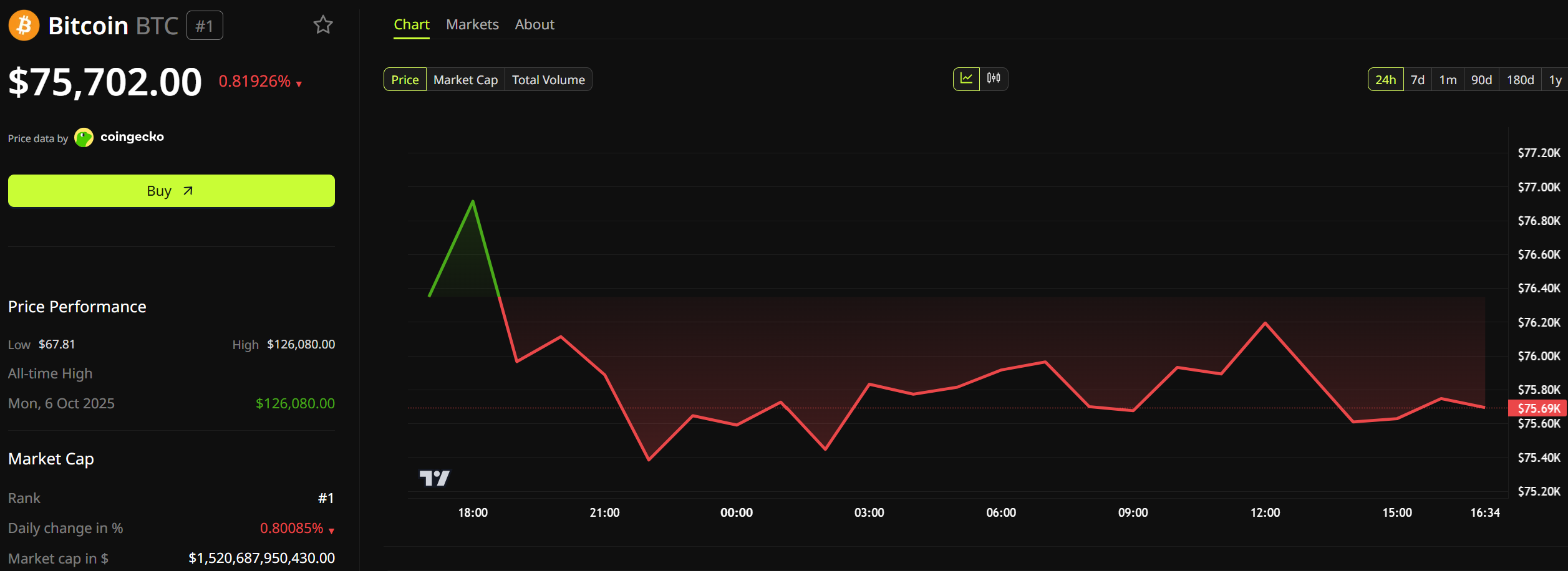
Bitcoin is volatile in the moments following the decision, but currently little changed from prior to the news at $75,700. U.S stocks continue modestly higher and bond yields slightly lower.
Fed Chair Kevin Warsh’s post-meeting press conference begins at 2:30 pm ET.
Celsius Network’s bankruptcy estate has sued five BitMEX companies over 6,360.1666 Bitcoin (BTC) seized in two forced liquidations during the March 2020 crash.
The September 12 filing landed 11 days before BitMEX stops trading for good. Celsius lost the coins under founder Alex Mashinsky, now serving 12 years for fraud.
The Two Liquidations at the Center of the Case
A liquidation is the forced closure of a leveraged trade once the collateral behind it runs short. BitMEX closed Celsius’s Bitcoin futures position late on March 12, 2020, taking 1,325.8385 BTC.
Celsius had sent 350 BTC of extra margin at 23:47 UTC. BitMEX emailed five minutes later to say it had seen the transfer but not yet confirmed it. The position was gone before that confirmation arrived.
The second liquidation hit JST Alpha 1, a Cayman Islands fund Celsius had invested in, at 02:50 UTC on March 13. It cost another 5,034.3281 BTC. JST assigned its claims to Celsius in April 2025.
In that same minute, the filing says, the best offer price on the contract fell from $4,502 to $3,422. Celsius argues the move cannot be rationally explained by trading.
“Instead of maintaining an orderly market, BitMEX intentionally designed its platform and liquidation procedures to cause liquidations of collateral and defraud its own customers,” Celsius said in the complaint.
Follow us on X to get the latest news as it happens
What the Estate Wants Before September 23
Blockchain Recovery Investment Consortium filed the case in the US Bankruptcy Court for the Southern District of New York. The VanEck and GXD Labs venture was appointed in 2024 to chase Celsius assets for creditors.
It names HDR Global Trading, ABS Global Trading, Shine Effort, 100x Holdings and HDR Global Services. Nine counts cover fraud, price manipulation and replevin, a demand for the property itself.
The coins are worth roughly $481 million at Wednesday’s Bitcoin price of $75,702. The same recovery team pulled a $299.5 million settlement out of Tether last October.

BitMEX force closes all remaining positions on September 23 at 04:00 UTC. It has tied the reasons behind its shutdown to a strategic review rather than insolvency, a hack or regulator action.
None of the allegations have been tested, and BitMEX has not answered them. Mashinsky, who ran Celsius when the coins vanished, was permanently barred from trading regulated US derivatives markets in June.
The post Celsius Sues Dying BitMEX Exchange for 6,360 Lost Bitcoin appeared first on BeInCrypto.


The failed Senate vote on the CLARITY Act has shifted attention toward the SEC and CFTC, while crypto founders and investors prepare for a longer period without a federal market structure law, industry experts told crypto.news.
Summary
- The SEC and CFTC may shape near-term crypto rules after the Senate failed to advance the bill.
- Founders are expected to keep building, but some may place more operations outside the United States.
- Bitcoin faces less regulatory uncertainty than altcoins, DeFi platforms, exchanges and token issuers.
- Institutional adoption may slow as banks and asset managers wait for more durable legal certainty.
- Experts said rates, yields and liquidity remain larger near-term market forces than the failed vote.
The U.S. Senate failed to invoke cloture on the motion to proceed with the Digital Asset Market Clarity Act on Sep. 15. The procedural vote recorded 49 votes in favor and 50 against, leaving the measure 11 votes short of the 60 required to open debate.
The result did not formally kill the bill, but it removed its immediate route through the Senate. The legislation sought to divide oversight of digital assets between the Securities and Exchange Commission and Commodity Futures Trading Commission while creating registration paths for crypto trading platforms and other intermediaries.
CLARITY Act setback turns attention to US agencies
Sid Powell, CEO and co-founder of Maple Finance, said the regulatory focus would now move from lawmakers to federal agencies. He expects the SEC and CFTC to use existing law, rulemaking and guidance to define the industry’s operating boundaries over the next year.
“The SEC and CFTC can do a great deal within existing law, through rulemaking and guidance, and that is where the perimeter actually gets drawn over the next year.”
Powell said market structure legislation was always more difficult to pass than to introduce. He expects meaningful near-term direction to come from regulators, with comprehensive legislation more likely to return in the next Congress.
Gabor Gurbacs, founder and CEO of OpenAssets, reached a similar conclusion, saying the vote did not resolve questions about regulatory authority, asset classifications or the framework institutions can use.
“The vote may have stalled. Regulatory work has not.”
Gurbacs, however, favors industry-led standards over broad top-down requirements. He argued that large regulatory bodies rely on committees, precedent and risk avoidance, which can produce rules that move more slowly than the technology.
Courtney Olujobi, principal at Moon Pursuit Capital, also expects regulators to deliver most of the immediate progress. She distinguished between agency action, which can change under later administrations, and legislation that gives founders and investors greater long-term confidence.
“What this vote means is that, for now, most of the progress will come from regulators rather than Congress.”
Edwin Mata, co-founder and CEO of Brickken, agreed that government action does not end when Congress stalls. He said agencies can use their current authority to issue rules and guidance, although the quality of those rules matters more than the mere existence of a framework.
“The SEC, CFTC and other regulators still have to do their jobs, and we are already seeing them use their existing powers to provide their own rules and guidance.”
Former CFTC Chairman J. Christopher Giancarlo made a similar argument after the vote, saying the two agencies could continue developing digital asset frameworks under existing law, crypto.news reported.
Founders may build globally instead of waiting for Congress
The experts broadly rejected the idea that the vote would stop crypto development. Several said it could instead affect where companies hire employees, seek licenses, raise capital and launch products.
Kyle Sonlin, president and co-founder of Global Settlement Network, said founders serving institutions need to know how regulators will treat assets and which agency will supervise their businesses. He expects companies to retain an interest in the United States while considering clearer jurisdictions from the beginning.
“I do think more companies will build with a global footprint from the start and keep jurisdictions with clearer rules firmly in the mix.”
Varun Datta, founder and CEO of Truth Ventures, also said serious founders would continue operating in the United States. However, he expects regulatory predictability to take on greater weight when companies compare the country with competing markets.
“Founders deciding where to incorporate, hire, raise money will increasingly compare the US not just on access to capital, but on regulatory predictability.”
Olujobi described uncertainty as a cost that appears before a company faces a formal legal bill. It can influence whether an early hire is an engineer or compliance specialist, whether a product launches in the United States, and whether founders first approach American or overseas investors.
Mata pointed to the European Union’s Markets in Crypto-Assets framework as an example of both the benefits and costs of clear regulation. MiCA gave companies a defined entry point, he said, but also introduced compliance costs and rules that he considers excessive.
Bobby Gray, founder of TEXITcoin, offered a stronger version of the builders-will-continue argument. He said founders should create businesses that can withstand changes in the political and regulatory environment instead of relying on Congress to deliver certainty.
“Policymakers will eventually have to decide how America participates in this industry, but builders have already decided to keep building.”
The United States still offers deep capital markets, institutional buyers and an expanding base of regulated custody and investment products, according to Olujobi. Mata warned, however, that overseas decisions can become permanent once companies establish teams, banking relationships, licenses and customers in other jurisdictions.
Institutional adoption could become slower and more selective
The lack of legislation may have a larger effect on institutions that require stable compliance standards before committing capital or building products.
Raj Kamal, CEO and founder of TransFi, expects the setback to slow institutional adoption in the United States and other markets that take cues from American regulation. He also sees a risk that more activity will move to jurisdictions such as the United Arab Emirates and Singapore.
“In terms of the impact on the sector, this is going to delay institutional adoption and slow down the pace of stablecoin usage across payments and other parts of the financial sector, as well as the growth of tokenised deposits.”
Kamal expressed concern that the delay could bring back regulation through enforcement. Sonlin made a related point, saying financial infrastructure needs rules that can remain in place beyond one administration.
Jeff Ko, chief analyst at ViaBTC, drew a distinction between institutions that already hold Bitcoin through regulated exchange-traded funds and the next group considering broader crypto services. He expects banks exploring custody and trading, asset managers developing multi-token products and companies studying tokenization to move more slowly rather than leave the market entirely.
“The impact falls on the next wave of adoption, like banks building custody and trading desks, asset managers launching multi-token products, and corporates exploring tokenisation in the US.”
HashKey Group senior researcher Tim Sun also expects institutions to divide their capital according to regulatory risk rather than abandon crypto altogether. Assets and products that already fit established rules could continue attracting demand, while sectors that depend on new legislation may face more caution.
“This does not imply a total institutional retreat, but rather a sharp bifurcation in capital allocation strategies based on risk stratification.”
Sun said Bitcoin benefits from its relatively settled non-security status. Tokenized securities and real-world assets could also face less disruption because they can operate within existing securities and fund rules. DeFi developer liability and exchange token-listing standards remain more dependent on future policy decisions, he added.
Bitcoin remains more insulated than altcoins and DeFi
Bitfinex head of derivatives Jag Kooner said the muted initial response showed that traders had not positioned heavily for the bill to pass. With limited bets on approval, the failed vote produced fewer positions that needed to be closed.
“With few market participants betting on the bill’s approval, there were correspondingly few positions to unwind after it failed, which helps explain the market’s modest reaction.”
Kooner said the more important effect was the extension of regulatory uncertainty rather than a sudden repricing. His assessment matches Powell’s view that the failed vote was the more likely outcome throughout the legislative process.
Ko similarly said the bill had stalled without becoming legally dead. He argued that Bitcoin already has access to regulated ETFs and that the GENIUS Act has established a framework for payment stablecoins, leaving the largest regulatory gap elsewhere in the market.
“The real impact falls on the rest of the market.”
Ko expects altcoins, token issuers, DeFi protocols and U.S. exchanges to carry the largest regulatory discount because the divide between securities and commodities remains unresolved. He said that could keep Bitcoin dominance elevated and widen performance differences among tokens, favoring assets with clearer legal status and cash-generating businesses.
Sun offered a similar view, noting that crypto-linked companies could react more sharply than Bitcoin because their business models depend more directly on regulatory boundaries. Ko and Sun therefore both expect the delay to produce a more selective market rather than an equal effect across digital assets.
Rates and liquidity may matter more than the Senate vote
The regulatory setback is only one of several forces shaping the market. Ko said sticky inflation, oil prices above $95 and increased expectations of further interest-rate increases remained the larger headwinds.
“Crypto has rarely sustained a bull run while yields are rising and liquidity is tightening.”
Ko said a bull-market return this year was possible but not his base case. Such a recovery would likely require sustained ETF inflows, softer inflation readings and improved liquidity, with capital concentrating in fewer assets than in previous cycles.
Sun similarly said rising risk-free rates and the loss of regulatory optimism both pressured crypto following the vote. He expects Federal Reserve policy, long-term Treasury yields and U.S. dollar liquidity to determine Bitcoin’s next sustained move more than the timetable for legislation.
Despite differences over the severity of the delay, the experts largely agreed that development and investment would continue. The failed vote changes who shapes U.S. crypto rules in the near term, while making regulatory strength, jurisdiction and access to liquidity more important in decisions about what to build and where to allocate capital.
Crypto World
Saudi Arabia Declares Mecca a ‘Red Line’ as Houthis Deny Targeting Holy Site In Latest Conflict Escalation

“Defending Mecca is going to create legitimacy domestically in their countries if they engage with the Saudis in a war against the Houthis,” says Al-Muslimi.
But Gerges suggests that support from Turkey and Pakistan would be largely ineffective, and therefore unlikely.
“The problem is how could Pakistan and Turkey really provide support since the armies are not integrated,” he says. “The key challenge facing Saudi Arabia is ground forces.”
Gerges notes that Riyadh’s aerial capabilities alone are not enough to inflict necessary damage on the Houthis.
Therefore, diplomacy could be the most viable option.
Gerges says that “the Houthis have proved to be very resilient, very dynamic, very resourceful, very nimble,” throughout the conflict, maintaining significant control in Yemen.
“Taking on the Houthis again in an all-out war, I doubt very much whether there is a viable military option,” he says.

How firelight may have shaped the origins of spoken language

What's driving UK 'shoplifting crisis'?

DOGE Initiative Resulted in Federal Employees Getting Paid Billions to Not Work, New Government Report Finds

Weekend Open Thread – Corporette.com

Memory prices are slowing because buyers ran out of money

Micron Stock Climbs Above $1,031 as AI Memory Crunch and a $50 Billion Outlook Fuel the Rally

The Biggest Losers Ever On Financial Audit

CLARITY Act reaches MAKE-OR-BREAK Senate moment as crypto industry FIGHTS for passage

My financial condition #bollywood #90s #shorts #trending #80s #youtubeshorts #funny #ytshorts #like
-
 Fashion5 days ago
Weekend Open Thread – Corporette.com
-
 Business7 days ago
Micron Stock Climbs Above $1,031 as AI Memory Crunch and a $50 Billion Outlook Fuel the Rally
-

 Tech3 days ago
The Latest Weird Thing to Play Doom Is the Mapped-Out Brain of a Fruit Fly
-

 Business7 days ago
AMD Stock Climbs After Management Lifts 2027 Data Center Outlook Toward $70 Billion in AI Sales
-

 Business5 days ago
10 Most-Streamed Songs On Spotify In 2026 So Far, Led By Ella Langley’s Dominant Run On The Charts This Year
-

 Crypto World5 days ago
XAG/USD: Silver’s Short-Term Rally Meets Its Moment of Truth
-
 Crypto World6 days ago
2 Chip Stocks Broke Out This Week. Neither Was Nvidia
-

 Crypto World7 days ago
Pi Network ships Protocol 27 on a network with 14 million users and zero DeFi
-

 Tech6 days ago
Battery life is the only iPhone 18 Pro and iPhone Duo upgrade I care about. Apple didn’t disappoint
-

 Crypto World6 days ago
OKX launches 10x OpenAI, Anthropic X-Perps in Europe
-

 Crypto World5 days ago
Diesel Tops $6 a Gallon for the First Time as 28 States Set Records
-

 Tech7 days ago
Apple Watch Ultra 4 vs Watch Ultra 3: Should you really spend another $799?
-

 News Videos5 days ago
Facing Financial Fears
-

 Business6 days ago
Western Digital Slips 2.7% as AI Storage Rally Cools After Record Cash and Guidance
-
 Crypto World7 days ago
Bitcoin price risks $70K if $78K neckline breaks
-

 Entertainment7 days ago
Case Sees Major Update As Jury Deliberations Begin
-

 Business4 days ago
Rivals Sam Altman and Elon Musk Rally Behind Dario Amodei’s Call for a Slowdown in AI Development
-

 Crypto World2 days ago
Elon Musk Drops a Bombshell: Grok 5 Could Be the AGI Breakthrough
-

 Business6 days ago
Five Leading AI Experts Warn Superintelligence Could Kill Humans and Explain Their Case
-
 Crypto World7 days ago
Ethereum price breakout hinges on a close above $2,535
You must be logged in to post a comment Login