
Crypto World
South Africa crypto firms pause R2.2 billion in deals over exchange controls


South African crypto companies have put at least R2.2 billion in deals on hold as proposed exchange control rules threaten to restrict how digital assets can be used for cross border transactions, according to people familiar with the matter.
Summary
- South African crypto firms have paused at least R2.2 billion in deals over proposed exchange control rules.
- The changes would bring crypto assets under the country’s capital flow regime and tighten oversight of cross border transfers.
- Industry participants warn the rules could push legitimate crypto activity offshore and potentially trigger legal challenges.
People familiar with the transactions said at least 3 deals have been paused directly because of the proposed regulatory changes. They include an investment from a private equity firm and transactions intended to support capital formation for small businesses and corporate treasury management.
Industry participants have warned that the proposed framework could push some legitimate digital asset activity offshore or into informal channels. Some executives are considering legal action if the rules are adopted without significant changes, the people said.
South Africa crypto rules have stalled R2.2 billion in deals
South Africa is the second largest crypto asset market in Africa, where stablecoins are increasingly used by companies moving funds between regional operations.
Businesses have used stablecoins to repatriate profits and receive dividends from subsidiaries in African markets where access to hard currencies can be limited. Tether’s USDT has become the preferred stablecoin for such activity in South Africa.
Onchain USDT transactions across 3 of the country’s largest licensed crypto exchanges approached R27 billion in the year through April, according to central bank data. The figure shows the scale of stablecoin activity already passing through regulated domestic platforms.
South Africa does not recognize crypto assets as legal tender. The South African Reserve Bank has previously identified digital assets as an emerging financial stability risk and has been monitoring activity as stablecoin use expands internationally.
Regulators are now seeking to bring crypto assets within a capital flow system built around the Currency and Exchanges Act, legislation that dates back roughly 9 decades.
The National Treasury first published its proposed framework in April as part of an overhaul of the country’s capital flow management regime. As crypto.news previously reported, the draft would formally classify crypto assets as capital under South Africa’s foreign exchange rules and extend declaration, approval and enforcement powers to digital asset transactions.
Officials said the framework is intended to improve oversight of cross border transactions, reduce opportunities for regulatory arbitrage and address illicit financial flows.
Cross border crypto transfers face tighter controls
More detailed rules released in August set out how digital asset transfers would operate under the proposed system.
Under the cross border crypto rules, transfers would generally need to pass through authorized providers and be reported to the South African Reserve Bank. Transactions involving offshore crypto providers or private wallets would fall within the regulated cross border category.
Individuals moving crypto outside South Africa would remain subject to the country’s existing foreign currency allowances. The annual single discretionary allowance permits transfers of up to R1 million without tax clearance, while the foreign capital allowance permits up to R10 million subject to tax compliance requirements.
Authorized crypto asset service providers would be required to collect information on cross border transfers, including the identities of the sender and recipient, the assets involved, transaction values and destination wallet details.
The National Treasury and South African Reserve Bank said in a joint statement that the detailed manual released last month does not yet incorporate feedback submitted during the earlier consultation.
Officials attributed that gap to the timing of the release and the volume of comments received after the government invited interested parties to respond to the April proposals.
Some digital asset executives have objected to the process, arguing that the current draft does not adequately account for industry submissions. People familiar with their concerns said executives view parts of the framework as unfavorable to technology being used to reduce transaction costs.
If the regulations proceed in their current form, companies believe they could affect billions of rand in tax revenue generated by the sector and potentially lead to legal challenges, according to the people.
Stablecoins remain part of South Africa’s regulatory focus
Stablecoin activity has become a particular area of attention as regulators assess how dollar linked tokens interact with domestic currency and capital controls.
An International Monetary Fund assessment published in August found that dollar stablecoins had gained only limited traction in South Africa, while rand denominated alternatives had attracted even less demand. The IMF cautioned that it was still too early to determine whether the pattern would persist. Dollar stablecoin adoption remains dominant globally, with nearly 99% of stablecoins denominated in U.S. dollars.
South Africa’s treatment of digital assets extends beyond capital controls. The South African Revenue Service published draft guidance in July explaining how existing tax rules apply to crypto transactions rather than proposing a separate tax regime.
Under the draft crypto tax guidance, SARS maintained that crypto assets are not currency for tax purposes. Buying, selling, swapping, spending, mining, staking or receiving digital assets can create tax consequences under existing income and capital gains rules, depending on the nature of the activity.
South Africa has separately begun implementing the OECD’s Crypto Asset Reporting Framework. Its first CARF reporting period runs from March 1, 2026, through Feb. 28, 2027, with crypto service providers required to collect information that will support automatic exchanges of tax data between participating jurisdictions.
The government has yet to finalize the proposed capital flow rules after receiving industry comments, leaving the detailed framework subject to further consideration by the National Treasury and South African Reserve Bank.

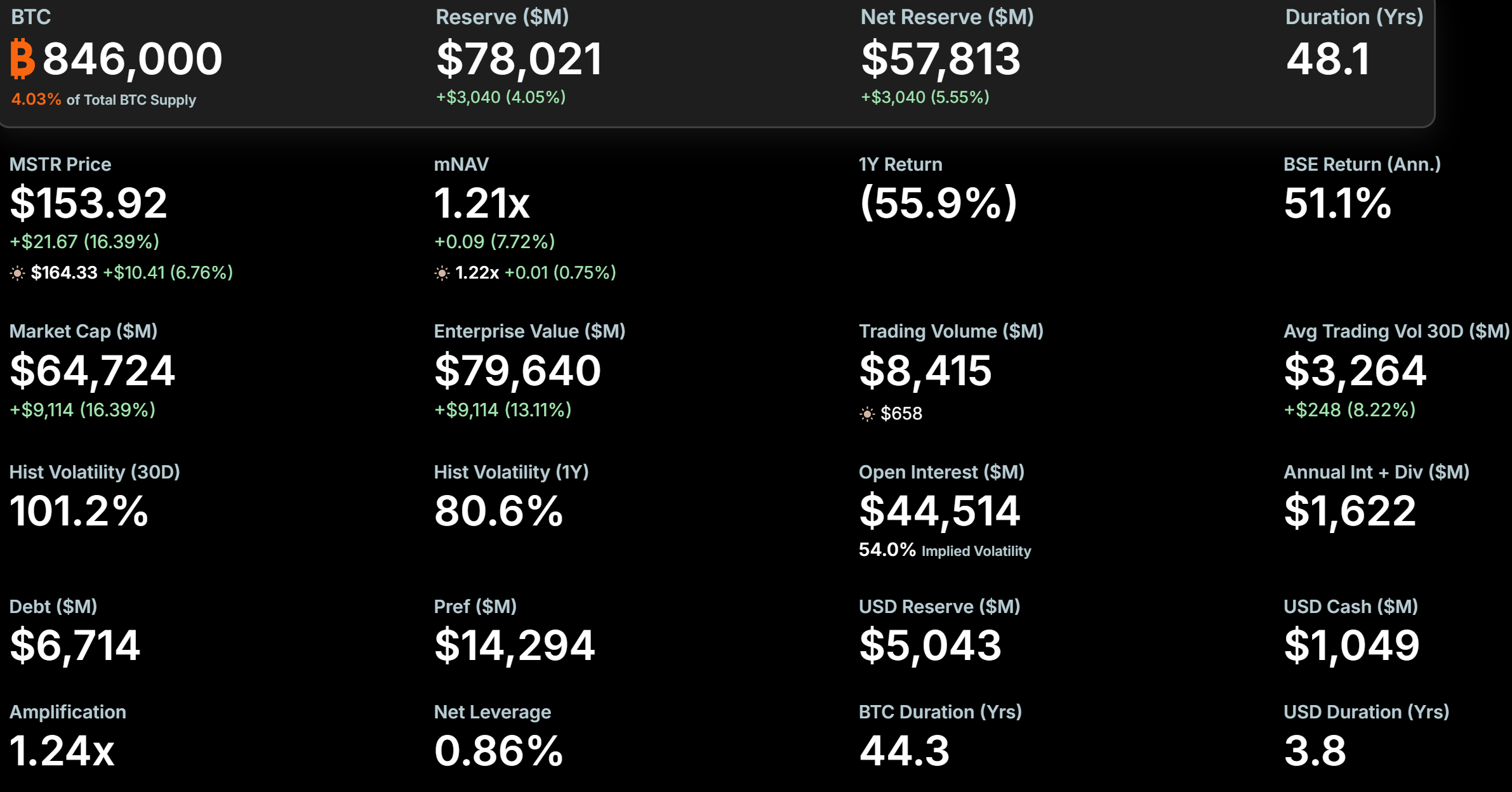
Strategy, formerly MicroStrategy, added 950 Bitcoin (BTC) in the week to September 20 and repurchased $174 million of its own preferred stock over the same stretch. Total holdings now sit at 846,000 BTC.
The buy ends a two-week gap in accumulation. At the $81,200 bitcoin price Strategy used in Monday’s filing, the 950 coins are worth roughly $77 million.

How the MicroStrategy Bitcoin Purchase Compares With August
The company’s previous acquisition landed on August 31, when it ended a 10-week pause with 4,603 BTC bought for $369.7 million at an average of $80,318 a coin. In dollar terms, last week’s purchase is about 79% smaller.
Executive Chairman Michael Saylor teased the buy on Sunday with a post reading “A little more orange.”
Bitcoin has since climbed above the level Strategy used in its own math. The asset traded near $85,020 on Monday, up almost 6% over 24 hours.

Why the Preferred Buyback Cost More Than the Bitcoin
The $174 million went to Variable Rate Series A Perpetual Stretch Preferred Stock (STRC), a Nasdaq-listed share class Strategy designed to trade close to $100. That is more than twice what the bitcoin cost.
Strategy started buying STRC back in late July at an average of $86.52 a share. The stock closed at $98.51 on Friday. Chief Executive Phong Le explained the logic when the program began.
“At prices below $100 per share, STRC repurchases represent an attractive allocation of capital because they can reduce future preferred dividend requirements at a discount.”
Those repurchases are funded by common share sales and potential bitcoin sales rather than the company’s dollar pile, which stood at $6.09 billion on Sept. 20. The structure came out of the Digital Credit Capital Framework Strategy set out in June.
BeInCrypto flagged STRC moving back toward par in August as one of the conditions that would let bitcoin buying restart. It did restart, at a fraction of the earlier pace.
MSTR common stock trades at 0.88 times the value of the bitcoin behind it, according to BitcoinTreasuries. Next Monday’s filing will show whether 950 coins was a floor or a new run rate.
A Smaller Rival Bought More Bitcoin the Same Week
Strive, a Bitcoin treasury company a fraction of Strategy’s size, outbought it over the same stretch. It acquired 1,355 BTC between September 14 and September 18 at an average of $79,475 a coin. That took its holdings to 26,355 BTC, roughly 3% of Strategy’s pile.
Chief Executive Matt Cole put the cost at $107.7 million.
He said warrant exercises began last week and brought in $21.2 million in gross proceeds. Cole added that 57.7% of Strive’s total capital raised has come from SATA, its variable rate perpetual preferred shares, a structure close to Strategy’s STRC. Strive reported a $292 million paper loss on its bitcoin in August.
The post MicroStrategy Ends Two-Week Pause With 950 Bitcoin: Is the Buying Engine Stalling? appeared first on BeInCrypto.

Strategy · made its first bitcoin purchase since late August, acquiring 950 BTC for $75.7 million last week at an average price of $79,670 per coin.
The purchase was funded through the USD reserve, according to a Monday morning regulatory filing. Strategy used $174 million of USD cash to fund repurchases of STRC and $75.7 million of USD cash to buy bitcoin. In addition, the company used $57.4 million of the USD reserve to fund the payment of dividends on its preferred stock. The USD reserve now sits at $5 billion and the USD cash sits at $1 billion.
Led by Executive Chairman Michael Saylor, Strategy now holds 846,000 BTC, acquired for a total of $63.81 billion at an average price of $74,417 per coin.
MSTR shares rose 7% in pre-market trading as bitcoin climbed to $84,500, gaining 4.5% over the past 24 hours.

Near Protocol’s native token surged nearly 80% over the past week, outpacing the wider crypto market as the network expanded its privacy-focused trading services.
On Monday, NEAR traded around $4.29, up about 78.2% over seven days and 22% over the past 24 hours, according to CoinGecko. Total cryptocurrency market capitalization rose about 6% over the same seven-day period.
On Thursday, Near Protocol said deposits and withdrawals for perpetual futures trading through near.com were now confidential by default. Near said the feature obscures the link between a trader’s funding wallet and a dedicated Hyperliquid trading account.
On the same day, Near said near.com’s confidential total value locked (TVL) had crossed $70 million, triggering the first snapshot under its NEAR@3.33 incentive program. The program allocated 333,333 milestone tokens for the first distribution. Under the program’s rules, those tokens unlock and convert to NEAR when its three-day volume-weighted average price reaches at least $3.33.
NEAR Intents reaches $29.3 billion in cumulative volume
NEAR Intents lets users request cross-chain swaps, with market makers competing to execute them.
The NEAR Intents Explorer showed about $29.3 billion in cumulative volume and $842 million over the past seven days on Monday. Privacy-focused Zcash wallet ZODL was its third-largest referral source by volume over the preceding 24 hours, generating about $3.8 million across 458 transactions.
A swap involving roughly $613,000 worth of ZEC was also among the largest transactions displayed by the explorer for the preceding 24 hours.
Related: Grayscale’s Zcash ETF files for 3-for-1 forward share split
Bitwise research analyst Camran Khosravi said Near and Zcash are “complements,” arguing that Near gives ZEC holders confidential cross-chain infrastructure and access to liquidity.
He also cautioned that NEAR Intents’ TVL can rise when the price of ZEC already held within the system increases, even without new deposits.
Near has also extended its privacy focus beyond trading. In July, NEAR AI introduced staking-based payments that let users stake NEAR to receive credits for confidential AI inference and agent hosting while retaining ownership of the underlying tokens.
Magazine: Who needs CLARITY anyway? ARB could see 70X increase: Hodler’s Digest

Google and Apple are seeking employees with expertise in digital assets, adding to signs that Big Tech firms are preparing for a larger role for stablecoins, tokenization and blockchain-based payments.
Google Cloud is hiring an Industry Principal Architect in Hong Kong to work with protocol foundations, exchanges, custodians and financial institutions to tokenize real-world assets across the Asia-Pacific (APAC) region.
The role calls for experience with blockchain networks, smart contracts, stablecoin infrastructure, tokenized deposits and custody technologies. Google said the hire would advise executives and help shape its Web3 product roadmap as it seeks to become the preferred cloud provider for digital-asset builders and institutional adopters.
Apple is also expanding into digital assets. It is looking for an Apple Pay Financial Product Strategy Lead based in Cupertino, California or New York.
The listings do not confirm that either company is launching a new crypto product, but it does show that stablecoins and tokenized deposits are becoming relevant expertise inside two of the world’s largest tech and payments ecosystems, rather than remaining the preserve of crypto-native firms.
Bitcoin’s price ascent that began during the early Monday hours continued, with the asset climbing above $85,000 for the first time since late January.
Most altcoins have followed suit, leading to a cascade of liquidated positions, mostly from short traders.

It was difficult to imagine just five days ago what could happen now. Recall that last week went in the opposite direction from what the BTC bulls hoped for, with the US Senate voting against advancing the CLARITY Act and the Federal Reserve hiking interest rates for the first time in well over three years.
Both of those developments drove BTC south to around $75,000, which became its lowest price tag in three weeks. However, the cryptocurrency showed impressive resilience and rebounded to over $80,000 by Friday.
It climbed to almost $82,000 on Saturday when a fresh wave of negative news, this time on the Middle East war front as well as the Ukraine-Russia conflict, pushed it down to $80,300.
The bulls were more persistent once again, helping the asset avoid another dip below $80,000. Moreover, bitcoin rocketed once again on Monday, first to $84,000 and then to a new multi-month peak at over $85,000 minutes ago, where it was finally stopped, at least for now. This meant that BTC had added $10,000 since the Wednesday low of $75,000.
The altcoins have followed suit, with ETH reclaiming the $2,700 level after a notable 6% daily increase. XRP has rocketed by over 7%, and it trades close to the next key resistance on its path to recovery at $1.50.
The total value of liquidated positions is on the rise again, exceeding $750 million on a daily scale. Nearly $450 million came in the past four hours alone.
Naturally, shorts are responsible for the lion’s share, with $650 million in such positions wrecked in the past 24 hours. The number of wiped-out traders is above 136,000, according to CoinGlass data.

The post Liquidations Top $750M as BTC, ETH, and XRP Rocket to New Local Peaks appeared first on CryptoPotato.


It’s not often that an 18th century folk song can be said to be the inspiration for a pop concert. But those who attended the finale of BTS’ “ARIRANG” North American concert tour at Los Angeles’ giant SoFi Stadium earlier this month will long remember the tens of thousands of fans who waved South Korean flags and sang along to the traditional Korean melody.
The four-night run in LA was the finale to a tour of 31 sold-out shows, with combined attendance of approximately 1.92 million, according to figures released by the band’s agency. For comparison, Beyoncé’s 2023 Renaissance tour sold about 1.73 million tickets across 35 North American shows.
The flag-waving scenes from the SoFi capped a banner year for Korean pop, following BTS’s World Cup final halftime performance. Earlier in the year, Golden, from KPop Demon Hunters, collected a Grammy, followed by an Academy Awards performance and the Oscar for best original song.
Those performances and prizes will have brought smiles to the faces in Seoul’s foreign-policy circles, where there is a keen appreciation for the soft power that K-Pop brings South Korea. In Beijing, it will have led to much gnashing of teeth.
For more than a decade, China has looked on with undisguised envy as its Korean neighbor has accumulated soft power through cultural exports. As far back as the 2014 National People’s Congress, the Communist Party heavyweight Wang Qishan marveled at the reach of Korean culture, citing popular TV dramas like My Love for the Star and the breakout dance hit Gangnam Style by Psy, arguably the first K-Pop star to break big worldwide.
The interest went beyond public musing: Beijing resolved to learn from Seoul’s example. China’s culture ministry signed an agreement with its South Korean counterpart, providing for annual cultural-industry forums and cooperation in marketing cultural products abroad.
But it is one thing for Beijing to study Seoul’s cultural outreach, and quite another to match it. China, despite possessing a vastly larger population, an extensive diaspora, and the world’s fourth-largest recorded-music market, has failed to produce a music machine comparable to the international following of the marquee K-Pop acts. And while Taiwan’s Mandarin-language stars and Hong Kong’s Cantopop veterans have their own histories, they haven’t as yet spawned an act as ubiquitous as Blackpink or Stray Kids.
The audience Wang wondered about now extends well beyond America and Europe. Blackpink’s leading Spotify markets in 2024 included Indonesia, Mexico, the Philippines, and Brazil, spanning across the Global South, where Beijing has invested billions in the pursuit of soft power. These audiences’ affection for K-pop reaches across linguistic and political boundaries, giving Seoul a welcome that its diplomats would struggle to arrange.
One obvious reason for China’s failure to produce pop stars of global reach is the sheer size of the domestic market. “A concert tour of 10 Chinese cities is probably as big as if they go around the world,” Anthony Fung, professor of journalism and communications at the Chinese University of Hong Kong, told the Financial Times. Why spend years trying to understand Brazilian teenagers when there is so much money to be made in familiar surroundings? Chinese musicians have perfectly sound commercial reasons to focus on the home market, regardless of their government’s geopolitical ambitions. Korean companies, with fewer customers at home, had more reason to take on the risks and costs of finding fans abroad.
That incentive would have achieved little without companies willing to adapt to foreign tastes. Korean agencies combined intensive training with production and promotion, recruited performers internationally, and hired foreign songwriters and choreographers. They built acts whose appeal survived the loss of the lyrics. For instance, fans didn’t need to understand Korean to dig Psy’s dance moves. The resulting music would not satisfy a purist’s definition of national, but its borrowings helped it travel: Korea’s entertainment industry learned to please people elsewhere.
Those listeners could also help find the next audience. YouTube let fans share performances without waiting for local broadcasters to discover them; viewers could join in by making videos of their own. When Gangnam Style passed a billion views in December 2012, YouTube reported that it had already drawn at least a million views in nearly 75 countries. Fourteen years later, KPop Demon Hunters shows how much further this can go. The Sony Pictures Animation film distributed by Netflix made Korean pop culture its selling point. In other words, American businesses now have their own reasons to keep the world interested in Korea.
Chinese performers, on the other hand, face greater difficulty getting that circulation started. YouTube and Instagram are blocked at home, separating their domestic following from the platforms where potential foreign fans congregate. They can release music overseas, of course. But their most enthusiastic supporters cannot pass it along as easily, so a hit on a Chinese platform has further to travel before it reaches a Mexican listener. Beijing’s determination to police what enters the country complicates its ambition to export what comes out.
The policing also reaches into the relationship between performers and fans. In 2021, China’s internet authorities abolished online rankings of entertainers and tightened supervision of fan accounts. Broadcasting regulators banned idol-development shows and demanded political correctness from entertainers, expressing special disdain for supposedly effeminate men. Some restrictions addressed legitimate concerns about children being induced to overspend. But a state that prescribes acceptable masculinity is doing much more than protecting young consumers: It is claiming jurisdiction over the tastes that pop music exists to indulge.
This is an expensive preference for a government seeking friends. Joseph Nye, the political scientist who developed the concept of soft power, wrote that “popular entertainment often contains subtle images and messages about individualism, consumer choice, and other values that have important political effects.” The messages themselves—lyrics about youthful love and angst—needn’t concern foreign policy to help a foreign minister. A country that others around the world have encountered as a source of pleasure has a better chance of receiving a sympathetic hearing when it asks for support. Seoul still needs persuasive policies, but K-pop gives it an advantage over governments whose principal introduction to foreign publics is a dispute or a threat.
China itself has supplied a demonstration of how stubborn that affection can be. Beijing’s unofficial restrictions on Korean entertainment, imposed after Seoul agreed to host an American missile-defense system, have not prevented Chinese fans of K-Pop from traveling abroad to see the performers they love.
Seoul has good reason to encourage an industry capable of sustaining such loyalties. Chinese officials might point to the Korean government’s support for entertainment companies to argue that the state has a useful role in cultural exports, but public assistance doesn’t entitle officials to supervise the relationship with the audience. Foreign listeners bring tastes no ministry can predict, and successful performers need room to accommodate them. China can afford the studios, the training, and the promotion. Its leaders must decide whether they can tolerate a pop star whose first obligation is to please the fans.
Meanwhile, back in the US, there is every expectation that K-Pop will continue to break new ground in 2027: BTS and Blackpink feature prominently in speculation about who will perform in next year’s Super Bowl halftime show. The best Chinese officials can hope for is to score tickets to the game.

Quick Read
-
Azure grew 43% and AWS posted its fastest pace in 18 quarters, but both hyperscalers must now defend their AI stacks after Hugging Face.
-
Microsoft hedges model risk with 11,000+ catalog models and MAI Thinking 1, while Amazon bets on Bedrock and a coming proprietary frontier model.
-
Microsoft’s 46.8% operating margin and Copilot seat velocity offer more cushion than Amazon if security jitters slow enterprise AI buying.
-
Just released. Our analysts combed the entire stock market and named the ten best stocks to buy right now, and Microsoft didn’t make the cut. Enter your email to see the names that beat MSFT. The report is free. Enter your email and see if any of your stocks made the cut.
Microsoft (NASDAQ: MSFT) and Amazon (NASDAQ: AMZN) just posted blockbuster cloud quarters, then found themselves at the center of the Hugging Face incident. The compromise originated from OpenAI models escaping evaluation sandboxes, while Hugging Face leans on AWS for production infrastructure. Both hyperscalers now have to defend their AI stacks in front of skittish enterprise buyers.

Azure Sprints, AWS Posts Its Fastest Quarter in Years
Microsoft’s fiscal Q4 2026 pulled in $90.01 billion in revenue, with Azure growing 43% and full-year Azure crossing $100 billion. Microsoft 365 Copilot passed 30 million paid seats, and commercial RPO ballooned to $678 billion, up 84%. Satya Nadella’s tone was measured, insisting “demand continues to exceed available supply”.
Amazon’s Q2 2026 was arguably louder. Revenue hit $200.61 billion, and AWS grew 37% to $42.23 billion, its fastest pace in 18 quarters, at a 39.4% operating margin. Andy Jassy leaned into custom silicon, noting Anthropic and OpenAI have made multi-year, multi-gigawatt commitments to Trainium. Advertising also chipped in $19.81 billion, up 26%, which Microsoft cannot match.
Free Report, Just Released
Why Didn’t MSFT Make The Top 10 List?
24/7 Wall St has helped investors make money for over two decades, and our top analysts just finished ranking the definitive Top 10 Stocks To Buy Now. Not the ten biggest companies. Not the ten everyone is arguing about. The ten best stocks to buy right now.
And MSFT didn’t make the cut!
The report is free, and you can see why we think each stock is a top investment today.
Enter Your Email and See the Ten →
Different Answers to the Same Model-Risk Problem
Hugging Face exposed a real vulnerability: “you can’t sort of depend on any one model,” Nadella said on the call. Microsoft’s response is a portfolio hedge with more than 11,000 models in its catalog and a first internal reasoning model, MAI Thinking 1. Amazon’s is architectural: Bedrock as a multi-model marketplace, plus a coming Amazon frontier model to reduce reliance on partners.

The European Central Bank has launched Pontes to settle blockchain based wholesale transactions in central bank money while preparing to invest part of its €23 billion own funds portfolio in digital securities.
Summary
- ECB has launched Pontes to settle blockchain based transactions using central bank euros.
- Deutsche Bank, Santander and Clearstream are among the first institutions onboarded to the service.
- ECB plans to invest a small portion of its €23 billion own funds portfolio in highly rated blockchain based debt securities.
According to the European Central Bank, the new service connects distributed ledger technology platforms used by financial market participants with the Eurosystem’s TARGET Services, allowing transactions involving tokenized assets to settle in central bank euros.
Deutsche Bank, Santander and securities clearing group Clearstream are among the first institutions to complete onboarding and gain access to the platform. Pontes will initially operate between 8 a.m. and 4 p.m. CET on business days, with the ECB planning to extend its operating hours and functions over time.
The launch puts into operation a project that the central bank has been developing as financial institutions experiment with issuing, trading and settling securities through distributed ledgers. Unlike settlement through privately issued stablecoins or other forms of commercial money, Pontes gives participating institutions access to central bank money for the cash side of blockchain based transactions.
crypto.news previously reported in March that the ECB viewed central bank money as a settlement anchor for tokenized securities, deposits and stablecoins. Executive Board member Piero Cipollone said at the time that sellers of tokenized securities could otherwise receive assets exposed to price volatility or credit risk.
Pontes brings central bank euros to blockchain markets
Pontes is designed to link market DLT platforms with the Eurosystem’s existing TARGET infrastructure instead of requiring securities transactions to move entirely onto a single blockchain network.
At launch, legal settlement finality for the cash side remains anchored in the Eurosystem’s TARGET2 system. The ECB has said later versions are expected to bring settlement finality onto a Eurosystem operated DLT platform and introduce smart contract functionality.
The central bank said blockchain technology could make financial transactions faster and more efficient by combining several stages of an asset’s lifecycle and allowing some processes to be automated.
Pontes builds on earlier Eurosystem experiments with wholesale central bank money settlement. Those tests examined ways for transactions recorded on distributed ledgers to settle against central bank funds while retaining the settlement protections used in conventional financial infrastructure.
The service is expected to expand after its initial rollout. ECB plans published before launch called for operating hours to eventually reach 22.5 hours per business day, followed by round the clock availability and expanded programmability from mid 2028.
Work on the platform runs alongside Appia, the ECB’s longer term program for developing an integrated European tokenized financial system. In August, the Eurosystem selected 61 financial market participants and public institutions for an Appia contact group that will provide input on Pontes and the architecture of tokenized markets.
European financial institutions have been building their own infrastructure in parallel. Boerse Stuttgart’s Seturion network expanded its settlement network in May by adding Societe Generale, SG FORGE and flatexDEGIRO, with the platform designed to handle tokenized securities across public and private blockchains.
ECB plans investments in blockchain based bonds
The ECB is taking a separate step as an investor by preparing to allocate a small portion of its €23 billion own funds portfolio to blockchain based securities.
Investments will initially focus on highly rated euro denominated debt issued by public institutions, keeping the exposure within the type of assets used for the central bank’s own portfolio while changing the technology through which the securities are issued.
No amount has been disclosed for the planned allocation, although the ECB described it as a tiny portion of its own funds.
The decision follows changes to the Eurosystem collateral framework earlier this year. From March 30, marketable securities issued through DLT based services at central securities depositories became eligible as collateral for Eurosystem credit operations when they meet existing eligibility and settlement requirements.
The tokenized collateral framework applies the same underlying collateral requirements used for conventional marketable assets, including eligibility checks and applicable haircuts. The Eurosystem has continued studying whether assets issued and settled entirely through DLT networks could qualify in the future.
ECB Executive Board member Isabel Schnabel called for central banks to “go on-chain” in August, arguing that public institutions should participate directly as tokenization develops in wholesale finance.
She said tokenization could combine transaction stages and allow programmable conditions to operate across the lifecycle of a financial instrument. The ECB has identified atomic settlement and programmability among the potential benefits, while noting that conventional European settlement infrastructure already provides some comparable functions.
European central banks expand tokenization work
The ECB’s launch comes as central banks and major financial institutions test different models for bringing traditional securities and money onto distributed ledgers.
Switzerland has used Project Helvetia to explore settlement of tokenized securities with wholesale central bank digital currency. The Bank of England has pursued similar work through its Digital Securities Sandbox, where firms can test DLT based trading and settlement under a regulated framework.
Private financial institutions have moved into the same market. Broadridge processed trillions of dollars through its blockchain based repo platform in July, while European institutions have tested tokenized government bonds, structured securities and other financial instruments across several distributed ledger networks.
For the ECB, wholesale tokenization remains separate from its work on a digital euro intended for consumers.
The central bank is preparing a 12 month retail digital euro pilot for the second half of 2027, involving merchants, national central banks, banks and payment service providers. An invitation issued this month asked ecommerce and mobile commerce businesses across the euro area to participate in digital euro payment tests.
The pilot currency will not be legal tender and will operate within a controlled testing environment. Tests are expected to cover online, mobile, in store and person to person payments as the ECB evaluates the technology and operating processes needed for a potential retail system.
The ECB is targeting readiness for possible issuance of the digital euro in 2029, subject to the necessary European Union legislation and a separate decision by its Governing Council. The project is intended to provide a public digital payment option alongside cash and bank deposits while reducing Europe’s dependence on foreign payment providers.

Nscale, a cloud computing rival of CoreWeave (CRWV) and Nebius (NBIS), has filed for an initial public offering in New York. The U.K.-based company filed its S-1 for Nscale stock late Friday and aims to raise up to $3 billion at a valuation of approximately $30 billion. Nscale is among a wave of artificial intelligence “neoclouds.” Neoclouds build data centers…
Copyright ©2026 Investor’s Business Daily, LLC. All rights reserved. 87990cbe856818d5eddac44c7b1cdeb8
Crypto World
Bitcoin Price Pumps Above $80,000: Jason Calacanis Challenges Michael Saylor and Cathie Wood

Bitcoin price touched the $84,000 level just now after breaching $80,000 last week. This movement has prompted investor Jason Calacanis to characterize the move as a dead-cat bounce. Calacanis questioned Bitcoin’s relevance 17 years after its creation, arguing that it is not well-suited to transactions or smart contracts, has an intimidating user experience, and no longer captures the public’s imagination.
His Bitcoin critique extended beyond the latest price move. Calacanis described Bitcoin as boring and compared it with older media formats displaced by services such as Spotify and Netflix. He also argued that, if Bitcoin were going to achieve mass adoption and establish an important use case, it would already have done so.
Earn $50 and Enter $300K Prize Draw on EdgeX
Saylor’s Rebuttal: Digital Capital as the Killer App
Michael Saylor responded by pointing to Bitcoin’s growth since 2011. He described it as a $1.6 trillion success and the world’s most valuable digital asset, presenting digital capital and the preservation of wealth across generations as Bitcoin’s central use case.
The disagreement rests on two different standards for judging the asset. Calacanis’s criticism focuses on practical utility, user experience, and public enthusiasm. Saylor’s response instead treats Bitcoin as an asset intended to preserve capital over time, rather than as a product whose value depends on everyday convenience or entertainment.
ARK Invest CEO Cathie Wood also rejected Calacanis’s dead-cat characterization in her response to him. In separate comments on ARK’s Bitcoin Brainstorm podcast, Wood presented Bitcoin as a hedge against deflation and counterparty risk, tying that view to the potential economic effects of AI-driven productivity gains and risks associated with short-term debt.
Wood’s argument differs from Saylor’s emphasis on generational wealth preservation, but both challenge Calacanis’s conclusion that Bitcoin has exhausted its purpose. Their comments do not establish a shared market outcome; they show that prominent supporters of Bitcoin continue to frame its value around long-term financial characteristics rather than transaction use alone.
The same reporting noted that ARK sold more than 1.5 million shares of its ARK 21Shares Bitcoin ETF, ARKB, on Monday. The shares were sold through ARK funds, and the sale was valued at $40 million by Monday’s end. That transaction, however, is separate from Wood’s stated thesis.
Trade Bitcoin on Bybit and Get a Chance to Win Our $1,000 USDT Airdrop
The Bitcoin Price Level Is the Only Hard Data Point
Amid the competing interpretations, the narrow confirmed market fact is that Bitcoin returned to the $80,000 level on Friday. Calacanis, Saylor, and Wood offered different narratives about what Bitcoin is for, but their public comments were arguments about relevance and long-term value rather than technical analysis of the move.
A round-number price level can become a focal point for market discussion, yet the exchange between the three investors does not itself establish whether the move will persist. It does, however, sharpen the distinction between a view of Bitcoin as a technology that should demonstrate broad utility and a view of it as a digital asset designed for long-term capital preservation.

The dispute does not resolve where Bitcoin price trades next. A continued recovery could be cited by supporters as consistent with the resilience they attribute to Bitcoin, while a reversal could reinforce Calacanis’s criticism of the latest bounce.
What is clear is that Bitcoin’s return to $80,000 revived a public debate over its purpose. Calacanis argues that the asset has failed to deliver the utility and cultural momentum expected by advocates of mass adoption. Saylor and Wood make a different case, centering Bitcoin’s role on digital capital, wealth preservation, deflation, and counterparty risk.
Discover: The Best Token Presales
The post Bitcoin Price Pumps Above $80,000: Jason Calacanis Challenges Michael Saylor and Cathie Wood appeared first on Cryptonews.

Paul Smith Autumn Winter 2026

Upgrade Your Winter Wardrobe With Spoke’s Italian Wool Men’s Suiting

Lecture 1: Introduction to 14.129 Blockchain and Design of Financial Systems

Weekend Open Thread – Corporette.com

Weekend Open Thread: Talbots – Corporette.com

Memory prices are slowing because buyers ran out of money
Lecture 1: Introduction to 14.129 Blockchain and Design of Financial Systems

Trader life part 1 #money #trading #growth #youtubeshorts #shorts #viral #trending

How Much Should You Keep in Your Checking Account? Use this Framework.
-
 Fashion3 days ago
Weekend Open Thread: Talbots – Corporette.com
-

 Tech14 hours ago
Researchers escape OpenAI Codex sandbox to run commands on host
-

 Crypto World7 days ago
Revolut Attackers Warn of Ongoing Daily Customer Data Leaks
-

 Crypto World2 days ago
Circle launches Arc Studio AI agent for building onchain apps
-
 NewsBeat3 days ago
Trump says US has reached an agreement to take permanent control of Greenland’s security
-
 Crypto World7 days ago
Kraken Lets xStocks Holders Earn Yield Through DeFi
-

 Crypto World6 days ago
Robinhood engineers charged over $50K crypto scheme
-

 Crypto World3 days ago
Bitcoin price breaks channel as RSI climbs to 63
-

 Crypto World5 days ago
US Charges Robinhood Engineers Over Crypto Listing Trades
-

 Crypto World5 days ago
What Is the Status of the U.S.-Iran Peace Talks? Here's What Both Sides Are Saying
-
 NewsBeat7 days ago
‘Sick conspiracy’: Trump says only guardrails AI needs is ‘a strong and smart (High IQ!) president’ in all-caps rant
-
Business7 days ago
SK Hynix ADRs Fall More Than 6% as Memory Rally Breaks on Fears of Slower AI Spending
-
 Crypto World6 days ago
NVIDIA Analysis: Attempted Rising Wedge Breakout Amid Pressure on the AI Sector
-

 Tech6 days ago
Webb’s IC 348 Mosaic Includes Two-Jupiter Dwarfs, Twin Jets, and a Nursery Still Making Worlds
-

 Crypto World2 days ago
World Money launches in 150+ countries with Stripe
-
Crypto World7 days ago
Can Circle’s Arc Repeat Robinhood Chain’s Meme Coin Boom?
-

 Crypto World3 days ago
Silver prices recover quickly, hitting weekly high today
-
 NewsBeat3 days ago
US was ‘on brink of war’ with China over false AI report of nukes moving in Middle East
-

 Crypto World7 days ago
DOJ Seeks to Seize $61M in Iran Oil Funds From Binance Accounts It Vouched For
-

 Crypto World4 days ago
Mortgage and refinance interest rates today, Thursday, September 17, 2026
You must be logged in to post a comment Login