
Crypto World
ECB launches Pontes to settle blockchain transactions in central bank money


The European Central Bank has launched Pontes to settle blockchain based wholesale transactions in central bank money while preparing to invest part of its €23 billion own funds portfolio in digital securities.
Summary
- ECB has launched Pontes to settle blockchain based transactions using central bank euros.
- Deutsche Bank, Santander and Clearstream are among the first institutions onboarded to the service.
- ECB plans to invest a small portion of its €23 billion own funds portfolio in highly rated blockchain based debt securities.
According to the European Central Bank, the new service connects distributed ledger technology platforms used by financial market participants with the Eurosystem’s TARGET Services, allowing transactions involving tokenized assets to settle in central bank euros.
Deutsche Bank, Santander and securities clearing group Clearstream are among the first institutions to complete onboarding and gain access to the platform. Pontes will initially operate between 8 a.m. and 4 p.m. CET on business days, with the ECB planning to extend its operating hours and functions over time.
The launch puts into operation a project that the central bank has been developing as financial institutions experiment with issuing, trading and settling securities through distributed ledgers. Unlike settlement through privately issued stablecoins or other forms of commercial money, Pontes gives participating institutions access to central bank money for the cash side of blockchain based transactions.
crypto.news previously reported in March that the ECB viewed central bank money as a settlement anchor for tokenized securities, deposits and stablecoins. Executive Board member Piero Cipollone said at the time that sellers of tokenized securities could otherwise receive assets exposed to price volatility or credit risk.
Pontes brings central bank euros to blockchain markets
Pontes is designed to link market DLT platforms with the Eurosystem’s existing TARGET infrastructure instead of requiring securities transactions to move entirely onto a single blockchain network.
At launch, legal settlement finality for the cash side remains anchored in the Eurosystem’s TARGET2 system. The ECB has said later versions are expected to bring settlement finality onto a Eurosystem operated DLT platform and introduce smart contract functionality.
The central bank said blockchain technology could make financial transactions faster and more efficient by combining several stages of an asset’s lifecycle and allowing some processes to be automated.
Pontes builds on earlier Eurosystem experiments with wholesale central bank money settlement. Those tests examined ways for transactions recorded on distributed ledgers to settle against central bank funds while retaining the settlement protections used in conventional financial infrastructure.
The service is expected to expand after its initial rollout. ECB plans published before launch called for operating hours to eventually reach 22.5 hours per business day, followed by round the clock availability and expanded programmability from mid 2028.
Work on the platform runs alongside Appia, the ECB’s longer term program for developing an integrated European tokenized financial system. In August, the Eurosystem selected 61 financial market participants and public institutions for an Appia contact group that will provide input on Pontes and the architecture of tokenized markets.
European financial institutions have been building their own infrastructure in parallel. Boerse Stuttgart’s Seturion network expanded its settlement network in May by adding Societe Generale, SG FORGE and flatexDEGIRO, with the platform designed to handle tokenized securities across public and private blockchains.
ECB plans investments in blockchain based bonds
The ECB is taking a separate step as an investor by preparing to allocate a small portion of its €23 billion own funds portfolio to blockchain based securities.
Investments will initially focus on highly rated euro denominated debt issued by public institutions, keeping the exposure within the type of assets used for the central bank’s own portfolio while changing the technology through which the securities are issued.
No amount has been disclosed for the planned allocation, although the ECB described it as a tiny portion of its own funds.
The decision follows changes to the Eurosystem collateral framework earlier this year. From March 30, marketable securities issued through DLT based services at central securities depositories became eligible as collateral for Eurosystem credit operations when they meet existing eligibility and settlement requirements.
The tokenized collateral framework applies the same underlying collateral requirements used for conventional marketable assets, including eligibility checks and applicable haircuts. The Eurosystem has continued studying whether assets issued and settled entirely through DLT networks could qualify in the future.
ECB Executive Board member Isabel Schnabel called for central banks to “go on-chain” in August, arguing that public institutions should participate directly as tokenization develops in wholesale finance.
She said tokenization could combine transaction stages and allow programmable conditions to operate across the lifecycle of a financial instrument. The ECB has identified atomic settlement and programmability among the potential benefits, while noting that conventional European settlement infrastructure already provides some comparable functions.
European central banks expand tokenization work
The ECB’s launch comes as central banks and major financial institutions test different models for bringing traditional securities and money onto distributed ledgers.
Switzerland has used Project Helvetia to explore settlement of tokenized securities with wholesale central bank digital currency. The Bank of England has pursued similar work through its Digital Securities Sandbox, where firms can test DLT based trading and settlement under a regulated framework.
Private financial institutions have moved into the same market. Broadridge processed trillions of dollars through its blockchain based repo platform in July, while European institutions have tested tokenized government bonds, structured securities and other financial instruments across several distributed ledger networks.
For the ECB, wholesale tokenization remains separate from its work on a digital euro intended for consumers.
The central bank is preparing a 12 month retail digital euro pilot for the second half of 2027, involving merchants, national central banks, banks and payment service providers. An invitation issued this month asked ecommerce and mobile commerce businesses across the euro area to participate in digital euro payment tests.
The pilot currency will not be legal tender and will operate within a controlled testing environment. Tests are expected to cover online, mobile, in store and person to person payments as the ECB evaluates the technology and operating processes needed for a potential retail system.
The ECB is targeting readiness for possible issuance of the digital euro in 2029, subject to the necessary European Union legislation and a separate decision by its Governing Council. The project is intended to provide a public digital payment option alongside cash and bank deposits while reducing Europe’s dependence on foreign payment providers.


Global mergers and acquisitions (M&A) value ran 11% above its 10-year average in the first eight months of 2026, according to Boston Consulting Group (BCG).
The gains sit almost entirely at the top of the market. Deal volumes below $1 billion remain under longer-term norms.
Megadeals Clear a Record Set in 2021
Aggregate deal value rose 15% year over year through August, BCG said. Deal value reached $2.09 trillion between January and August, up from $1.82 trillion a year earlier.

Follow us on X to get the latest news as it happens
Transactions worth $10 billion or more climbed to 37, up from 24 a year earlier. That count cleared the 32 megadeals announced over the same period in 2021.
Total deal value has not caught up, however. The 2021 figure reached $2.91 trillion across those eight months, leaving 2026 about 28% lower despite the higher megadeal count.
Meanwhile, 27 of this year’s megadeals involved a US buyer, a US target, or both. Deals between $250 million and $1 billion stayed below average. Transactions under $250 million did too, and those counts exclude inflation.
“Deal volumes in these segments remain below their longer-term averages, indicating that the global M&A market has not yet regained normal levels of breadth,” the report read.
The split matches what consulting firm PwC flagged in June, when it projected global M&A deal value would approach $4 trillion this year while deal counts fell 13%.
Region and sector tell the same story of concentration. North America accounted for more than half of the aggregate deal value. European value rose 43% to $541 billion, while Asia-Pacific activity fell 27%.
BCG global M&A leader Jens Kengelbach pointed to execution, rather than funding, as the current constraint.
“Capital and strategic appetite are available. The bottleneck has shifted to execution: finding transaction-ready assets, bridging valuation gaps, and clearing the operational and regulatory hurdles required to close,” he said.
AI Pushes Some Deals Forward and Freezes Others
The report also examined how artificial intelligence (AI) is shaping the M&A market. Daniel Friedman, BCG’s global leader of transactions and integrations, said AI works on the market in two directions at once.
“It’s a reason to do more deals and a reason some deals are harder to close. The companies that get furthest ahead are likely to be the ones that have actually worked out which is true for the asset in front of them,” he stated.
BCG cites a software valuation correction and a private equity pullback as evidence of the second effect. Its M&A Sentiment Index, which blends market fundamentals with AI-based analysis of corporate communications, rose to 83 from 79 at the start of the year, still well under the long-run average of 100.
Sector readings diverged sharply. Financial institutions and real estate scored 108, and health care reached 100, while technology came in lowest at 52 and consumer at 64.
Crypto dealmaking has taken the same shape. Disclosed crypto M&A deal value set a record $9.66 billion in the first half of 2026, even as announced deals fell 25% to 87.
Subscribe to our YouTube channel to watch leaders and journalists provide expert insights
The post Is the M&A Boom Real? BCG Says Yes at the Top, Not Below $1 Billion appeared first on BeInCrypto.
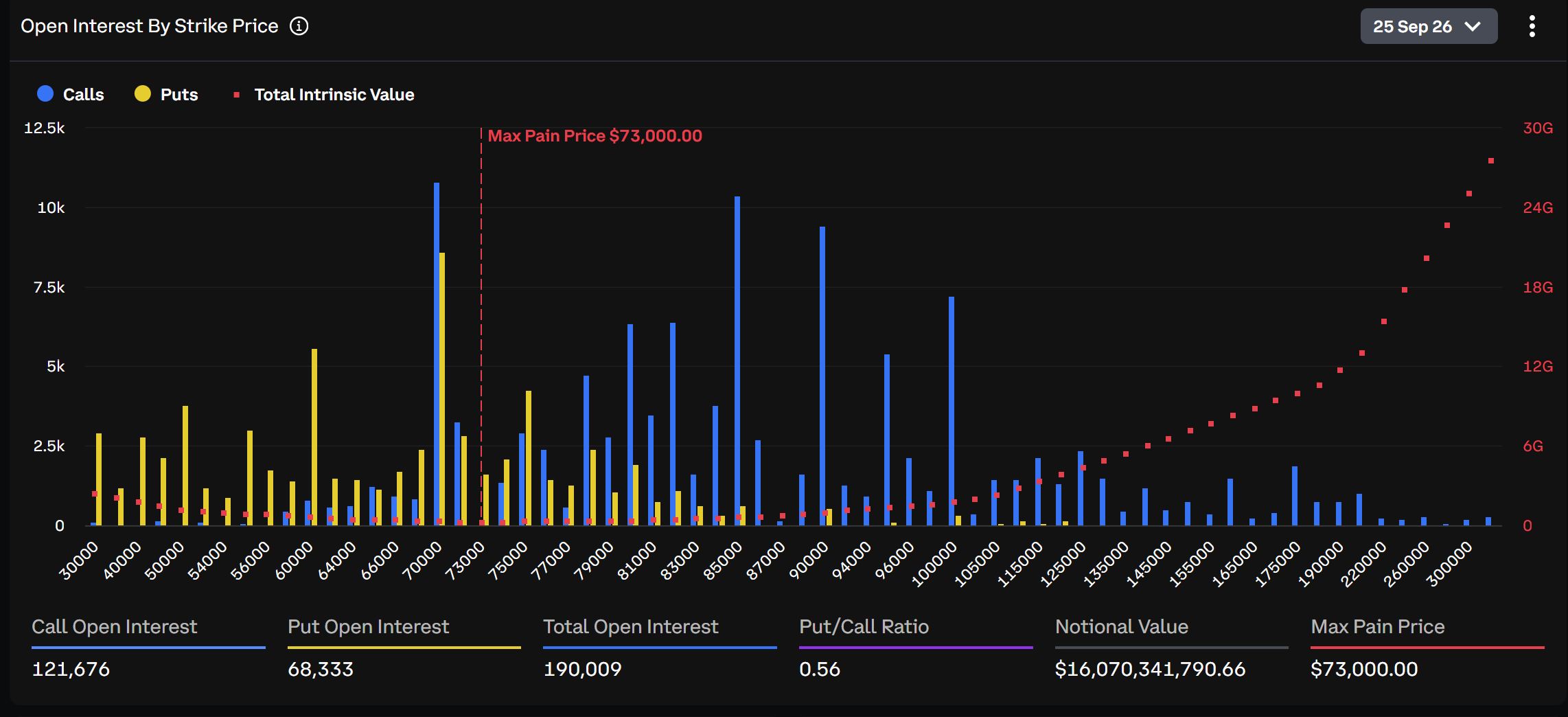
Bitcoin has to climb nearly 20% in four days for the biggest bets on the options market boards to pay off. Traders stacked them anyway.
Roughly $16.07 billion in Bitcoin (BTC) options expire Friday. The heaviest bullish positions sit at $90,000 and $100,000. Bitcoin trades near $81,292.

The Money Sits Well Above the Price
A call pays out when the price rises past a set level. A put pays out when it falls. Friday’s expiry holds 121,676 calls against 68,333 puts, Deribit data shows. That works out to a put/call ratio of 0.56. Close to two bullish contracts for every bearish one.
The single biggest call cluster sits at $85,000, about 5% above the current Bitcoin price. Stacks at $90,000 and $100,000 follow. A few reach $125,000, which would take a 54% rally.
The largest put cluster sits at $70,000, a level Bitcoin cleared last week.

Every Call Has a Seller on the Other Side
Here is what the chart does not show. Open interest counts contracts still alive. It says nothing about who is winning. Somebody bought each of those calls. Somebody sold them.
Max pain for Friday sits at $73,000. That is the price at which the largest number of contracts would expire worthless. Bitcoin sits 10% above it.
BeInCrypto reported Monday that Bitcoin hit an eight-month high after $262 million in short liquidations.
Watanabe Says October, MEXC Says Wait
Sota Watanabe founded Astar Network and runs Startale Group, the firm building Sony’s Soneium blockchain. In his opinion, October is poised to be a good month.
Vugar Usi Zade, chief executive of the exchange MEXC, is less sure. Bitcoin shrugged off a Federal Reserve rate hike and the collapse of the CLARITY Act, a US bill that would have set crypto market rules, he said.
Spot Bitcoin funds took in $593 million across Thursday and Friday. Strategy (MSTR) stock rose 17% on the week.
For the fourth quarter of 2026, the market needs multiple episodes to consider a trend reversal.
He named oil market tensions as the likeliest trigger to flip sentiment. ETF flows this week will show who blinks.
Friday settles the bets.
The post Sota Watanabe Says October Will Be Great: Bitcoin Bulls Stack $100,000 Bets appeared first on BeInCrypto.
Multicoin Capital co-founder Kyle Samani predicts more crypto companies will choose to build on Solana over Ethereum due to its ease of use and greater functionality.
Solana will flip Ether during “this market cycle,” Samani told Cointelegraph during an episode of Trade Secrets, predicting that Ethereum may gradually lose its edge as the default smart contract network choice for crypto companies.
“They’ll all switch their default over to Solana because it’s the most functional network for all of them and it’s just easier to consolidate their operations around Solana to the extent that they can.”
Samani and Multicoin amassed a sizable early position in Solana and he has been one of its strongest proponents for years. His prediction would require a five-fold increase in SOL’s $58 billion market capitalization to surpass Ether’s current market cap of $293 billion.
Samani argued that “today, no one really uses Ethereum” and that it only remains a leading blockchain network due to stablecoins, and stablecoins borrowed against Ether as collateral.
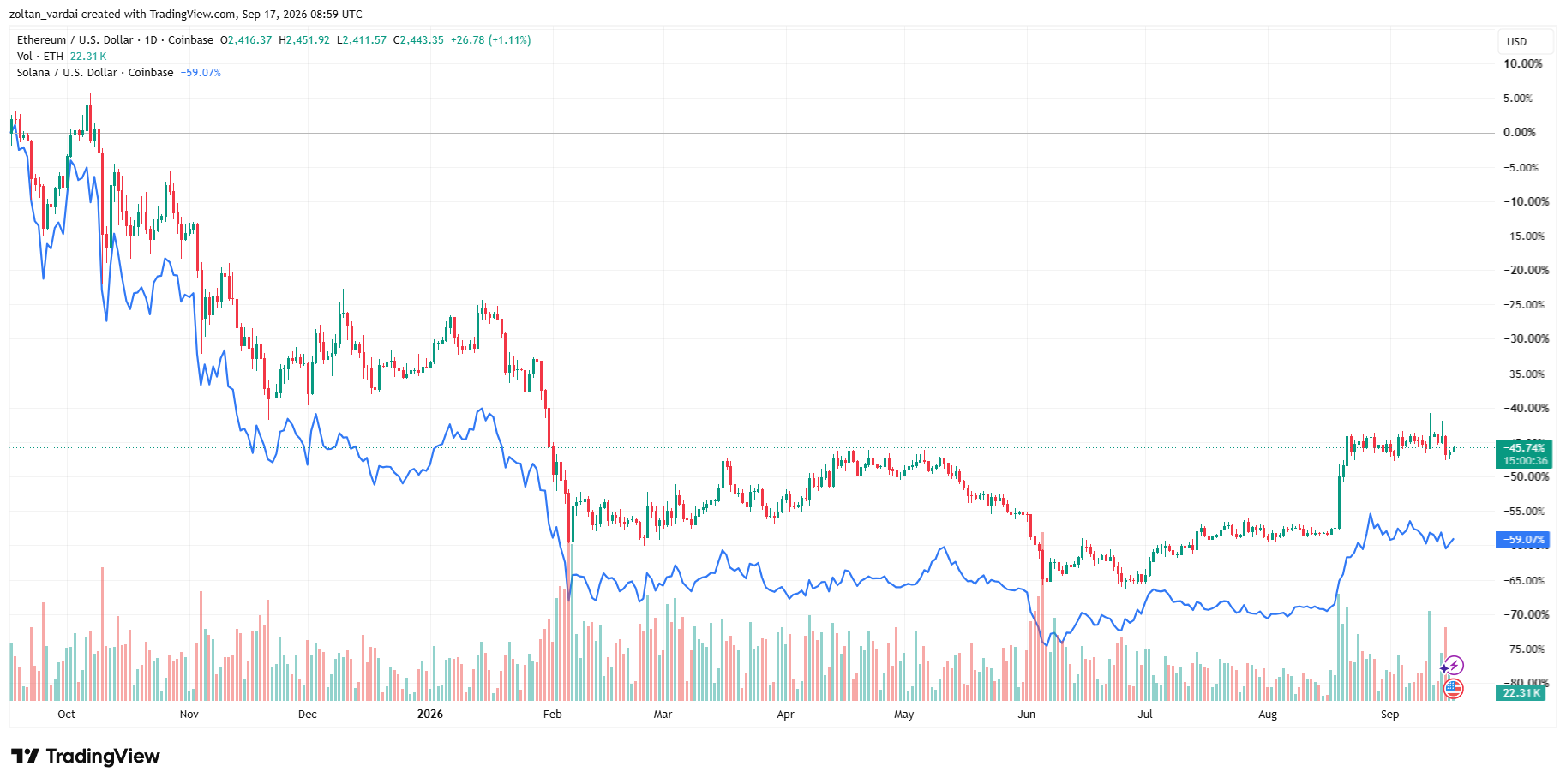
SOL and ETH have largely been moving in lockstep in percentage terms during the recent upturn in markets. During the past month, Ether rose 30%, while SOL rose 34%. However, Solana’s rise comes off a smaller base and the token saw a larger decline in the bear market, falling 59% during the past year, in comparison to Ether’s 45% decline, according to TradingView.
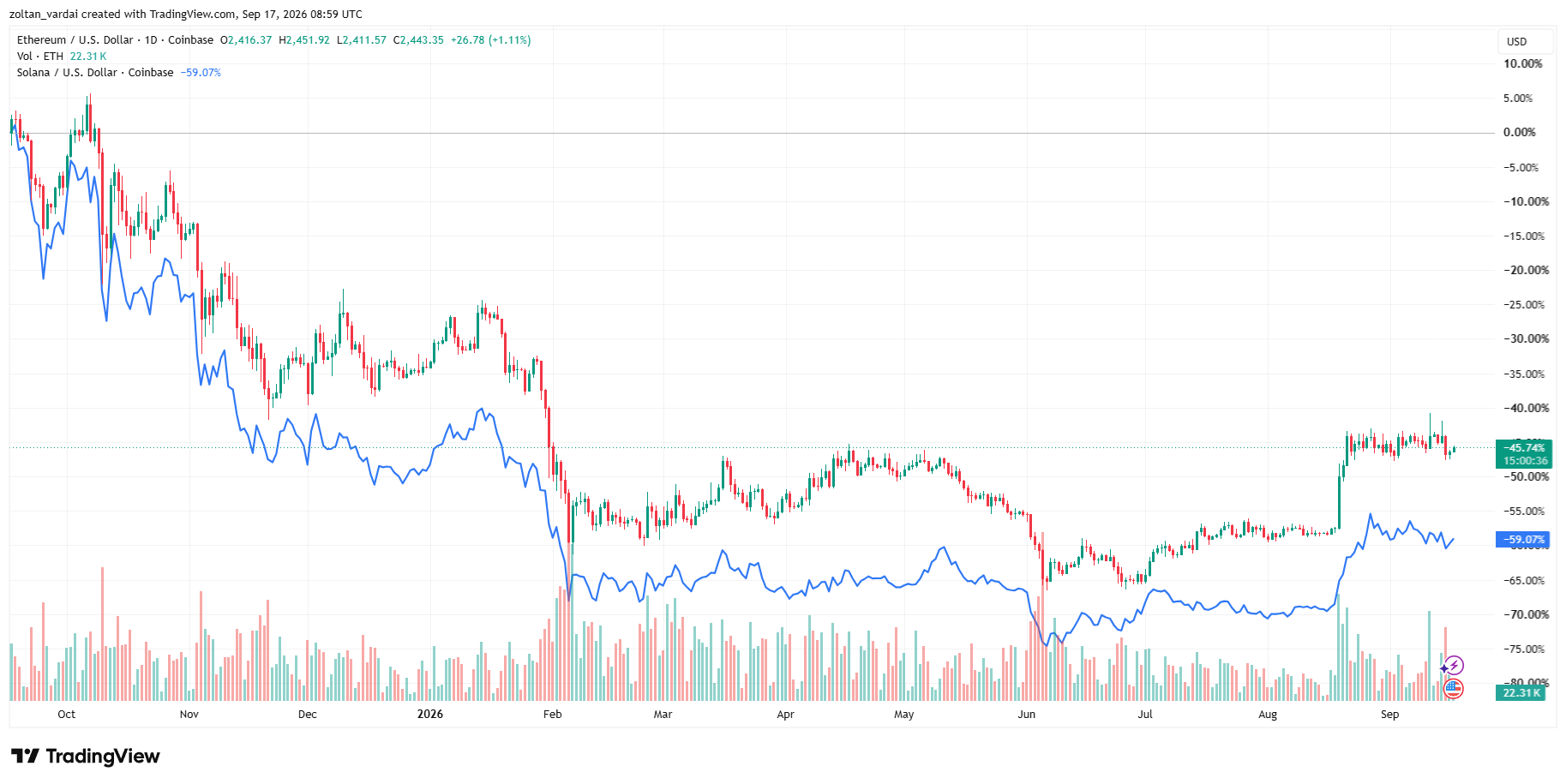
ETH/USD, 1-year chart. Source: Cointelegraph/TradingView
Did Samani ragequit crypto?
In February, Samani said he was stepping down as managing partner of the crypto investment firm Multicoin Capital after 10 years in the industry, in what he called a “bittersweet moment”.
At the time Samani seemed dispirited about the state of the industry. He reportedly quickly deleted an X post, in which he stated: “I once believed in the web3 vision. dapps. I don’t anymore…Crypto is just fundamentally not as interesting as many crypto enthusiasts wanted. Myself included.”
If it was a crisis of confidence, it was only fleeting. In September, Samani joined the US board of directors at crypto trading platform Backpack.
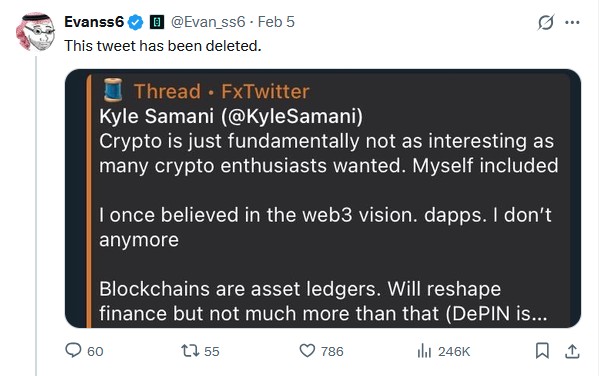
Source: Evanss6
Ethereum has ‘questionable’ value accrual
Samani said he is “bearish” on Ethereum’s ability to accrue value despite being the largest smart contract network.
“It’s a $400 billion to $300 billion asset that has questionable value accrual, if any, and it’s not growing at all.”
Samani added that he doesn’t understand why investors would want to own Ether at the current valuation, adding that he sees plenty of other investment opportunities at “more reasonable prices.”
He argued that more crypto companies will be pivoting to Solana, which he called “the most functional network” that makes it easier for firms seeking to consolidate operations.
While SOL accounts for less than one-fifth of Ether’s market capitalization, it has surpassed the Ethereum network in both weekly and monthly fees.
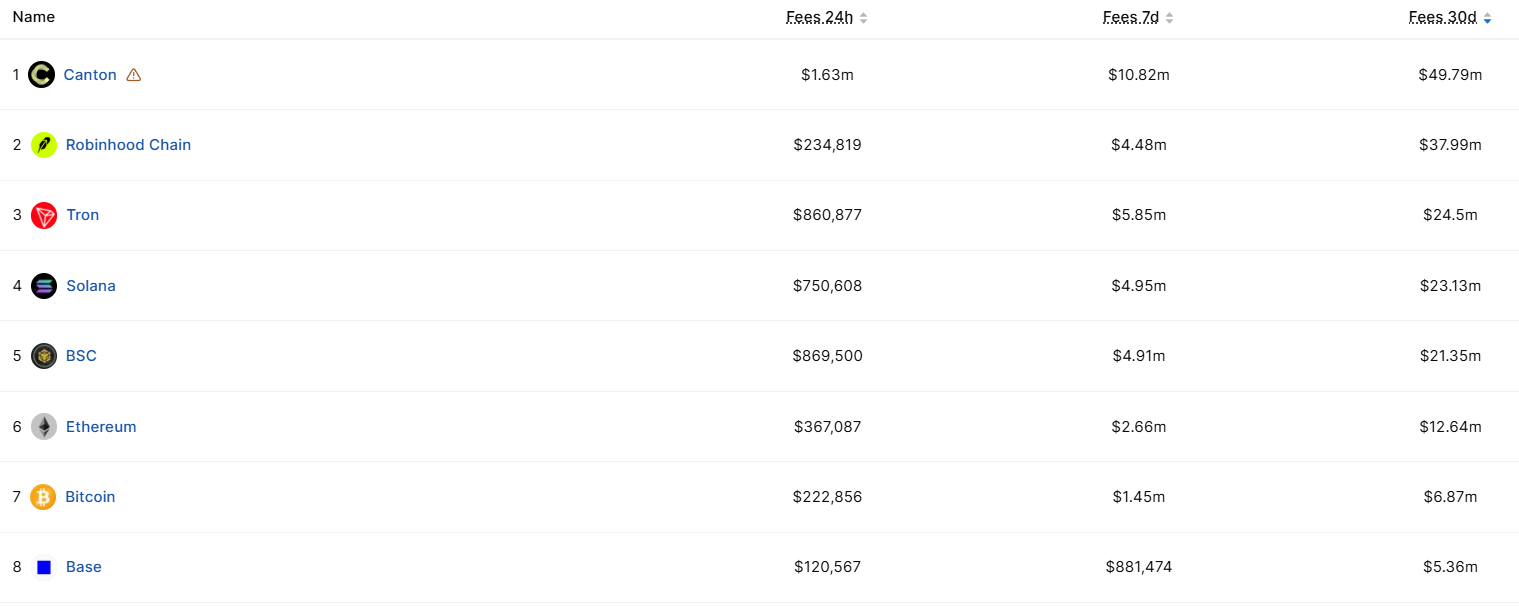
Top blockchain networks by 30-day fees. Source: DefiLlama
Solana generated $23 million in fees over the past 30 days and ranked fourth in monthly fees. Ethereum generated $12.6 million and ranked in sixth place, according to DefiLlama.
Related: Solana sees record 263K tokens issued in a single day
Solana became one of Multicoin Capital’s top bets
Samani first discovered permissionless finance and smart contracts through Ethereum in 2016 and has said it was his “entry into crypto.” However, he later lost faith in Ethereum after becoming dissatisfied with how Ethereum developers addressed scaling.
He came across Solana shortly after founding Multicoin in May 2017, and the firm went on to lead some of Solana’s earliest investment rounds in 2018.
It turned out to be one of the best ever bets for Multicoin, which reported managing $5.9 billion worth of assets in May 2025, making it one of the most prominent crypto investment firms.
Before joining the crypto industry, Samani co-founded and served as the CEO of healthcare IT company Pristine, which built software for Google Glass used by surgeons.
Magazine: Token buybacks are booming. But are they good for crypto projects?
Cointelegraph publishes long-form journalism, analysis and narrative reporting produced by Cointelegraph’s in-house editorial team with subject-matter expertise. All articles are edited and reviewed by Cointelegraph editors in line with our editorial standards. Some articles contain affiliate links, from which Cointelegraph may earn a commission. These relationships do not influence which products we review or our editorial conclusions. Content published in here does not constitute financial, legal or investment advice. Readers should conduct their own research and consult qualified professionals where appropriate. Cointelegraph maintains full editorial independence.
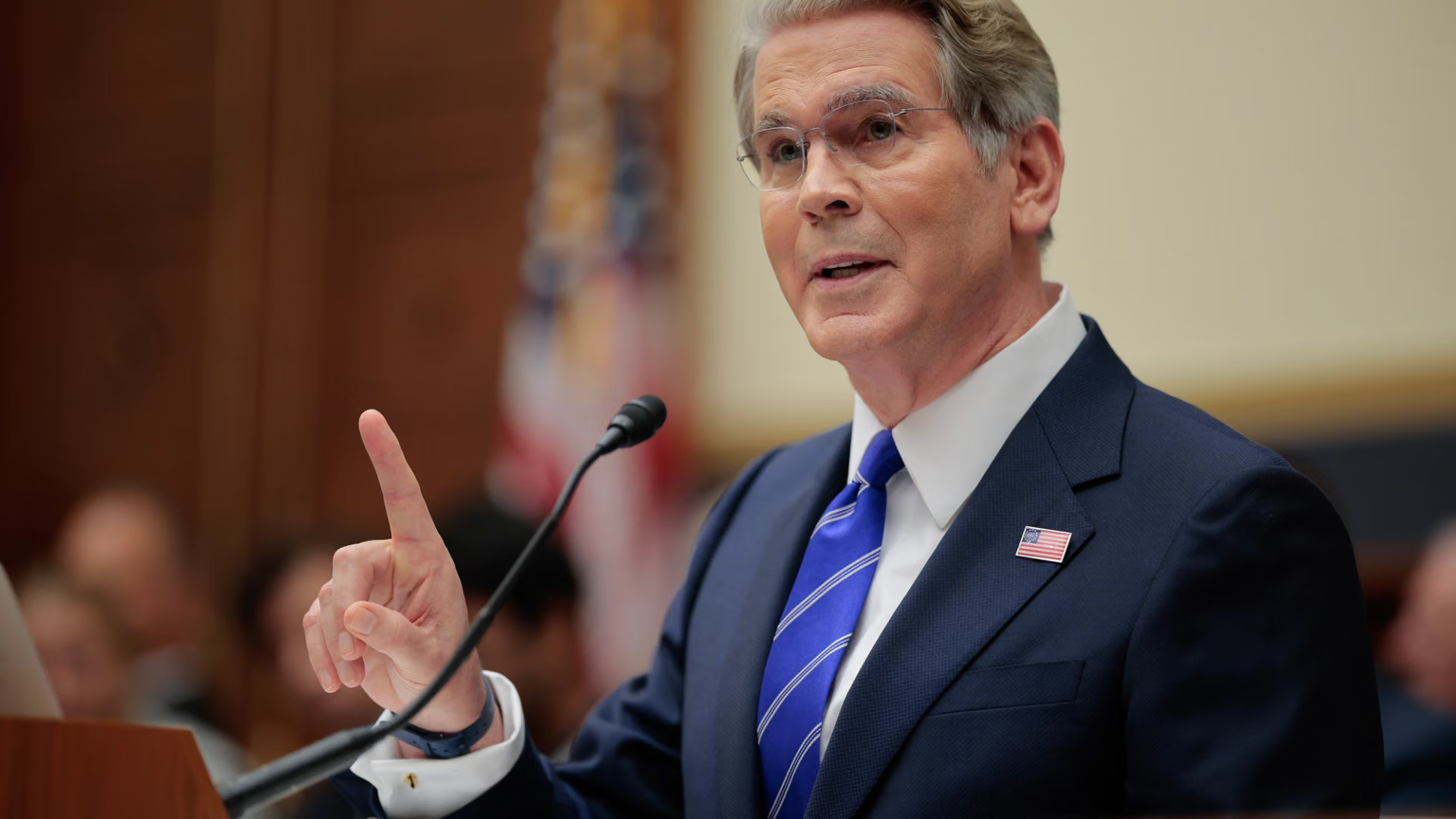
Treasury Secretary Scott Bessent leant on stablecoin adoption and dollar-denominated trade metrics to defend the strength of the U.S. economy, seeking to counter anxiety over surging government debt yields and shifting international payment rails.
Bessent pushed back against a recent report by the New York Times which outlined structural risks in the country’s financial position. He highlighted data amplified by conservative commentator Lawrence Kudlow, to emphasize the greenback’s enduring global dominance in a post on X, noting that the U.S. dollar remains on one side of 89.2% of FX transactions, while the overwhelming majority of stablecoins are pegged to USD.
Bessent also highlighted record median household income, a historically low official poverty rate, continued employment growth and the Atlanta Fed’s 5.1% annualised estimate for third-quarter GDP.
The pushback from Bessent comes at a time where U.S. Treasury yields reach multiyear highs, with the 10-year yield hitting 5%. The Treasury has been repurchasing longer term bonds, leading critics to accuse Bessent of attempting to suppress yields. Bessent rejects that interpretation, maintaining that the buybacks are intended to improve liquidity and manage the maturity structure, rather than control a Treasury market worth more than $30 trillion.
Bessent also cited Saudi Arabia’s departure from mBridge, the China-backed cross-border digital currency platform, according to the Financial Times, as supportive of dollar dominance. However, Saudi Arabia said its involvement ended after completing a planned proof of concept in May 2025. The platform continues to expand elsewhere, making the withdrawal a symbolic victory for Washington rather than evidence that the broader project is collapsing.

Michael Saylor’s Strategy resumed buying Bitcoin after a two-week pause while continuing to repurchase its STRC preferred stock.
Strategy acquired 950 Bitcoin (BTC) for $75.7 million at an average price of $79,670 per coin between Monday and Sunday, according to a Form 8-K filing with the US Securities and Exchange Commission on Monday.
The purchase brought Strategy’s holdings to 846,000 BTC, acquired for about $63.8 billion at an average cost of $75,416 per Bitcoin, including fees and expenses. With Bitcoin trading at $84,925 at the time of publication, Strategy was sitting on an unrealized gain of about $8.05 billion on its holdings.
The purchase comes as Strategy balances its Bitcoin accumulation strategy with managing a growing collection of preferred securities and billions of dollars in cash reserves.
Shares of Strategy, the largest publicly traded Bitcoin treasury company in the world, rose 7.4% to $165.2 in pre-market trading on Monday, according to Yahoo Finance data. Strive, the world’s fifth-largest corporate Bitcoin holder, also announced Bitcoin buys on Monday. It added 1,355 BTC last week, bringing its total to 26,355 coins. Its shares rose 6.44% to $32.03.
Strategy spends $174 million buying back STRC
Strategy continued buying back its perpetual preferred stock, STRC, repurchasing about 1.77 million shares for $174 million during the same week.
STRC rose 0.35% to $98.85 during Monday’s pre-market trading.
Strategy said it still had $875.1 million available under its preferred-stock repurchase program and $1 billion remaining under its MSTR share repurchase program.
Related: REX launches 2x leveraged ETF tied to Bitcoin treasury firm Strive
The company also reported no sales under its at-the-market offering programs between Sept. 14 and Sept. 20, meaning it did not raise funds through those programs during the period.
Strategy’s deployable cash drops
Strategy’s ”USD Cash“ balance fell nearly 20% to $1.05 billion from $1.30 billion a week earlier, when the company reported its previous cash balance.
Its separate ”USD Reserve“ declined to $5.04 billion from $5.10 billion as Strategy used $57.4 million to pay preferred-stock dividends and interest on outstanding debt.
Strategy uses USD Cash for broader treasury purposes, including Bitcoin purchases and capital management, while its USD Reserve is intended primarily to support preferred-stock dividends and debt interest.
Magazine: Bitcoin treasury firms can outperform BTC… but is the risk worth taking?
Crypto World
Ethereum news: Bitmine (BMNR) adds bought $75M ETH as Tom Lee says institutions are underweight crypto

Bitmine Immersion Technologies ·, the largest Ethereum treasury firm, bought another 27,562 ether last week, maintaining its steady buying as Chairman Tom Lee argued institutional investors remain underexposed to crypto.
The purchase was worth about $75.2 million at Monday’s ether price of $2,727, lifting Bitmine’s holdings to 5,983,940 ETH. That’s about 4.9% of the token’s 122.1 million supply, keeping the company close to its goal of owning 5%.
The firm has been buying at a similar pace in recent weeks and, at that rate, could reach its accumulation goal in the next couple of months. The company said it bought ether every week since June 2025, when it pivoted to a crypto treasury strategy.
Bitmine has staked about 5 million ETH, roughly 85% of its holdings, and projected a staking revenue of roughly $357 million annually at current yields.
Bitmine shares were 5.8% higher pre-market, extending Friday’s 8% rally as ETH surged overnight to a fresh high since late January.
Tom Lee sees year-end catch-up for crypto
Tom Lee, meanwhile, said institutional investors may be playing catch-up after favoring artificial intelligence-linked stocks earlier in the year.
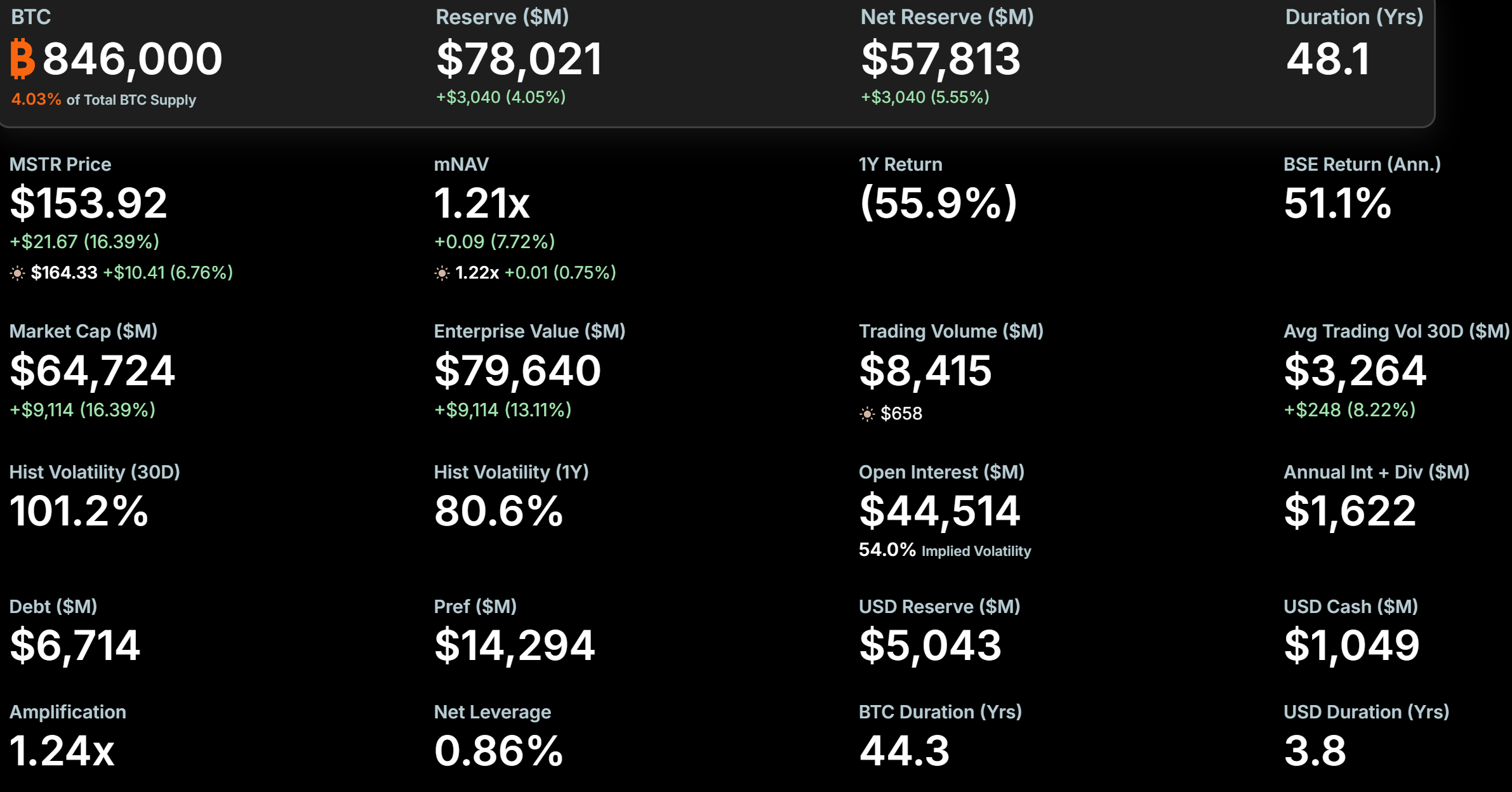
Strategy, formerly MicroStrategy, added 950 Bitcoin (BTC) in the week to September 20 and repurchased $174 million of its own preferred stock over the same stretch. Total holdings now sit at 846,000 BTC.
The buy ends a two-week gap in accumulation. At the $81,200 bitcoin price Strategy used in Monday’s filing, the 950 coins are worth roughly $77 million.

How the MicroStrategy Bitcoin Purchase Compares With August
The company’s previous acquisition landed on August 31, when it ended a 10-week pause with 4,603 BTC bought for $369.7 million at an average of $80,318 a coin. In dollar terms, last week’s purchase is about 79% smaller.
Executive Chairman Michael Saylor teased the buy on Sunday with a post reading “A little more orange.”
Bitcoin has since climbed above the level Strategy used in its own math. The asset traded near $85,020 on Monday, up almost 6% over 24 hours.

Why the Preferred Buyback Cost More Than the Bitcoin
The $174 million went to Variable Rate Series A Perpetual Stretch Preferred Stock (STRC), a Nasdaq-listed share class Strategy designed to trade close to $100. That is more than twice what the bitcoin cost.
Strategy started buying STRC back in late July at an average of $86.52 a share. The stock closed at $98.51 on Friday. Chief Executive Phong Le explained the logic when the program began.
“At prices below $100 per share, STRC repurchases represent an attractive allocation of capital because they can reduce future preferred dividend requirements at a discount.”
Those repurchases are funded by common share sales and potential bitcoin sales rather than the company’s dollar pile, which stood at $6.09 billion on Sept. 20. The structure came out of the Digital Credit Capital Framework Strategy set out in June.
BeInCrypto flagged STRC moving back toward par in August as one of the conditions that would let bitcoin buying restart. It did restart, at a fraction of the earlier pace.
MSTR common stock trades at 0.88 times the value of the bitcoin behind it, according to BitcoinTreasuries. Next Monday’s filing will show whether 950 coins was a floor or a new run rate.
A Smaller Rival Bought More Bitcoin the Same Week
Strive, a Bitcoin treasury company a fraction of Strategy’s size, outbought it over the same stretch. It acquired 1,355 BTC between September 14 and September 18 at an average of $79,475 a coin. That took its holdings to 26,355 BTC, roughly 3% of Strategy’s pile.
Chief Executive Matt Cole put the cost at $107.7 million.
He said warrant exercises began last week and brought in $21.2 million in gross proceeds. Cole added that 57.7% of Strive’s total capital raised has come from SATA, its variable rate perpetual preferred shares, a structure close to Strategy’s STRC. Strive reported a $292 million paper loss on its bitcoin in August.
The post MicroStrategy Ends Two-Week Pause With 950 Bitcoin: Is the Buying Engine Stalling? appeared first on BeInCrypto.

Strategy · made its first bitcoin purchase since late August, acquiring 950 BTC for $75.7 million last week at an average price of $79,670 per coin.
The purchase was funded through the USD reserve, according to a Monday morning regulatory filing. Strategy used $174 million of USD cash to fund repurchases of STRC and $75.7 million of USD cash to buy bitcoin. In addition, the company used $57.4 million of the USD reserve to fund the payment of dividends on its preferred stock. The USD reserve now sits at $5 billion and the USD cash sits at $1 billion.
Led by Executive Chairman Michael Saylor, Strategy now holds 846,000 BTC, acquired for a total of $63.81 billion at an average price of $74,417 per coin.
MSTR shares rose 7% in pre-market trading as bitcoin climbed to $84,500, gaining 4.5% over the past 24 hours.

Near Protocol’s native token surged nearly 80% over the past week, outpacing the wider crypto market as the network expanded its privacy-focused trading services.
On Monday, NEAR traded around $4.29, up about 78.2% over seven days and 22% over the past 24 hours, according to CoinGecko. Total cryptocurrency market capitalization rose about 6% over the same seven-day period.
On Thursday, Near Protocol said deposits and withdrawals for perpetual futures trading through near.com were now confidential by default. Near said the feature obscures the link between a trader’s funding wallet and a dedicated Hyperliquid trading account.
On the same day, Near said near.com’s confidential total value locked (TVL) had crossed $70 million, triggering the first snapshot under its NEAR@3.33 incentive program. The program allocated 333,333 milestone tokens for the first distribution. Under the program’s rules, those tokens unlock and convert to NEAR when its three-day volume-weighted average price reaches at least $3.33.
NEAR Intents reaches $29.3 billion in cumulative volume
NEAR Intents lets users request cross-chain swaps, with market makers competing to execute them.
The NEAR Intents Explorer showed about $29.3 billion in cumulative volume and $842 million over the past seven days on Monday. Privacy-focused Zcash wallet ZODL was its third-largest referral source by volume over the preceding 24 hours, generating about $3.8 million across 458 transactions.
A swap involving roughly $613,000 worth of ZEC was also among the largest transactions displayed by the explorer for the preceding 24 hours.
Related: Grayscale’s Zcash ETF files for 3-for-1 forward share split
Bitwise research analyst Camran Khosravi said Near and Zcash are “complements,” arguing that Near gives ZEC holders confidential cross-chain infrastructure and access to liquidity.
He also cautioned that NEAR Intents’ TVL can rise when the price of ZEC already held within the system increases, even without new deposits.
Near has also extended its privacy focus beyond trading. In July, NEAR AI introduced staking-based payments that let users stake NEAR to receive credits for confidential AI inference and agent hosting while retaining ownership of the underlying tokens.
Magazine: Who needs CLARITY anyway? ARB could see 70X increase: Hodler’s Digest

Google and Apple are seeking employees with expertise in digital assets, adding to signs that Big Tech firms are preparing for a larger role for stablecoins, tokenization and blockchain-based payments.
Google Cloud is hiring an Industry Principal Architect in Hong Kong to work with protocol foundations, exchanges, custodians and financial institutions to tokenize real-world assets across the Asia-Pacific (APAC) region.
The role calls for experience with blockchain networks, smart contracts, stablecoin infrastructure, tokenized deposits and custody technologies. Google said the hire would advise executives and help shape its Web3 product roadmap as it seeks to become the preferred cloud provider for digital-asset builders and institutional adopters.
Apple is also expanding into digital assets. It is looking for an Apple Pay Financial Product Strategy Lead based in Cupertino, California or New York.
The listings do not confirm that either company is launching a new crypto product, but it does show that stablecoins and tokenized deposits are becoming relevant expertise inside two of the world’s largest tech and payments ecosystems, rather than remaining the preserve of crypto-native firms.

At Close of Business podcast September 21 2026

Is the M&A Boom Real? BCG Says Yes at the Top, Not Below $1 Billion

BBC Pulls Blackface Scenes From That Mitchell And Webb Look

Weekend Open Thread – Corporette.com

Weekend Open Thread: Talbots – Corporette.com

Memory prices are slowing because buyers ran out of money

Money Talks Song Lyrics | Trending Short Video 2024 | Viral Song

XRP IS THE LAST ONE STANDING | SEC CRYPTO LAWS | CLARITY ACT FAILING WAS THE PLAN | EMERGENCY VIDEO

Lecture 1: Introduction to 14.129 Blockchain and Design of Financial Systems
-
 Fashion3 days ago
Weekend Open Thread: Talbots – Corporette.com
-

 Tech15 hours ago
Researchers escape OpenAI Codex sandbox to run commands on host
-

 Crypto World7 days ago
Revolut Attackers Warn of Ongoing Daily Customer Data Leaks
-

 Crypto World3 days ago
Circle launches Arc Studio AI agent for building onchain apps
-
 NewsBeat3 days ago
Trump says US has reached an agreement to take permanent control of Greenland’s security
-

 Crypto World7 days ago
Kraken Lets xStocks Holders Earn Yield Through DeFi
-

 Crypto World6 days ago
Robinhood engineers charged over $50K crypto scheme
-

 Crypto World3 days ago
Bitcoin price breaks channel as RSI climbs to 63
-

 Crypto World5 days ago
US Charges Robinhood Engineers Over Crypto Listing Trades
-

 Crypto World5 days ago
What Is the Status of the U.S.-Iran Peace Talks? Here's What Both Sides Are Saying
-
 NewsBeat7 days ago
‘Sick conspiracy’: Trump says only guardrails AI needs is ‘a strong and smart (High IQ!) president’ in all-caps rant
-
Business7 days ago
SK Hynix ADRs Fall More Than 6% as Memory Rally Breaks on Fears of Slower AI Spending
-
 Crypto World6 days ago
NVIDIA Analysis: Attempted Rising Wedge Breakout Amid Pressure on the AI Sector
-

 Tech6 days ago
Webb’s IC 348 Mosaic Includes Two-Jupiter Dwarfs, Twin Jets, and a Nursery Still Making Worlds
-

 Crypto World2 days ago
World Money launches in 150+ countries with Stripe
-
Crypto World7 days ago
Can Circle’s Arc Repeat Robinhood Chain’s Meme Coin Boom?
-

 Crypto World3 days ago
Silver prices recover quickly, hitting weekly high today
-

 Crypto World7 days ago
Kraken Adds DeFi Yield on Tokenized Stocks and ETF Assets
-
 NewsBeat3 days ago
US was ‘on brink of war’ with China over false AI report of nukes moving in Middle East
-

 Crypto World7 days ago
DOJ Seeks to Seize $61M in Iran Oil Funds From Binance Accounts It Vouched For
You must be logged in to post a comment Login