A pensioner was forced to have both his legs amputated after it took 29 medical appointments and four years to diagnose a common medical condition.
Nic Olsen, 80, visited his GP in 2020 after he began to experience foot and leg pain.
Believing it was linked to the back problems Mr Olsen had suffered with for years, he was referred to an orthopaedic specialist.
What followed was years of appointments with consultants, specialists and GPs, as well as endless scans and tests while his pain continued to worsen.
Each time he was sent away with new remedies, including being told to ‘walk more’, put insoles in his shoes or take cholesterol tablets.
The semi-retired financial adviser from Tugby, Leicestershire, even collapsed and saw his big toes ‘burst open’ before a blockage was finally spotted in the arteries in his lower legs.
He was diagnosed with peripheral arterial disease (PAD), which causes arteries to narrow due to the build-up of fatty deposits in the walls, leading to blockages.
The common condition affects one in five people over the age of 60 and can be diagnosed with a simple Doppler test, which uses ultrasound to measure blood flow.
However, by the time Mr Olsen was diagnosed, it was already too late and his condition was so advanced that treatment was unlikely to succeed.
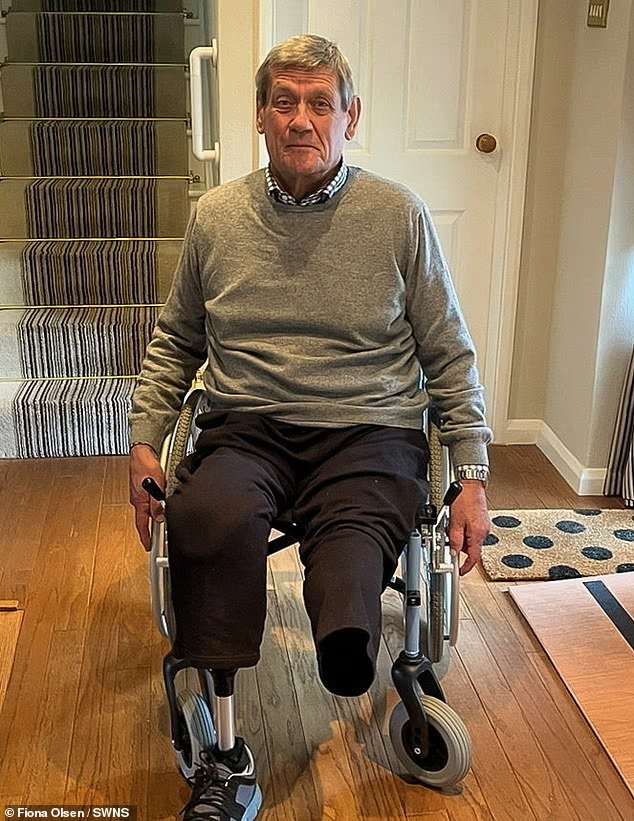
Nic Olsen, 80, lost both his legs after it took four years for medics to diagnose a common medical condition
Mr Olsen visited his GP in 2020 after he began to experience foot and leg pain
He was given an angioplasty followed by two bypass surgeries to reopen the arteries, but after that didn’t work he was forced to have a double amputation.
Both legs may have been saved had he been diagnosed earlier.
His ongoing treatment is also estimated to have cost the NHS £1million. But the figure would have been a fraction of this had his condition been properly diagnosed earlier.
Mr Olsen’s initial symptoms included pain, swollen feet and the loss of the hair on his lower legs – all recognised signs of PAD.
His wife Fiona said the Doppler test would have quickly identified a circulation problem in his legs.
Instead, he had a spectrum of tests including MRI scans, X-rays and blood tests over the next four years.
The mother-of-one, a retired travel and tourism teacher, said: ‘A Doppler is a simple test – you’d be able to hear from that if there is a circulatory problem. But nobody did one for years.’
‘All Nic ever talked about was the pain,’ she added.
‘He would say it was like someone was stabbing him with a carving knife.
‘He had all kinds of examinations and saw all kinds of doctors, surgeons and specialists.
‘Finally, after four years, someone looked at his ultrasound and said, “Oh my God, this is serious”.
‘They tried everything, but we were left with no option but amputation.
‘Nic’s care from start to finish has cost the NHS over £1million – if this condition had been found at the start, it could have been a fraction of that.
‘He could have had an angioplasty there and then, when it was still early, which costs the NHS about £1,000 – and would have saved his legs.
‘He had 29 different appointments before he got a diagnosis, it’s disgraceful. Lessons have to be learnt.’
Mr Olsen, pictured with his wife Fiona and daughter Emma after his double amputation
For months after his first appointment, Mr Olsen continued trying to find answers to what was causing his pain, as it turned to agony and he became less mobile.
During a holiday to Tenerife in January 2024, one of his toenails burst open and began gushing blood.
However it wasn’t until nine months later that a different podiatrist asked about whether he’d had a Doppler test.
Mrs Olsen, who is now her husband’s full-time carer, said: ‘She did the Doppler finally and there were no sounds of circulation. We knew then that it was bad.’
He was sent for an electrocardiogram (ECG) – a test to record the electrical activity of the heart.
He was also referred to a vascular hospital where a consultant revealed that he had chronic PAD.
Despite the diagnosis, he was just told to walk 10,000 steps a day and was prescribed cholesterol tablets, she said.
In January, 2025, Mr Olsen collapsed from the pain and was unable to walk.
After three further trips to the hospital, a different consultant looked at his ultrasound scan and raised the alarm.
Mr Olsen was sent for an angioplasty – a procedure to unblock arteries – but the procedure didn’t work.
He then underwent an arterial bypass – a large and risky 13-hour surgery, again to no avail
She said: ‘By this point the pain was phenomenal for Nic, so the next option was amputation.’
He had his right leg – the worse of the two – amputated below the knee in April 2025.
Within two weeks of returning home from his amputation, his second foot became ulcerated and he needed a second amputation in July 2025.
Mr Olsen, who also has two sons from a previous relationship, went through months of gruelling rehab using prosthetic legs to walk again.
In June 2026, he was strong enough to walk daughter Emma Olsen, 30, down the aisle on her wedding day.
Mr Olsen went through months of gruelling rehab using prosthetic legs to learn to walk again
Fiona said: ‘Nic is very brave and doesn’t say a lot, but every now and then he’ll gasp from phantom limb pain.
‘I know he has some dark thoughts, but my husband is so strong.
‘Nic is doing so well because of his massive strength and stamina.’
Mr Olsen said: ‘I don’t think any of the people I spoke to knew what PAD was. All the symptoms were ignored.
‘After amputation, it’s two or three weeks after you get home is when reality hits, and you reach your darkest mental state.
‘I slipped through the net. But early diagnosis saves lives, and it’s totally preventable if it’s diagnosed early enough.
‘I wouldn’t be anywhere without Fiona there behind me.’
Mrs Olsen is now campaigning to make more people aware of the PAD symptoms her husband had – including resting leg and foot pain, swollen toes and no hair on his lower legs.
She said: ‘The whole thing was shambolic. The only way I can let my anger out is to help people in the future.
‘Even the specialists say we need to keep banging the drum – PAD can easily be put right if you spot the signs early.’






.png?quality=75&auto=webp&width=960)
.png?quality=75&auto=webp&width=960)
.png?quality=75&auto=webp&width=960)
.png?quality=75&auto=webp&width=960)
.png?quality=75&auto=webp&width=960)














































You must be logged in to post a comment Login