
Crypto World
Binance Makes $100M Bet on Circle and Signs Five-Year USDC Deal


Binance bought $100 million of Circle Internet Group (NYSE: CRCL) stock in a private placement and signed a five-year agreement to promote USDC.
Both companies announced it on Tuesday with an 8-K filing, putting the purchase at 1,237,011 Class A shares at $80.84 each. The agreements were signed on September 17, and the share sale closed the same day, according to the filing, at a five percent discount to CRCL’s market price before closing. The stock closed at $85.09 that day and $94.49 on Monday.
Circle
@binance
Circle and Binance are continuing to build together through a new five-year commercial agreement to expand USDC access across emerging markets.
Binance has also made a $100M strategic investment in Circle.https://t.co/I0CIUBUoCZ pic.twitter.com/zQ9f9EiYTk
— Circle (@circle) September 22, 2026
Not Selling For Up To Two Years
Binance agreed not to sell, transfer or hedge the shares for up to two years and keep its voting rights. Also the new agreement “supersedes and replaces” contracts signed in November 2024 and August 2025, the filing states. Circle and Binance first partnered in December 2024, when Binance agreed to hold USDC in its corporate treasury and offer it to 240 million users.
Circle’s IPO prospectus later disclosed a one-time $60.25 million fee paid to Binance under that deal, plus monthly incentives on USDC held on its platform and in treasury. The treasury fees applied only while Binance held at least 1.5 billion USDC, and Binance agreed to keep 3 billion there (subject to exceptions). Both arrangements had two-year terms.
An August 2025 agreement superseded the non-treasury side of that deal and tied fees to USDC held through Circle’s Modular Smart Contract Wallet infrastructure service, on a four-year term. The new deal keeps that structure, with Circle paying a monthly fee set as a percentage of USDC held through the service.
Likewise, Circle’s annual report put the 2025 rise in Binance-related distribution costs at $152.1 million. Distribution and transaction costs ran $410.4 million in the second quarter, $324.6 million of it to Coinbase.
Teng Cites Arc and Emerging Markets
Richard Teng, co-CEO of Binance, said Circle “has earned its place as one of the most credible issuers in the world, spanning USDC, Arc, and the infrastructure reshaping how value moves across borders,” and that the investment and five-year term “represent long-duration conviction.”
Circle launched Arc’s public mainnet on September 16 with Binance among more than 100 participants.
Jeremy Allaire, Co-founder, Chairman and CEO of Circle, called Binance “the most widely used wallet in the world for dollar stablecoins” and said the partners would use USDC “to expand dollar access” and “reach people and businesses throughout global emerging markets.”
Binance has also had its fair run. The exchange reported 323 million registered users at its ninth anniversary in July.
The post Binance Makes $100M Bet on Circle and Signs Five-Year USDC Deal appeared first on CryptoPotato.

The team behind Pi Network supposedly completed another major ecosystem development, while the broader cryptocurrency market has been booming lately.
Despite these positive developments, PI remains deep in the red on a weekly basis.
The Latest Ecosystem Advancement
Pi Network began the long process of protocol updates at the start of the year and first implemented version 19.6. Many others followed suit, including v20.2, which laid the foundation for smart contract capabilities.
During the summer months, it unveiled versions 25 and 26, which actually came after their initial deadlines. The last technical update from that list is protocol v27, which was supposed to add more flexible and secure smart-contract authentication and should have been deployed on September 15.
On that date, the X account BSCN revealed that Pi Network initiated the upgrade, starting with a Testnet 2 implementation and planning to transition to Mainnet in the coming days. Several hours ago, the entity disclosed that the Core Team completed the final step toward launching protocol v27.
“Pi Network PiCoreTeam is moving to Protocol V27 on its Testnet 2 environment as it works toward a mainnet launch. The new protocol has stabilized at 250 transactions per block with no recorded failures, showing it can handle higher traffic. This is the final technical step before the Pi Network team switches to the live environment,” the announcement reads.
It is important to note that other X users have also highlighted the development, yet Pi Network’s official X account has remained silent on the matter.
Performing Maintenance
Pi Network’s PI has a maximum supply of 100 billion tokens, with a large portion allocated to community mining rewards. However, the circulating supply currently stands at roughly 11.24 billion units (per CoinGecko), while the supply created so far is around 17.2 billion.
This means that many coins remain locked and are set for release in the coming months and years. Traders and investors have been closely monitoring that development, as it can impact the price. The website providing this insight is piscan.io, but it has been unavailable for a few weeks as the team performs maintenance and reviews its service operations.
Besides upcoming token unlocks, PiScan has been providing data about the amount of PI tokens stored on crypto exchanges: another factor that is vital for the price trajectory. Nevertheless, such information is also unavailable at the moment.
PI Price Outlook
As of this writing, PI trades at roughly $0.09, down about 8% this week. This is concerning given the broader cryptocurrency market’s major upswing, with Bitcoin (BTC) briefly touching $87,000 and Ethereum (ETH) nearing $2,800.
Still, some believe that the token may soon regain bullish momentum. X user Crypto With Gopal noted that the price has been holding the $0.07-$0.08 support zone, suggesting buyers are defending the lows.
“A breakout above the $0.10-$0.11 resistance could trigger a stronger upside move toward the projected target. Bulls are trying to build momentum – breakout confirmation is key,” he concluded.
The post Important Pi Network News and PI Price Update: September 22 appeared first on CryptoPotato.
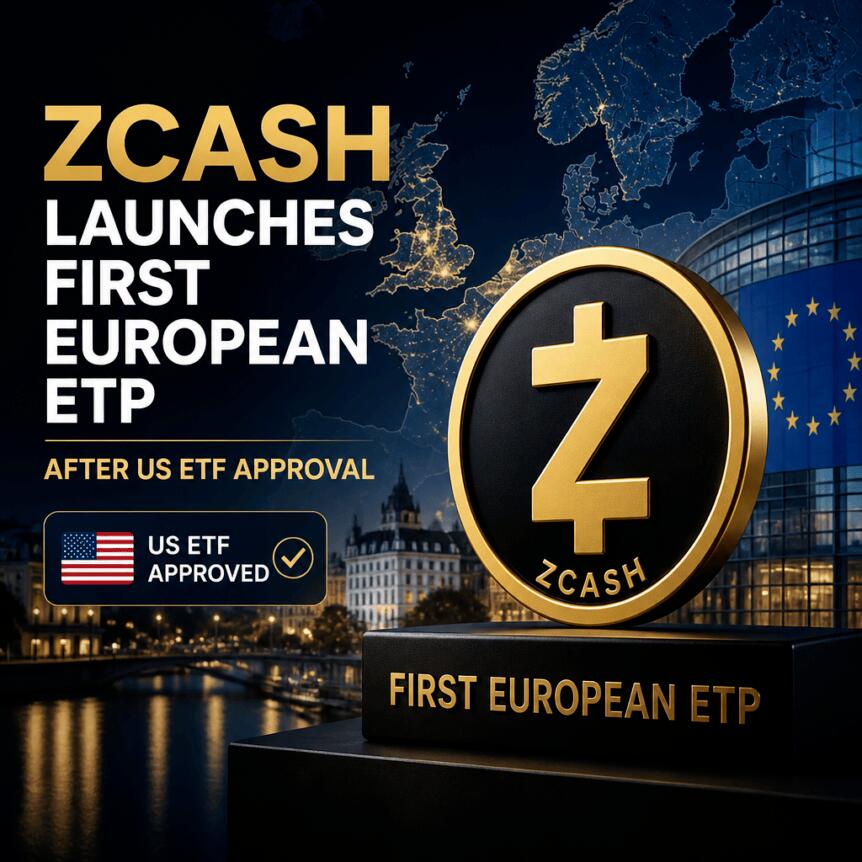
21Shares has rolled out a new set of exchange-traded products in Europe, bringing Zcash exposure to regulated Euronext markets and pairing it with a physically backed product tied to Ether.fi’s ETHFI token. The Zcash launch underscores how far privacy coins have traveled from niche infrastructure toward mainstream portfolio wrappers.
On Tuesday, the firm listed its physically backed Zcash ETP on both Euronext Paris and Euronext Amsterdam, giving investors the ability to hold Zcash-linked exposure through brokerage accounts rather than managing the cryptocurrency directly.
Key takeaways
- 21Shares listed a physically backed Zcash ETP on Euronext Paris and Amsterdam, offering ZEC exposure in a traditional investment format.
- A second physically backed ETP tracks ETHFI, the governance and utility token of Ether.fi, trading on the same Euronext venues.
- Both products charge a 2.5% annual management fee, which is higher than many comparable European crypto ETPs.
- The timing aligns with strong Zcash performance, including a recent push above $1,500 and a large gain over the past year, according to CoinMarketCap data.
- US and European product expansion is building momentum, following the earlier launch of Grayscale’s Zcash ETF on NYSE Arca.
Physically backed Zcash enters the Euronext wrapper
With the new Zcash ETP, 21Shares is effectively translating ZEC ownership into an exchange-listed product. Instead of buying and safeguarding the coin themselves, investors can access the asset through regulated trading and standard brokerage infrastructure.
The ETP is described as physically backed, meaning the product is intended to be supported by underlying Zcash holdings rather than relying on derivatives-based exposure. That structure often appeals to investors who want direct asset linkage while avoiding custody and operational complexity.
ETHFI ETP also lands in Europe
Alongside the privacy-coin listing, 21Shares introduced an ETP tracking ETHFI, associated with Ether.fi—an ecosystem that supports staking and other crypto financial services. The ETHFI product, like the Zcash offering, is physically backed and trades on Euronext Paris and Euronext Amsterdam.
For investors, the ETHFI ETP provides a similar “wrapper” experience for a token tied to a DeFi platform’s governance and utility. It also signals that ETP issuance in Europe is not limited to legacy assets such as bitcoin and ether, but is extending into tokenized access to active on-chain finance segments.
Fees: 2.5% puts both products above many peers
While the headline is new access via Euronext, the pricing details are equally important for potential buyers. Both the Zcash and ETHFI ETPs carry an annual management fee of 2.5%. The fee level stands out because it is well above what many Bitcoin– and Ether-linked investment products typically charge in Europe.
That higher fee can matter significantly for investors planning to hold over longer periods, especially in a market where alternative routes to crypto exposure—such as lower-fee ETPs or other regulated products—may be available. Investors evaluating either ETP may want to compare the total cost relative to their time horizon and expected volatility.
Zcash’s momentum revives “Bitcoin alternative” comparisons
The Euronext listing arrives during a period of renewed attention to Zcash’s market performance. The article notes that Zcash recently moved above $1,500 and was up nearly 1,100% over the past year, based on CoinMarketCap data.
That performance has also been feeding broader discussions about whether Zcash can serve as an alternative to bitcoin in certain narratives. Cointelegraph previously reported that Grayscale’s head of research, Zach Pandl, argued that Zcash could benefit from “second-mover advantages,” potentially helping it overcome Bitcoin’s entrenched network effects—an area where some earlier alternatives have struggled.
In practical terms, product listings like these often follow market interest. When an asset’s price action and institutional visibility rise together, it can create a feedback loop: regulated wrappers expand the investor base, and that expanded access can further boost attention.
Mining interest and institutional build-out
The Zcash story is not only about exchange-traded products. Mining activity has also been in focus. Cointelegraph reported that Fortitude Digital Mining said it mined about 28% of all ZEC produced in the first half of 2026, highlighting the scale of its operations on the network. The company tied its focus to Zcash’s proof-of-work model, its capped supply, and privacy features.
Meanwhile, Zcash’s move into regulated product structures is not confined to Europe. The source notes that the addition comes after the arrival of the Grayscale Zcash ETF in the United States, which trades on NYSE Arca under the ticker ZCSH. Combined with this European rollout, the trend points to a widening institutional appetite for Zcash exposure—despite ongoing debates about how privacy-oriented assets fit into regulated finance.
Investors should watch how these ETPs trade after launch—particularly whether the relatively high 2.5% fee influences demand—and whether Zcash’s recent momentum persists alongside further product announcements in other jurisdictions.

Self-proclaimed ChatGPT “co-creator” Diogo Almeida is running a viral marketing campaign for a new AI model, Jev, based on his work on the OpenAI chatbot’s core function, Reinforcement Learning from Human Feedback (RLHF).
The problem is, he’s admitting that his own invention doesn’t work well.
Almeida’s new startup, TypeSafe, emerged this month with a $40 million seed round, and a slick pitch that claimed he’d solved a problem that created during his time working on ChatGPT: AI hallucinations.
The pitch for its Jev model, however, is much less impressive and raises a few questions.
First of all, the claim that he “co-created ChatGPT” isn’t strictly true.
In fact, Almeida is the fourth of 20 listed authors on the 2022 InstructGPT paper that applied RLHF to language models. This was one research paper that ChatGPT engineers used while building the chatbot.
Relegating his role further, a footnote in that PDF marks Almeida as one of nine “primary” authors rather than a team lead.
Moreover, RLHF technology predates that paper by nearly five years and its foundational method came from six other researchers.
Read more: Viral report alleges Anthropic’s AI safety watchdog conflicted
Jev, an AI built on a résumé failure
Almeida is now attempting to launch and raise funding for Jev by admitting that his own creation, RLHF, “is not useful.”
He calls ChatGPT “unreliable without human supervision,” and he’s blamed RLHF for “mode dropping, overconfidence, and an overall lack of reliability.”
Almeida is also taking the opportunity to claim that his new AI model “can’t hallucinate.”
His claim about anti-hallucination technology, however, falls apart after even a momentary consideration.
Specifically, Jev’s supposed protection against hallucinations, according to its own documentation, is simply its option-choosing rather than sentence-writing design with a hard-coded cap of 255 options, not any particularly newsworthy code or algorithmic breakthrough.
Jev literally and quite simplistically presents itself as a simple decision selector among a limited set of options or pre-determined choices such as determining a likelihood percentage.
Because it doesn’t deliver text through a traditional chatbot, it literally cannot hallucinate because hallucinations require phrases that make sentences or factual claims.
Jev can only choose from predefined outputs and doesn’t deliver sentences that it or humans can misinterpret. Almeida therefore boasts that hallucinations in Jev are impossible by design.
Jev is days old and still in early access. It prices input tokens at $42 per billion, with output tokens momentarily free amid subsidies. Almeida claims speed, cost, and quality advantages over competitors.
Got a tip? Send us an email securely via Protos Leaks. For more informed news and investigations, follow us on X, Bluesky, and Google News, or subscribe to our YouTube channel.

Infamous entertainers Logan and Jake Paul, who are now making PR stops at the Treasury and the Department of War, are also heavily invested in gambling, AI, drones, and defense contracts, according to the website for their venture capital fund, Anti Fund.
Their portfolio includes Anduril, OpenAI, SpaceX, Kela Technologies, Polymarket, and Flock, which calls into question why they were invited to the Treasury and spoke in front of troops at the Pentagon.
Investments keep the brothers quiet
While fellow YouTubers and YouTube channels such as Benn Jordan, Donut, oompaville, and TommyG have criticized Flock and exposed issues with its surveillance cameras, Jake and Logan — who hosts a weekly podcast called Impaulsive with nearly 5 million subscribers — have remained silent about the company and its disturbing practices.
Anti Fund also invested in Kela Technologies, an Israeli defense contractor that “integrates commercial and military systems.” This could be why the brothers have completely avoided discussing the ongoing Palestinian genocide.
Read more: Paul brothers business partner claims ‘0% rug pull risk’ with new memecoin
Jake Paul says ‘America is not a spectator sport’
Jake Paul took to X after receiving a wave of backlash for appearing with numerous members of the Trump administration to tell his audience that “America is not a spectator sport,” and “Twitter fingers have never built a country.”
He failed to share what he discussed with Treasury Secretary Bessent, Secretary of War Hegseth, or Vice President JD Vance.
While the Paul brothers take aim at their critics, it’s undeniable that they’re putting their money where their mouths are: by investing in numerous companies and seeking short term profits while pouring hard cash into companies that are long-term eating away at the very fabric of American society.
Got a tip? Send us an email securely via Protos Leaks. For more informed news and investigations, follow us on X, Bluesky, and Google News, or subscribe to our YouTube channel.
Bitcoin (BTC) surged to a 7-month high on Monday, lifting market sentiment and institutional confidence with it.
The peak arrived after Bitcoin flashed a key bottom sign. Yet, two key signals raise questions about whether the rally can sustain itself.
Bitcoin Surges to a Level Last Seen In January
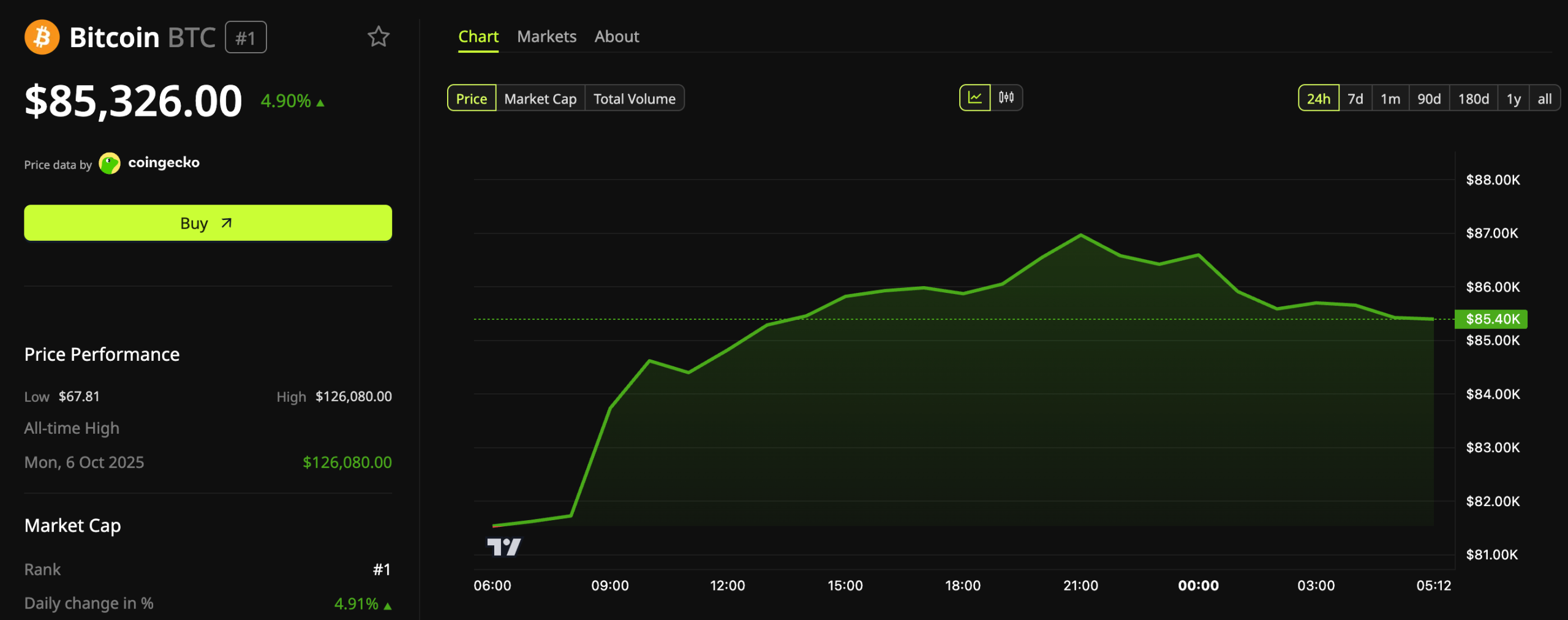
Bitcoin climbed to an intraday high of $87,395 on September 21, its strongest price since January 29. The asset traded at $85,326 at press time, up 4.90% over 24 hours.
Follow us on X to get the latest news as it happens

The rally followed a weekly close back above the 50-week moving average. This has historically served as a signal that bear-market lows are in.
A short squeeze supplied much of the fuel. Coinglass data showed $746.6 million in crypto liquidations over 24 hours, with shorts accounting for $647.9 million.
Market-wide trading volume rose 39% to roughly $224 billion as that forced buying accelerated the climb.
Sentiment and Institutional Flows Followed the Price
Sentiment moved with the price. Analytics firm Santiment recorded the largest spike in bullish commentary since December 2024, with social volume tied to bullish language reaching 954 mentions, compared with 269 for bearish language.
The Crypto Fear and Greed Index climbed to 78, or Extreme Greed, from 70 on Monday and 69 a week earlier.

Corporate treasuries stepped up alongside retail enthusiasm. Strive bought 1,355 Bitcoin for about $107.7 million between September 14 and September 18, well above the 469 coins it acquired the previous week. The purchase lifted Strive’s holdings to 26,355 Bitcoin.
Strategy returned to the market after a two-week pause. The company disclosed a purchase of 950 Bitcoin, which took its total to 846,000 coins.
Spot Bitcoin exchange-traded funds (ETFs) told a similar story. According to SoSoValue, the funds absorbed $999 million on September 21, their largest single day since October 6, 2025, with total net assets rising to $110.1 billion from $102.5 billion.
September flows still trail August, however. The funds have taken in roughly $1.3 billion across 14 sessions this month, compared with $3.5 billion in August.
What the Derivatives Data and the Coinbase Premium Show
Two signals complicate the bullish case. The first is leverage. Open interest across crypto derivatives rose 7.59% to about $156 billion, even as shorts were liquidated. This suggested that traders opened new positions rather than reducing risk.
Santiment also flagged the contrarian sentiment signal.
“Crypto often punishes crowded expectations. Extreme fear can appear near exhaustion lows, while synchronized “higher from here” confidence can develop near local tops. The current sentiment spike doesn’t guarantee a reversal, but risk is less attractive now than when the crowd was fearful last week,” it said.
The second signal is US spot demand. The Coinbase Premium Index remains negative at -0.028, though it has recovered from deeper readings earlier in September.
The gauge tracks buying pressure on the US exchange, and it needs to hold that recovery to confirm domestic appetite.

The coming sessions will tell whether this marks a durable trend change or a move that leaned too heavily on a short squeeze to hold.
Subscribe to our YouTube channel to watch leaders and journalists provide expert insights
The post Bitcoin Hits 7-Month High as FOMO Peaks, But 2 Signals Still Flash Caution appeared first on BeInCrypto.
Cardano officially joined the x402 payment standard on September 21, letting applications and autonomous AI agents pay for online services directly in ADA.
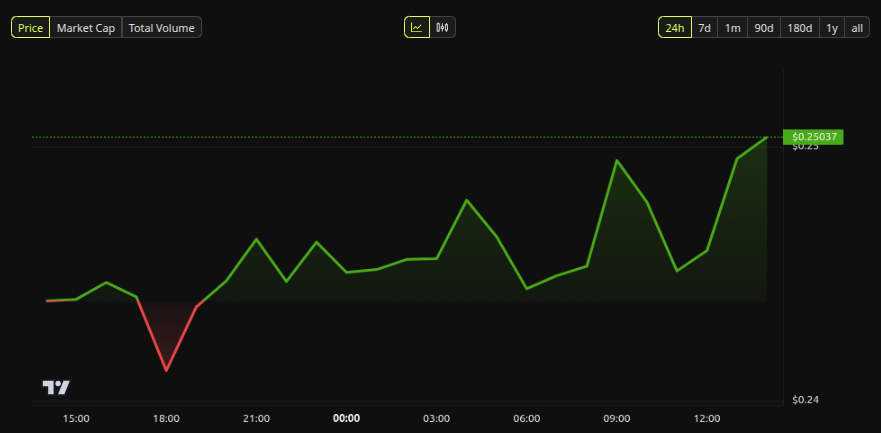
ADA’s price responded immediately, climbing roughly 4% over the past 24 hours, hitting its highest level in four months, according to BeInCrypto data.
What x402 Actually Lets AI Agents Do
x402 is an open HTTP payment standard, originally built by Coinbase in 2025 before shifting to Linux Foundation governance. It revives the long-dormant HTTP 402 “Payment Required” status code, turning it into a functional payment handshake for automated transactions.
When an AI agent requests a paid resource, such as an API call or dataset, the service returns pricing details in the same request. The agent signs a transaction, a facilitator verifies and settles it on-chain, and the resource gets delivered instantly, without accounts, API keys, or traditional checkout screens.
Cardano Foundation engineers built the client, server, and facilitator components after the network’s specification merged into the official x402 repository around September 9. The Cardano Foundation summarized the milestone directly on X, writing that the agent economy just got a Cardano rail.
Follow us on X to get the latest news as it happens
The facilitator has already processed a real transaction on Cardano’s pre-production testing network, though mainnet deployment remains pending. Developers can now access the TypeScript package, with Python support planned next.
Why Is ADA Suddenly Breaking Key Resistance?
Cardano enters a field where rivals already hold a meaningful lead. XRP Ledger has processed more than 1.4 million AI agent transactions through x402, while Coinbase reported over 100 million x402 payments combined across Base and Solana.
Market analysts noted the timing coincided with a notable technical shift. One chart-focused trader described ADA as breaking a multi-year resistance area, calling it a potential start of a much larger reversal.

That technical momentum, paired with genuine new utility, helps explain why traders reacted so quickly. Machine-to-machine commerce remains an early, largely experimental market, but Cardano’s entry adds another major blockchain competing to become the settlement layer for autonomous software.
Whether this translates into sustained trading volume depends on developer adoption once mainnet deployment actually goes live. For now, Cardano has secured a technical foothold inside one of crypto’s fastest-growing emerging use cases.
Subscribe to our YouTube channel to watch leaders and journalists provide expert insights
The post Cardano Unlocks AI Agent Payments With x402: ADA Hits 4-Month High appeared first on BeInCrypto.
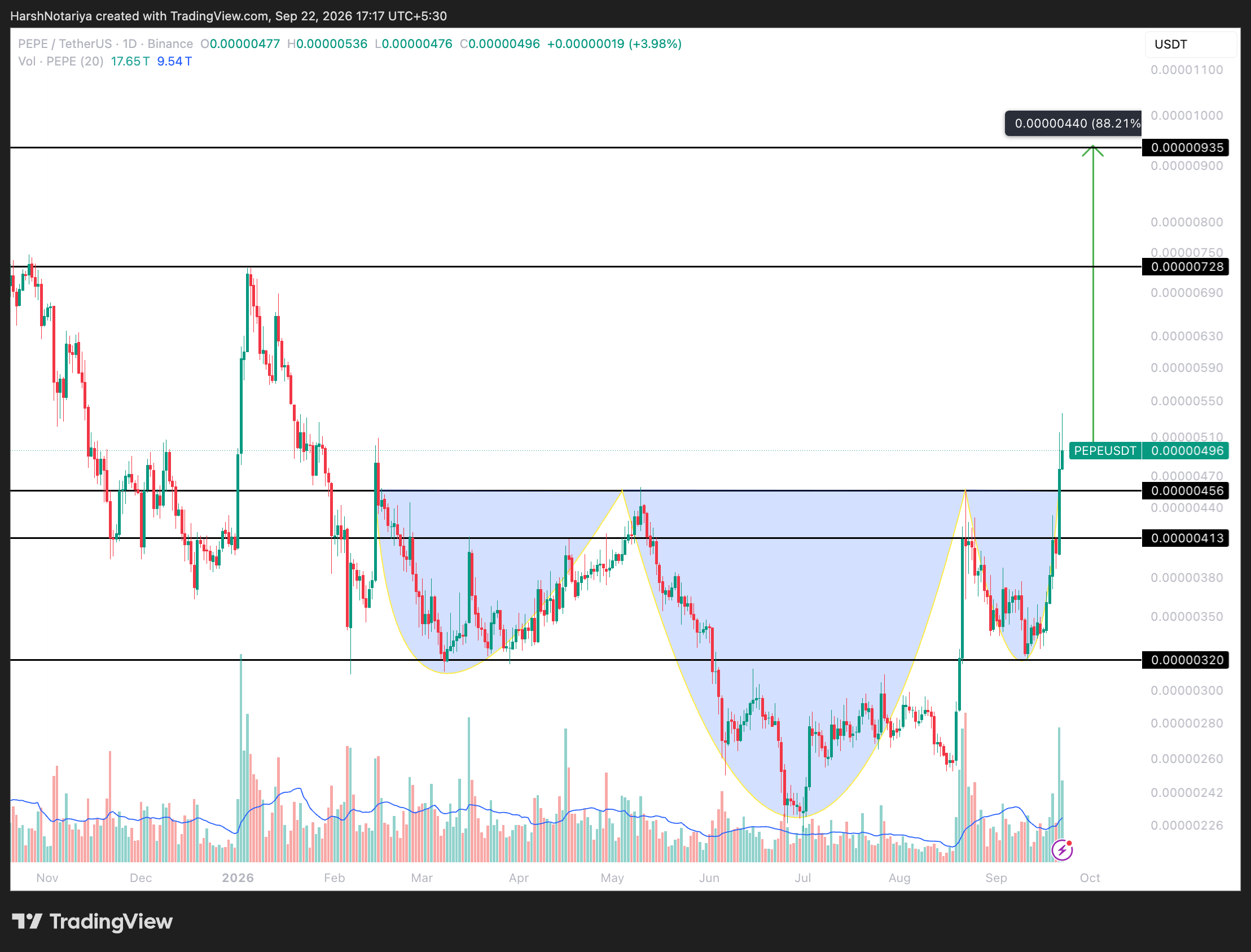
Dogwifhat (WIF), Pepe (PEPE), and Dogecoin (DOGE) top the meme coins to watch this week. Each broke out of a multi-month bullish chart pattern on Monday, with volume well above its 20-day average.
The breakouts arrived as Bitcoin (BTC) climbed to an eight-month high. The rally reversed last week’s slide, which came after a Federal Reserve rate hike and a failed Senate procedural vote 49-50.
The tide turned on Monday. BTC posted its first weekly close above the 50-week moving average in 45 weeks. It climbed above $87,000 for the first time since January.
Meme coins have outpaced the majors during the rebound. CoinGecko data shows PEPE and WIF each gained more than 40% over seven days, while DOGE added about 18%. BTC rose roughly 12% over the same period. Now the sector’s largest names are breaking out of patterns that took months to build.
1. Dogwifhat (WIF)
WIF broke out of a nine-month inverse head and shoulders pattern on Monday. The formation is a bullish reversal setup with three troughs, and the middle one sits deepest. Volume on the breakout candle reached 32.2 million WIF, more than double the 20-day average of 14.1 million.
The neckline sits at $0.2322. That level also marks the 0.236 Fibonacci retracement of the longer decline. The retracement runs from the May 2025 high near $1.40 to the August 2026 low near $0.133.
When a neckline and a Fibonacci level overlap, the breakout signal tends to carry more weight.
WIF trades near $0.256 as of writing, up about 15% in 24 hours. Its market cap of roughly $256 million places it among the 15 largest meme coins, per CoinGecko.
Based on the pattern’s depth, WIF could climb about 69% to $0.4319, which coincides with the 0.5 Fibonacci level. Along the way, the 0.382 level at $0.3273 may act as resistance. If the breakout fails, the price may find support at $0.1732.

2. Pepe (PEPE)
PEPE has traced out a near-identical structure since February 2026. The left shoulder formed in March, the head in late June, and the right shoulder earlier this month.
The Ethereum-based frog token cleared its neckline at $0.00000456 on Monday. Breakout volume reached 17.65 trillion PEPE, almost double the 20-day average of 9.54 trillion.
PEPE trades near $0.00000496 as of writing, up about 15% over 24 hours. Its market cap stands close to $2.05 billion, which makes it the fifth-largest meme coin, per CoinGecko.
The pattern’s depth points to a target of $0.00000935, roughly 88% above the current price. Before that, sellers may step in around $0.00000728, a level that capped the price in January.
A daily close below the neckline would invalidate the setup. In that case, immediate support stands at $0.00000413, with the next major floor at $0.00000320.

3. Dogecoin (DOGE)
DOGE remains the sector’s anchor. It is the largest meme coin by a wide margin, with a market cap near $15.3 billion. That also makes it the 12th-largest crypto asset overall. The token trades around $0.098 as of writing, up about 5% over 24 hours.
On the daily chart, DOGE has carved out a double bottom. The pattern forms when price tests the same support twice and then turns higher. Both lows landed near $0.080, first at the end of August and again in mid-September.
The neckline sits at $0.095. Monday’s candle closed above it on volume of 1.39 billion DOGE, about 47% above the 20-day average.
Measured from the pattern’s depth, the breakout targets $0.1156, roughly 18% above the current price. For the setup to hold, DOGE should find buyers at the neckline on any pullback and bounce from it.
A daily close below $0.095 would invalidate the pattern. The next support then stands at $0.0839, followed by $0.0782.

All three breakouts share the same weakness. Each arrived in a single session, and each depends on the neckline holding as support on the first retest. Whether meme coins can extend these gains may hinge on Bitcoin sustaining its move above the 50-weekly simple moving average.
The post 3 Meme Coins to Watch in the Fourth Week of September 2026 appeared first on BeInCrypto.
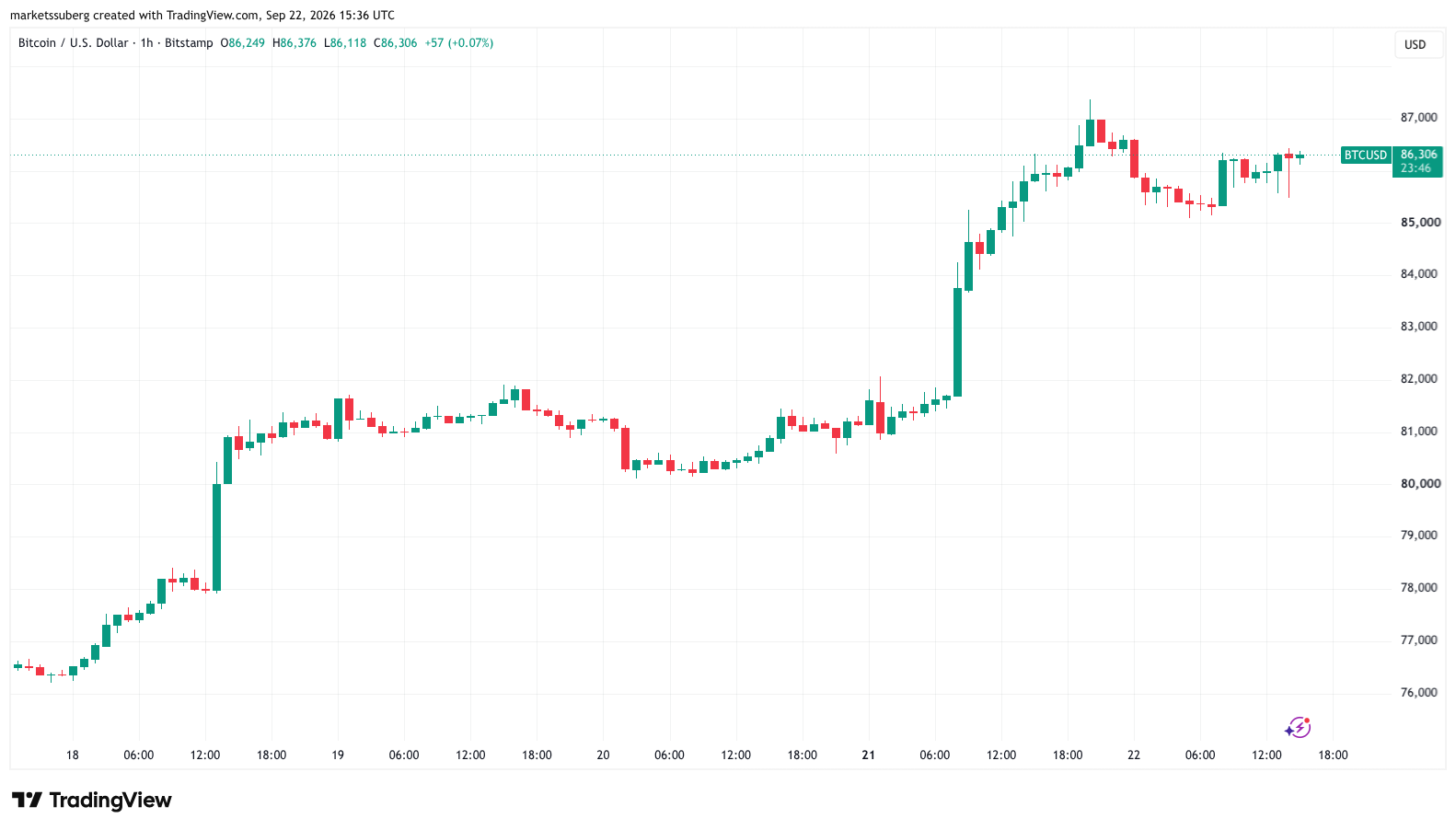
Bitcoin (BTC) fluctuated around $86,000 on Tuesday as crude-oil prices hit their lowest levels in nearly three weeks.
Key points:
- Bitcoin consolidated at around $86,000 after hitting fresh 33-week highs on Monday.
- US president Donald Trump told the UN that a deal to end the war with Iran could come after November’s midterm elections.
- WTI crude oil dropped to near $89 per barrel, its lowest level since Nov. 4 before reversing toward $92.
Bitcoin tests strength of $86,000 support as oil drops under $90
Data from TradingView showed the volatility of BTC/USD cooling after Bitcoin hit $87,350 the day prior, its highest level since Jan. 29.
BTC/USD one-hour chart. Source: Cointelegraph/TradingView
US stocks tracked sideways as US president Donald Trump took to the stage at the UN General Assembly in New York. In a speech to world leaders, Trump pledged to reach a deal to end the US-Iran war, but suggested that this might come after the US midterm elections in November.
“I believe we’ll make a deal right after the election because it doesn’t make sense for them not to,” he said.
WTI crude oil inched higher into the speech after falling as low as $89.16 per barrel, its lowest since Sept. 4. The drop was aided by reports that Saudi Arabia had reopened the East-West Pipeline, a key oil-supply route. Three anonymous sources referenced by Reuters said that it would take six to eight weeks for flows to reach full capacity.
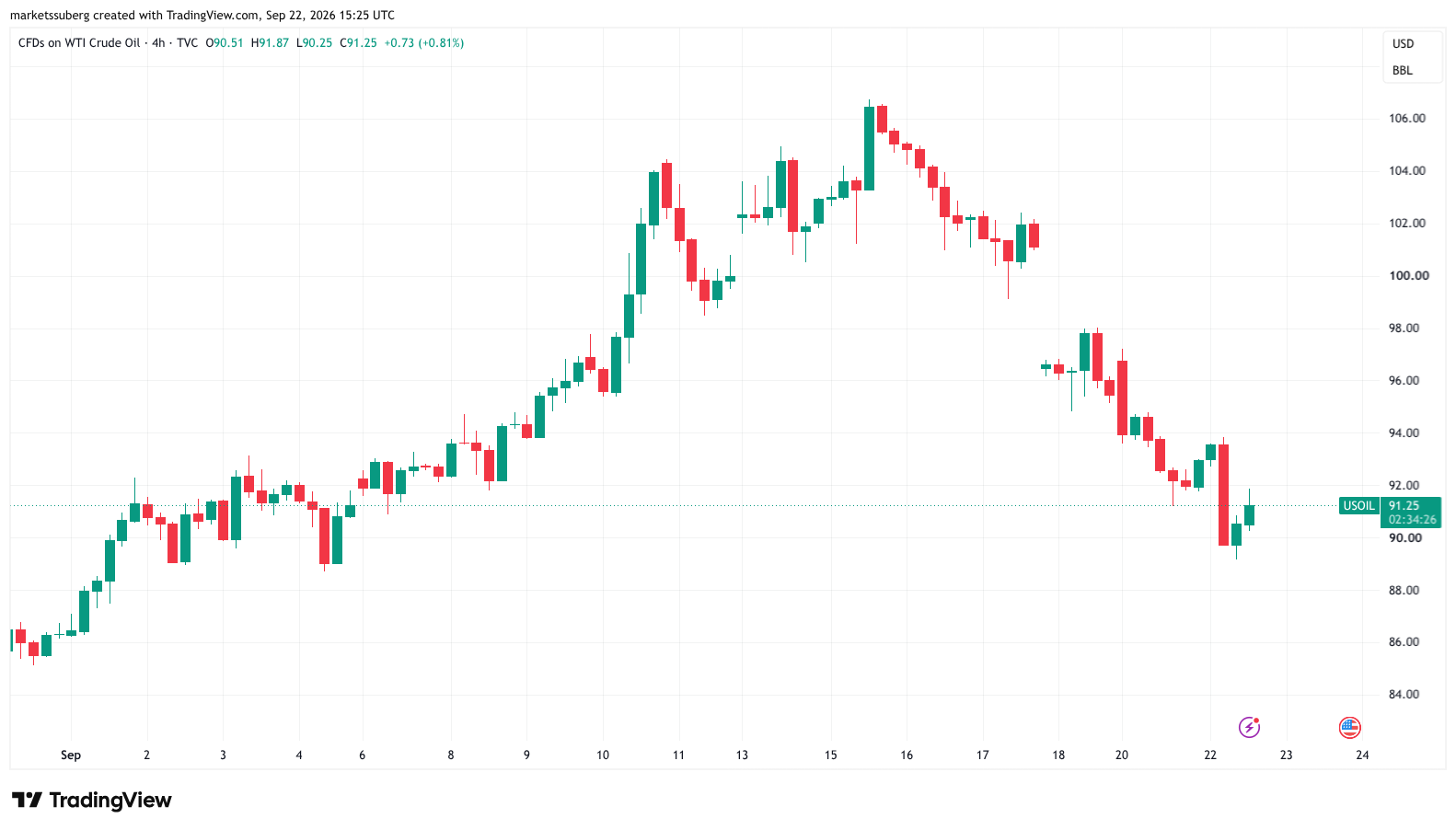
CFDs on WTI crude oil four-hour chart. Source: Cointelegraph/TradingView
Onchain metric points to end of bear-market accumulation
Commenting on Bitcoin’s current position, onchain analytics platform Glassnode noted a classic momentum indicator had returned above a key long-term trend line.
Related: Bitcoin adds to bull-market hopes as price metric prints fourth-ever bullish cross
Bitcoin’s market value to realized value (MVRV) ratio, which compares the book value of the BTC supply — its market cap — to the cumulative price at which it last moved onchain, has now crossed above its 365-day moving average.
“This is the same cross that we saw in 2019 and 2023 at the beginning of each bull market,” Glassnode noted on X.
The MVRV ratio seeks to determine what Glassnode describes as “fair” value for the supply — whether it is trading at a premium or discount to the price last paid by investors. High MVRV values correspondingly reflect larger unrealized profits among wallets.
The ratio currently sits at 1.62, having increased from 1.19 on Aug. 16. It remains far from the 3.7 level that has traditionally marked the profitability zone for bull-market tops.
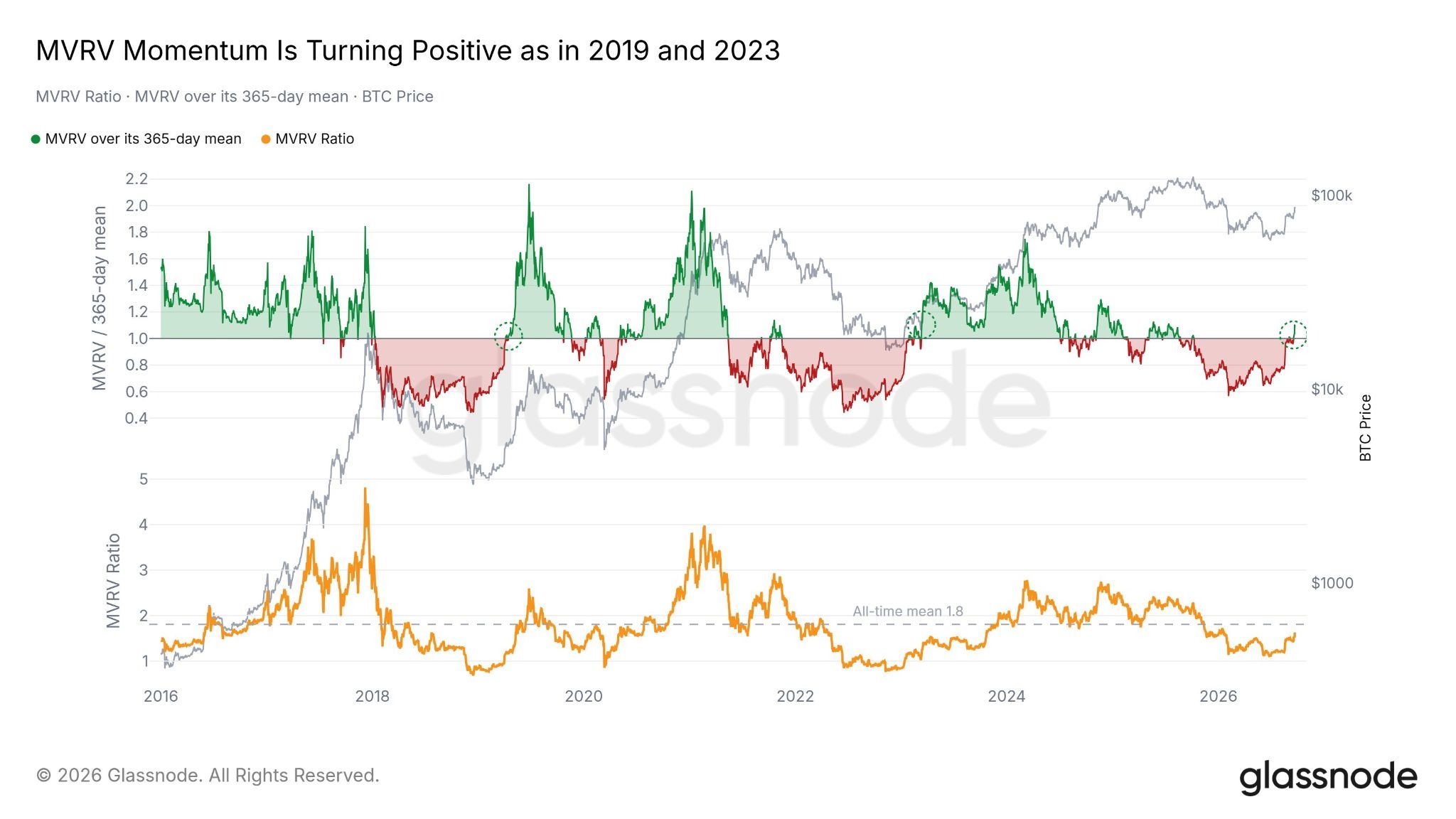
Bitcoin MVRV ratio chart. Source: Glassnode on X.com
Continuing, onchain analytics platform CryptoQuant eyed a breakout from a multi-month resistance level for the MVRV ratio’s 30-day moving average below 1.5. CryptoQuant concluded in a blog post that breaking above this level for the first time since January would mark the end of a lengthy investor accumulation phase.
CryptoQuant added that moving above the current 1.62 would “confirm the reversal of ongoing bear market,” bringing back Bitcoin’s all-time highs of $126,200 as a BTC price target.
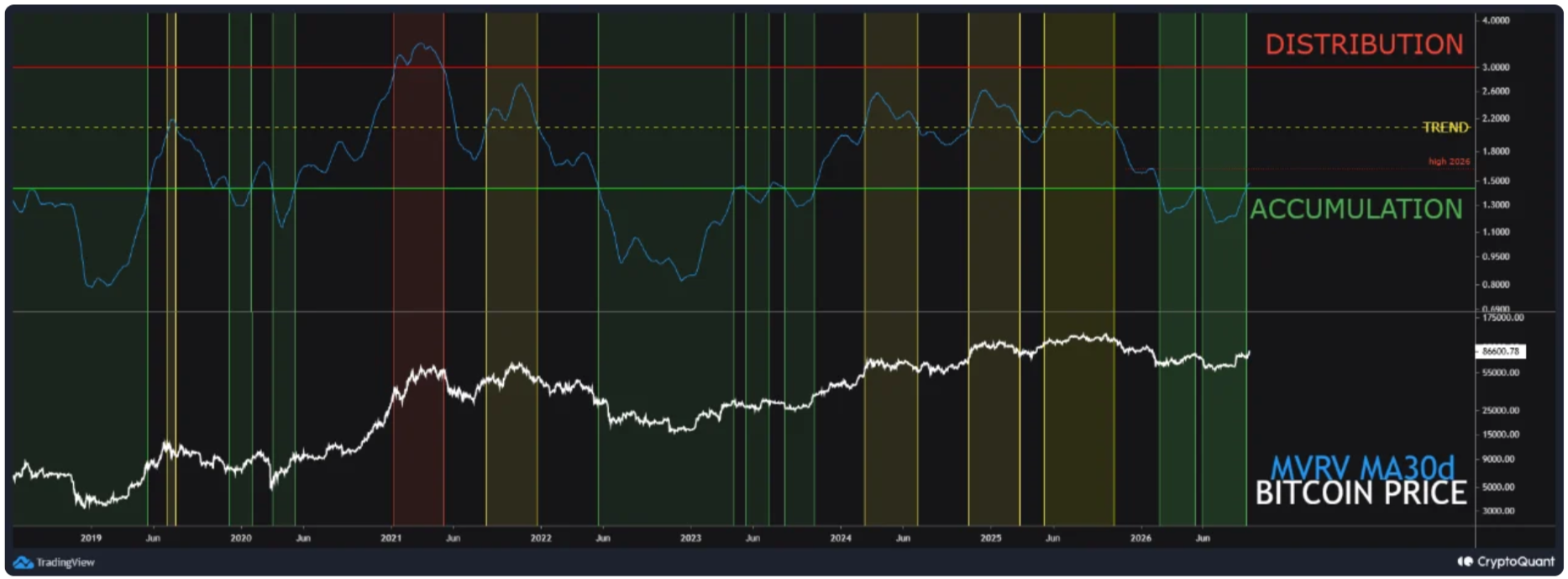
Bitcoin MVRV ratio data (screenshot). Source: CryptoQuant
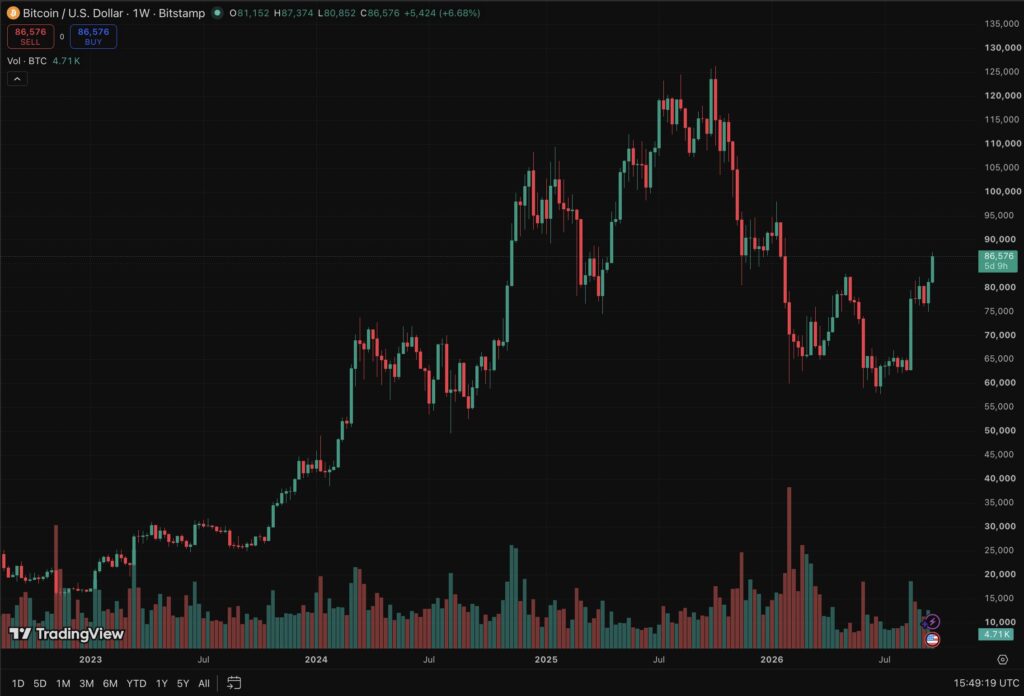
In Bitcoin news today, US spot Bitcoin ETFs pulled in $998.95M on Monday, their strongest single-day haul since October 2025, the same day X switched on trading links for Bitcoin and other assets across five outside brokerages, and Coinbase introduced fixed-rate Bitcoin-backed borrowing through Morpho Midnight.
All of these catalysts have played their part in BTC USD surging +1% over the past 24 hours as it broke through $86,000. Daily trading volume sits at $135Bn, per CoinGecko data.

What are X Cashtags? How Do They Work?
X unveiled its US Cashtag Partner Program on September 22, connecting stock, ETF, and cryptocurrency pages to five outside platforms: Coinbase, Gemini, Kraken, Interactive Brokers, and Moomoo.
A user who opens a supported ticker such as $BTC or $TSLA now sees a live price chart, related posts, and a “Trade” button that hands off to the chosen partner’s app or website.
That distinction matters more than the headline suggests. X does not execute the transaction itself – eligibility, account creation, custody, and final order execution sit entirely with the partner exchange or brokerage.
Kraken confirmed in its own announcement that its Cashtag integration covers nearly 2,500 assets across centralized and decentralized offerings, while Interactive Brokers is offering a $100 promotional credit to new U.S. clients who open and fund an account through the Cashtag flow.
The rollout builds on X’s earlier Smart Cashtags feature and stays deliberately separate from X Money, the platform’s payments product, which currently offers no direct link for funding trades.
For traders, the practical effect is a shorter discovery-to-brokerage funnel: a Bitcoin conversation on the timeline now converts into a login screen at Coinbase or Kraken in one tap, rather than a search-and-switch. That’s distribution, not liquidity, and the two aren’t interchangeable.
Don’t Miss Out on Our $1,000 USDT Airdrop on ByBit
Coinbase Turns Bitcoin Into Fixed-Term Collateral
Keep your Bitcoin, get liquidity. — Coinbase
With fixed-rate loans backed by Bitcoin you can lock in your rate and repayment dates before you borrow.
Built by @Morpho Midnight on @Base. pic.twitter.com/1oEf6L5Efd
 (@coinbase) September 22, 2026
In other Bitcoin news, Coinbase has introduced fixed-rate, fixed-term USDC borrowing backed by BTC through Morpho Midnight on Base, a step beyond the variable-rate, open-ended Bitcoin-backed loans the exchange already offers.
Locking in a rate and maturity date gives borrowers a predictable repayment schedule, rather than exposure to floating DeFi rates that can move against them mid-loan.
The broader significance is what it says about Bitcoin’s role as collateral rather than a pure directional bet. Every dollar borrowed against BTC without selling it is a dollar of demand that never hits the spot order book, which is the same dynamic driving on-chain lending growth elsewhere in crypto.
It also puts Coinbase’s retail-facing product directly on top of Morpho’s non-custodial credit rails, a pattern of centralized platforms wrapping DeFi infrastructure in familiar account-based UX that’s shown up repeatedly across the sector this year.
What’s not confirmed here is the exact scale of Coinbase’s book. Broader figures circulating for Coinbase’s Bitcoin-backed lending activity, in the billions of dollars across loans and collateral, describe the exchange’s overall program rather than Midnight specifically, and should be treated as unverified until Coinbase or Morpho publishes Midnight-specific numbers.
Supercharge Your Trading in 2026 With BloFin AI Trading Bots
Bitcoin News: ETF Inflows Snap Back Above $1Bn

Monday’s $998.95M inflow followed a week of record-low net inflows for spot Bitcoin ETFs, with BlackRock’s IBIT leading the session and Ark’s ARKB and Fidelity’s FBTC contributing significantly.
This surge brought Bitcoin above the average ETF cost basis, allowing typical spot-fund holders to profit for the first time since January, which could reduce selling pressure from those at a loss.
However, the timing of ETF flow data usually reflects the previous day’s trading, which means Monday’s figures may not indicate real-time demand, complicating the view of a sustainable trend.
This shift coincides with Bitcoin surpassing key price levels near $86,000 and ongoing discussions about its role in institutional portfolios.
Together, these developments suggest that Bitcoin is becoming more accessible for trading and borrowing, making it easier for institutions to invest through regulated products. However, one inflow does not erase the low activity seen the prior week, and execution risks remain.
Earn $50 and Enter $300K Prize Draw on EdgeX
The post Bitcoin News: X Launches Cashtag Partner Program appeared first on Cryptonews.

Geo has launched a short-form video debate platform that turns opposing views into traceable claims, starting with whether crypto needs the CLARITY Act to succeed.
Summary
- Geo Debates uses four timed turns across two rounds lasting about three and a half minutes.
- Viewers can vote for the stronger argument and inspect claims made by each participant.
- Published debates and individual points are added to Geo’s searchable knowledge graph.
- The first debate examines the CLARITY Act after its 49-50 Senate cloture defeat.
Geo said in a Sep. 22 announcement that its new product combines the viewing format of short-form video apps with a permanent record of each argument, source, and contradiction raised during a debate.
The company’s first published discussion centers on a question that has divided U.S. crypto companies and policy groups: Can the industry succeed without Congress passing the Digital Asset Market Clarity Act?
Geo does not take a position on the legislation. Instead, two participants argue opposite sides of the question while viewers decide who presented the stronger case.
How Geo Debates turns videos into searchable claims
Each Geo debate begins with one claim and pairs two people who disagree over it. Participants make four alternating statements across two timed rounds, with the complete exchange lasting about three and a half minutes.
While one participant speaks, the other person’s microphone remains muted. Geo then combines the recordings into one split-screen video, adds subtitles, and publishes the exchange in a vertical feed similar to the format used by TikTok.
Alongside watching the video, users can vote for the person who made the stronger argument. Individual claims are also available for further inspection, allowing viewers to examine the points behind each participant’s position instead of judging the discussion only from a short clip.
Once published, the debate becomes an entry in Geo’s knowledge graph. Each point raised during the exchange receives a separate record attributed to the person who made it, according to the company.
Users can later challenge those points in other debates, which lets one discussion lead to additional arguments. The system also links claims to available sources, evidence and contradictions, creating a record that remains accessible after the video leaves a user’s feed.
Geo founder Yaniv Tal compared the approach with his earlier work on The Graph, a blockchain data-indexing protocol designed to let developers query open networks.
“I spent years building The Graph so anyone could query open data instead of trusting a company’s API,” Tal said.
“Geo Debates is the same instinct, pointed at argument instead of data. You get a turn, you get a clock, and your mic is dead until it’s your turn again.”
Tal said the resulting record allows users to review an argument claim by claim and see which participant made each statement. Geo classifies points as factual claims or opinions but does not rule on whether either side is correct.
Why Geo chose the CLARITY Act for its first debate
Geo selected the CLARITY Act after the bill failed to clear a crucial procedural hurdle in the U.S. Senate on Sep. 15.
The Senate’s official roll call recorded 49 votes in favor of cloture and 50 against, leaving the motion 11 votes short of the 60 needed to advance. Cloture would have opened formal debate on H.R. 3633 rather than passing the legislation into law.
As crypto.news previously reported, the House-approved proposal would establish a legal division of digital asset oversight between the Securities and Exchange Commission and the Commodity Futures Trading Commission. It also contains registration routes for crypto exchanges, brokers and dealers.
The failed vote exposed an existing split among industry executives. Supporters argue that legislation is needed to give U.S. companies rules that cannot easily change with a new administration, while critics say the industry can continue operating through agency guidance and rulemaking.
Former CFTC Chairman J. Christopher Giancarlo said federal regulators can still develop digital asset frameworks using their existing authority. Coinbase CEO Brian Armstrong also called on the SEC and CFTC to move forward after Congress failed to act, while Ripple CEO Brad Garlinghouse urged both agencies to address the legislative gap.
Other industry participants maintain that only Congress can provide durable rules defining the agencies’ responsibilities. House Financial Services Committee Chairman French Hill and House Agriculture Committee Chairman Glenn Thompson made a similar argument following the Senate vote, although they supported interim action by regulators.
The disagreement gives Geo a debate containing two clear positions without requiring the platform to endorse either one. According to the company, arguments over U.S. crypto regulation often become scattered across conference panels, social media posts and isolated video clips, leaving viewers without an organized record of the reasoning behind each position.
CLARITY Act negotiations have not formally ended
Although the cloture motion failed, H.R. 3633 remains on the Senate calendar. Republican Sen. Thom Tillis changed his vote to “no” for procedural reasons, preserving an avenue for the chamber to reconsider the motion.
Time remains a major obstacle. Before the vote, House Republican leaders had removed eight voting days from the September schedule, limiting the period available for the Senate to amend the measure and return it to the House. Earlier coverage of the calendar showed that the shortened schedule had already reduced the chances of completing the bill before the November midterm elections.
Sen. Ted Cruz described the proposal as “mostly dead” after the defeat, while Sen. John Kennedy said lawmakers could reconsider it during a lame-duck session. Any Senate amendments would require additional House approval before the bill could reach the president.
Democratic lawmakers have also left open the possibility of renewed talks. Seven senators — Kirsten Gillibrand, Mark Warner, Cory Booker, Raphael Warnock, Ruben Gallego, Angela Alsobrooks and Catherine Cortez Masto — issued a joint statement saying the vote was “not the end” of efforts to pass digital asset market-structure rules.
The group said negotiations could continue around consumer protection, national security, financial stability and ethics provisions. Their attempt to revive CLARITY Act talks followed disagreements over restrictions involving public officials’ crypto interests and the treatment of stablecoin rewards.
Why the debate matters for U.S. crypto users
For American token holders and crypto businesses, the dispute concerns which federal agency would oversee different digital assets and trading platforms.
The CLARITY Act would place digital commodities mainly under the CFTC while leaving digital securities and investment-contract offerings with the SEC. Registration, customer asset protections, and rules for market intermediaries also form part of the proposal.
Without legislation, the SEC and CFTC can continue using their current powers, but agency rules cannot settle every question covered by a statute. The agencies also cannot independently create a permanent congressional division of jurisdiction between them.
Geo’s launch debate lets viewers compare the case for legislation with arguments favoring agency-led regulation. The platform records the participants’ positions, opens their individual points for further debate, and gives viewers a public vote on which side presented the stronger case.
Founded by Tal, who previously founded The Graph, Geo describes itself as a consumer knowledge network designed to preserve claims, sources, evidence, and contradictions. The company said its system labels statements as factual or opinion but does not independently decide whether a claim is true.
Lionel Richie in hospital after heart procedure with tour dates cancelled

Why Shopify Stock, Twilio Are Rising On Meta’s Muse Rollout
Important Pi Network News and PI Price Update: September 22




-

 Fashion4 days ago
Weekend Open Thread: Talbots – Corporette.com
-

 Tech2 days ago
Researchers escape OpenAI Codex sandbox to run commands on host
-

 Crypto World7 days ago
Robinhood engineers charged over $50K crypto scheme
-

 Crypto World4 days ago
Circle launches Arc Studio AI agent for building onchain apps
-
 NewsBeat4 days ago
Trump says US has reached an agreement to take permanent control of Greenland’s security
-

 Crypto World2 days ago
Who Needs CLARITY Anyway? ARB Could See 70X Increase: Hodler’s Digest
-

 Crypto World4 days ago
Bitcoin price breaks channel as RSI climbs to 63
-

 Crypto World6 days ago
US Charges Robinhood Engineers Over Crypto Listing Trades
-

 Crypto World4 days ago
Trading Bitcoin on Robinhood? Why 2% Spread Has Traders Worried
-

 Crypto World7 days ago
What Is the Status of the U.S.-Iran Peace Talks? Here's What Both Sides Are Saying
-

 Tech7 days ago
Webb’s IC 348 Mosaic Includes Two-Jupiter Dwarfs, Twin Jets, and a Nursery Still Making Worlds
-

 Crypto World5 days ago
Mortgage and refinance interest rates today, Thursday, September 17, 2026
-

 Crypto World4 days ago
World Money launches in 150+ countries with Stripe
-

 Entertainment7 days ago
Big Brother Update: Melody Explodes at Drew as Illness Sweeps BB28 House
-

 Crypto World4 days ago
Silver prices recover quickly, hitting weekly high today
-

 Business2 days ago
Analog Devices (ADI) Bets $1.35 Billion on Chips that Let Machines Think for Themselves
-
 NewsBeat4 days ago
US was ‘on brink of war’ with China over false AI report of nukes moving in Middle East
-

 Tech5 days ago
GPT-6 Astra Reached the Nether in Minecraft, Lost Its Stash to a Creeper, and Farmed Potatoes for Hours
-

 Crypto World1 day ago
Bitcoin price holds above $81K as key catalysts line up
-

 Business7 days ago
Federal Reserve expected to hike interest rates 25 basis points at FOMC meeting
You must be logged in to post a comment Login