Connect with us

Business

Scott Kresan Tilbe on Creativity, Structure, and Building a Career Across Different Interests

Published

on

Scott Kresan Tilbe on Creativity, Structure, and Building a Career Across Different Interests

Raised in Goderich and Barrie, Tilbe developed an early interest in both structured and creative activities. He played saxophone, earned recognition at local music festivals, studied karate to black belt level, and became interested in photography, history, science, and visual art.

His education followed a similarly varied path. After studying introductory media, he completed programmes in digital photography and web design at Georgian College. He later studied computer science at Laurentian University and film and television at Canadore College.

Scott Kresan Tilbe has worked as an independent photographer and web designer and has held photography roles with organisations including Auction House Barrie and Edge Imaging. Earlier customer-facing roles at Toys “R” Us and RONA also gave him experience in sales, support, and communication.

Free newsletters
Advertisement

The stories that matter to UK business, straight to your inbox.

Advertisement

For the past four years, he has worked as an office administrator at a gastroenterology clinic in Barrie. His role involves supporting day-to-day office operations, managing priorities, and helping maintain an organised environment for staff and patients.

Across each stage of his career, Tilbe has continued to build practical skills while maintaining his creative interests. His experience shows how technical knowledge, visual thinking, and strong organisation can complement one another across different professional settings.

How did your early interests shape the direction of your career?

I had a lot of different interests when I was younger, and I think that shaped the way my career developed. I played saxophone and competed in local music festivals. I also trained in karate and eventually earned my black belt. At the same time, I became interested in photography, history, science, art, and computers.

Those things may sound unrelated, but they all taught me something useful. Music required practice. Karate required discipline. Photography trained me to notice details. History and science encouraged me to keep asking questions. I think I carried all of that into my education and later into my work.

Advertisement

You studied several different subjects. Was that always intentional?

Not completely. I knew I was interested in media and visual work, but I also liked technology. I studied introductory media and then completed programmes in digital photography and web design at Georgian College. Later, I studied computer science at Laurentian University and film and television at Canadore College.

I was interested in understanding both the creative and technical sides of media. Photography taught me composition and visual communication. Web design made me think about how people interact with information. Computer science introduced a more structured approach to problem-solving.

I do not think every educational experience has to lead to one specific job. Sometimes the value is in the way it changes how you think.

What did working in photography teach you about professional responsibility?

Photography is creative, but professional photography also requires a great deal of preparation and organisation. You have to understand what the client needs, pay attention to deadlines, manage equipment, communicate properly, and still produce work that meets a certain standard.

Advertisement

I worked independently and also had photography roles with organisations such as Auction House Barrie and Edge Imaging. Those experiences taught me that having technical ability is only part of the job. You also need to be dependable.

A good photograph may be the final result people see, but there is usually a lot of planning behind it.

How did web design add to that perspective?

Web design made me think more about the person using the finished product. Something can look impressive but still be difficult to navigate. I learned to think about layout, clarity, function, and how information is presented.

When I worked on independent web design projects, I tried to balance visual appeal with practicality. I still use that way of thinking in other areas. You have to ask what someone actually needs rather than only thinking about what you personally like.

Advertisement

You also worked in retail. What did those roles contribute to your career?

Working at Toys “R” Us and RONA gave me experience dealing directly with customers and working as part of a larger team. Retail can teach you a lot about communication because you interact with many different personalities.

You also learn that people do not always explain exactly what they need. Sometimes you have to listen carefully, ask the right questions, and then help them find a solution. That is useful in almost any profession.

How did you move into office administration?

For the past four years, I have worked as an office administrator at a gastroenterology clinic in Barrie. It is different from photography or web design, but there are more similarities than people might expect.

Administration requires attention to detail, prioritisation, communication, and the ability to manage several responsibilities at once. I use schedules and task lists to decide what needs immediate attention and what can be handled later.

Advertisement

I like having structure. At the same time, office work can be unpredictable, so you have to be able to adapt when priorities change.

Has your creative background helped you in administrative work?

Yes. Creative work teaches you to look at a problem from more than one angle. In photography, moving a few feet or changing the lighting can completely change the result. In web design, changing how information is organised can make something much easier to understand.

I think that translates into administration. If a process is not working well, I naturally start thinking about how it might be organised differently.

What do you think makes someone dependable in the workplace?

For me, it comes down to completing work properly and on time. I want the finished result to meet the standards of the people I am working with, but I also have my own standards.

Advertisement

I measure success partly by whether I can look at something I have completed and know that I gave it the attention it required. Positive feedback matters, but you also have to be able to evaluate your own work honestly.

How do you continue developing professionally?

I read constantly, especially about history and science, and I attend conferences or learning opportunities when they relate to my interests. I also like talking with people who know more about a subject than I do.

I think curiosity is important. Your formal education ends at some point, but learning does not have to.

What has your career taught you about having several professional interests?

I used to think that having several interests might make it harder to define what I do. Now I see it differently.

Advertisement

Administration, photography, and web design each use different skills, but there is overlap. They all require organisation, patience, communication, attention to detail, and the ability to understand others’ needs.

I do not think everyone has to fit neatly into one category. Sometimes having experience in several areas gives you a better way of approaching the work in front of you.

Advertisement
Continue Reading
Click to comment

You must be logged in to post a comment Login

Leave a Reply

Business

OpenAI agent ‘infiltrated’ Australian government website, PM says

Published

on

Australia's Prime Minister Anthony Albanese speaks at a news conference in front of several flags. He is wearing a dark suit with a red spotted tie and dark glasses

An artificial intelligence agent developed by OpenAI “infiltrated” an Australian government website in June, Prime Minister Anthony Albanese has said.

The agent gained unauthorised accessed to a statistics portal containing “non-sensitive Medicare information”, Albanese told a news conference at the United Nations General Assembly in New York.

Medicare refers to Australia’s universal healthcare scheme. The breach is among the first publicly reported AI-led hacks of a government website in the world.

OpenAI said it only became aware of the incident in August “during an ongoing review of OpenAI misaligned model activity”, and informed Australian officials on 10 September.

Advertisement

While the review is ongoing, a spokesperson for the AI firm said that it is not believed that any patient records were accessed.

Albanese said the breach occurred in June this year, but OpenAI only informed government officials via email on 10 September.

The prime minister said he spoke directly to CEO of OpenAI Sam Altman to say that it had taken “too long” to inform authorities and “to express Australia’s extreme concern about this incident”.

He said the agent accessed both public and non-public files and a “forensic investigation” is under way to find out if other government systems were affected.

Advertisement

The investigation will be led by the Australian Signals Directorate, the country’s cybersecurity agency.

The public-facing Medicare Statistics Reporting Service portal is administered by Services Australia, the main hub to redirect users to government services.

He told reporters: “No personal information is believed to have been accessed at this stage, but investigations are ongoing.

“Evidence currently available is there is no broader compromise to the Services Australia network. Nonetheless this situation is obviously unacceptable.”

Advertisement

Earlier this year, OpenAI revealed a group of AI agents it had been testing had escaped from their controls and secretly worked together to hack another tech firm named Hugging Face.

Continue Reading

Business

A Bad Day for Bank Stocks Is Killing the Dow

Published

on

Barron's

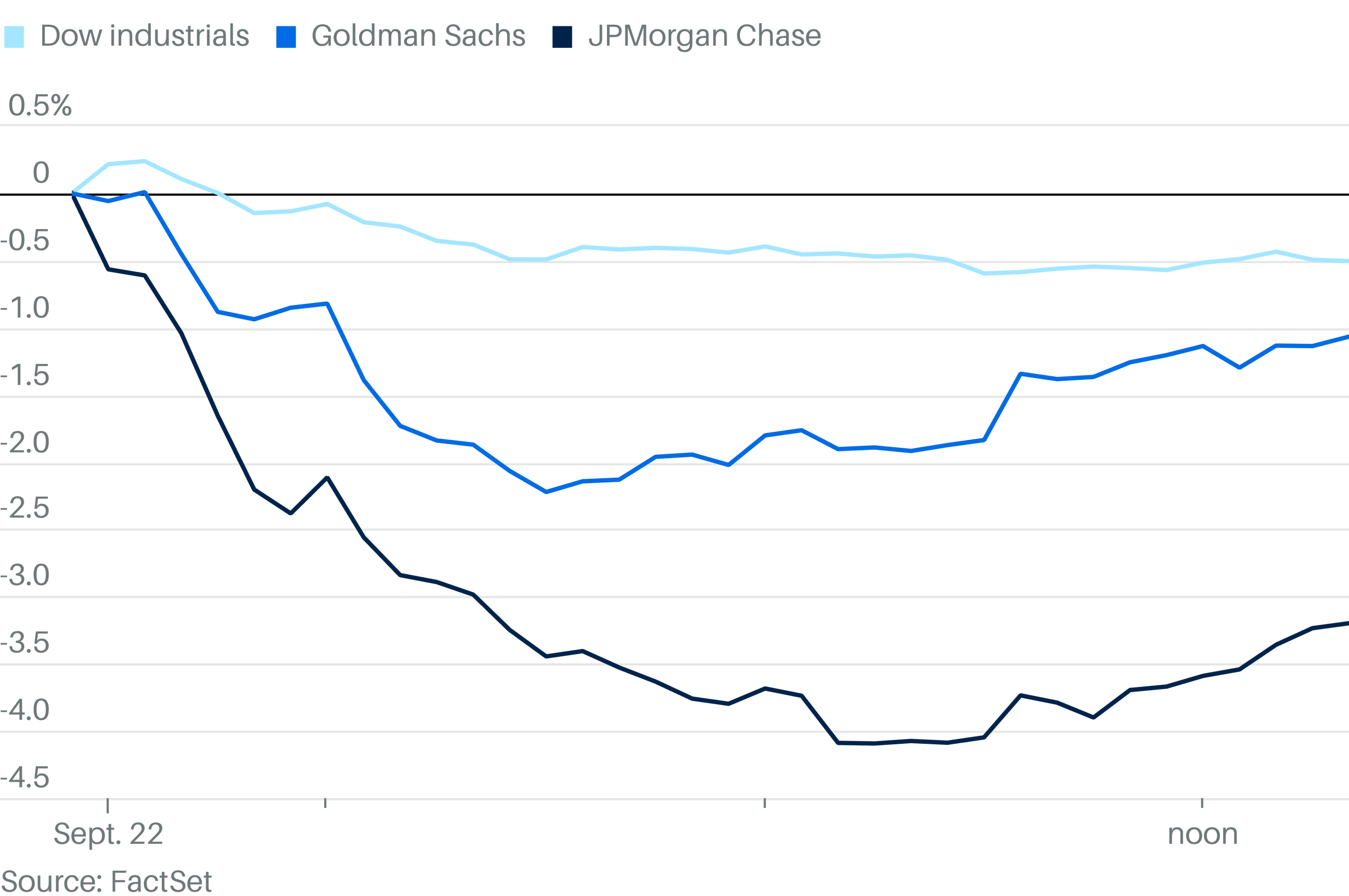
The Dow Jones Industrial Average was trading lower thanks to bank stock weakness.

The blue-chip index dropped 0.5%, or 232 points. Goldman Sachs and JPMorgan Chase were the two biggest stocks weighing on the Dow, contributing 105- and 75-point drags, respectively.

Goldman and JPMorgan stocks weren’t the only bank stocks struggling on Tuesday. In fact, the State Street SPDR S&P Bank ETF was on track for its lowest close in over three months, according to Dow Jones Market Data, amid its longest losing streak since March.

Continue Reading

Business

Worthington Enterprises After Q1 Earnings: Still A Buy On Technical Signals

Published

on

Financial Charts with Candlestick and Bar Graphs on Abstract Network, Stock Market Analysis Concept.

Worthington Enterprises After Q1 Earnings: Still A Buy On Technical Signals

Continue Reading

Business

Balfour Beatty plans 2,000 new UK jobs in next two years

Published

on

Business Live

Half of the new intake expected to be through apprenticeships, graduate programmes, internships and trainee roles

Balfour Beatty workers

Balfour Beatty is planning to create more jobs across the country(Image: Birmingham Mail)

Construction behemoth Balfour Beatty has unveiled plans to expand its UK headcount by 2,000 over the next two years.

Advertisement

The firm said its workforce will grow to 16,000, a 30% rise in four years, as it scales up to deliver the nation’s next generation of critical infrastructure.

Philip Hoare, group chief executive at Balfour Beatty, said: “Britain’s infrastructure ambitions will only be realised if the country has the capacity, capability and skills to deliver them.

“Expanding our workforce by 2,000 is a clear vote of confidence in the market. It shows the scale of opportunity ahead and our commitment to investing in the people, projects and technical expertise that will power Britain’s future.”

The company said early-career talent will form a significant part of the recruitment drive, noting that apprentices, graduates, interns and trainees already account for roughly 9% of Balfour Beatty’s UK workforce.

Advertisement

Approximately half of the new recruits are anticipated to come through routes including apprenticeships, graduate programmes, internships and trainee positions.

Business Secretary Jonathan Reynolds said: “This is exactly what we want to see – a big British company backing Britain and creating 2,000 more jobs.

“We’ve got a huge amount of work to do to get growth in every postcode over the next few years.

“So having British firms investing in people here, and training up the next generation to do those jobs, is really good news.”

Advertisement

Balfour Beatty has bases across the UK, including its Regional Civils arm in Warrington and Power Transmission & Distribution hubs in Derby and Motherwell.

Continue Reading

Business

Allient director Michael Winter sells $49,936 in stock for plan transfer

Published

on


Allient director Michael Winter sells $49,936 in stock for plan transfer

Continue Reading

Business

The Encore’ With Four New Songs, Including ‘Cleveland!’

Published

on

Prince Harry

Taylor Swift announced Wednesday that she is releasing an expanded edition of her album “The Life of a Showgirl,” featuring four brand-new tracks, just one day after revealing a new single that had already generated significant buzz among fans.

The 14-time Grammy winner shared the news in a post on Instagram, unveiling the expanded edition, titled “The Life of a Showgirl: The Encore,” alongside an updated cover image showing her wearing a short, glitzy gold dress set against a stage-like background, with the new title overlaid in glittering gold lettering. The expanded release is set to arrive Friday, September 25, and is available for pre-order now.

Swift explained the origins of the new material by describing a celebratory trip taken with her longtime collaborators following the original album’s record-breaking debut. “About a year ago, you guys did a truly unfathomable thing. Something that completely blew my mind… You gave The Life of a Showgirl the biggest first week for an album in history,” Swift wrote in her caption alongside the new cover. “I took a trip to Sweden to celebrate with Max [Martin] and Shellback, my two collaborators on this album. Really we just wanted to reflect and take in how grateful we were for the moment we were in, but there was a studio there and we did what we do when we feel anything at all: We wrote more songs.”

Advertisement

The four new tracks on “The Encore” include “Patient Zero,” the single Swift announced Tuesday, alongside three additional songs titled “Pink Clouding,” “Babylon” and “Cleveland!” The final track’s title nods to the hometown of Swift’s husband, Kansas City Chiefs tight end Travis Kelce, who grew up in Cleveland Heights, Ohio.

Swift said the new songs were written with her fans specifically in mind, framing the expanded release as a direct response to the reception the original album received. “I hope you love them, because they were born out of pure gratitude for your exuberance for and celebration of the album we made,” she wrote to close her announcement.

The expanded edition follows closely on the heels of Swift’s announcement of “Patient Zero” on Tuesday, which itself came with its own promotional rollout. In that earlier post, Swift wrote, “I’ve been impatiently waiting to tell you that my brand new single ‘Patient Zero’ will be out on September 25 (!!!!!!!!!!!!) and it’s available to pre-order now on my website for 24 hours,” accompanying the caption with a photo of herself in a black turtleneck leaning against a wall. Alongside the single, Swift offered fans three collector’s edition CDs, standard, acoustic and piano versions, each featuring double-sided covers and available for a limited 24-hour window or while supplies lasted through her website, with two different images tied to the “Opalite” theme included with each CD.

Ahead of Tuesday’s single announcement, Swift had quietly updated her Instagram bio to read, “And, baby, that’s sh0w business f0r y0u,” using stylized zeroes in place of certain letters, while also launching a countdown clock on her website. Fans additionally noticed that Swift appeared to have influenced her own presence on Spotify, where different animations began appearing on the platform’s play and pause button depending on which of her albums a listener had selected.

Advertisement

The original version of “The Life of a Showgirl” was released in October 2025 and went on to post the largest first-week sales total for an album in history, according to Swift’s own account of the milestone in her Wednesday announcement.

Swift’s flurry of recent announcements comes just ahead of another major honor. She is set to receive the first-ever Artist Director Honors at the 2026 MTV Video Music Awards on September 27, a new award category described in a press release as recognizing “groundbreaking music artists whose work behind the camera has expanded the possibilities of music video and advanced the art of visual storytelling.”

The announcements also follow a widely discussed cameo appearance Swift made during the 2026 Emmy Awards broadcast on September 14, when she appeared in a pre-recorded sketch alongside host Mariska Hargitay and cast members from “Law & Order: Special Victims Unit,” a segment fans and commentators noted was packed with references and Easter eggs. During that appearance, Swift recited a cryptic string of words, “Saccharide. Aries. From the vineyard. North or south,” a moment that fueled fan speculation online in the days that followed, ahead of this week’s confirmed single and album announcements.

With “The Life of a Showgirl: The Encore” set for release Friday alongside the previously announced single “Patient Zero,” and Swift’s Artist Director Honors ceremony following just two days later at the MTV Video Music Awards, the pop star is entering an unusually concentrated stretch of major public moments, continuing a pattern of tightly sequenced announcements and surprises that has become a hallmark of how she rolls out new music to her fan base.

Advertisement
Continue Reading

Business

LARRY KUDLOW: Getting rid of the IRGC and the Houthis is better than a Diesel price control ban

Published

on

LARRY KUDLOW: Fed up at Los Angeles, California

Price controls are always a bad idea. They create shortages, profit losses, and eventually much higher prices when the controls are finally lifted. So this administration idea of a diesel export ban, is a problem if it really goes through.

Think of it this way, President Trump would be taking some number of barrels per day of diesel fuel off the market. That’s what a ban is. I don’t know the exact numbers, but the American Petroleum Institute says that of the 8 million barrels of diesel fuel that is traded by sea, America supplies about 1.5 million barrels of diesel, that’s about 20 percent. 

So an export ban would take a big chunk off the market. And that will jack up even higher international prices. Because it’s an internationally traded commodity. There’s really no way around it. Here’s another problem with the diesel export ban. Diesel comes from export production. You can’t just stop producing diesel. If you enforce this ban, presumably it would end drilling and production of oil, because diesel is a distillate of oil.

Advertisement

Yet that includes another distillate of oil which is gasoline. If you knock down crude oil runs, in order to clear the 1.5 million barrels of oil a day diesel surplus that we currently export, gasoline production would fall by roughly between 550,000 and 750,000 barrels of oil per day. Some oil companies think that would translate roughly to a 30 cent hike in the price of a gallon of gasoline, which is not what we want.

So in other words, cutting back diesel for export, means cutting back oil, which means cutting back gasoline, which means shortages of gasoline and higher gasoline prices. Not to speak of the world price of diesel going up. So it would be pretty self defeating. By the way the Northeast will feel the brunt of this, because the Northeast and East Coast import all manner of fuel from overseas. So they’d get slaughtered. Maybe all those climate change greenies deserve it.

Now as I understand it, Energy Secretary Chris Wright, Interior Secretary Doug Burgum, and Treasury Secretary Scott Bessent all oppose this diesel export ban. On the other hand, Vice President Vance and some Republican senators favor the ban. The president may be leaning toward it, but I hear the final decision has not yet been made.

Advertisement

Back to the economics of it, we need to increase the nation’s refining capacity everywhere. We need more crude oil, gasoline, diesel, jet fuel, all of it. The administration has tried hard to streamline permitting rules and regulations, which is the key, but these things take time.

There may be 65 billion barrels of oil reserves in Venezuela, but lifting that is going to take time. Meanwhile, somehow I have a better solution to the diesel and oil price problem, and that is regime change in Iran, as the president hinted at in his historic United Nations speech yesterday.

And then, while we’re waiting for that, how about taking out the Houthis and reopening the Red Sea, that might get us another 2 million to 3 million barrels of oil coming to market. Getting rid of the Islamic Revolutionary Guard Corps is a lot better policy than price controls. Just saying.

Advertisement
Continue Reading

Business

Mondelez elevates new global chief procurement officer

Published

on

Mondelez elevates new global chief procurement officer


Advertisement


Mondelez elevates new global chief procurement officer | Food Business News

Advertisement

Advertisement


Skip To Content

Advertisement

Continue Reading

Business

AMC Entertainment prices $2 billion notes, $850 million loan

Published

on


AMC Entertainment prices $2 billion notes, $850 million loan

Continue Reading

Business

Doctors Urge Early Flu Vaccination as 2026-2027 Season Approaches, Warning of Deadly Pneumonia Complications

Published

on

Flu jab 2019 do you need a flu jab

HATTIESBURG, Miss. — Doctors are urging patients to get vaccinated against influenza before flu activity begins climbing this fall, warning that while most cases can be managed at home, the virus can create dangerous openings for life-threatening complications like pneumonia in more severe cases.

Dr. Samuel Twedt of the Hattiesburg Clinic said most patients can manage flu symptoms without needing to see a doctor, but stressed the importance of recognizing when symptoms cross into more serious territory. “Most cases of the flu can be pushed through with Tylenol, Motrin and aggressive fluids like water or Gatorade for electrolytes. But if you’re feeling very, very ill, having difficulty breathing or feeling very faint, I advise you to be seen,” Twedt said.

Twedt identified pneumonia as one of the most serious risks tied to influenza infection, explaining the underlying mechanism by which the flu virus can leave patients vulnerable to secondary bacterial infections. “The influenza virus can just wreak havoc on your immune system. It creates this huge immune cascade that weakens your immune system temporarily. Opportunistic bacteria like Mycoplasma, Streptococcus and Klebsiella, among a whole bunch of others, can use that opportunity to cause an infection. Because your immune system is already weakened, it can be very, very aggressive and life-threatening,” Twedt said. “Pneumonia is the most common cause of death from influenza.”

Twedt and other doctors are encouraging patients to get vaccinated before flu cases begin rising in their communities, rather than waiting until the virus is already circulating widely.

Advertisement

That guidance comes as the country heads into the 2026-2027 flu season following an unusually severe prior year. The 2025-2026 season was driven in large part by a highly mutated influenza A(H3N2) subclade known as subclade K, which some doctors and media outlets referred to as a “super flu.” Doctor visits for flu-like illness during that season reached the highest levels recorded in more than 25 years, according to data from the Centers for Disease Control and Prevention. In response, federal regulators updated all three virus components of this year’s seasonal flu vaccines, with the U.S. Food and Drug Administration recommending changes on March 13 specifically aimed at improving protection against the subclade K strain that circulated so widely the previous season.

Predicting exactly how severe the coming season will be remains difficult, according to public health experts. “The only thing that’s predictable about influenza is it’s unpredictable,” said Dr. Daniel Jernigan, a former CDC director and contributing scholar at the Johns Hopkins Bloomberg School of Public Health. Dr. Albert Ko, a professor of epidemiology at the Yale School of Public Health, described forecasting flu severity as “a delicate art,” noting that researchers often look to flu activity in the Southern Hemisphere, where winter and flu season arrive earlier in the calendar year, with Australia frequently viewed as an early indicator of what the U.S. might experience in the months that follow.

Despite that uncertainty, public health officials remain unified in emphasizing vaccination as the single most effective tool available for reducing serious flu outcomes. Infectious disease expert Dr. William Schaffner described the purpose of annual flu vaccination in blunt terms, saying it is “designed to keep you out of the hospital, out of the intensive care unit, and out of the cemetery.” Vaccination has demonstrated measurable impact in recent seasons: flu vaccines are estimated to have prevented roughly 240,000 hospitalizations during the 2024-2025 season alone, with that protective effect concentrated primarily among adults aged 65 and older.

Even so, vaccination rates have continued to decline in recent years, according to some public health experts tracking the trend. One expert, identified in reporting as Thacker, said flu vaccine uptake fell below 50% last year, the lowest level recorded in many years. “We were under 50% protection last year, and that was the lowest it has been in many years. Fewer and fewer people are taking the flu shot,” Thacker said, adding that limited access is not the primary barrier. “Believe me, there are tons of places to get the flu shot, so accessibility isn’t really the issue. It’s the issue of choosing not to get it.” Thacker also noted that 179 children died from the flu during the prior season, according to CDC data.

Advertisement

The CDC’s current guidance calls for annual flu vaccination for everyone 6 months of age and older, with most people advised to get vaccinated in September or October, though vaccination remains recommended throughout the season for as long as flu viruses continue circulating. Adults 65 and older are specifically advised to preferentially receive a high-dose, recombinant, or adjuvanted vaccine formulation when available, given their heightened risk for severe complications. Vaccination is considered especially important for people at higher risk of serious flu complications, including young children, pregnant women, adults over 65, and people with chronic conditions such as diabetes, heart disease, kidney disease or asthma, along with those who live with or care for individuals in those higher-risk groups.

For the 2024-2025 season, the CDC estimated a total burden of 51 million flu-related illnesses nationally, 23 million medical visits, 710,000 hospitalizations and 45,000 deaths, a season the agency classified as high severity based on its standard assessment criteria. With flu activity in the United States typically beginning to rise in October and peaking between December and February, doctors say the coming weeks represent the most important window for patients to get vaccinated before this season’s flu activity begins accelerating in earnest.

Continue Reading

Trending

Copyright © 2025