
Business
5 Best Ground Support Equipment Suppliers for FBOs, MROs, and Airport Operations (2026)


The nearest replacement part is three weeks out because you bought the unit from a seller who doesn’t stock spares. Meanwhile, your hydraulic power unit is overdue for calibration, and the tug’s warranty paperwork is sitting in a gray-market limbo you can’t quite trace.
This day-to-day reality makes choosing a ground support equipment (GSE) supplier just as important as choosing the equipment itself. For FBO managers, MRO directors, corporate flight department leads, charter operators, and airport operations teams, the vendor you pick determines whether your fleet stays on the ramp or sits grounded waiting on a part. A reliable supplier does more than just drop off equipment; they act as a partner who keeps your operation moving, helps you maintain compliance, and steps up when things break.
Our top pick is Pilot John International for any operation that wants to consolidate GSE sourcing, service, calibration, and parts under a single authorized distributor. They span every equipment category from aircraft tugs and ground power units to deicing equipment and cargo handling gear. What separates them from equipment-only sellers is that they back each sale with in-house service and repairs, in-stock spare parts, and calibration services, so a down unit gets immediate attention instead of a shrug. No single supplier wins every scenario, though. If your primary need is portable and mobile ground power units or battery jump-start solutions, Start Pac is the strongest specialist alternative. If you’re after GSE leasing or multi-location North American ground-handling support, Fortbrand Services is the more natural fit.
Below, we rank the five best ground support equipment suppliers for aviation operations in 2026, each with a clear “best for” segment so you can match a vendor to your actual procurement need – not just the lowest sticker price.
Our selection criteria
We didn’t rank these suppliers on brand recognition or how slick their websites look. We evaluated them against the things that actually determine whether a GSE purchase pays off over the life of the equipment.
Product range breadth
Does the supplier cover multiple GSE categories – tugs, ground power units, jacks, service carts, deicing gear – or does it live in a single niche? Breadth matters because every category you can source from one vendor is one fewer supplier relationship, PO, and point of contact to manage. For operations equipping a full ramp, consolidation is a real efficiency lever that saves both time and administrative overhead.
Authorized distribution and OEM status
There’s a meaningful difference between an authorized distributor and a gray-market reseller. Authorized status means legitimate warranty chains, genuine OEM parts, and a documentation trail that holds up under audit – which matters when you’re operating in a regulatory environment. The FAA’s minimum standards framework, laid out in Advisory Circular 150/5190-8, underscores how much airport commercial activity is governed by accountability and documentation. A traceable equipment chain fits that expectation; a mystery-sourced unit doesn’t.
Post-sale service, parts, and calibration
The purchase is the beginning, not the end. Can the supplier repair what it sells? Does it stock spare parts so a failure means a same-week fix instead of a factory queue? Does it calibrate the test and measurement tools that keep equipment airworthy and audit-ready? Lifecycle support is where equipment-only sellers fall down.
Suitability across buyer segments
Finally, we asked who each supplier actually serves. Some cover the full spread – FBOs, MROs, corporate flight departments, charter operators, aviation maintenance schools. Others are narrowly specialized by product or region. Neither is wrong, but you need to know which one you’re dealing with before you commit.
The 5 best ground support equipment suppliers for aviation operations
The five suppliers below stand out for different reasons and different operation types. Whether you’re equipping a new FBO, expanding an MRO’s ramp capability, or consolidating a corporate flight department’s vendor list, each entry offers a clear fit for a specific procurement need. Number one is our overall top recommendation; the rest earn their spots by owning a distinct segment.
| Provider | Best for | Key strength |
| Pilot John International | Single-source procurement + lifecycle support | Authorized distributor across all GSE categories; service, parts, and calibration in-house |
| Start Pac | Portable/mobile ground power | Family-owned US manufacturer; portable GPUs and battery packs since 1997 |
| Aviation GSE | Canadian/cross-border operators | Multi-city Canadian service locations |
| Air Parts International (API Sales) | West Coast MROs | Burbank-based parts and GSE support specialist |
| Fortbrand Services | GSE leasing + multi-location ground handling | North American GSE and airport maintenance equipment leasing |
#1. Pilot John International – Best for single-source GSE procurement and lifecycle support
If you’re tired of juggling five vendors to keep one ramp running, this is the entry to read closely.
Pilot John International is a global distributor and service center that covers essentially every GSE category on this list under one roof. That’s the whole idea: one vendor, one purchase order, one point of contact instead of chasing separate suppliers for tugs, power, jacks, and carts. You can source the complete range of ground support equipment – from aircraft tugs and towbars to ground power units, hydraulic power units, and deicing gear – through a single relationship, and, crucially, that relationship doesn’t end when the equipment ships. PJi services and repairs what it sells with its own technicians, stocks spare parts to get down units back on the ramp, and runs in-house calibration for the test and measurement tools that keep your equipment airworthy and audit-ready.
That lifecycle model is the real differentiator against equipment-only sellers. Anyone can move a unit; far fewer can fix it, part it, calibrate it, and answer a troubleshooting call six months later. PJi is also an authorized distributor for leading GSE manufacturers – not a gray-market reseller – which means the warranty chain and OEM parts path are legitimate. It’s a distinction that matters more every year as operators tighten their documentation and traceability practices.
Key specs:
- Complete GSE catalog: aircraft tugs and towbars, ground power units, hydraulic power units and fluid service carts, aircraft tripod and axle jacks and tail stands, lavatory and water service carts, deicing equipment, engine hoists and stands, maintenance platforms and stairs, oxygen and nitrogen equipment, tire service tools, and cargo handling gear
- Authorized distributor for leading GSE manufacturers
- In-house service and repair by PJi’s own technicians
- In-stock spare parts to minimize ramp downtime
- In-house calibration services for test and measurement tools
- Ongoing technical support from real people after the sale
- Serves FBOs, MROs, charter operators, corporate flight departments, and aviation maintenance schools worldwide
Pros:
- One vendor, one PO, one point of contact across every GSE category – the multi-supplier management overhead largely disappears
- Authorized distributor status protects warranty chains and gets you genuine OEM parts
- Full lifecycle coverage – buy, service, calibrate, manage – under a single relationship
- In-stock spare parts mean a failed unit typically returns to service faster than waiting in a factory queue
- Calibration services keep your test and measurement equipment audit-ready
Cons:
- As a distributor and service center rather than an OEM manufacturer, per-unit pricing may not always beat a direct factory purchase on very high-volume, single-category orders
- Buyers with a single, narrow need may find a dedicated specialist’s product depth in that one niche slightly greater
- Service technician coverage is strong globally but more concentrated in some regions; remote-location buyers should confirm local service availability before committing
- The catalog is broad enough that buyers new to GSE procurement may want a sales rep’s help to navigate it efficiently
Who it’s best for: Any operation – FBO, MRO, corporate flight department, charter operator, or aviation maintenance school – that would rather manage one accountable vendor across the whole ground equipment fleet than stitch together five.
#2. Start Pac – Best for portable and mobile ground power units
When your core problem is starting aircraft reliably and getting power to the ramp, this is the specialist to talk to.
Start Pac is a family-owned American company based in Las Vegas that has spent nearly three decades doing one thing extremely well: manufacturing and supplying portable and mobile ground power units and battery packs for jump-starting aircraft. Since 1997, the focus has stayed on business jets and general aviation, with products positioned as efficient, robust, and cost-effective. Because it’s a manufacturer rather than a multi-tier distribution chain, you’re dealing more directly with the people who build the equipment – and the company points to a strong 5-star customer satisfaction reputation.
That narrow focus is both the strength and the limitation. If ground power is your headache, the depth here is real. If you also need tugs, jacks, service carts, or deicing equipment, you’ll be sourcing those from somewhere else. It’s worth remembering that ground power is also an area under active decarbonization pressure across the industry – sustainable aviation and ground-operations policy discussed by the Council of the European Union is nudging operators to think about the full electrical and energy footprint of ramp equipment, so a specialist that lives in this category is worth watching.
Key specs:
- Family-owned, American company based in Las Vegas, Nevada
- Manufacturing portable and mobile ground power units and battery packs since 1997
- Products positioned as efficient, robust, and cost-effective
- Focused on jump-starting business jets and general aviation aircraft
- 5-star customer-rated
Pros:
- Nearly three decades of focused specialization in portable GPU and battery pack technology
- Family-owned manufacturer – a direct relationship rather than a layered distribution chain
- Strong customer satisfaction reputation
- Portable and mobile form factors suit line service teams and remote ramp operations
Cons:
- The product range is centered on power solutions, not broad multi-category GSE
- Buyers needing tugs, jacks, service carts, or deicing equipment have to source those elsewhere
- Publicly available detail on post-sale service infrastructure, calibration, and spare parts programs is limited – confirm those directly before assuming they exist
Who it’s best for: FBOs, corporate flight departments, and line service teams whose primary need is portable and mobile ground power units and battery jump-start solutions for business jets and general aviation.
#3. Aviation GSE – Best for Canadian and cross-border airport operators
If your operation sits north of the border – or straddles it – regional service presence is worth a premium, and that’s this supplier’s calling card.
Aviation GSE is a Canadian ground support equipment supplier whose most distinctive trait is a genuine multi-city service footprint. It maintains dedicated service contacts across Toronto, Montreal, and Calgary – a distribution of local operational presence that’s relatively rare among GSE suppliers and genuinely useful if you’re managing equipment across Canadian airports or running cross-border operations that need someone reachable in-country.
Publicly available detail on the full product range and service scope is thinner than we’d like, so we’re keeping this entry tight and factual rather than speculating. The takeaway is regional: if being able to call a service team in your own time zone and jurisdiction matters more than catalog breadth, Aviation GSE earns a look.
Key specs:
- Canadian GSE supplier with multi-city service coverage
- Dedicated service contacts for Toronto (YYZ), Montreal (YUL), and Calgary (YYC)
- Toronto-area phone presence
Pros:
- Multi-city Canadian service footprint (Toronto, Montreal, Calgary) – uncommon among GSE suppliers
- Location-specific service contacts suggest real local operational presence
Cons:
- Limited publicly available information on product range and full service scope
- Primarily oriented to the Canadian market, which may limit reach for US-only operations
Who it’s best for: Canadian airport operators and cross-border aviation businesses that value a GSE supplier with regional service presence in major Canadian cities.
#4. Air Parts International (API Sales) – Best for West Coast MROs and parts-integrated GSE support
For Southern California maintenance operations that want parts and GSE support from one regional specialist, geography is the story here.
Air Parts International Sales, Inc. is a Burbank-based aircraft parts and GSE support specialist positioned around being “service oriented for total support.” Its location puts it right in the middle of Southern California’s dense aviation maintenance corridor, which is a practical advantage if you run an MRO in the Los Angeles basin and want a supplier close enough to build a real working relationship with rather than a distant national account.
As with the previous entry, we’re deliberately keeping this one lean because verified public detail on product breadth and distribution status is limited. What’s clear is the regional, relationship-first positioning – and for the right West Coast operator, that proximity is exactly the point.
Key specs:
- Full name: Air Parts International Sales, Inc.
- Located in Burbank, California
- Positioned as “service oriented for total support”
Pros:
- Burbank location sits at the heart of Southern California’s aviation maintenance corridor
- “Service oriented for total support” positioning points to a relationship-based approach
Cons:
- Limited publicly available information on product breadth and service scope
- Regional focus means limited reach for operators outside the West Coast
Who it’s best for: West Coast MROs and operators in the Los Angeles/Burbank area who want to source aircraft parts alongside GSE support from a single regional specialist.
#5. Fortbrand Services – Best for GSE leasing and multi-location North American ground handling
If preserving capital or trialing equipment before you buy is a priority – or you operate across several airports – leasing changes the math, and that’s where this supplier lives.
Fortbrand Services provides a wide range of ground support equipment and Airport Maintenance Equipment (AME) across multiple United States locations, each offering products and services tailored to local needs. Its focus is squarely on airports and ground-handling operators across North America, and its distinguishing move is offering GSE leasing and maintenance services alongside outright equipment. That AME coverage also stretches beyond what a typical GSE-only supplier carries, which matters if your responsibilities extend past aircraft servicing into keeping the airfield itself running.
The leasing model is a genuine differentiator – it lets you preserve capital, scale up seasonally, or trial a unit before buying. It won’t suit everyone, though. If you strongly prefer outright ownership, a lease-oriented relationship may feel like a mismatch, and public detail on specific product brands, authorized distributor status, and post-sale calibration is limited, so confirm those points directly.
Key specs:
- Wide range of GSE and Airport Maintenance Equipment (AME)
- Multiple US locations with locally tailored products and services
- Serves airports and ground-handling operators across North America
- Offers GSE leasing, maintenance services, and specialized AME equipment
Pros:
- GSE leasing suits operators who want to preserve capital or trial equipment before purchasing
- AME coverage extends beyond typical GSE suppliers
- Multi-location US presence with locally tailored service – relevant for operators at multiple airports
- Explicit North American ground-handling focus
Cons:
- Publicly available detail on specific product brands, authorized distributor status, and post-sale calibration is limited – don’t assume these without confirming
- A leasing-focused model may not suit buyers who prefer outright ownership
- Full product catalog detail is not extensively published
Who it’s best for: Multi-location ground-handling operators and airports across North America that need GSE leasing, airport maintenance equipment, and locally tailored products and services.
Frequently asked questions
What is aviation ground support equipment and what categories does it cover?
Ground support equipment is the fleet of vehicles, tools, and machinery used to service aircraft on the ground – everything that happens between landing and the next departure. The category is broad: aircraft tugs and towbars for moving airframes, ground power units and battery packs for electrical supply and starting, hydraulic power units and fluid service carts, aircraft jacks and tail stands, lavatory and water service carts, deicing equipment, engine hoists and stands, maintenance platforms and stairs, oxygen and nitrogen servicing gear, tire service tools, and cargo handling equipment. Most operations need items from several of these categories at once, which is exactly why supplier breadth becomes a critical procurement question rather than an afterthought.
Why does buying GSE from an authorized distributor matter versus a gray-market reseller?
An authorized distributor has a legitimate relationship with the OEM, which means the warranty chain is intact, replacement parts are genuine, and the documentation trail holds up under audit. A gray-market reseller may offer a lower headline price, but you can inherit voided warranties, uncertain parts provenance, and gaps in your maintenance records. In a regulated environment where accountability and documentation are expected of commercial aeronautical activity, that traceability isn’t a nice-to-have – it’s part of running a defensible operation.
Should I consolidate GSE purchases with one supplier or buy best-of-breed from specialists?
It depends on how much administrative overhead you’re carrying and how varied your equipment needs are. Consolidating with a single-source distributor cuts down on purchase orders, contacts, and vendor management, and it makes lifecycle support – service, parts, calibration – far simpler to coordinate. Buying best-of-breed can occasionally get you slightly deeper product depth in one narrow niche. For most FBOs, MROs, and corporate flight departments running mixed fleets, the consolidation savings and single-accountability model outweigh marginal niche gains.
How important is post-sale service and spare parts availability when choosing a GSE supplier?
Extremely – arguably more important than the purchase price. A GSE unit that’s down and waiting weeks for a factory part is a unit that isn’t earning its keep, and in a busy operation that ripples straight into delayed aircraft. Suppliers that repair what they sell, stock spare parts, and offer calibration turn a potential multi-week outage into a same-week fix. When comparing suppliers, ask specifically about in-house technicians, parts inventory, and calibration capabilities before you sign anything. The cheapest unit on the market can quickly become the most expensive if it spends half its life waiting for a proprietary part.
What’s the difference between buying and leasing ground support equipment?
Buying gives you outright ownership and, over a long service life, often a lower total cost – but it ties up capital and puts full maintenance responsibility on you. Leasing preserves capital, lets you scale seasonally, and can be a smart way to trial a piece of equipment or cover a temporary surge without a permanent commitment. Multi-location and ground-handling operators often mix the two, owning core equipment and leasing the rest. If leasing is central to your strategy, prioritize a supplier that offers it as a first-class option.
Which GSE supplier is best for a Canadian or cross-border operation?
If in-country, in-time-zone service presence is a priority, a supplier with an actual Canadian service footprint is worth prioritizing over a distant national account. Regional coverage across multiple Canadian cities means faster response and a partner who understands local operating conditions. For operations that straddle the border, confirm both the supplier’s Canadian service locations and how they handle cross-border parts and support before committing.
How does calibration factor into GSE ownership and airworthiness?
Many GSE items – particularly test and measurement tools used in maintenance – must be periodically calibrated to remain accurate, airworthy, and audit-ready. Skipping calibration can invalidate readings your technicians rely on and create compliance gaps during inspections. A supplier that offers in-house calibration folds this recurring requirement into the same relationship you already use for purchase and repair, which is far cleaner than routing tools to a separate calibration house on a different schedule.
Choosing the right GSE supplier for your operation
The right ground support equipment supplier comes down to what your operation actually needs to solve. Choose Start Pac if portable and mobile ground power is your core requirement and you want a focused, family-owned manufacturer. Choose Aviation GSE if you’re operating in Canada or across the border and value multi-city regional service. Choose Air Parts International (API Sales) if you’re a West Coast MRO that wants parts and GSE support from a nearby Burbank specialist. Choose Fortbrand Services if leasing, airport maintenance equipment, or multi-location North American ground handling drives your decision.
For everyone else – and for most FBOs, MROs, corporate flight departments, charter operators, and aviation schools running mixed fleets – Pilot John International is the default top pick. Its combination of authorized-distributor breadth across every GSE category and genuine lifecycle support (service, repairs, in-stock spare parts, and in-house calibration) is what keeps equipment on the ramp instead of in a queue. If consolidating vendors and staying audit-ready matter to you, start there.




Greenland-linked rare earth stocks Critical Metals (CRML) and Greenland Mines (GRML) surged on Monday morning, following President Donald Trump’s Friday announcement of a security agreement with Denmark. Analysts have speculated that the U.S. government could invest in Greenland’s mining sector, a possibility that may be more likely following a deal that gives the U.S. a veto over “sensitive” investments in…
Copyright ©2026 Investor’s Business Daily, LLC. All rights reserved. 87990cbe856818d5eddac44c7b1cdeb8
Now all the headlines from President Trump’s United Nations speech are focused on his prior statements warning Iran that the Tehran regime has to either make a deal or face annihilation.
I believe annihilation refers to the regime. And he warned them not to focus on the midterm elections because he’s going to be president for another two and a half years. So, in effect, Mr. Trump discounted the midterm elections, and took them off the table. A bad day for Iran.
As Mr. Trump said: “They’re waiting to see how I do in the midterm election. What they don’t realize is that I’m not running. I did that already and won in a landslide. We won in a giant landslide, and I’ll be here for two and a half years.” He added that “I gave absolutely no credence and will not give credence to the election. When it comes to Iran. It doesn’t even enter my mind. The only thing that does is that Iran will never have a nuclear weapon. The cowards and traitors —” here applause interrupted the president.
Please note carefully that big applause when he said Iran will never have a nuclear weapon. The UN is not usually, the member’s not usually applauding Mr. Trump, but they did actually on several occasions as we will discuss. Again, another bad day for Iran.
The point is, even the UN hates Iran. So we’ll see about all of that and how it works out after the election. Before he got to the Iran warning, he talked about America having the hottest economy in the world. Creating a million new jobs, record-low poverty, and high real incomes in the 2025 Census, of course cutting taxes, getting rid of regulations, record stock market, by the way the Nasdaq tech rallied again to a new record high.
Then there was the issue of AI — which is now super intelligence now — is here to stay. And there will be no radical climate change type hoax or doomsday scenarios with our super intelligence. Nor will there be any global regulation of our super intelligence. By the way, no global regulation of anything. Including the International Criminal Court, UN agencies who won’t protect our children from transgenderism, or the persecution of Christians. Or promoting mass migration.
He emphatically said no to any global carbon tax, and in fact generalized “there will be no global taxes.” End quote. Full stop. Good for him. How about that? In front of the UN, Mr. Trump makes a no new tax pledge. Phenomenal. And the Nasdaq index hits another record high.
Yet on all these points, Mr. Trump struck a positive, constructive, optimistic tone. This was a different kind of speech. This was a speech that had praise and applause that was unusual for his UN meetings. Yes, even the UN hates Iran and wants to stop them from having a nuclear weapon. For sure.
New York Post columnist Miranda Devine analyzes President Donald Trump’s U.N. General Assembly address, his meeting with New York City Mayor Zohran Mamdani and Israeli Prime Minister Benjamin Netanyahu’s response to Mamdani on ‘Kudlow.’
Yet several times, Mr. Trump praised the UN, and its Security Council. For, say, helping on Iran, and for endorsing his 20 point Gaza peace plan, and approving the Board of Peace. And permitting the first lady, Melania Trump, to preside over a meeting of the Security Council, which has never been done before by a president’s wife.
Yet there’s more. Mr. Trump praised the leaders of Pakistan, Rwanda, Armenia, and Azerbaijan, for helping him in making peace deals.
To be sure, he mentioned the successful regime change and world oil implications of Venezuela. And he issued a very tough warning to Cuba — where Secretary of State Marco Rubio is working hard for some kind of regime change.
And of course, the new security arrangement in Greenland, which will protect the Western hemisphere and Europe from Chinese and Russian threats. But Mr. Trump had good things to say about NATO, which has come around toward his view on the need for 5 percent of GDP spending on defense.
We really haven’t heard him praise NATO much before. He talked about stopping the drug cartels throughout Latin and South America.
Yet importantly, he had very positive things to say about Mexican cooperation. Again, optimistic, positive, constructive. And then finally, well, no one seems to want to report on this toward the back end of the speech. I believe the president spoke movingly to all of the UN members about “the enemies of humanity.”
He declared: “That is the challenge for every nation in this room. If we go forward strong and united against the enemies of all humanity, if we reject the voices who would have us give in to fear and doubt, if we refuse to shrink from our duties to our people, then together, through bold action, we will make this world far safer and a far better place.”
And he concluded again by reaching out to all those UN nations who really are not our best friends, but he exhorted them to “leave our nations far stronger.”
He said: “We will grow our economies far bigger, and we will not just speak of peace, prosperity, and justice. Here at the United Nations. We will stand for them all over the world. Together, we will build a future for our people that is brighter, more hopeful, and more magnificent than ever before. Thank you. God bless the nations of the world and God bless America”
This is why I’m calling this a historic speech.
This is an optimistic vision of freedom, peace, and prosperity, where this 47th President of the United States is asking all the nations to join him in this great crusade. Mr. Trump’s optimism was Reaganesque. I’d say this was pretty great stuff.

Explainer-Ban on US diesel exports would hurt, not help fuel markets, analysts say
Business
Cancom SE (CCCMF) Presents at Berenberg and Goldman Sachs 15th German Corporate Conference 2026 – Slideshow

Cancom SE (CCCMF) Presents at Berenberg and Goldman Sachs 15th German Corporate Conference 2026 – Slideshow
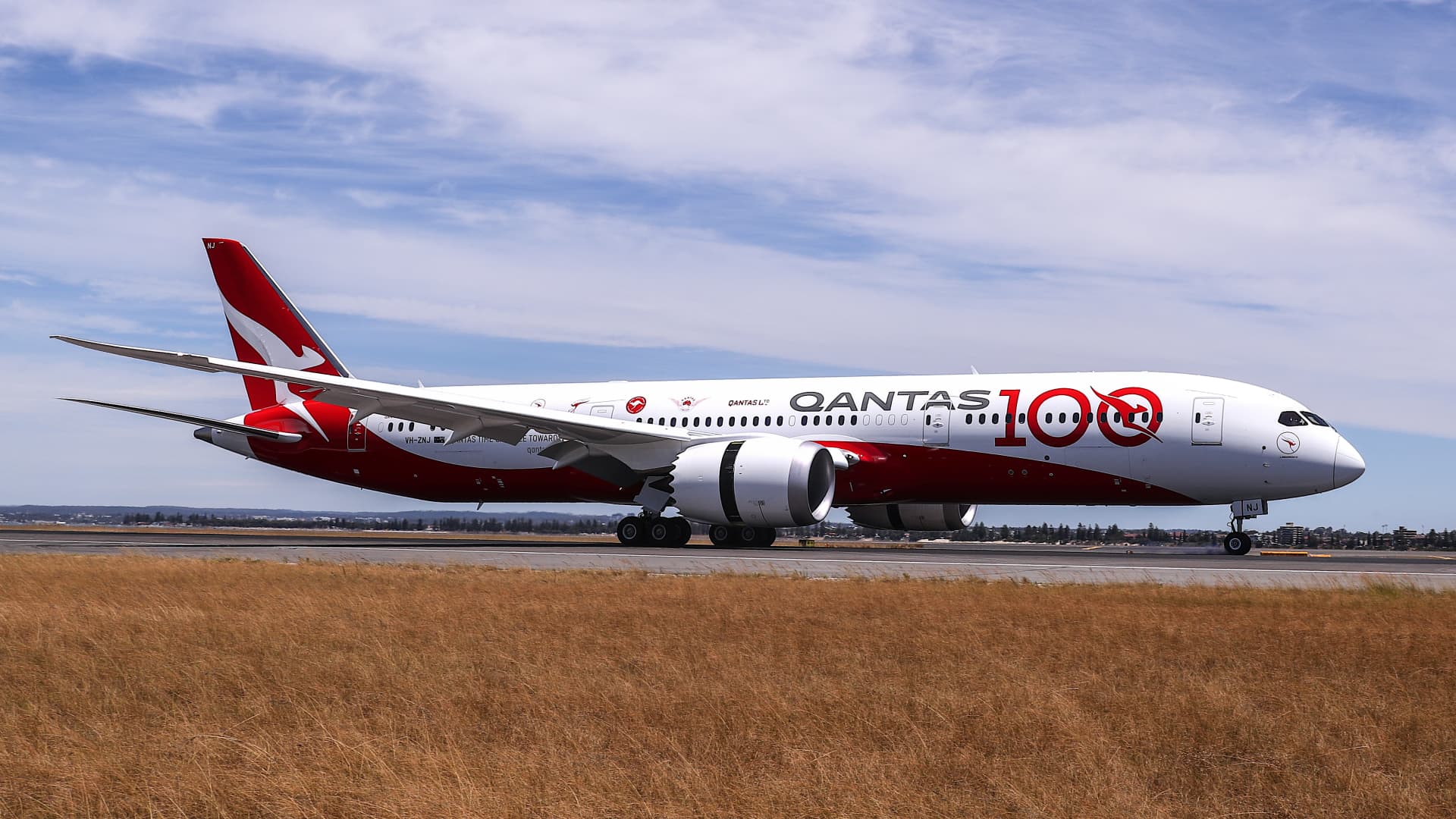
Qantas Airways plans to start selling seats on its first nonstop between New York and Sydney next August, with flights set to launch in 2028, as the Australian carrier fills out the details for another marathon route with a special Airbus plane.
The route will take about 18 hours, which puts it close to what is currently the world’s longest flight. The route that has that designation right now, nonstop service on Singapore Airlines from New York’s John F. Kennedy International Airport to Singapore, can top 19 hours.
But Qantas is set to take the crown next fall when it debuts nonstops between London Heathrow and Sydney that take about 20 hours. Flight times vary based on direction and time of year.
Qantas CEO Vanessa Hudson told CNBC that the new flights come after strong demand for another ultra-long-haul route: its Perth, Australia, to London service, which is more than 17 hours and is flown on a Boeing 787 Dreamliner.
“What we have been able to learn from that is that there is absolutely a customer who wants this and is prepared to pay a premium for it,” she said in an interview in New York, adding that travelers are trying to avoid having to connect in other airports.
The Qantas Airbus A350-1000 ULR, which stands for ultra-long range, will be equipped with first class, business class, premium economy and standard economy cabins. Those aircraft have an extra fuel tank for the trip.
Singapore Airlines, meanwhile, operates its New York to Singapore flight with only business class and premium economy seats.
As part of its ultra-long-haul program, which it calls Project Sunrise, Qantas spent years working with sleep scientists to study jet lag. Hudson said the carrier has looked at ways to minimize the effects of traveling long distances by using things like different lighting schemes so customers can get used to the time zone at their destination.

Liverpool against Arsenal is no longer a Halloween Saturday fixture. The Anfield meeting has been moved to Sunday 1 November at 16:30 GMT, with Sky Sports broadcasting the game in the UK.
For anyone checking the market through vippari, the important question is not only which team is stronger. It is how much of each first-choice XI survives October at full intensity.
Arsenal are the defending Premier League champions. Liverpool, now coached by Andoni Iraola, opened their Champions League campaign with a 2–1 win over Atlético Madrid, while Arsenal won 1–0 at Napoli. By the time they meet, those results will be almost two months old.
October Gives Liverpool Almost No Empty Space
Liverpool host Manchester City on 11 October, then travel to LASK on 14 October for Champions League Matchday 2. Brentford away follows on 17 October, before Villarreal visit Anfield on 20 October.
Brighton then come to Anfield on 25 October, followed by Liverpool’s Carabao Cup fourth-round tie against Chelsea during the week beginning 26 October. Arsenal arrive on 1 November.
That sequence puts Premier League, Champions League and cup football into the same three-week block.
Iraola’s style also makes workload relevant. His Liverpool are built around aggressive pressing and repeated high-intensity actions, so midfield and wide-player minutes matter more than a simple league-table comparison.
Arsenal Have Their Own Travel Problem
Arsenal’s calendar is hardly cleaner.
They host Leeds on 10 October, then face Lille at the Emirates on 13 October. Nottingham Forest away follows on 18 October, before the hardest trip of the month: Bayern Munich away on 21 October.
Everton visit on 24 October, and Arsenal also have a Carabao Cup fourth-round tie at Fleetwood during the final week of the month. Three days after Liverpool, they travel to Slavia Praha in the Champions League on 4 November.
That gives both clubs two Champions League matches, three league fixtures and a domestic cup tie before they meet.
The Market Should Follow Minutes, Not September Form
The 1X2 can still begin with basic team quality, home advantage and Arsenal’s status as champions. The Asian handicap and player markets need more detail.
A full-strength Arsenal midfield after managed minutes against Everton is one version of the game. The same midfield after 90 minutes in Munich is another.
Liverpool face the same problem. City, LASK and Villarreal can all take heavy minutes out of the same core group before Arsenal arrive.
Before taking a position, the most useful checks are:
- 1X2 and handicap after the Champions League midweeks, not immediately after City or Bayern;
- totals and both teams to score once the likely midfield and defensive combinations are clearer;
- shots and scorer props only after the confirmed XI;
- live markets with the October workload in mind if one side starts strongly but fades after the hour.
A price posted early in October is still working with assumptions. By 1 November, those assumptions will have been tested several times.
Player Markets Should Be the Last Ones Priced
This is where the second half of October matters most.
A striker who starts against Villarreal, Brighton and Chelsea is not necessarily the same player-market proposition against Arsenal. The same applies to an Arsenal attacker used heavily against Bayern, Everton and in the cup.
Checking updated markets through vippari indir closer to the confirmed line-ups is therefore more useful than relying on an early scorer or shots price.
The first goal will also change the live picture quickly. A Liverpool side leading after a heavy October may protect territory rather than press for a second. Arsenal in the same situation may slow possession instead of opening the game.
The Calendar Comes Before the Table
Liverpool–Arsenal will still be treated as a major title fixture, but the league table alone will not explain the price.
The more useful evidence comes from the weeks immediately before it: who played 90 minutes in Munich, who started against Villarreal, who was rested in the Carabao Cup and which midfield still has enough legs to press at Anfield.
The match takes place on 1 November, but its betting market is built through October. By kick-off, the schedule may have told more about both teams than their opening Champions League results ever could.


JEFFERSON, wIS.— Kikkoman Foods, Inc., the US manufacturing arm of Kikkoman Corp., has opened its third US production facility in Jefferson.
The soy sauce manufacturer broke ground on the facility in 2024 and expects to begin shipping a range of Kikkoman products — including soy sauce, teriyaki sauce and non-soy sauce related seasonings — to retail, foodservice and food manufacturing customers this fall.
Kikkoman also has manufacturing facilities in Walworth, Wis., and Folsom, Calif.
“This facility gives us proximity to key agricultural suppliers, access to high-quality water our brewing process demands, and a workforce rooted in the same values that have guided Kikkoman for generations,” said Yuzaburo Mogi, director chairman of the board and honorary chief executive officer at Kikkoman Foods, Inc. “As global culinary influences continue to shape what people want on their tables, this facility also strengthens our ability to meet that evolving demand by bringing the depth and authenticity of international flavors to more people, faster.”

It is a small problem that consumes a disproportionate amount of time, and it is one of the few genuinely solved problems in the current wave of AI tooling.
Why music licensing is confusing on purpose
The reason business owners find this hard is that the market is deliberately fragmented.
Royalty-free stock libraries charge either per track or by subscription, typically £10–£30 a month for the entry tier. The licence usually covers your own channels but excludes broadcast and paid advertising, which is exactly where most SMEs eventually want to use the video. Upgrading to a licence that covers paid media often costs several times the base rate.
Per-track marketplaces sell single tracks for £20–£60, which seems reasonable until you are producing video monthly and discover you have spent more than a year of subscription on six clips.
“Free” music from social platforms’ built-in libraries is genuinely free, and genuinely constrained — usable inside that platform only. Download the video and post it elsewhere and the licence does not travel with it. This catches people constantly.
Actually free music — Creative Commons and public domain — exists, is legal, and requires attribution formatting that most businesses get wrong, which converts a free track into a compliance liability.
The through-line is that the cheap options have restrictions you discover late, and the unrestricted options are priced for production companies rather than for a plumbing firm making a fortnightly explainer.
What generated music changed
The technology now produces instrumental backing tracks that are, for the purposes of a two-minute business video, indistinguishable from library music. Not chart music — nobody is releasing this — but the corporate-uplifting, acoustic-warm, minimal-tension register that business video actually uses.
Three practical advantages over library music:
It fits your runtime. Library tracks are fixed lengths and you cut to them or fade awkwardly. Generated tracks can be produced to length, which removes the most annoying part of the edit.
It is not on your competitor’s video. Popular library tracks appear thousands of times. If you have ever watched two firms in the same sector use the same swelling piano, you have seen the problem.
No takedown risk from automated matching. Platform content-ID systems flag library tracks with surprising frequency when licences are ambiguous, and disputing a claim on a video that is mid-campaign is a genuinely bad afternoon.
The pricing model is different, so budget differently
Here is where business owners get caught out. This is not billed like a subscription.
Generative audio is billed per generation, because each track costs the provider real computation. A track you generate and reject costs the same as one you use — and you will reject most of them. The realistic ratio is a handful of attempts before something fits.
So the number that matters is not the monthly headline price. It is: how many tracks do you need per year, multiplied by five or so for discards, multiplied by the per-generation rate. For a business producing one video a month, that total typically lands well below a mid-tier stock subscription — the current rates for the Flow Music API and comparable music models give a sense of the range, which varies more between providers than the output quality does.
For a firm producing video weekly, the gap widens considerably in generation’s favour. For a firm making two videos a year, a stock subscription cancelled after a month is still simpler.
The commercial rights question
This is the part to get right before you put anything behind paid media.
Terms differ meaningfully between providers. Some grant full commercial use on paid tiers including broadcast. Some restrict free-tier output to personal or internal use. Some retain rights to reuse what you generate. A few offer indemnification; most do not.
Before you standardise on anything, read the licence section specifically for: commercial use, paid advertising, broadcast, and whether the rights survive cancelling your account. That last one catches people — a track licensed under an active subscription may not remain licensed after you stop paying, which is a problem for evergreen content.
If your video is going on your website and social channels, most paid tiers are straightforward. If it is going on television or into a paid campaign, get the specific clause in writing.
What it does not replace
A composer writing to brief for a brand film is doing something this cannot do — responding to a creative argument, matching a brand’s existing sonic identity, iterating against feedback that is emotional rather than technical.
And music is not the reason a business video works. Clear script, decent audio on the voice, and a single idea per video matter enormously more than what plays underneath. A business that fixes its soundtrack problem and still films in a noisy office has optimised the wrong variable.
The practical answer
For most SMEs making regular video, the sensible setup is: generate backing tracks per project, keep the licence documentation, and stop paying a subscription for a library you use four times a year.
It is a small saving and a meaningful reduction in faff. Given how much of running a small business consists of small savings and reduced faff, that is not nothing.



Mondelez veteran Thomas Gaengler joins Barry Callebaut

Microsoft Copilot AI Predicts a Huge Move for Bitcoin by 2027

Brad Pitt’s Look-Alike Daughter Vivienne Praised For Art Sale




-

 Fashion4 days ago
Weekend Open Thread: Talbots – Corporette.com
-

 Tech2 days ago
Researchers escape OpenAI Codex sandbox to run commands on host
-

 Crypto World4 days ago
Circle launches Arc Studio AI agent for building onchain apps
-
 NewsBeat4 days ago
Trump says US has reached an agreement to take permanent control of Greenland’s security
-

 Crypto World2 days ago
Who Needs CLARITY Anyway? ARB Could See 70X Increase: Hodler’s Digest
-

 Crypto World4 days ago
Bitcoin price breaks channel as RSI climbs to 63
-

 Crypto World4 days ago
Trading Bitcoin on Robinhood? Why 2% Spread Has Traders Worried
-

 Crypto World6 days ago
US Charges Robinhood Engineers Over Crypto Listing Trades
-

 Crypto World7 days ago
What Is the Status of the U.S.-Iran Peace Talks? Here's What Both Sides Are Saying
-

 Tech7 days ago
Webb’s IC 348 Mosaic Includes Two-Jupiter Dwarfs, Twin Jets, and a Nursery Still Making Worlds
-

 Crypto World5 days ago
Mortgage and refinance interest rates today, Thursday, September 17, 2026
-

 Crypto World4 days ago
World Money launches in 150+ countries with Stripe
-

 Crypto World5 days ago
Silver prices recover quickly, hitting weekly high today
-

 Entertainment7 days ago
Big Brother Update: Melody Explodes at Drew as Illness Sweeps BB28 House
-

 Business2 days ago
Analog Devices (ADI) Bets $1.35 Billion on Chips that Let Machines Think for Themselves
-

 Tech5 days ago
GPT-6 Astra Reached the Nether in Minecraft, Lost Its Stash to a Creeper, and Farmed Potatoes for Hours
-
 NewsBeat4 days ago
US was ‘on brink of war’ with China over false AI report of nukes moving in Middle East
-

 Crypto World2 days ago
Coinbase, Robinhood, Circle Seen as Tokenized-Stock Winners
-

 Crypto World2 days ago
Bitcoin price holds above $81K as key catalysts line up
-

 Business7 days ago
Federal Reserve expected to hike interest rates 25 basis points at FOMC meeting
You must be logged in to post a comment Login