
Crypto World
ECB and EU Central Banks Push MiCA Changes on Stablecoin Deposit Caps

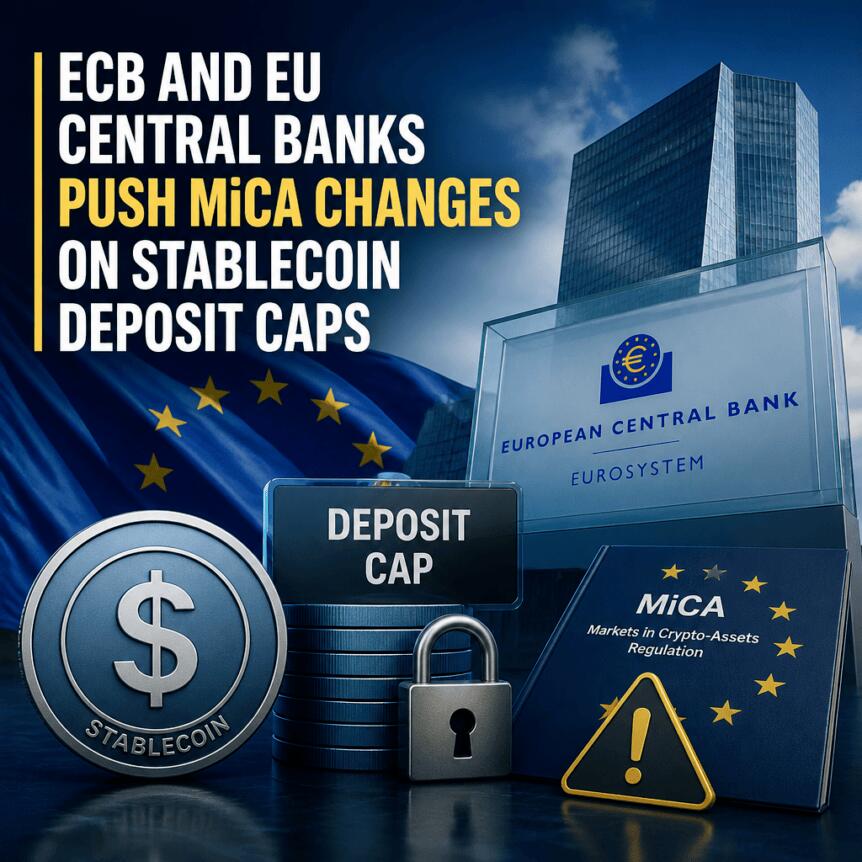
The European System of Central Banks (ESCB) is pushing to loosen parts of the upcoming MiCA framework governing how stablecoin issuers hold reserves. In a response published this Tuesday to the European Commission’s review of the Markets in Crypto-Assets Regulation (MiCA), the ESCB argues that mandatory requirements tying stablecoin reserves to bank deposits could generate liquidity stress for banks during periods of rapid redemption.
Instead of insisting that issuers keep a fixed share of reserves parked in deposits at credit institutions, the ESCB proposes replacing the bank-deposit thresholds with liquidity rules calibrated to how quickly reserve assets can be used—specifically focusing on assets maturing within one and five working days. The ESCB also points to instruments such as overnight reverse repurchase agreements (repos) and short-term sovereign bonds as potential reserve tools.
Key takeaways
- The ESCB wants to replace MiCA’s fixed bank-deposit reserve requirements with liquidity requirements based on time-to-maturity (one and five working days).
- ESCB warns that a stablecoin run could force fast withdrawals from banks, potentially exposing credit institutions to liquidity problems.
- The proposal aligns with earlier draft liquidity “buckets” developed by the European Banking Authority (EBA) in 2024.
- Central banks also caution that MiCA enforcement gaps could allow non-compliant firms to keep serving EU customers.
- The risk debate echoes concerns raised by stablecoin issuers, including Tether’s CEO, about MiCA’s deposit-linked approach.
From deposit floors to liquidity time buckets
At the heart of the ESCB’s proposal is a shift in how reserve adequacy is measured. The current MiCA-related approach requires a minimum proportion of stablecoin reserves to be held as deposits at credit institutions—30% for standard stablecoins and 60% for “significant” stablecoins.
In its published response to the European Commission’s MiCA review, the ESCB argues this model creates what it describes as a direct link between stablecoin issuers and banks. That linkage matters, the ESCB says, because if holders redeem at pace, issuers may need to withdraw deposited funds quickly—behavior that can strain bank liquidity at exactly the moment it is most needed.
To reduce that dependency, the ESCB backs liquidity requirements that focus on reserve assets’ maturity horizons. Under the new direction, issuers would have to hold minimum liquidity amounts among reserve assets maturing within defined short periods, rather than meeting a mandated share in the form of bank deposits.
How the ESCB’s alternative aligns with EBA drafts
The ESCB’s framing references draft rules from the European Banking Authority (EBA) that were published in 2024. Those drafts outline distinct liquidity thresholds for stablecoin reserves depending on whether a token is classified as “significant” or “non-significant.”
According to the EBA draft rules cited by the ESCB, significant stablecoins would be required to hold at least 40% of reserves in assets maturing within one working day and at least 60% in assets maturing within five working days. For non-significant tokens, the draft thresholds are 20% for one working day and 30% for five working days.
The ESCB’s Tuesday response suggests that, operationally, liquidity can be achieved without the rigid deposit framework—highlighting overnight reverse repurchase agreements and short-term sovereign bonds as examples of instruments that can help issuers meet near-term liquidity targets.
Why central banks see systemic two-way risks
The ESCB does not treat the risk as one-directional. While it emphasizes that stablecoin redemption pressure could pull liquidity out of banks, it also warns that bank stress can spill into stablecoin reserves.
As part of that argument, the ESCB points to the March 2023 collapse of Silicon Valley Bank. In the aftermath, a run on Circle’s USDC stablecoin followed disclosures that Circle had held $3.3 billion of its reserves at the failed institution. The ESCB uses this episode to illustrate how concentration of reserve funds in a single credit institution—and the resulting loss of confidence—can translate quickly into stablecoin redemption pressure.
Taken together, the ESCB’s approach implies that reserve rules should aim to reduce both the need for rapid bank-linked withdrawals during stablecoin stress and the vulnerability of stablecoins to bank-specific failure events.
MiCA enforcement challenges beyond reserve rules
Beyond the mechanics of reserve holding, the ESCB also cautioned that MiCA’s implementation may face “material challenges” in enforcement. The concern, as expressed in the response, is that even firms that fail to comply with MiCA requirements could still reach or continue serving EU customers.
That point broadens the discussion beyond liquidity buffers. Investors and users have largely focused on whether reserves are safe and liquid; central banks are effectively arguing that safety depends not only on what reserves look like, but also on whether the regulatory framework is implemented and enforced in a way that prevents non-compliant entities from operating inside the EU market.
Stablecoin industry warnings were already on the record
The ESCB’s position also echoes arguments made by stablecoin industry figures. In an October 2024 interview with Cointelegraph, Tether CEO Paolo Ardoino warned that MiCA’s bank-deposit reserve requirement could create systemic risks for both banks and issuers.
Ardoino illustrated the concern with a hypothetical example: if a stablecoin issuer had €10 billion in reserves and €6 billion had to be kept as bank deposits, then if a bank lent out 90% of those deposited funds, only €600 million might remain readily available. In a scenario where the issuer needed billions quickly to meet redemptions, that mismatch between depositor availability and redemption demands could contribute to a liquidity crunch.
In its Tuesday response, the ESCB references a similar dynamic—stating that a stablecoin run could force an issuer to withdraw deposits rapidly and that the impact could be most acute when stablecoin reserves represent a meaningful share of a bank’s funding.
With the ESCB’s response now on the record, the key next question is how the European Commission will balance MiCA’s original bank-deposit intent with the liquidity-time-bucket approach advocated by central banks and aligned with EBA draft rules. Readers should watch for how the final MiCA implementation details handle both liquidity measurement and enforcement capacity—especially during periods of market stress when reserve behavior is tested in real time.


The European Central Bank and national central banks across the European Union have called for MiCA’s stablecoin remuneration ban to cover lending, borrowing, staking and other arrangements that can generate indirect returns for token holders.
Summary
- ECB backed central banks want MiCA’s stablecoin yield ban extended to lending, borrowing and staking products.
- The ESCB said indirect returns could allow platforms to turn stablecoins into yield bearing arrangements despite existing restrictions.
- Central banks proposed replacing MiCA’s minimum bank deposit requirements with reserve rules based on one to five day liquidity.
According to the European System of Central Banks, the restriction should extend beyond services already regulated under the Markets in Crypto Assets framework because crypto platforms could structure products outside MiCA that effectively turn stablecoin holdings into yield bearing arrangements.
“Electronic money is intended to be used for making payments and not as a means of saving,” the ESCB said in its 57 page response to the European Commission’s consultation on reviewing MiCA.
The central banks said they “continue to support the prohibition on CASPs paying remuneration on stablecoins,” referring to crypto asset service providers. Existing restrictions should cover both direct payments and returns generated through other products, according to the response.
Stablecoin yield ban could extend to lending and staking
MiCA prevents issuers of electronic money tokens and crypto asset service providers from granting interest in relation to those tokens. The ESCB wants EU lawmakers to make clear that the restriction cannot be bypassed by placing stablecoins inside lending, borrowing, staking or similar products.
Stablecoins can be “transformed into yield-bearing arrangements through lending, staking or other layered structures,” the central banks said. Such products could provide holders with an economic return even when the stablecoin itself does not directly pay interest.
The ESCB said allowing such arrangements could weaken the regulatory distinction between electronic money and bank deposits while creating unequal conditions between crypto companies and regulated financial institutions.
“Maintaining and, where necessary, strengthening the prohibition, covering both direct and indirect forms of remuneration, should be a clear legislative priority,” the group said.
The position closely resembles a dispute that has shaped debate over stablecoin rewards in the United States.
As crypto.news previously reported, eight banking associations asked U.S. lawmakers in September to tighten the CLARITY Act’s restrictions on stablecoin incentives. The groups argued that rewards linked partly to balances or holding periods could operate like interest on bank deposits even when another condition was attached to the payment.
Banking groups have focused on the potential effect on deposits because those funds are used to support mortgages, business financing and other lending. In July, the American Bankers Association, Independent Community Bankers of America and 76 state banking associations sought tighter restrictions on incentives that could encourage customers to hold stablecoins instead of keeping money in bank accounts.
Citigroup CEO Jane Fraser raised a similar concern in August, warning that stablecoin reward programs could reduce deposits available to lenders. Fraser supported passage of the CLARITY Act but said changes were still needed to its stablecoin reward provisions.
The U.S. legislation later failed to advance in a 50 to 49 procedural vote on Sept. 15, with the debate covering stablecoin rewards as well as ethics and other provisions.
ECB backed banks want MiCA reserve rules changed
Alongside the remuneration restrictions, the ESCB proposed changing how MiCA regulates reserves backing stablecoins.
Current EU rules require issuers of tokens referencing official currencies to keep at least 30% of the amount referenced in each currency as deposits with credit institutions. The requirement rises to 60% for significant tokens.
The central banks want those minimum deposit requirements removed because large stablecoin issuers could become an unstable source of funding for banks. If an issuer faced heavy redemptions, it could need to withdraw a large deposit over a short period, according to the ESCB.
Such withdrawals could expose the receiving bank to sudden funding pressure at the same time the stablecoin issuer is trying to obtain cash to satisfy redemption requests.
Instead of requiring a fixed share of reserves to remain in bank deposits, the ESCB proposed rules based on how quickly reserve assets can mature or be converted into cash.
The approach would require issuers to maintain specified portions of their reserves in assets with maturities ranging from one to five working days, giving them liquid assets that can be used to handle redemptions without relying as heavily on withdrawals from banks.
Existing MiCA rules already require reserve assets to be managed in a way that addresses liquidity risks arising from holders’ permanent redemption rights. EU law requires the European Banking Authority, working with the European Securities and Markets Authority and the ECB, to specify liquidity requirements covering daily and weekly maturities.
Liquidity rules would focus on one and five day maturities
The ESCB pointed to European Banking Authority standards as a basis for the proposed structure.
Under the liquidity framework, significant stablecoins referencing official currencies would need at least 40% of reserve assets available within one working day and 60% within five working days. For non significant tokens, the corresponding thresholds would be 20% and 30%.
EBA standards were calibrated partly using observed deposit outflows connected with crypto related events. The framework covers cash and other reserve assets according to how quickly they can mature, be withdrawn or otherwise become available to meet redemption demands.
The proposal would therefore separate the amount of liquidity an issuer needs from the amount it must place directly with commercial banks. Stablecoin issuers would still need sufficient liquid reserves, but compliance would depend more heavily on the maturity profile of those assets.
The ESCB’s position comes as European authorities continue refining MiCA after its stablecoin provisions began applying in June 2024. The framework introduced EU wide requirements for asset referenced tokens and electronic money tokens, including reserve management, redemption rights and additional requirements for tokens classified as significant.
MiCA requires reserve assets to be legally and operationally segregated from an issuer’s own estate, while significant tokens face additional prudential requirements and heightened supervision.
European regulators have previously focused on redemption risk when setting the liquidity framework. The EBA’s technical work kept separate one day and five day liquidity buckets, while significant tokens face higher thresholds because of the potential scale of redemptions.
The ESCB’s latest proposal would retain that liquidity based approach while removing the rule forcing issuers to keep a minimum 30% or 60% of relevant reserves as bank deposits.
In the United States, banks have pursued a related argument from the opposite side of stablecoin balance sheets. Their focus has been on preventing reward paying stablecoins from drawing deposits away from lenders, while the ESCB’s reserve proposal addresses the risk created when stablecoin issuers themselves place large deposits inside banks.
The dispute over rewards remained active ahead of the September CLARITY Act vote. Banking groups argued that incentives tied to stablecoin balances could resemble deposit interest, while crypto companies sought to preserve rewards linked to transactions and other platform activity. A Senate compromise had sought to restrict passive yield while retaining some activity based incentives.
The ESCB wants the EU prohibition to cover indirect remuneration regardless of whether the return comes directly from the stablecoin issuer or through lending, staking or another layered product offered around the token.
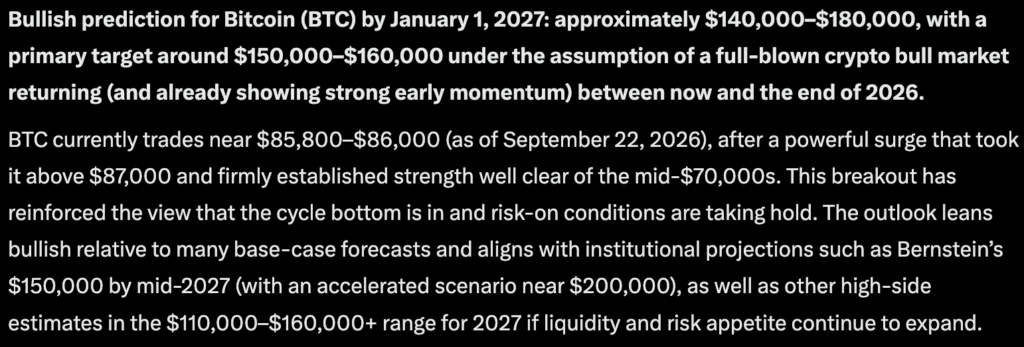
Microsoft Copilot AI predicts that if a full-blown bull market returns in Q4, Bitcoin could hit $180,000 before January 1, 2027. The bullish range is listed at $140,000–$180,000, with a genuine late-cycle blow-off potentially pushing Bitcoin toward $200,000+.
At roughly $85,000, $180,000 would be about a +110% move. The interesting thing about Bitcoin’s current setup is that it has already corrected substantially from its previous cycle high. BTC reached approximately $126,200 on October 6, 2025, before falling sharply during 2026.

Bitcoin has already shown it can produce enormous gains during strong cycles. According to historical annual data, BTC gained about +154% in 2023 and +110% in 2024, and if the current prediction proves true, a similar move could be on the way.
Microsoft Copilot AI Predicts Bitcoin to $180,000 if Specific Conditions Are Met: Does the Technical Analysis Back it Up?
Bitcoin recently broke out of a sequence of lower highs that developed from May onward and reclaimed several key moving averages.
Reuters’ technical analysis identified the $81,781 area as important support, with $86,500 now representing a major resistance level. Above that, the next technical objectives were around $90,000 and $97,867.
CryptoQuant has identified a similar progression. It sees $81,700 as particularly important because it matches Bitcoin’s 365-day moving average. Resistance levels above are around $86,600 and $88,700.
The first major test following the breach of $85,000 is the $86K–$88K region. Bitcoin has now pushed through that area, which is important because a sustained breakout would remove one of the largest technical obstacles between the current price and the $100,000 level.
The next major milestone is approximately $98,000. Above that, the market is approaching the $126,200 all-time high, and this is where things get interesting.
Once BTC decisively breaks $126,000, it enters genuine price discovery. Very little historical resistance sits above that level. At that point, psychological targets such as $130K, $140K, and $150K can become magnets for momentum traders and institutional flows.
Make Your BTC Price Prediction With $25 For Free on Kalshi
Bitcoin Hyper Targets Early Mover Upside as Bitcoin Tests Key Levels Near $86,500
A +5% daily pop is fine for whales and those already heavily positioned. However, for anyone watching from the sidelines, chasing BTC into resistance near $86,500 with the Microsoft Copilot AI predicts thesis still unconfirmed, it is still an unpredictable trade.
The upside math at a $1.5 trillion-plus market cap simply moves more slowly than early-stage infrastructure plays, which is where attention is rotating.
Bitcoin Hyper ($HYPER) is positioning itself as the first Bitcoin Layer 2 with full SVM integration. It boasts smart contract execution built for speed that outpaces Solana itself, while settling back to Bitcoin’s base-layer security.
As of today, the presale has raised more than $33.1M at a current token price of just $0.0136864, with staking rewards live at launch at a huge 35% APY.
The pitch: solve Bitcoin’s slow transactions, high fees, and lack of programmability without abandoning what makes BTC trusted in the first place. A Decentralized Canonical Bridge handles BTC transfers natively.
Gain Access to New Bitcoin Layer 2 Early Here
Discover: The Best Token Presales
The post Microsoft Copilot AI Predicts a Huge Move for Bitcoin by 2027 appeared first on Cryptonews.
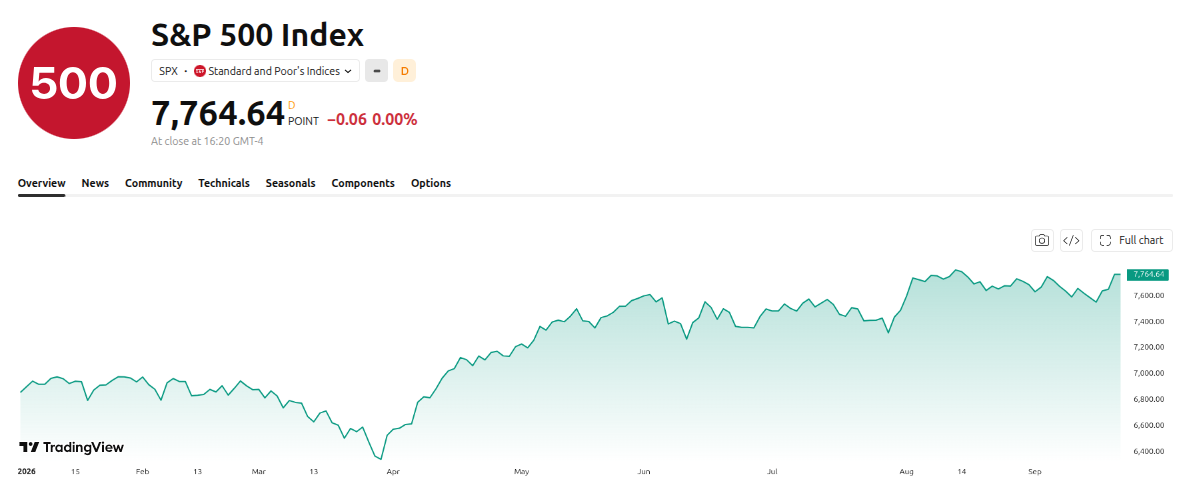
Goldman Sachs pushed back hard against fears of an S&P 500 earnings bubble on Tuesday. The firm projects another quarter of double-digit growth starting next week.
Deutsche Bank echoed that confidence separately, reaffirming its year-end target of 8,000 points for the benchmark index.
Goldman Sachs Dismisses S&P 500 Bubble Talk, Reaffirms Bullish Outlook
An earnings bubble is a scenario in which corporate profit growth becomes unsustainable. That imbalance eventually forces a sharp correction once reality catches up with inflated expectations.
Ben Snider, Goldman’s chief U.S. equity strategist, argued that the description doesn’t fit today’s market. Speaking on Bloomberg Open Interest, Snider said a bubble implies earnings are about to pop. Goldman simply doesn’t see that happening.

Aggregate S&P 500 earnings are currently climbing more than 30% year over year. The median stock, meanwhile, still posts a solid 14% gain.
Some deceleration looks likely as fiscal tailwinds fade and energy costs rise, Snider acknowledged. Even so, he expects results to remain robust. Third-quarter GDP tracking currently points above 3% growth.
Follow us on X to get the latest news as it happens.
On artificial intelligence specifically, Snider said token consumption and compute demand should continue to rise through 2027, sustaining one of the market’s key earnings tailwinds.
Investor positioning, he noted, currently sits at its lowest level since March, a sign of widespread caution that could fuel further upside if catalysts such as falling oil prices or lower rates materialize.
Why Is Deutsche Bank Just as Bullish Right Now?
Deutsche Bank’s equity strategy team, led by Binky Chadha, published a note titled “To 8,000 and Beyond?” pointing to several factors supporting their optimistic stance.
Third-quarter earnings should deliver roughly 30% year-over-year growth, mirroring an equally strong second quarter. The bank also raised its 2027 earnings-per-share forecast to $420, implying growth of nearly 17%.
Subscribe to our YouTube channel to watch leaders and journalists provide expert insights.

History adds another layer of support. Chadha’s team highlighted that 21 of the past 23 mid-term election years produced positive fourth-quarter returns, averaging a 7% gain. Positioning, technical indicators, and supply-demand dynamics all continue tilting favorably, the bank added.
Both firms ultimately arrive at a similar conclusion. Extraordinary earnings growth seen throughout 2026 will likely moderate somewhat, yet neither expects anything resembling a collapse.
As long as companies keep delivering double-digit or high-teens profit expansion, backed by AI-related investment and a resilient broader economy, Wall Street’s two most prominent bullish voices see meaningful room for the S&P 500 to climb further into year-end and beyond.
The post Goldman Sachs and Deutsche Bank Agree: The S&P 500 Rally Isn't Over appeared first on BeInCrypto.
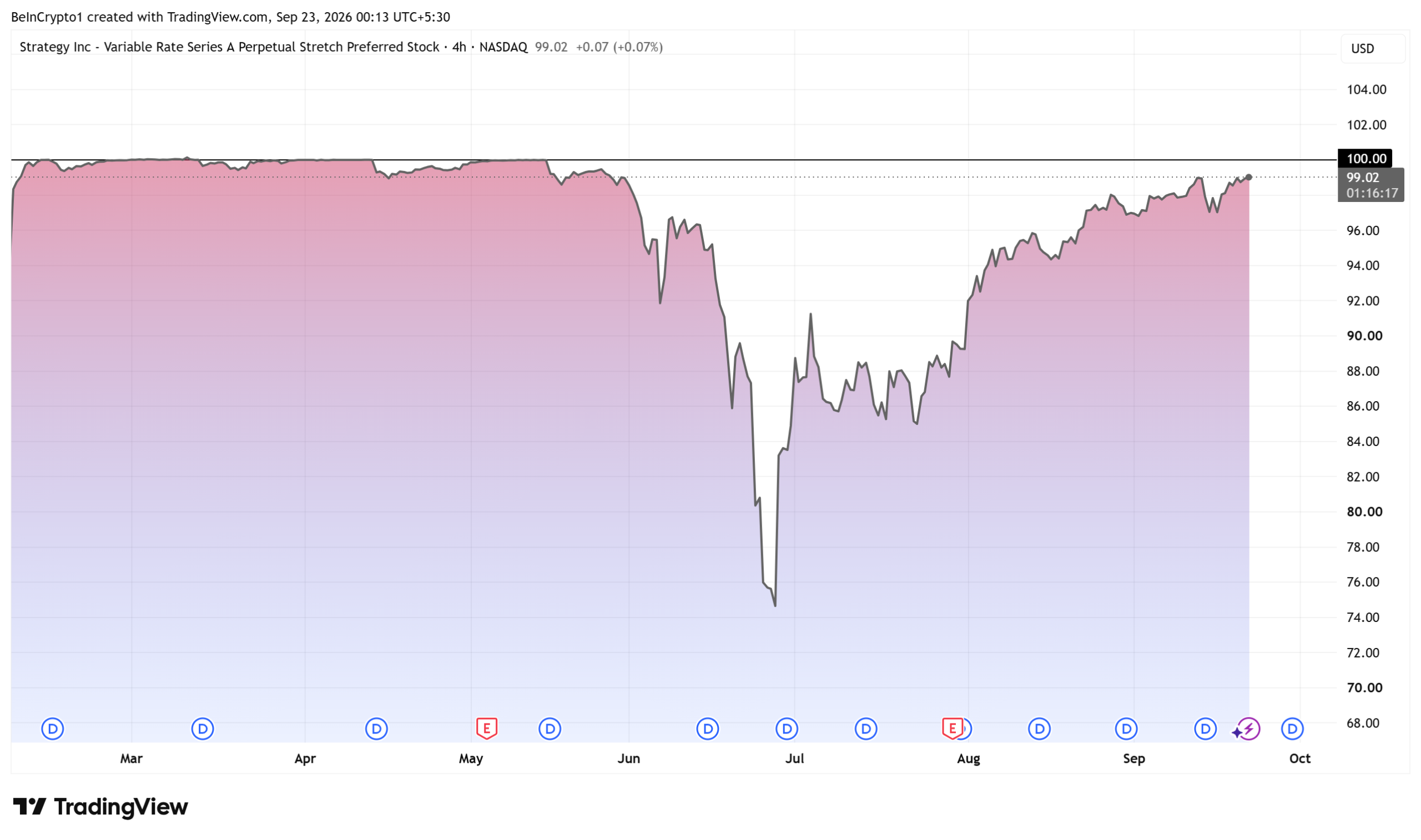
Strategy CEO Phong Le says the company underestimated how much borrowed money would flow into STRC, its $9.3 billion preferred stock that lost a quarter of its value this summer.
STRC pays a 12% annual dividend and is built to trade near its $100 face value. It sank to about $75 in late June and now trades at $99.

How Borrowed Money Sank STRC Below $100
Le explained the selloff in an interview with Natalie Brunell. He said STRC’s calm price invited investors to borrow against their Bitcoin (BTC) at about 6% to collect STRC’s 12% yield.
When Bitcoin fell, those loans came under pressure. Holders had to post more Bitcoin or sell STRC, Le said, and that forced selling drove the price lower.
“We did not expect the amount of leverage that came into the system,” Le explained.
Le said traders later bought STRC between $75 and $90, and that he bought some himself.
Why Strategy Chose Buybacks Over a Higher Dividend
In late June, Strategy set out a framework with a cash reserve, buyback authorizations, and a plan to sell Bitcoin when needed. It began repurchasing STRC in late July.
Le said earlier dividend increases toward 12% did not lift the price. A higher payout would also drain cash and weigh on common shareholders, he said. Buybacks shrink future dividend bills instead.
Strategy’s dollar reserve now holds about $5.1 billion, which Le said covers roughly three years of dividends. That money can only pay preferred dividends and interest on Strategy’s convertible debt.
What It Means for MSTR Shareholders
Strategy funds the latest STRC buybacks through sales of its common stock (MSTR) and, potentially, Bitcoin. Le said 95% of his pay is tied to MSTR’s share price and urged holders to think in three-year periods.
Le said institutions now own about 30% of STRC, up from 20%. He expects the stock to return to $100 as long-term holders replace leveraged traders.
$STRC is a passenger jet. $BTC is a fighter jet. $MSTR is a rocket ship. Buckle up,” Le said in a recent post.
STRC’s next dividend goes to holders of record on September 30, with payment due October 15, according to Strategy.
The post Strategy CEO Phong Le Reveals the One Mistake Behind STRC's 25% Collapse appeared first on BeInCrypto.
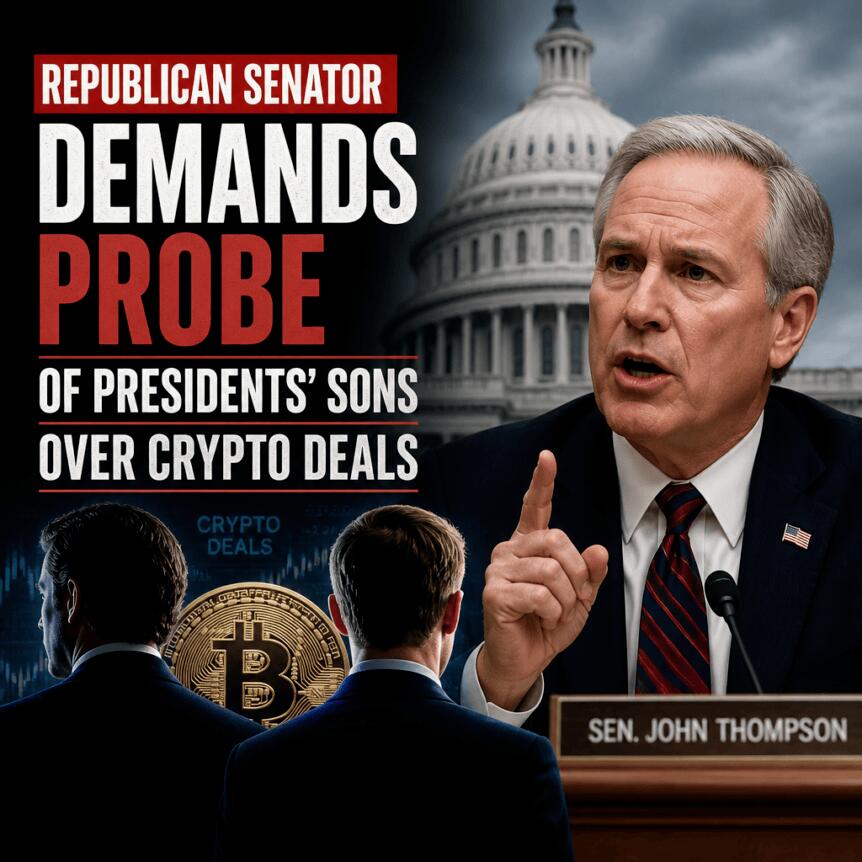
Republican Senator John Curtis of Utah has asked the U.S. Senate Judiciary Committee to investigate whether the sons of President Donald Trump and former President Joe Biden used their family ties to obtain private financial benefits—an inquiry that Curtis says should include subpoenas for Donald Trump Jr. and Hunter Biden.
In a Monday letter to Senate Judiciary Committee Chair Chuck Grassley and ranking member Dick Durbin, Curtis argued that lawmakers should probe “the use of presidential family relationships for private financial benefit, preferential treatment, or access by domestic and foreign interest.” The Utah senator’s request centers heavily on alleged cryptocurrency-related activity involving Trump Jr., while also citing Hunter Biden’s international business dealings.
Key takeaways
- Sen. John Curtis urged the Senate Judiciary Committee to investigate whether presidential family relationships were used for private financial gain.
- Curtis asked for subpoenas for Donald Trump Jr. and Hunter Biden, citing specific concerns tied to cryptocurrency ventures and foreign business.
- Trump Jr. was singled out for accepting gifts reportedly linked to Russian oligarch Umar Kremlev and for promoting family-backed crypto initiatives.
- The call for inquiry comes after Senate Republicans failed to move the Digital Asset Market Clarity Act despite Democrats’ objections.
- Democrats have tied broader crypto policy disputes to concerns that the presidency could be leveraged for profit through digital-asset businesses.
A Judiciary probe focused on family ties and crypto exposure
According to the letter, Curtis wants the committee to examine whether ethics, disclosure, or anti-corruption laws apply to conduct involving Trump Jr. and Hunter Biden. He emphasized that the objective should be to establish facts, determine legal applicability, and identify reforms needed to prevent the presidency from becoming a pathway to private enrichment.
Curtis specifically pointed to Donald Trump Jr.’s actions, including his acceptance of gifts from Umar Kremlev as part of his wedding. The senator also cited what he described as Trump Jr.’s “active promotion of family-backed cryptocurrency ventures” and advisory roles connected to prediction market platforms—entities that, according to Curtis, fall under the regulatory authority of the U.S. Commodity Futures Trading Commission.
Last week, President Trump said that his son repaid Kremlev for what Trump Jr. and his wife described as a “generous wedding gift.” Curtis’s request builds on that broader narrative by asking whether the underlying relationship and crypto involvement warrant formal scrutiny.
Hunter Biden: foreign business and the role of presidential proximity
Curtis also asked for a similar probe into Hunter Biden. His letter frames the request around “substantial business with foreign entities” and instances where, Curtis argued, either man’s relationship to the presidency was “invoked or understood to provide value.”
The letter notes that Joe Biden issued a pardon for Hunter Biden in December 2024 for crimes he “committed or may have committed or taken part in over the last decade.” Curtis also referenced Hunter Biden’s prior denials that his father was involved in his business dealings.
While Curtis’s focus is on potential misuse of access or preferential treatment, the request implicitly raises a question that extends beyond any single prosecution: whether existing rules are sufficient to address situations in which family members operate in sensitive sectors while their proximity to the White House or a former administration may influence outcomes.
Crypto regulation debate heightens as clarity legislation stalls
Curtis’s letter arrives amid an ongoing political dispute over U.S. digital-asset oversight. A week earlier, Senate Republicans failed to secure enough support from Democrats to pass the Digital Asset Market Clarity Act—legislation described as intended to establish market structure rules for the crypto industry.
In coverage cited in the article, some Democrats argued against the bill on the grounds that Trump was “using crypto to turn the presidency into a profit generating machine.” The argument references the broader concern that digital-asset activity connected to the president could raise conflict-of-interest issues that statutory ethics provisions may not adequately address.
Republicans said the president had agreed to stronger ethics provisions related to his crypto investments before the vote. Still, Democrats contended that the proposed measures did not go far enough to prevent corruption.
The tension highlights an asymmetry: while the legislation aimed to create regulatory clarity for the market, the political debate has also become a referendum on how lawmakers view the connection between crypto business activity and the presidency itself.
What to watch next
For investors and builders, the practical question is whether a Judiciary Committee inquiry will lead to new subpoenas, targeted disclosures, or recommendations for ethics enforcement—outcomes that could affect compliance planning and the perceived legitimacy of crypto-related public affairs. The scope of any investigation, and whether it meaningfully intersects with pending regulatory reforms, remains the key uncertainty.

Nephos Group has partnered with venture accelerator Brinc to provide accounting, compliance, corporate structuring, and tokenization support to more than 250 startups in Brinc’s portfolio.
Summary
- Brinc founders will gain access to Nephos services covering tax, banking, visas, and corporate structures.
- Stablecoin and Web3 companies can seek proof-of-reserve attestation and tokenization advice.
- The partners will hold workshops on compliance readiness, reserve reporting and cross-border structures.
- U.S. stablecoin rules add another compliance layer for GCC companies seeking American users.
In a Sep. 22 press release shared with crypto.news, Nephos Group said that Brinc’s portfolio companies will be able to use its financial and advisory services through the accelerator’s founder support program. The arrangement covers technology companies across the Gulf Cooperation Council, with added services for startups working on stablecoins, Web3 products and tokenized assets.
Financial terms were not disclosed. Rather than providing a new investment fund, the partnership adds professional services to the capital, mentoring and market support already available through Brinc.
Nephos will provide compliance support from an early stage
Under the agreement, founders can seek help with cross-border tax planning, corporate structures, banking introductions and visa matters. Nephos will also advise digital asset businesses on tokenization and provide proof-of-reserve attestations for companies whose products depend on backing assets.
Reserve attestations assess whether reported assets support an issuer’s claims at a stated point in time. They differ from full financial audits, which examine financial statements and accounting processes across a reporting period. As crypto.news previously explained, proof of reserves does not by itself establish a company’s solvency because it may not show all liabilities, internal controls, or claims against the reported assets.
For an early-stage stablecoin issuer, the distinction affects how information is presented to investors, banks and regulators. A company may need reserve verification alongside legal, accounting and operational controls, depending on the product and the jurisdiction where it is issued or distributed.
Nephos founder and CEO Joe David said founders often build such systems after launching, even though cross-border businesses may need them during their earliest stages.
“The GCC’s tech ecosystem is scaling rapidly, and founders here need professional infrastructure that keeps pace,” David said.
Having relocated to the United Arab Emirates, David said his experience building Nephos and Myna Accountants gave him direct knowledge of the issues companies face while setting up and expanding in the region. The Brinc agreement, he added, will let portfolio founders obtain compliance and structuring services “from day one rather than having to piece it together later.”
GCC stablecoin rules raise the compliance burden
Across the Gulf, digital asset companies operate under national regulators as well as separate financial-center and free-zone frameworks. A startup serving several GCC markets may therefore face different licensing, reserve, disclosure, tax and company-formation requirements.
Dubai’s Virtual Assets Regulatory Authority clarified its token issuance framework in April, setting separate routes based on a token’s design and risk profile. The Dubai issuance guidance placed fiat-referenced and asset-referenced tokens in its first category, with specific requirements covering reserve assets, redemption rights, disclosures and legal structures.
Licensed distributors also carry due diligence and continuing compliance duties for some token offerings under VARA’s framework. Such requirements mean a founder’s choice of issuer, distributor, banking provider and legal entity can affect whether a product can enter the market.
In May, AE Coin and USD Universal introduced a regulated conversion system connecting a dirham-backed token with USDU, a U.S. dollar-backed stablecoin, for institutional settlement in the UAE. The stablecoin conversion rail was built with support from Al Maryah Community Bank and initially offered through regulated providers Aquanow and Changer.ae.
USDU had previously become the first dollar-backed stablecoin registered under the UAE’s Payment Token Services Regulation framework for institutional and professional users. Its approval allowed digital asset-related payments under stated conditions, while mainland retail payments remained outside its permitted scope.
Against that regulatory setting, Nephos and Brinc plan to run workshops for participating founders on compliance preparation, cross-border structures, tokenization frameworks and proof-of-reserve practices. The companies did not provide a schedule for the sessions or identify the first startups expected to take part.
Brinc adds financial services to its accelerator model
Brinc chief marketing officer Nick Ramil said founders seeking to operate across several countries need more than funding and business introductions.
“It requires the right infrastructure, trusted partners, and the ability to navigate complex markets without unnecessary friction,” Ramil said.
Through the agreement, Brinc will connect founders with Nephos while continuing to provide its existing accelerator services. Ramil said the arrangement would give portfolio companies access to financial, compliance and structuring expertise as they build businesses across national borders.
Brinc has previously worked with blockchain accelerators in the region. In November 2024, the firm joined CoinList and Ghaf Group in a 12-week SuiHub program for pre-token projects in the Middle East and North Africa. Selected teams could receive as much as $200,000 in milestone-based funding, alongside technical assistance and networking support.
The Nephos deal uses a different format because it centers on professional services rather than direct startup funding. Brinc’s portfolio includes more than 250 companies spanning blockchain, artificial intelligence, connected hardware, robotics, drones, clean energy, food technology and the Internet of Things.
U.S. rules may affect GCC stablecoin founders
Gulf-based stablecoin companies seeking American customers must also account for the U.S. framework created by the GENIUS Act. The law established licensing, reserve, redemption, disclosure, and compliance requirements for payment stablecoin issuers, while federal agencies continue to develop the implementing rules.
In August, the U.S. Treasury proposed definitions for when a payment stablecoin is issued, offered, or sold in the United States. Under the Treasury stablecoin proposal, issuers generally will need an eligible federal or state license when the law is expected to take effect on Jan. 18, 2027.
Foreign-issued stablecoins face a separate route. According to Treasury, digital asset service providers generally cannot make such tokens available to U.S. users unless the issuer can comply with lawful orders and its home jurisdiction meets requirements connected to regulatory reciprocity.
From July 18, 2028, service providers generally will be barred from offering payment stablecoins to people in the United States unless an eligible licensed issuer issued the token, Treasury said. The agency’s proposal would also define when an overseas company’s activity amounts to an offer or sale to a person in the country.
For GCC founders, those rules can make reserve design, company location and distribution arrangements relevant before a stablecoin reaches American users. Treasury has also proposed anti-money laundering and sanctions duties for permitted payment stablecoin issuers, including systems for identifying suspicious transactions and blocking, freezing or rejecting transfers when legally required.
Brinc is headquartered in Hong Kong and has run programs with companies, public agencies, universities and investment groups. Its past partners include Huawei, Schneider Electric, Puma, Manulife, Hong Kong Science Park, the Mohammed Bin Rashid Innovation Fund, the National University of Singapore, Artesian and Bahrain’s Economic Development Board.

Bitcoin (BTC) rallied nearly 7% on Monday, crossing $87,000 and reaching an intraday high of $87,397 before closing at $86,593. It traded at levels last seen in January 2026.
BTC’s Monday rally came as global stocks and bonds reported substantial gains. At the same time, lower oil prices and a planned summit between US President Donald Trump and Chinese President Xi Jinping lifted market sentiment.
Bitcoin and Broader Crypto Market Rallies
Bitcoin (BTC) is currently trading around $86,197, up almost 2% over the past 24 hours. Meanwhile, Ethereum (ETH) followed a similar trajectory, rising to $2,804 before settling at $2,749, up almost 1% in the past 24 hours. Ripple (XRP) is up over 4% at $1.53, while Solana (SOL) is up 1.30%, trading around $117. Dogecoin (DOGE), Cardano (ADA), Stellar (XLM), Uniswap (UNI), and Litecoin (LTC) also recorded notable increases.
According to Pratik Gupta, head of Business at Mudrex, a favorable risk environment has helped the rally, while lower oil prices have eased inflation concerns. Gupta also highlighted short covering as another factor. Meanwhile, CoinGlass reported liquidations of long and short positions across crypto crossed $1 billion in 24 hours, the highest since August.
BTC is up 44% this quarter, marking its strongest gain since Q4 2024. Mudrex also highlighted Strategy’s purchase of 950 BTC, taking its total holdings to 846,000 BTC. Meanwhile, CoinSwitch’s Markets Desk said around $750 million in short positions were liquidated as BTC broke above $82,000 toward $87,000. However, it highlighted a $2 billion jump in futures open interest, indicating leverage had also increased. WazirX founder Nischal Shetty said BTC’s latest rally marks a significant improvement in market sentiment, highlighting renewed institutional activity after a brief period of uncertainty following the Federal Reserve raising interest rates and the Senate failing to pass the CLARITY Act.
Spot Bitcoin ETFs Record Substantial Inflows
Spot Bitcoin ETFs reported substantial outflows totaling $462.7 million for the week ending September 11. The outflows broke a three-week inflow streak. The ETFs resumed inflows on September 14, bringing in $159.9 million, before recording $450 million and $290 million in outflows on September 15 and September 16. The inflow streak resumed on September 17 with $159 million and $433 million on September 18. Bitcoin ETFs reported $999 million in inflows on Monday, propelling BTC to an intraday high of $87,397.
Inflation Concerns
Inflation is another key factor driving demand for BTC. At least some ETF inflows are being driven by investors looking for a hedge against inflation. The US Bureau of Labor Statistics has reported that consumer prices rose 3.4% year over year in August, fueling concerns that the dollar is losing purchasing power. Some investors are worried the decline will continue and are actively looking for fixed-supply assets, with BTC fitting the narrative. Other macroeconomic concerns and a volatile geopolitical situation have also dampened investor sentiment.
Miner Stress and Capitulation
The third factor buttressing BTC’s latest price action is the on-chain data on miner stress and capitulation. A research report by VanEck stated that eight of twelve holder capitulation signals, including average holding periods and liquidation rates of supply, were flashing. Mining difficulty also fell 18.3% from its November peak. The decline suggests unprofitable miners stopped mining or sold some holdings to cover costs. However, VanEck’s report suggests the squeeze is easing, with the August 8 adjustment raising mining difficulty by 1%.
Disclaimer: This article is provided for informational purposes only. It is not offered or intended to be used as legal, tax, investment, financial, or other advice.
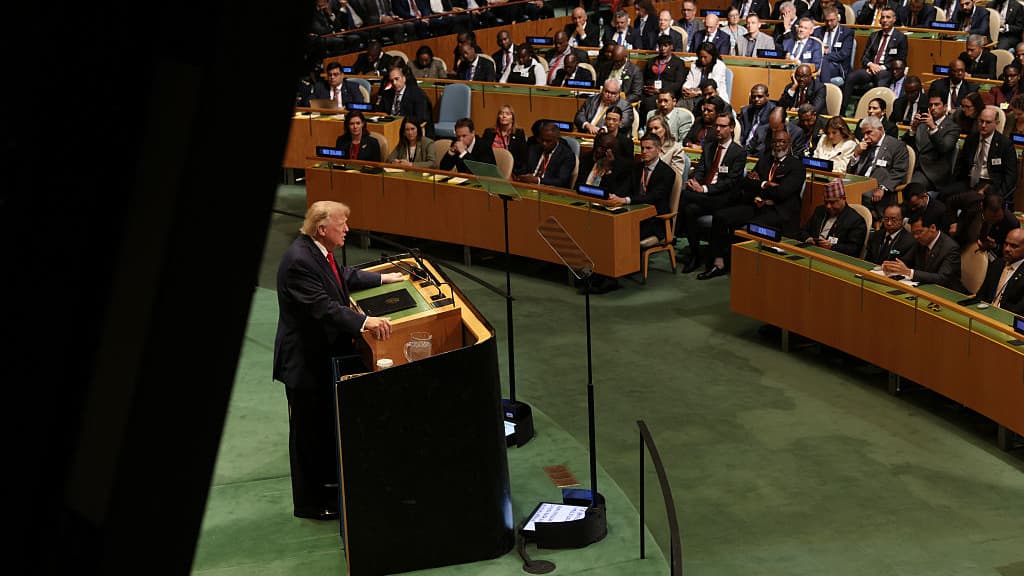
“The cartels are the ISIS of the Western Hemisphere—not good people,” he said. “Like ISIS, they should be killed, exiled, or detained as enemy combatants without the possibility of release, which is what we’re doing.”
But while these messages are largely meant to promote the very strength that Trump relies upon in his endeavors, the potency of his remarks may be dwindling amid contested claims of success.
Venezuela is Trump’s ‘peace through strength’ model. But Iran is testing its limits
Kristian Coates Ulrichsen, a fellow for the Middle East at the Baker Institute, tells TIME that Trump’s speech seems “consistent with the narrative of American dominance” that he has long used to justify military action.
Trump suggested Tuesday that he considers Venezuela a leading example. In January, the U.S. military launched Operation Absolute Resolve—a nighttime raid in Caracas that captured Venezuela’s president Nicolás Maduro and his wife, Cilia Flores. Both were transported to New York City to face federal drug-trafficking indictments.

Six of Canada’s largest banks have begun work on a shared concept for moving tokenized Canadian dollar (CAD) deposits between financial institutions. The initiative, announced Tuesday, would represent bank deposits as digital tokens while keeping the deposits’ legal status tied to the issuing banks.
Bank of Montreal, CIBC, National Bank of Canada, Royal Bank of Canada, Scotiabank and TD Bank Group said the project’s first phase will concentrate on transferring tokenized deposits across Canadian institutions. The banks also hinted at possible later interoperability with other digital asset ecosystems.
Key takeaways
- Six major Canadian banks are jointly exploring tokenized CAD deposits as a way to move digital representations of deposits between institutions.
- The plan’s early scope is domestic interbank settlement; future steps could connect the approach to broader digital asset systems.
- OSFI recently clarified that tokenized deposits are “not legally distinct” from traditional deposits, supporting the effort from a regulatory perspective.
- Tokenized deposits differ from fiat-backed stablecoins because the deposits remain a liability of a regulated bank, not a separate digital asset issued by a third party.
- Canada’s stablecoin framework is progressing separately and is designed for fiat-backed stablecoins issued by non-financial institutions, not banks.
A joint effort to tokenize deposits—without changing their legal nature
In the announcement, the participating banks framed tokenized deposits as a mechanism to modernize payments. The core idea is to use digital tokens to represent deposits, enabling them to move more quickly and—according to the banks—support “programmable” payment features.
What investors and builders should notice is that the tokenization concept described here is not about converting deposits into a new category of asset that sits outside banking regulation. The banks’ approach is explicitly grounded in existing deposit structures: the tokenized product still corresponds to money held at a regulated bank and remains that bank’s liability.
This distinction matters because it shapes how risk and oversight are applied. According to OSFI’s earlier guidance, the underlying technology used to deliver a financial product does not determine its legal character.
Regulatory backdrop: OSFI’s clarification came earlier this month
Less than two weeks before the banks’ joint announcement, Canada’s banking regulator provided additional clarity on tokenized deposits. On Sept. 10, the Office of the Superintendent of Financial Institutions (OSFI) stated that tokenized deposits are “not legally distinct from traditional deposits.” OSFI also emphasized that legality is determined by the nature of the product, not by whether it is implemented on-chain or through another technology layer.
That timing is more than a coincidence. By aligning their work with OSFI’s interpretation, the banks are effectively operating in a clearer regulatory lane—one that treats tokenized deposits as functionally equivalent to conventional deposits from a legal standpoint.
Still, the banks did not lay out the end-to-end architecture in the materials referenced in the announcement. Readers should expect further details to come as the first phase develops, especially around custody, settlement finality, operational controls, and how interoperability would work in practice.
Tokenized deposits vs. stablecoins: Canada is regulating both, but differently
The new deposit-token initiative sits alongside a broader regulatory push for digital money in Canada, but the policy frameworks are not interchangeable.
Canada’s Stablecoin Act was enacted in March as part of Bill C-15. The legislation establishes a federal framework for fiat-backed stablecoins, requiring non-financial institution issuers to register with the Bank of Canada, keep reserves at least 1:1 in high-quality liquid assets, and enable redemption at par. The framework is expected to take effect in 2027.
However, the Act’s scope is narrower than the tokenized-deposits project. The stablecoin framework covers fiat-backed stablecoins issued by non-financial institutions; banks and credit unions already subject to prudential regulation are outside its scope. The legislation also restricts issuers covered by the framework from presenting stablecoins as deposits or as insured under a public deposit insurance system.
That separation explains why tokenized deposits are being explored by banks under deposit-style legal treatment, while stablecoin policy is aimed at different issuer types. Even though both approaches involve token-like instruments, the regulatory intent diverges: tokenized deposits aim to preserve the traditional banking liability structure, while stablecoin rules focus on how non-bank issuers back and redeem fiat-linked tokens.
What the next phase could mean for payments
The banks said their first phase will focus on moving tokenized deposits between Canadian financial institutions. If successful, that could reduce certain friction points in cross-institution payment flows by enabling more direct digital transfer of deposit-linked balances.
The banks also indicated that longer-term plans could involve opening the system to other deposit-taking institutions, and possibly connecting with other digital asset systems. That raises an important question for the market: whether tokenized deposits will remain primarily an interbank settlement tool within the regulated banking perimeter, or whether they will evolve toward wider interoperability with permissioned networks and, potentially, broader on-chain payment rails.
For now, the initiative is explicitly framed as a development effort. The article notes that Cointelegraph reached out to CIBC for additional details but did not receive an immediate response, suggesting that key technical and operational specifics have yet to be publicly clarified.
Over the coming months, market participants will want to watch how participating banks define the project’s scope in practice—particularly how they handle settlement finality, compliance controls, and whether the pilot results influence wider adoption across Canada’s financial sector—especially in light of OSFI’s recent regulatory clarification.
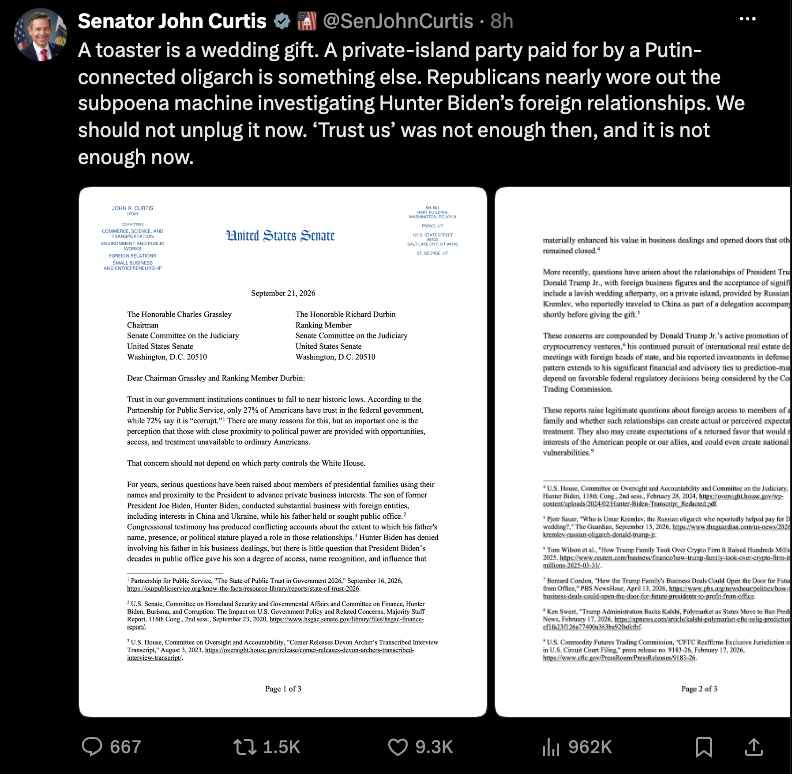
Senator John Curtis, a Republican representing Utah, sent a letter to leaders of the Senate Judiciary Committee calling for an investigation into US President Donald Trump’s and former President Joe Biden’s sons, citing the former’s involvement in the crypto industry.
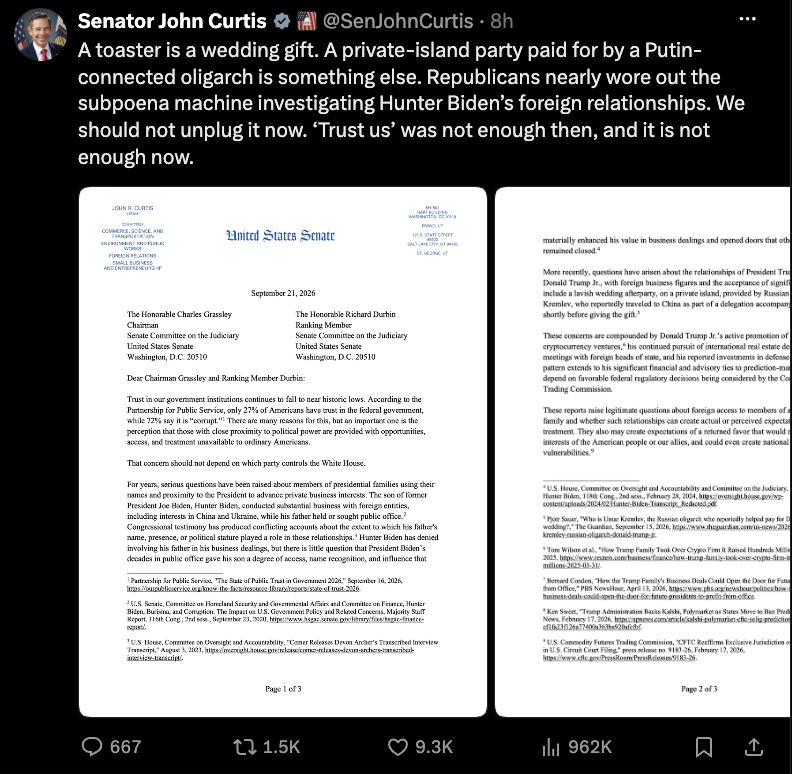
In a Monday letter to Senate Judiciary Committee Chair Chuck Grassley and ranking member Dick Durbin, Curtis said that the body should probe “the use of presidential family relationships for private financial benefit, preferential treatment, or access by domestic and foreign interest.” He also asked for subpoenas for Donald Trump Jr. and Hunter Biden, Joe Biden’s son.
The Utah lawmaker specifically called out Donald Trump Jr. for accepting gifts from Russian oligarch Umar Kremlev as part of his wedding, his “active promotion of family-backed cryptocurrency ventures” and advisory roles with prediction market platforms, as the companies are under the regulatory purview of the Commodity Futures Trading Commission. The president said last week that his son had paid Kremlev back for what Donald Trump Jr. and his wife called a “generous wedding gift.“
Curtis also called for a similar probe into Hunter Biden for “substantial business with foreign entities” and instances in which either man’s relationship to the presidency was “invoked or understood to provide value.” President Biden issued a pardon for his son in December 2024 for crimes he “committed or may have committed or taken part in over the last decade,” and Curtis noted that Hunter had “denied involving his father in his business dealings.“
“The purpose of such an inquiry should be straightforward: establish the facts, determine whether existing ethics, disclosure, or anti-corruption laws apply, and identify reforms necessary to prevent the presidency from becoming a vehicle for private enrichment by those closest to it,” said Curtis.
Source: Senator John Curtis
The call for an investigation into the Trump family’s ties to the crypto industry is nothing new for the current session of Congress, but it has largely come from House and Senate Democrats. Lawmakers have asked authorities to probe potential conflicts of interest surrounding Trump’s memecoin, his family’s World Liberty Financial business and a $500 million deal tied to Abu Dhabi’s royal family.
Curtis is serving his first term in the Senate and will not be up for reelection until 2030.
CLARITY still in limbo in US Senate as midterm elections approach
The call for an investigation into Donald Trump Jr. and Hunter Biden came a week after Senate Republicans failed to secure enough support from Democrats to pass the Digital Asset Market Clarity Act, a bill expected to establish market structure rules for the crypto industry.
One of the sticking points for not supporting the bill, according to some Democrats, was Trump “using crypto to turn the presidency into a profit generating machine.” The president disclosed that he had earned $1.4 billion from ventures tied to digital assets in 2025.
Republicans said the president had agreed to stronger ethics provisions in the bill affecting his crypto investments before the vote, but many Democrats argued that the measures did not go far enough to prevent corruption.
Magazine: Big Questions: Does Satoshi actually own 1.1 million Bitcoin?

Billie Lourd Talks ‘Gift’ That Lets Kids Connect With Late Mom

Reform MSPs flounce out of Holyrood over Scottish independence debate ‘farce’

ACG Metals LimitedA (ACGAF) Q2 2026 Earnings Call Transcript




-

 Fashion4 days ago
Weekend Open Thread: Talbots – Corporette.com
-

 Tech2 days ago
Researchers escape OpenAI Codex sandbox to run commands on host
-

 Crypto World4 days ago
Circle launches Arc Studio AI agent for building onchain apps
-
 NewsBeat4 days ago
Trump says US has reached an agreement to take permanent control of Greenland’s security
-

 Crypto World2 days ago
Who Needs CLARITY Anyway? ARB Could See 70X Increase: Hodler’s Digest
-

 Crypto World4 days ago
Bitcoin price breaks channel as RSI climbs to 63
-

 Crypto World4 days ago
Trading Bitcoin on Robinhood? Why 2% Spread Has Traders Worried
-

 Crypto World6 days ago
US Charges Robinhood Engineers Over Crypto Listing Trades
-

 Crypto World7 days ago
What Is the Status of the U.S.-Iran Peace Talks? Here's What Both Sides Are Saying
-

 Tech7 days ago
Webb’s IC 348 Mosaic Includes Two-Jupiter Dwarfs, Twin Jets, and a Nursery Still Making Worlds
-

 Crypto World5 days ago
Mortgage and refinance interest rates today, Thursday, September 17, 2026
-

 Crypto World4 days ago
World Money launches in 150+ countries with Stripe
-

 Crypto World5 days ago
Silver prices recover quickly, hitting weekly high today
-

 Entertainment7 days ago
Big Brother Update: Melody Explodes at Drew as Illness Sweeps BB28 House
-

 Business2 days ago
Analog Devices (ADI) Bets $1.35 Billion on Chips that Let Machines Think for Themselves
-

 Tech5 days ago
GPT-6 Astra Reached the Nether in Minecraft, Lost Its Stash to a Creeper, and Farmed Potatoes for Hours
-
 NewsBeat4 days ago
US was ‘on brink of war’ with China over false AI report of nukes moving in Middle East
-

 Crypto World2 days ago
Coinbase, Robinhood, Circle Seen as Tokenized-Stock Winners
-

 Crypto World2 days ago
Bitcoin price holds above $81K as key catalysts line up
-

 Business7 days ago
Federal Reserve expected to hike interest rates 25 basis points at FOMC meeting
You must be logged in to post a comment Login