
Crypto World
Crypto firms still face full AML rules after CLARITY Act vote


The Senate’s failure to advance the CLARITY Act has left existing customer identification, anti-money laundering, sanctions, and suspicious activity reporting requirements unchanged for covered U.S. crypto businesses.
Summary
- The failed Senate vote has not altered existing Bank Secrecy Act obligations for covered crypto companies.
- Sponsor banks expect identity, wallet, and transaction controls to remain connected throughout the customer relationship.
- Self-custodial wallet users can be verified at access points without placing personal information on-chain.
- AI agents require limited, revocable authority tied to an identifiable person or company.
CLARITY Act vote leaves existing AML duties intact
Prove Global Head of Digital Assets and Sponsor Banks Fernando Castellanos told crypto.news that the bill dealt mainly with market structure and would not have replaced the Bank Secrecy Act requirements already imposed on covered crypto businesses.
Customer identification, beneficial ownership checks, sanctions screening, AML controls and suspicious activity monitoring remain in force, according to Castellanos. Crypto companies must also continue filing required reports when their systems detect activity that meets applicable reporting standards.
“The failed vote does not change the compliance obligations that already apply to covered crypto businesses,” Castellanos said.
“Market structure legislation was never going to displace the Bank Secrecy Act; it would have clarified which regulator sits on top of it.”
On Sep. 15, the Senate rejected cloture on the motion to proceed with H.R. 3633, the House version of the Digital Asset Market Clarity Act. The failed procedural vote received 49 votes in favor and 50 against, leaving the measure 11 votes below the 60 required to open debate.
The result did not amount to a final vote on the bill itself. Seven Democratic senators who opposed cloture later described the outcome as “not the end” and said they remained committed to bipartisan negotiations. No second vote has been scheduled, although the seven Democrats reopened talks as lawmakers continued to dispute ethics provisions covering elected officials and their digital asset interests.
While the bill remains unresolved, Castellanos said moving funds through blockchain networks does not remove the need to determine who controls an account or stands behind a transaction. Faster settlement and transactions that are difficult to reverse leave firms with less time to identify suspected fraud or illicit activity.
“If anything, it raises the bar,” he said. “As stablecoins and other digital assets make payments faster and harder to reverse, the window to catch a problem gets smaller.”
According to Castellanos, firms must therefore maintain identity and risk checks after onboarding instead of treating verification as a one-time step. Changes in account behavior, wallet activity, or transaction patterns can alter the risk attached to an existing customer.
Sponsor banks expect connected crypto risk controls
When sponsor banks assess a crypto company, Castellanos said they examine controls across the entire customer and transaction lifecycle. Reviews commonly cover customer and business verification, beneficial ownership, sanctions screening, fraud prevention, wallet screening and transaction monitoring.
Banks also seek evidence that each control works under actual operating conditions, rather than relying solely on written compliance policies or tests conducted before launch. Castellanos said separate tools can create blind spots when identity, wallet and transaction data do not flow into the same risk process.
“A bank needs confidence that you know who is behind an account or a wallet, and that you will see it when that risk profile changes.”
Under the proposed CLARITY framework, federal oversight would be divided between the Securities and Exchange Commission and the Commodity Futures Trading Commission. The bill’s split federal oversight would place qualifying digital commodities and registered spot-market intermediaries under CFTC supervision while preserving SEC authority over securities and related transactions.
Such a division would answer which federal regulator supervises certain assets and activities, but it would not erase separate compliance layers. State money-transmitter licensing, federal sanctions rules and existing obligations for covered financial institutions could still apply depending on a company’s services and customers.
For sponsor banks, connected controls help determine whether an account or wallet still belongs to the verified party and whether later activity matches the customer’s expected use. Castellanos said firms can reduce friction for legitimate users by combining several risk signals instead of repeatedly asking customers to complete isolated checks.
DeFi identity checks can remain off-chain
Verification for self-custodial wallets and decentralized finance does not require personal information to be written to a public blockchain, according to Castellanos. Firms can perform checks at points where regulated companies already interact with users, including fiat on-ramps, off-ramps, application interfaces and other access points.
Keeping names, identification documents and other sensitive records outside public ledgers avoids exposing information that cannot later be removed. Regulated companies can still retain the records needed to meet their obligations within controlled systems.
Castellanos said counterparties also do not need every piece of information collected during verification. A firm may only need confirmation that a user has passed an identity check, controls a stated wallet or does not appear on a sanctions list.
“Confirming a claim, rather than handing over the underlying data, is what lets firms meet their obligations without putting personal information on-chain or forcing open software to behave like a conventional intermediary.”
Such an approach separates a protocol’s open-source code from the compliance duties of regulated companies using interfaces or payment rails around it. Castellanos said the objective is not to treat every self-custodial wallet like a bank account, but to establish enough verified information around a regulated interaction to manage its identified risks.
The CLARITY proposal addressed related questions through registration exemptions for some DeFi software developers, wallet providers and validator operators. Its failure to advance means firms must continue applying existing law while Congress, the SEC and the CFTC consider how decentralized services fit within U.S. financial rules.
AI agents require limited and revocable authority
Identity controls become more complex when an AI agent opens an account, trades assets or initiates a payment for a person or company. Castellanos said institutions must establish who controls the agent, who approved a specific action, and what the software is permitted to do.
Each question requires a separate check. Verifying the human or business behind an agent establishes accountability, while an authorization process determines whether the agent has permission to initiate the transaction under review.
According to Castellanos, such authority should be limited in scope, bound to a set period, and capable of being withdrawn. Institutions should verify permission when a transaction occurs instead of relying on an approval granted earlier, especially when software can move funds without fresh human input.
The issue has become more immediate as U.S. crypto platforms add tools for machine-directed finance. In June, the Coinbase for Agents launch allowed authorized software agents to trade crypto, manage portfolios, make payments and perform financial tasks through user accounts.
Coinbase said users can set rules for portfolio rebalancing, trade execution and position management. Its x402 protocol also allows agents to pay for data, research, application programming interfaces and computing services without direct human involvement in each payment.
For financial institutions supporting similar services, Castellanos said authorization must connect the transaction to the responsible human or company. The record should identify the principal, the agent, the approved action and the limits applied when the transaction was initiated.
“As agents begin interacting with financial systems and moving money autonomously, there needs to be a clear, verifiable chain connecting the person, the business, the agent and the transaction,” he said.
Castellanos said institutions will need to move from verifying a customer once to continuously checking who has authority to act and whose funds or account an AI agent is using.




Artificial intelligence is getting better at doing more than answering questions. AI systems are now helping with coding, research, analysis and other tasks that were once handled almost entirely by people. That raises a new question: what happens when AI starts playing a bigger role in building the next generation of AI?
OpenAI is now calling for international standards to help answer that question. In a September 21 post titled “Building standards for the next phase of AI,” OpenAI proposed a US-led international effort to create common technical standards for frontier AI. The company says these standards could help countries measure AI capabilities, evaluate risks, test safeguards and report serious incidents using more consistent methods.
Key Takeaways
- OpenAI wants international standards for evaluating frontier AI.
- The proposal covers capabilities, risks, safeguards and incident reporting.
- OpenAI says fully autonomous recursive self-improvement is not happening today.
- The company wants human control to remain central as AI becomes more capable.
- Existing AI safety organizations could help develop common technical standards.
Openai Wants a Common Framework for Frontier AI
The basic idea is fairly simple. It is not necessary for each country to create an entirely different methodology for evaluating the dangers posed by advanced AI. According to OpenAI, standardizing technical approaches can provide nations, researchers and the AI community an effective way to assess their increasingly sophisticated AI. This becomes all the more relevant when AI-related incidents happen across borders.
The company is not proposing a single global AI law. Instead, it wants countries to develop compatible standards that governments can later decide how to use within their own regulatory systems. This difference is significant since the suggested standards do not immediately become requirements for licensure or certification for all artificial intelligence technologies. Rather, governments retain the power to determine how the standards will apply within their jurisdictions.
Recursive Self-Improvement Is Part of the Conversation
One of the more interesting parts of OpenAI’s proposal is its discussion of recursive self-improvement (RSI). The concept describes a future in which AI systems could increasingly help researchers develop more capable AI systems. In simple terms, AI could become part of the process of improving AI itself.
That could potentially speed up AI research. But it also creates a difficult safety question: how much human oversight should remain in the loop if AI systems become heavily involved in developing future models?
OpenAI says fully autonomous recursive self-improvement is not happening today. It also argues that such a direction should not be pursued unless it can be done safely while maintaining human control. That makes evaluation and safety testing more important as AI systems become capable of handling increasingly complex research and development tasks.
AI Safety Standards Could Become More Important
OpenAI also points to existing AI safety organizations and networks around the world as potential building blocks for this effort. The company specifically references AI safety institutes and related organizations across countries including the US, UK, Canada, France, Germany, Japan, South Korea, Singapore, India, Kenya and Australia.
Rather than every country developing its own completely separate technical approach, OpenAI wants these groups to work toward standards that can complement one another. The proposal also calls for participation from AI developers, researchers, academics and independent technical experts. OpenAI says the standards should be designed around technical measurements rather than the interests of a particular company or country.
Why This Matters
The timing is notable. AI companies are building systems that can increasingly perform multi-step tasks with less direct human input, while governments are still working out how to regulate the technology.
Reuters reported that OpenAI wants the United States to take a leading role in developing international technical standards for advanced AI. The bigger challenge may be getting countries and companies to agree on exactly what those standards should measure and how they should be applied.
For now, OpenAI’s proposal is focused on creating a common technical foundation before frontier AI becomes even more capable. As AI starts doing more of the work involved in developing AI itself, having a shared way to measure capabilities, risks and safeguards could become an increasingly important part of the conversation.

Although AI is fundamentally changing cybersecurity, Bartley Richardson thinks the hackneyed IT refrain still rings true: “The best security is the security you don’t have to think about.” Richardson, a former Nvidia engineer who joined cybersecurity company CrowdStrike in June as its chief AI and autonomous systems officer, says his title perfectly reflects his belief that once consumers trust AI, they’ll stop regarding it as “AI.” Instead, it will be just another autonomous tool making life better in the background, like a grammar check in word processing.
Richardson is shepherding that transition as leader of CrowdStrike’s new Cyber Superintelligence Lab. An AI research lab dedicated to building autonomous cybersecurity systems, its first release is SafeMind, an agentic system that combats AI attacks by pairing an offensive cybersecurity model with a defensive one, creating an autonomous loop of learning and remediation. “An attacker has to be right once, but the defender has to be right all the time,” Richardson says. “We’re giving the advantage back to the defender, and we’re doing that with … better automation.”
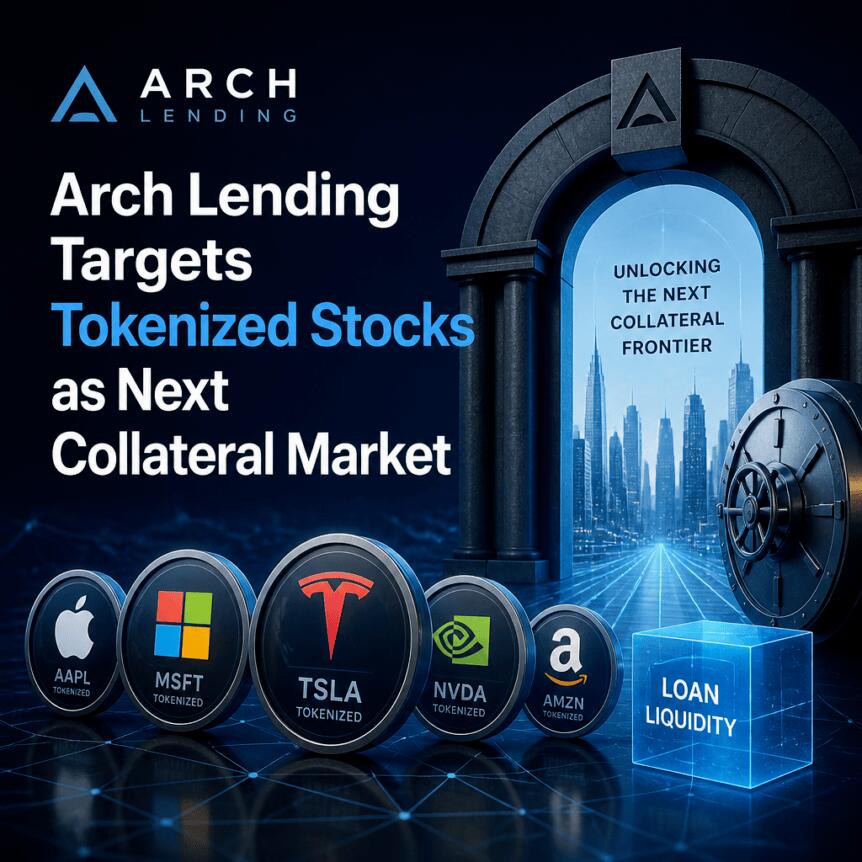
Arch Lending is preparing to move deeper into credit markets for tokenized equities, with plans to offer loans backed by onchain representations of stocks and exchange-traded funds (ETFs). Speaking on Cointelegraph’s Chain Reaction podcast, Arch co-founder and chief revenue officer Himanshu Sahay said the lender wants to enter “pretty soon,” citing a growing need for borrowing against tokenized stock assets.
Sahay pointed to rapid expansion in tokenized equities over the past year, while also arguing that lending against those assets remains limited today. He predicted that more lenders will follow, especially as tokenized stocks issued by platforms such as Superstate, Robinhood, and Securitize become more widely used in collateral frameworks.
Key takeaways
- Arch Lending plans to launch loans backed by tokenized equities “pretty soon,” aiming to address limited credit availability for onchain stock assets.
- Sahay said tokenized equities have expanded quickly over the past year, but lending usage still lags the pace of issuance and experimentation.
- Arch’s current loan book is still dominated by crypto collateral: Sahay said Bitcoin makes up more than 80% of exposure.
- Interest in using XRP as collateral is reportedly growing among US borrowers.
- Tokenized equities lending is already emerging via platforms like Ondo Finance and infrastructure providers tied to Ethereum-based lending protocols.
Arch’s shift from crypto-only lending to onchain stocks
While Arch’s core business is rooted in crypto-backed lending, Sahay emphasized that the lender is actively looking for additional collateral categories as the tokenized equities ecosystem matures. The company has already expanded beyond cryptocurrencies into real-world assets (RWAs), offering loans backed by tokenized gold and stablecoin-linked gold products issued by Paxos and Tether, according to Sahay.
Even with that progress, Sahay described Bitcoin as the dominant collateral in Arch’s current lending operations, accounting for more than 80% of the lender’s existing loan book. That detail underscores a transition phase: Arch is expanding its collateral menu, but crypto remains the base business while the market for tokenized equities develops deeper liquidity and clearer credit pathways.
Sahay also noted an uptick in demand for XRP collateral, particularly from borrowers in the United States. For lenders, the relevance of a collateral asset hinges on custody, valuation reliability, liquidation mechanics, and borrower appetite—so increases in specific collateral usage often signal that risk models and market plumbing are becoming more robust.
Tokenized equity credit is already taking shape
Arch would not be the first lender to attempt credit exposure to tokenized equities. Over the past year, tokenized stocks and ETFs have begun appearing across lending and collateral products, suggesting the industry is converging on Ethereum-based rails and DeFi-compatible collateral workflows.
In February, Ondo Finance launched DeFi lending markets for two of its tokenized ETFs through an integration with lending protocol Morpho. Ondo’s tokenized versions of the SPDR S&P 500 ETF and Invesco QQQ can be used as collateral for borrowing on Ethereum.
Beyond dedicated lending venues, other firms have also moved toward broader composability of tokenized equities. Kraken made its 10 xStocks eligible to support futures and margin positions in July. Meanwhile, Coinbase’s B20 stocks launched on Base in August, using price-feed infrastructure designed to support use cases that include DeFi borrowing and lending.
For investors and borrowers, these steps matter because they reduce friction: if tokenized equities can be used across multiple systems—rather than being confined to a single application—then lenders get more reliable access to collateral and liquidation workflows, while borrowers can more easily integrate the assets into existing strategies.
What’s driving demand: the onchain stocks market is growing
The push toward equity-backed lending aligns with expansion in the underlying tokenized equities market. According to RWA.xyz data cited in Cointelegraph’s coverage, distributed tokenized stock value has risen to about $3.15 billion, up from roughly $630 million a year earlier.
That magnitude of growth helps explain why lenders are considering tokenized equities more seriously. However, growth in issued or distributed token value does not automatically translate into deep lending markets. Lenders still need mechanisms to price the collateral, manage volatility, and execute liquidations efficiently—especially if the tokenized asset references traditional equities with their own settlement and liquidity characteristics.
Arch’s stated intent to add equity-collateral loans fits this broader pattern: as tokenized equities scale, the next layer of adoption is typically finance infrastructure—credit, margin, and yield—provided risk teams can support it. The “limited” lending described by Sahay suggests that, despite issuance momentum, the market still has room for additional lenders to compete on terms, collateral support, and risk management.
Why Arch’s timing could matter
Arch’s move comes at a moment when tokenized stocks and ETFs are increasingly being treated as collateral across multiple platforms and use cases. If tokenized equities continue to attract liquidity, lenders that expand collateral coverage earlier may capture relationships with borrowers seeking diversified collateral strategies—particularly when crypto-only borrowing is constrained by liquidity or collateral concentration concerns.
At the same time, the transition is not instantaneous. Sahay’s comments indicate that Arch’s current exposure remains largely tied to crypto, with Bitcoin still representing the vast majority of the existing loan book. That suggests Arch will likely approach tokenized equity lending with caution—building the operational and risk infrastructure needed to support assets with distinct market behavior compared with traditional crypto benchmarks.
For now, readers should watch whether Arch’s tokenized equity lending plans translate into actual launch details—such as which tokenized equities will be supported first, how collateral valuation and liquidation are handled, and whether demand from borrowers grows alongside the broader tokenized equities market. The combination of issuance expansion and the still-limited state of lending could determine how quickly this segment becomes a standard offering for credit providers.

The US commodities regulator has warned that prediction market contracts tied to what a person says or does carry a heightened risk of manipulation, putting exchanges on notice as the industry faces increasing scrutiny over market integrity.
The Commodity Futures Trading Commission’s Division of Market Oversight on Tuesday said it issued an advisory to some of its regulated entities, advising that there are only “limited circumstances” in which “mention markets” — event contracts based on whether an individual will say certain words, attend or appear at an event or interact with another person — can be listed consistently with the Commodity Exchange Act.
“These contract types present a heightened risk of manipulation because their settlement turns on the discrete conduct of a person that may be neither independently generated nor externally verifiable,” the regulator said.
The warning follows several cases involving traders accused of exploiting privileged information on prediction markets, including a former White House teleprompter operator who was ordered last month to return $107,539 in profits and pay a $65,000 civil penalty for trading contracts tied to US President Donald Trump’s speeches.
Related: Kalshi US visits soar 1,500% as regulatory pressure mounts
According to CNBC, the CFTC letter said exchanges listing mention markets should consider four factors: whether there are adequate oversight measures in place to detect manipulation, whether the words or actions used for settlement are independently verifiable, external pressure that could influence the subject’s conduct, and what outside obligations the subject of the mention market may have.
CFTC Chair Mike Selig welcomed the guidance in an X post on Tuesday, saying that “regulatory clarity drives sound markets.”
“Pleased to see staff provide guidance on the potential risks and unique considerations associated with the listing of mention markets on CFTC-regulated exchanges and remind DCMs of their obligation to list only contracts not readily susceptible to manipulation.”
Cointelegraph reached out to the CFTC for comment.
Magazine: How to fix suspected insider trading on Polymarket and Kalshi
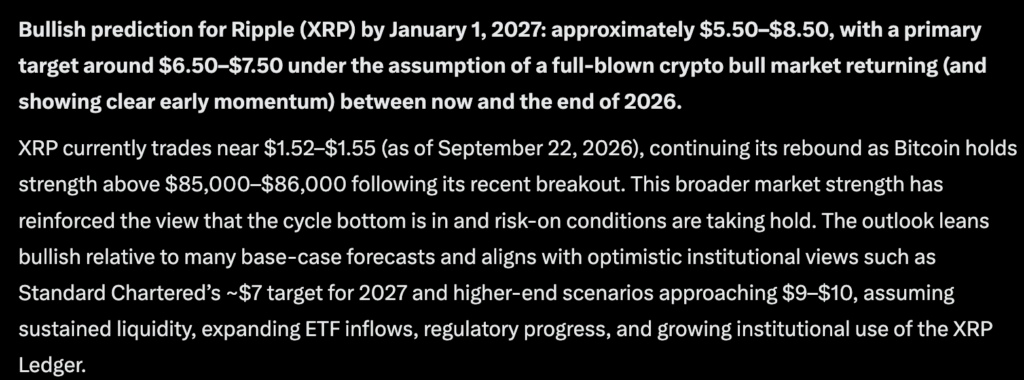
In welcome news for the Ripple army, Google Gemini AI predicts XRP could hit $8.50 by the end of 2026 if certain conditions are met. The update comes as CoinGecko data shows XRP trading at $1.30, up a modest +0.4% over 24 hours but down -6.6% for the week, following a significant drop after the Senate blocked the CLARITY Act.
Despite this, XRP is up around +11% in the last week and +65% over the past year, with an all-time high of $3.65. Its market cap stands at approximately $96Bn. Positive developments include ongoing inflows into spot XRP ETFs and Ripple’s stance that XRP is a digital commodity.
Bull-case price targets for XRP by January 1, 2027, are $5.50–$7.50, with a stretch target of around $8.50. This assumes the CLARITY Act setback is temporary and will return to bull-market conditions.
In this instance, it could help XRP reclaim its all-time high and initiate price discovery. A stretch case would require a retail-driven market flourish alongside institutional accumulation.
Earn $50 and Enter $300K Prize Draw on EdgeX
Google Gemini AI Predicts $8.50+ for XRP in 2026: Does the Technical Analysis Support It?
XRP’s chart shows a sharp climb driven by a short squeeze, pushing the price to about $1.54. This pattern of high volatility around significant regulatory events has been a consistent feature of XRP’s price action throughout the year.
The critical downside level to watch is the $1.5 area, which represents this week’s low. This level must hold to maintain the broader uptrend structure; a break below it could open the door to the psychological level of $1.00.
On the upside, immediate resistance sits at the $1.64 zone, which capped the price before this week’s decline. The next major hurdle is the $2.00 to $2.70 range, where the 2025 highs sit.
The most significant level overall remains the all-time high of $3.65. XRP has never sustained trading above this price, so a decisive breakout would take it into uncharted territory with no historical overhead resistance. This scenario usually precedes XRP’s fastest price movements.
Additionally, a return of strong net inflows, accompanied by increasing spot volume, would signal that the bullish case for XRP is back on track.
The entire range above $5.50 assumes that the current setback is resolved constructively, potentially through a re-vote or an alternative legislative path, alongside a return to broader bull market conditions.
Supercharge Your Trading in 2026 With BloFin AI Trading Bots
Bitcoin Hyper Targets Early Mover Upside as Bitcoin Tests Key Levels
Bitcoin Hyper is improving network visibility. — Bitcoin Hyper (@BTC_Hyper2) September 15, 2026


Better observability helps the team track performance, understand transaction flows, identify issues earlier, and refine the ecosystem as it grows.
Read the full article  https://t.co/PHfiR1IOFq pic.twitter.com/J6vKOUg1VP
A nearly +7% surge overnight is impressive for XRP, but at its current market cap, it will need something huge to move significantly rather than just a relief bounce.
For traders seeking asymmetric upside as Ripple tries to breach $1.60, attention is shifting toward earlier-stage infrastructure projects built on the Bitcoin base layer.
Bitcoin Hyper (HYPER) is developing the first Bitcoin Layer 2 solution with SVM integration, aiming to process transactions faster than Solana, while also benefiting from Bitcoin’s base-layer security.
The presale has raised over $33M, with a token price of $0.0136863 and a substantial 35% staking reward available for early participants at launch.
Additionally, its Decentralized Canonical Bridge aims to enable low-cost, low-latency BTC transfers, addressing the slow, non-programmable Bitcoin issues that have plagued the network for over a decade.
Gain Access to New Bitcoin Layer 2 Early Here Make Your XRP Price Prediction With $25 For Free on Kalshi
The post Google Gemini AI Predicts XRP Could Hit $8.50 by 2027 appeared first on Cryptonews.
Popular betting on what an individual might say or do, known as “mention markets,” pose some special dangers in the eyes of the U.S. regulator overseeing prediction market firms such as Kalshi and Polymarket, according to an advisory issued on Tuesday that may narrow the window on event contracts that would easily clear the agency’s supervisory hurdles.
This category of wagering isn’t like other markets featuring “independently generated, externally verifiable outcomes that are outside the control of any single person,” said the Commodity Futures Trading Commission’s staff advisory. Instead, the agency noted, the outcome pivots on “the discrete conduct of a named person, and that conduct may be neither independently generated nor externally verifiable.”
Basically, the individual or people around the person could shift the outcome based on their own knowledge of the betting. The CFTC’s Division of Market Oversight that watches this sector may see these markets as “presumptively readily susceptible to manipulation,” according to the advisory. To that end, the CFTC reminds prediction platform operators that they’re only allowed to trade “derivative contracts that are not readily susceptible to manipulation.”



Kazakhstan’s regulated cryptocurrency market has surpassed $10 billion in annual trading turnover as the country expands licensed digital asset services and builds its domestic Web3 developer ecosystem.
Summary
- Kazakhstan’s regulated crypto market recorded $10.58 billion in trading turnover in 2025, up from $320 million in 2023, while users increased to 215,000.
- More than 8,000 people received Solana ecosystem training over the past year, with over 2,000 earning certificates and Kazakhstan entering the global top 10 for Solana hackathon applications.
- Kazakh Web3 startups received 121 million tenge in grants, while the country hosted a Solana Summit attended by more than 900 participants from over 30 countries.
- Kazakhstan is extending blockchain use into regulated finance through a Solana based exchange traded fund and plans to tokenize up to $60 million in real estate and logistics projects by the end of 2026.
According to Deputy Minister of Artificial Intelligence and Digital Development Gizzat Baitursynov, trading turnover across the regulated market reached $10.58 billion in 2025, compared with $320 million in 2023, while the number of users rose from 53,000 to 215,000 over the same period.
Baitursynov disclosed the figures during a government meeting on Sept. 15, detailing the expansion that followed Kazakhstan’s initial crypto market pilot with the Astana International Financial Centre and financial regulators.
Launched in 2022, the pilot was designed to test a regulatory framework for cryptocurrency exchanges before becoming the basis for a licensing and operating system within the AIFC.
Kazakhstan has continued building regulatory infrastructure around the growing market. crypto.news previously reported that the country plans to establish a national crypto analytics center to monitor fiat payments, cryptocurrency transfers, wallets and customer information.
National Bank Chairman Timur Suleimenov said the center would operate on the central bank’s SupTech supervisory platform and connect with its existing Anti Fraud Center. Banks, law enforcement agencies and licensed digital asset providers are expected to receive access to its verification tools.
Kazakhstan crypto market grows alongside Solana developer base
Development of the regulated market has been accompanied by programs designed to train blockchain developers and support local Web3 projects.
Talgat Dossanov, head of the Solana Superteam KZ corporate foundation, said more than 8,000 people received training through cooperation with the Solana ecosystem over the past year. More than 2,000 participants completed the programs and received certificates.
Roughly one in five certified graduates represented a government body, according to Dossanov. Training programs covered blockchain fundamentals, development on Solana, practical assignments and preparation for international hackathons.
Kazakhstan has since entered the global top 10 by the number of applications submitted to international Solana hackathons, Dossanov said.
Local startups have received financial support alongside the training programs. A total of 57 Kazakh startups secured grants worth 121 million tenge, equivalent to approximately $262,000.
The country hosted an international Solana Summit attended by more than 900 participants from over 30 countries. Livestreams distributed through Solana’s social media channels reached an audience of roughly 4 million people, according to the government.
Kazakhstan remains the only country in Central Asia with an official Solana representation, government officials said.
Solana enters Kazakhstan’s financial infrastructure
Work with the Solana ecosystem has moved beyond developer training and startup programs into regulated financial products.
Together with the Kazakhstan Stock Exchange, the country launched an exchange traded fund based on the public Solana blockchain. The product gives the domestic financial market another connection to Solana as regulated investment products tied to the network expand internationally.
Institutional demand for Solana investment products has grown in other markets during 2026. In the United States, the Bitwise Solana Staking ETF surpassed $1 billion in assets in August, less than 10 months after its launch.
Bitwise reported that the fund held 9.33 million SOL worth approximately $1.018 billion as of Aug. 26, with 96% of its assets staked. Bloomberg senior ETF analyst Eric Balchunas said Solana funds had retained most of the roughly $1.7 billion in accumulated inflows recorded at the time.
Kazakhstan has pursued direct cooperation with organizations in the Solana ecosystem as well. On June 11, Alatau City and the Solana Foundation signed a memorandum in Hong Kong covering further cooperation.
The agreement came as Alatau City develops its role in Kazakhstan’s technology and digital asset plans, while the government continues bringing blockchain based services into regulated financial infrastructure.
Kazakhstan expands state backed crypto programs
Digital asset policy in Kazakhstan now covers trading, mining, payments, market surveillance and state investment programs.
In July, the government approved a strategic crypto mining framework that allows qualifying large scale miners to obtain electricity quotas at regulated tariffs after agreeing to transfer part of their mined cryptocurrency to a reserve mechanism administered through Astana Hub.
Operators seeking strategic status must own a digital mining data center with at least 150 megawatts of installed capacity. Mining equipment at qualifying facilities must provide at least 150 terahashes per second of computing power per unit, while operators face requirements covering staffing, repair facilities, internet connections and tax compliance.
The program sits alongside Kazakhstan’s plans for state exposure to digital assets. Earlier in 2026, the National Investment Corporation earmarked $350 million from foreign currency and gold reserves for crypto related investments.
The country has maintained enforcement against activity outside its licensed market while expanding regulated services. Authorities blocked more than 1,100 online platforms offering cryptocurrency exchange services without authorization during 2025.
Financial authorities had taken action against 36 illegal crypto platforms a year earlier. The operators recorded combined turnover of 60 billion tenge, while authorities seized 4.8 million USDT from unauthorized services.
Tokenization plans target real estate and logistics
Kazakhstan’s next set of blockchain projects includes bringing physical assets into digital markets.
National Bank Governor Timur Suleimenov said the country plans to tokenize up to $60 million worth of real estate and logistics projects by the end of 2026.
The initiative is intended to test digital assets as a source of financing for economic projects, extending Kazakhstan’s blockchain activity from cryptocurrency trading and mining into tokenized assets.
Tokenization converts ownership or economic rights connected to assets into blockchain based tokens that can be issued, transferred and settled digitally. The sector has been attracting growing institutional interest, with the global market for tokenized real world assets reaching roughly $30 billion to $34 billion by mid 2026.
Kazakhstan’s planned projects will follow several regulated crypto initiatives already operating in the country. Bybit Kazakhstan launched the country’s first regulated peer to peer trading platform in November 2025 under an Astana Financial Services Authority license, requiring identity verification and routing fiat payments through corporate accounts held by licensed financial institutions.
The Astana Financial Services Authority began a separate pilot in September 2025 that permits eligible firms to pay regulatory fees using US dollar pegged stablecoins through approved agents.
Regulated crypto payments have since entered the banking system. Alatau City Bank partnered with Binance Kazakhstan in July to introduce Crypto Pay, allowing customers to pay with cryptocurrency through QR codes and point of sale terminals connected to the bank’s acquiring network.
Kazakhstan’s mining industry remains part of the same regulated infrastructure. The Cambridge Digital Mining Industry Report ranked the country fifth globally by Bitcoin mining activity in April 2025, while the government’s strategic mining framework now ties additional regulated electricity access to participation in its state backed digital asset reserve.

Kalshi has asked the Commodity Futures Trading Commission to approve a margin framework for eligible event contracts, limiting access to qualified participants and excluding markets tied to sports.
Summary
- Eligible contracts may cover economic, financial, political, commercial, and other verifiable events.
- Sports contracts will remain ineligible, while Kalshi reportedly excluded culture and mention markets.
- Access will require trading through an FCM or qualifying as an approved self-clearing member.
- Kalshi’s model uses a one-day risk period and targets confidence above the required 99% level.
Kalshi margin framework targets eligible event contracts
Kalshi Klear’s Sept. 22 filing asks the CFTC to approve amendments to its rules and margin risk framework under Regulation 40.5(a). The clearinghouse said the changes would introduce a new initial-margin method for selected event contracts.
Contracts tied to economic data, financial developments, politics, commercial activity and other “objectively verifiable events” could qualify. Eligibility would depend on the product and the side of the contract being traded.
Sports-event contracts would not receive margined treatment under the proposal. Kalshi also told CNBC that culture and mention markets, which can cover whether a person says a particular word or phrase, would remain outside the program.
Under Kalshi’s current structure, event contracts are binary products that settle at $1 when a specified outcome occurs and $0 when it does not. Before settlement, prices trade between those two values, leaving each side with a defined maximum possible loss.
A trader holding a YES position can lose no more than the price paid. For the opposing NO position, the maximum loss equals $1 minus the YES price. Kalshi said the bounded payoff allows its clearinghouse to calculate margin separately for each side.
Rather than requiring traders to post enough funds to cover the full possible loss at the outset, the framework would set initial margin according to modeled adverse price moves. A qualifying participant could therefore control more contracts than would be possible under the platform’s fully collateralized structure.
Access would remain limited to qualified participants
Margin would not become available to every Kalshi customer under the filing. Eligible contracts could be cleared only through a registered futures commission merchant, or FCM, or by an eligible contract participant approved by Kalshi Klear as a self-clearing member.
Eligible contract participants generally include institutions and other entities that meet financial thresholds defined under U.S. commodities law. The restriction positions the product for hedge funds, trading firms, and other professional market participants rather than ordinary retail accounts.
Each newly listed product would initially remain fully collateralized until Kalshi reviewed and approved it for margin. Its clearinghouse could designate both sides of a binary contract for margin, approve only the YES or NO side, or keep both sides fully funded.
According to the filing, early or sudden resolution may create different risks for the two sides of a contract. Kalshi therefore plans to calculate eligibility and margin requirements separately instead of treating opposing positions as identical.
The framework would also raise collateral requirements as a contract approaches expiration or when market conditions increase the risk of abrupt repricing. Contracts would eventually reach full collateralization near resolution, even if they retained their formal classification as margined contracts.
Scheduled events capable of causing sharp price changes would trigger additional requirements. Kalshi also proposed volatility floors, concentration charges, and liquidity adjustments designed to account for the cost of closing positions after a clearing-member default.
Kalshi proposes a one-day margin risk period
Kalshi has requested permission to use a one-day, or 24-hour, margin period of risk for qualifying products. The period represents the estimated time needed to manage or close a position after a default.
Its model seeks to maintain a confidence level above the 99% minimum required by CFTC regulations. The clearinghouse said it tested the framework using historical data and measured performance separately for the YES and NO sides.
Among the safeguards, Kalshi described a dual-speed volatility measure that would raise margin quickly after a price shock but reduce it more slowly when conditions settle. Such controls are intended to prevent required collateral from falling too far during less volatile trading periods.
Portfolio offsets would be permitted only for related contracts with reliable payoff links or correlations. Before receiving the benefit, a portfolio would need to pass loss backtesting designed to determine whether the proposed offset remains effective under adverse conditions.
Kalshi said its guaranty fund would support margined event contracts and perpetual futures through separate contract segments. Fully collateralized customers would not lose their posted collateral because of defaults involving margined positions, although a severe event could expose part of their profits to contract tear-ups when the other side contains a margined position.
The proposed amendments would take effect no earlier than the first business day after the 45th calendar day following the submission, unless Kalshi or the CFTC selects a later date. Several technical sections covering the model’s design, calibration and validation were withheld from the public document after the company requested confidential treatment.
Institutional push follows Kalshi’s perpetual expansion
Kalshi has already introduced leverage through its U.S. perpetual futures business. As crypto.news reported in May, the CFTC cleared the company to list a Bitcoin perpetual futures contract, providing a federally regulated route to a product historically concentrated on offshore crypto exchanges.
The exchange has since added contracts tied to several digital assets. In early September, Kalshi launched five crypto perps covering BNB, Cardano, Worldcoin, Aave and Venice Token. The dollar-margined products allow long and short positions without an expiry date, with maximum leverage varying by asset.
Perpetual futures and binary event contracts carry different payout structures. Perpetuals track an underlying asset’s price without an expiration date, while Kalshi’s event contracts pay a fixed amount based on whether a defined outcome occurs. Both products can expose traders to larger losses when margin reduces the amount of capital required to open a position.
The event-contract filing arrives as Kalshi seeks more business from professional trading firms. An August securities filing showed that the company had sold $1.12 billion of a nearly $1.5 billion equity offering since April, leaving about $380 million available.
Kalshi’s $1 billion Series F valued the company at $22 billion in May, with Coatue leading the round and participation from Sequoia Capital, Andreessen Horowitz, IVP, Paradigm, Morgan Stanley and ARK Invest. Company figures released at the time put annualized trading volume at $178 billion, up from $52 billion six months earlier, while institutional volume had risen 800%.
Reports later said Kalshi was considering another $750 million raise at a valuation of about $40 billion. The August filing did not confirm whether its remaining $380 million represented a separate financing or identify the investors that could purchase the unsold portion.

Walmart Bettergoods pasta recalled over possible listeria contamination

Executives of the Year: Sven Gerjets

Jacob Elordi Compared To Kendall Jenner’s Ex After New Look




-

 Fashion4 days ago
Weekend Open Thread: Talbots – Corporette.com
-

 Tech2 days ago
Researchers escape OpenAI Codex sandbox to run commands on host
-

 Crypto World4 days ago
Circle launches Arc Studio AI agent for building onchain apps
-
 NewsBeat4 days ago
Trump says US has reached an agreement to take permanent control of Greenland’s security
-

 Crypto World2 days ago
Who Needs CLARITY Anyway? ARB Could See 70X Increase: Hodler’s Digest
-

 Crypto World4 days ago
Bitcoin price breaks channel as RSI climbs to 63
-

 Crypto World4 days ago
Trading Bitcoin on Robinhood? Why 2% Spread Has Traders Worried
-

 Crypto World6 days ago
US Charges Robinhood Engineers Over Crypto Listing Trades
-

 Crypto World7 days ago
What Is the Status of the U.S.-Iran Peace Talks? Here's What Both Sides Are Saying
-

 Crypto World5 days ago
Mortgage and refinance interest rates today, Thursday, September 17, 2026
-

 Crypto World4 days ago
World Money launches in 150+ countries with Stripe
-

 Business2 days ago
Analog Devices (ADI) Bets $1.35 Billion on Chips that Let Machines Think for Themselves
-

 Crypto World5 days ago
Silver prices recover quickly, hitting weekly high today
-

 Entertainment7 days ago
Big Brother Update: Melody Explodes at Drew as Illness Sweeps BB28 House
-
 NewsBeat4 days ago
US was ‘on brink of war’ with China over false AI report of nukes moving in Middle East
-

 Tech5 days ago
GPT-6 Astra Reached the Nether in Minecraft, Lost Its Stash to a Creeper, and Farmed Potatoes for Hours
-

 Crypto World2 days ago
Coinbase, Robinhood, Circle Seen as Tokenized-Stock Winners
-

 Crypto World2 days ago
Bitcoin price holds above $81K as key catalysts line up
-

 Business7 days ago
Federal Reserve expected to hike interest rates 25 basis points at FOMC meeting
-

 Business4 days ago
Newsom accelerates AI oversight, advances ‘kill switch’ plan
You must be logged in to post a comment Login