

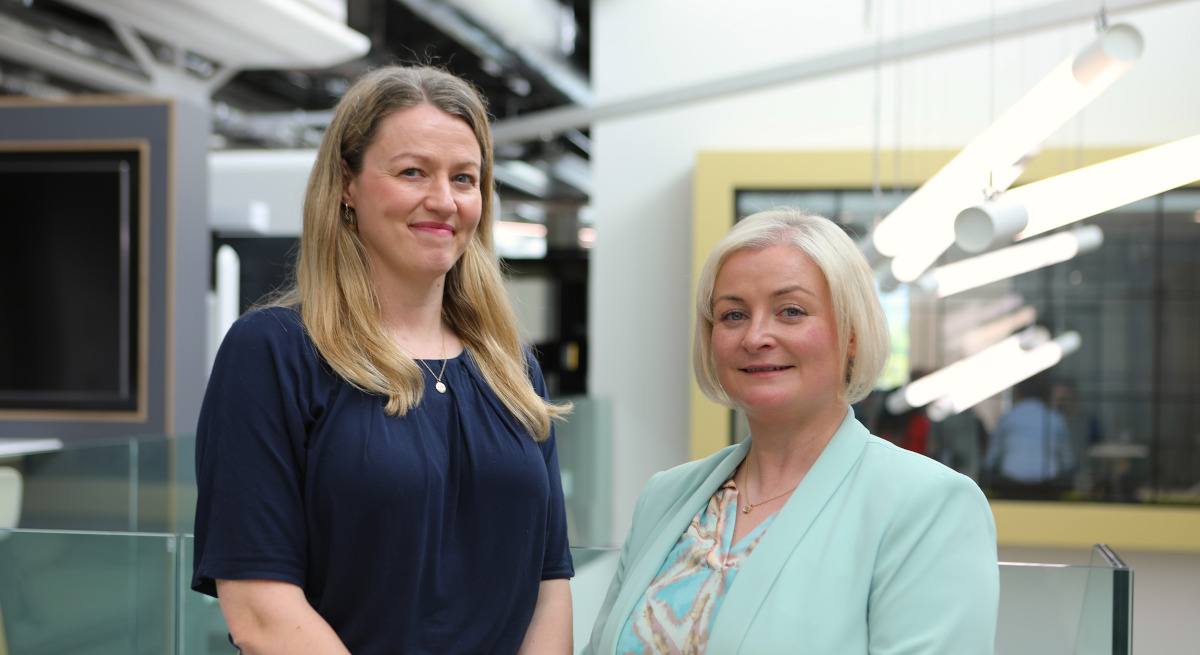

Amgen’s Christine O’Sullivan and Angela Jenkins discuss the impact a strong network can have when forging a career.
According to Christine O’Sullivan, an operations transformation senior manager at Amgen, networking is key to building relationships, particularly in larger organisations, as no one should work in isolation.
O’Sullivan told SiliconRepublic.com: “We rely on people across different functions who share different expertise, experience and perspectives. Building those relationships helps us understand more about the wider business, but it also makes it much easier to collaborate and to get things done when we need to.
“And that’s probably the simplest way I’d describe the value of networking, very few of us are going to achieve anything meaningful entirely on our own.”
For Angela Jenkins, a senior manager for quality and compliance, said that at its core, networking – while it sounds very formal – is really just about making connections.
She said: “If you’re an introvert it can be daunting, but it’s about striking up a conversation when you’re in the queue for a sandwich at the canteen or engaging with a colleague over coffee to find out what’s going on in their part of the business.
“This is an effective way to get to know different people across the business. Those small interactions are often how relationships start. Having a good network is essential to accessing expertise. You may not have the answer to a technical question, but you might know someone who knows someone else who has the answer.
“You build these connections across your working life, and then you can tap into that network for advice and guidance. Sometimes, it provides the answer to a question and on other occasions, it opens a door to a new opportunity.”
Who typically benefits from work-based networking initiatives?
O’Sullivan: Everyone benefits from networking, but it can be particularly valuable if you don’t have an established network, maybe you’re early in your career, new to the company, or have moved function or location. As you progress, those relationships will help you navigate and work across different parts of the business.
And importantly, networking is a two-way street. We all bring different experiences and perspectives. A digital native and someone with 20 years’ industry experience will learn different things from each other. That applies to leaders too, networking gives them direct access to emerging talent and fresh perspectives on topics like AI and new ways of working.
Jenkins: Work-based initiatives are beneficial because they provide structure and complement informal networking. You know that if you attend an event, you’ll meet leadership or colleagues from a different department or function. Participating in these structured events helps to light the sparks that ignite relationships and allow colleagues to connect informally.
For example, if you are transitioning into a new role, you might know about the role itself, but if you have previously met a colleague who works in this function at a work-based initiative, they could provide the information that you need. Having a network gives you the benefit of people who you can reach out to for the tacit knowledge and context about how the teams connect and who have expertise. You wouldn’t be able to get this kind of information without building those relationships.
How can companies create an environment in which networking is fully integrated?
O’Sullivan: Networking works best when there’s a mix of formal and informal opportunities. At Amgen, we also have a mentorship programme and I’ve found this particularly valuable when you connect with someone from a different part of the business who can bring a completely different perspective. So, while formal networking events are great for making connections, the informal side, the conversations and relationships you build over time, is just as important.
Jenkins: Networking works when it becomes part of everyday working life rather than something you only do at a networking event. It’s important for new joiners to take part in the non-work related activities that are part of everyday life at Amgen, as well as taking part in cross-functional projects which are brilliant for self-development.
When we view networking as being integrated into everything that we do, it means that colleagues are comfortable saying: “I’m really interested in what I heard you say in that meeting, can we have a chat about it?” People are willing to have those conversations regardless of organisation or level, and that openness is ultimately what drives our workplace culture.
How might networking events encourage less experienced employees to develop crucial future skills?
O’Sullivan: Networking events are a great way for junior colleagues to meet senior leaders. Regardless of whether the events are virtual or in-person, they also provide opportunities for junior employees to introduce themselves and to hear perspectives from across the business.
Jenkins: Amgen offers numerous pathways for young professionals to develop soft skills like communication and public speaking. For example, our networking events provide an opportunity for junior colleagues to practice their personal ‘elevator pitch’ to senior leaders; where they explain their role, and that of their team, in the context of the impact to the business.
In-person meetings have an added benefit for junior colleagues: it allows them to see how successful presenters and leaders deliver their messages, they can see the eye contact across the table and the nodding in the room.
What advice do you have for an individual who might find networking to be challenging?
O’Sullivan: Be authentic. I see that a lot of people network very naturally without realising it, so just being yourself is the best approach. You don’t have to walk into a room thinking, “I need to talk to 20 people”. Start with one good conversation. Be curious, ask what someone is working on, how they got involved or what they’ve learned along the way. That takes some of the pressure off and makes networking feel much more natural.
Jenkins: Be curious. Ask someone about their role, how they got there or what they’re working on. And don’t underestimate what you bring to the conversation either. If you have knowledge or expertise in a particular area, share it.
For example, if there’s a piece of technology you know a lot about, tell people. This is an effective way of networking because your colleagues will let other people know about your expertise. It’s also important to be consistent, spend a few minutes at the start of a meeting to introduce yourself to a colleague and then send them a follow-up note afterwards. Closing the loop is an underrated networking skill and it can spark the beginning of a productive two-way relationship.
How might you gauge how successful or unsuccessful a networking event has been?
O’Sullivan: It’s not just about how many people show up but the relationships that are forged. If you come away having made two meaningful new connections, gained a different perspective or learned something new, that’s valuable. The real measure is what happens afterwards, whether you continue those conversations and build on the relationships you’ve made.
Jenkins: It depends where you are on your professional journey. Our events tend to have a wide range of attendees, encompassing every career stage from executive directors to graduates. If you are a new hire, these initiatives are a great way to make valuable connections and to learn about key career development, influencing and communication skills. Similarly, attending an event can make graduates feel comfortable and give them the confidence they need at the start of their careers.
Don’t miss out on the knowledge you need to succeed. Sign up for the Daily Brief, Silicon Republic’s digest of need-to-know sci-tech news.
















.jpg)



















































You must be logged in to post a comment Login