Connect with us

NewsBeat

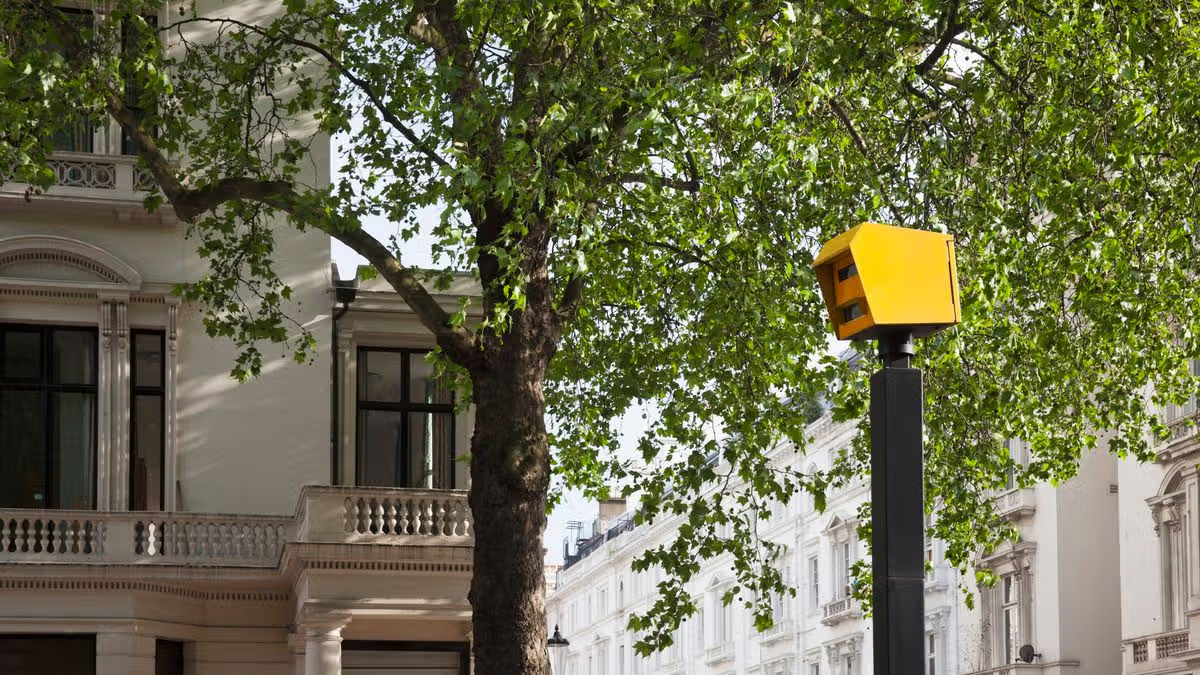
Your legal rights if you are caught by a hidden police speed camera

Published

on

Wales Online

Can you contest or appeal a speeding fine if the camera or van was not visible? This is what the guidelines, laws and experts say.

Ben Shephard ‘respect for speed cameras’ after doing a speed awareness course

Receiving a fine (officially known as a fixed penalty notice (FPN)) for speeding is never a nice experience. It may be even more frustrating when you didn’t realise you were doing it or didn’t realised you’d passed a speed camera. As such, many people might immediately begin thinking about how they can contest or appeal the fine and get it overturned.

One reason people believe they may be able to get speeding fines overturned is because the speed camera was hidden, or that there were no signs warning drivers it was there. In fact, one company director, who also claimed to be a former barrister, took to a legal forum to say exactly that. Claiming to have been pictured doing 61mph in a 50mph area of a dual carriageway, they wrote: “In my opinion this camera was hidden as it was under the bridge in the shadows. I only saw the van as I passed by. I believe there are Department of Transport guidelines that all speed cameras have to be clearly visible.”

This is everything you need to know about your legal rights if you are caught by a hidden speed camera.

Advertisement

What does the law say about speed cameras?

The Road Traffic Act 1991, Road Traffic Offenders Act 1988 and the Highways Act 1980, taken together, allow evidence collected on camera to be used in proceedings for a speeding offence. They in fact allow for evidence generated by speed and traffic light cameras to serve as the sole evidence against an offender and the resulting issuing of a fixed penalty.

What is the penalty for speeding?

The minimum penalty for speeding is a £100 fine and three penalty points added to your licence. There are three categories of speeding based on seriousness and this also affects the amount you may be asked to pay and the number of points you may get. You may be able to avoid the points and opt for a speed awareness course if it is offered to you but your eligibility for the course depends on which police force is dealing with your offence. You could be disqualified from driving if you build up 12 or more penalty points within a period of three years. Unlike with some parking fines, a speeding fine does not give you the option of paying a smaller amount if you pay the fine quickly.

Do speed cameras have to be visible?

You may think that if speed cameras are not visible, or there were no signs warning you were about to pass a camera, you might be able to appeal the fine. But you’d be wrong. However, it’s not surprising there’s confusion around the issue because government guidelines do in fact refer to the visibility of speed cameras.

They say speed cameras (including those in vehicles) “should be clearly visible from the driver’s viewpoint”. They also say signs warning of speed cameras should be visible.

Advertisement

Department for Transport guidance issued in 2007 says “fixed speed camera housings… should be coloured yellow” and that vehicles housing cameras “should be liveried and clearly identifiable as an enforcement vehicle”. It even says: “On every occasion before commencing enforcement at camera site, the enforcement officer should check that the conspicuity guidance is met.”

However, the crucial thing to be aware of here is that these are just guidelines and are not legally enforceable requirements. Indeed, in 2015 Humberside Police disguised speed cameras in tractors and other farm vehicles to catch motorcyclists and drivers travelling “at very high speed” on rural roads in East Yorkshire. While the plan attracted criticism, the National Police Chiefs Council said: “While speed enforcement will usually be conducted overtly to add to the deterrent effect, sometimes less overt tactics will be required to address specific problem which are causing casualties.”

Can I appeal a speeding fine?

You can appeal a speeding fine but your grounds for succeeding are very narrow and a hidden sign is not among them — “prosecutors have heard every excuse under the sun for speeding,” says the RAC. Possible grounds you have for disputing a speeding fine are:

  • a technicality: there are missing or incorrect details provided on the Notice of Intended Prosecution (NIP), or there were incorrect, absent or obscured road signs
  • you weren’t driving the vehicle (but, crucially, you know who was and can identify them)
  • you weren’t speeding (and you can prove it)
  • mistaken vehicle identity: it was not you driving or your vehicle involved
  • camera was faulty: all enforcement cameras are calibrated in accordance with manufacturers and Home Office guidelines. and you would have a legal defence against a speeding penalty if you could prove the equipment was faulty. Drivers can request the calibration certificate for the specific camera or radar gun used.

You can appeal the fine by filling out the correct section on the NIP within 28 days but if the police do not accept your appeal you will have to go to court to contest the conviction and if this happens things may still not go your away and you could end up with an even bigger fine.

Source link

Advertisement
Continue Reading
Click to comment

You must be logged in to post a comment Login

Leave a Reply

NewsBeat

These stories of forbidden love and devotion during the Troubles reveal a more intimate side of conflict in Ireland

Published

on

These stories of forbidden love and devotion during the Troubles reveal a more intimate side of conflict in Ireland

The following story is runner up in The Conversation Prize for writers 2026, a competition run in partnership with Faber and Curtis Brown. Read more about the competition here.


A woman is handing out paper cups of squash and flat lemonade at the back of a parochial hall in Belfast. This woman – I’ll call her Charlotte* – is there with her husband, helping out at a disco for the Catholic Church’s teenage congregants.

Her daughter is dancing inside; she’s young, probably 13 or 14. Years later, recalling this moment from her adolescence, their daughter says: “Daddy would be on the door, Mummy would be handing out minerals [soft drinks] in the back”. It’s an ordinary scene of parental duty and care, except for two details: this was the mid-70s and Charlotte was a Protestant.

Charlotte didn’t convert and didn’t attend Mass. Instead, she went to Church of Ireland services, in a different part of Belfast, with her sister. Charlotte’s husband – I’ll call him Eoin – drove Charlotte there every week. Eoin attended Vigil Mass on Saturday evenings to ensure he was free on Sunday mornings to help his wife.

Advertisement

After Eoin’s sudden death, Charlotte continued to contribute to the local Catholic Church’s weekly offertory by asking her neighbour to take the collections envelope with her to Mass. When Charlotte died, eleven years after her husband, both her Church of Ireland rector and the Catholic priest came to the house to pay their respects. “I thought it spoke volumes about who my parents were and about their values”, their daughter said.

Their daughter shared these fragments of memory carefully, offering an account of her parents and their love for each other through stories of everyday devotion. The tenderness with which she spoke of them made the warmth of their life together tangible. At the height of the Troubles, 20 years before any meaningful discussion about ceasefires, coexistence was happening through small, supposedly unremarkable moments like a husband driving his wife to church, or two clergymen visiting a grieving daughter.


The Insights section is committed to high-quality longform journalism. Our editors work with academics from many different backgrounds who are tackling a wide range of societal and scientific challenges.

Advertisement

The intimate sphere is never private alone. Domestic familiarity does not dissolve political division. Stories like Eoin’s and Charlotte’s are bruised by what is not said; heavy with uneasy compromise, asymmetrical sacrifice, emotional labour.
These are life histories marked by weddings without music (“a day to be got through”); baptisms without parents or grandparents; siblings attending different schools. Mixed marriage did not resolve the hostilities of Irish politics so much as translate them into the rhythms of daily life. Here, contradiction was negotiated through mundane ritual and strategic silence; acts of conciliation and maintenance.

Stories of forbidden love that ultimately triumphs over adversity are enduringly popular. In Ireland there is a particular local flavour to such tales of clandestine lovers, where a pair from opposite sides of the so-called divide translate national conflict into romance.

A wall in Belfast with colourful artwork under the title 'Romance'

Stories of forbidden love that triumphs are enduringly popular in Ireland.
Maria Albi/Shutterstock

I understand the appeal of these stories. I’ve spent a large part of my life reading them, watching them, thinking about them. But the more I encountered these stories where political and emotional commitments seemed irreconcilable, the more I began to ask: what was life like for those who found themselves inescapably drawn to someone they shouldn’t be?

A more intimate history

Over the past several years, I’ve been leading a project to build an archive of oral histories documenting mixed marriage in Ireland. Interviews were conducted by Ruth Duffy, a research fellow at Queen’s University Belfast, for the project and this collection of intimate histories allows people to share their family stories in their own words.

Advertisement
Wooden figure of a mother lifts up her baby to her face.

Intimate histories that tell tales of love, politics, betrayal and duty.
Ivan maguire/Shutterstock

Mixed marriage has long been made to bear symbolic weight far beyond the lives of the couples themselves. It is invoked as proof of peace-building, assimilation, coexistence or, more darkly, betrayal. But this archive tells a much more ambivalent story: that the messiness of romantic desire, filial love, political allegiance and religious duty could never be contained within the political scripts that have dominated the Irish story.

People have shared recollections that are vibrant, unexpected and bittersweet. I anticipated encountering stories marked by bigotry, intolerance and violence. These certainly exist. Many people and their families paid an enormous cost for their choice of partner.

People changed their names and couples were burnt out of their houses. Teenagers emigrated to get married and devout congregants were threatened with excommunication. Families were ostracised; mothers were coerced into putting their babies up for adoption; children were taken from their parents and placed in orphanages run by particular religious groups. People were killed.

These are not the cliches of a Troubles thriller but the realities of many people’s lives. The nature of the Northern Ireland conflict was terrifyingly intimate. In his poem ‘Wounds’, the late Michael Longley captures some of the desecration of a war that could see a man executed in his own home:

Advertisement

Shot through the head
By a shivering boy who wandered in
Before they could turn the television down
Or tidy away the supper dishes.

Wounds by Michael Longley. Warning: this video contains a sectarian jeer that may cause offence.

Amid these harrowing accounts, what lingers is the vitality of small things: the supper dishes, paper cups of squash and collections envelopes.

Textures, ambiguity and awkwardness

Perhaps the greatest surprise was the number of children who wanted to share their experiences of their parents’ – or even grandparents’ – mixed marriages.

Many of them voiced a similar impulse to share so “their parents’ story could be captured”; “their history is important for people to know, in a small way”.

For a researcher, the ethical demands implicit in listening to these memories cannot be overstated: you can hear that these are narratives shaped by love and pride. These are stories told with vulnerability and shared with hope. I feel that duty of care acutely; for this reason, all the names I use here are pseudonyms.

Advertisement

Despite the palpable affection in these intimate histories, they are not simple exercises in nostalgia. The tellers interpret and historicise their past, even as they offer it for curation.

A woman I’ll call Sarah expressed a “special kind of sadness” about the impact mixed marriage had on her parents and her family, “and because you’re a child, you don’t really understand”. These stories make painfully clear how society asked children to bear the burden of their parents’ marriages in a context of immense political discord and trauma. Adult children of mixed marriages frequently articulate an early intuition, a childhood sense, that something was amiss. These children don’t just inherit the political consequences of mixed marriage: they inherit its textures, ambiguity and awkwardness.

Things become most troublesome for mixed marriages when family life collided with institutions. Weddings, baptisms, schooling and funerals were especially fraught. In the words of one of our interviewees, these were instances that “made religion rear its ugly head”. Occasions that ought to have been a time for celebration and unity often prised open division with startling force. Photograph albums capture weddings where family members looked strained: “the worst thing that could possibly have happened had happened”.

I wonder how different our understanding of modern Ireland would be if we turned to family histories like these, rather than politicians and paramilitaries, to understand conflict and its legacy?

Advertisement

Some individuals recalled not just inheriting two traditions but actively inhabiting both in ways that neither community would approve of. One woman, May, shared an astonishing story about her father.

Asked to produce his birth and baptismal certificates before he could get married, the man was bewildered to discover that he had been baptised twice. Believing himself to be a lifelong Catholic, he learnt that he was baptised first in the Church of Ireland at four weeks’ old in Belfast’s St John’s Cathedral in 1912. In 1915, as a three-year-old, he was baptised again at St Matthew’s Catholic Church in the Short Strand.

A baby is baptised.

Just one point of contention.
sweet marshmallow/Shutterstock

Echoing so many stories about mixed life, these official records leave more questions than they answer. Over a hundred years later, his daughter May could only speculate why and how this had happened, attempting to make sense of institutional traces that seemed inherently paradoxical.

May’s grandfather was at war, fighting on the Western Front, when his son was baptised for a second time in 1915. May suggested her Catholic grandmother might have had her three sons baptised again in the Catholic Church to curry favour with her family. Unsure whether her husband would return from war, and raising six children by herself, her grandmother would have needed all the support she could get.

Advertisement

The emotional and social work taken to manage a cross-community family like this must have been endless.

Sarah shared some of the most distressing stories I’ve heard. The fourth and youngest child to her parents’ mixed marriage, she was their first and only daughter. Like many mixed families in Ireland, her parents had agreed to the common compromise that any sons born to the marriage would be baptised in the Catholic church like their father, and any daughters raised in her mother’s Evangelical church.

This did not protect Sarah’s mother from humiliation and heartbreak. When Sarah’s mother took her eldest son to the Catholic Church for his baptism, she expected to be welcomed and included in the service. She was his mother, after all. Instead, she was told to hand her baby over and sent to the back of the chapel while her son received the sacrament. This happened again with her next two sons. Three times she was made to watch from the back of the church as her sons were baptised without her.

When she had her daughter, Sarah, she was adamant that this would not happen again. As a girl, according to the uneasy but widespread Irish custom, Sarah ought to have been baptised in her mother’s church. What followed reveals how familial bonds can crumple under the weight of deeply held religious convictions. Sarah recalls her mother telling her that, when Sarah was six months old, her Catholic relatives “kidnapped” her and had her baptised without her mother’s consent. This time, her mother was not even allowed inside the chapel. Her father, Sarah reveals, “bent to peer pressure and the priests”.

Advertisement

Despite Sarah’s Catholic baptism, her mother fought hard to ensure that Sarah was brought up Protestant; her mother also “kept to her word” and sent the boys to the Catholic chapel every week.

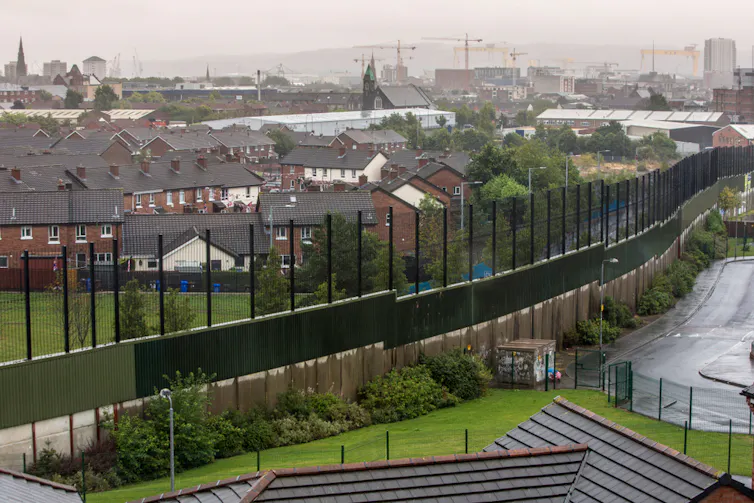
Sarah’s household was a divided one, with the children attending different churches and different schools. They learned to pray in different languages; they were taught different histories; they played different sports. These practical accommodations created children who learned to move between parallel worlds, carrying a keen awareness of the selves they might have been under different circumstances.

A photograph of a dividing fence in Belfast.
Navigating a life between parallel worlds.
CREATISTA/Shutterstock

These childhoods shaped by uneven concessions were defined by what Sarah called “unspoken boundaries”: rules children were expected to follow without ever fully understanding. Sarah used to attend Sunday School at the Evangelical Church she attended with her mother and, one week, her brothers went with her. When Sarah’s mother arrived to collect her four children, she was greeted by her sons sitting outside on the steps of the church, waiting for her. “Whatever had happened”, Sarah recollected, “they wouldn’t go in”.

Whatever had happened. The vagueness is telling. After all these years, Sarah still didn’t know. The silence and heaviness of that unknown hovers over so many of these narratives, carried in the image of three small boys sitting on some steps outside the church.

I return again to Charlotte, handing out her cups of squash. I think of her six children, each inheriting the afterlives of choices made long before they could understand them. For Charlotte and Eoin’s daughter, her parents were simply a “great example of how you can be yourself while compromising within your marriage and within your family”.

Advertisement

These families do not need their stories to be romanticised. They need them to be recognised. What mattered was not reconciliation in the abstract but the daily work of living together through contradiction and without resolution.

In the back of a parochial hall in Belfast, Charlotte was doing something both ordinary and extraordinary. She was making a family across a line that was meant to keep them apart. That labour – quiet, repetitive, unheroic – is part of Irish history too.

*Participants’ names have been changed to protect their anonymity.


À lire aussi :
Emily Robinson wins The Conversation Prize for writers 2026 for her entry on the lost medieval island of Ravenser Odd

Advertisement

Source link

Continue Reading

NewsBeat

‘Significant portion’ of Stormont adult content activity is linked to one individual

Published

on

Belfast Live Icon

A significant proportion of user-initiated attempts to access adult-content websites through the Stormont Assembly network were linked to a single individual, the Assembly Commission has confirmed.

The individual was responsible for a substantial share of the approximately 2,926 web-filtering events, which officials had previously assessed as more likely to relate to user-initiated access.

Belfast Live understands the activity formed part of a series of attempts to access adult websites and services revealed through Freedom of Information requests.

The individual was not a directly employed member of Assembly Commission staff but was an agency worker assigned to the Assembly Commission. Their assignment was “immediately ended”, the Commission confirmed.

Advertisement

The revelation comes after Belfast Live reported details of the activity recorded by the Assembly’s web-filtering system, including attempts to access sex chatrooms, escort websites and adult retailers.

The records also showed searches for images of celebrities, including an attempt to search for nude photographs of Derry Girls star Jamie-Lee O’Donnell and an attempt to find images of broadcaster Emily Maitlis’s feet.

However, the Assembly Commission stressed that all relevant requests were blocked and that the data does not show any successful access to adult content.

An Assembly spokesperson said: “It is important to note the data relates to blocked web-filtering events, not successful access to adult content and that all of the relevant requests were blocked by the Assembly’s web-filtering controls.

Advertisement

“The data also shows that a significant proportion of the user-initiated events related to one individual. The individual was an agency worker assigned to the Assembly Commission rather than a directly employed member of Assembly Commission staff. The agency worker’s assignment was immediately ended.

“In light of the end of this assignment, and in accordance with the data protection legislation, the Assembly Commission does not propose to disclose any further information about this individual.”

The original FOI response identified 52,265 web-filtering events categorised as adult content over a rolling 12-month period. However, officials said a significant proportion of those events appeared to have been generated automatically by search engines or other system activity.

Following a review, approximately 2,926 events were assessed as more likely to relate to user-initiated access. The Commission has now confirmed that a significant proportion of that smaller figure was associated with one person. It has not disclosed the precise number of events attributed to the individual.

Advertisement

The Assembly also confirmed that it had reviewed the underlying web-filtering logs following the publication of the Belfast Live report.

The Commission’s Acceptable Use Policy prohibits users from using Assembly information assets to create, transmit, store or display material that is “obscene” or “otherwise offensive or inappropriate”.

Asked whether the activity identified in the FOI material could constitute a potential breach of that policy, the Commission confirmed that it could. It said serious breaches of the policy may require further action under its internal procedures, with fairness and due process applying.

The Commission did not provide details of any separate disciplinary or HR process, instead referring Belfast Live to its statement about the agency worker’s assignment being ended. It also said there had been no referral to another body or authority.

Advertisement

The Assembly spokesperson said: “The Assembly Commission keeps its cyber-security and acceptable-use arrangements under regular review. The current web-filtering controls blocked the relevant requests, but any incident of this nature is an opportunity to consider whether controls, monitoring or escalation arrangements should be strengthened.

“Following learning points identified from this work, we have already increased our monitoring and escalation arrangements.”

The Commission said the fact that the requests were blocked demonstrated that its existing web-filtering controls were operating.

For all the latest news, visit the Belfast Live homepage here and sign up to our daily newsletter here.

Source link

Continue Reading

NewsBeat

Why you can’t get comfy at night, but bed feels like heaven by morning

Published

on

Why you can't get comfy at night, but bed feels like heaven by morning
The difference is largely internal (Picture: Getty/Metro)

Regardless of the mattress you have, sometimes it can feel like trying to fall asleep on concrete, as if you can’t get comfortable no matter how much you toss and turn.

By morning, however, that same bed which once seemed so inhospitable hugs every contour of your body, begging you to stay in its cosy embrace.

It’s a strange paradox experienced by many, and one that seems particularly frustrating once the alarm goes off each day.

Before you condemn your shapeshifting bed to the dump, though, it’s worth looking inwards to fix the problem.

Advertisement

Uncomfortable bedding can definitely be an issue that stops your brain switching off, along with external issues like noise or light.

But according to Becky Spelman, psychologist and founder of Private Therapy Clinic, the most common factor in preventing nighttime relaxation is ‘an active mind or high levels of stress.’

She adds: ‘Additionally, certain medical conditions or sleep disorders, such as insomnia, can make falling asleep challenging for some individuals.’

There aren’t borrowers coming in and turning your mattress from nails memory foam overnight either: the changes you go through in the hours you’re asleep are why you feel so different about your bed.

Advertisement
Adult woman, tossing and turning in her bed.
Sometimes tossing and turning just won’t cut it (Picture: Getty Images)

Becky tells Metro: ‘Our bodies have a natural sleep-wake cycle called the circadian rhythm. Towards the end of the sleep cycle, our body temperature rises, and the release of hormones like cortisol and serotonin helps us feel more awake and alert.

Ask Metro


Use AI to go deeper into the stories you care about – powered by Metro and trusted publications.

‘As a result, we may feel more comfortable in the morning due to these physiological changes.’

Advertisement

A hormone called melatonin — which is responsible for controlling the sleep-wake cycle — also plays a part to this snuggly switcheroo.

During sleep humans pump out plenty of melatonin, but as soon as we wake up this production stops.

It can take time for what’s left over to dissipate, so traces of it still coursing through your body could be why you feel like you’re cosied up in a cloud first-thing.

If you regularly find it difficult to wind down at night, it can be handy to take a look at your space and bedtime routine first — something you may see referred to as ‘sleep hygiene’.

Advertisement

‘Creating a comfortable sleep environment is crucial,’ says Becky. ‘Make sure your bedroom is dark, quiet, and at a comfortable temperature. Invest in a quality mattress, pillows, and bedding that suit your preferences too.’

She also recommends minimising your exposure to screens and stimulation close to bedtime, instead opting for soothing activities like ‘reading, taking a warm bath, or practicing relaxation techniques.’

Blue light emitted from phones and computers has been found to mess with that all-important circadian rhythm, so it’s best to steer clear of scrolling in bed, as well as avoiding vigorous exercise at nighttime which has the opposite effect to what you’re going for.

When it comes to how to wake up easier in the mornings, consistency is key.

Advertisement

‘It’s helpful to establish a regular sleep schedule,’ says Becky.

‘Try to go to bed and wake up at the same time each day, even on weekends, and avoid hitting the snooze button, as it can disrupt your sleep cycle and make you feel groggier.’

You may still have days where you want to swaddle yourself in the duvet, but hopefully if your sleep is improved you’ll feel more restored and less attached to your bed.

‘Exposing yourself to natural light after waking up can help regulate your circadian rhythm and promote wakefulness,’ Becky adds.

Advertisement

‘Additionally, engaging in some light physical activity or stretching can help energise your body.’

If your sleep issues continue or you regularly feel tired after sleeping, it’s best to visit your GP. You may have a condition such as sleep apnoea, in which case no amount of sleep hygiene will get to the root of the problem and medical advice is what’s needed.

This article was first published on September 10, 2023.

Do you have a story you’d like to share? Get in touch by emailing MetroLifestyleTeam@metro.co.uk

Advertisement

Source link

Advertisement
Continue Reading

NewsBeat

Homeowners urged to paint garden fences now according to experts

Published

on

Homeowners urged to paint garden fences now according to experts

Experts at UK paint brand Valspar Paint say now is the ideal time to give tired fences a fresh lick of paint, helping to protect them against the harsh winter weather ahead.

Leave it too late, however, and homeowners could be waiting until spring 2027 for suitable painting conditions.

Have you had to apply for planning permission? (Image: Getty)

Lucy Steele, senior brand manager and resident colour expert said: “Garden fences are exposed to the elements year-round, so choosing an exterior paint that can withstand unpredictable British weather is key to achieving a finish that lasts. I recommend looking for a durable exterior wood paint that offers resistance to moisture, mould and the changing UV levels, while providing a strong adhesion to wood to help minimise cracking, peeling and general wear.”

She added: “Good preparation can be the difference between a smooth, long-lasting finish and a patchy or peeling fence. Before painting, make sure the surface is clean and dry, removing any dirt, algae or loose flaking paint. Lightly sand any rough areas before applying thin, even coats, allowing the recommended drying time between each layer. This will help the paint adhere properly and give the finish the strongest possible start.

Advertisement

“When choosing a fence colour, I’d suggest taking inspiration from the existing palette in your garden. Warm, earthy shades from sage and olive through to terracotta can work particularly well. Soothing Sage, Rugged Olive and Ripe Peach will all help complement surrounding greenery rather than compete with it and bringing the whole outdoor space together.”

Source link

Advertisement
Continue Reading

NewsBeat

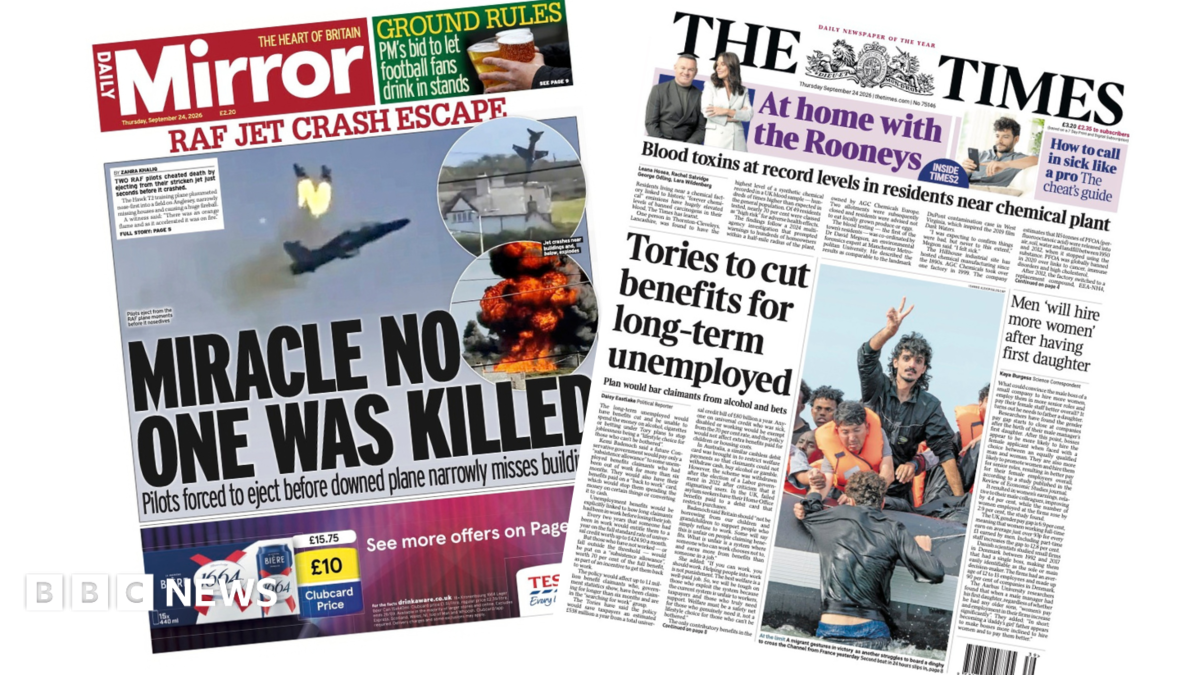
Newspaper headlines: ‘RAF jet crash escape’ and ‘Tories to cut benefits’

Published

on

The headline on the front page of the Mirror reads: “Miracle no one was killed”.

Many of the front pages focus on the Conservative party’s promise to prevent long-term jobless benefit claimants from spending their welfare payments on alcohol, cigarettes and betting. The Daily Mail’s headline is “Kemi’s ruthless crackdown on benefits street”, external. The Daily Telegraph says the Tories want to stop joblessness being what is referred to as a “lifestyle choice for those who can’t be bothered”, external.

The front page of the Daily Mirror carries a photograph of the moment two RAF pilots ejected from a jet before it crashed on Anglesey in North Wales, external. They were taking part in a training exercise when they were forced to parachute from the plane – which, the paper reports, then “plummeted nose-first into a field” and caused a “huge fireball”. The paper’s headline is “Miracle no one was killed”.

According to the Daily Telegraph, talks about the future of the Elgin marbles have collapsed, external. Greece reopened negotiations with the British Museum in 2021 as part of efforts to repatriate the ancient sculptures. But the paper says “it is understood negotiations are effectively over” as Greek representatives are frustrated by a lack of progress.

The Times says mounted cavalry might have an advantage in modern warfare, external, a century on after tanks replaced horses on the battlefield. Last year, a Ukrainian infantry company in Donetsk reported that Russian forces had started to use horses and donkeys to carry soldiers and supplies to avoid detection by drones. And the paper says the UK’s Household Mounted Cavalry regiment conducted trials over the summer, with officials saying in some situations, such as woodland, there’s a better chance of getting from A to B with a horse, than with a Challenger 2 tank.

Advertisement

And the boss of Timpsons says his company has seen a 680% increase in people asking for extra holes in their belts this year,, external reports the Daily Mail. He believes the demand is down to the popularity of weight loss jabs.

Source link

Continue Reading

NewsBeat

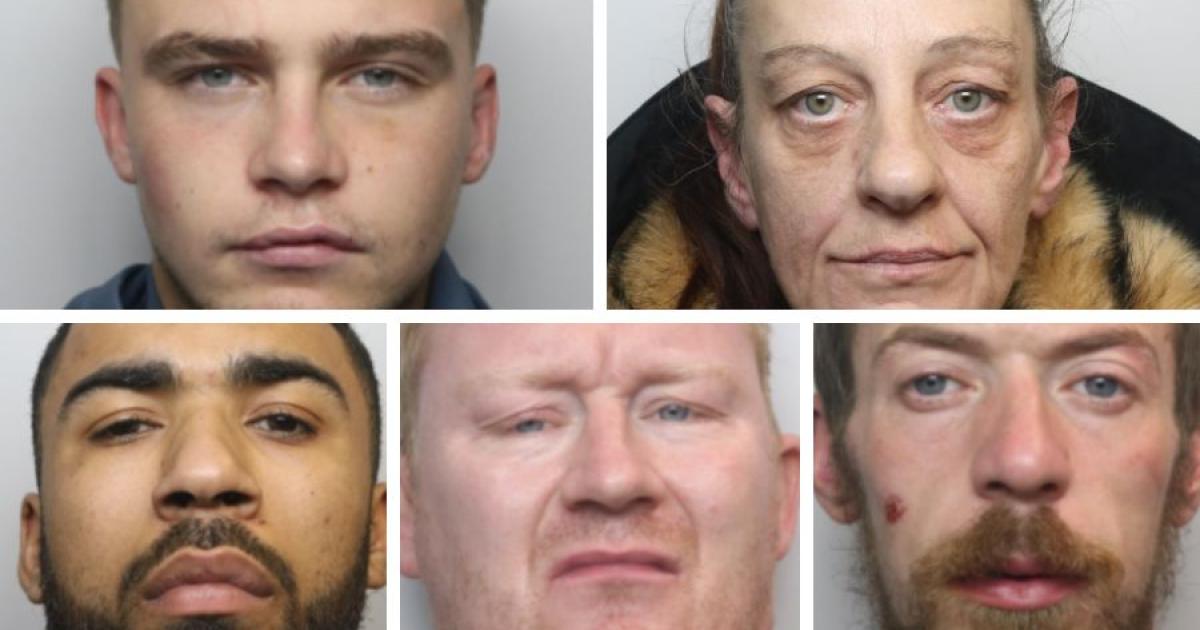
Bolton’s most wanted – September 24, 2026

Published

on

Bolton's most wanted - September 24, 2026

Bradley Curtis (Image: GMP)

BRADLEY CURTIS, 21, is wanted on recall to prison.

Julie Conway (Image: GMP)

JULIE CONWAY, 48, is wanted for failing to appear in court.

Caleb Campbell (Image: GMP)

CALEB CAMPBELL, 25, is wanted on recall to prison.

James Hilton (Image: GMP)

JAMES HILTON, 38, is wanted on recall to prison.

Advertisement

Cameron Wroe (Image: GMP)

CAMERON WROE, 31, is wanted on recall to prison.

A Greater Manchester Police spokesperson said: “Anybody found harbouring any wanted person or helping them to evade justice will be arrested themselves and face possible court action and a criminal record.”

These wanted people are not to be approached.

In the event of any sightings, please ring 999.

Advertisement

Anyone with any information can leave a message on the police social media pages or call independent charity Crimestoppers anonymously on 0800 555 111.

Source link

Advertisement
Continue Reading

NewsBeat

Former boy genius who shocked the world by exposing massive Microsoft security flaw at just FIVE years old suffers epic downfall as he’s arrested

Published

on

Several antisemitic markings were left on homes in Imperial Beach, California, over the past few weeks, police said

A former boy genius who shocked the world after discovering a massive Microsoft hack has been arrested in California for allegedly covering neighbors’ homes in antisemitic graffiti. 

Kristoffer Von Hassel, 18, was taken into custody by the San Diego Sheriff’s Office around 3am on Tuesday after several reports of vandalism were called in from residents in Imperial Beach, police said.

Deputies responded to two separate reports of swastikas and other hate symbols being displayed on homes on September 13 with black permanent marker, according to authorities. 

Another call came in on September 19, stating that one of the same homes was hit again, as well as a nearby alleyway behind the property, cops said. 

Advertisement

The agency then increased patrols in the area and uncovered surveillance footage that helped them locate the suspect, who was later identified as Von Hassel. 

He was located ‘in a dark alley where one of the vandalisms had occurred,’ police stated. 

Von Hassel had a ‘handheld electronic device capable of interacting with and analyzing certain wireless signals’ that could pair with garage doors, gates, and other systems, the police added. 

One of the homes that was hit belongs to Sandy and Bruan Brillhart, and they have been left horrified by the incidents. 

Advertisement

Several antisemitic markings were left on homes in Imperial Beach, California, over the past few weeks, police said

Kristoffer Von Hassel (pictured in 2014) has since been arrested for allegedly being behind the vandalism. He previously won the world over after discovering a Microsoft hack on his father's Xbox

Kristoffer Von Hassel (pictured in 2014) has since been arrested for allegedly being behind the vandalism. He previously won the world over after discovering a Microsoft hack on his father’s Xbox 

‘I don’t feel safe at the beach anymore, and now I no longer feel safe in my house,’ Sandy told KGTV.

Advertisement

At first, she wasn’t too concerned – thinking that it was just typical vandalism – but then she learned what the symbols meant. 

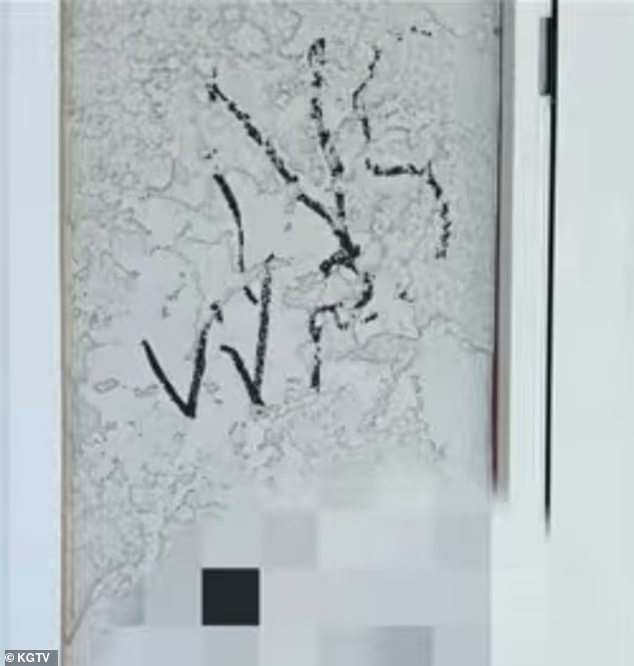
A swastika, which is widely known as a symbol of hate that Nazis wore, was drawn on her front door, Sandy said. 

Another display had the letters ‘NS’ and ‘WP’ on it. ‘NS’ stands for ‘National Socialists’, Hitler’s political party, or the Nazi Party, and ‘WP’ means ‘white power.’ 

Sandy said the first attack took place around Rosh Hashanah, a Jewish holiday that celebrates the New Year. 

Advertisement

Then, about a week after, and just before Yom Kippur – another Jewish holiday – the Brillharts realized that their garage door had Sandy’s name written on it. 

‘Well, this is unfortunate that it’s happened not only in our community, but worldwide now, and we need to deal with it before it gets out of control,’ Bill said. 

Another display had the letters 'NS' and 'WP' on it. 'NS' stands for 'National Socialists', Hitler's political party, or the Nazi Party, and 'WP' means 'white power'

Another display had the letters ‘NS’ and ‘WP’ on it. ‘NS’ stands for ‘National Socialists’, Hitler’s political party, or the Nazi Party, and ‘WP’ means ‘white power’

Meanwhile, Von Hassel’s father said this was not something his son would do, as he referred to the moment that made the now-adult famous when he was five years old. 

Advertisement

‘He’s never gotten in trouble like this before. Just look what he did with Microsoft when he was 5,’ his dad told The San Diego Union-Tribune. 

In 2014, Von Hassel made headlines after he figured out how to log in to his father’s Xbox account without the correct password. 

Somehow, the then-child discovered that entering the wrong password into the log-in screen would bring up a second verification screen, the BBC reported at the time. 

By doing that, he would be allowed into his father’s account, which let him play games he wasn’t supposed to play. 

Advertisement

His father sent the flaw to Microsoft, which led the company to address the issue. 

The vandal used permanent marker on the homes on separate occasions, police said

The vandal used permanent marker on the homes on separate occasions, police said

Von Hassel was also awarded a spot on a list of people who have discovered problems for Microsoft products. He was also gifted four free games, $50, and a year-long subscription to Xbox Live. 

He was also referred to as the ‘world’s youngest hacker’ for his achievement.  

Advertisement

But now he faces a new, and not so fun, reality after his arrest. 

His mother, who asked not to be named, said: ‘We’ll be fighting this case. We’re concerned how this will impact his future.’ 

As of Wednesday afternoon, Von Hassel remains in custody at San Diego Central Jail, according to jail records reviewed by the Daily Mail. His booking photo was not made available. 

He is being held on a $122,500 bail on several charges, including vandalism and damage to property, records show. 

Advertisement

Source link

Continue Reading

NewsBeat

Teenager screamed driver’s name before car plunged into river, inquest hears

Published

on

Cambridgeshire Live

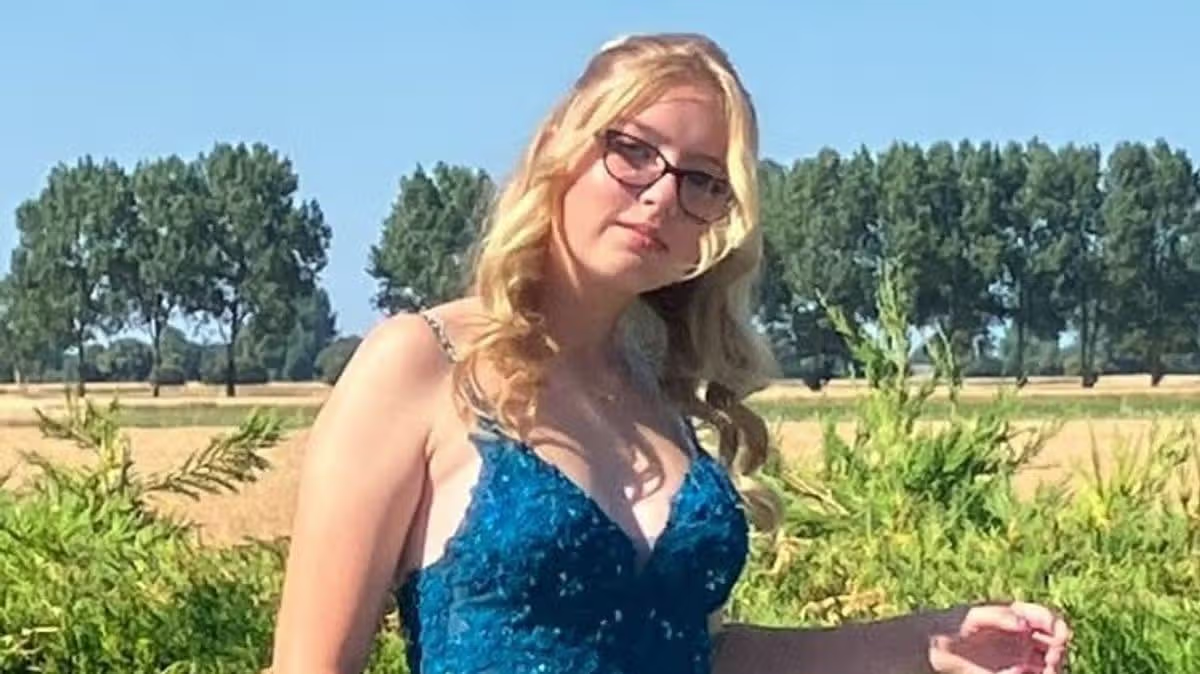
Eden Bunn died when the car she was in crashed into a river

A teenage girl, described as “most loving”, screamed the driver’s name before the car they were in plunged into a Cambridgeshire river, an inquest heard. A Volkswagen Polo containing five teenagers, aged between 16 and 18, crashed into the River Nene on North Brink, Wisbech, on March 17.

Three teenagers, including two girls aged 16 and an 18-year-old boy, managed to escape the car. However, the driver Declan Berry, 18, and Eden Bunn, 16 and from Sutton Bridge in Lincolnshire, died as a result of the crash.

The inquest into Eden’s death was concluded on Tuesday (September 22) by Cambridgeshire and Peterborough Coroner Elizabeth Gray at Vantage House in Huntingdon. The cause of Eden’s death was confirmed to be a head injury as a result of a road traffic collision.

Advertisement

Evidence heard in court revealed the road, which has a 60mph speed limit, had “numerous potholes” and “uneven surfaces along its length”.

Three passengers survived the collision. A statement from the front seat passenger read out in court said Declan had been driving at around 90mph moments before the crash. When the passenger asked Declan to “slow down”, the teen driver reportedly replied “we will be fine”.

The passenger believed Declan had intended to “show off”. They said a pothole possibly caused the vehicle to “suddenly lose control”.

Another passenger described the atmosphere as “eerie”, adding that they did not express concern about the speed as they were “accustomed” to Declan driving fast. The witness statement explained that Eden shouted “Declan” moments prior to the collision that killed her.

Advertisement

A third passenger said they recalled the vehicle “flipping” and “rolled” before entering the river. At one point, the witness believed they “may not be able to escape”. This passenger recalled hearing a “thud” prior to the incident, which they thought may have been caused by a pothole.

In written evidence read at the inquest, a nearby local named Thomas, who was adjacent to the River Nene, said he heard a “loud impact”, describing the vehicle as “rolling through the air”. He heard “multiple people screaming” and contacted the emergency services before rushing to locate the surviving occupants.

An inquest into Declan’s death on Monday (September 21), heard that the 18-year-old, who died of drowning, was the driver of the vehicle and had three penalty points on his licence.

At the time of her death, Eden’s family paid tribute to her. Eden’s family described her as the “kindest” and “most loving girl”. They added: “Her horses – Daisy and Dolly – were her world, and she was ours. Words cannot describe the tragedy that will stay with us until we are able to meet her again.”

Advertisement

Eden’s father Dean, mother Lisa, brother Jay and sister Shelby released the following statement after the inquest: “Eden was the kindest most wonderful person and to have her snatched away from us so suddenly has left us heartbroken. She was a beautiful soul and had such a love of life. No words can describe the devastation we feel and we will never get over losing her.

“We don’t want to say anything about the lad who was driving. He has lost his life and his parents are going through the same living nightmare that we are. Nothing will bring Eden back and her death is a horrific reality we will have to live with forever.”

Sarah Townsend, a specialist personal injury lawyer from Hodge Jones & Allen who represents the family, said: “Eden’s passing has understandably left her family inconsolable with grief and struggling to cope. What is most tragic is that it was entirely avoidable and should serve as a warning to young drivers to not drive recklessly and put others at risk. I hope that now the inquest process has concluded, Eden’s family can slowly start to rebuild their lives.”

Source link

Advertisement
Continue Reading

NewsBeat

I fear this Budget will gun for our pensions, savings and homes: JEFF PRESTRIDGE reveals exactly what YOU can do about it

Published

on

It's coming: In just over a month we will brace ourselves for yet another assault on our wealth and financial independence

Tick tock, tick tock, the clock is counting down. In just over a month we will brace ourselves for yet another assault on our wealth and financial independence.

This time around it won’t be Rachel Reeves who will be bashing up our finances and ruining our retirement – or retirement dreams. Instead, it will be John Healey who as Chancellor of the Exchequer will deliver Labour’s third horrible Budget in as many years.

Frankly, it doesn’t matter who the Chancellor is (it could be Ken Dodd if he was still alive) because Labour, socialist Labour, is gunning for our investments, wealth and homes.

If only time could stand still, or, even better, go back to when Labour was no more than a weak party in Opposition.

Advertisement

Healey has already indicated his guns are trained firmly on our wealth by stating that next month’s Budget will be a ‘tough’ one.

And he will come up with the usual Labour excuses as to why tough measures are needed.

It’s coming: In just over a month we will brace ourselves for yet another assault on our wealth and financial independence

Advertisement

He will blame continued hostilities in the Middle East for the country’s parlous state rather than the Government’s awful anti-business stance which has heaped costs on employers and caused the economy to limp along like someone who has just strained their Achilles heel.

Of course, there will be no mention of Labour’s reluctance to tackle a soaring welfare bill, even if it leaves our defences in a sorry state and Government borrowing costs reaching for the skies.

For Prime Minister Andy Burnham to suggest that spending on social security is a greater priority than the nation’s security is as naïve as it is dangerous.

God help us.

Advertisement

So we’re heading for yet more tax increases to shore up the Government’s finances and sadly (unfairly, I’d say) it will be taxpayers – Middle Englanders – who yet again will be asked to shoulder them.

That means the young and old, the aspiring and aspired, and everyone in between. It means those who work for a living, own their own home and put money aside for the future – as well as those of us who have been prudent all our lives and are now enjoying retirement or semi-retirement.

Although Healey has so far been tight-lipped about what tax hikes he has up his sleeve, I imagine his phalanx of Treasury advisers will be leaking a few details ahead of the Budget on Wednesday, October 28 (aka doomsday). 

They can’t help themselves, based on the tittle tattle they have come up with over the past two years.

Advertisement

No doubt, rumours about a restriction in the right for people to take a chunk of tax-free cash from their pension fund will surface again, as they did in the previous two Budgets.

In the run up to the 2024 Budget, some £10billion of ‘excess’ tax-free cash was taken by investors fearful of an imminent crackdown.

No clampdown came, leaving tens of thousands of savers with money that would have been better left invested in their pension fund – and not suddenly exposed to tax. The same happened last year.

Maybe Healey will hear investing giant AJ Bell’s passionate call for him to make a ‘pre-Budget’ commitment not to turn the screw on the right to tax-free cash. But maybe not.

Advertisement
Don’t wait until Budget day. You need to start protecting yourself now


Hi, I’m Simon Lambert, publisher of This Is Money. I want to warn you that your pension, savings and property could soon be under attack. 

Advertisement

On October 28, Andy Burnham’s government will set out the Budget. We don’t know what they will do, but we do know about tax raids already on the way. The best thing you can do is get prepared. So I’ve called on some of Britain’s leading financial experts to create my new six-week plan. I’ll cut through the noise and take you step-by-step through everything you need to do to protect your money. 

Don’t wait. Click here and sign up to Protect Your Money now.

<!- – ad: https://mads.dailymail.co.uk/v8/de/money/moneypensions/article/other/mpu_factbox.html?id=mpu_factbox_1 – ->

Advertisement

And if I was a betting man, I’d put my garden shed on him pushing up rates of capital gains tax on profits from second homes, buy-to-lets and investments so they are aligned with income tax rates.

It’s a move that most Left-leaning think tanks have been calling for since I wore shorts to school. 

I am sure its announcement in the Budget would result in many Labour MPs partying late into the night. Negronis all round (nice and red). 

Advertisement

For diehard socialists, utopia. For us, yet another spiteful attack on thrift.

What we do know for certain, because Healey has already said it, is that there will be no breaking of Labour’s 2024 manifesto which pledged not to increase ‘National Insurance, the basic, higher or additional rates of income tax, or VAT.’ Thank you for small mercies.

But there’s far more we know about what lies ahead taxation-wise as we march towards the end of Labour’s term in office in 2029 (of course Burnham could call a snap election before then).

There are a myriad of tax rises coming that are set in stone, but which we can plan for and, in most cases, take action to mitigate – with the aid, of course, of our brilliant Money team at the Daily Mail and This is Money.

Advertisement

These tax rises were of Reeves’ creation and come in the form of a series of tax bombs with in-built detonators designed to go off at specific times.

The tax raids coming from April 2027

The first batch of these detonators goes off in April, when the new tax year kicks off.

So, from April 6, tax on savings interest will jump by two percentage points, resulting in new tax rates for basic, higher and additional rate taxpayers of 22, 42 and 47 per cent.

Savage? Yes, but basic and higher rate taxpayers should still be able to shield, respectively, £1,000 and £500 of annual savings interest from these new tax rates through use of their personal savings allowance. 

Advertisement

I say this in the expectation (no, hope) that these allowances won’t be chipped away at or removed altogether by Healey (don’t rule it out).

These same higher tax rates will also apply to rental income earned by landlords (Labour truly hates landlords).

Saving into a cash Isa will be restricted at the same time – with only those aged 65 or over still being able to squirrel away up to £20,000 in any one tax year.

For all other adults, they will be allowed to put only a maximum £12,000 a tax year into a cash Isa. If they want to maximise their £20,000 allowance, they will have to run a stocks & shares Isa alongside their cash Isa. 

Advertisement

While stocks & shares Isas and Junior Isas will keep their respective maximum annual allowances of £20,000 and £9,000, managing the former will become far more challenging for investors.

This is because Labour has decided to introduce a flat 22 per cent tax charge on all interest earned from cash held inside a stocks and shares Isa

Both a bewildering move and a dent in the tax-free label that makes Isas so attractive.

Yet probably the most damaging tax ‘bomb’ that will ignite in the next tax year will be that affecting on any unused pensions when people die. For the first time, they will fall into the inheritance tax (IHT) fishing net.

Advertisement

As I’ve said before, the taxation of such pension pots will be nothing short of egregious.

For some beneficiaries, it will result in the proceeds from an inherited pension fund (where the plan holder was aged 75 or more) being subject to both 40 per cent IHT and income tax.

In the most extreme of cases, 91 per cent of an inherited pension fund could be lost to tax.

Whatever happens in John Healey and Andy Burnham's first Budget, there is already a painful series of tax raids coming that were orchestrated by Rachel Reeves

Whatever happens in John Healey and Andy Burnham’s first Budget, there is already a painful series of tax raids coming that were orchestrated by Rachel Reeves 

Advertisement

Join the discussion

How should hardworking families protect themselves from rising taxes on pensions, savings, and homes?

Finally, we now learn that staycations in England will become more expensive towards the end of this tax year as a result of mayors being free to impose an uncapped tax on visitors staying in their regions. 

Where mayors don’t exist, new ‘foundation strategic authorities’ will be able to levy the tax.

Advertisement

Labour says the levy will not exceed 5 per cent, but the tax will still make holidays more expensive for hard-working families. Accommodation providers, especially independent B&Bs, could also be hit if holidaymakers are deterred from staying in the UK.

Similar tourist levies are already charged in Edinburgh and are set to be introduced in Wales just ahead of England.

In Reeves’s defence, this new tax will not be of her doing: the finger points at Burnham, Healey and Local Government Secretary Angela Rayner.

And a year later… more tax raids

Reeves’s detonators are far from spent when the tax year to April 2028 comes to an end. 

Advertisement

A new mansion tax will then kick in, landing those with homes worth £2million or more with annual bills up to £7,500.

Then, a year later, a new stealth tax will be imposed on salary sacrifice pension plans offered by many employers. The upshot is that many employees and employers will end up paying more in NI. Yes, more bloody tax!

So what can you do?

All rather scary? Absolutely – I’ve got into a right old flap just writing this article.

And I’ve not even mentioned the tax consequences of Burnham’s wish to ‘fix’ the social care crisis through the creation of a ‘national care service’. 

Advertisement

Reform of social care, the Prime Minister has already said, will require ‘difficult decisions’ – which is code for some form of tax rise. When it will all be decided is anyone’s guess. 

But in the meantime, between 30,000 and 40,000 people a year will be forced to sell their home to fund their long-term care costs.

To the good news, dear readers. There is a lot you can do to protect your wealth from what is coming down the road in the weeks, months and years ahead.

Most of it is centred around good, old-fashioned financial planning. For example:

Advertisement

– Ensuring your family assets (everything from pensions, investments and savings) are set up in the most tax advantageous way possible and are best in class in terms of the deal (investment growth, interest rate) they give;

– Taking full advantage of saving and investment tax-breaks (for example, Isas and pensions). Not just for you and your spouse or partner, but for your children via Junior Isas and pensions (yes, pensions);

– Making sure your existing Isas are fit for purpose ahead of the rule changes in April;

– Having up-to-date wills and being aware of a multitude of gift allowances that can help mitigate IHT bills further down the line (especially given the inclusion of unused pension funds in IHT calculations from April);

Advertisement

– Maybe downsizing your home to mitigate the mansion tax – or releasing equity to support your retirement finances;

– And finding out how to plan for the possibility – not probability – of care costs in later life.

Our brilliant six-part newsletter series, written by my colleague Simon Lambert, in the weeks leading up to the Budget and in its immediate aftermath will cover all these areas: IHT, pensions, savings and investments, property, care costs and later-life planning, and what the Budget means for you.

It will be essential reading, drawing upon a mix of the country’s best Money team’s extensive personal finance knowledge and that of leading financial experts. It’s unmissable.

Advertisement

More importantly, it will put you in a better place to mitigate the impact of the tax detonators coming all our way.

Protect Your Money – sign-up to our six-week plan 

The Budget is coming – but are you prepared? Sign up to our six-week plan and Simon Lambert and his team of financial experts will reveal how to Protect Your Money. If you’re a subscriber, it’s completely FREE 

> Sign-up to Protect Your Money 

Source link

Advertisement
Continue Reading

NewsBeat

Driver left pedestrian dying on the road in hit-and-run crash

Published

on

Cambridgeshire Live

The pedestrian was pronounced dead at the scene

A driver who hit and killed a pedestrian before fleeing the scene has been sent to prison. Marcin Pilarski, 36, hit Sam Pope, 28, as he walked along Oil Mills Road in Ramsey Mereside just before 11pm on May 11, 2024.

Advertisement

It was only reported to police when another driver saw Mr Pope, of Lincoln Road, Peterborough, lying in the road and called 999. But despite the best efforts of the emergency services, he was declared dead at the scene.

Paying tribute to him at the time, Mr Pope’s family said: “Sam was a free spirit, who liked to live his life at 100mph and believed that rules were meant to be broken.

“We shall miss his smile and crazy sense of humour that would always make you laugh, despite what mood you were in that day. Sam was a rough diamond with a heart made of gold and will leave a big hole in our lives.”

At around 11.40pm on the same evening, police were called by Pilarski’s partner, who told them he’d returned home in her Vauxhall Astra which was badly damaged. She reported that it had a smashed windscreen and headlamp and that there was blood on the front of the car.

She said they lived around 15 minutes, or 9.5 miles from the scene of the crash. When police visited the address, they also saw the damaged car, and Pilarski, of Sorrell Avenue, Whittlesey, was arrested in relation to the fatal crash.

In a statement, Pilarski’s partner said that he had called her at 11pm and told her he had “hit or killed somebody” who was in the road, but she had to end the call becasue he was screaming. When he returned home, she told him they needed to call the police, and he said, “I know”.

In police interview, Pilarski answered no comment to most questions, but later pleaded guilty to causing death by driving without a licence or insurance. He was sentenced at Cambridge Crown Court on September 17 to one year and three months in prison. He has also been disqualified from driving for four years and six months.

Advertisement

In a victim impact statement taken into consideration by the court, Mr Pope’s family said they were angry that Pilarski didn’t seem remorseful and hadn’t apologised for his actions.

The statement added: “We hope the memory of the night keeps him up at night like it does us. I don’t really know how as a family we will ever come to terms with this.”

Detective Inspector Craig Wheeler, who investigated, said: “Pilarski made a conscious decision to drive his partner’s car without a licence or insurance. He should never have put himself behind the wheel of a car and my thoughts and sympathies remain with the family and friends of Mr Pope, who needlessly lost his life at such a young age.

Advertisement

“No sentence will ever ease the pain of their loss, but I hope the case acts as a stark reminder against getting behind the wheel while uninsured or without a licence. Just one journey could end in tragedy.”

Source link

Continue Reading

Trending

Copyright © 2025