
Crypto World
Trump Administration Weighs Overseas Stablecoin Push

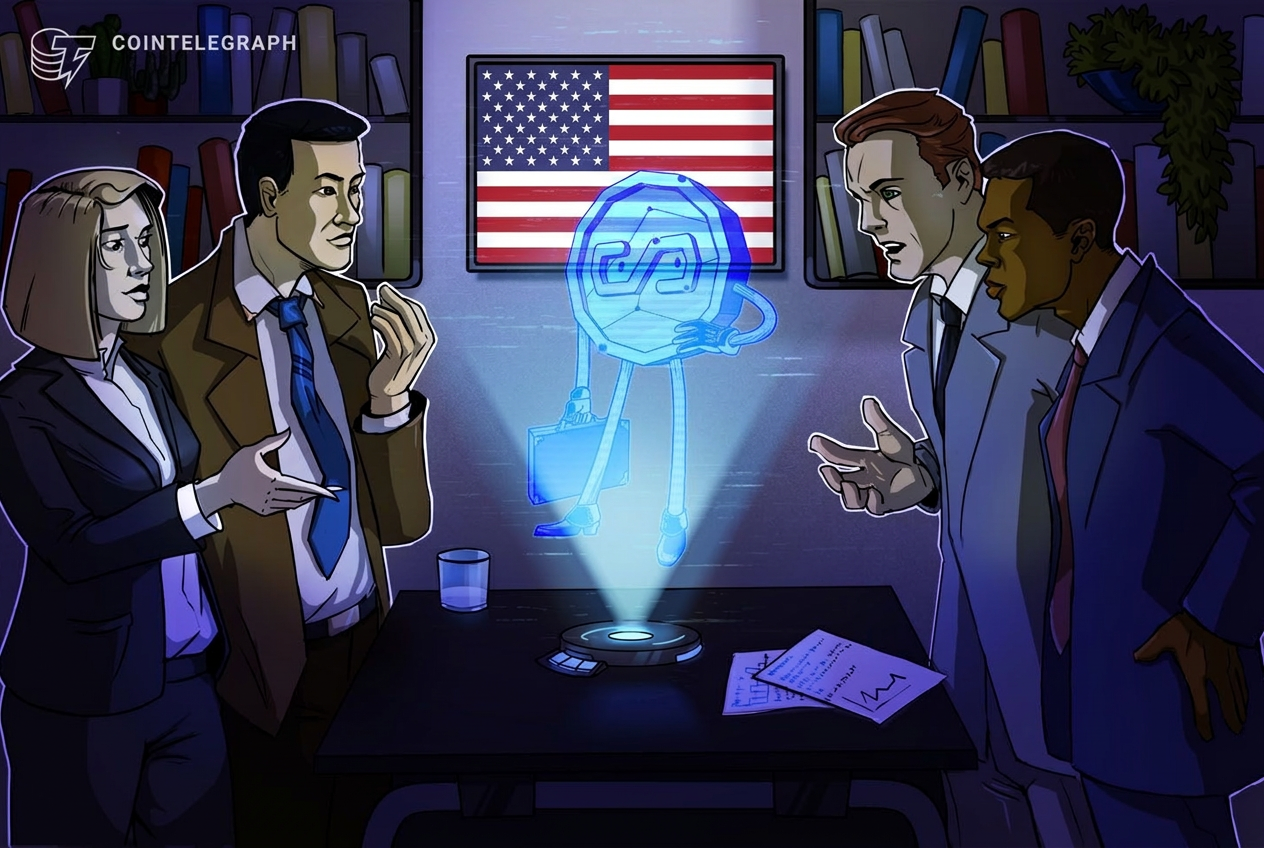
The Trump administration is reportedly considering an initiative to promote the use of dollar-backed stablecoins overseas as part of an effort to reinforce the US dollar’s position as the world’s reserve currency.
Citing people familiar with the plans, Bloomberg reported on Wednesday that the US government could support stablecoin projects by creating joint ventures with private-sector firms. The effort could involve several federal agencies, including the Treasury Department, State Department and the US International Development Finance Corporation (DFC).
The initiative would seek to expand the international use of dollar-denominated stablecoins while potentially boosting demand for US Treasurys, a common reserve asset for dollar-backed stablecoins.
The potential overseas push also comes as other nations are developing their own digital payment infrastructure. China’s digital yuan is among the central bank digital currencies used in Project mBridge, a platform for cross-border CBDC transactions, while the European Central Bank is preparing a 12-month digital euro pilot expected to begin in the second half of 2027.
Cointelegraph reached out to the US Treasury, the DFC and several US-based stablecoin companies for comment, but did not receive a response before publication.
US ties stablecoin growth to dollar dominance
Senior US officials repeatedly linked the growth of dollar-backed stablecoins to maintaining the dollar’s global role and increasing demand for US government debt.
In February 2025, venture capitalist David Sacks, who served as the White House crypto and AI czar at the time, said stablecoins could “extend the dollar’s dominance internationally” and potentially generate trillions of dollars in additional demand for US government debt.
Related: CFTC chair pushes tokenization as SEC opens door to onchain stocks
In July 2025, US Treasury Secretary Scott Bessent said the GENIUS Act, which established a federal regulatory framework for payment stablecoins, could strengthen the dollar’s status as the global reserve currency, expand access to the dollar economy and increase demand for US Treasurys.
The Treasury also continued implementing the GENIUS Act. On Aug. 17, it issued a notice of proposed rulemaking seeking public comment on provisions governing the issuance, offering and sale of payment stablecoins. Bessent said the rules would help “cement” the US dollar’s status as the world’s reserve currency.
Magazine: Winners and losers of the SEC’s new tokenized stocks rules

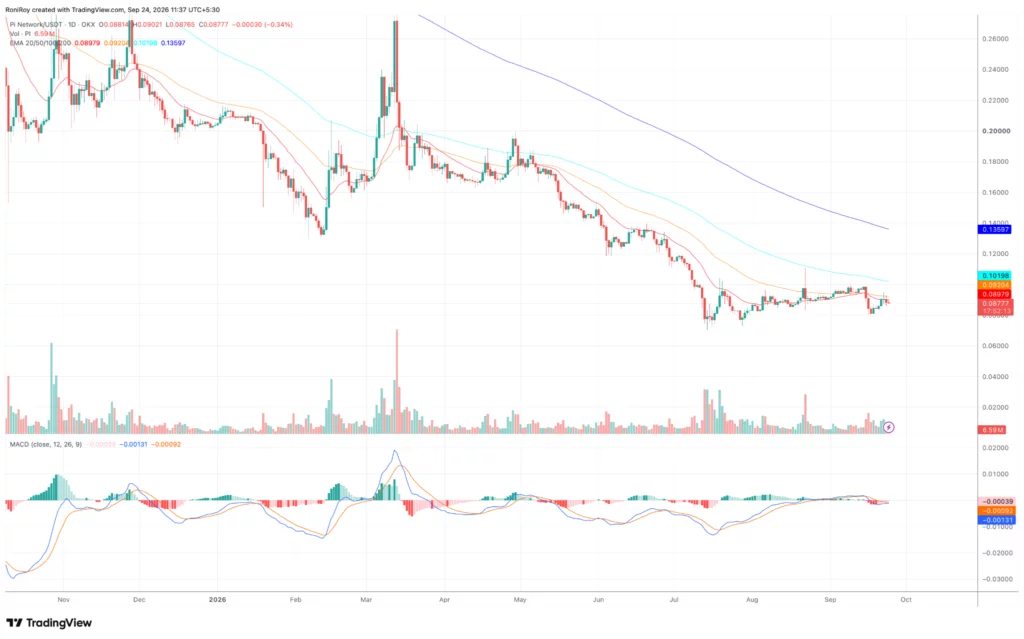
Pi Network price has fallen back below $0.09 on September 24 after its latest recovery failed near $0.093, leaving PI below its main daily moving averages as short term momentum weakened.
Summary
- PI has fallen below $0.09 after its latest recovery stalled near $0.093.
- Price remains below the 20, 50, 100 and 200 day EMAs, while daily MACD remains negative.
- A break below $0.085 could put the $0.080 to $0.082 support region back in focus.
- PI needs to reclaim $0.0898 and $0.0920 before the short term technical picture improves.
According to the PI/USDT charts, Pi Network was trading near $0.0878 at the time of writing, after opening the daily session around $0.0881 and falling as low as $0.08765. The pullback followed an attempt to recover above $0.09 earlier this week, but buyers were unable to keep the token above that level.
PI had already shown signs of losing momentum a day earlier. As crypto.news previously reported, the token reached $0.0926 on Sept. 23 before dropping back toward $0.088. The 50 day and 100 day moving averages were acting as overhead barriers during the move.
Recent Pi Network developments have been more positive on the network side. More than 417,000 users were cleared to continue KYC, while Protocol V27 progressed through testing. The price response has remained limited despite those updates.
Why is Pi Network price going down today?
PI’s latest decline comes after buyers failed to turn the recent move above $0.09 into a sustained breakout.
The daily chart shows PI trading below its 20, 50, 100 and 200 day exponential moving averages. The 20 day EMA currently sits around $0.08979, followed by the 50 day EMA at $0.09204.
Higher up, the 100 day EMA stands near $0.10198, while the 200 day EMA remains much further away at approximately $0.13597.
All four averages are arranged in bearish order, with the shorter term averages below the longer term ones. Price has spent most of September trying to build a base below the 20 and 50 day averages but has yet to hold above either.
Selling pressure returned after PI approached the same resistance area this week. The token’s failure around $0.092 is notable because traders were watching a similar zone during August. PI tested the $0.095 to $0.102 area during its August recovery but could not turn that move into a lasting breakout.
Daily MACD has weakened again following the latest rejection. The MACD line sits near minus 0.00131, below the signal line at roughly minus 0.00092, while the histogram has moved negative to around minus 0.00039.
Both MACD lines remain below the zero line. Momentum is considerably less negative than during PI’s June and July selloffs, but the indicator does not yet show enough buying pressure to confirm a trend reversal.
Pi Network upgrades have yet to translate into stronger demand
Price weakness has continued even as Pi Network works through several technical and user onboarding changes.
The Pi Core Team recently refined checks for accounts that had been flagged as possible duplicates, allowing more than 417,000 users to resume the KYC process. Another roughly 497,000 Fast Track wallets had been unable to claim migrated PI because they lacked the gas funds required for the transaction.
Protocol V27, meanwhile, moved to Testnet 2 after processing roughly 250 transactions per block. Earlier work around Protocol 27 infrastructure included smart contract authentication, automated market maker functions and RPC infrastructure.
PI has struggled to turn those developments into sustained buying demand. During an August rally, the token gained more than 10% and trading volume rose as Protocol 26 approached, yet the $0.0882 to $0.09 region was already acting as resistance.
Supply remains another factor hanging over the market. Roughly 1.21 billion PI tokens are scheduled to unlock during 2026, according to earlier estimates, while mainnet migration can turn previously inaccessible balances into transferable tokens.
A previous analysis of Pi Network’s 2026 token unlocks estimated the release pace at around 6.5 million PI per day. Actual selling depends on whether holders move newly available tokens to exchanges, so migration does not mean those tokens will automatically enter the market.
PI price risks another test of $0.08
The four hour chart shows the recent recovery losing momentum without confirming a strong new downtrend yet.
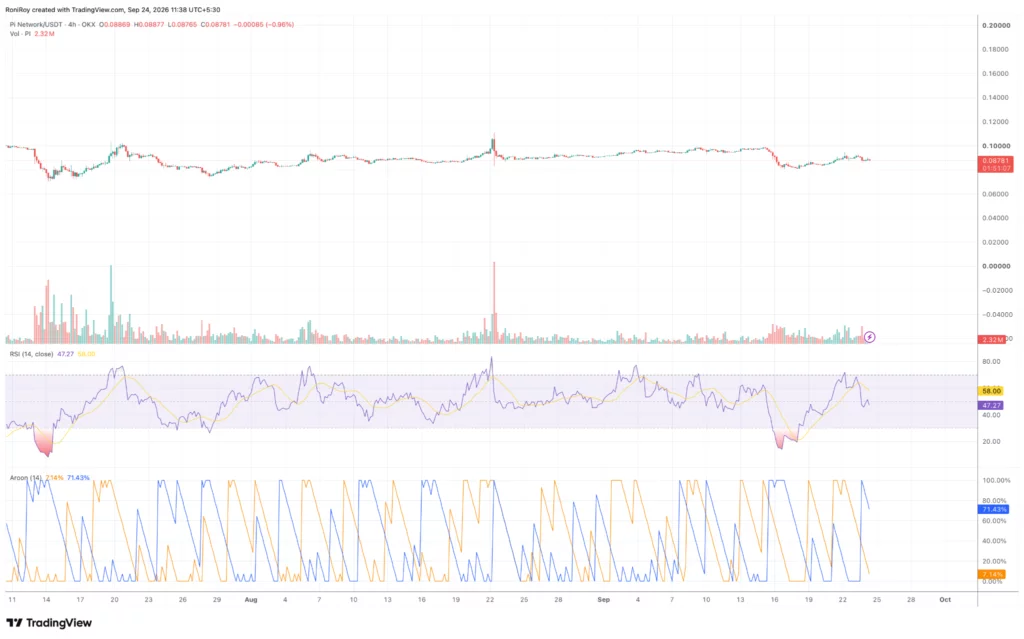
PI’s 14 period relative strength index has dropped to 47.27, down from above 70 during the Sept. 22 recovery. Its RSI moving average remains considerably higher at around 58.
An RSI reading below 50 gives sellers a slight momentum advantage, although PI is nowhere near oversold territory. A move below 40 would provide stronger evidence that selling momentum is building, particularly if price breaks its recent local lows at the same time.
Aroon paints a less bearish short term picture. Aroon Up remains around 71.43%, while Aroon Down sits at only 7.14%. The reading shows that the latest meaningful high remains more recent than the latest significant low, meaning the indicator has not yet confirmed a fresh four hour downtrend.
Immediate support sits around $0.085 to $0.087. PI has repeatedly traded around this region since its mid September decline, making a clean break below it the next technical test.
Failure to hold $0.085 could put the $0.080 to $0.082 region back in play. A larger selloff would leave the July price area around $0.071 to $0.075 as the next lower zone visible on the daily chart.
Buyers first need to reclaim the 20 day EMA around $0.0898. The 50 day EMA near $0.0920 forms the next hurdle, followed by the $0.096 to $0.10 region.
A move through those levels would bring the 100 day EMA near $0.102 into focus. Until then, PI remains below every major daily EMA while MACD stays negative and four hour RSI sits below 50, leaving $0.085 as the key level separating the current consolidation from another possible test of $0.08.
Bitwise has found that most crypto allocations among 15 institutional investors sat between 1% and 2% of investable assets, while none of the interviewed institutions cut exposure during the roughly 50% market decline from October 2025 through April 2026.
Summary
- 15 institutional allocators were interviewed between late March and April across seven major investor categories.
- Most surveyed crypto allocations ranged between 1% and 2%, while the full range reached 13%.
- Every crypto-owning institution interviewed held Bitcoin, usually as its first and largest digital asset position.
- None reduced crypto exposure during the 50% drawdown, while several institutions increased their positions instead.
- Almost every respondent uses or plans spot crypto ETFs, citing lower costs and operational burden.
Bitwise published its inaugural Institutional Crypto Adoption report on Sept. 23 after conducting 15 interviews between late March and April with senior investment professionals responsible for crypto allocation decisions. Participants came from endowments, foundations, public pension funds, sovereign wealth funds, multi-family offices, investment consultants and public companies.
The interviews lasted 30 to 60 minutes and covered sizing, governance, investment vehicles, rebalancing and exit conditions, with Bitcoin, Ethereum and Solana receiving particular attention. Bitwise did not identify the institutions, and its report says market figures were measured as of April 30 unless stated otherwise. The findings therefore describe the 15 interviewed allocators and should not be treated as a representative survey of the entire institutional market.
Bitwise survey puts most crypto allocations at 1%-2%
Across the full group, reported crypto exposure ranged from 0.5% to 13% of investable assets. Most allocations clustered between 1% and 2%, using combinations of spot ETFs, direct holdings, venture investments and hedge funds.
The numbers varied considerably by institution type. Endowments and foundations reported allocations from 0.5% to 10%, with most between 0.5% and 2%. Sovereign wealth funds in the sample reported 1% to 1.5%, while public pensions ranged from 1.5% to 4.5%. Multi-family offices reached as high as 13%, and Bitwise said family offices commonly targeted around 5%. Public companies reported allocating between 1% and 10% of excess cash.
During the roughly 50% crypto-market decline between October 2025 and April 2026, none of the 15 interviewed institutions reduced their allocation, according to Bitwise. Several increased exposure while prices fell. The finding applies only to the unnamed respondents and cannot establish how institutions outside the survey behaved during the same period.
Price declines were not listed as an exit trigger by any interviewee. Respondents instead cited reasons such as a breakdown in their underlying investment thesis, regulatory reversal, an industry credibility crisis or a failure of Ethereum and Solana activity to create value for their underlying tokens.
Some participants had already held crypto through earlier drops exceeding 50%, including the 2022 downturn. Bitwise said several continued working toward existing target allocations during the 2025-2026 decline, while others moved exposure from private placements toward direct holdings or ETFs.
Bitcoin remains the common institutional holding
Bitcoin was the only crypto asset held by every crypto-owning institution in the study.
For almost all respondents with crypto exposure, Bitcoin was their first, largest and longest-held digital asset. Several institutions held it independently, while market-cap-weighted crypto portfolios left some respondents with roughly 80% of their digital-asset allocation in Bitcoin.
Bitwise found that many institutions framed Bitcoin as a store-of-value position and compared it with gold. Some endowments had built positions in both assets as part of the same portfolio strategy, although one foundation rejected the digital-gold comparison and classified crypto as disruptive technology.
Ethereum and Solana received less consistent support. Institutions holding them generally used smaller allocations, shorter investment periods and explicit performance conditions. Several institutions owned neither asset because they said they could not clearly determine how network usage would translate into token value or how the assets should fit within existing portfolio classifications.
Respondents with ETH or SOL exposure tended to treat the assets as technology investments tied to network adoption. Some said they could sell within several years if growth in areas such as stablecoins, DeFi and tokenization failed to produce value for the tokens themselves.
Bitwise’s finding on Bitcoin is consistent with some public institutional filings, although those filings cover different investors. Harvard kept its 3.04 million-share BlackRock Bitcoin ETF position unchanged during the second quarter after reducing that publicly disclosed stake during earlier quarters.
Spot ETFs are becoming a common institutional route
Almost every institution Bitwise interviewed either used spot crypto ETFs or planned to use them. Respondents that moved from direct custody into ETFs cited lower total costs, fewer operational requirements and easier back-office handling. ETFs can fit into existing systems for custody, reporting and portfolio rebalancing without requiring institutions to build their own digital-asset infrastructure.
Not every institution preferred that structure. One sovereign wealth fund was developing domestic custody infrastructure because of a government mandate to control the underlying assets directly. A public endowment cited a policy prohibiting ownership of spot commodities, including through ETFs, while another investor preferred structures that avoided public Form 13F disclosure.
Bitwise therefore argued that institutional crypto exposure visible in 13F filings should be treated as a floor because the filings do not capture direct token ownership, many private funds or other non-reportable vehicles. Form 13F itself covers qualifying securities held by institutional investment managers and does not provide a complete view of every portfolio asset.
Recent public filings show how ETFs are appearing in endowment portfolios. The SEC received Dartmouth College’s second-quarter 13F on Aug. 13, covering holdings as of June 30. In related coverage, Dartmouth retained its Bitcoin, Ethereum and Solana ETF share counts during the second quarter even though their combined reported value fell with market prices.
Public data outside Bitwise’s anonymous group show that institutional behavior has not been uniform. Harvard exited its Ether ETF and reduced its Bitcoin ETF stake during the first quarter before holding its remaining IBIT shares steady in Q2. Because Bitwise did not disclose the identities of its respondents, there is no basis to assume Harvard was included in its 15 interviews.
Governance still limits larger crypto allocations
Bitwise found that operational structure and internal governance remained major constraints on allocation size.
Respondents raised custody, portfolio classification, committee approvals and reputational concerns more often than questions about whether crypto could produce investment returns. One multi-family office summarized its approach as “Just have a process.”
Approval structures differed sharply. Some investment teams could make an allocation internally, while one sovereign wealth fund reported scrutiny from central-bank leadership involving security reviews, executive background checks, public perception and comparisons with peer institutions.
Family offices generally faced fewer approval layers, helping explain why allocations in that group reached the highest level in Bitwise’s sample. Public pensions faced boards, beneficiaries, elected officials and media scrutiny, while sovereign funds described longer decision processes involving committees and public-sector oversight.
Career risk appeared repeatedly among public-facing institutions. Foundations, pensions and sovereign wealth funds told Bitwise that professional and reputational consequences could influence whether an allocation received approval, even when the investment team supported the underlying thesis.
Bitwise expects a majority of institutional investors to hold crypto within five years, but the firm presents that statement as its own outlook, not a result established by the 15 interviews. Its report lists regulatory development and peer adoption as possible drivers while warning that a major crypto failure or weak real-world adoption could delay further allocations.
Several sovereign wealth funds interviewed by Bitwise remained in active due diligence on potential crypto positions, with some already invested and others still conducting research. One respondent said building the legal and regulatory infrastructure required to deploy sovereign capital could take more than a year.

Introduction
SimpleSwap and SecureShift have been routing swaps for each other for five years. Over that time, one thing has stayed constant on both sides: we build around privacy, and we take it seriously enough to argue about what it means. For most of crypto’s history, the answer was a coin. You held Monero, or you did not. In 2026, the question has moved to how value travels: which networks a swap touches and what each leg leaves behind.
For the anniversary, we did something more useful than a press release. Each team wrote down the observations it believes will shape where privacy goes next, an aggregator on one side and an instant exchange with a hybrid XMR model on the other. Six in total; none of them made a prediction about price. Read them, disagree with them, and tell us where you see it differently.
Part 1. What SimpleSwap sees
1. A private asset’s guarantees end at the swap boundary
In its Big Ideas for 2026, a16z crypto’s Ali Yahya called privacy the most important moat in the industry and put the problem in one line: bridging tokens is easy; bridging secrets is hard. Once a shielded asset becomes a different asset on another chain, the original asset’s properties remain behind.
SimpleSwap’s H1 2026 Swap Report shows how often that boundary gets crossed: 91.8% of swaps moved value between two networks, seven in ten had a leg outside the four largest chains, and stablecoins ended the half with a 9.2-point net gain in the share of sent vs. received. The typical swap changes both the asset and the rate. Privacy has to be discussed at the route level, because that’s where the guarantees change hands.
2. Privacy now has a number
The case for on-chain privacy used to rest on principle. In 2026, it rests on data. Blockworks’ Q1 2026 Zcash report put the shielded pool at 5.16 million ZEC, 31.0% of circulating supply, up from 18% in October 2025 by The Block’s count. Shielding requires an on-chain action, so analysts read it as usage rather than positioning. Regulated wrappers followed: The Block reported the Grayscale Zcash Trust’s daily volume doubling in April 2026 to about $1.7 million.
What is built into this demand is not concealment but selectivity: viewing keys and proofs that a transaction meets a rule without exposing the transaction itself. SimpleSwap’s own position is descriptive. The service is self-custodial: funds move between wallets the user controls, and the platform applies risk-based controls, including transaction screening and monitoring, as set out in its Anti-Financial Crime and KYC Policy. The reason is the nature of a public ledger. Crypto funds carry a history from previous wallets and counterparties, and that history can affect a transaction without the current sender knowing. When information identified during screening requires further review to meet legal or compliance obligations, the swap may be paused, and KYC may be required to ensure transaction security and compliance. A pause is not an accusation; it means the transaction context has to be clarified before the case can move forward. A private user and a controlled service are not opposites; the interesting engineering of 2026 lies at their intersection.
3. The leak moved from the chain to the browser
On 25 June 2026, Polymarket confirmed that a compromised third-party vendor had injected malicious JavaScript into its frontend. External investigators estimated that close to $3 million in PUSD was drained from at least 11 wallets before the dependency was removed. Polymarket said affected users would be refunded in full. Its smart contracts were not touched. The attacker inserted themselves between the user and the interface, and the interface constructed the transactions that the wallets then signed.
A connected wallet exposes an address, a balance, an approval history, and a signing surface to every script a page loads. A deposit-address swap exposes far less: the user receives an address and sends from a wallet they control, with nothing to connect and nothing to sign in a browser. The domain and the receiving address still need to be checked manually. In August, the work at SimpleSwap went into what sits behind those routes: new routes were added to the pool, and private transfers became available on selected pairs.
“Users think about privacy at the level of the asset. Routing forces you to think about it at the hop level. Every network boundary is where one set of properties ends, and another begins, and an aggregator sees more of those boundaries than any single venue does.” Stefan Lauer, Head of Infrastructure at SimpleSwap
Part 2. What SecureShift sees
4. Privacy is becoming a property of the route, not just the asset
SecureShift’s hybrid DEX model reflects a practical problem with moving between Monero and transparent assets. The decentralized side of the swap handles the transparent-chain legs, while XMR can be accessed through a custodial bridge using USDC or USDT as the intermediary asset. In other words, the route does not treat XMR as an isolated endpoint. It treats the swap as a sequence of different settlement environments, each with its own properties.
That distinction matters because a swap between XMR and a transparent asset does not preserve the same privacy characteristics across all legs. The XMR portion has Monero’s own transaction model, while the intermediary stablecoin leg operates on a transparent blockchain. SecureShift’s current DEX infrastructure supports XMR alongside BTC, ETH, SOL, BNB Chain, and other networks, with XMR pairs visible across its live swap activity.
The broader lesson is that privacy cannot be evaluated only by asking which asset is being received. It has to be evaluated by asking how the value got there.
5. XMR demand is spreading across routes and networks
One change SecureShift has observed in 2026 is that privacy-related demand is increasingly expressed through the routes users choose rather than through a single dedicated privacy market. XMR is now part of a broader multi-chain swap environment: SecureShift currently lists Monero alongside Bitcoin, Ethereum, Solana, BNB Chain, Arbitrum, and other networks, while its live activity shows XMR being exchanged against BTC, ETH, USDT, and other assets.
That matters because the user’s decision is no longer simply whether to hold a privacy-oriented asset. It is also which network to enter from, which asset to use as an intermediary when necessary, and where the final asset will settle. SecureShift’s wider exchange currently supports thousands of currencies and reports an average exchange time of 2 to 10 minutes, showing that privacy-related routes increasingly reside within the same infrastructure as ordinary cross-chain swaps rather than existing as a separate category.
From the exchange side, the interesting signal is therefore not just demand for XMR itself. It is the continued demand for routes that include XMR as one leg of a larger cross-chain transaction.
6. The next privacy layer is route transparency
The growth of multi-chain swapping creates a second privacy question: not only what a user sends and receives, but what happens between those two points. A route can cross several networks, assets, and liquidity sources before the final asset reaches the user’s wallet. Each additional leg can have different transaction visibility and different assumptions about custody.
SecureShift’s DEX architecture is built around this multi-chain reality. Its DEX supports cross-chain swaps while keeping the settlement of supported decentralized legs on-chain, and the platform currently lists more than 1,300 token pairs on its DEX interface. The hybrid XMR model adds another layer by using USDC or USDT as a bridge when moving between the XMR environment and transparent networks.
This suggests a change in how privacy should be discussed. Users increasingly need to understand the route itself: which asset is used at each stage, which network records each leg, and where custody enters the process. Privacy is no longer a single feature attached to the coin. It is something assembled, and sometimes lost, one hop at a time.
“Privacy is no longer only about the asset someone holds. In a multi-chain swap, it also depends on how that asset travels, which networks it touches, and what each leg reveals.” Sanket Mishra, Founder & CTO, SecureShift
What stays on the user’s side
A piece about privacy written by two services should end where the responsibility sits, not with the services. None of this is exotic.
- Check the domain before every deposit. SimpleSwap’s only official domain is simpleswap.io; SecureShift’s is SecureShift.io. Lookalike domains are the most common way funds vanish.
- Verify the receiving address character by character on a device you trust.
- Select the network deliberately. An asset sent on the wrong chain is usually not recoverable by any service.
- Know what a route exposes. A swap from a private asset to a transparent one results in a transparent transaction. Decide whether that matters before you send.
- Never share a seed phrase or private key. No swap service needs it.
- Save the order ID before sending. It is the only handle support has if a transaction stalls.
Privacy in 2026 is not something a token grants, nor something a service guarantees. It is a property of a route, assembled from choices the user makes one leg at a time.
About SimpleSwap and Secureshift
SimpleSwap is a self-custodial, multi-source swap aggregator that helps users exchange crypto wallet-to-wallet with more control, without having to compare providers and routes themselves. It supports direct wallet-to-wallet swaps across 20+ liquidity providers and 2,800+ swappable assets, combining liquidity from well-known CEX and DEX sources under the hood.
SecureShift is a hybrid, self-custodial crypto swap platform that helps users exchange digital assets wallet-to-wallet with greater control, without having to manually compare providers and liquidity routes. It combines liquidity from centralized exchanges and decentralized protocols to find efficient swap routes across a wide range of networks and assets, including BTC, ETH, XMR, SOL, ZEC, TRX, SUI, and more. SecureShift also supports advanced swap features, including private swaps, DEX routing, and automated AML-based refund handling.
StarkWare says the estimated computing cost to construct a “quantum-safe” Bitcoin transaction has dropped sharply after a week of optimization work, falling to around $67—down from roughly $320 for the first such mainnet transaction in August.
The improvement comes from participants in the Quantum-Safe Bitcoin Optimization Challenge, which targeted the GPU-heavy steps needed to build a transaction using the Quantum-Safe Bitcoin (QSB) design. StarkWare cautions that the newest figures are based on benchmark results rather than fresh on-chain deployments, but the direction suggests the approach could become more practical for emergency use.
Key takeaways
- StarkWare reports the estimated QSB transaction preparation cost is now about $66–$67, down from about $320 in August.
- The cost reduction followed optimization contributions from the Quantum-Safe Bitcoin Optimization Challenge, which ran for about a week.
- StarkWare says the challenge produced 62 accepted improvements across two tasks needed to prepare QSB transactions.
- Despite the lower estimates, StarkWare notes the latest gains are demonstrated in benchmarks, not confirmed through additional mainnet transactions.
- QSB is presented as a quantum-resilience “emergency” measure that does not require changes to Bitcoin consensus rules—though StarkWare still favors protocol-level upgrades for long-term protection.
Cost of quantum-safe construction falls again
StarkWare said that after a week of iterative optimizations by challenge participants, the computational estimate for preparing a QSB transaction fell by roughly 79%. In its Sept. 23 update, the company argued that moving from “a few hundred dollars” toward the $60s brings the method closer to what a Bitcoin holder could consider during an urgent scenario.
StarkWare adds that the live dashboard for the QSB challenge now displays the current estimate at $66. The company previously pointed out that earlier demonstrations involved higher GPU requirements and therefore higher costs.
What QSB is—and why the network doesn’t need to change
QSB was first published by StarkWare researcher Avihu Levy in April. The design aims to provide hash-based protection intended to reduce the risk posed by future quantum attacks, while avoiding changes to Bitcoin’s consensus rules. In Levy’s earlier framing, the approach was considered a “last resort” option because of cost, complexity, and limited applicability—concerns that the new optimization work is directly addressing.
The underlying idea is to add a layer of defense without requiring the Bitcoin network to adopt new rules. That “no consensus changes” property matters for holders because it can allow quantum-resistance steps to be taken with specialized tooling rather than waiting for a widely deployed protocol upgrade. However, that same constraint can limit how broadly such a system can be used in the near term.
From the first mainnet transaction to benchmark-driven reductions
StarkWare ties the earlier baseline to the first QSB transaction mined and confirmed on Aug. 26. The company previously reported engineering work from Tomer Giladi and submission through MARA’s Slipstream service, with preparation requiring approximately 3,100 GPU-hours across roughly 100 GPUs.
StarkWare estimated the compute cost for that first mainnet transaction at about $320, excluding Bitcoin network fees. The latest update changes the picture on estimated preparation expense: StarkWare says the optimization challenge reduced the estimated computing cost based on benchmarks.
To find efficiency gains, StarkWare, Yukon Research, and Eigen Labs launched the Quantum-Safe Bitcoin Optimization Challenge on Sept. 16, inviting developers, researchers, and AI agents to improve the transaction-building pipeline. In the latest update, StarkWare said the effort resulted in 62 accepted improvements across two computational tasks needed for QSB transaction preparation.
While that work is reflected in benchmark cost estimates now shown on Yukon’s QSB dashboard, StarkWare’s update still leaves an important gap: readers should treat the new $66–$67 figure as an estimate for construction workflows, not as proof that the same cost can be reproduced for additional live on-chain transactions yet.
Why holders may care—and what remains uncertain
The renewed focus on cost comes as concern continues to grow in the crypto community that a sufficiently powerful quantum computer could eventually undermine Bitcoin’s elliptic-curve digital signature system. If attackers can exploit that weakness, coins exposed by their public keys could become vulnerable—though real-world timelines and feasibility depend on engineering breakthroughs that remain uncertain.
Against that backdrop, StarkWare positions QSB as an “emergency” measure—useful if and when quantum risks become immediate enough to justify expensive operational work. The sharper cost estimates may increase the likelihood that QSB could move from a proof-of-concept into a more realistic option for holders with a larger balance who can justify special preparation in advance.
At the same time, StarkWare reiterates a key strategic tension: the company still prefers a soft fork—meaning changes to Bitcoin’s consensus rules—as the better “long-term answer” for broad, durable quantum protection. The optimizations therefore appear to strengthen the near-term toolkit around QSB, while the longer-term debate over protocol-level defenses continues.
What to watch next is whether the benchmark-driven reductions can translate into additional on-chain QSB transactions at similar cost levels, and whether broader community attention shifts from experimental benchmarking toward practical integration and planning for quantum-era safeguards.
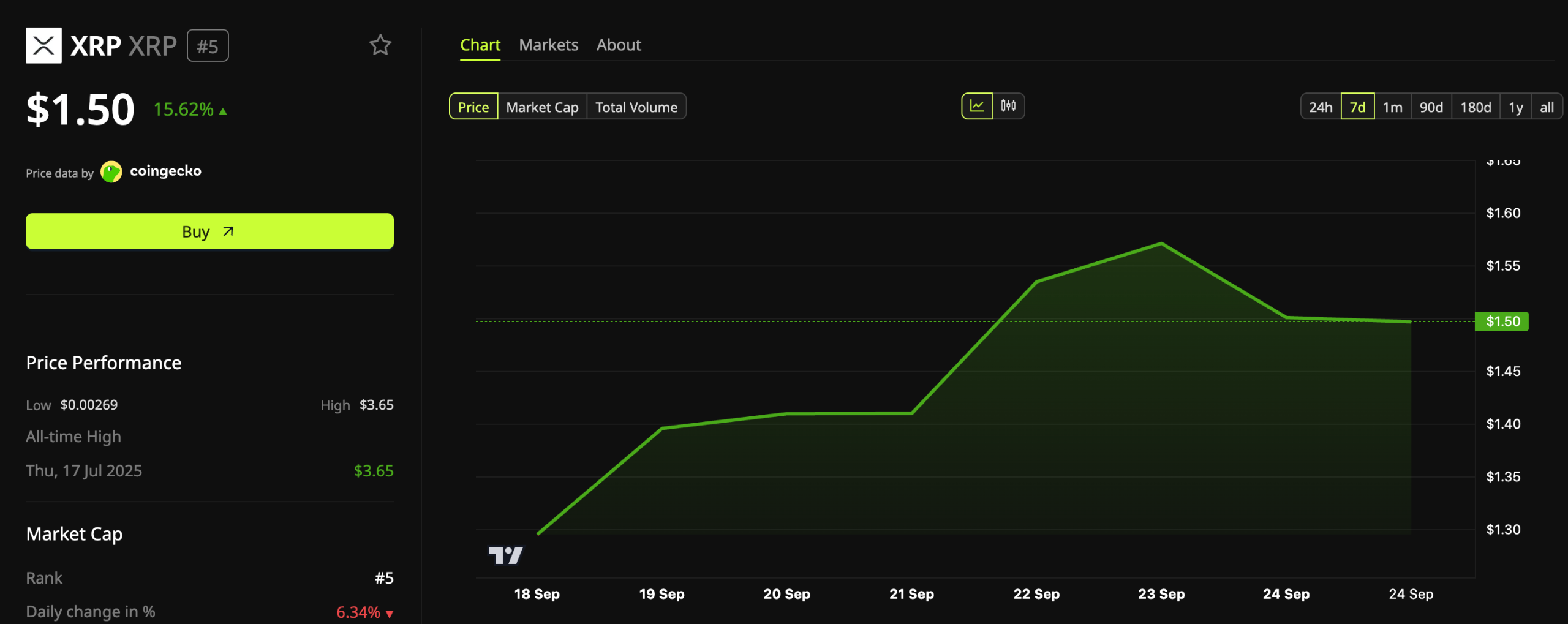
XRP (XRP) is still flashing 3 bullish signals across its holders, derivatives, and ETF data. These signals come as the token gave back part of its September gains on Thursday.
The token traded near $1.50 at press time, down about 6.3% over 24 hours, according to BeInCrypto Markets data. The pullback still leaves XRP up over 15.6% on the week, a gain that tracks a broader market rally.

Follow us on X to get the latest news as it happens
Year-Long XRP Holders Are Still Underwater
The first signal comes from wallets that have held XRP over the past year. The altcoin’s 365-day market value to realized value (MVRV) ratio sits near -11.75%, according to data from Santiment. A negative reading means the average wallet active over that period sits at a loss.
Bitcoin (BTC), Ethereum (ETH), and Chainlink (LINK) hover slightly over 0%, while Dogecoin (DOGE) sits deeper at -19.26%.
According to Santiment, a low MVRV tends to limit downside because fewer holders have profits to take. XRP holders stayed in the red after last week’s rebound.
“Buying during that pain has historically offered better long-term setups,” the post read.

Futures Traders Return in Numbers Last Seen in January
While long-term holders nurse losses, futures traders have started adding exposure again. XRP futures open interest (OI) on Binance has climbed to nearly $600 million, a January-level reading.
CryptoQuant analyst Darkfost flagged the jump. OI tracks the value of futures contracts still open.
OI has also broken decisively above its 180-day moving average near $445 million. Darkfost read this as speculation returning after months of muted activity. Positive funding rates, he added, suggest buyers are driving the build-up.
“This return of positive sentiment on XRP’s derivatives markets is therefore an encouraging signal for the current momentum. That said, it’s worth keeping in mind that OI remains dangerous in case of excess. That’s not the case today,” the analyst added.
XRP ETF Buyers Keep Showing Up Every Week
Lastly, demand for XRP’s spot exchange-traded funds (ETFs) has held steady. The funds have drawn net inflows every week since mid-July, SoSoValue data shows. That streak now covers 11 weeks, including the current week through September 23.
Bitcoin and Ethereum funds lacked that consistency. Bitcoin ETFs posted outflows in 3 of those weeks, including $462.7 million in the week ending September 11. Ethereum products lost $140 million in the week ending September 18.
The XRP inflows are smaller, however. Most weeks brought in between $1 million and $20 million, although the week ending August 28 drew $110.5 million. Cumulative net inflows have now climbed to $1.75 billion.

2 Signals Keep the Bulls in Check
Not every measure of US demand has kept pace with the ETFs, however. XRP’s Coinbase premium over Binance has narrowed to about 0.0055%, CryptoQuant analyst Arab Chain noted. Traders often read that premium as a gauge of US spot buying.
A sustained premium would point to stronger demand on Coinbase, and the current gap shows none yet.
The calendar adds a second caution, with October only a week away. XRP has closed October lower in 8 of 13 years, averaging a -5.14% monthly return, CryptoRank data shows. The token also fell 11.9% last October.

XRP therefore heads into a historically soft month with 3 signals leaning bullish. Whether Coinbase spot buyers join ETF investors could decide how much of that strength holds.
Subscribe to our YouTube channel to watch leaders and journalists provide expert insights
The post XRP Is Flashing 3 Bullish Signals Heading Into a Historically Weak October appeared first on BeInCrypto.

The work addresses a possible future threat to Bitcoin. A sufficiently powerful quantum computer could use a wallet’s exposed public key to work out its private key and steal the coins. StarkWare’s method adds a form of protection based on hashes, which are expected to withstand that attack. It fits within Bitcoin’s existing rules, so trying it did not require the network to approve an upgrade.
As such, the method is an emergency option for moving eligible coins if the quantum threat arrives before Bitcoin adopts a broader fix. Using it widely would be expensive at $320 of computing per transaction — and a lower bill could make the option more practical.
Read More: Quantum-safe bitcoin now possible without a soft fork, but costs $200 a pop, new research shows
The $66 figure remains an estimate drawn from a test of the computation. The improved code has not been shown preparing another transaction mined on Bitcoin.
Applying the speedups displayed on the contest site to its listed $320 cost breakdown yields about $83, according to CoinDesk calculations. The site says later record-setting runs go beyond those measurements, without showing which results bring its transaction estimate to $66.
Meanwhile, the method also has limits beyond cost. These transactions have to be sent directly to a miner because they do not travel through the network in the usual way, and they do not protect coins whose public keys are already exposed, which is the group a quantum attacker would reach first.

Paramount Skydance CEO David Ellison has at long last gotten his prize. After fighting off Netflix in a bidding war and state attorneys general in an antitrust lawsuit, the path is finally clear for Paramount to close its acquisition of Warner Bros. Discovery. On Monday, Paramount settled an antitrust lawsuit led by California Attorney General Rob Bonta that also included…
Copyright ©2026 Investor’s Business Daily, LLC. All rights reserved. 87990cbe856818d5eddac44c7b1cdeb8

U.S. President Donald Trump disclosed purchases of Strategy shares worth between $50,001 and $100,000 in July, according to a filing published by the U.S. Office of Government Ethics on Tuesday. The disclosure adds to a pattern of reported holdings in several crypto-adjacent companies, as Trump’s administration continues to push for parts of a broader pro-crypto agenda.
The latest report indicates that Trump bought Strategy shares on July 27 for $50,001 to $100,000, after a smaller purchase three days earlier. The filing also lists other crypto-related transactions during July, including activity involving Coinbase and sales of shares in Bitcoin mining companies MARA Holdings and CleanSpark.
Key takeaways
- According to the Office of Government Ethics filing, Trump bought Strategy shares worth $50,001 to $100,000 on July 27.
- A prior Strategy purchase reported in the same filing covered $1,001 to $15,000 made three days earlier.
- The July 27 Strategy purchase is the largest crypto-linked transaction described in the filing, and Trump previously disclosed a similar $50,001 to $100,000 Strategy buy on Feb. 12.
- The filing reports transaction values in ranges, so it does not reveal how many Strategy shares remain in Trump’s portfolio.
- The disclosures come as regulators have advanced limited crypto-related initiatives even though comprehensive market-structure legislation has stalled in Congress.
What the ethics filing shows about Strategy holdings
The Office of Government Ethics filing reports that Trump’s Strategy transactions in July included two buys: $1,001 to $15,000 on July 24 and $50,001 to $100,000 on July 27. Strategy is widely described as the largest publicly traded corporate holder of Bitcoin; BitcoinTreasuries.net data cited in the filing context places Strategy’s holdings at 846,000 BTC.
The filing’s approach matters for how investors interpret it. Because disclosures are made as dollar value ranges rather than as running share totals, readers cannot determine the number of Strategy shares Trump currently holds after these transactions.
Strategy purchases also appear consistent with earlier disclosures. BitcoinTreasuries.net data referenced in the article notes that Trump previously disclosed a Strategy purchase in the same $50,001 to $100,000 range on Feb. 12. The filing context further indicates that Trump’s accounts have also reported smaller Strategy buys and sells during the year.
Broader portfolio moves and third-party management
While Strategy is the most prominent crypto-linked holding disclosed for July, the filing indicates Trump’s overall portfolio activity was not limited to crypto-adjacent equities. It includes sales of $5 million to $25 million each of Microsoft and Amazon stock on July 20, along with additional purchases and sales in other ranges between $1 million and $5 million.
Separately, the White House told CNBC that Trump’s stock and bond portfolio is independently managed by third-party financial institutions, with no input from Trump or his family. That statement is relevant because the ethics disclosures detail transactions without describing investment decision-making or timing beyond the reported dates.
Strategy stock gains and what traders should watch
Following the July disclosures, Strategy shares have moved higher in the near term. According to Yahoo Finance data referenced in the reporting, Strategy’s stock has gained nearly 30% over the past five trading days and roughly 37% over the past month.
For market participants, the key question is how much these price moves relate to broader corporate and Bitcoin market dynamics rather than to the individual disclosure itself. The filing describes transactions rather than portfolio effects, and the disclosure does not indicate how the trades were executed beyond the reported date and value range. Traders are therefore likely to focus more on Strategy’s underlying Bitcoin exposure and market sentiment than on the specific disclosure as a standalone catalyst.
Disclosure amid stalled legislation and regulatory workarounds
Trump’s Strategy disclosure arrives during an ongoing policy push that targets parts of the U.S. crypto market, even as comprehensive market-structure legislation remains stalled in Congress. The article notes that the Senate did not advance the CLARITY Act on Sept. 15, but that regulators have used existing authorities to move forward on narrower issues.
In the period after the failed advance, the Securities and Exchange Commission cleared a limited form of onchain trading for tokenized U.S. stocks under a temporary exemption, according to earlier coverage cited in the article from Cointelegraph. The Commodity Futures Trading Commission also eased registration requirements for certain software providers that offer access to regulated derivatives markets, again according to Cointelegraph reporting cited in the article.
The CFTC also submitted a broader crypto market rulemaking initiative for White House review on Sept. 17, with the article noting that it remains preliminary rather than a formal proposal. The initiative is described as “Regulation Crypto Asset Transactions and Regulation Crypto Asset Markets.”
Beyond regulatory actions, the administration’s agenda has extended to Bitcoin directly. The article states that the House Financial Services Committee voted 28-21 to advance legislation to codify Trump’s proposed Strategic Bitcoin Reserve and to require any Bitcoin placed into that reserve be held for at least 20 years. The report also references Arkham Intelligence data suggesting the U.S. government holds an estimated 324,527 BTC.
Read together, the disclosures and policy developments point to a consistent theme: even where broad legislative frameworks face delays, regulators and lawmakers have pursued incremental steps that shape how tokenized assets, trading access, and crypto market oversight may evolve.
Closing perspective
Investors and builders should watch whether additional ethics filings continue to show increased exposure to Bitcoin-linked corporate vehicles like Strategy, and whether regulators’ limited pathways for tokenized assets and trading access expand into more comprehensive market-structure rules. The next signal to track is whether stalled legislation such as the CLARITY Act regains traction—or whether further regulatory action fills the gap.
Crypto World
Caris Life Sciences Coasts Past A Buy Point; Why This Texas Biotech Researcher Deserves A Look

Texas might not be the initial state that pops into mind when thinking about leading-edge companies in the field of biotechnology. But Irving, Texas-based Caris Life Sciences (CAI) is carving a name for itself within the stock market. Caris, Tuesday’s IBD 50 Stocks To Watch pick is rebounding fast after bottoming at 14.19 in May. Those investors looking for an entry…
Copyright ©2026 Investor’s Business Daily, LLC. All rights reserved. 87990cbe856818d5eddac44c7b1cdeb8
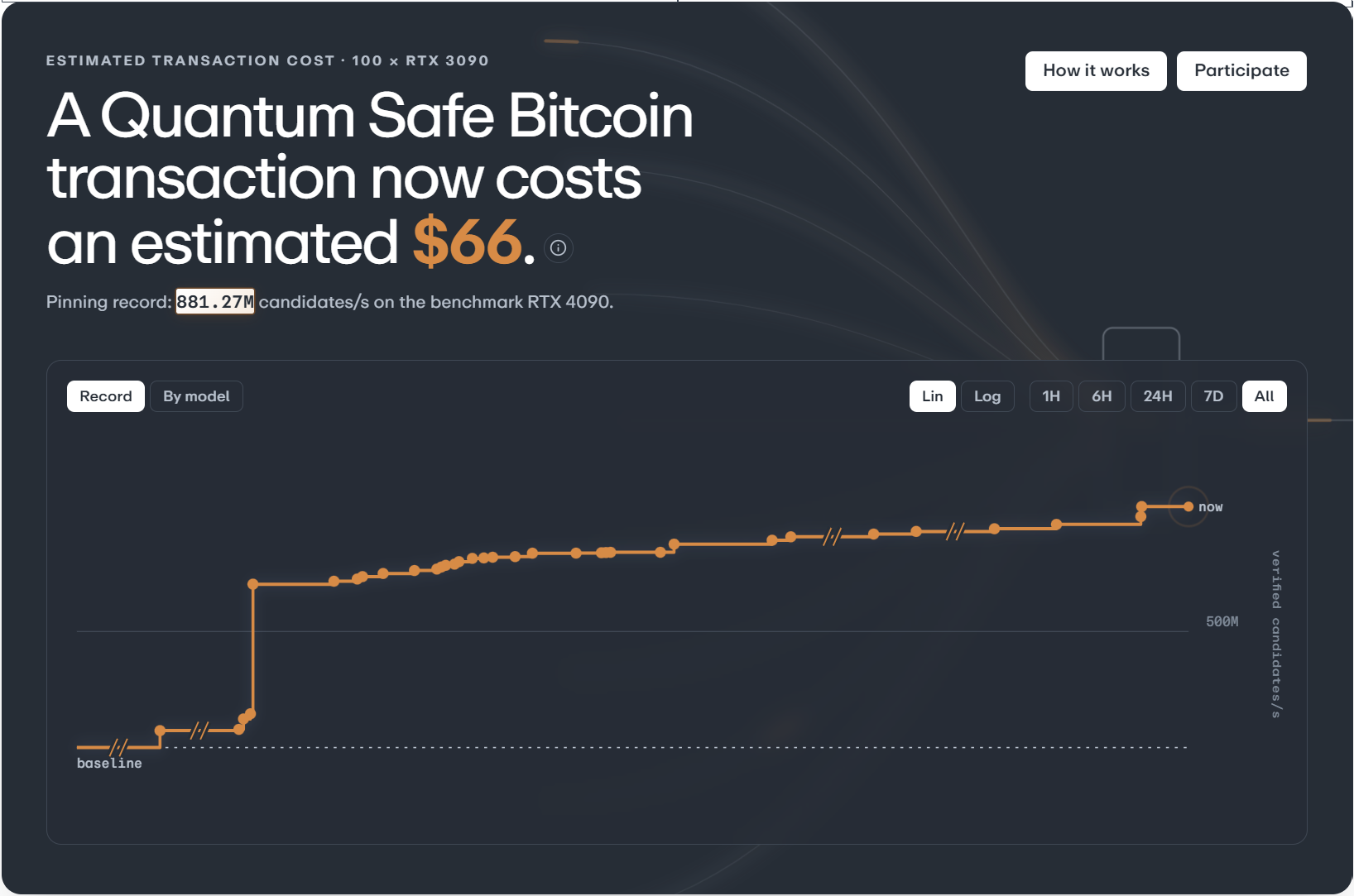
The estimated computational cost to prepare a quantum-resistant Bitcoin transaction has fallen below $67 after a week of optimization, down from the roughly $320 spent on the first such mainnet transaction in August, according to StarkWare.
The results came after participants in the Quantum-Safe Bitcoin Optimization Challenge found ways to push down the GPU computation needed to build a quantum-safe Bitcoin transaction.
The reduction could make the experimental defense (which doesn’t require changes to the network’s consensus rules) against future quantum attacks more practical for Bitcoin holders. However, the latest optimizations have only been demonstrated in benchmark tests.
“A construction that costs a few hundred dollars per transaction is a demo. One that costs $67 is closer to something a holder with a large unexposed balance might reach for in an emergency,” StarkWare wrote in its Sept. 23 update. The dashboard now shows the estimated cost has dropped to $66.
Quantum-Safe Bitcoin an “emergency” solution
StarkWare researcher Avihu Levy published the Quantum-Safe Bitcoin (QSB) design in April, outlining a way to add hash-based protection against quantum attacks without changing Bitcoin’s consensus rules. At the time, he described it as a “last resort measure” due to costs, complexity and limited applicability, while continuing to advocate for protocol-level changes.
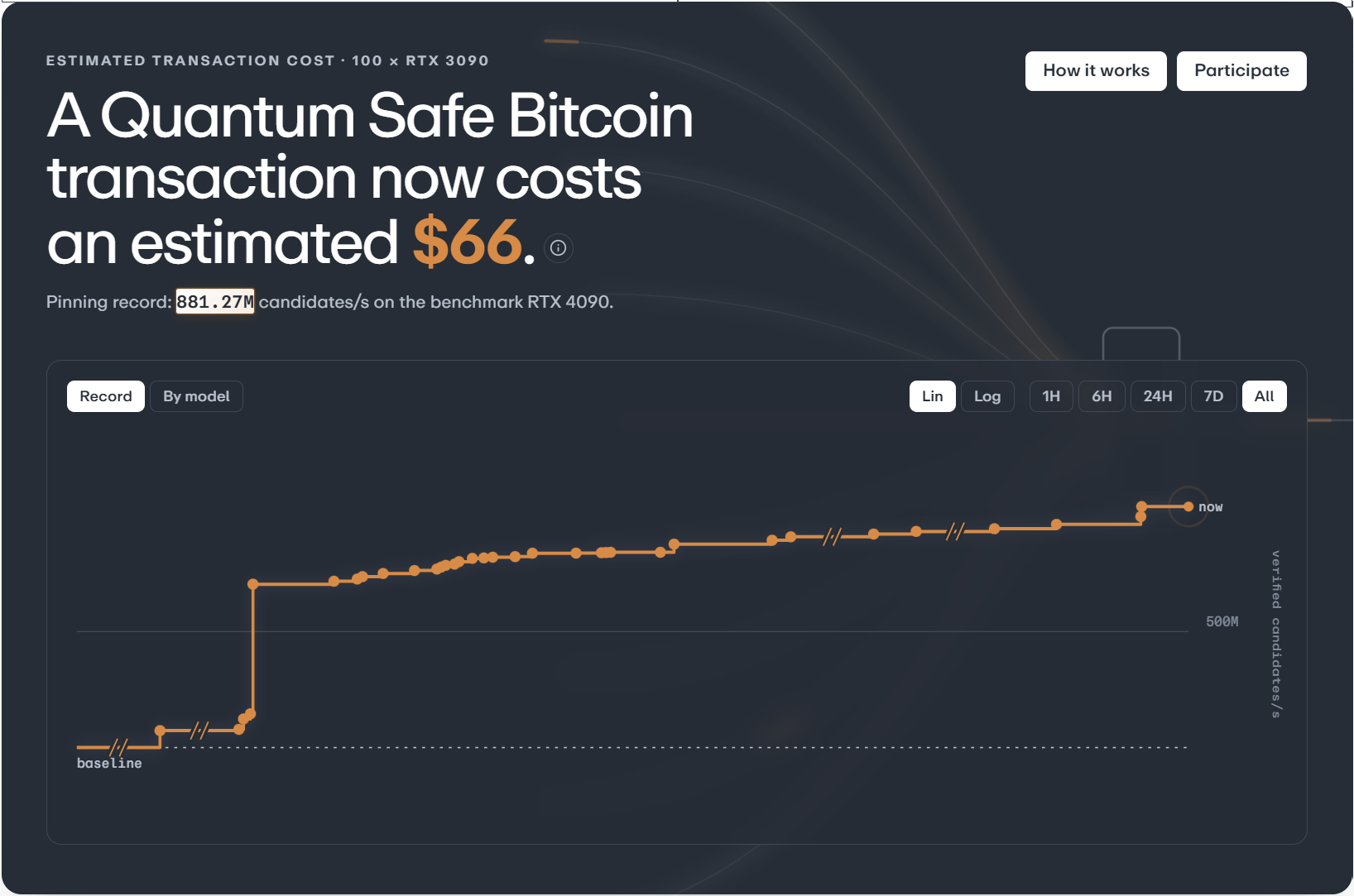
The estimated cost fell by another dollar since publication. Source: Yukon
According to StarkWare, the first QSB transaction was mined and confirmed on Aug. 26, with engineering work from Tomer Giladi and direct submission through MARA’s Slipstream service. Preparing it required approximately 3,100 GPU-hours across roughly 100 GPUs, at a compute cost of about $320, excluding Bitcoin network fees.
Related: Crypto’s first quantum attack will look like unexplained breach: Quantus founder
To find ways to bring that cost down, StarkWare, Yukon Research and Eigen Labs launched the QSB challenge on Sept. 16, inviting developers, researchers and AI agents to make the transaction-building software faster and more efficient.
In its latest update, StarkWare said the challenge produced 62 accepted improvements across two computational tasks needed to prepare a QSB transaction. According to StarkWare, this ended up cutting the estimated computing cost by about 79%, based on benchmark tests.
The development comes amid increasing concern that a sufficiently powerful quantum computer could break the elliptic-curve digital signatures used by Bitcoin, potentially allowing attackers to steal coins whose public keys are exposed.
Researchers are developing quantum-resistant protections, including QSB. However, StarkWare said it still favors a soft fork — a change to Bitcoin’s consensus rules — as a better “long-term answer” for broad quantum protection on Bitcoin.
Magazine: A quantum roadmap would push Bitcoin much higher: Charles Edwards

PI price falls below $0.09 as bearish momentum returns

8 Psychological Thriller Movies Without Any Flaws

MLB wild-card roundup: Blue Jays eliminated, clinches postponed




-

 Fashion6 days ago
Weekend Open Thread: Talbots – Corporette.com
-

 Tech3 days ago
Researchers escape OpenAI Codex sandbox to run commands on host
-

 Crypto World5 days ago
Circle launches Arc Studio AI agent for building onchain apps
-

 Crypto World3 days ago
Who Needs CLARITY Anyway? ARB Could See 70X Increase: Hodler’s Digest
-
 NewsBeat5 days ago
Trump says US has reached an agreement to take permanent control of Greenland’s security
-

 Crypto World1 day ago
Goldman Sachs and Deutsche Bank Agree: The S&P 500 Rally Isn't Over
-

 Crypto World5 days ago
Trading Bitcoin on Robinhood? Why 2% Spread Has Traders Worried
-

 Crypto World6 days ago
Mortgage and refinance interest rates today, Thursday, September 17, 2026
-

 Crypto World5 days ago
Bitcoin price breaks channel as RSI climbs to 63
-

 Tech3 days ago
Google’s $899 Googlebook is a bet that you’ll buy a new laptop for Gemini
-

 Business3 days ago
Analog Devices (ADI) Bets $1.35 Billion on Chips that Let Machines Think for Themselves
-

 Crypto World3 days ago
Coinbase, Robinhood, Circle Seen as Tokenized-Stock Winners
-

 Tech6 days ago
GPT-6 Astra Reached the Nether in Minecraft, Lost Its Stash to a Creeper, and Farmed Potatoes for Hours
-
 Business1 day ago
Oil Price Today (September 23): Crude oil below $100 on hopes of US-Iran talks. What did Trump say?
-

 Crypto World5 days ago
World Money launches in 150+ countries with Stripe
-
 Tech4 days ago
Trump suggests rebranding AI with a new name, says he’s also creating an AI Force
-

 Crypto World6 days ago
Silver prices recover quickly, hitting weekly high today
-
 NewsBeat5 days ago
US was ‘on brink of war’ with China over false AI report of nukes moving in Middle East
-
 Crypto World3 days ago
Bitcoin price holds above $81K as key catalysts line up
-
 Crypto World2 days ago
Meta Jumps 11% As Muse Shines and Investors Show an Appetite for Advancing AI
You must be logged in to post a comment Login