
Crypto World
AI Coders Just Cut Quantum-Safe Bitcoin Costs by 79%: What’s This Mean?


A week-long coding challenge just made quantum-safe Bitcoin transactions dramatically cheaper. AI-assisted developers cut the estimated cost by 79%, from $320 down to roughly $66.
StarkWare’s experimental method offers a contingency tool against a theoretical future threat, not an immediate fix for everyday wallets.
What Quantum-Safe Bitcoin Actually Protects Against
Quantum-Safe Bitcoin, or QSB, uses hash-based cryptography to move eligible Bitcoin under existing consensus rules, without requiring any protocol change or soft fork. It addresses a specific risk. A sufficiently powerful quantum computer could one day derive private keys from exposed public keys, then spend those funds.
No such machine exists today, but developers treat the threat as a long-term contingency worth preparing for.
StarkWare mined the first QSB transaction on the Bitcoin mainnet on August 26, through MARA’s Slipstream service. Building it required roughly 3,100 GPU-hours and cost an estimated $320 in compute alone.
That price tag limited the method’s practicality. On September 16, StarkWare launched the Quantum-Safe Bitcoin Optimization Challenge. Yukon Research and Eigen Labs joined as partners, offering more than $20,000 in prizes.
Participants tackled two computational bottlenecks. Pinning searches for a valid transaction commitment, while subset selection finds the right combination of components. Sixty-two accepted submissions, many built with AI coding tools, pushed processing speed roughly six times faster on identical hardware.
Follow us on X to get the latest news as it happens.

Benchmark tests on an RTX 4090 GPU told the story clearly: pinning speed jumped from about 146 million verified candidates per second to more than 880 million. That leap pushed the cost estimate from $320 down to roughly 66 to $67.
That figure has not yet been demonstrated in a second-mined transaction, and it covers only GPU compute, and excludes network fees.
Is Bitcoin’s Broader Quantum Defense Keeping Pace?
StarkWare’s challenge fits inside a much larger, fast-moving field. NIST finalized its official post-quantum cryptography standards in August 2024, setting a 2035 migration deadline for federal agencies. Google set its own internal target of 2029.
A Google Quantum AI research paper published in March 2026 further sharpened the urgency, reducing the estimated qubit count required to break Bitcoin’s cryptography by roughly 20x. That shift pushed some expert timelines from decades away into the early 2030s.
Bitcoin’s own developer community responded separately with BIP-360, a quantum-resistant address proposal that reached testnet with over 50 participating miners in March 2026.
Not every expert agrees on urgency, though. Stanford cryptographer Dan Boneh, who co-authored Google’s March paper, warned that a hasty transition could cause a catastrophic bug to strike first more readily than an actual quantum attack would.
That tension frames exactly what StarkWare’s challenge represents: one narrow, low-risk emergency tool, built while the industry debates how fast Bitcoin’s core cryptography should actually change.
Subscribe to our YouTube channel to watch leaders and journalists provide expert insights.
The post AI Coders Just Cut Quantum-Safe Bitcoin Costs by 79%: What’s This Mean? appeared first on BeInCrypto.

Crypto World
Judge Orders White House to Restore Access for CNN, MS NOW, and Politico. What Happens Next?

Vowing to fight any legal block on his ban, Trump insisted: “Almost without question and, as usual, we’ll go for appeal, because fake news people and publications that only write negatively, and who violate our national security by writing false and defamatory stories with unknown ‘sources,’ shouldn’t be allowed access to the [Oval Office].”
However, in the court filing, Kelly has stated that “temporary restraining orders are generally unappealable.”
Instead, during the 14-day period, the court “will set a schedule for expedited briefing on a motion for a preliminary injunction,” allowing Trump and the media outlets to submit further evidence for Kelly to consider.
Trump, during his first term, revoked the White House press credentials of Jim Acosta, who was then a CNN correspondent, after a tense exchange during a news conference.
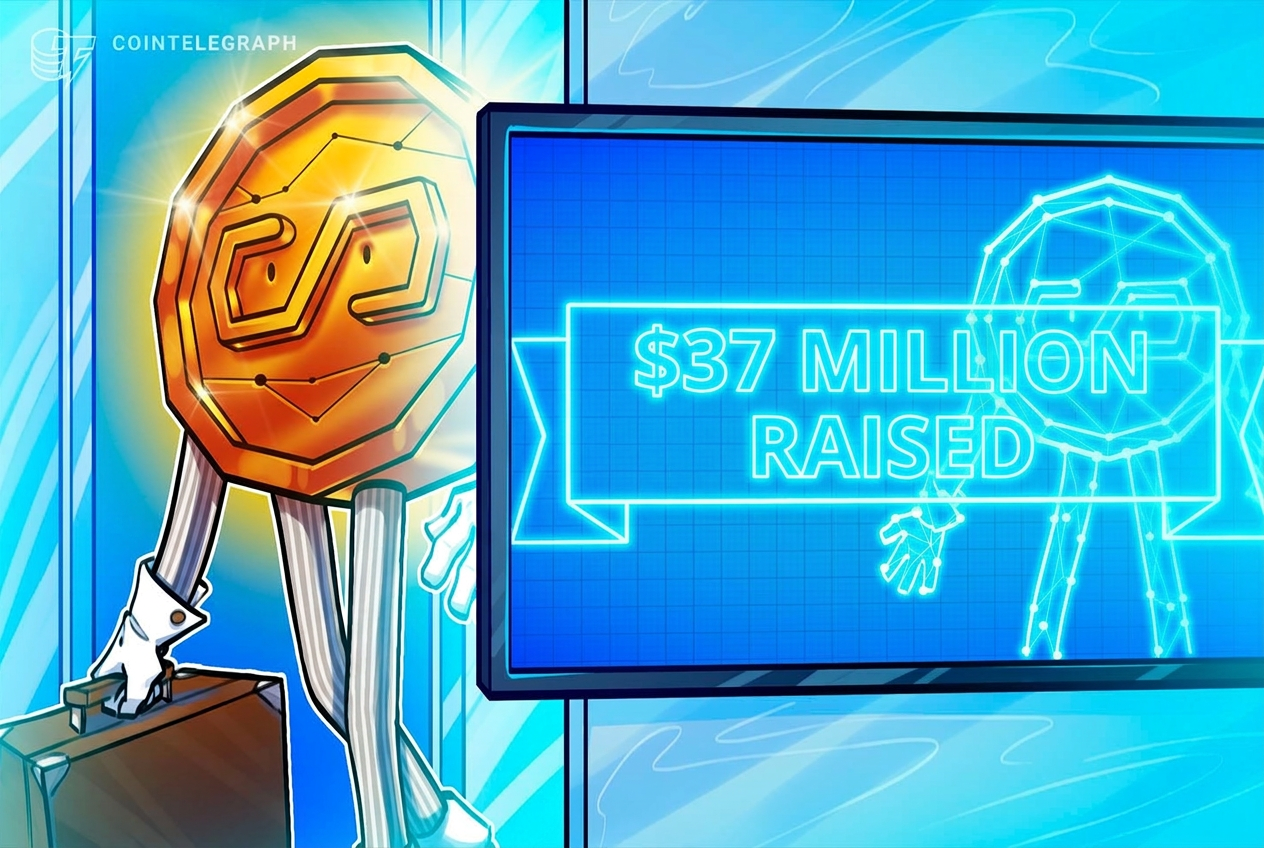
Stablecoin infrastructure company HIFI has raised $37 million in a Series A funding round led by Left Lane Capital as the use of stablecoins for payments and cross-border transfers continues to grow despite weakness in the broader crypto market.
Cross-border stablecoin flows rose 77.5% to $220.3 billion in the 12 months ending June 2026, even as the wider crypto market shrank by more than a third over the same period, according to Chainalysis.
HIFI CEO Zach Walsh told Cointelegraph that the Series A is the company’s first priced funding round. The company did not disclose its valuation. “HIFI is processing approximately $7 billion in annualized volume directly through its platform,” Walsh said.
The funding comes as more payments and financial assets move onto blockchains, increasing demand for infrastructure connecting those networks to the banking system.
Firms such as Visa and the Depository Trust & Clearing Corporation (DTCC) have been rolling out or testing blockchain-based financial infrastructure.
HIFI expands into tokenized capital markets
HIFI’s infrastructure allows customers to move dollars into and out of stablecoins, send payouts through US banking rails and cards, and settle the cash side of tokenized repo and Treasury transactions in US dollars.
“This financing will support the scaling of HIFI’s tokenized capital markets infrastructure and the expansion of its broader product suite, including stablecoin payments products,” Walsh told Cointelegraph.
In July, DTCC conducted production trades using tokenized securities across several market functions, including US Treasury and repo settlement, equity transactions, securities lending and collateral workflows. HIFI was among more than 30 firms that participated, alongside BlackRock, Goldman Sachs and Nasdaq.
The transactions included US Treasury and repo delivery-versus-payment trades, equity transactions, securities lending and collateral workflows using assets held at the Depository Trust Company that had been converted into tokenized representations. DTCC plans to launch its Tokenization Service in October.
Related: US stablecoin adoption could surge with bank-like protections: Visa survey
HIFI has also expanded into card-based payouts through Visa Direct. Its platform allows customers to convert USDC and send the proceeds to eligible Visa debit and credit cards globally, according to the company’s website.
The expansion comes as Visa reports growing use of stablecoins across its payments network. On Sept. 9, the company said more than 160 stablecoin-linked card programs were live globally during its fiscal second quarter, with payment volume through those programs rising nearly 200% year over year.
Visa also said its stablecoin settlement volume had surpassed a $20 billion annualized run rate, more than 15 times its level a year earlier.
Magazine: Winners and losers of the SEC’s new tokenized stocks rules

Mint.io has opened its Web3 player economy across its full web platform, connecting games, XP, leaderboards and rewards ahead of the planned activation of its MNTD token.
Summary
- Mint has opened a Web3 player economy that connects XP, ranks, leaderboards and rewards across supported games.
- Eligible leaderboard progress on the web platform and Telegram Mini App will convert into MNTD allocations when the token is activated.
- MNTD emissions will be capped and linked to platform revenue, with reward limits and controls designed to manage exploitation.
- Mint plans to add more games, token denominated leaderboard seasons and new content through its AI assisted production pipeline.
According to Mint, the platform was built with token mechanics from the start and uses a multi chain infrastructure layer to connect progression and rewards across supported games. Technology for the platform is supplied by Hero Gaming Group, an iGaming business founded in 2013.
Players can collect XP through eligible activity, move through different tiers and compete for prize pools without their progression being limited to a single title. Mint said onchain verification is used for core reward flows, while AI assisted models are used to manage token emissions and balance the player economy as activity changes.
A free to play Telegram Mini App sits alongside the main web platform, giving users another route into the progression system.

MNTD allocations will draw from pre launch activity
Players who participated before the MNTD launch will have their accumulated leaderboard standings converted into token allocations when the asset is activated, according to Mint.
Eligible activity has carried a 200% XP boost during the run up to the launch. Progress recorded through both the main web platform and Mint’s free to play Telegram Mini App will count toward the allocation process.
The system builds on ranks, seasons and XP already available to users, with each eligible session contributing to a player’s position on the platform. Mint has not disclosed the conversion rate between leaderboard progress and MNTD allocations.
Mint said emissions will be capped and linked to platform revenue. Reward limits are part of the same structure, while controls have been introduced to deal with promotional abuse and attempts to exploit the progression system.
Under the model described by the company, token distribution is connected to eligible platform activity instead of relying solely on rewards distributed around the launch itself. Mint said the setup is intended to keep emissions manageable during periods of higher volume as well as slower market conditions.
Its existing reward system already links eligible activity to progression. Mint’s help center says real mode gameplay uses supported cryptocurrency balances, with qualifying activity able to contribute to XP or other rewards depending on the applicable rules. Demo play, where available, does not generate XP or real money rewards.
Web platform connects progression across supported games
Mint’s infrastructure connects supported games to a common progression layer, allowing XP, ranks and rewards to carry across the platform instead of operating separately within each title.
AI assisted systems are used in two parts of the platform. Incentive modeling helps manage token emissions as participation changes, while Mint said its content pipeline can produce themed experiences with token utility in roughly 10 days.
Core reward flows use onchain verification. A free to play Telegram Mini App provides another entry point into the ecosystem, with eligible progress there contributing to the same MNTD allocation process used by the main web platform.
Telegram Mini Apps have become one route for Web3 gaming projects to reach users inside the messaging platform. Crypto.news previously covered the Telegram gaming ecosystem as developers experimented with social games that could be accessed without a separate application.
Mint’s Telegram product complements its main web platform, where supported cryptocurrency balances can be used for real mode gameplay. Qualifying activity can contribute to XP and other rewards depending on the applicable rules, while demo play does not generate XP or real money rewards.
Mint caps token emissions based on platform revenue
MNTD emissions will be hard capped and linked to revenue generated by the platform, Mint said.
Reward limits will determine how much can enter circulation through the player economy, while controls against exploitation are intended to restrict abuse of promotional and progression systems. Eligible platform activity will determine participation in the reward structure.
Mint said the model was designed to operate through changes in player volume and weaker market conditions without depending on unrestricted token distribution. The company has not provided projections for MNTD’s market value or the monetary value of allocations earned during the current campaign.
More games and leaderboard seasons are planned
Mint plans to bring more titles onto its shared infrastructure after the MNTD launch, with future games expected to use the same XP, ranking and reward framework.
Additional leaderboard seasons with token denominated prize pools are planned, while the company intends to continue using its AI assisted pipeline to produce new themed experiences. Mint has not disclosed how many games will be added or provided a timetable for individual integrations.
Mint.io is operated by Sage Shark Ltd under Anjouan gaming license No. ALSI-202507035-FI2. Its web platform and Telegram Mini App are already operational, with qualifying leaderboard standings accumulated during the pre launch period set to convert into MNTD allocations at token activation.
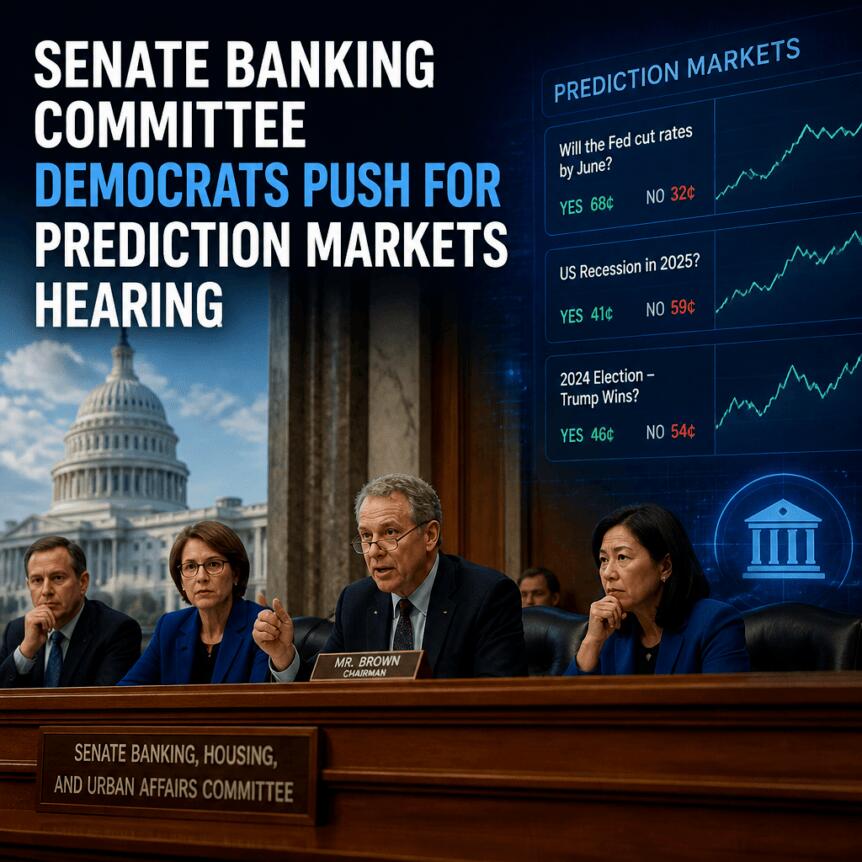
Senate Banking Committee Democrats have written a letter urging committee chair Tim Scott to hold a congressional hearing on prediction markets.
The demand came the same day Scott and Senate Banking Committee Republicans held a private meeting with Kalshi CEO Tarek Mansour.
Democrats Push For Congressional Hearing
Senate Banking Committee Democrats wrote a letter to Scott stating that the panel has a critical role in overseeing prediction markets and platforms like Kalshi. Several Democratic Senators, including Elizabeth Warren, Catherine Cortez Masto, Jack Reed, Mark Warner, Raphael Warnock, Ruben Gallego, and Angela Alsobrooks, signed the letter.
“It is critical that Congress examine prediction markets on a bipartisan basis in a public hearing—not behind closed doors in a Republican-only, industry-friendly roundtable.”
News of the meeting between Senate Banking Committee Republicans and Mansour was first reported by Punchbowl News. Scott confirmed the meeting in a separate statement sent to The Block. The Banking Committee Chair said the committee’s Republican members and Kalshi officials met to “better understand the opportunities and challenges presented by securities-linked products.” The statement read,
“We discussed the importance of bringing innovation onshore, how investors use these products, ways to protect retail investors, and the regulatory questions Congress should address. My goal is to ensure that America leads in financial innovation while protecting investors and providing the regulatory clarity these emerging markets need.”
Who Regulates Prediction Markets
There remains substantial confusion about which body has oversight of prediction markets like Kalshi. The Commodity Futures Trading Commission (CFTC) has stepped in to regulate prediction markets. However, it has faced pushback from states such as New York and Arizona that argue they have the authority to regulate event contracts. State and federal regulators have repeatedly clashed over who should regulate prediction markets, with lawmakers mulling whether Congress should step in to break the deadlock.
Lawmakers have raised doubts about whether existing laws and the CFTC’s limited resources are enough to oversee the rapidly growing sector. Rep. Dusty Johnson, R-S.D., stated during a House Agriculture Committee digital assets subcommittee hearing,
“As with many emerging technologies, our laws are being asked to answer questions that we had never really contemplated when we wrote the laws years ago.”
The House Agriculture Committee and Senate Agriculture Committee have primary jurisdiction over the CFTC. On the other hand, the Securities and Exchange Commission (SEC) falls under the Senate Banking Committee’s jurisdiction. Senate Democrats have argued that prediction market products offer bets tied to company performance indicators, thus falling under the SEC’s regulatory purview.
Cboe Global Markets has also asked the SEC for the green light to list “all-or-nothing options” tied to the earnings results of companies. Senate committee Democrats cited Cboe’s request in their letter, stating,
“As industry participants request SEC approval for options tied to corporate earnings, the full Senate Banking Committee has a critical oversight role to play.”
Meanwhile, prediction markets remain trapped in a high-stakes tug-of-war between federal and state regulators.
Disclaimer: This article is provided for informational purposes only. It is not offered or intended to be used as legal, tax, investment, financial, or other advice.

Bitwise’s first Institutional Crypto Adoption Report, based on interviews with 15 asset owners conducted in late March and April, suggests that the institutions that hold crypto were far more resilient during a major drawdown than many might expect. According to Bitwise, none of the surveyed organizations cut their crypto allocations during an approximately 50% market decline that began in October 2025—though several said they added.
Across the group, Bitcoin (BTC) was the core holding. Every institution in the sample that owned crypto held BTC, typically as its largest and longest-standing position. Ether (ETH) and Solana (SOL) were present too, but generally in smaller allocations tied to clearer conditions for when (and whether) those positions should be maintained.
Key takeaways
- During a roughly 50% drawdown, none of the 15 interviewed institutions reported reducing crypto allocations, and some increased exposure.
- Bitcoin remains the anchor asset for institutional conviction, with ETH and SOL viewed as more conditional and shorter-horizon bets.
- Asked what would trigger selling, institutions pointed to fundamental and credibility risks—not price declines such as regulatory reversals or thesis failure.
- Most allocations for these investors were structured via spot crypto ETFs, or ETF usage was planned; some investors shifted from direct custody or private placements.
- ETH and SOL are being judged on token value accrual, with some institutions willing to exit if network growth does not translate to benefits for token holders.
Hold through drawdowns: what institutions said they would change
Bitwise’s report is grounded in interviews conducted as markets were still adjusting to a decline that started in October 2025. While the report does not name every participant, it describes the types of organizations involved, including endowments, foundations, public pensions, sovereign wealth funds, multi-family offices, investment consultants, and public companies.
One of the most notable findings is what did not drive behavior. When Bitwise asked respondents about potential reasons to sell, none cited falling prices as the deciding factor. Instead, institutions highlighted scenarios such as regulatory reversals, an industry-wide credibility problem, or a clear failure of their investment thesis.
That framing matters because it positions the drawdown not as a near-term test of price tolerance, but as a stress test of whether each institution’s original rationale still holds. Investors that treat crypto exposure as a long-term mandate—rather than a trading position—tend to be less likely to make allocation changes based on volatility alone, and Bitwise’s interview results appear to align with that approach.
BTC at the center; ETH and SOL under a “prove it” standard
The report’s asset-level breakdown reinforces a common pattern in institutional crypto adoption: BTC is the default core, while other networks are evaluated with more scrutiny.
According to Bitwise, every institution that owned crypto held Bitcoin, often as its first, largest, and longest-held position. For many of these organizations, BTC was described as a store of value—frequently compared alongside gold.
By contrast, Bitwise reports that conviction around ETH and SOL varied more. Institutions were less uniform about how long they expected those holdings to remain part of a portfolio. Several respondents told Bitwise they could exit ETH or SOL over the next few years if growth in network activity—such as stablecoins, decentralized finance, and tokenization—failed to translate into value accruing to the tokens themselves.
Bitwise also highlights a specific example from the interview set: one institution that held neither Ether nor Solana had used decentralized finance applications but saw no clear path for that activity to benefit the underlying tokens.
This “token value accrual” focus is important because it clarifies what institutions appear to be underwriting. Rather than treating network usage as sufficient on its own, the interviews suggest investors are looking for more direct economic linkage between adoption and tokenholder outcomes. The next question for market participants is whether ongoing growth in DeFi, tokenization, and stablecoin ecosystems will increasingly be presented in a way that demonstrates measurable benefits for ETH and SOL holders.
ETFs are becoming the default implementation path
Bitwise’s report also sheds light on how institutions are gaining or managing crypto exposure. Among the interviewed organizations with crypto exposure, allocations ranged from 0.5% to 13% of investable assets, with most sitting between 1% and 2%.
Nearly every institution in the sample either used spot crypto exchange-traded funds or planned to. Bitwise further said some investors were shifting from private placements or direct custody toward ETF structures. The shift matters for institutions because it often reduces operational complexity and can align crypto exposure with established portfolio management workflows.
The ETF implementation angle also connects to broader investor positioning trends. CoinShares data published in June, cited by Bitwise, found that professional investors’ reported spot Bitcoin ETF exposure fell by 17% in the first quarter. CoinShares attributed the reduction primarily to hedge funds and brokerages, which accounted for roughly 96% of the decrease, while banks added exposure.
Put together, these details suggest that institutional participation is not simply expanding in a straight line. Instead, exposure can migrate between investor categories and vehicles—sometimes reducing holdings in aggregate for certain groups while increasing for others. For readers, that implies that tracking ETF flows by investor segment may be as important as watching headline totals.
What could trigger selling—beyond market volatility
Perhaps the clearest throughline of the Bitwise interviews is that allocation decisions were tied to durability of the investment rationale rather than to interim price performance. When asked what might prompt selling, respondents referenced three broad categories: regulatory reversal, credibility issues across the crypto industry, and failure of their investment thesis.
In practical terms, this means the “risk calendar” for these institutions is shaped more by policy and structural legitimacy than by day-to-day market moves. Regulatory uncertainty can quickly alter the perceived long-term viability of crypto products, custody frameworks, and market access—so it is unsurprising that institutions prioritize it.
At the same time, the report signals a meaningful split between how investors view BTC versus other major tokens. Even with BTC serving as the anchor asset, ETH and SOL appear to be held with clearer conditions: if token-linked value does not materialize as networks scale, those positions may not survive the next investment review cycles.
Going forward, investors will likely watch two things closely: whether institutional ETF usage continues to deepen across different investor types, and whether Ethereum– and Solana-linked economic models can convincingly demonstrate how growth converts into tokenholder value—since that is the standard several institutions say would determine their next decisions.
The Hashgraph Group has put its Hedera-based IDTrust identity platform on IBM Cloud Catalog under a partnership announced Sept. 23, giving enterprise customers a route to deploy verifiable identities for AI agents.
Summary
- THG’s IDTrust is now listed on IBM Cloud Catalog as a Hedera-based enterprise identity platform.
- IBM’s directory lists The Hashgraph Group as a Silver Partner, ISV, and managed service provider.
- IDTrust issues decentralized identifiers and verifiable credentials for humans, devices, and autonomous AI agents securely.
- Gartner expects task-specific AI agents in 40% of enterprise applications by the end of 2026.
- IBM joined Hedera’s governing council in 2019, linking the companies through existing network governance ties.
The Hashgraph Group said IDTrust has been validated and listed as a SaaS offering on IBM’s marketplace, while the companies have signed an Embedded Solution Agreement covering IBM cloud and AI technology. THG described the product as “among the first” commercial Hedera-based enterprise applications available directly through a major cloud marketplace, a claim made by the company rather than an independently established market ranking.
IBM’s live catalog independently confirms that IDTrust is listed as a third-party blockchain product from The Hashgraph Group. The catalog describes it as a self-sovereign identity platform for AI agents, smart devices and humans.
Hedera IDTrust gives AI agents verifiable credentials
IDTrust assigns decentralized identifiers and verifiable credentials to people, machines and AI agents. THG says each actor can receive a unique did:hedera identifier registered through Hedera Consensus Service, while credentials are cryptographically signed and recorded through an auditable identity process.
The platform lets enterprises define credentials for particular purposes and revoke them through its management tools. THG says AI-agent identities are non-transferable and can be approved by humans, while revocation registries are anchored on Hedera. Its current product page lists financial services, telecoms, healthcare, education and device identity among supported use cases.
IDTrust uses W3C Verifiable Credentials and decentralized identifier standards. The W3C formally published its Verifiable Credentials 2.0 family as Recommendations in May 2025, defining standards for cryptographically secure and machine-verifiable digital credentials.
THG said the platform includes MCP servers that can connect AI agents with IBM watsonx Orchestrate, allowing an agent to obtain identity credentials and leave an auditable trail for authorized activity. The integration details come from THG’s announcement and have not been accompanied by a separate technical deployment report from IBM.
IBM partnership gives THG another enterprise channel
The agreement extends beyond the catalog listing. THG said it signed a global Embedded Solution Agreement with IBM covering cloud and AI technology, which allows it to incorporate IBM technology into products sold under its own offering.
IBM’s Partner Plus directory currently lists The Hashgraph Group as an Independent Software Vendor and Managed Service Provider and displays a Silver Partner badge. The same page identifies IDTrust among THG’s available solutions. IBM notes, however, that company and solution information in the directory is supplied by partners and is not validated by IBM unless stated otherwise.
The companies already share a connection through Hedera governance. IBM joined the Hedera Governing Council in August 2019 alongside Tata Communications, becoming one of the organizations involved in overseeing the network. Hedera’s historical records confirm IBM’s membership.
In related coverage, crypto.news previously reported on THG’s BrandBoost enterprise platform built on Hedera. That product combines loyalty tools with IDTrust identity functions and is part of the same Hashgraph for Enterprise product suite.
THG previously introduced TransAct, a managed gateway that lets businesses execute Hedera transactions without directly holding HBAR or handling crypto wallets. Crypto.news reported on THG’s TransAct enterprise gateway launch in September 2025.
Know Your Agent identity is becoming an enterprise focus
The IBM listing arrives as several technology and payments companies develop identity frameworks for autonomous software. Gartner projected that task-specific AI agents could appear in 40% of enterprise applications by the end of 2026, compared with less than 5% in 2025. The figure is a Gartner forecast, not an observed adoption rate.
Governance remains part of that forecast. In May, Gartner predicted that “40% of enterprises will demote or decommission autonomous AI agents” by 2027 because of governance gaps discovered after deployment. The firm said access levels and agent autonomy require different controls instead of one uniform governance model.
Other companies are developing similar identity concepts. Akamai introduced an agentic security framework in June that links agent identity, authorization and human attribution. Its partners include Visa, Experian and Skyfire.
Akamai describes its Know Your Agent framework as a method for agents to declare their identity, origin and intent while linking them to the platforms and people they represent. Visa’s Trusted Agent Protocol addresses authorization and identity for automated payments, while Experian contributes identity and risk tools.
THG is using the same KYA terminology for IDTrust, but the approaches are separate products and frameworks. No common industry-wide KYA standard has been established by the announcements reviewed for this report.
IDTrust extends THG’s use of Hedera beyond identity
THG has expanded its Hedera enterprise portfolio during 2026. Its current product suite includes identity, transaction, loyalty, traceability and environmental-market tools, while IDTrust specifically covers credential issuance and verification.
The company announced work with Merck in September on cocoa traceability and digital product passports, following other projects involving carbon-market infrastructure and cross-border logistics. THG lists the IBM agreement as its latest enterprise announcement.
Hedera has separately continued adding enterprise organizations to its governance structure. IBM has participated since 2019, while the current network history records its role among the organizations that joined during the council’s early expansion.
THG CEO Stefan Deiss said enterprises increasingly need to verify whether autonomous software is authorized to act on their behalf. He said IDTrust is intended to answer the question, “how do I know this agent is authorised to act on my behalf?”
Naemi Benz, vice president of IBM Partner Ecosystem DACH, said making IDTrust available through IBM Cloud Catalog gives clients access to THG’s decentralized identity technology through IBM’s partner ecosystem. Her comments appear in THG’s release announcing the agreement.
As of Sept. 24, IBM Cloud Catalog lists IDTrust as an available third-party blockchain product, while THG’s product site offers enterprise access through its managed platform, SDK or API.

Everyone is asking the same question today. ‘Who is Ronald Spektor?’ Spektor, 23, of Sheepshead Bay, Brooklyn, was sentenced on September 23, 2026, by Brooklyn Supreme Court Justice Danny Chun to four to 12 years in prison for orchestrating a Coinbase phishing and social engineering scheme that prosecutors said stole roughly $15.944M from about 100 users.
Spektor pleaded guilty on September 2, 2026, to the entire 31-count indictment, closing out a case the Brooklyn District Attorney’s Office had spent about a year building around one of the more elaborate cryptocurrency theft operations to hit Coinbase’s retail customer base.
— Defraud (@DefraudTG) September 24, 2026
 COINBASE SCAMMER STEALS $16M, LOSES $6M GAMBLING
Ronald Spektor, 23, has been sentenced to 4–12 years in prison after stealing nearly $16 million from around 100 Coinbase users through social engineering scams.
Prosecutors say he bragged about the thefts on Telegram as… pic.twitter.com/BKaGj6nBHA
The plea covered first-degree grand larceny, first-degree money laundering, first-degree criminal possession of stolen property and related counts. Prosecutors had pushed for seven to 21 years and objected to the shorter negotiated term, according to the Brooklyn District Attorney’s Office.
The gap between the sought sentence for Ronald Spektor, and the one handed down underscores how plea negotiations can blunt defendants’ theoretical exposure, even in large-scale cryptocurrency theft cases.
Who is Ronald Spektor, and How Did He Pull Off the $16M Coinbase Scam?
According to the Brooklyn District Attorney’s Office, someone claiming to be a Coinbase representative contacted victims and warned that a hacker had compromised their accounts.
Believing they were securing their holdings, users moved cryptocurrency into wallets they thought remained under their sole control but that were allegedly accessible to Spektor, the core mechanic of crypto phishing built on urgency rather than any technical exploit of Coinbase’s systems.
More than 70 of the roughly 100 identified victims were interviewed during the investigation. Reported losses varied widely: a California resident lost more than $1M, a Virginia resident lost more than $900,000, a Pennsylvania victim lost about $53,150, and a Maryland victim lost about $38,750.
Investigators said the stolen assets were subsequently run through swapping and mixing services, gambling platforms and online storefronts before conversion – a laundering pattern similar to what investigators have traced in other high-profile crypto-linked money laundering cases.
Prosecutors tied Spektor to the scheme through transaction records, blockchain analysis, digital forensics and search-warrant evidence, including an alleged link between his home IP address and wallets from which cryptocurrency was stolen.
Investigators seized approximately $105,000 in cash and $400,000 in cryptocurrency from Spektor during the probe, though that figure reflects assets recovered at the time rather than a confirmed final forfeiture order.
Got a Gut Feeling? It Could Pay Out Big on Polymarket
District Attorney Speaks, and Coinbase’s Chief Legal Officer Details the Exchange’s Role in Catching Spektor
Brooklyn District Attorney Eric Gonzalez framed the sentencing as vindication for the office’s Virtual Currency Unit. “Today’s sentencing holds the defendant accountable for a brazen, long-running social engineering scam that amounted to a digital robbery of nearly 100 victims,” Gonzalez said.
“Our Virtual Currency Unit painstakingly pieced together the digital proof that identified the defendant behind this sophisticated scheme, followed the money that he stole, and compiled iron-clad evidence against him. This case should put crypto scammers on notice: we will follow the digital trail wherever it leads and aggressively pursue those responsible.”
Coinbase Chief Legal Officer Paul Grewal said the company helped identify Spektor and the customers he defrauded, provided evidence to support the charges, and assisted law enforcement in tracing and recovering stolen funds, cooperation that speaks to how exchange customer-facing security tooling increasingly factors into prosecutions like this one.
The Brooklyn District Attorney’s Office reiterated the same warning it issued at the time of the original indictment: Coinbase and most legitimate companies will never call customers or ask them to move crypto to a “safe wallet.”
Caller ID, sender names, and lookalike domains can be spoofed, so verify requests only through official in-app support channels, and treat any request pressuring an immediate transfer with extra scrutiny rather than speed.
Earn $50 and Enter $300K Prize Draw on EdgeX
The post Who is Ronald Spektor? New York Coinbase Scam Mastermind That Stole $15.9M appeared first on Cryptonews.

Beijing is pursuing this ambition at a moment when Washington, despite its power, appears less willing to shoulder the traditional burdens of global leadership. Its domestic political divisions, the Trump Administration’s apparent disregard for international law, and its erratic approach to foreign policy and global conflicts have raised questions about the future of American stewardship.
Yet China is not inheriting a vacuum. Thanks to its power, Washington remains deeply entrenched in the institutions, alliances, and technologies that underpin its supremacy. China is gaining room to shape the international order, but it is not yet replacing the power that built much of it. Instead, Beijing is creating alternatives that allow other countries to become less dependent on the existing American-led system.
China’s new new world vision
Perhaps the most powerful element of China’s vision for a different international order is not its defense of national sovereignty or multipolarity, but its proposition about development. Beijing is asking a pointed question: what if countries need not follow the Western path to modernity?
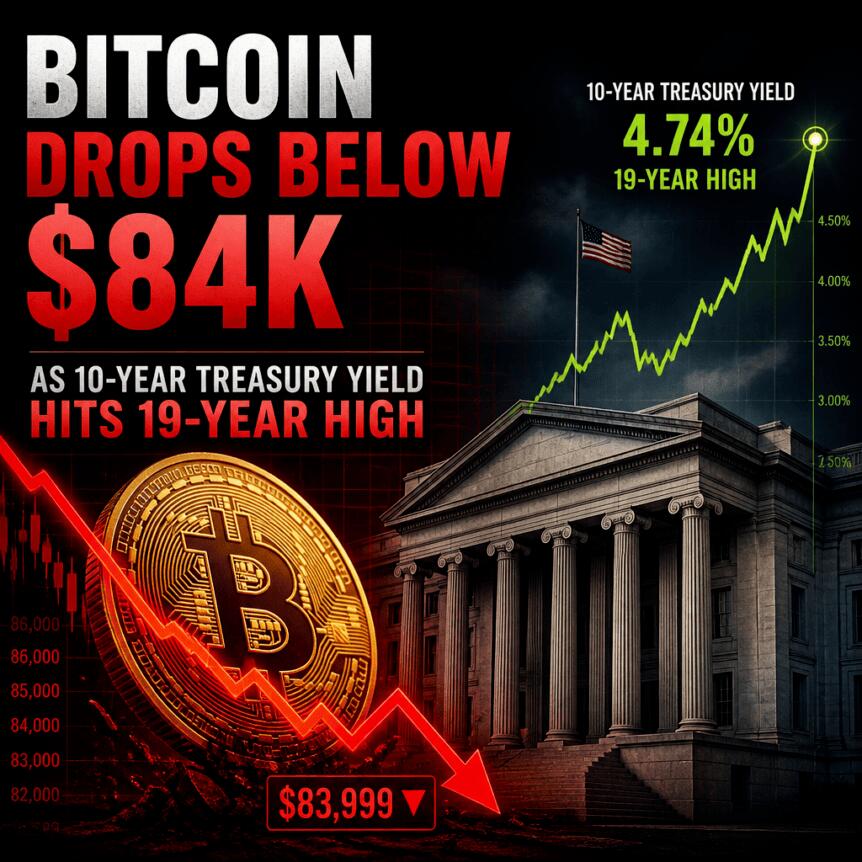
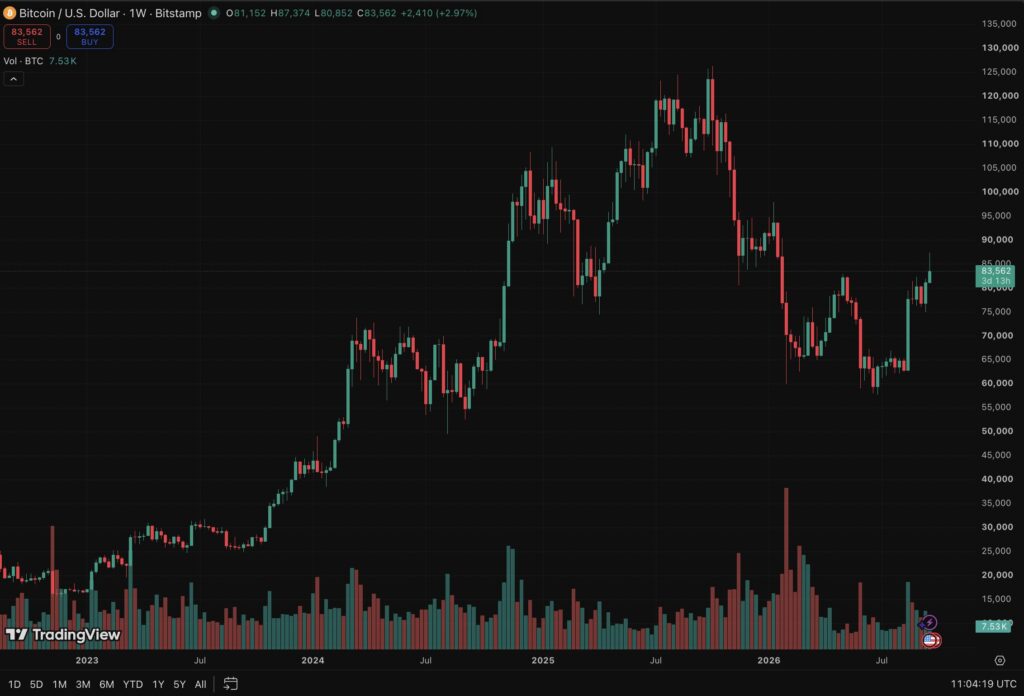
Bitcoin slipped below the psychologically important $84,000 level during Asian trading hours on Thursday, touching around $83,200 as US Treasury yields surged to their highest point since 2007. The move highlights how quickly macro rates conditions can overwhelm even relatively constructive crypto seasonal patterns.
The catalyst behind the rate-driven pressure was a combination of firmer US economic data and higher energy prices, which pushed the US 10-year yield higher on Wednesday before ending the day at 5.11%—up from 4.96% the prior session. With the yield reaching 5.13% intraday and Treasury buyback activity scheduled, traders are now looking toward upcoming Federal Reserve communications and economic releases.
Key takeaways
- Bitcoin dipped to roughly $83,200 after the US 10-year Treasury yield climbed to 5.13% intraday, its highest since 2007.
- CME attributed part of the bond market selloff to stronger US business data and rising oil prices.
- Market pricing for an October Fed hike has risen materially, with an analyst citing around a 70% probability and CME Fedwatch showing a 75.3% chance for a 4.00%–4.25% range.
- Despite the pullback, CoinGlass data indicate Bitcoin has closed September higher in each of the past three years, while October has historically been one of its strongest months.
Yields at multi-year highs reassert pressure on risk assets
The selloff in Bitcoin accelerated as US rates moved further into territory that tends to be challenging for high-duration assets. During Wednesday trading, the 10-year yield closed at 5.11% after climbing from 4.96% on Tuesday, and it reached 5.13% during the session. That trajectory matters because higher yields typically offer investors better returns on government debt, while also raising borrowing costs across the economy—two factors that can weigh on risk-taking.
CME’s explanation for the bond market decline pointed to stronger US business data and increased energy prices. In other words, the rate move wasn’t purely technical; it reflected an adjustment in the outlook for growth and inflation pressures, which in turn can influence expectations for Fed policy.
James Stanley, senior market analyst for global macro at FOREX.com, said Bitcoin has managed to hold up “even with surging rates and a strong USD.” Stanley also highlighted a level to monitor if the pullback deepens, identifying $82,833 as the next area of interest.
Treasury buybacks and “higher-for-longer” rate expectations collide
Alongside the macro data backdrop, the US Treasury also announced a bond buyback with a ceiling of $6 billion. The program targets longer-dated bonds—roughly 20 to 30 years remaining maturity—and is intended to improve liquidity in that segment of the market. The Treasury said the ceiling applies to its Thursday buyback activity, as detailed in an official announcement released Wednesday.
While buybacks are typically supportive for liquidity, the timing also places additional attention on how long-dated yields trade relative to policy expectations. With the Fed still the central variable for rates, traders are likely to view any ongoing yield strength through the lens of what it may imply for the next policy decision.
In that context, rising Treasury yields can directly affect leveraged participation in Bitcoin markets. If borrowing costs remain elevated, dollar-funded strategies—particularly those using leverage—can become less attractive, which can amplify downside moves during periods of macro stress.
Fed hike odds rise, and October’s policy date grows closer
Expectations for the Fed’s next steps have shifted toward a higher probability of tightening. Bas Kooijman, CEO and asset manager at DHF Capital, said stronger US business activity and elevated energy prices increased expectations of further Federal Reserve action. In a market analysis shared with Cointelegraph, Kooijman stated that markets were assigning around a 70% probability to an October hike—up from roughly 55% the previous day—while expectations for additional tightening over coming months had also increased.
That repricing, according to Kooijman, is supporting both Treasury yields and the US dollar. The Federal Reserve remains the key transmission mechanism between macro data and crypto pricing, since rate path expectations affect discount rates, risk appetite, and cross-asset correlations.
CME Group’s Fedwatch tool also reflects this shift. With less than five weeks remaining until the Oct. 28 meeting, CME Fedwatch showed a 75.3% probability of a hike to a 4.00%–4.25% range. The implication is straightforward: if an October hike becomes more firmly priced, risk assets like Bitcoin can face renewed pressure even before the meeting arrives.
Kooijman added that resilient labor data or further hawkish signals could extend the rise in yields and strengthen the dollar, while softer data could prompt traders to dial back the probability of an October move—potentially easing currency gains and reducing headwinds for Bitcoin.
Seasonality offers support, but “Red September” still sets the tone
Crypto traders often frame the calendar in terms of “Red September” and “Uptober.” The pattern is built on history: Bitcoin fell in five consecutive Septembers from 2017 through 2021, while October finished higher in 10 of the 13 completed years, based on CoinGlass data cited in the report.
CoinGlass also shows September typically posts the lowest average returns in the month-by-month table, with an average return of -2.34%. Yet the most recent stretch has been an exception to that broader tendency. Bitcoin has not closed September in the red since 2022; it rose in September 2023, 2024, and 2025. As of the current reading, Bitcoin is up 7.35% so far in September.
October, meanwhile, has averaged a 19.92% gain—second only to November. Still, the seasonal script is not guaranteed, and last year’s October performance fell short of the “Uptober” narrative, with Bitcoin down 3.69% in the month. This matters because the current drawdown below $84,000 suggests that, for now, macro forces may be overpowering the calendar tailwind.
Going forward, traders will likely watch two things closely: whether further data keeps pushing Treasury yields and dollar strength higher into the October Fed meeting, and whether Bitcoin can reclaim—and hold—key technical levels such as the next support area identified by analysts. Until policy odds stabilize, seasonal history may offer guidance, but it won’t eliminate the near-term impact of rates.
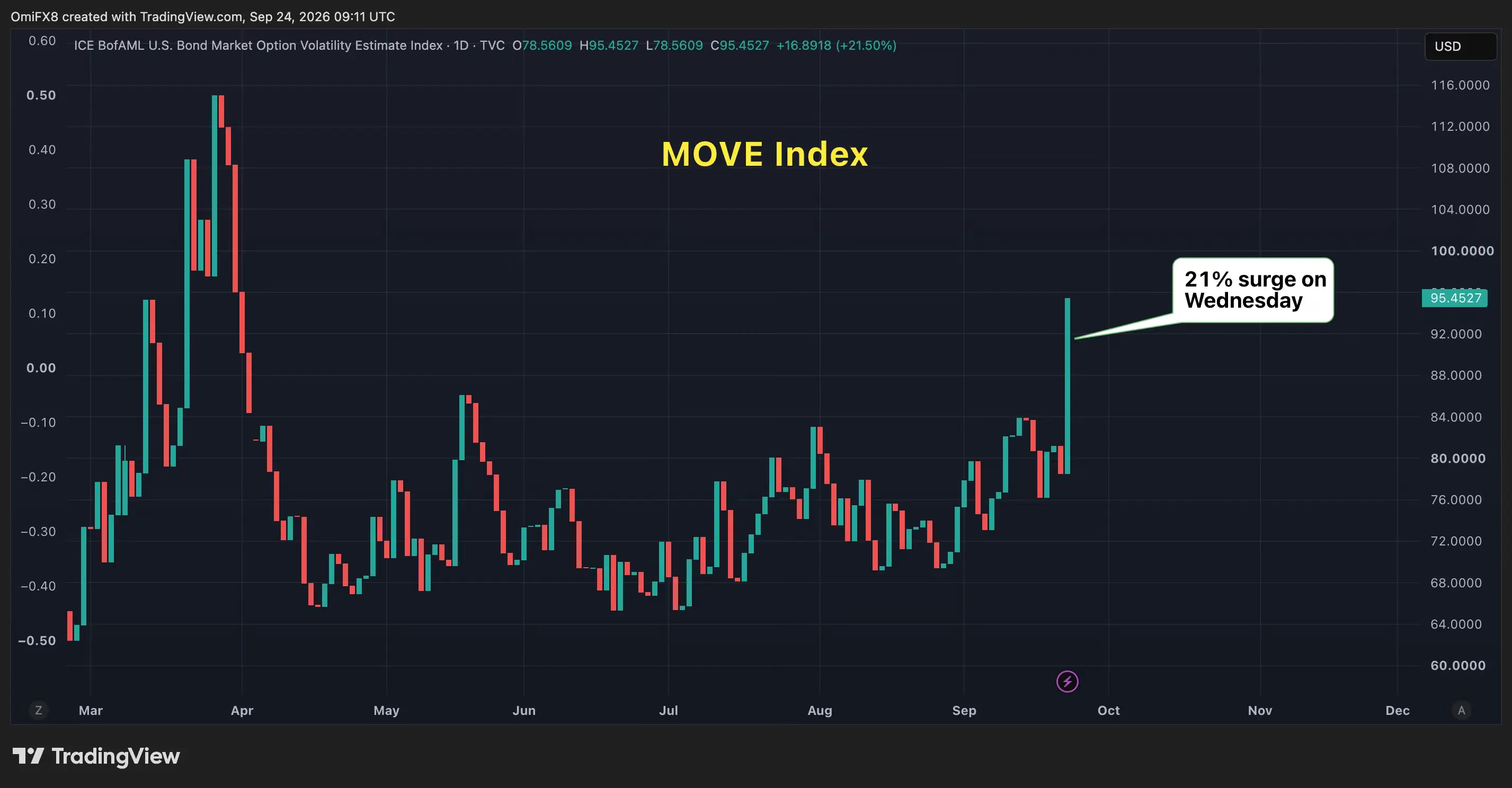
A sudden spike in bond market turbulence, particularly in Treasuries, which underpin global finance, can tighten financial conditions, make credit more expensive, and trigger broader risk aversion.

The MOVE Index, which tracks expected turbulence in Treasury notes, surged 21% to 95 points on Wednesday, its highest level since April 1. That helps explain bitcoin’s pullback from $87,200 to $83,500 on Wednesday, though the market may also have simply been looking for a reason to pull back after the recent steep run higher.
If Treasury volatility persists or climbs further, bitcoin could correct more.
Yields rise
Yields’ lift on Wednesday was led by U.S. data, not fiscal fear.
S&P Global’s flash U.S. Composite PMI rose to 58.4 in September, the highest reading since July 2021, up from 56.0 in August, with business activity expanding at its fastest pace in more than five years alongside a buildup in inflationary pressure.
That data reinforced expectations that the Fed will need to keep hiking after the September rate increase of 25 basis points. The 10-year and two-year yields both jumped on it.
But a closer look at the feature image shows France’s yield actually rose more than the U.S.’s on Wednesday, even though it was U.S. data driving the move. The U.K.’s yield also rose nearly as much as the U.S. Per Robin Brooks, Senior Fellow at the Brookings Institution and former chief economist at the IIF, the same held for Italy and Greece.

Judge Orders White House to Restore Access for CNN, MS NOW, and Politico. What Happens Next?

5 Fantasy Literary Series Where Every Book Is a Masterpiece

Taylor Swift’s Patient Zero Music Video Stars Colin Farrell And Dakota Johnson




-

 Fashion6 days ago
Weekend Open Thread: Talbots – Corporette.com
-

 Tech4 days ago
Researchers escape OpenAI Codex sandbox to run commands on host
-

 Crypto World2 days ago
Goldman Sachs and Deutsche Bank Agree: The S&P 500 Rally Isn't Over
-

 Crypto World5 days ago
Circle launches Arc Studio AI agent for building onchain apps
-

 Crypto World4 days ago
Who Needs CLARITY Anyway? ARB Could See 70X Increase: Hodler’s Digest
-
 NewsBeat6 days ago
Trump says US has reached an agreement to take permanent control of Greenland’s security
-

 Crypto World6 days ago
Trading Bitcoin on Robinhood? Why 2% Spread Has Traders Worried
-

 Crypto World7 days ago
Mortgage and refinance interest rates today, Thursday, September 17, 2026
-

 Crypto World6 days ago
Bitcoin price breaks channel as RSI climbs to 63
-

 Tech3 days ago
Google’s $899 Googlebook is a bet that you’ll buy a new laptop for Gemini
-

 Business4 days ago
Analog Devices (ADI) Bets $1.35 Billion on Chips that Let Machines Think for Themselves
-

 Crypto World3 days ago
Coinbase, Robinhood, Circle Seen as Tokenized-Stock Winners
-
 Business1 day ago
Oil Price Today (September 23): Crude oil below $100 on hopes of US-Iran talks. What did Trump say?
-

 Tech5 days ago
Trump suggests rebranding AI with a new name, says he’s also creating an AI Force
-

 Tech7 days ago
GPT-6 Astra Reached the Nether in Minecraft, Lost Its Stash to a Creeper, and Farmed Potatoes for Hours
-

 Crypto World5 days ago
World Money launches in 150+ countries with Stripe
-

 Crypto World6 days ago
Silver prices recover quickly, hitting weekly high today
-
 Crypto World3 days ago
Bitcoin price holds above $81K as key catalysts line up
-
 Crypto World2 days ago
Meta Jumps 11% As Muse Shines and Investors Show an Appetite for Advancing AI
-
 NewsBeat6 days ago
US was ‘on brink of war’ with China over false AI report of nukes moving in Middle East
You must be logged in to post a comment Login