
Crypto World
Bitcoin (BTC) Slips Below $85,000 As Rally Loses Momentum

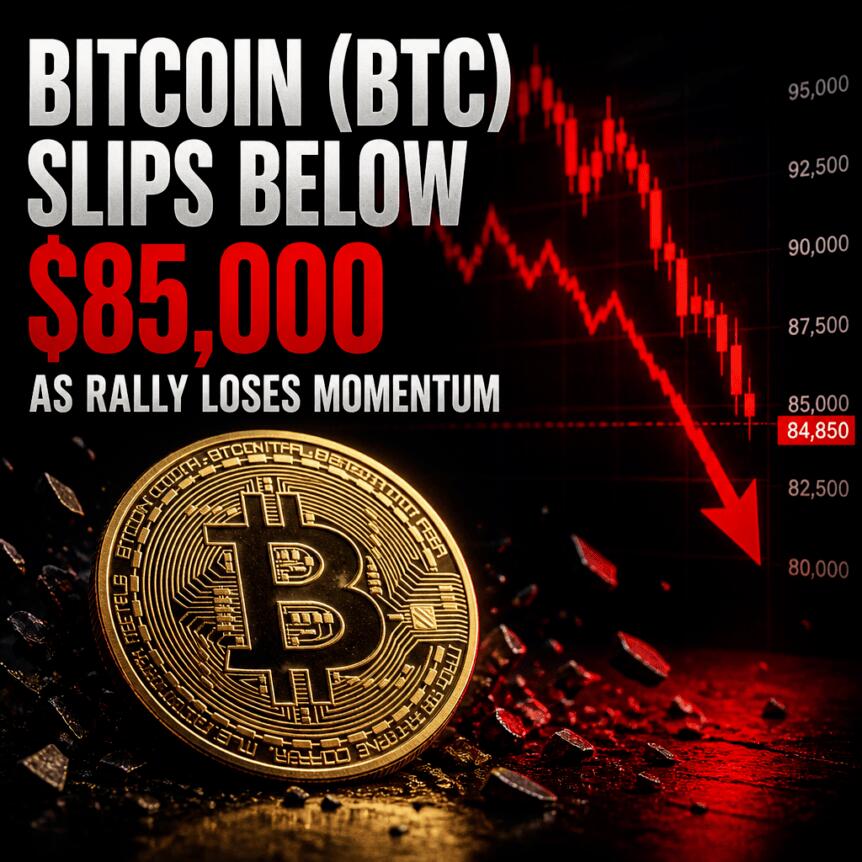
Bitcoin’s latest rally has lost momentum after reaching a high of $87,397 on Monday (September 21). The price pulled back sharply after stronger-than-expected PMI data pushed Treasury yields higher and flushed $125.9 million in long positions.
The flagship cryptocurrency is currently trading around $83,698, down 2.58% over the past 24 hours.
Bitcoin (BTC) Pulls Back After $87,000 Rejection
<a href=
This article was originally published as Bitcoin (BTC) Slips Below $85,000 As Rally Loses Momentum on Crypto Breaking News – your trusted source for crypto news, Bitcoin news, and blockchain updates.

Solana Foundation has moved to strengthen its institutional and payments push with two senior hires, naming former Binance chief marketing officer Rachel Conlan as chief strategy officer and Polygon Labs executive Jamal Raees as general manager of payments.
The appointments come as Solana attempts to broaden its footprint beyond developers into mainstream business use cases, including stablecoin payments and tokenized deposits—areas the foundation says it plans to prioritize through partnerships and ecosystem growth.
Key takeaways
- Rachel Conlan joins Solana Foundation as chief strategy officer, overseeing institutional partnerships, ecosystem expansion, and business onboarding efforts.
- Jamal Raees becomes general manager of payments, with a mandate to deepen ties with payments companies and focus on infrastructure for payment-service builders.
- Solana’s hiring decisions follow the March launch of the Solana Developer Platform, which introduced Modern Treasury as a payments infrastructure partner.
- AWS has added Solana support to its x402 feature, designed to let website owners charge AI agents in USDC for access to content.
- Solana is also preparing the Alpenglow network upgrade, which is intended to reduce transaction finality time from about 12.8 seconds to roughly 150 milliseconds.
Conlan’s strategy role targets institutions and business adoption
In her new position, Conlan will lead Solana Foundation’s strategy work across multiple fronts, including institutional partnerships, ecosystem growth, and initiatives intended to bring businesses onto the Solana network.
Solana Foundation noted that Conlan spent three years at Binance, and previously held senior roles at OKX, CAA Sports, and Havas. The breadth of that background—spanning major exchange marketing leadership and broader corporate experience—signals that the foundation is aiming to close the gap between crypto-native infrastructure and the requirements of traditional business partners.
For investors and builders, the practical question is whether this strategy focus translates into more deployment-ready payment tools and repeatable enterprise onboarding. Conlan’s remit includes institutional partnerships, which typically require more than technical compatibility; they often depend on compliance readiness, commercial go-to-market support, and partnerships that can scale beyond pilots.
Raees to focus on payments infrastructure and stablecoin growth
Raees’ mandate is more narrowly centered on payments. Solana Foundation said he will deepen engagement with major payments companies and concentrate on the infrastructure that teams use to build payment services on Solana.
In a statement provided by Solana Foundation, Raees said his focus would be “driving greater adoption and usage of stablecoins and tokenized deposits,” with an emphasis on global markets.
That emphasis matters because stablecoins and tokenized deposits sit at the intersection of crypto and regulated finance: they are frequently the use cases that business partners ask for when evaluating whether to integrate with blockchain networks. By putting Raees in charge of the payments layer, Solana Foundation is effectively prioritizing the parts of its stack that help other companies launch compliant-looking payment products at scale.
Developer Platform and early partners widen the payments pathway
The hiring decisions follow Solana Foundation’s March launch of the Solana Developer Platform. The program includes Modern Treasury as a payments infrastructure partner, and early users cited by the foundation include Mastercard and Western Union.
While the announcement does not detail commercial outcomes, the pairing of high-profile payments ecosystem names with a dedicated developer platform is notable. It suggests Solana is trying to reduce friction for companies that want to build payment services without having to assemble every component themselves.
For traders and market participants, these kinds of platform moves can be important even when they don’t immediately show up in price headlines—because they can shape liquidity, transaction routing, and long-term user flows. The immediate impact may be hard to measure, but the direction of travel is clear: more institutional and payments integration pathways, supported by infrastructure partners.
AWS x402 expands a new USDC distribution route for content access
Separately, Amazon Web Services added Solana among the networks supported by its x402 feature, which lets website owners charge AI agents in USDC for access to content.
This development points to an increasingly common pattern in blockchain adoption: using stablecoins as a payment rail for specific application workflows rather than relying on general-purpose speculative activity. In this case, the integration is framed around access and usage billing for AI-related content delivery.
For builders, the value is practical—integrating a supported chain and stablecoin into a cloud product can lower deployment complexity. For Solana users, it may open additional demand channels for USDC in app environments that are not traditionally crypto-native.
Alpenglow upgrade aims to materially shorten finality
Solana is also preparing its Alpenglow network upgrade. The foundation says the planned change is intended to reduce transaction finality from about 12.8 seconds to roughly 150 milliseconds.
Finality improvements can matter for payment-related apps because faster confirmation reduces friction for interactive user experiences and can improve operational reliability for services that depend on timely settlement. While the announcement here is focused on the goal and not on delivery timelines, the magnitude of the proposed shift suggests Solana is actively targeting performance characteristics that are often central to enterprise evaluations.
It also provides an additional reason why payments-focused hires are arriving now: infrastructure improvements and commercial expansion efforts are being coordinated around the same core objective—making Solana more practical for real-world financial workflows.
Stablecoin and tokenized asset activity underscores the payments thesis
Solana Foundation said the network has processed more than $5 trillion in stablecoin volume so far in 2026. It also reported more than $4.5 billion in real-world assets on the network and more than $620 million in tokenized equity supply.
Those figures support the foundation’s broader narrative that stablecoins and tokenization are becoming more than isolated experiments. However, readers should still watch how activity translates into durable partnerships and product launches—particularly in environments where payments and tokenized deposits require robust operational controls, predictable settlement behavior, and clear integration paths.
With Conlan and Raees taking on strategy and payments leadership just as Solana’s Developer Platform and Alpenglow upgrade work are underway, the next signals to watch are whether early ecosystem users expand, whether stablecoin and tokenized deposit integrations move from pilots into ongoing deployments, and how the network’s performance targets line up with the demands of real payment services.
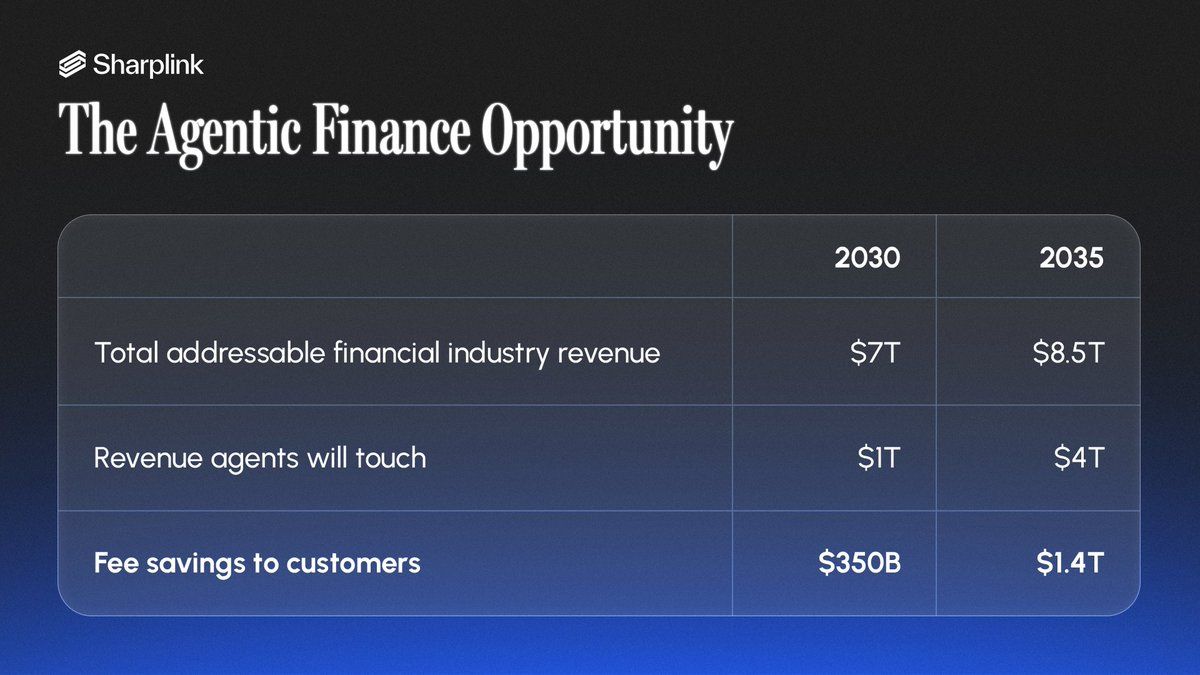
Sharplink CEO Joseph Chalom projects that AI agents will eliminate nearly a quarter of global finance fees by 2035.
His team’s model puts the resulting investor savings at $1.4 trillion a year. Chalom, a former BlackRock executive, set out the forecast in an X post on Wednesday.
A $4 Trillion Prize and a $180 Billion Blind Spot
Chalom’s team modeled 10 financial verticals through 2035. The model puts more than $1 trillion in annual financial services revenue up for grabs by 2030. Chalom expects that figure to reach $4 trillion a year by 2035.

The model assumes agents will make financial providers compete more aggressively on fees. Consumers would then keep an extra $350 billion a year by 2030, before the figure climbs to $1.4 trillion.
Chalom also points to roughly $15 trillion that US households hold in checking, savings, and short-term deposits. Much of it earns well below money-market rates, which he says costs savers at least $180 billion a year.
“Over $1 trillion of annual global financial services revenue is going to be up for grabs by 2030, growing to $4 trillion annually by 2035. Every major bank, broker, payments firm, and digital assets company is racing to capture a share in one of the most important battles over money and value we will see in our time,” he said.
Follow us on X to get the latest news as it happens
Visa, Coinbase, and Circle Race for the Agent’s Wallet
Chalom says the contest to control these agents has already begun. He names Visa, Mastercard, Stripe, PayPal, Circle, Tether, Robinhood, Coinbase, and Binance among the contenders.
In his view, the winner would also decide which products agents recommend and where idle cash gets swept.
“Whoever owns the infrastructure, owns the agent, and therefore the customer,” Chalom added.
BlackRock’s research paper this week made a related case, naming stablecoins as the leading candidate for agent payments.
Chalom argues that agentic transactions will predominantly occur where stablecoins, tokenized assets, and DeFi liquidity are concentrated, with much of that activity currently centered in the Ethereum (ETH) ecosystem. He points to Ethereum’s record of 3.6 million daily transactions in April as evidence of the network’s growing activity.
That outlook lines up with Sharplink’s balance sheet. The company held 891,714 ETH as of September 14, according to its dashboard.
Fidelity Digital Assets offered a more cautious read in August. Senior research analyst Max Wadington warned that closed systems run by tech and fintech firms could instead absorb agent activity.
Subscribe to our YouTube channel to watch leaders and journalists provide expert insights
The post AI Agents Could Wipe Out $1.4 Trillion in Wall Street Fees, Sharplink CEO Says appeared first on BeInCrypto.
Cointelegraph is committed to providing independent, high-quality journalism across the crypto, blockchain, AI, and fintech industries.
All news, reviews, and analyses are produced with full journalistic independence and integrity. For more details on our standards and processes, please read our Editorial Policy.
Most crypto and fintech founders build their marketing for retail audiences first. That’s understandable — retail audiences are large, accessible, and respond to the energy that drives a project’s early community. But when the same founder walks into a family office meeting or pitches an institutional fund carrying materials built for someone else, the results are predictable: polite non-answers, long silences, no term sheet.
Institutional investors and high-net-worth individuals evaluate blockchain companies differently than retail participants do. They have legal teams, compliance officers, and risk committees. They care about regulatory positioning, not roadmaps. They read footnotes. Reaching them requires a different kind of marketing — one built around credibility, precision, and compliance awareness from the ground up.
Positioning: Stop Competing With the Noise
The first problem most blockchain startups have is that their positioning is indistinguishable from thousands of other projects. “Decentralized,” “trustless,” “next-generation” — these words appear on countless project websites and tell an institutional investor nothing useful. At best, they signal that the team communicates for retail traders. At worst, they raise the concern that the project can’t explain itself in plain terms.
Effective positioning for institutional audiences starts with specificity. What problem, exactly, does this company solve? For whom? What is the market size, sourced from identifiable data? What does the competitive landscape actually look like — not dismissively (“we’re better than X”), but in an honest structural analysis of where this company sits?
A family office managing $200 million doesn’t need to feel excited. It needs to see that the founding team understands the space clearly enough to place a coherent bet on itself.
The table below shows how the two audiences read the same marketing signals differently:

The implication is direct: a company can’t run one marketing program for both audiences. The signals that build retail excitement actively undermine institutional credibility.
Credibility-Building Content: Show Work, Not Vision
Institutional investors don’t respond to vision decks the way early adopters do. They respond to evidence. A content strategy targeting this audience needs to demonstrate expertise, not announce ambition.
The content formats that carry real weight with institutional readers are specific:
- Audited white papers — written to a technical standard, with methodology documented and findings signed off by an independent auditor, not internal team members
- Cited research reports — market analysis, protocol assessments, or competitive reviews thorough enough that other practitioners reference them
- Trade press bylines — published in Bloomberg, the Financial Times, Reuters, The Block, or CoinDesk’s institutional coverage, not consumer crypto outlets
- Legal and regulatory memos — brief, factual documents that show the company understands its jurisdictional exposure and has addressed it
- Team credential materials — structured backgrounds for key hires that surface relevant prior roles: exchange positions, regulatory agency experience, institutional fund management
Leadership credibility is a separate lever. Institutional investors diligence people before they diligence protocols. A CIO who previously ran a prime brokerage desk, or a general counsel who came from a regulatory agency — these are marketing assets. They belong in investor materials, not buried in an about page.
Working with a specialist in blockchain marketing, such as ICODA, often makes sense at this stage because the content standards for institutional audiences differ in kind, not just degree. A generalist agency experienced in SaaS or e-commerce campaigns doesn’t know why a tokenomics paper needs an independent auditor’s sign-off — or why a hedge fund’s compliance officer will kill a deal if the company’s website carries “not financial advice” disclaimers in the footer while the homepage talks about guaranteed yields.
Compliance-Aware Messaging: The Rules Are Part of the Product
This is where most blockchain startups underestimate the problem. Securities law, AML obligations, investor accreditation requirements, and jurisdiction-specific disclosure rules create a constraint landscape that effective institutional marketing has to be built inside — not layered onto afterward.
These are the messaging mistakes that most commonly damage credibility with institutional audiences — and in some cases create direct legal exposure:
- Implying returns — any language that suggests historical performance will repeat, or that a yield is predictable, is both a compliance violation and a red flag for legal teams
- Skipping risk sections — pitch decks or one-pagers that omit regulatory risk, counterparty risk, or liquidity risk read as either naïve or deliberately evasive
- Using general solicitation channels for restricted offerings — an email campaign or social post promoting a Regulation D private placement to an unqualified audience can void the exemption entirely
- Inconsistent disclaimers — “not financial advice” in the footer while the homepage describes projected returns signals to compliance reviewers that the team doesn’t understand what the disclaimer actually requires
None of this means messaging has to be evasive. It means it has to be precise. There’s a difference between “our protocol returned 340% to early participants” (a liability) and “here is an independent analysis of how the protocol performed under the following conditions” (a reference document). The second version tells the same story with more substance and less exposure.
Institutional-grade messaging also addresses risk directly. Retail marketing tends to minimize or avoid risk language. Institutional investors expect it. A pitch deck that doesn’t acknowledge regulatory risk, counterparty risk, and liquidity risk reads as either naïve or evasive. A risk section isn’t a weakness — it demonstrates that the team has a mature view of its own business.
The Underlying Issue
The gap between retail crypto marketing and institutional crypto marketing isn’t a matter of tone or production quality. It’s a structural difference in what the audience values, what they’re allowed to respond to, and what professional consequences they face if they back a company that turns out to have operated carelessly.
Institutional capital markets run on reputation and referrals. A firm that impresses a family office once gets introduced to three others. A firm that wastes their time doesn’t get a second meeting.
The companies that close institutional rounds aren’t always the ones with the best technology. They’re the ones that understood who they were talking to and built everything — content, positioning, legal review, distribution channels — around that understanding. That’s not a niche marketing problem. It’s a business problem that marketing is responsible for solving.
Disclaimer: The above article is sponsored content; it’s written by a third party. CryptoPotato doesn’t endorse or assume responsibility for the content, advertising, products, quality, accuracy, or other materials on this page. Nothing in it should be construed as financial advice. Readers are strongly advised to verify the information independently and carefully before engaging with any company or project mentioned and to do their own research. Investing in cryptocurrencies carries a risk of capital loss, and readers are also advised to consult a professional before making any decisions that may or may not be based on the above-sponsored content.
Readers are also advised to read CryptoPotato’s full disclaimer.
The post Why Blockchain Startups Need Different Marketing for Institutional Investors appeared first on CryptoPotato.
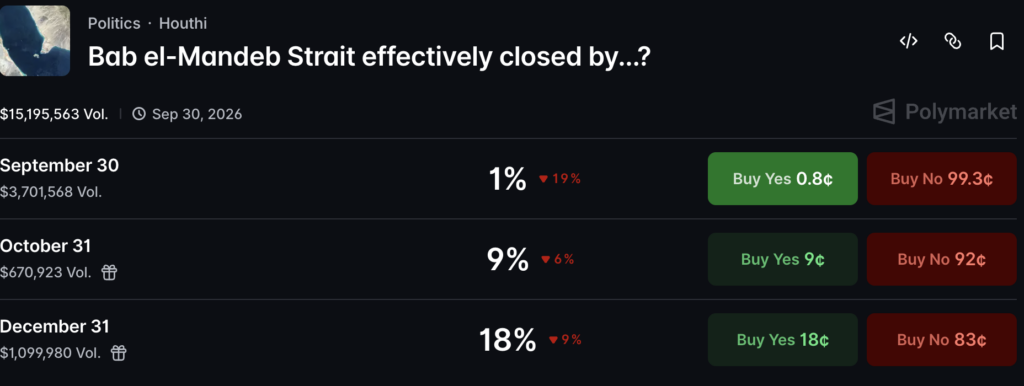
Polymarket traders are pricing an 18% implied probability that the Bab Al-Mandeb Strait betting odds meet the platform’s definition of “effectively closed” before December 31, 2026, based on the market’s live pricing as of its September 24 update.
The contract does not require any government or naval authority to declare the waterway shut; it resolves Yes only if IMF PortWatch records a seven-day moving average of 10 or fewer ship arrivals on any date before the deadline.
That distinction matters more than the headline number. Shipping through the strait has collapsed by most measures on record, but collapse and the contract’s specific data trigger are not the same thing.
Also, nothing in the available reporting confirms that the seven-day threshold has actually been crossed. Polymarket has run into this same verification gap before on Houthi-linked contracts, where ground-truth confirmation lags the market’s appetite for a clean binary answer.

Bab Al Mandeb Strait Betting Odds: What Does the Shipping Data Actually Show?
Houthi forces seized Yemen’s Red Sea coastline, the port of Mokha, Perim (Mayun) Island, and the Hanish Islands in mid-September, putting the group in control of both shores flanking the strait. No government or maritime authority has declared Bab el-Mandeb closed, but the traffic figures reported since then are stark and inconsistent across time windows.
Anadolu Agency reported on September 17 that only four vessels transited the strait in the preceding 24 hours, against a roughly 33-vessel daily norm, an 88% decline, with oil and chemical tanker traffic down 91% and container ship traffic down 86%.
Six days earlier, the same outlet cited Kpler data putting daily transits at around 26 to 27 vessels, a steep drop from the roughly 70-vessel pre-crisis baseline but nowhere near the four-vessel reading that followed.
Those two figures are not contradictory. They’re different windows capturing different moments in a fast-moving blockade. A single 24-hour count of four vessels is not a seven-day moving average, and a seven-day average sitting anywhere from 15 to 27 vessels a day.
JUST IN:
Iran threatens to shut down the Bab el-Mandeb Strait.
"Linking the Strait of Hormuz and the Bab el-Mandeb will change the battlefield."— BRICS News (@BRICSinfo) September 24, 2026

Have Your Say on the Al Mandeb Strait Closure on Polymarket
The Houthi Claim and the Contract’s Blind Spot
The Houthis maintain they are enforcing a targeted embargo on Saudi-linked shipping while asserting safe passage for other vessels, a claim attributed to the group and not independently verified in the available reporting.
International statements have emphasized freedom of navigation under UNCLOS, but assurances of safe passage from a party controlling both shores of the strait carry obvious credibility limits that the PortWatch data trigger sidesteps entirely.
That’s the core tension embedded in this market. Geopolitical risk around Bab el-Mandeb is plainly elevated, with rerouting around the Cape of Good Hope, rising insurance premiums, and the broader Iran-linked regional conflict all pressuring the corridor.
But the Polymarket contract pays out only on a narrow statistical condition, not on the broader sense that the route has become commercially unusable. Polymarket has drawn this same line before on other geopolitical contracts, where the news cycle outran the specific resolution language written into the market.
— AFP News Agency (@AFP) September 24, 2026
 Yemen's Houthis show off seized Saudi military gear
Yemen's Iran-backed Houthis release drone footage of the Bab al-Mandeb Strait, as well as images of Saudi military equipment and bases they claim to have seized in and around Mocha and Dhubab. pic.twitter.com/SpYjHZ9yte
Bab Al Mandeb Strait Scenarios Into Year-End
If the IMF PortWatch seven-day average shows 10 or fewer arrivals on a qualifying date before December 31, the Yes side resolves immediately, meaning one bad week could settle the contract.
If arrivals stay in the mid-teens to mid-20s, uncertainty remains without triggering resolution, despite the high war-risk premiums shippers face. Restoring daily counts above 10 would likely reduce the 18% price, though historical reactions to data prints aren’t specified.
The key takeaway for traders is to understand resolution criteria before interpreting headline probabilities, since the 18% price reflects contract specifics rather than the broader situation at Bab el-Mandeb.
Never Miss a Swing Again: Use AI Copy Trading Bots From CryptoHopper
The post Bab Al-Mandeb Strait Betting Odds Hit 18% as Price Hinges on a Data Trigger appeared first on Cryptonews.
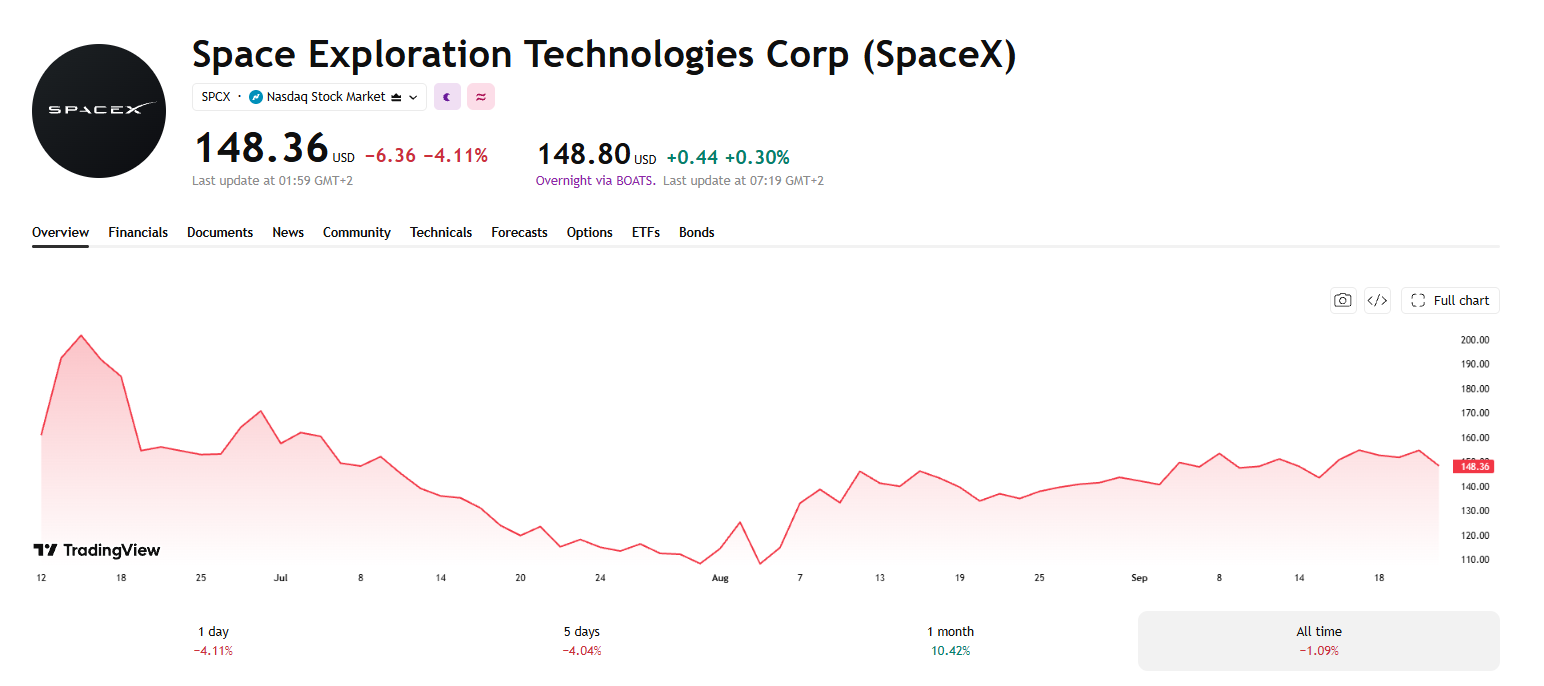
SpaceX stock fell more than 4% on September 23, one day before a lockup expiration freed about 328 million shares for trading.
The selling pressure comes ahead of Starship Flight 14, the rocket’s first planned trip into Earth orbit and its first revenue-generating mission.
Starship Flight 14 Targets Orbit With Paying Cargo
SpaceX CEO Elon Musk said on September 24 that the company is preparing for a Monday launch, which falls on September 28. By then, the launch tower’s mechanical arms had already stacked Ship 41 on top of Super Heavy Booster 21.
Until now, every Starship test stayed on a suborbital path by design. This time, the fully assembled 124-meter rocket aims for an orbit roughly 275 kilometers above Earth, SpaceX says. The flight should last nearly 10 hours and circle the planet about six times.
Moreover, the ship will carry 26 Starlink V3 satellites instead of dummy mass. Chief Financial Officer Bret Johnsen described the flight as the vehicle’s first revenue-generating mission.
However, SpaceX will not try a tower catch. Both stages are expendable, so the booster will splash down in the Gulf of Mexico. Meanwhile, SpaceX plans a deorbit burn that brings the ship down in the Pacific west of Chile.
Why SpaceX Stock Faces Selling Pressure
News of the orbital attempt first lifted shares above $150 in mid-September. Since then, fresh supply has weighed on SpaceX stock. The company releases insider shares in stages rather than all at once, and the first tranche unlocked in August.
The previous tranche unlocked on September 9, and the stock fell 3.9% that day.

Still, the expiration does not force anyone to sell. Instead, the real impact depends on how many insiders cash out. Further tranches are scheduled through June 2027.
On the fundamental side, Wall Street treats Flight 14 as a key proof point. Morgan Stanley analyst Adam Jonas holds a Buy rating and a $300 price target, implying about 99% upside. In his view, the market underprices SpaceX’s AI and orbital computing plans.
A clean orbit and satellite deployment would give Starship its first commercial proof. Until then, SpaceX stock looks caught between launch progress and a growing pool of tradable shares.
The post Why Did SpaceX Stock Fall 4% Days Before Starship's Biggest Flight? appeared first on BeInCrypto.

DoubleZero has launched five Hyperliquid data feeds on Edge, giving subscribers a live view of the exchange’s order book and trade[XYZ] markets over dedicated fiber.
Summary
- Four feeds cover Hyperliquid’s native perpetuals and trade[XYZ] markets, including contracts linked to commodities.
- A fifth feed carries order intents drawn from Hyperliquid’s mempool transactions.
- DoubleZero says subscribers receive sequenced data without having to rebuild the order book from public API updates.
- Hyperliquid joins Solana and Kalshi as the third venue available through Edge.
According to a Sep. 24 announcement from the DoubleZero Foundation shared with crypto.news, the new service delivers Hyperliquid market data in a machine-readable format for trading firms, market makers and quantitative desks. The launch was built with Hyperliquid validator operators and ecosystem partners Hyperion DeFi, MAVAN and Kinetiq.
Subscribers can receive four market data feeds covering Hyperliquid’s native perpetual futures and trade[XYZ] markets under HIP-3, the system that lets outside teams create perpetual futures markets on Hyperliquid. A separate feed carries order intents from mempool transactions. Together, the products give firms information they can use in their own pricing, hedging and trading systems, according to DoubleZero.
The foundation said the feeds are available now through a paid subscription. Its website lists prices, and each subscription includes two IP addresses per region.
Hyperliquid feeds replace work firms did through public APIs
For firms tracking many contracts at once, DoubleZero said, maintaining a current order book has meant collecting public API responses, managing WebSocket connections, and rebuilding the book on their own systems. Changes to Hyperliquid’s public APIs have reduced the update frequency and depth available through those endpoints, according to the announcement.
Edge instead sends subscribers a sequenced feed across DoubleZero’s fiber network. The company says its infrastructure draws on validator operators and partners in Tokyo to provide a view of Hyperliquid’s order book. It describes the service as its fastest commercially available Hyperliquid feed, though the announcement does not include comparative latency measurements.
The distinction matters for automated systems that act on changes in bids, offers and completed trades. DoubleZero says a delayed or missed update can affect whether a trading strategy fills an order. Its product supplies the data path; firms still use their own systems to decide whether and how to trade.
In a September interview about Kalshi, DoubleZero co-founder Austin Federa described Edge as a read-only data service without order-entry or execution functions. That account explains the role the company has assigned to its distribution platform, although the Hyperliquid announcement does not set out separate execution terms for the new feed.
Trade[XYZ] brings commodity markets into the feed
The Hyperliquid package includes trade[XYZ]’s HIP-3 contracts tied to assets such as oil, gold and silver. Unlike a conventional futures contract with an expiration date, a perpetual contract can remain open while funding payments help keep its price close to the reference asset.
The size of those markets gives the data launch a use beyond crypto pairs. A September report covered by crypto.news put trade[XYZ] Q2 volume at $202.36 billion, up 79.2% from the previous quarter, based on research by GLC Research, Four Pillars, Arrakis and GRZ Research. The report also estimated that trade[XYZ] accounted for 95.1% of HIP-3 trading volume during the quarter. Those figures came from external research, rather than audited company results.
DoubleZero said Hyperliquid as a whole processed more than $662 billion in trading volume in Q2. Its launch statement presents the growth of crypto and asset-linked perpetuals as a reason firms need a consistent stream of market data, particularly when the contracts continue trading outside the hours of established exchanges.
“When traditional markets are closed, oil and other assets still trade, they just trade somewhere else,” Federa said in the announcement. He compared Edge’s publish-once distribution model with the market data systems used by NYSE, Nasdaq and CME.
DoubleZero adds Hyperliquid after Kalshi and Solana
Hyperliquid is the third venue on Edge. In August, Kalshi opened its order book to Edge subscribers, starting with Level 1 and Level 2 data for sports contracts and crypto perpetual futures. Level 1 covers the best bid and ask and completed trades; Level 2 shows orders at multiple prices. DoubleZero had earlier introduced Edge with Solana validator data.
The Kalshi rollout also showed how DoubleZero distributes venue data: a publisher sends information once, and the network delivers it to connected subscribers. Hyperliquid adds another source to that service, with feeds spanning its native contracts and markets operated by an outside HIP-3 deployer.
Hyunsu Jung, CEO of Hyperion DeFi, said his firm is participating in the launch alongside Kinetiq and MAVAN. DoubleZero named the three as ecosystem partners but did not assign each one a separate technical role in the announcement.
U.S. energy proposal remains before the CFTC
The Hyperliquid feeds include markets relevant to a U.S. regulatory debate, though a market data subscription does not, by itself, authorize trading a contract in the United States. In August, Hyperliquid Policy Center and trade[XYZ] asked the CFTC to permit regulated perpetuals tied to West Texas Intermediate crude, Brent crude and Henry Hub natural gas. Their filing argued that continuous contracts could let U.S. firms manage energy exposure during weekends.
The Commodity Futures Trading Commission was reviewing questions about continuous energy trading and perpetual contract design, including reference prices, surveillance, margin and customer safeguards. The agency had not approved the proposed energy products when the groups submitted their filing in August.
DoubleZero’s announcement also referred to an August signal from the U.S. president about a possible compliant path for Hyperliquid. It did not identify an approval, a launch date for U.S. trading, or a change to the platform’s existing access rules.
For the present launch, DoubleZero says the five Hyperliquid feeds are available by subscription through its website, with two subscriber IP addresses included per region.
Crypto World
Crypto investment firm RockawayX puts $150M behind push for trade finance, private credit onchain

The next big opportunity is in assets that offer higher returns and behave differently from crypto markets, CEO Viktor Fischer said in an interview with CoinDesk.
“Our thesis going forward that after trading, yield will be the largest use case onchain” Fischer said. For that, “we need new sources of yield, 12% plus, uncorrelated to crypto,” he added.
Catapult will focus on areas including trade and supply-chain finance, specialty asset-backed securities, CLOs and real-estate-related credit.
Fischer said the appeal of putting less-liquid assets onchain is that market makers can create an exit even when the underlying investment has lengthy redemption periods.
RockawayX is looking for traditional finance professionals who know how to originate and underwrite those assets, then pair them with crypto-native operators who can help structure and distribute them onchain.
“The hard part of RWAs was never tokenization. It’s everything after: who buys the asset, where it trades and what happens when someone needs to get out,” Fischer said.
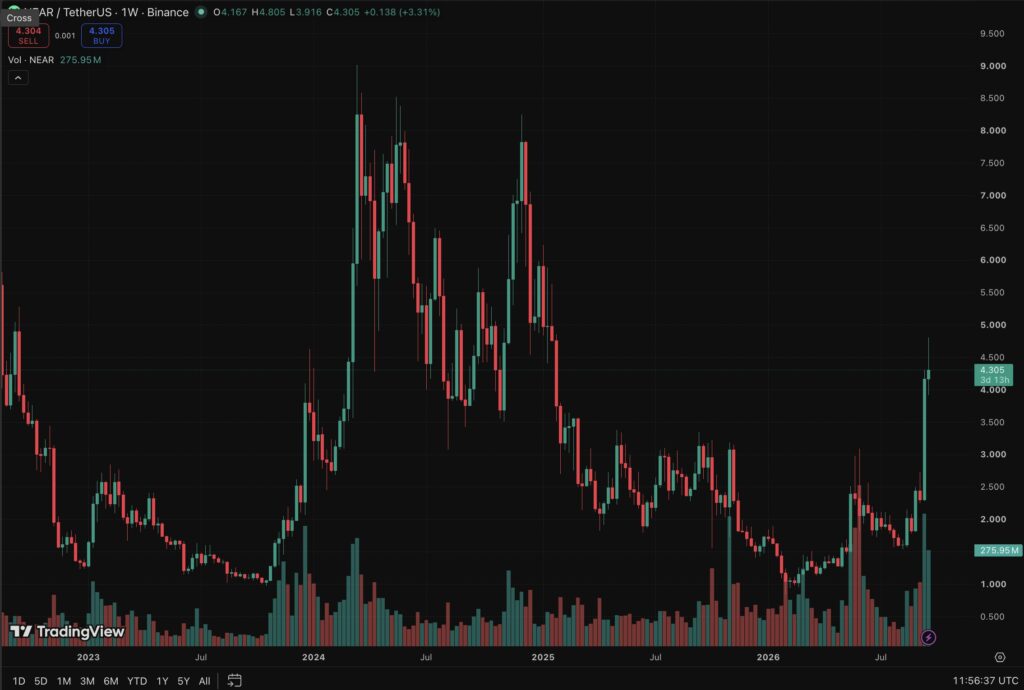
NEAR crypto and Ondo Finance have launched access to tokenized U.S. stocks and ETFs on near.com, opening with 20 assets including Nvidia, Tesla, Apple, Microsoft, Amazon, SPY and QQQ.
Eligible users fund their accounts with stablecoins or other supported crypto from more than 30 networks, with NEAR Intents acting as the cross-chain distribution layer that can eventually route these tokenized securities to connected wallets, applications, and DeFi protocols.
The launch is a distribution story before it is an asset-count story. Ondo’s broader tokenized stocks platform already lists more than 100 stocks and ETFs, according to Ondo’s own documentation, but NEAR’s initial rollout exposes only a fifth of that catalog through Near.com.
NEAR Crypto and the Multichain Route to Ondo Stocks
Near.com functions as the initial user-facing surface for this integration, while NEAR Intents is positioned separately as the cross-chain routing layer, according to the launch material from Ondo Finance.
That distinction matters: near.com is where users open accounts and trade, while NEAR Intents is the plumbing intended to eventually let other wallets and DeFi protocols surface the same real-world assets to their own users.
Ondo’s own documentation describes the broader Ondo Stocks platform as offering more than 100 tokenized stocks and ETFs, spanning individual equities, indexes such as QQQ and SPY, and fixed-income ETFs like TLT, TIP and AGG.
The 20-asset NEAR selection is a subset of that catalog, not a replacement, and Ondo has said the full app at app.ondo.finance remains the reference point for the complete list.
Purchases run through USDon, a stablecoin Ondo says is backed 1:1 by a U.S. dollar held in an Ondo Stocks brokerage account. When a user buys with a different stablecoin, the platform atomically swaps it into USDon before executing the tokenized stock purchase.
It then reverses the process on redemption, a mechanic Ondo’s documentation frames as designed to keep the buy-and-sell flow instant rather than dependent on settlement windows.
How Users Access the Initial Offering
The reported flow is straightforward: an eligible near.com user deposits stablecoins or other supported crypto from any of the more than 30 connected networks, then swaps directly into an available tokenized stock or ETF in a single transaction.
That collapses what would normally be a multi-step bridging-and-onboarding process into one action inside the near.com interface. The current selection is capped at 20 assets, not the full Ondo catalog, and the source material doesn’t publish a complete list beyond the named examples.
Traders looking for a specific ticker outside that initial set should check current availability directly rather than assume parity with Ondo’s broader 100-plus offering.
Earn $50 and Enter $300K Prize Draw on EdgeX
Why Distribution, Not Asset Count, Is the Main Change
The more consequential piece of this launch is the routing layer, not the ticker list. NEAR Intents is a cross-chain distribution mechanism that can push Ondo’s tokenized equities to wallets, applications, and DeFi protocols beyond near.com itself, meaning the 20-asset figure is a starting point for a pipe built to widen, not a ceiling.
Ondo currently restricts its tokenized securities to names trading on the NYSE and NASDAQ, though its documentation leaves room to expand to other countries’ exchanges over time.
Other issuers are pursuing distribution through different rails; Robinhood’s tokenized-stock push on its own chain is a useful comparison point for how competing platforms are structuring access, though the mechanics differ enough that a direct read-across isn’t warranted here.
What are the Eligibility and Jurisdiction Limits for the Near Crypto Ondo Stocks?
None of this is available to US persons. Ondo’s documentation states plainly that Ondo Stocks products are offered only to organizations and individuals outside the United States and other prohibited jurisdictions, subject to its own eligibility criteria, and that the products are not accessible in certain regions at all.
These are tokenized exposures to NYSE and NASDAQ-listed securities, not shares held in a conventional brokerage account, and regulators are still working out how to treat that distinction across jurisdictions.
The broader US regulatory posture toward tokenized equities remains unsettled, and nothing in this launch changes that for US-based traders.
Discover: The Best Token Presales This Bullrun
The post NEAR Crypto Tokenized Stock Launch Puts Distribution Ahead of Scale appeared first on Cryptonews.


IBM’s beta link lets banks instruct tokenized deposit transfers on Swift’s ledger using existing payment messages and compliance processes.

Lucy Letby’s defenders are getting desperate now

RUMUS BEBAS FINANSIAL GAJI 10 JUTA #investing #financialeducation

Parenting Expert Explains What You Should Do If Your Children Start Whining

Weekend Open Thread – Corporette.com

Weekend Open Thread: Talbots – Corporette.com

Memory prices are slowing because buyers ran out of money
RUMUS BEBAS FINANSIAL GAJI 10 JUTA #investing #financialeducation

**XRP ON THE NASDAQ** XRP BLACKROCK ETF ABOUT TO BE ANNOUNCED | BEARABLEGUY123 SIGNALS XRP PRICE

Dr Boyce wants to sell the family jewels – Financial Godfather
-
 Fashion6 days ago
Weekend Open Thread: Talbots – Corporette.com
-

 Tech4 days ago
Researchers escape OpenAI Codex sandbox to run commands on host
-

 Crypto World2 days ago
Goldman Sachs and Deutsche Bank Agree: The S&P 500 Rally Isn't Over
-

 Crypto World6 days ago
Circle launches Arc Studio AI agent for building onchain apps
-

 Crypto World4 days ago
Who Needs CLARITY Anyway? ARB Could See 70X Increase: Hodler’s Digest
-
 NewsBeat6 days ago
Trump says US has reached an agreement to take permanent control of Greenland’s security
-

 Crypto World6 days ago
Trading Bitcoin on Robinhood? Why 2% Spread Has Traders Worried
-

 Crypto World7 days ago
Mortgage and refinance interest rates today, Thursday, September 17, 2026
-

 Crypto World6 days ago
Bitcoin price breaks channel as RSI climbs to 63
-

 Tech3 days ago
Google’s $899 Googlebook is a bet that you’ll buy a new laptop for Gemini
-

 Business4 days ago
Analog Devices (ADI) Bets $1.35 Billion on Chips that Let Machines Think for Themselves
-

 Crypto World4 days ago
Coinbase, Robinhood, Circle Seen as Tokenized-Stock Winners
-

 Tech5 days ago
Trump suggests rebranding AI with a new name, says he’s also creating an AI Force
-
 Business1 day ago
Oil Price Today (September 23): Crude oil below $100 on hopes of US-Iran talks. What did Trump say?
-

 Tech7 days ago
GPT-6 Astra Reached the Nether in Minecraft, Lost Its Stash to a Creeper, and Farmed Potatoes for Hours
-

 Crypto World6 days ago
World Money launches in 150+ countries with Stripe
-

 Crypto World6 days ago
Silver prices recover quickly, hitting weekly high today
-

 Crypto World2 days ago
Trump-Xi Polymarket Odds for Handshake Hit 50%
-
 NewsBeat6 days ago
US was ‘on brink of war’ with China over false AI report of nukes moving in Middle East
-
 Crypto World2 days ago
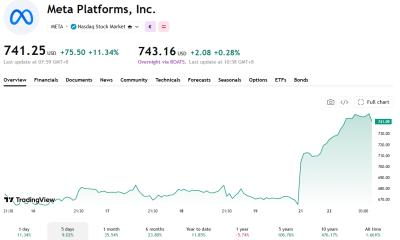
Meta Jumps 11% As Muse Shines and Investors Show an Appetite for Advancing AI
You must be logged in to post a comment Login