

Connect with us

Business

Dow Edges Up 0.19% as Bond Yields Ease and Hopes Rise for a Phased Hormuz Reopening Deal, Snapping Losing Skid

Published

on

FTSE 100 Surges 0.8% Today as Oil Eases and Markets

NEW YORK — The Dow Jones Industrial Average climbed 99.21 points, or 0.19%, to 51,449.19 in Friday trading, as easing Treasury yields and growing optimism over a potential phased deal to reopen the Strait of Hormuz helped stocks snap a three-session losing streak.

Friday’s gains followed a difficult stretch for U.S. equities. The Dow fell for a third consecutive session Thursday, dropping 161.61 points, or 0.31%, to close at 51,349.98, as Treasury yields at multidecade highs continued to weigh on the market’s more cyclical sectors. The S&P 500 slipped 1.90 points Thursday, or less than 0.1%, to 7,704.13, while the Nasdaq Composite eked out a marginal gain of 3.34 points to 26,939.37, and the Russell 2000 index of smaller companies fell 3.09 points, or 0.1%, to 2,835.57.

The 10-year Treasury yield had climbed to 5.16% Thursday, its highest level since the global financial crisis, before easing three basis points to 5.17% early Friday, paring a two-day surge of more than 20 basis points. That earlier climb in yields had been driven in part by comments from New York Federal Reserve President John Williams, who said the central bank would likely need to raise interest rates again before the end of the year, along with weak demand at a recent Treasury debt auction and heavy government borrowing.

Reflecting on the broader bond market turbulence, BlackRock’s Rick Rieder offered a measured assessment in comments to Yahoo Finance Thursday, describing the sell-off as significant but not alarming. “Not a crisis but an eye-opener,” Rieder said.

Advertisement

Stocks found additional support Friday from developments tied to the Middle East. Reuters reported, citing sources, that U.S. and Iranian negotiators meeting in New York were considering a deal that would bring a phased end to the ongoing conflict, under which Iran would reopen the Strait of Hormuz. That report helped pull oil prices lower, with West Texas Intermediate crude falling to around $92 a barrel and global benchmark Brent crude trading near $98 a barrel Friday morning, offering relief to a market that has remained highly sensitive to swings in energy prices amid the monthslong regional crisis.

Futures pointed to a broadly positive session ahead of Friday’s open, with contracts tied to the Dow and S&P 500 both up 0.3%, and Nasdaq-100 futures rising 0.6%, as investors weighed the easing bond and oil pressures against a slate of incoming economic data. Friday’s economic calendar included the preliminary August reading on durable goods orders, expected to show a 0.3% decline compared with a 1.1% increase the previous month, alongside the Kansas City Fed’s September services activity index and the final September reading of the University of Michigan’s consumer sentiment survey, expected to hold steady at 47.8.

Thursday’s session had featured a notable divergence between winners and losers within the Dow. Industrial conglomerate 3M surged 3.70% to $148.62 on continued optimism surrounding its restructuring efforts, while Nvidia added 1.77% to $225.00 and Johnson & Johnson rose 1.61% to $227, even as broader concerns about tight financial conditions tied to heavy debt issuance for artificial intelligence infrastructure weighed on several other chipmakers, including Intel, Marvell and Micron, each of which traded down as much as 3% at points during the session. IBM was the Dow’s biggest laggard Thursday, falling 2.42% to $213.40, followed by Home Depot, which dropped 2.14% to $303.84. Salesforce declined 1.64%, while American Express and JPMorgan Chase fell 1.27% and 1.12%, respectively, reflecting a broader pullback in cyclical stocks tied to the elevated yield environment.

Meta Platforms stood out as a notable gainer this week, jumping 4% Thursday alone and extending its weekly rally to 16%, driven by positive market reaction to the company’s newly unveiled artificial intelligence agent software and hardware products, including a new lightweight virtual reality headset the company introduced earlier this week.

Advertisement

Elsewhere in corporate news, Oracle disclosed it had invoked a force majeure clause in connection with a data center project under development in New Mexico, in a letter sent to the project’s developer, a unit of Blue Owl Capital, according to Bloomberg. An Oracle spokesperson quoted in that report said the underlying construction project “remains on our planned schedule,” even as the company works to preserve legal flexibility in the event of future delays. Oracle shares fell 4.5% Thursday following the disclosure.

Beyond the immediate market-moving developments, Friday’s trading also unfolded against the backdrop of Thursday’s high-profile meeting between President Donald Trump and Chinese President Xi Jinping, with trade and oil among the topics on the two leaders’ agenda, and coverage of Trump administration advisers analyzing the potential economic impact of a proposed short-term ban on diesel exports.

With bond yields showing early signs of stabilizing and hopes building for a diplomatic resolution to the Middle East crisis that has weighed on oil markets for months, investors are likely to watch closely in the coming sessions for confirmation of whether Friday’s rebound can be sustained, or whether the underlying pressures from elevated interest rates and geopolitical uncertainty reassert themselves as the market heads into the final stretch of the third quarter.

Advertisement
Continue Reading
Click to comment

You must be logged in to post a comment Login

Leave a Reply

Business

What’s next for the proposed Manchester-Sheffield tunnel?

Published

on

Business Live

Future Works has come up with plans for a 14-mile Peak District tunnel

The Sheffield skyline

The Sheffield skyline(Image: Getty)

The idea to build a tunnel under the Pennines and connect Manchester and Sheffield resurfaced earlier this year. Now the steps towards it becoming a reality have been laid out.

Advertisement

An organisation called Future Works has devised a strategy to build a 14-mile tunnel beneath the Peak District mountains. The scheme is estimated to cut journey times between Manchester and Sheffield by 30 minutes and take traffic away from the National Park.

This comes 10 years on from when the government originally looked into the idea.

The Department for Transport’s (DfT) own report highlighted the benefits of the scheme would include a major environmental and economic boost. The report added that the scheme could be a ‘catalyst to explore further improvements in east-west connectivity, including linking the international ports on Merseyside and Humberside’.

However, the idea came to nothing as DfT decided it would be too expensive to complete – around £10bn. But Future Works believe it can be done for just £2bn.

Advertisement

The organisation, co-founded by Michael Dnes, wants to build the dual carriageway as well as a railway line – inspired by engineers who’ve done similar work in Norway. The Norwegians built the world’s longest road tunnel, the 24.5km Lærdal in Norway, for around £130m.

Despite the excitement of Future Works seemingly bringing the project back to life, the idea remains just an idea. The local MP, Jonathan Reynolds, has long advocated for better transport connectivity around the eastern corner of Tameside.

The villages of Hollingworth and Mottram have long been the victims of queueing traffic through their centres. They are right at the crossroads on Tameside and Derbyshire, where the Woodhead Pass and Snake Pass meet the Greater Manchester road network.

Mr Reynolds was instrumental in securing the Mottram bypass scheme currently under construction. But he believes Future Works’ plan now needs to undergo work to understand if it is actually deliverable and the actual benefits it could bring.

Advertisement

Jonathan Reynolds, MP for Stalybridge and Hyde, said: “Residents in Hollingworth have been waiting for years to see real progress on the issue of traffic passing through the village, so any credible proposal that could reduce congestion and improve connectivity deserves to be looked at seriously.

“I’ve been keen to support Future Works by speaking to stakeholders, and the priority now is to undertake the detailed work needed to establish whether it can be delivered, how it could be financed, and what benefits it could bring to local communities and the wider region.”

The idea would see one of the current Woodhead tunnels, which currently transport electricity lines for the national grid, for the new road and railway.

Rather than using the standard British approach of a tunnel-boring machine, Future Works has looked into the drill-and-blast method applied to tunnels in Norway. This system replaces giant machinery with more traditional mining techniques, the natural strength of the rock and small expert crews.

Advertisement

Although this would not work in many areas of the UK, the expert teams believe this ‘drill-and-blast’ method could work in this area due to the geology of the Pennines. This is because the tunnels built in Norway go through mountains with a similar rock type.

The previous model of going for direct government funding through the Department for Transport never got going after appetite for big road projects waned, according to Mr Dnes. So his team believes the project could be funded by either big pension funds or the local authorities and paid back over time through tolls on the tunnel.

Mr Dnes explained that tolls could actually work out cheaper than paying for fuel costs to go around an alternative route, particularly if the vehicle is larger, such as a HGV.

Route map for the Trans-Pennine Connect scheme between Manchester and Sheffield

Route map for the proposed Trans-Pennine Connect scheme between Manchester and Sheffield (Image: Future Works)

A spokesperson for Future Works said previously: “High demand for the route means that the project could pay for itself, without the need for Westminster funding.

Advertisement

“Scandinavian tunnels are often owned by local councils, who recover the costs through tolls. Equally, northern pension funds have hundreds of billions in investment capital that could be mobilised to build the project.

“Many options exist – public, private and partnership. Future Works was set up by infrastructure experts Michael Dnes and Alex Griffiths, with a combined expertise in more than £100bn of infrastructure projects. They aim to create a shovel-ready scheme, and to bring this through the planning system faster than the 10+ year processes that have become the norm in UK planning.

“Work could begin before the end of the decade, with the road and railway open in the mid-2030s.”


Advertisement
Continue Reading

Business

Crypto’s Split Screen: Washington Tightens the Rules as Markets Wobble and Hackers Strike Again

Published

on

Article by: CryptoMan

Cryptocurrency had one of those days this week that captures the industry’s entire identity crisis in miniature: regulators in Washington were busy building guardrails for an asset class that keeps proving, hack after hack, why it needs them, while traders shrugged off a nine-figure exchange breach and kept their eyes on bond yields instead.

On Thursday, the Federal Reserve unveiled a long-awaited proposal spelling out capital, redemption and disclosure requirements for stablecoin issuers operating under its supervision — the clearest sign yet that Washington intends to treat dollar-pegged tokens less like speculative curiosities and more like the payment infrastructure they’re becoming. The same day, crypto exchange Bitget confirmed that roughly $351.6 million had been siphoned out of its hot wallets, forcing a temporary halt to withdrawals. Meanwhile, Bitcoin held a shaky line near $84,000 as the 10-year Treasury yield touched levels not seen since 2007, and the Commodity Futures Trading Commission quietly rewrote its own rulebook after Congress once again failed to pass comprehensive crypto legislation.

Advertisement

Taken together, it’s a snapshot of an industry maturing on two tracks at once — one where federal agencies race to fill the vacuum left by a gridlocked Congress, and another where the everyday hazards of running billions of dollars through digital wallets haven’t gone away.

The Fed lays down the law on stablecoins

The Fed’s proposal is its first major step in implementing the GENIUS Act, the law that already requires stablecoin issuers to back their tokens one-to-one with cash, bank deposits or short-term Treasurys. What the Fed added Thursday is the fine print: an operational-risk capital charge scaled to an issuer’s size — 2% on the first $20 billion in stablecoins outstanding, 1.5% on the next $30 billion, and 1% above that — plus additional buffers tied to credit and operational risk. Issuers would generally have to honor redemptions within two business days, and if their reserves ever dip below full backing, they’d be required to notify the Fed immediately and either top up the shortfall or start liquidating and redeeming tokens.

Transparency is baked in too. Issuers would have to publish monthly reports on their outstanding tokens and reserve composition, independently audited and personally certified by their CEO and CFO. A companion proposal would open a formal application pathway for Fed-supervised banks that want to issue stablecoins through subsidiaries.

Fed Governor Michael Barr backed the plan but made clear the job isn’t finished. “Stablecoins will only be stable if they can be reliably and promptly redeemed at par in a range of conditions,” he said, flagging market stress and issuer-specific strain as the real tests of any framework. Barr also pushed for stronger, universal redemption rights in the final rule and warned against language that would limit the Fed’s ability to act on anti-money-laundering failures unless they’re deemed “significant or systemic.”

Advertisement

The proposals now face a 60-day public comment period. The GENIUS Act itself is set to take effect January 18, 2027, or 120 days after final rules are issued — whichever comes first.

Congress stalls, so regulators move on their own

The stablecoin push arrived just days after the Senate failed to advance the Digital Asset Market Clarity Act, the bill meant to finally settle which agency — the SEC or the CFTC — has jurisdiction over which corner of the crypto market. With that effort stalled and few expecting Congress to revisit market-structure legislation before 2027, both regulators are simply proceeding without it.

The CFTC updated its guidance on tokenized assets and blockchain recordkeeping this week, clarifying that registered entities can invest customer funds in tokenized assets as long as those tokens carry legal and economic rights equivalent to the traditional version, and signaling it won’t object to blockchain-based recordkeeping. CFTC Chair Michael Selig framed the move as an effort “to provide regulatory clarity for the crypto industry,” even as he stopped short of tying it directly to the Senate’s failure. The SEC, for its part, has already floated its own rules on crypto investment contracts, with Chair Paul Atkins saying the agency is “ready, willing, and able” to act without Congress.

A reminder that the risks haven’t disappeared

If regulators are trying to make crypto safer on paper, Bitget’s breach was a reminder of how exposed the industry remains in practice. The exchange said its security systems flagged unauthorized transfers from a limited number of hot and warm wallets Thursday evening, prompting an immediate withdrawal freeze. CEO Gracy Chen said cold wallets were untouched, user balances remained accurate, and the entire stolen sum falls within the exchange’s $464 million User Protection Fund — effectively an insurance backstop meant to make customers whole. Bitget said it has flagged the addresses involved to law enforcement and onchain investigators and promised a full incident report within 24 hours, though it has yet to say how the attackers got in.

Advertisement

It’s the kind of incident that, a few years ago, might have sent shockwaves through crypto markets. This time, prices barely flinched — arguably because investors had bigger macro worries on their minds.

Bitcoin caught between yields and yield-chasers

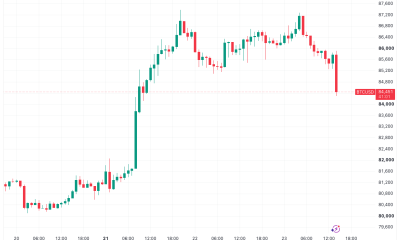
Bitcoin spent Thursday oscillating around $84,000, briefly dipping below $83,000 before clawing back, as the 10-year Treasury yield climbed to 5.18% — its highest since July 2007 — and the 30-year hit 5.46%. Higher yields make government debt more attractive relative to non-yielding assets like Bitcoin, and the pressure was compounded by a weakening Japanese yen edging toward levels that could trigger intervention, which economist Mohamed El-Erian warned could add further strain to an already jittery Treasury market.

Even so, Bitcoin has managed to extend its August rally, defying predictions tied to its traditional four-year boom-bust cycle. Elsewhere in the market, the tokenized real-world-asset project Ondo Finance was a standout gainer, with its token reclaiming the $0.50 level for the first time since December as BlackRock-backed “Ondo Intelligent Portfolios” launched on Ethereum and BNB Chain — another sign that tokenization of traditional financial products keeps advancing even as legislative clarity lags behind.

And on the infrastructure side, a smaller but telling development: DoubleZero rolled out a dedicated fiber market-data feed for the decentralized exchange Hyperliquid, giving professional trading firms the kind of fast, institutional-grade access to order-book data long taken for granted on venues like the CME or Nasdaq. As Hyperion DeFi CEO Hyunsu Jung put it, onchain markets aren’t becoming traditional exchanges so much as adopting their plumbing — a quiet but steady sign of an industry professionalizing in the background, even as its regulatory foundation is still being poured.

Advertisement

Cryptocurrency is gaining ground as a valid payment method. New laws should provide stability and build user trust in stablecoins as an alternative currency.

The  altcoin  crypto payment space is generating very interesting opportunities  and one of those is DAPAhe, a privacy-focused cryptocurrency built on a BlockDAG architecture; their website is hosted at dapahe.com.

Unlike standard blockchains that store transactional details in plain text, DAPA uses an account-based model secured by a layer-1  Twisted ElGamal homomorphic encryption and Zero-Knowledge Proofs.

This structure allows users to instantly check their balances by querying only the most recent block, providing full network anonymity without requiring a complete blockchain sync.

Advertisement

I checked the webwallet DAPA offer, and it’s a good functional wallet with a history of all transactions and a very easy setup. For me, one of its best features is the sync: once done, you don’t need to do it again unless you leave the browser you see;

🔐 Initializing Secure Balance Decryption

Starting cryptographic table initialization…

Downloading cryptographic tables (~330MB)
This only happens once – tables are cached locally   create a new wallet or import an existing one and of you go, i expect this coin to grow over time  , and if you can buy it my advice is to buy it.
Continue Reading

Business

Tandem Foods invests $42 million in bar production plant

Published

on

Tandem Foods invests $42 million in bar production plant


Tandem Foods invests $42 million in bar production plant | Food Business News


Skip To Content

Continue Reading

Business

Mizuho bullish on Tower Semiconductor, points to AI optical growth

Published

on


Mizuho bullish on Tower Semiconductor, points to AI optical growth

Continue Reading

Business

Ocean Spray bolsters executive leadership team

Published

on

Ocean Spray bolsters executive leadership team

LAKEVILLE, MASS. — Ocean Spray Cranberries, Inc. said it is strengthening its leadership team as cranberry harvest season begins.

The agricultural cooperative named Kevin Zidron chief strategy and transformation officer and Brad Hartzell chief supply chain officer. Hartzell succeeds Earl Larson, who will retire at the end of the month, the company said.

Zidron is joining the company from Nestle Health Science where he previously was vice president of business optimization and strategy. Zidron’s past leadership roles additionally include vice president of strategy and transformation roles at Vital Proteins and Kraft Heinz.

Hartzell most recently was chief operating officer of beauty and body solutions at KDC/One Development Corp., Inc., and was chief operating officer at NovaTaste prior to KDC.“At Ocean Spray, we have an iconic brand, an extraordinary fruit, a strong cooperative foundation and talented people across our business,” saidAbigail Buckwalter, who was named president and chief executive officer of Ocean Spray earlier this year. “Our focus now is on bringing those strengths together with greater clarity, pace and discipline to accelerate growth and unlock our full potential. We have an opportunity to build on what makes Ocean Spray unique while creating the capabilities needed for our next chapter. Kevin and Brad bring the leadership and expertise to help us move faster, sharpen execution and deliver on our priorities.” 

Advertisement

Continue Reading

Business

Hints and Spangram Answer for September 25, 2026 as Puzzle 936 Goes Back to Math Class

Published

on

Powerball tickets rest on a 7-Eleven store register January 9, 2016 in Chicago, Illinois.

Puzzle number 936 of The New York Times’ Strands game took a notably different turn Friday, trading the format’s usual wordplay and thematic red herrings for a grid built around basic multiplication, giving solvers a puzzle that felt more like a flashback to primary school math class than the typical vocabulary-driven Strands challenge.

Strands presents players with a six-by-eight grid of letters and asks them to find a set of words connected by a hidden theme, tracing each word in a continuous line that can bend around corners as it moves through the grid. One special word, known as the spangram, always touches two opposite sides of the board and summarizes what the rest of the puzzle’s theme words have in common. Players can also tap or drag to select letters, and non-spangram theme words remain highlighted in blue once correctly identified.

For those still working through Friday’s puzzle, the theme centers on numbers, specifically the kind produced by multiplying a whole number by itself. Every non-spangram answer in Friday’s grid is a number written out in words, and each of those numbers happens to be a perfect square. One outlet described the day’s theme hint plainly as “these are squares,” while another characterized the official in-game theme clue as “1×1, etc.” Today’s spangram itself runs 13 letters long and is positioned horizontally across the board.

SPOILER WARNING: The full solution to Friday’s Strands puzzle follows below. Stop reading now if you’d rather work through the grid on your own.

Advertisement

Today’s spangram answer is SQUARE NUMBER, directly naming the mathematical theme running through the rest of the puzzle. The confirmed non-spangram theme words include FOUR, NINE, TWENTY FIVE, THIRTY SIX and EIGHTY ONE, each representing a perfect square, the result of multiplying a whole number by itself: 2×2, 3×3, 5×5, 6×6 and 9×9, respectively.

Puzzle guides covering Friday’s grid described it as an unusually direct and approachable Strands puzzle compared with the format’s typical entries, since the theme rewards basic multiplication recall rather than the more associative or lateral thinking that Strands puzzles often demand. One outlet framed the puzzle as proof that the Strands format can flex into math-based themes without losing the puzzle’s underlying character, even as it noted this kind of overtly literal theme remains relatively rare for the game.

Strands, created by The New York Times as a spatial twist on the traditional word search format, continues to operate in what the newspaper has described as a beta phase, even as the game has steadily grown in popularity alongside the Times’ other daily word games. A new puzzle appears at midnight local time each day, meaning solvers in different time zones begin working through that day’s grid at staggered points relative to players elsewhere around the world.

Strategy guides accompanying Friday’s puzzle noted that players who find themselves stuck can tap any of several designated clue words to unlock the game’s built-in hint system, a feature intended to nudge solvers toward the puzzle’s theme without immediately revealing the full solution. Guides also reminded players that theme words in Strands fill the entire board without any overlap between words, meaning every letter in the grid ultimately belongs to exactly one theme word or the spangram.

Advertisement

Puzzle number 936 followed Thursday’s Strands puzzle, themed around locations just outside one’s front door, continuing the game’s pattern of rotating through a wide range of everyday and conceptual themes from one day to the next. Players tracking their personal performance on Friday’s puzzle can compare notes with friends and fellow solvers, given how quickly Strands has built a dedicated following since its launch, joining Wordle, Connections and the Mini Crossword among the Times’ most widely played daily word games.

With Friday’s math-themed puzzle now solved, players will have an entirely new grid and hidden theme to work through when Saturday’s edition of Strands resets at midnight local time, continuing the daily puzzle’s steady climb in popularity as one of the newspaper’s newer, but increasingly essential, word game offerings.

Continue Reading

Business

World Service – Listen Live

Published

on

World Service - Listen Live

Ione Wells speaks to Roelf Meyer, South Africa’s new ambassador to the United States. In the 1990s, Meyer was one of the leading negotiators in the talks that helped bring apartheid to an end.

Now he takes up his new post amid a serious rupture in relations with the US President Trump has cut aid, expelled the previous South African ambassador and offered refugee status to white Afrikaners he says are fleeing persecution, claiming the community faces “genocide”.

The South African government rejects that allegation. Meyer, himself an Afrikaner, explains why he believes Trump has been given the wrong picture and how his experience negotiating the end of apartheid could help repair relations with Washington.

“The notion of a mass attack on the Afrikaner was misrepresented by those that might have conveyed the message. I mean, I’m an Afrikaner from South Africa myself. And I can say that I’ve never experienced something of that kind. We found it strange. So the source is misrepresented, unfortunately, something that just doesn’t exist,” says Meyer.

(Photo: Roelf Meyer, South Africa’s ambassador to the US, wears a navy blazer with a white shirt and light blue tie. He has short white hair. Credit: Getty Images)

The Interview brings you conversations with people shaping our world, from all over the world. The best interviews from the BBC, including episodes with Sundar Pichai and Julia Gillard.

You can listen on the BBC World Service on Mondays, Wednesdays and Fridays at 0800 GMT. Or you can listen to The Interview as a podcast, out three times a week on BBC Sounds or wherever you get your podcasts.

Presenter: Ione Wells
Producer: Osman Iqbal
Editor: Damon Rose

Programme Website

Continue Reading

Business

At Close of Business podcast September 25 2026

Published

on

At Close of Business podcast September 25 2026

Mark Beyer and Justin Fris discuss the business aspects and benefits behind Saturday’s AFL Grand Final between the Fremantle Dockers and Brisbane Lions. 

Plus: Satterley appoints Ben Rosser, restructures; Higher interest rates needed, say top economists; Freo final to help revive country pub. 

Continue Reading

Business

Special agents blood and urine test results stolen in FBI hack

Published

on

Two FBI agents in Washington DC

Cyber-criminals who hacked the FBI say they have extremely sensitive medical data for thousands of its special agents.

BBC News has seen samples of the stolen “fitness-for-work” medical examinations, which contain information such as blood and urine test results, and doctors’ notes mentioning conditions such as a “shellfish and banana allergy”.

The records include agents’ full names and addresses, as well as references to medical concerns including ‘blood in the urine’ and ‘high cholesterol’.

Experts say the hack – which the FBI is investigating – could leave agents vulnerable to scams, blackmail and targeted attacks, as well as help criminals impersonate law enforcement officers.

Advertisement

“The list maps thousands of agents against their medical and fitness records,” said Etay Maor, vice-president of threat intelligence at Cato Networks.

“Passwords can be reset if stolen, but medical records cannot, so once this data is out, it stays compromised for good. That permanence, applied across an entire workforce, is what makes this leak so serious.”

The FBI has not responded to requests for comment. However, on Wednesday it acknowledged the breach and said it was “aggressively investigating” how it happened.

The cyber-criminal group ShinyHunters claims it breached FBI systems on Monday, and later posted details of the attack on its darknet site.

Advertisement

The group also shared samples of the alleged stolen data with reporters, along with an extortion demand.

Unusually, the hackers are not demanding money. Instead, they are seeking a retraction of an FBI advisory published in May, which they claim “offended” them.

The samples shared with journalists appear genuine and include names, addresses, phone numbers, badge numbers, job titles and information about spouses.

The records appear to relate to thousands of agents, including senior officials such as deputy directors.

Advertisement

Professor Ciaran Martin, the former head of the UK’s National Cyber Security Centre, has described the hack – if confirmed – “as serious as it gets when it comes to data breaches.”

Continue Reading

Business

Apple: Why I’m Betting Against This Valuable Company (Rating Downgrade) (NASDAQ:AAPL)

Published

on

Turned on flexible book phone display opened mockup, colored background

This article was written by

I’m specialized in fundamental equity research, global macro strategy, and top-down portfolio construction.

Analyst’s Disclosure: I/we have no stock, option or similar derivative position in any of the companies mentioned, and no plans to initiate any such positions within the next 72 hours. I wrote this article myself, and it expresses my own opinions. I am not receiving compensation for it (other than from Seeking Alpha). I have no business relationship with any company whose stock is mentioned in this article.

Seeking Alpha’s Disclosure: Past performance is no guarantee of future results. No recommendation or advice is being given as to whether any investment is suitable for a particular investor. Any views or opinions expressed above may not reflect those of Seeking Alpha as a whole. Seeking Alpha is not a licensed securities dealer, broker or US investment adviser or investment bank. Our analysts are third party authors that include both professional investors and individual investors who may not be licensed or certified by any institute or regulatory body.

Advertisement

Continue Reading

Trending

Copyright © 2025