
Crypto
ESMA gives EU crypto platforms 3 months to drop non-MiCA stablecoins such as USDT


The guidance said authorized crypto firms must stop offering services that let EU customers buy, trade, swap or otherwise increase their holdings of affected stablecoins.
The rules cover exchange services, trade execution, transfers, custody, administration, advice and portfolio management.
National regulators should require any remaining customer holdings to be resolved “as soon as possible, and no later than three months” after the opinion’s publication, ESMA said. That places the deadline at Jan. 8, 2027.
In the meantime, platforms may provide limited services to resolve existing holdings. These can include selling, converting, withdrawing, transferring or safekeeping tokens, but not purchases, promotion, trading or continued market availability.
EU users who keep USDT on an exchange will have to follow that platform’s instructions. Some may be able to sell or withdraw it during the wind-down period; others may face an earlier cutoff.
ESMA said keeping noncompliant stablecoins available through authorized platforms would weaken the reserve, redemption, governance and disclosure rules MiCA imposes on authorized issuers.
The opinion is directed at national regulators, who will decide how individual platforms handle their remaining client balances within the three-month outer limit.


Crypto.com is rolling out a new partnership that hands everyday traders the kind of execution tools once reserved for institutional desks, without charging them a cent extra or asking them to move their funds elsewhere.
The exchange has struck a deal with Insilico Terminal, a platform built for active crypto traders who want faster order execution and more sophisticated trade management. The integration lets Crypto.com Exchange accounts connect directly to Insilico’s system, giving users access to professional-grade tools while their assets stay put on Crypto.com.
What Crypto.com Users Actually Get
The feature list reads like something out of a Wall Street trading desk: Chase and Swarm orders, TWAP execution, Scale orders, Depth of Market visibility, programmable hotkeys, automated position sizing and one-click strategy execution. These are the kinds of tools typically used by high-frequency and high-volume traders to manage risk and speed across volatile markets, and now they’re available to Crypto.com’s retail and professional user base alike.

Crucially, the integration isn’t limited to a single market view. Traders can monitor and execute across their Crypto.com accounts alongside positions held on other exchanges, all from one customizable workspace. For anyone juggling multiple platforms, that consolidation could cut down on the lag and guesswork that comes with switching between tabs during fast-moving sessions.
No Fees, No Custody Risk
Perhaps the most notable part of the arrangement is how it’s priced: there isn’t a price tag at all. Insilico’s execution tools are being made available to Crypto.com users free of subscription costs or hidden charges. The connection runs through an API-only setup with two-factor authentication support, and Insilico has been explicit that it does not take custody of user funds or store sensitive account information.
That distinction matters in an industry still recovering from a string of custody failures and collapsed platforms. By keeping funds on Crypto.com rather than routing them through a third party, the partnership is designed to let traders access advanced functionality without taking on additional counterparty risk.
Insilico has positioned itself around low-latency performance, pitching its infrastructure as built specifically to handle the kind of volatility that defines crypto markets, where price swings of several percent in minutes are routine rather than exceptional.
Targeting the High-Volume Trading Crowd
Crypto.com and Insilico both frame the collaboration as aimed squarely at serious traders, from high-volume futures players to active spot traders looking to sharpen their execution. Iskandar Vanblarcum, Managing Director of Crypto.com Exchange, said the move reflects the exchange’s commitment to its more advanced trading community.
“By integrating with Insilico Terminal, we are making it even easier for users to engage with our markets using professional-grade, low-latency execution tools at the speed and scale they require,” Vanblarcum said.
The companies describe the partnership as a way of combining Crypto.com’s existing market access with Insilico’s execution technology, layering a more advanced trading environment on top of the exchange without disturbing where customer funds are actually held.
The announcement lands at a moment when exchanges are under growing pressure to differentiate themselves beyond simple spot trading, as competition intensifies for traders who want institutional-style tooling without institutional account minimums. For Crypto.com, bundling Insilico’s toolkit into its existing platform offers a way to court that audience directly, positioning the exchange as a venue capable of serving both casual investors and professional desk traders from the same infrastructure.
Explore more on this topic with Vexel Search.


Bitcoin ETFs erased October’s net inflows with $485 million in withdrawals, while Ether funds logged a seventh straight outflow session.
The latest entry in the ever-expanding catalogue of crypto gimmicks has arrived, and it comes in the form of a vape pen. Dubbed “Gudtrip,” the product is being marketed as an AI agent vape pen with blockchain integration — a combination of buzzwords so dense that commentators have joked it is missing only “quantum” to complete the bingo card of 2020s tech hype.
The device, flagged by longtime blockchain critic David Gerard on his site Attack of the 50 Foot Blockchain, is emblematic of a broader pattern that has defined cryptocurrency culture for years: take a mundane consumer product, bolt on an AI “agent,” wrap it in blockchain terminology, and hope the resulting novelty generates enough attention to translate into sales or token value. Details on exactly how the vape pen’s blockchain component functions, what the AI agent actually does, or who is meant to benefit from either feature remain scarce. What is clear is that the pairing of inhalable nicotine products with decentralized ledgers and artificial intelligence is being treated, at least by crypto-watchers, as more punchline than breakthrough.
A Pattern of Crypto Gimmicks Chasing the Next Hype Cycle
Gudtrip did not emerge in isolation. It lands amid a wave of similar crypto gimmicks that attempt to fuse whatever technological buzzword is currently ascendant — these days, almost always AI — with blockchain infrastructure that may or may not serve any functional purpose. Gerard’s own recent writing has chronicled several other examples from this same moment: an AI-branded crypto wallet associated with Elon Musk’s Grok that was reportedly compromised through a combination of an NFT and a prompt-injection attack, and companies reportedly experimenting with paying staff in AI-linked tokens rather than conventional currency.
Taken together, these stories sketch a familiar shape. When a new technological trend captures public imagination, cryptocurrency promoters have historically been quick to graft it onto existing crypto products, regardless of whether the combination makes technical or economic sense. ICOs borrowed the language of ground-breaking innovation during the 2017 boom. NFTs absorbed digital art and collectibles culture. Now AI agents — software systems marketed as capable of autonomous decision-making — are being stitched onto blockchain projects, vape pens included, in what critics describe as an attempt to manufacture relevance rather than build it.
Why Crypto Gimmicks Keep Finding an Audience
Despite years of volatility, high-profile collapses, and regulatory scrutiny, crypto gimmicks continue to find traction because they tap into a recurring appetite for speculative novelty. A product that promises to be simultaneously cutting-edge in artificial intelligence and finance offers a kind of double hype — two trend narratives bundled into one pitch. For promoters, that bundling can be a marketing shortcut; for consumers and investors, it can obscure a lack of underlying substance.
The security incident involving the Grok-linked wallet is a case in point. According to Gerard’s reporting, the unofficial crypto wallet tied to the AI chatbot was hacked using a method that combined an NFT with a prompt injection — a technique that manipulates AI systems by hiding malicious instructions within content the system processes. The episode underscores a practical risk that often gets lost amid the marketing sheen of AI-blockchain mashups: stacking emerging, imperfectly understood technologies on top of each other can multiply vulnerabilities rather than multiply value.
Meanwhile, the reported experiments with paying employees in AI-branded tokens raise a more old-fashioned concern that has dogged cryptocurrency since its earliest days — compensating workers in volatile, illiquid digital assets rather than stable currency shifts financial risk onto the people least equipped to absorb it.
Substance Still Lagging Behind the Hype
What connects a vape pen, a chatbot wallet, and employee paychecks is not a coherent technological breakthrough but a marketing instinct: when uncertain whether a product has staying power, pile on every trending label available. Whether Gudtrip’s blockchain and AI features amount to anything more than branding is, based on currently available information, an open question — one that mirrors the skepticism long directed at crypto projects chasing headlines rather than solving clear problems.
For now, Gudtrip stands as the latest, oddest data point in crypto’s long history of gimmicks searching for a market. Whether it fades quickly like many before it, or finds some unexpected niche, may say less about vaping or artificial intelligence than it does about an industry still hunting for its next genuinely useful idea.
- Gudtrip: the AI agent vape pen with blockchain (David Gerard)
Explore more on this topic with Vexel Search.

Cardano wallet firm SecondFi finally launched a recovery portal for victims of the neo-finance platform’s $21 million hack, but will only pay roughly $8 for every unrecoverable NFT taken.
SecondFi says victims looking to recover their assets will be assessed with an “incident snapshot” based on the June 2026 exploit of Cardano wallets.
This snapshot will only act as an estimate, and SecondFi claims, “The final amount may differ.”
Unfortunately, for any NFTs that for some reason cannot be returned to victims, SecondFi says it will offer unlucky holders “a fixed amount” of 30 ADA, worth $7 and 60 cents.
Victims are also required to use a newly created Cardano wallet for the destination of any recovered funds.
Recovery portal repeatedly delayed
Today’s portal launch was initially scheduled for August, but was pushed back several times across September.
The portal allows victims to verify their affected wallets and submit a claim for any taken assets.
Incredibly, the project’s official guide recommends typing the private recovery phrase of an exploited wallet into SecondFi’s webpage, an extremely dangerous suggestion that puts users at risk of spoofing, man-in-the-middle, and a variety of other catastrophic attack vectors.
Their exploited wallet addresses are checked against the incident snapshot, where a tool provides “an estimated breakdown of any assets eligible for recovery.”
Victims must then provide a new Cardano wallet address as a destination for the recovered assets. A zero-knowledge proof is then created (this can take up to 15 minutes) before the recovery claims process begins (this can take up to five working days).
Read more: Mystery deepens over Cardano wallet’s $18.5M white hat hacker
Criminal hackers stole $2.4 million from Cardano wallets thanks to a “nonce derivation” issue that exposed users’ private keys.
Around the same time, a mysterious white hat hacker took $18.5 million from Cardano wallets as part of the platform’s security response.
Since the incident, SecondFi announced that it was winding down operations to focus on asset recovery, while Cardano co-founder and SecondFi creator, Emurgo, gave up the handling of its Token2049 booth as a result of the hack.
Got a tip? Send us an email securely via Protos Leaks. For more informed news and investigations, follow us on X, Bluesky, and Google News, or subscribe to our YouTube channel.

Bitcoin has slipped below $84,000 after reaching $87,197 last Friday, while analysts have offered competing views on whether October can deliver a recovery toward $100,000.
Summary
- SideShift founder Andreas Brekken predicts Bitcoin will reach $100,000 within weeks as investor attention turns toward crypto.
- Bitfinex says holding $84,000 could leave late short sellers exposed if spot buying increases.
- Nansen’s Jake Kennis says October’s historical gains do not establish a reliable Oct. 5 bottom.
- DWF Labs’ Martin Lee puts Monday’s $90 million ETF outflow against two months of strong inflows.
Andreas Brekken, founder of SideShift.ai, told crypto.news that he expects a strong October for Bitcoin, arguing that investors are looking for opportunities after capital flowed toward the SpaceX IPO.
“I’m predicting a strong Uptober and $100K in weeks.”
In Brekken’s view, investors who no longer consider themselves early to the artificial intelligence trade could turn to crypto as their next choice among risk assets. He described the change as an “attention transfer,” attributing the earlier drain on liquidity to the SpaceX offering.
Other analysts tied their recovery forecasts to measurable buying rather than investor attention alone. Bitfinex’s team identified $84,000 as the immediate support to defend, while Nansen and Bitget Wallet researchers cautioned against treating October’s seasonal record as evidence of a market bottom.
Bitcoin’s $84,000 support could leave shorts exposed
According to Bitfinex Alpha’s latest update, Bitcoin fell below $84,000 overnight ahead of the Oct. 7 Federal Reserve minutes, triggering a wave of forced position closures.
The team put total crypto futures liquidations over 24 hours at $510.6 million, including $417.6 million in long positions. Roughly $300 million of the long liquidations occurred within an hour as Bitcoin broke below the support level, the analysts said.
Despite the selloff, Bitfinex reported that open interest across major perpetual trading venues was 0.5% higher on the morning of Oct. 7 than on Oct. 5. The analysts interpreted the relatively steady number of outstanding positions as evidence that fresh trades replaced longs forced out of the market.
With average annualized funding rates edging lower but remaining positive between 5% and 6.5% throughout the week, the team attributed much of the new positioning to short sellers.
“If BTC holds $84,000, late short positions become trapped below this key level.”
A rise in spot purchases could put those traders under pressure and carry Bitcoin toward, or above, its $87,722 yearly opening price, according to the analysts.
Bitfinex’s earlier assessment placed 867,000 BTC in the $84,000 cost-basis cluster, the largest concentration identified by its analysis. The team also described that price as the dividing line at which 75% of Bitcoin’s supply sits in profit.
The failed $87,197 breakout lacked spot buying
In Bitfinex’s account, last Friday’s advance relied mainly on futures trading. Open interest increased by $2.1 billion during the 24 hours before the September U.S. payrolls report, then contracted by $1.5 billion as the report was released.
Without enough spot purchases to sustain the move, the analysts said Bitcoin retreated toward $84,000 after its third rejection below the yearly open in two weeks.
Their base case remained consolidation between $84,000 and $87,722, with an upward break depending on ETF inflows returning toward September’s daily average of $340 million.
In an Oct. 6 report on Bitcoin’s stalled recovery, the team said several ETF sessions attracting at least $340 million each, combined with a daily close above $87,722, would support a move toward $90,000.
The same assessment placed ETF investors’ estimated average purchase price at $84,320, using Checkonchain’s flow-weighted calculation. According to Bitfinex, holders had spent 233 consecutive days below that level before Bitcoin reclaimed it on Sep. 21.
For the analysts, a return to breakeven helps explain weaker buying appetite, since inflows have historically accelerated when ETF investors hold a larger profit cushion.
ETF outflows have not unsettled DWF Labs’ Lee
Martin Lee, head of content and data insights at DWF Labs, said he was “not too concerned” about Monday’s roughly $90 million withdrawal from Bitcoin ETFs.
Lee described Sep. 21–25 as the funds’ strongest inflow week this year, with about $2.4 billion arriving, followed by another $241 million the next week. In his assessment, both preceding months had produced strong inflows.
A Sep. 26 report documenting September’s ETF inflows put the Sep. 21–25 total at $2.39 billion, according to Farside Investors. BlackRock’s IBIT received $1.16 billion, Fidelity’s FBTC attracted $701.6 million and ARK 21Shares’ ARKB added $294.7 million.
Across the year, Lee counted negative flows on 93 of 190 trading days, or about 48%, despite net inflows of $1.2 billion.
For Lee, weekly and monthly totals carry more weight than individual sessions, although he said the withdrawals warrant monitoring. Bitfinex’s concern centers instead on the pace of new purchases: its figures show weekly inflows falling from $2.39 billion to $241.1 million.
October’s record does not establish a bottom
Jake Kennis, senior research analyst at Nansen, said Bitcoin has delivered a median October return of roughly 14% since 2013, with gains in 10 of the past 13 Octobers.
However, Kennis rejected the idea that those monthly results establish Oct. 5 as a dependable turning point.
“Ultimately liquidity, positioning, macro conditions, and underlying demand are more important drivers than any specific date.”
Kennis cited Bitcoin’s 2.7% seven-day gain as positive momentum entering October, while cautioning that it did not confirm a calendar-driven bottom. He identified post-September positioning and improving risk appetite as possible contributors to the historical “Uptober” pattern.
Lacie Zhang, research lead at Bitget Wallet, said:
“This year, Bitcoin’s bottom may already have formed near $57,000. What matters more from here is the direction of macro liquidity and ETF flows rather than any specific seasonal date.”
Zhang also said weaker altcoins can take longer to bottom, even when they follow Bitcoin’s market cycle.
In an Oct. 5 assessment of Bitcoin’s conditional upside, Zhang identified $90,000–$93,000 as possible targets if Treasury yields decline and inflation figures support the weaker employment reading. She required a daily or weekly close above roughly $87,400, continued ETF inflows, and stronger spot purchases before calling the move a convincing breakout.
For the next U.S. inflation test, Bitfinex’s analysts pointed to September CPI on Oct. 14, saying the release could end Bitcoin’s trading range.

Forget retail traders and Wall Street allocators for a moment. According to BlackRock, the next wave of crypto demand might not come from people at all, but from machines quietly transacting with one another, thousands of times a second, without a human anywhere in the loop.
In a new report titled “The Machine-Native Economy,” the $15 trillion asset manager argues that artificial intelligence and digital assets are converging in ways that could reshape how value moves through the global economy. The core idea is straightforward: as AI agents take on more autonomous tasks, from booking flights to purchasing datasets to renting cloud computing power, they will need a financial system built for machine speed rather than human bureaucracy. BlackRock believes that system already exists, and it runs on blockchains.
https://www.youtube.com/watch?v=videoseries
Why Traditional Payments Can’t Keep Up With AI-Driven Crypto Demand
The report’s starting point is a blunt critique of existing financial plumbing. Card networks and automated clearing houses, BlackRock notes, were designed around human onboarding, batch settlement windows, and fee structures that make sense for a $50 purchase but collapse under the weight of a transaction worth a fraction of a cent. An AI agent calling an API a thousand times a minute, or paying machine-to-machine for slivers of compute time, doesn’t fit that mold.
That mismatch, BlackRock suggests, is exactly where crypto demand could surge. Blockchain rails, the report argues, are “particularly well suited to high-frequency, sub-cent, machine-to-machine transactions that take place around-the-clock,” pointing to use cases like on-demand data purchases and consumption-based compute billing as early examples of what an agent-driven economy might actually look like in practice.
Bitcoin as Savings, Stablecoins as Spending Money
Perhaps the most striking part of the report is its attempt to sketch out how AI agents might actually behave with money if given the choice. Citing research from the Bitcoin Policy Institute, BlackRock says controlled simulations found that AI systems generally gravitated toward stablecoins for everyday payments, while favoring bitcoin for long-term value preservation.
In other words, the machines sorted themselves into roughly the same two-tier monetary logic that many human crypto investors already follow: a stable, dollar-pegged token for spending, and a scarcer, harder asset for saving. BlackRock frames this as evidence of “a potential AI-native monetary architecture in which stablecoins serve as transactional money and bitcoin as a store of value,” a split that, if it holds at scale, could generate steady transactional crypto demand from stablecoins alongside accumulation-driven demand for bitcoin itself.
The report goes further, suggesting that as agentic AI systems become more capable and more widely deployed across industries, digital assets could become genuinely embedded in AI’s economic infrastructure. That would stretch beyond bitcoin and stablecoins to include tokenized real-world assets and other native crypto tokens that support blockchain settlement, according to the report.
BlackRock’s Growing Bet on Digital Assets
This isn’t a one-off musing from a firm dabbling in crypto commentary. BlackRock has steadily built out a crypto footprint over the past two years, most visibly through its iShares Bitcoin Trust, which the Securities and Exchange Commission approved in 2024. That fund went on to post the most successful debut of any ETF in history and now oversees more than $67 billion in assets, cementing BlackRock’s position as the dominant player among U.S. spot bitcoin funds.
The firm has also previously argued that bitcoin deserves to be treated as its own asset class, separate from equities or gold, and has pointed to investors using it as a hedge against potential sovereign debt crises. The AI-agent thesis adds a new, less conventional layer to that argument: instead of framing crypto demand purely around human portfolio allocation or macro hedging, BlackRock is now betting that software itself will become a buyer, and that machine-driven adoption could end up being an underappreciated force in the market.
Whether AI agents actually begin transacting in bitcoin and stablecoins at meaningful scale remains to be seen, and the report leans heavily on simulations rather than live market data. But coming from a firm managing trillions of dollars and sitting atop the world’s largest bitcoin ETF, the argument carries weight. If BlackRock is right, the next leg of crypto demand may not be driven by a bull run in sentiment among human traders, but by the quiet, round-the-clock commerce of machines that never sleep, never take holidays, and never wait for a bank to open.
- BlackRock Says AI Agents Could Be the Next Big Driver of Crypto Demand (Bitcoin Magazine)
Explore more on this topic with Vexel Search.

Justin Sun, the creator of TRON and crypto billionaire suing the Trump family, posted a bizarre admission on X yesterday when he stated that his exchange Poloniex is now “the world’s only exchange used solely by the boss himself.”
In essence, Sun, while perhaps being tongue-in-cheek, seemed to admit that most of the volume on Poloniex is down to him.
The only way to create nearly $1 billion dollars in volume on an exchange would be by trading with yourself. In other words, wash trading.
Read more: Is Justin Sun mixing HTX’s reserves with Poloniex?
In most countries, wash trading is considered illegal because it can be used to manipulate the price of an asset. However, unless it can be verifiably proven it’s rarely prosecuted.
The SEC previously alleged (in a since-dropped case) that Sun had engaged in wash-trading of TRX.
Freedom in loneliness and rumors about harm
While Sun has been posting about finding freedom in trading crypto assets with himself, the rumor mill went into overdrive during the weekend in Mainland China.
A few individuals began spreading a fake screenshot claiming that UAE media outlets were reporting Sun had been shot in Dubai.

The news spread fast and wide with some people in China being upset and worried for the billionaire, while others were almost celebratory in their response.
Nonetheless, Sun put the rumors to bed by posting “All is well” with a smiling sunglasses emoji on X on Sunday.
Sun has been hopscotching between Chicago, where he’s promoting TRON ETFs getting listed, and Singapore, where he’s set to attend a conference this week.
Got a tip? Send us an email securely via Protos Leaks. For more informed news and investigations, follow us on X, Bluesky, and Google News, or subscribe to our YouTube channel.

Peter Thiel’s venture firm Founders Fund has led a $5 million purchase of governance tokens in Anvil, a decentralized finance protocol that lets businesses use digital assets as crypto collateral, in a deal that signals growing institutional appetite for infrastructure plays beyond simple bitcoin and ether bets.
Pantera Capital, Theta Blockchain Ventures, Bullish and Protoscale Capital also joined the purchase of ANVL tokens, according to a Monday announcement from the project. Terms of the valuation were not disclosed, and Anvil told CoinDesk the tokens were drawn from its existing treasury rather than minted fresh for the sale. The protocol’s token currently has a circulating supply of 80 billion out of a total 100 billion ANVL.
The investment arrives as Anvil, built on the Ethereum blockchain, pushes to make its brand of crypto collateral more accessible to companies that have no interest in writing blockchain code themselves. Alongside the funding announcement, Anvil Research Labs — the protocol’s affiliated research and development arm — unveiled a software development kit designed to let businesses plug into Anvil’s system directly, without needing in-house blockchain engineers.

A Different Approach to Crypto Collateral
What sets Anvil apart from the broader universe of decentralized finance lenders is its underlying mechanics. Most DeFi platforms require users to borrow against their crypto collateral, meaning a company looking to secure a transaction typically has to take out a loan and pay interest on it. Anvil’s model skips that step entirely: digital assets posted as collateral are used to guarantee a financial commitment — such as a payment or a credit line — without the provider taking on debt or paying interest.
That structure is part of what has attracted serious institutional names to the project. Founders Fund, which has backed companies ranging from Palantir to SpaceX, has increasingly dipped into crypto infrastructure in recent years, and its decision to lead this round suggests confidence that collateral-based protocols like Anvil could become plumbing for mainstream financial activity rather than remaining a niche corner of DeFi.
Pantera Capital, one of the earliest and most prolific crypto-focused investment firms, rounds out a backer list that also includes Bullish, the crypto exchange operator that has been expanding its footprint across trading and now venture investment. Their involvement adds weight to the idea that crypto collateral products are being eyed as a bridge between traditional finance and blockchain-based systems.
Lowering the Barrier for Business Adoption
The newly launched software development kit is central to Anvil’s pitch to potential enterprise partners. By abstracting away the technical complexity of interacting with Ethereum smart contracts, the kit is meant to let payment companies, lenders and other financial institutions tap into Anvil’s crypto collateral infrastructure the same way they might integrate any other third-party API — without hiring blockchain specialists or building custom tooling from scratch.
That focus on usability reflects a broader trend in the crypto industry, where protocols are racing to court traditional businesses that want exposure to blockchain-based efficiency without the operational headache of managing private keys, smart contracts or token mechanics directly. For Anvil, convincing businesses that commitments backed by digital-asset collateral are trustworthy — and easy to implement — is key to moving beyond its current base of crypto-native users.
“Businesses need to know the commitments behind payments and other financial obligations are solid,” the company said in its announcement, underscoring its argument that digital-asset-backed guarantees can offer certainty that traditional credit arrangements sometimes lack.
Whether that pitch resonates with risk-averse corporate treasuries and financial institutions remains to be seen. But the involvement of Founders Fund, Pantera and Bullish gives Anvil a credibility boost as it tries to position crypto collateral not as a speculative trading tool, but as practical infrastructure for everyday commerce.
Explore more on this topic with Vexel Search.
XRP is consolidating around $1.50 after a strong rebound from the $1.00 area. The broader structure has improved considerably, but the latest price action suggests that buyers are struggling to push through the overhead resistance zone. The key question now is whether the asset can break the $1.70 resistance, or whether another pullback toward support develops.
Ripple Price Analysis: The USDT Pair
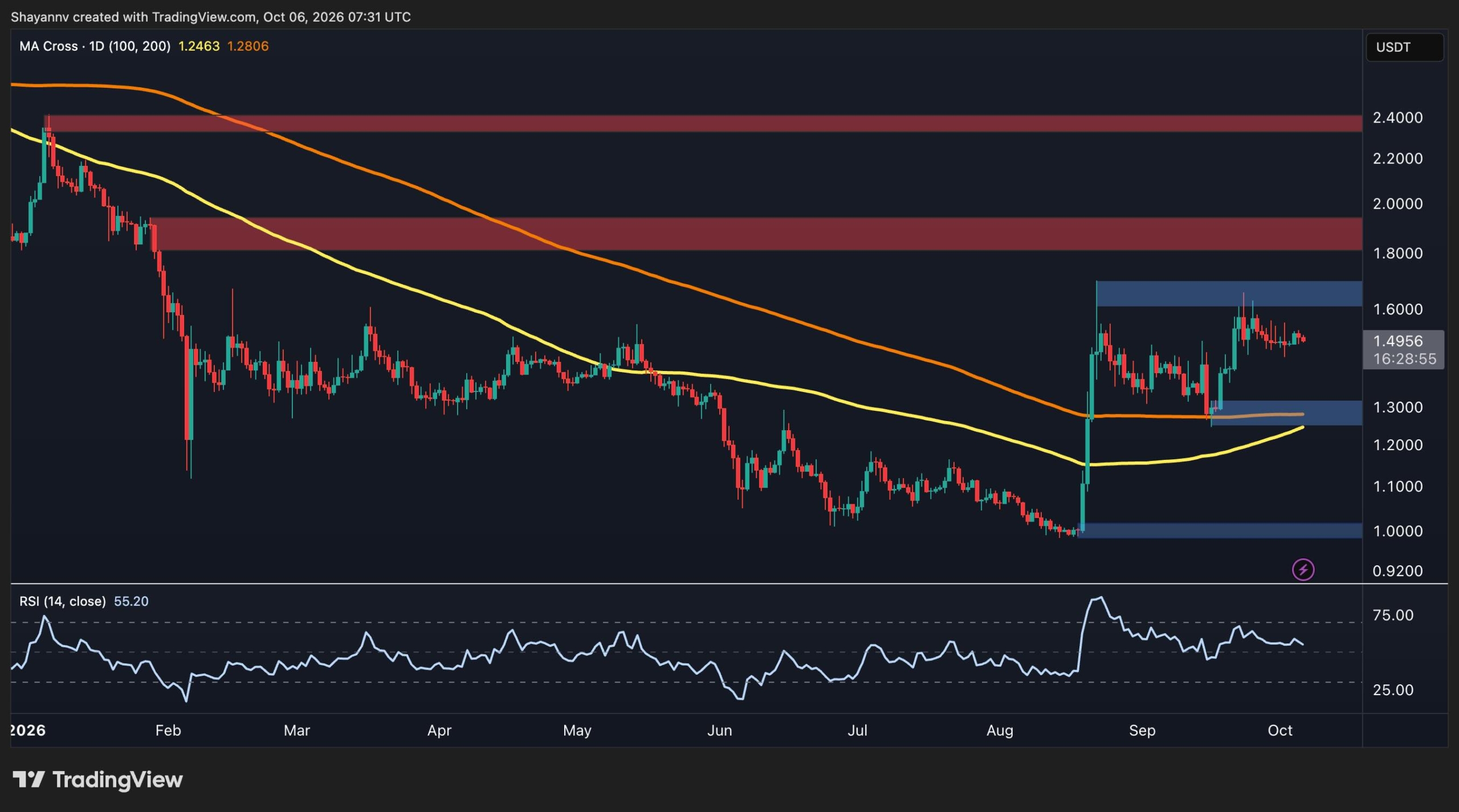
The daily chart shows a major structural recovery from the $1.00 support zone. XRP broke sharply higher in August and subsequently reclaimed both the 100-day and 200-day moving averages. The 100-day MA is now around $1.25, while the 200-day MA is around $1.28, with the 100-day average aggressively approaching the other for a potential bullish crossover. This is a constructive development from a medium-term perspective.
The main resistance is located between $1.60 and $1.70. XRP has already tested this area twice in recent weeks, with the latest attempt in September failing to break out. A daily close above $1.70 would represent a significant structural improvement and could open the door toward the next major resistance around $2. Above that, the next resistance zone sits around $2.40, which coincides with a major high formed early this year.
On the downside, the $1.25-$1.30 region has become particularly important. It contains the 100-day and 200-day moving averages and coincides with a marked demand zone. As long as XRP remains above this support area, the broader recovery structure remains intact. A deeper decline back toward the $1.00 area would become more relevant if this support is decisively lost, which would reverse all the recent gains and put the market under immense pressure once more.
The 4-Hour Chart
The 4-hour chart shows XRP trading inside a tightening structure beneath a descending trendline. The trendline currently acts as dynamic resistance, with XRP repeatedly failing to establish a decisive move above it. At the same time, buyers have continued to defend the green support zone around $1.45, creating a relatively well-defined consolidation range.
The immediate resistance is around $1.70, followed by the significant $2 supply zone. A breakout above the descending trendline and subsequent move through $1.70 would strengthen the bullish case and could bring the $2 level into play.
Conversely, a loss of the $1.45 support zone would weaken the short-term structure. In that scenario, XRP could retrace toward the $1.30 area, which is a clear demand zone that buyers should defend at all costs in the short term. Otherwise, a bearish reversal scenario would materialize, which could once again send XRP back toward the $1 area, and potentially lower this time. Still, the current structure is better viewed as consolidation, with a higher probability of a bullish breakout, rather than a bearish reversal forming.

The post Ripple Price Analysis: Is XRP Consolidation Almost Over as the Range Tightens? appeared first on CryptoPotato.
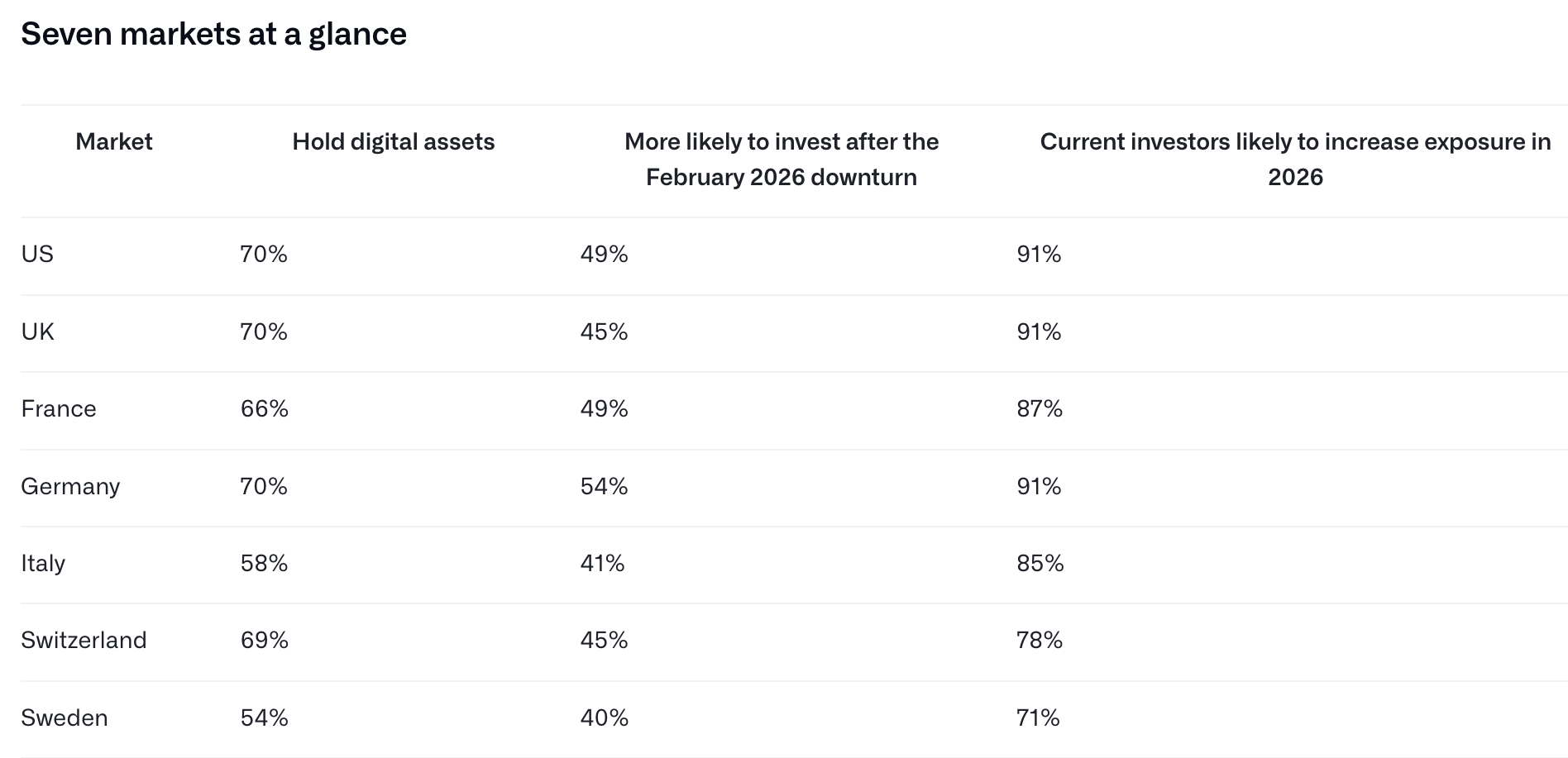
A majority of affluent investors across seven of the biggest economies hold digital assets, with crypto accounting for around 10% of their portfolios on average, according to a new CoinShares survey.
The survey covered 2,230 investors with at least $500,000 in investable assets across the US, UK, France, Germany, Italy, Sweden and Switzerland. Digital asset ownership ranged from 54% in Sweden to about 70% in the US, UK, Germany and Switzerland.
At least 85% of current digital asset investors in five of the seven countries said they planned to increase their exposure in 2026, with as much as 91% in the US, UK and Germany.
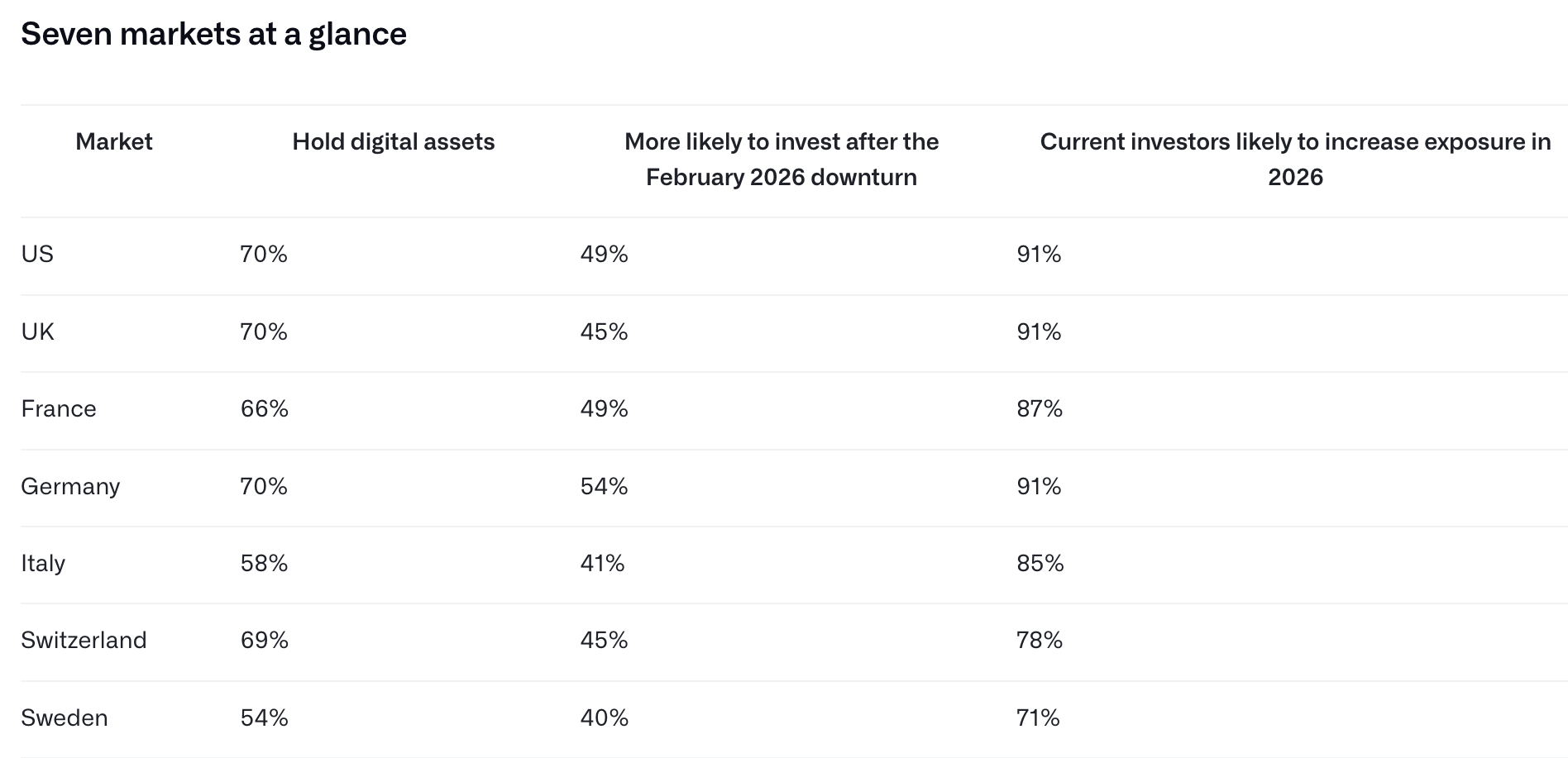
CoinShares survey of affluent investors across seven countries. Source: CoinShares
The February 2026 crypto market downturn did little to dampen that appetite. In all seven countries, more respondents said the sell-off made them more likely to invest in digital assets than less likely.
That resilience appears to reflect a longer-term view of the asset class. Long-term appreciation and diversification were the leading reasons respondents gave for investing in crypto, while speculation ranked last. Just 6% identified primarily as short-term traders.
Bitcoin (BTC) remained the most widely held digital asset, owned by 80% of digital asset investors on average, though 89% of BTC investors also held other digital assets. Meanwhile, 77% of respondents believed BTC would play a significant role in the future global financial system, while 79% supported increased regulation of digital asset markets.
Crypto exposure was particularly high among younger investors. That cohort allocated more to digital assets than older investors in all seven countries and roughly twice as much in four of them.
Related: Wealth in retirement: A use case for Bitcoin in IRAs
Advisers lag crypto investors
The survey also found signs of a disconnect between affluent investors and their financial advisers. Roughly four in 10 respondents in Switzerland, France, the US and Germany who worked with an adviser said they found them overly cautious about digital assets.
The respondents’ view on advisers was echoed by Ric Edelman, founder of the Digital Assets Council of Financial Professionals and Edelman Financial Engines.
Edelman told Cointelegraph that financial advisers remain slow adopters of digital assets, with many lacking the knowledge or incentive to learn about the asset class. He said:
Advisors are busy; they are already operating a successful practice filled with happy clients — so why bother learning something new? — and most are getting little to no encouragement from their firms.
He added that some firms prohibit advisers from discussing crypto or offering crypto-related investments to clients. As a result, he said advisers may not know which of their clients own crypto and could be missing opportunities to provide tax, estate-planning and philanthropic services around those holdings.
How much crypto should investors hold?
Edelman challenged CoinShares’ finding that crypto allocations among affluent investors average around 10%, saying his own research suggests allocations of 2% to 5% are far more common.
Despite questioning the survey’s figure, Edelman recommends allocations ranging from 10% to 40%, depending on risk tolerance. He recommends 10% for conservative portfolios, 25% for moderate portfolios and 40% for aggressive portfolios.
“As the asset class matures, 10% allocations or higher will become the norm,” Edelman said. “The sooner people do that, the better off they will be.”
Edelman’s recommended allocations stand in contrast to broader skepticism about using crypto for retirement savings. An August survey from the National Institute on Retirement Security found that 77% of Americans considered cryptocurrency in workplace retirement plans risky, including 46% who viewed it as very risky.
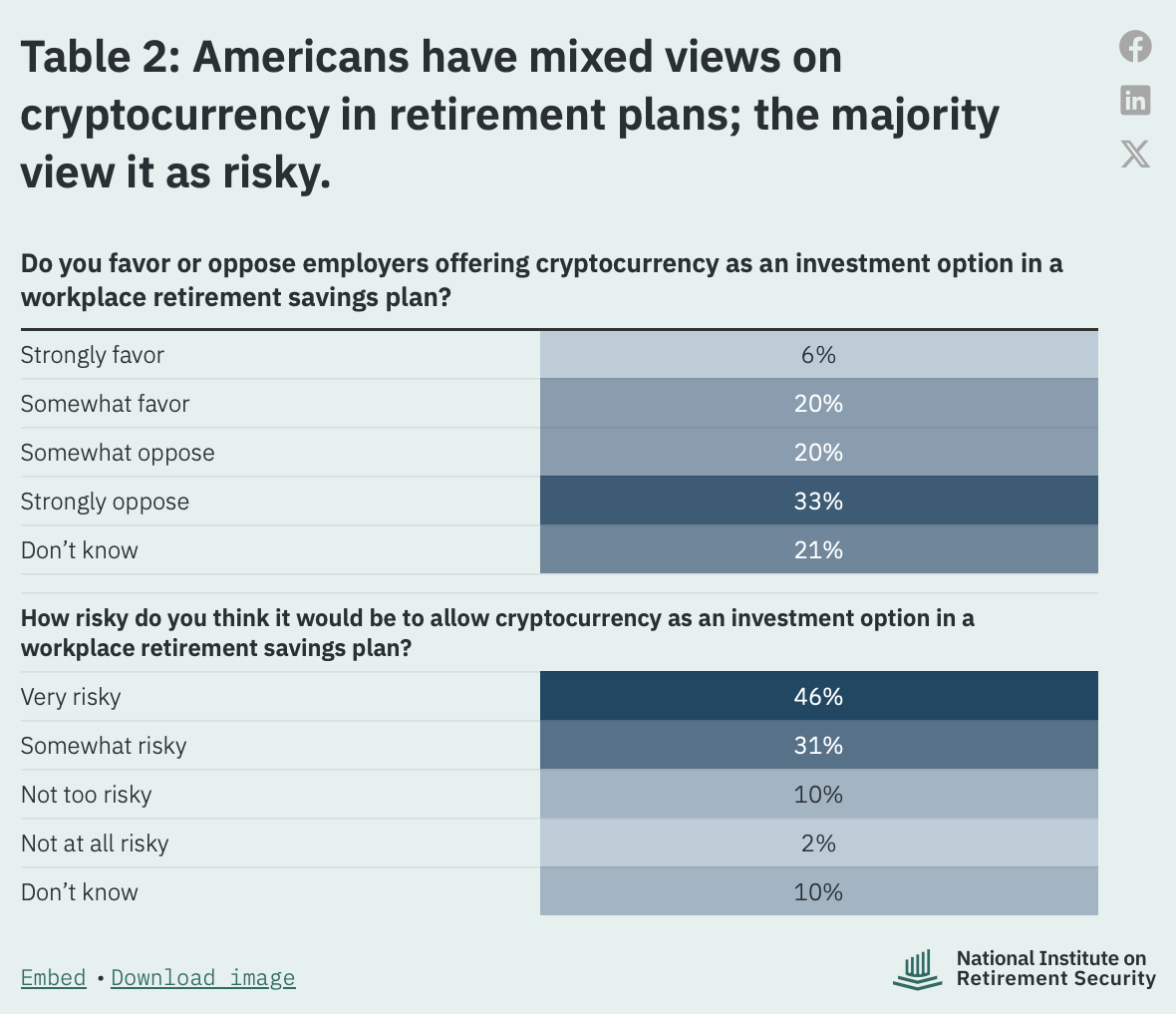
Americans view of crypto in retirement plans. Source: National Institute of Retirement Security
Magazine: Peter Brandt says Bitcoin may hit $600K by 2029, calls XRP a ‘fool coin’

12 Years in the Making: Mike Tomlin’s Minecraft City Reveals Gaming’s Quiet Grip on the NFL

How Some Small, Rural Districts Are Winning the Attendance Struggle

Southampton’s Eckert Spared Ban as FA Suspends Six-Week Sentence Over Spygate


-

 Fashion5 days ago
Weekend Open Thread: Veronica Beard
-

 Tech & AI3 days ago
Common Mistakes You Should Avoid When Using Foldable Phones
-

 Tech & AI6 days ago
Fireflies.ai Launches Fireflies Talk for Free, Unlimited Voice Dictation
-

 Tech & AI6 days ago
Excellent hardware badly hampered by too-small SSD
-

 Crypto7 days ago
NEAR Intents hacked days after freezing stolen Bitget funds
-

 Tech & AI7 days ago
Whatever AI Safety Is, It’s Not This
-
 Tech & AI6 days ago
Mystery AMD Chip “Gainsborough” Fuels Steam Deck 2 Speculation — But Don’t Get Too Excited Yet
-

 Tech & AI7 days ago
Can Schools Trust AI Features in Edtech Products?
-

 Tech & AI6 days ago
Sony’s new PS5 Pro lottery requires 60 hours of playtime just to apply
-

 Gaming6 days ago
Reigns Studio Nerial Shuts Down as Founders Step Back “To Our Roots”
-

 Tech & AI5 days ago
Koreans Left With Spoiled Food Due To Borked Samsung Firmware Update For ‘Smart’ Fridges
-
 Crypto6 days ago
Bitcoin edges higher ahead of U.S. jobs report as global bond yields surge
-

 Entertainment6 days ago
Russo Brothers Tease Very Surprising Ending for Avengers: Doomsday
-

 Business & Hustles5 days ago
Beyond Ozempic: Lilly and Novo Chase the Next Obesity Blockbuster With Amylin
-

 Entertainment6 days ago
From Horror Reboots to Soul Reinventions: This Week’s Entertainment Headlines
-

 Gaming5 days ago
Sony’s Late-Stage Listening Tour on Physical Games Raises More Questions Than It Answers
-

 Sports7 hours ago
Saracens’ Venter Brands Premiership Rugby ‘Autocratic’ Over £5,000 Media Fine
-

 Tech & AI5 days ago
Muse Creates Detailed Profiles of All Your Friends and Family
-
Tech & AI6 days ago
CDC Opens Up COVID Vaccine Procurement Without Explanation
-

 Tech & AI6 days ago
Missile Test Sinks US Navy Warship Off The Scottish Coast
You must be logged in to post a comment Login