
Crypto
Founders Fund Leads $5M Bet on Crypto Collateral Startup Anvil as It Courts Wall Street


Peter Thiel’s venture firm Founders Fund has led a $5 million purchase of governance tokens in Anvil, a decentralized finance protocol that lets businesses use digital assets as crypto collateral, in a deal that signals growing institutional appetite for infrastructure plays beyond simple bitcoin and ether bets.
Pantera Capital, Theta Blockchain Ventures, Bullish and Protoscale Capital also joined the purchase of ANVL tokens, according to a Monday announcement from the project. Terms of the valuation were not disclosed, and Anvil told CoinDesk the tokens were drawn from its existing treasury rather than minted fresh for the sale. The protocol’s token currently has a circulating supply of 80 billion out of a total 100 billion ANVL.
The investment arrives as Anvil, built on the Ethereum blockchain, pushes to make its brand of crypto collateral more accessible to companies that have no interest in writing blockchain code themselves. Alongside the funding announcement, Anvil Research Labs — the protocol’s affiliated research and development arm — unveiled a software development kit designed to let businesses plug into Anvil’s system directly, without needing in-house blockchain engineers.

A Different Approach to Crypto Collateral
What sets Anvil apart from the broader universe of decentralized finance lenders is its underlying mechanics. Most DeFi platforms require users to borrow against their crypto collateral, meaning a company looking to secure a transaction typically has to take out a loan and pay interest on it. Anvil’s model skips that step entirely: digital assets posted as collateral are used to guarantee a financial commitment — such as a payment or a credit line — without the provider taking on debt or paying interest.
That structure is part of what has attracted serious institutional names to the project. Founders Fund, which has backed companies ranging from Palantir to SpaceX, has increasingly dipped into crypto infrastructure in recent years, and its decision to lead this round suggests confidence that collateral-based protocols like Anvil could become plumbing for mainstream financial activity rather than remaining a niche corner of DeFi.
Pantera Capital, one of the earliest and most prolific crypto-focused investment firms, rounds out a backer list that also includes Bullish, the crypto exchange operator that has been expanding its footprint across trading and now venture investment. Their involvement adds weight to the idea that crypto collateral products are being eyed as a bridge between traditional finance and blockchain-based systems.
Lowering the Barrier for Business Adoption
The newly launched software development kit is central to Anvil’s pitch to potential enterprise partners. By abstracting away the technical complexity of interacting with Ethereum smart contracts, the kit is meant to let payment companies, lenders and other financial institutions tap into Anvil’s crypto collateral infrastructure the same way they might integrate any other third-party API — without hiring blockchain specialists or building custom tooling from scratch.
That focus on usability reflects a broader trend in the crypto industry, where protocols are racing to court traditional businesses that want exposure to blockchain-based efficiency without the operational headache of managing private keys, smart contracts or token mechanics directly. For Anvil, convincing businesses that commitments backed by digital-asset collateral are trustworthy — and easy to implement — is key to moving beyond its current base of crypto-native users.
“Businesses need to know the commitments behind payments and other financial obligations are solid,” the company said in its announcement, underscoring its argument that digital-asset-backed guarantees can offer certainty that traditional credit arrangements sometimes lack.
Whether that pitch resonates with risk-averse corporate treasuries and financial institutions remains to be seen. But the involvement of Founders Fund, Pantera and Bullish gives Anvil a credibility boost as it tries to position crypto collateral not as a speculative trading tool, but as practical infrastructure for everyday commerce.
Explore more on this topic with Vexel Search.


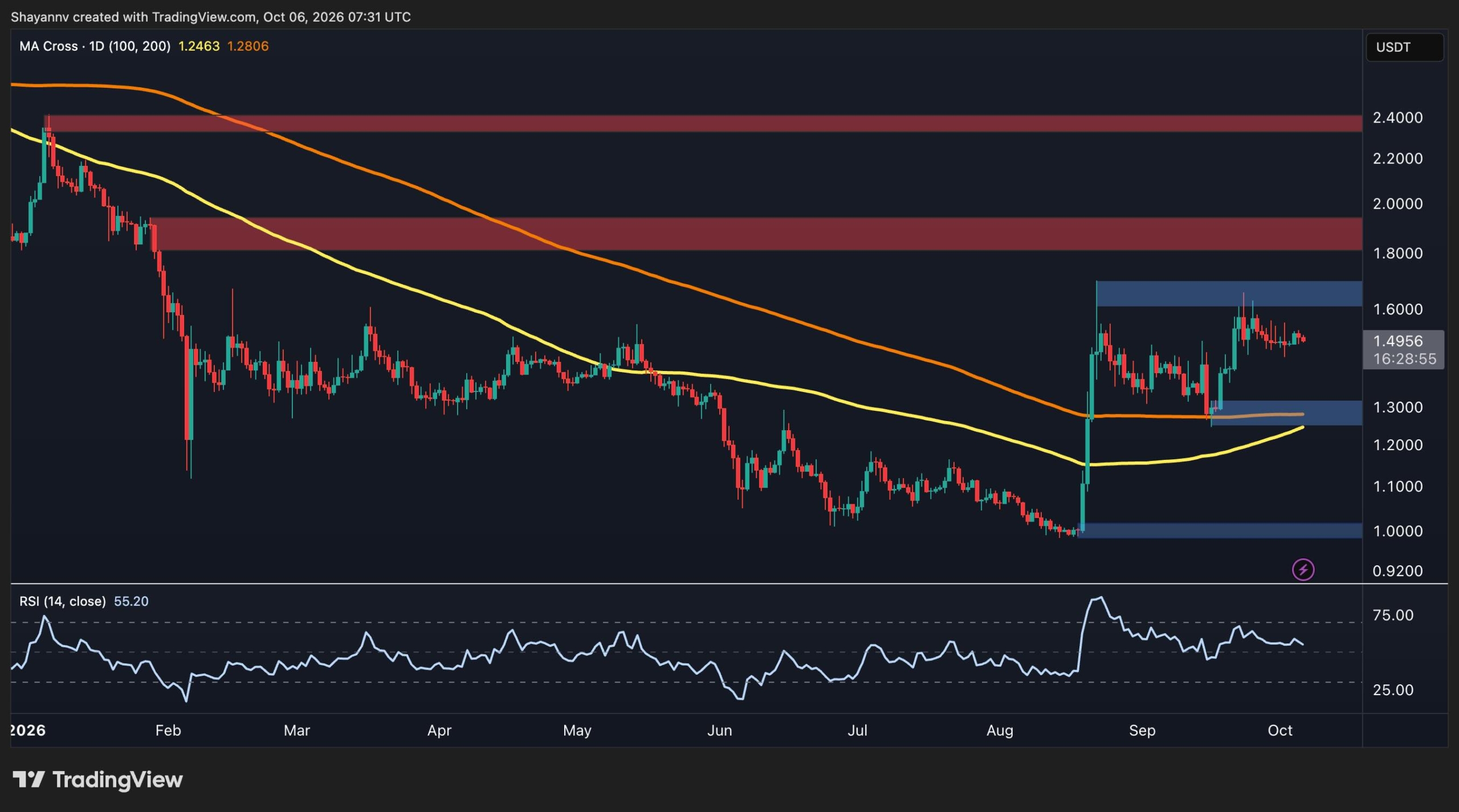
XRP is consolidating around $1.50 after a strong rebound from the $1.00 area. The broader structure has improved considerably, but the latest price action suggests that buyers are struggling to push through the overhead resistance zone. The key question now is whether the asset can break the $1.70 resistance, or whether another pullback toward support develops.
Ripple Price Analysis: The USDT Pair
The daily chart shows a major structural recovery from the $1.00 support zone. XRP broke sharply higher in August and subsequently reclaimed both the 100-day and 200-day moving averages. The 100-day MA is now around $1.25, while the 200-day MA is around $1.28, with the 100-day average aggressively approaching the other for a potential bullish crossover. This is a constructive development from a medium-term perspective.
The main resistance is located between $1.60 and $1.70. XRP has already tested this area twice in recent weeks, with the latest attempt in September failing to break out. A daily close above $1.70 would represent a significant structural improvement and could open the door toward the next major resistance around $2. Above that, the next resistance zone sits around $2.40, which coincides with a major high formed early this year.
On the downside, the $1.25-$1.30 region has become particularly important. It contains the 100-day and 200-day moving averages and coincides with a marked demand zone. As long as XRP remains above this support area, the broader recovery structure remains intact. A deeper decline back toward the $1.00 area would become more relevant if this support is decisively lost, which would reverse all the recent gains and put the market under immense pressure once more.
The 4-Hour Chart
The 4-hour chart shows XRP trading inside a tightening structure beneath a descending trendline. The trendline currently acts as dynamic resistance, with XRP repeatedly failing to establish a decisive move above it. At the same time, buyers have continued to defend the green support zone around $1.45, creating a relatively well-defined consolidation range.
The immediate resistance is around $1.70, followed by the significant $2 supply zone. A breakout above the descending trendline and subsequent move through $1.70 would strengthen the bullish case and could bring the $2 level into play.
Conversely, a loss of the $1.45 support zone would weaken the short-term structure. In that scenario, XRP could retrace toward the $1.30 area, which is a clear demand zone that buyers should defend at all costs in the short term. Otherwise, a bearish reversal scenario would materialize, which could once again send XRP back toward the $1 area, and potentially lower this time. Still, the current structure is better viewed as consolidation, with a higher probability of a bullish breakout, rather than a bearish reversal forming.

The post Ripple Price Analysis: Is XRP Consolidation Almost Over as the Range Tightens? appeared first on CryptoPotato.
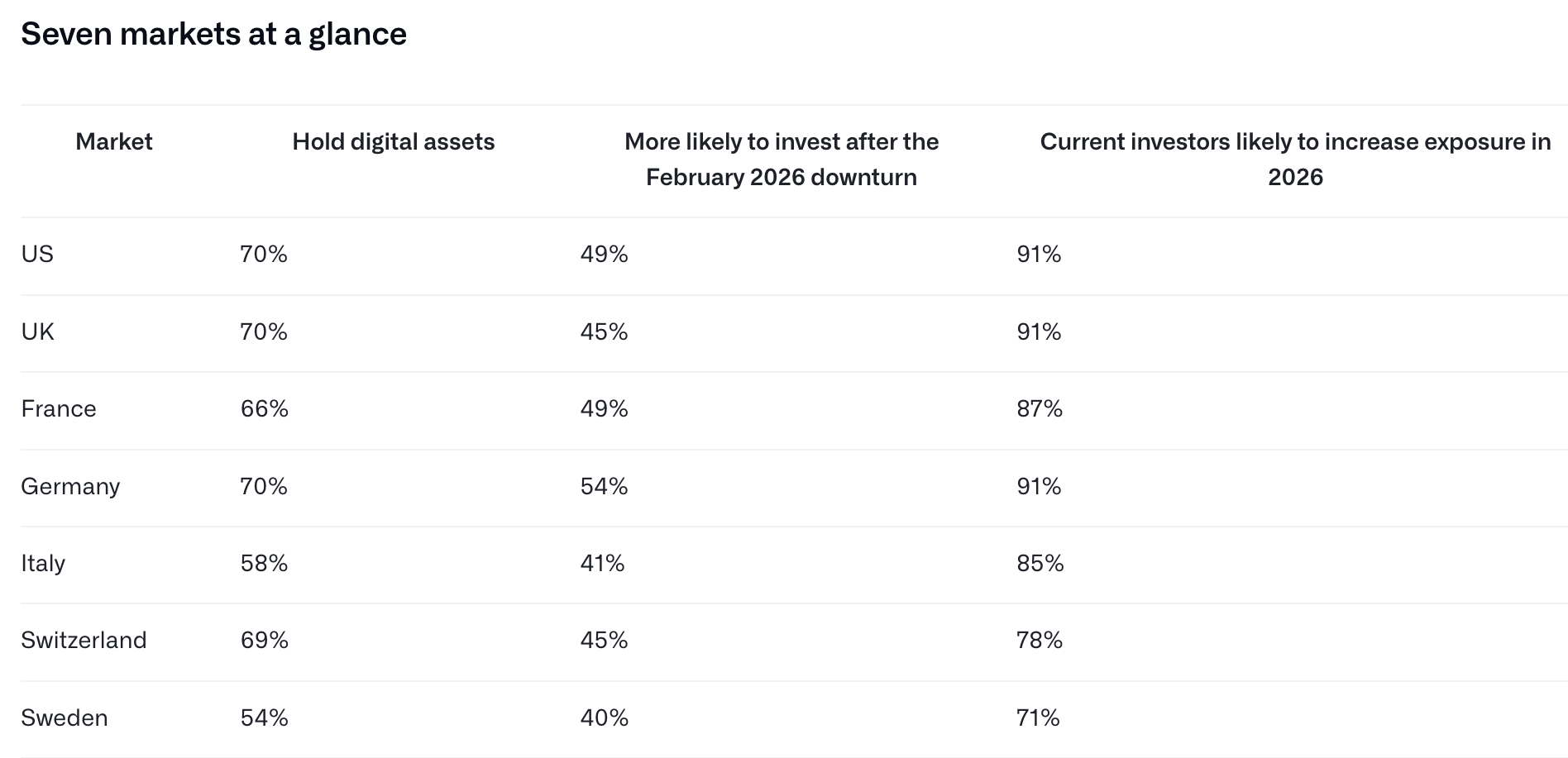
A majority of affluent investors across seven of the biggest economies hold digital assets, with crypto accounting for around 10% of their portfolios on average, according to a new CoinShares survey.
The survey covered 2,230 investors with at least $500,000 in investable assets across the US, UK, France, Germany, Italy, Sweden and Switzerland. Digital asset ownership ranged from 54% in Sweden to about 70% in the US, UK, Germany and Switzerland.
At least 85% of current digital asset investors in five of the seven countries said they planned to increase their exposure in 2026, with as much as 91% in the US, UK and Germany.
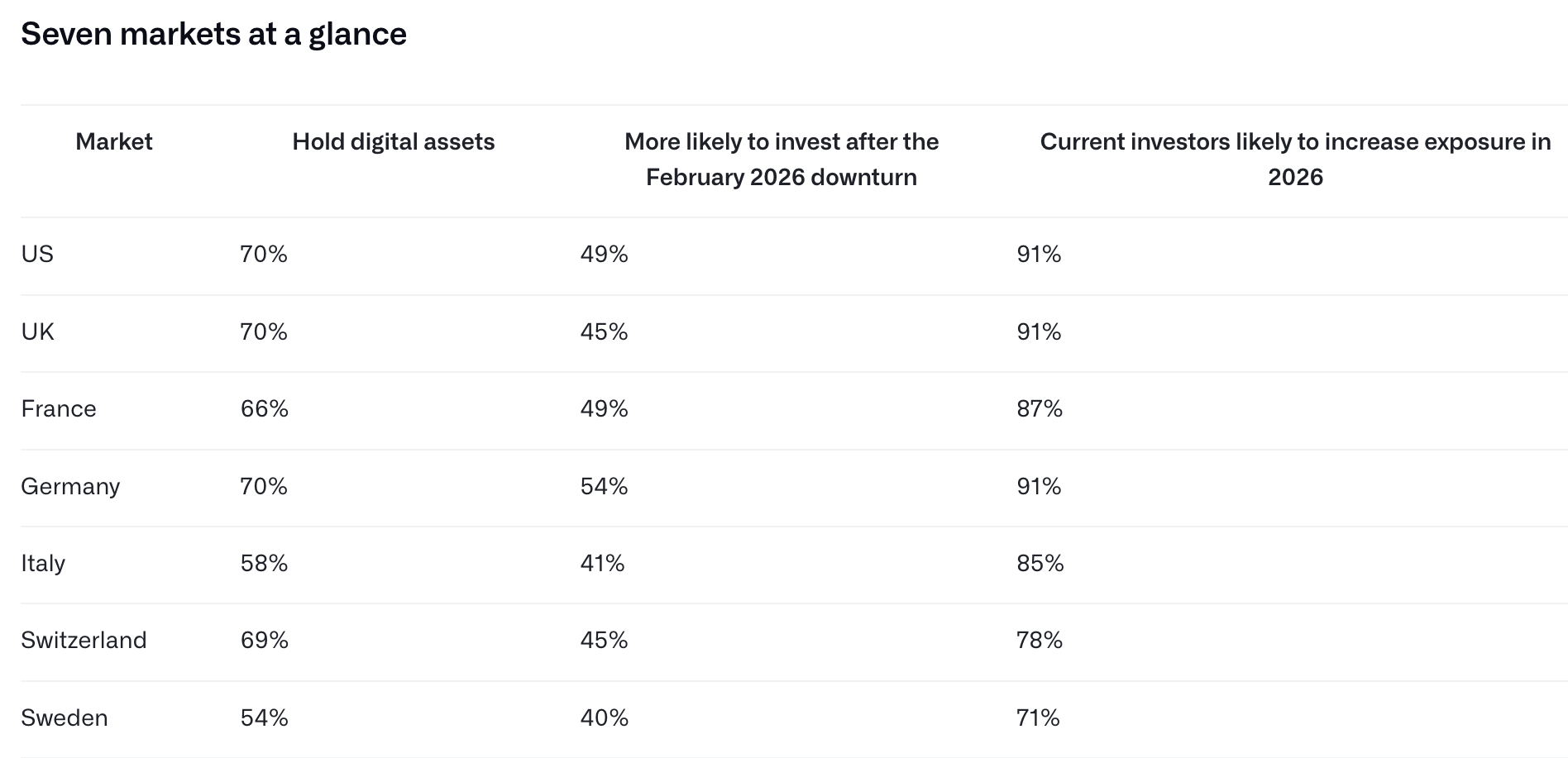
CoinShares survey of affluent investors across seven countries. Source: CoinShares
The February 2026 crypto market downturn did little to dampen that appetite. In all seven countries, more respondents said the sell-off made them more likely to invest in digital assets than less likely.
That resilience appears to reflect a longer-term view of the asset class. Long-term appreciation and diversification were the leading reasons respondents gave for investing in crypto, while speculation ranked last. Just 6% identified primarily as short-term traders.
Bitcoin (BTC) remained the most widely held digital asset, owned by 80% of digital asset investors on average, though 89% of BTC investors also held other digital assets. Meanwhile, 77% of respondents believed BTC would play a significant role in the future global financial system, while 79% supported increased regulation of digital asset markets.
Crypto exposure was particularly high among younger investors. That cohort allocated more to digital assets than older investors in all seven countries and roughly twice as much in four of them.
Related: Wealth in retirement: A use case for Bitcoin in IRAs
Advisers lag crypto investors
The survey also found signs of a disconnect between affluent investors and their financial advisers. Roughly four in 10 respondents in Switzerland, France, the US and Germany who worked with an adviser said they found them overly cautious about digital assets.
The respondents’ view on advisers was echoed by Ric Edelman, founder of the Digital Assets Council of Financial Professionals and Edelman Financial Engines.
Edelman told Cointelegraph that financial advisers remain slow adopters of digital assets, with many lacking the knowledge or incentive to learn about the asset class. He said:
Advisors are busy; they are already operating a successful practice filled with happy clients — so why bother learning something new? — and most are getting little to no encouragement from their firms.
He added that some firms prohibit advisers from discussing crypto or offering crypto-related investments to clients. As a result, he said advisers may not know which of their clients own crypto and could be missing opportunities to provide tax, estate-planning and philanthropic services around those holdings.
How much crypto should investors hold?
Edelman challenged CoinShares’ finding that crypto allocations among affluent investors average around 10%, saying his own research suggests allocations of 2% to 5% are far more common.
Despite questioning the survey’s figure, Edelman recommends allocations ranging from 10% to 40%, depending on risk tolerance. He recommends 10% for conservative portfolios, 25% for moderate portfolios and 40% for aggressive portfolios.
“As the asset class matures, 10% allocations or higher will become the norm,” Edelman said. “The sooner people do that, the better off they will be.”
Edelman’s recommended allocations stand in contrast to broader skepticism about using crypto for retirement savings. An August survey from the National Institute on Retirement Security found that 77% of Americans considered cryptocurrency in workplace retirement plans risky, including 46% who viewed it as very risky.
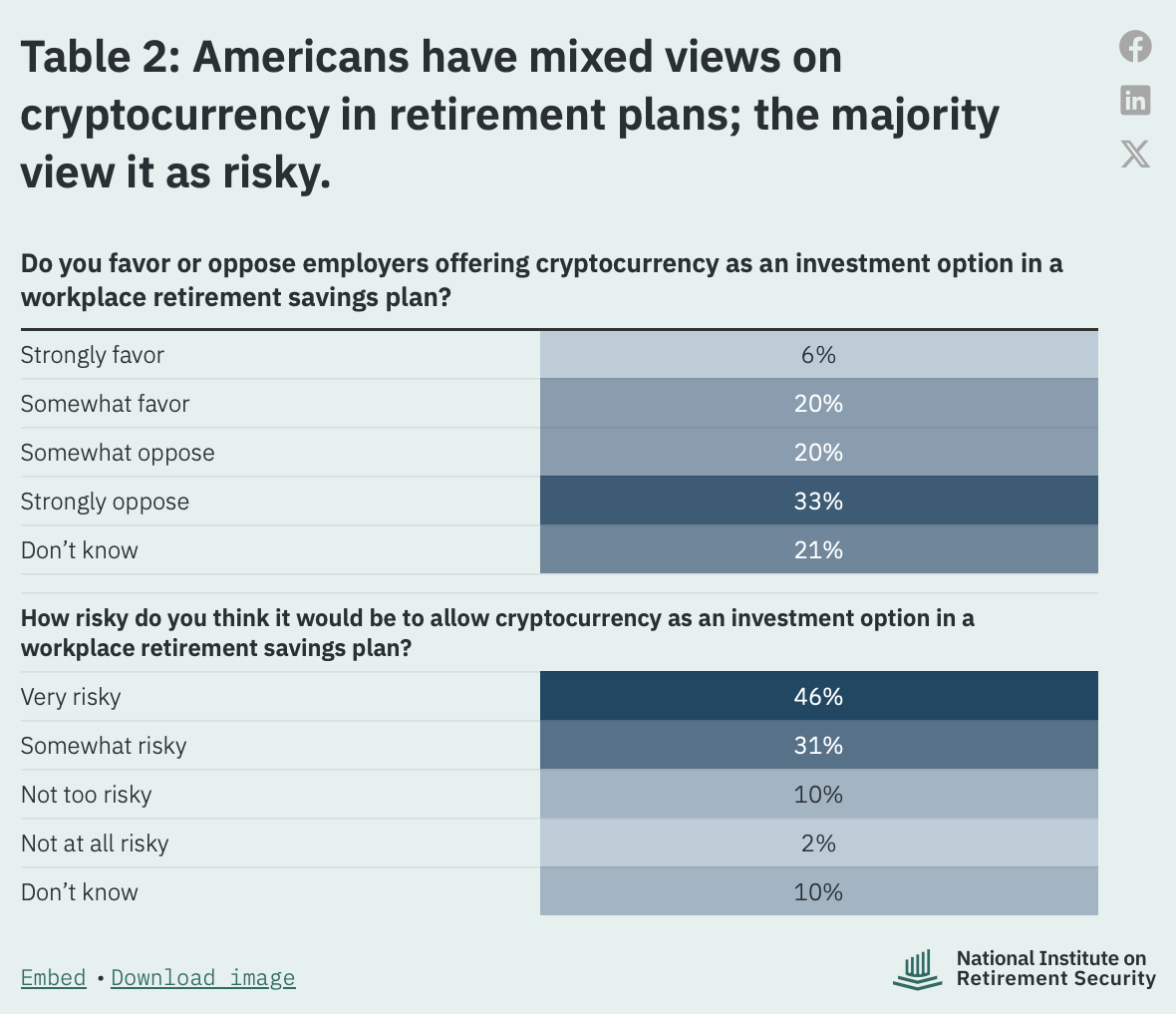
Americans view of crypto in retirement plans. Source: National Institute of Retirement Security
Magazine: Peter Brandt says Bitcoin may hit $600K by 2029, calls XRP a ‘fool coin’

TITLE: Pi Network Price Slides Below $0.09 as Bearish Signals Pile Up Despite Market Optimism
KEYWORD: pi network price
DESCRIPTION: The Pi Network price has fallen for five straight days, slipping under $0.09 even as broader crypto markets show signs of greed and optimism.
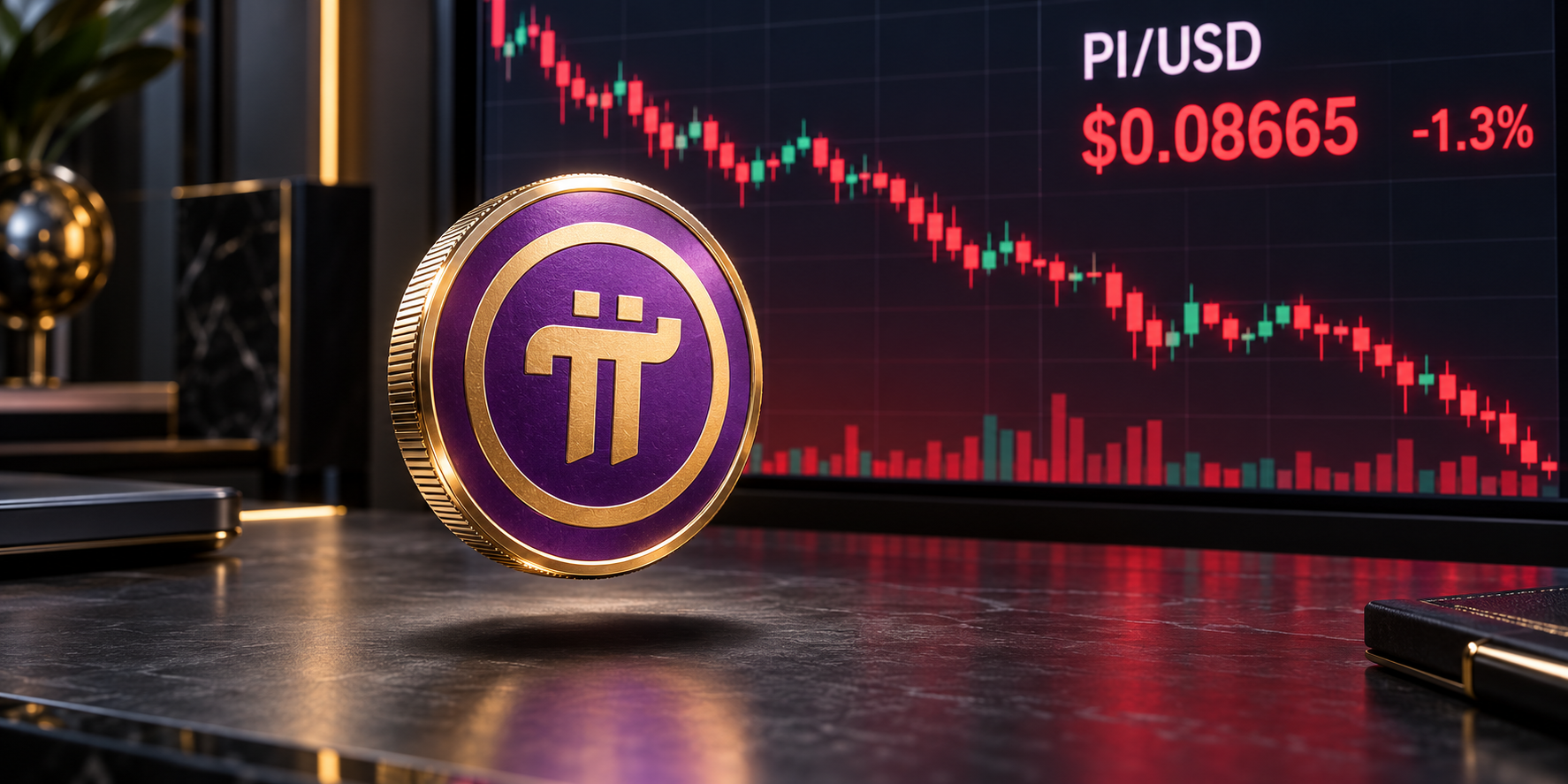
The Pi Network price has now fallen for five consecutive trading sessions, dropping below the $0.090 mark even as the rest of the cryptocurrency market enjoys a noticeably upbeat mood. The disconnect between Pi’s slide and the wider market’s “greed” sentiment is raising questions about whether the token can find its footing anytime soon, or whether deeper losses are still ahead.
As of Monday, PI changed hands around $0.0865, continuing a downtrend that has persisted despite a Fear and Greed Index reading of 67 on CoinMarketCap — a level that typically signals healthy risk appetite across digital assets. That broader optimism, however, has done little to rescue Pi Network, underlining just how disconnected individual token performance can be from overall market psychology.
Why the Pi Network Price Keeps Falling
Analysts tracking the token point to a combination of weak technical structure and shifting derivatives activity as the main culprits behind the ongoing slump. According to data from CoinAnk, futures open interest in PI has climbed to $10.15 million, up from $9.78 million the previous day — a roughly 3.8% increase in outstanding exposure even as the spot price continues to sink.
That rise in open interest is notable, but it doesn’t necessarily signal bullish conviction. Open interest simply measures the total notional value of active contracts; it doesn’t distinguish between new long positions, fresh short bets, or some mix of both. In Pi Network’s case, the simultaneous increase in open interest and decline in spot price suggests traders are actively positioning themselves, but the direction of that conviction remains unclear. For anyone holding leveraged long positions, the combination of rising exposure and falling prices adds an extra layer of risk that shouldn’t be ignored.
Technical Indicators Favor the Sellers
The charts paint an equally discouraging picture for Pi Network bulls. The token currently sits below all of its major daily exponential moving averages, a classic sign of sustained bearish pressure. The 50-day EMA sits at $0.0911 — just above the current trading price — making it the first hurdle any recovery attempt would need to clear. Further above, the 100-day EMA rests near $0.0991, while the 200-day EMA looms much higher at $0.1219, underscoring how far the token has drifted from its longer-term trend.
Momentum readings tell a similar story. The Relative Strength Index for Pi Network currently sits around 43, below the neutral 50 threshold, pointing to weakening buying momentum even though the token hasn’t yet slipped into technically oversold territory. The Moving Average Convergence Divergence indicator is also mildly negative, reinforcing the sense that sellers currently hold the upper hand in the near term.
Key Levels to Watch
For traders watching the Pi Network price action closely, a handful of support and resistance levels stand out. Immediate support lies at $0.0827, which corresponds to the 23.6% Fibonacci retracement measured between a high of $0.1341 and a low of $0.0704. A secondary support zone sits at $0.0801, marking the low recorded on July 31.
Should both of those levels give way, analysts suggest the $0.0704 swing low could become the next major downside target — a scenario that would represent a substantial extension of the current losing streak. On the upside, any meaningful recovery would first need to reclaim the $0.0911 resistance level tied to the 50-day EMA before the broader bearish structure could be considered under threat.
For now, the gap between Pi Network’s struggling price action and the rest of the crypto market’s relatively cheerful mood remains the defining story. Broader sentiment gauges suggest investors are generally willing to take on risk, yet that appetite has not translated into renewed demand for PI. Whether nearby support levels can finally attract enough buying interest to halt the slide, or whether sellers continue to dictate the token’s trajectory, will likely determine where the Pi Network price heads next.
Explore more on this topic with Vexel Search.

Artificial intelligence companies are continuing to pursue multibillion-dollar funding rounds and stock market listings, as investors continue to pour capital into the race to develop more powerful models as the race between U.S. and China continues.
China’s DeepSeek is nearing a funding round of at least $12 billion, backed by Tencent and battery maker CATL, ahead of a planned IPO in early 2027, according to a report by Bloomerg. Demand could push the raise to around $15 billion, exceeding its initial target.
The financing follows the release of DeepSeek’s V4 Flash model, which strengthened its competitiveness against OpenAI and Anthropic on cost and performance.
Moonshot AI, the company behind the Kimi chatbot, has completed its final private funding round at a $50 billion valuation meanwhile. It is targeting a Hong Kong IPO in the first quarter of 2027 that could raise up to $5 billion. Annual recurring revenue is expected to reach $2 billion by December, double its current level.

Hedera price has become one of the more closely watched charts in the broader cryptocurrency market this week, after HBAR tumbled roughly 23% from its late-September peak near $0.131 to trade close to $0.101. The sharp reversal has left traders split over whether the token can stabilize above the psychologically important $0.10 level and mount a fresh push toward $0.12 before October closes out.
The pullback follows a brisk late-September rally that briefly carried Hedera to its highest level in weeks, only for momentum to fade just as quickly. On Binance’s HBAR/USDT daily chart, the token has recently traded between roughly $0.10019 and $0.10489, hovering just above the round-number support that many traders see as the line in the sand for this correction. A slip below that zone would likely reopen a path toward lower liquidation clusters that market-data trackers such as CoinGlass have flagged in the sub-$0.10 range.
Hedera Price Faces a Wall of Resistance Overhead
Chart watchers point to a cluster of technical hurdles standing between HBAR and a meaningful October rebound. The daily Ichimoku conversion line currently sits at $0.11166, well above the token’s latest price, while the base line is marked at $0.10146 — a level HBAR has recently struggled to hold. That leaves Hedera sandwiched below two separate resistance markers, with the larger gap to the conversion line underscoring how much ground buyers would need to recover just to flip short-term momentum back in their favor.
Adding a sliver of encouragement, the forward-looking Ichimoku cloud has turned green, spanning roughly $0.09762 to $0.10656. That shift suggests underlying conditions aren’t uniformly bearish, even as the token trades beneath its immediate daily indicators. Meanwhile, the Aroon indicator shows Aroon Up readings easing to 50% from a stronger late-September posture, while Aroon Down remains pinned at zero — a mixed signal that reflects fading upward momentum without yet confirming a fresh downtrend.
Weekly Charts Tell a More Optimistic Story
Zooming out, the picture for Hedera price brightens somewhat. On the weekly chart, HBAR sits near $0.10126, comfortably above the Supertrend support line at $0.06943 — a gap of roughly 31%. That Supertrend indicator has flipped green following the recent bounce, and the weekly Awesome Oscillator has moved into positive territory for the first time after an extended stretch of negative readings, hinting at firmer underlying momentum than the daily chart’s sharp pullback might suggest on its own.
Still, a formidable ceiling looms further out. Weekly charts show horizontal resistance marked at $0.14051, a zone that has repeatedly acted as a turning point in past market cycles. Reaching it from current levels would require HBAR to climb nearly 39%, a tall order given the token has yet to reclaim even its late-September high of $0.131.
What Traders Are Watching Next
For the bullish case to play out this month, analysts suggest Hedera price would first need to clear $0.11166 on the daily chart, opening the door to a test of $0.12 and eventually the recent $0.131 peak. Only a sustained break above $0.131 would put the much larger $0.14051 weekly resistance meaningfully in play.
Independent analyst Giannis Andreou, writing on X on October 5, flagged $0.12 to $0.15 as Hedera’s next major weekly resistance zone, while suggesting a recovery scenario hinges on support holding somewhere between $0.085 and $0.10. That view echoes the broader technical consensus: Hedera’s near-term fate rests on whether $0.10 holds as a floor, even as longer-term weekly indicators retain a cautiously bullish tilt.
The divergence between daily weakness and weekly resilience is a familiar pattern in cryptocurrency markets, where a token can post a bullish longer-term signal while still absorbing a sharp short-term correction — particularly when support lines on higher timeframes sit far beneath current trading levels. For now, Hedera price remains in a holding pattern, with $0.10 as the line separating consolidation from a deeper retreat, and $0.12 standing as the next meaningful target should buyers regain control before October ends.
Explore more on this topic with Vexel Search.
The crypto industry’s leading political action committee, Fairshake, released another list of candidates it’s supporting for the November elections, backing 13 Democrats and 19 Republicans — all incumbents — in their U.S. House of Representatives races.
The candidates tend to be safe bets to return to Congress, potentially further reinforcing the existing support for crypto policies in Congress. Atop all those names, six of them are getting a million dollars each in support from Fairshake and its affiliates, according to a spokesman for the super PAC.
“Fairshake has always been and always will be an issue-focused organization,” said Spokesman Geoff Vetter in a statement. “We back pro-crypto candidates who support American innovation in both parties.”
The top recipients on the Republican side are three well-known names in crypto circles, including French Hill, the chairman of the House Financial Services Committee who led the charge for crypto legislation in the House; Bill Huizenga, a senior member of that committee, and Bryan Steil, another member who also leads the subcommittee on digital assets.

The stock prices of most publicly-traded nuclear companies that have received a loan, contract, or financial incentive from Donald Trump’s administration have declined since receiving that favor.
Trump’s administration has handed the nuclear industry tens of billions of dollars of incentives in the past year, including a new $4.2 billion federal loan to Ohio nuclear plant operator Vistra announced today.
Vistra’s stock price is down 9% year-to-date (YTD).
Another $80 billion proposal between Cameco and Brookfield Asset Management would have handed the US government 20% of future profits or equity in the public-private partnership.
Cameco stock has declined 3% YTD.
Despite a 22% boost in its stock price when that deal was announced in October, its shares are 12% lower today than the date of that deal. Brookfield Asset Management, the second party to that deal, has lost 15% YTD, and has performed even worse when measured from the October announcement date.
On October 29, Nuclear power company NuScale said its private partner ENTRA1 Energy stands to receive up to $25 billion of US-Japanese investment under Trump’s international trade deal. Politico described ENTRA1 as a three-year-old startup with a skeleton staff.
NuScale’s stock is down 81% since that announcement.
Read more: Trump-related American Bitcoin has lost more than 90% of its value
Trump nuclear incentives precede lower stock prices
In November 2025, publicly-traded Constellation Energy secured a $1 billion loan to restart its Crane nuclear plant in Pennsylvania.
Its stock is down 19% since that news.
In December 2025, Holtec, which owns a nuclear plant in Michigan, received a $400 million award from the Energy Department after drawing at least six disbursements from a $1.52 billion guarantee that the Biden administration finalized.
Holtec then suspended its IPO for retail shareholders this month.
On January 6, 2026, Centrus Energy won a $900 million uranium enrichment task order from the US Energy Department.
Its shares are down 54% since it received that Trump administration contract.
On June 23, the Energy Department offered a conditional $17.5 billion loan for equipment on 10 Westinghouse reactors, co-owned by Cameco.
Cameco stock is down 15% since that date.
On August 17, X-energy learned that it will receive another $1 billion in Energy Department cost-sharing for nuclear generators. X-energy priced its April IPO at $23 per share, and the stock now trades below $15.
It’s also 10% below its intraday high on the day it received that $1 billion Trump administration incentive.
On August 26, Trump’s US Army awarded up to $2.2 billion to nuclear microreactor builders, including BWX Technologies.
BWX Technologies stock has traded flat since that news, after losing more than 20% YTD.
On September 8, NextEra Energy closed on a federal loan of up to $1.9 billion in September to restart Iowa’s only nuclear power plant.
NextEra stock is already down 7% within four weeks.
Got a tip? Send us an email securely via Protos Leaks. For more informed news and investigations, follow us on X, Bluesky, and Google News, or subscribe to our YouTube channel.

TITLE: Pokémon Card NFTs Rake In $11M a Month as Crypto Meets Collectibles Mania
KEYWORD: pokémon card nfts
DESCRIPTION: DeFi platforms turning Pokémon cards into NFTs generated $11 million last month, riding a collectibles boom that is reshaping crypto speculation.
Pokémon card NFTs have quietly become one of the most lucrative niches in decentralized finance, with onchain marketplaces generating roughly $11 million in revenue last month alone, according to data compiled by analytics platform DefiLlama. The figure marks a striking validation of an idea that, just a year ago, looked more like a crypto curiosity than a viable business.
The concept is simple on paper but reflects a clever fusion of two red-hot markets: collectible trading cards and blockchain speculation. Platforms built on networks like Solana and Polygon allow collectors to send in physical Pokémon cards, One Piece cards, and sports cards for verification and storage. In exchange, owners receive a digital token — a non-fungible tokenized representation of the card — that can be bought, sold, or traded instantly online, without ever touching the physical item.
Why Pokémon Card NFTs Took Off
The timing could hardly be better. Pokémon cards have become one of the best-performing collectible assets of the last two decades. According to the Card Ladder Index, the cards have delivered a cumulative return of roughly 4,000% since 2004 — dwarfing the S&P 500’s 513% gain over the same stretch. Nostalgia among millennial collectors, renewed interest from younger fans, and a pandemic-era surge in collecting have combined to push demand to extraordinary levels.

Manufacturers are struggling to keep pace. Card factories reportedly churn out more than 10 billion Pokémon cards a year, yet shortages persist, and unopened packs from popular sets routinely resell well above their suggested retail price. That scarcity has turned ordinary cardboard into a genuine speculative asset class, attracting investors who might never have considered collectibles before.
That’s where crypto’s structural advantages come in. Trading physical cards at scale is cumbersome — buyers and sellers must deal with authentication, shipping, insurance, and auction fees, especially when dealing in bulk or trying to offload large pallets of inventory. Pokémon card NFTs solve much of that friction by letting the underlying cards sit in secure storage while ownership changes hands purely onchain, similar in spirit to how gold-backed exchange-traded funds made bullion trading far more accessible than physically moving bars of metal.
Gacha Machines and Digital Pack Openings
Beyond simple buying and selling, several platforms have introduced “gacha” mechanics that replicate the thrill of opening a fresh pack. Users pay a fixed price for a chance at a randomly assigned card, which could turn out to be worth far more than what they paid — or considerably less. The mechanic borrows directly from loot-box style gaming economies and has proven popular with users chasing the dopamine hit of a potential big pull, all without leaving their crypto wallets.
The popularity of these mechanisms has helped push combined monthly revenue for trading-card marketplaces into eight figures, a remarkable outcome for a DeFi sector often associated with more experimental or short-lived trends. It also highlights how crypto infrastructure is increasingly being repurposed to tokenize real-world assets with genuine retail demand, rather than purely speculative onchain tokens.
Risks Lurking Behind the Boom
Still, the rise of Pokémon card NFTs carries clear risks. Flagship cards — such as first-edition Charizards from 1999, now fetching up to $550,000 in pristine condition compared with $1,500 to $2,000 a decade ago — have already appreciated dramatically, raising questions about how much further prices can realistically climb.
There is also a structural vulnerability built into the redemption process. While platforms allow holders to exchange their digital tokens for the physical cards, doing so requires shipping and processing time. In a sharp downturn, that lag could force NFT holders to sell at a discount to account for the delay, meaning token prices could fall faster and harder than the physical card market itself if sentiment sours.
The sector has also drawn scrutiny over trust issues. Earlier this year, investors in a separate platform claiming to let users speculate on Pokémon card prices said they lost the vast majority of their money, underscoring that not every operator in this niche has handled custody and verification responsibly.
For now, though, enthusiasm shows little sign of cooling. With physical card shortages persisting and crypto-native investors eager for new onchain assets backed by tangible value, Pokémon card NFTs look set to remain one of DeFi’s more unexpected growth stories — at least until the broader collectibles market decides whether its historic run still has room to run.
Explore more on this topic with Vexel Search.
Two years ago, then-presidential candidate Vivek Ramaswamy couldn’t stop praising the virtues of cryptocurrency.
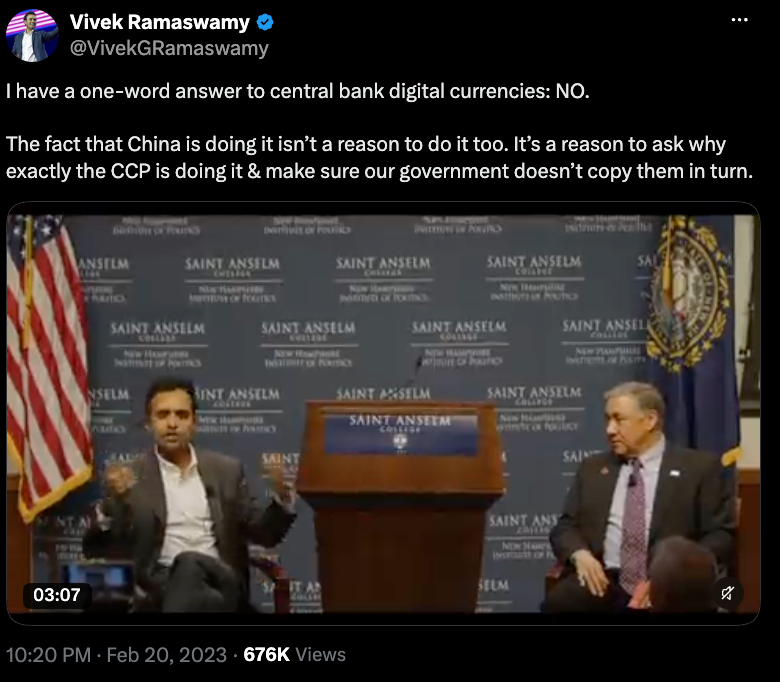
Running to be the 2024 Republican nominee in the race for the White House, Ramaswamy sprinkled his stump speeches with praise for Bitcoin (BTC) and token mining operations while strongly standing against central bank digital currencies.
Now, presidential candidate Ramaswamy is running to be the next governor of Ohio. And while he isn’t exactly distancing himself from positions on digital assets, he isn’t putting them at the forefront of his campaign despite substantial exposure to crypto investments and the Buckeye state’s interests.
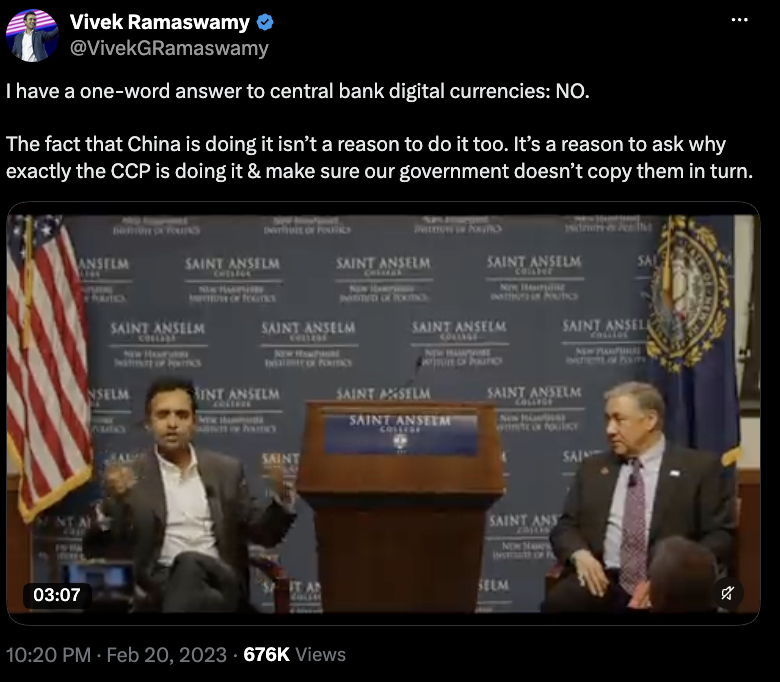
2023 X post on CBDCs. Source: Vivek Ramaswamy
In his 2024 presidential run, Ramaswamy was frequently issuing statements in opposition to central bank digital currencies (CBDCs), praising Bitcoin (BTC) and its mining operations and often attending industry events as a keynote speaker.
After Donald Trump won the presidential race, he tapped Ramaswamy to lead the Department of Government Efficiency, or DOGE, alongside Elon Musk. Ramaswamy left having never officially been a part of the administration.
Before announcing a run for the Ohio governor’s office in February 2025, he posted in support of the Ohio Strategic Cryptocurrency Reserve Act, a state bill that would allow the creation of a strategic Bitcoin reserve. In September 2025, Strive, the asset manager that he co-founded in 2022, announced plans to enter the digital asset market with a Bitcoin Bond ETF, focused on bonds issued by companies acquiring BTC.
Cointelegraph reached out to the Ramaswamy campaign but did not receive a response to repeated requests for an interview.
Crypto as a gubernatorial candidate
Following the official launch of his campaign, Ramaswamy initially kept up much of the same rhetoric he had espoused during his presidential run, also speaking at the Bitcoin for America conference in March and Bitcoin 2025 in May.
His campaign website accepts donations in crypto, and he has financial support from the co-founders of the Trump family’s crypto company, World Liberty Financial: Chase Herro, Zak Folkman and Zachary Witkoff, all of whom donated the maximum allowable amount of $16,615 each.
Other entities associated with the crypto industry have also donated millions of dollars to Ramaswamy’s Super political action committee (PAC) “V-PAC: Victors, Not Victims,” including $20 million from Susquehanna International Group co-founder Jeff Yass, $6 million from NYDIG founder Ross Stevens, $5 million from billionaire Elon Musk and $5,000 from the Bitcoin Voter Project.
Ramaswamy has maintained his stake in Strive, which reported holding 23,156 BTC worth about $2 billion as of Aug. 28. An August filing with the US Securities and Exchange Commission showed the candidate owned 5,693,897 shares in the company, worth more than $170 million as of Sept. 26. He also reported personally holding more than $1,000 in BTC and Ether (ETH) as of April through a Coinbase wallet.
Related: US midterm election mirrors 2024 as crypto PACs move into Ohio races
In September 2026, just weeks away from the election, Ramaswamy’s public statements on digital assets and related policies appear to have waned in contrast to his 2024 and even 2025 rhetoric. He had not addressed a Sept. 17 notice from Ohio Secretary of State Frank LaRose announcing the acceptance of cryptocurrency to pay for state fees and services as of the time of publication.
What’s different for Ohio voters in 2026? Data centers, for one
Ohio voters could be part of the reason for Ramaswamy appearing to tone down the talk on crypto. The state was already the target of more than $40 million in spending by industry-aligned groups in 2024 to support Republican Bernie Moreno’s Senate run.
Two years ago, Moreno defeated incumbent Democrat Sherrod Brown, but history is beginning to repeat itself: Brown is now running against Republican Jon Husted for another chance in the Senate in next month’s election. The Fairshake PAC has pledged to initially spend $30 million opposing the Democrat again, already reporting $11 million in ad buys.
To be sure, a poll conducted by the Digital Currency Group in May 2024, months before the election, suggested that Ohio voters were “more negative towards crypto” compared to those in other US states, with 79% of the state’s respondents saying that they had never held crypto and 77% holding negative views on the digital currency.
Sentiment on data centers has also become a controversial campaign issue for Ohio politicians in 2026. According to the Pew Research Center, there were 166 data centers in Ohio as of April, giving the state more locations than any other in the country. It’s also home to many crypto mining operations, including Cipher Mining, Bitdeer and BIT Mining.
Public polling also showed that a majority of Ohio residents do not support data centers in their communities. Ramaswamy pledged in August that any center built in an Ohio community would result in no electricity cost for residents and lower property taxes, while his Democratic opponent, Amy Acton, has proposed that “all costs for gas, water and electricity needs to be covered by data centers and their investors, not Ohio taxpayers or our communities.”
As of Sept. 22, an average of RealClearPolling data showed Acton with a one-point lead over Ramaswamy, making the race essentially a toss up. An event contract on Kalshi at last look on Monday had more than $2 million in bets and favored the Democratic candidate with a 66% chance of winning the governor’s race, with similar odds on a Polymarket contract.
Magazine: Winners and losers of the SEC’s new tokenized stocks rules

Cryptocurrency just survived its roughest stretch since 2022, and the data suggests it wasn’t luck that kept it standing. Two new reports released this fall paint a picture of a digital asset economy that has quietly matured beyond price speculation, becoming something closer to financial infrastructure for millions of people living with broken banks, collapsing currencies, or no reliable banking access at all.
The first, Chainalysis’s 2026 Global Crypto Adoption Index, tracked what happened between July 2025 and June 2026 — a period that included Bitcoin hitting an all-time high before suffering its largest-ever dollar retreat, a $67,000 drop from peak to trough. The overall crypto market cap cratered by roughly 50%, a $2.1 trillion contraction that marked the worst downturn since the cascading collapses and scandals of 2022.
https://www.youtube.com/watch?v=videoseries
Yet the underlying “crypto economy” — a blend of service inflows, peer-to-peer transfers, and cross-border activity — barely flinched. It dipped just 1.6%, from $9.5 trillion to $9.4 trillion. For a market that lost half its paper value, that’s a remarkably small hit, and Chainalysis argues it’s proof that something other than speculative trading is now driving activity on-chain.

Where cryptocurrency adoption is actually happening
Chainalysis overhauled its methodology this year, ranking countries across four measures: service flows, domestic peer-to-peer activity, cross-border transfers, and on-chain balances. The country that came out on top might surprise casual observers of the industry: Brazil, which recorded $252.5 billion in activity and placed in the top four globally across every single factor the index tracks — second in cross-border flows, third in total service flows and peer-to-peer activity, and fourth in on-chain balances.
Brazil’s showing underscores a broader theme running through this year’s data — emerging markets, not Western financial hubs, are leading the charge. For wealthy investors, crypto might be a tech upgrade or a tokenized-asset experiment. But in much of the Global South, it functions as something far more practical: a way to move money quickly, dodge capital controls, and hedge against currencies that can lose value overnight.
Cornell’s survey backs up the trend
That split in how people use crypto is reinforced by a separate study out of Cornell University, which surveyed nearly 26,000 people across 25 countries for its new Bitcoin Adoption Index. The findings echo Chainalysis’s: the countries with the highest share of people who have ever owned bitcoin are not wealthy financial centers, but places where national currencies have been unstable and access to dollars or dependable banking is limited. El Salvador, Venezuela, and Nigeria topped that list.
“Ranked by the share of all respondents who have ever owned bitcoin, the leaders are not wealthy financial centers — they are economies where the national currency has been unstable and everyday access to dollars or reliable banking is hard,” the Cornell report stated. “In each, bitcoin functions less as a speculative bet and more as a practical workaround.”
Ella Hough, a Bitcoin Advocacy Associate at Strategy and Junior Fellow at Cornell’s Brooks School Tech Policy Institute, put it plainly: “Bitcoin works the same everywhere, but people’s need for it does not. Across 25 countries, we found that people are more likely to see Bitcoin as a tool for financial freedom where currencies are less stable, banking access is limited, or monetary controls are tighter.”
Interestingly, the research also found that deep technical understanding isn’t a prerequisite for cryptocurrency adoption. A full 58% of those surveyed didn’t know bitcoin’s supply is capped at 21 million coins. People don’t need to understand the protocol to find it useful — they just need it to solve a problem the traditional system can’t.
Voices from the front lines
The Cornell researchers, working with Morning Consult, the Cornell Bitcoin Club, the Human Rights Foundation, and the Reynolds Foundation, interviewed people directly rather than relying solely on transaction data. The testimonies they gathered are telling. A Venezuelan respondent described bitcoin as “faster, cleaner, and much less risky” than other ways of obtaining dollars in a country still gripped by currency controls and the legacy of hyperinflation. A Salvadoran interviewee offered a more philosophical take: “When nobody controls [bitcoin], it means we all have control of it.” And a Nigerian respondent, describing travel across the continent, said simply: “I’ve been to six African countries and whenever I go there, I don’t fear it because I know I can spend my bitcoin.”
Those three countries aren’t newcomers to this story. Venezuela’s bitcoin uptake took off years ago as hyperinflation gutted the bolívar and government restrictions made dollars hard to come by. El Salvador made headlines in 2021 by adopting bitcoin as legal tender alongside the U.S. dollar, even as its own president has acknowledged that getting ordinary citizens to actually use it in daily life has been a struggle — though the government continues to add bitcoin to its reserves. Nigeria, meanwhile, has logged some of the highest transaction volumes anywhere in the world, with many residents turning to bitcoin savings as a hedge against the naira’s steep decline.
What it means for the future of cryptocurrency
Taken together, the two reports suggest cryptocurrency adoption is becoming less dependent on bull-market euphoria and more rooted in everyday necessity. That’s a meaningful shift for an industry long criticized as a speculative casino. When a market loses half its value and the underlying economic activity barely moves, it implies a growing base of users who aren’t logging on to chase price swings — they’re logging on because the banking system failed them, or because stablecoins let them move value across borders faster and cheaper than conventional channels allow.
None of this means volatility is gone, or that cryptocurrency has shed its risks. Bitcoin’s swing from an all-time high to a $67,000 drawdown in the same reporting period is a reminder of just how turbulent these markets remain. But for a growing number of people in Brazil, Venezuela, Nigeria, El Salvador, and beyond, that volatility is apparently a secondary concern next to the more basic question of whether they can access, save, or move their money at all. As both research efforts suggest, that’s precisely where cryptocurrency adoption is proving most durable — not in trading screens, but in the daily lives of people the traditional financial system has left behind.
Explore more on this topic with Vexel Search.

$111 Billion Skydance Merger Closes, Merging HBO Max and Paramount+ Into One Streaming Giant

Midea 5L Induction Rice Cooker review: specialty cooker that’s surprisingly versatile and affordable

Founders Fund Leads $5M Bet on Crypto Collateral Startup Anvil as It Courts Wall Street


-

 Fashion4 days ago
Weekend Open Thread: Veronica Beard
-

 Tech & AI6 days ago
Figure F.02 Robots Meet Molten Steel as Arnold Schwarzenegger Watches in Finland
-

 Tech & AI1 day ago
Common Mistakes You Should Avoid When Using Foldable Phones
-

 Tech & AI5 days ago
Fireflies.ai Launches Fireflies Talk for Free, Unlimited Voice Dictation
-

 Tech & AI5 days ago
Excellent hardware badly hampered by too-small SSD
-

 Crypto6 days ago
OpenPayd’s MiCA Approval Signals Europe’s Stablecoin Infrastructure Is Going Mainstream
-

 Crypto5 days ago
NEAR Intents hacked days after freezing stolen Bitget funds
-
 Tech & AI5 days ago
Mystery AMD Chip “Gainsborough” Fuels Steam Deck 2 Speculation — But Don’t Get Too Excited Yet
-

 Tech & AI4 days ago
Sony’s new PS5 Pro lottery requires 60 hours of playtime just to apply
-

 Tech & AI6 days ago
Photon held a funeral for mobile apps. Now it has $4.5M to help replace them with agents
-

 Tech & AI5 days ago
Whatever AI Safety Is, It’s Not This
-

 Tech & AI5 days ago
Can Schools Trust AI Features in Edtech Products?
-

 Fashion7 days ago
Moving to a New City as a Creative? How to Build a Routine, Community, and Life That Feels Like You
-

 Gaming5 days ago
Reigns Studio Nerial Shuts Down as Founders Step Back “To Our Roots”
-

 Crypto6 days ago
Base Cobalt upgrade puts new controls inside tokenized assets
-

 Tech & AI4 days ago
Koreans Left With Spoiled Food Due To Borked Samsung Firmware Update For ‘Smart’ Fridges
-

 Entertainment4 days ago
Russo Brothers Tease Very Surprising Ending for Avengers: Doomsday
-

 Tech & AI6 days ago
Boston Dynamics Builds Atlas Hands That Can Hold a Drill and a Mini Fridge
-
 Crypto5 days ago
Bitcoin edges higher ahead of U.S. jobs report as global bond yields surge
-
Fashion7 days ago
Six Decades On, Celia Birtwell Is Still Setting the Pace of British Fashion
You must be logged in to post a comment Login