
Business
What now for Asia after Trump's tariffs struck down?



A Norwegian green-steel start-up has emerged as the preferred bidder for the former Liberty Steel operations in South Yorkshire, raising hopes of a long-awaited rescue for two plants that have become emblematic of Britain’s troubled heavy industry.
Blastr, a business backed by the Oslo-based renewables investor Vanir Green Industries, has entered a five-week period of exclusive negotiations with the Government’s official receiver to acquire Speciality Steel UK (SSUK), the company that owns Britain’s largest operating electric arc furnace in Rotherham and the downstream works at Stocksbridge.
The deal, if completed, would draw a line under one of the most drawn-out corporate collapses in recent British manufacturing history. SSUK has been in the hands of the official receiver since last August, when London’s High Court stripped ownership from the embattled metals magnate Sanjeev Gupta and declared the business “hopelessly insolvent”.
A successful sale would also hand ministers a rare piece of good news on the steel file. The Department for Business and Trade is already wrestling with the future of British Steel in Scunthorpe, the Chinese-owned blast furnace operation taken into state control roughly a year ago and now widely tipped for full nationalisation. Whitehall officials had privately floated the idea of bolting SSUK on to British Steel to create a single, state-shepherded speciality and long products champion, but sources suggest that option has fallen away under Blastr’s plans.
Confirmation of the exclusivity window came on Wednesday. “The official receiver will look to complete the sale at the earliest opportunity,” the Government said in a terse statement, with officials pointing to the tight five-week runway as a sign that negotiations are already well advanced.
For Blastr, the prize is considerable, but so is the challenge. The company does not yet own or operate a single working steel plant. Its flagship project is a greenfield site in Finland, where it plans to use green hydrogen to produce low-carbon iron and steel — a technology that remains commercially unproven at scale. The business is led by Mark Bula, a steel industry veteran who has held senior roles at large producers in India and the United States, and who is understood to be the driving force behind the push into the UK.
Industry watchers expect Blastr to require substantial external financing to take the Rotherham and Stocksbridge sites across the line. Even so, insiders argue that SSUK itself is a fundamentally viable business, long throttled by the chronic shortage of working capital that plagued the wider Liberty Steel group under Mr Gupta and left the plants unable to buy raw materials consistently. Gupta, whose globe-spanning GFG Alliance has contracted sharply in recent years as cash pressures mounted, fought to retain SSUK to the last, but was eventually overruled in court.
The Rotherham electric arc furnace is a particularly strategic asset. As Britain’s largest operational EAF, it is central to any credible vision of a lower-carbon domestic steel sector and produces the kind of speciality and engineering steels used by the aerospace, defence and oil and gas industries — customers the Government is keen to keep sourcing at home.
The response from the shop floor was cautiously welcoming. Charlotte Brumpton-Childs, a national secretary of the GMB union and a former steelworker herself, said Liberty Steel employees “have been at the sharp end of years of uncertainty at this point — this needs to be a deal that secures the long-term future of steelmaking in South Yorkshire”. She added that “any sale of SSUK must include due diligence which guarantees ongoing operations and stability of the sites”, a pointed reminder that unions will scrutinise Blastr’s funding package and operational plan closely before offering unqualified support.
For a region that has watched its steelmaking heritage erode over decades, and for a Government anxious to demonstrate that its industrial strategy can deliver more than just holding operations, the coming five weeks will be among the most consequential yet for the future of British speciality steel.

Jamie Young
Jamie is Senior Reporter at Business Matters, bringing over a decade of experience in UK SME business reporting.
Jamie holds a degree in Business Administration and regularly participates in industry conferences and workshops.
When not reporting on the latest business developments, Jamie is passionate about mentoring up-and-coming journalists and entrepreneurs to inspire the next generation of business leaders.

Walt Disney is preparing to shed roughly 1,000 jobs in the first significant cost-cutting exercise under its new chief executive Josh D’Amaro, as the entertainment giant grapples with the shifting economics of Hollywood.
In an email to staff on Tuesday, seen by Reuters, D’Amaro told employees the company would be eliminating roles across several divisions, citing the need for a more nimble operation. “Given the fast-moving pace of our industries, this requires us to constantly assess how to foster a more agile and technologically-enabled workforce to meet tomorrow’s needs,” he wrote.
According to a person familiar with the matter, the redundancies will land across the recently reorganised marketing group, the studio and television businesses, sports network ESPN, products and technology, and a handful of corporate functions. Affected staff began receiving notifications earlier this week.
The cull marks D’Amaro’s first major structural intervention since succeeding Bob Iger in the corner office, and signals that the new chief is wasting little time in putting his own stamp on the House of Mouse. It also places Disney firmly alongside its peers: Warner Bros Discovery and Paramount Skydance have both taken the axe to headcount in recent months as the legacy Hollywood majors confront the same unforgiving combination of a softening linear television market, sluggish box office receipts and intensifying competition for viewers’ attention and wallets.
For Disney, it is the largest round of cuts since 2023, when the group announced some 7,000 redundancies as part of a sweeping $5.5bn (£4.2bn) cost-saving drive. That earlier exercise was launched under pressure from activist investor Nelson Peltz, who had been agitating for sharper financial discipline and a credible route to profitability for the group’s loss-making streaming arm.
With a global workforce of around 231,000 at the close of its last fiscal year in September, the latest reduction is proportionately modest, affecting well under half of one per cent of total headcount. But the symbolism is hard to miss. By targeting marketing, studio, television and ESPN in a single sweep, D’Amaro is effectively telling Wall Street that no corner of the empire is beyond scrutiny as management hunts for leaner operating structures and faster decision-making.
The job losses were first reported by the Wall Street Journal.
Jamie Young
Jamie is Senior Reporter at Business Matters, bringing over a decade of experience in UK SME business reporting.
Jamie holds a degree in Business Administration and regularly participates in industry conferences and workshops.
When not reporting on the latest business developments, Jamie is passionate about mentoring up-and-coming journalists and entrepreneurs to inspire the next generation of business leaders.


The ranch dressing marks the first condiment launched by the company.


Twix Bits are bite-size varieties of the classic candy bar.

NEW YORK — Alphabet Inc. Class C shares edged lower in early trading Wednesday, dipping 0.47 percent to $329.01 as investors paused ahead of the company’s first-quarter earnings later this month while weighing heavy artificial intelligence investments against broader market optimism over potential de-escalation in the Middle East.

At 9:41 a.m. EDT, GOOG had fallen $1.57 from Tuesday’s close. The modest decline contrasted with gains in the broader Dow Jones Industrial Average, which rose on hopes that President Donald Trump’s comments signaling the Iran conflict is “very close to over” could ease energy price pressures and support global advertising spending.
Alphabet, parent of Google, has been navigating a complex environment. Strong momentum in Google Cloud and Gemini AI advancements have driven optimism, yet concerns over soaring capital expenditures — projected between $175 billion and $185 billion for 2026 — continue to pressure near-term margins and free cash flow.
Earnings Preview
Alphabet is scheduled to report first-quarter 2026 results after the market close on April 29. Analysts expect revenue around $106-107 billion and earnings per share near $2.60, building on the robust Q4 2025 performance that saw revenue hit $113.8 billion and EPS reach $2.82.
Google Cloud remains a standout, with recent quarters showing accelerating growth fueled by AI infrastructure demand from hyperscalers. The segment’s backlog has swelled, reflecting strong enterprise adoption of Gemini-powered tools. However, the massive AI-related buildout has raised questions about profitability timelines.
Search advertising, still the company’s core engine, benefits from AI Overviews and Gemini integration, though shifts in user behavior and competition from OpenAI and others create ongoing dynamics. YouTube advertising and subscription services also provide diversified revenue streams.
AI Leadership and Gemini Momentum
Alphabet has aggressively pushed Gemini models throughout 2026. Recent updates have expanded capabilities, with user growth reaching hundreds of millions and deeper integration across Google products. The company’s heavy CapEx reflects ambitions to maintain leadership in the generative AI race, including data centers, custom chips and model training.
While some investors worry about the short-term financial burden, others see it as necessary spending to capture long-term market share. Google Cloud’s growth rate is expected to be a key focus on the upcoming earnings call, with analysts viewing it as the primary driver for potential stock upside.
Market and Geopolitical Context
Wednesday’s trading comes as markets broadly advance on Middle East developments. Reduced fears over prolonged disruption to oil supplies from the Strait of Hormuz have lifted risk assets, benefiting advertising-dependent companies like Alphabet. Digital ad spending tends to correlate with economic confidence and corporate budgets.
Alphabet shares have shown resilience in 2026 despite volatility tied to AI spending concerns and earlier geopolitical shocks. The stock has traded in a range, pulling back from highs earlier in the year amid broader tech sector rotation but remaining well above longer-term averages.
Regulatory and Antitrust Backdrop
Ongoing U.S. Department of Justice actions and potential appeals continue to loom over the company. Any resolution or clarity on remedies could influence investor sentiment, though the immediate focus remains on operational execution and AI progress.
Internationally, Alphabet navigates varying regulatory environments, from European privacy rules to competition probes in multiple jurisdictions. These factors add layers of uncertainty but have not derailed core business growth.
Analyst Perspectives
Wall Street remains generally bullish on Alphabet’s long-term prospects. Several firms highlight the company’s undervaluation relative to growth potential in cloud and AI, with price targets often exceeding current levels. However, execution on cost management and returns on AI investments will be closely scrutinized.
Some analysts recommend buying ahead of earnings, citing strong fundamentals and the possibility of positive surprises in cloud metrics. Others advise caution given high expectations and the risk of margin compression from elevated spending.
Broader Tech Sector Outlook
Alphabet’s performance mirrors trends across big tech. Peers face similar pressures balancing innovation spending with profitability. Yet demand for AI infrastructure remains robust, supporting valuations even as near-term costs mount.
Retail and institutional investors continue monitoring Alphabet as a core holding for exposure to digital advertising, cloud computing and artificial intelligence — three secular growth areas expected to shape the economy for years.
Looking Ahead
As the April 29 earnings approach, investors will seek details on cloud growth trajectory, Gemini adoption metrics, advertising trends and updated guidance on capital expenditures. Management’s tone on balancing growth and efficiency could sway sentiment significantly.
In the meantime, external factors like Middle East developments, Federal Reserve signals and overall market risk appetite will influence trading. Wednesday’s slight pullback appears more like profit-taking or positioning than a fundamental shift.
Alphabet’s massive scale, financial strength and technological moat position it well for continued leadership. Whether the current AI investment cycle delivers outsized returns remains the central debate, but the company’s track record of innovation suggests it is well-equipped to navigate the challenges.
For now, the modest decline in GOOG shares reflects a cautious pause in an otherwise optimistic market environment. As global tensions ease and earnings season intensifies, Alphabet stands ready to demonstrate why it remains one of the most important technology franchises in the world.

NEW YORK — IonQ Inc. shares have delivered explosive gains for early believers but remain a high-stakes bet heading deeper into 2026, with Wall Street analysts largely urging investors to buy the dip while cautioning that the quantum computing pioneer’s path to profitability is long and volatile.

Trading around $35–$40 in mid-April 2026, IONQ stock has pulled back from earlier highs amid broader tech sector rotation and lingering concerns over execution risks. Yet the company’s fundamentals tell a compelling growth story: 202% revenue increase in 2025 to $130 million, a robust $370 million backlog, and ambitious 2026 guidance of $225 million to $245 million in revenue.
Analysts maintain a consensus “Moderate Buy” to “Strong Buy” rating. The average 12-month price target sits near $65–$69, implying roughly 80–100 percent upside from current levels, with some optimistic forecasts reaching $100. No major brokerage currently carries a Sell rating.
Strong Commercial Momentum
IonQ has transitioned from pure research to a full-stack quantum platform provider faster than many competitors. Its trapped-ion technology has achieved industry-leading fidelity metrics, including 99.99% two-qubit gate fidelity on systems like Tempo. The company recently hit key milestones such as photonic interconnect breakthroughs and expanded collaborations with institutions including the University of Maryland and DARPA.
Enterprise and government adoption is accelerating. Major customers across finance, pharmaceuticals, logistics and defense are using IonQ systems for complex optimization, simulation and machine learning tasks that classical computers struggle with. The $370 million remaining performance obligations provide strong revenue visibility into 2026 and beyond.
CEO Niccolo de Masi described 2025 as an “inflection point,” with the company scaling production, improving manufacturing yields and positioning itself as the only full-stack quantum player with vertically integrated hardware, software and cloud access.
Financial Position and Path Forward
IonQ ended 2025 with a fortress-like balance sheet — roughly $3.3 billion in cash, cash equivalents and investments and no debt. This war chest funds aggressive R&D and potential acquisitions while shielding the company from near-term dilution pressures that have plagued smaller quantum peers.
Still, the company remains deeply unprofitable. Gross margins are negative as it invests heavily in scaling systems and cloud infrastructure. Analysts expect continued cash burn in 2026, though improving commercial mix and higher utilization rates should gradually narrow losses. Earnings growth estimates for 2026 sit around 65 percent on top of triple-digit revenue expansion.
Risks That Could Derail the Bull Case
Quantum computing is still an emerging field with significant technical and commercial hurdles. Error correction, scalability to thousands of logical qubits, and real-world advantage over classical systems remain years away for most applications. IonQ faces stiff competition from IBM, Google, Rigetti, Quantinuum and others pursuing different technological approaches.
Valuation remains stretched. Even after the recent pullback, shares trade at enormous multiples of current sales. Any delay in hitting 2026 guidance, slower customer ramp or negative clinical trial outcomes for quantum use cases could trigger sharp sell-offs. The stock’s beta above 2.7 underscores its volatility.
Broader market sentiment toward high-growth tech also matters. Geopolitical tensions, interest rate shifts or another AI-related rotation could pressure speculative names like IonQ.
Why Many Analysts Still Say Buy
Supporters argue IonQ is uniquely positioned. Its technology has demonstrated superior performance on key benchmarks, and the company is shipping systems and cloud access today while competitors remain further from commercialization. Government contracts, including recent DARPA awards, provide stable revenue and validation.
Longer-term forecasts are even more bullish. Some models see IonQ capturing a meaningful slice of a quantum market projected to reach tens of billions by the early 2030s. For patient investors with high risk tolerance, the current valuation may represent an entry point before the next leg of commercial scaling.
Recent sector catalysts — including Nvidia’s quantum-related AI announcements — have lifted the entire quantum basket, with IonQ often leading gains on positive news flow.
Investment Considerations for 2026
For growth-oriented portfolios, IonQ offers asymmetric upside if it executes on its roadmap and quantum advantage materializes in the coming years. Position sizing should remain modest given volatility and binary outcomes typical of frontier technology.
Conservative investors or those seeking near-term profitability may prefer to wait for clearer signals of sustained positive gross margins and consistent earnings beats. Dollar-cost averaging on dips could mitigate timing risk for believers in the long-term thesis.
Bottom Line
IonQ enters the heart of 2026 as a leader in a transformative but immature industry. Strong revenue momentum, technical progress and a rock-solid balance sheet support the bullish analyst consensus. Yet sky-high expectations, ongoing losses and execution challenges mean the stock will likely remain a roller-coaster ride.
Investors considering IonQ must weigh its enormous potential against substantial risks. For those with long time horizons and conviction in quantum’s future, the data leans toward buying on weakness. For others, it may be prudent to monitor from the sidelines until more commercial proof points emerge.
As quantum computing inches closer to practical utility, IonQ’s ability to convert its technology leadership into durable profits will ultimately decide whether today’s buyers become tomorrow’s winners.
Business
Trump administration ends lease for consumer protection bureau’s headquarters, records show


Trump administration ends lease for consumer protection bureau’s headquarters, records show

Nu Holdings: Not Waiting On The U.S. Market

USBC announces departure of Ronald P. Erickson and related compensation terms
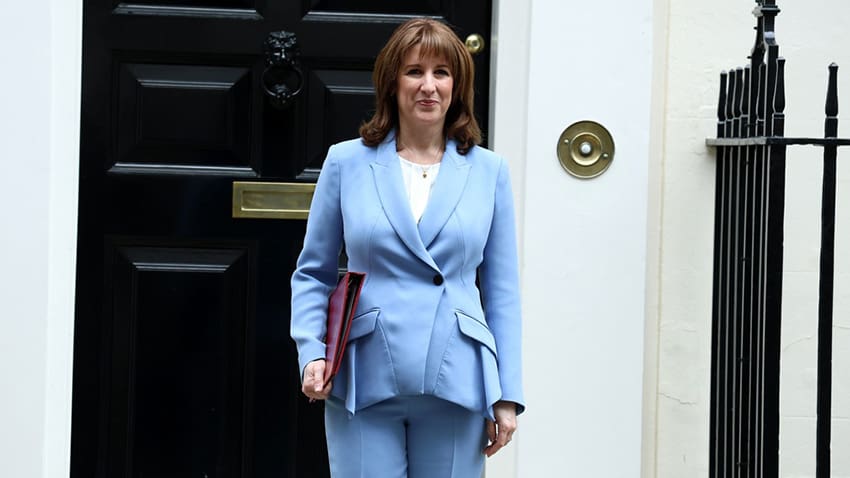
Rachel Reeves touched down in Washington on Tuesday carrying an unwelcome piece of luggage: the International Monetary Fund’s verdict that Britain is the biggest economic casualty of the Iran war among the world’s wealthiest nations.
The Fund’s spring forecast, delivered as the Chancellor arrived for the IMF and World Bank meetings, trimmed 0.5 percentage points from the UK’s 2026 growth projection, the steepest cut handed to any G7 economy since its January outlook. Inflation is now expected to push towards 4 per cent, while unemployment is heading for its highest rate in more than a decade.
For the small and medium-sized businesses that power two-thirds of the UK’s private sector workforce, the numbers translate into a grim set of pressures: softer consumer demand, stubborn cost inflation and a Treasury with precious little headroom to soften the blow.
The UK entered the conflict already on the back foot. Growth was sluggish well before the first missiles flew, with firms and households hunkering down ahead of last autumn’s Budget amid a fog of tax speculation that dampened activity across the high street and the boardroom alike.
Pierre-Olivier Gourinchas, the IMF’s economic counsellor, pointed to what he called a “shadow effect” lingering from that weaker momentum, a drag the Fund believes will bleed into next year’s performance. It is a diagnosis the Chancellor firmly rejects, arguing that Labour inherited a damaged economy from the Conservatives and has since set firmer foundations. Yet the data is unsympathetic: British households were already wrestling with the G7’s highest inflation rate before a single Iranian oil facility was struck.
The deeper problem is energy. The Iran conflict has delivered the sharpest shock to global supplies since the oil crises of the 1970s, and Britain’s gas-heavy power mix leaves it unusually exposed. Although much of the country’s gas is produced domestically, imported cargoes are being bought at sharply elevated wholesale prices, and because gas sets the marginal price for UK electricity, the pain travels quickly from the terminal to the meter.
“There is more of a pass through, if you want, of gas prices into wholesale prices of energy,” Gourinchas observed, noting that household bills were being cushioned only temporarily by existing government measures.
Reeves has used her Washington platform to push for de-escalation while sharpening her criticism of Donald Trump’s decision to prosecute the war on Iran. The political calculus is plain enough. With the public finances squeezed by elevated debt and stubbornly high borrowing costs, her fiscal room for manoeuvre is wafer-thin, and Labour is trailing in the polls as it approaches a testing set of May local elections.
Treasury insiders expect short-term, narrowly targeted relief measures rather than a broad spending splurge, precisely the prescription the IMF itself has endorsed. Anything more expansive risks spooking the gilt market and undoing the hard-won credibility Reeves has spent the past year trying to bank.
For Britain’s business community, the more consequential question is what happens once the immediate crisis fades. Insulating the country against the next energy shock will demand a far more aggressive push into domestic renewable generation, grid reinforcement and the kind of supply-side reforms that unlock private investment at scale.
SME owners hoping for relief will be watching two pressure points closely: whether the promised targeted support reaches smaller firms exposed to soaring input costs, and whether the long-promised industrial strategy finally delivers the cheaper, home-grown power that British manufacturers have been demanding for the best part of a decade.
Reeves returns from Washington with the IMF’s blessing for her fiscal restraint, but also with its unvarnished warning that, on current trajectory, Britain will spend 2026 at the bottom of the G7 league table. For a Chancellor already short on political capital, that is a verdict she can ill afford to let stand.

Amy Ingham
Amy is a newly qualified journalist specialising in business journalism at Business Matters with responsibility for news content for what is now the UK’s largest print and online source of current business news.

Why this Labour MP’s ‘summer of sex’ is such a turn-off
The Masters hangover cure? A bunch of money in Hilton Head

A Tale Of Cheap Hard Drives And Expensive Lessons


-

 Politics5 days ago
US brings back mandatory military draft registration
-
 Sports5 days ago
Man United discover Nico Schlotterbeck transfer fee as defender reaches Dortmund agreement
-

 Fashion5 days ago
Weekend Open Thread: Veronica Beard
-

 Politics5 days ago
Malcolm In The Middle OG Turned Down ‘Buckets Of Money’ To Appear In Reboot
-

 Politics3 days ago
World Cup exit makes Italy enter crisis mode
-

 Crypto World6 days ago
Canary Capital Files SEC Registration for PEPE ETF
-

 Business5 days ago
Tesla Model Y Tops China Auto Sales in March 2026 With 39,827 Registrations, Beating Cheaper EVs and Gas Cars
-

 Crypto World2 days ago
The SEC Conditionalises DeFi Platforms to Be Avoided for Broker Registration
-

 Crypto World2 days ago
SEC Signals Exemption for Crypto Interfaces From Broker Registration
-

 News Videos6 hours ago
Secure crypto trading starts with an FIU-registered
-
 NewsBeat3 days ago
Pep Guardiola and Gary Neville agree over Arsenal title problem that benefits Man City
-

 Business5 days ago
OpenAI Halts Stargate UK Data Centre Project Over Energy Costs and Copyright Row
-

 Business4 days ago
Ireland Fuel Protests Enter Day 5 as Blockades Spark Shortages and Government Prepares Support Package
-

 Politics5 days ago
LBC Presenter Mocks Trump Over Iran War Failures
-

 Crypto World5 days ago
Federal judge blocks Arizona from bringing criminal charges against Kalshi
-
 NewsBeat3 days ago
JD Vance announces ‘no agreement’ with Iran over nuclear weapons fear
-

 Tech6 days ago
A version of Windows 10 released a decade ago is now eligible for additional security patches
-

 NewsBeat1 day ago
Trump and Pope Leo: Behind their disagreement over Iran war
-

 Crypto World1 day ago
SEC Proposes Certain Crypto Interfaces Don’t Need to Register as Brokers
-

 Business5 days ago
IMF retains floor for precautionary balances at SDR 20 billion
You must be logged in to post a comment Login