WASHINGTON — The U.S. Air Force released striking new images of its next-generation B-21 Raider stealth bomber in midair refueling this week, a dramatic public display that comes amid heightened tensions with Iran and underscores America’s advancing long-range strike capabilities.
US Air Force Boldly Reveals B-21 Raider Stealth Bomber, Mocking Iranian Radar Defenses
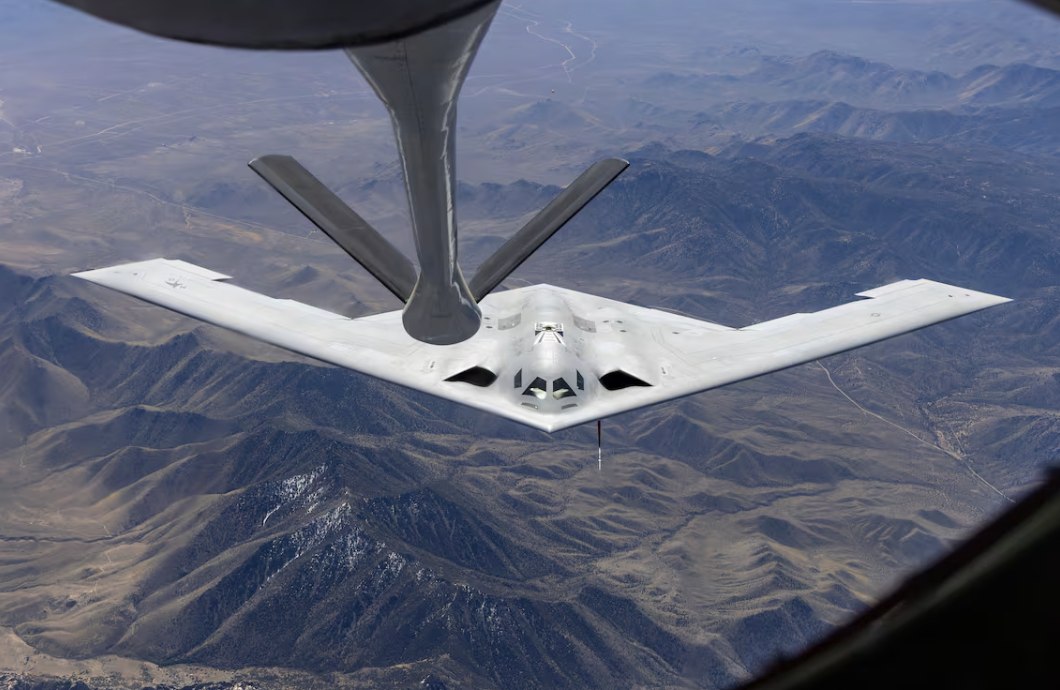
The photographs, shared Tuesday by the Air Force and analyzed widely by defense observers, offer the first clear overhead view of the B-21 Raider during aerial refueling with a KC-135 Stratotanker. The images highlight the aircraft’s sleek flying-wing design, refueling receptacle and subtle exhaust features, showcasing its advanced low-observable technology designed to evade even sophisticated enemy air defenses.
Military analysts and Korean media outlets quickly dubbed the B-21 “the sky’s assassin that laughs at radar,” framing the release as a deliberate show of force directed at adversaries like Iran following recent U.S. operations in the region. The timing amplifies the message: while the B-21 has not yet entered combat, its predecessor, the B-2 Spirit, played a pivotal role in striking deeply into Iranian territory during Operation Epic Fury.
The B-21 Raider, developed by Northrop Grumman, represents the first new American bomber in decades and is engineered as a dual-capable platform able to deliver both conventional and nuclear weapons. Smaller and more affordable than the B-2, the Raider is intended to form the backbone of the Air Force’s future bomber fleet, with plans calling for at least 100 aircraft and discussions of expanding to 145.
Recent flight testing milestones, including successful aerial refueling near Edwards Air Force Base in California, mark significant progress. The new overhead imagery reveals details that differentiate the B-21 from its larger predecessor, such as refined shaping and surface treatments aimed at further reducing its radar cross-section. Defense experts note that these features could allow the Raider to penetrate contested airspace with even greater impunity than the B-2.
Advertisement
The public reveal coincides with accelerated production efforts. In February and March 2026, the Air Force and Northrop Grumman finalized a $4.5 billion agreement to boost annual production capacity by approximately 25%. The move compresses delivery timelines while preserving cost and performance targets, driven in part by the demands of great-power competition and recent conflicts.
First operational B-21 Raiders are still slated for delivery to Ellsworth Air Force Base in South Dakota in 2027, though senior officials have signaled urgency. U.S. Strategic Command leaders have advocated for a larger fleet and even a potential second production line to meet emerging threats from Iran, China and Russia.
The B-21’s development has benefited from lessons learned in actual operations. During strikes against Iranian hardened targets and underground facilities, B-2 bombers demonstrated the unmatched value of stealth platforms in modern warfare. Operating without losses, the Spirits delivered precision munitions against heavily defended sites, proving that penetrating bombers remain essential even against integrated air defense systems.
Iranian officials have long boasted about their radar networks and anti-access capabilities, yet the B-2’s success exposed vulnerabilities. The B-21, with its improved stealth, networked systems and potentially lower operating costs, is positioned to exploit those gaps more effectively in future scenarios.
Advertisement
Air Force officials have been cautious about linking the new images directly to any specific adversary. However, the bold release of high-resolution photos — including the first full top-down perspective — sends a clear strategic signal at a time when regional tensions persist.
The Raider program remains highly classified, with many performance details withheld. What is known is that the aircraft builds on the B-2’s flying-wing configuration but incorporates modern manufacturing techniques, open-system architecture for easier upgrades and enhanced survivability features.
Test flights have ramped up in recent months. Multiple B-21 airframes are now involved in the program, with at least two aircraft conducting flights from Palmdale, California, and Edwards AFB. The recent refueling tests validate the bomber’s ability to extend its already impressive range, critical for global power projection without relying solely on forward bases.
Cost remains a key focus. Each B-21 is projected to cost significantly less than the B-2, which ran over $2 billion per aircraft in adjusted dollars. The Air Force aims to keep unit costs around $700 million or lower in current dollars, making the Raider more sustainable for a larger fleet.
Advertisement
Production acceleration comes as the broader bomber force faces strain. The Air Force’s current fleet of B-52s, B-1s and B-2s is aging, with the B-2 fleet particularly small at just 20 operational aircraft. The B-21 is designed not only to replace retiring bombers but to complement them in high-end conflicts.
Defense analysts say the images serve multiple purposes: reassuring allies, deterring potential aggressors and building public and congressional support for the program. In an era of rapid technological change, demonstrating tangible progress on a sixth-generation platform carries psychological weight.
Korean-language coverage, including headlines calling the B-21 the “radar-mocking sky assassin” that appeared defiantly before Iran, reflects global interest in how the aircraft could reshape deterrence in the Indo-Pacific and Middle East. South Korea and other U.S. partners view advanced American stealth capabilities as vital to countering regional threats.
Northrop Grumman has released limited additional details, emphasizing the aircraft’s maturation through ground and flight testing. Company executives have expressed confidence in meeting the 2027 initial operational capability target at Ellsworth.
Advertisement
Challenges remain. Integrating the B-21 into existing force structures, developing tactics for its unique capabilities and ensuring supply chain resilience for stealth materials will require sustained effort. The program has faced typical developmental hurdles, though officials describe progress as on track.
The new photographs also fuel speculation about future combat roles. With greater automation potential and improved sensor fusion, the Raider could one day operate alongside unmanned systems in collaborative combat aircraft concepts.
As testing continues, the Air Force plans further public and congressional briefings. The service has stressed that while the B-21 enhances conventional deterrence, it also bolsters the nuclear triad’s credibility.
The timing of the imagery release — just days after intense media focus on stealth operations in the Iran conflict — has not gone unnoticed. Some observers interpret it as psychological messaging: America’s stealth edge is not static but evolving rapidly.
Advertisement
Iranian state media has downplayed the significance, claiming its own air defenses and asymmetric capabilities would counter any new American bomber. However, the proven performance of the B-2 has already forced adversaries to reassess their strategies.
U.S. lawmakers from both parties have largely supported the B-21 program, viewing it as essential national security investment. Recent budget actions, including the so-called “One Big Beautiful Bill,” provided the funding flex needed to ramp up production without new appropriations fights.
Looking ahead, the Raider’s entry into service will mark a generational shift in bomber aviation. Its ability to loiter undetected, strike with precision and return safely could redefine how the U.S. projects power in an era of anti-access/area-denial threats.
For now, the sleek black silhouette captured against the sky during refueling serves as a potent reminder of ongoing American technological superiority in the air domain. As one defense commentator noted, the B-21 doesn’t just evade radar — in the eyes of adversaries, it appears to mock it.
Advertisement
The Air Force continues to withhold exact performance metrics, but the visual evidence of successful refueling and the accelerated production schedule suggest the “sky’s assassin” is steadily approaching operational reality.
With global tensions unlikely to ease soon, the B-21 Raider’s development carries strategic weight far beyond its airframe. It embodies a commitment to maintaining air dominance and long-range strike options well into the 21st century.
WAFarmers has warned Elders’ retreat from selling Western Australian wool locally is the first domino in the sector’s supply chain to fall as the federal government’s live export ban looms.
IT services major Wipro on Thursday announced a Rs 15,000 crore share buyback at Rs 250 per share, offering a 19% premium over the stock’s last closing price. The share buyback marks the first such action announced by the IT major in nearly three years.
Wipro’s board approved the plan to buy back up to 60 crore shares, representing 5.7% of the total paid-up share capital, for an aggregate amount not exceeding Rs 15,000 crore.
The buyback will be done via the tender route, and all shareholders on the record date, including those who received the equity shares after cancelling their American Depository Receipts (ADR), will be eligible to take part in the corporate action.
Wipro said that promoters and promoter groups have indicated their intention to participate in the proposed buyback. The record date and other timelines will be announced soon
Live Events
Wipro Q4 earnings
Wipro announced the share buyback along with its earnings for the January-March quarter of the financial year 2026. The IT major’s consolidated net profit declined 2% YoY to Rs 3,502 crore during the period under review, while revenue from operations increased 8% YoY to Rs 24,236 crore. However, Wipro’s core IT services segment showed limited traction. Revenue stood at $2.65 billion, growing just 0.6% quarter-on-quarter and 2.1% year-on-year. On a constant currency basis, IT services revenue rose 0.2% sequentially but declined 0.2% on an annual basis, highlighting weak underlying demand.
Wipro share price
Wipro shares rose marginally to close at Rs 210.26 apiece on NSE on Friday. The stock has gained around 4% in one week and 8% in one month, but declined by over 21% in 2026 so far following the sharp AI worries and Iran-US war-led selloff. Buyback of shares refers to a corporate action where a company repurchases its own shares from the existing shareholders. Usually, the company purchases the shares at a higher price than the current levels, encouraging investors to participate. Typically, a company decides to buy back its shares in order to increase share value, utilise surplus cash, prevent hostile takeovers or increase promoter holdings.
(Disclaimer: The recommendations, suggestions, views, and opinions given by the experts are their own. These do not represent the views of The Economic Times.)
The biggest American automakers all but abandoned sedans and coupes in recent years as they rushed to compete in the pickup truck and SUV markets.
Many domestic buyers also shifted toward those bigger vehicles. Still, there’s a market for cars, as Japanese, Korean and German brands sell hundreds of thousands of smaller passenger vehicles in the U.S. annually.
The resilience of the sedan market and concerns that high prices are driving away customers have led some American automakers to reconsider their lineups.
With the average price for a vehicle hovering around $50,000, a compact sedan that starts at about $22,000 is an attractive entry point for buyers, industry experts said.
Advertisement
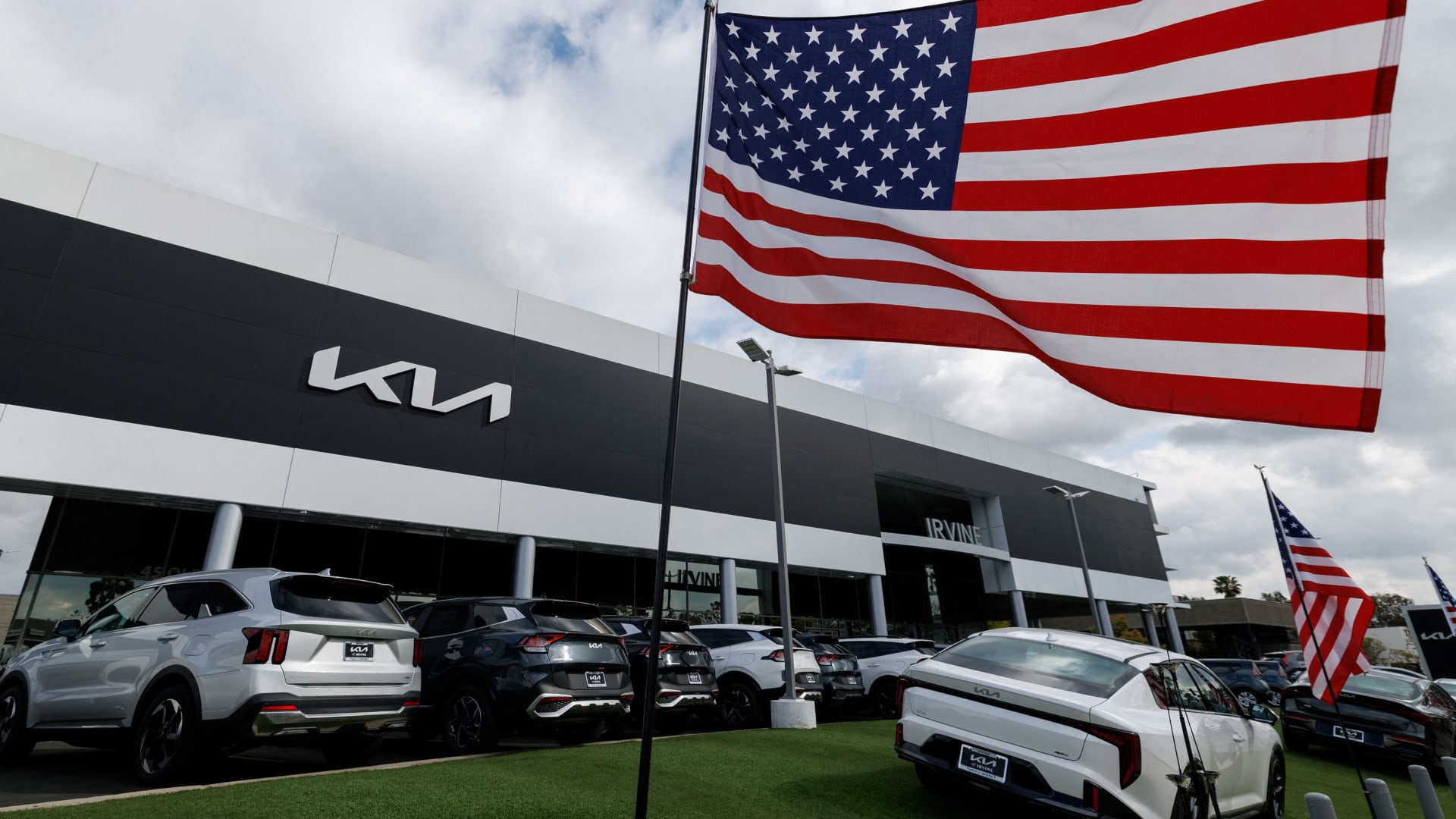
“It’s all about affordability,” said Orth Hedrick, vice president of product planning for Kia USA. Kia’s K4 compact sedan and its predecessor, the Kia Forte, together were the brand’s second-bestselling vehicle last year, accounting for 140,514 units sold. “It’s just been doing phenomenally well for us. Way over plan, and a lot of it is affordability.”
Similarly, the RAV4 crossover SUV is Toyota’s bestseller, reaching 479,288 units sold in 2025. The automaker also moved 316,000 Camrys and nearly 250,000 Corollas last year, or 65% and 51% of the SUV’s sales, respectively.
“There is opportunity for sedans to offer an alternative to the sea of SUVs, and they are typically less expensive than an SUV in the same size class,” said Stephanie Brinley, associate director, AutoIntelligence, for S&P Global Mobility. “Sedans do offer more opportunity for compelling design and they are typically more fuel efficient than utility vehicles.”
Industry watchers, dealers and automaker executives have publicly expressed concerns that high vehicle prices and rising fuel costs could cause buyers to pull back or increasingly turn to used cars.
Advertisement
Indeed, Volkswagen said it has kept its Jetta sedan in its lineup for 45 years in the U.S. as an affordable entry point. The brand showed off a newly refreshed version of its full-size Atlas SUV at the New York International Auto Show in early April. But it also had its compact car, Jetta — and two higher-trim versions of the Golf hatchback — on the show floor as well.
“Jetta is one of our most important nameplates,” said Petar Danilovic, senior vice president of North American product marketing for Volkswagen. “Every car has a different role in the portfolio. And the Jetta, for example, is of course important to also attract entry customers. So hopefully to be able to grow them in the brand from a Jetta maybe to a Tiguan to an Atlas. So this is also the logic behind it.”
“Affordable options are essential for bringing newer and younger buyers into a brand,” said Rebecca Lindland, a managing director at Allison Worldwide. “Many Gen Z and younger Millennials simply can’t, or don’t want to, stretch to the typical SUV or crossover payment.”
SUVs have been growing in popularity for decades and shot up in popularity in the 2010s, while sales of smaller cars shrank. Sedans were almost 40% of the market in 2015, according to Edmunds. As of 2026, they were only 15%, according to the auto site.
Advertisement
The SUV offered a lot of those buyers a change from the cars they were familiar with. Now, their rarity might be giving sedans the same effect.
“A lot of it is this new generation that grew up in the back seat of an SUV,” Hedrick said. “They don’t want to drive an SUV. They like something different. So to them, a sedan is new. For the rest of us who grew up with sedans all the time, it’s old hat. But for new buyers, they like the look. They like the idea of doing something different.”
American automakers
Despite their pullback, American automakers still make a few sedans and coupes.
General Motors’ luxury brand Cadillac is discontinuing the CT4 sedan in 2026. The larger CT5 will leave the market temporarily, but will return, the company confirmed in an email.
Advertisement
GM also makes the high-end Corvette sports coupe.
A report from Automotive News, citing an anonymous source, said GM is planning to build a Buick sedan in a Michigan plant. GM spokesperson Kevin Kelly told CNBC in an email the company does not comment on product plans.
“We don’t see sedans recovering a decade-old heyday,” Brinley said, “but getting back into the segment may be a good move for GM and others considering the opportunity.”
Ford’s only traditional silhouette is the Ford Mustang, which many insiders — including CEO Jim Farley — have called the “soul of the company,” despite the fact that the F-150 pickup truck is its biggest seller by far and the Mustang is outsold by most of Ford’s SUVs. Still, it’s the best-selling coupe in the U.S. as of April 2026, according to Edmunds.
Advertisement
Farley said at the Detroit Auto Show that the company would “never say never” to bringing back more traditional passenger cars.
Stellantis‘ Dodge currently makes the Charger sedan in two- and four-door configurations.
The best-selling sedan by an American automaker is the Tesla Model 3, according to Edmunds. It’s the only sedan Tesla makes now that it has discontinued the full-sized Model S.
Electric vehicle maker Lucid Motors also makes the high-end Lucid Air sedan, but is planning a midsize SUV for its next product.
Advertisement
Others say they aren’t giving up on the segment.
“Obviously, the industry has moved towards SUVs and light trucks away from passenger cars,” Dave Christ, group vice president and general manager at Toyota Motor North America, said. “But we still believe in passenger cars, so we’re going to continue to invest in passenger cars. Even if the industry is 20% passenger cars, that’s over 3 million cars a year.”
Pluxee N.V. (PLXNF) Q2 2026 Earnings Call April 16, 2026 2:30 AM EDT
Company Participants
Pauline Bireaud – Head of Investor Relations & Financial Communication Aurélien Sonet – Chief Executive Officer Stephane Lhopiteau – Group Chief Financial Officer
Conference Call Participants
Advertisement
Pravin Gondhale – Barclays Bank PLC, Research Division Hannes Leitner – Jefferies LLC, Research Division Justin Forsythe – UBS Investment Bank, Research Division Andre Juillard – Deutsche Bank AG, Research Division Mahir Bidani – UBS Investment Bank, Research Division
Presentation
Operator
Advertisement
Good morning. Thank you for standing by, and welcome to the Pluxee First Half Fiscal 2026 Results Presentation. [Operator Instructions] I advise you that this conference is being recorded today on Thursday, April 16, 2026.
At this time, I would like to hand the conference over to Ms. Pauline Bireaud, Head of Investor Relations. Please go ahead, madam.
Pauline Bireaud Head of Investor Relations & Financial Communication
Advertisement
Good morning, everyone, and thank you for joining us today for our fiscal 2026 H1 results. So I’m Pauline, I’m Head of Investor Relations for Pluxee and I’m joined by Aurelien Sonet, our CEO; and Stephane Lhopiteau, our CFO.
Let me guide you through today’s presentation agenda in the next slide. So Aurelien will start with the key highlights and figures for H1, followed by a focus on our commercial performance, and then Stephane will take you through our financial results. Finally, Aurelien will then conclude with our outlook, including an update on the regulatory situation in Brazil before we open the floor for the Q&A.
And with that, I will hand over to Aurelien.
Advertisement
Aurélien Sonet Chief Executive Officer
Thank you, Pauline, and good morning, everyone. I’m pleased to be back with you today to present our first half fiscal 2026 results, starting with our key highlights. We are pleased to share that we delivered overall solid H1, which puts us





















































You must be logged in to post a comment Login