

Crypto World
BOJ explores tokenized central bank money as 2026 digital yen decision looms



The Bank of Japan (BOJ) announced expansion of its blockchain experimentation for settling central bank reserves, while highlighting that efforts for a retail central bank digital currency (CBDC) are ongoing.
The BOJ rolled out a “sandbox project” to experiment settlements and bank deposits using central bank money, Governor Kazuo Ueda said on Tuesday in a speech titled “The New Financial Ecosystem and the Role of Central Banks.”
“In this experimental project, the Bank will conduct technical experimentation on settlement using central bank money in the form of current account deposits on a system that uses blockchains,” Ueda said.
The bank intends to explore “methods of connection with the existing system as well as examining use cases such as domestic interbank settlement and securities settlement,” he added. Analysts say introducing blockchain for reserves settlement would allow for instant round-the-clock settlement and reduce gridlock risk in stress events.
Ueda emphasized that the retail CBDC project is ongoing. “First, the ongoing pilot program for retail central bank digital currency (CBDC) involves the bank’s continued conduct of technical experiments, which will make it possible to provide … a digital form of cash when in demand by the wider public.”
Japan began CBDC experiments in 2021 and launched a pilot program in 2023. But the central bank has not committed to issuing a digital yen. According to a prior report, the BOJ this year will decide whether to issue a retail CBDC.
Ueda also spoke of Project Agorá,” an international experiment involving multiple central banks and major private financial institutions. He said its participants are considering “building a mechanism that would enable central banks, including the Bank of Japan, to issue central bank money as tokenized deposits on the blockchain.” If successful, he said, the effort “may bring innovation in terms of streamlining cross-border payments.”
Unlike a retail CBDC, which would function as a digital form of yen for the general public, tokenized central bank deposits would represent wholesale central bank money used by financial institutions on blockchain-based infrastructure, according to Ueda’s speech.
The move to use blockchain technology to settle reserves follows decisions in the U.K. and Hong Kong to issue sovereign debt on the blockchain.

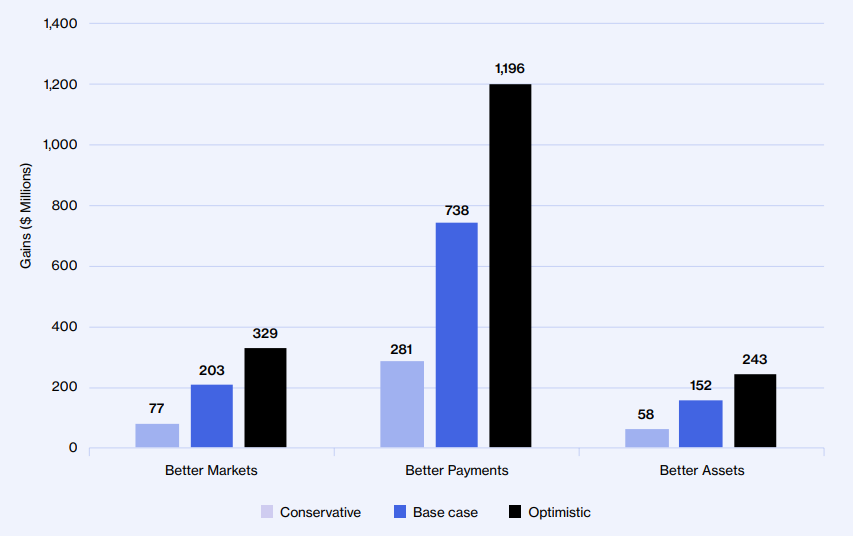
Australia could unlock 24 billion Australian dollars ($17 billion) annually from advances in tokenized markets and digital assets, but only if lawmakers start moving forward with regulation, according to a new report from a local fintech research group.
In a report titled “Unlocking Australia’s $24b Digital Finance Opportunity,” which was published on Monday, the Digital Finance Cooperative Research Centre (DFCRC) said regulatory uncertainty, coordination challenges and limited pathways for pilot projects to grow are the biggest constraints facing the industry.
One way to address the shortcomings would be to establish a sandbox for testing new technology, such as tokenized financial market use cases, said the DFCRC. This would lead to ongoing collaboration between regulators and industry participants and improve licensing frameworks, it said.
The research group also suggested deploying tokenized government bonds and a wholesale central bank digital currency (CBDC) in the sandbox to underpin the development of tokenized markets, collateralized lending, and related financial services.

The DFCRC report was jointly produced with the Digital Economy Council of Australia and was financed by crypto exchange OKX.
Better markets, payments and assets are the key
DFCRC estimates that billions could be generated annually from markets with broader investor access, deeper liquidity and higher market participation, creating additional gains from trade.
At the same time, tokenized money, such as stablecoins and CBDCs, could streamline cross-border and domestic transactions, creating gains by reducing reliance on correspondent banks, which charge high fees.
Tokenization will create assets with increased transparency, usability, and flexibility, which could also increase their utility and make them directly “usable within automated trading, lending, and collateral-management systems,” according to the report.
“Nearly half of the asset-related economic gains arise from enabling collateralized lending, repo, and invoice financing markets on tokenized rails, where smart contracts automate collateral management, margining, and settlement,” the report states.

Without better regulation, the $17 billion is off the table
Kate Cooper, the CEO of crypto exchange OKX, said that without better regulation, the estimated economic gains will be much smaller over the next few years.
Related: Australian crypto execs upbeat on progress despite lingering issues
On the current trajectory, and without substantial industry-wide changes, DFCRC estimates that Australia will secure only 1 billion Australian dollars ($710 million) in economic gains from crypto by 2030.
“Long-term economic benefits will only be realised through clear regulatory frameworks and infrastructure built to institutional standards. That is how Australia strengthens trust, attracts capital and secures its place in the next era of global finance,” Cooper added.
Magazine: 6 massive challenges Bitcoin faces on the road to quantum security
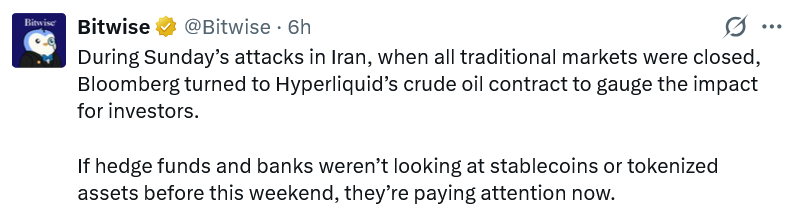
Bitwise chief investment officer Matt Hougan says he’s drastically cut his estimates of when “on-chain finance” will take off after seeing investors pile into crypto platforms such as Hyperliquid to trade tokenized assets amid the US-Israel attack on Iran.
In a post on Tuesday titled “The weekend that changed finance,” Hougan said crypto perps futures platform Hyperliquid became the epicenter for trading real-world assets like crude oil and tokenized gold while the US, European and Asian stock exchanges were closed at the time of the first attack on Saturday at about 3:30 am UTC.

“For most of Sunday, onchain finance was the center of the financial world,” he said, adding that he previously expected traditional markets to take five to 10 years to move onchain but now sees that shift happening much sooner.
“This weekend proved me wrong. Now I’m convinced it’s going to happen much faster than that,” Hougan said, adding that blockchain’s 24/7 trading rails make “stock exchanges and T+1 settlement look archaic.”
Hougan said much of the weekend RWA trading activity took place on Hyperliquid, which saw over $11.5 billion in trading volume across Saturday and Sunday.
“When Bloomberg wanted to write about how crude oil responded to the bombing, it cited the Hyperliquid crude oil contract as the most relevant price,” Hougan said.
Tether’s tokenized gold product, Tether Gold (XAUt), also saw its 24-hour trading volume spike to over $300 million, while prediction markets volumes on Kalshi and Polymarket also rose, he noted.
NYSE is building a 24/7 tokenization platform
In January, the New York Stock Exchange and its parent, the Intercontinental Exchange, said it would enable 24/7 trading and instant settlement of stocks and exchange-traded funds with a blockchain post-trade system, including multi-chain support and custody features.
Related: Ray Dalio cautions on Bitcoin, says ‘there is only one gold’
However, no timeline was provided for the platform’s launch, nor were details shared about which blockchain it would be built on or whether it would operate in a permissionless or permissioned environment.
For now, Hougan said hedge funds, banks and other investors who want to “trade competitively” have no other choice but to set up a stablecoin wallet and learn how to trade on crypto perps platforms like Hyperliquid.
Magazine: South Korea gets rich from crypto… North Korea gets weapons


The program allows fintech firms and wallet providers to offer cards that let users spend stablecoin balances at any of Visa’s 175 million merchants worldwide.
Visa and Bridge, the stablecoin infrastructure platform now owned by Stripe, announced a major expansion of their collaboration that will bring stablecoin-linked Visa cards to more than 100 countries across Europe, Asia Pacific, Africa and the Middle East by the end of 2026, according to an announcement posted on the Visa website today.
The program, which is already live in 18 countries, allows fintech firms and wallet providers to offer cards that let users spend stablecoin balances at any of Visa’s 175 million merchant locations worldwide, the announcement said.
Onchain Settlement
Under the expanded partnership, Bridge’s stablecoin-funded cards will leverage Visa’s payments network while settlement can occur on-chain through a pilot involving Lead Bank, a participating issuer in Visa’s stablecoin settlement initiative. Lead Bank settles Visa’s stablecoin transactions on the Solana blockchain as part of Visa’s stablecoin settlement pilot.
The pilot is evaluating whether settling card transactions with stablecoins can increase operational efficiency, improve reconciliation and give issuers more flexibility in how value moves across payment networks.
“Visa is committed to meeting businesses where they operate, and increasingly, that’s onchain,” said Cuy Sheffield, Visa’s Head of Crypto.
Crypto Rails for Payments
Sheffield described the expanded Bridge collaboration as a step toward integrating blockchain-native currency settlement into the broader payments ecosystem while maintaining the convenience and ubiquity of Visa’s network.
Stripe’s acquisition of Bridge in 2025 underpins much of the technical infrastructure for the offering, enabling developers and fintech platforms to issue stablecoin-backed Visa cards through a single API.
Popular digital wallet providers such as Phantom and MetaMask are already using the solution, giving millions of users the ability to spend stablecoins for everyday purchases, the announcement said.
Custom Stablecoins
Bridge’s co-founder Zach Abrams said the expansion will help businesses launching custom stablecoins integrate them seamlessly into card programs, an approach he described as part of a multi-year effort to help firms “own their own financial stack.”
The announcement comes days after MoonPay and M0 launched PYUSDx, a platform designed to simplify the creation and management of application-specific stablecoins. PYUSDx leverages PYUSD, the stablecoin developed by PayPal and issued by Paxos Trust Company.
Industry analysts see the rollout as emblematic of how traditional payments firms and crypto infrastructure providers are increasingly working together. Stablecoin-linked cards have grown rapidly as a bridge between digital assets and real-world spending, offering a way for stablecoins to be used at scale without requiring direct merchant acceptance of blockchain payments.
Visa’s move also aligns with broader experimentation in the payments industry around stablecoins and blockchain settlement, as regulatory frameworks such as the GENIUS Act in the U.S. establish clearer rules for stablecoin issuance and use.


Ripple is no longer just moving money. It wants to be the entire pipe.
The company shared with CoinDesk on Wednesday a press release that outlines a major expansion of Ripple Payments which turns the platform into a full-stack infrastructure layer for fiat and stablecoin money movement.
Businesses can now collect, hold, exchange, and pay out in both traditional currencies and stablecoins through a single provider, rather than stitching together separate vendors for custody, collections, conversion, and settlement.
The new capabilities come from two recent acquisitions. Palisade, which handles custody and treasury automation, powers the managed custody layer that lets businesses provision wallets at scale and sweep funds into operational accounts.
Rail, a virtual accounts and collections platform, enables businesses to accept fiat and stablecoin pay-ins through named virtual accounts with automated conversion and settlement.
The result is that a fintech doing cross-border payouts no longer needs one provider for custody, another for foreign exchange, a third for stablecoin liquidity, and a fourth for local payout rails. Ripple is consolidating all of that into one platform with one integration.
“For the global financial system to evolve, fintechs and financial institutions need infrastructure that treats digital assets with the same rigor as traditional finance,” said Monica Long, president at Ripple, said in a prepared statement. “Ripple has built the blueprint for blockchain-based enterprise solutions designed to operate at global scale for regulated finance.”
Meanwhile, Ripple said the platform has now processed more than $100 billion in total volume. That milestone lands against a broader backdrop of stablecoin adoption accelerating across the financial system, with global annual transaction volumes reaching $33 trillion last year and stablecoins now accounting for 30% of all onchain transaction volume.
The expansion comes at an interesting time for Ripple specifically.
XRP has been under pressure, down roughly 5% over the past week, according to CoinDesk market data, amid the broader market sell-off driven by the U.S.-Iran conflict.
But the payments business operates largely independently of the token’s price, and the institutional adoption trajectory suggests Ripple’s enterprise strategy is gaining traction regardless of what the spot market does.

A Bitcoin Policy Institute study delves into how artificial intelligence models choose among money forms in a variety of hypothetical scenarios, revealing a strong inclination toward Bitcoin and digital money over fiat in most cases. The research tested 36 models across six providers and generated more than 9,000 responses across a spectrum of monetary tasks, from long-term value preservation to everyday payments. The findings show Bitcoin outpacing stablecoins in many contexts, while stablecoins regain sway in transactional use cases like micropayments and cross-border transfers. The study’s authors emphasize that the results reflect training data patterns and framing rather than widespread real-world adoption, but they nonetheless offer a unique lens on how AI interprets money in a digital era, with results released via MoneyForAI.org.
Key takeaways
- 36 AI models across six providers produced 9,072 responses to monetary scenarios; Bitcoin was selected in 48.3% of cases, the most-used instrument overall.
- When asked to preserve purchasing power over multi-year horizons, 79.1% of responses favored Bitcoin, the study’s most lopsided result.
- In payments, micropayments, and cross-border transfers, stablecoins were chosen 53.2% of the time versus 36% for Bitcoin, highlighting a transactional edge for stablecoins in certain contexts.
- Nearly 91% of responses preferred digitally native instruments (including Bitcoin or other digital assets) over fiat, with zero models rating fiat as their top choice.
- Model-provider differences emerged: Anthropic models averaged 68% BTC preference; OpenAI 26%; Google 43%; and xAI 39%, illustrating how training data shapes outputs rather than deterministic financial forecasting.
Tickers mentioned: $BTC
Market context: The study arrives amid ongoing experimentation with digital money in AI-assisted scenarios, underscoring how institutional and research communities are evaluating Bitcoin’s role as a borderless, programmable asset alongside stablecoins and other digital instruments.
What to watch next – The Bitcoin Policy Institute plans to broaden the model set and providers, test different prompt framings, and explore additional monetary scenarios to validate whether these preferences hold under varied conditions.
Why it matters
For users and investors, the findings offer a nuanced view of how AI systems—trained on vast data corpora—perceive money forms in a digital economy. The recurring tilt toward Bitcoin in long-horizon scenarios reinforces Bitcoin’s narrative as a non-sovereign store of value that can operate independently of any single country’s monetary policy. Yet the study also highlights practical reasons stablecoins remain appealing for transactions: near-instant settlement, compatibility with existing payment rails, and the ability to freeze or limit access in certain jurisdictions, which some participants see as a drawback for a universally accessible currency. The methodological caveats matter for interpretation: the results reflect synthetic prompts and model training data rather than current market adoption or consumer behavior.
From a development perspective, the research underscores how AI agents—when asked to optimize for efficiency or resilience in simulated economies—tend to converge on a small set of digital money forms. This convergence could inform the design of wallet interfaces, AI-driven financial planning tools, and cyber-physical systems that rely on digital value transfers. It also raises policy questions about the role of programmable money in cross-border ecosystems and how guardians of financial stability might respond to AI-generated preferences that favor digital currencies in abstract decision environments. In other words, the study is less about predicting the next price move and more about understanding how AI framing shapes perceptions of what “money” should look like in a digitized world.
The research also points to distinct differences across AI families. Anthropic models leaned most toward Bitcoin, while other providers displayed broader variance. These disparities remind readers that the results are contingent on the models’ training data and internal prompts rather than a universal forecast for asset demand. While some may interpret the Bitcoin bias as an endorsement of BTC in all contexts, the authors are careful to emphasize that the observed preferences do not translate directly into real-world adoption or policy outcomes. They describe the results as patterns emerging from the interplay between model design and the digital money landscape rather than a prescriptive verdict on fiat, stablecoins, or Bitcoin itself.
What to watch next
- Expanded model coverage: expect the BPI to include more AI models and more providers to test whether the BTC preference persists across the broader AI ecosystem.
- Framing sensitivity: researchers will experiment with alternative prompts to determine how wording and context influence outcomes.
- Broader scenarios: additional situations—such as storing earnings across multiple countries and complex settlement schemes—could further illuminate how AI perceives money in varied environments.
- Implications for tooling: developers building AI-assisted financial tools may use these insights to shape asset-selection features and risk disclosures in simulated environments.
Sources & verification
Bitcoin’s role in AI-driven monetary tests: what the study reveals
Bitcoin (CRYPTO: BTC) emerged as the leading instrument across the majority of prompts, appearing in 48.3% of the 9,072 responses generated by 36 models across six providers, according to the Bitcoin Policy Institute’s report released on MoneyForAI.org. The exercise probed a range of economic scenarios—from preserving purchasing power over years to everyday payments—testing how AI agents allocate value across money forms. The result is a strong tilt toward digital money, particularly Bitcoin, as the substrate for economic activity that can function across borders and regulatory regimes.
In long-horizon scenarios, the study found 79.1% of AI responses favored Bitcoin, marking the most pronounced bias in any tested category. This constellation of results suggests that, when asked to optimize for durability and sovereignty, AI agents consistently gravitate toward assets that retain value independently of any single country’s monetary policy. The digital-money axis appears to be the most favored frame for multi-year planning within the tested prompts, hinting at how future AI tools might simulate or advise on wealth preservation in a world where fiat policies are volatile or opaque.
Conversely, when the focus shifts to payments and transactions—whether micropayments or cross-border transfers—stablecoins win a higher share: 53.2% of responses favored stablecoins, while Bitcoin attracted 36%. The transactional efficiency and network familiarity of stablecoins explain their appeal in these contexts, where rapid settlement and compatibility with existing systems can matter as much as asset selection in a simulated environment. A prominent industry observer noted that stablecoins’ ability to be frozen is a double-edged sword: it provides control in certain regulatory settings but removes a layer of confidence for users seeking an uninterrupted transfer capability. Jeff Park, the chief investment officer at Bitwise, framed the context succinctly: the “most obvious explanation” for stablecoins’ relative performance in these scenarios is the ability to freeze, whereas Bitcoin cannot be frozen, offering a durable trust anchor in a digital suite of tools.
Across all responses, the AI agents favored digitally native instruments—Bitcoin, stablecoins, altcoins, tokenized real-world assets, or compute units—over fiat in roughly 91% of cases. The study’s authors emphasize that fiat relevance did not appear as a top overall choice in any of the 36 models tested. They caution readers that these results reflect patterns in training data and prompt design more than real-world adoption patterns. In other words, the study captures how AI systems interpret monetary constructs when asked to optimize for hypothetical outcomes, rather than a forecast of consumer behavior or regulatory impact.
The analysis also reveals notable differences among model families. Anthropic models averaged a Bitcoin preference of 68%, with OpenAI at 26%, Google at 43%, and xAI at 39%. These numbers illustrate how distinctive training corpora and prompt engineering shape outputs, reinforcing the study’s central caveat: responses are indicative of data patterns rather than prescriptive predictions about the future of money. The researchers acknowledge that the prompt framing used in several scenarios may have steered results toward certain instruments, and they plan to explore alternative framings in future work to measure sensitivity and robustness of the observed preferences. Aside from the methodological note, the study contributes to a growing discourse about how AI agents conceptualize money in a highly digitized financial landscape, where fiat, stablecoins, and digital assets coexist in a rapidly evolving ecosystem.

TLDR
- American Bitcoin purchased 11,298 ASIC miners to expand its bitcoin mining operations.
- The new equipment will increase the company’s total mining capacity by about 12%.
- The miners will add approximately 3.05 exahashes per second to the company’s hashrate.
- American Bitcoin will deploy the machines at its Drumheller site in Alberta in March 2026.
- The company’s total owned fleet will grow to 89,242 miners with 28.1 EH per second of capacity.
American Bitcoin confirmed the purchase of 11,298 ASIC miners to expand its bitcoin mining operations. The company said the new equipment will increase total capacity by about 12%. The machines will deploy at its Drumheller, Alberta, site in March 2026.
American Bitcoin Expands Fleet With 11,298 New Miners
American Bitcoin said the purchase will add about 3.05 exahashes per second of capacity. The miners will operate at an efficiency of 13.5 joules per terahash. As a result, the company’s total owned fleet will reach 89,242 units. The combined capacity will represent about 28.1 EH/s at an average efficiency of 16 J/TH.
The company stated that the equipment will arrive and be deployed in March 2026. Once installation finishes, the operational fleet will include 58,999 active miners. These machines will run at about 25 EH/s with an efficiency of 14.1 J/TH. Based on current network data, the added capacity equals about 0.3% of global hashrate. That share could produce about 42 bitcoin each month, or roughly 515 bitcoin each year.
Operational Strategy and Bitcoin Holdings
Eric Trump, co-founder and chief strategy officer, outlined the company’s focus. He said, “As bitcoin matures, the priority is clear: grow American-owned, professionally operated hashrate.” He added that this strategy will protect the network and support innovation in the United States.
Matt Prusak, president of American Bitcoin, described the firm’s mining approach. He said, “Every decision we make is oriented around maximizing Bitcoin accumulation.” The company reported that it mined bitcoin at a 53% discount to spot prices in the fourth quarter of 2025. During that period, bitcoin reached an all-time high above $126,000 in early October.
By year-end 2025, the firm reported revenue of $185.2 million. It posted a net loss of $153.2 million. The loss stemmed mainly from an unrealized $227.1 million loss on bitcoin holdings under fair value rules. The company closed the year with 5,401 bitcoin on its balance sheet.
American Bitcoin later reported holding 6,039 bitcoin valued at nearly $402 million. The company also posted a quarterly loss of $59.45 million. At recent prices near $68,000 per bitcoin, the projected annual output could generate about $35 million in gross revenue before costs.
Shares of American Bitcoin traded lower on Tuesday. The stock declined about 2.6% to $0.99 during trading. In later trading, the shares fell nearly 6% to below $0.96. Over the past month, the stock has dropped nearly 29%.

David Bailey, a former crypto advisor to the Trump administration, argues that the US government could be doing more to support Bitcoin adoption.
“At the end of the day, liking Bitcoin is not enough,” Bailey said during the Bitcoin Investor Week Conference in New York, which was published to YouTube on Tuesday.
“The Trump administration was a very important first step, but you know there is so much further for us to go and not just in talk but in actual delivery,” said Bailey, who now serves as CEO and Chairman of KindlyMD, a Bitcoin treasury company.
Bailey points to stalled Strategic Bitcoin Reserve plan
Trump repeatedly voiced his support for Bitcoin (BTC) and the broader crypto industry during his presidential campaign appearances.
While he signed an executive order for a Strategic Bitcoin Reserve in March 2025, it is understood that the US government has yet to begin accumulating Bitcoin outside of the funds seized through illicit activity.
“We’re sitting here a year later, the Strategic Bitcoin Reserve was signed into an executive order,” Bailey said.

“Last time I checked, we don’t even know how much Bitcoin we have exactly,” Bailey added. Data from Arkham Research shows it currently holds 378,372 Bitcoin, worth approximately $22.48 billion at the time of publication.
Just two months after Trump signed the executive order, White House AI and crypto czar David Sacks said the process of accumulating wouldn’t be so straightforward, explaining that the US could buy more Bitcoin if the government could fund the purchase in a “budget-neutral” way, without a tax or adding to the growing national debt.
Industry participants became more divided on the possibility as the year progressed. Some stayed optimistic. Galaxy Digital’s head of firmwide research, Alex Thorn, said in September that there was a “strong chance” it would still happen before the end of 2025.
Bailey said that while Trump has been the first politician to champion “our worldview,” an opinion alone isn’t enough to drive Bitcoin’s price to $1 million.
“Just because you like Bitcoin doesn’t mean that you’ve invested the political capital necessary for things to happen,” Bailey said.
“Unless you’re willing to bear the political capital necessary to mobilize the different gears necessary to move the ball forward, then at the end of the day, you can like Bitcoin, you cannot like Bitcoin, you’re going to get the same outcome achieved.”
Bitcoin will succeed either way, says Bailey
However, even without action from the US government, Bailey said Bitcoin will eventually succeed. “It’s not like we need the government to cater for us for Bitcoin to be successful,” Bailey said.
“Whether it’s four years from now, or 10 years from now, or 20 years from now, we will get to the point where we actually have a government that is conducive to the rules we need for Bitcoin to be successful,” he said.
Related: Bitcoin futures demand falls to 2024 lows: Are institutions exiting the market?
“I’m bullish on what we can accomplish in this administration. If we really want the progress to continue, we need more people to own Bitcoin every year,” Bailey said.
“We need more voters to own Bitcoin every year. And then it is just inevitable,” he added.
Bitcoin is currently trading at $68,220, approximately 45% below its October all-time high of $126,000, according to CoinMarketCap.
Outside the Strategic Bitcoin Reserve, Bitcoiners are eyeing the potential passage of the US CLARITY Act, which aims to provide the industry with more regulatory clarity. Trump said in a Truth Social post on Tuesday that “the U.S. needs to get Market Structure done, ASAP.”
Magazine: Would Bitcoin really be at $200K if not for Jane Street? Trade Secrets
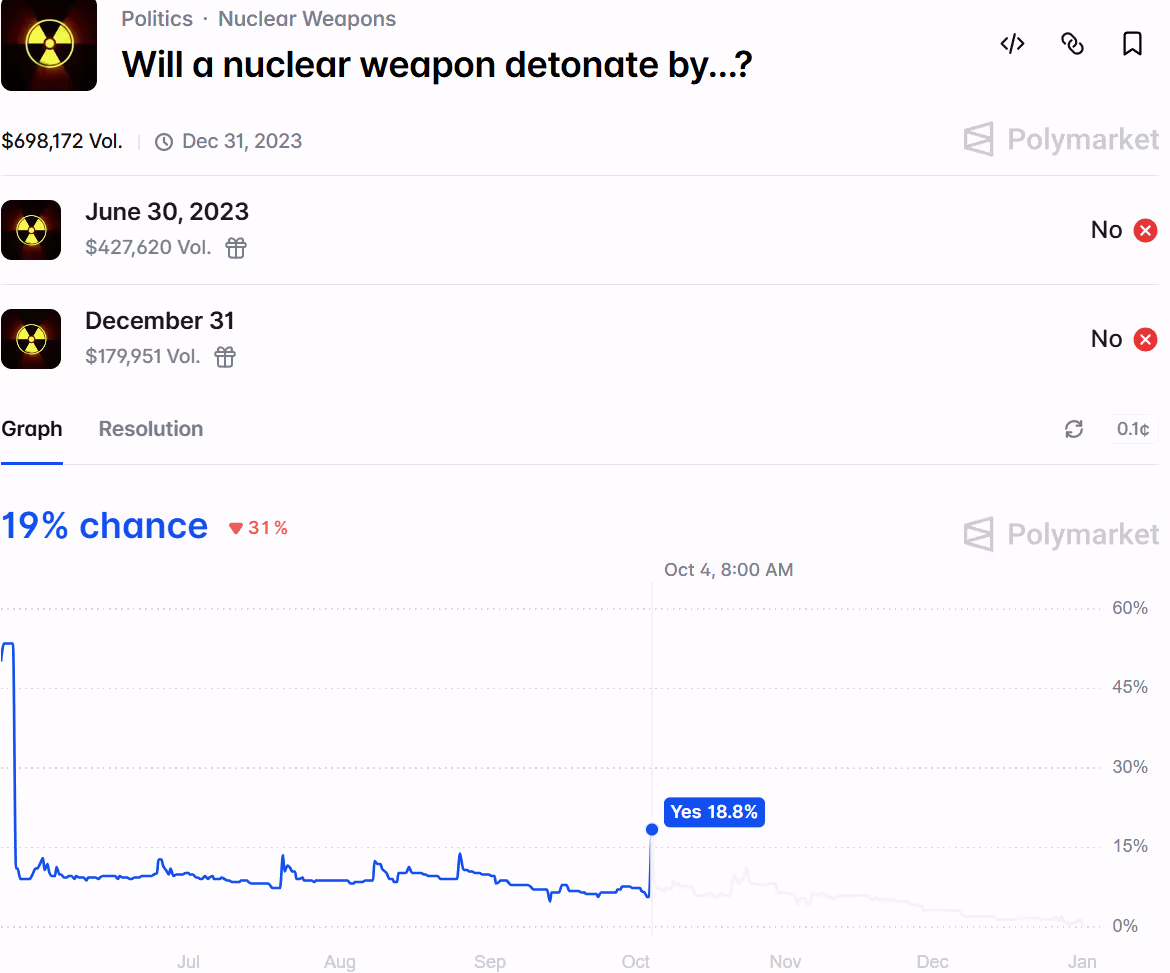
Bettors have long been able to speculate on the chance of a nuclear weapon detonating on Polymarket, but the current conflict with Iran – and scrutiny about insiders trading on war – has apparently caused the platform to remove the contracts.
Polymarket has created a market that would monetize a nuclear attack amid increasing concerns that bets are happening among government insiders who can make military decisions. pic.twitter.com/r1CbWaLWcw
— David Sirota (@davidsirota) March 3, 2026
The markets, which asked users to assign probabilities to whether a nuclear weapon would detonate by specific dates, have circulated on Polymarket for years and historically have resolved to “No.”
But renewed attention to the contracts comes as prediction markets face criticism after a trader reportedly made more than $400,000 betting on Venezuelan leader Nicolás Maduro’s ouster shortly before the U.S. operation that led to his capture, raising questions about whether insiders could exploit the platforms to trade on the outbreak of war – such as the start of this current conflict with Iran – and other military actions.
Historical trading suggests the contracts occasionally priced meaningful risk.
A Polymarket contract in 2023 at one point implied roughly a 19% chance that a nuclear weapon would detonate before the end of the year, according to platform data.

A later market expiring in June 2025 traded near 12%.
The markets also attracted significant trading activity. The 2025 contract alone recorded more than $1.7 Million in volume, while the 2023 version drew nearly $700,000 in wagers.
All this comes as U.S. regulators consider how to oversee prediction markets.
The Commodity Futures Trading Commission proposed rules in 2024 that would bar exchanges it regulates from listing event contracts tied to war, terrorism, assassination, or other activities deemed contrary to the public interest.
Chairman Mike Selig said the Commission plans to issue clearer guidance on prediction markets in the near future.

Australia could unlock 24 billion Australian dollars ($17 billion) annually from advances in tokenized markets and digital assets, but only if lawmakers move forward with regulation. A new study by the Digital Finance Cooperative Research Centre (DFCRC) outlines regulatory uncertainty, coordination hurdles, and a limited pathway for pilots as the primary constraints. The research argues that a well-designed sandbox for testing tokenized financial market use cases could catalyze ongoing collaboration between regulators and industry players, help refine licensing frameworks, and accelerate real-world adoption of tokenized rails for markets, payments, and collateral management.
Key takeaways
- The DFCRC projects up to A$24 billion in annual economic gains from tokenized markets and digital finance if regulatory frameworks are clear and supportive.
- A dedicated sandbox for testing tokenized financial market use cases is recommended to foster regulator–industry collaboration and to mature licensing for institutional participants.
- Tokenized instruments, including government bonds and CBDCs, could underpin the growth of tokenized markets, enabling more efficient collateralized lending, settlement, and cross-border payments.
- Without a more predictable regulatory regime, the projected gains could shrink significantly; the study cautions that gains depend heavily on the pace and scope of policy reform.
- The report notes the project was launched in collaboration with the Digital Economy Council of Australia and financed by OKX, highlighting industry interest and the potential role of private partners in advancing a regulatory-ahead regime.
Tickers mentioned:
Sentiment: Bearish
Market context: The findings reflect a broader global push toward regulated tokenized finance, with sandbox approaches and pilot programs shaping how markets, settlements, and collateral management could evolve as liquidity and interoperability improve across digital assets.
Why it matters
The Australia study frames tokenization not merely as a technology upgrade but as a foundational shift in how capital markets, payments, and asset ownership operate. By linking regulatory clarity with technical experimentation, the DFCRC argues that tokenized markets could unlock liquidity that today remains constrained by legacy infrastructures and custodial frictions. In practical terms, tokenization could widen investor access to a broader set of instruments, improve market depth, and facilitate faster settlement cycles—benefits that, in turn, could widen the pool of available capital and deepen secondary markets.
More specifically, tokenized money—encompassing stablecoins and central bank digital currencies (CBDCs)—could streamline cross-border and domestic transactions by diminishing reliance on traditional correspondent banking rails, which can carry high fees. The DFCRC notes that tokenized rails promise greater transparency, traceability, and resiliency, with smart contracts automating processes such as collateral management, margining, and settlement. In this vision, assets become not only more liquid but more programmable, enabling new forms of automated lending, repo arrangements, and invoice financing that could reduce transaction costs and expand financing options for businesses and institutions alike.
Crucially, the report emphasizes the distribution of gains across three core areas—collateralized lending, repo, and invoice financing—where tokenized rails could yield the most measurable improvements. In such ecosystems, smart contracts handle collateral evaluation, threshold triggers, and settlement on a continuous basis, reducing counterparty risk and improving capital efficiency. If regulators provide a clear, interoperable framework, these gains could translate into tangible improvements for the broader economy, from faster settlement times to lower financing costs for infrastructure projects and small-to-medium enterprises.
The authors acknowledge that projected gains are contingent on regulatory unfoldings. The report highlights that, absent substantial regulatory reform, Australia could see far more modest economic benefits. If the current trajectory persists, DFCRC estimates that crypto-related economic gains may plateau at around A$1 billion by 2030, well short of the aspirational A$24 billion. Kate Cooper, chief executive of the crypto exchange OKX, underscored this view, stressing that robust regulation is a prerequisite for material gains, as uncertain rules can choke investor confidence and slow the deployment of tokenized services. The media release accompanying the study reiterates that the most significant upside emerges from well-defined licenses and infrastructure built to institutional standards. For readers seeking the full economic analysis, the DFCRC Economic Impact Report is available here: https://dfcrc.s3.ap-southeast-2.amazonaws.com/260303_DFCRC_Economic+Impact+Report_V7_Single.pdf.
The discussion sits within a broader international context where policymakers are balancing innovation with consumer protection, market integrity, and systemic risk concerns. While Australia contemplates a regulatory path, the underlying message is consistent with global trends: for tokenized markets to scale, regulators and industry participants must co-create frameworks that reduce friction without sacrificing safeguards. The DFCRC’s partnership with the Digital Economy Council of Australia and its funding from OKX signal both a public and private appetite for experimentation—paired with a clear-eyed recognition that policy design will ultimately determine the speed and scale of adoption. The study’s emphasis on three pillar areas also resonates with other research suggesting that tokenized collateral and automated settlement can transform capital markets by unlocking liquidity and reducing operational risk.
As the authors point out, the estimated gains could be higher or lower depending on regulatory outcomes, and the direction of policy evolution will shape both the pace and the geographic footprint of any rollout. The report’s cautions aside, the proposed sandbox model offers a concrete pathway to de-risk experimentation, offer a platform for pilots, and create license-ready infrastructure that could invite institutional participants to participate in tokenized markets at scale. In the near term, observers will watch how regulators respond to proposals for pilot projects, licensing regimes, and pilot-friendly capital-raising mechanisms that could accelerate the transition from theory to practice in tokenized finance. The collaboration behind the report reflects a broader industry push for practical regulatory reform that can foster innovation while preserving market integrity.
References to the DFCRC and its associated documents appear in links within this article, including the economic impact report and related materials that discuss tokenization and CBDCs in the Australian context. The broader ecosystem benefits described by the DFCRC align with ongoing discussions about how tokenized assets could reshape payments, lending, and collateral management, underscoring the importance of clear, institutionally aligned frameworks as Australia contemplates the next era of digital finance.
What to watch next
- Regulatory progress in Australia: any new guidelines or licensing reforms that enable sandbox participation by banks and non-bank financial institutions.
- Launch of tokenized-government-bond pilots or wholesale securities pilots within a sandbox framework.
- Deployment and testing of CBDCs in controlled environments to support settlement, collateralization, and cross-border flows.
- Announcements of further collaborations between regulators, industry groups, and crypto firms to evolve licensing standards for institutional players.
Sources & verification
- Digital Finance Cooperative Research Centre Economic Impact Report PDF: https://dfcrc.s3.ap-southeast-2.amazonaws.com/260303_DFCRC_Economic+Impact+Report_V7_Single.pdf
- OKX media release on the DFCRC economic impact collaboration: https://dfcrc.com.au/wp-content/uploads/2026/03/Economic-impact-report-media-release-digital.pdf
- Tokenization explained overview: https://cointelegraph.com/explained/tokenization-explained
- CBDCs overview for beginners: https://cointelegraph.com/learn/articles/what-are-cbdcs-a-beginners-guide-to-central-bank-digital-currencies
- Stablecoins market cap and growth data: https://cointelegraph.com/news/stablecoins-300-billion-market-cap-47-growth-ytd
- Additional reference: Australian crypto industry perspectives and related policy discussions: https://cointelegraph.com/news/australia-crypto-adoption-regulation-smsf-growth-2026
Unlocking Australia’s $24 Billion Digital Finance Opportunity
The DFCRC’s analysis positions tokenization as a potential lever for widening participation in capital markets and for improving the efficiency of financial plumbing through programmable assets. A well-structured sandbox could serve as a bridge between high-level policy goals and the day-to-day realities of banks, fintechs, and asset managers exploring tokenized markets. By enabling controlled experiments with tokenized government bonds, collateralized lending, and cross-border settlement, Australia could build a scalable blueprint for modernizing its financial infrastructure while maintaining robust investor protections. The study emphasizes that gains are not just about faster settlements or better liquidity; they hinge on a broader regulatory architecture that supports innovation without compromising financial stability. If policymakers can align on licensing standards, interoperability, and risk controls, the country could position itself as a measured, forward-looking hub for digital finance at the regional level and beyond.
Crypto World
Bitcoin Nears Historic Sixth Red Month as Gold and Silver Shed $2.4 Trillion in a Single Day
TLDR:
- Bitcoin has recorded five straight monthly red candles in 2025, pushing sentiment to historically exhausted levels.
- Gold and silver erased $2.4 trillion in market value in one session after a parabolic rally through early 2025.
- Dollar strength overrode geopolitical fear, revealing gold as a macro trade rather than a pure crisis hedge.
- A strong Bitcoin monthly reversal could trigger sharp altcoin gains, especially in assets that held technical structure.
Bitcoin continues to face mounting pressure as traditional safe-haven assets experience a sharp reversal. Gold and silver together erased roughly $2.4 trillion in combined market value in a single trading session.
The selloff followed a parabolic rally that both metals staged earlier in 2025. Bitcoin, by contrast, has now recorded five consecutive monthly red candles throughout the year.
Dollar strength has become the dominant force shaping price action across both crypto and commodity markets.
Dollar Strength Exposes the Limits of Traditional Safe Havens
Gold and silver have long been considered reliable hedges during times of geopolitical uncertainty. However, recent price action across both metals tells a different story about their true nature.
Despite tensions involving Iran, global shipping disruptions, and persistent inflation talk, dollar strength overrode fear-driven demand for metals.
Gold climbed as much as 96% since the start of 2025, while silver surged approximately 191% over the same period.
Both assets had entered parabolic territory before the sharp correction ultimately took hold. The pullback effectively flushed excess leverage from an already overstretched market position.
One analyst on X wrote that dollar strength “overpowered fear,” arguing gold behaves more like a macro trade.
According to the post, gold remains tied to yields and the dollar, not a pure crisis hedge. The comment reflects how macro traders are reassessing the metal’s role in uncertain conditions.
Five Red Months Push Bitcoin Toward Historic Exhaustion
The digital asset has fallen approximately 27% since the start of 2025, even as metals posted strong gains. The nature of that decline, however, differs sharply from the selloff metals experienced this week. Rather than a sudden forced liquidation, the drop has resembled a slow and sustained liquidity drain.
Forced selling in overleveraged markets typically produces violent, sharp price drops within short timeframes. Bitcoin’s five-month slide has been more measured and gradual by comparison. That distinction carries weight when evaluating where the asset stands heading forward.
Bitcoin is now trading at historically stretched levels across multiple timeframes. Sentiment has been steadily drained throughout several months of consecutive losses. In effect, the asset has already completed the reset cycle that metals are only now beginning.
What a Reversal Could Mean for BTC and Altcoins
A strong monthly close for Bitcoin at current levels would carry considerable upside momentum. Historically, when a price breaks out after extended compression, the move tends to be sharp rather than gradual.
Altcoins that maintained structure during the prolonged bleed are best positioned to benefit from any rotation.
The same analyst noted that when Bitcoin moves aggressively after long compression, altcoins tend not to follow quietly. Instead, they often surge alongside the broader shift in market sentiment. Assets that held technical structure through the downturn are likely to see the largest moves.
Risk factors, however, remain present. If dollar strength continues building and equities weaken, Bitcoin will not escape the broader fallout. Oversold conditions build potential energy, but a macro catalyst is still needed to confirm a sustained reversal.

Digital Finance Could Deliver $17 Billion Annual Boost for Australia

Virgil van Dijk offers scathing assessment of Liverpool’s stoppage-time loss to Wolves

Today’s NYT Connections: Sports Edition Hints, Answers for March 4 #527

Smart energy pays enters the US market, targeting scalable financial infrastructure

Why Israel is blocking foreign journalists from entering

Bitcoin: We’re Entering The Most Dangerous Phase

Moneyview EMI Auto Debit Problem | Money View EMI Pay Problem | Money View EMI Auto Debit Failed

Jane Street accused of market manipulation in crypto, 10am BTC price dumps have stopped (for now)

ETFs vs. Stocks EXPLAINED In 30 Seconds #finance
-

 Politics5 days ago
ITV enters Gaza with IDF amid ongoing genocide
-

 Politics21 hours ago
Alan Cumming Brands Baftas Ceremony A ‘Triggering S**tshow’
-

 Fashion4 days ago
Weekend Open Thread: Iris Top
-

 Tech3 days ago
Unihertz’s Titan 2 Elite Arrives Just as Physical Keyboards Refuse to Fade Away
-

 NewsBeat6 days ago
Cuba says its forces have killed four on US-registered speedboat | World News
-
Sports4 days ago
The Vikings Need a Duck
-
 NewsBeat3 days ago
Dubai flights cancelled as Brit told airspace closed ’10 minutes after boarding’
-

 NewsBeat3 days ago
‘Significant’ damage to boarded-up Horden house after fire
-
 NewsBeat6 days ago
Manchester Central Mosque issues statement as it imposes new measures ‘with immediate effect’ after armed men enter
-
 NewsBeat4 days ago
The empty pub on busy Cambridge road that has been boarded up for years
-

 NewsBeat3 days ago
Abusive parents will now be treated like sex offenders and placed on a ‘child cruelty register’ | News UK
-

 Business6 days ago
Discord Pushes Implementation of Global Age Checks to Second Half of 2026
-

 Entertainment2 days ago
Baby Gear Guide: Strollers, Car Seats
-

 Business5 days ago
Only 4% of women globally reside in countries that offer almost complete legal equality
-
 Tech5 days ago
NASA Reveals Identity of Astronaut Who Suffered Medical Incident Aboard ISS
-
 NewsBeat3 days ago
Emirates confirms when flights will resume amid Dubai airport chaos
-
Politics3 days ago
FIFA hypocrisy after Israel murder over 400 Palestinian footballers
-

 Crypto World5 days ago
From Crypto Treasury to RWA: ETHZilla Retreats and Relaunches as Forum Markets on Nasdaq
-

 NewsBeat2 days ago
Is it acceptable to comment on the appearance of strangers in public? Readers discuss
-

 Tech3 days ago
Viral ad shows aged Musk, Altman, and Bezos using jobless humans to power AI