
Business
10 Surprising Facts About Zendaya, From Her Full Real Name to Turning Down a Major X-Men Movie Role



Zendaya has built one of Hollywood’s most closely watched careers over the past decade and a half, moving from Disney Channel star to Emmy-winning drama lead and franchise blockbuster fixture. Here are 10 facts about the actress that trace that path.
- Her full name is Zendaya Maree Stoermer Coleman, and “Zendaya” means “to give thanks” in the Shona language, according to IMDb. She has said the name reflects her mixed heritage, drawing on African American roots from her father’s side and German and Scottish ancestry from her mother’s side.
- Before acting, Zendaya worked as a child model for retailers including Macy’s, Old Navy and Mervyn’s, according to IMDb. She was also part of a hip-hop dance group as a child and appeared as a backup dancer in a Sears commercial alongside Selena Gomez, according to a summary of her career published by The Fact Site.
- Zendaya auditioned for the lead role in a school production of “James and the Giant Peach” but was instead cast in the nonspeaking role of the silkworm, according to The Fact Site. She was also held back a grade in kindergarten to work on her social skills, an experience she has said helped shape her later focus and discipline.
- She turned down the role of Storm in “X-Men: Apocalypse,” reportedly because she felt the part was not substantial enough, according to IMDb. The role ultimately went to actress Alexandra Shipp, who also replaced Zendaya in a separate 2014 Lifetime biopic about singer Aaliyah after Zendaya dropped out of that project over concerns about production quality and how the film was being handled.
- Zendaya became a vegetarian as a child after witnessing conditions inside a slaughterhouse, according to The Fact Site, and has maintained a largely plant-based diet for most of her life since. She has said she is not particularly fond of vegetables despite the dietary choice.
- She met her now-husband, actor Tom Holland, while filming “Spider-Man: Homecoming” in 2016. Though dating rumors began circulating as early as 2017, the couple did not publicly confirm their relationship until 2021, according to The Fact Site. Zendaya and Holland were married in 2026.
- At age 24, Zendaya became the youngest person ever to win the Primetime Emmy Award for Outstanding Lead Actress in a Drama Series, earning the honor for her role as Rue Bennett in HBO’s “Euphoria,” according to Kiddle’s summary of her career. She has since won the award a second time, becoming a two-time Emmy winner for the same role.
- Zendaya’s father, Kazembe Ajamu Coleman, has served as her manager throughout much of her career, according to a compilation of facts published by The Pop Tales. Her mother, Claire Stoermer, worked as a stage manager at a Bay Area theater during Zendaya’s childhood, an environment that helped introduce her to performing at a young age.
- In 2021, Zendaya became the youngest person ever to receive the CFDA’s Fashion Icon Award, recognizing her influence on the fashion industry, according to Mental Floss. She launched her first major fashion collaboration, a line with Tommy Hilfiger called Tommy X Zendaya, in 2019, and has said she deliberately used red carpet fashion earlier in her career to help establish herself as more than a Disney Channel actress. “I would show up to shit I had no business being at just so I could get the look,” she said in a 2021 interview cited by Mental Floss. “I was called a seat-filler for years… but I looked good though, so how about that.”
- Zendaya’s breakout role came as Rocky Blue on the Disney Channel series “Shake It Up,” which premiered in 2010 to 6.2 million viewers, one of the network’s most-watched premieres at the time, according to Kiddle. She went on to produce and star in a second Disney Channel series, “K.C. Undercover,” before transitioning into major film roles including Michelle “MJ” Jones in Marvel’s rebooted “Spider-Man” trilogy and Chani in the “Dune” film franchise.



First Principles Partners is an equity research analyst specializing in technology, innovation, and sustainability investment. My unique approach, “First Principles,” involves breaking down complex problems to their most basic elements in terms of financial and technology, enabling me to uncover overlooked investment opportunities.With a strong background in investment, private equity and venture capital, I have a proven track record of delivering strong returns for readers. Articles on Seeking Alpha focus on emerging technologies, sustainable investing, and the intersection of innovation and finance. I am passionate about sharing insights with a wider audience and learning from fellow investors. Together, we can drive positive change and contribute to a more sustainable and innovative world.
Analyst’s Disclosure: I/we have no stock, option or similar derivative position in any of the companies mentioned, and no plans to initiate any such positions within the next 72 hours. I wrote this article myself, and it expresses my own opinions. I am not receiving compensation for it (other than from Seeking Alpha). I have no business relationship with any company whose stock is mentioned in this article.
Seeking Alpha’s Disclosure: Past performance is no guarantee of future results. No recommendation or advice is being given as to whether any investment is suitable for a particular investor. Any views or opinions expressed above may not reflect those of Seeking Alpha as a whole. Seeking Alpha is not a licensed securities dealer, broker or US investment adviser or investment bank. Our analysts are third party authors that include both professional investors and individual investors who may not be licensed or certified by any institute or regulatory body.

Victoria Beckham’s fashion and beauty brand has turned a profit for the first time since it launched in 2008, a milestone delivered in spite of a challenging macroeconomic slump affecting global luxury goods.
Revenue at Victoria Beckham Holdings rose 15 per cent to £129.8 million in the year to the end of December, marking the fifth consecutive year of double-digit revenue growth. The company posted a pre-tax profit of £3.38 million, compared with a loss of £4.85 million the year before, while operating profit reached £7.3 million against an operating loss of £1.6 million in the previous year.
The company said on Monday that the improvement in its bottom line was driven by “disciplined cost control, stronger direct-to-consumer trading and an expanding international wholesale presence”.
Sybille Darricarrère Lunel, chief executive of Victoria Beckham, said: “Achieving our first operating profit is a landmark moment and reflects several years of disciplined execution and strategic investment.
“Delivering this result against a more challenging luxury market and macro backdrop makes it an even more significant milestone for the business.”
From £66m of losses into the black
Before its turnaround, the label of the former Spice Girl had accumulated more than £66 million in losses, relying on multimillion-pound cash injections from her husband David Beckham’s personal fortune. Accounts covering 2024 showed the Beckhams and the private equity firm Neo Investment Partners providing a £6.9 million injection, with £3 million meeting working capital needs at the fashion label and £3.9 million building inventory at Victoria Beckham Beauty.
The reasons behind the prolonged struggle were laid bare last year in a Netflix documentary, which revealed a corporate culture in which employees were afraid to tell Beckham “no”, allowing overhead expenses to run out of control.
When David Belhassen, the private equity investor who founded Neo, stepped in to audit the business, he uncovered striking examples of aesthetic perfection put before fiscal reality. The company was spending £70,000 a year on office plants simply because she loved them, while an external contractor was paid a further £15,000 a year just to water them.
Beckham admitted to high-end indulgences born of her entertainment background, such as flying luxury chairs from one side of the world to the other for the office space.
Two chief executives, two cities
The company recruited two new chief executives last year to lead the two sides of the business. Lunel joined as chief executive of the fashion business from Christian Dior Couture last July and is based in London, while Lauren Edelman was promoted from global chief marketing officer to chief executive of the beauty business last January and is based in New York.
The beauty business, launched in 2019, is reported to generate about two-thirds of group revenue. Fellow British beauty brand Charlotte Tilbury reported a £21 million pre-tax profit on sales of £539 million in newly filed accounts covering its own year to the end of December.
The wider luxury sector remains under pressure, however. Burberry is cutting up to 1,700 jobs in a global savings drive after a sharp downturn in the luxury market pushed the British fashion house to a £66 million pre-tax loss.

Amy Ingham
Amy Ingham is a reporter at Business Matters, covering UK business news with a focus on breaking news, business policy, late payments and insolvency. She joined the magazine in 2026 after completing the NCTJ Diploma in Journalism at Harlow College’s journalism school. Her recent reporting includes British Steel’s nationalisation and its impact on SME suppliers, the decline in late payments by large firms, and Insolvency Service director disqualifications. Reach her at aingham@cbmeg.co.uk.
Business
Resolute Mining Shares Rise 5 Percent as Analysts Call Gold Miner Undervalued After Profit Surge

Shares of Resolute Mining rose more than 5% Monday, extending a stretch of investor interest in the Perth-based gold producer following a set of half-year results that showed profit more than doubling on the back of surging gold prices.
The stock traded at 1.44 Australian dollars, up 0.07 dollars, or 5.11%, on the Australian Securities Exchange. Resolute, which operates the Syama gold mine in Mali and the Mako mine in Senegal while developing the Doropo project in Cote d’Ivoire, has drawn sustained attention from analysts and investors in the roughly two weeks since it reported its results for the six months ended June 30.
Resolute reported net profit after tax of 162.6 million dollars for the first half of 2026, up 129% from 71 million dollars in the same period a year earlier, according to a summary of the results published by Kalkine Media. Revenue rose 31% to 584.7 million dollars, driven primarily by a sharply higher average realized gold price of 4,712 dollars per ounce, compared with 3,076 dollars per ounce in the first half of 2025, even as overall gold production declined to 104,795 ounces from 151,460 ounces a year earlier. Earnings before interest, taxes, depreciation and amortization rose 42% to 323.9 million dollars, according to the same figures.
Resolute Chief Executive Officer Chris Eger described the results as reflecting the strength of the company’s underlying operations despite the production decline. “Resolute has delivered a strong first half of 2026, generating significant operating cash flow and ending the period with a net cash position of 317.4 million dollars,” Eger said, according to a company statement carried by TradingView News. “This performance was underpinned by continued strength in the gold price, disciplined cost management and the resilience of both Syama and Mako. During the period we continued to advance our key growth initiatives. At Doropo, the project progressed from final investment decision into active construction, with early works advancing and financing progressing.”
The lower production figures were tied to operational disruptions at the Syama mine, including a planned roaster shutdown, explosives supply interruptions and slower-than-expected mobilization in the mine’s A21 area, according to reporting from Discovery Alert. Those disruptions pushed the company’s all-in sustaining cost up sharply to 2,327 dollars per ounce, a 38% increase from 1,688 dollars per ounce in the first half of 2025, a rise the company attributed to a combination of higher royalty payments tied to elevated gold prices and reduced production volumes.
Resolute’s balance sheet strengthened considerably during the period. Net cash climbed 189% to 317.4 million dollars, up from roughly 109.9 million dollars a year earlier, while operating cash flow more than doubled to 277.6 million dollars. The company also received 31.9 million dollars from the sale of its stake in Loncor Gold and a further 53.9 million dollars from repayment of a vendor financing note tied to its earlier Ravenswood mine transaction, according to figures reported by Kalkine Media.
Beyond its existing operations, Resolute continued advancing its growth pipeline during the period. The company’s ABC Project in northwest Cote d’Ivoire saw its inferred mineral resource estimate grow to 3 million ounces of contained gold, up from 2.16 million ounces a year earlier, according to Stocklight. Resolute has also secured 155 million dollars in local bank financing in Cote d’Ivoire to support the Doropo project’s construction, with an additional 105 million dollars in financing expected to be secured during the third quarter of 2026.
Analysts have responded favorably to the results. According to Simply Wall St, Resolute’s stronger-than-expected profitability has prompted some analysts to argue the stock remains meaningfully undervalued, with certain fair-value estimates suggesting upside of as much as 59% from prior trading levels, even as the firm cautioned that funding requirements and regulatory risk in the company’s West African operating jurisdictions remain factors investors should continue to monitor closely.

Bitmine Immersion: A Better Way To Play The Crypto Bull Market
Claire Tyrrell speaks to Ella Loneragan about the risks and rewards of private credit within the property sector.
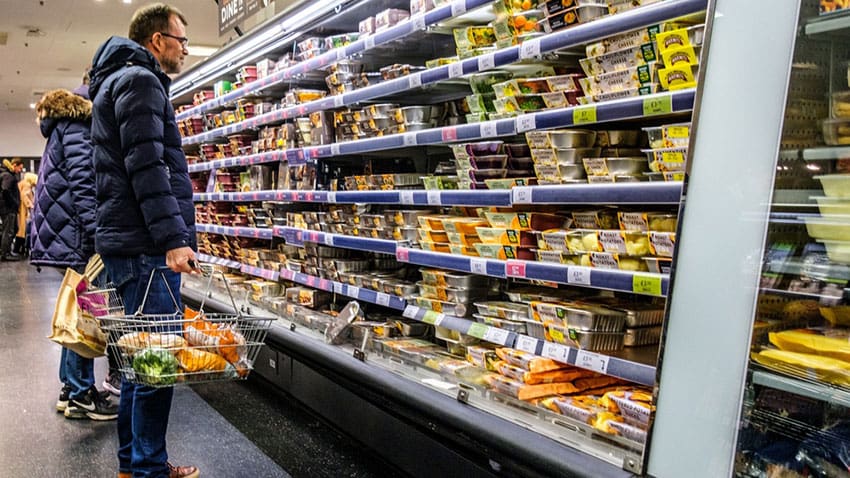
Shop price inflation climbed to its highest level in more than two years in August, as retailers began passing higher energy, input and commodity costs on to consumers.
Prices in UK shops rose by 1.5 per cent in the year to August, up sharply from 0.9 per cent in July, according to the latest BRC-NIQ Shop Price Monitor. That is the highest rate for more than two years, although it remains below the headline rate of consumer price inflation. The pace of increase has picked up markedly since shop price inflation slowed to 1.1 per cent in February, when retailers were still cutting prices to tempt cautious shoppers.
Helen Dickinson, chief executive of the British Retail Consortium, said: “The impact of higher energy, input and commodity costs is beginning to filter through into prices, particularly for ambient foods which are typically imported and processed. In non-food, electrical prices rose amid the ongoing AI boom, which is forcing up the price of memory chips and storage.”
The rise was particularly pronounced in non-food goods such as clothing and electrical items, where inflation accelerated to 0.9 per cent year on year in August, from 0.2 per cent in July. Food inflation also increased, rising to 2.8 per cent from 2.2 per cent.
Within food, there was a clear divergence between fresh and ambient products. Fresh food inflation eased slightly to 3 per cent in August, from 3.1 per cent in July, while inflation on ambient goods, the packaged and long-life products that fill the middle of the store, more than doubled to 2.5 per cent from 1.1 per cent. Chocolate, sweets, fizzy drinks and coffee recorded the steepest rises.
Mike Watkins, head of retailer and business insight at NIQ, said the acceleration in food and non-food inflation was not unexpected as some summer promotions came to an end. He added: “Retailers continue to keep prices low, helping consumers manage rising household costs such as energy and fuel. However, pressures are continuing to build across supply chains, and we can expect price competition to intensify as we move into the autumn months.”
The figures land against a backdrop of rising inflation across the wider economy. The Office for National Statistics reported that consumer price inflation rose to 2.9 per cent in July, up from 2.6 per cent in June, while the CPIH measure, which includes owner occupiers’ housing costs, increased to 3.1 per cent.
Energy is emerging as a particular source of renewed pressure. ONS figures showed inflation in housing and household services jumping to 4.1 per cent in July, from 2.7 per cent the previous month, driven largely by higher gas prices. Gas prices were 14.7 per cent higher than a year earlier, while electricity prices rose 3.6 per cent.
The squeeze is expected to intensify if energy costs stay elevated. The Centre for Economics and Business Research warned this week that the Middle East conflict was likely to strip £70.4 billion from UK households’ real spending power over the next two years, as higher energy prices fuel inflation and weaken wage growth. The consultancy estimated the war in Iran would leave household spending power £1,100 lower than previously expected in 2026 and £1,300 lower in 2027. Economists have separately warned that the conflict could knock £35 billion off UK output and push inflation back above 4 per cent.
For retailers, many of them small and mid-sized businesses already contending with higher wage bills and taxes, the combination of rising supply chain costs and renewed energy pressures threatens to make the autumn a difficult trading period. Dickinson warned that rising operating costs were limiting the industry’s ability to absorb further increases, echoing earlier warnings from retailers that tax rises in the autumn budget would push shop prices higher still.
“The months ahead look challenging for households, with rising bills putting further pressure on budgets,” she said. “Retailers are facing persistently high operating costs, limiting their ability to absorb further increases without impacting investment, jobs and prices. If the government is serious about supporting growth while keeping the cost of living in check, it must address the cost of doing business, including by tackling the growing burden of business rates, packaging and employment taxes.”

Jamie Young
Jamie Young is Senior Reporter at Business Matters, covering SME finance, employment law and Westminster policy since 2016. He has reported on every Budget and Autumn Statement since 2018, helped make sense of the ‘covid era’ and the bounce-back loan scheme from launch through the fraud investigations, and broke the magazine’s coverage of the 2024 late-payment reforms. He joined Business Matters straight from completing his BA in Administration from Exeter University and is NCTJ-qualified. Reach him at jyoung@cbmeg.co.uk

Consumer Protection is prepared to take enforcement action against now-collapsed Bella Modular if necessary after the modular home and granny flat builder collapsed.

SB Energy files for proposed IPO
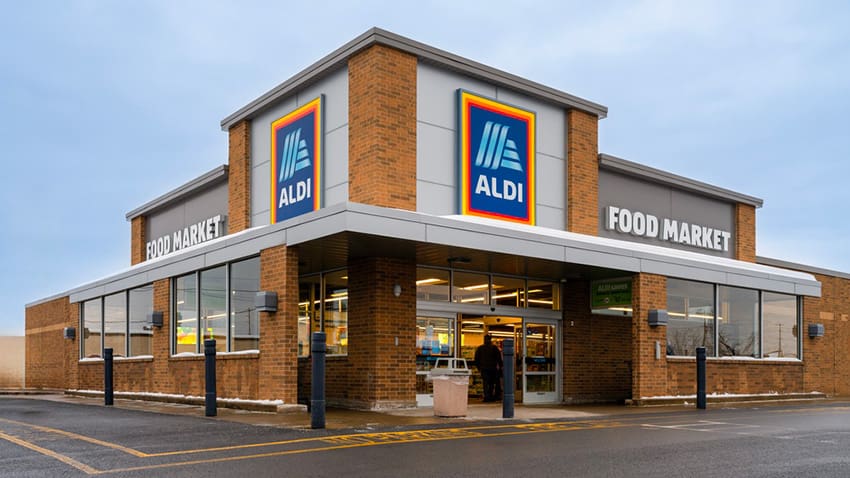
Aldi has been accused of desperation by senior retail figures after its UK chief executive attacked rival supermarkets’ loyalty schemes, just as industry data showed the discounter’s sales growth slowing sharply behind its competitors.
Giles Hurley, the chief executive of Aldi UK, used a piece in the Daily Mail last week to back the Government’s investigation into supermarket pricing, arguing that loyalty schemes offer shoppers a “false sense of value”. Shoppers, he said, were being bombarded with discounts that could make them believe they were getting a bargain when a rival supermarket was still cheaper.
“Taking £2 off a £6 product doesn’t make it good value if you can buy it for £3 somewhere else,” Hurley said.
The intervention went down badly across the industry. One senior retail adviser said Aldi was “completely talking their own book” by wading into the row over supermarket pricing, which is under investigation by the UK competition watchdog. “It was opportunistic, and in a way, perhaps a little bit desperate,” they said.
The timing is awkward for Aldi. Its sales rose by just 0.8 per cent in the 12 weeks to 8 August, according to NIQ, compared with 8.2 per cent at Lidl, 13 per cent at M&S, 17 per cent at Ocado and 3.6 per cent at Sainsbury’s. The slowdown is all the more significant because Aldi has continued opening new shops, with 40 more stores planned for 2026 as part of a £370 million expansion.
Clive Black, of Shore Capital, said the discounter was “protesting a bit too much”. He said: “The fact that customers are choosing to shop more at other retailers tells us something about Aldi, and it’s not just about price.”
Hurley, who joined the retailer nearly 30 years ago, took the top job in 2018 and oversaw the opening of Aldi’s 1,000th UK store in 2023. The company does not operate a loyalty scheme along the lines of Tesco’s Clubcard or Sainsbury’s Nectar Prices, and argues that shoppers should get its lowest prices without having to sign up, hand over their data or use a smartphone.
Its rivals, however, have become increasingly adept at copying its playbook. Tesco, Sainsbury’s and Morrisons are among those advertising “Aldi price match” products.
Aldi’s argument that shoppers are being duped also sits uneasily with the evidence gathered by the Competition and Markets Authority. The watchdog examined loyalty pricing across around 50,000 grocery products and found very little evidence that supermarkets were artificially inflating prices before applying discounts. Loyalty card members could “almost always” make a genuine saving against the normal price, it found, although some loyalty deals remained more expensive than the cheapest option elsewhere.
Black was equally dismissive. “British shoppers are not stupid,” he said, pointing out that Tesco and Sainsbury’s now compete with Aldi on hundreds of high volume products. “You can see that they’re growing more slowly than the big four, more slowly than Lidl,” he added.
The row comes at a significant moment for the discounters. The CMA has proposed extending the rules governing supermarket land agreements to Aldi and Lidl, arguing that their size and geographic reach mean they should now be treated like the established chains. Until now the discounters have had greater freedom to use restrictive agreements that can prevent rivals opening stores nearby, a freedom that has supported Aldi’s push to open new stores across the UK.
“I think they’re really feeling it, and the CMA ruling is a big thing for them actually, because until now they’ve had a lot of freedom,” Black said. “It’s a very significant moment in the development of the discounters here. It does have the potential to change the dynamics of the market.”
Aldi’s pricing strategy is also under renewed scrutiny from another direction. Earlier this year it cut the price of potatoes, carrots and parsnips to 4p, prompting fears that its cut price approach is offering shoppers unrealistic prices at the expense of British agriculture. Farmers are already under pressure from rising labour and input costs and increasingly unpredictable weather, and the Government’s Farming Profitability Review warned that farm input costs are expected to be 30 per cent higher this year than in 2020, calling for farmers to receive “a fair return for what they produce”.
Black believes supermarkets cannot compete endlessly to make food cheaper without eventually putting pressure on the people producing it. “To be devaluing fresh produce … giving a packet of carrots away for 8p when it costs £4.50 for a cup of coffee is just not helpful to the sustenance of the food system,” he said. “We need a food system from farm to fork that is financially sustainable. And I think that does involve paying more for food.”
Aldi rejects any suggestion that its low prices come at the expense of British farmers. It says it has committed £5 billion to British farming and food production through longer term agreements covering fruit, vegetables, dairy, meat and eggs, alongside £3 billion to British beef suppliers over five years and £1.1 billion to British egg production. The company says its model is based on efficiency rather than squeezing suppliers.
“Loyalty programmes are expensive to run and ultimately lead to higher prices,” an Aldi spokesman said. “We fundamentally believe that the best way to keep grocery bills low for customers is to keep things simple.”
Black, however, said the retailer should stop attacking its rivals. “When we saw Aldi effectively trying to badmouth competitors in a way that was encouraging politicians to get involved, I thought that was bad form,” he said.
Jamie Young
Jamie Young is Senior Reporter at Business Matters, covering SME finance, employment law and Westminster policy since 2016. He has reported on every Budget and Autumn Statement since 2018, helped make sense of the ‘covid era’ and the bounce-back loan scheme from launch through the fraud investigations, and broke the magazine’s coverage of the 2024 late-payment reforms. He joined Business Matters straight from completing his BA in Administration from Exeter University and is NCTJ-qualified. Reach him at jyoung@cbmeg.co.uk
Business
Shoprite Holdings Ltd 2026 Q4 – Results – Earnings Call Presentation (OTCMKTS:SRGHY) 2026-09-01


Seeking Alpha’s transcripts team is responsible for the development of all of our transcript-related projects. We currently publish thousands of quarterly earnings calls per quarter on our site and are continuing to grow and expand our coverage. The purpose of this profile is to allow us to share with our readers new transcript-related developments. Thanks, SA Transcripts Team

GOLDMAN SACHS JUST LIQUIDATED RIPPLE FROM XRP?!?!?! (ALL GONE?)
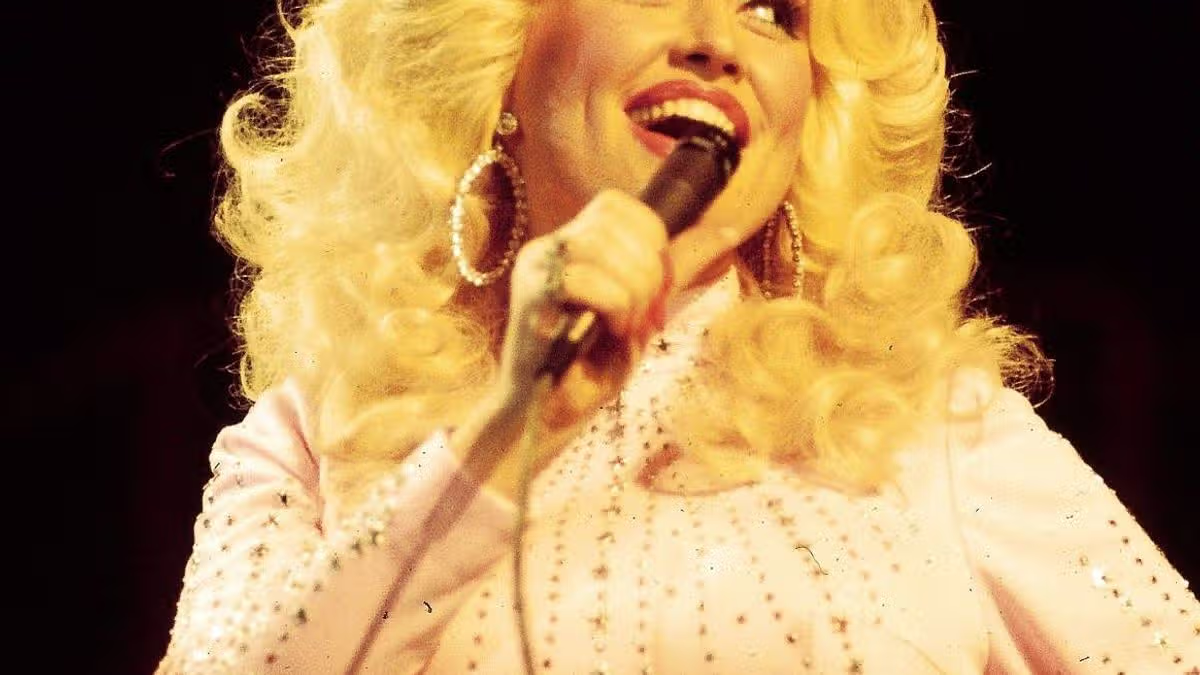
‘Masterpiece’ Dolly Parton comedy added to Netflix days after iconic singer’s death

JinkoSolar: Things Could Be Better From Here, But Market Hasn’t Priced It In (NYSE:JKS)





-

 Crypto World6 days ago
SpaceX stock could rise 75% to $240, JPMorgan says
-

 Fashion4 days ago
Weekend Open Thread: Maeve – Corporette.com
-

 Crypto World4 days ago
Bitcoin’s 22% rally now needs real demand to outlast Treasury liquidity boost
-

 Crypto World6 days ago
Warsh Jackson Hole keynote puts financial innovation first
-

 Business4 days ago
Salesforce Stock Soars 19% as Blowout Earnings and Agentforce AI Growth Silence Software Skeptics
-

 Crypto World5 days ago
Elon Musk Grok Bot Promise: We Will Make You Whole if AI Loses Your Money
-

 Business4 days ago
Apple Confirms September 9 Keynote and Reveals Its Full Pre-Order Schedule
-

 Crypto World6 days ago
Did Trump Just Move SpaceX Stock With One Truth Social Post?
-

 Business3 days ago
Onto Innovation Stock: AI’s Next Bottleneck Is Yield (NYSE:ONTO)
-

 Business6 days ago
Walmart takes aim at younger shoppers with new fashion brand
-
 NewsBeat6 days ago
Lindsay Clancy jury braces for closing arguments as judge tells court: ‘You’ve heard all the evidence’ – Live updates
-

 Crypto World3 days ago
Bitcoin price tests $82K resistance as Brandt stays long
-

 Crypto World5 days ago
NVIDIA revenue hits $96.2B as AI demand doubles
-

 Business6 days ago
Thailand’s Eastern Economic Corridor Capital City (EECiti): Key Developments and Investment Opportunities
-

 Business4 days ago
iPhone 18 Pro Pre-Orders Could Shift to Saturday as Apple Reportedly Avoids September 11 Anniversary
-
 Crypto World6 days ago
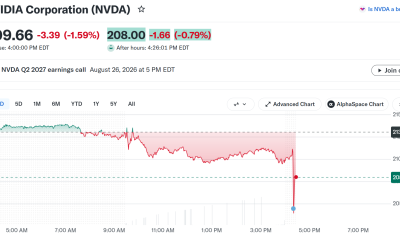
Nvidia Q2 Earnings Reveal $96.2 Billion Beat, So Why Is NVDA Falling?
-

 NewsBeat6 days ago
Trump’s trade truce with China faces test with Iran effort
-

 Tech5 days ago
Claude Cowork gets its own browser that doesn’t touch your tabs, bookmarks, or saved passwords
-
 Tech3 days ago
Hugging Face built a $4.5 billion empire on free AI models. Now Nvidia is buying it for $12.9 billion
-

 Crypto World4 days ago
Truflation calls for Fed rate cut after PCE forecast
You must be logged in to post a comment Login