Connect with us
DAPA Banner
DAPA Coin
DAPA
COIN PAYMENT ASSET
PRIVACY · BLOCKDAG · HOMOMORPHIC ENCRYPTION · RUST
ElGamal Encrypted MINE DAPA
🚫 GENESIS SOLD OUT
DAPAPAY COMING

Business

48 Small Business AI Adoption Statistics for 2026 (And Why They Don’t All Agree)

Published

on

48 Small Business AI Adoption Statistics for 2026 (And Why They Don't All Agree)

Last updated: July 2026

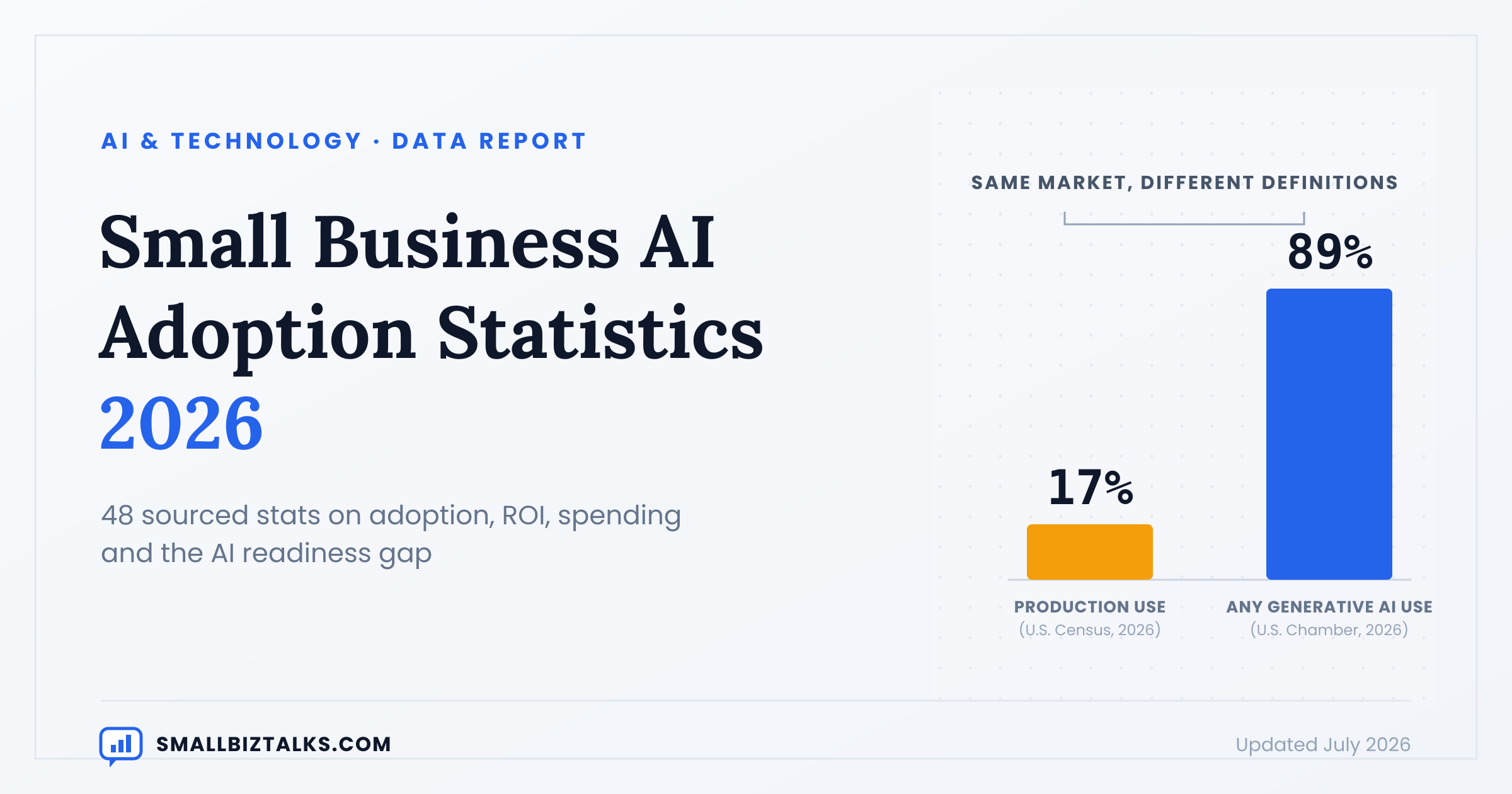
Ask five different sources what percentage of small businesses use AI, and you’ll get five different answers, anywhere from single digits to nearly 90%. That’s not sloppy research. It’s five surveys measuring five different things, and almost nobody bothers to say so before quoting the number that sounds best.

So before we get to the data: every stat below is dated and sourced, and where two credible reports disagree, we’ve said so rather than pretending there’s one clean number. If you’re trying to figure out where your business actually stands relative to your peers, that distinction matters more than the headline percentage.

The Short Answer

  • Somewhere between 17% and 20% of small businesses are using AI in actual production operations, per U.S. Census Bureau data from May 2026.
  • Somewhere between 58% and 89%, depending on the survey, have used a generative AI tool like ChatGPT for at least one task.
  • 91% of the businesses that do use AI report a revenue increase — but only 14% have fully integrated it into core operations.

Both of those things are true at once. That’s the story this page tells.

How Many Small Businesses Actually Use AI in 2026?

The gap between “AI adoption” headlines usually comes down to definition:

Advertisement
  • The U.S. Census Bureau’s Business Trends and Outlook Survey (BTOS) asks whether a business uses AI to produce its goods or services — a strict, production-level bar. By that measure, adoption sat in the high single digits as recently as 2023 and had climbed to roughly 17–20% by May 2026.
  • The JPMorgan Chase Institute, using transaction-based data rather than self-reporting, found the small business AI adopter base expanded from 5.2% in 2023 to 17.7% by the end of 2025 — a figure that lines up closely with the Census numbers.
  • Broader surveys that ask about any generative AI use — drafting an email with ChatGPT counts — report far higher numbers. Thryv’s April 2026 survey of 561 small business owners found AI adoption at 66%, up from 55% a year earlier.
  • The U.S. Chamber of Commerce’s 2026 Small Business Survey put generative AI use at 89%, up from 36% in 2023. An earlier 2025 wave of Chamber data had already shown a climb from 23% (2023) to 58% (2025) — consistent with the trajectory, if not the exact figure, reported a year later.

The practical takeaway: if you’re citing an adoption rate, cite the definition along with it. “58% of small businesses use AI” and “18% of small businesses use AI in production” can both be accurate descriptions of the same market.

What Are Small Businesses Actually Using AI For?

  • 41% of small businesses use AI for marketing and content creation — the single most common use case (HubSpot State of Marketing, 2025).
  • 29% use it for customer service, including chatbots and automated ticket routing (Salesforce Small Business Trends, 2025).
  • 24% use it for data analysis and business intelligence, including sales forecasting and inventory optimization (Deloitte Small Business Survey, 2025).
  • Among businesses already using AI, the 2026 NFIB survey found marketing content creation the top use case at 68% — a higher share than the HubSpot figure above, another reminder that survey population and phrasing move these numbers.
  • 42% of small businesses use generative AI chatbots specifically, though state-level adoption ranges from 13% to 71% (U.S. Chamber of Commerce, 2025).

Among the AI tools small businesses adopt, category-specific usage breaks down as:

  • 24% use AI accounting tools such as QuickBooks AI or Xero (Intuit, 2025).
  • 19% use AI customer service tools such as Zendesk AI or Intercom Fin (Zendesk, 2026).
  • 14% use AI design tools such as Canva Magic or Midjourney (Canva, 2025).
  • 11% use AI coding or development tools such as GitHub Copilot (GitHub, 2025).

Is AI Actually Paying Off for Small Businesses?

  • 91% of small businesses using AI report a measurable revenue increase (Salesforce, 2025).
  • 90% say AI has made their operations more efficient (Salesforce, 2025).
  • Small businesses using AI are 2.3x more likely to report revenue growth than those that don’t (U.S. Chamber of Commerce, 2026).
  • 70% of Thryv survey respondents said AI contributed to increased revenue over the past 12 months.
  • 92% of AI users in the same survey said the technology saves them time, with 79% expecting to reclaim between 11 and 60 hours per month.
  • 61% estimate AI will save their business between $500 and $2,000 per month (Thryv, April 2026).
  • The average small business saves 5.6 hours per week using AI tools; owners and managers specifically save more than 7 hours per week (Business.com, 2026).
  • In a Goldman Sachs survey of 1,256 small business owners conducted with Babson College and David Binder Research (January–February 2026), 93% reported a positive business impact from AI but only 14% said they’d fully integrated it into core operations.

That last gap — strong reported impact, low structural integration — shows up again and again in the barrier data below.

What’s Actually Holding Small Businesses Back?

  • 77% of small businesses that haven’t adopted AI say they see no applicable use case for their business (SBA Office of Advocacy, 2025). Among businesses with fewer than five employees specifically, that figure rises to 82%.
  • 45% of small business AI users cite a lack of technical expertise as a challenge, and 47% say it’s difficult to choose the right tools (Goldman Sachs, 2026).
  • 70% of small business owners say they need more, or significantly more, training to use AI productively (Thryv, April 2026) — despite 86% describing themselves as comfortable to extremely comfortable using it.
  • 77% of small businesses using AI have no formal prompting strategy or system in place (Aufsite Research, 2026).
  • Only 23% of small businesses using AI have received any formal training on the tools they’re using.
  • Roughly 77% of small businesses using AI have no written AI policy, leaving them exposed to data leaks and unchecked AI-generated output in client-facing work.

How Much Are Small Businesses Spending on AI?

  • 53% of small businesses now spend at least $100 per month on AI tools (Thryv, April 2026).
  • Median AI spending per firm actually peaked around $80 per month in 2022 and had fallen to roughly $30 per month by 2025 (JPMorgan Chase Institute) not because established users are spending less, but because the pool of new, lower-spending adopters using $20–$30/month entry-tier tools has grown so fast it pulls the average down.
  • That entry-level tier now makes up roughly 63% of the small business AI user base, up sharply since 2022, while the highest-spending tier has shrunk to about 16%.
  • The overall small business AI adopter base more than tripled between 2023 and 2025 (JPMorgan Chase Institute, 2026).

Which Businesses Are Leading — and Which Are Lagging?

  • Adoption follows a U-shaped curve by firm size: the very smallest businesses, those with fewer than five employees, actually over-index on AI use compared to mid-sized small businesses (U.S. Census Bureau / SBA, 2025). For a solo operator, AI functions less like a tool and more like a first hire.
  • By industry: 36% of small real estate businesses use AI (National Association of Realtors, 2025), 33% of small education and training businesses (National Center for Education Statistics, 2025), and 31% of small construction businesses — the lowest adoption rate of any major sector, largely due to field-based, low-digital-maturity work (Associated General Contractors, 2025).
  • The gap between large-enterprise and small-business AI adoption has narrowed from roughly 1.8x to 1.2x over the course of 2025, with the smallest firms actually over-indexing on certain use cases like marketing automation (SBA Office of Advocacy, 2025).

Where Is This Headed?

  • New businesses founded in 2025 reached 10% AI adoption within just six months — compared to 77 months for businesses founded in 2019. That’s roughly a 13-fold acceleration in how quickly new companies fold AI into operations (JPMorgan Chase Institute, 2026).
  • The OECD projects a 19.34% compound annual growth rate for SME AI adoption through 2031.
  • Gartner projects that 60% of commercial research queries will be AI-assisted by the end of 2026 — a shift that affects how small businesses need to think about discoverability, not just tool adoption.
  • 96% of small business owners say they plan to adopt emerging technologies including AI (U.S. Chamber of Commerce, 2026).
  • 71% plan to increase their AI investment over the next year (Salesforce, 2025), and 53% of small businesses not yet using AI say they’re considering it (Intuit QuickBooks, 2025).

The holdouts are shrinking. The gap that matters in 2026 isn’t between businesses that use AI and businesses that don’t, it’s between the ones treating it as a free-tier experiment and the ones actually building it into how they operate.

Sources

Methodology note: figures above are drawn directly from primary research reports rather than from other roundups, and each stat is dated to its source’s survey period. Where two reputable sources report different numbers for what appears to be the same question, both are presented rather than collapsed into a single figure.

Continue Reading
Click to comment

You must be logged in to post a comment Login

Leave a Reply

Business

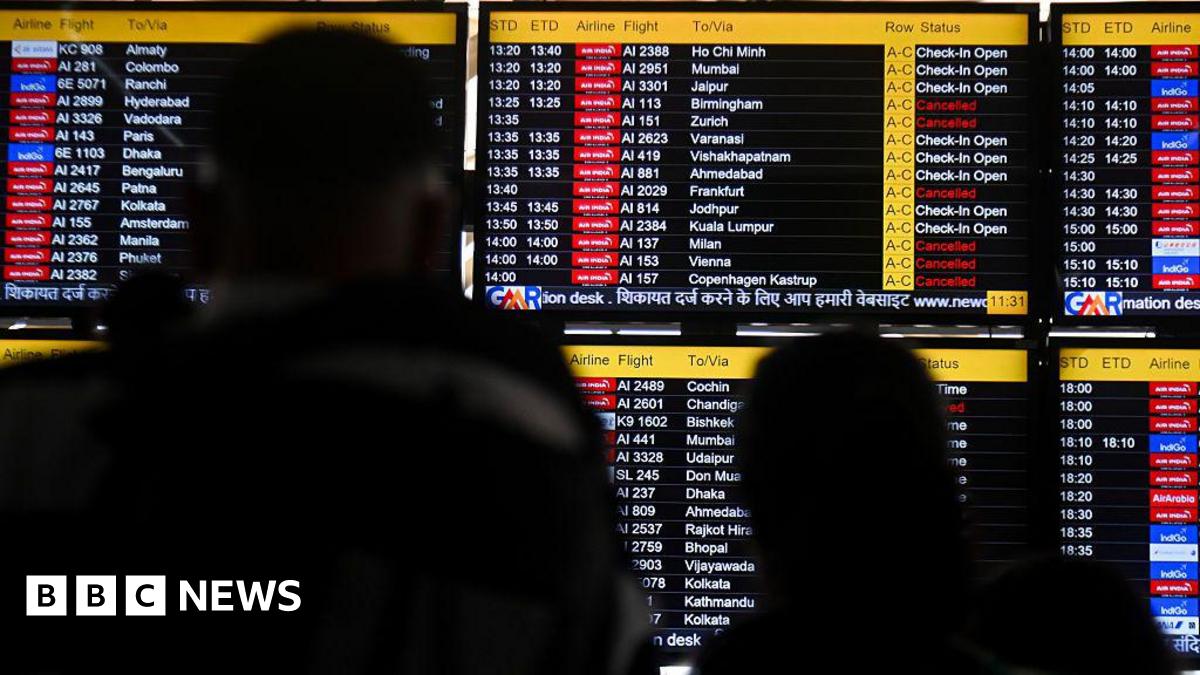
What are my rights if my flight is cancelled or delayed?

Published

on

Artwork depicting an armour-suited character patrolling through a post-apocalyptic desert scene, with a German shepherd trotting alongside them. A dramatic sunset fills the landscape behind them, which is dotted with the ruins of buildings.

When flights are delayed or cancelled, UK and EU airlines, and other carriers when you are departing a UK or EU airport, have a duty to look after you.

That includes providing meals and accommodation, if necessary, and getting you to your destination. The airline should organise putting you on an alternative flight, at no extra cost.

Additional losses, such as unused accommodation, might require a claim to a credit card provider, if that was the payment option used.

After that, a claim may need to go to your travel insurance provider. But there is no standard definition of what is covered.

Advertisement

It may require a close look at the details of the policy to see what is covered, in which circumstances.

Passengers are also being urged to heed travel advice from the UK government, external, as this can also affect travel insurance rights.

Continue Reading

Business

Bristol more expensive than Paris or Sydney to build in

Published

on

Business Live

The South West city has been ranked among the priciest in the world for construction

Scenic view of colourful houses on a hillside in Bristol

Scenic view of colourful houses on a hillside in Bristol(Image: © Boys in Bristol Photography)

Bristol is among the top 10 most expensive places in the world to build in, according to a new report. The South West city ranked ninth on the International Construction Cost Index, above Los Angeles, Paris and Sydney.

The findings, which were compiled by design consultancy Arcadis, compared construction costs across 100 major cities around the globe.

Geneva, in Switzerland, took the top spot followed by London, Zurich, Munich and Copenhagen.

The index found the world’s highest-cost construction markets remain concentrated in mature cities with deep demand and constrained delivery capacity.

Advertisement

While Arcadis said the top of the ranking remained “broadly consistent”, the wider market context is understood to have shifted. Global construction markets are moving from inflation-led uncertainty into a more selective phase of investment, where capital is being deployed more carefully rather than demand simply slowing.

Edel Christie, global president of places at Arcadis, said: “The need to build has not gone away. Cities still need homes, infrastructure, resilient energy systems, modern workplaces and digital infrastructure to support the next generation of economic growth.

“The opportunity is clear, but investment will flow to places and programmes where delivery is credible, viable and achievable — not just cheap to build.”

The report found that many developers are increasingly favouring complex, high-performing assets that support long-term growth such as modern workplaces, healthcare facilities, laboratories, data centres and advanced manufacturing plants.

Advertisement

Ms Christie said one area where demand was “abundant” and where the construction sector was “rising to the delivery challenge” was in data centres.

“The spectacular growth of the wider data centre ecosystem has created a critical scaling challenge for the construction sector: the ability to deploy huge project teams quickly while maintaining detailed control over scope, quality, schedule and risk,” she said.

The Arcadis report also highlighted the breadth of cost variation across global construction markets. While high-cost locations are concentrated in Europe, the UK and North America, some of the lowest-cost locations were found across Asia, Africa and Latin America.

Bengaluru ranked as the least expensive city in the index, followed by Buenos Aires, Delhi, Mumbai and Ho Chi Minh City.

Advertisement

10 most expensive cities in world for construction

1. Geneva

2. London

3. Switzerland

4. Munich

Advertisement

5. Copenhagen

6. New York

7. San Francisco

8. Dublin

Advertisement

9. Bristol

10. Philadelphia

Continue Reading

Business

Axfood drops 13% after Q2 miss as Willys disappoints for second quarter

Published

on


Axfood drops 13% after Q2 miss as Willys disappoints for second quarter

Continue Reading

Business

Sunrise Energy Metals Stock Jumps 13% to $16.82 as Blistering Yearlong Scandium Rally Continues Strong

Published

on

Sunrise Energy Metals Stock Jumps 13% to $16.82 as Blistering

SYDNEY — Shares of Sunrise Energy Metals surged 13.34% on Wednesday to close at $16.82, gaining $1.98 on the day and extending one of the most dramatic rallies on the Australian Securities Exchange, as investor enthusiasm for the company’s scandium project in New South Wales continued to drive intense buying activity.

The Melbourne-based mineral exploration company, formerly known as Clean TeQ Holdings before rebranding in March 2021, has emerged as the flagship Western play in the global scandium market, a niche but strategically significant metal used in aerospace, defense and clean energy applications. The stock’s latest surge builds on a rally that has seen shares climb from levels below 30 cents in early 2025 to well above $16 today, a gain exceeding 3,000% over roughly the past year.

The Syerston Project at the Center of the Story

At the heart of Sunrise’s remarkable ascent is its Syerston Project in New South Wales, which the company is developing into what would become the largest primary scandium operation outside China. The project’s significance has grown alongside intensifying global competition over critical mineral supply chains, particularly as China has moved to tighten export restrictions on scandium, a metal it currently controls an estimated 80% to 85% of global supply for.

Advertisement

Company materials have emphasized scandium’s applications across a range of high-specification uses, including defense and aerospace alloys, hypersonic technology, missile systems, shipbuilding and solid-oxide fuel cells, some of which support energy-intensive data centers used in artificial intelligence infrastructure.

A Landmark Deal With Lockheed Martin

A significant catalyst behind the stock’s re-rating came when Sunrise secured a multi-year supply agreement with Lockheed Martin, one of the world’s largest defense contractors. Under the arrangement, Lockheed holds an option to purchase up to 15 tonnes of scandium oxide over five years from the Syerston project, representing roughly 25% of the operation’s forecast Phase 1 production.

The agreement marked a significant validation for a company that had previously struggled to attract top-tier offtake partners, demonstrating both the project’s technical viability and genuine commercial demand for its output from a major aerospace and defense supplier.

Advertisement

CEO Sees Role in US Strategic Stockpile

Sunrise Energy Metals CEO Sam Riggall has publicly stated that the company expects to contribute scandium supply to the United States’ critical minerals stockpile, positioning Sunrise within broader U.S. industrial policy and defense supply-chain objectives as Washington works to diversify away from Chinese-dominated mineral markets.

That positioning has become central to the market’s valuation of the company, with investors increasingly treating the Syerston project as strategic infrastructure rather than a conventional speculative mining play, a framing that has helped cushion the stock against some of the volatility typically associated with pre-revenue resource companies.

Additional Government and Financial Backing

Advertisement

Sunrise has also drawn interest from U.S. government financing channels. The company received a letter of interest from the Export-Import Bank of the United States for up to $67 million, or roughly 103 million Australian dollars, in debt financing support for the Syerston project, further reinforcing the strategic significance being placed on the operation by policymakers seeking to secure non-Chinese sources of critical minerals.

The company is backed in part by Canadian mining entrepreneur Robert Friedland, whose involvement has added additional credibility among institutional and retail investors closely tracking the critical minerals sector.

A Resource Base That Keeps Growing

Sunrise’s project economics have continued to improve alongside its exploration results. A mineral resource estimate revision in September 2025 roughly doubled the contained scandium metal identified at Syerston, reinforcing the project’s potential to support multi-decade supply commitments to strategic partners. The company has since moved from the study phase into early construction activity, awarding engineering contracts earlier this year as it works to advance the project toward production.

Advertisement

A feasibility study previously pegged life-of-mine direct site cash costs at roughly $530 to $540 per kilogram of scandium oxide, positioning Syerston at the lower end of the global cost curve and suggesting the project could offer Sunrise meaningful pricing power in a market where transparency remains limited and supply is tightly controlled by a small number of producers.

A Stock That Has Captured Retail Attention

Sunrise’s dramatic share price trajectory has made it a frequently discussed name within retail investing communities, with online forums repeatedly highlighting the stock’s outsized gains as a case study for other critical minerals equities. The broader rare earths and critical minerals sector has benefited from improving sentiment throughout 2026, supported by continued demand tied to electric vehicles, renewable energy infrastructure and heightened geopolitical concern over supply chain security.

Risks Remain Despite the Rally

Advertisement

Despite the extraordinary run, analysts have cautioned that Sunrise remains a pre-revenue company, meaning its current valuation continues to rest heavily on the successful execution of its development plans rather than established cash flow. The stock has also experienced sharp pullbacks at points over the past year, including notable declines in late February, underscoring the volatility that continues to accompany its rapid ascent.

With a market capitalization that has climbed into the billions of Australian dollars, the margin for error has narrowed considerably even as bullish sentiment persists. Whether Sunrise can successfully convert its scandium narrative into consistent operational output, and whether global demand for the metal ultimately matches current market expectations, will likely determine whether Wednesday’s gains represent another step in a sustainable long-term growth story or a further extension of a speculative run that has already defied expectations for more than a year.

Continue Reading

Business

HDFC Bank, SBI, other stocks jump up to 2%; Nifty Bank gains 560 points. What lies ahead?

Published

on

HDFC Bank, SBI, other stocks jump up to 2%; Nifty Bank gains 560 points. What lies ahead?
The shares of banks, including heavyweights HDFC Bank, State Bank of India (SBI), IndusInd Bank and others, rose up to 2% on Wednesday, pushing the Nifty Bank index around 1% up as financial stocks led gains on Dalal Street.

The Nifty Bank index gained around 561 points to trade at 58,023, as seen at 12.40 pm. State Bank of India (SBI) shares were the top gainers, rising around 2%. Union Bank of India, Punjab National Bank (PNB), Canara Bank, HDFC Bank and Bank of Baroda rose more than 1% each.

IDFC First Bank, ICICI Bank and AU Small Finance Bank shares gained nearly 1% each, while Yes Bank, Axis Bank, Federal Bank and Kotak Mahindra Bank shares were trading in the green with marginal gains.

“Improving balance sheets, better liquidity conditions, stable interest rates and moderating credit costs are expected to support stronger growth and mark the beginning of a broad-based earnings upside for the financials sector,” said Siddhartha Khemka, head of research of wealth management at Motilal Financial Services.

Advertisement

Q1 earnings showdown on Saturday

The sharp rise in the shares of the Indian lenders ahead of crucial Q1 earnings announcements scheduled for Saturday. As many as five heavyweight private banks, including HDFC Bank, Axis Bank, Kotak Mahindra Bank, ICICI Bank and Yes Bank, are all set to announce their results for the April-June quarter of the ongoing financial year 2027 on Saturday (July 18).

Nomura, in its note, said that it expected banks under its coverage to report modest core-PPOP growth, led by soft NII growth and controlled opex, while seasonally higher credit costs keep PAT growth muted. It named ICICI Bank, HDFC Bank and Kotak Mahindra Bank as its top picks.
The international brokerage said that reported loan growth has been strong for HDFC Bank and Yes Bank, but soft for Axis Bank and Kotak Mahindra Bank. For ICICI Bank, Nomura expects loan growth to be strong. However, it overall expects net interest margins will moderate for the lenders.
“We expect Q1 FY27 to be another steady quarter with negative surprise, if any, coming from possible NIM contraction. Provisional numbers suggest solid performance on loan growth across banks (large/mid, public/private/SFB). Asset quality is holding up well across banks and products, with no discernible impact from the current crisis in the Middle East. We prefer frontline banks to others looking at the current macro set-up, which could see NIM pressures abating from here on,” said Kotak Institutional Equities.
Also read | Q1 Showdown: Analysts pick top bets as ICICI Bank, HDFC, Axis, Kotak, Yes Bank gear up for results this week

Motilal Oswal Financial Services, meanwhile, said that its channel checks signal a strong MSME credit demand in the April-June quarter of the ongoing FY27, with an increase in the working capital cycle. Private banks’ share is higher among higher ticket sizes, while public sector banks are gaining incremental market share with competitive pricing and CGTMSE-backed lending, the domestic brokerage added.

Technical view on Nifty Bank

Vatsal Bhuva, Technical Analyst at LKP Securities, expected the Nifty Bank index to find support in the 56,800–56,900 zone, while immediate resistance was seen around 58,200.

On the upside, 58,700 (June’s high) remains the immediate hurdle, according to Bajaj Broking. “A decisive close above this level would confirm a breakout from the ongoing consolidation and could trigger the next leg of the rally towards 59,300 and eventually 60,000 levels in the coming weeks,” it added.

Advertisement

Also read | Explained: Why is stock market rising today even as Iran-US war escalates, oil prices cross $85

(Disclaimer: Recommendations, suggestions, views and opinions given by the experts are their own. These do not represent the views of The Economic Times)

Continue Reading

Business

We Love To Hate Trimmed-Mean Inflation – Canada’s Tale About Introducing New Core Measures

Published

on

We Love To Hate Trimmed-Mean Inflation - Canada’s Tale About Introducing New Core Measures

close up high angle Asian businesswoman working with her coworker in meeting room

Edwin Tan /E+ via Getty Images

Trimmed-mean inflation measure and its sibling median inflation gauge have both gotten unprecedented attention in recent months. It is all owing to new Federal Reserve chairman Kevin Warsh.

In his Senate Banking Committee

Advertisement
Continue Reading

Business

WA truckers, farmers raise concern over proposed trailer safety device

Published

on

WA truckers, farmers raise concern over proposed trailer safety device

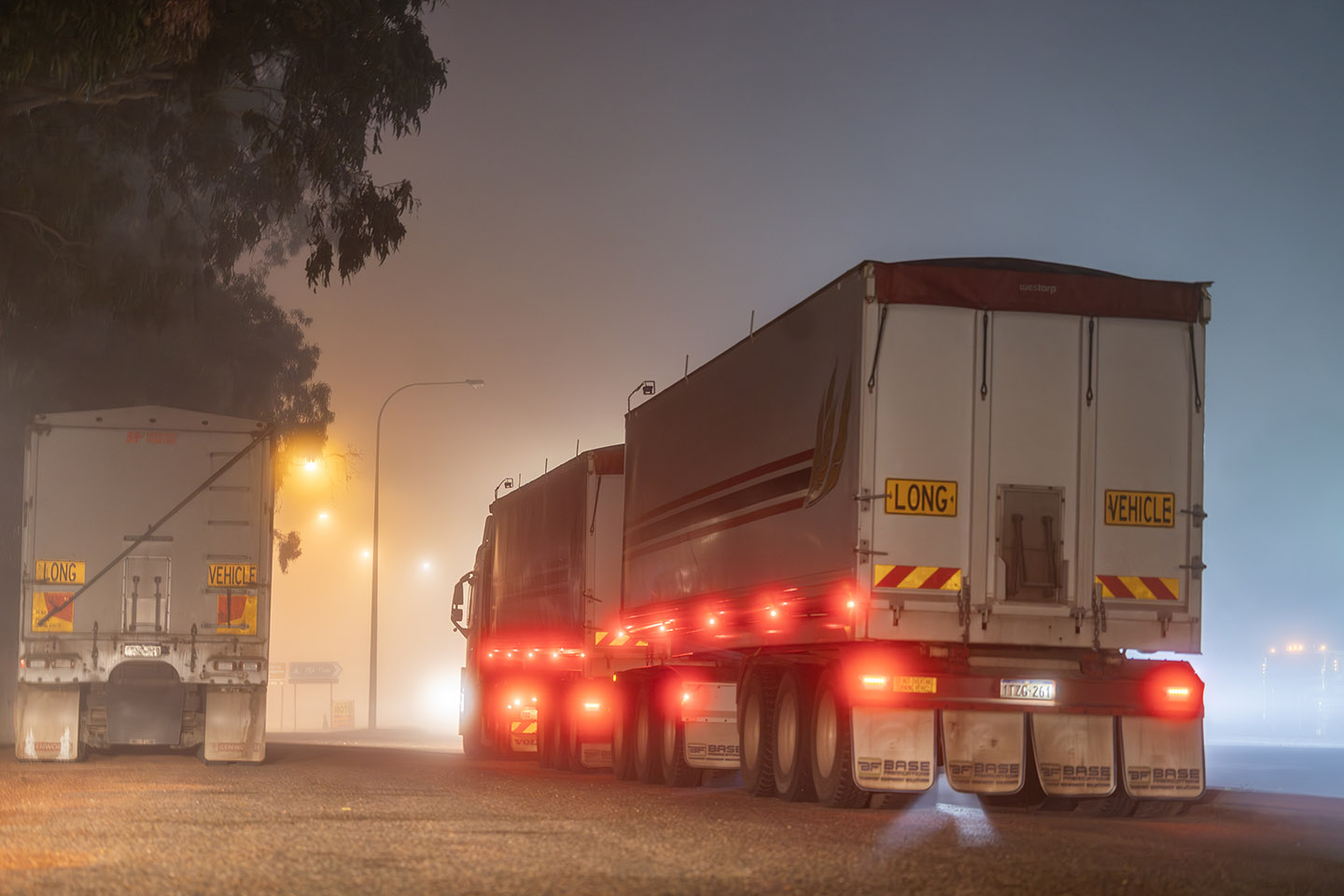
WA’s trucking and agricultural sectors argue the proposed mandating of a new safety device is misguided, instead calling for better driver training and design regulations.

Continue Reading

Business

BHP leads Australian shares higher as retail sells off

Published

on

BHP leads Australian shares higher as retail sells off

Australia’s share market has pared early gains for a modest advance, despite BHP counterbalancing an underwhelming day for the bourse.

Continue Reading

Business

Air France-KLM: A Stronger Q2 Is Not Enough To Change The Equity Story

Published

on

Air France-KLM: A Stronger Q2 Is Not Enough To Change The Equity Story

Air France-KLM: A Stronger Q2 Is Not Enough To Change The Equity Story

Continue Reading

Business

Melco Resorts & Entertainment: The Worst Is Behind Us

Published

on

Melco Resorts & Entertainment: The Worst Is Behind Us

Melco Resorts & Entertainment: The Worst Is Behind Us

Continue Reading

Trending

Copyright © 2025